

Introduction
Mobility is much more than migration between locations. It is also about bridging physical and temporal gaps while forging new relationships. For newcomers in an area such gaps may be experienced as painful voids or ruptures, especially when relocations have been involuntary or even forced. For people uprooted and marginalized by a state or a state-like dominant polity, and with scarce economic and material resources available, the ruptures compel resistance while once-possible futures must be reimagined. At the same time, however, the experience of void may nourish unexpected forms of locally grounded agency and creativity. Seeking to develop and extend Igor Kopytoff’s (Reference Kopytoff and Kopytoff1987, 17) model for dynamics between ‘firstcomers’ and ‘latecomers’ (see also King Reference King2017, 539) to material knowledge networks, the following study is about the employment of material knowledges and related practical problem-solving in the aftermath of rupture, primarily among communities in contexts characterized by such intense mobility. The vital roles of key material constituents should not be overlooked here. We tend to forget, as Alfredo González-Ruibal (Reference González-Ruibal2019, 129) points out, that ‘mud, stone and wood have dominated the twentieth-century built environment and shaped the social experience and temporal rhythms of hundreds of millions of human beings—and still do.’ For newcomers having lost their homes, a fundamental first step is very often to locate and gain access to such easily available and low-cost or free materials, to re-establish a sense of presence and to build a future to dwell in. Accordingly, the primary analytical focus here is on community members we refer to as ‘ground breakers’—knowledgeable and skilled builders and makers of shelters, homes, heating stoves and ceramic containers for cooking and storage—during the early stages of establishment in a new location, and on how these ground breakers find concrete ways to merge the socio-material world they knew with the new one they find themselves in and engage with on a daily basis.
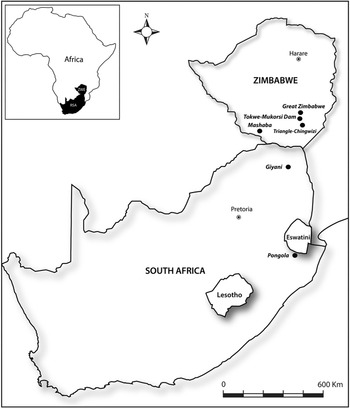
What happens to material knowledges and practices in the aftermath of involuntary uproot and relocation? How do displaced newcomers handle rupture and weave their lifeworlds, knowledges and practices into a landscape in the early stages after arrival? Guided by these queries—and seeking to develop a theoretical framework inspired by a growing number of works in African archaeology sharing a critical epistemic focus on the aftermath of violence, marginalization and marginal spaces, often with reference to Kopytoff’s influential model—this archaeological study centres on ground breakers in local communities in southern Africa (Fig. 1) whose members have experienced more or less involuntary relocations and had to navigate a dense political landscape as newcomers. Our prism case located in southern Zimbabwe resonates in key respects with other contemporary examples with multi-layered pasts, and also a deeper-time case. The latter example extends the temporal scope of this work to at least the early nineteenth century. This choice finds support in González-Ruibal’s (Reference González-Ruibal2019, 116) observation that in colonial and postcolonial contexts it may turn out necessary to overflow the limits of the twentieth century, thereby transcending conventional divides between the subfields contemporary, historical and prehistorical archaeology.Footnote 1
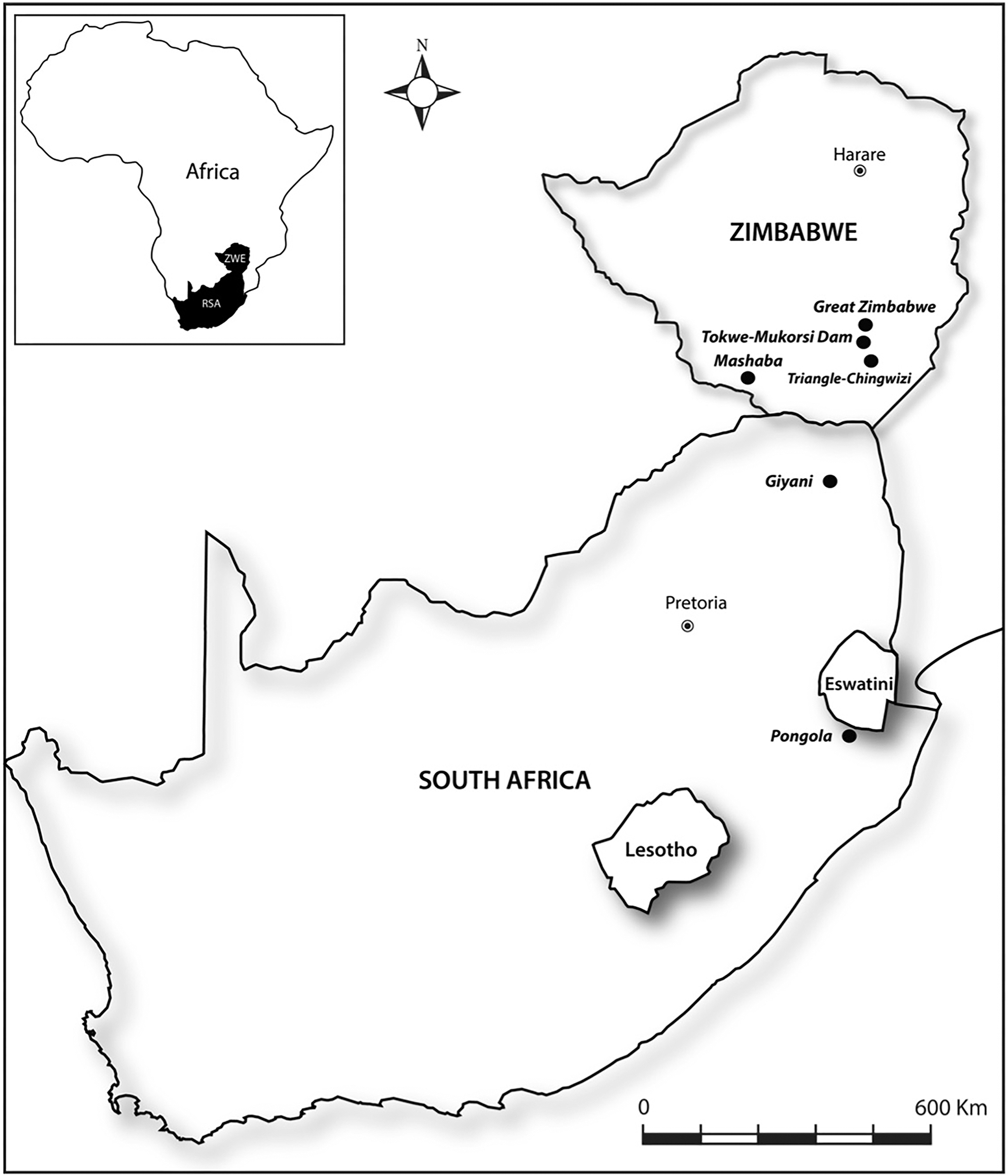
Map of southern Africa with the location of the prism case and other areas mentioned in the text. (F. Bandama).
The following analysis develops this deliberate temporal overflowing into a research strategy. Here we draw on recent analyses in African archaeology and anthropology that demonstrate the analytical potential in critically engaging with mobility and ensuing meetings between material knowledges, which permeate through postcolonial, colonial and precolonial pasts in contextually distinct ways. Specifically, decolonizing inquiries into what the notion of mobility actually means in various African contexts demonstrate the importance of detaching from deep-seated modernist assumptions while asking new questions about localized epistemologies, knowledges and learning networks (Ashley et al. Reference Ashley, Antonites and Fredriksen2016; King Reference King2017; Reference King2018; Reference King2024; Mavhunga Reference Mavhunga2014; Reference Mavhunga and Mavhunga2017; Reference Mavhunga2018). Focusing on social memory and interrelated commemorative and performative bodily practices (Connerton Reference Connerton1989) and following a course staked out by Rachel King (Reference King2017, 547) we intend to show how an attention to the trauma of violent confrontation and exploitation allows for a study of such situations as a series of epistemic encounters. Moreover, in the following we add a crucial everyday material dimension to such encounters. Dislocation opens up a void, caused by spatial distance and disconnectedness with the living and non-living community members left behind—the ancestors—and thereby also the materially textured spaces at home and places in landscapes that are deeply intertwined with ancestors and the pasts of such resituated communities. Consequently, our focus is on the material attention and problem-solving involved when seeking to fill such spatio-temporal voids (Fredriksen Reference Fredriksen, Bjerregaard, Rasmussen and Sørensen2016, 152–9) by weaving one’s previous lifeworld (sensu Jackson Reference Jackson2013, xii, 254–5) into a new one. From this vantage point, we develop an approach that seeks to merge two research domains seldom combined: craftspeople’s engagements with their surrounding socio-ecological landscape and the political relevance of ancestral commemoration and related forms of memory work.
This study proceeds in four stages. The first outlines the background and scope. The second presents two key lessons learnt during an initial pre-Covid-19 field season, and then turns to the refined, tailored approach we employed when resuming fieldwork after the pandemic, informed by the two early lessons. This is focused on the ground breakers’ knowledge networks, their epistemic encounters and their material recipes. The third stage comprises the main analysis and an ensuing comparative discussion of resistance and memory work, where the two terms turn out commonly grounded and inextricably linked, which adds clarifying context-specific substance to our approach. Finally, we offer a set of concluding reflections on the future scope of such an approach to material knowledges in turbulent times.
Background and scope
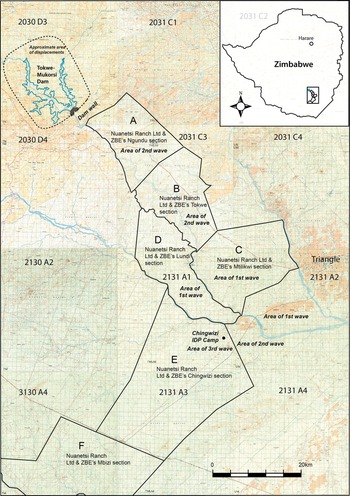
Our fieldwork in a community of displaced flood victims in the Triangle-Chingwizi area of southern Zimbabwe (Fig. 2) turned out particularly influential in redirecting our analytical attention to the dual process of memory work while weaving one’s lifeworld into a new landscape. Our study is informed by previous work on the aftermath of dam projects and large-scale relocations in nearby areas in Zimbabwe (Fontein Reference Fontein2015) and elsewhere in Africa (e.g. Matanzima 2022; Reference Matanzima2024). The fieldwork was conducted in 2019 and 2022–23.Footnote 2 A detailed Human Rights Watch Report (HRW Report 2015) provides a critical account of the events that had unfolded prior to our aftermath study. After the Tokwe-Mukosi Dam flooded in February 2014 while still under construction, more than 20,000 people were relocated by civil authorities and the Zimbabwe army. The forced evictions uprooted over 3000 families from their homesteads, bringing them to a transit camp on the government-controlled Nuanetsi Ranch about 150 km from the dam.Footnote 3 In August 2014, after several violent incidents, the authorities shut down the camp and sought to relocate the evicted families to farmland plots on the same ranch, which already had c. 3000 resident families who had arrived in two earlier waves. Thus, the forced relocations in 2014 were the third and final wave of migrants settling on the ranch. The firstcomers had settled on vacant land in the wake of land reforms introduced by the Mugabe regime around the millennium turn, and this was followed by a second wave around 2010, consisting of the families moving voluntarily before the dam flooded (see Table 1 for detailed overview). In total c. 18,000 hectares (ha) at the ranch was to be divided between the c. 6000 families, resulting in an average of 3 ha per family.Footnote 4
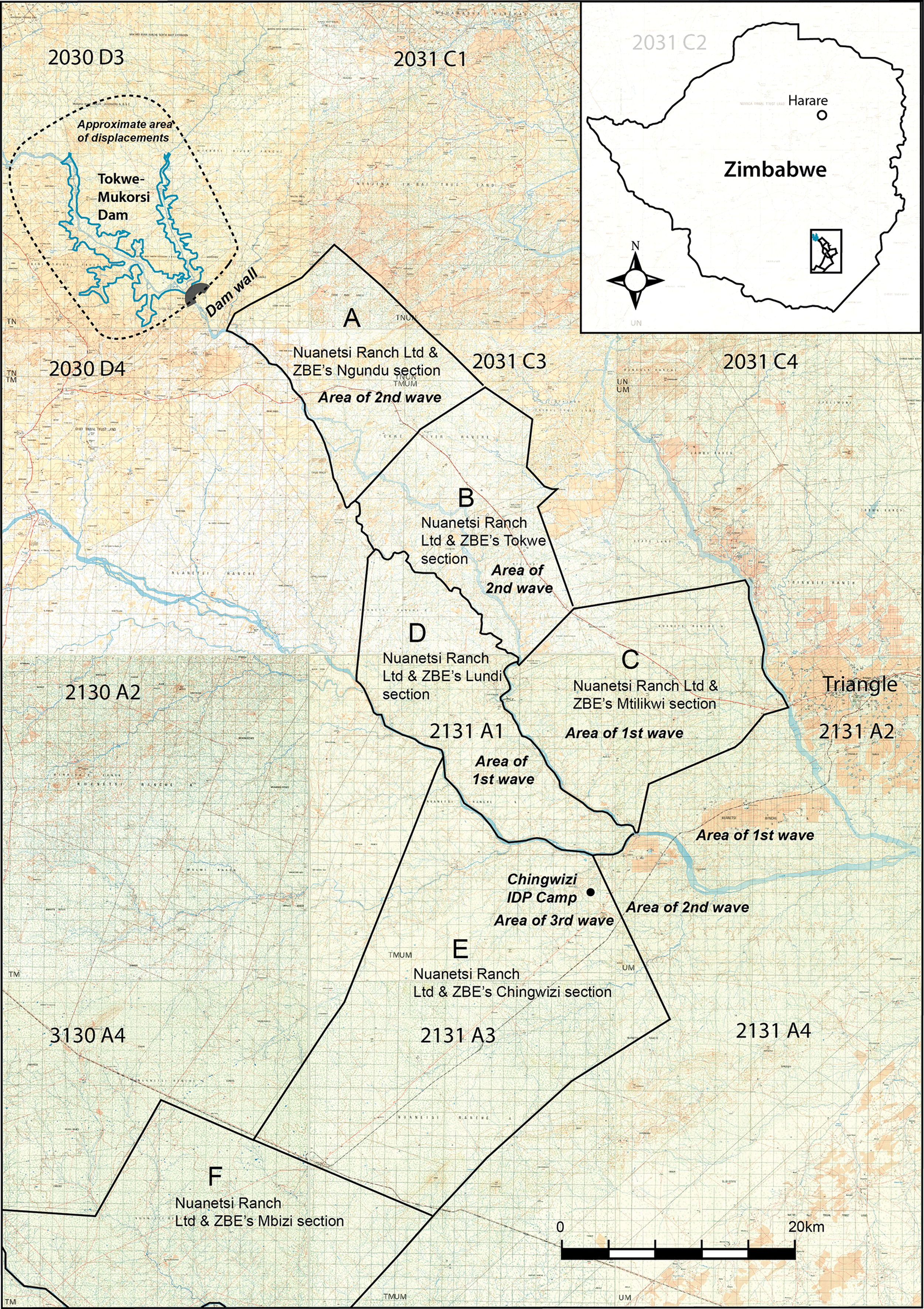
The Tokwe-Mukosi Dam and the Nuanetsi Ranch with sections A–E, location of the Internally Displaced Community (IDP) camp, and areas of 1, 4 and 8 hectare plots. (F. Bandama).
Overview of characteristics of the three migrations waves into the prism study area. (F. Bandama & P.D. Fredriksen.)
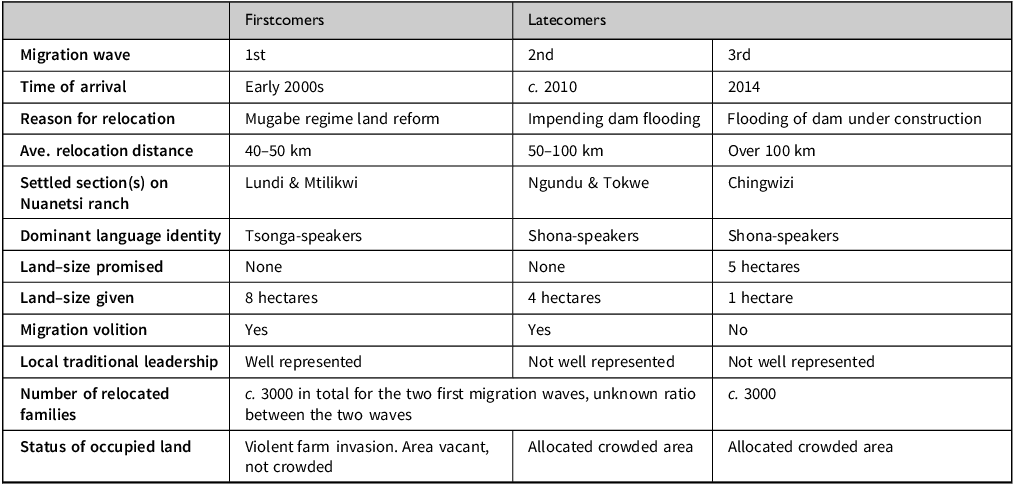
Table 1 Long description
A table comparing characteristics of three migration waves into the prism study area. The table has 12 rows and 2 columns. The columns are labeled Firstcomers and Latecomers. The rows are labeled Migration wave, Time of arrival, Reason for relocation, Ave. relocation distance, Settled section(s) on Nuanetsi ranch, Dominant language identity, Land-size promised, Land-size given, Migration volition, Local traditional leadership, Number of relocated families, and Status of occupied land. Row 1: Migration wave, 1st, 2nd, 3rd. Row 2: Time of arrival, Early 2000s, c. 2010, 2014. Row 3: Reason for relocation, Mugabe regime land reform, Impending dam flooding, Flooding of dam under construction. Row 4: Ave. relocation distance, 40-50 km, 50-100 km, Over 100 km. Row 5: Settled section(s) on Nuanetsi ranch, Lundi & Mtilikwi, Ngundu & Tokwe, Chingwizi. Row 6: Dominant language identity, Tsonga-speakers, Shona-speakers, Shona-speakers. Row 7: Land-size promised, None, None, 5 hectares. Row 8: Land-size given, 8 hectares, 4 hectares, 1 hectare. Row 9: Migration volition, Yes, Yes, No. Row 10: Local traditional leadership, Well represented, Not well represented, Not well represented. Row 11: Number of relocated families, c. 3000 in total for the two first migration waves, unknown ratio between the two waves, c. 3000. Row 12: Status of occupied land, Violent farm invasion. Area vacant, not crowded, Allocated crowded area, Allocated crowded area.
The relocated families from the camp obtained a plot of only 1 ha each, significantly smaller than the 5 ha plots they had been promised and the 4 ha plots allocated to the families who had already settled voluntarily before the forced relocations began—and certainly much smaller than their lands prior to the evictions. As a result, the 3000 newly arrived families were left struggling to meet basic needs while living under constant threat of being further expelled. Importantly, partly because of the above-mentioned contestations, all resettled people from the camp were directed not to build any permanent structures on the plots (HRW Report 2015, 17–20).Footnote 5
Prior to our main field seasons in 2022–23, other research carried out among the displaced people in Triangle-Chingwizi (Mavhura Reference Mavhura2020; Mucherera & Spiegel Reference Mucherera and Spiegel2022) confirmed the continued lack of a comprehensive plan, serious disruption of livelihoods and a widespread fear of further relocation. The list of critical issues included lack of housing structure, further delay of promised irrigation schemes, frequent reports of health issues like diarrhoea and dysentery, stress and depression, and an immense pressure on women who travelled long distances for fresh water daily.
Thematically, previous and parallel social science research conducted in the aftermath of the Tokwe-Mukosi Dam flooding has focused on disaster management and improvement of models (Mucherera & Spiegel Reference Mucherera and Spiegel2022), the role of traditional leadership (Tarisayi Reference Tarisayi2018) and social institutions (Nhodo & Ojong Reference Nhodo, Ojong and Mhlanga2023), and ethical reflections on fieldwork in such conflict zones (Nhodo et al. Reference Nhodo, Ojong and Chikoto2021). However, while covering a range of important aspects, this research has paid relatively little attention to the everyday livelihoods of the displaced people, their trajectories and histories and the material world they have had to scramble together. Realizing this knowledge gap during Covid-19 lockdown, prior to our two main field seasons, we decided to focus our study on how the newcomers wove their lifeworld into a new context already inhabited by people and the complex everyday dynamics that followed, and their perceptions of before/after the relocation. Interestingly, as these first-wave families had relocated to the area only 10–15 years earlier, the firstcomers were also navigating in relatively shallow temporal waters.
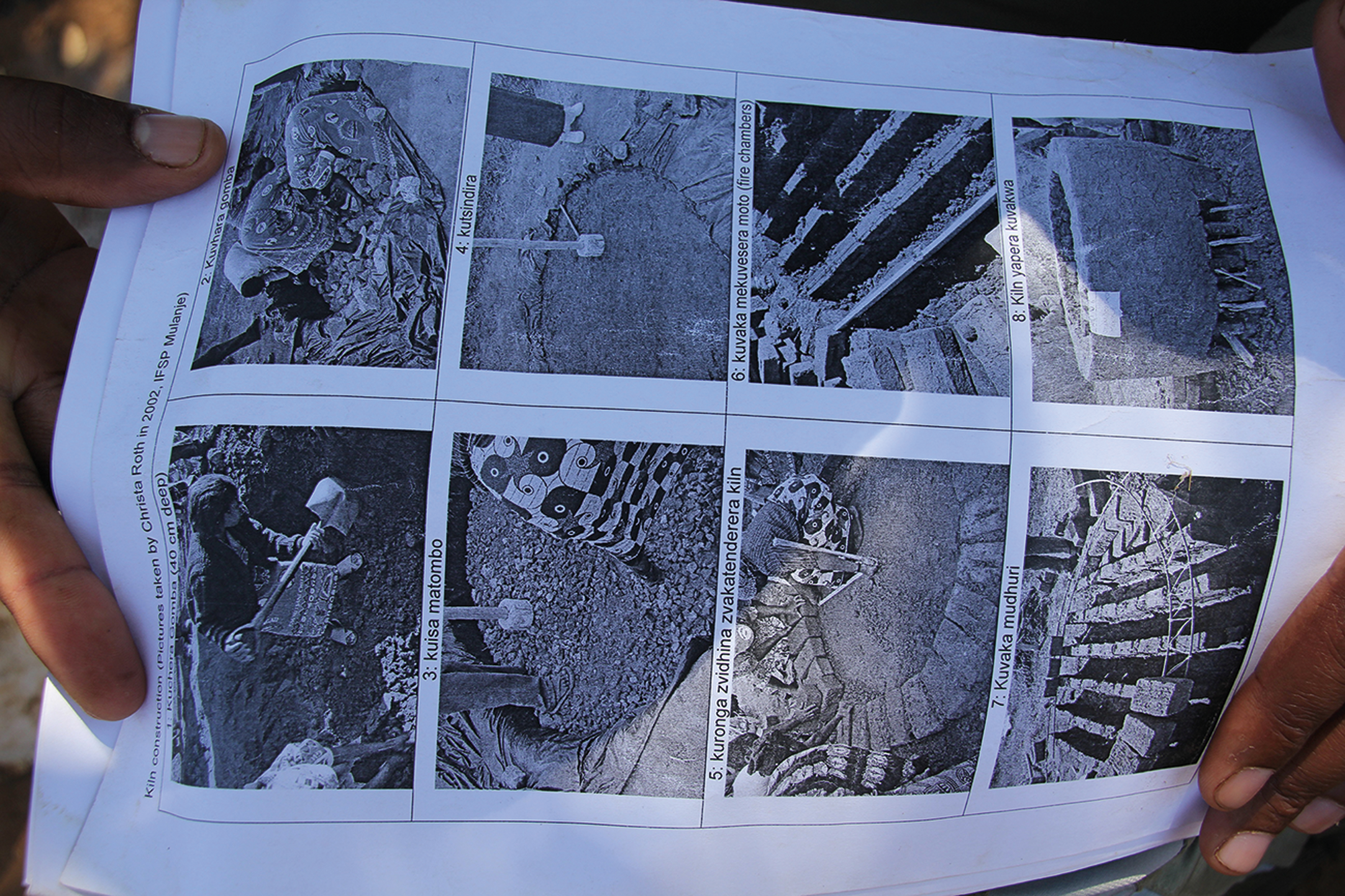
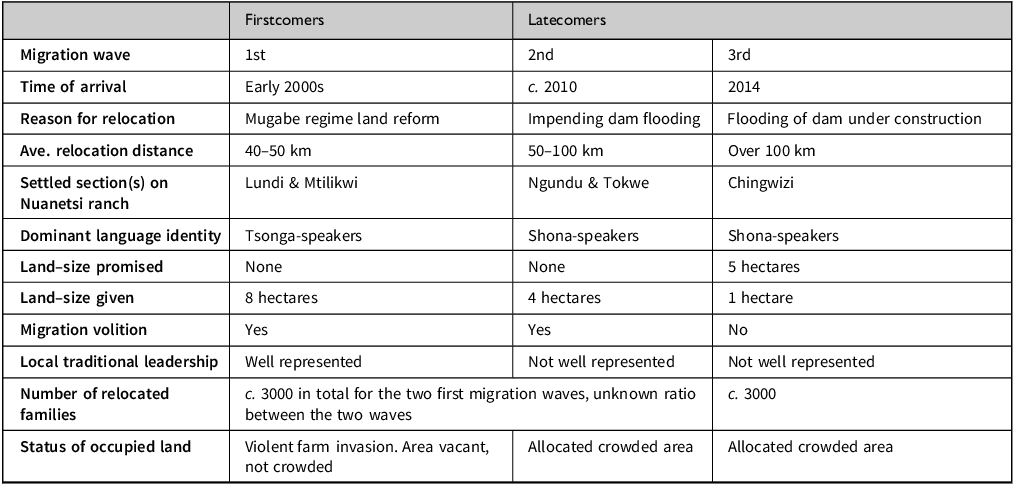
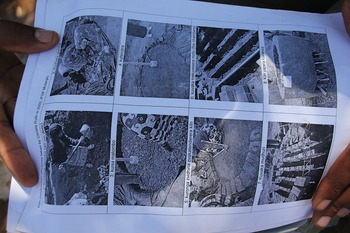
As indicated above, our fieldwork in this area of southeastern Zimbabwe was part of a wider research agenda, centring on local responses by craftspeople in the wake of training workshops organized by external aid programmes. Employing a similar approach in three parallel cases, the previous two located in northern South Africa and southwestern Zimbabwe (Fredriksen & Bandama 2016; Reference Fredriksen, Bandama, Higgins and Douglas2021), the initial stages of the present study focused on a common feature in all cases: the introduction of uniformly designed production methods for fuel-efficient utensils for heating and cooking, typically providing handouts of illustrated text manuals (Fig. 3), in Zimbabwe commonly known as the Tsotso stove (Fig. 4).Footnote 6 Seeking to understand how dynamics among craftspeople working with earth materials change and adapt to the novel situation, the overall scope of these aftermath studies have been twofold: (a) to identify the key factors contributing to local dynamics from the perspective of local custodianship and stakeholders, and (b) to capture how the external initiative affect the local community’s understanding of heritage and the pasts of the area they now found themselves in (Fredriksen & Bandama Reference Fredriksen, Bandama, Higgins and Douglas2021, 79–80).
A page of the handout manual for the Tsotso workshops. (Photograph: P.D. Fredriksen).
A typical Tsotso stove (normal height c. 25–30 cm). (Photograph: P.D. Fredriksen).

Learning from the ground breakers in Triangle-Chingwizi
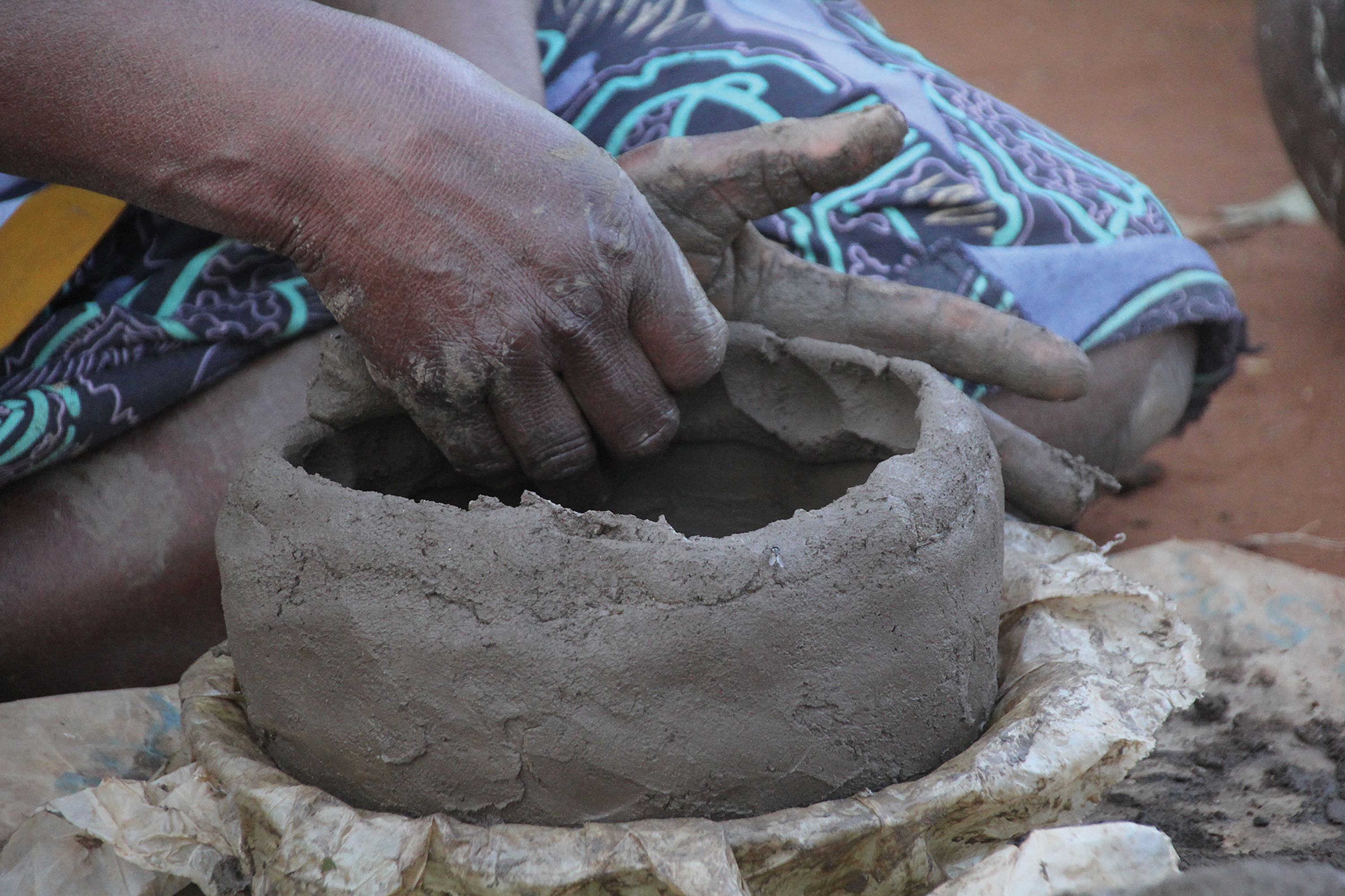
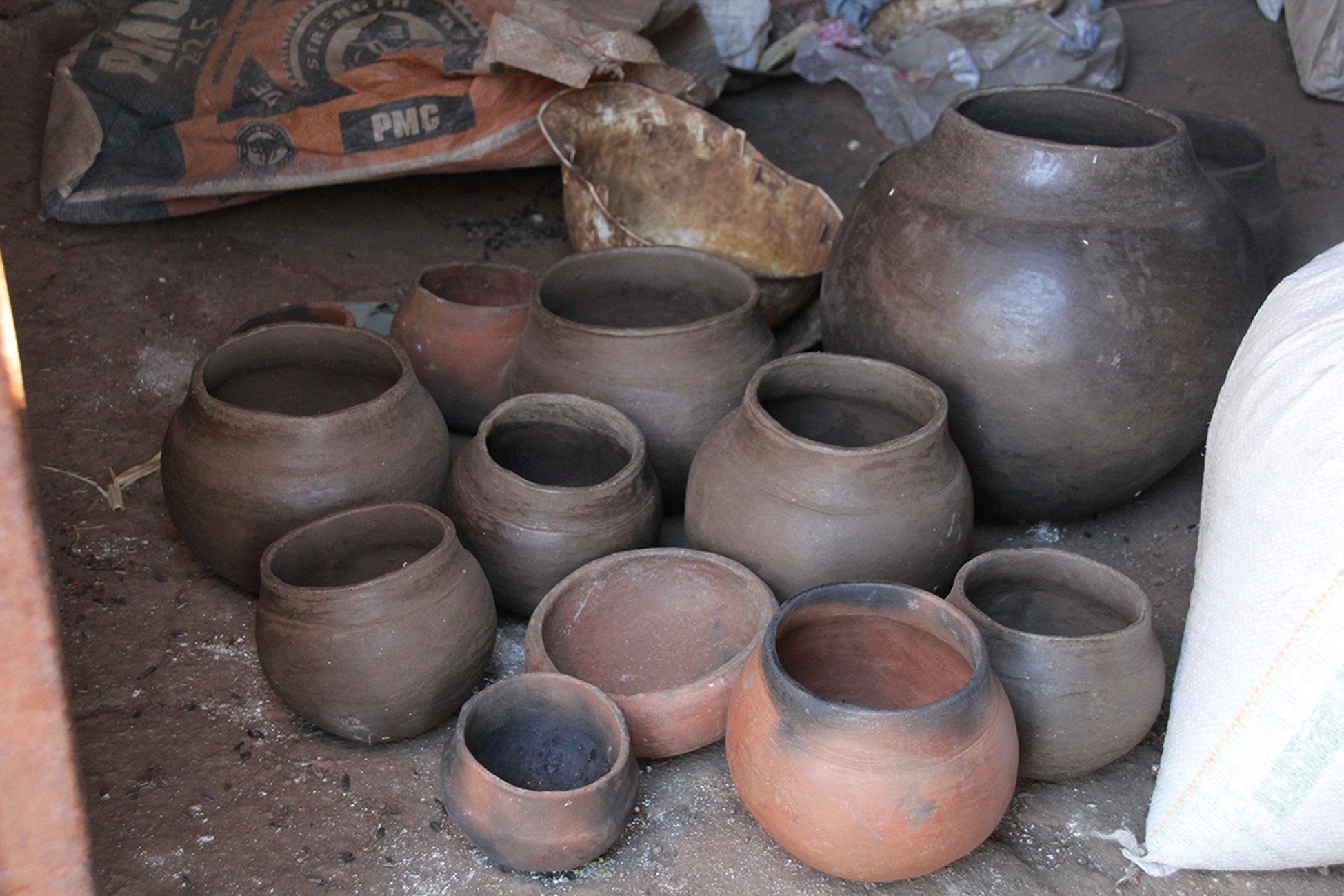
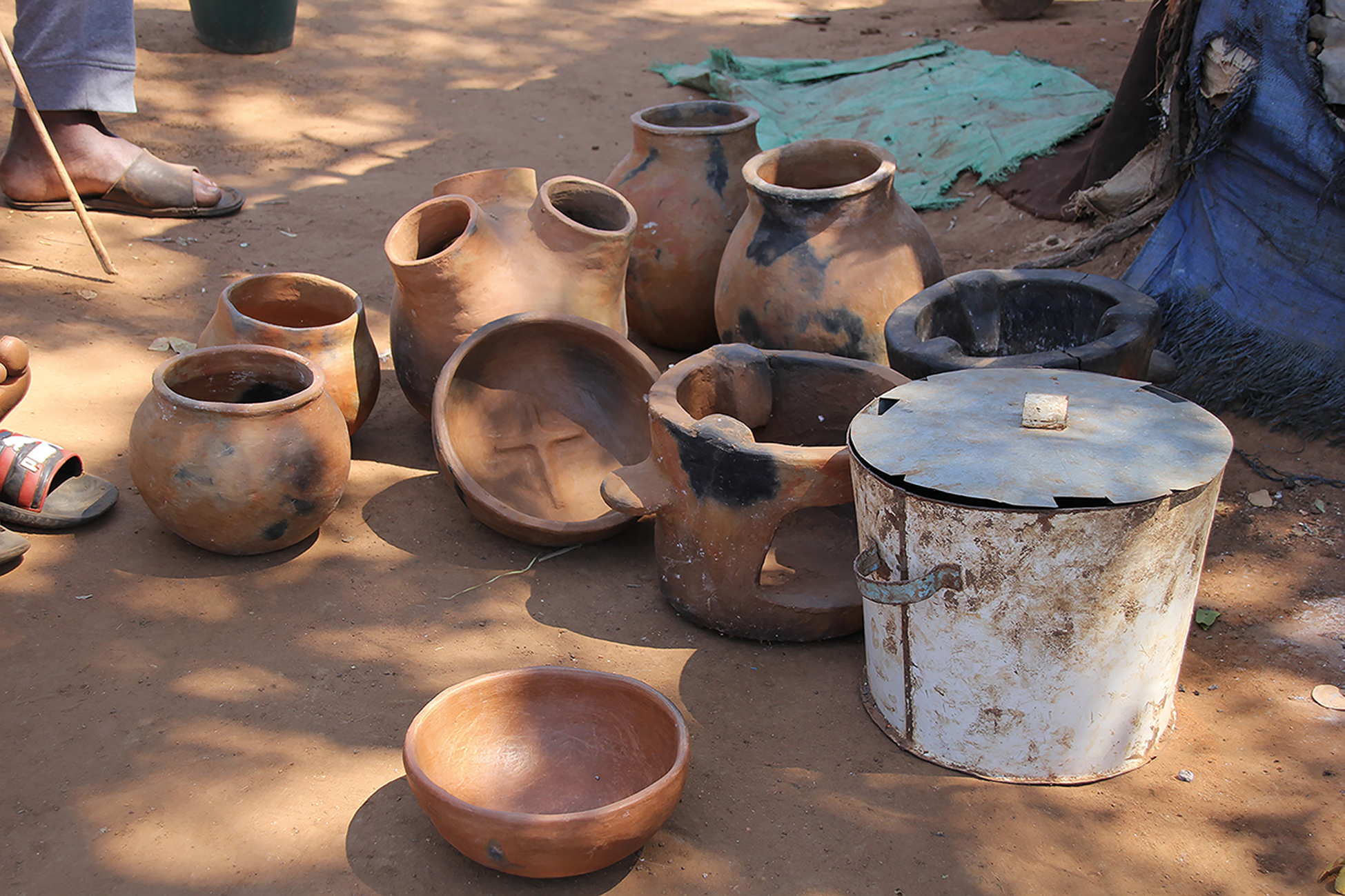
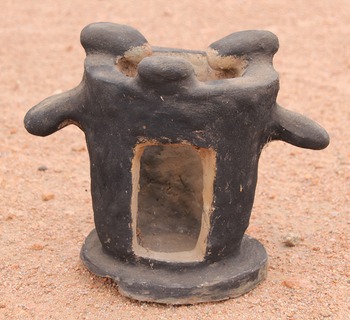
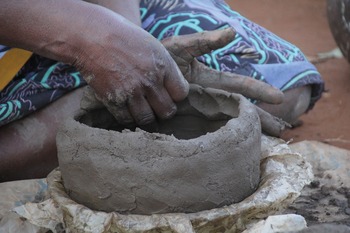
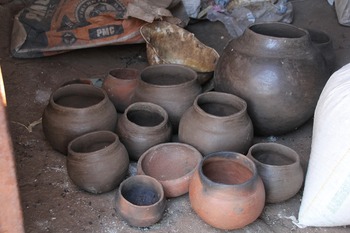
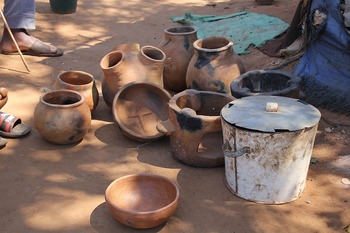
During our first field season in Triangle-Chingwizi in 2019, five years after the closing of the transit camp, we initially focused on the ceramic chaîne opératoire of potters among the firstcomer and the latecomer (second and third wave) communities. Using the same methods as in earlier works with communities with several waves of relatively recent relocations (Fredriksen & Bandama 2016, 494–5; Reference Fredriksen, Bandama, Higgins and Douglas2021, 82–6), we followed the potters through the entire operational sequence (clay procurement, clay storage, shaping, decoration, drying, firing and storage of completed vessels) with a focus on dynamics of learning and knowledge sharing. As expected, the shaping technique for handmade potting considered traditional (Fig. 5) was quite similar for all potters: superimposing and drawing of large rings (Gosselain Reference Gosselain2000, 201–2, figs 4 & 5). However, we quickly noticed a significant difference between the Tsonga-speaking potters of the first wave and the Shona-speaking potters of the third wave. While the firstcomers produced a relative wide range of vessels, including pots for cooking, serving and storage of liquids (Fig. 6), the latest-comers of the third wave only made a few of the traditional vessels, predominantly serving plates and liquid containers, while adding Christian symbols on plates and combining potting with the making of Tsotso stoves (Fig. 7). These initial observations drew our attention to the complex and conflicted dynamics between the latest-comers and those already living there. Specifically, we realized that people we interviewed among the third wave, and to a certain extent also second-wave newcomers, were primarily interested in discussing differences in ways of living, doing and making things before and after the relocation.
The typical shaping technique for handmade pottery among firstcomer and latecomer potters alike. When making containers for cooking, serving and storage considered traditional, all potters used a similar technique. (Photograph: P.D. Fredriksen).
The ceramic repertoire of a firstcomer potter, predominantly vessels for cooking and storage considered traditional for Tsonga-speakers in the region. (Photograph: P.D. Fredriksen).
The ceramic repertoire of a newcomer potter making Tsotso stoves, three-mouthed vessels and pots with Christian symbols, mixed with vessels considered traditional for Shona-speakers in the area they left behind. (Photograph: P.D. Fredriksen).
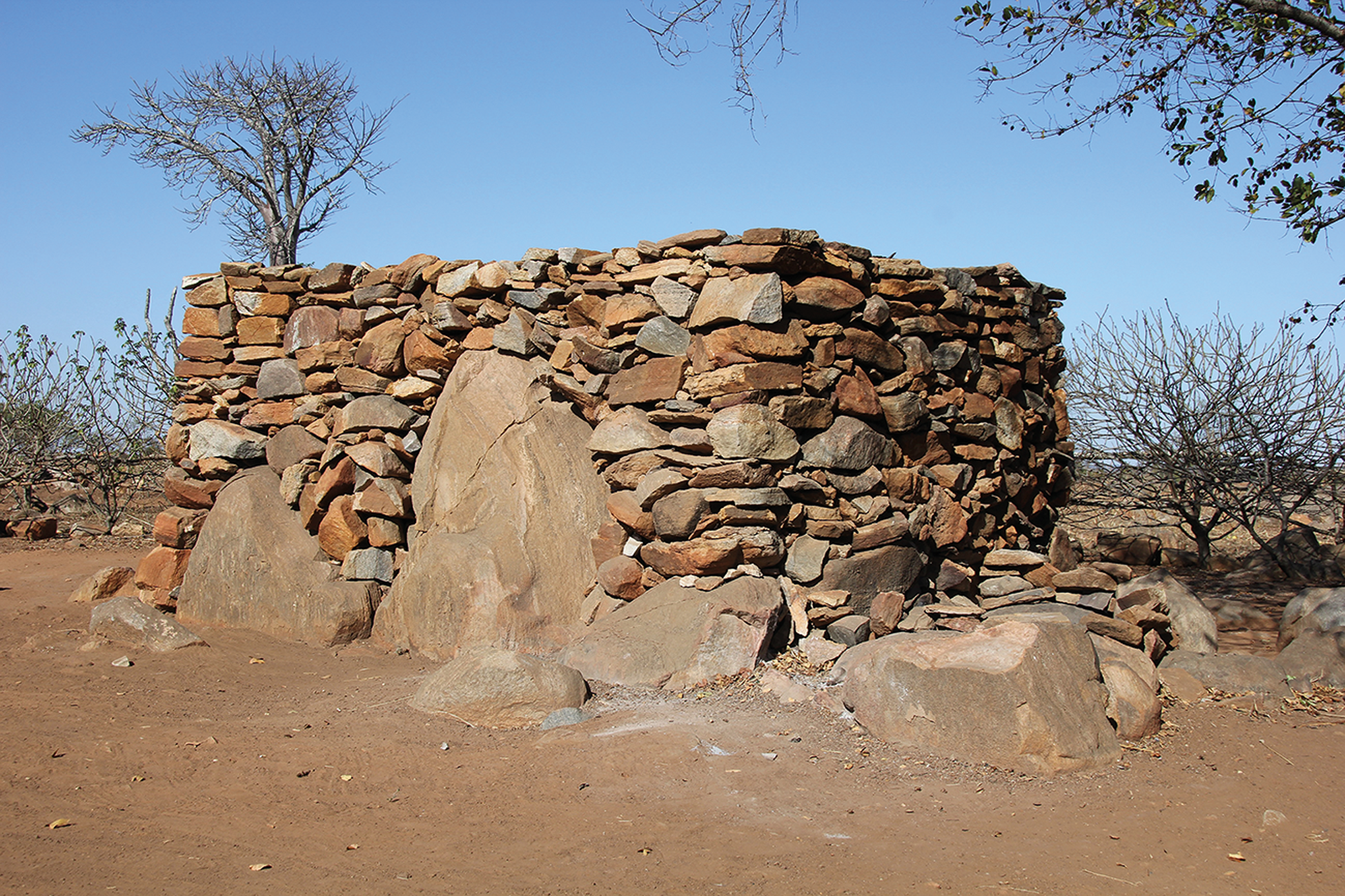
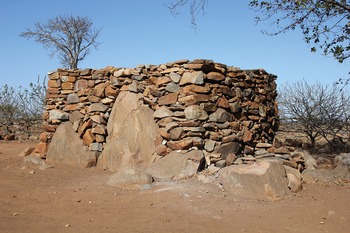
Two initial key lessons helped us adjust and fine-tune the approach when resuming fieldwork in 2022–23 after the Covid-19 pandemic. The first was that a significant number of plots had a strikingly visible feature: contrary to official directions, it was common to build permanent structures (Fig. 8). People sought a durable built environment as soon as possible after the crash-landing in a new landscape, using the most accessible materials at their disposal, that is, mud,Footnote 7 stone and wood, and to make this architecture resemble the homestead they left behind. As explained by a member of the firstcomer community staying on the Nuanetsi ranch: ‘We are constantly reminded that we will be moved. So, we did not build permanently. But those who moved into the small plots just ignored this and went ahead and built permanent homes.’ Thus, an important first lesson was that for people making vernacular architecture (houses, fences, screens, perimeter walls) using mud, stone and wood, earthenware kilns for heating and ceramic containers for cooking and storage, the acts of building ‘hard’,Footnote 8 durable and elaborate were at once a form of resistance to the situation they found themselves in and the political forces that had caused this, and a form of memory work—a way of staying connected with those and that they had recently parted ways with. Significantly, this led us to treat memory work and resistance as integrated in the same problem-solving strategies.
Building hard and durable. A stone-walled toilet and shower construction at a newcomer 1 hectare plot. (Photograph: P.D. Fredriksen).
The second lesson resonated with previous observations that externally organized workshops were instrumental in igniting an interest in traditional ceramic crafts, and thereby in the formation of new craft knowledge networks with their own alternative workshops and learning arenas (Fredriksen & Bandama Reference Fredriksen, Bandama, Higgins and Douglas2021). At the same time, the Tsotso stove-making muddled the traditionally highly gendered boundaries between potting (female) and brickmaking (male), two crafts that usually kept their clay sources separate.Footnote 9 An outcome of this was an increased workload for women, now typically ending up collecting raw materials for both forms of craft activity. Significantly, the aftermath of the introduction of a craft knowledge system underpinned by modernist ideals was an important reminder that the hands of the ground breakers working with mud, stone and wood very often belong to women and, moreover, that this gendering of craft knowledge is key to understanding the continually ongoing heritage-making and memory work in such situations.
Learning from these two lessons, during the involuntary pandemic break and before resuming fieldwork in 2022–23, we redesigned our approach to demonstrate the value of a tailored ceramic craftscapes approach (Chirikure et al. Reference Chirikure, Manyanga and Fredriksen2018; Michelaki et al. Reference Michelaki, Braun and Hancock2015). Given the importance of ancestors and the related problem-solving filtered through gendered material knowledges, the adjustment also included an expansion of the theoretical undergirding of our approach, in order to explore better the dynamics of craft knowledge networks in turbulent times,Footnote 10 by focusing on the epistemic encounters between the newcomers and firstcomers already on the landscape. Significantly, adjusting our approach also made us re-engage with empirical data from previous work with related cases in Zimbabwe and South Africa (Fredriksen Reference Fredriksen, Seebach and Willerslev2018; Fredriksen & Bandama 2016; Reference Fredriksen, Bandama, Higgins and Douglas2021; Fredriksen & Lindahl Reference Fredriksen and Lindahl2023).
A craftscapes approach to knowledge networks and their recipes
Informed by the concept of craftscapes, i.e. the landscapes of daily life strategies and interaction where crafts and technologies are innovated, improvised and experimented with (Chirikure et al. Reference Chirikure, Manyanga and Fredriksen2018, 428), our approach is designed to capture the material decision-making involved in everyday social interaction and dynamics. By situating craftspeople and their technological chaînes opératoires within wider socio-political identity-formation processes, it enables the tracing of movements of craft knowledge within and between different knowledge networks. This offers insights into inter-generational learning and transmission when engaging with clay and soil (e.g. Fredriksen Reference Fredriksen2011; Lorenzon Reference Lorenzon2023; Salisbury Reference Salisbury2012) and into relationships between crafts using such earth materials when sharing the same workspaces (Budden & Sofaer Reference Budden and Sofaer2009; Rebay-Salisbury et al. Reference Rebay-Salisbury, Brysbaert, Foxhall, Rebay-Salisbury, Brysbaert and Foxhall2014). In this manner, we seek to capture and understand encounters between material knowledges and the concrete repertoires employed when re-building and re-connecting. Consequently, we explore the concept of making as material and spatial resistance and as temporal memory work.
Making as resistance
As people move through concrete places, they shape and are shaped by these places. The dislocated find themselves thrown into a situation that is not of their making, which constitutes the setting and limits of their meaning-making. This focus on processes of ‘creating place-attachment while co-dwelling’ (Lems Reference Lems2016, 317–33), directs attention to how people cope with gaps and voids caused by the absence and loss of the world they left behind, ontologically as well as existentially. The everyday epistemic encounters between the material knowledges of newcomers and firstcomers may potentially include forms of resistance, especially when the encounters are characterized by social asymmetry. Such asymmetry may become very real and visible: following Zygmunt Bauman (Reference Bauman2004, 98–104) and González-Ruibal (Reference González-Ruibal2019, 157–8), migrants, homeless people and subalterns often find themselves occupying marginal ‘leftover’ spaces. These interstitial spaces tell important stories of trauma, marginalization and reluctance (cf. Kiddey Reference Kiddey2019), and to occupy such spaces is an effective way to avoid and resist dominant entities. For us, this analytical focus on such in-between spaces is key for understanding the problem-solving strategies of newcomers seeking to carve out new futures in a new setting (see also González-Ruibal Reference González-Ruibal2021, 570–73; Hamilakis Reference Hamilakis2021, 532–5). Embedding this focus in a craftscapes approach, we seek to scale down Igor Kopytoff’s (Reference Kopytoff and Kopytoff1987) influential framework for firstcomer–latecomer dynamics, which also offers a deep-time interpretive lens widely used by archaeologists for understanding the last millennium of the southern African interior, to the level of individual households and homesteads.
Kopytoff’s model draws attention to ethnically ambiguous social formations at the interstices of existing ones, characterized by layered interactions between firstcomers and later arrivals, resulting in a complex mesh of fluid identities and varied interactions (Ashley et al. Reference Ashley, Antonites and Fredriksen2016, 424–5). Specifically, the principle of precedence ties firstcomers and later-comers into a chain of hierarchy and a legitimacy of authority, whereby the first arrivals are recognized with a form of ownership to the land through their deeper ritual and ancestral ties (Kopytoff Reference Kopytoff and Kopytoff1987, 53). To recognize firstcomers is therefore to recognize their authority and special ritual position, which limits ‘the legitimacy of whatever claims of authority might be made by latecomers’ (Kopytoff Reference Kopytoff and Kopytoff1987, 54). Significantly, as pointed out by Kopytoff in a later work (Kopytoff Reference Kopytoff, Rösler and Wendl1999, 41–2), firstcomer–latecomer dynamics are inherently paradoxical in that their culturally conservative function may lead to structural innovation and new social formations. As we shall see, this is precisely what happened with a knowledge network in our prism case.
Making as memory work
The relocated flood victims faced the challenge of having lost the political capacity of materiality relating to the newcomer community’s pasts, such as graves and homestead ruins (see Fontein Reference Fontein2015, 15). What to do when all of this is at the bottom of an artificial lake? The ground breakers in Triangle-Chingwizi sought to solve this problem—the absent capacity of the past to intrude upon the present as part of political dynamics of belonging—by turning to the performance of repeated acts of assembling materials and building homes. This can be described as context-specific citations of past material arrangements before the relocation. The memory of how to assemble things and people became ‘distributed’ as practice, as embodied techniques, which then became materialized into contextually distinct recipes for making (Fredriksen & Kristoffersen Reference Fredriksen, Kristoffersen, Austvoll, Eriksen, Fredriksen, Melheim, Skogstrand and Prøsch-Danielsen2020, 101). This form of memory work has a significant performative aspect, as recurrent citations of the past give a pulse to spaces where such individual acts and transformations take place and allow them to remain functional (Olivier [2011] Reference Olivier2015, 69), and is therefore fundamental to the process of social memory-making (Fredriksen & Kristoffersen Reference Fredriksen, Kristoffersen, Austvoll, Eriksen, Fredriksen, Melheim, Skogstrand and Prøsch-Danielsen2020, 100–101; Lucas Reference Lucas2012, 195–201). Consequently, during our fieldwork in 2022–23 we sought to identify and understand the distinctly local repertoires of resistance, in the form of bodily gestures and their material recipes for building houses and homesteads and making material culture.
This particular approach to contemporary contexts adds theoretical texture to well-established methods in historical and prehistorical archaeology. Significantly, among skilled ceramic craftspeople, a common way to cite other places and past events—material storytelling—is to work specific material elements of the old world into the new, either by using grog (to grind up old pots and work this material into new pastes) or by using specific tempers with a well-known geographic origin. This ability to cite people, places and events in the past through choices of pastes and techniques, by making ancestry and belonging material, to work them in by more or less subtle means, into more or less visible features of pastes and wares, creates subtle social geographies that can be identified via sophisticated microscopic studies (Fredriksen & Lindahl Reference Fredriksen and Lindahl2023, 95–6; for other examples from southern Africa, see Bandama et al. Reference Bandama, Hall and Chirikure2015; Wilmsen et al. Reference Wilmsen, Killick, Rosenstein, Thebe and Denbow2009). The always-underlying aspect of memory work in such provenance studies is often overlooked. When relocated craftspeople are making things in a new location it is not merely about re-making. They are citing the materiality and tactility of past places and events by re-making familiarity—by using the same or similar materials whenever possible. A defining characteristic of such material storytelling and memory work is a particular attention to arenas for learning and sharing of material knowledges and skills, and this attention is directed towards specific locations, people, ancestors, objects and materials (Fredriksen 2016, 152–9; Reference Fredriksen, Seebach and Willerslev2018, 77–83). This focus on memory work resonates with recent archaeological studies of mobility on the African continent, by appreciating the intimacies between the human condition and the many nonhuman forces and agencies at play, thus recognizing the multi-layered processes that take place in everyday lives (Ashley et al. Reference Ashley, Antonites and Fredriksen2016, 427).
Learning from our first field season in Triangle-Chingwizi, the following analysis treats the concepts of resistance and memory work as inextricably entangled. Turning to the analysis of our prism case, which is followed by a comparative discussion of relevant cases in southern Africa, our primary focus is on two intimately connected aspects of bridging the new and the old in the early aftermath phase. The first is the re-construction of the physical lifeworld, the re-assembling of the everyday and re-establishment of practices in these spaces, especially dwelling- and workspaces, the arenas for learning and transmission of key social practices and material knowledges. This involves meeting with other ways of doing and knowing, and new materials. The second aspect is the memory work of connectivity and the ensuing vulnerability to practices and transmission of knowledge, the material storytelling that helps overcome the continual challenges of distance.
Resistance and memory work in Triangle-Chingwizi
As briefly outlined above, three main waves of small-scale farmers have settled relatively recently on sections of the privately owned but government-controlled Nuanetsi Ranch (Table 1 and Fig. 2). The first arrived in the wake of the Mugabe regime’s fast-track programme in the early 2000s,Footnote 11 thus only about a decade prior to the second wave. The majority of these firstcomers were Tsonga-speakers, typically moving 40–50 km from neighbouring areas, settling in the Lundi and Mtilikwi sections (C and D in Fig. 2), and families obtained an 8 ha plot each. The second wave was the earliest arrivals from the Tokwe-Mukosi Dam catchment, predominantly Shona-speakers, who relocated voluntarily, in response to the governments first call and offer, prior to the flooding. Each of these families received a 4 ha plot, located in the Ngundu and Tokwe sections (A and B in Fig. 2). The third wave comprised the evicted victims of the 2014 flooding. While still in the relocation camp they were told that they would only get small, 1 ha plots to begin with, which caused anger and unrest. After an incident where a police car was burnt, the authorities used a heavier hand, dissolved the camp and pushed people to settle in these plots, which were located in the newly cleared Chingwizi section (E in Fig. 2) of the Nuanetsi Ranch. As section E with the 1 ha plots was clearly separated from sections A–D with the larger 4 and 8 ha plots, commonly referring to each other as ‘the other side’, the inhabitants of this section considered themselves a separate community. Consequently, the term ‘newcomers’ here primarily refers to third-wave flood victims settled in Chingwizi, although a newcomer self-perception is also common among second-wave settlers in Ngundu and Tokwe (4 ha plots), while the ‘firstcomers’ term refers to first-wave community members settled in Lundi and Mtilikwi (8 ha plots).
A common trait for the allocation of land to Shona-speakers in Ngundu, Tokwe and Chingwizi was that it followed the spatial organization of the villages the families had left behind. The main difference from their prior living conditions was, in addition to significantly less available farmland, their failing representation in local leadership. As the relocation process had kept entire village units more or less intact, the newcomers found it hard to accept that they could not keep their old leadership. Among the about 30 headmen residing on the Nuanetsi Ranch, none were from the Chingwizi community. Initially, therefore, Shona-speaking newcomers did not recognize the Tsonga-speaking chief. This was sought to be resolved by instating a headman who was Tsonga-speaking, but had lived for many years in the same region as the newcomers and was considered sympathetic to their needs. This headman described the situation in the first months of settling into the 1 ha plots thus: ‘It did not help that these people were told that they were no longer considered a unit. They were used to having these heads, so it did not make sense to them’. In 2022–23, having spent nearly a decade in a state of limbo, the experience of dissolution among the newcomers had only worsened. Adding to this, they now realized that permanent infrastructure was planned around the tiny plots they had been told were only temporary. The authorities’ initial openly physical violence had morphed into more structural forms. As a member of the Chingwizi community complained: ‘Now they tell us we will get irrigation, so we are not going to be moved. We try to remain hopeful, but it is way overdue. We were much better off where we were’. Significantly, while the community still lingered in a void and the initial hopes of improvement and resettling to plots of the promised size had long been fading, their reactions to this structural violence ranged from overt defiance to more subtle forms of local agency that combined resistance and memory work.
Finding materials and making in new places
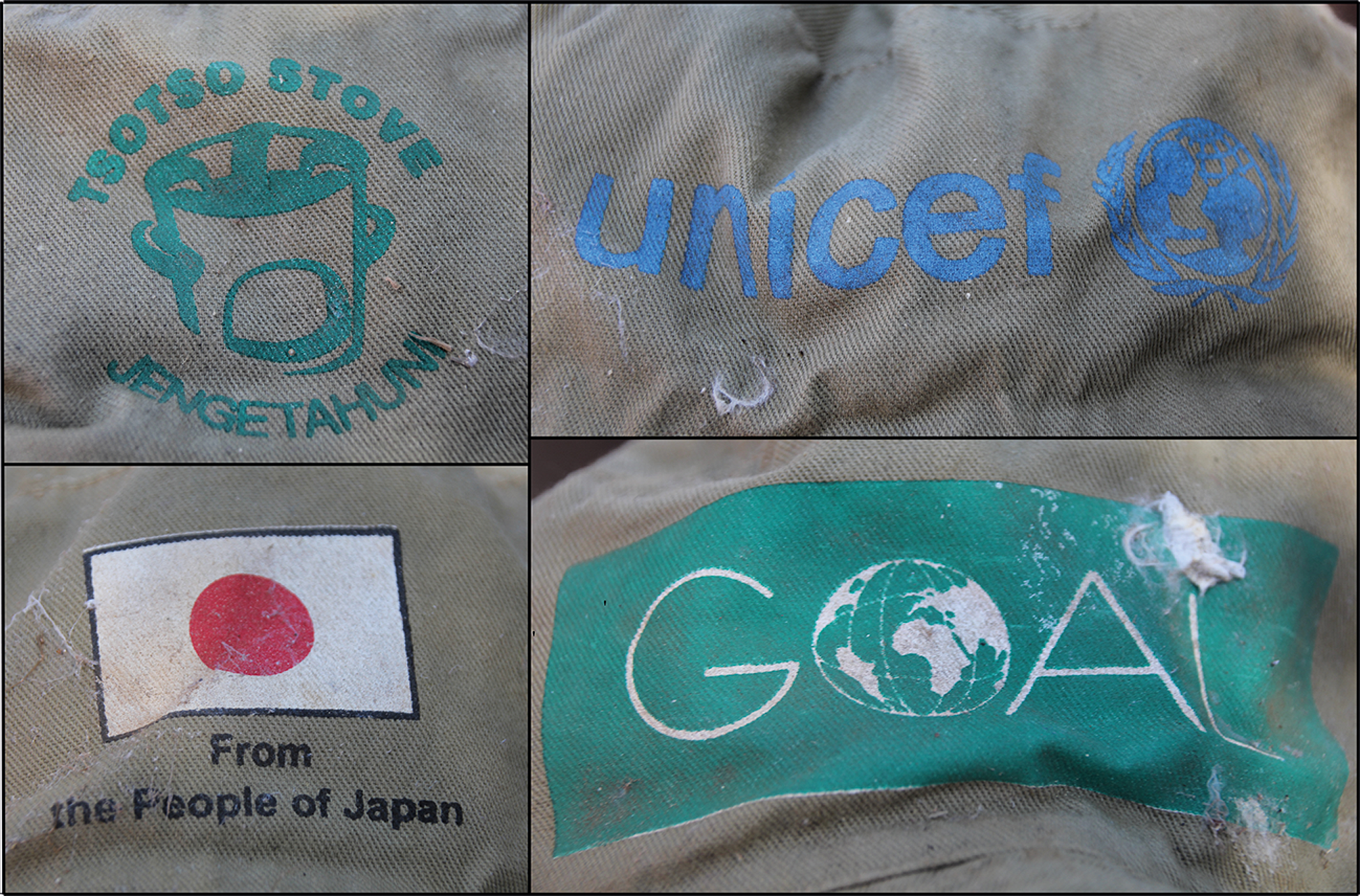
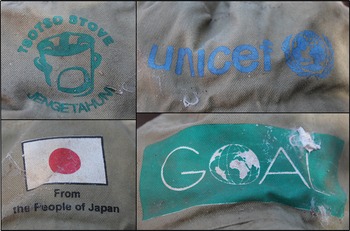
The two early lessons we learnt from the newcomers in Chingwizi were (1) their resistance by building hard and permanent, contrary to authorities’ instructions; and (2) that the Tsotso stove-making workshops ignited creative ways of engaging with earth materials. When pursuing these in more detail, we quickly realized that more subtle forms of resistance had appeared in the wake of the Tsotso initiative, which was supported by several international NGOs and aid agencies (Fig. 9) and offered only to third-wave flood victims in Chingwizi. In the words of a workshop participant: ‘We thought we were only waiting, to be moved later on. Not long after arrival there came this programme, teaching us how to make stoves. We were told that in the future there will be challenges with firewood, and now is the time to start preparing for that.’ As indicated above, the result was an alternative knowledge network, to which we now turn in more detail.
A selection of hats from visiting aid agencies and NGOs. (Photographs: P.D. Fredriksen).
The local responses to an externally initiated stove-making workshop programme resonated well with our previous observations of another Tsotso case in southwestern Zimbabwe: a distribution of printed construction manuals (Fig. 3) and an aftermath characterized by the formation of an alternative craft knowledge network with its own learning arenas and sources of raw materials, clearly different from firstcomers’ established practices (Fredriksen & Bandama Reference Fredriksen, Bandama, Higgins and Douglas2021). Specifically, as elsewhere, Tsotso workshop attendants were encouraged to use clay from termite mounds, frequently found on the outskirts of the small 1 ha plots in Chingwizi and therefore easily accessible. Consequently, materials were primarily extracted from common, uncontested grounds, either at the outskirts of the newly established settlement or in the border areas between plots. Importantly, these clay sources not only provided a second main arena for knowledge transmission and exchange in themselves, but the relatively high degree of sharing while walking between clay sites and the other main learning arena—the household—was a characteristic trait of the newcomer network, whereas potters in the firstcomer network considered the household as the primary location for learning and knowledge sharing. This learning-while-moving between locations for material extraction and making turned out to be a subtle but significant act of resistance (see next section).
This means that the new knowledge network was located at the interstices between clearly defined farmlands and apart from the nodal points of the existing craft network. In other words, having to navigate in shallow temporal waters, the new network established its own nodal points on conceptually ‘harmless’ ground, but therefore also out of the grasp of the established network—beyond the reach of firstcomers’ traditional heritage custodians, perceived by newcomers to be sanctioned by the very same authorities responsible for their forced eviction and ensuing relocations.
However, while the alternative network did not rely on the material knowledges of firstcomer Tsonga craftspeople, practices within the new network varied significantly, depending primarily on previous knowledge of ceramic crafts before arriving in Chingwizi. Experienced potters among the newcomers, all middle-aged or elderly women, preferred clays brought in from landscapes close to their previous homes, and to mix these with clays from local sources they had identified themselves. As such a potter recalled about the workshops: ‘We were never taught how to find clay or showed it to us. They just assumed we knew how to find it’. The local clays were, however, ‘not as good as where we were staying before. The clay comes from termite mounds. It does not have the right feel.’ There were also emerging divergences within the network due to claims of ownership. In one particular case, the potter residing closest to the most frequently used clay source stated that the clay had become contaminated and cursed by all the unregulated clay extraction at the site, which in turn resulted in suspicion by other potters that she wanted to keep the material to herself.
To our knowledge, this kind of sharpening of internal boundaries is rarely found among potters elsewhere in southern Zimbabwe. This clearly indicates the negative effects of the dense living arrangements in Chingwizi. Indeed, the practices and dynamics developed among the newcomers were quite different from the nearby Tsonga-speaking firstcomer knowledge network, whose members we encountered had also observed these differences. When asked to describe the practices of the newcomer potters, firstcomer potters mainly referred to traditional ceramic styles, whereby the newcomers were perceived as fusing their novel stove-making practices with the production of traditional ceramic material culture associated with Shona-speakers in the region they had left behind. Members of the firstcomer network conveyed an ethos of collaboration and sharing of materials and related knowledges, a common trait for most contemporary ceramic craft networks across southern Africa. Among these first-wave potters, the practice of mixing clays from several sources was widespread, a result of collaborative experimentation and trial-and-error since their very first arrival in the area, until they found the ‘right’ recipes made up of different local clay types. For example, the most active potter among the firstcomers, having practised the craft since she was around 11 years old and arriving in the area as an experienced potter, ended up using clay from three different local sources used by different potters, and combined the clay types differently according to size and function of the planned vessel.
Importantly, there were few, if any, traces of knowledge exchange between the predominantly Shona-speaking newcomer potters and the established knowledge network of Tsonga-speaking firstcomers already using the landscape. Specifically, the material attention in lived-in and worked-in spaces of the two networks differed significantly throughout key stages of their ceramic chaînes opératoires: from extraction and uses of clay, via locations for making and the range of ceramic produce (in addition to the stoves), to the preferred venues and markets for ceramic products. For the newcomer network, the introduction of a new repertoire of material recipes, bodily gestures and ceramic objects resulted in a conflation of earlier (typically referred to as ‘traditional’) boundaries between gendered craft knowledges using earth materials, especially potting and brick building. A characteristic trait for this conflation was that women were to a higher degree performing tasks perceived as belonging within a traditionally male domain (stove making and housebuilding). This was highly significant for the dynamics of everyday interaction, as the repetitive body motions that included materials, otherwise typically carried out in daily life without much self-reflection, became conscious performances of gendered identities as newcomer craftspeople built and made things in different ways from the firstcomers. In other words, through the process of anchoring in a new landscape the newcomer minority had found its own, context-specific ways to adapt to and to resist the dominant political entity.
We found the flexibility to gendered tasks to be a key characteristic for the third-wave ground breakers’ knowledge network in the early stages after settling on the 1 ha plots. However, in later stages there was a tendency to revert to more conventional gender divisions for craft practices using earth materials. Specifically, we observed a general development from an initial use of ‘harmless’ materials in uncontested spaces to a consolidation of workspaces and material recipes as the newcomers’ network matured. Compared to the firstcomer network, the material knowledges of the newcomers had become increasingly anchored in new spaces for learning and transmission. Interestingly, this gradual ‘hardening’ process of the network unfolded in tandem with a gradual hardening of the architecture of their primary learning arenas: from soft constructions using earth materials and wood to the use of stone walling and corrugated iron for roofing. Consequently, homesteads looked as though they had been there for a long time, thus resonating with problem-solving we have recently observed elsewhere in southwestern Zimbabwe (Fredriksen & Bandama Reference Fredriksen, Bandama, Higgins and Douglas2021, 86): in order to compensate for navigating in rather shallow temporal waters, craftswomen create new practices anchored in older practices and strategies, resulting in things looking older than they are.
Ways of making as citation of past people, places and events
Our main entry point into issues of social memory and the bridging of spatio-temporal gaps through the making of everyday materiality was to follow trajectories of ceramic items made by newcomer and firstcomer craftspeople. A characteristic trait for newcomer potters was their refusal to follow the rhythm of the regionally rotating Monday market. As an elderly firstcomer potter remarked about the newcomer network in Chingwizi: ‘They are not following the market as it moves around. They prefer to stay in one spot, they don’t follow the group. They wait for the Monday when it is back here again.’ We quickly learned the reason for this strategy: the newcomer potters’ main market was their own community, comprising a reliable group of customers who were all part of the same church congregation.Footnote 12 This inward group focus among newcomer craftspeople is significant, as it not only resulted in a specific repertoire of ceramic objects (Fig. 5), clearly different from that of the firstcomer network (Fig. 6), but also in a characteristic set of problem-solving strategies for re-connecting with deceased community members. A firstcomer potter described the differences between the two networks in this manner: ‘We follow different paths. They solve their issues among themselves and with their ancestors without involving us.’ Indeed, newcomer potters perceived these differences in a similar way, pointing out their own ‘church route’ while the firstcomers were following their ‘ancestral route’, firmly situating the Tsonga-speaking community leadership as custodians who followed the latter.
Importantly, the commemoration of ancestors was equally important to newcomers and firstcomers; they merely drew up different temporal and material trajectories. A third-wave potter put this plainly: the newcomers built in stone to show that they come from Masvingo, a region known for its deep history of monumental stone architecture, including the Great Zimbabwe site. In other words, to re-build a homestead with a similar spatial layout and using the same type of stone materials in this new location articulates an alternative trajectory. This articulation was not only directed at other living human beings. Deceased members of the community buried elsewhere should be able to recognize the new homestead, and members who pass away after the relocation should be able to reconnect with these already existing ancestors. This form of problem-solving by newcomers resonates with Fontein’s (Reference Fontein2015) observations of a familiar aesthetics of resettlement across Zimbabwe in the early 2000s: an emphasis on the political materialities of landscape where different pasts co-exist in close historical and material proximity. Such material articulations of belonging in politically charged and always-emergent landscapes often relates to the merging of substances, the properties and flow of materials and of bodies into the soil, thereby pointing to ‘the complex, and always incomplete, processes of becoming, though which both objects and subjects are constantly being (re-) constituted, transformed and re-assembled’ (Fontein Reference Fontein2015, 70). In the Triangle-Chingwizi case, one such reassembling was to combine the overt disregard for the authorities’ directive against ‘hard’ architecture by using stone walling and corrugated iron with the significantly more subtle use of novel and area-unique material blends of clay with e.g. dung, rocks and minerals in elaborate house and wall shapes, thus merging prior craft knowledge and practices with the new material everyday. In other words, the newcomers merged their previously learnt material attention (cf. Fredriksen Reference Fredriksen, Bjerregaard, Rasmussen and Sørensen2016, 152–9) by inventing a set of new and distinct material recipes, whereby resistance and memory work became deeply entangled. Interestingly, the recipes materialized citations to past genealogies of practice, and this new repertoire also included performances of chaînes opératoires of making, by displaying bodily gestures distinctly different from those of the firstcomers. Taken together, this characteristic combination of locating in-between, the material recipes and the bodily gestures of making became visible and tangible signatures of the dislocated newcomers.
Memory work in mud, stone and wood: a wider and deeper lens for the future
Our fieldwork approach to material knowledges may be viewed through a geographically wider and temporally deeper lens; by scaling up the discussion to the southern African subcontinent and beyond, and by overflowing the limits of twentieth-century contemporary and historical archaeology (cf. Gonzalez-Ruibal Reference González-Ruibal2019, 116). In the following we identify three analytical waypoints that may be useful for future archaeological engagements with locally grounded agency and creativity in cases of intense mobility: (1) to design studies that capture local knowledge dynamics and asymmetries; (2) to situate households as learning arenas when studying locally anchored forms of resistance in contexts of oppression; and (3) to take the social and political reality of ancestors seriously.
Firstly, our departure point for discussion of material knowledges may vary significantly depending on how we approach gendered asymmetries. Insights into situatedness in relation to locally anchored knowledge is vital for how we understand expressions of identity and belonging among relocated people, and their strategies for keeping in touch with the lifeworld left behind across space and time. In our prism case, positions differed significantly between the relatively informally organized newcomer craftswomen and the more formalized roles of headmen and heritage custodians, all held by male elders of the firstcomer community. This asymmetry gave male elders the power to validate traditional ceramic crafts as ‘real’, whereas the novel, hybrid practices of the attendants of the Tsotso stove-making workshops were deemed ‘modern’. This illustrates the importance of an awareness of dissonant voices within a local community (see also Fredriksen & Bandama Reference Fredriksen, Bandama, Higgins and Douglas2021, 86–7; Jopela & Fredriksen Reference Jopela and Fredriksen2015, 275).
The alertness to dissonance directs attention to our second waypoint: a sensitivity to the forms of resistance to oppression developed at the scalar level of the household. The craftscapes approach outlined above is theoretically undergirded by recent challenges to conventional modernist assumptions of mobility in Africa, in particular the underlying notion of home and homestead as anchors that provided permanence to social entities and formations (Fredriksen & Bandama 2016; Reference Fredriksen, Bandama, Higgins and Douglas2021; King Reference King2018; Mavhunga 2014; 2017; Reference Mavhunga2018). As described above, the newcomer network in Chingwizi conveyed their high degree of sharing of material knowledge while walking between home and clay source as a resistance strategy. Accordingly, the learning of everyday material practices such as making and building in earth materials did not only take place in a singular nodal point at home. In our prism case, then, the key arenas for learning-while-moving and related acts of resistance were the locations for raw material extraction and for shaping and firing—and the routes between these locations. As pointed out by anthropologist Clapperton Mavhunga, learning happens in transient spaces, in ‘an arena, site or space where mechanical work is being performed as and because the body is moving. This mobility ceases to be just conveyance from one point to another, but production-on-the-move’ (Mavhunga Reference Mavhunga2014, 20). Importantly, this means that not only the outcomes of the process of making can articulate resistance (and therefore also memory work), but also the very act of making can do so. Indeed, as historian and political theorist Achille Mbembe writes in his treatise of necropolitics, bodily movement and gestures can be effective forms of resistance when finding oneself in a situation which is not of one’s own making: ‘a way of breaking with uprootedness and the experience of becoming things among other material commodities, in the pure world of things in which he or she is but a fragment’ (Mbembe Reference Mbembe2003, 22). While Mbembe’s primary example of such bodily resistance is rhythmic movement to music, here we can add bodily practices related to working with earth materials. For dislocated communities, the performance of crafts using soil and clay, locally abundant materials acquired at little or no economic cost, is not coincidental. To embed such everyday materiality in politics of co-existence on the same landscape is to articulate notions of heritage and memory-work. In this manner, the gestural and material signatures of the uprooted also have significant temporal dimensions.
While several works have demonstrated the value of viewing the archaeological record through a Kopytoffian lens, as shown above, material forms of resistance and memory work similar to those we have seen in our prism case may also be traced into the deeper pasts of southern Africa. There is ample evidence in the archaeological record, especially for the tumultuous eighteenth and nineteenth centuries ce, of heavy investment in elaborate, labour-demanding ‘hard’ stone architecture, despite the likely prospect of having to relocate within their lifetime (Whitelaw & Hall Reference Whitelaw, Hall, Hamilton and Leibhammer2016; see Ashley et al. Reference Ashley, Antonites and Fredriksen2016, 425–8; King Reference King2017, 539). An illustrating example is a recent study of the Tlokwa in the interior of South Africa in the early nineteenth century (Fredriksen & Lindahl Reference Fredriksen and Lindahl2023; Hall Reference Hall2012). Their practices and recipes were a form of resistance against the dominant entity on the complex and turbulent landscape. As a political minority, the Tlokwa sought to secure continuity of collective identities through a situated discourse around distinct histories and inheritances. The evidence points to continuation of practices drawing on the knowledge of raw materials obtained at previously occupied settlements, by actively returning to the same sources, and by re-using old material by grinding up old ceramic vessels and mixing this material—commonly known as grog—into new ones. This was in marked contrast to material signatures of the dominant knowledge network, with relatively less emphasis on ties to specific craftscapes (cf. Chirikure et al. Reference Chirikure, Manyanga and Fredriksen2018) and more emphasis on a relatively uniform aesthetic expression, probably signalling connectivity to the dominant entities on the political landscape.
This example demonstrates the value of tracing connectivity in the ways in which objects were made, by indicating an increased emphasis on material culture for connecting people and places. As a response to frequent relocation and when facing a majority knowledge network, the minority network found a distinct material expression that foregrounded their common past and their movements together, which became a way of connecting across distances, geographically and socially, using the same material recipes (Fredriksen & Lindahl Reference Fredriksen and Lindahl2023, 115–16). Consequently, by downscaling and demonstrating Kopytoff’s macroscale inter-polity model’s relevance for craft knowledge networks at the meso- and microscale levels of interaction (Knappett Reference Knappett2011, 61–145) and connectivity,Footnote 13 our craftscapes lens may be developed further to focus on newcomers’ forms of material and spatial resistance, including the choice of location of their building and making—to settle in the ‘leftover’ spaces in-between—and of their preferred arenas for transmission of craft knowledge.
The third waypoint is the analytical importance of deceased members of local communities. For newcomers the distance to their previous home is not only geographical. There is also an ever-increasing temporal gap, and thereby the potential loss of connectivity or communication between generations, including those no longer living. To create a new dwelled-in world with familiar texture and tactility is also about creating a world that is recognizable and familiar to those members of the community who passed away before the relocation. When a minority and its material knowledges meet a major political entity, the problem-solving strategy includes not only resistance by building hard and monumental but also, more subtly, the development of new forms of memory work consisting of a web of travel itineraries embedded in the making and use of everyday material culture.
What transpires from our craftscapes analysis, then, is a need to take the political reality of ancestors seriously (Bubandt Reference Bubandt2009; Fredriksen Reference Fredriksen, Seebach and Willerslev2018, 86–7; Santo & Blanes Reference Santo, Blanes, Blanes and Santos2014). To treat notions of absence and presence not as opposed but as entangled phenomena (Sørensen Reference Sørensen, Bille, Hastrup and Sørensen2010, 128) offers a better position from which to engage with complex dynamics of co-existence on a politically charged landscape. The continued references to ancestral beings, graves and ruins point to the capacity of the past to intrude upon and disrupt the present. Things from past lifeworlds ‘remember’, thereby contributing to a complex meshwork of memories and temporalities (Olsen Reference Olsen2010, 107–28). Melancholia inspired by affective objects and places is not separated from memories, imaginations or discursive constructions of the past; rather they are entangled and mutually constitutive (Fontein 2015, 15, 67; Reference Fontein2023, 46–63), and this seamless traversing of the living/dead boundary is grounded in everyday practices. The absence/presence duality is perhaps of particular importance when working with communities such as those in Triangle-Chingwizi, where newcomers, whose previous homes are under water, find themselves bereaved of the political capacity of the materiality relating to their pasts.
Future work on the necropolitics of resistance within contemporary archaeology and related fields may find value in relating concrete case studies with a broad research agenda that combines a focus on indigenous archaeologies and social memory with African ontologies (Lane 2011; Reference Lane, Crook, Edwards and Hughes2015; Lyons & David Reference Lyons and David2019), potentially brought into what philosopher Ifeanyi Menkiti (Reference Menkiti and Brown2004, 129) terms an ‘expanded notion of material causation’ where humans and nonhumans share the ability for action (see Fredriksen 2011; Reference Fredriksen, Bjerregaard, Rasmussen and Sørensen2016, for discussions). In addition to demonstrating the paradox of firstcomer–latecomer dynamics (Kopytoff Reference Kopytoff, Rösler and Wendl1999, 41–2), whereby cultural conservatism results in innovations and the formation of a new knowledge network, this kind of approach, where politics and power dynamics should not be taken to mean the give-and-take of humans only (cf. Latour Reference Latour2004, 424) but also to include things and ancestral beings, may offer insights into engagements with community members who may no longer be living (Fredriksen Reference Fredriksen, Bjerregaard, Rasmussen and Sørensen2016, 161).
Concluding remarks
While being strong reminders of the darker side of western modernity (cf. Mignolo Reference Mignolo2011) and supermodernity (González-Ruibal Reference González-Ruibal2019, 1–24), the lessons we learnt during our first season of our prism study informed a refined, tailored re-engagement with local communities and stakeholders. A primary focus in this study is body politics in turbulent times. Involuntary relocation causes ruptures and voids that need to be filled, geographically across distances and temporally across generations. A newly arrived minority found a set of unique ways to respond to dominant politics and violence, and their focus on earth materials was not coincidental. The locally developed problem-solving strategies allowed flood victims bereaved of economic and political leverage to resist the present situation and remember their past by not only building hard and durable, but also to further develop their gendered material knowledges and to keep them at a respectful distance from previously established (male) traditional heritage custodianships. Significantly, the ground breakers’ strategies also kept ancestors and their memories alive and within reach. Thus, we encountered a set of locally anchored solutions to a much more widely shared challenge for people facing oppression in a new location. By insisting on following a highly flexible ‘church route’, the living and the non-living alike were prepared for future relocations, when or if they should happen.
Acknowledgements
The authors are deeply grateful to all community members in the Triangle-Chingwizi area who allowed us into their everyday lives. This research was made possible by a Research Council of Norway FRIPRO grant to ARCREATE. An Archaeology of Creative Knowledge in Turbulent Times (Project No. 334377) and support from the Department of Archaeology, Conservation and History, University of Oslo.

 Open access

