

Introduction
The Roman military occupation of the central European Alpine region and its northern foreland in 15 bc represents one of the most historically significant incursions into the cultural development of this area. Socio-cultural structures as well as subsistence and everyday life witnessed fundamental changes under the influence of the novel Mediterranean lifestyle. So far, however, the issue of continuity of Celtic lifeways into Roman times could not be answered conclusively. Until recently, archaeological evidence for the presence of an autochthonous population in the decades before and after the initial Roman occupation was almost non-existent. As a result, it was postulated that the area was mostly uninhabited before the onset of Roman occupation (e.g. Sommer, Reference Sommer and Piso2008). But archaeological finds uncovered recently from settlements dating to the last century preceding the Roman occupation (e.g. Meixner & Pütz, Reference Meixner and Pütz2013), and excavations of burials and settlements of the so-called Heimstetten group (c. ad 30–60) in particular (e.g. Volpert & Früchtl, Reference Volpert and Früchtl2012), revealed building traditions and artefacts possibly indicating cultural persistence from the La Tène culture into early Roman times. In order to provide answers about continuity or discontinuity in the material culture and traditions in the northern Alpine foreland from around 100 bc to ad 100, a multidisciplinary approach involving archaeology, zooarchaeology, anthropology, palaeobotany, and stable isotope analysis is currently being applied.
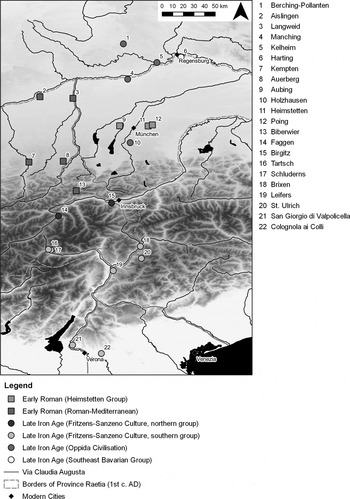
In this contribution, we focus on recent archaeological and zooarchaeological results. Following an overview of the archaeology of the area of the province of Raetia, we present the results of an ongoing analysis of the animal bone assemblages from Iron Age and Roman settlements in western and eastern Raetia and adjacent regions (Figure 1). Spatio-temporal developments in livestock composition and husbandry from the Iron Age until Roman times are addressed and evaluated with respect to (dis)continuity in animal farming practices. Since they are relevant in the context of this study, possible Mediterranean influences on livestock breeding will also be considered.
Map of the study area with sites mentioned in the text (map basis: SRTM (Shuttle Radar Topography Mission) data; graphics: Anna-Sophie Buchhorn).
Archaeology of the Celtic-Roman Transition
The chronological starting point for this study is the Celtic ‘oppida civilisation’, named after the centrally located, fortified proto-urban La Tène settlements that Caesar called oppida (Salač, Reference Salač2005: 281). Examples exist at Manching (Sievers, Reference Sievers2003), Kelheim (Wells, Reference Wells1993), and Fentbach (Uenze, Reference Uenze and Dannheimer1971). There were, however, also unfortified settlements that acted as central places, for example Berching-Pollanten (Fischer et al., Reference Fischer, Rieckhoff-Pauli and Spindler1984). Also the square ditched enclosures (Viereckschanzen; Wieland, Reference Wieland1999) are one of the features that characterize La Tène settlements. As part of an extensive economic network, there is evidence for a collapse of the ‘oppida civilisation’ around 80 bc. Postulated reasons for this include economic demise (Salač, Reference Salač2005: 296), the invasion of Germanic tribes (Rieckhoff-Pauli, Reference Rieckhoff-Pauli1985), and human disease (Rieckhoff, Reference Rieckhoff, Dobiat, Sievers and Stöllner2002: 375–79). Archaeologically, this decline is visible in the abandonment of central places as well as in transformations of the material culture and settlement structure.
Following the collapse of the ‘oppida civilisation’, small, isolated farmsteads with predominantly sunken floored buildings characterized the landscape (e.g. Irlinger, Reference Irlinger, Husty, Irlinger and Pechtl2014). During this phase, ceramic types and traditional clothing design unequivocally reflect an influence from the Central German uplands (Mittelgebirge) and these elements are therefore considered to indicate immigration to the northern Alpine foreland (Rieckhoff, Reference Rieckhoff1995: 183). Based on these findings, it has even been argued that Central Germanic tribes displaced the Celtic ‘oppida civilisation’ (e.g. Stöckli, Reference Stöckli1979: 196–97). Rieckhoff-Pauli (Reference Rieckhoff-Pauli1985: 17), however, suggests two separate waves of population movement: a first one overrunning and pillaging the northern Alpine foreland between 72 and 58 bc, followed by another migratory wave settling permanently in the largely depopulated area, where it subsequently mingled with the remaining Celtic inhabitants, thereby forming a new cultural entity. Others take the position that local Celtic people were assimilated following intense cultural contacts with the Central German uplands (Gebhard, Reference Gebhard, Hüssen, Irlinger and Zanier2004: 112). This cultural successor to the ‘oppida civilisation’ is termed the Southeast Bavarian group (südostbayerische Gruppe), though both cultural milieus may have co-existed (e.g. Pietsch, Reference Pietsch2002: 74–75).
For the Iron Age–Roman transition period, which lasted some two to three decades before and after the turn of the first century bc to the first century ad, factors including (1) the paucity of sites dating to the Final La Tène period, (2) the lack of evidence for continued settlement use through to Roman times, and (3) the apparent absence of autochthonous elements in the archaeology of early Roman Imperial sites have led to the assumption that an indigenous population substrate was absent until the Roman conquest and/or had fallen into complete oblivion (e.g. Sommer, Reference Sommer and Piso2008: 212–15). However, results from pollen analysis (Peters, Reference Peters, Hüssen, Irlinger and Zanier2004: 31–38) and zooarchaeology (Peters & Manhart, Reference Peters, Manhart, Hüssen, Irlinger and Zanier2004: 39–52) hardly endorse such a hiatus hypothesis. Moreover, the close spatial proximity of Final La Tène and early Roman settlement remains also suggests continuity (Hüssen, Reference Hüssen, Hüssen, Irlinger and Zanier2004: 81–88). The continued use of sacrificial sites for burning animal offerings (Brandopferplätze) also point to enduring local customs. These communal places of worship have yielded finds from both Late La Tène and early Roman phases (Zanier, Reference Zanier1999: 108–14). But opponents of settlement continuity in the northern Alpine foreland consider these arguments to be unconvincing. Moreover, the kind and nature of the findings are often too general to identify regional differences that possibly existed and persisted in the decades marking the transition from the La Tène period to the Roman period.
Turning to the inner Alpine region, cultural developments occurred in a completely different manner. The inner Alpine Fritzens-Sanzeno culture, encompassing the historically documented Raetians (Lang, Reference Lang1998: 229), is distinct from the La Tène culture by its settlement types (e.g. Gamper, Reference Gamper2006), burial customs (e.g. Lang, Reference Lang1998), and ritual practices (e.g. Steiner, Reference Steiner2010). Whereas since the second century bc Raetian groups living south of the main chain of the Alps were successively integrated into the Imperium Romanum (Demetz, Reference Demetz, Metzger and Gleirscher1992: 639–41), those inhabiting the main Alpine divide and its northern valleys were only assimilated much later during the military campaign of 15 bc. Thus, until the Roman conquest, Raetian settlements north of the Alpine divide were occupied continuously during the first century bc, e.g. ‘Hohe Birga’ in Birgitz (Tyrol, Austria) (Gleirscher, Reference Gleirscher1987: 266). Burial and worship practices as well as the material culture moreover illustrate that local traditions continued well into Roman times (Lang, Reference Lang, Hüssen, Irlinger and Zanier2004).
The catalyst for the military campaign of 15 bc was the need to gain permanent control of the Alpine passes and enable the efficient transfer of people and goods between the already occupied regions of Illyria in the east and Gaul in the west. In recent years it has become possible to better document the Roman conquest and subsequent colonization thanks to new archaeological findings and historical and epigraphic data (Zanier, Reference Zanier, Aßkamp and Esch2010). Clearly, development under Roman control had already begun by Augustan times. Important villages, road intersections, and thoroughfares were secured by military posts of varying sizes, e.g. at Abodiacum/Epfach (Ulbert, Reference Ulbert1965). Late Augustan amd especially Tiberian rule (ad 14–37) was characterized by the formation of sprawling civilian settlements including the Auerberg near Bernbeuren (Ulbert & Zanier, Reference Ulbert and Zanier1997) and Cambodunum/Kempten (Sieler, Reference Sieler2009). Their inhabitants were primarily Roman and Romanized colonists (Mackensen, Reference Mackensen1978: 180; Ulbert & Zanier, Reference Ulbert and Zanier1997: 124). In addition, certain cultural aspects point to people of Celtic (Ulbert & Zanier, Reference Ulbert and Zanier1997: 124–25) and Germanic (Steidl, Reference Steidl, Grabherr, Kainrath and Schierl2013: 162–69) origin. In the subsequent late Tiberian and early Claudian periods, Roman infrastructure was extended.
Archaeological evidence for Mediterranean influence is clearly visible in western Raetia and linked to the Via Claudia Augusta. This important thoroughfare connected Romanized upper Italy with the northern Alpine foreland (Figure 1).
At about the same time, eastern Raetia saw the Heimstetten group, dated to c. ad 30–60, flourish. Well represented in the Munich gravel plain, the Heimstetten group extends between the rivers Iller and Inn, and from the tertiary foothills to the north and the Tyrolean Inn valley to the south. The group's burial customs are probably the most characteristic socio-cultural difference with the Roman-Mediterranean culture (e.g. Reinecke, Reference Reinecke1957: 56). One major feature of these burials is the uniform traditional clothing for women, composed of group-specific features comprising La Tène and provincial Roman elements (Keller, Reference Keller1984: 31–48). Besides, the typical buildings consist of post-built structures with vertical roof-bearing timbers (e.g. Volpert & Früchtl, Reference Volpert and Früchtl2012), similar to the building forms reported from the late second/early first-century bc oppida (e.g. Steidl & Will, Reference Steidl and Will2005).
Being anomalous but coeval with early Roman provincial contexts, the Heimstetten findings provoked a lively debate about the cultural roots and geographic origin of the Heimstetten group. One hypothesis considers this cultural entity to represent the indigenous inhabitants of the Alpine foreland (e.g. Ulbert, Reference Ulbert1959: 79). Alternatively, it has been postulated that the Heimstetten group comprises emigrants from the northern inner Alpine region (Mackensen, Reference Mackensen1978: 49–51; Keller, Reference Keller1984: 53). The most recent hypothesis, however, sees in the Heimstetten group the expression of nativism. In such a scenario the original inhabitants of an occupied area exclude their conquerors through an exaggerated accentuation of native cultural traditions (Kandil, Reference Kandil1983; Haffner, Reference Haffner1988; Zanier, Reference Zanier1999: 147–49).
The foregoing shows that cultural developments in the northern Alpine foreland are complex and not yet well understood in western and, particularly, eastern Raetia. However, throughout central and western Europe, the process of Romanization left a distinct imprint in the faunal record (Peters, Reference Peters1998; Stopp, Reference Stopp and Deschler-Erb2011), and this raises the question of whether zooarchaeology can throw additional light on issues like (dis)continuity in animal exploitation and hence on the cultural roots of the inhabitants of the newly-founded province of Raetia.
Zooarchaeology of the Celtic-Roman Transition
The faunal analysis of hitherto unpublished faunal assemblages from settlement sites located in Raetia, and belonging to the Fritzens-Sanzeno culture, the Roman-Mediterranean milieu, and the Heimstetten group, forms the core of this contribution (see Figure 1 and Table 1).
Sites and composition (NISP) of main livestock species.
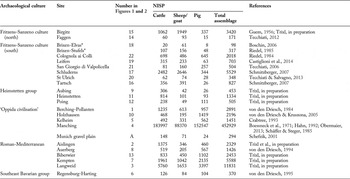
Note: *latest Iron Age/earliest Roman transitional period.
The identification of the faunal remains was carried out with the aid of the comparative collection housed at the Bavarian State Collection of Anthropology and Palaeoanatomy, Munich. Data recording followed best practice as outlined in the database OssoBook (Kaltenhaler et al., Reference Kaltenthaler, Lohrer, Kröger, van der Meijden, Granado, Lamprecht, Nücke, Obermaier, Stopp, Baly, Callou, Gourichon, Pöllath, Peters and Schibler2016).
Thanks to extensive excavations at oppida sites, knowledge about Late La Tène faunal exploitation can be considered exhaustive (e.g. Boessneck et al., Reference Boessneck, von den Driesch and Wechsler-von Ohlen1971). But for the Southeast Bavarian group the opposite is true. Given that the assemblages are much smaller, the animal remains provide only a preliminary insight into the kind of husbandry practised towards the end of the La Tène period and shortly before the Roman conquest. For the northern Alpine pre-Roman Fritzens-Sanzeno culture, the situation is hardly better: except for a single larger faunal sample from the ‘Hohe Birga’ site in Birgitz, for the third to first century bc excavations have so far only yielded smaller or less extensively published assemblages. As for the early Roman period, research into the Heimstetten group is essential but, to date, no analysis of settlement refuse associated with this cultural entity has been conducted. Finally, the early Roman-Mediterranean milieu is represented by animal remains from several settlements along the Via Claudia Augusta, with a focus on the sites of Langweid and Cambodunum/Kempten (see Figure 1 for location).Footnote 1
Species Composition in Iron Age Livestock Herds
The spatio-temporal comparison of the Iron Age faunal assemblages studied clearly illustrates regional differences in livestock composition and consequently in farming practices (Figure 2). One major reason for this is that throughout the study area, eco-geographic conditions varied considerably, whilst the presence of human groups of different cultural origin since the Late Iron Age is also likely to have played a role. Locational details as well as socio-cultural aspects must therefore be factored in when interpreting livestock species composition and breeding targets.
Proportion of main livestock species in the foreland and inner Alpine sites during the La Tène period by specimen counts. Based on own research and published data (see Table 1). *Data from complete excavations between 1955 and 1999; **data from past and new excavations; ***data from complete material of the Middle and Late La Tène period.
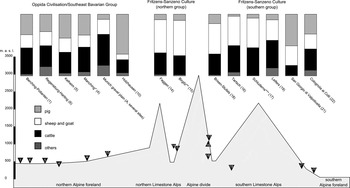
As would be expected, faunal assemblages from Late Iron Age sites situated in mountainous regions are characterized by high proportions of small ruminants (Riedel, Reference Riedel1986: 60; Peters, Reference Peters1998: 381, fig. 14). This predominance of sheep and goat relates to their more efficient use of the often sparse and dispersed vegetation cover in landscapes with steep, rugged mountain sides. Significantly, higher proportions of small ruminants are reported from Bronze and Iron Age settlements in Trentino and South Tyrol, which possess little fertile land suitable for agriculture (Riedel & Tecchiati, Reference Riedel and Tecchiati1999: 109). In order to protect the agricultural plots at lower altitudes that were essential for the supply of fodder and winter grazing (e.g. Putzer, Reference Putzer2013: 27) and of staples for human consumption, the inhabitants of the inner Alpine region exploited pastures at higher altitudes since prehistoric times. Demonstrating seasonal vertical transhumance is, however, fraught with problems (Reitmaier, Reference Reitmaier, Mandl and Stadler2010). Be that as it may, exploitation of high pastures may have started as early as the Neolithic (Deschler-Erb et al., Reference Deschler-Erb, Ginella, Hüster-Plogmann and Töchterle2015: 373), growing in intensity during and particularly after the Bronze Age (Carrer, Reference Carrer2013: 49–51). The keeping of livestock at high altitudes is usually linked to milk and cheese production, which one might have expected to come from cattle; it is nonetheless clear that in steeper and more sparsely vegetated rocky habitats above the timberline herders preferred small livestock over cattle.
For the period considered here, vertical transhumance is suggested by La Tène building structures likely to represent shepherds' huts, e.g. at Schwarzboden in the Maneid valley/Vinschgau (Putzer, Reference Putzer2009: 35–36) and at Pitschedboden near Ainet/East Tyrol (Staudt et al., Reference Staudt, Klocker, Flatscher and Stadler2014). Moreover, the examination of the La Tène fauna from the rock shelter of Hexenfelsen in the Rofan Mountains (Northern Limestone Alps; c. 2000 m asl) has revealed that 95.5 per cent of the animal bones belong to small ruminants (Bachnetzer & Nutz, Reference Bachnetzer and Nutz2010: 35), underscoring their economic importance in this subalpine ecosystem.
In the Late Iron Age assemblages considered here, the proportion of cattle differs considerably between sites located in the inner Alpine region and the northern and southern foreland (Figure 2). In view of the cattle's live weight and lifetime products including milk, dung and labour, however, cattle played a key role in almost all Alpine economies, even if numerically the species ranks second behind small livestock.
La Tène faunal assemblages from sites located in the northern Alpine foreland are characterized by comparably high proportions of pigs. The species is also quite prominent in the southern Alpine piedmont, where the mountain valleys open towards the Po plain, the catchment basin of the river Po. In the inner Alpine setting, however, pig husbandry played a less important role, as would be expected (e.g. Peters, Reference Peters1998; Riedel & Tecchiati, Reference Riedel and Tecchiati1999), except for the site of San Giorgio di Valpolicella. Here the relatively high number of pig bones is probably owed to ritual activities for which there is archaeological evidence (Tecchiati, Reference Tecchiati, Tecchiati and Sala2006). According to Schmitzberger (Reference Schmitzberger and Steiner2007: 680–81), the absence of beech and oak in an east-west stretch south of the main Alpine divide is likely to have inhibited the raising of pigs in any great numbers in the southern inner Alpine landscape. North of the Alpine divide, in the valley of the river Inn, however, beech trees still grow today at higher elevation in the mountains and sometimes even predominate there. Pollen analyses illustrate that in prehistoric times deciduous woodland was even more extensive in the Inn valley and that it shrank during the Neolithic period and in the metal ages in particular (Oeggl, Reference Oeggl, Oeggl and Schaffer2013). Suitable forest habitat providing these highly nutritive dietary staples must nonetheless have been available north of the main Alpine divide considering the occasional presence of sites with decidedly higher quantities of pig, for instance at Late Roman Teriola/Zirl (Pucher, Reference Pucher and Höck2003). It must therefore be questioned whether the minor contribution of pigs in La Tène settlements in the Tyrolean Inn valley relates exclusively to the lack of suitable forest habitat or if there is a cultural reason for this.
Interestingly, once dairy production and cheese making became major activities in Alpine subsistence, pigs (re-)gained in economic importance: whey, a major by-product when making cheese, is particularly well suited as a dietary supplement for fattening pigs. This explains why, until the nineteenth century ad, pigs were driven in significant numbers to Alpine pastures (Werner, Reference Werner1981: 36).
Osteometric Comparison of Iron Age Livestock Species
In light of the differences in subsistence strategies throughout the study area, we should ask whether the animals kept by the people of the Fritzens-Sanzeno culture in the inner Alpine region differed phenotypically from their relatives in the Alpine foreland. One standard method to approach this question is comparative osteometry, but sample size may be an issue. For the Late La Tène northern Alpine foreland, for instance, there are sufficient measurement data because oppida assemblages have been well studied (e.g. Boessneck et al., Reference Boessneck, von den Driesch and Wechsler-von Ohlen1971). With respect to the inner Alpine Fritzens-Sanzeno culture, however, only sparse metrical data are available for Late Iron Age cattle and even less exist for pigs. It has therefore been necessary to combine measurements from different skeletal elements. This was done by applying the logarithmic size index method (LSI; Meadow, Reference Meadow, Becker, Manhart, Peters and Schibler1999; Wickham, Reference Wickham2009; analyses based on R and ggplot 2: R Core Team, 2014). Despite this, the small sample size for pigs across the study area still prohibited size comparison for this species.
With respect to the sheep raised in the northern Alpine foreland and the northern and southern inner Alpine regions respectively, no statistically significant differences in size could be found (Figure 3a). Moreover, the range and distribution of the values in the box-and-whisker plots strongly suggests that we are dealing with fairly homogenous populations.
Size comparison of La Tène-period sheep and cattle using LSI (logarithmic size index). Based on own research and published data (see Table 1). 3(a): LSI for sheep. A: ‘oppida civilisation’ (n = 13,782), B: Fritzens-Sanzeno culture, northern group (n = 34), C: Fritzens-Sanzeno culture, southern group (n = 153). 3(b): LSI for cattle: A: Berching-Pollanten (‘oppida civilisation’; n = 33), B: Manching (‘oppida civilisation’; n = 171), C: Fritzens-Sanzeno culture, northern group (n = 16), D: Fritzens-Sanzeno culture, southern group (n = 97).
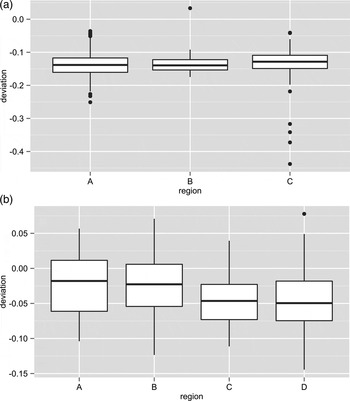
As for cattle, the populations kept by the inhabitants of the oppida of the northern Alpine foreland (Manching, Berching-Pollanten) appear on average slightly more robustly built compared to their relatives in the contemporaneous inner Alpine region (Figure 3b). Statistical comparison (Kruskal-Wallis test with Bonferroni correction (Field et al., Reference Field, Miles and Field2012)) shows, however, that most differences are not significant; additional finds from the inner Alpine region are necessary to clarify this issue. The somewhat smaller body mass of Alpine cattle, as suggested by the osteometric comparison, can probably be explained by poor husbandry conditions and environmental stress, caused by long winters and fluctuating availability of food so typical of mountainous regions. However, prior to the introduction of modern technologies, smaller-sized cattle breeds, well-adapted to the harsh conditions of the Alps, benefitted from a long tradition that can be traced back to the Bronze and Iron Ages (Pucher, Reference Pucher and Mandl2006, Reference Pucher2010). By contrast, clearly larger-sized cattle were present in the southern Alpine foreland in the period, e.g. in the Veneto (Riedel, Reference Riedel1986: 18–19).
Animal Husbandry in the Early Roman Northern Alpine Foreland
Cultural changes caused by the incorporation of a new region into the Imperium Romanum were accompanied not only by societal and economic transformation, but also by marked changes in animal husbandry and breeding targets, as evidenced for instance in Gaul (e.g. Méniel, Reference Méniel1993; Lepetz, Reference Lepetz, Meeks and Garcia2008), the Iberian Peninsula (Colominas, Reference Colominas2013), and the Roman north-western provinces of Germania, Raetia, and Noricum (Peters, Reference Peters1998). In inner Alpine Raetia, and for reasons of eco-geography, however, the Roman animal economy continued to have high proportions of small ruminants (Riedel & Rizzi, Reference Riedel, Rizzi and Cavada1994: 236; Donat et al., Reference Donat, Flügel and Petrucci2006). The combination of archaeozoological data with the archaeological evidence (e.g. Segard, Reference Segard2009) and the pollen record (e.g. Oeggl, Reference Oeggl, Biagi and Nandris1994) documenting the exploitation of mountain pastures in Antiquity indicates that, in Alpine economies, caprine herding continued to be a cornerstone of animal subsistence.
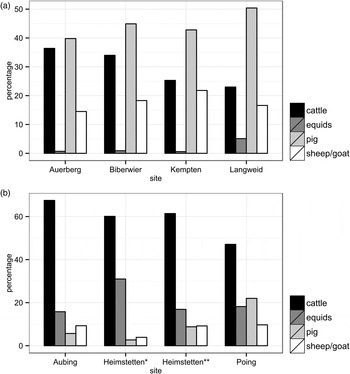
Compared to the inner Alpine region, more detail is available for the Early Imperial northern Alpine foreland. As mentioned before, there are two different scenarios with respect to the presence of indigenous groups in the northern Alpine foreland at the onset of the Roman conquest. Once under Roman control, cultural (including faunal) developments would have been broadly similar across the northern Alpine foreland, according to current opinion. But ongoing faunal analysis of Early Imperial sites in the northern Alpine foreland does not confirm this picture. With respect to animal farming, the Heimstetten group in north-eastern Raetia stands out in many ways. As illustrated in Figure 4, the faunal assemblage of the eponymous site of Heimstetten contains large proportions of cattle and equids. Conversely, caprines and pigs—i.e. farmyard species that were well represented in the preceding settlements of the La Tène ‘oppida civilisation’ and the Southeast Bavarian group as well as in early Romanized contexts along the Via Claudia Augusta in north-western Raetia—only make a minor contribution (Figure 4a, see also Figure 2). Faunal assemblages from other Heimstetten group sites (Aubing, Poing) support this assessment (Figure 4b). Since the Heimstetten group bone assemblages from the Munich gravel plain are poorly preserved, the question arises of whether taphonomic bias favoured the survival of remains of large mammals at sites located there. This seems not to be the case because, from prehistory (Schefzik, Reference Schefzik2001: 171–76) up to early medieval times (Schäffer & von den Driesch, Reference Schäffer and von den Driesch1983: 33, tab. 1), cattle always ranked first, whilst small ruminants and pigs fluctuated in numbers. This is also true for the early medieval settlement of Kirchheim, which is located in the immediate vicinity of the eponymous site of Heimstetten (Schäffer & von den Driesch, Reference Schäffer and von den Driesch1983: 33, tab. 1). Another feature typical for the Munich gravel plain is that most animal remains associated with the Heimstetten group come from archaeological contexts like pits and well shafts. The latter also contained partial skeletons, but, since we focus on meat supply, these were excluded from our calculations.
Relative proportions of main livestock species in Roman Raetia based on NISP counts. 4(a): Roman-Mediterranean sites: Auerberg , Biberwier (c. first century AD), Cambodunum/Kempten (only late Augustan to early Claudian occupation period; n = 1044) and Langweid (only late Augustan/early Tiberian to Claudian occupation period; n = 713). 4(b): Heimstetten group sites: Aubing (complete assemblage), Heimstetten (*first century ad; n = 406; **late first to early second century ad; n = 928) and Poing (complete assemblage).
Telling changes are also reflected in the overall size of cattle, as shown by the logarithmic size index calculated for populations excavated in La Tène-period and Roman-Mediterranean influenced settlements compared to the site of Heimstetten (Figure 5). With respect to the cattle raised in the vicinity of the newly-founded Roman settlements along or near the Via Claudia Augusta at Aislingen, Auerberg, Cambodunum/Kempten, and Langweid, only a minor increase in body size could be observed compared to cattle from the preceding La Tène period. Moreover, the distribution of the values in the plots of these early Roman populations points to an amalgam of different types of cattle. Conceivably, in order to achieve their breeding targets, early Roman cattle breeders selected indigenous stock for crossing with imported larger-sized (male) individuals exhibiting the desired characteristics and phenotype. In this way a gradual improvement in the performance of landrace breeds that were optimally adapted to the local landscape and vegetation would be achieved. The continuous size development on the one hand, and the appearance of some large individuals as well as a limited, initial increase in bone size on the other, points to such a practice during the first century ad. Presumably the need for strong animals to pull heavy loads or cultivate extensive fields was at the origin of this development, but an increasing demand for meat seems to be an option as well. In all Roman-Mediterranean settlements, females strongly dominate the adult age cohort, which points to selective slaughter of immature males. Nonetheless, it seems that local breeds persisted. The reason for this may have been the lower milk production in hybrid cows—according to the Roman writers on agriculture, Mediterranean breeds were not very prolific in this respect—combined with continued demand for dairy milk by the local human population (Peters & Manhart, Reference Peters, Manhart, Hüssen, Irlinger and Zanier2004).
LSI (logarithmic size index) of: A: ‘oppida civilisation’ cattle populations (n = 217); B: the Heimstetten group (n = 28); and C: the Roman-Mediterranean milieu (n = 434). Based on own research and published data (see Table 1).
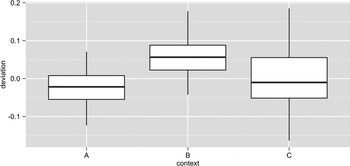
The metric data obtained from the Heimstetten group show a completely different picture. By the middle of the first century ad, body size in cattle had already surpassed that of their La Tène-period relatives by a wide margin. The narrow distribution of their values (Figure 5) indicates a rather uniform population that does not fit the model of slow amelioration across many generations including local breeds. One possible explanation is that we are dealing with an imported breed, whose region of birth still needs to be identified through stable isotope analysis. Alternatively, systematic replacement of local stock by out-breeding must be considered. In this case, performance is enhanced rapidly by back-crossing with parental stock. In doing so, the genetic make-up is halved with each subsequent generation, and after only six generations, or about fifteen years, a mere 1.6 per cent of the local breed's original genetic make-up remains (Sambraus, Reference Sambraus1994: 23). Unfortunately, the ratio males to females in the assemblage cannot be specified due to small sample size and high degree of fragmentation.
This raises the question why such amelioration is not evidenced in early Roman urban centres like Cambodunum/Kempten. Possibly the meat supply of the newly-founded settlements at the foot of the Alps was based on indigenous Celtic/Raetic montane-adapted breeds reported to be of small stature (e.g. Pliny, Natural History, VIII.70). Pollen analysis within the site catchments of the early Roman sites of Auerberg (Küster, Reference Küster1986) and Biberwier (Oeggl, Reference Oeggl and Walde1998) support the hypothesis of continuity in Late La Tène/early Roman land use. Presumably these well-established traditional methods of food production sufficed to cover the needs of the early colonists. This diet was supplemented with the meat of pigs and chicken, two species typical for Roman urban centres and likely to have been bred locally.
Besides species composition and size in cattle, several other characteristics in the animal bone assemblages of the Heimstetten group distinguish this cultural entity from Romanized sites along the contemporaneous Via Claudia Augusta. Examples include the low visibility of poultry farming (if at all) and the way carcasses were treated during butchery (implying Iron Age roots), but these aspects will be treated elsewhere. The investigation of slaughter ages, to examine differences in animal exploitation strategies, would be of interest too. But comparison of age profiles in livestock from Roman-Mediterranean and first century AD Heimstetten group sites is hampered by the very low frequency of dental remains in the latter, precluding any test or statistical analysis.
Concluding Remarks
From the foregoing we can conclude that faunal developments in the Munich gravel plain are distinct from those observed on contemporary settlements in western Raetia, which was clearly more susceptible to Roman influence. Whereas sites in the catchment area of the Via Claudia Augusta bear testimony to the Roman-Mediterranean lifestyle in their architecture, material culture, and patterns of animal exploitation, such as specialized meat processing—i.e. smoking of meat, characteristic carcass processing—and the appearance of imported animals (probably ‘lapdogs’ and certainly sea shells), people living in the Munich gravel plain in the first century ad seem to have been quite reluctant towards external cultural influences. Most interestingly, the La Tène-influenced, nativist Heimstetten group struck new ground in the breeding of cattle. In a region poor in geographical assets and natural resources, husbandry of large livestock may have offered a sustainable income for the inhabitants of the Munich gravel plain since the Early Bronze Age (Schefzik, Reference Schefzik2001: 175). Clearly, the exploitation of this landscape did not change in the Roman period. Presumably cattle breeding filled an economic niche that could perhaps offer an explanation for the extraordinary outfit of the female deceased. The fact that cattle breeding was one of the economic mainstays in the Munich gravel plain since prehistory is a major argument against the hypothesis that people of the Heimstetten group immigrated from the Inn valley. As shown above, livestock breeding in the Fritzens-Sanzeno culture focused on sheep, and it is reasonable to assume that on the Munich gravel plain sheep husbandry would have been successful if people had chosen to pursue it.
To conclude, fundamental differences in animal husbandry practices between the Fritzens-Sanzeno culture and the Heimstetten group make an inner Alpine origin of the latter unlikely. Rather, continuity in building tradition, burial customs, and large livestock farming all point to a cultural entity rooted in the tradition of the preceding La Tène culture. Future study of bioarchaeological assemblages covering the period of transition between the Iron Age and the Roman period, as well as the application of stable isotope analysis and palaeogenetics to human and animal remains, will help ascertain whether this hypothesis holds or whether further explanatory models are required.
Acknowledgements
The funding of the project ‘Transalpine mobility and cultural transfer’ by the German Research Council (Deutsche Forschungsgemeinschaft, DFG, PE 424/11–1, 2) is gratefully acknowledged. G. McGlynn kindly provided a translation of this contribution.



