

Location of Buthiers-Boulancourt and view of Burial 416.

Instances of trepanation have been documented on many occasions amongst Linearbandkeramik (LBK) and post-LBK burials in Europe. Other surgical interventions, such as amputations, have, however, been recorded more rarely and remain difficult to identify.
It appears that such a case can be documented at a site excavated in 2005 in advance of sand quarrying at Buthiers-Boulancourt, 70 km south of Paris (Samzun et al. 2006) (Figure 1). This Neolithic site was occupied by agro-pastoralists of the LBK culture: seven longhouses were dated, by the pottery found in their borrow pits, to the later Blicquy-Villeneuve-Saint-Germain period or 4900-4700 BC (Durand et al. 2008), which corresponds to the late and post-LBK period in Central Europe. The site also contained two small groups of burials consisting of two and three pits containing single inhumations, as is the norm for this period (Reference JeunesseJeunesse 1997). An isolated cremation was also found.
The body with schist axe near skull and, over the left humerus, a long flint pick. A poorly-preserved domestic animal lies at the feet of the body.

The burial under discussion was located in the settlement area, a few metres from a borrow pit, and produced a radiocarbon date of 4906-4709 cal BC (GrA-31022: 5860±40 BP, Groningen, Centre for Isotope Research, calibration OxCal 2007). The burial pit was oblong, measured 2.5 x 1.6m and was 1.5m deep. This is unusual, not only compared to the other burials on the site which are shallow and respect the size of the individual buried, but also for LBK burials in general. The limestone subsoil proved no obstacle to this deep excavation.
The person buried was oriented east-west, head at the east, looking south. Burial position is typical, i.e. flexed and lying on the left side, with lower limbs and knees brought up to the left (Figure 2). The feet are close together and the right arm is bent, the hand close to the left shoulder. The left upper arm is slightly away from the upper body. No trace of the lower left arm or hand was found. There are no reasons, such as sediment type, variations within the soil or disturbances, which could explain this absence.
The grave goods
Schist axe and flint pick. These grave goods are unusual in burials of the Blicquy-Villeneuve-Saint-Germain period (photograph: Inrap).

The objects deposited in the grave are not typical of Blicquy-Villeneuve-Saint-Germain. They consist of a long axe made of polished schist found near the skull and of a very large flint pick placed at right angles to and over the upper left arm. A very young animal (sheep or goat according to C. Bemilli) was at the feet of the skeleton. Complete animal offerings are rare in Early Neolithic burials, parts of animals (leg, jaw or head) being more common.
The schist axe is 205mm long, 40mm wide, 25mm thick and weighs 217g (Figure 3, left-hand). Made of imported material (from the Ardennes?), its blade is oval in section, very narrow and elongated. It is substantially longer that the examples known from burials of this period. Long axes have only rarely been excavated on settlements, and then in the form of fragments, and never in burials of the Blicquy-Villeneuve-Saint-Germain area. This object is rare in the Paris Basin and may have been a prestige object (Samzun et al. in press).
The very large flint pick is 300mm long, 45mm wide, 37mm thick and weighs 542g (Figure 3, right-hand). It is oval to lozenge-shaped in section and polished at both ends as well as on parts of its surface. Use-wear analysis reveals that it was little used and traces of polishing are still visible on the whole object. This type of tool, usually small (around 100mm long) and roughly made, appears in north-western Europe at the end of the Blicquy-Villeneuve-Saint-Germain period and becomes common in the post-LBK, around 4500 BC (Reference AugereauAugereau 2004). A few very large (300mm and more) examples are known but all are chance finds.
These two objects, unusual in the Blicquy-Villeneuve-Saint-Germain complex, show that the burial in which they were found is of an exceptional person. It is however impossible to tell whether the grave goods belonged to the deceased or whether they were especially made for his funeral.
Biological study
While the bone is robust and well preserved for a burial of this date, it is nevertheless quite fragile. The longbones are best preserved; other bones, such as vertebrae or pelvic bones, although recorded in situ, were particularly delicate to lift and this has resulted in some loss of information. Nevertheless, the morphological characteristics of the coxal bones clearly indicate a male (Bruzek 1992) and the degree of cranial synostosis (Masset 1982) shows that he was mature to old. Many osteoarthtitic changes are visible, in particular on the cervical vertebrae, with eburnation of the extremity of the second vertebra, as well as along the remainder of the spine, with interapophysal lesions, with the yellow ligament ossified. The lower limbs are also affected from the knees to the feet. One thoracic vertebra displays a Schmorl's node. The upper and lower jaws show that all the teeth were lost during life, with partial resorption and infection of the gums.
Detail of the amputated humerus (photograph: LDA CG 94).

The amputation
Particular attention was paid to the incomplete left arm right from its discovery. Bones or parts of limbs can be missing from archaeological skeletons, usually for reasons linked to differential preservation or local disturbance, such as observed in the animal deposit which accompanied the burial. However, the bones of the latter were still all present, though poorly preserved because disturbed and the immaturity of the animal. Disturbance cannot account for the absence of the human bones. No element or trace of the forearm or hand was recovered elsewhere in the grave and the bones immediately next to the expected location of this limb were not decayed. The left humerus is identical to the right, except that the distal end of the former is missing. Its surface exhibits an abnormal straight edge, which cannot be attributed to excavation. Based on observation of the bone and the complete absence of forearm, we therefore propose that this is a case of amputation.
Detailed examination reveals that the distal end of the humerus shows a clear cut at the epitrochlea, on the medial and lateral epicondyles (Figure 4). The cuts are oblique, angled downwards and towards the interior in the case of the epicondyles, and downwards and towards the exterior in the case of the epitrochlea, which suggests trauma rather than a congenital malformation. Moreover, the absence of progressive bone thinning at the extremities rules out any teratological causes such as amelia, hemimelia or other partial or complete congenital anomalies. On the other hand, some degree of post-mortem damage was observed on the epiphysis.
Three-dimensional microtomographic reconstruction of the humerus, distal view (A. Mazurier). Click to enlarge.

Radiological and microtomograhic examination resulted in a three-dimensional reconstruction of the bone (Figures 5 & 6). All the images show that, despite some post-mortem modification of the surface of the bone, there are signs of healing (Figures 5 & 6, white arrows), i.e. a new layer of cortical bone has formed.
The cuts are located just above the trochlea, where the bone is particularly robust and difficult to cut, especially if using flint. It would have been much easier to cut a little higher up, on the diaphysis. We think that the original trauma, whatever its cause, must have partially severed the forearm. The surgical intervention then took advantage of the trauma, cutting only what was still attached, which would explain why the cut was placed in such a linear fashion. We further suggest that this represents not an accidental amputation but a true medical procedure. A fragment of cortical bone on the posterior side indicates that the surgeon proceeded from the anterior towards the posterior side, and that the weight of the forearm, perhaps assisted by the surgeon, caused the last few millimetres of cortical bone to break away, as when cutting a piece of wood (Figure 4, yellow arrow). The arm was probably slightly raised to allow the elbow to be extended.
How long before death healing took place is estimated, from the thickness of the cortical bone, to have been several months or years. The macroscopic examination has not revealed any infection in contact with this amputation, suggesting that it was conducted in relatively aseptic conditions. The newly-formed cortical bone is denser than the original bone. Moreover, a comparison of the diameters, thicknesses and densities of the shafts of the left and right humeri shows that the left upper arm was mobile, as it is neither atrophied nor calcified. No traumatic lesion which would throw light on the need for this surgery or its context could be observed on the rest of the skeleton. Altogether, the sum of the elements at our disposal, i.e. the siting of the cut, the absence of bone thinning, the presence of cicatrising tissue, the radiological and microtomographic images, would support our hypothesis.
Three microtomographic reconstructions of the Neolithic humerus compared to a modern humerus. Signs of healing are visible on the two top images. The yellow line on the bottom image shows the site of amputation on the comparative modern humerus (right). The yellow arrows show the olecranon fossae between the lateral and medial epicondyles and the abnormal development on the Neolithic bone. Click to enlarge.

We believe this to be the earliest case of an intentional and successful amputation recorded in France. The patient survived the operation, benefiting from good medical knowledge, including knowledge on how to stop bleeding and infection and how to promote healing. Such know-how is not unexpected, as surgical interventions on bones, for example trepanations (Reference LisowskiLisowski 1967) are known earlier, for example on Mesolithic (Reference LillieLillie 1998) and Early Neolithic (Alt et al. 1997) subjects.
Amputation, on the other hand, is rarer and more difficult to document. Examples in the Early Neolithic include two cases in the LBK. At Sondershausen, the individual in Burial 18 (one of 45 graves) is buried on his back, with legs flexed to the left, right arm bent over the chest and hand on the left shoulder; here too the other forearm and hand are missing, without any trace of disturbance noted in the grave (Reference KahlkeKahlke 2004). Unfortunately the graphic records of the 1950s excavation were poor. It seems, however, that the humerus shaft is almost complete, suggesting an amputation similar to that of Buthiers-Boulancourt. It is not known whether this is the result of trauma or of a surgical procedure.
An LBK burial at Vedrovice in Moravia (Czech Republic) comes from a site excavated between 1975 and 1982 which contained 110 graves (Reference PodborskyPodborsky 2002). Burial 82 consisted of the remains of an old man buried prone, with all limbs flexed and the left forearm bent under the chest. The hand and the distal extremities of the radius and ulna are missing. A study by Crubézy (1996) concludes that this represents a healed intentional amputation after trauma.
These examples suggest that medical practice was well developed in the Early Neolithic. Such medical knowledge is also documented in later phases (Mavroforou et al. 2007), for example in later Neolithic Germany (Grupe & Herrmann 1986) or in Bronze Age Israel (an amputated hand: Bloom et al. 1995). Though our examples are selective, the phenomenon nevertheless remains marginal, most probably because it is difficult to record signs of amputation on very old bones. At Buthiers-Boulancourt we benefited from good excavation conditions and the latest advances in medical imaging.
Conclusion
The proposed Buthiers-Boulancourt amputation was a successful surgical intervention. Despite losing part of an arm and suffering from probably painful osteoarthritis, the elderly individual survived in the community. The prestigious grave goods and the unusual character of the burial pit all suggest that he occupied a special place in the social order. The two tools, a schist axe and a flint pick, which are otherwise unknown in the Blicquy-Villeneuve-Saint-Germain area, also show that the tool-makers of the later Early Neolithic were accomplished craftsmen, a feature not always apparent from the assemblages recovered in the settlement's refuse pits.
Though we can only speculate about the status and the individual, it seems that the community looked after him and that his disability did not exclude him from the group. The other LBK examples cited seem to confirm this. The image projected is that 7000 years ago there was advanced medical knowledge and complex social rules operating amongst the farming communities of Europe.
Technical note
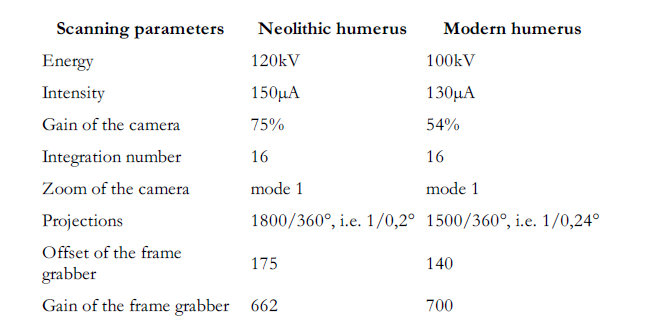
The Neolithic and modern humerus microtomographic records were made at the University of Poitiers, with an X8050-16 Viscom model (on 26 February 2007 and 4 March 2007 respectively).
Scanning procedure: Both bones were scanned by A. Mazurier according to the following parameters:

Neolithic humerus: reconstructed volume has a 1004x1004x1004, 8bits format with a resolution of 63.0637µm3. A ring artefacts correction was carried out and the original uCT slices reduced. The 845 final 8bits-tif format sections of 848x426 pixels have a resolution of 63.0637µm3.
Comparative modern humerus (coll. Univ. Poitiers): reconstructed volume has a 1004x1004x1004, 8bits format with a resolution of 68.2275µm3. A ring artefacts correction was carried out and the original uCT slices reduced. The 976 final 8bits-tif format sections of 897x434 pixels have a resolution of 68.2275µm3.
Acknowledgements
We thank R. Macchiarelli, UMR 6046, University of Poitiers, for suggestions and help, particularly with scanner imagery. The microtomographic images were by A. Mazurier, ERM, Poitiers. A first CT scan and conventional radiography were performed in the University Hospital of Garches by R. Carlier, MD, and reviewed by I. Huynh, MD, from the University Hospital of Pitié-Salpétrière. A first microtomographic record was made by Prof. B. Tavitian and his team (Orsay). Use-wear analysis on artefacts was carried out by M. Christensen (University of Paris I, Sorbonne) and identification of the animal bone was by C. Bemilli, Inrap-UMR 5197. Thanks are also due to Nathan Schlanger, Inrap, to J.-P. Farruggia, UMR 7041, who helped with comparanda in the LBK area and to our referees.