




INTRODUCTION
The historiography of the Golden Horde (1221–1438 CE), the successor of the Mongol World Empire ruled by Chinggisids, is not well defined and bears many contradictories and misinterpretations, partly due to the scarcity of Mongol written chronicles about the internal affairs of the Gengghis Khan’s family (Halperin Reference Halperin1985; Uskenbay Reference Uskenbay2013). Traditionally, the history of Ulus Jochi integrates much lore, legend, and oral genealogy, as well as written narratives from Buddhist cosmology, and Latin, Chinese, Russian, Arab, and Persian chronicles that originated in the conquered states or outside of the nomadic empire (Suleimenov Reference Suleimenov1969; Masanov et al. Reference Masanov, Abylkhozhin Zh and Yerofeeva2007; Yurcheko Reference Yurchenko2008; Usmanova et al. Reference Usmanova, Kozha, Uskenbay, Akhatov and Dzhumabekov2021). The history of the later states in Central Asia representing a direct continuation of the parent Golden Horde (Uskenbay Reference Uskenbay2003) consists mostly of oral tradition. Medieval archaeology of Kazakhstan has been effectively rationalized to the material culture of the Golden Horde (Margulan Reference Margulan1948; Usmanova et al. Reference Usmanova, Dryomov, Panyushkina and Kolbina2018), yet the framework and legitimacy of Chinggis’s dynastic history is constrained by a lack of chronological evidence.
Recent archaeological surveys throughout central Kazakhstan describe a considerable amount of preserved historical architecture attributed to the Golden Horde (Khorosh Reference Khorosh2010, Reference Khorosh2011). However, the age of the medieval structures is mainly approximated from architectural elements or oral tradition (Gerasimov Reference Gerasimov1957; Margulan Reference Margulan1974; Yegenbayuly Reference Yegenbayuly2001; Khorosh Reference Khorosh2011). The lack of adequate calendar-defined evidence is a challenge to the authenticity and origin of the historical unions (Masanov et al. Reference Masanov, Abylkhozhin Zh and Yerofeeva2007; Yerofeeva Reference Yerofeeva2016). Clustering of large mausoleums that have been well-kept and worshipped for 500–700 years could be not coincidental and certainly conveys a special historical memory of Mongol and Turks tribes of Central Asia preserved in architecture. We propose to define the age of these masonry structures with radiocarbon dating which will help outlining an improved calendar-based chronology of the Golden Horde archaeology in Kazakhstan.
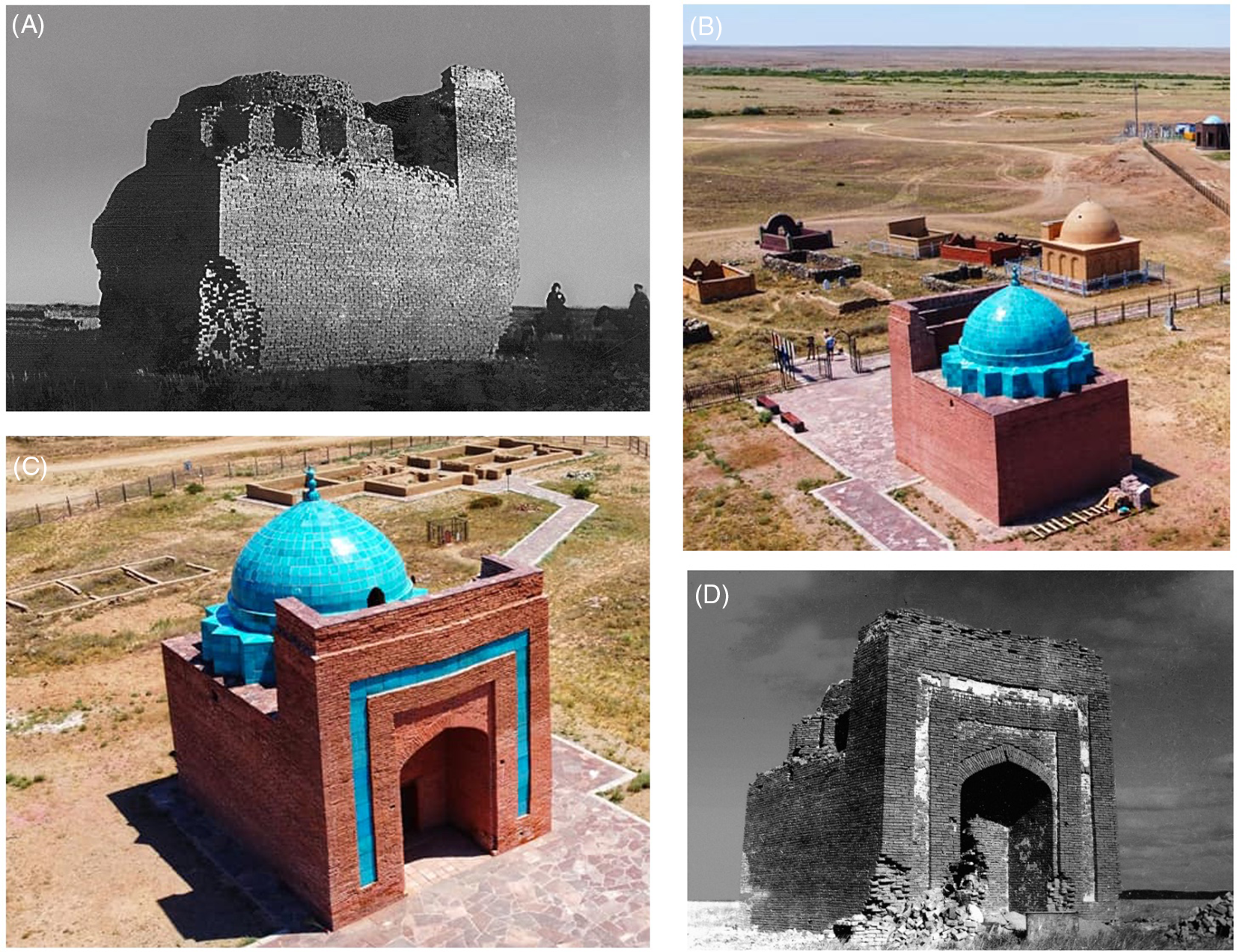
In the Ulytau Mountains of central Kazakhstan, there are several dozen medieval monuments, including mausoleums, necropolises, and ancient settlements built of burnt bricks from the time of the Golden Horde (13th–15th centuries). A total of 34 mausoleums have been documented there, four of which have preserved architecture and 30 others have only structural footings remained (Khorosh Reference Khorosh2009; QORYQ 2021). The most significant of them is the mausoleum of Jochi Khan (or Zhoshy-khan in Kazakh language). Jochi (ca. 1182–1225) was the oldest son of Gengghis Khan, an accomplished military commander and the founder of the Golden Horde also called the Ulus of Jochi. According to legend, he died while hunting, falling from a horse, and his funeral was carried out according the Chinggis protocol for sacred burial. The mausoleum of Jochi Khan is a medieval burial structure in a shape of a single-chamber domed portal (Figure 1). It was erected according to Islam tradition and presently surrounded by nine other smaller mausoleums. In Medieval Central Asia, a mausoleum was the most popular type of building and site after the mosque (Barthold and Rogers Reference Barthold and Rogers1970; Hillenbrand Reference Hillenbrand1999). The structure includes many key elements of medieval tomb architecture: a massive domed square tower built of burnt bricks, a portal with a rectangular frame around an arched opening, geometrical drum carrying the double dome (inner and outer), gallery, stucco vaults, and decorations with blue glazed tile (Gerasimov Reference Gerasimov1957; Khorosh Reference Khorosh2009).
Jochi Khan Mausoleum in Ulytau, central Kazakhstan as seen in ca. 1946 and now. Black and white photos (A, D) by architect G.G. Gerasimov circa 1946 are from the archive of KazRestovratsia, (Almaty, Kazakhstan) edited by M.A. Antonov. Color photos (B, C) by V. Shuptar (Karaganda) are the most recent view of the mausoleum after the latest restoration (2018–2020). A–B is northeast direction with the dome view. C–D is the portal facing the Qibla direction (southwest) toward the Kaaba in Mecca. (Please see electronic version for color figures.)
The mausoleum building has been known under this name since the 16th century from the description by Hafeez Tanysh (court historian) of the emir of Bukhara, Abdullah Khan, who visited Ulytau during his military campaign in the spring of 1582 (Suleimenov Reference Suleimenov1969). Folk stories, historical maps, and travelers’ narratives commonly described the Mausoleum throughout the 19th and 20th centuries (Barthold and Rogers Reference Barthold and Rogers1970; Yegenbayuly Reference Yegenbayuly2001; Khorosh Reference Khorosh2009). The first scientific documentation and mapping of the Mausoleum architecture occurred in 1946–47 (Gerasimov Reference Gerasimov1957). Also in 1946, the excavation of the mausoleum’s two burials has found a human skeleton with missing bones of one hand, animal bones, a camel skull, fragments of leather and fabrics, and a female skeleton in another crypt (Margulan Reference Margulan1948). Two decades later A.Kh. Margulan (Reference Margulan1978) suggested that the skeleton in the first coffin (sometimes also referred as a wooden box) belonged to Jochi Khan “who was buried one year later after his death in a new mausoleum built in 1228” (Margulan Reference Margulan1978). This statement began the official recognition of the mausoleum as the burial place of Jochi Khan.
This hypothetic affiliation had been doubted by many researchers, primarily because Jochi as all Genghis’s family had practiced Tengrism, while the mausoleum is designed following the Islamic burial tradition. It is well known from historical evidence that Tengrism kept elite burial places in inaccessible, secret and sacred place under the protection of the ancestors (Barthold and Rogers Reference Barthold and Rogers1970; Rykin Reference Rykin2010), since looting of burials (often practice in the past) was believed to weaken the clan’s power (Yurchenko Reference Yurchenko2008; Usmanova et al. Reference Usmanova, Kozha, Uskenbay, Akhatov and Dzhumabekov2021). Barthold and Rogers (Reference Barthold and Rogers1970) explicitly stated that the burial rites of a Khan remained exactly the same throughout the Mongol Empire, and the royal cemetery was forbidden ground and the grave was not indicated in any way. Interestingly, the name of “Ulytau” is a derivative from the word “Ulug” which is translated from Kazakh and many other Turk languages as a “Grand Place” in the sense of veneration (Sembi Reference Sembi2014). Moreover, Islam only became an official religion of the Golden Horde in the beginning of the 14th century (1313 CE, Halperin Reference Halperin1985; DeWeese Reference DeWeese1994). Recently, the year of Jochi Khan’s death was corrected from 1227 CE to 1225 CE with new analysis of written historical documents (Uskenbay Reference Uskenbay2003).
In this study, we aim to establish the calendar age of the coffin and the building of the mausoleum in order to test the hypothesis that Jochi’s remains could have been reburied shortly after his death since the Chinggis funeral tradition excluded the Islamic mausoleum. The human bones from the Margulan’s excavations are currently inaccessible. This predicament limits our approach to the datable materials that are available. Nevertheless, 14C dating can potentially link the historical evidence and calendar dates of the mausoleum. Additionally, this will confirm the prospect on developing a calendar chronology of the Golden Horde in Kazakhstan with radiocarbon dating of the medieval architecture.
METHODS AND DATA
We analyze the age of three wood samples collected at the Jochi Khan mausoleum under different restoration projects in 1997, 2001, and 2021. The mausoleum is located on the left bank of Kara-Kengir River (48°09ʼN, 67°49ʼE). A small piece of a wooden coffin (AA106632) from the burial inside the domed chamber was sampled in 1998 during the burial re-excavation (Yegenbayuly Reference Yegenbayuly2001). Another wood sample (DeA-19262) was cut from a scaffolding attached inside the brick wall at 1/3 height from the ground at the main façade. A third wood sample (DeA-30740) was the end of door- saddle threshold that was subsampled at the archive of National Historical, Cultural and Natural Reserve-Museum “Ulytau” (QORYQ 2021) in Zhezkazgan, Karaganda Oblast. The original wood of the doorway was archived after the latest restoration of the mausoleum. All samples are small pieces of wood with few of visible rings that are not suitable for tree-ring cross-dating that requires >50 rings (Figure 2). The coffin plank is made of a conifer species (probably pine) and two other samples are construction timbers from deciduous trees cottonwood/poplar species which are presently grown in the vicinity of the mausoleum. The curvature of the rings indicates that the wood was harvested from relatively young trees of 20–30 years of age.
Samples of the timbers used in 14C dating. A is the piece from the coffin; B is the weathered end of scaffolding beam from the facade.

Wood samples were cleaned and checked for possible contamination then grounded to 20 μm-mesh. The 14C-dating was performed at two AMS facilities: the NSF-Arizona AMS facility, University of Arizona, USA (Arizona) and the Isotope Climatology and Environmental Research Centre, Debrecen, Hungary (ICER). Each powdered sample was converted to α-cellulose using pretreatment by sodium chlorite bleaching at pH 3 (Leavitt and Danzer Reference Leavitt and Danzer1993; Molnar et al. Reference Molnár2013a). The cellulose samples were combusted to CO2 and converted to graphite, and 14C dating was performed using the 3MV Pelletron AMS (National Electrostatics Corporation) operated at 2.5 MV in Tucson, Arizona, and a 200kV MICADAS (ETHZ, Zürich, CH) in Debrecen, Hungary using standard facility protocols (Jull et al. Reference Jull, Burr, Beck, Hodgins, Biddulph, McHargue and Lange2008; Molnar et al. Reference Molnár, Rinyu, Veres, Seiler, Wacker and Synal2013b; Rinyu et al. Reference Rinyu, Molnár, Major, Nagy, Veres, Kimák, Wacker and Synal2013; Janovics et al. Reference Janovics, Futó and Molnár2018). Carbon-14 calculation and error data reduction were done using the standard BATS software (Wacker et al. Reference Wacker, Christl and Synal2010). The fraction of modern carbon, F is defined as the 14C/12C ratio relative to 1950AD (Stuiver and Polach Reference Stuiver and Polach1977; Donahue et al. Reference Donahue, Linick and Jull1990) and this can be converted to an uncalibrated radiocarbon age using the standard formula, $14C\;age = \left( { - {1 \over \lambda }} \right)\ln F$
Where λ is 1.245 × 10⁻⁴, the decay constant based on the Libby half-life of 5568 yr. The calendar age range can be determined from the uncalibrated age using the OxCal v4.4 program (https://c14.arch.ox.ac.uk) and the IntCal20 calibration curve (Reimer et al. Reference Reimer, Austin, Bard, Bayliss, Blackwell, Ramsey, Butzin, Cheng, Edwards, Friedrich, Grootes, Guilderson, Hajdas, Heaton, Hogg, Hughen, Kromer, Manning, Muscheler, Palmer, Pearson, van der Plicht, Reimer, Richards, Scott, Southon, Turney, Wacker, Adolphi, Büntgen, Capano, Fahrni, Fogtmann-Schulz, Friedrich, Köhler, Kudsk, Miyake, Olsen, Reinig, Sakamoto, Sookdeo and Talamo2020).
RESULTS
To determine the calendar age of the Jochi Khan mausoleum, we analyzed new and the only available, as of now, accelerator mass spectrometry radiocarbon (AMS 14C) dataset from three wood samples measured at two AMS facilities: ICER and Arizona (Table 1). All 14C measurements from both AMS facilities are high quality and show a coherent time sequence. The error of measurements is adjusted to 18–26 calendar years and the length of 68% range of calibrated dates are ∼100 yr. The result of the 14C ages calibration is shown in Figure 3. The 3-point sequence of the developed dates matches well the structure of IntCal20 calibration curve for the interval 1220–1400 CE (Figure 4). The calibrated sequence determines the chronology of the studied burial. From the midpoints of the calibrated intervals (95.4%) the coffin timber was harvested ca. 1243 CE (Figure 4). Since Jochi passed away in 1225 CE, the 95.4% confidence interval for the wood of 1218–1268 CE is consistent with this age, yet the mid-point indicates the age of the coffin wood about 20 years later. Masonry work on the mausoleum building continued throughout the 14th century. The bricks of the front facade were laid ca. 1350 CE according to the midpoint of carbon-14 date derived from the wall-top scaffolding. Meanwhile, the door to the burial chamber was installed, most likely, in 1280–90 (Figure 3).
Summary of wood samples and 14C dates from the Jochi Khan Mausoleum. DeA-ICER in Debrecen and AA-Arizona in Tucson.

Calibration of three 14C dates from the Jochi Khan Mausoleum. The probability distribution of 14C calibrated dates at 95.4% range (gray) calculated in OxCal v.4.4 program is plotted against the IntCal20 curve (blue line). 14C age with 68% range is shown in red. See Table 1 for the datils of the 14C dates.

Sequence of three calibrated 14C dates plotted on the IntCal20 calibration curve. Red frames show the intervals of calibrated ages for the coffin and the mausoleum building. See Table 1 for the sample details.

The gap between these two dates from the building probably delineates the period of two construction phases established by the architectural analysis of the masonry earlier (Khorosh Reference Khorosh2011). However, it would be useful to obtain more samples to better define the full period of construction. The mausoleum architecture suggests that the original part of structure had only the front portal with the central cupola (Figure 1). The decorative star-like drum of the cupola and the raised facade of the portal have appeared much later. Moreover, the installation of the decorative elements (e.g., blue glazed tile, gallery, stucco vaults and inner dome) was associated with the increasing importance of the tomb during the rule of the Timurids at the late 14th–15th centuries (Khorosh Reference Khorosh2011). It is well- known that the interior walls of the mausoleum were covered with several layers of stucco before and after the decorative interior renovations (Gerasimov Reference Gerasimov1957; Khorosh Reference Khorosh2009), which is the evidence of the continued maintenance of the building.
The dating results challenge the traditional attribution of the mausoleum to Jochi Khan. It is evident from the 14C dating that an older coffin was interred in a later mausoleum structure. Although, there is no historical evidence for such an important reburial of Jochi, Barthold thought there could be a possibility that the mausoleum was erected in the vicinity of the actual burial of Jochi (Barthold and Rogers Reference Barthold and Rogers1970). Ginsburg, who studied the anthropology of the skulls from the Margulan excavations, concluded that the bones most likely belong to the descendants of the Jochi clan (Ginsburg Reference Ginsburg1956). We think that the secret burial of Jochi could be located anywhere in the Ulus Jochi and its location remains unknown (Masanov et al. Reference Masanov, Abylkhozhin Zh and Yerofeeva2007; Yerofeeva Reference Yerofeeva2016; Usmanova et al. Reference Usmanova, Kozha, Uskenbay, Akhatov and Dzhumabekov2021). The mausoleum most likely contains the remains of members of the Jochi clan. However, to confirm this hypothesis, it is necessary to look for new historical evidence.
CONCLUSIONS
Our first 14C dating of Medieval construction timbers in Kazakhstan showed a great potential of this dating approach for developing the calendar chronology of the Golden Horde (Ulus Jochi). The attribution of the Jochi Mausoleum as the burial place of the Jochi Khan does not correspond with the dating results. The mausoleum was built about 100 years after the death of Jochi (1225 CE) and, more importantly, soon after Islam became the official religion of the Golden Horde (1313 CE). The historical date of the Jochi Khan Mausoleum ca. 13th–15th centuries should be narrowed down to the 14th century. The architectural context of the dated timbers suggests two phases in the mausoleum construction during the 14th century, which points to the importance of the complex for the Golden Horde elite. The coffin date from the burial excavated in 1998 is consistent with near the time of Joshi’s death or some decades later. The age of the coffin does not overlap with the age of the building materials. Perhaps the mausoleum complex was built for the descendants of Jochi Khan and named after Jochi to honor the great ancestor.
ACKNOWLEDGMENTS
This paper is dedicated to the memory of (1) Irina V Yerofeeva (1953–2020), Director of Institute for Cultural Heritage of Nomads, Kazakhstan, and (2) our dear colleague and friend Elena Khorosh (1957–2018), who passed away while this paper was being prepared for publication. E. Khorosh, historical architect, has surveyed the medieval structures in the Ulytau region and assembled multiple datasets for future chronology of the Golden Horde. The sampling efforts were supported by award NSF BCS #1122359. We would like to thank Anur Tolebaev, Director and Restoration Specialist of Ular-Ulytau Ltd, and Baktiyar Kojakhmetov, Director of the National Historical, Cultural and Natural Reserve-Museum “Ulytau” (2011–2021) for assistance in the field.


 Open access

