

Introduction
There is increased political realisation of the societal impacts of deteriorating biodiversity (Griggs et al. Reference Griggs, Stafford-Smith, Gaffney, Rockström, Öhman and Shyamsundar2013, IPBES Reference Brondizio, Settele, Díaz and Ngo2019). This is encapsulated in a variety of multilateral environmental agreements (MEAs), most notably the Convention on Biological Diversity (CBD), and in the UN Sustainable Development Goals, and national policies and strategies. The two main factors behind species extinction are continual growth in both human population and per capita consumption (Pimm et al. Reference Pimm, Jenkins, Abell, Brooks, Gittleman and Joppa2014, Guerry et al., Reference Guerry, Polasky, Lubchenco, Chaplin-Kramer, Daily and Griffin2015). These give rise to a variety of pressures that have direct consequences for species and the scale of these pressures is increasingly understood.
General patterns in the intensity and distribution of these pressures can be drawn from the IUCN Red List of Threatened Species (IUCN 2019). One of the most significant anthropogenic pressures is agricultural activity, with 62% (5,407) of those species that have been assessed as threatened or near threatened affected by crop farming, livestock farming, timber plantation, and/or aquaculture (Maxwell et al. Reference Maxwell, Fuller, Brooks and Watson2016). Overexploitation of species for consumption by humans has been long considered to be a significant threat to many species (Fa et al. Reference Fa, Currie and Meeuwig2003, Milner-Gulland and Bennett Reference Milner-Gulland and Bennett2003, Vié et al. Reference Vié, Hilton-Taylor and Stuart2009, Wittemyer et al. Reference Wittemyer, Northrup, Blanc, Douglas-Hamilton, Omondi and Burnham2014). Some species may also be overexploited for non-subsistence purposes, such as trade or recreation and there are many high-profile cases, for example tiger Panthera tigris, which is ‘Endangered’, and is hunted illegally because of the high commercial demand for its skin and bones. Often species are threatened by more than one threat, with the combined effects of overexploitation and agricultural activity having the greatest impacts on biodiversity (Mace et al. Reference Mace, Balmford, Boitani, Cowlishaw, Dobson and Faith2000, Peres Reference Peres2001). Together they affect 75% of all the species that have gone extinct since AD 1500 (Maxwell et al. Reference Maxwell, Fuller, Brooks and Watson2016).
Pressures on biodiversity may increase or decrease over time, and this may be over the short or long-term, and new pressures may emerge. As pressures change, the specific threats that they produce and negative impacts they have on species, and indeed other elements of biodiversity, will also change. Therefore, to identify the most appropriate conservation measures in a given place and time, whether policy, legislation, management, or some other intervention, we need to know that the conservation action will have a beneficial impact on species.
Aichi Biodiversity Target 12 stated that ‘by 2020, the extinction of known threatened species has been prevented and their conservation status, particularly of those most in decline, has been improved and sustained’ (CBD 2010). Although these targets are outdated, we continue to work towards preventing extinctions. To reach this target we need to go beyond simply understanding species extinction risks, and knowledge of pressures and their scale, and move towards detailed understanding of how to mitigate threats so that species can recover. In other words, we need to deepen our assessments of pressures and the conservation status of species so that we know which threats have a documented impact on species’ populations and where, so that when they are reduced they can result in population increases. In this paper, we explore what we know about threats to a group of 24 bird species, the Galliformes of the Himalaya.
Galliformes are important ecologically, economically, and culturally in the Himalaya and are one of the most threatened bird orders (McGowan and Fuller Reference McGowan and Fuller2006, Sathyakumar and Kaul Reference Sathyakumar and Sivakumar2007) and yet, no study specifically examines all threats facing an entire taxonomic group within the Himalaya. Most studies to date have focussed on only a few species, and we need to be clear about the impact of a reported threat on the population of a species. To make optimal use of limited conservation resources, we need to know with as much certainty as possible, what the threats are, where they occur, and whether there are any patterns in the type and spatio-temporal distribution of threats for Himalayan Galliformes. Given that they are often limited, it is important to balance the requirements for research into potential threats with those conservation actions that can be readily implemented. Information from multiple sources can then be integrated as part of a targeted response. A major challenge is that in general it is difficult to formally quantify the impact of a specific threat, for example as a result of ethical reasons, or simply because standard techniques available in other life sciences, such as randomised control trials, are not possible. This results in a greater reliance on subjective judgement that is widespread in the literature (e.g. Awan et al. Reference Awan, Ali and Lee2014).
There is a need to understand what is really known, rather than assumed, about the impacts of threats on species for which there is little extant information on their ecology, behaviour, or life-history. Where there is no firm information on how threats are affecting species and what is needed to address the threats, we need to structure our predictions logically and transparently (e.g. Grainger et al. Reference Grainger, Garson, Browne, McGowan and Savini2018). An objective approach must be taken to increase our understanding of threats to Galliformes where the quality of published evidence that a threat results in population decline is variable. In this paper, we seek to understand our knowledge of the threats facing Himalayan Galliformes by undertaking a literature search to identify the threats reported in the literature and the supporting evidence.
Methods
Assessing published knowledge of threats to Himalayan Galliformes
Search engines and search terms:
Searches were undertaken on the Web of Science core collection and Google Scholar for research articles that included potential threats to Galliformes in the Himalaya. Search terms were selected to maximise the possibility of obtaining relevant articles on all potential threats. The main aim of the literature search was to glean information on possible factors thought to cause declines in Galliformes in the Himalayan region, and what empirical evidence existed for these factors actually causing declines in species’ populations. The term “Galliformes” tends to be used in keywords of papers, if not in the paper themselves, to describe the taxonomic group to which each species belongs.
Web of Science was searched for terms “TS = ((galliform* OR pheasant OR partridge OR quail) AND threat*)”, “TS = ((galliform* OR pheasant OR partridge OR quail) AND Himalaya*)” and “TS = ((galliform* OR pheasant OR partridge OR quail) AND Himalaya* AND threat*)” and “TS = ((galliform* OR pheasant OR partridge OR quail) AND Himalaya* AND conserv*)” and “TS = ((galliform* OR pheasant OR partridge OR quail) AND conserv*)” . Google Scholar was also searched for “threats to Galliformes in the Himalaya”. Articles from “Proceedings of the 3rd International Galliformes Symposium, 2004” (Fuller and Browne Reference Fuller and Browne2005), which was a CD-ROM and so the articles not easily indexed, were also screened.
Papers from Environmental Sciences/Ecology fields were searched for inclusion in the study since there was an overlap of research articles in other fields. These fields have been identified in the Web of Science database, but Google Scholar does not provide these fields to narrow down the search results. Searches were made across all years and the language search criterion was set to include papers in English. Even without using this language filter, we did not find any papers in the local languages of the five Himalayan countries and we are confident that we did not omit any relevant scientific research published in non-English journals.
Criteria for inclusion in study:
All papers were screened based on titles and abstracts. The primary inclusion criteria were a) studies should only focus on Himalayan Galliformes; b) papers should be primary literature i.e. no reviews, unpublished reports, or action plans; c) studies should be within the Himalayan region in India, Pakistan, China, Nepal, and Bhutan. Articles that dealt with other species and were outside the Himalayan region were discarded.
Quality of threat reporting, and definitions used in classification of quality of documentation of threats
Papers included in the study were assigned to one of four categories according to the evidence that the paper provided for each threat that it reported. In theory it would have been ideal to have assigned different categories to each threat mentioned within a single paper to reflect the quality of evidence, but in practice there was insufficient information available to do this, hence the need to categorise all species within a paper as having the same quality of documentation. The four categories were:
-
a) Unsubstantiated Assertion: A study was categorised as ‘unsubstantiated assertion’ when a threat was reported as a probable factor in driving a species towards population decline but the threat had not been documented in the study site.
-
b) Threat Documented: A study was allocated to this category when a threat had been documented but there was no evidence to show that the threat was causing a decline in species’ numbers.
-
c) Impact Inferred: A paper was categorised as ‘impact inferred’ if it showed that a threat did exist and then suggested that the threat has had an impact on a Galliformes species but did not provide evidence to show what that impact was in the paper.
-
d) Impact Documented: A study was classified as ‘impact documented’ when there was direct evidence to show that the population had declined due to a reported threat.
To avoid any biases in categorising papers, two authors reviewed all papers separately and classified them to one of the four categories. Twenty-four papers were reviewed by three authors. We assessed the proportion of agreement by calculating Cohen’s Kappa with Psych package (Revelle Reference Revelle2019) in R version 3.6.1.
Threats reported to Himalayan Galliformes in published literature and their classification
Threats reported in research papers included in the study were identified and then classified based on Level 1 categories of the IUCN-Conservation Measures Partnership unified Classification of Direct Threats (IUCN-CMP 2019) (see Table S1 in the online supplementary material). The Level 1 categories in the IUCN threat classification are: Biological Resource Use, Agriculture and Aquaculture, Natural System Modifications, Residential, Transportation and Service Corridors, Human Intrusion and Disturbance, Pollution, and Others. The papers found during the literature survey were nearly all published before the Classification of Direct Threats was adopted and so they did not report threats using the terminology of the Level 1 categories of IUCN threat classification. The way that the papers reported each threat to a species made it straightforward to classify the threats in one of the Level 1 categories. See Table S2 for the list of papers, and assignments, used in this research.
Results
Assessing published knowledge of threats to Himalayan Galliformes
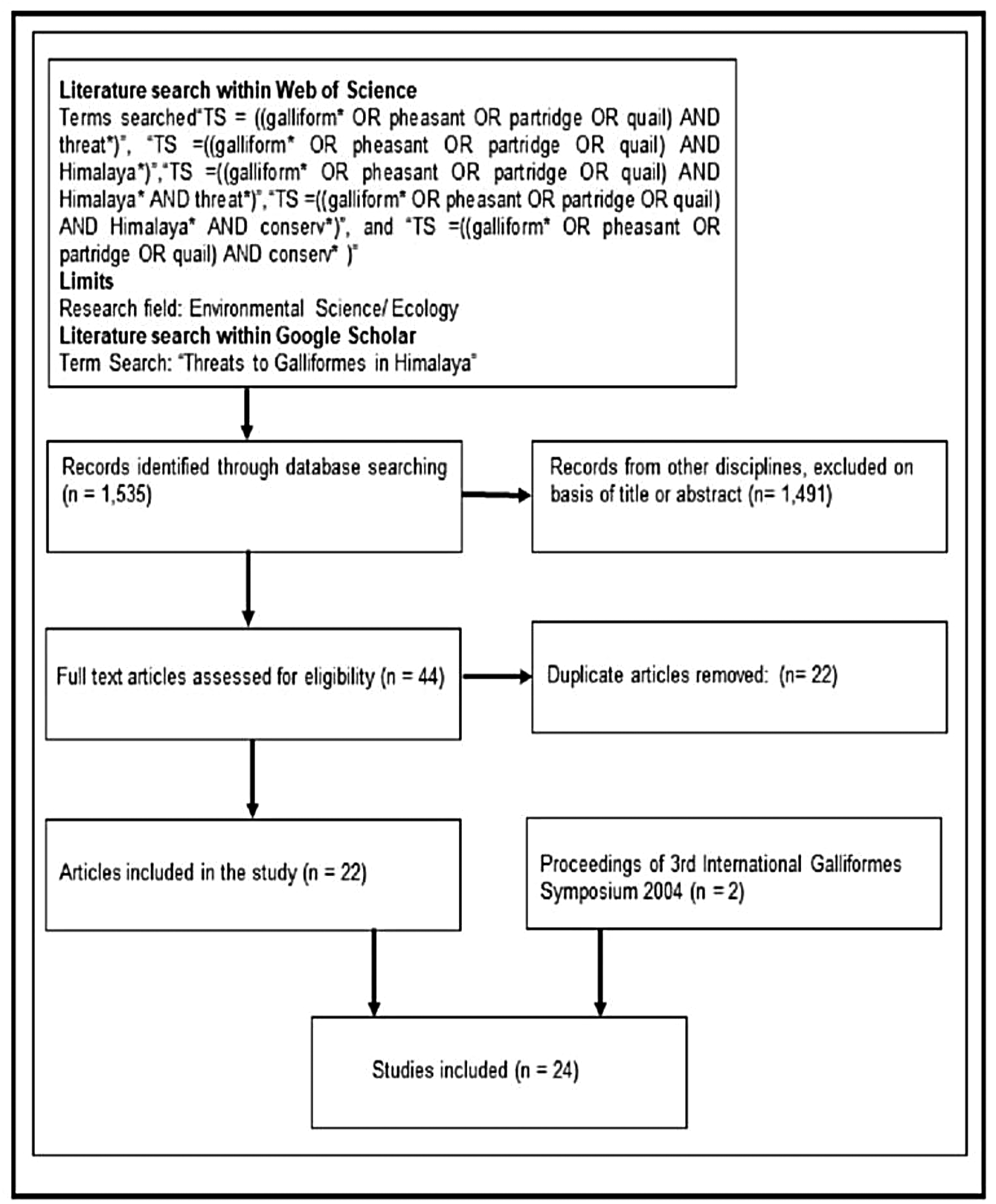
The total number of papers identified by searching the Web of Science for “TS = ((galliform* OR pheasant OR partridge OR quail) AND threat*)” were 181 results. Similarly “TS = ((galliform* OR pheasant OR partridge OR quail) AND Himalaya*)” and “TS = ((galliform* OR pheasant OR partridge OR quail) AND Himalaya* AND threat*)” and “TS = ((galliform* OR pheasant OR partridge OR quail) AND Himalaya* AND conserv*)” and “TS = ((galliform* OR pheasant OR partridge OR quail) AND conserv* )” returned 36, nine, 22, and 620 results respectively. Google Scholar returned 667 results when the term “threats to Galliformes in the Himalaya” was used. Duplicate papers that were returned from different database searches were eliminated.
The searches returned a total of 1,535 unique references of which only 22 (1.4%) met the inclusion criteria and were consequently included in the study. Approximately 97% (1,491) of references were excluded as they did not fit the inclusion criteria and were, for example based on lab-based genetic and molecular studies, which have no relevance to the current study. The remaining 22 references (1.6%) were found to be duplicates and hence were discarded from the study. Another two papers were included from “Proceedings of the 3rd International Galliformes Symposium 2004” (Fuller and Browne Reference Fuller and Browne2005). (See Figure 1 for details).
PRISMA flow diagram of literature search, based on Liberati et al. (Reference Liberati, Altman, Tetzlaff, Mulrow, Gøtzsche and Ioannidis2009).
Quality of threat reported
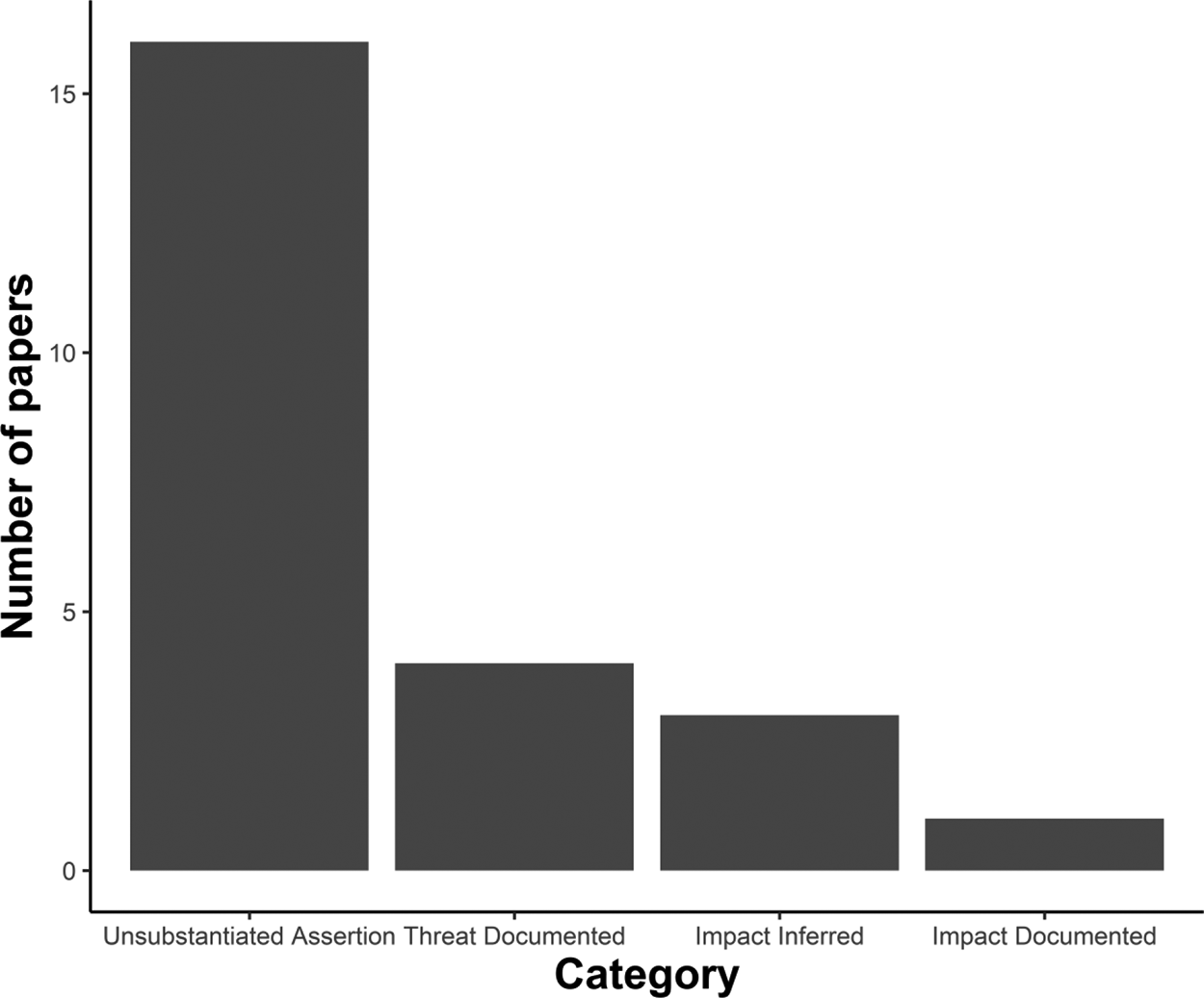
Papers were assessed for the quality of threat reporting and of the 24 studies identified, only one paper quantified the effect of hunting on the population of the Himalayan Galliformes (Figure 2). Sixteen papers (64%) included in the study reported threats based on unsubstantiated assertion. The number of papers classified under threat documented and impact inferred are four and three respectively. There was a high agreement between all reviewers in classifying the papers (Cohen’s Kappa = 0.83; 95% CI 0.63–0.83).
Nature of the evidence reporting threats to 24 Galliformes in the Greater Himalaya in 24 studies in the peer reviewed literature.
Threats reported to the Himalayan Galliformes
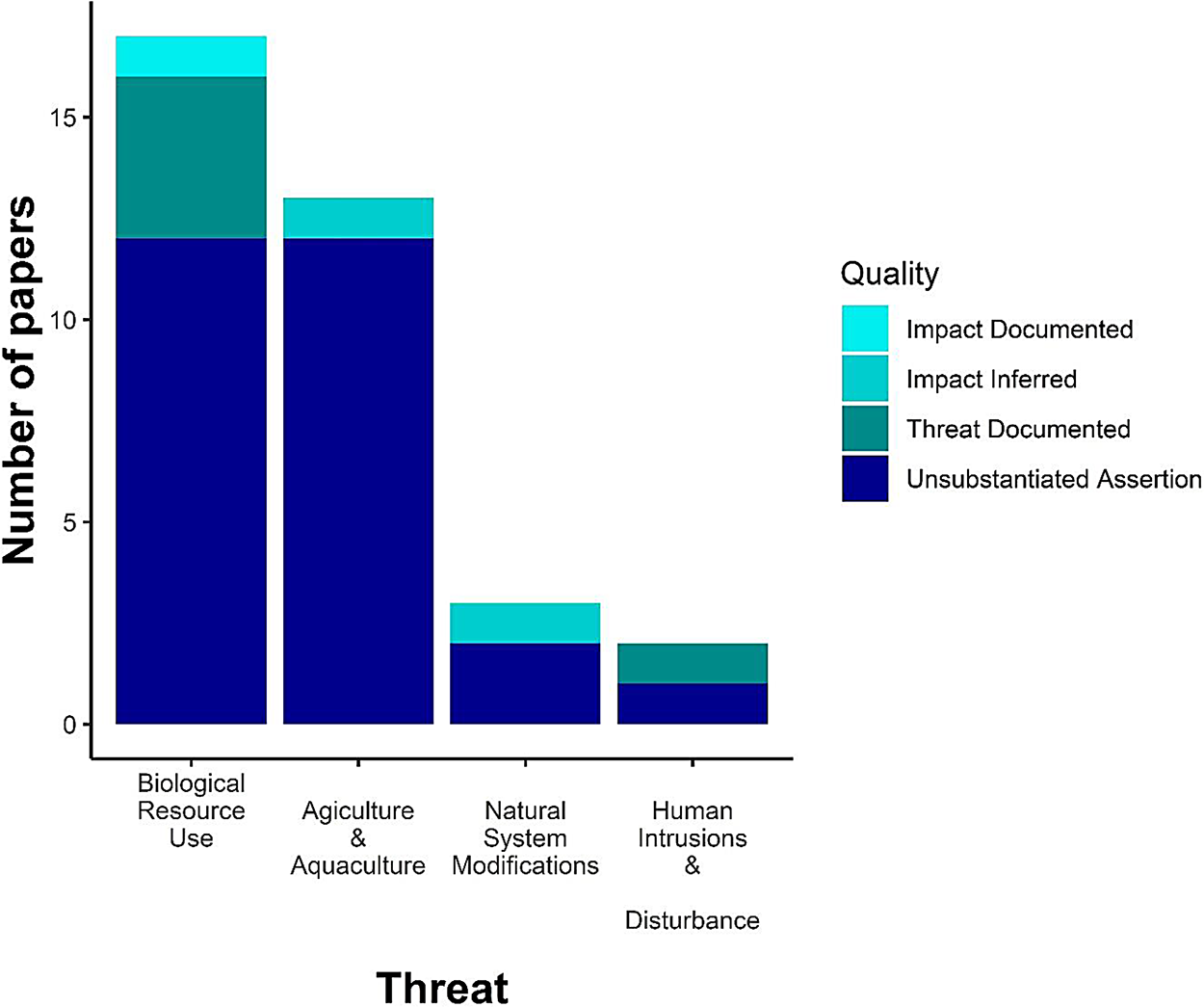
Eleven papers reported more than one threat to the Galliformes in the Himalaya, which meant that there were 35 reported threats in 24 papers (Figure 3). Sixteen papers reported Biological Resource Use as a potential threat to Himalayan Galliformes (Figure 3). Of these 16 papers, only one documented Biological Resource Use as having an impact, whilst most of them were unsubstantiated assertions. Agriculture and Aquaculture was reported in 13 papers, of which one was classified under threat inferred and the others were unsubstantiated assertions. Development activities such as hydroelectric dams categorised under Natural System Modification were also reported as a threat to Himalayan Galliformes.
Different types of threats reported in research papers included in the study and the quality of documentation of threats.
Discussion
Effective conservation decision-making is challenging because our knowledge of the natural world is imperfect and the impact of our actions upon it are uncertain (Bolam et al. Reference Bolam, Grainger, Mengersen, Stewart, Sutherland and Runge2018). It is not easy to predict the impact of conservation actions on each species, and is also a challenge to determine where and how to act to ensure maximum long-term conservation benefits (e.g. Grainger et al. Reference Grainger, Garson, Browne, McGowan and Savini2018). In this study, ‘only’ 24 papers from a total of 1,537 reported threats to the Galliformes of the Greater Himalayan region. Sixteen papers had a threat reported but provided no firm evidence that it was operating in the area studied and only one paper had firm, documented evidence that a threat was having an impact on a population. Biological Resource Use and Agriculture & Aquaculture were reported as the main pressures on Himalayan Galliformes.
Despite being a highly threatened group of birds with 25% of the 308 Galliformes species threatened with extinction (McGowan Reference McGowan2002, Grainger et al. Reference Grainger, Garson, Browne, McGowan and Savini2018), the group remains understudied. This incomplete knowledge is reflected by only 24 papers reporting impacts of threats that may be causing population declines in Galliformes species. This suggests that there is a need for both field studies in the region to study human pressures on the species, and a change in the way studies examine and report threats and their impact on species.
Galliformes are an important source of protein and hunting, which is classified under Biological Resource Use (Table S1). This was found to be the predominant threat reported as 16 papers stated hunting as a threat to Galliformes in the Greater Himalaya. Even though hunting is prohibited in many countries, many species are still hunted illegally for their body parts and meat. Many tropical areas suffer from hunting that can have profound impacts on biodiversity, which can then have negative cascading effects on wider food webs and ecosystems (Milner-Gulland and Bennett Reference Milner-Gulland and Bennett2003, Bennett et al. Reference Bennett, Blencowe, Brandon, Brown, Burn and Cowlishaw2007, Wright et al. Reference Wright, Stoner, Beckman, Corlett, Dirzo and Muller‐Landau2007). Since hunting of wildlife is illegal in many countries, this might be one of the reasons behind lack of evidence on hunting in the Himalayan area. People might not be open about the prevalence of hunting in the region, as they might be afraid of being caught and penalised for their actions. Although wildlife in Asia has been undergoing rapid declines in geographic range and population size, there are relatively few studies that have documented the actual impact of hunting as a problem for a species (e.g. O’Brien et al. Reference O’Brien, Kinnaird and Wibisono2003, Steinmetz et al. Reference Steinmetz, Chutipong and Seuaturien2006, Corlett Reference Corlett2007). Thus, there is often not enough evidence to determine the significance of hunting in the decline of individual species. Of the 16 papers that reported hunting as a threat to the Galliformes in the Greater Himalaya, four papers had the threat properly documented (Table S2) while others were based on unsubstantiated assertions.
Other threats include habitat loss due to deforestation activities mainly for agriculture such as jhum cultivation (slash and burn). Thirteen papers reported Agriculture and Aquaculture, which includes threats from farming and ranching as a result of agricultural expansion (Table S1) as the second biggest threat. Since the Greater Himalaya has the most extensive areas of glaciers and permafrost globally and is the source of nine large rivers, it is called ‘the water tower of Asia’ (Xu et al. Reference Xu, Grumbine, Shrestha, Eriksson, Yang and Wang2009, Xu and Grumbine Reference Xu and Grumbine2014). This makes the Himalaya a potential source of hydroelectric energy resulting in deforestation and submergence of huge areas, with subsequent loss of species habitat.
There is therefore a need to understand threats to biodiversity, identify regions where risks occur, and quantify the rates of change in those threats, in order to ensure that conservation actions are appropriately targeted and are most effective in achieving long-term environmental goals (Geldmann et al. Reference Geldmann, Coad, Barnes, Craigie, Hockings and Knights2015). We can achieve this by focussing research on threats in areas with high biodiversity and high human pressures whilst ensuring that the research is designed and reported to a high standard. Sometimes, however, it is difficult to design a study that demonstrates that any threat has resulted in decline of a species and often there are multiple interacting threats in an area, which makes it difficult to identify which threat has been affecting the species’ population the most. In that scenario those threats should be reported with a caveat that there is no strong evidence available to document unequivocally an impact on species. In conclusion, this study has identified major gaps exist in our knowledge on the threats to species that can lead to extinction. It is imperative to fill these gaps if we want to halt the extinction of species and improve the status of the declining threatened species.
Recommendations
-
• The way a threat is reported in any study needs to be supported by empirical evidence. Reporting threats only when: a) a threat has been identified in the area and b) if the documented threat results in decline of a species population, will enable us to take conservation actions accordingly. Studies with lack of such conclusive evidence need to be addressed with caution.
-
• Designing studies to directly assess threats rather than infer them from circumstantial evidence is important. This will be difficult, but there is a pressing need to design better observational studies (and pseudo-experimental designs), and better socio-ecological studies to assess this directly. Studies on population parameters are needed, for example survival could be monitored through telemetry. We can use integrated population models that use data on populations, survival, and reproduction and combine these to reconstruct population dynamics - these simulations can then lead to inference about the influence of poaching on population persistence over time.
-
• Studies on specific species could be coordinated so that key components of the population parameters are assessed by different researchers and then combined into a single integrated population model. For example, the IUCN Species Survival Commission Galliformes Specialist Group (https://www.iucn.org/commissions/ssc-groups/birds/galliforme) can coordinate this for the Himalayan Galliformes.
Acknowledgements
This research received no specific grant from any funding agency, or commercial or not-for-profit sectors.
Supplementary Materials
To view supplementary material for this article, please visit http://doi.org/10.1017/S0959270921000514.


 Open access

