




The fresco cycle in the Oratory of San Giorgio in Padua, adjacent to the Franciscan church of Sant’Antonio, is unusual due to the high number of Mongols appearing on every wall. The Oratory was built as a family chapel by the Lupi family, allies of the ruling Carrara family, and painted c.1379–84 by Altichiero da Verona (c.1330–90). The completion contract of 1384 reveals that Raimondino Lupi commissioned Altichiero, but the project supervision was transferred to Bonifacio Lupi after his death on 30 November 1379.Footnote 1 The frescoes’ iconography, overtly funerary in purpose and rich in depictions of saints’ lives, represents the family’s devotion. However, the presence of the Mongols, equipped with swords and among western knights in Christian settings, has not been fully explained. This article explores the function of these armed Mongols in a Christian funerary chapel.
Discussion of the representation of Mongols in the Oratory is limited.Footnote 2 John Richards noticed the representation of Mongols in San Giorgio and argued that this reflected the artist’s own experience of a multicultural society, thereby broadening the setting of the biblical narrative.Footnote 3 Fabio Tonzar examined different images of Mongols in fourteenth-century Trivenetan art as reflecting broader historical concerns, but regarded Altichiero’s representations as simply revealing his exotic taste.Footnote 4 More recently, Anne Dunlop has explored the transmission of images of the Far East and how it permeated northern Italian culture, but she did not focus on the Mongols in the Paduan frescoes.Footnote 5 The visual sources of Altichiero, an analysis of the Mongols’ costumes and their specific iconography within the frescoes thus remain insufficiently understood. The representations of them are multifaceted, encompassing positive, neutral and negative perspectives, and cannot be simplified as being merely figures from a different country. In this article, I will concentrate on their identity as ‘bystanders’ rather than as torturers, providing a fresh perspective on their significance. The Mongol figure is here understood as a hybrid creation, shaped by daily observation, textual imagination and image transmission, serving both cultural and religious functions. The analysis begins with the identification of the Mongols through their physiognomy and costume, comparing the Mongol figures with Chinese visual materials, a Persian manuscript, travellers’ accounts, and missionary reports. I then consider the possible transmission of these images from Verona and Florence, and how Altichiero adapted them. Recognizing the military identity of the patrons, I also explore how the Mongols are portrayed as non-western knights. Finally, I situate the representation of the Mongols within the historical context of the patrons’ political engagement and Franciscan missionary work in the East, exploring its mnemonic function, and its potential political and religious significance.
The Physiognomy and Attire of Mongols
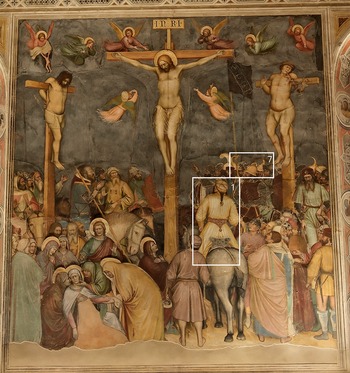
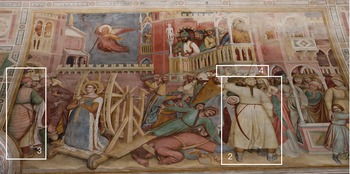
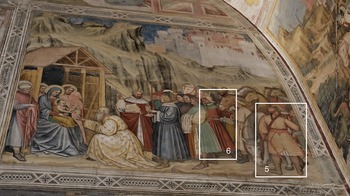
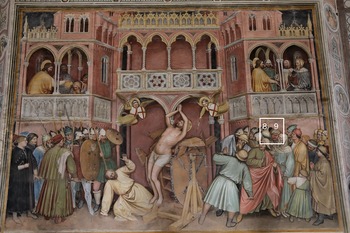
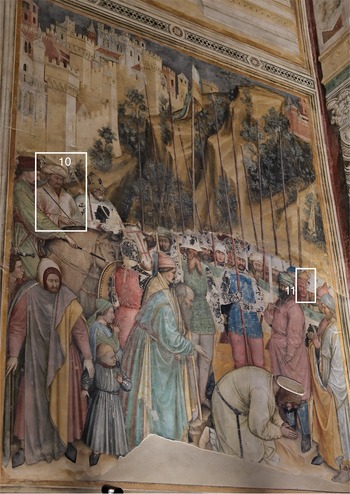
In San Giorgio, the figures represented with the typical physiognomy of the Mongols are usually portrayed as wearing a pointed hat and a robe with fitted sleeves, a gathered waist and a loose bottom. Depictions of Mongols (marked by squares) appear in the south wall’s Crucifixion (Figure 1, no. 1), the upper west wall’s Martyrdom of St Catherine (Figure 2, nos 2–3), on the middle right of the north entry wall’s Adoration of the Magi (Figure 3, nos 5–6), and in the upper north-west wall’s Execution of St Catherine. Other Mongols depicted with pointed hats or Mongolian physiognomy appear among groups in St George on the Wheel and Beheading of St George (Figures 4–5, nos 8–11).
Altichiero da Verona, Crucifixion, 1378–84, fresco, Oratory of San Giorgio, Padua. © The author.

Figure 1. Long description
At the vertical center, three men are crucified on wooden crosses: the central figure is labeled I N R I above his head, flanked by two others. Four angels hover above, two on each side, with outstretched arms and expressive gestures. Below the crosses, a dense crowd fills the lower half, including armored soldiers, mounted figures, and mourners. At the lower left, a group of women, some veiled, comfort each other, while a kneeling figure reaches toward the central cross. At the lower right, soldiers and onlookers in colored robes cluster together. The background is a dark sky, and the fresco is framed by an ornate border. Numbered boxes highlight two areas: one around a mounted soldier at center right, and another above him within the crowd.
Altichiero da Verona, Martyrdom of St Catherine, 1378–84, fresco, Oratory of San Giorgio, Padua. © The author.
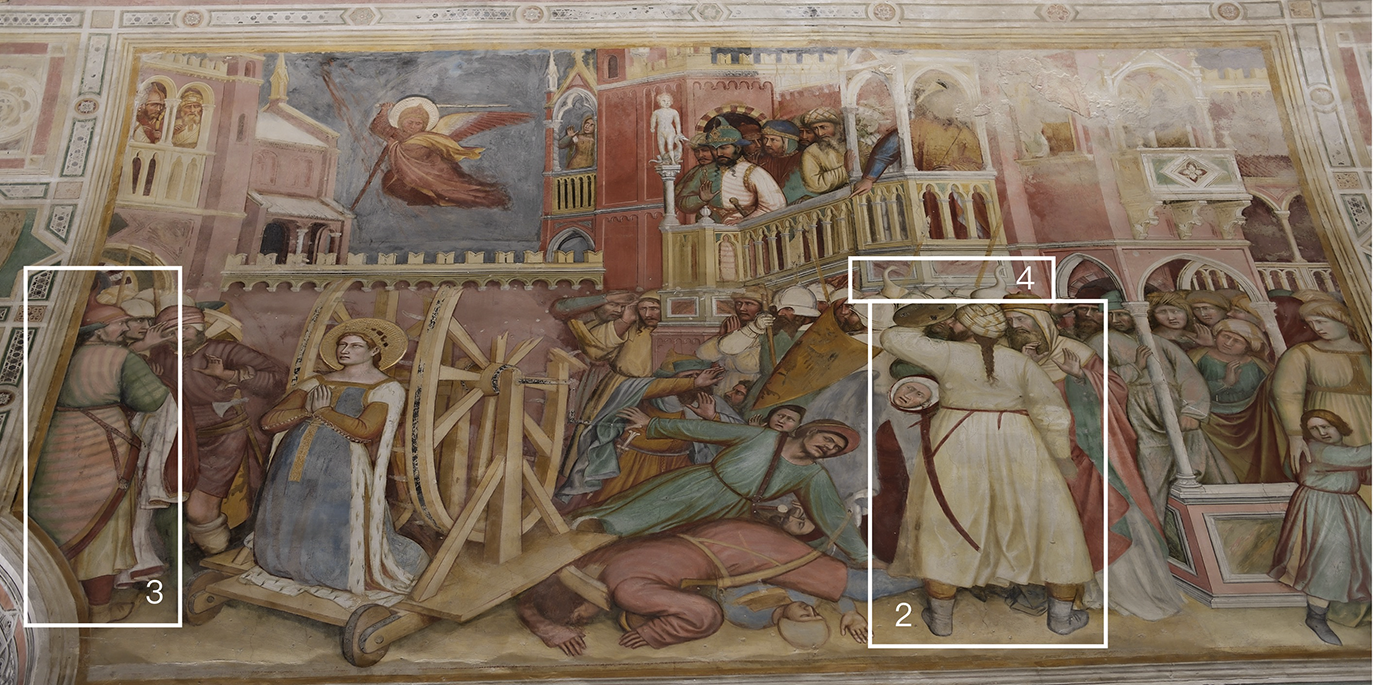
Figure 2. Long description
At the lower left, St Catherine with a halo is seated before a spiked breaking wheel, surrounded by armored executioners. To her right, a group of men in colored robes operate the wheel, while others fall or recoil from its destruction. In the lower right, a man in white robes (zone 2) stands before a crowd, with another group of figures behind him (zone 4), some gesturing or turning away. The upper half features a walled cityscape with pink and ochre buildings, balconies filled with onlookers, and an angel descending from the blue sky toward the central action. The narrative is structured in horizontal bands: foreground martyrdom, midground chaos, and background spectators, with numbered rectangles highlighting key figures and actions.
Altichiero da Verona, Adoration of the Magi, 1378–84, fresco, Oratory of San Giorgio, Padua. © The author.
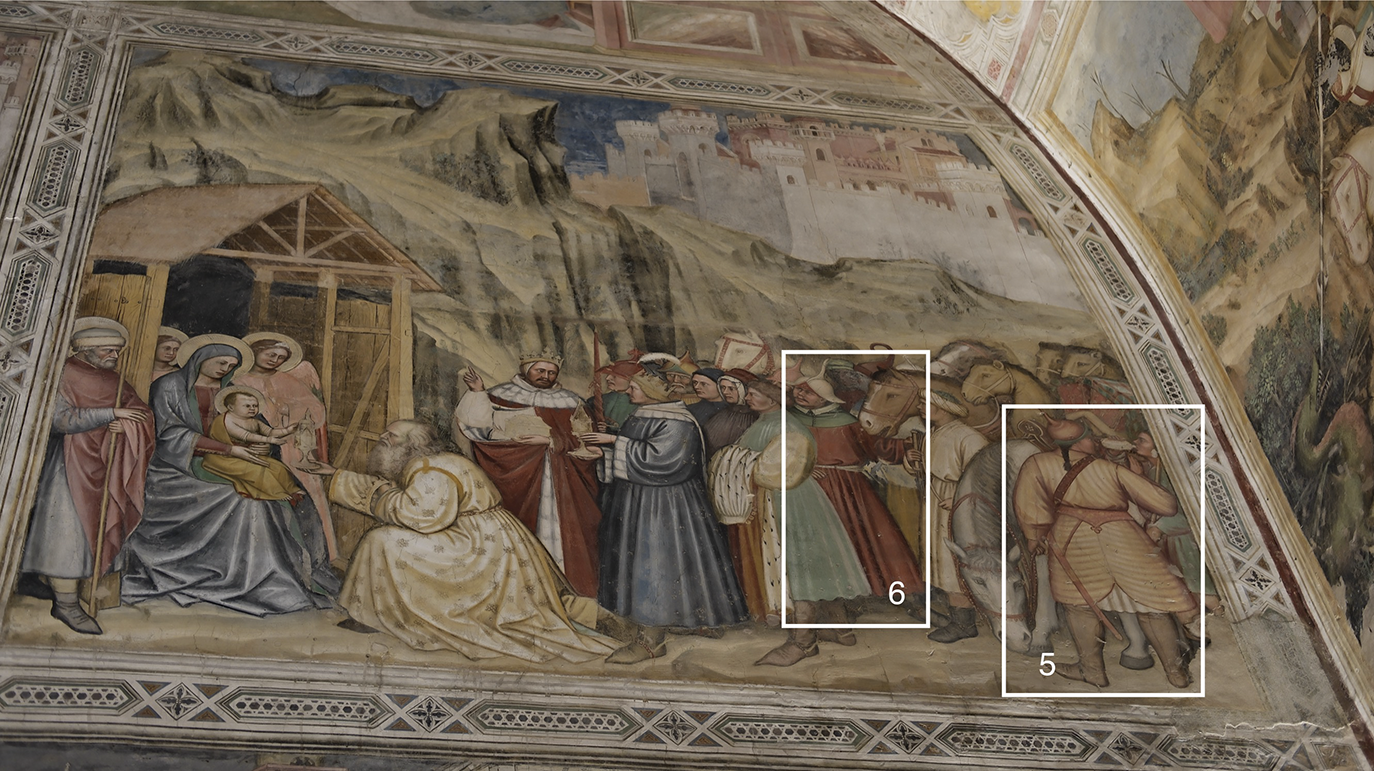
Figure 3. Long description
At the left foreground, Mary in blue holds the child, both facing a kneeling elderly Magus in gold robes who offers a gift. Behind Mary, Joseph stands in pink. Two attendants in turbans stand further left. To the right of the Magus, two other Magi in ornate robes present gifts, flanked by a group of attendants and animals. Rectangular labels mark two groups: label 6 encloses two men in colored tunics, one holding a drum, while label 5 frames two armored figures with swords and red sashes. The background features a wooden stable, rocky hills, and a walled city with towers. The crowd and animals extend into the right background, emphasizing the procession’s movement toward the holy family.
Altichiero da Verona, St George on the Wheel, 1378–84, fresco, Oratory of San Giorgio, Padua. © The author.
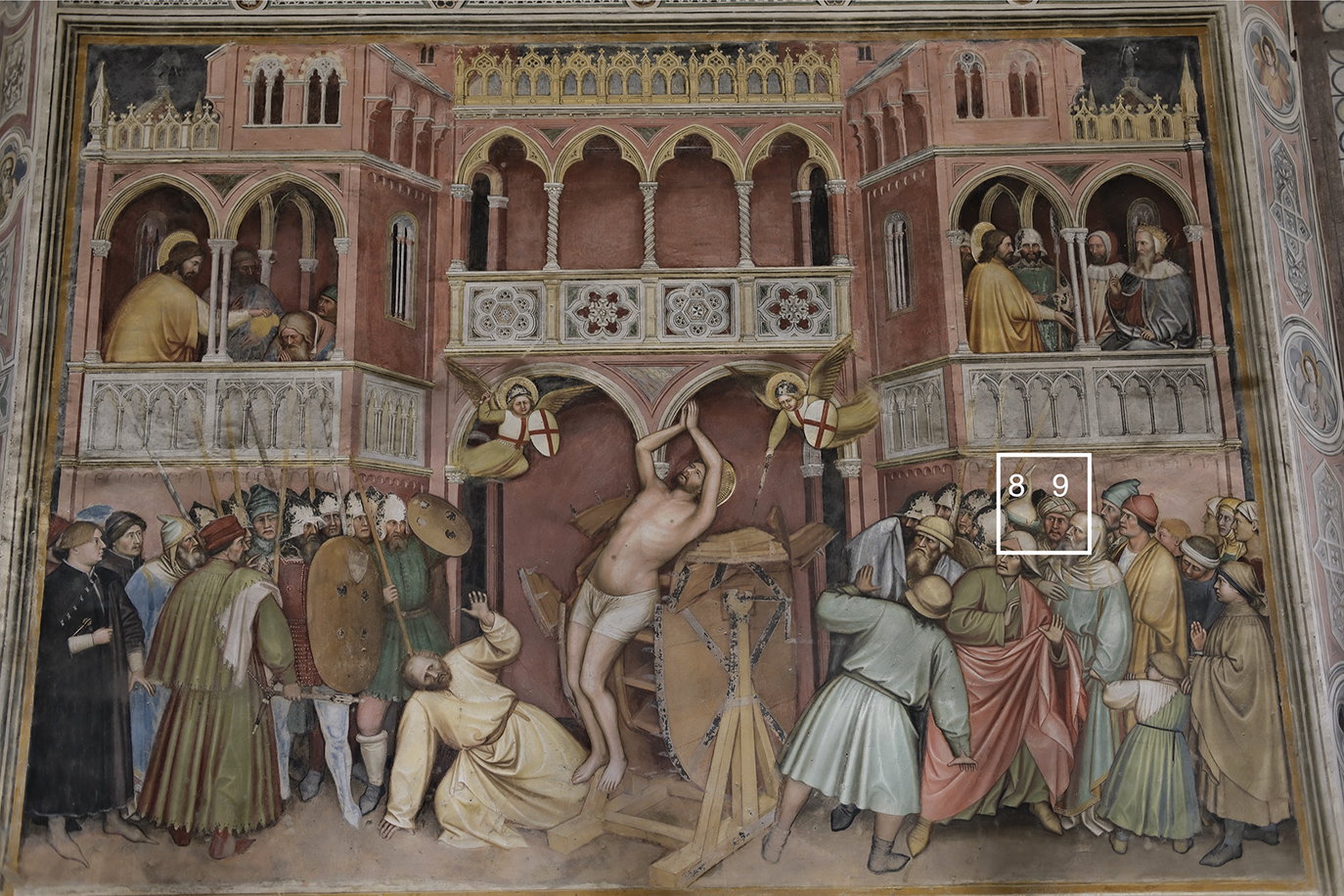
Figure 4. Long description
At the center, Saint George is depicted nearly nude, bound to a large wooden wheel, his arms raised above his head. Two angels descend from above, each holding a shield and a sword, positioned symmetrically on either side of the wheel. Directly below Saint George, a man in yellow robes collapses backward, his arm raised in alarm. To the left and right of the wheel, groups of soldiers and onlookers fill the foreground, many wearing helmets, carrying shields, or gesturing toward the central scene. On the left, a cluster of figures in elaborate robes and hats stand in front of a pink architectural structure with arched windows and balconies. On the right, a similar architectural structure mirrors the left, with additional figures in yellow and blue robes observing from the balcony. The uppermost section features ornate arches and decorative stonework, with more spectators visible behind the balustrades. The entire composition is framed by architectural elements, with the crowd density highest near the wheel and thinning toward the edges. The numbers 8 and 9 are labeled in white boxes above two figures in the right foreground.
Altichiero da Verona, Beheading of St George, 1378–84, fresco, Oratory of San Giorgio, Padua. © The author.
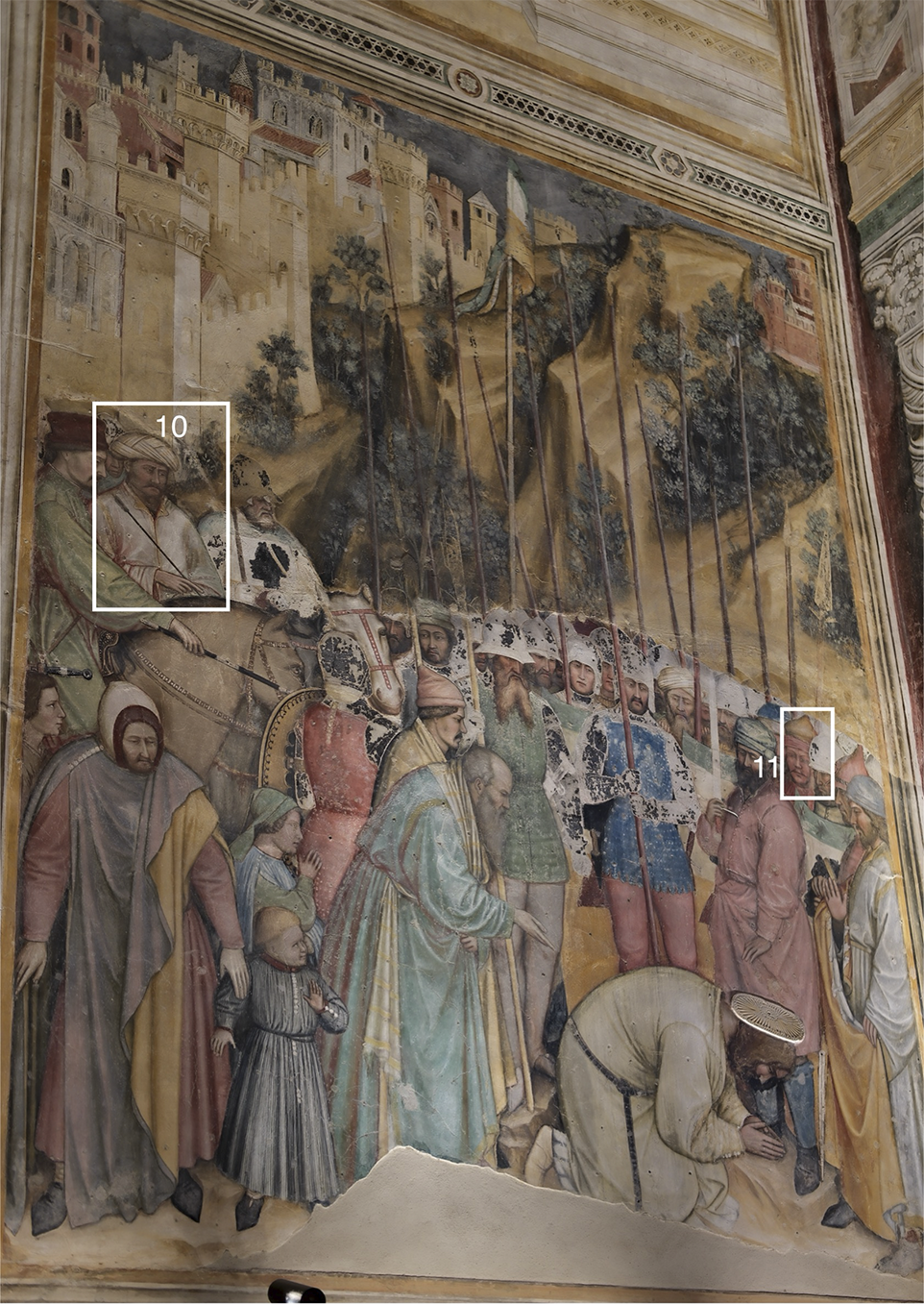
Figure 5. Long description
At the bottom center, a haloed figure in white robes kneels, head bowed, facing a man in a red tunic holding a sword. To the left, a group of onlookers in colored robes, including a child, stand in a row. Behind the kneeling figure, a line of soldiers in blue and red uniforms hold long spears upright, forming a vertical barrier. To the far left, two seated men, one labeled 10, observe the scene. At the right edge, a man labeled 11 stands among other witnesses. The upper half of the fresco is dominated by a detailed cityscape with fortified walls, towers, and clustered buildings, set against a hilly, wooded landscape. The composition is framed by ornate architectural borders at the top and right.
The most typical feature of Mongol identity is their physiognomy, which has usually been represented with a round face, narrow and upswept eyes, a moustache, a long braid and the wearing of a pointed hat (or turban). This coincides with the description of Tartar slaves made by poets, merchants and in slave contracts in the fourteenth century. The main features of their facial shape are broadness and flatness.Footnote 6 Their visual representation here is therefore clear and realistic, rather than an artistic creation. For Richards, the Asians in these frescoes, who are shown wearing their modern dress (that is, contemporary with the artist), signified the continuous ‘empirical expansion of the painted world’.Footnote 7 The background and architecture of the scenes might have originated from the Paduan court and their daily life, but Altichiero widened this world by depicting different nations, including Tartars and Turks who could be met in daily life.Footnote 8 Indeed, the painting of this cycle coincides with a period in which Mongols had not completely retreated from Paduans’ daily life and political activities. Altichiero could have seen Tartars himself.Footnote 9 In Venice, records show that a transaction involving a Tartar slave took place on 10 September 1366, with three further transactions involving Tartar slaves being recorded in 1372, 1373, 1377.Footnote 10 These transactions provide evidence that artists would have had opportunities to observe Tartars in the cities and depict them from real life. The Venetian sculptor Andriolo de Santi (who refurbished a nearby chapel also painted by Altichiero) hired five Tartar slaves for a year for 200 ducats on 29 May 1374.Footnote 11 In February 1372, Andriolo was hired to refurbish the Lupi Chapel of San Giacomo in the Santo.Footnote 12 It is not inconceivable that these Tartar slaves helped with the stonework for the chapel and were in the Santo in 1374 and 1375. The last date of Altichiero’s involvement in this chapel’s fresco was 1379, but in March 1377 the scaffolding was already prepared for the painter.Footnote 13 Prior to 1377, when Altichiero was designing the fresco, he would have needed to observe the building work. Moreover, before working for the Lupi family in 1377, Altichiero had painted the frescoes of the Sala dei Giganti in the Carrara Palace (famous for its portrait of Petrarch), which he had probably designed by 1374.Footnote 14 Thus, it is possible that Altichiero lived in Padua between 1374 and 1375, although there is no direct evidence to prove this. Therefore, it is feasible that Andriolo’s Tartar slaves could have been the model for the physiognomy of Altichiero’s Mongols in San Giorgio.
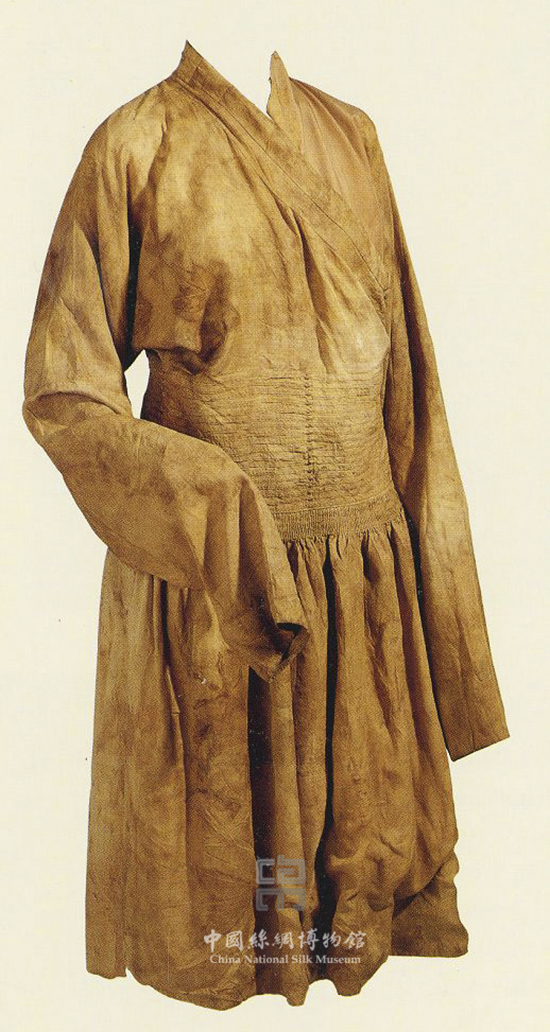
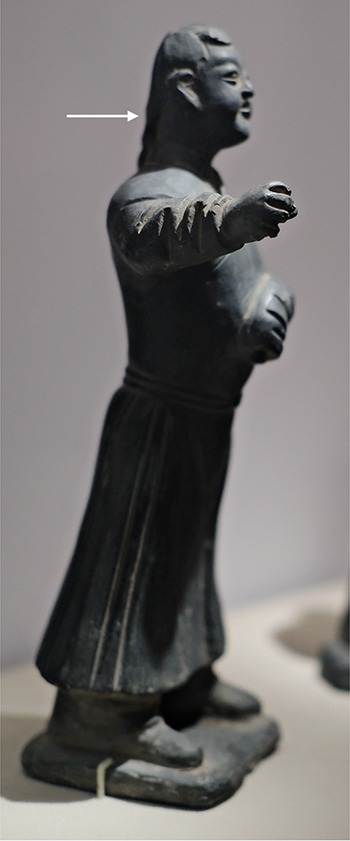
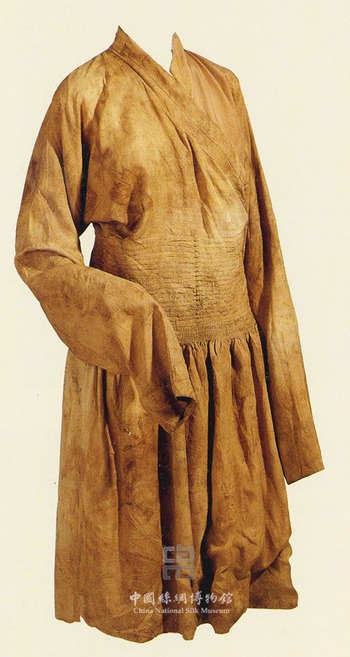
Among their recurring features is the long braid, combined with a robe whose style could point to the figure’s nation. A remarkable Mongol seen from the back riding a horse can be identified by these two characteristics in the Crucifixion (Figure 1, no. 1). The man gazing up at Christ has a braid and wears a turban, a light-yellow robe with narrow sleeves and a loose bottom, and a wide waist belt patterned with golden motifs. Mongols were known for braiding their hair into a single plait that hung down from the back of their head.Footnote 15 A Yuan-Dynasty pottery figurine unearthed in Shaanxi shows this hairstyle (Figure 6). Without any other significant facial or hat features, the long braid is one major way to differentiate Mongols from the back from western men’s short and curly hair in the Paduan frescoes.Footnote 16 Moreover, the style of this figure’s robe corresponds to that of an extant Mongolian braided waist robe of the Yuan Dynasty in the China National Silk Museum (Figure 7), although the extant robe has a prominent braided band on the waist, while the fresco either omits this part or has it covered by the belt. In addition, this wide belt has a downward protruding section in the middle, which is different from the more usual narrow belts: no similar extant object has been found in central Asia or China. This difference suggests that Altichiero might have relied on textual descriptions rather than direct observation. Indeed, his depictions correspond to earlier missionary accounts. The Flemish Franciscan friar William of Rubruck (c.1215–95) and the Italian Franciscan friar John of Plano Carpini (c.1180–1252) both mentioned that the clothing styles of Mongolian women and men were the same, and that ‘they wear tunics of buckram, velvet or brocade’ which ‘are open from top to bottom and are folded over the breast’.Footnote 17 To a certain extent, Altichiero’s representation of the Mongolian robes accords with both the features of Yuan Dynasty representations and western descriptions of Mongols.
Pottery figurine, Yuan Dynasty (1271–1368), unearthed at Tomb 132 of Jiangqincun Cemetery, Xi’an, Shaanxi province, National Museum of China, Beijing. © The author.

Braided waist robe, Yuan Dynasty, silk tabby with supplementary wefts of gilt thread, 202 × 117 cm, China National Silk Museum (No. 1753), Hangzhou. © 2017 China National Silk Museum.
In the Martyrdom of St Catherine, a Mongol appears at the front of the crowd raising his arm and holding a shield, with his back to the scene (Figure 2, no. 2). The representation of his robe and turban bears a striking resemblance to his counterpart in the Crucifixion, but his belt – designed for the carrying of personal effects like a curved sword – is narrow, as commonly seen in Mongolian examples. On the left side of the fresco closest to the wheel, another Mongol is looking at St Catherine (Figure 2, no. 3). He wears a long, red and padded robe, and a red pointed hat with a long braid. At his waist, a curved sword hangs from a thin belt. Another Mongol can be seen from the back on the right hand side of the Adoration of the Magi (Figure 3, no. 5). In contrast to the worshippers who focus their attention on the Christ child, he directs his gaze in the opposite direction towards a man drinking. He wears a pointed hat, a robe with tight sleeves and a wide orange belt holding a sword, but his robe is shorter, just down to the knee. The belt is of the wide type with a protruding part. Another Mongol, wearing a red robe and a pointed hat with four corners, shows curiosity towards the Magis’ act of offering (Figure 3, no. 6). His physiognomy suggests that of a Mongol, and his red robe also displays the features of their robes, but the green collar seems an addition. All these Mongols are presented as bystanders, watching the scenes. However, another is depicted as a torturer in the Execution of St Catherine: he wears a turban and a long robe, holds the curved sword in his right hand and Catherine’s crown in his left.Footnote 18
In addition to these prominent figures, Altichiero also portrayed subtle and specific details to suggest other Mongols among the many bystanders. There are two light yellow pointed hats protruding among the faces behind the Mongol seen from the back in the Martyrdom of St Catherine (Figure 2, no. 4). In the Crucifixion, Altichiero carefully delineated the face of a Mongol wearing a yellow pointed hat immediately behind the knight bearing a SPQR banner, as well as two yellow pointed hats in the background (Figure 1, no. 7). In St George on the Wheel, among the soldiers on the right, there is a pointed hat, this time with a square shape (Figure 4, no. 8) and a Mongol face wearing a turban (Figure 4, no. 9). A similar mounted figure with a yellow turban pointing to St George kneeling holds an arrow (Figure 5, no. 10), while a head in the crowd capped with a round hat on the right of his Beheading displays the physiognomy of a Mongol (Figure 5, no. 11). These Mongols are all represented as passive onlookers, witnessing the unfolding of the key events of the Christian narrative.
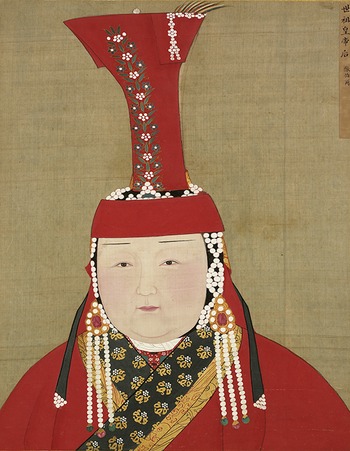
In these scenes, headgear serves as a crucial visual identifier. The pointed hats of the Mongols demand particular attention given their ambiguous origin and potential symbolic function. There is no similar representation or extant object from the Yuan Dynasty or the Near East; however, Altichiero could be imitating the Mongolian noblewomen’s official hat. In the official bust portraits of the Yuan Dynasty, the empress wears a tall pillar-shaped hat called boqta (Guguguan or Gugu hat) (Figure 8).Footnote 19 The reproduction of this hat in the China Silk Museum also shows its strikingly tall feature.Footnote 20 Meanwhile, William of Rubruck described this headdress, bocca, as being like ‘the capital of a pillar’ and ‘square above’; the Muslim traveller Ibn Battuta (1304–c.1369) called it a boghthak and ‘decked at the apex’ with a peacock’s feather; Franciscan friar Odoric of Pordenone (c.1286–1331) referred to it as ‘the foot of a man’ worn on married women’s heads.Footnote 21 These visual depictions and verbal descriptions confirm that the tall pillar-shaped hat was an actual Mongol headdress. Altichiero seems to have captured the tall feature, transformed the flat top to a pointed apex and put it on a man’s head. These altered hats then become the typical and stereotypical markers of the Mongols in the frescoes.Footnote 22 Eiren L. Shea has argued that the Mongolian women’s dress was also a symbol of Mongol power and, thanks to the typical hat boqta, could be recognized quickly.Footnote 23 Indeed, Eleonora Tioli cited an image, evoked by William of Rubruck, that ‘from a distance, each [Mongol woman] looked like a soldier, since her boqta could be mistaken for a helmet, and the feathers at its top for spears’.Footnote 24 This description might explain why Altichiero was inspired to represent Mongols with such pointed hats.
Khubilai Khan’s Consort (Chabi), Yuan Dynasty, album leaf, ink and colours on silk, 61.5 × 48 cm, National Palace Museum, Taipei. Open data © 2024 The National Palace Museum, Taipei, CC BY 4.0 @ www.npm.gov.tw.

Figure 8. Long description
At the top center is a tall, angular red headdress adorned with white pearls and embroidered floral patterns in blue, green, and white, with a feather detail at the upper right edge. The headdress base is encircled by a band of pearls. Below, the central figure wears a red outer robe with wide shoulders, over a black inner garment patterned with gold floral designs and a diagonal gold sash. The neckline reveals a white undergarment. From the headdress and shoulders, multiple strands of pearls cascade downward, framing the face and extending to the chest. Large, circular gold and red earrings with pearl drops hang at each side. The background is a plain, muted tan silk. At the upper right, vertical Chinese calligraphy is inscribed on a rectangular panel.
However, the turbans of some of the figures (Figures 1, 4, 5, nos 1, 2, 9, 10) display hybrid features, raising questions about Altichiero’s visual sources and intentions. These turbans resemble headwear more commonly associated with Central Asia or the Ottoman Turks in the late fourteenth century, yet they are positioned on ‘Mongolian’ heads. The political context helps to explain this representation. During this period, Ottoman Turks became a violent threat to Christendom, and popes organized several crusades against them in 1363, 1373 and 1375.Footnote 25 Although turbans were worn by Muslims of all origins, whether Turks, Moors or Arabs, they became the quintessential symbol of Turks.Footnote 26 Nonetheless, as early as the twelfth century, turbans had appeared in religious visual representation and were associated with distance in place or religious belief.Footnote 27 As Mongols were distant strangers to Paduans, it became possible for Altichiero to appropriate this religious visual expression.
By integrating a turban with a Mongolian robe and hairstyle, these representations illustrate the hybridity of two eastern nations. The braid and robe are two characteristics attributed to the Mongols. Regarding the robes, William of Rubruck and John of Plano Carpini both recorded that the dress of Mongol men and women was similar and that they did not have distinguishing differences.Footnote 28 Considering that not all artists were able to witness Mongols in real life, and that the oral and visual sources of Mongolian physiognomy could be vague, it might be possible that artists selected very specific elements of Mongolian clothing, like the boqta or the long robes, to distinguish the group from western styles of dress. Furthermore, Altichiero’s representation of the robe’s collar also shows this hybridity. William of Rubruck recorded that ‘the Tartars differ from the Turks, for the Turks tie their tunics on the left, but the Tartars always on the right.’Footnote 29 Indeed, in the contemporary Chinese painting Albums of Yuan Imperial Portraits and the hanging scroll depiction of the emperor and empress entitled Kublai Khan Hunting, all the protagonists are shown with robes tied on the right.Footnote 30 However, frontal details are rare in the frescoes of the Oratory, as are the hairstyles. The only frontal dress represented is that of the torturer in the Execution of St Catherine, whose collar is different from the Mongol or Turk. This might point to Altichiero’s appropriation of different headgear and clothing details, as he mixed the gender and national features of the hat. Overall, the representation of the Mongols in San Giorgio draws together visual features from diverse sources. This suggests that Altichiero drew on both his own knowledge of Mongols and others’ verbal accounts to create a recognizable Mongol.
Precedents and the Transmission of Images in Verona and Florence
Although Altichiero’s Mongol figures in San Giorgio are highly distinctive, they did not emerge in a visual vacuum. An early visual precedent for the pointed hat appears in the fresco of the St Anthony Chapel in San Fermo Maggiore in Verona, dated to the 1340s.Footnote 31 A person wearing such a hat is listening to St Anthony’s sermon. There again, it is a hybrid figure: the artist combined western physiognomy with a Mongolian hat. On the lunette of the west door of San Fermo, Turone di Maxio also painted this pointed hat in 1350 in his Crucifixion. Despite the similarity in Altichiero and Turone’s works of the pointed hats, narrative format and crowding, this is unlikely to suggest a direct influence from Verona, though Altichiero did work in Verona in the later 1360s.Footnote 32 It is more plausible that both artists drew from the Tuscan painting format or responded to the same visual representation.Footnote 33
Another visual connection exists between Altichiero’s fresco cycle in San Giorgio and Andrea di Bonaiuto da Firenze’s Pentecost in the Chapter Hall of Santa Maria Novella in Florence (Figure 9). Both depict a Mongol seen from behind, observing miracles in Christological or martyrdom cycles. On the day of Pentecost, the Holy Spirit appeared in the shape of a tongue of fire, with the apostles now able to preach to the nations in their own languages.Footnote 34 The presence of the Mongol in Bonaiuto’s Pentecost may suggest the apostles’ ability to preach to Mongols and the possibility that the Mongols could be converted. Similarly, Altichiero’s fresco cycle could also reflect this expectation of the Mongols’ conversion.Footnote 35 In addition, comparing Florence and Padua, we can observe striking similarities in their depictions of the Mongolian pointed hat, braided hairstyle, long robe and back in the central scene. In the Martyrdom of St Catherine, the central Mongol (Figure 2, no. 2) adopts a similar inverted posture to the one in Pentecost. Consequently, the Pentecost might be a possible visual source for the braid for Altichiero. In contrast, neither William nor Odoric mention either this hairstyle or the hairstyle of a Tartar slave. Furthermore, Altichiero had previously looked to Tuscan models for inspiration when he was transmitting the composition of the silver altar of the martyrdom of St James in Pistoia for his fresco cycle in San Giacomo.Footnote 36 Chronologically, this is also plausible, for the Florentine fresco was completed only twelve years before Padua.Footnote 37 Although a direct visual borrowing cannot be proved, the Pentecost may have offered Altichiero a compositional and iconographic model, particularly for the rendering of the Mongol’s headgear and the view of him from behind.
Andrea di Bonaiuto, Pentecost, 1365–7, fresco, Spanish Chapel of the Church of Santa Maria Novella, Florence. © The author.

Figure 9. Long description
At the center of the lower register stands a figure in a white robe and pointed hat, gesturing upward. This figure is framed by a white rectangle. To the left and right, groups of men and women in colorful robes and head coverings are engaged in conversation or observation, with some gesturing toward the central figure. Two small dogs are present on the ground, one near each group. The architectural setting features a two-story structure: the lower level contains the main scene, while the upper level is a balcony with a row of haloed figures, some with hands clasped in prayer, others looking downward. The uppermost background is gold, and the fresco is bordered by ornate geometric and floral patterns. The spatial arrangement emphasizes the central figure below and the divine assembly above, visually linking the earthly and spiritual realms.
Mongol Armour and Swords
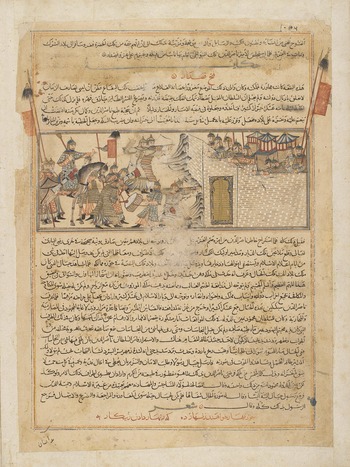
The depiction of Mongols with swords in San Giorgio introduces a different perspective: martial presence. The Persian historian Rashīd al-Dīn (1247–1318) provided a foundational source for Mongol military images. His illustrated universal chronicle, Jami’ al-Tawarikh (‘Collected History’, 1314–15, Or. MS 20 Edinburgh) offers detailed scenes of Mongolian battles, especially largely accurate images of Mongol soldiers.Footnote 38 Members of the Mongolian cavalry wear lamellar armour across the whole body, usually holding bows or lances (Figure 10).Footnote 39 Helmets depicted in these manuscripts often feature an upfolded brim, pointed apex and a protective attachment for neck and ears formed by lamellar armour. These images convey the core elements of Mongol armed attire. A similar iron helmet is preserved in the Hulunbuir (China) Ethnography Museum,Footnote 40 suggesting visual continuity. Moreover, the military actions of western soldiers indicate the distinctive nature of Mongolian helmets: these helmets became recognizable military markers, sometimes applied as a disguise. Thus, after successful Mongol invasions in the thirteenth century, Armenian soldiers imitated Mongolian apparel, especially their hats, to threaten and confuse their opponents into abandoning fighting.Footnote 41 The Mamluk governor Izz al-Din Aybak al-Rumi requested a supply of Mongol caps in 1293 to achieve this military disguise.Footnote 42 This confirms that Mongol helmets were both visually distinctive and symbolically powerful, distinguishing the Mongols from other armies.
Jami’ al-Tawarikh, Or.Ms.20, fol. 108v, Heritage Collections, University of Edinburgh. Reproduced with permission. © 2015 University of Edinburgh.

Figure 10. Long description
At the top center is a rectangular illustration bordered in gold and blue. On the left, armored soldiers on horseback and on foot wield swords, shields, and bows, advancing toward the right. Arrows are shown in flight toward a high, crenellated city wall at the right, behind which defenders and multiple tents are visible. The city gate is depicted in gold. The background includes stylized mountains separating the attackers from the city. Above and below the illustration, dense Arabic script is arranged in horizontal blocks, with a prominent red heading above the image and a highlighted line at the bottom. The script frames the illustration, providing narrative context.
Strikingly, such helmets are absent from San Giorgio. Whether depicted as riders, witnesses, or as individuals half-hidden amongst western soldiers, the Mongol figures’ headgear and clothing do not display the significant features of the iron-made helmets or armour belonging to the Mongols. Rather, the Mongolian clothing represented seems to be that of unarmed men. The style of robe, as mentioned above, is that of the Mongols’ daily robes, although the curved swords hanging on their belts may differentiate them from general witnesses. Yet it is clear that the material of the robes has been represented as padding (see especially Figures 1–3, nos 1, 3, 5). The appearance of early thirteenth-century Western knights was clumsy due to the heavily padded undergarment worn beneath their chain mail, the earliest type of medieval metal armour.Footnote 43 This padded garment was made from quilted fabric ‘stuffed with cotton or other material’. It served as further protection, and when chain mail was removed, the padded garment or robe was the main civil dress for contemporary knights.Footnote 44 In the fourteenth century, the knights’ costume was modified with the development of plate armour, with their undergarment evolving into a tight-fitting dress.Footnote 45 The soft armour made of linen and fabric was assembled with steel plates covering brocaded and embroidered fabric.Footnote 46 Military costumes not only showed the knights’ power and force, but also reflected contemporary fashion, showing their slim beauty and taste for bright colours influenced by contemporary daily dress.Footnote 47 In contrast, Mongolian robes were made of silk and their armour was totally covered by lamellas. The padded garment worn by the Mongols in Altichiero’s frescoes seems therefore to derive from western knights’ costume, rather than from actual Mongolian armour.
It is unlikely that Altichiero had direct contact with Mongolian merchants and ambassadors, or with anyone wearing their national attire. While he did represent the Mongolian-style robe, matching William of Rubruck and John of Plano Carpini’s descriptions, he also created his own military fashion. The style of the robe matches the verbal description, but it has subtle differences from extant objects. The braided waist belt has been replaced by thin or wide belts, and the collar depicted in the fresco is round rather than covered. The awkward heaviness of the padded fabric has been lessened by combining it with the long robe, narrow sleeves and tight belt on the waist. This draws on the contemporary aesthetic of western knights showing their slim bodies. However, Altichiero did not select the updated, most functional western armour for Mongols, namely iron plate armour covering a short, tight surcoat or decorated with embroidered fabric. The long, padded garment worn under chain mail as knight’s civil dress was old-fashioned by the late fourteenth century, but the padding was still used as military costume. This choice perhaps created a sense of chronological distance for contemporary audiences familiar with armour. This sense of distance might be transferred to the Mongols as coming from a distant country. By adapting the bright colour and style of the robe in the frescoes, Altichiero also fashioned it to accord with contemporary military fashion, with the bright yellow and red of the robes recalling contemporary descriptions of knights’ colourful attire in historical romances.Footnote 48 The padded fabric on the Mongolian-style robe distinguishes the Mongols from other knights in the frescoes and is presumably in accordance with the patrons’ own tastes in fashion. The combination shapes an imaginary and fashionable costume for the Mongols, but also relies on a realistic knowledge of Mongols themselves. In addition, when this padded robe is associated with the hanging swords at the waist (Figures 2, 3, nos 3, 5), it may have signified an implicit identity of Mongols to the patrons. They might not have been intended as just ordinary witnesses, that is, civilians, but as foreign warriors. In contrast with wheel-pommel swords equipped by European knights and short swords carried by civilians in the fourteenth century, the curved swords hanging on the Mongol’s belts are entirely distinct.Footnote 49 Both European and Muslim troops used straight iron swords in the Crusading period,Footnote 50 while Mongol soldiers used curved swords, which were regarded as ‘formidable and efficient’.Footnote 51 Gong Zhao emphasized the light and curved features of swords utilized by Mongol soldiers.Footnote 52 These hanging swords would have highlighted the figures’ Mongol identity, while also presenting them to audiences as eastern knights. The patrons of San Giorgio, the Lupi, were themselves knights and undisputedly acquainted with armour and weapons. Simone Lupi, nephew of Raimondino, had educated Francesco il Novello, heir of the Carrara family, in arms and chivalry in 1359 and 1360.Footnote 53 For these patrons, the Mongolian figures could be understood as eastern knights, albeit wearing civic clothing. Additionally, these eastern knight figures might have reminded the patrons of those Mongols invading eastern Europe in the later thirteenth and early fourteenth centuries.Footnote 54 In his testament of 13 July 1385, Bonifacio Lupi, the supervisor of the fresco project, commented that he was over seventy years old, indicating that he had been born some time before 1315.Footnote 55 Lack of direct documentary evidence makes it difficult to determine whether Lupi was aware of the 1348 incursion, which took place in eastern Europe and far from northern Italy, and did not cause the same level of panic as earlier Mongol invasions. His understanding was more likely shaped by the collective memory of earlier invasions, which might have already entered western European discourse before his birth and continued to circulate through chronicles and oral transmission.Footnote 56 Before 1315, the Chronica Major (c.1236–50, MS 16II) of Matthew Paris (c.1200–59) had illuminated and described images of Mongols as cannibalistic monsters. The Hungarian illuminated chronicle Chronicon Pictum (1358) also recorded two Mongolian invasions of Hungary. It is possible that Bonifacio’s memory was shaped by these chronicles and artistic depictions, or by family narratives relating to Mongols. Medieval mnemonic practices often relied on architectural spaces and visual imagery to aid recollection.Footnote 57 Within this framework, distinctive physiognomy, curved swords, and unique attire could serve as mnemonic triggers evoking association with Mongols. Meanwhile, the frescoes also functioned as a visual record, conveying visual information on the Mongols to audiences when the Oratory was open to the public. The frescoes could therefore have played a part in cultural memory-making.
Mongols as Religious and Political Propaganda
Although the participation of Franciscan friars in the decoration of San Giorgio is less documented, it is improbable that the artist would depict pagans and the threat to Christendom without consultation with, or permission from, both the friars and the patrons. To understand their involvement, the following section considers these depicted Mongols at the intersection of Franciscan missionary concerns, the political activities of the Lupi family, and papal-Mongol relations in fourteenth-century Padua.
Beyond artistic expression, the placement of Mongols in the religious narrative may indicate a geographic inference. As noted above, two distinct Mongolian figures (Figure 3, nos 5, 6) appear in the Adoration of the Magi. The Magi are usually depicted as arriving from the East to visit Christ in Bethlehem, having first travelled to Jerusalem.Footnote 58 Altichiero’s representation of Mongols might suggest that the scene occurred in Central Asia, as well as highlighting the Eastern provenance of the Magi. In the Adoration of the Magi, apart from the castles in the right background, which correspond to the Golden Legend’s description of Jerusalem as ‘the royal city’, the Mongols serve as the main visual clue linking the scene to the East.Footnote 59 In reality, Jerusalem and Bethlehem were under Mamluk rule in the late fourteenth century.Footnote 60 The Mamluk sultan exchanged slaves as gifts with the Golden Horde, and free people from the Golden Horde voluntarily became slaves to acquire political power; thus, Mongols could be present in these cities.Footnote 61 Francesco Petrarch, in his Itinerary to the Sepulcher of Our Lord Jesus Christ (1358), mentioned Jerusalem alongside Jaffa and Acre, providing a tangible eastern spatial direction that might have informed Altichiero.Footnote 62 A similar rationale may explain the Mongols’ presence in accounts of the martyrdom of St George. According to the Golden Legend, one version recounted that St George’s martyrdom took place in a Persian city, Dyaspolis, while in another version he suffered under the Persian emperor Dacian.Footnote 63 In the early thirteenth century, the Mongols had conquered eastern Persia, and in the fourteenth century, Persia was under the control of the Mongols.Footnote 64 The representation of the Mongols could therefore show contemporary knowledge of the Mongol-controlled region in the fourteenth century, serving as an eastern visual sign, rather than a specific historical site.
In contrast, the presence of Mongols in the Martyrdom of St Catherine is less indicative of geographic location. Their appearance there and in the Crucifixion of Christ as indifferent bystanders might suggest a symbolic rather than a geographic rationale. Notably, one Mongol (Figure 2, no. 2) raises his left arm as if responding to the divine presence descending from the angel or in the breaking of the wheel, echoing the Golden Legend’s description, on which Catherine prayed for the destruction of the wooden wheels and the conversion of those standing nearby.Footnote 65 This figure’s placement corresponds to that of the potential converts described in the text. This representation can be considered in the broader context of Franciscan missionary activities. Six popes in the fourteenth century ‘extend[ed] the purview of Latin Christianity’ to Mongol Eurasia through measures including preaching and papal treaties.Footnote 66 The Mongols might have resonated with Franciscans’ persistent appointments to despatch missionaries to the Yuan Dynasty to achieve their dream of ‘universal Christendom’ in the far East in the late thirteenth and fourteenth centuries.Footnote 67 However, there is no direct evidence that Altichiero intended to position the Mongol as a potential convert to Christianity within this Franciscan oratory. The depiction might also indicate contemporary Franciscan engagement with missions to the East. In this reading, the frescoes can be considered within a broader Eurasian horizon, without asserting a definitive symbolic meaning.
Finally, given their involvement as patrons, the activities of the Lupi family and the political context of the frescoes deserve attention. In July 1356, the Paduan lord Francesco il Vecchio da Carrara (1325–93) extended his friendship to King Louis of Hungary (1326–83), who supported Padua in the wars against Venice in 1372 and 1373.Footnote 68 Bonifacio Lupi, as a knight, served on the war council of the Carrara regime in 1372 and acted as ambassador to Hungary in the same year.Footnote 69 The Lupi family joined the inner circle of the Carrara after Bonifacio returned from Hungary with the military cooperation of the king.Footnote 70 King Louis, as a long-term ally of Padua, provided both financial and military support for Padua’s wars with Venice in 1372 and 1378.Footnote 71 Bonifacio’s military activities were closely connected with the campaigns of the king of Hungary. In July 1372, on returning from Hungary, Bonifacio commanded Hungarian troops.Footnote 72 In June 1378, Paduans-Hungarians initiated an armed conflict with Venice.Footnote 73 Bonifacio, as one of the Paduan lord’s ambassadors, participated in the negotiation for peace with Venice on 8 June 1380 with the Hungarian ambassadors.Footnote 74 In addition, a Hungarian marble relief (1487) records one of King Louis’s victories, which may have occurred in his war between the Turks and Bulgarians in Wallachia in 1375.Footnote 75 Two years later, the king wrote a letter to Francesco il Vecchio declaring his victory over the Bulgarians.Footnote 76 All this reveals that Bonifacio had close contact with the king of Hungary, who himself was in direct contact with the Mongols.
For nearly a century, Christendom and the Mongols experienced a dynamic interplay of peace and conflict. The Mongols were not always a threat. In the late thirteenth century, the Mongol Ilkhan of Persia sought alliance with the papacy against Turks and Mamluks.Footnote 77 On 4 April 1275, Pope Nicholas III despatched the Franciscan mission to the Ilkhan Abagha of Persia, seeking a potential alliance with the Mongols against Islam.Footnote 78 The Mongol envoys received generous hospitality in Rome and were allowed to attend religious celebrations and other events. In the early fourteenth century, successive popes attempted to establish ties with the Mongol Khans against Islamic enemies. In 1307, Clement V expressed optimism about the Ilkhan’s potential to restore the Holy Land to the West, while in 1305 the Golden Horde Khan wrote to the French king seeking peace.Footnote 79 In 1313, Clement V despatched seven bishops to Cathay after receiving a letter from Brother Giovanni who was conducting missions in its capital.Footnote 80 However, the peace between the eastern European countries and the Golden Horde did not last long, though the pope tried to intervene. In 1340, Benedict XII sought reconciliation to ease the conflict between Hungary and the Golden Horde.Footnote 81 From 1348 to 1352, Mongols attacked Hungary several times, but King Louis had the force to resist.Footnote 82 By the late fourteenth century, the conflicts declined and papal commendations praised Hungarian kings for their resistance.Footnote 83 From about 1354, under the policy of King Louis, Hungary’s territorial conflicts turned southwards, clashing with the Ottoman Turks.Footnote 84 The ‘anti-Mongol crusade’ in eastern European countries waned after the decline of the Golden Horde.Footnote 85 Yet, the connections and diplomatic relationships between the Mongols and the popes did not end abruptly. In 1370, Urban V (1362–70) despatched friar William of Prato as archbishop to Cathay, but the Ming Dynasty banned entry to all foreign religions approved by the Yuan Dynasty.Footnote 86 Urban’s action may not have been only about eastward missionary efforts. In March 1363, he convened a meeting with King John II of France and Peter I of Cyprus, announcing a crusade setting out on 1 March 1365 to respond to the attacks of the Turks.Footnote 87 He also urged King Louis to offer the support of his Hungarian troops.Footnote 88 He was eager to facilitate the crusade against the Turks and made considerable efforts to do so. In 1369, Urban wrote to ‘kings and other magnates’ urging them to support the emperor in recovering Christian lands which the Turks had occupied.Footnote 89 It may not have been a coincidence that one year later, he despatched missionaries to Cathay. This was no sudden diplomatic manoeuvre. The papacy had attempted to cooperate with the Mongols against their common Islamic enemy in the early fourteenth century. When Pope Urban V was endeavouring to seek allies against Turks, the previous pope’s intended cooperation with the Mongols would have served as a pertinent reminder.
Within this context, Altichiero accepted the commission from Raimondino. Only four years before Altichiero received the commission for San Giorgio, Bonifacio Lupi’s ally, Louis I of Hungary, won a victory over the Turks. As Richards has argued, ‘the crusading themes, the chivalric material, the interpenetration of contemporary life with that of a historical or mythical past, all these are common elements which had already shaped the course of Altichiero’s career.’Footnote 90 In light of these events, the date of the commission and the increased Mongolian figures in San Giorgio, it could be argued that the Mongols in the San Giorgio frescoes symbolized both the patrons and the Franciscan friars’ political and religious propaganda. Firstly, the depiction of Mongolian warriors watching the martyrdom of saints as neutral bystanders could weaken the tension and hostility between Christians and Mongols. Secondly, if I am correct in interpreting the Mongols’ robes as the civilian dress of knights equipped with swords, this attire could convey to audiences, especially chivalric family members, that these Mongols had military power. As noted earlier, the patrons must have been well acquainted with this dress. However, the visualized force of the armed Mongols was not directed against Christians. The Mongols were watching, rather than being engaged in violence, and there is probably a suggestion that Mongols might be converted, in which case, their military power could also be used to Christian ends. All this suggests that the representation of the Mongols could put into pictures the prospect that Mongols could be potential allies of the Holy See or Christendom in the fight against the Turks.
Conclusion
This article has examined the image of the armed Mongols in relation to the Lupi family’s military and political engagements, Franciscan missions to the East, and later medieval papal-Mongol diplomacy. Altichiero represented the Mongols through distinctive physiognomy and costume, combining his knowledge, visual experience, and imagination of the Mongols with elements of Western armour to create a hybrid image of the Mongol in San Giorgio. Within the contemporary historical and political context of Padua, these figures could evoke both geographic association with the East and the potential of the Mongol as an ally against the Turks. Yet Paduan attitudes towards Mongols were complex, and this remains a subject for further study.Footnote 91 The Mongols in San Giorgio served not only as a reminder of a distant land, but also as a means of placing medieval Padua within a Eurasian framework.


 Open access

