

Introduction
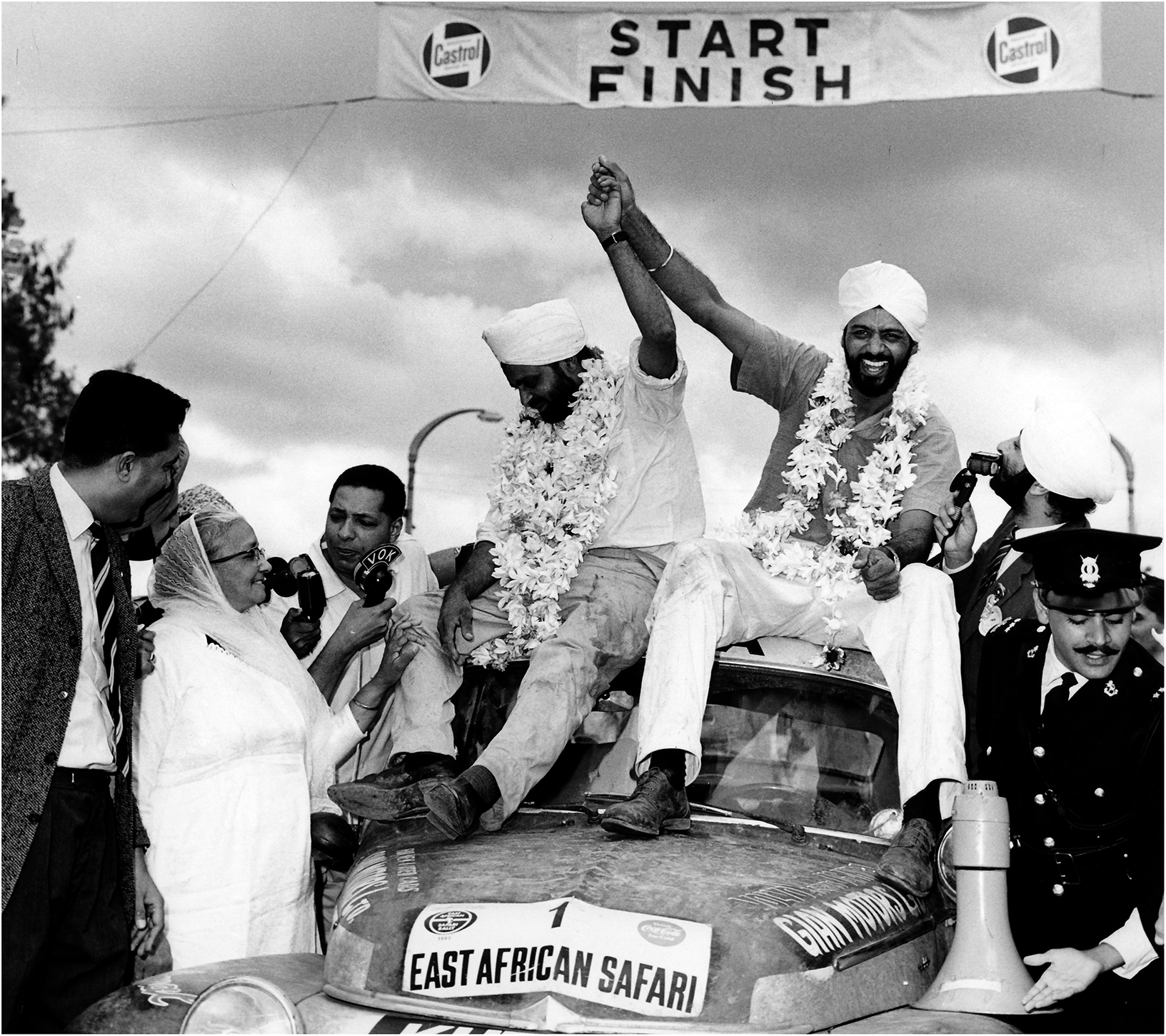
The illustration on this page (Figure 1), taken in 1965 in Nairobi, shows the two brothers Joginder and Jaswant Singh, having just won the East African Safari Rally, a motoring event held annually in East Africa since 1953. They were driving a second-hand car left behind by the Volvo works team after a crash in the previous year’s rally.Footnote 1 Overnight, the two Kenyan-Asian drivers became popular heroes, in particular among the large Asian immigrant community in the former British colonies in East Africa, but also around the world, where their story contributed to the growing reputation of the Safari “as the world’s fastest, toughest and most prestigious rough-road rally.”Footnote 2
Joginder and Jaswant Singh, Nairobi, 1965.

The Safari’s extraordinary and long-lasting local and global popularity implies that even a seemingly frivolous, idiosyncratic, and ludic engagement with mobility technologies and infrastructures as evident in this and similar events can reward historical analysis. The history of the Safari highlights the relevance of motorsports for mid-twentieth century automobility. The automotive industry, a prime element of globalized consumer capitalism, used events such as the Safari primarily for advertising purposes, not just to highlight the technical capabilities of its products but also to tap into the positive emotions generated by competitive, spectacular, and adventurous pursuits. Meanwhile, the East African host states of the Safari, though definitely on the margins of automobility and consumerism, seized on the colonial-era event to support strategies of economic development as well as narratives of development and nation-building. A large number of stakeholders, including manufacturers, the businesses enabling automobility, media, governments, consumers, and punters, coalesced around the Safari, finding ways to make it serve their economic interests, political agendas, or desire for entertainment.
During its “golden age” in the 1960s and 1970s, the Safari proved capable of serving various overlapping, complementary, competing, and contradictory projects. However, the increasing professionalization of rallying eventually eroded its relevance to ordinary motorists and stakeholders in the African host nations. These, moreover, shifted their developmental priorities towards socialism, coping with crises, or both, and consequently found less value in an event that implicitly celebrated globalized consumer capitalism. Thus, the rise and fall of the Safari as a globally significant sporting event demonstrates how automobility, sport, and consumerism were interlinked across continents and integrated into developmental projects in the second half of the twentieth century by highlighting the different ways for stakeholders to engage with capitalism and sport, emotionally and economically, as producers, participants, or spectators.
The Safari Rally
The history of the Safari Rally begins in the early 1950s when several (mostly) white middle-class motorists in British East Africa came up with the idea of a competitive, challenging, and adventurous drive through the three colonies of Kenya, Uganda, and Tanganyika. They drew on several existing traditions. Organizations such as the Royal East African Automobile Association (REAAA) had promoted exploring the African continent by motor car since the 1920s, and a Cape Town-Nairobi road race had taken place in 1950. In Europe, road rallying was well established, with events such as the Monte Carlo, the Alpine Trial, or Liège-Rome-Liège.Footnote 3 Several motoring enthusiasts in Kenya had been involved in the lively club-level motorsport scene in the United Kingdom (UK).
A suitable date to hold such an event in East Africa soon presented itself: Queen Elizabeth’s coronation on 2 June 1953 not only allowed the organizers to mobilize support by badging the rally as a “tribute from the motoring public of East Africa to Her Majesty the Queen,” but also was accompanied by public holidays that allowed the amateur drivers and the volunteers manning control points to take part.Footnote 4 Although only sixteen of the fifty-seven participating cars reached the finish (the leader arriving after just under 43 hours without rest), the press celebrated the “greatest ever event in Kenya’s motoring history,” adding that nothing in recent years had “aroused such wide public interest, such intense competitive enthusiasm and such truly epic performances.”Footnote 5 From then on, there was an annual rally organized by the REAAA. Over the years, both the organizers and the participants adopted an increasingly professional approach and regulations were updated; the event was renamed the East African Safari Rally in 1959 and simply the Safari Rally in 1974, but its basic principles remained unchanged. Over the Easter weekend (a replacement for the coronation holiday being needed in subsequent years), drivers tackled a route up to 4,000 miles in length, usually starting and finishing in Nairobi. The Safari ran on open public roads and until the late 1960s cars had to be in showroom specification, with only minor modifications allowed.Footnote 6 Only about 300 miles of the course were on tarmac roads, and Easter usually coincided with the beginning of the rainy season.Footnote 7
These characteristics made for a race that rewarded a strong car and the stamina, willpower, and mechanical skills of driver and codriver rather than outright speed. The obstacles participants had to contend with included various locally specific types of sticky or slippery mud, dust, rocks, roads that would within minutes turn into rivers, collapsing bridges, pedestrians, cycles, and lorries on the roads, along with cattle and wild animals. All this helps explain why, in the first years of the Safari, the humble 30-hp Volkswagen Beetle was the car with the most wins to its credit, why until 1972 none of the renowned European rallying stars could win the Safari, and why during all these years none of the drivers was killed in a crash, but three of them drowned. With all this, the Safari was far from a chaotic free-for-all; there were clear rules and regulations, meticulous organization, and local support from large numbers of volunteer helpers and fans.
These are the reasons why the Safari began to attract the attention of motor manufacturers and why the international media developed an interest in covering the event, playing on themes of exoticism and endurance.Footnote 8 Nonetheless, it is worth investigating why an event in East Africa came to rank alongside the Rally Monte Carlo as the most high-profile international rally from the 1960s to the 1980s and beyond.Footnote 9 After all, while most areas of substantial European settlement developed some sort of competitive motoring culture, none had an event of comparable stature.
Twentieth-Century Automobility and the Safari
“Automobility” and “car culture” were, and still are, powerful global cultural forces and provide the wider context for this study. The attachment of vast groups of people from across society in the West and beyond to the car—whether as a tool for mobility, a promise of freedom, a symbol of status or individuality, a machine giving access to the experience of speed—is perhaps one of the most universal features of twentieth-century culture,Footnote 10 permeating capitalistFootnote 11 as well as communistFootnote 12 and developingFootnote 13 societies. The role of the car in colonial and postcolonial settings has attracted the interest of historians and anthropologists who have paid particular attention to themes such as the relationship between car use and patterns of social inequality, and the interplay between globally manufactured cars and the local contexts in which they are used. For some researchers, “the arrival of the motor vehicle was the single most important factor of change in Africa in the twentieth century.”Footnote 14
Chronologically, it was in the years after World War II that car production and car ownership expanded enormously so that, by the mid-1960s, “an automobile-based culture had taken hold in the industrialized world.”Footnote 15 The car industry became a leading sector in industrialized economies, accounting for a significant proportion of growth and exports.Footnote 16 A sustained export drive in Europe’s industrial economies was a key element in the continent’s postwar “economic miracle” in the 1950s. The British car industry had a share of 52 percent in global car exports in the early postwar years. It exported three-quarters of its production, overwhelmingly into Commonwealth countries. Soon enough, the British were challenged by the Germans, in particular Volkswagen (VW). Exports were “at the heart of VW’s expansion” in the 1950s, and Germany was the largest exporter of cars from 1956 and soon the second-largest producer after the United States until overtaken by Japan in 1967.Footnote 17
Culturally, the car everywhere—and this includes colonial and developing countries—became an essential element of the definition of a modern lifestyle. By the 1960s, the downsides of mass automobility were increasingly visible: congestion, pollution, and the rise in fatal road accidents were widely discussed and deplored even before the energy crisis briefly cast doubt over the fundamental viability of a car-based society. This crisis marked the end not of car culture but of an unproblematic relationship with the car. Henceforth, the societal and environmental impact of the car had to be acknowledged and justified. However, automobility remained firmly embedded in the basic structures of societies, cultures, landscapes, and economies.
Use of the road for sporting purposes is marginal in histories of transport and infrastructure. East Africa’s colonial and postcolonial road infrastructure was primarily designed to facilitate the traffic of essential imports and exports between the interior and the coast and to allow officials, businessmen, and troops to move between the local and regional centers. Yet mobility always involves emotional and sporting elements alongside the more utilitarian considerations of transport from A to B. Attitudes towards cars are a prime example of what Martina Keßler and her coauthors have called “techno-emotions,” leading Mimi Sheller to speak specifically of “automotive emotions.”Footnote 18 Such emotions can be extremely consequential, supporting “‘deep politics,’ in which political ideas were expressed in a seemingly non-political way” as well as consumerist desires.Footnote 19 It is the deep embeddedness within many different societies of positive feelings towards individual mobility, speed, technology, and the control of man (and, less frequently, woman) over machine that supports pro-car policies and makes it worthwhile to produce wide varieties of cars aimed at various groups of consumers and to use motorsport as a tool to advertise both motoring and nonmotoring products.Footnote 20
Initially, all cars were “sports cars in the sense that speed, adventure, and the appeal of technological novelty,” rather than their practical utility, “were among their key attractions.”Footnote 21 From the very beginning cars were raced, usually on the open road, which provoked similar conflicts over the mixing of sports and transport to those already faced by cycle racing.Footnote 22 Fatal accidents soon led to road racing being outlawed and to the emergence of circuit racing where drivers raced against each other to be the first to complete a certain number of laps around a circuit that was either purpose-built or temporarily closed to traffic. Rallying, on the other hand, was racing against the clock, usually on the open public road and over long distances testing the stamina and endurance of cars and drivers. Notionally, regularity, navigational skills, and mechanical sympathy were more important determinants of success in rallying than speed, but all the prestigious events rewarded fast and skillful driving over long stretches of rough roads in often adverse conditions and with very little rest. The first such events, the Rally Monte Carlo and the Alpine Trial, were already well established before the First World War.
The sport of rallying developed in tandem with the general evolution of motoring, but neither motorsport in general nor rallying, in particular, have received significant attention even in fields such as the history of sports, transport history, or histories of the motor industry.Footnote 23 Very recently, historians interested in the interplay between modernity, nationhood, and society outside Europe have begun to show an interest in the topic.Footnote 24 While most of the available literature is primarily aimed at enthusiasts, a number of these works are well-researched and give access to the insights the authors developed through their intimate and long-standing involvement with the sport as journalists, codrivers, or managers.Footnote 25 They highlight how rallying globally was shaped by the spread of automobility in postwar Europe. Interest in the sport both from participants who no longer had to be spectacularly wealthy and from fans increased. For example, there were over 300 local and regional motorsports clubs in the UK in 1950. They organized a total of 386 rallying and racing events. In Sweden, over 450 rallies were held in 1970, supported by 319 motor clubs with 47,330 members in total. As cars became more capable, speed and exceptional driving skills were now essential for sporting success, and rallies became more spectacular to watch.Footnote 26
Given the spread of car ownership and grassroots enthusiasm for rallying, manufacturers of run-of-the-mill cars became aware of the advertising potential of rallying success. Long-distance events featuring unmodified cars in showroom specification allowed to highlight of the robustness and durability of cars everybody could buy and thus appeal to the majority of consumers for whom cars were a means of transport, not a piece of sporting equipment or a lifestyle accessory. “Success advertising”—essentially, highlighting sporting success in quickly-arranged advertisements in the print media, following the slogan “win on Sunday, sell on Monday,” was one of the “main marketing tools” in the 1950s and 1960s. To achieve such success, manufacturers began pouring resources into the sport. By the early 1960s, works teams with professional full-time drivers backed up by dedicated service mechanics, development facilities, and team managers were the norm, and rallying soon was a sophisticated and glamourous sport.Footnote 27
As Köhler has demonstrated, over the course of the 1960s motor markets became more competitive as pent-up demand from first-time buyers was mostly satisfied while more discerning replacement buyers demanded cars that met increasingly individualized needs for emotional experiences and social distinction. Competition was also fostered by the reduction of tariff barriers within Europe, which led to a significant increase in car imports in all major markets. Many manufacturers now saw building brand image as a key strategic challenge, and sporting success as an essential ingredient in their branding strategies.Footnote 28 While with the energy crisis, advertising focused on speed and motorsport began to decline in importance, manufacturers’ involvement in rallying did not. A 1979 survey in the Financial Times notes that eighteen out of the twenty-six manufacturers selling “volume” cars in Europe were involved in rallying, and only two (Volvo and Honda) did not participate in any form of motorsport. For some of them, competition was “a cornerstone of marketing policy,” and the two million spectators turning out for the 1979 British Royal Automobile Club (RAC) rally were evidence of the vast fan base for the sport.Footnote 29
However, the spread of automobility that turned rallying into a sport with mass appeal also changed driving conditions in Europe in a way that undermined traditional European rallies. The condition of the roads improved vastly, while standard cars became ever faster and more reliable. Long-distance motoring as such no longer was a sporting challenge, and high-speed long-distance motoring increasingly presented unacceptable risks for both competitors and the public. As a result, just when rallying had developed into a “major international sport” with its own European championship run from 1953 onwards and attracted the support of major manufacturers,Footnote 30 open-road motorsports became increasingly unviable. Some rallies were transferred to rough and remote roads to avoid tourists, commuters, and lorries. The Liège-Rome-Liège, for example, was rerouted through the Balkans and became the Liège-Sofia-Liège, but it ended in 1965 as the Yugoslav authorities were increasingly concerned about accidents involving rally cars and ordinary traffic. Others were held as a series of “special stages” on temporarily closed roads or private land.Footnote 31
This is the context in which the Safari Rally acquired relevance for motor manufacturers, journalists, and enthusiasts from across the globe. There were lingering memories of Africa as a site for motoring adventures.Footnote 32 But through most of the 1950s, the Safari remained an event of almost exclusively local interest with the air of amusement for “a bunch of expatriate motoring enthusiasts charging about in the bush,” as the British magazine Motorsport put it.Footnote 33 Since 1957, the Safari was listed as an international event by the Fédération Internationale de l’Automobile (FIA). The first overseas works teams, Ford UK and Rootes, competed in 1959. They were soundly beaten by a Swiss-born local amateur, Bill Fritschy, who with his stepfather drove a privately entered Mercedes. Major manufacturers such as the British Motor Corporation (BMC), Citroën, Ford, Mercedes-Benz, Renault, Saab, and Volvo began sending works teams to Nairobi beginning in the early 1960s. In 1962, more than one hundred cars took part; thirty-three of the drivers were professionals from overseas. The works teams were attracted by the reputation of the Safari as the “toughest rally in the world,” by its commercial potential, and by the “legend” that only local drivers could win it. The organizers were responsive to the suggestions and requests made by the prestigious and well-funded overseas teams, and during the 1960s, the Safari developed into a competition between professional drivers employed by works teams and supported by ever larger advertising budgets.Footnote 34
With rallying in Europe becoming more popular, faster, more competitive, and thus more difficult to organize on the open road, manufacturers noticed that the Safari had quietly emerged as a challenging and well-run rough-road competition, providing a potential opportunity to advertise the virtues of their products. Motoring journalists began to regard performance in the Safari “as a basis of comparison between various makes,” and manufacturers saw it as one of the few internationally known high-profile events with large advertising potential: “an outright victory was as important to sales, particularly in developing countries, as a Monte Carlo success would be.”Footnote 35 A Ford advertisement in the Financial Times noted in 1964:
The Ford that won the Safari rally has the same engine, the same body, the same chassis, the same standard controls as the Ford you can buy in your local Ford dealer. … Every part of the Safari-winning Fords was subjected to 3,180 miles of the worst motoring conditions in the world—conditions which proved too much for all but 21 of the original 94 starters.Footnote 36
The participation of works teams and professional drivers changed the Safari profoundly. All serious competitors now thoroughly explored the route and made copious notes prior to each year’s rally. The works teams employed mobile service crews to carry out repairs and maintenance on their cars. The significance of Joginder and Jaswant Singh’s victory emerges in the context of these developments. It was celebrated as the story of the local underdog beating the professionals: The Singhs came from a modest background, had bought an initially competitive, but crashed and written-off Volvo for £350 on credit, and rebuilt it themselves. Their friends supported them by buying advertising space on the car while others organized a rudimentary service effort. They were the “only private entrant to finish” in a field of “works teams with superb servicing,” the first private entrants to win a major rally in many years, and the first Asians ever to do so.Footnote 37 They were soon called the “Flying Sikhs”—a reference to the “Flying Finns,” the collective nickname given to the Nordic superstar drivers who burst onto the rally scene in the early 1960s and dominated the sport well into the 1980s.
Locally-entered Fords, Mercedes, Volkswagen, Volvos, and Peugeots continued to dominate the Safari until the late 1960s. But once extensively modified “Group 2” carsFootnote 38 were admitted in 1967 it was only a matter of time before the balance would swing in favor of the overseas works teams with their specialized competition departments and experience in developing high-performance versions of run-of-the-mill saloon cars (sedans for the American readership). The works cars of Ford Germany and Nissan won in 1969–71 with local drivers at the wheel, and in 1972, one of the “Flying Finns,” Hannu Mikkola, was the first European to win the Safari, driving an Escort RS1600 entered by Ford UK. The efforts of Ford’s drivers and service crews were coordinated via a radio link to a chartered airplane. Ford admitted having spent more than £50,000 on their 1972 effort, though the real cost was rumored to be at least twice that. The money came from the American multinational’s marketing budget.Footnote 39 Significantly, an additional £90,000 was then spent publicizing the team’s success in the world’s media.Footnote 40
This brief overview linking developments in mobility, rallying, and consumption illustrates how the study of sport, as Matthew Taylor has suggested, “might help to deepen our understandings of globalizing processes and transnational linkages over time.” With regard to the Safari, it will become apparent that the “cultural centrality of motor sport within many developed nation states” David Hassan has highlighted may have been equally salient in developing nations as well.Footnote 41
Whose Safari?
As soon as the Safari acquired a measure of importance and permanence, it was contested amongst its stakeholders. Describing those involved in and affected by the Safari as stakeholders allows us to analyze their stake in the event and their influence on its development. They include the local amateur and semiprofessional drivers, motor traders, and the Safari’s organizing committee who between them had invented and developed the Safari. To this need to be added diverse and deeply divided local populations in both rural and urban areas across colonial and then postcolonial East Africa; the governments of newly independent Kenya, Tanzania, and Uganda who began to see the rally, despite its colonial origins, as a national asset; international motor manufacturers with an eye on sales and advertising opportunities; the local and international media; and even international motorsport’s governing body, the FIA. The stakeholders’ interests and influence were obviously affected by wider global and local transformations.
Decisions on and preparations for the rally were made by a small, almost entirely volunteer group. At first the Safari was simply run out of the REAAA’s offices, then it gained a full-time chief executive and a public relations (PR) officer as tasks such as canvassing manufacturers around the globe to send works teams and cultivating relations with hundreds of international press titles became more onerous. Eric Cecil, a Nairobi businessman, was chairman of the Safari until 1974 when he was succeeded by Bharat Bhardwaj, an ophthalmologist from the South Asian community. Only in 1985 did an African, Nicholas Nganga, take over. As will be discussed below, this was just one example of continuities over the watershed of decolonization which appeared increasingly anachronistic.Footnote 42
Local Drivers and Teams
The winners in the first two decades of the Safari all were amateurs in the sense that they had full-time jobs and honed their driving skills on weekends in their own cars in local rallies, races, and hill climbs. However, nearly all of them received substantial works or dealer support in the Safari. Rallying in colonial East Africa was a pastime for a predominantly white, rather transnational, middle class. While some of the successful drivers of the 1950s and 1960s had been in East Africa since the interwar years, others had arrived as engineers, technicians, or businessmen during the development-focused “second colonial occupation” after World War II.Footnote 43 Not all of them took as circuitous a route as Zbigniew (called Nick) Nowicki who was born in Poland in 1929, spent the war as a refugee in India, and decided to stay behind when the ship that was supposed to bring him to the UK in 1947 had to stop in Mombasa for repairs, but alongside emigrants from Britain and their descendants we find others of Greek, Swedish, Swiss, and German origin. Not all were agents of globalization in the same way as Edgar Herrmann, a German who first visited Kenya as a backpacker in the early 1950s when he was still a student. He later returned as a hotelier and one of the pioneers of package tourism in Kenya, luring German and Swiss tourists with the slogan “sun, sand and sex.”Footnote 44 Unsurprisingly, those working in the motor trade as employees, managers, or owners of local car dealerships and garages were strongly represented. For them, mechanical skills, enthusiasm for motoring, access to workshop facilities, and an interest in promoting their business made entering the Safari appear as almost natural. But there was also Lucille Cardwell, a zoologist, laboratory technician, and amateur racer from Nairobi who was among the finishers in some of the toughest years and achieved the best result for an all-female team, coming in third in 1961. Derek Gates, executive manager for the Safari from 1968, had come to Kenya as a civilian police employee at the end of the 1950s, but there is no obvious sign of drivers or key officials with a background in the colonial police and security services which were expanding at a rapid rate during the years of the Mau Mau rebellion and anticolonial protests.Footnote 45 While some drivers left in the years around independence, many of them remained in East Africa into the 1970s and 1980s.
From the beginning, a number of “African Asians” took part in the event, including the two most successful drivers, Joginder Singh (three victories) and Shekhar Mehta (five). Singh, born in Kenya in 1932, was the eldest of ten children of a Punjabi immigrant who worked as a mechanic on tea plantations before establishing his own garage in 1946. Singh learnt his trade there before becoming the REAAA’s first mobile mechanic and then moving into a desk job. It was only after his 1965 victory that he managed to establish his own garage called Joginder Motors. In 1960, he was refused membership of the elitist East Africa Motor Club. Shekhar Mehta, conversely, came from Uganda’s richest industrial dynasty. Mehta Group, established by immigrants from India, controlled sugar and cotton processing as well as tea and coffee plantations. Mehta was educated in Switzerland and the UK before returning to Uganda to work for the family business.
Both Mehta and Singh joined the ranks of paid semiprofessionals once they had proven they could get a privately entered car to the finish. Both were given the opportunity to drive in non-African rallies. Volvo gave Singh an up-to-date car (the winning PV544 unfortunately was no longer commercially available) to compete in the Rally Sweden, the Akropolis Rally, and the Safari. He achieved several top results in the latter event but less than stellar performances elsewhere. Mehta came to be regarded as one of the top drivers in endurance events internationally.
The East African Standard noted before the start of the very first Coronation Safari that “drivers of every rank, European and Asian,” took part, implicitly acknowledging that Africans were not even expected to be involved. The first African drivers took the start in 1958, but their number remained very limited. It was not until 1967 that one of them, Yusuf Sabb from Uganda, managed to finish the course. Two years later Ugandan transport entrepreneur Sospeter Munyegar achieved the first class win by an African driver.Footnote 46 Low African participation initially reflected colonial patterns of car ownership that was confined almost exclusively to the Asian and European populations, not least because the colonial state had always discouraged all forms of African mobility.Footnote 47 As a result, at the time of decolonization speed and motoring were perceived in overlapping racial and class terms. When accidents occurred, crowds of black “have-nots” often blamed European and Asian “haves” for speeding and careless driving.Footnote 48
After independence, Kenya, Tanzania, and Uganda sought to increase the participation of Africans in the modern economy from which the colonial state had largely excluded them. Africanization policies rapidly increased car ownership among new African elites and thus marked “the real beginnings of mass automobility.” In Kenya, road transport was a major area of government investment. Upwardly mobile Africans who used their government salaries and subsidized loans to acquire a Peugeot 404 (“the car to beat, not only in the parking lots of dance clubs, but also in the famed East African Safari Rally”) became known as kupujoo, and were notorious for speeding and accidents.Footnote 49 The first Kenyan of African descent to finish the Safari, Peter Shiyukah, was a permanent secretary in the Department of Public Works. Shiyukah was not just a driver but also president of the Kenya Rally Drivers Club (KRDC), which supported African drivers, providing subsidies as well as service facilities during the rally. Spurred on by his achievement in 1971, thirty-seven African drivers, including six all-African crews, tackled the Safari in the following year. However, it was not until 1979 that another African driver, Mohamed Noor, reached the finish.Footnote 50
Nonetheless, it seemed as if by the 1970s all ethnic communities in East Africa were committed to the pursuit of speed. An American observer noted in 1973, deploring the “terrible toll the automobile takes in African life”:
If there is one thing that unites Africans, Asians and European settlers, it is reckless driving. The Asians, particularly the Sikhs, who are East Africa’s rally racing champions, hurtle along the roads in a spine-chilling fashion. The African busses and cars whizz down the center of the road. Either you move over or you become a statistic.Footnote 51
The Safari certainly “reflected the cosmopolitan life of East Africa,”Footnote 52 in the sense that it was part of the modern, urban segment of East Africa’s economy that “had been fashioned largely in response to the existence of a non-African population” and was opened up to African participation only slowly and incompletely.Footnote 53
International Works Teams
The participation of professional overseas drivers represents the major change in the social composition of the Safari over the period. In local terminology, drivers from Europe were “visitors”: “you can’t say ‘European’ for the Kenyans are still considered Europeans and all others apart from locals are ‘visitors’.”Footnote 54 The first visitors, like the more successful locals, were semiprofessionals with works support, often with a background in the motor trade or motoring journalism. Examples include Ford works drivers Cuth Harrison and his sons who owned a Ford dealership in Sheffield, or A.E. (Bill) Bengry, a VW dealer from Leominster.Footnote 55 From the 1960s, however, the typical visitor was a professional works driver. All the big names in international rallying now made the trip to East Africa, beginning with Sweden’s Eric Carlsson and his future wife, Pat Moss (sister of grand prix driver Stirling). Both of them came close to victory with their little Saabs.
Professional drivers from overseas demonstrated their skills in the Safari from their first appearances, dazzling the locals with their speed and advanced driving techniques. H.S. Sembi, Singh’s brother-in-law and codriver in 1971, acknowledged the visitors were “far better drivers” than the locals and admitted he had “never seen anything like it” after watching Saab’s Stig Blomqvist tackle a muddy section.Footnote 56 But in the end, for almost twenty years it was a local driver pairing that came out on top, helped by the fact that the works teams thought it prudent to always give a car to drivers with local knowledge. European superstar drivers would usually take the lead early on, but then wear out and break their cars, or fail to cope with the rapidly changing road conditions. The myth developed that the Safari was “the rally a European could not win.”Footnote 57
How did the Safari fit into major manufacturers’ strategies? From 1954, Volkswagen supported East African distributors entering their cars in the Safari. All six VWs entered that year finished the rally, and the drivers were rewarded with a letter of congratulations and a wrist watch from Wolfsburg.Footnote 58 Rallying success achieved through local importers helped brands such as VW, Peugeot, and Mercedes establish themselves in the East African market where motorists often preferred them to British cars on grounds of performance, robustness, and a reliable supply of spare parts.Footnote 59 Ford was a prime example of a company using motorsport strategically to refashion its brand image. The man behind Ford’s 1972 Safari victory, Stuart Turner, was credited with single-handedly professionalizing the sport in the 60s while working for BMC where he oversaw the spectacular rallying successes of the Mini Cooper.Footnote 60 At Ford, he targeted high-profile victories, at the Safari, in the Le Mans 24-hour race, and through the development of a Formula 1 engine, and made sure that all the resources of a global company were deployed in the pursuit of success. Though the focus on a sporty brand image led Ford into trouble during the energy crisis, the company continued to support rallying and Turner, meanwhile promoted to lead Ford’s public relations, continued to believe that rallying had been “a major catalyst in changing Ford’s early-1960s image of a utility car maker to one spanning the spectrums of age and earnings.”Footnote 61
Nissan/Datsun first entered the Safari in 1963, at a time when Japanese cars were regarded as cheap and lacking in both performance and reliability and had yet to find a substantial overseas market. The Safari became the main focus of Nissan’s rallying activities as part of a long-term strategy to gain a foothold in new markets without a local car industry and where “sturdy cars, strong enough to take a beating on rough roads” were in demand.Footnote 62 Nissan rally cars were developed with the Safari in mind (Mehta later said “Datsun is a car which has grown up in Africa with the Safari Rally. It is an African car”).Footnote 63 The works team achieved three outright victories with Edgar Herrmann (1970 and 1971) and Shekhar Mehta (1973). By then, Nissan was moving upmarket and targeting European and American sales, and the Safari proved the ideal terrain for the 240Z coupé, sturdy and fast but not nimble enough for most European events.Footnote 64 Thus, Safari’s success helped create the image of Nissan’s Datsun brand as both reliably engineered and sporting, an image that was bolstered by Mehta’s four consecutive victories in 1979–82.
United States (US) manufacturers, the largest car producers, struggled to make an impression at the Safari, or on the international rallying scene in general. Rallying and perhaps motorsports more widely demonstrate that the US, though the birthplace of car culture and foremost stronghold of automobility, did not necessarily set the tone for how societies elsewhere engaged with the car. Ford and General Motors (GM) largely left the activity to their European subsidiaries (Ford UK and Ford Germany merged into Ford Europe in 1967, and Vauxhall/Opel). This can be explained by the unique driving conditions, customer preferences, and motorsport scene in the US where, as Volti notes, a “rather uninvolved approach to driving” prevailed, the cars and road conditions “made few demands on motorists’ skills,” and technological innovation was focused on comfort and acceleration rather than handling.Footnote 65 Rallying did not develop to any significant extent, and there were few cars available that were suited for fast driving on rough roads.
Ford US briefly showed an interest in European-style rallying in the mid-1960s, when performance versions of the newly introduced “compact” models—which still dwarfed European cars—became available. They encountered some success in the Monte Carlo, but the large-scale effort in the 1964 Safari was a disaster. It suffered from a lack of knowledge of local conditions and the regulations, and the six Lincoln-Mercury Comets entered were too heavy and mechanically not strong enough for the Safari. Only two cars finished at the tail end of the field, Singh bringing his Comet home last of the twenty-one finishers after carrying out extensive repairs en route.Footnote 66 Overall victory as well as the team prize that year went to the nimble Cortinas entered by Ford UK.
Through their substantial engagement, the works teams and the drivers they employed quickly became the largest, most influential stakeholders in the Safari. Given the importance the works teams’ participation soon acquired for the local economy, they could rely on other stakeholders to do their bidding.
Other Stakeholders
Commercial interest and sponsorship from the local motoring trade and newspapers had played a key role in the Safari from the beginning. In the first Safari, about half the entrants drove cars supplied by the motor trade for advertising purposes.Footnote 67 Cars were divided into classes according to their Nairobi showroom price, providing potential buyers with a clear indication of which model within their budget most successfully withstood competitive rough-road driving.
Local newspapers stimulated public interest in the event and benefited from the increased sales and rally-themed advertising. The East African Standard contributed £500 in prize money from the first Safari onwards—not an inconsequential sum, given that the smallest class was for cars priced up to £600.Footnote 68 In the 1960s and 1970s, the Safari dominated the front pages of Kenya’s two main newspapers, the East African Standard and Daily Nation, in the weeks around Easter. Car-related businesses advertised heavily, with those associated with winning cars buying full pages. Newspapers provided multipage supplements and scorecards on which readers could record the progress of the cars. Regular Safari bulletins were presented on radio and television (TV), provoking angry debates in the newspapers’ letter pages between those who complained about the lack of quality and content of the reporting and those who felt the Safari did not merit such extensive coverage.Footnote 69
The close interdependence of sport, the media, and commercialization is of course not specific to the Safari.Footnote 70 On an international level, the Safari was merely one part of a steady stream of sports-related news items that helped sell newspapers and fill TV schedules, in turn providing manufacturers with an audience receptive to sports-based advertising. All leading newspapers covered the event in the 1960s and 1970s. Some, like the New York Times, printed full-page previews explaining what the Safari was about and how it had developed into “a major event on the international automobile competition calendar.” The effects of a Safari victory on sales, as Volkswagen and Mercedes had proved, were also highlighted, and the US coverage thus generated certainly did not hurt Volkswagen in America, its key foreign market.Footnote 71 The global nature of Safari coverage is evident in the following report on Mehta’s first victory from the Times of India: “Shekar Mehta, the British Asian expelled from Uganda and now a Kenya resident, was officially declared today as the winner of the 21st East African Safari with his British navigator Lofty Drews in a Japanese Datsun 240Z.”Footnote 72
The Safari’s organizers permitted advertising on the cars from 1956 (more than a decade before it was allowed in Formula 1), incentivizing local businesses to support the rally and allowing local drivers to raise funds.Footnote 73 Alongside the names of local car dealerships and other businesses, the logos of motoring-related brands such as Esso and Castrol were often spotted on the cars. While Peter Hughes’s winning Ford Cortina sported a Coca-Cola logo already in 1964, global consumer brands became consistently prominent only in the 1980s.
There were two ways in which the Safari had a real impact on the local economy: directly, as the teams, journalists, and fans spent significant sums of money with local businesses, bringing much-needed foreign currency into the country (though critics noted they also consumed products that had to be paid for in foreign currency); and indirectly, as free publicity for tourism that was rapidly developing into Kenya’s most important export industry. Safari coverage generated media exposure not just for cars but for wildlife, Nairobi’s modern center, and a local population that could be portrayed as friendly but exotic.
None of this would have made any sense without the high levels of public interest shown in the Safari from the very beginning. The support of up to one thousand volunteers was required to make the Safari happen. Work such as surveying and selecting a route and planning the deployment of volunteer helpers took up almost the entire year between rallies and was performed by volunteers. Over the Safari weekend, volunteers were involved in scrutineering the cars before and after the event, manning the control points where the cars had to get their route cards time-stamped, setting up a wireless communications network, and keeping track of the standings and communicating them to the media, amongst various other tasks.Footnote 74
A couple of thousand spectators turned out in Nairobi to see off the Safari cars in the 1950s. By the mid-1960s, 30,000 came to see the start, and perhaps 100,000 lined the streets to welcome the Singhs home in 1965.Footnote 75 That year, “East Africans of all races” celebrated the “Flying Sikhs,” and the East African Standard’s editorial noted the “evident increasing interest of the African people” as “Africans formed the vast majority of the crowds at the start and finish and along the route.”Footnote 76 Turnout in Kampala and Dar es Salaam was equally impressive. Substantial mixed crowds spent the Safari weekends, sometimes through the night, in front of the scoreboard at the rally headquarters.Footnote 77 Those who stayed at home could follow radio coverage of the rally in English, while TV bulletins were available in Swahili.Footnote 78 Like other sports, the Safari also attracted betting. The local turf accountants saw the rally as a risky and unprofitable business, but felt that they had to offer bets on the Safari to keep their regular customers happy.Footnote 79
Urban crowds were enthusiastic, in particular when African drivers appeared, though occasionally unruly.Footnote 80 In several rural areas throughout East Africa, however, stones were thrown at rally cars, and barriers formed of boulders and tree trunks were erected across the roads. It is difficult to establish the reasons for these actions.Footnote 81 Out-of-control children and youths were often blamed, presumably because this made it unnecessary to further enquire into the motives. A knowledgeable observer believed that “hooliganism” was often involved, though occasionally, “some political protest, or a genuine dislike of rally cars speeding through villages” could provide an explanation.Footnote 82 Sometimes, it was suspected that spectators wanted to force cars off the road so that they could earn “push money,” or even rob the drivers of their possessions.Footnote 83 Most sabotage of this kind was directed indiscriminately against local and overseas, white, Asian and African drivers, but at least one stone thrower who was apprehended and taken to court admitted that he wanted an African to win and was angry at seeing so few black faces behind the wheel.Footnote 84 Firmly sticking to colonial-era attitudes, Motorsport complained in 1967 that
the natives in recent years have been getting more restless, and now consider it good sport to throw rocks and other sundry debris at the speeding cars. … It’s not as if the natives were plain marauding savages, but … civilisation tends to bring with it decadence expressed in these outbreaks of hooliganism.Footnote 85
Politics and Communities
The Safari was at times a controversial event. Criticism of its existence seems to have been brushed under the carpet as far as possible, given the strength of the interests vested in the rally. The Daily Nation retrospectively acknowledged in 1971 that “Five years ago, the call on most African lips was that the Safari should be abolished.”Footnote 86 Such criticism implied that the rally was an event run by, and for, non-Africans—Asian and white locals representing colonialism, and car manufacturers representing global capitalism. However, already before independence, nationalist leaders had promised their “full support” to the Safari, and the government of independent Kenya stuck to its pro-Safari stance, recognizing the rally’s economic importance. As tourism became one of the country’s “leading industries” and a crucial source of foreign exchange, the publicity generated by Safari coverage worldwide was a key reason the government firmly supported the rally. From 1968 onwards, President Jomo Kenyatta flagged off the cars (“the first time that a Head of State has started an international car rally”), and government ministers ritually warned the public against throwing stones at the rally cars, stressing that such behavior would be harmful to Kenya’s international reputation and drive away foreign participants.Footnote 87
While there was thus overwhelming support for the Safari from the public, government, media, local business, and foreign participants, there were nonetheless fierce discussions and disagreements between these stakeholders over how the rally should evolve and whose interests should shape that evolution. Open political conflict erupted between the governments of Tanzania, Uganda and Kenya, at first over sharing the benefits of hosting the Safari but soon revealing deeper differences over the meaning of political independence and economic development. Tanzania and Uganda at different times boycotted the Safari in order to force Kenya to let the start and finish rotate between the three countries and thus attract the teams, press and spectating crowds to their own capitals. The Safari indeed started and finished in Kampala in 1970 and in Dar es Salaam in 1972. However, the economic nationalism that was behind these conflicts also led to the erection of increasingly irksome political and economic barriers which made it more and more difficult to organize cross-border events, even though the Safari’s host states were theoretically committed to close economic integration as members of the East African Community.Footnote 88
The economic and political paths of the Safari’s three East African host countries diverged substantially.Footnote 89 From 1967, Tanzania pursued self-sufficiency, rural collectivization, and the development of rail infrastructure with Chinese support. The expropriation of European and Asian-owned businesses in the name of Socialism and Africanization put an end to the social and economic privileges that had allowed some members of these groups to engage in rallying, and the car did not play a prominent role in Tanzania’s development strategy. Uganda followed Tanzania on the path towards an “African Socialism” until Idi Amin created his brutal dictatorship following a military coup in 1971. Amin had a personal interest in motorsport, reportedly taking part in local rallies in a Citroën SM with his wife Sarah as codriver, and once directly intervening in the Safari to save Edgar Herrmann from incurring a time penalty.Footnote 90 His rule, however, was as detrimental to the Safari as to Ugandan society as a whole. The “economic war of liberation” he declared on the Ugandan-Asian population, forcing them to leave the country so that Africans could take control of the economy and enjoy the fruits of economic development, also affected Shekhar Mehta and his family.Footnote 91 Mehta at first competed for Kenya, then for Great Britain while the headquarters of Mehta Group were moved to Nairobi and then to India, leaving behind, as he claimed, 8,000 employees and business assets worth £40–50m.Footnote 92 Due to economic collapse looming in Tanzania and Uganda and increasing barriers to cross-border interaction between the three East African states, the Safari’s organizers ran the rally as a purely Kenyan event from 1974 onwards.
By that time, the organizers were well aware that they were operating in a complex, and rapidly changing, environment, with the interests of the different stakeholders increasingly pulling in different directions. This can be seen from an analysis of their efforts to increase the involvement of manufacturers, along with the local spending, big-name drivers, and public interest they brought with them. The Safari’s organizers from early on had made an effort to get European drivers, journalists, and manufacturers interested in the rally. Safari regulations were aligned with the first international set of rules for rallying and racing created by the FIA, the “Appendix J” regulations, as soon as they were published in 1956, making an entry more attractive for overseas teams.Footnote 93 In the 1960s, the decline of European open-road rallying seemed to suggest that “the Safari could become the world’s top motoring classic” if it paid sufficient attention to the works teams’ interests.Footnote 94 In particular, manufacturers lobbied for the admission of the more extensively modified cars that were also used in European rallying (in technical terms, those coming under FIA’s Group 2, 3, and 4 regulations), and the elimination of the roughest road sections where it was often a matter of chance whether cars would get through or not. These requests were met through several changes to the regulations. By the end of the 1960s, the organizers openly expressed their wish that an overseas driver would win, fearing the works teams would stay away if they did not see a realistic chance of victory.Footnote 95
Close attention to manufacturers’ interests was rewarded when the Safari was included in the new International Rally Championship for Makes from 1970, eliciting “a lot of pride for in our state of economic and social development we have been able to produce … an international rally which can compete … with the world’s best.”Footnote 96 International Championship status guaranteed manufacturer interest and global media coverage, underpinning the rally’s benefits for the host countries. However, it also changed the character of the competition, driving a wedge between local competitors and works teams. In place of the showroom-spec Volkswagens that had been competitive with 30 or 40 hp until the early 1960s, there now were cars such as the highly tuned 210 hp Ford Escort or even the purpose-built 320 hp Lancia Stratos, and the average speeds the drivers had to maintain to remain in the rally were set so high that a reasonably powerful car was required simply to keep up and avoid being time-barred.
Such changes put victory more or less out of reach of local entrants. Competing in the Safari had never been cheap. Already in 1958, the East African Standard put the cost of an entry at £432, close to the price of a new Volkswagen. These costs were steadily rising as weekends away on reconnaissance, service backup, and extensive preparation of the car all had to be figured in.Footnote 97 A journalist who entered in 1966 concluded: “there are two approaches to the Safari—one amateur and one professional. Only the latter can succeed.”Footnote 98 Yet a car prepared to Group 2 specifications would cost several times as much as a showroom model in the early 1970s and require an extensive set of locally unobtainable spare parts.Footnote 99 Even Shekhar Mehta said that he “wouldn’t rally as a privateer … It is too expensive.”Footnote 100 Meanwhile, the works teams saw the “locals” merely as journeymen supporting the international superstars. Under these circumstances, it is remarkable that Joginder Singh, after turning his back on the works teams, managed to win the Safari two more times in 1974 and 1976 driving a comparatively underpowered 120 bhp Mitsubishi Colt Lancer he had imported and prepared himself.
Professionalization was a somewhat controversial topic at the time across many sports, with the International Olympic Committee and football associations fiercely defending a traditional ideal of gentlemanly amateurism. However, rallying, like skiing, illustrates how the dedication and skills of full-time professionals produced superior sporting performance and entertainment value, which advertisers, the public, and equipment manufacturers were prepared to pay for, making amateurism more and more difficult to sustain.Footnote 101 Shoring up the private entrants’ role in the Safari was a preoccupation of the local media. Editorials frequently advocated keeping the rally true to its amateur origins, with unmodified cars and driving conditions ordinary local motorists could relate to. The issue gained increased importance in the 1970s. One of the reasons was the impact of government policy on the cost of competing. Would-be private entrants found it increasingly difficult to procure even ordinary vehicles due to exchange controls, inflation, duties of 100 percent on imported cars and spares, and import quotas. The organizers saw this as a problem affecting a range of developing countries which, to bolster their import-substitution policies, tightly restricted the import of cars and spares. This made it impossible for local drivers to enter a car that conformed to FIA specifications. However, the FIA rejected proposals for a “new deal for the private entrant” that would have allowed a “rally within the rally” exempt from FIA regulations.Footnote 102 The organizers and prominent local drivers including Singh and Mehta successfully lobbied the Kenyan government to waive import duty and sales taxes on cars imported specifically for the Safari from 1978.Footnote 103 Given the ever-increasing discrepancy between the resources mobilized by the works teams and those at the disposal of private entrants, the effect of such measures was limited.
Importantly, the prospects of private entrants were key to “Africanizing” the rally and thus keeping it relevant to a changing audience, the largest section of which now were the wananchi, ordinary African citizens. The Daily Nation celebrated in 1969: “The first completion of the event by an African crew made it ‘The People’s Safari’ at last.”Footnote 104 Yet, while prominent local drivers of European or Asian background had demonstrated their abilities and earned work drives at a time when it was still possible for a private entrant or dealer-supported semiprofessional to win, African drivers seeking a breakthrough in the 1970s found this route blocked. Inventive measures were taken to promote African drivers, including the financial backing and service support provided by the KRDC or local communities raising the funds for an entry by public subscription in the spirit of Harambee (“all pull together,” Kenya’s official motto).Footnote 105 Despite this, African drivers failed to finish during most of the 1970s. As a result, they were criticized for failing to practice their skills in local rallies or being more interested in drinking, showing off, or raising sponsorship money than in competing.Footnote 106 Other voices, however, alleged racial discrimination against African drivers by the organizers and non-African volunteer helpers.Footnote 107
Since decolonization, the relevance and legitimacy of the rally depended on increasing the involvement of Africans as drivers, spectators, and volunteer helpers. The public outcry when the start and finish were moved away from Nairobi’s City Hall to Jamhuri Park in 1967 provided an early warning against ignoring the views of the African public. As the Park was difficult to access by public transport the move was denounced as “racialism” against African fans.Footnote 108 The move was reversed the following year, a deliberate effort was made to improve access and information for fans, and the organizers promoted the 1969 event as “a people’s Safari.”Footnote 109 However, demands to accelerate the Africanization of the Safari by placing it under public control and replacing the largely white and Asian volunteers with Africans continued to be made—a dilemma for the organizers who relied on the volunteers’ enthusiasm but had to acknowledge rural communities’ view of them as “remnants of colonialism.”Footnote 110
The thrust of such criticism was not to abolish the rally, but to Africanize it. Progress was made in this respect through the 1970s. Kenya’s Attorney-General Charles Njonjo became the patron of the East African Automobile Association and one of the most vocal public supporters of the Safari. More African faces were seen at the control points, in the cars, and in the Safari’s organization, even though the vast majority of officials remained “Europeans” through the 1980s. The government provided a cash grant to support the rally and many local firms contributed prizes for private finishers. The Daily Nation proclaimed 1978 as the “year that everybody rallied round,” lauding a “truly Harambee effort … the Safari has now full support from the Government, the big companies, the private entrants, the African drivers and the public.”Footnote 111 Yet, within a few days of the finish, unsuccessful African drivers, supported by commentary on state-run Voice of Kenya radio, again complained about the unfair treatment of private and in particular African entrants, provoking a fierce reaction from the organizers.Footnote 112
These debates suggest that analyzing the stakeholders’ engagement with the Safari solely with a focus on their political and economic interests may be incomplete. The Safari’s appeal did not rest on a utilitarian appreciation of roads and cars but rather on “automotive emotions” (Mimi Sheller) and how fans and the wider public could identify with the event.Footnote 113 Finishing in the Safari while many European superstars fell by the wayside became an aspiration for local motorists. Asian drivers such as Joginder Singh and Shekar Mehta became popular heroes at a time when their communities were branded as lackeys of imperialism and faced persecution and expulsion. Local communities raised funds to allow African drivers to compete and demonstrate their skills. The organizers and authorities were keen on presenting the Safari as an example of voluntary collective effort, whether by predominantly white expatriate communities in colonial times or as a “Harambee effort” of Kenya’s citizens after decolonization. The Safari thus links into the project of African nation-building internally as a collective experience of modernity and Kenya’s relevance to the wider world, and externally through advertising a unique combination of tradition, nature, modern amenities, and openness. Like the cycling Tour de France and the Mille Miglia road race in Italy, it was used to promote a particular narrative about social integration and modernization.Footnote 114
As a motor race, the Safari’s relevance partly rested on the socioeconomic linkages that have been described as making up a “system” of automobility: garages, parts suppliers, hospitality, dealers, manufacturers, consumers, and a range of services and infrastructures required by, and requiring the car.Footnote 115 Featuring showroom-specification cars and run on open roads, during its golden age the Safari was sufficiently close to everyday mobility practices to make it readable and accessible to the growing group of motorists and aspiring motorists in East Africa. It provided intrinsic satisfaction for competitors and spectators, as well as an outlet for adventurism, the expression of modern (masculine as well as feminine!) identity, entrepreneurial spirit, and patriotism. The annual nature of the spectacle kept hearts, minds, and business interests fixed on the transformational experience of getting behind the wheel of a motor car. Automobility was “part of an aspirational modernity.”Footnote 116 At the same time, the Safari allowed an approach to driving that normally would have been regarded as satisfying but too risky to contemplate. Thus, while celebrating the expanding possibilities for everyday mobility, the Safari also involved a reappropriation of transport infrastructure for purposes of individual and collective enjoyment. Such experiences underpinned and were reinforced by marketing strategies, and they may even help explain policies that supported popular aspirations for car ownership and individual mobility.
“A Manufacturers’ Battleground”
Meanwhile, the same conditions that had driven rallying off the open road in Europe began to emerge in Kenya where, in response to popular demand, resources were poured into road building. Though much of the network remained untarred in the late 1970s, roads were now busy with the various vehicles used by a rapidly growing and increasingly mobile population.Footnote 117 Nonetheless, rally drivers with their highly modified cars were now expected to reach average speeds exceeding 85 mph over long stretches of unsurfaced, open roads.Footnote 118 Accidents cost the lives of service personnel and members of the public, including a woman killed by Singh’s car in 1976.Footnote 119
Motoring journalists fretted about even Africa no longer being sufficiently backward to be of much use as a place to go rallying:
although the advance of civilisation may, on the face of it, signify an improvement in almost everything, to the rallying enthusiasts of the world (and to climbers, aviators, conservationists and many others) it represents a threat to the activity which gives them greatest pleasure.Footnote 120
Indeed, activities that are, from a present-day perspective, as unrelated as motorsport, mountaineering, conservationism, and photo safaris, all demonstrate how access to colonial space had been taken for granted by the colonial and European middle classes, and how they, along with the manufacturers’ works teams, claimed privileged access to African spaces even after independence—whether that meant use of the public road for sporting purposes or exclusion of African populations from sites of natural beauty where this was seen as key for the preservation and enjoyment of endangered wildlife.Footnote 121
Such attitudes reveal how Africa had been transformed from a developing market into an exotic backdrop for a marketing event aimed at European, American, and Japanese consumers. Ford’s team manager Peter Ashcroft described the Safari as “a manufacturers’ battleground.”Footnote 122 The prize was global market share, not local sales as in the early years of the Safari. Motorsport noted “the inadequacy of the East African market potential, bearing in mind that the object of works-rallying is to sell more cars,” and highlighted that what counted for manufacturers was “the worldwide publicity that the event gets.”Footnote 123 Nairobi’s largest Ford dealer later remarked: “The Safari counts for precisely sweet Fanny Adams as far as local sales go,” adding that the real importance of the event lay elsewhere: “what sells cars internationally … is a combination of name drivers and victory.”Footnote 124 Nissan likewise placed global brand value above local sales. The 240Z coupé driven to victory by Edgar Herrmann and Shekhar Mehta was not even available for sale in Africa.Footnote 125 Local dealers lost interest in the Safari as competing became more and more expensive, and import restrictions made marketing unnecessary in a supply-constrained market.Footnote 126
Gradually, the Safari was absorbed into the globalized system of professional, advertising-financed motorsport.Footnote 127 In 1980, the organizers secured a three-year sponsorship deal with Philip Morris, and the rally was renamed the Marlboro Safari (later, it became the Martini Safari). It was now run by Safari Rally Ltd, a nonprofit company spun off from the EAAA. Into the 1990s, the Safari remained one of the commercially most important rallies in the world. Its success led to the inclusion of similar events such as the Bandama Rally in the International Championship, and it inspired the creation of the Himalayan Rally in India. A delegation of the Himalayan Rally Association visited the Safari several times in the late 1970s and secured the help of Joginder Singh and Bharat Bhardwaj in planning the route. Singh even put in an entry for the first Himalayan Rally, but in the end, he did not take the start and thus also failed to pay a visit to his ancestral village en route.Footnote 128 Another event that sought to revive the spirit of amateur adventurism of the early Safari and claim the mantle of “the world’s toughest and most dangerous motor race” was the Paris-Dakar, which was first held in 1978 and became increasingly popular over the 1980s.Footnote 129
Yet like the Safari such events struggled to balance the interests of safety, local and global spectators, competitors, and manufacturers. Competitive motoring on public roads, even in remote areas, became too dangerous; closed special stages often were too far away for casual spectators and no longer conveyed the spirit of endurance and adventure that had accompanied the early Safaris; lightly modified cars and drivers without works support no longer had a place in the rally. With highly modified cars, closed special stages, and no excited crowds present, the Safari became very similar to European events, making manufacturers reluctant to bear the costs of competing in Africa. The golden era of the Safari ended long before it lost its place on the World Rally Championship calendar in 2003 as a result of financial and organizational troubles.Footnote 130 Joginder Singh sold his Nairobi garage in 1978 and retired in Surrey. He died, aged 81, in 2013.Footnote 131
Conclusion
This article has examined the development of the Safari Rally in the context of intertwined trends in mobility, sports, and consumerism at local, global, and intermediate levels. Rallying acquired significance alongside the rise of “automobility.” The sport became accessible for competitors, relevant to spectators and fans, and thus viable as a marketing tool as a result of mass motorization in Europe after World War II. Soon, it was transformed from a pastime for a wealthy elite into a professionalized and competitive sport. The 1970s saw a balance between professionalization and glamour sustained by marketing budgets on the one hand, and accessibility on the other. Cars were still closely related to what could be bought in the showroom and drivers were skilled professionals, but not wealthy celebrities, nor too concerned with brand image.Footnote 132 While snobs might have turned up their noses at “cars garishly daubed with advertising” and “scruffy little cars driven noisily by scruffy—though undeniably brave—little people,” rally drivers now were superstars and large numbers of fans were eager to identify with them.Footnote 133 Public interest in rallying continued to grow in the 1970s despite increasing concerns about fuel consumption and environmental pollution. As consumers’ “perverse preoccupation with the motor car” persisted, motorsports remained big business and continued to attract growing numbers of sponsors.Footnote 134 Thus, the development of the sport and its chronology were largely driven by European forces, particularly producers and buyers of cars, the media, and advertisers.
Racing cars through the remoter corners of East Africa mattered to a surprisingly large group of stakeholders across the globe, including African governments, European and Japanese car makers, consumer brands, the FIA, professional and amateur drivers, motorsports enthusiasts, local businesses and media, and more. All these stakeholders shaped the Safari’s development. As open-road motorsports became increasingly unviable in Europe, manufacturers were prepared to look further afield for locations to go rallying. However, the key reason the Safari emerged, grew, and survived in a changing environment was that it had deep local roots.Footnote 135 At first, these roots anchored it within the small group of privileged immigrants and expatriates from Europe and South Asia that dominated society in colonial East Africa. Support for the Safari widened considerably after decolonization. Automobility became an aspiration for the upwardly mobile, and postcolonial governments saw the Safari as an essential tool to advertise the attractions of their countries to foreign tourists and to tell local populations a story about modernity and progress. The Safari’s inclusion in the International Championship for Makes in 1970 was a source of considerable pride, and governments and the press consistently urged everyone “to protect [the Safari’s] interests which … must be the interests of East Africa.”Footnote 136 Deep local roots explain why the Safari provided not just adventure and a colorful, exotic background, but also competent organization, enthusiastic supporters, and a competitive challenge that kept manufacturers interested.
The Safari’s stakeholders enjoyed varying levels of agency. European and Japanese manufacturers quickly became dominant, as the others’ interest in the Safari depended on the involvement of works teams. This made the rally more expensive, more competitive, and eventually less accessible for local drivers and less interesting for the local public—a common dynamic in professional, advertisement-supported sports.Footnote 137 However, car manufacturers’ PR departments were far from the only influence on the development of the Safari. Local government support was important, but economic and political nationalism in East Africa undermined cross-border connections that were vital (not only) to the Safari, including open borders and cooperation between the three East African governments as well as trading relationships with developed countries. Non-African expatriates and immigrants who had played prominent roles in the rally as drivers, volunteer helpers, and loyal fans lost not just their colonial-era privileges but also—most obviously in the case of the Asian population—a whole range of opportunities and basic rights.Footnote 138 Ultimately, the Safari could not remain unaffected by the disappointments of the project of development that became apparent in the 1970s, with a local market that remained too small to be of much interest to manufacturers and governments that understandably had different priorities. The annual visit of the “rally circus” was increasingly irrelevant to the concerns of the population in a developing country. Thus, the Safari turned into an enclave dominated by manufacturers, sponsors, and international media with only tenuous links to the remaining host country, Kenya. The amalgamation of local roots and global significance, of grassroots support from competitors, businesses, and fans, and the interests of national governments and global manufacturers could not be sustained beyond the Safari’s “golden age” in the 1960s and 1970s.
This shift was evident not only in the area of socio-economic interests but also in that of culture. Emotions, experiences, and identity help explain why this event, blatantly celebrating the mobility practices of a privileged colonial elite, found wide and long-lasting popularity both in Africa and further afield. Many road users, while wishing to get from A to B, also wanted to experience the emotions generated by mobility, speed, and control over a powerful machine. Such experiences underpinned and were reinforced by marketing strategies, and help explain policies that supported popular aspirations for car ownership and individual mobility.
Over time, the logic of Africanization, economic growth, individual prosperity, and global consumer capitalism pulled in different directions. The limits of an emotional or sporting engagement with transport infrastructure became apparent, be it through the negative externalities generated by increasing traffic such as accidents and congestion, through enduring economic penury, and the political limits placed on automobility and international economic exchanges by states in East Africa, or through the increasingly sophisticated and remote nature of professionalized, advertisement-financed rallying. It is in these ways that highlighting the factors accounting for the rise, and decline, of the Safari as a sporting event of global significance contributes to understanding how mobility, sports, and consumerism were interlinked across continents in the second half of the twentieth century.
Acknowledgements
I gratefully acknowledge the comments, suggestions, and encouragement received at various times from Robbie Aitken, Laura Evans, Robert Heinze, Julia Held, Kai Herzog, Baz Lecoq, Gerlind Niemer, and John Singleton, as well as from two anonymous reviewers.

 Open access

