


Campylobacter spp. are among the most commonly reported food poisoning agents. The incidence of campylobacteriosis increased during the 1990s and it still remains high in Japan [1]. Human campylobacteriosis has been commonly linked to the consumption of raw or undercooked chicken, and food cross-contaminated with raw chicken. Preventing Campylobacter cross-contamination in chicken-processing factories and reducing Campylobacter colonization rates on broiler farms is therefore necessary [1]. However, epidemiological information about Campylobacter prevalence in broiler flocks and contaminated food is limited [Reference Sasaki2].
Seasonality in the incidence of campylobacteriosis has been reported in many countries, including Europe, Australia and New Zealand [Reference Kovats3, Reference Jore4]. Seasonal variation in the colonization of Campylobacter spp. in broiler flocks has been reported in some European countries and the incidence of infection has been linked with mean monthly air temperatures for that month and for the previous month of sampling [Reference Jore4, Reference Patrick5]. However, the association between air temperature and number of campylobacteriosis cases was the opposite in Adelaide and Brisbane, Australian cities with different climatic conditions [Reference Bi6]. Recently, our previous year-round investigation revealed that the percentage of Campylobacter-contaminated chicken products started increasing in early summer and remained high until late autumn in Japan [Reference Ishihara7]. However, the association of seasonal fluctuation in the rate of Campylobacter-contaminated food with the climatic elements in Japan has not been elucidated. Japan is an island country in the Pacific Ocean and the climate is influenced by seasonal winds. Hence, the Japanese climate is different from those of European countries and Australia. The objective of this study is to reveal the association between climatic elements (air temperature, humidity, sunshine duration) and Campylobacter-contaminated chicken products in Japan, thereby allowing for more effective prevention of food contamination and Campylobacter colonization in broiler chickens.
Data for Campylobacter-contaminated chicken detected in a previous study were used in this investigation [Reference Ishihara7]. The data on 125/213 raw chicken products (chicken meat, chicken livers, chicken skins) were chosen for this investigation, because the production area of these 125 samples could be identified from the product's retail label.
For isolation of Campylobacter spp., these raw chicken products were collected at several retail stores every month from April 2009 to March 2010 in Japan. Neither frozen nor thawed products were included in this study. We chose different brands when obtaining samples from the same store on the same day. About 10 g of each sample was added to 40 ml of Preston enrichment broth (Oxoid Ltd, UK) supplemented with 5% lysed horse blood. After enrichment, Campylobacter spp. were isolated with mCCDA agar plates (Oxoid Ltd) and identified by PCR. Campylobacter jejuni or C. coli isolates were obtained from 64/125 chicken samples [Reference Ishihara7].
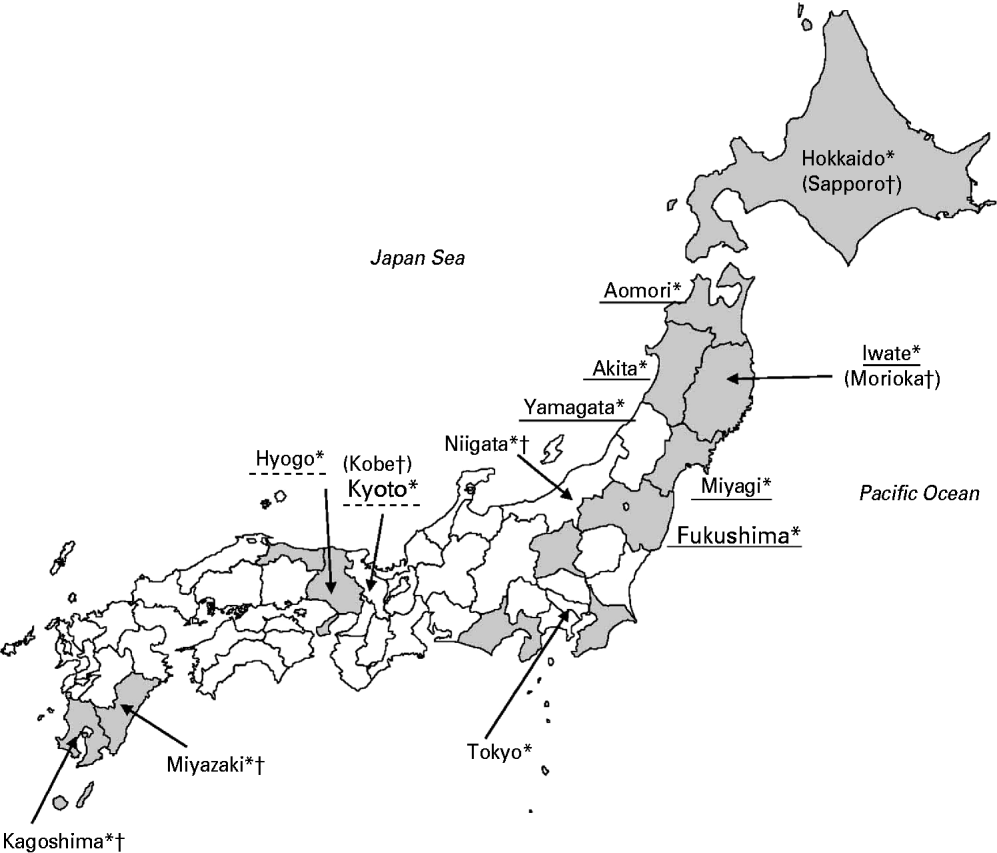
Twelve prefectures were identified as production locations for 122 samples (Fig. 1). A further two samples were produced in Tohoku (which includes six prefectures such as Iwate) and a single sample from the Tamba region (the eastern part of Hyogo and the central part of Kyoto; Fig. 1). Weather data for these production locations were obtained from the Japan Meteorological Agency (http://www.data.jma.go.jp/obd/stats/etrn/index.php). Weekly mean values were calculated from the daily climatic elements data at prefectural capitals of prefectures where chicken samples tested in this investigation were produced. In addition, weather data for Morioka (Iwate Prefecture) and Kobe (Hyogo Prefecture) were used for the labelled production areas of the Tohoku and Tamba regions, respectively, since these prefectures produce the most broiler chickens in the prefectures in each region. The mean climatic element data for the prefectures that produced Campylobacter-positive samples were compared by Student's or Welch's two-sample t test with those of prefectures that produced negative samples. P values were calculated by two-tailed test. A P value of <0·05 was considered to be significant. The week (from Sunday to Saturday) including the day when each sample was purchased at the retail shop was defined as 0-week lag. Weekly mean air temperatures from 1 to 15 weeks before the date samples were purchased (1- to 15-week lags), the weekly mean humidity and weekly mean hours of sunshine per day 1–5 weeks before samples were purchased (1- to 5-week lags) were compared between positive and negative samples in order to analyse any potential lagged effects.
Geographical locations where chicken products tested for Campylobacter isolation were produced. Prefectures shown in grey produced chicken products tested. * Prefecture; † prefectural capital. The prefectures underlined were in Tohoku region. The prefectures underlined with a broken line were in Tamba region.
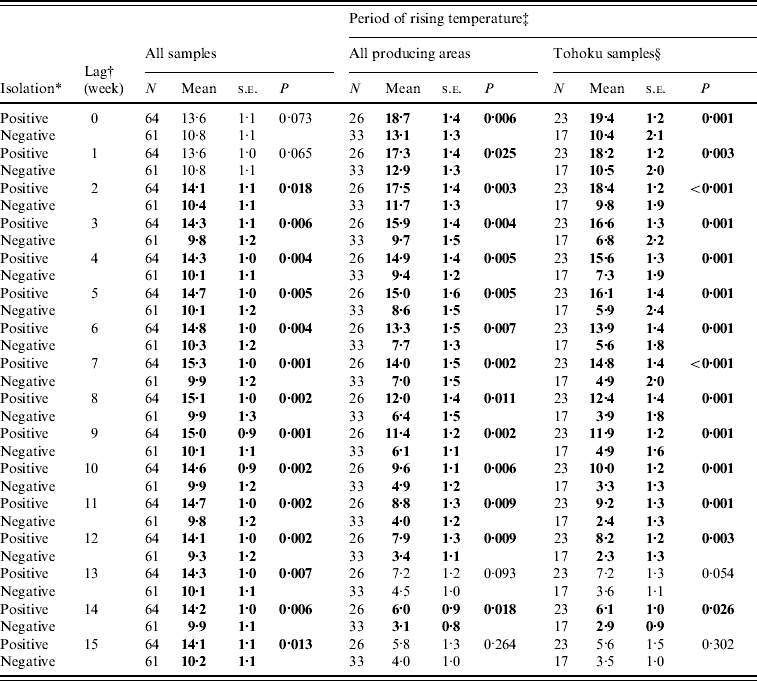
Significant differences in the weekly mean air temperature at production prefectures between 64 Campylobacter-positive samples and 61 Campylobacter-negative samples between a 2-week lag (14·1°C vs. 10·4°C, P=0·018) and a 15-week lag (14·1°C vs. 10·2°C, P=0·013) were observed (Table 1). The higher air temperature used for the chicken-rearing period was suggested to be associated with increased Campylobacter colonization in chicken flocks and subsequent carcass contamination in processing factories in Japan. A similar higher risk of Campylobacter colonization in broiler flocks during summer was observed in Northern Ireland and Great Britain [Reference McDowell8, Reference Ellis-Iversen9]. It was reported that increases in air temperature corresponded to higher percentages of infected broiler flocks at slaughter. This was also observed in Denmark, with air temperature 3–4 weeks before slaughter having the greatest impact on infection in broiler flocks [Reference Patrick5].
Effects of temperature on Campylobacter contamination of chicken products
s.e., Standard error.
* The results of Campylobacter isolation from chicken products.
† Period of time prior to purchase of samples used to measure temperatures.
‡ The weekly mean air temperatures at each prefecture producing Campylobacter-positive samples were compared with those of negative samples during the period of rising temperature (April–August 2009 and March 2010).
§ The data was limited to weekly mean air temperatures at prefectures in Tohoku region.
Sasaki et al. [Reference Sasaki2] reported a higher prevalence of Campylobacter spp. in broiler flocks in Western Japan (54%), which is generally a warmer area than those in Eastern Japan (28%), and suggested that further studies on the relationship between climatic condition and prevalence of Campylobacter spp. were needed. Our results, which showed a relationship between Campylobacter contamination and air temperature, may help to explain differences in Campylobacter prevalence between the different climatic regions of Japan.
In order to evaluate the influence of air temperature without seasons, the air temperature at prefectures producing Campylobacter-positive samples were compared to negative samples produced during each period of rising and decreasing temperature. The periods of rising and decreasing temperature were divided by the difference (plus or minus) between the weekly mean air temperatures at 0 and 7 weeks lag. The weekly mean air temperature at 0 week lag was compared with that at 7 weeks lag, because the general rearing period of broiler flocks is about 7 weeks in Japan, with an average broiler flock age at the time of shipment of 54 days (range 46–73 days) [Reference Sasaki2]. About 1 week is usually needed to transport raw chicken from slaughter to retail shops in Japan. Therefore, the period between 1 and 7 weeks before samples were purchased would correspond to the chicken-rearing period.
Regarding chicken samples produced during the period of rising temperature (April–August 2009 and March 2010), the weekly mean air temperatures at prefectures producing 26 Campylobacter-positive samples were significantly higher than those of 33 negative samples for the period of 0- to 12-week lags and at a 14-week lag (Table 1). On the other hand, the significant difference was not observed in the weekly mean air temperature between 38 Campylobacter-positive and 28 Campylobacter-negative samples produced during the period of decreasing temperature (from September 2009 to February 2010; data not shown). Moreover, the data of only samples produced in Tohoku region were analysed to exclude the influence of different production areas. Regarding samples produced in Tohoku region during the period of rising temperature, the significant differences of the weekly mean air temperature at prefectures producing between 23 Campylobacter-positive samples and 17 Campylobacter-negative samples were observed for the period of 0- to 12-week lags and at a 14-week lag (Table 1).
The air temperature at production prefectures during the chicken-rearing period was suggested to be associated with Campylobacter-contaminated chicken produced only during the period of rising temperature (spring and summer) but not decreasing temperature (autumn and winter) in Japan. In a previous Danish study, temperature did not seem to have as great an effect on prevalence during the colder months as during the warmer months [Reference Patrick5]. In our previous study, the percentage of Campylobacter-contaminated chicken products in May was the lowest and it started increasing in June [Reference Ishihara7]. Therefore, air temperature in production locations will be an important factor in increasing Campylobacter-colonized broiler flocks on farms.
Since air temperatures in production locations over the 7-week period before chicken samples were purchased were significantly different between areas producing positive and negative samples, we suggest that higher air temperature during the previous production cycle is associated with Campylobacter contamination of chicken products. This association between contamination and air temperature at times before samples were purchased occurred over longer time periods than general rearing times for broiler chickens, which might indicate that higher air temperature allows Campylobacter spp. clones to continue to persist on broiler farms as a consequence of infection carry-over between chicken flocks. This hypothesis is supported by a previous study, in which specific C. jejuni clones were detected in chicken flocks at different time periods on broiler farms [Reference Ishihara10]. It is also possible that colonized broiler flocks contaminate the environment around broiler farms.
The weekly mean of minimum humidity for 64 Campylobacter-positive sample locations (54%) was significantly higher than for 61 negative sample locations (49%) with a 1-week lag (P=0·005). The weekly mean of sunshine hours per day for 64 positive sample locations (4·1 h) was significantly shorter than for 61 negative sample locations (4·8 h) with a 1-week lag (P=0·032). Humidity and sunshine duration were negatively correlated (correlation coefficient, −0·713, 95% confidence interval −0·7895 to −0·6140).
Significant differences were observed in the average of weekly minimum humidity and hours of sunshine per day at the 1-week lag period between prefectures producing positive and negative samples. Locations with higher humidity and shorter periods of sunshine appear to be conducive to the colonization of broiler flocks and the subsequent contamination of chicken products. Since Campylobacter are susceptible to dry conditions, higher humidity is beneficial to Campylobacter survival in the environment inside and/or around chicken houses.
Regarding the samples produced during the period of rising temperature, the significant difference in weekly mean of minimum humidity at production prefectures was observed between 26 positive and 33 negative sample locations with a 1-week lag [55·2% (+) vs. 46·3% (−), P=0·004] and a 2-week lag [51·7% (+) vs. 46·3% (−), P=0·013]. Moreover, significant differences in the weekly mean of minimum humidity between 23 positive samples and 17 negative samples produced in Tohoku region were observed with a 2-week lag [51·7% (+) vs. 45·4% (−), P=0·007] and a 4-week lag [53·9% (+) vs. 46·9% (−), P=0·032].
Moreover, the significant difference in weekly mean of sunshine hours per day was observed between 26 positive and 33 negative samples produced during the period of rising temperature with a 1-week lag [4·2 h (+) vs. 5·4 h (−), P=0·02] and a 2-week lag [5·5 h (+) vs. 6·6 h (−), P=0·003]. Regarding samples produced in Tohoku region, the significant difference in weekly mean of sunshine hours per day was observed between 23 positive and 17 negative sample locations with a 2-week lag [5·7 h (+) vs. 6·6 h (−), P=0·026] during the period of rising temperature and with a 4-week lag [4·2 h (+) vs. 3·4 h (−), P=0·040] during the period of decreasing temperature. Humidity and sunshine duration were associated with Campylobacter-contaminated chicken products during the period of rising temperature, similar to the association between air temperature and contamination. These associations were observed only on samples produced in Tohoku region.
In conclusion, high air temperatures and high humidity, and short duration of sunshine during the chicken-rearing period enhanced Campylobacter spp. colonization in broiler flocks reared during the period of rising temperature. Overall, the percentage of Campylobacter-contaminated chicken products on the market is potentially affected by climatic elements in Japan.
ACKNOWLEDGEMENTS
This work was partially supported by a Grant-in-Aid to Cooperative Research from Rakuno Gakuen University and Rakuno Gakuen University Dairy Science Institute, 2009–8.
DECLARATION OF INTEREST
None.



