


Increasing congressional pay comes with a political cost for the members who vote for it, but that cost may be conditional on other factors. As a result, the threat of public backlash may not always be sufficient to deter legislators from increasing their own compensation. Inquiries into the politics of congressional compensation have examined the degree to which characteristics of the legislators and their constituencies intervene and allow for members to support higher salaries with relatively little political cost.Footnote 1 A focus on such dyadic factors leaves out the role that institutional arrangements can make in facilitating or undermining electoral accountability. The Compensation Act of 1856 illustrates that the structure of the party system and the design of electoral institutions can muffle accountability and responsiveness for House members.
The connection among congressional pay, electoral accountability, and responsiveness has deep roots. Tensions between representatives and their constituents over the amount and method of compensation arose as early as the second half of the seventeenth century in the American colonies and carried forward into both the U.S. Congress and state legislatures.Footnote 2 In 1816, Congress voted itself a substantial pay increase and made the raise retroactive to the start of that Congress. On returning to their districts, members quickly realized how deeply unpopular this action was. Many of them chose to retire, and many of those who ran for reelection lost. Soon after the next session began, the salary was repealed.Footnote 3 In 1873, on the last day Congress was in session, members again enacted a substantial pay increase, and again they made the raise retroactive to the start of that Congress. On returning to their districts, members quickly realized how deeply unpopular this action was. The majority Republicans lost numerous state and local races in the months that followed. Soon after the next session began, the pay increase was repealed.Footnote 4
Lest we think this a nineteenth-century congressional version of the film Groundhog Day, the Compensation Act of 1856 followed a different path. Like the acts of 1816 and 1873, it gave members a substantial increase in pay, and like those two acts, it made the increase retroactive to the start of a session that was nearly finished. Unlike both of those acts, however, it did not lead to dramatic and widespread backlash from angry constituents. Some members did retire, but a great many who voted for the pay increase sought reelection and were returned to office. Newspapers expressed anger, but such coverage was matched by an almost equal amount of understanding and support.
Enactment of the 1856 reform could be evidence that members did not fear an electoral judgment. The design of ballots and other electoral rules and practices, which strongly encouraged party-line voting, and the structure of political careers, which favored short tenures and rotation in office rather than reelection seeking, together inhibited the ability of voters to hold representatives accountable in comparison with the modern House.Footnote 5 On the other hand, the experience of 1816 as well as the aftermath of the contingent election of 1824 showed that electoral accountability was possible despite those hurdles.Footnote 6 Antebellum members acted strategically in seeking reelection, including responding to the size of their electoral majority, and voters exhibited some discretion by favoring quality challengers over ones without electoral experience, as well as by a small personal vote for members.Footnote 7 This scholarship suggests that voters had the capacity to hold representatives accountable for highly salient matters even before the advent of the Australian ballot, albeit less so than in the modern House.
How, then, can we explain the successful compensation reform in 1856, especially in contrast to the aborted attempts before and after? As I will show, the protracted debate leading up to the Compensation Act of 1856 reveals that legislators were sensitive to the anticipated judgment of voters opposed to the reform, consistent with other evidence of an emerging electoral connection in the early House of Representatives. The fiasco of 1816 weighed heavily on them four decades later as members sought a way to pass the bill without reviving the backlash.
Three factors muffled responsiveness to backlash and facilitated enactment, however. First, the debate about compensation became tied to growing public concern over corruption, specifically ways members supplemented their income by abusing perks of office. The Know Nothings rose quickly to power mainly on anti-immigrant sentiment, but also on a campaign to end the corrupt hegemony of Democrats and Whigs. By tackling certain forms of abuse, supporters of compensation reform were able to defuse some public opposition to a pay increase and to attract support from the Know Nothings and their allies.
Second, the rapid splintering and reconfiguration of the party system in the mid-1850s created confusion for representatives and constituents alike. That confusion obscured partisan responsibility for the law. Cross-national research on parties has found that voters in multiparty electoral systems have more difficulty assigning responsibility for policy than voters in two-party systems.Footnote 8 This in turn facilitates shirking by officeholders as they shift responsibility toward other parties or factions.Footnote 9 Antebellum voters, who witnessed the collapse of a major party, the rapid rise of two new competitors, and a national patchwork of inconsistent party fusions and personalized local factions, faced an acute version of the accountability problem.
A final possible explanation derives from the timing of elections and its implications for responsiveness in the Antebellum House. States held elections at widely varying dates across an election cycle, with many state elections preceding or overlapping with the second regular session of a Congress, and a few even occurring in the midst of the first session.Footnote 10 The staggered timing meant that voters in different states could respond to different information about the policymaking activities of their representatives. If the House considered a highly salient and politically controversial policy like congressional pay after some states but before others had held their elections, this might have affected the degree to which members acted responsively with regard to the proposed policy in anticipation of that judgment.
Although scholarship on nineteenth-century representation has focused on the degree to which accountability and responsiveness might have been inhibited by a lack of careerism or by the method of voting, such as use of the party-strip ballot, these were not the only institutional features that might have done so. Moreover, by failing to account for other factors that affected the judgment of Antebellum voters on the quality of their representation, our analyses might overstate the effects of ballot design and career paths as well as miss the capacity of those voters to hold their representatives accountable on occasion.
In addition, the Compensation Act of 1856 allowed Congress to take a preliminary step toward professionalization, a destination it would not arrive at for several more decades.Footnote 11 The reform coincided with a broader transformation in the nineteenth century that shifted government workers from ad hoc pay schemes that were prone to corruption and toward a more standardized salary-based structure.Footnote 12 Unlike a per diem, where payment implied that legislators’ time was their own, a salary put them on the public's time.
1. Compensation, Absenteeism, and Corruption
Arguably the earliest and most dramatic case of congressional accountability came with the Compensation Act of 1816.Footnote 13 To that point, members of Congress had been paid a per diem of $6 and reimbursed 20¢ per mile of travel between their district and Washington. The new law replaced the per diem with an annual salary of $1,500, which amounted to a raise of about one-third based on the typical length of sessions to that point. The House passed it 80 to 67, and almost immediately a furor arose. A month after the vote, Samuel S. Conner (MA) explained with some understatement, “It remains to be inquired, whether the increase was proper and reasonable.”Footnote 14 A year later, the ambiguity was resolved. John Tyler (DR-VA) wrote to his constituents, “From every quarter it was severely anathematized, and all were forced to acknowledge that the great majority of the People required its repeal.”Footnote 15
Robert Mentor Johnson (KY), author of the bill, acknowledged later as the House considered repeal that “he was left to take that course which honor and duty dictated; and that, so far as he could infer the will of his constituents, it should have a controlling influence upon his mind.”Footnote 16 Public outcry, he said, combined with outrage ginned up by political opportunists, meant that “the poor compensation bill excited more discontent than the alien or sedition laws, the quasi war with France, the internal taxes of 1798, the embargo, the late war with Great Britain, the Treaty of Ghent, or any one measure of the Government, from its existence.”Footnote 17 He later wrote in a circular to his constituents that in the wake of the backlash he had decided to retire from Congress after five terms in office:
I had contemplated this course previous to the last election; but having incurred the temporary displeasure of some of my political friends, by having voted for the compensation bill, I could not reconcile it to myself, to withdraw from them, under the influence of a broken friendship, which had existed unimpaired for so many years. . . . But restored to the full enjoyment of the friendship and confidence, which have ever been my highest ambition, and continue to be my greatest reward; I can now with more perfect satisfaction dissolve that political connection which has bound us together.Footnote 18
About three-fifths of Johnson's colleagues chose to retire, and of those running again who had voted yes, three in eight lost their bids for office. Soon after Congress returned for a lame duck session, the act was repealed and replaced with an $8 per diem, providing members with a small pay increase in the end but no salary.
In the ensuing years, public debate over the compensation of members of Congress became tied up with concern over absenteeism and abuse of office, especially by House members. Because both issues implicated the way members earned—or failed to earn—their pay, enactment of a new compensation scheme would have to confront them in order to succeed. Nonvoting on House roll call votes increased from around 15 to 20 percent during the Era of Good Feelings to a range of 25 to 35 percent in the 1850s, and candidates used claims about their own attendance or their opponents’ nonattendance in campaign appeals.Footnote 19 The House Journal recorded that Congress began receiving petitions and memorials in 1842 asking that the per diem and/or the mileage reimbursement for members be reduced. In some cases, calls for reduction in congressional pay tied it to curtailment of the franking privilege, a valuable perk of office that had become subject to public scrutiny over claims of abuse.
Representative John Quincy Adams (W-MA) complained in his diary of the habit of some members to claim their per diem while neglecting their duties in the House. Of two legislators’ absences in particular, he wrote:
Both of these members have gone away without notice to the House, and without intending to return. This, though in direct violation of a rule of the House, and a gross violation of the duty of the member to his constituents and to his country, has become a very general practice; and the motive for it is as mean as the practice itself is vicious. The rule is that no member shall absent himself from the service of the House without its permission; but if he asks and obtains permission, his pay is suspended during his absence. If he goes without permission, his pay continues without suspension; and members absent themselves for weeks, and sometimes for months, and receive pay as if their attendance had been without interruption.Footnote 20
Similarly, a broadside from 1826 on behalf of William Creighton's pro-Adams candidacy in Ohio's sixth district said of incumbent Jacksonian Representative John T. Thompson, “Were you not absent from the House for a week or ten days at a time, on visits to your relations in Pennsylvania and elsewhere, or in attending to your own private business; and did you not draw from the public Treasury eight dollars per day for the time you were thus absent?”Footnote 21 With payment based on a per diem, questions of attendance were tied directly to the compensation (and corruption) of members.
Some observers feared that the move to a salary would exacerbate the attendance problem. The New York Daily Tribune said that absenteeism already prevented Congress from completing its business and that nearing the close of the session with appropriations bills yet to be passed, “the House obliged to adjourn before 3 P.M. for want of a quorum!” The writer concluded, “Pass this bill, and every lawyer in the House would go home to attend his circuit, every merchant to supervise his business, until the few who remained would be discouraged into adjourning, leaving the public business but half done.”Footnote 22
At the same time, concerns were rampant about the legal and extralegal ways members supplemented their pay with the perks of office. In addition to the abuses of the franking privilege that had attracted public scorn in the 1840s, another scheme gained attention in the 1850s involving the book allowance for members each Congress: copies of the Constitution, volumes of the Congressional Globe, and other publications useful for their work. The Trenton State Gazette said that taxpayers bought four boxes of books and documents for $1,202 per member, who then sold them to book dealers for $400, a supplement equal to fifty days’ work in the House at current rates.Footnote 23 Argued the Daily Ledger of New Albany, Indiana, “The people ought to know what their agents receive for their services, but under the franking and book taking system it is impossible that they should do so.”Footnote 24
The argument in favor of a salary for members of Congress rested on two claims. First, the cost of living in Washington had become so high by the late Jacksonian period that it was difficult to live on the same wage rate as legislators in the era of Madison and Monroe. Nationally, the 1830s was a period of rapid growth and saw a nearly 25 percent increase in the cost of living, and the development of Washington in the intervening decades accentuated the problem even further.Footnote 25 Moreover, while legislators’ pay remained stagnant, Congress enacted multiple compensation laws increasing the pay of every other rank of the federal government, such that by the 1850s the average executive department clerk—and even a doorman at the Capitol—was paid more than members of Congress.
Second, there was growing concern that inadequate pay pushed members into corrupt acts. The Daily Ledger wrote, “If eight dollars a day is not sufficient compensation to a member of Congress, let it be increased to ten or twelve, but do not give him gratuities in the shape of books and the free use of the mails to make up for the deficiency in his salary.”Footnote 26 For some, the high cost of living in Washington after nearly four decades of stagnant pay explained the corruption members engaged in. The solution was not just to restrict or prohibit those practices, but to increase compensation so that members would no longer be tempted by graft.
Despite this logic, advocates of compensation reform recognized that it was politically dangerous ground. In the words of the Delaware State Reporter, “My impression is, [a pay increase] will be killed. – Notwithstanding the compensation of every officer of the Government, excepting the President and Vice President, has been increased since the per diem of members of Congress was established, eight dollars a day sounds large at home, and many will be afraid to face the storm which such vote would probably create.”Footnote 27 Almost four decades later, the lessons of the Compensation Act of 1816 were still clear: A palpable fear of the voters by representatives induced a strong disincentive to raise the pay of members. Indeed, the Kalamazoo Gazette was suspicious that talk of the high cost of service was just a ruse to extract more money from the Treasury, and one that would cost legislators at the next election. They wrote, “We know not how general such a feeling may be among the Representatives in Congress, but in our judgment, the first movement toward an increase of compensation would be met with a tempest of indignation from the people, and the actors swept into immediate and irretrievable oblivion.”Footnote 28
In short, the politics of compensation were more than a little muddled by the mid-1850s. For every newspaper like the Arkansas Whig that declared talk of an increase in compensation as symptomatic of a “rottenness in Congress,” there was a Baltimore Sun that called it “a redeeming chapter in their history” because of how it might reduce corruption.Footnote 29 The memory of the 1816 debacle was still strong and regularly invoked directly and indirectly by opponents of an increase. At the same time, there was broad acceptance in political circles that pay had fallen well behind the cost of living in the nation's capital. Public concern about political corruption had been growing for years, and by the 1850s it became a flashpoint around which the Know Nothings organized.Footnote 30 Packaging compensation reform as a remedy for corruption was a method to draw in the support of the Know Nothings and, because it did not threaten the forms of patronage-based corruption on which the major parties depended, might attract the support of Democrats, Republicans, and erstwhile Whigs as well.
2. The Move to Increase Compensation
By the mid-1850s, members of Congress had begun to advocate for an increase in pay. In the waning days of the 33rd Congress, Sen. George Badger (W-NC) introduced S.513 to increase the compensation of Supreme Court justices and members of the Senate and House of Representatives, with legislators seeing a 50 percent increase in their per diem allowance from $8 to $12 per day. Senator Robert Johnson (D-AR) offered an amendment to replace the per diem with a salary at $2,500 per year. James Mason (D-VA) rose in objection, “We had once such a compensation law, at a very moderate sum, and it seemed to have met with the reprobation of the American people.”Footnote 31 James Bayard (D-DE) disagreed that the lesson of 1816 was that the public dislikes a salary for legislators, rather that it was the size of the increase and the retroactive payment that caused the backlash. Nevertheless, on the third day of debate the Senate tabled the legislation, effectively killing it for that Congress.
The matter of compensation arose again late in the first session of the 34th Congress. Andrew Butler, a States Rights Democratic senator from South Carolina, introduced S.398 to alter the compensation of representatives, senators, and delegates. Rather than a per diem, the bill provided for an annual salary of $3,000 and specified that the cost of any books distributed to members out of legislative funds be deducted from that member's compensation. The Committee on Finance reported it on August 9, 1856, reducing the amount to $2,500, and the Senate took up the legislation four days later. Again, the question turned on whether the lesson of 1816 was that the public objected to a salary or to the size of the increase. Jacob Collamer (R-VT), for example, noted that whereas a per diem gave legislators an incentive to stretch a session as long as possible, a fixed salary would induce them to shorten the session before completing the public's business.
The new dimension that had been omitted from the previous bill sought to solve the book graft. Some senators said that the issue was trifling and that, of the several new members entering their chamber every two years, some did not accept the books at all. Andrew Bayard (D-DE) replied that the problem was greater for members of the House than those of his own chamber and that the politics of it had at least as much to do with public perception as with the substance of the reform. He said, “I am not opposed to high compensation, but I am opposed . . . to public plunder under any cover whatever.”Footnote 32 Bayard declared that if the provisions on the book allowance were dropped from the bill, he would vote against it. The amendment to delete the section was then withdrawn.
By the end of the debate, the senators who spoke were united in their preference for increased compensation, whatever the form, but divided on its political wisdom. After some amending on the details of the mileage allowance, the Senate passed S.398 on a 35–11 vote. The House turned to the legislation two days later.
Representative James Orr (D-SC), who served as House floor manager for S.398, offered a substitute amendment to increase the compensation to $3,000, as in Butler's original bill.Footnote 33 It reduced compensation for each day a member was absent from his official duties and made the new compensation scheme retroactive to the start of the current Congress. Orr, echoing an argument heard in the Senate debates, underlined the corrupting influence of a compensation rate that was too low:
If the present rate of compensation is continued, and members are not paid a sum sufficient to support them, one of two results must follow: The people will have to fill the two Houses of Congress with men of large private fortunes, who can afford to come here and draw upon their private means to support themselves whilst in public service, and exclude men of capacity and integrity, who have no private fortunes, from the public councils, or they must be contented to be represented by a class of men who will make a support, and even an income, by selling their votes and the rights of their constituents for gold.
He concluded by asserting that “there is not a gentleman upon this floor who will not concede the necessity of an increased compensation to members.”Footnote 34
The debate did not proceed as Orr predicted, however, or quite as it had in the Senate. He was the only member to speak in favor of the legislation, while ten of his colleagues representing all of the major party coalitions rose in opposition. John Cadwalader (D-PA) reminded his colleagues that of the members who voted for the 1816 Compensation Act, only three were reelected to the next Congress. Those in opposition tried numerous procedural maneuvers to force recorded votes on motions and to delay final passage. According to the New York Daily Tribune, “Much excitement prevailed in the hall during the struggle, and dodging was quite prevalent.”Footnote 35 Before the afternoon was done, the House passed S.398 as amended by a 100–99 vote.
When S.398 returned to the Senate, Alfred Iverson (D-GA) argued that the narrowness of the victory in the House meant that however much senators might disagree with the House amendments, any change risked defeat in the other chamber. With only a few days left in the session, they would not have another chance at passing a compensation bill. The principal point of concern for senators was the provision to apply the salary retroactively for the current Congress. George Pugh (D-OH) proposed to delete that section, and his amendment was narrowly defeated 21–19. Then, with nearly the same coalition, the Senate concurred in the House amendments 20–18. Immediately after, Robert Hunter (D-VA) made a motion to reconsider the vote. He argued that given the political risk contained in the Compensation Act, he wanted to give his colleagues in the other chamber some political cover by voting for the bill in the end, despite his vote against the House amendments moments before, and thought some of his colleagues might want the same. After adopting the motion to reconsider by unanimous consent, this time the Senate concurred with a vote of 27–12.Footnote 36
The debates illustrate two salient points regarding accountability and responsiveness. First, the experience of 1816 weighed heavily on legislators. With the exception of technical disagreements over formulas for calculating mileage reimbursements, members largely expressed their opposition to the reform not in terms of the rightness of the provisions themselves but in terms of whether constituents would punish them for adopting it. Interpretations of the lessons from four decades earlier differed, in particular whether voters were angry due to the size of the increase or to the use of a salary. But the legislators did not disagree that they had to consider the reaction of voters in deciding on the bill, with most anticipating that the reaction would be negative. Framing the argument this way reveals that at least some of them were motivated by reelection seeking.
Second, although members of both the House and the Senate expressed wariness over the electoral effect, how that concern shaped their debates and decisions differed. Senators were insulated both because they did not face the direct judgment of voters and because two-thirds had not begun their terms amid the partisan upheaval of the last election cycle. During the initial debate, the greatest concern senators voiced about the bill—apart from its merits on policy grounds—was how this might affect the 1856 election for the House and the presidency.Footnote 37 Representatives, on the other hand, felt the threat more tangibly, which may have contributed to the reticence of every supporter but Orr to speak in favor. The differences between the chambers also affected the endgame. After the House made its changes to the bill, including the provision for a retroactive salary for the current session, senators said they were bound to concede. They acknowledged in reconsidering their vote on the House amendments that representatives were more exposed politically and that the Senate had a responsibility to give them cover despite some disagreement. Much like international negotiations when one side is constrained by domestic politics, the Senate understood that the House had much less room to maneuver, forcing the hand of senators.Footnote 38
3. A Party System in Flux
To understand how the House was able to pass compensation reform despite the fear of political backlash, we first consider the role of the transformation of the party system in the mid-1850s. A robust finding in the comparative literature is that in multiparty systems, voters have difficulty assigning responsibility for policies, allowing legislators to shift responsibility and shirk from responsiveness. In the case of Antebellum American politics, the challenge presented by the presence of multiple viable party coalitions was heightened by the rapid flux in the system and its wide variation from state to state, inhibiting coordination.
After its widespread losses in the presidential election of 1852, the Whig Party was in decline. From the midterm election through the convening of the 34th Congress, the recurring question was what party (or parties) could replace it. The Know Nothings swept into office on a wave of anti-immigrant and anticorruption sentiment, finding greatest success in New England. Meanwhile, anger over the Kansas-Nebraska Act of 1854 spurred abolitionist organizing and the development of the Republican Party in the North, especially in what we now call the upper Midwest. The sense of chaos was heightened by the semi-secrecy of the Know Nothings, who initially sought to infiltrate existing political organizations to gain power.Footnote 39
The ultimate collapse of the Whigs and rise of the Republicans as the chief rival for the Democrats was not obvious to everyone during the 34th Congress.Footnote 40 The 1855 edition of the Whig Almanac, for example, correctly predicted the quick demise of the Know Nothings based on the author's reading of the history of previous nativist movements in the country, but it made no mention of the Republican Party as their successors.Footnote 41 A few Whig leaders like William Seward of New York thought in 1856 that the party could recover, and indeed it did hold onto power in Pennsylvania until 1858 even as the party crumbled elsewhere.Footnote 42 The uncertainty begat a coordination problem for candidates—and, in turn, for voters—anticipating which coalition would be able to win majority control of Congress.Footnote 43 The speakership election at the start of the 34th Congress underlined the problem, requiring two months and 133 ballots to choose Nathaniel Banks (R-MA).Footnote 44
In addition to the major and nascent parties, elections of the mid-1850s were replete with localized factions and fusions—divided or allied in various combinations by stances on slavery, immigration, and temperance—which compounded the coordination problem for national party coalitions. Democrats were not immune, as they saw splits emerge in Illinois, New York, and elsewhere over slavery, the Kansas-Nebraska Act, and an admixture of local issues.Footnote 45 Sometimes the factions were identified with a specific figure: California Democrats split into Broderick and Anti-Broderick factions (roughly northern and southern California) in reaction to the power accumulated by David C. Broderick in the San Francisco party machine, and Missouri Democrats split into factions allied with and opposed to antislavery U.S. Senator Thomas Hart Benton.
Parties and factions in some states sought to coalesce into fusion tickets to compete in elections with a more united front, but they had widely varying levels of success, and the precise form the fusion took varied from state to state. The Indiana People's Ticket was able to sustain cohesion into the 1856 election, at which point it became the basis for the state's Republican Party.Footnote 46 On the other hand, one newspaper wrote prior to the 1854 election that in Illinois “there will be less of fusion than confusion.”Footnote 47 In Maine, Gienapp argues that an attempt to create a statewide fusion that same year foundered on the Nebraska question, leading to a “multiplicity of tickets” that “made it impossible to forecast the results of the fall election.”Footnote 48 Like the coordination problem for candidates, factionalization compounded the accountability problem for voters who faced an array of ballot choices and uncertainty around the future of the leading contenders for major-party status and majority control of Congress.
During the first Senate debate on S.398, Thomas Pratt (W-MD) recognized that the flux of the party system affected strategies regarding the Compensation Act, noting the coordination problem facing congressional party caucuses as they looked past the imminent roll call vote and toward the 1856 election:
Now, sir, if the passage of this bill is to be made by either party a political hobby in the canvass, I do not think the money we are to get is worth the trouble of meeting this question when we go before the people in the presidential canvass. I am informed that all on the other side of the Chamber are going for it. If so, there can be no difficulty about it; but that is what I want to ascertain. There are three parties in the country, each represented in this Chamber. If we all know it is a matter of right that there should be increased compensation, let us go together, and then neither can complain; and if we do not go together, and either of the parties goes against it, I shall go against it.Footnote 49
The dynamics with several viable political parties looked very different than when there had been only two; however, Pratt's appeal for all of the major party coalitions to share in the responsibility of enacting compensation reform did not succeed in the House.
Another motivation for Pratt's call for a united front was that the compensation issue cut across partisan and sectional lines. Parties did not make raising the pay of members of Congress a priority in their platforms—not surprisingly, given their concern about constituent backlash—and only the Know Nothings made opposition to political corruption a centerpiece.Footnote 50 When proponents tied the pay increase rhetorically to reduced graft and substantively to the elimination of the book allowance, the Know Nothings embraced the bill, but there remained an open question of how coordinated support would be within any of the other party coalitions. The House debate revealed the size of the challenge when members of all parties spoke against the bill. Nor did the issue have a clear sectional basis, unlike much of American politics in the 1850s. On the one hand, Southern Democrats in the House voted against the bill 12–25, while their northern counterparts narrowly supported it 17–16.Footnote 51 On the other hand, the floor managers in both chambers and the lead sponsor, as well as some of the most vocal supporters of S.398 in the Senate, were Southern Democrats. The lack of clear partisan or sectional lines on compensation reform magnified the challenge for voters in discerning responsibility.
Do we see evidence that the upheaval in the party system affected roll call voting on compensation reform when the bill came before the House? For the reasons discussed above, it is notoriously difficult to categorize a member's party affiliation during the 34th Congress. Tables 1 and 2 provide two ways of thinking about it. First, Table 1 uses party categories for House members in the 34th from the Database of Congressional Historical Statistics.Footnote 52 Democrats and Republicans opposed the compensation plan, whereas members of the Know Nothings, or the American Party as it was often known, supported it by a wide margin, showing that the backing of the Know Nothings was essential to passage.
Final Vote on S.398 by Party Affiliation During the First Session of the 34th Congress

Note: Members could have more than one party affiliation during the 34th Congress.
The Senate votes displayed none of these partisan patterns. Senators expressed less reticence for compensation reform, perhaps because they were more insulated from electoral tides generally and from Know Nothingism in particular. On both the initial passage vote and the final concurrence with the House amendments, no party coalition had a majority of its members voting against. The majority Democratic caucus, in fact, supported both roll calls by wide margins, 25–4 on initial passage and 19–8 in concurrence.Footnote 53 While Pratt's call for all parties to share responsibility for reform failed in the House, it succeeded in the Senate. The contrasting experience in the two chambers suggests that, aside from the anticorruption Know Nothings in the House, the decisions of members were not shaped mainly by party ideologies and priorities.
Another way to gauge Know Nothing support in the House beyond those who openly ran as American Party candidates comes from an extraordinary speech by Representative Samuel A. Smith (D-TN) on April 4, 1856. In the speech, he argued that the Know Nothings threatened to split the vote in the South in the 1856 election, throwing the result to the abolitionist Republicans who would carry the North. Motivating his concern was the fact that the Know Nothings had been a semi-secret society with legislators in its ranks who were nominally members of another party and, he claimed, totaled half the House.Footnote 54 So as to reveal the extent of their influence, he read into the record a list of representatives who either were members of the society themselves or were elected with substantial support of the local chapters in their districts. Smith then entered into a colloquy with his colleagues about whether their names should or should not be included in the list, with most of those speaking wanting to ensure that they were in fact counted as members. Using this more expansive definition of Know Nothing affiliation, Table 2 shows that most of the support for the bill came from members elected with the support of the Know Nothings.
Final Vote on S.398 by Support of the Member by Know Nothings
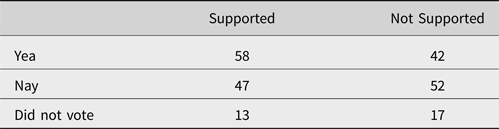
Note: Data are from the speech and colloquy of Samuel A. Smith (D-TN).
Due to the rise of the Know Nothings and the Republicans, together with the fragmentation of party coalitions in some states, nearly one-third of members had competed in multichallenger races when elected to the 34th Congress, with one in nine House members having faced three or more challengers.Footnote 55 During the Senate debate, Pratt said that the presence of multiple party coalitions presented an obstacle to building a legislative majority behind the compensation bill due to the temptation for one or more of the other parties to defect. On the other hand, as research on comparative party systems shows, the presence of multiple challengers might give cover to an incumbent who supported the bill by splitting the opposition vote or obscuring responsibility. Table 3 lends preliminary support to the latter interpretation, with those running versus a single challenger voting against the bill 55–70 but those facing two or more challengers favoring it 40–22. The remaining five members who had run unopposed broke 3–2 in favor, providing additional corroboration. Pratt may have been correct about the challenge of cobbling together a majority for the bill, but the electoral logic of multichallenger (and unopposed) races favored supporters.
Final Vote on S.398 by the Number of Opponents in the Previous Election
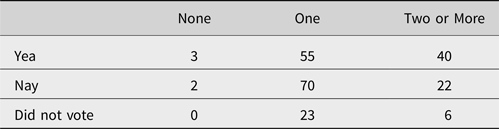
Note: Excluded from the count of opponents are vote totals labeled “scattered.” Election returns on named election opponents were unavailable for eight members.
The effect of multicandidate races on support helps explain the difference between rank-and-file Northern and Southern Democrats. Although the Know Nothings gained some support in the South, the fragmentation of the party system was far more pronounced in the North, which is reflected in the number of opponents members faced. Representatives in the South faced 0.94 challengers on average, in contrast to the 1.57 challengers to representatives in the rest of the country (t = 4.94, p < 0.001).
4. Election Timing and Reelection Seeking
A secondary explanation for the passage of the Compensation Act despite the political risks concerns the timing of elections for the 35th Congress. Prior to an 1872 federal law that imposed uniformity on the scheduling of elections for the U.S. House, there was great variability across states, so much so that it may have affected the degree to which voters collectively would be able to hold the House accountable for its actions in a given Congress.Footnote 56 If members were sensitive to the effect that their policy choices had on reelection, then one place we might see it is in the relationship between election timing and roll call votes.
The election for the 34th Congress was spread over sixteen months, from August 4, 1854, in Arkansas to November 6, 1855, in Maryland and Mississippi, typical for the era. Then for the following Congress, Arkansas was joined by Iowa and Missouri on August 4, 1856, and the last regular elections were held in Maryland on November 4, 1857.Footnote 57 The elections in the first three states, in fact, occurred before the floor debate and roll call vote on S.398. Altogether, eighteen states held regular elections for 152 House seats, 64 percent of the total membership, before the 34th Congress was complete.
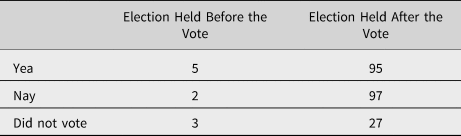
If members were concerned about the effect the vote would have on their chances to hold the seat, we ought to see a difference in propensity to vote for the legislation between members facing reelection to the 35th before and after the vote on S.398. Table 4 shows there was such a difference. Not many such members faced reelection so early, only ten in total, but they voted 5–2 in favor of the legislation and another three did not vote, in contrast to those representing states with later elections. Because final passage was so close, this margin alone was enough to help the bill get over the finish line.
Final Vote on S.398 by the Timing of the Election for the 35th Congress
Another way to consider the relationship between vote choice on the bill and concern about reelection is to compare members who ran for reelection to the 35th with those who did not. Overall, reelection seeking was higher than in the Congresses immediately prior and after. Of members serving to the end of the 34th Congress, 68.1 percent sought reelection. In contrast, for the decade before the 34th, no Congress had a rate of reelection seeking higher than 61 percent, and in the next Congress, 66 percent did so. Despite the comparatively high rate of reelection seeking in the aggregate, the vote seemed to be associated with more House retirements. As Table 5 demonstrates, support for the compensation reform was overwhelming for those not running.Footnote 58 Taking the results of Tables 4 and 5 together, members who did not face imminent judgment by their constituents, whether due to the timing of their election or to retirement from the House, favored the bill 50–17, while those who faced reelection after the vote opposed it 50–82. Insulation from voters, therefore, appears to have contributed strongly to passage of the reform.Footnote 59
Final Vote on S.398 by Whether a Member Ran for Reelection to the 35th Congress

Note: Excluded are the ten members whose elections were held prior to the vote on the bill.
5. Analyzing Enactment
The foregoing provides preliminary support for our two leading explanations for the passage of the Compensation Act: the fragmentation of the party system and the timing of elections. We have partial insight into the electoral pressures members faced as well. Do the results hold up when we account for other covariates? Probit models estimate of the probability of a yay or nay vote on the final House roll call for S.398.Footnote 60
Three indicators test for electoral vulnerability: the margin in the proportion of the vote the member won for election to the 34th Congress, whether he was a first-term representative, and whether he ran for reelection to the 35th.Footnote 61 In all cases, we expect that greater vulnerability—narrower electoral margin, freshman, and seeking reelection—would make a nay vote more likely, to avoid backlash from constituents that might cost him his seat.
Party dynamics are captured in two ways. First, dichotomous variables indicate a member's party affiliation derived from the Inter-university Consortium for Political and Social Research (ICPSR) historical database: American, Democrat, or Republican, with Whig affiliation used as the latent category.Footnote 62 As noted above, members could have more than one party label attached to them due to the rapid shift in party coalitions. Second, to account for the range of electoral environments that members had faced in their election to the 34th Congress, the models include the number of opponents a member faced.Footnote 63
Two sets of control variables were used.Footnote 64 First, the first- and second-dimension DW-Nominate scores measure the revealed ideological preferences of members in their roll call voting patterns. The first dimension is usually sufficient, mainly capturing a standard left-right distribution regarding the role of government in the economy. However, because the vote occurred at a moment of particularly fraught sectionalism, the second dimension is included here as well. The second dimension tends to measure positions on slavery and sectionalism during this period.Footnote 65 Second, because the compensation reform affected the mileage reimbursement rate, members whose districts were located near Washington might have had different preferences than those whose districts are quite distant. The natural log of the distance in kilometers from the district's centroid to the Capitol is included.Footnote 66 Finally, a dichotomous variable indicates whether a member's election for the 35th Congress occurred prior to vote on S.398.
Before turning to the role of party system flux, a simple model was estimated using only the measures of electoral vulnerability and the controls for ideology and district distance. As Table 6 reports, all three measures of electoral vulnerability in Model 1 help predict support for the bill. Members who faced a closer election to the 34th were less likely to vote for it, and those who ran for reelection to the 35th tended to oppose it as well. Conversely, first-term members were more likely to vote for the bill, contrary to expectations. We return to this finding below. Finally, while ideology unsurprisingly is associated with the votes on S.398, how distant a member's district was from Washington did not affect their vote.
Support for S.398 on Final Passage

Note. Cell entries are probit coefficients with robust standard errors in parentheses.
+p < 0.10, * p < 0.05, ** p < 0.01, *** p < 0.001.
Model 2 incorporates dichotomous indicators of party membership. Marginality and reelection seeking continued to be associated with members’ votes.Footnote 67 Consistent with their public narrative about political corruption, American Party members were strongly in favor of the bill. Including indicators for party membership washes away the effect of tenure in office, and the reason for this becomes clear when we look at the distribution of freshmen across the party coalitions. Members identifying as American Party were overwhelmingly freshmen (35 of 37), whereas the other 162 members who cast a roll call vote were evenly split between freshmen and nonfreshmen. Finally, there is evidence of mild support among Democrats on the bill, which was driven by the northern members of the caucus.
When we incorporate the number of opponents the member faced in their election to the 34th Congress, we see that the flux of the party system had its effect not only on the shifting coalitions within the House but also the electoral dynamics members faced in their districts (Model 3). As the number of opponents increased, a member's likelihood of supporting the bill also increased. This is consistent with the claim that voters would have difficulty assigning responsibility—in this case, voting in favor of an unpopular pay increase—when several candidates were running, in contrast to elections with only two major candidates.Footnote 68
Finally, in Model 4 we account for the timing of elections. The effects of electoral vulnerability and flux in the party system remain strong; however, despite the findings in Table 4, the timing of the roll call relative to a state's election for the 35th Congress had a negligible additional effect on a member's vote. The noneffect may be due to the small number of observations affected or that other indicators picked up the variation in the pre- and postelection voting patterns. One notable result is that even though Democrats voted against the bill 41–29, on average they were supportive of the bill once ideological and electoral factors were taken into account.Footnote 69 Figure 1 plots the mean marginal effects for the key coefficients in Model 4, testing for the role of electoral vulnerability and flux in the party system. The association between reelection seeking and opposition to the bill is particularly strong, as is the association for electoral margin. Moreover, whereas members facing a single opponent in the previous election narrowly opposed the bill, as the number of challengers increased, so did their probability of support by almost 0.1, such that a member in a highly fragmented district with five opponents would vote in favor of reform about nine times out of ten (Figure 2).
Predicted Marginal Effects on Support for S.398.

Effect of the Number of Election Opponents on Support for S.398.

Taken together, the results provide strong and consistent support for the claim that representatives in the 34th Congress were highly sensitive to their electoral vulnerability in casting votes on the Compensation Act. In addition, the presence of the Know Nothings and the proliferation of parties and factions competing for seats allowed for more members to vote in favor than had they been driven only by electoral vulnerability. The effect of the flux in the party system was just enough to eke out a victory for reformers over the fears of electoral backlash.
6. The Aftermath of Compensation Reform
Newspapers reacted with outrage at the retroactive provision added by the House. Even though the “increase in compensation was very necessary,” wrote the New York Herald, together with the appropriations bills recently passed, the Compensation Act amounted to “plundering the public treasury.”Footnote 70 The papers recalled the retroactivity of the 1816 law, a parallel that legislators said in the debates that they wanted to avoid. Several publications printed comparisons of congressional pay under the old and new systems without additional comment, presumably with the expectation that these facts alone would be enough to anger voters.Footnote 71
The New Albany Daily Ledger praised its local representative, William English (D-IN), who “opposed this measure in all its stages. In so doing he no doubt truly represented the views and wishes of his constituents.”Footnote 72 Or, as the Jamestown Journal put it, “The record on this question will be very likely to bother some Members who may be disposed to try for the honors of a reelection.”Footnote 73 One member, Joshua R. Giddings (R-OH), wrote the New York Daily Tribune to explain his vote in favor. He said that the costs of service and the low pay meant it was impossible to bring his wife and four children to Washington with him. The Tribune printed a rebuttal pointing out that the outrage would have been far less had the payment not been made retroactive.Footnote 74 Another, John Pettit (R-IN), was asked to defend a vote he didn't cast when his political opponents accused him of having supported the bill. The New York Daily Tribune then reported that his name was incorrectly omitted from the “nays” in its initial list of roll call votes.Footnote 75
The parties blamed each other for its passage. The Milwaukee Sentinel sarcastically called the Compensation Act and the appropriations bills “a striking example of Democratic ‘Retrenchment and Reform.’”Footnote 76 In contrast, the New York Daily Tribune cited the Ohio Patriot attributing the law to the work of a “Black Republican Congress” to double its own pay.Footnote 77 The National Era was alone in ascribing the correct partisan responsibility, saying that Democrats and Republicans voted against the bill by a small margin “but the greater part of the ‘American’ voted for it, and carried it.”Footnote 78 Notably, newspapers focused on the House vote rather than on the Senate. The concern of Pratt that the politics of compensation could create a coordination problem among parties appeared to come true after the fact as a tool of blame avoidance in the run-up to the House elections.
The problem soon began to solve itself. Following a contentious Cabinet meeting shortly after signing the bill into law, President Franklin Pierce decided to call Congress back for a special session in order to complete business on the Army appropriations bill, which had failed to clear both chambers before the end of the first session.Footnote 79 Under the terms of the Compensation Act just signed, members would get neither mileage nor extra pay for the special session because their remuneration was already covered by the payments for the first session. This quelled some of the outrage over the law. Indeed, a day after criticizing the law, the Daily Picayune conceded that were it not for the new salary structure, members would not only be paid for the extra session, but they would also have an incentive to drag it out as long as possible.Footnote 80
In the view of the National Era, the bill was an important step forward in combating corruption despite the retroactivity provision.Footnote 81 Agreed the Daily Picayune, “If it shall have the effect of diminishing garrulity, expediting public business, and reducing the length of the sessions, it will be a public good, for which the country may well be willing to pay something.”Footnote 82 A Washington correspondent for the New York Daily Tribune wrote to rebut criticisms that the paper had made of the law, “The country will be greatly the gainer in the long run, by elevating the moral standard of Congress, and putting it above the suspicion of verbal imputations, such as are now freely bandied about.”Footnote 83
Did members who voted for the bill suffer—or members who voted against it rewarded—in the elections to the 35th Congress that were held over the next several months? English and Giddings both won reelection to the 35th with a larger share of the vote than they had for the 34th; Pettit, who was mistakenly accused of supporting the reform, won as well but with his margin narrowed by ten percentage points.Footnote 84 One campaign broadside published in the Weekly Patriot and Union of Harrisburg, Pennsylvania, pitted incumbent John C. Kunkel (R) against his opponent on this very question. In contrast to Henry C. Eyer, who while in the state legislature voted himself a decrease in pay, Kunkel “impeaches his own personal integrity by voting himself extra compensation to the amount of more than three thousand dollars, enough to buy a farm, or erect a town dwelling house.”Footnote 85 Nevertheless, Kunkel was returned to the House for another term with a margin of more than 11 percentage points, an only slightly smaller majority than before.Footnote 86 On the other hand, Cooper K. Watson was defeated in his try for another term, which the Ohio State Journal said was “justly attributable to the vote which he gave to pass the congressional compensation bill.”Footnote 87 In general, Table 7 shows that while support for the Compensation Act did take its toll on some House careers, more than three-quarters of members who had voted for it and sought another term were returned by their districts. Unlike 1816, voting for a pay increase did not cause a broad constituent uprising against their representatives in the next election.Footnote 88
Final Vote on S.398 and Members’ Service in the 35th Congress

Note. Excluded are the ten members whose elections were held prior to the vote on the bill.
The effect, if there was one, may have been on whether a member ran in the general election at all, as the first column of Table 7 suggests.Footnote 89 Because the factors affecting reelection success may be correlated with the factors for the member's choice to be a candidate for reelection in the first place, estimating reelection success alone could yield biased results, so a bivariate probit selection model is estimated.Footnote 90 The dependent variable for the selection equation is whether the member ran for a seat in the 35th Congress, and for the outcome equation it is whether the member was reelected. For both equations, the central question is whether the vote on compensation reform affected reelection seeking or success, and so indicators are included for members voting in favor and for members not voting on final passage.Footnote 91
To account for electoral factors, both equations include measures of the electoral margin in the last election, the number of terms served by the member, and the number of opponents they faced last time. Both equations also include dichotomous indicators of party membership. To account for whether ideological extremity affected the choice to run again or the incumbent's chance of winning, the member's absolute distance from the House median on the first and second dimensions of DW-Nominate were included. A final indicator common to both equations, a member's rate of participation in roll call votes during the 34th Congress, captures the degree to which he was engaged with the professional responsibilities of a representative as well as the effect on the propensity of voters to return him to office.Footnote 92 The selection equation uses measures of the member's age and the log of his district's distance from Washington; the outcome equation does not use these, because both variables might affect the member's choice to run but not whether he won, given that more elderly members and more distant districts would be expected to lead to lower reelection seeking.Footnote 93 The outcome equation uses an indicator for whether the member faced a quality challenger for reelection, which is expected to be associated with a lower rate of success.Footnote 94
The results of the selection model show that a member's vote on the Compensation Act had a strong effect on reelection seeking, but for those members running for reelection, the vote had a negligible effect on winning (Table 8). Members who voted against the bill had a probability of 0.82 of running for another term, those who did not vote had a 0.68 chance, and those who voted in favor of reform had a 0.55 chance (Figure 3). A higher electoral margin in the last election is associated with both a greater chance of reelection seeking and a greater chance of success, consistent with evidence of strategic entry and an electoral connection for Antebellum House members.Footnote 95 Older members, those whose districts were more distant from Washington, and those who participated in fewer roll calls were less likely to run for reelection. Members who faced a quality challenger in the general election and those who were closer to the ideological median of the House were more likely to lose. Finally, while American Party members were especially likely to seek another term, Democrats and Republicans were especially likely to win, consistent with the party system transition that was underway.Footnote 96 However, the results also show that the two equations were uncorrelated, so that despite an intuitive understanding that the factors shaping reelection seeking were associated with those shaping electoral success, that was not the case here.Footnote 97 In sum, the expected electoral and partisan factors affected both reelection seeking and reelection success, but the votes on the Compensation Act affected only whether a member stood for reelection.
Predicted Probability of Seeking Reelection After Vote on S.398.

Association between the Vote on Final Passage of S.398 and Reelection

Note. A bivariate probit selection model is estimated with reelection seeking as the dependent variable for the selection model and reelection success as the dependent variable for the outcome model. Cell entries are probit coefficients with robust standard errors in parentheses.
+p < 0.10, * p < 0.05, ** p < 0.01, *** p < 0.001.
7. Conclusion
Responsiveness in the Antebellum House of Representatives was a mixed bag. The experience of 1816 resonated strongly four decades later. In their words and actions, legislators in the 34th Congress were acutely aware that constituents might penalize them at the polls for increasing their own compensation. Provisions to eliminate abuse of the book allowance by members were aimed in part at mitigating the expected anger by voters. In short, the accountability exercised by voters in 1816 created expectations by future legislators of further accountability. This in turn induced members to condition their behavior on their expectations.
At the same time, electoral and legislative institutions of the Antebellum period undercut the full effect of accountability and responsiveness. The staggered timing of elections across states meant that members of the House faced vastly different incentives during a session; for some, lame duck status might begin before even the first session of a Congress had finished. The chaos in party coalitions of the mid-1850s made it difficult for voters, who were accustomed to making electoral decisions by party ballot rather than by office, to identify whom to punish in the next election. The sudden and explosive growth of the Know Nothings, a semi-secret society that both fielded its own candidates and formed coalitions with other parties on the local level, made accountability even more difficult for voters. Due to their relative distance from the judgment of voters, senators responded differently than representatives did, with the senators creating a broad coalition to provide political cover for the representatives, while representatives mainly sought to avoid blame. The weak partisan and sectional cleavages on the issue, especially compared with the rest of the political landscape in the mid-1850s, illustrate that compensation reform was as widely desired by members as it was feared.
Even with the way that chaos in the party system disrupted the relationship between representatives and constituents, local parties may have retained some power and exercised it strategically. The much lower rate of reelection seeking by members who voted for the Compensation Act indicates either that members opted out of further service in the House out of fear of backlash or that their parties chose not to renominate them. Unlike in 1816, when many members who had supported the bill ran for reelection and lost, this time the aftershocks were more limited, as the parties were able to renominate someone untainted by congressional pay.
In the end, partial insulation from the judgment of voters due to the splintering of the party system and the staggered timing of elections permitted Congress to increase members’ pay substantially and to choose a salary-based system of compensation, refashioning the relationship between pay and work for legislators. The New York Herald wrote in the waning days of the special session in the summer of 1856, while senators worked on the Army appropriations bill, “as the members are now receiving annual salaries, the country is entitled to their whole time, and to desert their posts here while the public peace is threatened would be base treachery.”Footnote 98
Supplementary material
To view supplementary material for this article, please visit https://doi.org/10.1017/S0898588X2200013X.
Acknowledgments
Earlier versions of this article were presented at the 2010 annual meeting of the Midwest Political Science Association, Chicago, IL, and the 2010 Congress and History Workshop at University of California, Berkeley. Thank you to Chris Den Hartog, Tim Nokken, Sarah Roberts, Charles Stewart, and the anonymous reviewers for helpful feedback, none of whom bear responsibility for any remaining errors of omission or commission.


 Open access

