

Introduction
Animal welfare is increasingly affecting consumer behaviour and, consequently, food enterprises have the chance to move from the current approach (based on compliance to new and emerging legislative norms) to an approach where the attention to animal welfare issues may create additional profit from increased production efficiency, product quality and fulfilment of consumer needs in terms of animal welfare standards. Products obtained from animals that are well treated on farm and throughout the production chain may get higher market shares, particularly in animal welfare conscious consumer segments (Carlucci et al., Reference Carlucci, Monteleone, Braghieri and Napolitano2009) The quality of the human-animal relationship plays a central role in defining the welfare of the animals (see Waiblinger, Reference Waiblinger, Geoff and Vicky2019 for a review) and, undoubtedly, in dairy animals the human-animal interactions are more frequent and more intensive than in the other farm species as some procedures are performed daily (handling, milking). This relationship can range from a predator/prey-like response (high flight distance and high fear of humans) to dominance-like interactions (medium to short flight distance and submissive approach to humans) and affiliative-like relationship (no flight distance and humans perceived as social partners) (see Rushen et al. Reference Rushen, Munksgaard, Marnet and DePassillé2001 for a review).
Australian researchers, headed by Paul Hemsworth, are renowned to be the pioneers of the study of human−animal interactions in farm animals and their effects on animal wefare. They defined stock-people's attitude towards animals as a psychological tendency to value an animal in a positive, neutral or negative way, albeit affected by various factors such as temperament, age, gender, level of education. This value assessment is considered to be the driving force in determining the quality of their interactions with animals (Hemsworth and Coleman, Reference Hemsworth and Coleman2011). According to their model a negative/neutral/positive attitude of stock-people towards the animals they handle will be reflected in negative/neutral/positive interactions of stock-people with the animals, respectively (Hemsworth and Coleman, Reference Hemsworth and Coleman2011). As a consequence, the animals will modulate their levels of fear towards their stock-people and the humans in general and, accordingly, the level of welfare will be affected. Fear may be defined as a psycho-physiological reaction to a danger situation (Jones, Reference Jones1996) or, in other words, a response to a stimulus that the animal tries to end, avoid, or escape (Gray, Reference Gray1987). Fear reactions may jeopardize both human and animal safety and increase handling difficulties and time. Fearful dairy animals show higher level of restlessness by increasing the frequency of stepping and kicking during milking, and milk ejection may be impaired (Hemsworth, Reference Hemsworth2003). Finally, this sequence of events will negatively impact milk production
Different methods can be used to assess the quality of the human-animal relationship (HAR), each of them corresponding to one of the components of this model. Although stock-people's attitude cannot be assessed directly, the administration of attitude questionnaire has been used as a means to infer their underlying attitude (Hemsworth et al., Reference Hemsworth, Barnett and Borg2000; Waiblinger et al., Reference Waiblinger, Menke and Coleman2002; Ebinghaus et al., Reference Ebinghaus, Ivemeyer and Knierim2018). However, stock-people may give false answers if they know or guess the aim of the questionnaire (Hemsworth and Coleman, Reference Hemsworth and Coleman2011). Alternatively, the behaviour of the stock-people while they handle the animals can be observed and their interactions classified as positive (petting, talking quietly, gentle touching, etc.), neutral (talking dominantly, gentle handling, gentle stick usage, etc.) or negative (shouting, talking impatiently, forceful stick and hand use, etc.) (Waiblinger et al., Reference Waiblinger, Menke and Coleman2002; Napolitano et al., Reference Napolitano, Serrapica, Braghieri, Masucci, Sabia and De Rosa2019). Once again, stock-people may change their behaviour if they know or guess the aim of the observations (Waiblinger et al., Reference Waiblinger, Menke and Fölsch2003). More reliably, the behaviour of the animals can be observed using different types of test (i.e. avoidance distance in the home pen, avoidance distance at the manger, approach test) or during the milking routine in dairy animals (e.g. number of steps, number of kicks). Even more reliably, the reaction of animals to human handling, could be monitored on farm by using precision livestock farming techniques, which would allow prompt interventions for the improvement of animal welfare.
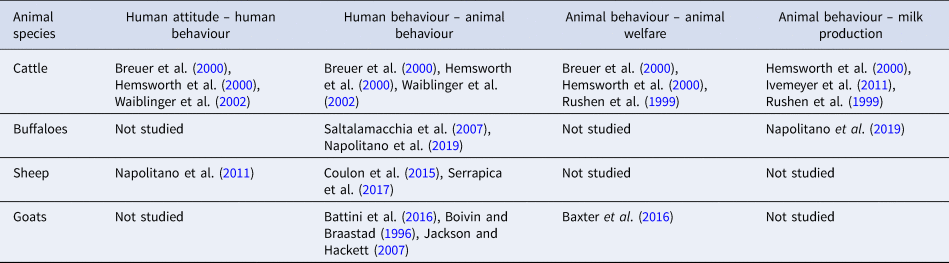
Therefore, after a background description of the main findings concerning dairy species (cattle, buffaloes, sheep and goats) and the gaps to be filled to fully verify the applicability of the HAR model in those species (Table 1), the present study will identify margins for the improvement of dairy animal welfare and production through the combination of pieces of information on animal behaviour, human attitude and behaviour, and new technologies capable of impacting the quality of the interactions between stock-people and animals.
Summary of the studies on the sequential relationship between human attitude/behaviour and animal behaviour/welfare/production
HAR in cattle
Humans
In dairy cattle the quantity and quality of HAR and their impact on behaviour, welfare and productivity have been widely investigated (see Waiblinger et al. Reference Waiblinger, Boivin, Pedersen, Tosi, Janczak, Visser and Jones2006 for a review).
The sequential relationship between stock-people's attitude and their behaviour has been well documented in dairy cattle (see Hemsworth, Reference Hemsworth2003 for a review). For instance, in this species, a positive attitude was negatively associated with both the number and the percentage of forceful, negative, tactile interactions (Breuer et al., Reference Breuer, Hemsworth, Barnett, Matthews and Coleman2000; Hemsworth et al., Reference Hemsworth, Barnett and Borg2000; Waiblinger et al., Reference Waiblinger, Menke and Coleman2002), and positively correlated with the number of quiet or soft vocalisations performed by the stock-people when moving the cows (Breuer et al., Reference Breuer, Hemsworth, Barnett, Matthews and Coleman2000). In addition, the frequency of gentle contacts was positively associated with a positive attitude of the farmers towards veal calves (Lensink et al., Reference Lensink, Fernandez, Boivin, Pradel, Le Neindre and Veissier2000). However, as suggested by Lensink et al. (Reference Lensink, Fernandez, Boivin, Pradel, Le Neindre and Veissier2000), other factors, such as gender and work load may directly influence the behaviour of stock-people towards animals.
Training programmes and a more careful recruitment of stock-people have been proposed in order to improve the attitude and behaviour towards animals (Boivin et al., Reference Boivin, Lensink, Tallet and Veissier2003). For example, in dairy cattle (Hemsworth et al., Reference Hemsworth, Coleman, Barnett, Borg and Dowling2002) appropriate stock-people training, aimed at modifying their attitude and behaviour, had a beneficial effect on these aspects, as well as, on the fear response of animals to humans.
Animals
The behaviour expressed by humans towards the animals may elicit a fear response depending on the intensity of stimuli and its previous experiences (Price, Reference Price1999). In dairy cattle, this response may result in increased restlessness and heart rate when milked (Rushen et al., Reference Rushen, de Passillé and Munksgaard1999), or in reluctance to move, falling, baulking, etc. when handled (Grandin, Reference Grandin1997). For example, negative stock-people interactions were positively correlated with the number of kicks during milking and with farm milk cortisol concentrations, whereas positive interactions were negatively correlated with the number of kicks (Breuer et al., Reference Breuer, Hemsworth, Barnett, Matthews and Coleman2000; Hemsworth et al., Reference Hemsworth, Barnett and Borg2000). In addition, the percentage of positive interactions during milking had a beneficial effect on udder health (Ivemeyer et al., Reference Ivemeyer, Knierim and Waiblinger2011).
Ultimately, an increased level of animals' fear of humans may be a major source of stress resulting in reduced productivity and welfare (Hemsworth, Reference Hemsworth2003). It has been observed that the use of negative interactions may have detrimental effects on milk ejection, with increased amounts of residual milk, on milk yield, with reduced milk production, and on milk quality in terms of reduced fat and protein contents (Rushen et al., Reference Rushen, de Passillé and Munksgaard1999; Breuer et al., Reference Breuer, Hemsworth, Barnett, Matthews and Coleman2000; Hemsworth et al., Reference Hemsworth, Barnett and Borg2000; Waiblinger et al., Reference Waiblinger, Menke and Coleman2002). In contrast, positive interactions were associated with increased fertility and udder health of dairy cows (Hemsworth et al., Reference Hemsworth, Barnett and Borg2000; Ivemeyer et al., Reference Ivemeyer, Knierim and Waiblinger2011) and growth rate of dairy calves (Lürzel et al., Reference Lürzel, Münsch, Windschnurer, Futschik, Palme and Waiblinger2015). Further, gentle handling and less fearful dairy cattle may reduce the risk of injuries to humans during milking (Rousing et al., Reference Rousing, Bonde, Badsberg and Sørensen2004; Bertenshaw et al., Reference Bertenshaw, Rowlinson, Edge, Douglas and Shiel2008), transport (Lensink et al., Reference Lensink, Fernandez, Boivin, Pradel, Le Neindre and Veissier2000, Reference Lensink, Fernandez, Cozzi, Florand and Veissier2001) and veterinary procedures (Waiblinger et al., Reference Waiblinger, Menke, Korff and Bucher2004).
Undoubtedly, in dairy cattle the most used measure of the quality of human-animal relationship is represented by the avoidance distance of animals to humans (AD). AD may be defined as the distance at which an animal allows a moving unfamiliar person to approach (Waiblinger et al., Reference Waiblinger, Menke and Coleman2002). AD has been measured either at the feeding place or in the barn (Waiblinger et al., Reference Waiblinger, Menke and Fölsch2003; Windschnurer et al., Reference Windschnurer, Schmied, Boivin and Waiblinger2008; Ivemeyer et al., Reference Ivemeyer, Knierim and Waiblinger2011). AD in the barn was negatively correlated with positive interactions during milking and positively correlated with negative interactions (Waiblinger et al., Reference Waiblinger, Menke and Coleman2002). In addition, it has been reported that the number of negative stock-people interactions during milking was negatively associated with the percentage of cows approaching a motionless observer within 1 m in a standard approach arena test (Hemsworth et al., Reference Hemsworth, Barnett and Borg2000). However, it has been documented that AD at the feeding place and AD in the barn were highly correlated (Waiblinger et al., Reference Waiblinger, Menke and Fölsch2003; Windschnurer et al., Reference Windschnurer, Schmied, Boivin and Waiblinger2008). Indeed, AD measured at the feeding place is more feasible than that measured in the barn. Therefore, AD measured at the feeding place was included in the Welfare Quality® assessment protocol for cattle to assess the quality of the human–animal relationship at farm level (Welfare Quality®, 2009).
HAR in buffaloes
Humans
In Italy dairy buffalo intensification occurred in the last five decades. Obviously, this intensification has led to an increase in the number of events where stock-people and animals interact. Thus, the role of stock-people, as in other intensive production systems, has become more and more important (Napolitano et al., Reference Napolitano, Serrapica, Braghieri, Masucci, Sabia and De Rosa2019). However, to our knowledge, the study of the attitude of stock-people towards dairy buffaloes has never received scientific attention.
Animals
The relatively recent introduction of machine milking, together with early calf-separation practice, configure buffaloes as sensitive animals to the milking environment and routine changes, as even small modifications can elicit restlessness and other discomfort emotional states (Napolitano et al., Reference Napolitano, Pacelli, Grasso, Braghieri and De Rosa2013; Polikarpus et al., Reference Polikarpus, Napolitano, Grasso, Di Palo, Zicarelli, Arney and De Rosa2014). Stepping and kicking, frequency of urination and defecation, pulling the teat cup off the teats, and a delay in milk ejection can be considered the most frequent behaviours expressing discomfort in dairy buffaloes during milking (De Rosa et al., Reference De Rosa, Napolitano, Grasso, Pacelli and Bordi2005; Saltalamacchia et al., Reference Saltalamacchia, Tripladi, Castellano, Napolitano, Musto and De Rosa2007). In dairy buffaloes, negative stock-person interactions during milking were positively correlated with the number of kicks and the percentage of buffaloes injected with oxytocin to facilitate milk ejection (Saltalamacchia et al., Reference Saltalamacchia, Tripladi, Castellano, Napolitano, Musto and De Rosa2007; Napolitano et al., Reference Napolitano, Serrapica, Braghieri, Masucci, Sabia and De Rosa2019). In addition, Napolitano et al. (Reference Napolitano, Serrapica, Braghieri, Masucci, Sabia and De Rosa2019) found a correlation between the number of positive interactions and milk production.
In buffaloes, milking parlour design may affect stock-people behaviour towards animals, with a higher number of negative stock-people interactions in tandem parlours as compared with herring-bone parlours (Napolitano et al., Reference Napolitano, Serrapica, Braghieri, Masucci, Sabia and De Rosa2019). This may be due to the fact that the chance to perform negative interactions is higher in tandem than in herring-bone, as in the former the animals are individually handled, whereas in the latter the animals are group-managed.
Cavallina et al. (Reference Cavallina, Roncoroni, Campagna, Minero and Canali2008) observed more kicking and frequency of urination during milking in primiparous than multiparous buffalo cows. As expected, they also observed a reduction of these behavioural expressions in primiparous animals as the lactation proceeded as a result of the process of habituation to this novel procedure. These findings were confirmed by the work of Polikarpus et al. (Reference Polikarpus, Napolitano, Grasso, Di Palo, Zicarelli, Arney and De Rosa2014) where a pre-partum habituation programme to the milking routine (including the presence of two milkers) was effective in reducing buffalo heifers' level of restlessness, expressed in terms of kicking and stepping, when they subsequently entered the lactating group and were regularly milked.
As reported for dairy cattle, also for dairy buffaloes, avoidance distance measured at the feeding place was included in Welfare Quality® assessment protocol to assess the quality of the human–animal relationship at farm level (De Rosa et al., Reference De Rosa, Napolitano, Grasso, Pacelli and Bordi2005, Reference De Rosa, Grasso, Winckler, Bilancione, Pacelli, Masucci and Napolitano2015).
HAR in sheep
Humans
In a recent cross-cultural study, the quality of HAR was not mentioned by a number of stakeholders when asked to list the most important aspects to be considered to sustain sheep welfare (Dalla Costa et al., Reference Dalla Costa, Tranquillo, Dai, Minero, Battini, Mattiello, Barbieri, Ferrante, Ferrari, Zanella and Canali2019) and, although incorporated in the AWIN scheme under the form of a familiar human approach test (AWIN, 2015), it was not included in a list of relevant parameters for the assessment of the welfare of sheep kept for meat production (Munoz et al., Reference Munoz, Campbell, Hemsworth and Doyle2017). Accordingly, Phillips and Phillips (Reference Phillips and Phillips2010) noted that farmers consider long-lasting factors such as malnutrition, poor management and parasite infestations, as the main welfare issues in sheep kept for meat production in Australia, whereas animal welfare activists paid more attention to acute pain induced by mutilations such as castration. However, farmer attitudes are affected by education level, job satisfaction, gender and size of the farm. For instance, in Turkey the welfare of sheep kept for meat production is given more consideration by farmers with increasing education level and job satisfaction, while they are deemed less relevant by farmers with increasing farm size and by male farmers, as these characteristics (farm size and male gender) were possibly more associated with an interest towards profits rather than with the conditions of individual animals (Kılıç and Bozkurt, Reference Kılıç and Bozkurt2013). This latter aspect highlights the lack of knowledge concerning the relationship between animal welfare and productivity and signals an oppoortunity for animal welfare improvement by targeting sheep farmers' attitude. In particular, Munoz et al. (Reference Munoz, Coleman, Hemsworth, Campbell and Doyle2019) observed a close relationship between farmer attitude and management decisions, which in turn were able to markedly affect the welfare of sheep kept for meat production. The attitude of farmers, even when they are not directly involved in farm activities and animal handling, has an impact on stock-people attitude and behaviour in terms of training provided and priorities identified in flock management. A study conducted in Italy (Napolitano et al., Reference Napolitano, De Rosa, Girolami, Scavone and Braghieri2011) showed that stock-people generally had a positive attitude towards dairy sheep (they considered them to be sensitive animals), about working with them (they considered them manageable when handled) and about how to interact with them (positive interactions were considered the most effective to handle the animals), and were satisfied about their job.
As to human behaviour, numerous studies showed that gentle interactions increased the affinity of lambs from dairy breeds towards humans (Caroprese et al., Reference Caroprese, Napolitano, Albenzio, Annicchiarico, Musto and Sevi2006; Napolitano et al., Reference Napolitano, Caroprese, Girolami, Marino, Muscio and Sevi2006), while subsequent studies indicate that the consequent close relationship may function as social support in lambs kept for meat production prematurely separated from their mothers (Coulon et al., Reference Coulon, Nowak, Peyrat, Chandèze, Boissy and Boivin2015; Serrapica et al., Reference Serrapica, Boivin, Coulon, Braghieri and Napolitano2017).
Animals
It has been demonstrated that sheep can be easily habituated to the human presence (González-Pech et al., Reference González-Pech, Marín-Tun, Valladares-González, Ventura-Cordero, Ortiz-Ocampo, Cámara-Sarmiento, Sandoval-Castro and Torres-Acosta2018) and, more importantly, to the milking routine (Dimitrov et al., Reference Dimitrov, Stancheva, Staikova, Peeva, Vasilev and Apostolov2012). Although no studies are available on the behaviour of stock-people in the milking parlour and its effect on animal behaviour, it has been observed that positive attitudes of stock-people about working with dairy sheep and about how to interact with sheep were correlated with a reduced flight distance at the feeding place (Napolitano et al., Reference Napolitano, De Rosa, Girolami, Scavone and Braghieri2011). Habituation to human handling and the development of a positive human-animal relationship may, therefore, make the ewes calmer and less reactive to the milking routine with increased welfare, more effective milk ejection and higher production (Dimitrov and Djorbineva, Reference Dimitrov and Djorbineva2003). Taken together these results suggest that a positive human behaviour at milking may potentially impact animal behaviour and welfare and consequently increase the productivity of dairy sheep enterprises.
HAR in goats
Humans
As also observed for sheep, different stakeholders did not mention the quality of HAR as a relevant issue for dairy goat welfare (Dalla Costa et al., Reference Dalla Costa, Tranquillo, Dai, Minero, Battini, Mattiello, Barbieri, Ferrante, Ferrari, Zanella and Canali2019). After a number of preliminary studies where it was repeatedly tested and validated (Mattiello et al., Reference Mattiello, Battini, Andreoli, Minero, Barbieri and Canali2010; Battini et al., Reference Battini, Barbieri, Vieira, Stilwell and Mattiello2016; Can et al., Reference Can, Vieira, Battini, Mattiello and Stilwell2016) HAR was integrated in the AWIN scheme under the form of latency to the first contact test (AWIN, 2015) and, although it was not listed among a number of animal based parameters suggested for dairy goat welfare assessment by Anzuino et al. (Reference Anzuino, Bell, Bazeley and Nicol2010), these authors stated that a measure of goat fearfulness had to be developed to make the assessment more comprehensive.
In Norwegian dairy farms a generally positive farmer attitude towards goats (they were considered to be capable of distinguishing different humans), about how to interact with them (positive interactions were considered more effective to handle the animals) and job satisfaction was recorded (Muri et al., Reference Muri, Stubsjøen and Valle2013) while in Italy Battini et al. (Reference Battini, Barbieri, Vieira, Stilwell and Mattiello2016) observed that a positive attitude of the handler tended to be associated with the farms qualitatively classified as ‘good’ in terms of HAR (based on the judgment provided by the technical advisor regularly visiting the farms), whereas a negative attitude tended to be associated with ‘poor’ farms.
Human behaviour has an impact on the reaction expressed by goats. Boivin and Braastad (Reference Boivin and Braastad1996) recorded a higher affinity of gentled kids to a familiar human as compared with untreated animals. They also noted that gentling was more effective if performed at 1 week than at 6 weeks of age. In adult goats Jackson and Hackett (Reference Jackson and Hackett2007) observed that gentled animals were quicker in approaching an unknown person as compared with non-gentled goats, whereas Battini et al. (Reference Battini, Barbieri, Vieira, Stilwell and Mattiello2016) noted that the majority of the variables recorded during the approach and the avoidance tests were able to discriminate the farms classified as ‘good’ and ‘poor’ in terms of HAR quality. Then, we can suppose that the model proposed by Hemsworth and Coleman (Reference Hemsworth and Coleman2011) is applicable to dairy goats, as also reported for other animal species, and assume that stock-people attitude is reflected in stock-people behaviour.
Animals
Unfortunately, no specific studies on the effect of human behaviour at milking on goats are available leaving room for further research to have this gap filled. Nevertheless, a recent study demonstrated that positive and negative handling of pregnant goats had significantly different outputs in terms of reproduction efficiency and maternal behaviour, with lower pregnancy maintenance rates in animals receiving aversive treatments, and improved maternal care in mothers receiving gentle treatments (Baxter et al., Reference Baxter, Mulligan, Hall, Donbavand, Palme, Aldujaili, Zanella and Dwyer2016). Accordingly, lactating goats had a significant increment of heart girth (a proxy of body weight) if previously gentled but did not show any changes if left untreated, possibly because the former were able to adsorb and use more efficiently the nutrients contained in their ration (Jackson and Hackett, Reference Jackson and Hackett2007), thus potentially compensating the negative energetic balance experienced by lactating animals soon after parturition. In addition, goats receiving aversive handling showed increased salivary cortisol levels during the treatment as compared with control and gentled animals (Baxter et al., Reference Baxter, Mulligan, Hall, Donbavand, Palme, Aldujaili, Zanella and Dwyer2016). These results indicate that human behaviour can have a marked effect on goat behaviour, welfare, reproduction and feed conversion efficiency, while further studies are needed to verify whether the quality of HAR can affect milk production.
New technologies
Several devices and sensors have been developed to assess the welfare of the animals (such as thermography and accelerometers), although no new technologies specifically designed to monitor the quality of HAR on farm are available. Therefore, existing technologies could be further developed to this aim. For instance, a system combining video management and machine learning may allow collection, recording and analysis of the videos and the corresponding sounds, thus enabling a real time feed-back with a potentially prompt improvement of the welfare of the animals through tailored interventions on handlers (such as training on specific aspects of animal handling) or facilities (elimination of abrupt changes in flooring, for example). However, in a recent study conducted in the UK, sheep farmers, albeit acknowledging the advantages deriving from the application of precision livestock farming techniques, showed a resistance to their adoption due to the belief that they would, at least partly, lose the control of the farm (Kaler and Ruston, Reference Kaler and Ruston2019). Further aspects potentially hindering the implementation of new technologies are economic and cultural constraints and lack of information and competence (Pierpaoli et al., Reference Pierpaoli, Carli, Pignatti and Canavari2013).
Concluding remarks
The present review highlighted the need for further research to definitively verify the applicability of the HAR model proposed for other species to dairy sheep and goats. In particular, in both species, studies linking human behaviour at milking to animal behaviour, animal welfare and milk production are lacking. In dairy cattle the model has been fully verified, whereas in dairy buffaloes, studies on the relationship between stock-people attitude and behaviour are lacking. However, in both dairy cattle and buffaloes the effects of human behaviour on animal welfare and milk production have been confirmed. The main tool proposed to improve the quality of HAR is training of stock-people by targeting their attitude and behaviour. Given that a good quality HAR may benefit the welfare of dairy animals and productivity, new technologies for monitoring the handling routine on the farm may be more effective in promoting good practices. In particular, the implementation of new technologies may allow the precise identification of specific inappropriate behaviours to be targeted at stockperson level, thus increasing the efficacy and efficiency of training. However, an issue related to the introduction of new technologies in the farms, particularly in those that follow traditional farming practices, is the resistance to innovations which may be encountered.
Acknowledgements
This article is based upon work from COST Action FA1308 DairyCare, supported by COST (European Cooperation in Science and Technology, www.cost.eu). COST is a funding agency for research and innovation networks. COST Actions help connect research initiatives across Europe and enable scientists to grow their ideas by sharing them with their peers. This boosts their research, career and innovation.


 Open access

