

INTRODUCTION
The Mexican landscape is characterized by a wide variety of landforms including hills, ridges, mountains, and volcanoes; this orography molded the worldview of Mesoamerican people, who considered these elements inhabited by spirits (Broda Reference Broda, Iwaniszewski and Montero García2001). It is natural to assume that mountains and volcanoes were among the most sacred objects of veneration due to their physical link between heaven, earth, and the underworld as well as providers of food and water. Furthermore, mountains were perceived as supernatural beings associated with water and fertility and were the most important point of encounter between Tlaloc—the life cycle of water—and the landscape (Hernandez Reference Hernández Bautista2014). As a result, Mesoamerican people integrated these natural objects to their daily lives through the construction of “artificial mountains” or pyramids in their settlements, or sculptures carved in stone. Mountains and volcanoes with archaeological remains were probably the most immediate and ancient veneration objects. According to some historic accounts from the 16th and 17th centuries, societies that lived in the surrounding areas of the Nevado de Toluca in Prehispanic times performed rituals and offerings related to the worship of aquatic deities throughout the volcano. After the Spanish conquest, these ceremonies were hidden from Christian priests (Hernández Reference Hernández Bautista2014), leading to the fact that current cultural rituals remain, they can be linked somehow with the ancient Mesoamerican rites that focused on fertility of the fields, abundant harvests, the right amount of rain, and mild climate.
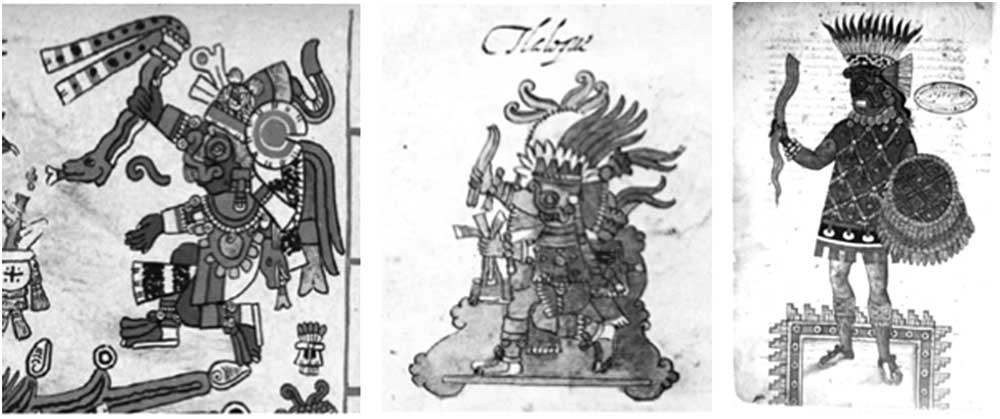
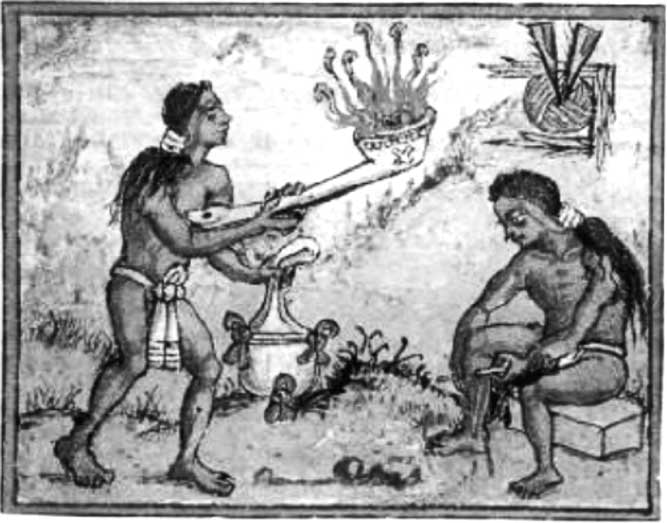
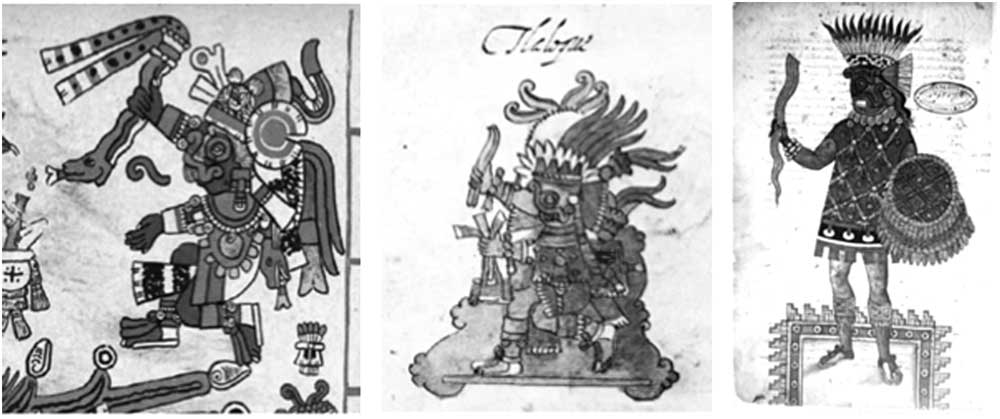
Over time, the man–volcano interaction has been recorded through materials deposited in the mountain. The El Sol and La Luna crater lakes in the Nevado de Toluca were chosen by Prehispanic societies to make offerings. Among the objects in these rituals were copal, a resin from the copal santo (Bursera bipinnata) tree used since Prehispanic times as a smelling smoke offering when burnt on censers; maguey thorns commonly used as a sharp object for self-sacrifice to injure different parts of the body and causing it to bleed, after which the blood is offered to the gods as described in historical accounts from the 16th and 17th centuries (Figure 1). And finally, wooden scepters (waved-shaped, carved wooden sticks) were made to represent the lightning bolt/serpent scepter of Tlaloc (Junco and Vigliani Reference Junco and Vigliani2012), a symbol of lightning and rain, one of its most characteristic attributes (Figure 2).
Representation of burning copal resin on a censer while a man perforates his calf. In the background, straw balls can be seen with deposited bleeding maguey thorns. Illustration taken from Historia de las Indias de la Nueva España e islas de tierra firme, Fray Diego Duran.
Three representations of Tlaloc holding an undulated scepter in his right hand. From left to right: fragments of Codex Borbónico, Codex Ríos, and Codex Ixtlilxochitl.
SITE DESCRIPTION
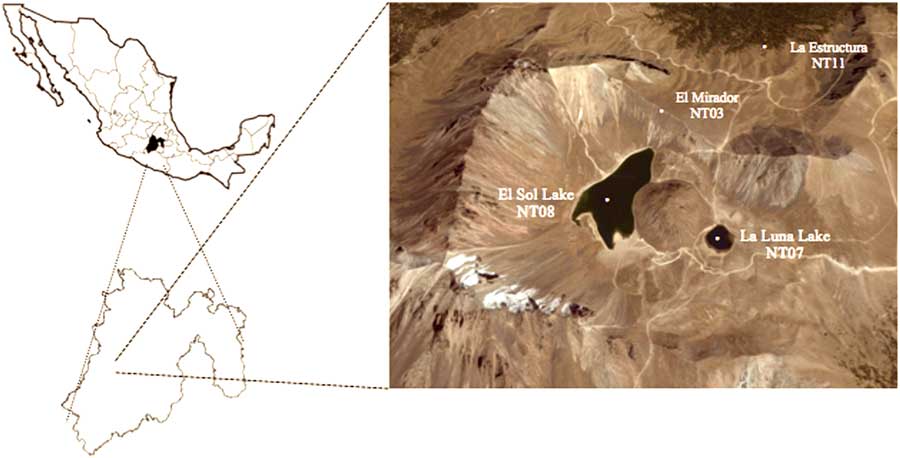
The Nevado de Toluca or Xinantecatl is a stratovolcano located in the southwest part of the Toluca Valley, in the State of Mexico at 19°06′31′′N and 99°45′29′′W. It is the fourth-highest peak in Mexico with height of 4680 m asl (Yarza Reference Yarza Carreón2003). Inside the crater there are two perennial bodies of water known as El Sol and La Luna lakes both at 4200 m asl (Figure 3). By 2013, 27 archaeological sites in the Nevado de Toluca had been registered; four of them were part of the most important archaeological explorations in 2007, 2010, and 2012: La Luna (NT-07 Site) and El Sol (NT-08 Site) lakes; El Mirador (NT-03 Site) and la Estructura (NT-11 Site), respectively. For this study, objects from La Luna (NT07) and El Sol (NT08) archaeological sites were used. These places have two archaeological contexts: land and underwater. In the northern bank of La Luna lake, ruins of stone and stucco were identified, possibly part of a ritual structure, as well as ceramic censers and remains of lithic and other pottery objects used in their rituals (Montero Reference Montero García2013). Additionally, remains of Prehispanic offerings had been found inside the lake, principally well-preserved objects made of organic materials like copal cones and spheres, wooden scepters, remains of basketry, as well as thorns and leaves of maguey. In the northern west bank over the land of El Sol lake, archeologists found a site with remains of pottery, charcoal, maguey thorns, fragments of wooden scepters, and numerous turquoise mosaic pieces. Most importantly, they were found beneath the water (Montero et al. Reference Montero García and Junco Sánchez2009). It is worth mentioning that the site with archaeological remains found out of the water is flooded when the level of the lake increases in the rainy season. (Hernandez Reference Hernández Bautista2014).
Map showing the Nevado de Toluca volcano in the State of Mexico. El Sol (NT08) and La Luna (NT07) crater lakes zoom in. Satellite photograph from Google Maps.
Although the lakes were known to have had a lot of archaeological objects under their waters, they were looted by sport divers in the last half of the 20th century. This looting, along with natural alterations of archaeological lake contexts, have compromised the archaeological record and made it difficult to establish a clear stratigraphy. Nevertheless, the exceptional preservation conditions that the lakes’ cold water and intense UV radiation (Alcocer Reference Alcocer2009) provides to the organic archaeological material has made it possible to date the ritual activities in the volcano.
MATERIALS AND METHODS
Sampling
From the organic materials’ offerings recovered in the lakes of El Sol (NT08) and La Luna (NT07), 21 were selected as the most representative samples from the lake bottoms: 14 Tlaloc´s scepters, 4 maguey thorns, 3 copal resin pieces, and 1 rubber disc. Because of their composition and characteristics, these materials are ideal for radiocarbon (14C) dating. Except for two maguey thorns (LEMA 530 and LEMA 531) from El Sol Lake and a rubber disc (LEMA 561) from La Luna Lake, all the objects had already been consolidated for preservation, possibly with polyethylene glycol (PEG)/ethylene glycol.
Sample Preparation
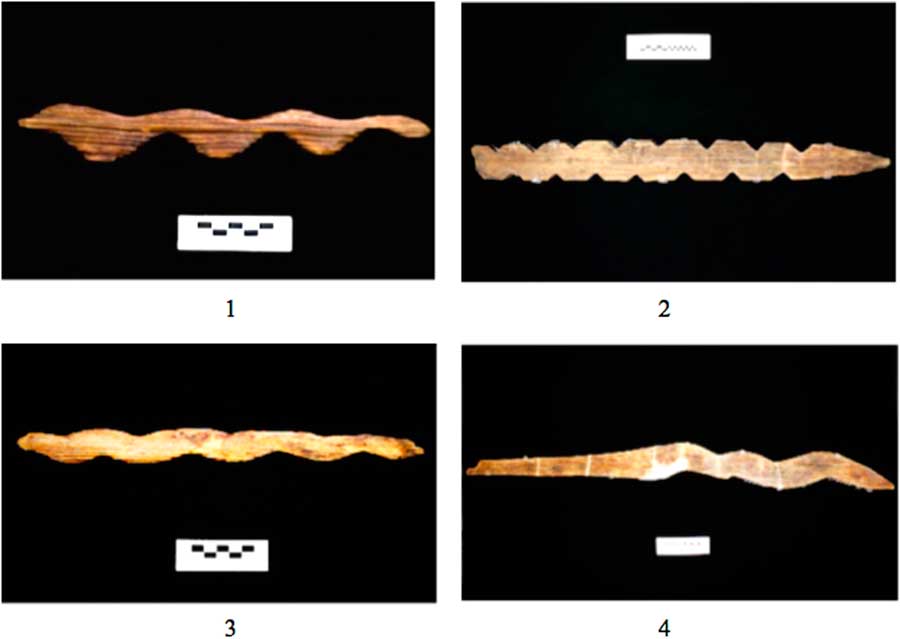
The larger group is comprised of consolidated samples: 14 wooden objects (Figure 4), 13 extracted from La Luna lake (LEMA 532-540, LEMA 540, and LEMA 544-546), 1 (LEMA 547) from El Sol lake (LEMA 547), and 2 maguey thorns (LEMA 528 and LEMA 529) from El Sol lake. After mechanical cleaning, the consolidants were removed using an automated continuous extraction Sohxlet system (Büchi Labortechnik; E-812) for 2 hr with n-hexane, 2-propanol and ethanol. At the end the samples were washed with hot ultrapure water. The second group of samples, 2 maguey thorns, 2 copal pieces, and 1 piece of rubber were cleaned and washed followed by ABA treatment method: The samples were treated with 0.5 M [HCl]aq at 60°C for 10 hr and then rinsed with deionized water to neutral pH. They were then treated with 0.1 M [NaOH]aq at 60°C for 10 hr and rinsed with deionized water to neutral pH. Finally, the samples were treated with 0.5 M [HCl]aq at 60°C for 10 hr, rinsed with deionized water, and dried in an oven at 50°C for 12 hr. Once clean, all wooden pieces and maguey thorns were subjected to cellulose extraction process by base-acid-base-acid-bleaching method (Němec et al. Reference Němec, Wacker, Hajdas and Gäggeler2010). The samples were treated with 4% [NaOH]aq at 75°C for 10 hr and rinsed with deionized water until neutral pH. Then they were treated with 4% [HCl]aq at 75°C for 1 hr and rinsed with deionized water to neutral pH. After that, they were treated with 4% [NaOH]aq at 75°C for 1.5 hr and rinsed with deionized water to neutral pH. And finally they were treated with 5% [NaClO2]aq to which was added 5% [HCl]aq to pH=2, kept at 75°C for 2 hr. They were then rinsed to neutral pH, decanted, and dried by lyophilization.
Four undulated wooden scepters with different sizes and shapes recovered from Lake La Luna: (1) LEMA 537; (2) LEMA 547; (3) LEMA 542; and (4) LEMA 545.
For AMS-14C analyses, the cellulose, copal, and rubber samples obtained were transformed to graphite using a commercial Automatic Graphitization Equipment (AGEIII; IonPlus) (Wacker et al. Reference Wacker, Němec and Bourquin2010). In this apparatus, an elemental analyzer (EA; Elementar, Vario Micro Cube) is coupled to a compact and fully automated graphitizer. The sample is weighted in a tin crucible and introduced into the EA, where it is combusted at 950ºC. The CO2 produced is separated from N2, SO2, and H2O and transferred to the graphitizer by helium as carrier gas, where it is absorbed in a zeolite trap. CO2 is then transferred from the zeolite to each one of seven reactors, where the graphite is formed at 580ºC in the presence of H2 and Fe powder catalyst. Routine preparation of 1 mg carbon of some International Atomic Energy Agency (IAEA) reference materials as from National Institute of Standards and Technology (NIST) NIST 4990C oxalic acid (OXAII), were performed for standard normalization and correction for isotope fractionation. 14C-free blanks (phthalic acid blank) were used for quantify the backgrounds of combustion, graphitization a spectrometer. Measuring standard reference materials supplied by the IAEA assessed the accuracy of the 14C analyses. The performance of the 14C preparation laboratories was tested through the analysis of VIRI-2 (Fifth International Radiocarbon Intercomparison), sample F (Scott Reference Scott, Cook and Naysmith2010). Our results for VIRI F (horse bone) dating were 2520±50BP (consensus values 2513±40BP).
Corresponding 14C dates were calculated using computer codes developed at LEMA (Solís et. al. Reference Solís, Chávez-Lomelí, Ortiz, Huerta, Andrade and Barrios2014). Calendar ages were obtained with OxCal program v4.2.4 (https://c14.arch.ox.ac.uk/oxcal/OxCal.html; Bronk Ramsey and Lee Reference Bronk Ramsey and Lee2013), using the InCal13 calibration curve (Reimer et al. 2013). The OxCal program is basic for calculating the calendar ages and to be compared with those predicted for any site (Bronk Ramsey Reference Bronk Ramsey1995; Bronk Ramsey and Lee Reference Bronk Ramsey and Lee2013).
RESULTS AND DISCUSSION
The main Mesoamerican civilizations (Teotihuacan, Zapoteca, and Maya) dominated the Mesoamerican Classic Period (200–900 AD); but their collapse towards the Epiclassic (700–900 AD) allowed the emergence of many centers of regional power, such as Matlazinca. The Matlazincas dominated an extensive territory, with some main trade routes to the south and the Pacific. In addition, it was a very fertile region with an important agricultural production. This made the Matlazinca region the object of conquest by the dominant warrior people in the Late Postclassic (1200–1521 AD), the Aztecs.
The earliest date for the 14 wooden objects goes back to the Epiclassical end (650–900 AD) and part of the Early Postclassical 900–1200 AD; while the rest of the pieces belong in between the Early Postclassical and part of the Late Postclassical (1200–1520 AD). Table 1 presents the results for all wooden samples. None of the dates for this objects goes beyond 1455 AD. This is an important result as it highlights the fact that all ritual activity dates to the period before the Aztec conquest of the Toluca Valley in 1476 AD. According to the archaeological record the control of the Toluca Valley by the Matlazinca culture happened from 1162 AD to 1474/76 AD (Piña Chan Reference Piña Chan1975). This permits us to put forward the idea that the highest frequency of ritual activity in the volcano happened during Matlalzinca times rather than in the following Aztec times, for whom one of two most important deities was Tlaloc, god of rain. Besides, the results demonstrate that organic archaeological objects from Nevado de Toluca are older than expected and remain in exceptional conditions. Nonetheless, we must take into account that other cultural groups also inhabited the region controlled by the Matlazinca when putting forward hypotheses about the ritual activity, and the meaning of these wooden objects in the region.
Results for all wooden samples.
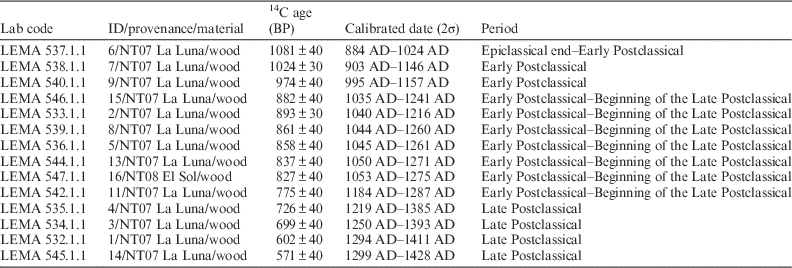
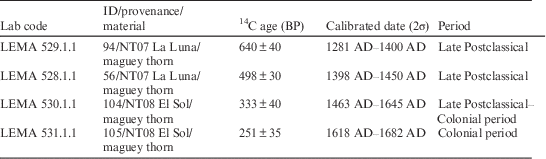
Table 2 shows dates for maguey thorns, associated with Mayhuel the pulque’s female divinity, the alcoholic beverage, fertility and practice of ritual self-sacrifice. The thorns (LEMA 529 and LEMA 528) found in La Luna Lake (NT07) fall into the Late Postclassical period just like the wooden objects belong to a time previous to the Aztecs conquest of the Toluca Valley. On the other hand, thorns dates (LEMA 530 and LEMA 531) from El Sol Lake (NT08) are much later, belonging to the Colonial period. This means there is evidence of the ritual use of the lakes into the Colonial period. Table 3 shows results for two copal (LEMA 559 and LEMA 560) and one rubber (LEMA 561) samples from La Luna Lake (NT07). Copal is a plant resin of a tree with a short life cycle whose physical and chemical characteristics make it stable during a long period. Copal and rubber sample datings belong to the Late Postclassical previous to the Aztecs’ arrival in the Toluca Valley.
Dates for maguey thorns.
Results for copal and rubber samples from La Luna Lake.

The Prehispanic cult in the Nevado de Toluca ran from Epiclassical end to the 19th century. Nevertheless, it was more intense between the Early Postclassical and the Late Postclassical and almost disappeared around 1460 AD in coincidence with the Aztecs’ first attacks that ended with the conquest of Matlazinca around 1479 AD. Rituals in the Nevado de Toluca in Later Postclassical also coincide with the Little Ice Age (1360–1910 AD), which brought the tendency of the region to have colder and drier weather. This climatological record has been established from the sediments of La Luna Lake, suggesting also the colder and drier weather (Cuna et al. Reference Cuna, Zawusza, Caballero, Ruiz-Fernández, Lozano-García and Alcocer2014). Furthermore, also coinciding are some of the most intense or longest droughts, which were recorded for 1365–1384 AD, 1526 AD, and 1655–1670 AD (Sosa-Nájera et al. Reference Sosa-Nájera, Lozano-García, Roy and Caballero2010). Thus the period that coincides with ritual activity in the volcano and weather patterns goes from 1360 AD to 1500 AD, and from 1500 AD to 1660 AD, approximately.
CONCLUSIONS
The AMS 14C dating analyses conducted on various materials (wooden scelpters, copal, maguey thorns, and rubber) confirmed the use of the Nevado de Toluca volcano as a very active offering site.
Despite diverse context alterations, such as looting and weathering, most of the analyzed objects found at La Luna Lake were found under exceptional conservation conditions. 14C dating has made it possible to obtain the first estimate of peak ritual activities at Nevado de Toluca. The analysis results suggest that the greatest period of ritual activity at the Nevado de Toluca was in the Late Postclassical period. This could have been related to a greater need for rain and to have better climatological conditions for growing crops.
Although the analysis of the short-live samples, such as maguey thorns and copal, allowed the establishment of a better chronology of the rituals at Nevado de Toluca, the wooden materials provided just rough estimates.
ACKNOWLEDGMENTS
The authors thank A. Huerta for maintenance and operation of the AMS system, and Sergio Martínez for laboratory assistance. This project was financed by Conacyt grants 232718 and 205317 and DGAPA-UNAM grants IG100313 and IG100216.