

INTRODUCTION
The Upper Paleolithic open-air site Sungir is located on the central Russian Plain on the high left bank of the Klyazma River (56°11′N, and 40°30′E; see Figure 1; Bader Reference Bader1978). Sungir was discovered in 1956. For 24 field seasons (1957–2004) an expedition under the leadership of O.N. Bader, N.O. Bader, and L.A. Mikhajlova explored over 4000 square meters of the site area. Some authors define the cultural layer as “cultural soil,” because remains are to a large extent mixed and can be found through the whole depth of the soil. The thickness of the find-bearing layer is up to 1 m (Bader Reference Bader1978). The archaeological remains consist of stone and bone objects, faunal remains, fireplaces, firepits, and ritual pits. A complicated burial complex with two graves with four burials (six individuals in all) was also found at the site.
Location of the Sungir site (Kuzmin et al. Reference Kuzmin, Burr, Jull and Sulerzhitsky2004).

The lithic industry is characterized by parallel reduction. The most numerous blanks are flakes. The tool assemblage has two components. The first one has a rather archaic (Mousterian-like) character and consists of side-scrapers, triangular bifacial points with a concave base, and projectile points. The second part of the tool set is from the Upper Paleolithic and includes end-scrapers (single end-scrapers, circular end-scrapers, oval end-scrapers, etc.), burins (truncation burins, straight burins, etc.), punches and pièces esquillées, etc. (Bader Reference Bader1978; Seleznyov Reference Seleznyov2004). An analogous industry has been discovered at numerous Streletskian culture sites in the middle of Don River. Due to the presence of triangular bifacial points with concave bases, the Sungir site has been classified as a transitional cultural phase of the Early Upper Paleolithic (Bader Reference Bader1978; Marom et al. Reference Marom, McCullagh, Higham, Sinitsyn and Hedges2012: 6879), a hypothesis that sometimes has been underlined by the emphasis that the industry combines elements of the Aurignacian and the Szeletian (Bader Reference Bader1978; Grigoriev Reference Grigoriev1990; White Reference White, Knecht, Pike-Tay and White1993).
The fauna of the Sungir site contains numerous remains of reindeer (Rangifer tarandus), mammoth (Mammuthus primigenius), horse (Equnus caballus cf. Taubachensis Frend), polar fox (Alopex lagopus), wolf (Canis lupus), and others (Gromov Reference Gromov, Sukachev, Gromov and Bader1966).
Interpretation of the radiocarbon (14C) dates from Sungir is one of the most debated issues in the discussion of the peculiarities of the site, with consequences for the view of the cultural layer as well as for the establishment of different periods of human occupation there (e.g., Alekseeva and Bader Reference Alekseeva and Bader2000; Dobrovolskaya et al. Reference Dobrovolskaya, Richards and Trinkaus2012; Marom et al. Reference Marom, McCullagh, Higham, Sinitsyn and Hedges2012; Kuzmin et al. Reference Kuzmin, van Der Plicht and Sulerzhitsky2014). It has been repeatedly noted that 14C dates on human bones from the famous burials do not correspond well to one other and, at the same time, do not correlate with 14C dates obtained on samples from the cultural layer (e.g. Alekseeva and Bader Reference Alekseeva and Bader2000). There are unresolved questions about the presence of two cultural layers at Sungir as well as the question of the general chronological position of the site. In various publications, Sungir is attributed to the Early or Middle Upper Paleolithic, and some argue that it belongs to the Eastern Gravettian (e.g. Dobrovolskaya et al. Reference Dobrovolskaya, Richards and Trinkaus2012; Marom et al. Reference Marom, McCullagh, Higham, Sinitsyn and Hedges2012; Soldatova Reference Soldatova, Otte, Sinitsin and Vasiliev2017). At the same time, the lithic industry, with its combination of both archaic (Mousterian-like) and Upper Paleolithic tools, as well as the study of the bone, antler, and ivory industry, as conducted by the author of the current article, lead to the conclusion of the possible influence of the Early Aurignacian culture (Bader Reference Bader1978; Seleznyov Reference Seleznyov2004; Soldatova Reference Soldatova, Otte, Sinitsin and Vasiliev2017).
MATERIAL AND METHODS
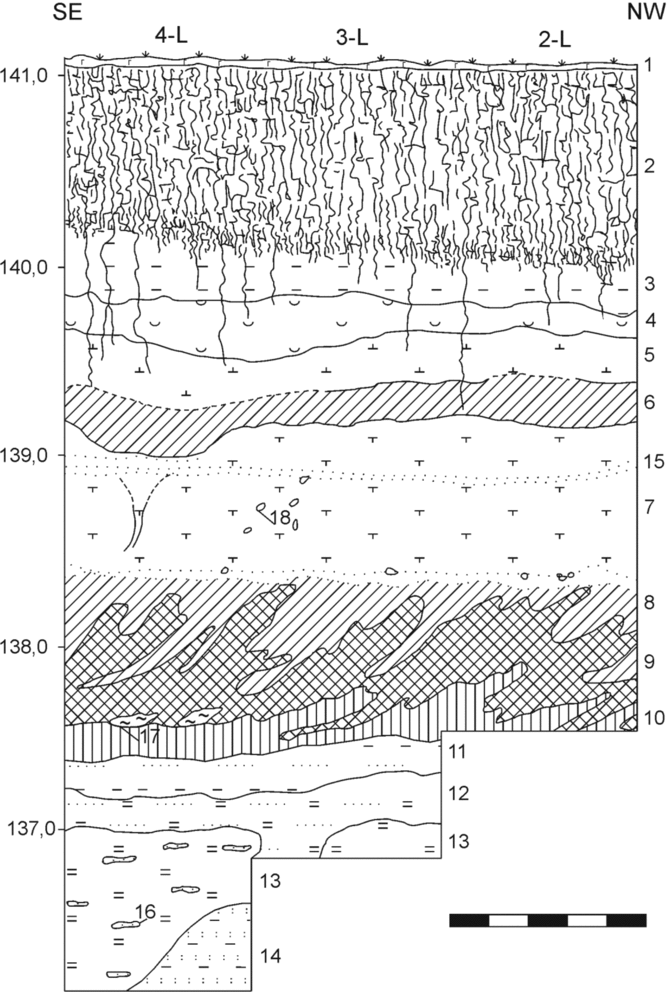
The area of Sungir was investigated within the boundaries of three excavation blocks, which have their own grid system. The thickness of the cultural layer varies from 0.5 to 1 m, with a greater thickness noted in the upper parts of the slope (Bader Reference Bader1998; see Figure 2). In the course studying the statistical data, E.D. Kaverzneva concluded that the “initial” cultural layer was no more than 40 cm thick (Kaverzneva Reference Kaverzneva1985). According to Kaverzneva, the difference between the thickness of the original cultural layer and its current state is associated with the influence of solifluction (Kaverzneva Reference Kaverzneva1985, Reference Kaverzneva2004). On the other hand, in a 1998 publication, the concept of the effect of solifluction on the cultural layer was called into question (Lavrushin and Spiridonova Reference Lavrushin, Spiridonova and Bader1998). Instead, Yu.A. Lavrushin and E.A. Spiridonova developed the idea of widespread gravitational processes in the slope area of the Sungir site and concluded that the deformations described before as resulting from solifluction are associated with the lower parts of landslide blocks, not with solifluction processes (Lavrushin and Spiridonova Reference Lavrushin, Spiridonova and Bader1998: 196). It should be noted that the analysis of the original collection of Sungir by T. Soldatova showed that the objects have no signs of rounding or movement, which speaks for the absence of strong solifluction activities in the zone where bone, antler, and ivory artifacts occur (Soldatova Reference Soldatova, Otte, Sinitsin and Vasiliev2017).
Stratigraphy of the Sungir site (Bader Reference Bader1998): 1) modern soil; 2) columnar brown loam; 3) bottom of columnar loam denser structure; 4) loam scaly structure with a significant amount of carbonate inclusions; 5) light loam, yellowish; 6) upper buried soil; 7) loam with numerous whitish carbonate and point inclusions of manganese; 8) light-gray humus loam, contains rare cultural remains; 9) dark-gray humus loam contains cultural remains; 10) light loam; 11) clay loam, grayish, with inclusions of manganese; 12) clay loam, bright orange color with a lot of manganese; 13) clay loam, bright, with horizontal stripes, light sand and a lot of manganese; 14) bright red loam; 15) ortsand horizon; 16) carbonate; 17) varved clay; 18) sandy clay.
Other problems derive from the excavation method applied by O.N. Bader (Reference Bader1978), who was not only confronted with a problem that is was impossible to fix—the paleosurface of the find-bearing layer—but at the same had to find a way to cope with the thickness of the latter. He decided to subdivide the cultural layer during the field research into arbitrary levels. The levels were counted from a zero-line determined by the level of the first occurrence of finds within the layer. The thickness of the arbitrary levels depended on the frequency of cultural remains and averaged between 15 and 20 cm, but sometimes arbitrary levels of 5–10 cm were excavated separately (Bader Reference Bader1978).
Although O.N. Bader notes that the level of first stratigraphical appearance of material culture and fauna “was on average about 20 cm above the visually definable, well-defined fossil soil horizon” (Bader Reference Bader1978: 25, 61; translation by the author), the level of the soil itself would have varied throughout the entire excavation area. Thus, it is not possible to establish the exact depth of the finds. Consequently, the stratigraphic analysis is only possible by using the arbitrary levels in which certain items were excavated. In addition, the correlation of arbitrary levels between different excavation blocks is hampered by the fact that they start at different zero-lines, the latter resulting from the depth of the first occurence of archaeological remains. Furthermore, it is impossible to fully analyze the the spatial distribution. Although the locations of particular finds in a specific area of each square were documented during the excavations, not all plans of each excavation block are available in the field reports of O.N. Bader stored the Archive of the Institute of Archaeology Russian Academy of Sciences.
In excavation block No. I, arbitrary levels were not always distinguished (Bader Reference Bader1978: 25). Moreover, excavation block No. I was located in an area that was dug up in the course of the development of a brick plant’s quarry “by several longitudinal faces for the entire length of the quarry to a depth of 4 m,” which partially disturbed the cultural layer (Bader Reference Bader1978: 10; translation by the author). In this regard, the arbitrary levels of this excavation block cannot be correlated with the levels of other excavation blocks. Due to the aforementioned reasons, the material from excavations of block No. I was not used in the original consideration of the stratigraphy of Sungir (Bader Reference Bader1978; Kaverzneva Reference Kaverzneva1985, Reference Kaverzneva2004).
Notwithstanding the aforementioned shortcomings, O.N. Bader (Reference Bader1978) combined all finds from each excavation block into a single system of arbitrary levels. Due to the large size of the excavated area, it is—for the moment—not possible to solve this problem, and it is questionable if any long-term project would be able to do so. Therefore, the present article uses the (overall problematic) state of the art, which is the three-dimensional fixation of archaeological remains within the excavation cubatur. It follows that conclusions based on the stratigraphical information at hand must be treaed with caution, especially when it comes to large-scale interpretations.
14C dates on animal bones and charcoal were produced from the cultural layer of Sungir (Sulerzhitsky et al. Reference Sulerzhitsky, Pettitt, Bader, Alekseeva and Bader2000). The direct AMS 14C dates were published by Pettitt and Bader (2000), followed by Kuzmin et al. (Reference Kuzmin, Burr, Jull and Sulerzhitsky2004), and more recently by Marom et al. (Reference Marom, McCullagh, Higham, Sinitsyn and Hedges2012) and Dobrovolskaya et al. (Reference Dobrovolskaya, Richards and Trinkaus2012) (Kuzmin et al. Reference Kuzmin, van Der Plicht and Sulerzhitsky2014: 451). Thirty-four 14C dates on the mammal bones—mammoth, horse, and reindeer—were obtained from the Sungir cultural layer. Twenty 14C dates came from human bones from the Sungir burials, and four 14C dates stemmed from charcoal sampled from the cultural layer and human burials (one sample each) and the soil (two samples). Samples were dated by several laboratories: the Geological Institute of the Russian Academy of Sciences (lab code GIN), the University of Arizona (lab code AA), the University of Groningen (lab code GrA), the University of Oxford (lab codes OxA, OxX), and University of Kiel (lab code KIA).
It is also necessary to note the dearth of the archival data linked to the 14C samples. Of the 60 14C dates available, 20 were obtained on the samples from the human burials. Thirty-three dates come from the cultural layer and were measured in the laboratory of the Geological Institute of the Russian Academy of Sciences, Moscow. Of these, only 16 14C dates are clearly linked to a specific excavation unit (square). For four additional 14C dates, it was possible for the author of the present article to identify their origin after consulting the field reports of O.N. Bader. For five 14C dates, which were measured during an experimental phase when the laboratory was established, no information exists except that the samples came from the Sungir site. In the remaining eight cases, the number of the square is not clearly indicated. Recent investigations of the available data in the logbook of the Geological Institute by the current author allowed for the correction of some information given in the publication by L.D. Sulerzhitsky (Alekseeva and Bader Reference Alekseeva and Bader2000), who partly analyzed the location of the samples dated in the laboratory of the Geological Institute of the Russian Academy of Sciences. For example, in two cases, Sulerzhitsky did not publish the excavated square, although it is recorded in the logbook (GIN-9591 and GIN-9027). In the same publication, date GIN-9030 was reported to come from excavation block No. III. However, according to the field reports, this excavation block was not excavated in the area indicated (164-б). In these cases, it is logical to assume that the information from the logbook is more reliable because it is more detailed and precise than the information given in the publication. Vice versa, for dates taken from horse bones, the information published by L.D. Sulerzhitsky seems to be more reliable. In this case, the publication lists seven different squares for the seven horse bones 14C-dated, whereas only one square was noted for all these samples in the logbook. However, since these results may be a weighted average of specimens of different ages, the author does not consider it appropriate to use them in the spatial analysis of the distribution of 14C dates.
Also noteworthy is the discrepancy between the depths of the majority of the samples and one sample with a date of 27,460 ± 310 BP (OxA-9039). While the counting of the depths of the arbitrary levels usually began with the appearance of the first finds (Bader Reference Bader1978), sample OxA-9039 was obtained during the 1995 excavation, also conducted by N.O. Bader but this time using modern excavation methods. Thus, this sample has a three-dimensional control point, whereas the rest of the samples discussed here, as a whole, are referenced by arbitrary levels without exact depth.
Unfortunately, detailed archive data on the remaining seven dates, which were obtained in laboratories other than the one in Moscow, were not available to the author. Thus, the presented spatial analysis is based on the distribution of 22 14C dates. Information about the relative depth of a particular sample is indicated in 13 cases. In this regard, a number of the following assumptions should be understood to be a hypothesis based on the available archival data.
RESULTS AND DISCUSSION
All the direct 14C values published to date from the Sungir site are summarized in Table 1. The author calibrated the dates of the cultural layer using the IntCal09 data set (Reimer et al. Reference Reimer, Baillie, Bard, Bayliss, Beck, Blackwell, Bronk Ramsey, Buck, Burr, Edwards, Friedrich, Grootes, Guilderson, Hajdas, Heaton, Hogg, Hughen, Kaiser, Kromer, McCormac, Manning, Reimer, Richards, Southon, Talamo, Turney, van der Plicht and Weyhenmeyer2009) and CalPal software (Weninger and Jöris Reference Weninger and Jöris2008).
Results of 14C dating from the Sungir site.
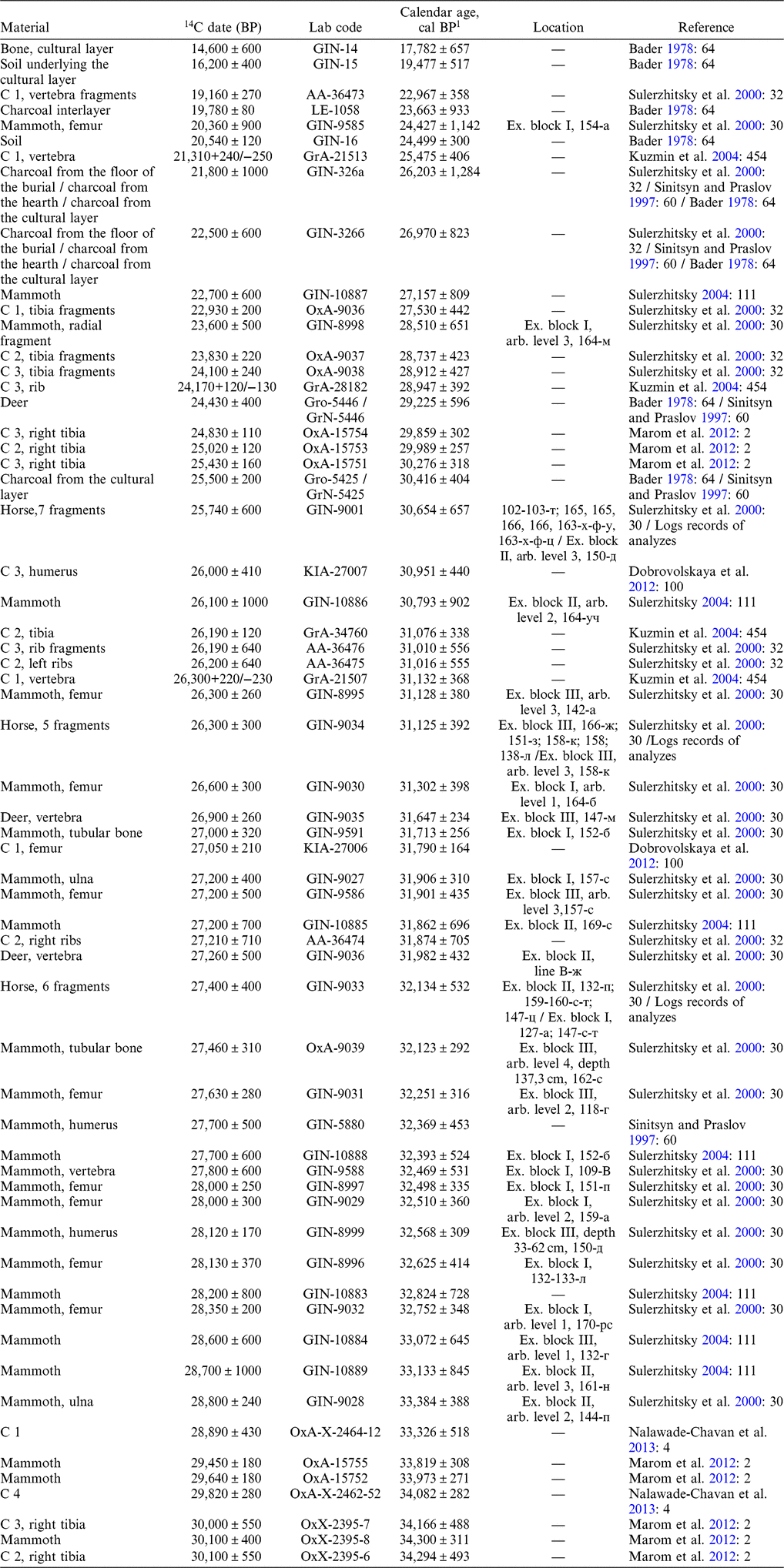
1 Calibrated using the IntCal09 data set (Reimer et al. Reference Reimer, Baillie, Bard, Bayliss, Beck, Blackwell, Bronk Ramsey, Buck, Burr, Edwards, Friedrich, Grootes, Guilderson, Hajdas, Heaton, Hogg, Hughen, Kaiser, Kromer, McCormac, Manning, Reimer, Richards, Southon, Talamo, Turney, van der Plicht and Weyhenmeyer2009) and CalPal software (Weninger and Jöris Reference Weninger and Jöris2008); –2σ, with all possible intervals rounded to the next 10 yr and combined.
All in all, 14C values range between ~14,000 and 30,000 BP. There are 40 14C dates from the cultural layer of the Sungir site run on animal bones, charcoal, and soil, and 20 dates on human bones from the burials.
It must be mentioned that the youngest 14С values up to 20,000 BP were obtained in the laboratory of the Geological Institute of the USSR Academy of Sciences when the 14C dating method was in an early stage of development. This has also been clearly stated by O.N. Bader (Reference Bader1978), who interpreted these dates as too young.
14С samples of tibiae found in the human burials S 1, S 2, and S 3 were measured at the University of Oxford and range from 22,930 ± 200 BP (OxA-9036) to 24,100 ± 240 BP (OxA-9038). These dates contradict 14C dates obtained by the 14C laboratory of the University of Arizona on rib fragments from the same burials, which fall into a range from 19,160 ± 270 BP (AA-36473) to 26,200 ± 640 BP (AA-36475; Alekseeva and Bader Reference Alekseeva and Bader2000). These 14C dates have no correlation with each other; at the same time 14C dates 22,930 ± 200 BP (OxA-9036) and 19,160 ± 270 BP (AA-36473) contradict most of the cultural layer dates (Alekseeva and Bader Reference Alekseeva and Bader2000). It was noted by Kuzmin et al. (Reference Kuzmin, Burr, Jull and Sulerzhitsky2004, Reference Kuzmin, van Der Plicht and Sulerzhitsky2014) that there was a substantial discrepancy in the results and that a reanalysis was needed. AMS 14С measurements of the S 1 individual on a sample from the femur and of the S 3 individual’s on a humerus were conducted in the Leibniz Laboratory at the Christian-Albrecht-University of Kiel, Germany. The dates are 27,050 ± 210 BP (KIA-27006) and 26,000 ± 410 BP (KIA-27007), respectively (Dobrovolskaya et al. Reference Dobrovolskaya, Richards and Trinkaus2012).
Because results obtained for the human burials by the Oxford, Arizona, and Kiel labs were “highly inconsistent, both between the laboratories and between the different individuals dated,” there was an attempt to carry out the analysis using the AMS hydroxyproline dating method (Marom et al. Reference Marom, McCullagh, Higham, Sinitsyn and Hedges2012: 6879). The results obtained from samples from the double burial (S 2, S 3) and a mammoth bone found in the cultural layer were published in 2012: 30,100 ± 550 BP (S 2, OxX-2395-6), 30,000 ± 550 BP (S 3, OxX-2395-7), and 30,100 ± 400 BP (mammoth bone, OxX-2395-8), respectively (Marom et al. Reference Marom, McCullagh, Higham, Sinitsyn and Hedges2012). The AMS dates are in good agreement to each other, and according to the authors of the study, reflect the actual age of the investigated burials (Marom et al. Reference Marom, McCullagh, Higham, Sinitsyn and Hedges2012). In 2013, additional AMS hydroxyproline dates for the burials S 1 and S 4, measured in the Oxford laboratory, were published: 28,890 ± 430 BP (OxA-X-2464-12) and 29,820 ± 280 BP (OxA-X-2462-52), respectively (Nalawade-Chavan et al. Reference Nalawade-Chavan, McCullagh and Hedges2013). Allthough Nalawade-Chavan et al. (Reference Nalawade-Chavan, McCullagh and Hedges2013) emphasize that the specimens have traces of impurity resulting from museum conservation, they still conclude that the results, if compared to the results published in 2012, are reliable (Nalawade-Chavan et al. Reference Nalawade-Chavan, McCullagh and Hedges2013: 5).
Therefore, the rather reliable AMS hydroxyproline dates for S 1, S 2, S 3, S 4 and of the mammoth bone indicate that the samples’ ages are approximately between 28,000 and 30,000 BP (or 31,000 and 34,000 cal BP).
There are three 14C values from horse bones: 25,740 ± 600 BP (GIN-9001), 26,300 ± 300 BP (GIN-9034), and 27,400 ± 400 BP (GIN-9033). It is not clear how far the single specimens of bulk samples were measured here, so the results may be a weighted average of specimens of different ages (Alekseeva and Bader Reference Alekseeva and Bader2000: 30). Moreover, the sample for the date of 25,740 ± 600 BP (GIN-9001) was taken from a mixed layer and is not connected with archaeological complexes (Alekseeva and Bader Reference Alekseeva and Bader2000: 34).
In contrast to the new dates on human bones, but comparable to the horse remains dates, the 27 14С dates on mammoth bones, which range from 20,360 to 30,100 BP, also raise questions with regard to their reliability. It is known that prehistoric hunter-gatherers used bone as fuel to run fireplaces and raw material for tool production as well as the construction of dwellings, obtaining them not only from hunting but also from gathering fossil bones (e.g. Kuzmin et al. Reference Kuzmin, Orlova, Stuart, Zenin and Dementiev2001). Therefore, the dates on mammoth bones found at Sungir may indicate the death of the animal, but do not necessarily correlate with the age of human activities at the site (e.g., Sulerzhitskiy Reference Sulerzhitsky2004).
There are three 14C values run on reindeer bone, which date to 24,430 ± 400 BP (GrN-5446), 26,900 ± 260 BP (GIN-9035), and 27,260 ± 500 BP (GIN-9036). They appear to be directly connected with human activities and therefore more accurate than the other dates on animal bones, as most of the faunal remains at Sungir come from reindeer (Gromov Reference Gromov, Sukachev, Gromov and Bader1966; Alexeeva Reference Alekseeva and Bader1998). V.I. Gromov underlines that “The debris [of reindeer; comment by the author] contains skull fragments and all bones of the postcranial skeleton.” He also states that “Many bones have traces of manmade splitting for brain extraction” (Gromov Reference Gromov, Sukachev, Gromov and Bader1966: 78; translation by the author). In addition, reindeer antler was used extensively for tool production. In sum, 28 items or 16% of all hard organic raw material tools found in the cultural layer were made of antler (Soldatova Reference Soldatova2014). Therefore, in the author’s opinion, 14С ages of the reindeer bones are fairly reliable. The calendar age range for those bones falls between ~29,000 and 31,000 cal BP.
Four 14С dates were obtained from charcoal samples: 19,780 ± 80 BP (LE-1058), 21,800 ± 1000 BP (GIN-326а), 22,500 ± 600 BP (GIN-326b), and 25,500 ± 200 BP (GrN-5425). The first, 19,780 ± 80 BP, was measured in a laboratory at the Leningrad department of the Institute of Archaeology of the USSR Academy of Sciences, and, in O.N. Bader’s opinion, did not prove to be accurate (Bader Reference Bader1978: 65). The charcoal material for the other two results is equally unclear because the exact provinience is uncertain. Due to the information available, the samples were either taken from the cultural layer, a hearth, or the floor of the burial (Bader Reference Bader1978: 64; Sinitsyn and Praslov Reference Sinitsyn and Praslov1997: 60; Sulerzhitskiy et al. Reference Sulerzhitsky, Pettitt, Bader, Alekseeva and Bader2000: 32). With regard to dates on charcoal, it appears that only the date of 25,500 ± 200 BP (GrN-5425) 14С is reliable.
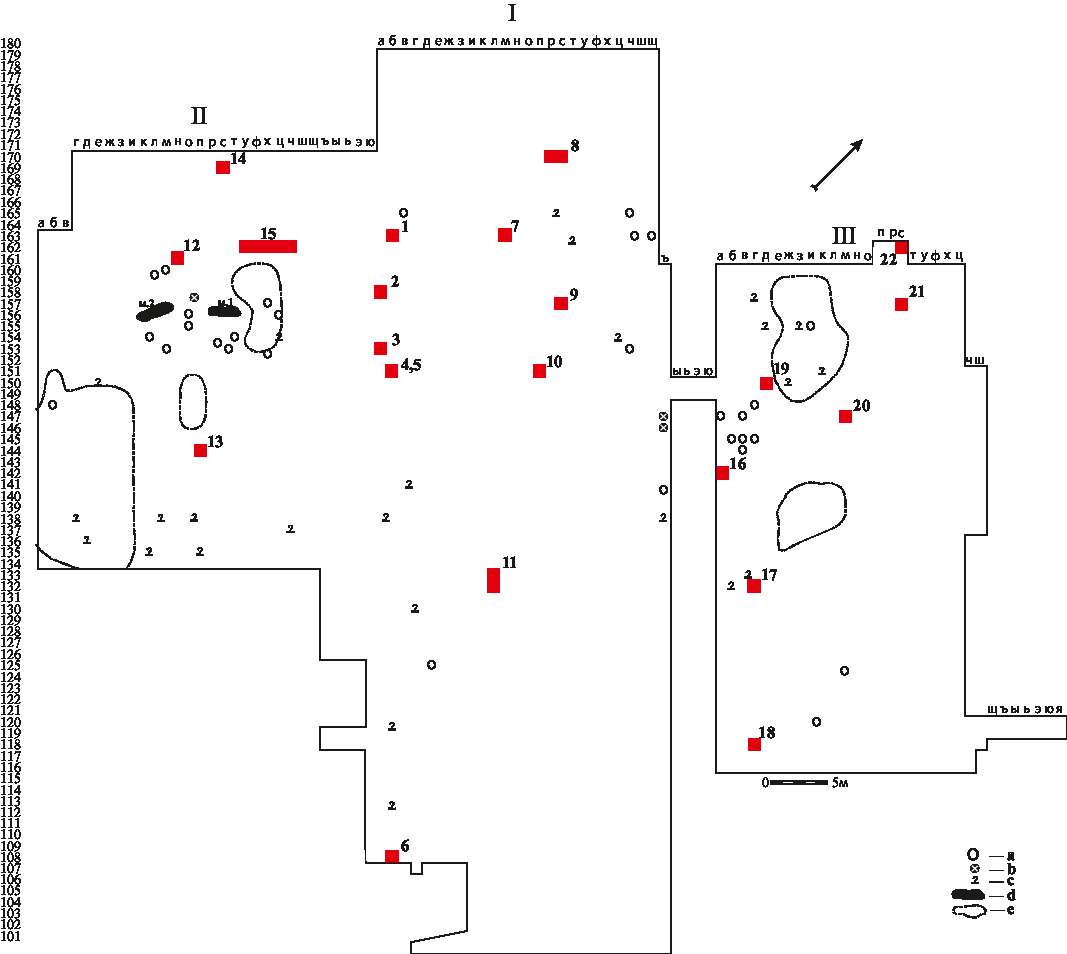
In the course of the current study, the author analyzed the spatial distribution of 14C-dated samples from animal bones. The spatial distribution of the dated samples is shown in Figure 3. All in all, spatial information was available for 22 samples: 21 samples on mammoth bones and one sample on a deer bone. Apart from the fact that the presence of mammoth remains at the site might go back to the gathering of fossil bones, one can say that the results so far for 14C dating at Sungir essentially do not correlate with evident structures, e.g. fireplaces, fire and ritual pits, large accumulations of bones, etc.
Excavation block No. I is the best dated. In sum, 11 14С dates were obtained from samples from the cultural layer. At the same time, this area is relatively poor in finds (Bader Reference Bader1978; Soldatova Reference Soldatova2012). The main array of dates covers the period from 26,600 ± 300 to 28,350 ± 200 BP. Two dates show a younger age of 20,360 ± 900 and 23,600 ± 500 BP. In contrast to excavation block No. I, excavation block No. II has only four 14С dates (without considering the results of dating burials), which fall in a range between 25,740 ± 600 and 28,800 ± 240 BP. Finally, excavation block No. III has seven 14С dates, which cover a period from 26,300 ± 260 to 28,600 ± 600 BP.
Spatial distribution of the samples of 14C dating. a) firepit; b) ritual pit; c) fireplaces; d) grave; e) large accumulations of bones. Excavation block No. I: 1) 26,600 ± 300 BP (GIN-9030); 2) 28,000 ± 300 BP (GIN-9029); 3) 20,360 ± 900 BP (GIN-9585); 4) 27,000 ± 320 BP (GIN-9591); 5) 27,700 ± 600 BP (GIN-10888); 6) 27,800 ± 600 BP (GIN-9588); 7) 23,600 ± 500 BP (GIN-8998); 8) 28,350 ± 200 BP (GIN-9032); 9) 27,200 ± 400 BP (GIN-9027); 10) 28,000 ± 250 BP (GIN-8997); 11) 28,130 ± 370 BP (GIN-8996); excavation block No. II: 12) 28,700 ± 1,000 BP (GIN-10889); 13) 28,800 ± 240 BP (GIN-9028); 14) 27,200 ± 700 BP (GIN-10885); 15) 26,100 ± 1,000 BP (GIN-10886); excavation block No. III: 16) 26,300 ± 260 BP (GIN-8995); 17) 28,600 ± 600 BP (GIN-10884); 18) 27,630 ± 280 BP (GIN-9031); 19) 28,120 ± 170 BP (GIN-8999); 20) 26,900 ± 260 BP (GIN-9035); 21) 27,200 ± 500 BP (GIN-9586); 22) 27,460 ± 310 BP (OxA-9039).
As far as the vertical distribution of the 14C-dated samples is concerned, the available data suggests that most of the samples came from arbitrary levels 1 to 3, which correspond to a depth of about 20 to 60 cm “from the beginning of the finds” (Bader Reference Bader1978). It should be noted that arbitrary levels below this level were also rich in archaeological finds (Bader Reference Bader1978; Soldatova Reference Soldatova2012). Therefore, it must be assumed that the results of the 14C dating in general only poorly correlate with the frequencies of archaeological finds in the artificial arbitrary levels of the cultural layer.
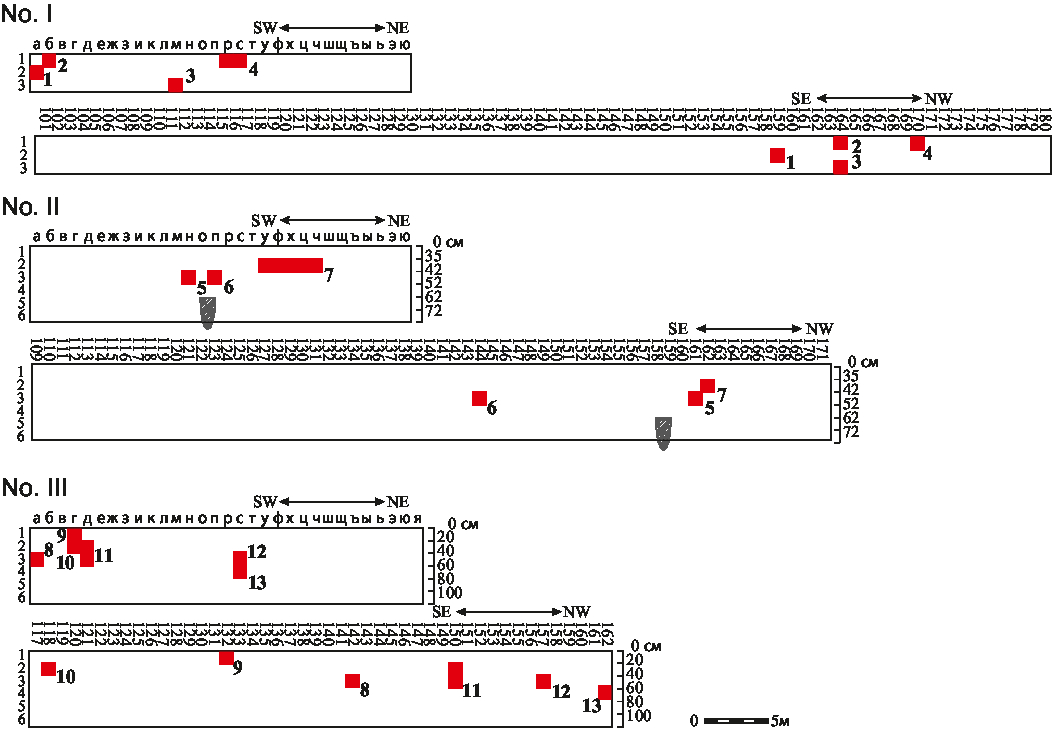
In addition, there are cases in which the dates are in contradiction with the stratigraphical sequence For example, for excavation block No. I, three dates yield information about their stratigraphical context: one sample from arbitrary level 1 is dated to 26,600 ± 300 BP, another sample from arbitrary level 2 below dates to 28,000 ± 300 BP, and a third sample from the lowermost arbitrary level 3 with a date of 23,600 ± 500 BP is the youngest. Excavation block No. III shows a similar picture (Figure 4). The dates from excavation block No. II seem to be in stratigraphical order: arbitrary level 2 dates to 26,100 ± 1000 BP and arbitrary level 3 delivered 14C ages of 28,700 ± 1000 and 28,800 ± 240 BP. Whereas the low number of samples calls for caution, the inverse order in excavation block No. I indicates the activity of solifluction and/or slope processes, which lead to a mixing of the cultural layer.
Stratigraphic distribution of the samples of 14C dating. Excavation block No. I: 1) 28,000 ± 300 BP (GIN-9029); 2) 26,600 ± 300 BP (GIN-9030); 3) 23,600 ± 500 BP (GIN-8998); 4) 28,350 ± 200 BP (GIN-9032); excavation block No. II: 5) 28,700 ± 1,000 BP (GIN-10889); 6) 28,800 ± 240 BP (GIN-9028); 7) 26,100 ± 1,000 BP (GIN-10886); excavation block No. III: 8) 26,300 ± 260 BP (GIN-8995); 9) 28,600 ± 600 BP (GIN-10884); 10) 27,630 ± 280 BP (GIN-9031); 11) 28,120 ± 170 BP (GIN-8999); 12) 27,200 ± 500 BP (GIN-9586); 13) 27,460 ± 310 BP (OxA-9039).
Once again, I would like to point out the insufficiency of archival materials and the presumptive nature of the statements made above.
CONCLUSIONS
Consequently, despite the significant number of 60 14C dates, there are still many open questions concerning the age of the Sungir site.
The available 14С dates do not allow for an exact determination of the period of existence of the Sungir site, nor do they enable us to clearly distinguish different occupations. On the other hand, it must be emphasized that a comprehensive analysis of the archaeological items made from hard, organic raw materials, including a technical-typological and spatial analysis of bone, antler, and ivory objects, did not give any argument for the existence of different cultural layers and/or a long chronology of site use. The presented spatial and stratigraphic data is certainly incomplete due to the lack of archive data. However, the results presented here still allow one to draw some general conclusions: (1) the stratigraphic analysis of the distribution of dates argues for a mixed character of the cultural layer of the Sungir, and (2) the results of the horizontal distribution of the dates showed the absence of dates associated with the evident features (fire places, pits, etc.) of the cultural layer.
To solve the problems described above, it is necessary to conduct new 14C datings from the cultural layer of Sungir. In the recent past, the most attention was paid to dating samples from the burials, which are connected both with their world value and the contradictory results of older datings. However, for a better understanding of the cultural layer of the site, a series of 14C dates should be obtained directly from the cultural layer. From the author’s point of view, samples from all arbitrary levels of a selected representative yet undisturbed area of Sungir should be used. In addition, it would be important to collect more detailed information about the excavations in which burials were discovered in order to better correlate the burials with the cultural layer.
In general, material for new 14C dates would be available: faunal remains are stored in the Vernadsky State Geological Museum, at the Paleontological Institute of the Russian Academy of Sciences (collection from 1986) and in the Vladimir-Suzdal Museum-Reserve (excavations from the 2000s). In addition, reference samples are hosted in the Geological Institute of the Russian Academy of Sciences in Moscow and in the Zoological Institute of the Russian Academy of Sciences in St. Petersburg. Finally, there is a collection of bone, antler, and ivory products from Sungir at the Vladimir-Suzdal Museum-Reserve. Among these are items with a clear reference to arbitrary levels and square meters of the excavations that would allow for sampling stratigraphical sequences in areas with evident features and high frequencies of finds. Perhaps, in light of a new series of dates, it will be possible to distinguish the presence of several cultural layers, the impact of solifluction processes, and the chronological position of the Sungir site.
ACKNOWLEDGMENTS
I am grateful to Roman Nechushkin (Geological Institute, Russian Academy of Sciences, Moscow) for assistance with the provision of data from the logged records of analyses. I also want to thank Prof. Dr. Thorsten Uthmeier (Institut für Ur- und Frühgeschichte, Friedrich-Alexander-Universität Erlangen-Nürnberg) for accepting and taking time to supervise the work and showing his interest by providing valuable comments, language editing, and proofreading. I acknowledge the two anonymous reviewers for their comments.


 Open access

