

Introduction
Something curious happened to the south of the Dutch Rhine around 10 ce. After a 50-year period in which all habitation in the area ceased following Julius Caesar's violent subjugation of northern Gaul, grave-making returned as a social practice (Roymans Reference Roymans, Janković, Mihajlović and Babić2014). Farming communities started to memorialize their deceased through the deposition of cremations under small barrows, imitating those burial features they saw in the landscape around them. The type of interment they copied—small barrowed graves—was Early Iron Age in date, however (Fontijn Reference Fontijn1996). These communities were therefore mimicking a form of funerary landscape that had fallen out of use half a millennium earlier. Yet more striking still is that the grave-goods used in these now Roman-period barrows subsequently changed every few decades (Pitts Reference Pitts2019). In effect, the construction of a series of small funerary structures that had deep connections in the local area masked a new, generational dynamism in commemorative practice at the graveside that lasted for nearly 250 years during the Roman Empire (c. 10–260 ce). These changes are provoking as they show a higher rate of alteration than elsewhere in the Roman West (for example, compare the assemblages at Skeleton Green: Partridge Reference Partridge1981).
This article will analyse these generational shifts by drawing on theory relating to both collective memory and forgetting in imperial spaces. The reading shows how important processes of both forgetting and the remaking of the past were to the formation of group practices for a community that had been devastated by invasion, slaughter, rebellion and occupation. The group under investigation appears, then, to have experienced recurrent periods of amnesia, in a similar manner to many others living under imperial rule (Fanon [Reference Fanon and Philcox1961] 1991).
In this study of memory loss, two points in particular are noted. The first is that subdued groups in imperial spaces such as those in (what is now) the Netherlands appear to have encouraged themselves to forget the immediate past when commemorating their dead as a response to living in an imperial system. The second is that there has been relatively little discussion in archaeology about how societies forget in the short term, and why they do so, consciously or otherwise. This relative lack of attention contrasts with the discipline's prominent problematizing of remembrance, commemoration and other acknowledgements of the past, in cultures as separated in space and time as Neolithic Britain and Pre-Columbian Mexico (Borić Reference Borić and Borić2010; Bradley Reference Bradley2002; Hill & Hageman Reference Hill and Hageman2016; Joyce Reference Joyce2001; van Dyke Reference van Dyke, Bernbeck and McGuire2011; van Dyke & Alcock Reference van Dyke, Alcock, van Dyke and Alcock2003; Williams Reference Williams2004). The evidence from the highlighted case study here is that shorter-term forgetting or misremembering, too, can be seen as a way of processing the difficult experience of living under empire.
The Roman-period Netherlands
Away from the military and regional centre of Nijmegen (Ulpia Noviomagus, hereafter, Noviomagus), the land stretching down from the Rhine in the Dutch Roman period (c. 12 bce–410 ce) was occupied by small agricultural communities. Farming settlements were made up of byre-houses (Wohnstall-Häuser) with attendant enclosures (Roymans Reference Roymans, Janković, Mihajlović and Babić2014, 241–2; Willems Reference Willems1984). Life in this landscape seems to have revolved around the core demands of cabin and cattle (Roymans Reference Roymans1990, 51). Pastoralism supported farmers who were limited in their scope by the yield that could be obtained from the soils of the region (Küster Reference Küster, Haselgrove, Rebay-Salisbury and Wells2018).
It was a mode of living that was complicated by the requirements of the Roman imperial state which focused locally on manpower. The political grouping of these parts, the Batavi—a formation that arose from the destruction wreaked by Caesar's violent campaigns across and beyond Gaul (58–50 bce)—was bound by treaty to fill out the ranks of Rome's auxiliary troops (Tacitus, Germania 29). Quite simply, it paid its tax in flesh (Roymans Reference Roymans, Janković, Mihajlović and Babić2014, 234–5). The consequences of having a minimum of 5000–5500 of its male population under arms at any one time—possibly up to a sixth of the overall group—would have been extensive and profound (Derks & Roymans Reference Derks and Roymans2006, 123; Willems Reference Willems1984, 237). In fact, finds of seal-boxes and militaria across the present-day province of Gelderland demonstrate the probable higher-than-average literacy of this group and their integration into forms of empire-wide communication, plus, perhaps, the increasingly pronounced role of military equipment in everyday society (Nicolay Reference Nicolay2007). These military overtones extended into most realms of this community's life; the Batavi's tutelary deity was a syncretic form of the chaotically violent demigod Hercules, Hercules Magusanus, possibly Hercules the Powerful (Roymans Reference Roymans and Cession-Louppe2009, 227; Toorians Reference Toorians2003).
In this context, burials and their placement under barrows may have served an important purpose for the Batavi. In the words of Nico Roymans (Reference Roymans, Janković, Mihajlović and Babić2014, 242), they cultivated an ‘ancestral, native tradition’ by constructing them. They hereby established a visual ‘continuity’ with the past: a move that looks especially significant if we hypothesize that the Batavi migrated across the Rhine at a point post-50 bce to take over land emptied by Caesar's campaigns, to staff and stabilize this Roman-period frontier space (as suggested in Roymans Reference Roymans2004). In this scenario, the group may have wished to legitimize its relatively recent presence in the space through the utilization of landscape forms that had historical relevance. But the graves’ assemblages did not remain static through time, even when the architecture of the barrow outwardly stayed the same. The changing composition of burial assemblages from cemeteries such as Nijmegen-Hatert points to repeated social changes and adjustments.
This article takes Nijmegen-Hatert as its key case study because the evidence is not only especially clear here, but also demonstrates at several levels how communities erased or brushed away the recent past in favour of looking back to previous eras, or in some cases set the past aside altogether. For example, the site demonstrates generational alterations in depositional practice, ones that occurred every three decades or so. These included the replacement of larger drinking vessels made for group commensality with small beakers that promoted individualized consumption. In addition, over time, there was an increasing utilization of a whole suite of pots that suited feasting activities in the graveyard itself. The growing utilization after 150 years of rule of terra sigillata—the red, glossy pottery of the Roman Empire—illustrates how classes of object became much more acceptable despite initial resistance, or non-use, by preceding generations. What these initial examples signal is that the funerary process, and the burial ground, were taking on distinct roles at different times through the Roman period.
Nijmegen-Hatert was excavated in 1979–80 during the building of an industrial estate (Haalebos Reference Haalebos1990, 9). Its burial population was in the low 200s. As with other cemeteries of the same date, it consisted of enclosed, ditched and hummocked cremation graves in addition to other flat graves that lay in their vicinity. From the Middle Iron Age, Dutch graveyards formed on the edge of farms (although not in barrows), and Roman-period Nijmegen-Hatert follows this pattern (Fontijn Reference Fontijn1996; Haalebos Reference Haalebos1990, 12, fig. 2). These graves lay a few tens of metres from the entrances of their associated Wohnstall-Häuser. But while the graveyard was proximate to Noviomagus, the nearby fortress-city, as the name suggests, this did not seem to overly affect the traditions practised. The differences between Noviomagus's cemeteries and that of Nijmegen-Hatert were of such a degree that they prompted Willem Willems and Harry van Enckevort to label the latter ‘antique’ (Willems & van Enckevort Reference Willems and van Enckevort2009, 142–3).
This disconnection encourages us to follow the lead of cognate disciplines like history and psychology to examine again the importance of structural violence on societal practice in Rome's western provinces. The fact is that the Roman Empire arose ‘through the ruthless application of force’, and throughout its history it continued to manifest ‘conventions’ of ‘dominant harm’ (Linklater Reference Linklater2017, 61, 100). This formulation underpins the close review of Nijmegen-Hatert's burial assemblages that follows. As this will show, a better understanding of violence and forgetting in imperial systems can help to throw light on the longer-term repercussions of disremembering, and persuades us to grant the concept greater explanatory potential within archaeology.
Forgetting under empire
To conceptualize and better understand what appear to be processes of forgetting or blurring the near past at Nijmegen-Hatert, the article now explores analogic links with studies of colonial incursion and indigenous response under modern empires. These give several clear instances of how forgetting—whether involuntary or not—played a central role for people living within these contexts. The instances provide a framework for interpreting the evidence from the ancient world. Although such equations of modern and past experience are fraught with difficulty, research on the former can nonetheless deepen our awareness of the parallel effects of invasion and occupation and shed light on the complexity of ancient social expression.
The analysis of community memory in the ancient world emerged around the turn of the new millennium and called explicitly for the proper consideration of memory and forgetting, in tandem (Alcock Reference Alcock, Alcock, D'Altroy, Morrison and Sinopoli2001, 349–50). Susan Alcock illustrated, with the help of examples from the Athenian agora in the Roman period, how the reuse of older material allowed for memory manipulation and new forms of political messaging (Alcock Reference Alcock, Alcock, D'Altroy, Morrison and Sinopoli2001; Reference Alcock2002). To Simon Price, similarly, the Greeks developed a practice of ‘overlay’ by which fresh meanings replaced older ones (Price Reference Price, Dignas and Smith2012, 28–9). Hella Eckardt also established that the incorporation of material culture from the distant past (for example, Neolithic flint axes) peaked in the fourth century ce as groups in the Roman-period West faced up to wider change (Eckardt Reference Eckardt, Croxford, Eckardt, Meade and Weekes2004). Such research focused on interrupted commemoration has dwelt on the often physical damnatio memoriae occasionally used against the ‘condemned’ in society (Hope Reference Hope, Hope and Huskinson2011, xiv)—an effacement of inscriptions and sculpture that was all about strengthening recently acquired power. This evidence for the iconoclastic erasure of the past has parallels across history, as archaeologists of other cultures have helpfully revealed (Pool & Loughlin Reference Pool and Loughlin2017).
However, despite this range of research, it remains the case that the scholarship has tended to overlook a more invasive—though admittedly less obvious—amnesia. This is especially crucial in the light of Greg Woolf's work, which showed that ‘barbarian history was an oxymoron’ in the Roman West. Therefore, as he shows, social elites in Gaul therefore ‘seem to have done little to preserve a sense of their pre-conquest past’ (Woolf Reference Woolf, Gehrke and Möller1996, 371; Reference Woolf2002, 7).
In memory studies, the processes of remembering and forgetting are generally seen as interconnected (‘memory and oblivion are two sides of the same coin’: Capra Reference Capra, Castagnoli and Ceccarelli2019, 193). As Maurice Halbwachs writes (Reference Halbwachs, Ditter and Ditter1980, 69), this interconnection is a function of how we understand the immediate future as representing both a return and renewal: ‘[a] remembrance is in very large measure a reconstruction of the past with data borrowed from the present’. David Lowenthal puts it in related terms: ‘[t]he remembered past is malleable and flexible, what seems to have happened undergoes continual change. Each time a memory is recalled, it is reprocessed’ (Reference Lowenthal2015, 320; Nora Reference Nora1989). Forgetting, therefore, can be as significant for the creation of social group identity as active remembering, especially perhaps in situations of historical violence and exclusion (see Alcock Reference Alcock2002; van Dyke & Alcock Reference van Dyke, Alcock, van Dyke and Alcock2003, 3; Williams Reference Williams2004, 419; Mullin Reference Mullin2001 is an exception).
Both under empire and in other conflict zones, memory loss tends to be recognized as a product of ‘historical trauma’. Michelle Sotero (Reference Sotero2006, 96) lists it among those ‘psychological problems’ induced by legacies of conflict and oppression. Such effects of severe ‘emotional and psychological wounding’ also tend to transcend the single lifespan (Brave Heart Reference Brave Heart2003, 7). Imperial hierarchy, Caroline Elkins reminds us, is ‘maintained’ by violence or its constant threat—a chronic viciousness that she has exposed in respect of the British Empire (Reference Elkins, Dwyer and Micale2020; Dwyer & Nettlebeck Reference Dwyer, Nettlebeck, Dwyer and Nettlebeck2017, 1). For example, ‘British troops, along with the local police force’ acted ‘virtually without restraint’ in the Mandate for Palestine during the middle part of the twentieth century (Elkins Reference Elkins, Dwyer and Micale2020, 87). The behaviour was conditioned and enabled by the military manuals of the period. Such violence could produce ‘new and unique forms of social existence’ in which the subjugated, regardless of generation, took on ‘the status of living dead’ (emphasis retained: Mbembé Reference Mbembé and Meintjes2003, 40) (Connerton Reference Connerton2009, 88).
Anthropology has usefully pointed to how social amnesias are tied up in the production of new identities, an argument developed most famously in Benedict Anderson's formalization of the modern nation state as an ‘imagined community’. Anderson's ‘conception of personhood, [and] identity’, such as first arose in formerly colonized landmasses like South America, was pertinently predicated on ‘characteristic amnesias’ (emphasis retained; Anderson [1983] Reference Anderson1991, 204). Relatedly, Eric Hobsbawm and Terence Ranger proposed that ‘invented traditions’ helped in the ‘legitimation and maintenance of political regimes’ both in the (early) modern world, and in postcolonial Africa (Ranger Reference Ranger, Hobsbawm and Ranger1983, 252–4; van Dyke Reference van Dyke2019, 210). For Ranger, the creation of a kingship by the Tumbuka people in the 1930s (in modern-day Malawi, then within the British Empire's Nyasaland) provided a particularly strong instance of such remaking of identity using borrowed forms, and hence the erasure of others. The Tumbuka had never previously possessed a royal institution, but their political hierarchy sought to alter practice so as to re-legitimize itself in an imperial space that was becoming much more closely administered. In doing so, they absorbed some of the cultural symbols—specifically, a Christian-style monarchy—of their colonial overlords (Ranger Reference Ranger, Hobsbawm and Ranger1983, 240–43).
Placing these recent examples alongside the classical shows that empires across time have provided a space for cultural change and innovation as subjugated groups attempt to assert themselves and develop new identities, creating invented identities and fictitious archaisms which are, crucially, articulated by indigenous groups themselves. This tallies with Paul Connerton's analysis of forgetting as useful, giving as it does ‘living space for present projects’ (Connerton Reference Connerton2008, 63). There is alignment up to a point with Frantz Fanon's contention that colonialism corrodes remembrances of the past because it ‘distorts … disfigures … and destroys’ memory (Fanon [1961] Reference Fanon and Philcox1991, 16).
A complementary strand of research has also explored the more involuntary psychological effects that imperial regimes have, as in the following case studies from twentieth-century sub-Saharan Africa. For instance, Gonzáles-Ruibal demonstrates that the ‘production of oblivion’ in Equatorial Guinea began under Spanish imperial rule with local markets being flooded with objects that were European in origin. But it was sustained into the present day due to the continuation and replication of colonial, capitalist mindsets, specifically towards ‘development’, which led to the Benga of Corisco appearing to be uninterested in expressing ‘cultural heritage’ (González-Ruibal Reference González-Ruibal, Starzmann and Roby2016). In a similar vein, Megan Vaughan has posited that ‘subjectivities’ in Britain's territories in (then) Central East Africa were ‘fragmented, incoherent and constantly in a state of creation and recreation’ (Vaughan Reference Vaughan1991, 16). In Fabian's telling individual case study from the Belgian Congo, Babi Ngoie, a former employee of the Banque du Congo Belge, chose later in life not to acknowledge his participation in social ballroom dancing during his youth in the 1920s. According to Ngoie's interlocutor, this disremembering was a deliberate act and allowed Ngoie's middle-class and post-independence social life to be distinguished from that co-experienced by the Belgian Congo's lower classes (Fabian Reference Fabian2003, 500).
Of course, the forms of violence that Rome could bring to bear cannot be directly compared to those produced under capital-fuelled colonialism. However, it remains possible to argue that the increasing rate of connectivity and the standardization of some classes of material culture and expression in the Roman Empire did reduce the possibility for communities to continue to use material identifiers specific to the maintenance of their identity beyond a certain timespan (Pitts Reference Pitts2019; Stearns [2001] Reference Stearns2006, vii). Among the Gallic nobility, too, the expression of an elite identity involved the erasure of indigenous features and an awkwardness concerning the transmission of traditional, pre-Roman forms of knowledge in the Roman West (Woolf Reference Woolf, Gehrke and Möller1996). At the same time, Roman thought was characterized by ‘the more normal condition’ of ‘oblivion’, as Harriet Flower argues: memorialization was not the ‘natural state’ in Roman culture. In fact, it took special ‘effort and achievement’ to stimulate its ‘production’—effort and achievement that were usually available only to a narrow elite (Flower Reference Flower2006, 1–3). The outcome for a subaltern society in this system was that it may not have had the materials for sustained forms of commemoration across generations.
The Roman Empire and its local communities in the Netherlands
Against the background of these different historical contexts, we now turn to consider how forgetting, or forms of disremembering, also manifest at the level of the local Nijmegen-Hatert community in the Roman period, and, furthermore, how this appears to have been integral, paradoxically, to some form of group continuity. For, as we also saw with Vaughan (above), the accelerated circulation of culture in imperial worlds may reduce the possibility for communities to continue to use material identifiers specific to the conservation of their identity beyond a period of time. The distinctive identity of a community appears unlikely to concentrate around a set of objects when their supply is in a state of constant flux. As we find in the archaeological record relating to the western half of the Roman Empire, other forms of practice come into play.
Here we recall that Rome was fundamentally a form of tributary empire. Composed of a patchwork of colonial and imperial elements, it was more interested in wealth extraction than socio-cultural re-engineering. The Empire directly managed some territory, while the control of other areas was left to local nobilities. Its administrative staff being comparatively small, Rome's imperialism has been said to be ‘laissez faire’; its rule was not directive (Millett Reference Millett1990, 99). Although this might produce the suggestion that the longer-term effects of violence, including memory loss, would have been qualified and even lessened—at least when compared to nineteenth- and twentieth-century empires—it is important further to acknowledge the shock that conquest created, and the structural violence this would have continued to generate, specifically in this instance at Nijmegen-Hatert.
Research since the 1990s has convincingly established that Caesar's military operations in northern Gaul were particularly punitive and led to the collapse and disappearance of the grouping he originally encountered in this area, the Eburones (Roymans Reference Roymans2019). The massacre of the indigenous population may have caused the half-century gap that appears to exist in the Netherlands’ archaeological record, a period for which no settlement has been recorded. Whether the Batavi incorporated or grew out of parts of a destroyed group, or were transplanted from elsewhere, there is every reason to suspect that this landscape experienced an extreme form of subjugation (Roymans Reference Roymans2004). Some of its Roman-period population then continued to be involved with the army at the sharp end of further imperial control and domination elsewhere in the Empire (Roymans Reference Roymans, Janković, Mihajlović and Babić2014). In 68–69 ce, the Batavi rebelled, their revolt lasting a year before the forces could be mustered to crush it. This additional episode of suppression undoubtedly impacted local communities, as did the fact that the grouping was situated so close to the frontier. They lived next to a militarized border where the infrastructure of empire, its forts and roads, could not have been ignored.
In this context, value systems would consistently have been under strain, and forgetting was likely to have been a useful social process, a way of accommodating the constant shocks to which communities were subject. It is significant in this regard that the nobilities belonging to the Batavi created a new form of grave at Noviomagus incorporating weaponry and metal lamps, deposits that emphasized their position as part of the officer class in Rome's military (e.g., Burial 8: Koster Reference Koster2013, 57). These large assemblages were important to status formation and were quite unlike anything that had existed in the preceding century (Pitts Reference Pitts2019). The tradition appears to have been invented so that at least a part of the population could adapt their position to suit or fit in with the surrounding imperial world. The dates for the burial assemblages, however, suggest that even these material identifiers only had a certain lifespan. As none of the burials date to much later than the 120s ce, elite interest in utilizing such artefacts, and the burial grounds of Noviomagus, seems to have waned (Koster Reference Koster2013).
There are both archaeological and historical reasons, therefore, for believing that pastoral, subaltern communities living in the region to the south of the Dutch Rhine would have been particularly reliant on processes of forgetting in order to adapt after a traumatic conquest, exacerbated by further repression following their rebellion. Additionally, the Batavi group formed a key cog within the Empire's military machinery. As the graves of their nobility emphasize, their social expression was limited to their immediate temporal and geographic contexts, and could be disposed of if needed, as closer consideration of the Nijmegen-Hatert graveyard will show.
The burials of Nijmegen-Hatert (c. 10–260 ce)
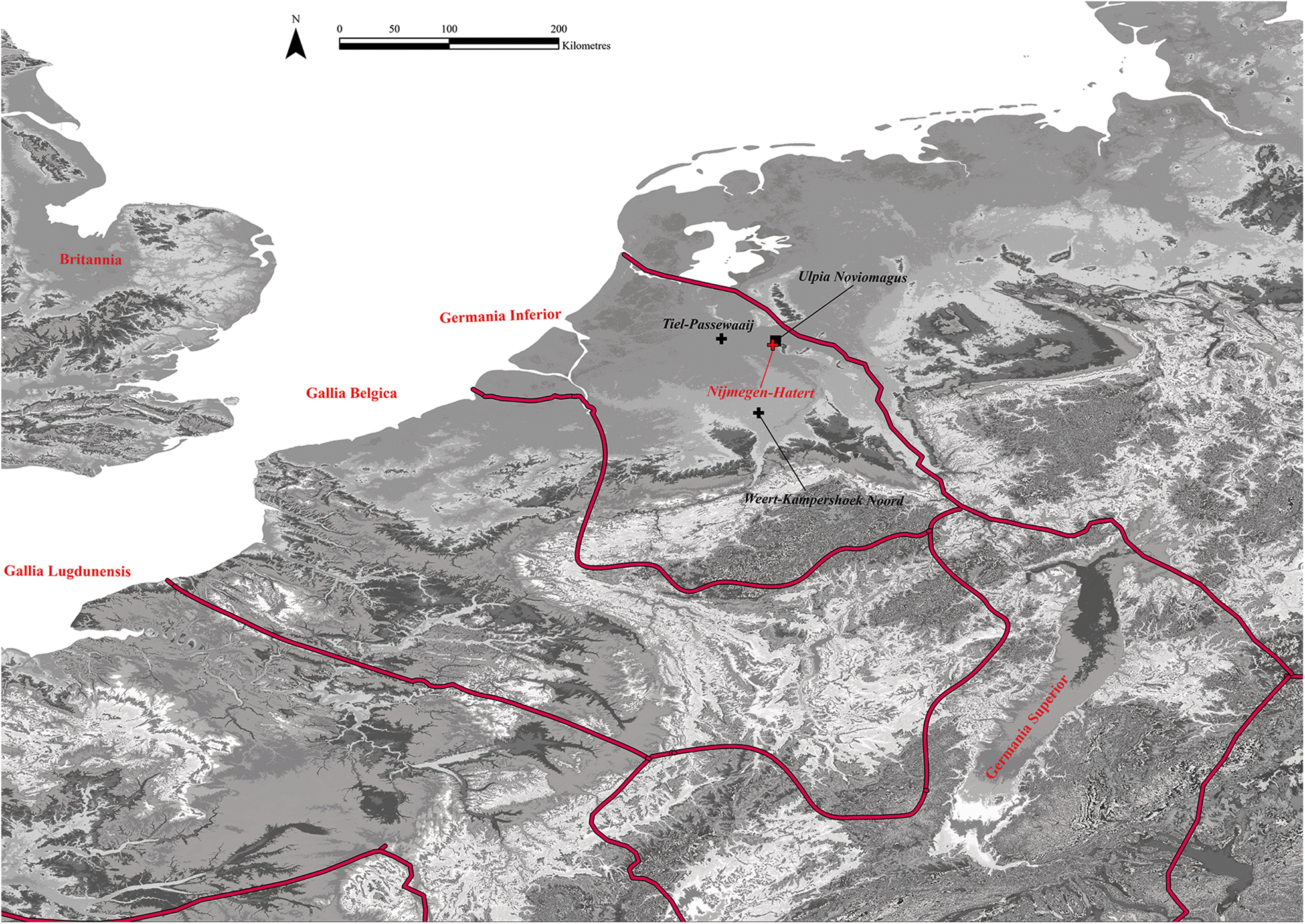
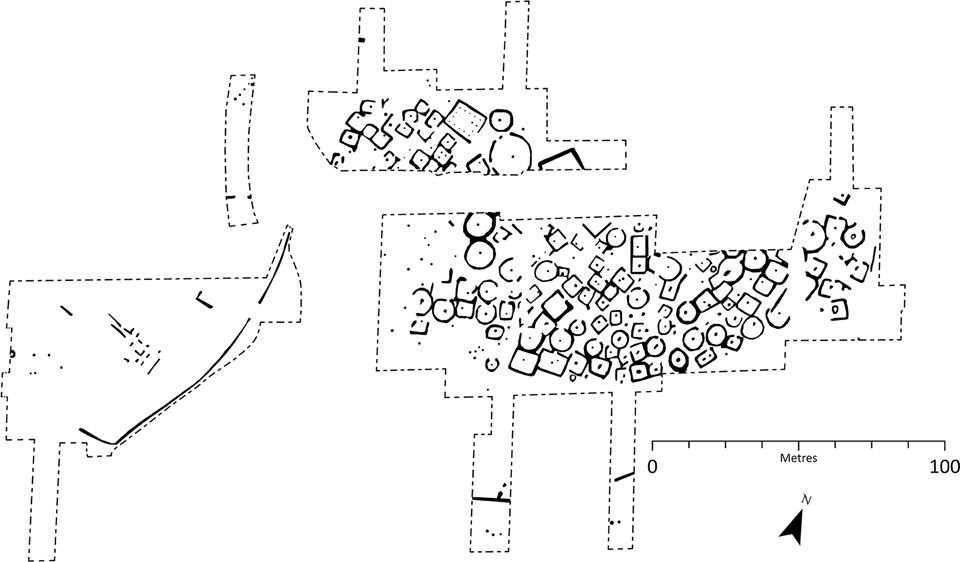
Nijmegen-Hatert is not exceptional in its regional context. Its general structure parallels other rural cemeteries from the Roman-period Netherlands, including Tiel-Passewaaij and Weert-Kampershoek Noord 1 (Fig. 1; Aarts & Heeren Reference Aarts and Heeren2011; Heeren Reference Heeren2014, 446; Hiddink & de Boer Reference Hiddink and de Boer2014). It was, though, one of the first burial sites of its date to be almost totally excavated in the Netherlands and was subsequently analysed using computer-based seriation to determine the dates and phasing of individual graves (Fig. 2; Haalebos Reference Haalebos1990, 25–6). The long exposure of Nijmegen-Hatert to research also means that it has taken centre stage in discussions of how identity altered in this frontier space. Martin Pitts (Reference Pitts2019, 172–3) sees the growing use of colour-coated beakers in burial assemblages there as symptomatic of the creation of a Batavian cultural identity from c. 70 ce onwards. And, in relation to the late first century, Stijn Heeren used brooch counts from this graveyard along with those of Noviomagus itself to propose that burial customs shifted again, perhaps due to the influx of outsiders into the region following the Batavian revolt (Heeren Reference Heeren2014, 454).
Map showing relevant sites within the c. 200 ce boundaries of the Roman Empire.
Plan of the Nijmegen-Hatert site. (After Haalebos Reference Haalebos1990, fig.2, 12.)
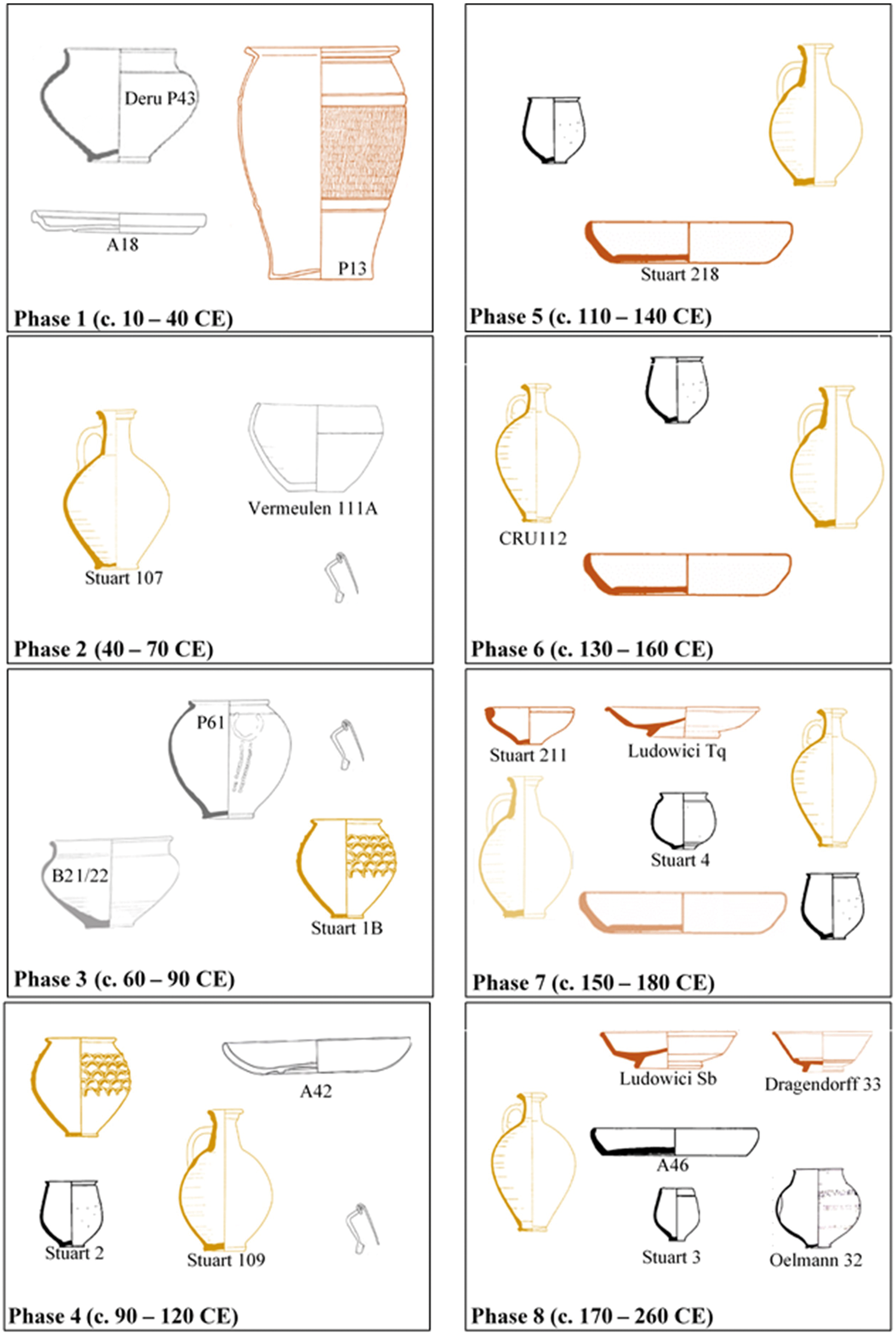
From this overview, it is clear that scholars have been alert to the degree of change in dedication at Nijmegen-Hatert, even if the discussion has been limited in temporal scope. My own reading of Jan-Kees Haalebos's report, coupled with a new Correspondence Analysis, suggests a rephasing of a number of graves. From this it appears that the turnover in the type and quantity of dedication was not restricted to the end of the firstcentury ce, but started earlier and continued until c. 260 ce, when the graveyard fell out of use. This adjustment builds on the degree of possibility that Haalebos embedded into the original systemization, namely, that some graves could belong to a number of different phases (e.g. Haalebos Reference Haalebos1990, 76, Graf 446). For this study, it is important to note that the ‘standard’ assemblage for each of the eight phases was idealized so as to present the changes in burial more efficiently. This idealization forms the basis for the review (Fig. 3).
Infographic illustrating the most common forms of material culture deposited in each of Nijmegen-Hartert's phases. Pots have been coloured so as to match the shade of their usual exterior surface.
On the general patterns found at Nijmegen-Hatert: the first century ce saw a rise in burial followed by a fall after c. 110 ce (Fig. 4). The increase complements a growth in the size of the ceramic burial assemblage, while the subsequent decrease led to another, greater surge in ceramic deposition after c. 140 ce. During the second century ce, the numbers of barrowed burials fell, particularly after the period c. 150–170 ce. The final phase of the cemetery—the 8th (c. 170–240 ce)—also paid witness to a change in cremation handling. In these decades, there was less of an interest in separating the bone from pyric material (primarily charcoal), in contrast with what had happened up until then. Different attitudes to the pyre had been tested previously, notably in phase 2 (c. 40–70 ce), but this final episode of the cemetery's lifespan saw the interring of larger quantities of broken, fire-smashed pottery as well.
Smoothed decadal graph illustrating trends in numbers of graves and pots interred at Nijmegen-Hatert.
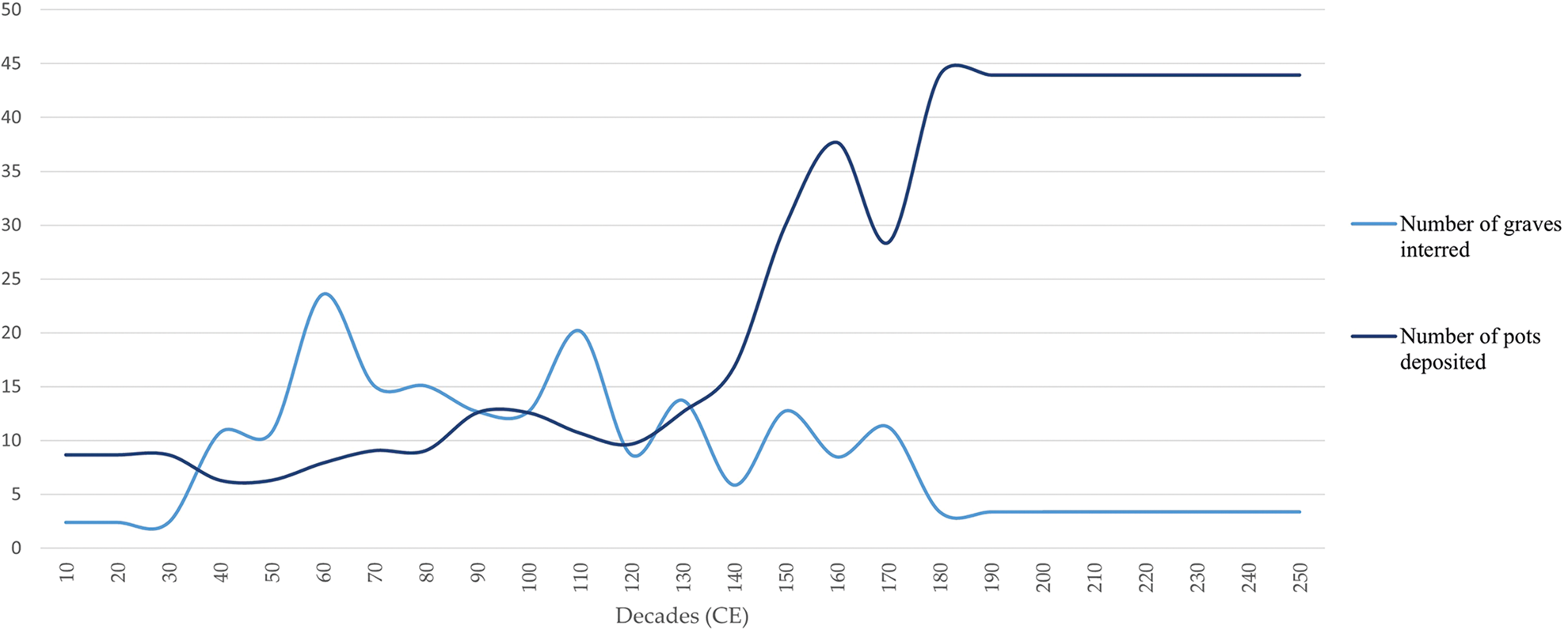
But few of these trends were unique to Nijmegen-Hatert, as I suggested. At Tiel-Passewaaij, for instance, after c. 180 ce increasingly more of the ceramic assemblage was damaged by fire (Aarts & Heeren Reference Aarts and Heeren2011). There were also underlying continuities to the burial ritual. Cremation was still practised, as it had been since the Bronze Age, and the Empire-wide shift to inhumation was only registered in the Netherlands during the third century ce (see Veldman & Blom Reference Veldman and Blom2011 or Steures Reference Steures2013 for examples). Moreover, although the building of barrows over graves was an invented practice in the early first century ce, the community at Nijmegen-Hatert (as elsewhere) remained true to the tradition for a long time. Yet these outward veneers tend to overlie alterations as to how the cremation was handled and how its identity was formed at the graveside itself.
The utilization of barrows from the beginning of the Roman period in order to make a funerary landscape certainly represented a break from the past. This disconnection with the Late Iron Age is especially obvious in that it is accompanied by an increased interest in the dead—more were being buried—and by the desire to lay the cremation to rest with material. Moreover, as the infographic shows, the pottery placed with the cremations during phases 1–3 (c. 10–90 ce) suggests that the community could not fix on what to dedicate with their dead. As an example, phase 1 saw the use of heavy-duty butt beakers that allowed for the consumption of beer by a group of drinkers. Pitts believes (2019, 127) that these vessels mark out a Northern Gallic funerary tradition that began in the Late Iron Age, yet they have not so far been found in the Dutch iteration of that era. These vessels were then replaced by a combination of flagons and handmade bowls in phase 2. The latter were more common during the Dutch Late Iron Age (Vermeulen Reference Vermeulen1932, 121, type 111A). Their reappearance is comparably seen in similarly dated graves at Tiel-Passewaaij and the cemeteries of Noviomagus (Aarts & Heeren Reference Aarts and Heeren2011, 141; see Graf 64: Vermeulen Reference Vermeulen1932, 182). However, what is especially significant in this case is that the vessels appear to have returned to use and been deposited once again.
Phase 3 also saw the introduction of beakers for drinking (Stuart type 1; Stuart Reference Stuart1963, 20–21). Pitts remarks on these as being associated with the construction of a specific Batavian identity that formed around the experiences of returning veterans. The addition of these pots came at the expense of hand-made forms which disappear almost entirely from Nijmegen-Hatert. Haalebos's report highlights that a higher proportion of the beakers was interred both burnt and smashed. This is in contrast to the accompanying flagons, which sometimes were smashed, perhaps in certain cases through post-depositional processes, but were usually not burnt, neither in phase 2, nor 3. A possible scenario here is that the beakers were placed with the corpse during its cremation, and the flagon retained for acts of libation as the cremated remnants were placed in the ground. The three initial phases described at the graveyard thus demonstrate constant shifts in the manner through which the cremation was being presented. There seems to be a lack of connection between them that is not merely random.
The next century-and-a-half does not see the same marked alterations in the ceramic assemblage. Indeed, phases 6–8 look remarkably similar, though there are some pronounced shifts in practice that merit further inspection. First, the costuming of the corpse altered. Previously, brooches had helped clothe a number of bodies. By phase 5, their use was restricted, and is only found in certain instances. Second, the appearance of coins in phase 7—as pennies to pay the ferryman—illustrates clearly that Mediterranean-style burial customs were being appropriated for the first time. Despite these practices having appeared usual in Noviomagus at an earlier point, the changing use of other forms of material culture suggests that other kinds of depositional practice were now being tested out (see Graf 31: Vermeulen Reference Vermeulen1932, 160). This is also reflected in the wholescale appropriation of terra sigillata from phase 7.
Vessels produced in the kilns of South and Central Gaul were deliberately avoided in the initial phases at Nijmegen-Hatert, though they were commonly used around Noviomagus, a few kilometres up the road. Comparable avoidance or aversion is found in other indigenous spaces within the western half of the Empire, for example at Verulamium (Stead & Rigby Reference Stead and Rigby1989). When the more local Eastern Gallic terra sigillata kilns began to produce, however, this approach changed. The local ‘rootedness’ of the industry may have conditioned this acceptance (van Oyen Reference van Oyen2016, 124). The orange-coloured, less glossy tones of these pots—in contrast to their South and Central Gallic predecessors—were now preferred. Those at Nijmegen-Hatert had a long-term interest in the local. When the terra sigillata industry moved nearer, this meant that the community was more open to absorbing its goods.
Finally, the evidence underlines certain differences in how central the pyre was to the formation of the deceased's identity. We saw that this included the introduction of a greater amount of pyre material to the grave itself in phase 8. This move, perhaps beginning in phase 7, saw a significant proportion of the growing pottery assemblage being interred both broken and burnt. Yet this move followed a half-century's interest in keeping ceramics intact. The role of the graveyard thus appears to have been subject to change, too. If, in phases 4–5 (c. 110—160 ce), there was much more variety in the pathways through which pots were introduced as accompaniments to the grave, by the end of the second century, and into the third, the few graves interred seem to have been the focus of other activities.
Such evidence could point to a growing emphasis on larger, public funerals, and the use of the graveyard for commemorative feasting (Millett Reference Millett and Struck1993; Scheid Reference Scheid, Georgoudi, Koch Piettre and Schmidt2005). We find, for example, that some of the assemblages of soot-stained, smashed pots were interred without cremated remains, and included wine-containing amphorae (for example, Haalebos Reference Haalebos1990, 114–15, Graf 807). This tallies with evidence from other parts of the Netherlands, accentuating that burial may no longer have been the only purpose for the graveyard. Instead, the community may have been coming together there to remember and interact with the long-dead as well (compare Brandrestenkuil 271, Tiel-Passewaaij: Aarts & Heeren Reference Aarts and Heeren2011, 460–62).
As this overview has shown, the evidence from Nijmegen-Hatert has highlighted a range of responses to the deceased across the period, extending from changes in how the cremation was presented to those who watched its burial, to how the centrality of the pyre was modified. The counter-argument could be made, of course, that all of this should be expected: pottery supply alters, industries come and go, a new generation may seek to define itself against the past. But these contentions overlook the imperial context in which these shifts happened and the particular conditions within which the local communities were commemorating their dead.
Discussion
When the earth over the barrow was patted down, and its surrounding ditch dug, little would have distinguished the graveyard at Nijmegen-Hatert from Early Iron Age examples that the community would have seen in the landscape around them. Their barrow-making seemingly related them more closely to their distant ancestors than to their (more) immediate possible forebears in the Late Iron Age. At the same time, the community's reliance on cremation as the way in which the corpse could be prepared or processed for burial was preserved. As we saw, the former practice was in all likelihood an invented tradition; the latter simply the way in which things had always been done. Together, these practices may have made them part of an imagined community. But the tinkering with assemblage size and composition suggests that what was believed to be traditional was maintained, even as each generation came to work in new ways with how they defined themselves at the graveside.
Evidence suggests that demonstrative remembrance was not fundamentally interesting or useful to Rome, even amongst its highest social echelons. Rather, the past was manipulated and downplayed, especially in the West where the conquered people were ubiquitously viewed as barbarian. Writing in the second century, Tacitus described the Batavi in these very tones of disapprobation. They were a soldiering, ferocious group, and barbarian, he claimed (Tacitus, Histories 1.59). Sweeping though Tacitus’ pronouncement may be, it sets the keynote for our analysis of the changes at Nijmegen-Hatert, which prioritized some traditions, while also having reference to the more distant as opposed to the nearer past.
Confronted with the Empire and its infrastructure on their doorstep, and the demands of the state on their population, the Batavi appear to have evolved a series of coping mechanisms that regularly drove new forms of interaction with the dead, almost every generation or so. The role that material culture played in this was crucial. It included the shaping of a series of new identifications using burial practices and arrangements, from those that depended on deliberate antiquarianism (phase 2), to those that formed around the transmitted experience of military service (phase 3), to assemblages that seemed to have accentuated the significance of community activity (phases 7–8). The decline in numbers of brooches and graves also appear to suggest an increasing focus on fewer corpses. Cremation and burial were thus being restricted to a smaller group within the wider community. The overall more relaxed approach in the community's attitudes to the incorporation of objects with a Mediterranean heritage (coins, terra sigillata) certainly seems reasonable given the length of time that the cemetery was in use. However, it shows once more that new outlooks were being expressed every couple of decades or so.
Clearly, commemorators tended to be restricted during any given period in what they were able to place in the ground with the dead. Constraining elements included the material available and forms of existing practice. However, what is interesting at Nijmegen-Hatert is that these restrictions have less of a hold than we might expect. Local pastoralists adjusted commemorative practices and the consequent expression of identity relative to their immediate experiences of the surrounding imperial conditions. These new forms of commemoration were for those present at the time of burial. Anyone passing through this society's lands would have found that the local inhabitants’ commemoration linked them back to an older past. Each phase of the graveyard showed a distinct form of commemorative memorialization, each limited in its timespan. Though we do not know enough to typify this as conscious amnesia or the kind of forgetting as caused by psychological wounding, nonetheless the effects of disremembering are plain to see.
To close, I will pinpoint this effect one final time by looking at the varying roles that alcoholic drink had in the making of the graveyard. The changing aspect of Nijmegen-Hatert's ceramic assemblage showed that big communal vessels were replaced by flagons, then by flagons and beakers, and thereafter by a variety of different drink containers. The emphasis appears to move from a group drinking together using a large amount of alcohol, along with the apparent assumption that this will continue in an afterlife, to the use of alcohol in a commemorative way, to libate the cremated remains. The drinking vessels themselves thus became the means through which to mark out and identify the dead, before the group's interests were later reasserted as dining in the graveyard started to become important. In the late firstcentury ce, the Batavi step forward as a community whose masculine, military environment was expressed through companiable practices of swigging together. Though this was a change from the past, it would not continue to be significant in the future when the role of alcoholic drink shifted again, becoming central to the commensal feasting activities that took place within the bounds of the graveyard.
Conclusion
From this review of burial assemblages at Nijmegen-Hatert in the period c. 10–260 ce and the evidence of the local inhabitants’ changing priorities, two main conclusions emerge: first, that collective amnesias were as important to social expression as the replication of existing rites, and, second, that these modes of forgetting invite interpretation as responses to the community's experiences of Empire. The research has helped to probe an underlying scholarly consensus that peoples in the past were more interested in memorialization than, essentially, in living in the present and adapting their communal practices to fit changing local conditions. Not only did the local people of Nijmegen-Hatert alter their funerary practices according to the imperial structures within which they lived, but they also generated a variety of constantly creative and fluid ways of evaluating and responding to their dead. It would be interesting to expand the implications rising from these findings further, to ask whether and how forgetting occurred in other spatial contexts, in the Roman Empire and beyond, as, for example, in the colonial Rhodesia depicted in Tsitsi Dangarembga's This Mournable Body (Reference Dangarembga2020, 180):
Acknowledgements
I would like to acknowledge the kind support of Martin Millett, Marie Louise Sørensen, Chris Evans, and Greg Woolf. I would also like to thank the Arts and Humanities Research Council Doctoral Training Programme for their support towards some of the research contained in the article. I am grateful to the anonymous reviewers for their extremely useful comments, any remaining errors remain my own. Finally, I am indebted to EB, SM, and LC for their reading of the many drafts of this article.


 Open access

