





Introduction
Despite important advances toward gender equality, the emergence of backlash movements underscores the need for a deeper understanding of gender dynamics in society and politics. In particular, there is a need to move beyond surface-level indicators to examine how gender identities, norms, and everyday experiences shape attitudes toward equality and inequality. Capturing these dimensions is essential for understanding where gender-based inequalities persist and how they are perceived and contested.
Addressing the field’s limited empirical coverage of gender attitudes, a new module Gender in Contemporary Europe: Rethinking Equality and the Backlash, on contemporary attitudes about gender and gender equality has been fielded as part of Round 11 of the European Social Survey and includes data from 31 countries.Footnote 1 The objectives of this short article are fourfold: (1) introduce the need for the measure of gender attitudes and its unique contributions; (2) describe how the module items were developed and tested within the ESS framework; (3) identify the challenges in measuring gender attitudes and sexism; and (4) highlight the strength of the data and applications for future research.
The need for measures of gender attitudes and their unique contributions
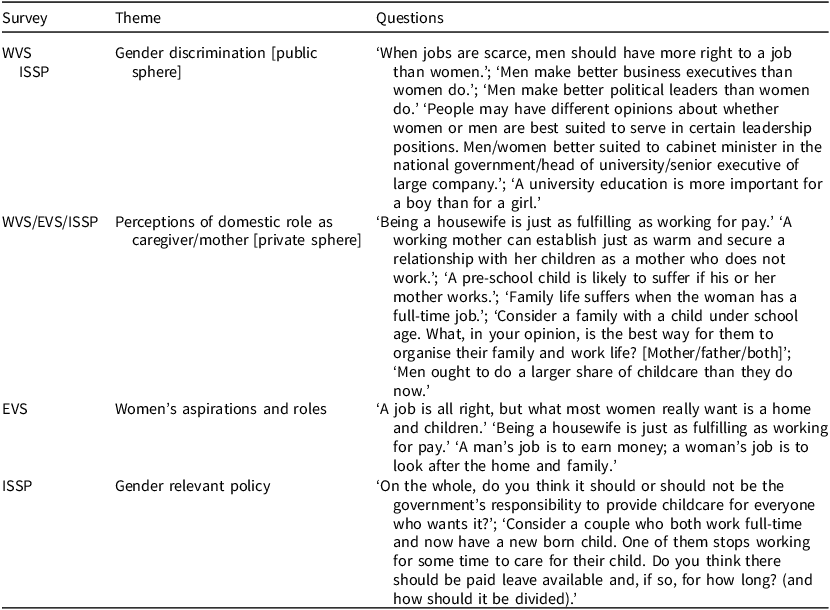
Existing cross-national surveys have significantly advanced our understanding of gender attitudes. Still, important limitations in existing data persist – limitations that the ESS Gender in Contemporary Europe module is designed to address. First, existing surveys offer only limited attention to attitudes surrounding gender, typically presenting a narrow, ancillary focus on gender roles. Most cross-national surveys have primarily examined attitudes toward women’s participation in society – particularly in the labour market (e.g. the EVS/WVS (Inglehart et al., Reference Inglehart, Haerpfer, Moreno, Welzel, Kizilova, Diez-Medrano, Lagos, Norris, Ponarin and Puranen2022), the Eurobarometer Surveys (2025), and see Table 1 for item examples). These studies often frame their inquiry around women’s dual roles as workers and mothers, or around distinctions between their public and private responsibilities (e.g. ISSP Family and Changing Gender Roles module (2025), and see Table 1 for item examples). Consequently, they tend to foreground the role of women, rather than interrogating broader constructions of gender. Moreover, they often situate evaluations of women within the context of motherhood or private roles, thus presuming traditional gender roles rather than questioning them. What remains largely unaddressed are experiences of gender discrimination across social domains, assessments of the impact of gender equality on society, and gender equality policy preferences in addition to variations in gender identity. This ESS module introduces a level of comprehensive and systematic focus on gender not previously seen in the field.
Examples of cross-national survey items measuring gender attitudes

Note: To construct this table, for WVS, ISSP and EVS, we searched for gender, women/men, mother/father, sex, children, masculinity/femininity, family in the GESIS archive and on the relevant website of the studies. Our list is not meant to be exhaustive but representative of the range of questions asked about gender attitudes. We do not intend this to be an exhaustive list and there are topics we exclude such as sexuality and LGBTQ+ rights.
Second, existing research provides limited insight into the attitudes and psychological predispositions that underpin gender norms – specifically, those related to gender identity, stereotypes, and prejudice. Our module addresses this gap by moving beyond binary conceptions of gender to include measures of masculinity and femininity, as well as the salience of one’s gender. It also incorporates validated measures of sexism, encompassing modern, hostile, and benevolent forms (Swim et al. Reference Swim, Aikin, Hall and Hunter1995; Glick and Fiske Reference Glick and Fiske1996; Glick Reference Glick and Guimond2006). These different dimensions represent complementary aspects of traditional gender relations: benevolent sexism idealises women who conform to conventional roles; hostile sexism targets those who challenge them; and modern sexism denies or downplays ongoing gender inequality. Together, they sustain entrenched gender hierarchies under the guise of social norms.
Third, absent from cross-national surveys are measures of experiences of discrimination in the everyday lives of men and women. The existing survey data have not allowed researchers an opportunity to systematically evaluate the extent to which everyday experiences of discrimination, across a range of contexts, shape the salience of attitudes towards gender equality, or the strength of feelings people hold about gender and gender equality. Furthermore, examining perceptions of gender-based discrimination across these same domains allows researchers to explore the connections between personal experiences and societal perceptions of injustice. This enables researchers to identify when personal experiences do or do not lead individuals to view the system as fair (Jost Reference Jost2020), as well as how responsibility for such experiences and/or perceptions is attributed.
Examples of the gender-related questions across the World Values Survey (WVS), European Values Study (EVS), and International Social Survey Programme (ISSP) largely focus on the evaluation of traditional gender norms, employment and education, and family roles (see Table 2) and illustrate these three limitations. Many items reflect normative judgements about the proper roles of men and women in society. For example, these items suggest that men are more entitled to employment when jobs are scarce, or that women are inherently more suited to caregiving roles. Several questions explicitly compare the abilities or desirability of men and women in leadership or educational domains, while others gauge perceptions about the effects of maternal employment on child development and family life. Across all three surveys, questions about whether being a ‘housewife’ is as fulfilling as paid work are frequently used to capture societal valuation of domestic roles. These questions provide a comparative lens into gender role ideology, with a clear emphasis on binary distinctions and assumptions and/or stereotypes about women’s responsibilities in private versus public life.
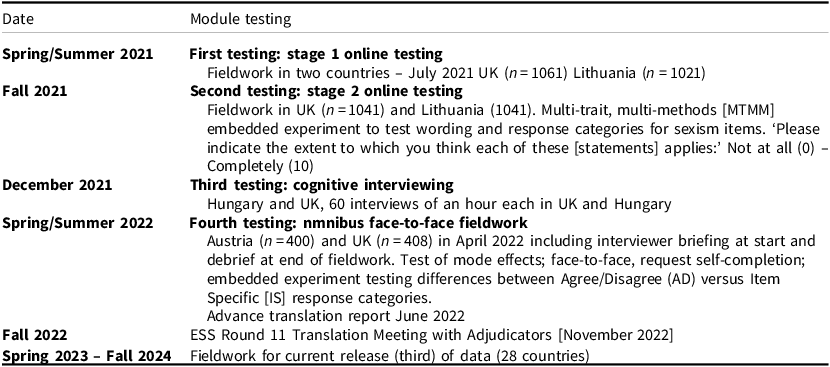
Stages of module development

In sum, the Gender in Contemporary Europe module in ESS Round 11 (2025) advances the study of gender attitudes by enabling scholars to engage with core conceptual questions that have remained difficult to address empirically in cross-national research. It extends existing research by moving beyond a narrow focus on gender roles and equal opportunity. Instead, it adopts a broader conceptualisation of gender as a social structure that shapes identities, experiences of inequality, and evaluations of social change. By integrating attitudes, identities, lived experiences, and policy orientations, the module enables analysis of how gender equality is understood, valued, and contested across societal domains. This integrative design makes it possible to study not only support for gender equality, but also resistance, ambivalence, and backlash – linking individual experiences to broader societal debates about fairness, responsibility, and social change. In doing so, the module provides a foundation for research that moves beyond documenting attitudes toward women’s roles to theorising how gender relations themselves are understood, justified, and challenged across contemporary European societies.
Developing the gender in contemporary Europe module within the ESS framework
In 2020, following an open competition among European researchers, the Gender Attitudes module was selected by the European Social Survey Scientific Advisory Board for inclusion in Round 11 (2022/23) of the ESS. The ESS provides an ideal platform for the design and implementation of new survey items due to its strong reputation for high-quality, cross-national survey research. It uses large, representative samples and follows careful procedures for developing and testing questionnaire items, helping to ensure high quality data across countries. Surveys follow a strict translation protocol, ensuring that questionnaires are culturally and linguistically adapted for different national contexts. Rigorous piloting and pretesting of survey questions helps refine the questionnaire and ensure clarity for respondents. The ESS is often referred to as the ‘gold standard’ in cross-national survey research due to its transparency, comparability, and methodological innovations.
The ESS develops its questionnaires using a comprehensive, theory-led methodology rooted in the Total Survey Error (TSE) framework (Groves Reference Groves2005). The TSE model distinguishes between measurement error (arising from question wording, mode, or respondent interpretation) and representation error (linked to sampling and nonresponse), and ESS applies this framework to minimise bias and maximise data quality across all stages of design. Items undergo rigorous pretesting, including cognitive interviews and mode experiments, to detect problems like social desirability bias, satisficing, or lack of cultural resonance. In doing so, ESS operationalises the TSE framework not just as a diagnostic tool but as a guiding model for minimising error at each stage of the questionnaire development. The aim is for a suite of survey items that are theoretically coherent, empirically validated, and culturally adaptable ensuring that data collected across Europe is comparable.
The ESS has a sustained commitment to developing cross-nationally equivalent instruments (Fitzgerald and Jowell Reference Fitzgerald, Jowell, Harkness, Braun, Edwards, Johnson, Lyberg, Mohler and Smith2010). Focusing on translation issues is fundamental to the effort. The TRAPD approach used by ESS – comprising Translation, Review, Adjudication, Pretesting, and Documentation – offers a systematic framework for ensuring high-quality, culturally sensitive translations of survey instruments, which is a critical concern in cross-national public opinion research (Harkness Reference Harkness, Jowell, Roberts, Fitzgerald and Eva2007). The process includes multiple translators independently producing draft versions of the questionnaire to capture a range of linguistic interpretations. After aligning drafts, focusing on conceptual equivalence rather than literal word-for-word fidelity, the revised instruments are subject to pretesting to detect issues of comprehension, relevance, or unintended connotations. These processes are documented to provide a transparent record of translation decisions, reviewer comments, and pretest findings.
To illustrate the development process, Table 2 provides an overview of the stages involved in testing and developing the gender attitudes module. The development process proceeded in four key stages. In Spring and Summer 2021, the first stage involved initial online testing of sexism items, with fieldwork conducted in two countries in July. This phase focused on evaluating basic data quality through checks on item distributions, ‘Don’t Know’ responses, and response timing. In Fall 2021, the second stage introduced a Multi-Trait Multi-Method (MTMM) experimental design to further test item wording and response scales. Conducted online in two countries, this phase compared different formats, including 5-point and 10-point ‘Not at all – Completely’ scales against traditional agree/disagree formats. The third stage, in December 2021, consisted of cognitive interviewing in Austria, Hungary, and the UK, with 60 one-hour interviews designed to assess how respondents understood and interpreted the items. These interviews led to a set of concrete recommendations for item revisions. Finally, in Spring 2022, the fourth stage involved omnibus fieldwork in Austria and the UK (400 and 408 respondents, respectively), incorporating interviewer briefings and debriefings. This phase tested for mode effects – comparing face-to-face and self-completion formats – and evaluated the performance of agree/disagree versus item-specific response scales, generating experimental data on the impact of survey mode and format (see Archer and Clifford Reference Archer and Clifford2022).
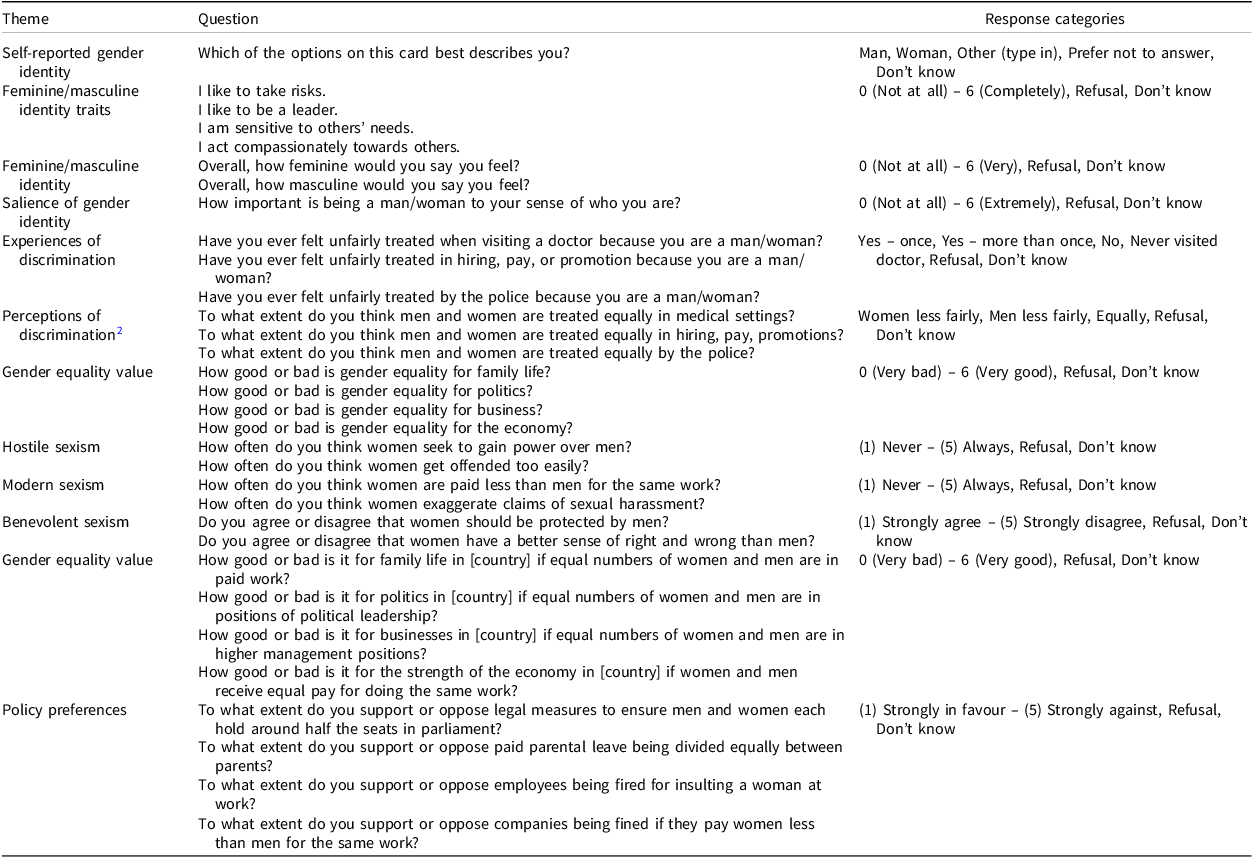
Table 3 presents the finalised set of survey items fielded within the Gender in Contemporary Europe module of the European Social Survey (ESS) Round 11. Fieldwork for this round, now in its third release of data with 28 countries, was conducted between 1 February 2023 and 24 October 2024, with each participating country completing data collection within a 6-week to 5-month window during this period. The table reflects the harmonised questionnaire items as administered across countries during their respective fieldwork periods.
Questions included in the gender in contemporary Europe ESS module

Challenges in measuring gender attitudes and sexism
During the questionnaire development, we encountered several challenges and considerations. Below, we discuss four key issues: gender bias, response bias, translation, and the measurement of sexist attitudes.
Gender bias
During the development of the module, a key area of resistance stemmed from the ‘perceived one-sidedness’ of the module. Members of the development team and stakeholders expressed concern that the module ‘focused primarily on women’s disadvantage’, without adequately acknowledging the challenges and inequalities faced by men or gender-diverse individuals. This framing led some to feel that the module lacked balance and neutrality. Despite these concerns, cognitive interviews and debrief sessions revealed that a few respondents actively pushed back against what some interpreted as an underlying assumption of widespread gender inequality in the survey. When prompted, some respondents did reject the premise of gender inequality or suggest a focus on it was ideologically driven. In many ways, it is precisely these kinds of resistance that our module aims to capture.
Pilot testing showed only minor evidence of response bias and social desirability effects. For example, interviewer-administered formats produced slightly more ‘Don’t Know’ responses, although this pattern was not consistent across all items. Additionally, women and non-binary respondents took slightly longer to complete the gender module in online settings, possibly suggesting greater reflection or potential discomfort among these social groups.
Translating gender
Translating questions related to gender across diverse European languages presents significant challenges, particularly due to the multidimensional nature of the term ‘gender’. As both a grammatical and social category, gender intersects with linguistic structures (e.g. gendered nouns and pronouns) and sociopolitical hierarchies and social norms, making it inherently complex to render consistently across contexts. Scholars have described gender as a ‘slippery and ambiguous term’ (Di Sabato and Perri Reference Di Sabato, Perri, von Flotow and Kamal2020), noting that it exists simultaneously as a cultural norm and an abstract linguistic system. This dual nature can lead to confusion in cross-cultural research, especially when concepts do not neatly align between source and target languages. Translation issues can be found particularly in languages like Norwegian and German, where terms related to gender identity and gender roles lacked clear or culturally resonant equivalents. This can lead to confusion between grammatical and social meanings of gender, particularly in contexts where gender is linguistically encoded in ways that do not easily map onto non-binary or fluid identities. As a result, items intended to capture gender diversity could sometimes be misunderstood or seen as ambiguous. This would undermine their effectiveness and interpretability. For these reasons, for example, we dropped an item on gender-based violence. Where needed, interviewer guidance was given to clarify the meaning of the item.
While the questionnaire is originally developed in British English, each participating country is responsible for translating the survey into all languages spoken as a first language by at least 5 per cent of its population. This ensures inclusivity but also increases the complexity of ensuring semantic equivalence, particularly with terms such as ‘gender’, which may have no direct comparisons in languages like Norwegian or German. Moreover, such translations often involve ideological transfer (Nissen Reference Nissen2002), where broader social norms and assumptions about gender are implicitly carried across cultural boundaries. Translating gender-related survey items is not a matter of word-for-word replacement. Many languages lack gender-neutral forms or use grammatical gender in ways that differ substantially from English, which complicates direct translation. In addition, there are significant lexical and conceptual gaps; for example, terms such as ‘masculine’, ‘feminine’, ‘compassionate’, or ‘preferential treatment’ do not always have direct, neutral, or culturally appropriate equivalents in other languages. In Italian, for instance, ‘maschile’ (masculine) is not commonly used for self-description outside of LGBTQ+ contexts, while alternatives like ‘maschio’ or ‘uomo’ carry unwanted sexual or biological connotations. Ambiguities in the English source text further contribute to translation challenges, as teams often require clarification to avoid misinterpretation. Cultural norms also shape what is considered acceptable or potentially offensive, sometimes necessitating changes to avoid unintended connotations. Achieving inclusivity for non-binary or third gender identities is particularly challenging, as many languages lack appropriate terminology.
As an example of the lack of gender-neutral terms, in Polish, the word ‘you’ itself is gendered and requires separate forms for male and female respondents, making direct translation in question E11 (‘Which best describes “you”: Being a Man or Being a Woman?’) impossible without adaptation. ESS Round 11 introduced a significant change by moving from interviewer-identified to self-identified gender. Respondents are now asked, ‘Which of the following best describes you?’ with options including ‘A man’, ‘A woman’, ‘Other (TYPE IN)’, and ‘Prefer not to say’. In follow-up items, respondents are invited to reflect on the importance of their gender to their self-concept, drawing on language that emphasises self-perception. Interviewer instructions clarify that phrases such as, ‘the way you think about yourself’, should be interpreted as equivalent to ‘how you perceive yourself’. Despite this shift toward inclusivity and self-identification, variation in how gender is linguistically and culturally understood continues to pose interpretive challenges for both respondents and translators. These linguistic and conceptual mismatches made it necessary to carefully adapt or explain terms to ensure accurate and culturally sensitive translation.
Response bias
During item testing, several forms of response bias were identified, each with relevant implications for the reliability of data collected. We offer further detail on these potential biases below. However, although response biases emerged during testing, their impact was judged to be minimal, where appropriate adjustments were made to the items, and not expected to compromise data quality.
The cognitive interviewing revealed the potential for social desirability bias in some items – where respondents feel pressure to give answers that are socially acceptable even though they may be contrary to true feelings or attitudes. For example, Item E13 measuring benevolent sexism, which stated, ‘Women should be rescued before men’, triggered strong negative reactions from respondents such as ‘That is not acceptable!’, indicating that some respondents were unwilling to agree with the statement even if they may hold traditional views privately. One respondent remarked that ‘the module is mainly working towards women being disadvantaged’, suggesting an assumed expectation to agree with statements that emphasise gender inequality. Recent research notes, however, that benevolent sexism is rather entrenched in European societies (Mastari et al. Reference Mastari, Spruyt and Siongers2019), and that these items generally do not elicit high social desirability bias as respondents do not feel the pressure to mask their true responses (Agut et al. Reference Agut, Martín-Hernández, Soto and Arahuete2023).
Non-response bias or satisficing can occur when questions are found to be unclear or overly abstract. Item E8a/b (see Table 3), which asked about gender identity, was described as ‘too complicated’ or ‘not at all understood’, particularly in contexts where the term ‘identity’ was unfamiliar or conflated with ethnicity. This question was adapted to exclude identity from the phrasing. Likewise, there are respondents with no personal experiences of the scenarios described in Items E21a–E23b (see Table 3, e.g. experiences with police, promotion, or job loss) so as to avoid a default to midpoint or ‘Don’t Know’ options, an option of ‘No Personal Experience’ was added. Additionally, Item E5a/b, which asked ‘How masculine/feminine do you feel?’, was met with some confusion. Comments were made, such as, ‘I am a man so I am masculine – why should there be a gradation?’. Nevertheless, there was evidence that, in general, respondents were able to map their feelings onto the masculine and feminine scales. Further direction was added to the question on the differences between these scales and biological sex.
Finally, protest or reactance bias was identified when respondents objected to the premise of a question, leading to sarcastic or dismissive answers. For instance, Item E29, which stated that ‘Men should be legally required to take parental leave’, prompted outright protest from some participants once the premise was understood. Likewise, Item E5a/b and E7a/b (which asked about personal feelings of masculinity/femininity and alignment with traditional gender roles) were sometimes described as ‘funny’ or ‘ridiculous’, with some respondents refusing to take the items seriously. These cases suggest a rejection of the survey’s assumptions or perceived irrelevance, which can undermine the quality of the data.
Response scale for sexism items
Research using the ambivalent sexism scale and the modern sexism scale has generated important insights, showing that both hostile and benevolent forms of sexism can predict a range of attitudes and behaviours, ranging from support for traditional gender roles and protective, paternalistic behaviours (Bareket and Fiske Reference Bareket and Fiske2023) to shaping attitudes on gender equality policies and vote choice (Off et al. Reference Off, Charron and Alexander2022; Coffé et al. Reference Coffé, Fraile, Alexander, Fortin-Rittberger and Banducci2023; Fortin-Rittberger and Eder Reference Fortin-Rittberger and Eder2025). Despite their wide use and contributions, the scales are not without critiques (McHugh and Frieze Reference McHugh and Frieze1997). In discussions with ESS headquarters, national coordinators, and the scientific advisory board, additional concerns were raised about the sexism items – particularly the statements used to construct the scales. A key issue was the perceived lack of balance between the situation of men and women in their respective societies. However, the items are designed precisely to capture existing and often latent negative attitudes toward women and function as a unipolar scale: high scores indicate the existence of sexist attitudes, while low scores reflect their absence – not the presence of positive attitudes toward men. Simply replacing ‘women’ with ‘men’ in the items would not create a meaningful inverse scale.
Given the limited space available in the ESS module, we could not include the full Ambivalent Sexism Inventory (11 items per dimension) or the complete Modern Sexism Inventory (8 items). To ensure robust measurement within these constraints, we relied on prior research identifying the best-performing items. For hostile and benevolent sexism, we selected items most strongly related to the underlying constructs based on empirical performance in previous studies. For modern sexism, we followed Schaffner (Reference Schaffner2022), who optimised sexism measurement for political surveys by identifying items with the highest reliability and validity. Regarding benevolent sexism specifically, which consists of three subcomponents – protective paternalism, complementary gender differentiation, and heterosexual intimacy (Glick and Fiske Reference Glick and Fiske1996) – we prioritised items capturing the two most central subcomponents (protective paternalism and complementary gender differentiation), while omitting the third (heterosexual intimacy) due to space limitations and its lower relevance for the module’s primary focus on gender equality attitudes. These decisions were guided by prior validation studies and recommendations for shortened scales, ensuring strong construct validity while minimising respondent burden.
Another concern about the items was the response scale. The agree/disagree scale (AD) that is typically used to measure sexist attitudes in prior surveys, requires respondents to translate their thoughts about a construct into a judgement of agreement which is cognitively demanding and encourages satisficing (Archer and Clifford Reference Archer and Clifford2022). AD scales are prone to acquiescence bias, where respondents tend to agree with statements regardless of content – often due to politeness, cognitive shortcuts, low motivation, or respondents’ fatigue. The ESS recommends not using AD scales in general for the same reasons. Archer and Clifford (Reference Archer and Clifford2022) show that the item-specific (IS) scales on hostile sexism items, where the question matches the response format asking how often something occurs, reduces some of the problems associated with an AD scale and typically performs better.
While many concerns were addressed during question formulation – mainly through rewording to improve clarity and provide context – others were tested empirically in online and omnibus pilots. One such issue was the reliance on AD response categories. A series of embedded experiments tested how response formats and item wording affected data quality in measuring sexist attitudes. Two embedded experiments were conducted: an MTMM experiment comparing a 5pt and 10pt response scale (see Table 2) and an experiment comparing an AD and IS response scale. We report the results of the second experiment as this guided the response scales that were finally implemented. The aim was to compare the performance of standard AD scales against IS formats using frequency or intensity-based wording (Archer and Clifford Reference Archer and Clifford2022). For example, one hostile sexism item was presented as:
-
IS: How often would you say that women seek to gain power by getting control over men?
-
AD: Women often seek to gain power by getting control over men.
A two-group split-ballot design randomly assigned respondents to receive either AD or IS versions of the items. AD scales used the standard 5-point agree-disagree format, while IS items used unipolar frequency (e.g. ‘Never’ to ‘Always’) scales. Respondents were drawn from the ESS pretesting sample. Item performance was evaluated using quantitative indicators (e.g. midpoint use, DK rates, response time) and qualitative feedback from interviewer debriefings and cognitive interviews.
The results showed small but consistent effects of response format. IS scales led to more midpoint and DK responses, suggesting they made it easier for respondents to express non-extreme views. Similar to Archer and Clifford (Reference Archer and Clifford2022), we found floor effects in AD with more extreme anti-sexist responses – almost double those in the IS scale. See the online Appendix for distributions across response categories for tested items.
Importantly, format effects varied by sexism dimension. Modern sexism items showed little difference across formats, suggesting they are robust to question structure. Hostile sexism items – especially those referencing concrete behaviours – performed well with IS formats. Benevolent sexism items, by contrast, performed less reliably with IS wording. Respondents appeared to struggle with expressing benevolent attitudes (e.g. protection norms, moral virtue) in behavioural or frequency terms. This reflects known issues in the cognitive response model (Tourangeau et al. Reference Tourangeau, Rips and Rasinski2000), where abstract constructs are harder to map to concrete response tasks. These differences stand to complicate the building of scales and dimensionality testing. Benevolent sexism, often idealised or normative in tone, is harder to express as a frequency – especially when involving vague moral or emotional language. Based on these results, the team retained the IS format for hostile and modern sexism dimensions and the AD response scale for benevolent sexism items. This choice improves reliability for each dimension but introduces comparability limitations across subscales because of differences in response format and scale range; users should therefore exercise caution when interpreting direct comparisons between benevolent sexism and the other sexism dimensions.
Analytical strengths and research applications of the dataset
The Gender in Contemporary Europe module provides rich data for academic research on gender attitudes in Europe and enables a comparative analysis across European countries. It allows researchers to examine how perceptions of gender roles, identities, and equality vary across different European societies. It supports generational analyses, essential for understanding the dynamics of societal change. By combining measures of hostile, benevolent, and modern sexism with attitudes toward gender policies, scholars can investigate how sexism shapes support for – or resistance to – initiatives like gender quotas, equal parental leave, or workplace protections. The cross-national design of the ESS facilitates comparisons of these issues across countries, uncovering important cultural and political patterns. The Gender Attitudes module can be combined with contextual indicators already available in the ESS – such as measures of gender inequality in education and health – as well as the additional indicators proposed in our module proposal such as implementation of gender quotas (Fortin-Rittberger et al. Reference Fortin-Rittberger, Banducci, Marta, Coffe and Alexander2020: 23), to explore how country-level factors help explain variations in gender attitudes. These insights are vital for predicting shifts in societal norms and designing effective public engagement strategies.
The Gender in Contemporary Europe module can also be used to build a robust evidence base for gender equality initiatives. Policymakers at the EU and national levels can use the data to assess public support for a range of gender equality measures. The nuanced indicators capturing gender identity salience, perceived discrimination, perceptions of gender as a social good, and policy preferences provide critical insights into areas where interventions are likely to encounter support or resistance. Moreover, the module’s cross-national design allows policymakers to benchmark their country’s progress or stagnation on gender equality, thereby identifying context-specific gaps in equality and informing the development of national policies that are culturally and politically responsive. Additionally, stakeholders engaged in public discourse, such as journalists, can draw upon the module’s comprehensive data to empirically represent the public’s gender identity, and their attitudes regarding discrimination and equity – an especially valuable resource amid contemporary challenges of polarisation and misinformation.
Conclusion
The Gender in Contemporary Europe dataset constitutes an important new data source for research examining the intersection between gender and other identities – such as ethnicity, age, or socioeconomic status – across various institutional domains, including healthcare, policing, and employment. By offering comprehensive and nuanced indicators, it enables intersectional and comparative analyses that were previously constrained by a lack of suitable data. Additionally, the use of culturally sensitive translation methodologies enhances the validity and comparability of findings across different countries, thereby supporting robust and rigorous comparative analysis. The Gender in Contemporary Europe module is a valuable and timely resource for researchers and policymakers interested in understanding and addressing the evolving landscape of gender equality in Europe. As with all European Social Survey data, the data are freely accessible without embargo. As a result, it stands to foster broad scholarly engagement from across multiple disciplines.
Supplementary material
The supplementary material for this article can be found at https://doi.org/10.1017/S1682098326100435
Data availability statement
The ESS Round 11 data reviewed in this article are freely available at https://ess.sikt.no/en/.
Acknowledgements
We would like to express our gratitude to the European Social Survey Headquarters, especially Tim Hanson, and the national and translation teams who supported the development of this module.
Funding statement
This research has been supported by the Spanish Agencia Estatal de Investigación (Reference: PID2023-147429OB-I00). Susan Banducci acknowledges funding from the European Research Council (ERC) under the European Union’s Horizon 2020 Research and Innovation programme under grant contract number 101019284.
Competing interests
On behalf of all authors, the corresponding author states that there is no conflict of interest.


 Open access

