1 Introduction: A Global Politics Perspective on Deep-Sea Mining
Who Governs Deep-Sea Mining?
This Element asks: Who governs deep-sea mining (DSM)? Is it an intergovernmental organisation, created formally by an international treaty or agreement between sovereign states, or individual states? The key object of this research is DSM for critical minerals. However, it does not focus on the mining process and its associated technical issues but on whether global governance of DSM is possible. In other words, it examines the DSM from a global politics perspective.
Why are critical minerals, DSM, and global governance worth our attention? Minerals on the deep seabed were first discovered in 1873 during the HMS Challenger expedition, a global marine research expedition (1872–76) organised by the Royal Society of London. Deep-sea mining was, however, deemed to be not technologically feasible until the 1960s and 1970s (Harrison, Reference Harrison2011, p. 115). After a frenzy of activities for about two decades, it ground to a halt and ‘was dead in the water’ in the 1980s until the early twenty-first century (Sparenberg, Reference Sparenberg2019, pp. 842–843).
The term ‘critical minerals’ began to gain wider currency around 2008, following the National Research Council (2008) of the US publication, Minerals, Critical Minerals, and the U.S. Economy. There, a critical mineral is defined as a mineral ‘that is both essential in use and subject to the risk of supply restriction’ (National Research Council, 2008, p. 14) (emphasis in original). Critical minerals are essential and vital to both civilian and military defence technologies; and securing their supply chain has become crucial for national strategic planning. The Energy Act of 2020, enacted into law by President Donald Trump in his first term (2017–21), requires the Department of Interior to establish a list of ‘critical minerals’, and the Department of Energy also maintains a list of ‘critical materials for energy technologies’ pursuant to the same Act.Footnote 1
More recently, the strategic significance of critical minerals is obviously seen in the context of the China–US great-power competition and rivalry. China’s chokehold on supplies of critical minerals in its trade dispute with the USA in 2025 has given Beijing powerful leverage and ‘dictated the path toward trade truce’ (Emont & Bade, Reference Emont and Bade2025). In April 2025, after the Trump administration announced its tariff war towards fifty-seven trading partners, including imposing 34 per cent tariff on imports from China, Beijing struck back with restrictions on exporting ‘dual-use’ critical minerals, especially rare-earth minerals,Footnote 2 to the USA. Rare-earth elements (REEs) are crucial in the production of a vast amount of high-tech products, including electric vehicles, jet fighters, and missiles. Since China dominates their global production and processing, its export restrictions pushed Washington to re-negotiate a trade deal with Beijing. Eventually, Presidents Donald Trump and Xi Jinping managed to reach a one-year ‘trade truce’ when they met in South Korea in October 2025, whereby the USA pledged to lower tariffs on Chinese goods, and China promised to suspend certain restrictions on rare-earth exports (Kine & Messerly, Reference Kine and Messerly2025). However, China’s grip on the supply of rare-earth magnets needed for weapons systems remains a potential flashpoint, as companies with ties to the US military will be excluded from China’s rare-earth export approval system (Chen & Potkin, Reference Chen and Potkin2025; Emont & Huang, Reference Emont and Huang2025). This trade war has shown the risk of ‘weaponisation’ of supply chains of critical minerals and the imperative of supply-chain security. The strategic importance of critical minerals could further be seen from the Trump administration’s ‘critical-mineral diplomacy’ to break China’s dominance over the supply chains of critical minerals. To name but a few, Trump signed critical minerals deals with Australia, Cambodia, Japan, Malaysia, Thailand, and Vietnam in his Asia tour in October 2025 (Vandome, Reference Vandome2025). He also hosted a ‘C5+1’ summit meeting with five Central Asian leaders in November 2025 as part of his critical-mineral diplomacy. Cove Capital, a US mining investment company, has agreed to develop a tungsten deposit in Kazakhstan. The cost of the project is estimated at $1,100 million, and the US Export-Import Bank would fund $900 million (Reuters, Reference Reuters2025).
However, land-based mining has long been criticised for its environmental impacts, including deforestation, water pollution, and habitat destruction. These concerns have prompted increasing scrutiny and resistance from environmental groups. In response, the mining industry and some countries are now shifting their attention toward the oceans as an alternative to getting the supply of critical minerals.
Deep-sea mining is the process of extracting mineral deposits from the deep seabed. The International Union for Conservation of Nature (IUCN) defines ‘deep seabed’ as the seafloor located at depths greater than 200 metres (below sea level). But the depth is not part of the operational definition of DSM, which may take place in two areas: (1) within a coastal state’s national jurisdiction, including its exclusive economic zone (EEZ) or continental shelf; and (2) in the seabed beyond the limits of national jurisdiction of any coastal state, which is known as the Area, according to the United Nations Convention of the Law of the Sea (UNCLOS) (Hilmi et al., Reference Hilmi, Dbouk and Crisóstomo2026, p. 1).Footnote 3 DSM in the Area is, in principle, regulated by the International Seabed Authority (ISA), which is tasked with writing and implementing rules for commercial-scale exploitation of the minerals on the deep seabed, but does not address the normative question as to whether DSM ought to be conducted (Standing, Reference Standing2022, p. 352).
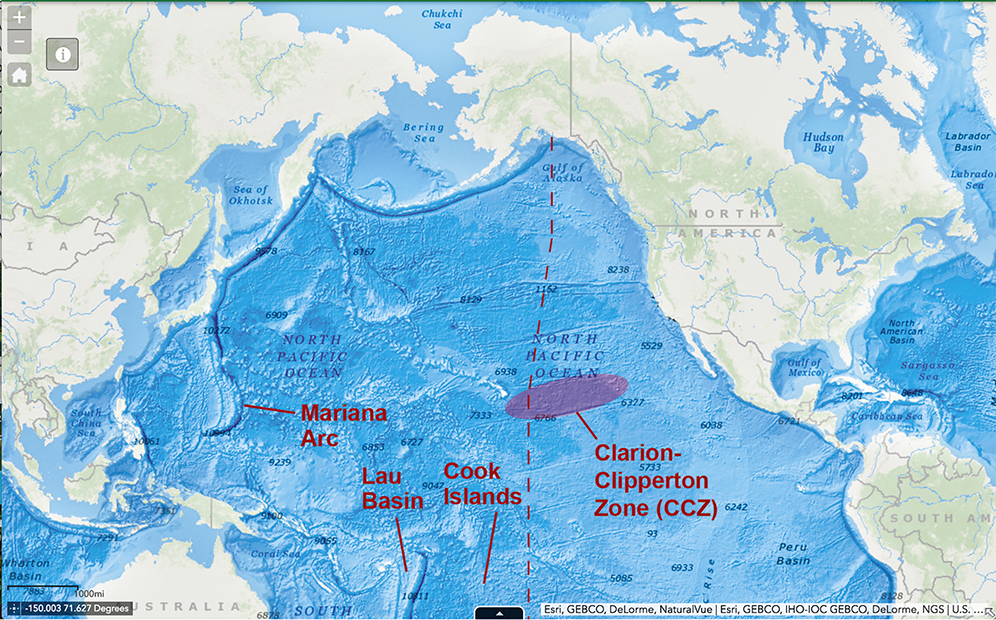
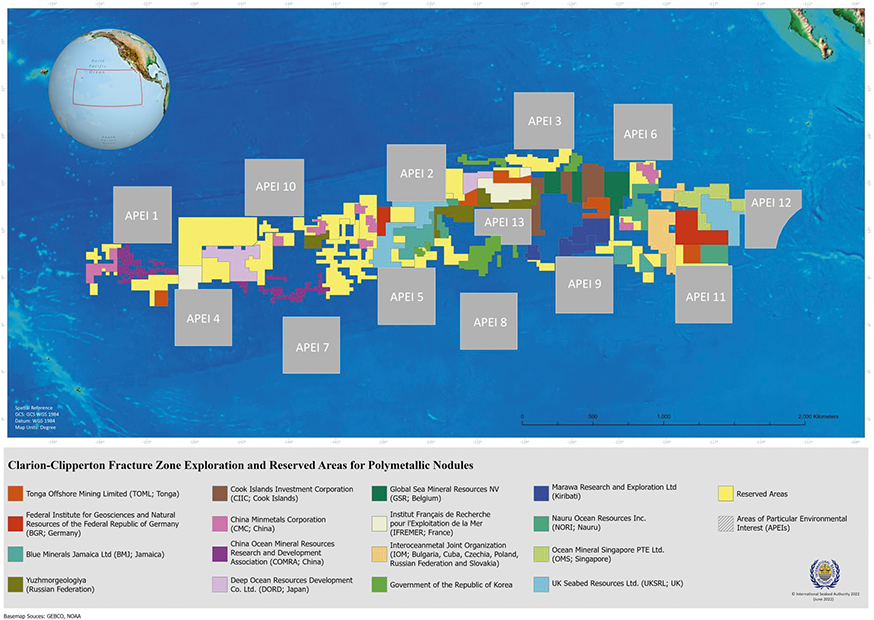
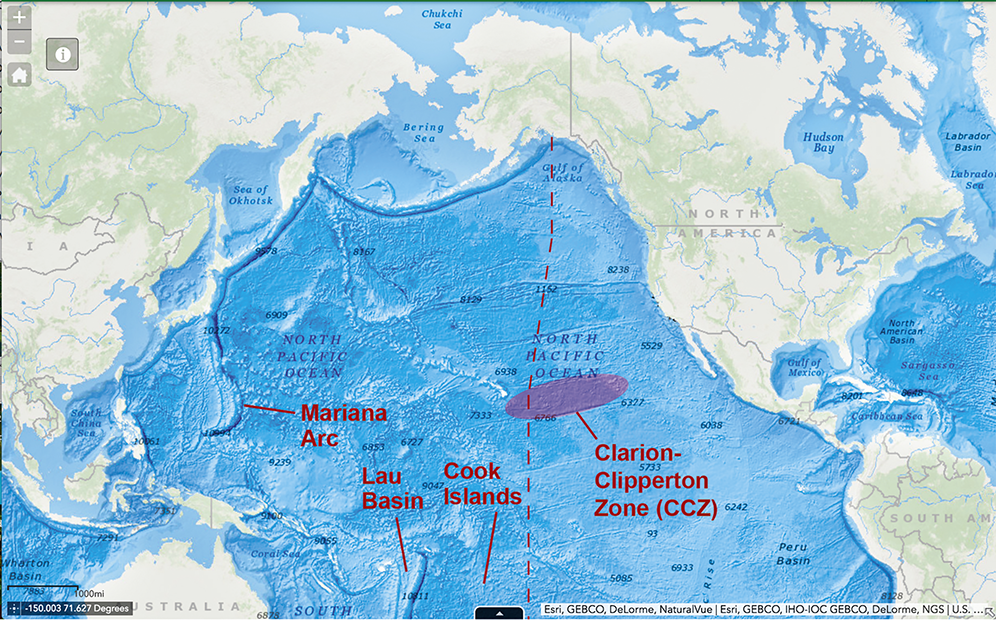
As part of the Area, the Clarion-Clipperton (Fracture) zone (CCZ)Footnote 4 in the equatorial eastern Pacific Ocean between Hawaii and Mexico (see Figure 1) is said to hold abundant supplies of polymetallic nodules, also known as manganese nodules. These nodules are rich in critical minerals such as magnesium, nickel, cobalt, and rare-earth elements. Contemporary DSM industry did not come into being until the 2010s when demands for minerals required by both green and digital transitions (the so-called twin transitions) began to grow (Bryan, et al., Reference Bryan, Hodgson and Dempsey2025). As the deep seabed functions as both an untapped significant source of critical minerals and a global common, mining activities on the deep seabed are going to exert significant impacts, both positive and negative, on human life.
Clarion-Clipperton fracture zone (CCZ)
Why global governance? The Area lies beyond national jurisdictions of sovereign states, and its management, as stipulated in Section 4 of Part XI of UNCLOS, falls within the remit of the ISA. The ISA aims to take global collective action to manage DSM because of the nature of public goods or public ‘bads’. Political economists differentiate between private and public goods by asking two questions: do the goods have the properties of ‘exclusion’ and ‘rival consumption’ (Stiglitz, Reference Stiglitz2000, p. 128)? The first question asks whether it is possible or practicable (i.e. without incurring enormous costs) to exclude any individuals from the benefits of the good or whether the good’s benefit is available to all, once it is supplied. The second question is whether one’s consumption of the good reduces or prevents another’s consumption of the same good simultaneously. If this is not the case (i.e. the marginal cost of extending the consumption of the good to additional users is zero), it will incur a gross welfare loss – and thus socially undesirable – to keep others from using the same good simultaneously (Sandler, Reference Sandler2004, p. 47). The most widely cited example of public goods is a lighthouse. No ships in the ocean can be effectively excluded from using a lighthouse and the benefit of the lighthouse can be used by more ships ‘without a noticeable degradation in quality or quantity’ (Sandler, Reference Sandler2004, p. 17). These public good properties give rise to the free-rider problem, whereby no consumers have the incentive to pay for the provision of the lighthouse and other public goods. Collective action by the state is often required to address the under-provision of public goods (Stiglitz, Reference Stiglitz2000, pp. 128, 131). Similarly, there are public ‘bads’ which have the same defining features. Examples include: environmental degradation or pollution, the spread of deadly infectious diseases, and transnational terrorism. Measures to contain or mitigate these public bads are regarded as public goods, albeit not necessarily pure.
A key feature of the deep seabed is non-excludability in consumption. As no states can claim sovereign rights to the seabed, no one can be excluded from using it. The deep seabed is understood as a global common, and the principle of common heritage of humankind (CHH)Footnote 5 is, in principle, observed. However, the potential environmental hazards created by DSM, which concern many scientists and environmental activists, are non-rival global public bads. One more individual suffering from their effects does not diminish or eliminate the suffering of others. In sum, they create the demand for collective action at the global level to regulate the use of the deep seabed and mitigate the harmful environmental impact of DSM (Chan, et al., Reference Chan, Lee and Chan2012, p. 20).
Global governance is the sum of rules, norms, institutions, and practices by means of which states, citizens, and intergovernmental and non-governmental organisations combine to address and manage a host of life- or wealth-threatening transnational problems at a global level, based on a recognition that the problems go beyond the capacity of individual states to tackle. The chief goal of global governance is to provide global public goods or regulate global public bads through collective action (Chan et al., Reference Chan, Lee and Chan2012, pp. 11, 21; Weiss, Reference Weiss2013, p. 32). Global governance of DSM is to ensure that the benefits of DSM are equitably shared by all humanity and that the costs of it are properly managed.
However, there is a battle between global governance and national governance over the commercial exploitation of deep-seabed minerals. In the midst of UNCLOS III negotiations, the USA and some industrialised countries had made national laws to govern DSM when they perceived that UNCLOS would cater more to developing countries.Footnote 6 The USA, then West Germany, and six other Western statesFootnote 7 signed a treaty in August 1984 to recognise mutually each other’s deep seabed claims to resolve overlapping claims, forming a so-called mini-treaty reciprocating states regime (RSR) (Sparenberg, Reference Sparenberg2019, p. 848).Footnote 8 Although 172 parties (as at 6 February 2026) worldwide have ratified UNCLOS,Footnote 9 the USA is not a party to it due to its Senate’s staunch opposition to the role of the ISA, as stipulated in UNCLOS. While USA presidential administrations since 1994, when the ISA was established, have engaged with the ISA informally as an observer, the second Trump administration (2025–29) decides to opt for a more explicitly national governance approach to DSM. In April 2025, President Trump signed Executive Order (EO) 14285, titled ‘Unleashing America’s Offshore Critical Minerals and Resources’, instructing the Department of Commerce, alongside a number of executive agencies,Footnote 10 to advance the exploration and exploitation of DSM both within the USA’s EEZ and in areas beyond its national jurisdiction (The White House, 2025b). This EO will effectively bypass the ISA, enabling American companies to access and exploit resources in the Area without seeking approval or coordination with the ISA (Baskaran & Schwartz, Reference Baskaran and Schwartz2025). While the legal basis for US unilateral resource exploitation in the Area, including the CCZ, remains uncertain (Kraska, Reference Kraska2025; Kraska & Rewatkar, Reference Kraska and Rewatkar2026), the intent and key objective of Trump’s EO is to secure critical mineral supply chains through a framework of national governance, using American domestic law.
On the other hand, China, while advocating for the enactment of a Mining Code for DSMFootnote 11 by the ISA as soon as possible, also engages in national governance by signing bilateral mining agreements with individual Pacific Island countries (PICs), which are geographically proximate to the CCZ. For the time being, a key objective is to exploit the deep-seabed minerals within their EEZs and continental shelves. The CCZ is thus the geostrategic area where China and the USA (and its Indo-Pacific allies) are competing for political influence. This China–USA competition for access to critical minerals sets the stage for our more in-depth discussion of how the deep-seabed minerals and DSM are to be managed, governed, and regulated.
We also ask whether major powers, Western or not, perceive or interpret the deep seabed and DSM from a similar perspective. As China is transitioning into a developed economic power in the current twenty-first century, whether it is still supportive of global governance of DSM, as many developing countries do, or comes to a shared understanding of DSM with the USA, is a moot point. This puzzle will form the core of the discussion in the following sections.
Constructivist-Interpretive Approach to the Study of DSM Governance
This Element aims to fill a lacuna in the literature on DSM, which has long been dominated by works in the fields of international law or environmental science, with insubstantial contributions from the discipline of International Relations (IR). To do so, this book adopts a constructivist-interpretive approach to the study of DSM governance by focusing on the concept of ‘social construct’ as well as its role in shaping human behaviour. As succinctly summarised by Craig Parsons (Reference Parsons, Lowndes, Marsh and Stoker2018, p. 90), ‘[c]onstructivism is a broad family of arguments built on the notion that people only arrive at certain actions due to their adoption of certain “social constructs” to interpret their world’.
A social construct is the construct or artefact created by a particular group of people; and it is an (un)intended product of a social practice (Haslanger, Reference Haslanger1995). It does not arise naturally or biologically and must be created and maintained through language (narrative or discourse), social or legal norms, and domestic or international institutions (Berger & Luckman, Reference Berger and Luckman1967; Searle, Reference Searle1996). In the field of IR, national sovereignty is a typical example of social construct (Biersteker & Weber, Reference Biersteker and Weber1996). In short, a social construct is something that ‘it [does] not have to be in this way’ (Parsons, Reference Parsons, Lowndes, Marsh and Stoker2018, p. 83) and could be otherwise; it can be challenged and changed through social interaction and practices.
The epistemology of interpretivism is often used by constructivists because it helps them understand the socially constructed nature of reality and appreciate the indeterminacy of the meaning of social constructs. An interpretive approach is premised on the claim that people act on their beliefs and preferences which cannot be directly deduced from ‘objective facts about them such as their social class, race, [religion,] or institutional positions’ (Bevir & Rhodes, Reference Bevir, Rhodes, Marsh and Stoker2002, pp. 132–133). Interpretive researchers seek to ‘understand how specific human beings in particular times and locales make sense of their worlds’; they study ‘context-specific meanings’ rather than ‘generalized’ ones (Schwartz-Shea & Yanow, Reference Schwartz-Shea and Yanow2012, pp. 10–11, 23).
The concept of social construct is appropriate for the study of DSM governance because of two reasons. First, critical minerals, as defined earlier, are a social construct. A mineral is critical only if it is ‘both essential in use and subject to the risk of supply restriction’. The utility of a mineral and the perceived risk of supply restriction do not arise naturally but are subject to human interpretation. Second, Part XI of UNCLOS, which outlines a DSM regime, is premised on the principle of ‘common heritage of humankind’, which itself is a social construct or an intended social product of developing states. Not only does it create a particularly constructed meaning to the deep seabed and the natural resources there, but also a new international institution, the ISA, to manage the resources on behalf of humanity. However, as an artefact it has met persistent resistance from developed countries which have been reluctant to fully accept its constructed meaning and instead wanted to contest or replace it by another social construct, freedom of the high seas. Interestingly, one can fathom an inherent dichotomy or conflict between Part XI and the rest of UNCLOS. Other parts of UNCLOS are indeed built on the social constructs of freedom of the high seas and national sovereignty (Tanaka, Reference Tanaka2019, pp. 22–25). As Susan Buck has argued, ‘the design of UNCLOS III was flawed because it tried to reach agreement on two completely different resource domains: the sea and the deep seabed’ (Buck, Reference Buck1998, p. 88). This has made it possible for the tension between the global governance advocated by the Global South and the national governance preferred by the Global North – now almost solely by the USA after the entry of UNCLOS into force in 1994 – to emerge and develop.
When constructivist-interpretive researchers study global governance, methodically speaking, they examine how various social actors, state and non-state, perceive discursively global, transnational problems through social constructs and how they arrive at their own preferences and actions accordingly. As far as DSM is concerned, they aim to study how relevant actors interpret, understand, and contest the meanings of social constructs of the CHH and freedom of the high seas in the specific context of deep-seabed mining and how they justify or challenge the authority of the ISA.
Governance of DSM: Tension between Global Governance and National Governance
In general, more economically industrialised and militarily powerful states are often tempted to territorialise the governance of the global commons by enacting national rules to govern the commons (Rossi, Reference Rossi2017).Footnote 12 As far as the deep seabed is concerned, there could be two different interpretations of the CHH in the USA that serve to justify its national governance approach. In 1980 when the US Congress enacted the Deep Seabed Hard Mineral Resources Act (DSHMRA), which establishes the legal framework for US citizens to exploit (or recover in American jargon) hard minerals on the deep seabed, it declared that ‘the nations of the world, including the United States, will benefit if the hard mineral resources … of the deep seabed beyond limits of national jurisdiction can be developed and made available for their use’ (Keating-Bitonti, Reference Keating-Bitonti2025, p. 10). This particular understanding of the impact of the DSHMRA emphasises the benefits of DSM to ‘the nations of the world’, including but not limited to the USA. The National Oceanic and Atmospheric Administration (NOAA), a federal agency within the Department of Commerce, is authorised by Congress to issue exploration and exploitation (or commercial recovery in US terminology) licences to US citizens. To date, Lockheed Martin is holding two exploration licences in the CCZ, USA-1 and USA-4, which remain active up to June 2027 (Keating-Bitonti, Reference Keating-Bitonti2025, p. 12). In line with the National Environmental Policy Act of 1969, NOAA is required to assess the potential marine environmental impact of the mining operation under consideration (Keating-Bitonti, Reference Keating-Bitonti2025, pp. 11–12). The CHH principle is thus alleged to be adhered to by the DSHMRA and NOAA (Kraska & Rewatkar, Reference Kraska and Rewatkar2026, pp. 22–26).
The other interpretation was that the CHH ‘lacked precise legal content’ necessary for constituting a binding legal regime for DSM (Ranganathan, Reference Ranganathan2014, p. 151). The USA rather claimed that, at least until UNCLOS’s entry into force, exploitation of the deep seabed would be governed by the principle of freedom of the high seas pursuant to the Convention on the High Seas of 1958, which entered into force in September 1962. So, in 1980–85, the USA and other Western industrialised states had enacted domestic laws to grant licences for the exploration and exploitation of the deep seabed, espousing freedom of the high seas (Ranganathan, Reference Ranganathan2014, pp. 151, 161–163).
This second interpretation, which in both practice and ideology rejects the CHH (Ranganathan, Reference Ranganathan2014, p. 171), is likely to be adopted by the Trump administration in 2025. Armed by the principle of freedom of the high seas, US companies have the right to explore and exploit deep-seabed minerals freely. This discourse provides the legitimation for national governance of DSM, using US domestic law.
The US national governance approach has eroded the CHH norm and may set a precedent that may encourage other countries to ignore or bypass global governance. Acting through its US subsidiary (TMC USA), The Metals Company (TMC), a Vancouver-based Canadian mining corporation, applied to NOAA for two exploration licences and one commercial recovery permit in late April 2025, shortly after EO 14285. It submitted a consolidated application, which integrates application for an exploration licence and a commercial recovery permit, to NOAA in January 2026, after NOAA streamlined the regulatory review process (Keating-Bitonti, Reference Keating-Bitonti2026b). National governance is also happening in the South Pacific.Footnote 13 With the sponsorship of Nauru, a small PIC within the Micronesia subregion, TMC, through its subsidiary Nauru Ocean Resources Inc. (NORI), was granted a 70,000-square-kilometre concession exploration contract in the CCZ by the ISA in 2011. In June 2021, Nauru informed the ISA that NORI would intend to start DSM in two years, triggering the ‘two-year rule’ to urge the ISA to make international rules for extracting deep-seabed minerals (Singh, Reference Singh2021). By the expiry of the two-year rule in July 2023, however, negotiations had failed to conclude or finalise any Mining Code (Pickens et al., Reference Pickens, Lily, Harrould-Kolieb and Blanchard2024).
In light of US unilateralism, other major powers, notably China, might accelerate its own DSM efforts and assert their right to exploit resources in the high seas, ahead of global consensus or scientific understanding. During UNCLOS III (1973–82), China was strongly opposed to the application of freedom of the high seas to the Area; instead, it argued that the Area’s resources are ‘commonly owned by all the peoples in the world’. It also expressed its displeasure that the DSM regime outlined in Part XI had given ‘too much advantage to a few industrialised countries’ (Liu & Kim, Reference Liu and Kim2016, pp. 692, 693). Now China has become an industrialised and naval power. Currently, China, South Korea, and Russia are the only states that sponsor exploration of all three types of deep-seabed minerals – polymetallic nodules, polymetallic sulphides, and cobalt-rich ferromanganese crusts – in the Area.Footnote 14 It is clearly observed that China no longer ‘passively [seeks] benefits shared by developed countries in the spirit of the common heritage of mankind’; rather, it ‘actively [seeks] direct benefits from the Area’ (Liu & Kim, Reference Liu and Kim2016, p. 693). China also indirectly benefits from the 1994 Implementation Agreement, which effectively removes the objections to accession to UNCLOS by major Western industrialised powers except the USA.Footnote 15 After it, the ISA began to be operational (in November 1994), and China has received five exploration contracts from it and allegedly ‘has considerable influence over the development of the Mining Code as a key member of the (ISA) Council’ (Liu & Kim, Reference Liu and Kim2016, p. 693).
Externally, China is collaborating with Nauru and the Cook Islands in advocating commercial DSM. Nauru, the Cook Islands and KiribatiFootnote 16 are three of fourteen countries that hold licenses to explore the CCZ for polymetallic nodules. In fact, Nauru is the most active country in advocating commercial DSM under the ISA. The resumption of diplomatic relations between China and Nauru in January 2024 may give fresh impetus to commercial DSM. After Trump’s EO 14285, Chinese ambassador to Nauru, Lu Jin, and Nauruan president, David Adeang, met in May 2025 to discuss coordination efforts in fast-tracking seabed mining. China also held discussions with Kiribati and the Cook Islands on the same issue between April and May 2025 (Hicks, Reference Hicks2025). The signing of the ‘Action Plan 2025–2030 for the Comprehensive Strategic Partnership between the Cook Islands and China’ in mid-February 2025 in Beijing was a key step for the two countries to lock up critical minerals as their national wealth, rather than following the CHH principle. This Action Plan covers the condition that the Chinese People’s Liberation Army’s Navy is cooperating with China’s mining companies in the exploration and exploitation of critical minerals in the South Pacific. The Cook Islands Seabed Minerals Authority (CISMA) also attended the meeting when the Action Plan was signed in Beijing and engaged in discussions with the Chinese government about mineral exploration (Bradly, Reference Bradly2025). It is open to question whether China has a new interpretation of the meaning of social construct or whether China begins to embrace the conflicting social construct, freedom of the high seas.
Key Arguments of This Element
This Element focuses on DSM in the Area, beyond coastal states’ limits of national jurisdiction, which falls within the remit of the ISA. Although DSM itself is not a novel activity and can be dated back to the 1960s, it has attracted growing attention in recent years due to the intensifying rivalry between China and the USA in obtaining access to critical minerals, which is now interpreted as a matter of national security. Deep seabed is deemed to be of strategic significance because, according to some scientists’ estimates, critical mineral deposits are more abundant on the deep seabed than on land.
From a scholarly point of view, DSM has been a subject matter of international law or environmental science, with little contributions from the field of IR yet. Governing DSM in the Area is, however, a matter of international politics. The rule-making process is shaped by state preferences amid interstate negotiations, and rule-making takes place in an intergovernmental organisation, the ISA. It is always state representatives who make the rules. The key political questions of where state preferences come from and how state leaders justify them remain unaddressed. To fill this lacuna, this Element examines DSM from a constructivist-interpretive IR perspective, which asks through what social construct major actors interpret and understand the social world and then come to their own decisions and actions. The primary social construct in Part XI of UNCLOS is the notion of the CHH. Not based on any natural truth, Part XI regards resources collected from areas beyond national jurisdiction (ABNJ) as the CHH. Accordingly, the utilisation of mineral resources recovered from the deep seabed ought to be beneficial to all humanity, regardless of where they live and whether they contribute to the mining. Largely because of this understanding of the CHH, transnational harm to marine habitats arising from DSM has become a matter of global concern. But this particular interpretation of the meaning of the deep seabed is being contested by the USA.
Due to space constraints, this Element can only deal with how the USA and China, currently the two major powers in world politics, interpret and understand the CHH principle and arrives at their own decisions about DSM. What is particularly noteworthy is that when UNCLOS and the Implementation Agreement were adopted in 1982 and 1994, respectively, the power and status of the USA and China differed significantly. The USA was the most industrialised advanced country and naval power, while China was an impoverished developing country only, especially in the early 1980s. Their understandings of the CHH were unsurprisingly divergent from each other. Nowadays, however, China is widely regarded as a rising power in the world. Does it still look at DSM through the old understanding of the CHH of the 1980s and 1990s?
Even though the USA is not a party to UNCLOS, US presidential administrations since the 1980s have not initiated an alternative DSM regime. The ISA-centred DSM regime based on the Mining Code, albeit only emerging, has been widely believed as the ‘only game in town’ (Noyes, Reference Noyes2011–12, p. 465). However, this has been given a fundamental far-reaching change by President Trump’s EO 14285 in April 2025. The USA may use its domestic law, the DSHMRA, to grant exploration and exploitation licences to US-based companies, for example, TMC USA, allowing them to exploit minerals from the CCZ.
One is tempted to ask whether the rise of this US national governance regime would likely push the ISA and its member states to speed up the finalisation of the Mining Code or whether US unilateral approach would prompt other major states, notably China, to follow suit by using the Chinese Deep Seabed Law or the domestic law of a partner state in the Pacific Ocean, for example, Nauru, to start the mining process in either the EEZ or the Area.
A historical review of the growth of the DSM regime informs us that industrialised countries have uniformly favoured national governance while developing states have used global governance and international institutions to counter the monopolisation of DSM by developed states and their private mining corporations. They have perceived DSM from different social constructs. Up to the end of the twentieth century, all industrialised countries were Western (including Japan), but it is no longer the case in the current twenty-first century. Would present-day China hold the same perception of DSM as Western developed countries’ understanding of the CHH?
The remainder of this Element will primarily address this battle between global and national governance of DSM and between China and the USA in controlling the supply chains of critical seabed minerals. After this Introduction, Section 2 will first discuss in more detail the theoretical framework of this study, which uses a constructivist-interpretive approach to examining the governance of DSM. It then examines the social construction of the high seas and the deep seabed, as parts of global commons, in terms of freedom of the high seas and the CHH, respectively. The latter was advanced by newly independent developing states in the age of decolonisation and advocacy of the New International Economic Order (NIEO) in the 1960s–1970s. Both the CHH and the NIEO were premised on the notion of equity, which indeed called for wealth redistribution from developed to developing countries. This gave rise to US principled disagreement with the CHH principle and Part XI of UNCLOS. Despite not having ratified UNCLOS, the USA has engaged with UNCLOS and the ISA. It has adopted EEZ and freedom of navigation, signed the 1994 Implementation Agreement, and has been an observer to the ISA.
Section 3 will deal with the emergence of global governance in managing the deep seabed and, more importantly, the international politics of establishing a global Mining Code under the leadership of the ISA. A major obstacle to the adoption of the Mining Code is the disagreement among member states over the social meaning of ‘equity’, which may refer to equitable sharing of benefits derived from DSM, equitable participation, and inter-temporal (or inter-generational) equity. The latter gives rise to environmental awareness of the adverse impacts of DSM on marine ecosystems and, more recently, calls for a moratorium on DSM. Disappointed by the stalled rule-making process, some mining companies and countries are in partnership with each other to explore mining within their national jurisdictions.
Section 4 will focus on the perceived imperative of mining critical minerals in the context of great-power rivalry between China and the USA, and how they (re)interpret the principle of the CHH and freedom of the high seas in legitimising their respective DSM policy. In addition, it contends that Trump perceives DSM through the ‘Make America Great Again’ (MAGA) New Right’s disdain for liberal internationalism, in addition to the traditional freedom of the high seas. This makes sense of his unprecedented authorisation of unilateral mining in the Area. On the other hand, China appears to have a revised understanding of the CHH. It tweaks common ‘heritage’ into common ‘interests’, suggesting that it harbours reservations about sharing material benefits with developing countries equitably.
Finally, the Element will argue that a ‘Grotian moment’, a period of rapid and paradigm-shifting development (Scharf, Reference Scharf2021), for the enactment of a Mining Code will less likely arrive. The enactment of a Mining Code, if any, would not make DSM in the Area commercially viable. There are mounting financial concerns over the payment regime and environmental liabilities. The most likely ‘mainstream’ scenario would be moratorium. However, DSM may take place in areas within national jurisdiction, to which the Mining Code may not necessarily be applied.
2 A Constructivist-Interpretive Approach
Theoretical Framework
This Element’s theoretical framework is built on constructivism and interpretive theory. Common to the constructivist approach to international politics, including its seminal works such as Finnemore (Reference Finnemore1996), Katzenstein (Reference Katzenstein and Katzenstein1996), Kratochwil (Reference Kratochwil1989), Onuf (Reference Onuf1989), and Wendt (Reference Wendt1999), is the argument that ‘people only arrive at certain actions due to their adoption of some “social constructs” to interpret the world’ (Parsons, Reference Parsons, Lowndes, Marsh and Stoker2018, p. 90). These social constructs or ‘interpretive filters’ are often referred to as non-material ideas, beliefs, norms, and identities (Parsons, Reference Parsons, Lowndes, Marsh and Stoker2018, p. 75).
Integral to constructivism is the notion of ‘contingency’ (i.e. ‘it [does] not have to be this way’) (Parsons, Reference Parsons, Lowndes, Marsh and Stoker2018, pp. 82, 83). The natural world is indeterminate for human action, and what policy-makers do (or do not do) is affected by certain ‘social constructs’ or ‘interpretive filters’ through which they perceive and interpret the world (Parsons, Reference Parsons, Lowndes, Marsh and Stoker2018, p. 75). To slightly paraphrase Parsons (Reference Parsons, Lowndes, Marsh and Stoker2018, pp. 82–83), ‘certain people face an indeterminate set of “real” conditions, and only arrive at a course of action as they adopt certain social constructs’. These social constructs are therefore said to have ‘constitutive power’ (Parsons, Reference Parsons, Lowndes, Marsh and Stoker2018, p. 82).
Many, albeit not all, constructivists adopt an interpretive epistemology, which argues that it is people’s interpretations of social phenomena that directly affect their behaviour and social outcomes, and their interpretations can only be understood within discourses and contexts, of which social action is a part. Interpretivists claim that people act on their beliefs and preferences which cannot, however, be directly deduced from ‘objective facts about them such as their social class, race, [religion,] or institutional positions’ (Bevir & Rhodes, Reference Bevir, Rhodes, Marsh and Stoker2002, pp. 132–133). Akin to constructivists, interpretive researchers are well aware of the ‘indeterminacy’ of meaning (Lynch, Reference Lynch2014, p. 22). With the belief that the world is socially or discursively constructed, interpretive research is neither about determining ‘causal relations’ in a mechanical sense nor as ‘objective’ as the natural sciences can be (March, et al., Reference March, Ercan, Furlong, Lowndes, Marsh and Stoker2018, p. 190).
Interpretive researchers ask: ‘how the actors in them understand their context, explicitly and/or tacitly, and why they conduct themselves in particular ways’ (Schwartz-Shea & Yanow, Reference Schwartz-Shea and Yanow2012, p. 52). The ‘why’ question takes the form of ‘constitutive causality’ that tries to ‘explain events in terms of actors’ understandings of their own contexts, rather than in terms of a more mechanistic causality’, which is called a ‘billiard ball’ understanding by positivists. To study constitutive causality means the study of how ‘humans conceive of their world, the language they use to describe them, and other elements constituting that social world, which make possible or impossible the interactions they pursue’ (Schwartz-Shea & Yanow, Reference Schwartz-Shea and Yanow2012, p. 52). In short, it examines what has made it (im)possible for actors to act as they do. With acknowledging the existence of multiple social realities, interpretivists aim to create ‘local’ (Schwartz-Shea & Yanow, Reference Schwartz-Shea and Yanow2012, pp. 50, 51, 53, 65, 74, 94, 133) or ‘provisional’ (i.e. subject to change) (March, et al., Reference March, Ercan, Furlong, Lowndes, Marsh and Stoker2018, p. 192), rather than generalised, knowledge only.
Interpretivism comes under the influence of hermeneutics and poststructuralism (Bevir & Rhodes, Reference Bevir, Rhodes, Bevir and Rhodes2016, pp. 12–14). They are interested in the discourse and intentional meaning surrounding the social constructs at work. The role of language is particularly significant because, for poststructuralists, any knowledge of ‘the world’ outside is always dependent on representations of ‘it’. Social knowledge is therefore unthinkable outside interpretation and the politics of representation (Peoples & Vaughan-Williams, Reference Peoples and Vaughan-Williams2020, p. 77). A discourse assigns a possible meaning to a specific event. To paraphrase Lene Hansen, a heart attack can be attributed to a ‘lifestyle’ discourse, a ‘genetic’ discourse, or a ‘religious’ discourse (e.g. as a divine punishment). Each discourse says differently what holders believe to be the primary cause of the heart disease and accordingly what can or should be done to prevent the disease (Hansen, Reference Hansen, Baylis, Smith and Owens2014, p. 172). A discourse creates social reality by constructing ‘what is knowable, sayable and doable’ within a particular historical context (Halperin & Heath, Reference Halperin and Heath2012, p. 311). The relationship between discourse and public policy is that policymakers ‘need an account, or a story, of the problems and issues they are trying to address’, as the ‘facts’, ‘events’, and ‘material factors’ do not in and of themselves produce policy (Hansen, Reference Hansen2006, pp. xvi, 214). According to poststructuralism, language is politically significant because political actors must legitimise their policies to audiences at home and abroad discursively (Hansen, Reference Hansen, Baylis, Smith and Owens2014, p. 172). A discourse aims to change the terrain of political debate by excluding or foreclosing some policy options from deliberation and consideration. Inherent in discourse analysis, which explores how a discourse gives legitimacy and meaning to social practices and institutions (Halperin & Heath, Reference Halperin and Heath2012, p. 309), is ‘otherness’. Otherness entails the social construction of other(s) as different from and threatening to us/self (Dalby, Reference Dalby1990, pp. 4–16; Steans et al., Reference Steans, Pettiford, Diez and El-Anis2010, pp. 141–142).
Constructivist-interpretive IR researchers ask: through which social constructs do national leaders under study interpret or understand the social world, and how do they describe their actions and policies and legitimise them discursively? As discussed in detail in what follows, the key social construct regarding DSM is the norm that deep-seabed and the associated mineral resources ought to be regarded and regulated as the ‘common heritage of humankind’. It identifies freedom of the high seas as its ‘other’. Accordingly, the use of the mineral resources ought to be beneficial to all humanity; otherwise, they ought to be left unscathed or ought not to be exploited.
Behind this normative ‘consensus’, there are three competing discourses, namely (1) the ‘green-digital twin transition’ discourse (suggesting that the utilisation of deep-seabed minerals are beneficial to all humanity for facilitating the transition to green energy economy); (2) the ‘environmental hazard’ discourse (suggesting that the exploitation of the minerals most likely causes irreparable damage to the environment and all humanity); and (3) the ‘sparing the land’ discourse (suggesting, albeit less vocal than the former two, that DSM does not necessarily cause more environmental damage than the existing terrestrial mining). Their proponents are calling for the ISA to lead the governance of the deep-seabed resources either by writing the rules for, or endorsing a moratorium on, DSM.
However, there is a countervailing social construct, freedom of the high seas, which rejects the notion of a CHH. The Trump administration is apparently embracing this social construct and contends that the minerals on the deep seabed are open to national appropriation. This discourse provides the legitimation for the national governance of DSM, using US domestic law.
These set the stage for the battle and tension between global and national governance of DSM (as we shall return to it later).
Social Construction of the High Seas and the Deep Seabed
The high seas and the deep seabed are considered or socially constructed as parts of the global commons, which can be defined as ‘resource domains to which all nations have legal access’ where resource domains are ‘the fixed spatial dimension in which resources are found’ (Buck, Reference Buck1998, pp. 192–193). In sum, global commons are the fixed spatial dimension in which resources are found and to which all nations have legal access. The high seas and the deep seabed, comprising the waters and natural resources beyond the sovereign jurisdiction of any state, have been widely – but not universally – seen as global commons. They share two key properties with global public goods, namely non-excludability (i.e. no one can be effectively excluded from using them) and non-rivalry (i.e. there is no rival consumption of the environmental damages to them), and thus require a transboundary, collective form of governance. Next, we discuss the high seas and the deep seabed separately, as they are ‘two completely different resource domains’, albeit addressed in the same treaty, UNCLOS (Buck, Reference Buck1998, p. 88) (emphasis added).
The High Seas and Freedom
Historically speaking, the term ‘commons’, in old English and Dutch laws, referred to a system in which property or resources were collectively owned and shared for mutual use. They ‘belonged to everyone and yet were from no one’ (Schrijver, Reference Schrijver2016, p. 1253). The term ‘global commons’ is derived from the Dutch humanist and lawyer Hugo Grotius’s (1583–1645) seminal book, Mare Liberum (Freedom of the Seas, 1609). But Grotius, in turn, drew on the Indo-Asian sea-surfing practices and norms prevalent up to the end of the fifteenth century when the Portuguese, the Spaniards, and the Dutch were competing for the spice trade in Asia (Heritage & Lee, Reference Heritage and Lee2020, p. 8). At the request of the Dutch Republic (1579–1795), which was negotiating with Spain for a truce during the Eighty Years’ War of 1568–1648,Footnote 17 Grotius argued that the high seas were global commons, not subject to the exclusive dominion of any single state.Footnote 18 No state could exercise sovereignty or sovereign rights over the high seas. He was contemporarily countered by the Englishman John Selden, who advocated the doctrine of mare clausum (closed seas). Contemporary law of the seas is, to a large extent, shaped by the contestation between these two principles (Heritage & Lee, Reference Heritage and Lee2020, p. 8).
While ‘open access’ or ‘freedom of access’ was the starting point, the freedom to navigate also implied ‘the freedom to take’ (Marcos, Reference Marcos2025). The original mare liberum principle gradually ‘digressed’ into a ‘first-come, first-served’ regime that had primarily benefited industrialised countries (Schrijver, Reference Schrijver2016, pp. 1252, 1263). Before 1945, the oceans were broadly divided into two zones only: the territorial sea and the high seas. The former was then normally of three nautical miles from the coast, based on the ‘cannon-shot rule’ of the eighteenth century, and under the territorial sovereignty of the coastal state (Churchill, et al., Reference Churchill, Lowe and Sander2022, p. 137). Beyond the territorial sea was the high seas, governed by the principle of freedom of the high seas advocated by Grotius. This simple maritime order was given a fundamental change by the Truman Proclamation of 1945, which coined the concept of ‘continental shelf’ (Churchill et al., Reference Churchill, Lowe and Sander2022, pp. 224–225). The Proclamation articulated the US unilateral claim to the natural resources on its continental shelf. The other twenty coastal states followed suit by laying similar but not identical claims to their own continental shelves beyond their shores. This confusing situation led to the convening of the first United Nations Conference on the Law of the Sea (UNCLOS I) in 1958, which adopted four Conventions.Footnote 19 The Convention on the Continental Shelf, however, did not define the outer limit of the continental shelf clearly. The ‘exploitability’ criterion it used was believed to be in favour of the seaward expansion of more advanced Western countries (Churchill et al., Reference Churchill, Lowe and Sander2022, p. 229).
Deep-Seabed Resources and the CHH
The natural resources in the deep seabed beyond national jurisdiction (i.e. the Area) are defined by UNCLOS’s Article 133 as ‘all solid, liquid or gaseous mineral resources in situ in the Area at or beneath the seabed, including polymetallic nodules’ (United Nations, 1982, Art. 133).
On the surface, natural resources, as defined earlier, are ‘natural’, but they can also be perceived collectively as a social construct. As argued by Sparenberg (Reference Sparenberg2019, p. 844) the term ‘resource’ does not denote a fixed quantity of something; rather, it serves as a ‘function of satisfying a want’. Minerals themselves are ‘neutral stuffs’ and their strategic values are not fixed, depending on how human beings perceive the minerals’ utilities to their well-being. Polymetallic (or manganese) nodules are an example. After their discovery in the nineteenth century, they were initially perceived as ‘neutral stuffs’. However, given the expectations about their function as future sources of useful metals, they have become a resource since the 1950s. This social construction of polymetallic nodules as a resource was followed by an advance in technological capabilities to undertake maritime exploration and exploitation (Koskenniemi & Lehto, Reference Koskenniemi and Lehto1996, p. 536)Footnote 20 as well as the independence of former colonies of Western powers in the 1960s.
Prior to the adoption of UNCLOS, there were three different perspectives on the question of who could legally appropriate the deep seabed (outside sovereign jurisdiction) and natural resources on it. One argued that coastal states could exercise sovereign rights to them. This view was common among international law scholars before the mid-1960s (Van Dyke & Yuen, Reference Van Dyke and Yuen1982, p. 503). The second used the res communis (‘common thing’) principle, saying that the deep seabed and resources were available for use by all who enjoyed the freedom of the high seas, although they could not be appropriated by any states. The strongest proponents were the USA and other RSR states (Ranganathan, Reference Ranganathan2014, p. 172). The third adopted the res nullius (‘thing of no one’) principle whereby the deep seabed and resources were open to appropriation by all states. This was promoted by a couple of scholars such as Northcutt Ely and Louis Frederick Edward Goldie, and mining companies (Van Dyke & Yuen, Reference Van Dyke and Yuen1982, p. 518). Irrespective of which interpretations were adopted, the most advanced industrialised countries were best placed to explore and exploit deep-seabed resources (Tanaka, Reference Tanaka2019, pp. 217–218). In the 1960s, mining companies in the West began to imagine that they could mine the minerals from the seabed profitably (Cannistraro, Reference Cannistraro2013). When John L. Mero, the first advocate of DSM, wrote his seminal book, The Mineral Resources of the Sea (1965), he believed that polymetallic nodules were up to grabs for advanced industrialised states. More powerful coastal states began to lay claims to more areas of the ocean to exploit more minerals or living resources such as fish. These gave rise to the notions of EEZ and continental shelf and to the practices of drawing out maritime boundaries of coastal states. They had expected that this expansionist trend would go unhindered until the ocean was fully divided by them (Sparenberg, Reference Sparenberg2019, p. 847). An additional ‘advantage’ of DSM, for industrialised countries, was its remoteness from human populations. It would carry less political risk than terrestrial mining for mining companies (Feichtner, Reference Feichtner2019, p. 613).
With little say in UNCLOS I, newly independent (now designated as developing) states in the 1960s were determined to stop the West from colonising the ocean and were collectively opposed to the implementation of the de facto ‘first-come, first-served’ rule and the predominance of developed countries in mining (Buck, Reference Buck1998, pp. 28–29). This post-colonial concern over ‘a neo-imperial race for the deep seabed’ (Feichtner, Reference Feichtner2019, p. 605) among the Group of 77 (G-77), the largest group of developing countries in the UN,Footnote 21 set the stage for Malta to lead the identification of the deep seabed to the CHH.Footnote 22 Arvid Pardo (1914–99), then Malta’s ambassador to the UN, proposed the principle of CHH in a speech to the UN General Assembly in November 1967. He argued that certain geographical areas (such as the seabed beyond national jurisdiction) and the resources there were understood to be the property of all humanity, and consequently, the benefits of exploiting the resources were to be shared by all (Malta, Reference Malta1967). In other words, the resources extracted from there cannot be legally owned by any individual or state, regardless of their roles in the extraction; instead, they belong to all of humanity. Three years later, the CHH was first affirmed by the Declaration of Principles Governing the Sea-Bed and the Ocean Floor, and the Subsoil Thereof, beyond the Limits of National Jurisdiction, adopted by the UN General Assembly in December 1970 (Paragraph 1).Footnote 23
The CHH was further tied to the NIEO movement in the following decade of the 1970s, which called for the creation of a more equitable global economic system to reduce economic inequalities between developing and developed countries, challenging the liberal economic order advocated by Western industrialised states (Friedheim & Durch, Reference Friedheim and Durch1977; Koskenniemi & Lehto, Reference Koskenniemi and Lehto1996, pp. 539–540). The NIEO notion was adopted by the UN General Assembly in Resolution 3201 (S-VI) in May 1974.Footnote 24
G-77 states saw in the resource-rich deep seabed a potential for ‘engineering a new world order of substantial economic justice’ (Zhou & Xie, Reference Zhou and Xie2024, p. 692). During the UNCLOS III negotiations, developing countries were attempting to ‘operationalize’ the CHH principle (Buck, Reference Buck1998, p. 86). Generally speaking, they saw the oceans and the deep seabed as a ‘new’ source of economic development and were all in favour of global governance of DSM to counter the domination of more industrialised Western countries. They hoped that economic inequality between the Global North and the Global South could be reduced through global governance by an international institution, acting on behalf of humankind. This would enable their effective participation in the exploitation of seabed minerals and the redistribution of revenue derived from exploitation (Feichtner, Reference Feichtner2019, p. 603). Wealth redistribution from developed to developing countries lay behind both the principle of the CHH and the NIEO movement.
UNCLOS’s Preamble and Article 136 explicitly link the deep seabed and its resources with the CHH principle (United Nations, 1982, Preamble, Art 136). The CHH principle would entail the following features (Noyes, Reference Noyes2011–12, pp. 450–51; Jaeckel et al., Reference Jaeckel, Gjerde and Ardron2017, p. 152):
No exercise of sovereignty over the Area and the resources;
The vesting of rights to the resources in humankind as a whole;
Peaceful use of the Area;
Protection of the natural environment;
Equitable sharing of benefits from the exploitation of the resources, and paying attention to the interests and needs of developing countries; and
Governance of the Area and the resources via a common management regime.
With this socially constructed meaning of the CHH, UNCLOS, in its Preamble, affirms that the legal maritime order established through the Convention will:
contribute to the realization of a just and equitable international economic order which takes into account the interests and needs of mankind as a whole and, in particular, the special interests and needs of developing countries, whether coastal or land-locked.
The reference to a just and equitable international economic order highlights the principle of equity, albeit a slippery concept. First, it may stipulate that ‘all manage [natural] resources and share in the rewards of exploiting them, even if they are not able to participate in that exploitation’ (Noyes, Reference Noyes2011–12, p. 447). Second, not only should it refer to fairness among countries but also to fairness between peoples in current and the future generations, as the meaning of ‘humankind’ is understood to not only include all people now on the earth (an ‘intra-temporal’ interpretation), but also both present and future generations (an ‘inter-temporal’ interpretation, ensuring fairness across time in welfare) (Noyes, Reference Noyes2011–12, p. 451; Tanaka, Reference Tanaka2019, pp. 25–26).Footnote 25 Therefore, sustainable development and equitable distribution ought to go hand in hand in governing global resources and global commons. The distribution of benefits from extracting natural resources on the seabed should focus on protecting the common interests of humanity and ensuring equitable sharing. This should serve as the ultimate objective when developing a DSM regime (Bourrel et al., Reference Bourrel, Thiele and Currie2018).
We conceptualise the CHH as a socially constructed norm because it is not based on any undisputed ‘natural truth’ to assert that resource domains beyond the limits of national jurisdiction are ‘all humanity’s inheritance’.Footnote 26 For example, why do people in Europe and Africa have, in principle, equal stakes as those in PICs in the resource domain in the CCZ in the Pacific Ocean? The normative ‘oughtness’ claim itself is a social construct that prescribes what states and non-state actors ought to do with natural resources outside the jurisdiction of states in a socially appropriate manner.Footnote 27 Human interpretations are crucial for shaping and influencing the social meaning of natural resources beyond national jurisdiction as well as the collective expectations for the proper behaviour of various actors in utilising the resources, as long as they want to be recognised as respectable members of the global community. However, social norms, as social constructs, are open to contestation over their applicability and/or validity (or righteousness), and their social meanings are never fixed (Wiener, Reference Wiener2014; Deitelhoff & Zimmermann, Reference Deitelhoff and Zimmermann2020). The CHH, albeit enshrined in Article 136 of UNCLOS as a principle governing the Area, has been contested by Western industrialised countries, particularly the USA.
Western developed countries have historically preferred national governance to global governance. Since the end of World War II, particularly after the oil crisis of 1973, developed states had perceived mineral import dependence on developing countries as a vulnerability. Mineral producers in the Global South had formed cartels similar to the Organisation of Petroleum Exporting Countries (OPEC). A typical example was the Intergovernmental Council of Copper Exporting Countries (CIPEC, derived from the French name of the organisation). This had motivated Western industrialised countries as mineral consumers to ponder exploiting deep-sea critical minerals.
The American Contestation
The USA has argued that the CHH principle ought to be regarded as equivalent to the freedom of the high seas, whereby no single country exercises sovereignty over the deep seabed but ‘may acquire exclusive property rights in its resources’ (Noyes, Reference Noyes2011–12, p. 451). There have been disputes as to whether ‘preferential treatment’ ought to be given to developing countries (Noyes, Reference Noyes2011–12, pp. 452–453). In January 1982, the Reagan administration announced, ‘While most provisions of the draft convention are acceptable and consistent with U.S. interests, some major elements of the deep-seabed mining regime are not acceptable’ [cited in Oxman (Reference Oxman1994, p. 688)]. His administration had associated the Enterprise with ‘international socialism’ (Koskenniemi & Lehto, Reference Koskenniemi and Lehto1996, p. 543). Thus, the USA voted against the Convention while three other major G-7 countries, namely Italy, the UK, and then West Germany, abstained (Bräuninger & König, Reference Bräuninger and König2000, p. 604; Tanaka, Reference Tanaka2019, p. 37).Footnote 28 Many industrialised countries had withheld ratification until the Implementation Agreement was adopted by the UN General Assembly in June 1994 (Oxman, Reference Oxman1994, p. 687).Footnote 29
The 1994 Implementation Agreement was under negotiations (in 1990–94) (Koskenniemi & Lehto, Reference Koskenniemi and Lehto1996, pp. 546–552) when the NIEO was losing traction because of the emergence of the pro-free market Washington Consensus under the Reagan-Thatcher revolution and the spread of economic globalisation after the end of the Cold War. It aimed to address some concerns over equitable distribution expressed by the USA and other developed countries. Developing countries were willing to make compromises because, based on the ratifications having been secured by the end of the 1980s, UNCLOS was expected to enter into force in the early 1990s. As developed states would not accede to the treaty without substantial revisions of Part XI, the financial burden of the establishment and operation of the ISA would be shouldered by the existing state parties, which were predominantly developing countries (Koskenniemi & Lehto, Reference Koskenniemi and Lehto1996, p. 547; Churchill et al., Reference Churchill, Lowe and Sander2022, p. 423).
The 1994 Implementation Agreement ‘substantially accommodates the objections of the United States and other industrial states to the deep-seabed mining provisions of [UNCLOS]’ (Oxman, Reference Oxman1994, p. 695). Accordingly, three original provisions in UNCLOS ‘shall not apply’. They are: the provision for the mandatory transfer of technology to developing states via the Enterprise; the provision for funding the Enterprise by state parties; and the provision for a Review Conference that might have resulted in amendments to Part XI binding on state parties even without their consent. In addition, the limitation of seabed production, originally aimed to protect developing countries with land-based mining interests, is also disapplied (Noyes, Reference Noyes2011-12, p. 464; Oxman, Reference Oxman1994, p. 689ff). To a certain extent, the Implementation Agreement also modifies the original Part XI regime, with the creation of the Enterprise being postponed. The ISA’s Secretariat ‘shall preform the functions of the Enterprise until it begins to operate independently of the Secretariat’, according to Section 2(1) of the 1994 Implementation Agreement. Despite these changes, the principle of the CHH remains largely intact, and the ISA is responsible for working out the rules governing the activities in the Area (Tanaka, Reference Tanaka2019, pp. 227–32), and the USA still disagrees with ‘common management’ of the Area and the resources by the ISA.
Finally, there is controversy surrounding the legal status of the CHH principle. Although the USA, legally speaking, is not bound by UNCLOS because it has yet to ratify the treaty, do the CHH principle and the resultant DSM rules still have binding power on the country as customary international law (Noyes, Reference Noyes2011–12, pp. 455, 456, 468)? There has been a lively debate among international law scholars about this unsettled issue, and we shall return to it in Section 4 when some American scholars draw on the notion of ‘persistent objector’ to defend Trump’s unilateralism in DSM. Suffice it to say now is that US practices have not consistently objected to UNCLOS.
Domestic bills were introduced in the US Congress in 1971–80, spanning the Nixon, Ford, and Carter administrations, to establish a US legal regime for the exploration and commercial recovery of manganese nodules by US citizens, but until 1980 the three presidential administrations had vetoed the bills, based on the reasons that unilateral legislation might put the ongoing UNCLOS III negotiations in jeopardy (Kraska & Rewatkar, Reference Kraska and Rewatkar2026, p. 13).Footnote 30 The USA under the Clinton administration signed the 1994 Implementation Agreement, although it was not ratified by the Senate. It has been an observer to the ISA and participated in its meetings (Willaert, Reference Willaert2021, p. 4).
It does not reject all jurisdictional claims endorsed by UNCLOS. In general, it has treated UNCLOS, except Part XI, as customary international law, as many UNCLOS provisions had been codified in the four conventions adopted in UNCLOS I in 1958 or have become custom as state practices. Prior to UNCLOS, there was no internationally recognised EEZ for coastal states. In accordance with UNCLOS, the USA established its own 200-nautical-mile EEZ. By following that institution, the USA wanted to demonstrate its commitment to those provisions it accepted and which reflected customary international law. UNCLOS’s provisions on navigation and overflight have also provided the legal framework for the USA to conduct its Freedom of Navigation (FON) programme. The US rationale for conducting FON operations as well as challenging China’s territorial claims to the South China Sea is derived from customary international law (Heritage & Lee, Reference Heritage and Lee2020, pp. 111, 124, 127, 136).
Therefore, the USA has been criticised of ‘cherry-picking’ which provisions of UNCLOS it would comply with. UNCLOS is argued to be a ‘package deal’ that the benefits and obligations must be considered a single whole. States either accept that all articles of the Convention are binding on them or reject all provisions if they choose not to accede to them (Kraska, Reference Kraska2014; Valencia, Reference Valencia2018).
Inside the country, until the second Trump administration, the ISA-centred DSM regime, as pointed out by Noyes, who wrote before the second Trump administration, had been regarded as the ‘only game in town’. It was simply because ‘no state is actively pursuing any alternative deep seabed mining regime’ and ‘the possibility of a competing deep seabed regime appears extremely remote, and any such regime would surely be condemned as inconsistent with international law’ (Noyes, Reference Noyes2011-12, p. 465). Until April 2025, NOAA had been inactive for more than forty years. In 1984, ten years before the entry of UNCLOS into force, it issued four exploration licences in the CCZ, and only two of them remain active to date. Since 1984, NOAA has not issued any new exploration licences nor commercial recovery ones (Keating-Bitonti, Reference Keating-Bitonti2026b). The DSHMRA was supposed to be an ‘interim’ DSM regime, pending the USA’s ratification of UNCLOS (Willaert, Reference Willaert2021, p. 5) (emphasis added).
Concluding Remarks
This section has discussed in more detail the main features of our constructivist-interpretivist theoretical framework, which focuses on the role of social constructs in constituting human interpretation of the social world and their behaviour. Using the theoretical framework, the section dealt with the social construction of the high seas and the deep seabed in ABNJ. Developed industrialised countries socially constructed them to be governed by the same principle of freedom of the high seas. Accordingly, more advanced countries ought to have the freedoms to use the high seas for navigation and the deep seabed for mining. This stance was opposed by developing states which argued that they would be structurally disadvantaged if the ‘first-come, first-served’ principle was adhered to. In response, they socially constructed the novel principle of CHH, asserting that the deep seabed below the water column of the high seas belongs to humankind and that the deep seabed is to be governed by the CHH principle and a new international organisation.
Global governance of DSM has been shaped by this North-South divide over the control of the deep seabed as well as the debates about social meanings of the CHH. These bring our discussion to the emerging politics of governing DSM in the following sections.
3 Global Governance of Deep-Sea Mining
As soon as the ISA was established in November 1994, upon the entry into force of UNCLOS and the 1994 Implementation Agreement, and began to operate as an autonomous international organisation in June 1996, the international politics of DSM have primarily become the politics of translating the not-yet-well-defined concept of the CHH into codified global rules governing the future DSM, under the leadership of the ISA.
The Starting Point: The ‘Parallel System’
During the specific negotiations over Part XI in the course of UNCLOS III, four groups of countries with divergent interests had emerged. The first group, developing countries, advocated for a restrictive legal regime governing the ocean floor to ensure that the benefits of seabed resources would be shared equitably among all states, including the least developing land-locked states. To achieve this vision, they proposed the establishment of the ISA with an operational arm, the Enterprise, which would directly carry out mining activities on behalf of the global community. Initially, the Enterprise was envisioned as having a monopoly over resource extraction in the Area. However, industrialised states, the second group, strongly opposed this idea, criticising it for a ‘dirigiste and inefficient bureaucratic system’ (Sparenberg, Reference Sparenberg2019, p. 848). Instead, developed countries expected that the international organisation would function as a ‘claims registry’ only, with access to the Area and minerals leaving to individual states and commercial mining enterprises. Lying in between were the Communist bloc countries. Some of them ‘owned’ seabeds, but they did not have the technology to exploit them. So, they aligned themselves, to certain extent, with developing states while hoping that relevant UNCLOS articles would protect their mining interests to be exploited in the future. The fourth group was composed of countries with land-based mining interests. They were fearful that DSM would undercut their profits (Buck, Reference Buck1998, pp. 88–89). Ultimately, a compromise known as the parallel system over DSM was adopted before UNCLOS III was concluded in 1982 (Buck, Reference Buck1998, p. 89; Sparenberg, Reference Sparenberg2019, pp. 846–848). The USA had been a key actor in the genesis of the parallel system until Ronald Reagan was elected US President in November 1980.Footnote 31 The parallel system was a regulatory framework in which both the ISA (acting through the Enterprise) and individual states and their sponsored enterprises would have access to the deep-seabed resources. Under it, states and private companies (sponsored by states) could exploit seabed resources alongside the Enterprise, under the ISA’s oversight. This opens the door to profit-driven exploitation by powerful corporate or states, undermining the equitable distribution and inclusive nature of the CHH principle (Noyes, Reference Noyes2011–12, p. 463).
However, because of the staunch opposition to Part XI by the USA, Western industrialised states’ interest in DSM had subsided since the 1980s until ‘the 2000s commodity boom’ in the early twenty-first century. There was little DSM also because mineral cartels were seen to not possess the same market power as OPEC and prices of nickel, copper, and cobalt had fallen partly because land-based mines had substantially increased their outputs in 1965–90 (Sparenberg, Reference Sparenberg2019, pp. 844–848). But this parallel system remains in place and contentious throughout the DSM rule-making process.
The ISA-Led DSM Regime
This section focuses on how the ISA interprets and operationalises the ‘bedrock principle’ of the CHH in the process of working out the DSM regime (Shen, Reference Shen2023, p. 356). As mentioned earlier, the key social construct regarding DSM is the norm that the deep seabed and the associated mineral resources ought to be regarded and regulated as the CHH. This social construct has been created by developing states and been maintained by the ISA, which is mandated to ensure the effective protection of the marine environment from harmful effects arising from deep-seabed-related activities and that mining activities beyond national jurisdiction (the Area) have to benefit all humankind (ISA, n.d.1). The ISA has drafted three regulations on prospecting and exploration of three different types of minerals on the deep seabed in the Area since July 2000.Footnote 32 The ISA issued the first draft of exploitation regulations in July 2016, which was later revised and issued in 2017, 2018, and 2019 (Shen, Reference Shen2023, p. 359). A consolidated text of the draft regulations on the exploitation of mineral resources in the Area was unveiled in February 2024 (ISBA/29/C/CRP.1). In the following November, a revised consolidated text (ISBA/30/C/CRP.1) was issued.Footnote 33 The regulations are informally known as the Mining Code. However, at the time of writing (April 2026), the Mining Code has yet to be finalised. The ISA’s Secretary-General, Leticia Reis de Carvalho, was optimistic that the rule-making process could be finished by the end of 2026.Footnote 34
Global Governance of DSM: Viable?
A major obstacle to the adoption of it is the bitter disagreement among member states over the social meaning of ‘equity’. Equitable sharing of benefits derived from DSM (Keating-Bitonti, Reference Keating-Bitonti2025, p. 22) and equitable participation – or inclusion of developing countries, Indigenous people, and so on – in DSM are issues under debate (Ranganathan, Reference Ranganathan2024).
There are two components of an equitable sharing mechanism. One is a payment system whereby DSM revenue from mining enterprises or their sponsoring states is to be shared with the ISA; the other is for distributing the revenue collected by the ISA, which may take the form of a ‘resource fund’, similar to a sovereign wealth fund. However, the second component of the sharing mechanism has received less attention to date (Churchill, et al., Reference Churchill, Lowe and Sander2022, pp. 452–453). According to Joanna Dingwell (Reference Dingwall and Tassin2023), to devise a workable payment regime upon the commencement of commercial exploitation is challenging because it must strike a proper balance between the need to offer attractive financial incentives to contractors to invest in the fledgling DSM in the Area and that to provide the ISA with sufficient revenues not only to finance its own operations but also to share benefits with developing countries.
‘Equity’ can also be interpreted as equitable participation in DSM. The ISA is obliged to promote developing countries’ capacity to participate in DSM (Churchill et al., Reference Churchill, Lowe and Sander2022, p. 453). Both the Enterprise and the parallel system (and the associated ‘reserved areas’Footnote 35) are believed to be the main mechanisms that would enable developing countries to participate in DSM. During the UNCLOS III negotiations, polymetallic nodules were the only type of minerals known to exist in the deep seabed, and many features of Part XI and the parallel system were premised on the mining of them. As the concentration of polymetallic nodules was relatively unknown, it was assumed that contractors would require access to extensive areas of seabed to ensure the commercial viability of mining operations. At the same time, to prevent a single operator from monopolising seabed resources, Annex III of UNCLOS introduced the duration of operations and other performance requirements, apart from the size of the area to be exploited (Harrison, Reference Harrison2011, p. 143).
However, it was later found that the sharing-based parallel system designed for the exploitation of polymetallic nodules is not suitable for polymetallic sulphides and cobalt-rich crusts due to the different nature of these resources. Given the highly localised and geologically specific nature of sulphides and crust deposits, which are harder to be divided into two equal parts,Footnote 36 applicants are offered two options when applying for the exploration contracts for these two types of minerals. Option 1, similar with the originally negotiated in UNCLOS III, the applicant submits an area for proposed exploration that is twice the total area of the exploration area (up to 200 blocks) and divides it into two equal-value sites. The ISA would assign one site as a ‘reserved area’ for exploration and exploitation by the Enterprise or a developing country, while the other site would be granted to the applicant for exploration. Option 2 is that the applicant does not need to contribute a reserved area but instead offers an equity interest in a joint venture arrangement with the Enterprise for exploration of the area. Since no area is reserved by the ISA for future exploration and exploitation, the Enterprise will obtain a minimum of 20 per cent (but could go up to 50 per cent) of the equity in the joint venture arrangement. This equity model, however, does not contribute to capacity-building of developing countries in engaging in DSM (Harrison, Reference Harrison2011, pp. 142–145; Shen, Reference Shen2023, pp. 362–363).
Finally, the benefits derived from DSM are not only distributed ‘intra-temporally’ between present-day states but also ‘inter-temporally’ across generations (Churchill et al., Reference Churchill, Lowe and Sander2022, p. 452; Standing, Reference Standing2022, p. 353). The second interpretation was not seriously deliberated in the 1960s-1980s when the CHH emerged, but, as noted earlier, is stressed by environmental activists, scientists, and some governments in the current twenty-first century. As a result of growing environmental awareness among populations, promoted by non-governmental organisations, the environmental impacts of DSM are now issues of common concern for the public (Sparenberg, Reference Sparenberg2019, pp. 850–851).Footnote 37 Amid rising exploration activities in the 2000s, the ISA faced growing uncertainty about the responsibilities and potential liabilities arising from environmental damage between sponsoring states and contractors. With unclear obligations under UNCLOS, divergent national laws, and increasing environmental concerns, the ISA is in discussion of establishing an environmental compensation fund (ECF). The key objective of this ‘residual’ or fallback fund is to address situations where damage from DSM could not be fully covered by contractors or sponsoring states, creating a potential liability gap in the regime governing the Area (Anton, Reference Anton2012; Xu & Xue, Reference Xu and Xue2021).
To provide references to sponsoring states, the Seabed Disputes Chamber of the International Tribunal for the Law of the Sea (ITLOS) issued an Advisory Opinion in February 2011.Footnote 38 Two key components of the ITLOS Advisory Opinion define the obligations of sponsoring states in DSM. The core principle is the ‘responsibility to ensure’ whereby the primary obligation of sponsoring states is to ensure that their sponsored contractors comply with UNCLOS and ISA regulations. This obligation is fulfilled through ‘due diligence’, requiring states to adopt and enforce effective laws within their legal systems. In addition, there are also ’direct obligations’ that require sponsoring states to assist ISA through compliance, to apply a precautionary approach,Footnote 39 and to conduct environmental impact assessment (EIA) (Xu et al., Reference Xu, Zhang, Xue, Lee and Lee2015, pp. 194–198).
Canada-based Nautilus Minerals’ Solwara 1 project to mine sea-floor sulphides in the Bismarck Sea, within Papua New Guinea’s (PNG) EEZ,Footnote 40 in 2016, was believed to be a sign of the imminent start of DSM (Sparenberg, Reference Sparenberg2019, p. 842; Standing, Reference Standing2022, pp. 359–360). But the bankruptcy of the company in 2019 was seen as a turning point. It led to calls for a moratorium on DSM by some PICs because the project experienced fierce opposition from local communities who were concerned about environmental hazards and the risk of mining (Doherty, Reference Doherty2019; Churchill et al., Reference Churchill, Lowe and Sander2022, p. 454).Footnote 41 Now forty states have joined the call for a moratoriumFootnote 42 (or its equivalent), which is endorsed by major international business and financial companies such as BMW, Volvo, Google, Samsung, and Volkswagen. Led by environmental NGOs, activists, and scientists, they are highly concerned about the possible long-term adverse and irreversible harm to the ecosystem of the earth (Lu, Reference Lu2025). Arguing that the creation of sediment plumes, for example, is understudied,Footnote 43 they call for a mining moratorium until evidence-based rules and regulations that safeguard the environment from extraction are in place. The 2021 IUCN World Conservation Congress, held in Marseille, France in September 2021, adopted a resolution that supports a moratorium on DSM to protect deep-ocean ecosystems and biodiversity unless and until several conditions are met.Footnote 44 Although the IUCN has no jurisdiction to implement a ban on DSM, opposition against DSM has been growing since then (Arnold, Reference Arnold2023). In 2024, the organisation further argued that DSM ‘could severely harm marine biodiversity and ecosystems’, which could constitute as human rights offences (IUCN, 2024). More than 100 environmental NGOs have joined the Deep Sea Conservation Coalition (DSCC), which also calls for a suspension of DSM (Arnold, Reference Arnold2023).
As DSM is widely believed to have the potential to make a detrimental impact on marine biodiversity in ABNJ, the Agreement on the Conservation and Sustainable Use of Marine Biological Diversity of Areas beyond National Jurisdiction (BBNJ Agreement or informally the High Seas Treaty) may likely affect how the Mining Code regulates DSM. This is because the BBNJ Agreement ‘sets a higher bar for EIAs’ than the ISA was deliberating (Robb et al., Reference Robb, Jaeckel and Blanchard2023). The BBNJ Agreement, the third implementing agreement to UNCLOS, was adopted in June 2023 and entered into force in January 2026 (Woody, Reference Woody2025c).Footnote 45
An implication of the rise of the ‘inter-temporal’ interpretation of equity (see pp. 14, 22, 30), while the ‘intra-temporal’ interpretation, focusing on redistributive politics and the North-South divide in wealth inequality, subsides is that DSM is being primarily considered a mega-commercial project. Net profits in the longer run matter for mining companies. Without an operational Enterprise, many developing states cannot be benefitted from DSM in reserved areas via forming partnerships with the Enterprise. The most viable path would be for them to act as sponsoring states. But inevitably international mining companies based in industrialised countries are more concerned about the commercial viability or net profits of DSM while facing mounting concerns over the risks and uncertainties of mining than about equitable sharing of mining benefits by all humanity. These uncertainties are mainly about what minerals are to be found from the deep seabed, their volumes and market values, the payment regime and more importantly the possible detrimental impact of DSM on maritime ecosystem and the associated financial liabilities. Although sponsoring states may not be held direct liabilities for the ‘wrongdoings’ of their sponsored contractors, they, as ISA member states, are obliged to contribute to the ECF. With this understanding that DSM is fraught with risks and uncertainties, ISA member states have exercised great caution in approving the legal regime for commercial DSM.
In addition, there have been concerns about the ISA’s capacity to write regulations, monitor the mining sites, and effectively to handle environmental crises due to limited resources (Nugent, Reference Nugent2025). The ISA’s neutrality and impartiality in establishing a DSM regime is also a concern, particularly under the leadership of Michael Lodge, although officially speaking it is an ‘autonomous’ intergovernmental organisation. As the Secretary-General of the ISA from 2016–24, Lodge was seen as a proponent of industrial-scale DSM. During his realm, he urged the ISA to complete the regulatory framework for DSM ‘sooner rather than later’ (Lu, Reference 69Lu2024b). The ISA was accused of prioritising mining over protection. In March 2023, the Seventh Report of the Code Project, compiled by nineteen scientists and legal scholars from ten countries and established by the Pew Charitable Trusts, found ‘significant inadequacies’ in the ISA’s EIA process, and concluded that the agency must urgently reform its rules to protect the deep sea (Lily et al., Reference Lily, Craik and Jaeckel2023, p. 1). Although UNCLOS specifically indicates ‘the exploration and exploitation of which [the seabed] shall be carried out for the benefit of mankind as a whole’, at issue is whether ISA has commodified a global common that has been recognised as the CHH.Footnote 46
Having served for two terms, Lodge sought to be re-elected in August 2024, but was defeated by Leticia Carvalho, a Brazilian oceanographer, by a thirty-four to seventy-nine vote. It reflected that many ISA member states wanted a change in leadership as well as an approach to DSM. Carvalho pledged to prioritise transparency and science, and claimed that prolonged negotiations, for years, might be needed to safeguard ocean biodiversity and marine ecosystems from DSM’s worst impacts (Woody, Reference Woody2024). In an interview with Mongabay before the election, she was asked if she would like to ‘see the mining regulations finished by 2025’. She replied, ‘Let me make this very clear: This is a decision of member states and the council, not for the secretary-general. It’s not my role as secretary-general to do anything to speed up or to procrastinate or to delay’ (Alberts, Reference Alberts2024).
However, her stance about the neutrality of the Secretary-General no longer stands after Trump’s EO 14285. In February 2026, she told the New York Times that it was ‘absolutely existential’ that ISA member states had now reached an agreement on the Mining Code because US unilateral mining would challenge the ISA’s authority over rule-making (Mulkey, Reference Mulkey2026) (emphasis added). She was, in particular, concerned about the streamlining process by NOAA, mentioned earlier, whereby the environmental review period would be halved. She emphasised that ‘Being able to make the rules before [DSM] activity starts is unique in human history’. She was worried that if the USA acts unilaterally, other countries would follow suit, resulting in a ‘patchwork’ of rules. She also asserted that moratorium on DSM would be ‘counterproductive’, as it would only delay the ISA’s efforts to set up stringent environmental standards. In light of these unfavourable developments, she called for an end to ‘ideological debate’ and instead for deciding ‘what is desirable versus what is tolerable’. For her, ‘the perfect is the enemy of the good’. Before the start of the 31st session of the ISA in February 2026, she had urged EU leaders to agree on the Mining Code (Mulkey, Reference Mulkey2026). In Brussels, she pointed out the danger of unilateral mining and warned that ‘We are facing an existential threat to the very existence of the International Seabed Authority and what it stands for: the common governance of the oceans’ (Servia, Reference Servia2026) (emphasis added).
International Politics of the ISA Mining-Code Making Since 2021
Nauru’s triggering of ‘two-year rule’ in 2021 was deemed to be another major turning point in environmental activism over DSMFootnote 47 because as soon as the onset of commercial DSM became imminent, environmental NGOs began to feel the urgency of this issue and the possible environmental impacts of DSM (Greenpeace UK, Reference Greenpeace2021). They have since then intensified their discursive campaign, arguing that DSM will lead to an environmental catastrophe.
During the ISA Council meeting in July 2024, a ground-breaking research study of ‘dark oxygen’ – oxygen produced in the deep seabed without sunlight – led by Andrew K. Sweetman of the Scottish Association for Marine Science was released and published in Nature Geoscience (Sweetman et al., Reference Sweetman, Smith and de Jonge2024). Immediately catching the attention of delegates, the study finds that the polymetallic nodules produce net oxygen after consuming oxygen. This finding, according to some delegates, would likely change the existing understanding of deep-sea ecosystems as well as the timeframe of the negotiations.
On the other hand, those in support of DSM, notably Norway and the PICs of Nauru, the Cook Islands, and Kiribati, are advocating clean energy transition. In the corporate sector, TMC is a pioneer in backing and lobbying for commercial DSM. It sets up a wholly owned subsidiary in Nauru, NORI. With the sponsorship of Nauru, NORI was granted by the ISA a polymetallic nodule exploration contract in the CCZ in 2011.Footnote 48 These actors argue that DSM would provide the critical minerals required for the transition to green economy while being more environmentally friendly than terrestrial mining. In response to the Nature Geoscience article, TMC sent a rebuttal, arguing that ‘contrary to the paper’s title, the authors do not present any credible evidence to support dark oxygen production at the abyssal seafloor’ (Khan, Reference Khan2024).
All in all, debates on DSM are shaped by two sharply contrasting discursive voices. Each side constructs its narrative through social meanings and legitimises its policy stance on DSM by mobilising language as a tool of interpretation and justification. On the one hand, Leticia Carvalho has described Trump’s EO 14285 as an ‘existential threat’ to the ISA, justifying the conclusion of the rule-making process by the end of 2026. On the other hand, the same EO has served to mobilise support for the call for a moratorium of DSM. In the Third United Nations Ocean Conference (UNOC) in Nice in June 2025Footnote 49 and the ISA annual meeting in the following month in Jamaica, environmental scientists, NGOs, and DSM-opposing countries emphasised the high ecological uncertainties and risks from industrial-scale DSM. A bloc of countries, including major industrialised countries of Canada, France, Germany, and the UK, publicly endorsed a moratorium or precautionary pause of DSM. Because member states and stakeholders are deeply divided about the environmental impacts, and the social meaning of ‘equity’, the ISA Council did not reach consensus and did not adopt the Mining Code by its July 2025 session. By the end of 2025, the coalition calling for a moratorium on, precautionary pause in, or even ban on DSM, had expanded to forty states, turning what began as NGO and scientific alarm into an intergovernmental political front.
However, driven by frustration over the stalled Mining Code and rising geopolitical interest in critical minerals, several countries have begun exploring bilateral arrangements for DSM, based on domestic laws. These collaborations typically involve with a coastal state that claims jurisdiction over part of the seabed. For example, the USA forged bilateral cooperation with the Cook Islands (Paik & Baskaran, Reference Paik and Baskaran2025) and Japan (Nohara, Reference Nohara2025) in August and October 2025 respectively to advance DSM and mining of critical minerals. Possessing one of the world’s biggest deposits of polymetallic nodules, the Cook Islands has emerged as a site of contest between the USA and China over the possibility of DSM for critical minerals. Both great powers signed their deals with the Cook Islands in 2025 and have explored the resource potential in the waters around the Cook Islands separately (Srinivasan, Reference Srinivasan2025).Footnote 50 Minami-Torishima (which literally means ‘Southern Bird Island’) in the Pacific,Footnote 51 where the Japan–US joint programme is located, is believed to be rich in rare-earth minerals and yttrium (REY). It is estimated that the seabed surrounding Minami-Torishima contains rare-earth reserves of more than 16 million tonnes, and the small island may hold the world’s third-largest REY deposit (Yano, Reference Yano2025). China is competing with Japan for access to minerals around the island, which is the easternmost territory of Japan. Much to Japan’s annoyance,Footnote 52 the ISA has granted a Chinese state-owned company, Beijing Pioneer Hi-Tech Development Corporation, exploration rights for two sites on the edge of Minami-Torishima’s EEZ (Ryall, Reference Ryall2024). In June 2025, the Chinese aircraft carrier, Liaoning, was seen to enter into that EEZ with analysts speculating the political motives behind the entry. With growing demand for critical minerals, conflict over the island is expected to accelerate in the years to come (Chan, Reference Chan2026). China has also established ties with Kiribati and Nauru, apart from the Cook Islands, over DSM in the past few years (Sier, Reference Sier2025; Wright, Reference Wright2025).
Concluding Remarks
This section has discussed the daunting challenges to global governance of DSM from two primary sources: internal and external. Internally, member states of the ISA have been debating among themselves how to interpret and operationalise the slippery notion of equity, as embedded in the CHH principle. The drafting and negotiation process of regulations to enforce the intra- and inter-temporal meanings of equity, as well as equitable participation in DSM has inevitably been full of controversies and disagreements and has been lengthy. Since 2021, greater attention has been paid to the inter-temporal meaning of equity and accordingly, to marine environmental protection. This has been given added impetus by the adoption of the BBNJ Agreement.
Externally, the dissenting voice of the USA, the world’s most industrialised country, has also posed a challenge to the universality of the Mining Code, even if it is successfully made and adopted. More threatening to the authority of the ISA is Trump’s EO 14285, which in practice indicates the start of an unprecedented unilateral approach to DSM in the Area on the part of the USA. Concerned about the fragmentation of governing regimes, the ISA is eager to remain in the driving seat in the development of the Mining Code and is in favour of finalising the drafting of the Code by 2026.
Currently, global governance of DSM and the ISA is at a crossroads. There are forty member states (plus environmental activists and scientists) who are calling for a moratorium on DSM, while the leadership of the ISA prefers an adoption of the Mining Code before US unilateral mining begins. Both the USA and China have explored bilateral mining deals with other coastal states, likely using domestic laws for the mining activities.
We shall focus on the intense competition between the USA and China for access to critical minerals, which will act as a catalyst for the battle between global and national governance of DSM, in the remainder of the Element. Their respective policies towards DSM are indeterminate. First, the international community asserts that the USA and its companies are precluded from DSM in the Area, as a prohibition on unilateral mining in the Area has attained the status of customary international law (Willaert, Reference Willaert2021). This view is supported by the main argument that the DSM regime is ‘almost universally accepted and recognised’ (Willaert, Reference Willaert2021, p. 4). As mentioned previously, 172 parties have already acceded to UNCLOS. Second, as shown earlier, the USA is not a ‘persistent objector’ in terms of state practices, especially after both UNCLOS and the 1994 Implementation Agreement entered into force (Willaert, Reference Willaert2021, p. 5). We therefore ask: Why does Trump not only object to the ISA-made DSM regime discursively but also vow to undertake mining in the Area unilaterally? Through what social construct, in addition to freedom of the high seas, does Trump, in his second administration, understand DSM and come to the decision in April 2025 that an alternative DSM regime is possible? And, how practicable is the unilateral approach and how far is it internationally recognised?
Second, the indeterminacy of the meaning of the CHH as an international norm may happen in China, another major power. Unlike China of the early 1980s, present-day China possesses the economic resources and technology to exploit deep-seabed minerals beyond its national jurisdiction. How does a risen China – no longer a developing country – interpret the CHH norm today? Does it stick with the 1960s–90s version, which was designed to protect the interests of developing countries? Does it still perceive freedom of the high seas as the ‘other’? Or does it feel the juggernaut of the CHH principle and consequently want to contest it? Does it want to share the benefits of DSM with other developing states ‘equitably’?
The ongoing great-power competition for critical minerals may usher in a new era of DSM governance.
4 Great-Power Competition for Critical Minerals: National ‘Gold Rush’ in DSM?
As outlined in Section 1, state interest in DSM in the current twenty-first century is partly attributable to the intensifying great-power competition between China and the USA over access to critical minerals. Accordingly, the answer to the question of who governs DSM and the contour of DSM governance is, to a large extent, shaped by this great-power rivalry.
Critical Minerals: Growing Strategic Significance amid Great-Power Rivalry
Since 2015, there has been a growing strategic concern about whether the USA is falling rapidly behind China in securing the supply chain of critical minerals. In the same year, a US Congressional Research Service report said, however, that ‘[t]here may not be an immediate crisis’ for the USA, as China’s dominance in the global supply and demand of critical minerals could be addressed by various means. They would include development of alternate sources of supply and alternate substitutes (Humphries, Reference Humphries2015, p. ii). However, within a decade and under its ‘go global’ policy, China has developed and dominated the supply chain and mineral processing. The country produces 70 per cent of the world’s REEs, while most of the remaining supply comes from Myanmar, Australia, and the USA. More importantly, China dominates the global refining stage, processing 90 per cent of the world’s rare earths, including all its own and Myanmar’s output and half of US production (Bradsher, Reference Bradsher2025). Currently, among the forty-two critical minerals that include REEs, the USA relies on imports for thirteen and depends on China for nine of them. By contrast, China is import-reliant for eight minerals, with the USA serving as the primary global producer for only one: beryllium (Virginski, Reference Virginski2025). More detrimentally (to the USA), Beijing has been actively ‘weaponising’ this asymmetric resource power as an economic statecraft instrument to coerce other countries for non-commercial disputes. In September–November 2010, due to a territorial dispute over the Diaoyu/Senkaku islands in the East China Sea, in which a Chinese fishing trawler’s captain had once been detained by Japanese coastguards, China suspended shipments of rare-earth ores and semi-processed rare earth oxides to Japan for two months, sending the Japanese high-tech industry into panic (Terazawa, Reference Terazawa2023).Footnote 53
In March 2025, in an effort to accelerate domestic production of critical minerals, Trump invoked the Defense Production Act through EO 14241 titled ‘Immediate Measures to Increase American Mineral Production’. The EO mobilised federal funding sources to support domestic minerals projects by framing the initiative as vital to national security. It claims that US ‘national and economic security are now acutely threatened by our reliance upon hostile foreign powers’ mineral production’. Thus, it is imperative to ‘facilitate domestic mineral production to the maximum possible extent’ (The White House, 2025a) (emphasis added). Weeks after Beijing applied export controls to a range of rare-earth minerals and magnets in April 2025,Footnote 54 the American automobile industry had been hit hard and almost paralysed. Ford was forced to pause a production line in Chicago. General Motors and Toyota were also facing the vulnerability of shutting down their assembly lines (Barrett, Reference Barrett2025). As mentioned previously, this has forced the Trump administration to re-negotiate with China, and their trade talks had to shift from tariffs to export controls, particularly on rare-earth minerals and magnets (Wei, Reference Wei2025). In this context of ‘trade war’, President Trump signed EO 14285 in April 2025 (The White House, 2025b). As a Congressional Research Service report to Congress points out, ‘[s]ourcing minerals from the deep sea may reduce U.S. dependency on importing land-based minerals and reduce potential supply disruptions, including critical mineral supplies controlled by [China]’ (Keating-Bitonti, Reference Keating-Bitonti2025, p. ii). A path to doing so is US unilateral authorisation of DSM under the DSHMRA in areas beyond its national jurisdiction (Keating-Bitonti, Reference Keating-Bitonti2025, p. ii), raising questions about how international law is being interpreted – or bypassed – on the high seas.
This section primarily discusses how the USA and China, in their global quest for critical minerals, perceive DSM.
The USA: Neither Common Heritage of Humankind nor Global Governance
Before the signing of the EO 14285, it was said that TMC had effectively shaped the narrative of the Trump administration’s DSM policy.Footnote 55 The company’s senior executives, including CEO Gerard Barron, engaged Trump administration officials when the USA was working to secure critical mineral independence from China. TMC has repeatedly emphasised that the global seabed, particularly the Pacific Ocean, holds the planet’s largest estimated reserves of minerals like cobalt and nickel in the form of black rocks called polymetallic nodules. The company has also framed DSM as essential to counter China’s dominance in critical mineral supply chains, positioning US access to critical minerals as vital to national security and industrial competitiveness for generations. In Barron’s words, ‘China is close behind’ (Woody, Reference Woody2025a), and that if the USA does not move quickly, China will dominate access to critical minerals from the deep seafloor. Barron reportedly presented Trump with a seabed mineral nodule as a gift during a private engagement (Bryan et al., Reference Bryan, Hodgson and Dempsey2025).
How does the USA interpret and understand the CHH principle and freedom of the high seas? How does the Trump administration legitimise its unilateral DSM policy discursively? Trump’s EO 14285 was immediately followed by negative international responses. The European Commission questioned the legality of it, asserting that UNCLOS ‘sets out the legal framework within which all activities in the ocean and seas must be carried out’, and that the Convention reflects customary international law and is therefore ‘binding on all states irrespective of whether they have acceded to the Convention’ (Hodgson, Reference Hodgson2025). The Secretary-General of the ISA, Leticia Carvalho, also criticised Trump’s decision, suggesting that the world would be worse off if the USA went its own way (Carvalho, Reference Carvalho2025). At the opening of the UNOC, convened in Nice, France, in June 2025, UN Secretary-General António Guterres also argued that unregulated DSM should not be allowed to proceed (Stallard, Reference Stallard2025b). The UNOC renewed calls for collective ocean governance and stronger environmental safeguards.Footnote 56 In a similar vein, China aligned with the EU and international organisations, condemning Washington’s decision as ‘brush[ing] aside international law and international order in pursuit of its selfish interests’ (Ministry of Foreign Affairs of the PRC, 2025).
On the other hand, there are arguments that defend the USA’s right to pursue DSM in the Area, and they mainly reiterate the principles cited in the past decades. James Kraska, a professor of International Maritime Law at the US Naval War College, argues that the legal principle, pacta tertiis, has established that international treaties bind only the parties and cannot create obligations or rights for states that are not parties to them without those states’ consent. The legal principle protects state sovereignty. As the USA has neither signed nor ratified UNCLOS and, consequently, is not a member of the ISA, it is not legally bound by the provisions of UNCLOS, as a matter of treaty law (Kraska, Reference Kraska2025, p. 507). Besides, the USA is qualified for a ‘persistent objector’ as a result of its persistent objection to Part XI of UNCLOS since 1982.Footnote 57 Therefore, Trump’s EO 14285 does not violate customary international law either. Without an international treaty binding on the USA, the country is free to apply its domestic law, the DSHMRA, which asserts that DSM is a lawful exercise of the freedom of the high seas (Kraska, Reference Kraska2025, p. 510).
Similarly, to justify the USA’s ‘legal right’ to mine unilaterally, Nathan Nagy, the Attorney Adviser of Office of Oceans under the Department of State of the USA, stated at the 35th Meeting of States Parties to UNCLOS in New York on 25 June 2025 that the USA ‘has never considered Part XI of the Convention or the 1994 Implementation Agreement to reflect customary international law’ (Nagy, Reference Nagy2025 p. 708) and therefore the USA, a non-party to UNCLOS, is not bound by them. He reiterated and quoted US comments at the conclusion of UNCLOS III, which stated:
Article 137 of the Convention may not as a matter of law prohibit seabed mining activities by nonparties to the Convention; nor may it relieve a party from the duty to respect the exercise of high seas freedoms, including the exploration for the exploitation of deep sea-bed minerals, by nonparties. Mining of the seabed is a lawful use of the high seas open to all States. United States participation in the Conference and its support for certain General Assembly resolutions concerning sea-bed mining do not constitute acquiescence by the United States in the elaboration of the concept of the common heritage of mankind contained in Part XI, nor in the concept itself as having any effect on the lawfulness of deep sea-bed mining.
The quoted statement demonstrates that the USA has not accepted the idea that the deep seabed is part of the ‘common heritage of mankind’ nor that this idea has any legal bearing on seabed mining. For the USA, the seabed is not a shared common to be jointly managed, but an open frontier, similar with the high seas themselves, where the freedom of access includes the freedom to extract resources (Marcos, Reference Marcos2025).
To a certain extent, Trump’s EO 14285 is not a departure from the US traditional established norm; it rather revives a much older legal imaginary – one that envisions the ocean as ‘a site of liberty, extraction, and sovereign ambition’ (Marcos, Reference Marcos2025). The USA views seabed mining as a legitimate and unrestricted activity under the principle of freedom of the high seas; and that it should be available to all states, irrespective of whether they accede to UNCLOS. According to this reasoning, the USA asserts that it has the right to issue licenses to its domestic companies to exercise the freedom of the high seas for exploration for and commercial recovery of hard mineral resources of the deep seabed. Earlier in 2012, Steven Groves of the Heritage Foundation argued similarly that ‘the US can mine the deep seabed without joining [UNCLOS]’ because DSM ‘has been a high seas freedom that every [state] may exercise regardless of membership in any treaty’ (Groves, Reference Groves2012, pp. 1, 2). UNCLOS, for him, indeed ‘restrict[s] access to the deep seabed and infringes on the intrinsic rights of the United States’ and other non-party states. He asserts that Part XI of UNCLOS does not attain the status of customary international law (Groves, Reference Groves2012, p. 3). In particular, he claims that developing countries are ‘free-riders’ who ‘take no risk and will reap rewards, have nothing to lose and much to gain from their UNCLOS membership’ (Groves, Reference Groves2012, p. 14). In this aspect, the USA’s policy stance on DSM has been historically consistent.
However, perceiving DSM through the lens of the social construct of freedom of the high seas is one thing; undertaking a unilateral approach that defies Part XI of UNCLOS and the ISA is another. As noted earlier, previous American presidential administrations had never authorised unilateral mining in the Area. What is the ‘new’ social construct that has made it possible for Trump to take a unilateral turn in DSM? We argue that both the imperative to outcompete China in the resource war, and his anti-liberal internationalism, embedded in the ideology of the MAGA New Right policy (Field, Reference Field2025a), equally matter in Trump’s DSM policy.
Trumpism is composed of three elements: nationalist, protectionist economics; secure borders; and an ‘America First’ foreign policy (Field, Reference Field2025b). There are ‘networked clusters of thinkers, intellectuals, and activists who have gathered together since 2016 and given intellectual sustenance to Trumpism’ and these networked clusters are collectively known as the MAGA New Right (Field, Reference Field2025b). The movement contains several factions, and what brings them together is that they reject liberalism and fusionism. Ronald Reagan’s conservatism tried to fuse free-market economic liberalism with anti-abortion social conservatism and an anti-communist interventionist foreign policy (Borg, Reference Borg2024; Field, Reference Field2025b).
National Conservatives (NatCons), the most influential faction of the MAGA New Right (Borg, Reference Borg2024, p. 2233), embrace and promote the ideology of ‘hardcore, capital-N Nationalism’, which calls for ‘closed borders and a homogenous, Christian, American nation[-state]’ (Field, Reference Field2025b). Their primary target is pro-globalist liberal internationalism (Borg, Reference Borg2024, p. 2241), which can be understood as ‘a project to transform international relations so that they conform to models of peace, freedom and prosperity allegedly enjoyed within constitutional liberal democracies such as the United States’ (Griffiths et al., Reference Griffiths, O’Callaghan and Roach2014, p. 204).Footnote 58 The ‘normative’ transformative project (Ikenberry, Reference Ikenberry2020, p. 7) envisages three major groups of ‘liberal’ policies, namely ‘commercial liberalism’, ‘republican liberalism’, and ‘institutional liberalism’, to achieve peace, freedom, and prosperity. These three major policy groups promote: intensification of economic interdependence by encouraging free trade and investment across state borders; the spread of liberal democracy among states; and multilateral cooperation through international institutions and international law to promote mutual gain and mitigate the negative impact of international anarchy on states (Griffiths et al., Reference Griffiths, O’Callaghan and Roach2014, pp. 204–205). The resultant ideal-type world order is often known as the liberal international order (Duedney & Ikenberry, Reference Duedney and Ikenberry1999).
However, nationalist NatCons contend that multilateral institutional cooperation harms American interests by constraining the US exercise of national sovereignty and freedom of action. We may attribute Trump’s unilateral mining approach to his distrust of international organisations, including the ISA, and international law. He has openly said ‘I don’t need international law’ and his own ‘morality’ is ‘the only thing that can stop [him]’ in an interview with the New York Times in January 2026 (Sanger et al., Reference Sanger, Pager, Rogers and Kanno-Youngs2026). The second Trump administration (2025–29) has decided to withdraw the USA from a couple of UN organisations, such as the World Health Organisation and the UN Framework Convention on Climate Change. The USA does not participate in the UN Human Rights Council anymore either (The White House, 2025; Rubio, Reference Rubio2026). The US Biden administration (2021–25) signed the BBNJ Agreement in September 2023. But the US Senate has yet to ratify it and thus the country is yet a state party to the Agreement (Bryan, Reference Bryan2026a; Keating-Bitonti, Reference Keating-Bitonti2026a).
Furthermore, the CHH’s and the ISA’s historic mission to reduce interstate wealth inequality by vowing to share the benefits of DSM ‘equitably’ between developed and developing countries has caused affront to far-right conservatives who ‘celebrate difference and [elitist] hierarchy’, asserting that inequality is natural and some people – and accordingly some states – are superior to others and ought to possess more power (Mudde, Reference Mudde2019, pp. 6–7, 24–25).
Another issue is how Trump’s EO 14285 authorising DSM outside US jurisdiction by US citizens and companies can be implemented in practice. Under ISA regulations, the USA cannot apply for ISA contracts to explore for critical minerals in ABNJ, nor sponsor any USA-registered companies to obtain licences from the ISA for that purpose. There are two key issues of global concern, arising from EO 14285. First, are there any American companies that are strongly interested in pursuing DSM in areas beyond the national jurisdiction of the USA? Could companies of ISA member states cooperate with them in the exploitation of minerals without being sanctioned by the ISA? Second, are licences issued by NOAA internationally recognised, resulting in few legal disputes between US licensees and mining companies endorsed by the ISA and its member states?
As mentioned previously, two of the four exploration licences issued by NOAA based on the DSHMRA (USA-1 and USA-4) were granted to Lockheed Martin – a US defence group – and remain valid through June 2027 (Keating-Bitonti, Reference Keating-Bitonti2025, p. 20). Although the company has held the two licenses in the CCZ since 1984, it has never begun operations under those permits. It is disputable whether USA-1 and USA-4 are internationally recognised. There are even signs that Lockheed Martin has been divesting from DSM. In March 2023, Lockheed Martin sold UK Seabed Resources, its British subsidiary, entirely to Loke Marine Minerals, a Norwegian company. UK Seabed Resources, sponsored by the UK, held two licences issued by the ISA to explore minerals in the CCZ (Keating-Bitonti, Reference Keating-Bitonti2025, pp. 14–15).
Since Trump’s EO 14285, some US companies have expressed interest in DSM. The US subsidiary of TMC (TMC USA) was the first to respond. Four days after the EO, it submitted applications to NOAA for two exploration licences and one commercial recovery permit for operations in the CCZ (Keating-Bitonti, Reference Keating-Bitonti2025, p. 13). The areas, however, overlap the areas for which TMC has a license for exploration from the ISA. It entails legal uncertainty as to whether NOAA infringes on the ISA’s authority. The company anticipates receiving the permit from NOAA as early as 2026, setting the stage for commercial-scale extraction potentially in 2027 (Bryan et al., Reference Bryan, Hodgson and Dempsey2025). However, TMC does not (or cannot) undertake DSM entirely by its own means. It is using a 229-metre-long ultra-deep-water drill vessel, MV Hidden Gem, owned by Allseas Group (Ashcroft, Reference Ashcroft2024). Allseas, a Dutch-owned and Swiss-registered offshore engineering firm, is also TMC’s second-largest shareholder and primary provider of DSM technology. Yet Allseas, which holds its own ISA-issued exploration licence, is now facing mounting political and activist pressure in the Netherlands to withdraw its support for unilateral mining activities. TMC is also in partnership with Japan’s Pacific Metals Company for processing extracted minerals (Ryall, Reference Ryall2025). As the Netherlands and Japan are parties to UNCLOS, the exploitation will likely entail legal challenges and disputes if TMC USA, after receiving a licence from NOAA, uses the Dutch vessel to exploit minerals in the CCZ and ships the minerals to Japan for processing while the licence is not recognised by the ISA (see throughout the rest of this section).
Following TMC, Deep Sea Rare Minerals, Inc. (DSRM) was the second company that officially submitted an application to NOAA for mineral exploration licences in areas within the CCZ and in the Western Pacific Ocean near Guam, beyond American national jurisdiction, in early November 2025 (ACCESS Newswire, 2026). Tony Romeo, the chief executive of DSRM and a former US Air Force Intelligence officer, stated that as an American-based company, DSRM is ready to help strengthen national mineral supply chains and ‘become a dependable supplier of U.S.-sourced critical minerals’. DSRM is the parent company of Deep Sea Vision which owns HUGIN 6,000 autonomous underwater vehicle (AUV) for mining, but the AUV is manufactured by Kongsberg Discovery, a Norwegian company (Mining.com, 2025). Lockheed Martin is also reconsidering its involvement in DSM. Frank St John, its chief operating officer, told the Financial Times in July 2025 that there was ‘large interest’ in the company’s licences in the CCZ, and the company has been in talks with mining companies and American regulators to allow exploitation of its Pacific seabed licensing areas, USA-1 and USA-4 (Pfeifer & Bryan, Reference Pfeifer and Bryan2025). However, St John’s words suggested that Lockhead Martin would not play a key role in mining. He did not disclose the nationality of the prospective third-party partners.
International law scholars have argued that pursuant to Articles 137–139 of UNCLOS, state parties have the obligation ‘not to aid or assist’ non-state parties in the exploration or exploitation of resources in the Area. In extension, state parties must ‘take reasonable steps to ensure that they, the corporations under their jurisdiction, and their nationals do not acquire, receive, or deal with minerals recovered through unilateral activity in the Area’ (Fisher & Robb, Reference Fisher and Robb2025). This restriction extends beyond direct extraction to related support activities, including processing, vessel provision, financing, and other logistical or technical services. In other words, Japan and the Netherlands (and other state parties) have the obligations to amend their domestic laws to prevent the participation of their corporations in unilateral activities in the Area (Fisher & Robb, Reference Fisher and Robb2025). TMC, DSRM, and Lockheed Martin will face the similar legal problem when they seek cooperation with corporations based in ISA member states, although it remains unclear whether there are any loopholes or time lag in domestic legislation in any state parties and whether USA-registered corporations would exploit the loopholes.
The DSHMRA requires that companies with US licences process and refine the extracted minerals domestically in America (Kraska & Rewatkar, Reference Kraska and Rewatkar2026, p. 26). However, the USA currently has no such capacity. Since the 1980s, the USA has experienced a rapid decline in metallurgical expertise, as many universities began phasing out related degree programmes. It would cost billions of dollars, and take up to a decade, if not decades, for the country to re-establish this capacity (Woody, Reference Woody2025a). There is likely opposition to rebuilding polluting processing facilities in the USA from environmental activists. In the meantime, US mining companies must go into partnerships with foreign companies for mineral processing and encounter the legal uncertainties discussed above.
All in all, it is doubtful whether an American company can use all-American technology, drill vessels, and processing in the supply chains of DSM.Footnote 59 Probably because of this constraint, only a handful of American corporations have expressed interest in DSM in the Area, making US unilateralism less practicable than the Trump administration has envisaged.
Second, unlike Groves’s claim that the USA has successfully secured its rights to mine the deep seabed (Groves, Reference Groves2012, p. 7), those NOAA licences have not earned international recognition. A clear indicator is that in December 2021, the ISA designated a central region of the CCZ as an area of particular environmental interest (APEI) and referred to it as APEI-13 (see Figure 2). The intention of APEI is to protect the full range of biodiversity and habitats by prohibiting seabed mining activities in that zone. However, APEI-13 partially overlaps with the USA-1 area, held by Lockheed Martin. This overlapping may suggest that exploration licences issued by NOAA are not recognised by the ISA and could potentially generate conflicting claims between the ISA and the USA. Since the USA is not a party to UNCLOS, the same recognition problem would likely apply to any future commercial recovery permits issued by NOAA. As acknowledged in a September 2017 NOAA notice, ‘any rights a U.S. company may have domestically [under DSHMRA] are not secured internationally’ (Keating-Bitonti, Reference Keating-Bitonti2025, p. 12).
Clarion-Clipperton fracture zone exploration and reserved areas for polymetallic nodules
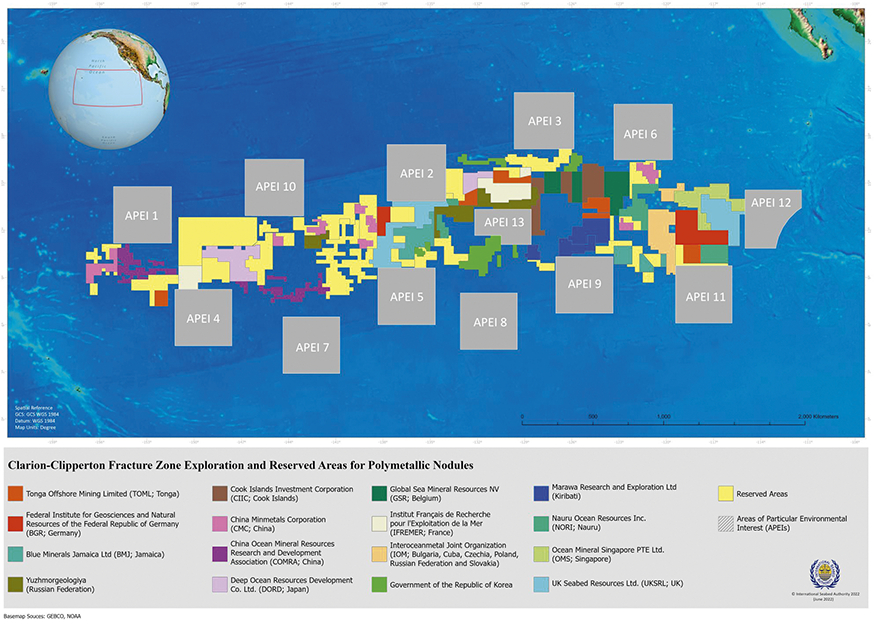
In addition, significant uncertainties remain regarding TMC’s ability and legal authority to operate under both USA and ISA seabed mining licenses simultaneously. The company holds two exploration licences issued by the ISA. In July 2025, the ISA Council requested the organisation’s secretary-general to assess whether ISA-licensed seabed mining companies are at risk of violating their contracts under UNCLOS if they decided to mine the seabed unilaterally (Hutchins, Reference Hutchins2025; Woody, Reference Woody2025b). TMC’s ISA exploration contract may be nullified if it gets a licence from the USA.
To conclude, the USA has long argued that based on the principle of freedom of the high seas, American companies can unilaterally undertake mining on the deep seabed beyond the USA’s national jurisdiction without violating UNCLOS. Its rationale is that the USA is not a party to UNCLOS, and the DSM regime outlined in Part XI of UNCLOS does not constitute customary international law and is thus not binding on all states. However, in reality, while the USA government may use its domestic law to unilaterally grant licences to its companies for DSM in ABNJ (e.g. in the CCZ), it is open to dispute whether any US company can unilaterally do so because it is less likely that American mining companies can undertake DSM without relying on technology, drilling vessels, or processing provided by companies based in ISA member states. Concerns over legal disputes and challenges may in effect block the USA from exercising national governance over DSM in the Area.
China’s Changing Understanding of the CHH
In recent years, there have been arguments saying that China, rather than the USA, is leading the international rule-making process about the governance of DSM (Kardon & Camacho, Reference Kardon and Camacho2023; Virginski, Reference Virginski2025). They point out that as a party to UNCLOS, China has worked for decades with the ISA to shape the multilateral mineral extraction rule-making process on terms to its liking. In addition, China is a main benefactor of the ISA and provides training for ISA technical experts coming from other developing countries. China is the most active state in DSM, as demonstrated by the fact that it has more ISA-issued contracts (five) to explore seabed minerals than any other country. Virginski (Reference Virginski2025), in particular, asserts that China exercises ‘durable influence over the drafting of ISA rules’ However, they say little concrete and substantial about which particular norms, rules, or standards adopted by the ISA come from Chinese practices, and what impacts ‘Chinese’ rules have on the ISA’s Mining Code. This part will therefore focus on a broader issue of China’s policy towards DSM, through the lens of how it has understood and interpreted the social construct of the CHH.
In the 1970s and early 1980s, as one of the least developed countries, China had neither the interest in nor the capability to carry out any deep-seabed exploration. Archival evidence of China’s participation in the nine-year UNCLOS III negotiations reveals that China’s primary concerns were more about defining territorial waters, EEZ, and continental shelf rights – issues directly tied to its core maritime interests and closer to its borders – than developing deep-seabed minerals (Xu, Reference Xu2026). As far as Part XI is concerned, Beijing was dissatisfied with the final agreement, considering that the ‘parallel system’ of exploitation would only favour a few industrialised states. In the 191st Plenary Meeting of UNCLOS III, held on 9 December 1982, Han Xu, the head of the Chinese delegation as well as Vice Minister of Foreign Affairs, stated:
Resolution 11 of the Conference, governing preparatory investment in pioneer activities relating to polymetallic nodules, has done too much in the way of meeting the demands of a few industrialized nations and given them and their companies some privileges and priorities. We consider that inappropriate.
Throughout the 1980s and 1990s, China began scientific exploration of seabed mineral resources. Two scientific vessels, Xiang yang hong (which literally means ‘Facing the Red Sun’) 16 and Xiang yang hong 9, were dispatched to the central, north, and northwest Pacific in 1983, 1985, and 1987, where they carried out comprehensive surveys covering meteorological conditions, hydrology, environmental factors, and geological features. In April 1990, China Ocean Mineral Resources Research and Development Association (COMRA) was established, with the mandates to support China’s interest in the international seabed resources, to enhance the development of high technology for deep-seabed mining, and to engage in international cooperation concerning deep-seabed mining. Nominally, COMRA is listed as a non-profit research and development organisation, it was, however, first administered by the State Oceanic AdministrationFootnote 60 and later by the Ministry of Natural Resources (MNR) under the central government (see below) (Zou, Reference Zou and Kotzur2018, pp. 188–189). Among the five contracts that China has received from the ISA, three of them are contracted to COMRA.Footnote 61 In the ISA Regional Environmental Assessment for the Northwest Pacific (2020), COMRA is cited many times in relation to oceanographic and seabed survey data. China was actively participating in the consultations for the 1994 Implementation Agreement, as one of the six proposing states of the final draft Agreement. The ISA-China Joint Training and Research Centre (JTRC), established in 2020 in Qingdao, east China, was the first-ever joint training and research centre for the ISA. The JTRC provides a platform for ISA to promote capacity-building and knowledge transfer of marine technology (ISA, n.d.2).
In line with Xi Jinping’s vision of adopting a ‘holistic approach’ to national security, China’s 2015 National Security Law (NSL) explicitly includes the deep seabed as one of the strategic frontier issues (Kardon & Camacho, Reference Kardon and Camacho2023). Article 32 of the NSL specifically affirms the need to safeguard ‘the security of our nation’s activities and assets in outer space, seabed areas and polar region’ (Paul Tsai China Center, 2015) (emphasis added), signalling the importance of the deep seabed for China’s security interests.
Having ratified UNCLOS in 1996, China enacted its own legislation on DSM – the Law of the People’s Republic of China on Exploration for and Exploitation of Resource in the Deep-Seabed Area (hereafter referred to as the Chinese DSM Law) – in 2016.Footnote 62 It consists of twenty-nine articles, divided into seven chapters. Preparatory work for the Chinese DSM Law started in 2013, followed by the legislative drafting group’s visit of the ITLOS, headquartered in Hamburg, Germany, and the ISA, seeking advice from both organisations in 2014 (Xu et al., Reference Xu, Zhang, Xue, Lee and Lee2015, p. 188). The objectives of the legislation are twofold. First, as required by the ITLOS Advisory Opinion, sponsoring states have the obligation to adopt and enforce effective laws within their legal system to fulfil the principle of ‘due diligence’. As argued by Chinese scholars, the Chinese DSM Law safeguards China’s interests by discharging ‘China from its liability as a sponsoring State’ if its contractors cause damage to the Area or its resources (Chen, Reference Chen and Banet2020, p. 342; Shen, Reference Shen2021, p. 24).Footnote 63 Second, at the international level, it allegedly aligns itself with the core principles of Part XI of UNCLOS (Li & Shen, Reference Li and Shen2024, p. 178; Shen, Reference Shen2021, p. 22). However, there is little mention of how in practice the Chinese DSM Law has ‘aligned’ with the current international seabed governance and of what the UNCLOS core principles are. In addition, critics argue that although one chapter of the Chinese DSM Law is devoted to environmental protection, ‘relevant provisions are quite vague and general, which is difficult to operationalize in practice’ (Xu et al., Reference Xu, Zhang, Xue, Lee and Lee2015, p. 199).
More interestingly, the Chinese DSM Law makes no explicit reference to the CHH principle. Protecting the ‘common interest of humankind’ (rénlèi gòngtóng lìyì; 人類共同利益) rather than ‘common heritage of humankind’ (rénlèi gòngtóng yíchǎn; 人類共同遺產) is enshrined as one of the four key principles for activities in the Area (Liu & Kim, Reference Liu and Kim2016, p. 698) (emphasis added). Another loosely defined key principle is ‘cooperation and sharing’ but ‘equitable sharing’ (Article 3) is lacking in detail (Liu & Kim, Reference Liu and Kim2016, p. 695). One may wonder if a specific type of resources after extraction are not to be shared. It is open to question whether these provisions comply with the CHH, whether China has a new interpretation of the meaning of social construct, or whether China begins to embrace another social construct, freedom of the high seas.
Another indicator of China’s new approach can be seen from Chinese scholars’ interpretation of China’s contribution to deep-sea governance. In outlining ‘China’s contribution to advancing the legal and regulatory framework of deep-sea governance’, Yu et al. (Reference Yu, Liu and Jin2025, pp. 10, 11) make no mention of the CHH, though they emphasise that ‘China stands as a staunch advocate of international maritime norms and regulations and a supporter of sustainable maritime development’.
In March 2018, China further consolidated and centralised its governance of DSM, particularly regarding its engagement with the ISA. A new ministry, Ministry of Natural Resources (MNR), was created from the original Ministry of Land and Resources, State Bureau of Surveying and Mapping, and State Oceanic Administration. Deep-sea mining policy, environmental regulations, seabed resource management, and international representation are now all under the MNR’s remit (Shen, Reference Shen2021, pp. 35–37; Chun, Reference Chun2018). With a unified system, the MNR represents China in the ISA Council as well as other ocean governance forums (Zhou & Zhang, Reference Zhou and Zhang2019). It is also the institutional unit to manage deep-sea activities, including approving China’s ISA exploration contract applications; supervising contractor performance; and issuing national-level policies on seabed resource utilisation. Sun Shuxian, Vice Minister of the MNR, met then ISA Secretary-General, Michael Lodge, during his visit to China in June 2024. On the top of the agenda of their meeting was the draft Mining Code. Sun said, ‘The adoption of the draft exploitation regulations will provide clear rules and guidance on the deep-seabed exploitation activities to ensure the sustainable use of seabed resources and effective protection of the marine environment’ (ISA, 2024). The official statement of Sun suggests that Chinese interests include fast-tracking of the Mining Code negotiations, but do not include equitable sharing of the benefits of DSM, which was absent from Sun’s words.
China is not only the largest contributor to the ISA, but has also consistently sent a large delegation, compared with many countries, to ISA meetings in Jamaica.Footnote 64 In 2019, when the ISA held discussions on the draft exploitation regulations at its 25th Council meeting, China raised issues, including clarifying the role and responsibilities of the ‘Enterprise’, how liability and inspection should work, and how the sponsoring states should be defined. In its written comments to the ISA, China stated that ‘[i]n order to ensure the smooth operation of deep seabed mining, it is essential to establish a reasonable inspection mechanism’ (PRC, 2019, p. 6). As seen from its official comments on the draft regulations for deep-seabed mining in 2019, China was inclined to support full exploitation of the deep seabed as soon as possible.
After Nauru triggered the ‘two-year rule’ in 2021, Nauru and China had pressed the ISA for a firm deadline (Woody, Reference Woody2023). In July 2023, China (together with Nauru and Mexico) blocked a motion to discuss a mining moratorium at an ISA meeting. It also expressed opposition to the creation of an independent commission to monitor how mining companies comply with environmental regulations, arguing that environmental protection and development must be in balance (Kuo, Reference Kuo2023). It (and Nauru and Mexico) managed to block the ISA Assembly, which as usual convened after the Council meeting, from considering a proposal by Chile, France, Palau, and Vanuatu on a pause on approving mining licences until the rules were adopted. China argued that it is the Council, not the Assembly, that is responsible for discussing the proposal. The two sides could only reach an agreement that the issue could be discussed in 2024 (Kardon & Camacho, Reference Kardon and Camacho2023; Woody, Reference Woody2023).
China’s ambition to enter the DSM race has intensified in response to advances made by TMC, which recovered 3,000 tonnes of seabed nodules during test operations in 2022 (Lam, Reference Lam2024). In June 2024, Shanghai Jiao Tong University tested a mining vehicle in the Western Pacific Ocean at a depth of 4 km, and the Chinese state-owned media described it as ‘a new breakthrough’ in DSM (Xinhua News Agency, 2024). China has also advanced its deep-sea research capabilities by deploying specialised vessels such as Xiang yang hong 6 and Tansuo (which literally means ‘exploration’) 1, equipped with manned submersibles capable of descending up to 10 km and advanced sonar for ocean-floor scanning. Complementing these assets with sea drones and autonomous underwater gliders, China has gathered high-resolution bathymetric data that could also facilitate future undersea mine deployment, underlining the strategic implications of its expanding deep-seabed research activities (Buckley, Reference Buckley2025). Wu Changbin, Director of the China Deep Ocean Affairs Administration, indicated that ‘[t]he goal [for China] is to … establish a comprehensive system of technical standards – fundamentally improving China’s voice and competitiveness’ in the international maritime order if it is to win the global DSM race (Cai, Reference Cai2025).
Apart from COMRA, the other two Chinese state-owned enterprises with ISA contracts, China Minmetals and Beijing Pioneer Hi-Tech, are also preparing to conduct trials of DSM equipment in the Pacific exploration zones. In March 2025, the ISA approved China’s first Environmental Impact Statement for a polymetallic nodule collector trial in Contract Area A-5, part of China Minmetals’ licensed exploration zone in the international seabed. The decision granted China Minmetals formal authorisation to commence at-sea testing of its nodule collection system in the Area. Although polymetallic nodules are primarily known for containing nickel, cobalt, copper, and manganese, studies have also identified the presence of REEs in some seabed sediments and nodular deposits. This milestone signals a new stage in China’s pursuit of strategic and critical mineral resources from the deep ocean, expanding its ambitions beyond conventional battery metals to include potential seabed sources of REEs (Rare Earth Exchanges, 2025).
Overall, China has positioned itself as a pivotal player in DSM. With five ISA exploration contracts – the largest portfolio in the world – it has already secured a leading institutional and operational foothold. China has consistently emphasised the need for an ISA-centric governance framework in managing DSM activities, arguing that unilateral actions by individual states would undermine the CHH principle and weaken the legitimacy of the ISA (Wang et al., Reference Wang, Liu and Pei2019, p. 293). After Trump’s EO 14285, there have been Chinese voices suggesting that if more countries follow suit to act unilaterally, China would be under pressure to reconsider its multilateral approach to DSM (Poh, Reference Poh2025). Despite so, China still portrays itself as a defender of multilateralism in DSM.
However, does its perception of CHH remain the same as before or shifting? As mentioned earlier, when UNCLOS III was concluded in 1982, China criticised the parallel system for being a mechanism through which industrialised states could dilute or sidestep the CHH principle. Yet today, as the country is ascending to a developed economic power, China has gradually toned down its criticism of the parallel system. Hao Shen (Reference Shen2023) of the School of Law at Fudan University, Shanghai, does not criticise the parallel system first envisaged in UNCLOS for favouring industrialised countries. He instead argues that the parallel system provides developing countries with participation in DSM and is ‘an important means for the ISA to implement the [Common Heritage of Humankind] principle’ (Shen, Reference Shen2023, p. 362). What he takes issue with is the parallel system at work for polymetallic sulphides and cobalt-rich crusts. His argument is that according to the equity model of the parallel system as applied to these two types of minerals, as mentioned in Section 3, contractors from developed countries ‘do not directly assist developing countries in terms of technological capacity building, but only share economic benefits with developing countries through the Enterprise’ (Shen, Reference Shen2023, p. 363). This is because, pursuant to the 1994 Implementation Agreement, the provision in Article 5 of Annex III of UNCLOS about compulsory technology transfer to the Enterprise from developed countries, if the Enterprise cannot acquire the technology necessary for operating in the reserved area, shall not apply (Shen, Reference Shen2023, pp. 364–366). Nevertheless, there is little evidence that China was opposed to this change in the parallel system. One may decipher that China’s current policy interest is no longer in the redistribution of wealth accrued from DSM but in technology transfer or competition with Western mining companies in mineral extraction.
Likewise, China has expressed concern that mining companies based in developed countries, with technological advantages, would predominate in exploitation in reserved areas indirectly through setting up wholly-owned subsidiaries in developing countries which, in turn, sponsor nominally their companies to apply to the ISA for exploration and exploitation rights in the Area (Li & Shen, Reference Li and Shen2024, p. 183). The most typical example of this is NORI, a subsidiary of TMC in Nauru. Sponsored by Nauru, it holds an ISA-issued exploration contract in the CCZ.
Ideally a remedy for this domination by the industrialised West would be the Enterprise, which was designed to be the ‘operational arm’ of the ISA in the Area. However, according to the 1994 Implementation Agreement, ISA member states are not obliged to fund the Enterprise. The establishment of the Enterprise was postponed after its functions were assigned to the Secretariat. To start mining operations, the Enterprise must do so initially through joint ventures and ‘in accordance with sound commercial principles only’ (Feichtner, Reference Feichtner2019, p. 618). An implication of the Enterprise’s ‘inactivity’ for developing countries is that they cannot actively partake, via the Enterprise, in resource extraction, and the Enterprise cannot generate any revenue for redistribution to them (Feichtner, Reference Feichtner2019, p. 617). While acknowledging that the ‘establishment and operation of the Enterprise and the reserved areas … are important mechanisms to realise the sharing of resources between developed and developing countries’ and that the Enterprise has yet to be operational (Li & Shen, Reference Li and Shen2024, p. 170), China has not actively pushed for the ‘activation’ of the Enterprise as an independently operational entity. It was rather the African Group and the Latin American and the Caribbean States Group in the ISA that tried to operationalise the Enterprise, and it was Nautilus Minerals, a Canadian mining company (in 2012), and Poland (in 2018), which proposed forming a joint venture with the Enterprise (Feichtner, Reference Feichtner2019, pp. 616–617). A possible reason for China’s ‘inaction’ might be that China might treat the Enterprise as a competitor to its mining companies. An inactive Enterprise would be beneficial to Chinese enterprises because only enterprises sponsored by developing states have access to reserved areas.
In developing an international seabed regime, China warns, developing states should be prepared to make compromises and take into account the legitimate interests of developed countries as well. Chinese scholars explicitly state that:
Developing countries are paying too much emphasis on fairness but they do not particularly concern about efficiency … We should consider the interests of major maritime powers and strong states, and the legal framework for such development should be formulated through consensus. Otherwise, if the system single-mindedly pursues the interests of developing countries, major maritime powers may abandon the United Nations Convention on the Law of the Sea and proceed with resource development unilaterally. This would render the Convention meaningless in practice, undermine the established order for resource development in the international seabed Area, and erode the credibility of international law.
This more ‘compromising’ perspective aligns with the principle embedded in the Chinese DSM Law, which frames the seabed as serving the common interest – rather than the common heritage – of humankind. There are signs that China no longer interprets DSM through the moral-political, post-colonial, and redistributive lens of the CHH first articulated in 1967. Now, it is rather primarily concerned about the gap or inequality between mining companies in the West and its companies in global competition for markets as well as access to critical minerals. Although the Chinese narrative still nominally sticks with the CHH, its understanding of the principle has changed to the extent that the CHH is not interpreted to be entirely about ‘equity’ or ‘fairness’. Now as an industrialised power, it has less incentives to share ‘equitably’ financial and other economic benefits of DSM with developing countries. Reduction in global inequality between the Global North and the Global South is no longer on China’s policy agenda.
China’s policy towards the codification of DSM in the Area can be summarised as ‘wait and see’. It refrains from undertaking DSM activities unilaterally in order to set itself apart from the USA, which is accused of violating the international law. It is not an active leader; it neither in practice pushes for the completion of negotiations over the Mining Code nor leads or echoes the calls for a moratorium on DSM. In contrast, small PICs are more proactive in these two competing areas. Nauru, Kiribati, Tonga, and the Cook Islands are strongly behind DSM, while seven PICs, including Fiji, Palau, and Vanuatu, openly call for a moratorium on DSM. With the environmental impact and the possible liabilities for environmental hazards so unpredictable, DSM in the Area may not be deemed to be commercially viable for Chinese enterprises to undertake. They are inclined towards exploiting critical minerals within the national jurisdiction of their partner countries in the Pacific under less constraints from the ISA and the Mining Code. Alternatively, China may invest more in new technologies and materials that use less critical minerals such as cobalt, manganese, and nickel. China’s battery production has reportedly used lithium iron phosphate (LFP) or sodium-ion batteries for electric vehicles (Bore, Reference Bore2025).
While China seems to have limited interest in DSM in the Area, it has a growing interest and stake in global ocean governance. It is in a race with Belgium and Chile to host the BBNJ Agreement’s secretariat. However, Monica Medina, US Assistant Secretary of State for Oceans and International Environmental and Scientific Affairs and Special Envoy for Biodiversity and Water Resources in the Biden administration, told the Financial Times that China was ‘one of the most reluctant signatories’ of the Agreement. It harboured concerns over sharing proceeds from marine genetic resources, shipping lanes, and fishing rights (Bryan, Reference Bryan2026a). China’s activism in the wake of the Agreement’s entry into force in January 2026 is mostly attributable to the Agreement’s direct impact on China’s existing fishing industry, especially its distant-water fishing fleet, as well as the absence of the USA from the Agreement. China wants to ensure that it will be in the driving seat in shaping the rules governing how the high seas are to be exploited (Borton, Reference Borton2026; Bryan, Reference Bryan2026b). All industrialised powers have historically perceived the use of the oceans through the social construct of freedom of the high seas with less interest in benefit-sharing. An ascendant China is likely no exception.
Concluding Remarks
This section has discussed the impact of China–USA competition for secure access to critical minerals on the fate of global governance of DSM. President Trump’s EO 14285 marked the beginning of a US unilateral approach to DSM in the Area. His preference was shaped not only by the China–USA resource war and the long-standing social construct of freedom of the high seas but also by a new social construct of the MAGA New Right’s ideological disdain for liberal internationalism, international organisations, and international law. However, this unilateral approach is less practicable than the Trump administration would like us to believe. This is largely because UNCLOS prohibits individuals and corporations based in any member state of the ISA from participating in the DSM unauthorised by the ISA. Unless American companies can undertake DSM entirely without relying on any seabed mining technologies, vessels, or processing possessed by the citizens or corporations of any state parties, unilateral mining is almost impossible to take off and bear fruit.
This section has also dealt with China’s changing conceptualisation and understanding of the CHH principle. It pointed out that as it emerges rapidly as a major industrial power in the world, China is no longer fully committed itself to the cardinal principle of equitable sharing of benefits. Instead, it attaches significance to the common ‘interests’ between it and other countries, both developed and developing. Although its official narratives stick with the CHH principle, it is more concerned about the technological gap between Western mining companies and its own ones and about its liabilities for environmental hazards as the aftermath of DSM. Therefore, while China is discursively in favour of concluding the negotiations over the Mining Code as soon as possible, it has not been active in pushing the negotiations forward, as the material interests are remote. In the meantime, it also explores the possibilities of seabed mining with PICs inside their national jurisdictions and inventing and using new technology that would consume less critical minerals in the transition towards a green and digital economy.
Thus far, we have discussed the positions and preferences of various major actors regarding DSM, including the ISA, which leads the making of the Mining Code, the USA, China, and an emerging group of developed and developing countries, backed by environmental NGOs and scientists, which demand a moratorium on DSM. The following concluding section will bring them together to explore the question of ‘whither global governance of DSM?’
5 Conclusion: Not a Looming ‘Grotian Moment’
This Element asks: Who governs DSM? As the consolidated text of the Exploitation Regulations – and its (further) revised versions – is being considered and debated by the ISA Council (IISD, 2026), it is fair to anticipate that it will eventually be adopted in the foreseeable future. This was echoed by Leticia Carvalho, who has since EO 14285 been eager to have the Mining Code enacted by the end of 2026. Apparently, DSM in the Area is to be under global governance. However, based on our analysis, whether any mining companies would use the global rules to carry out mining in the deep seabed is open to question. A key issue is its commercial viability. Owing to the campaigns against environmental hazards launched by environmental activists, scientists, and some forty governments, the inter-temporal interpretation of equity has gradually taken precedence over the initially dominant intra-temporal interpretation. The Sea Disputes Chamber of ITLOS requires that the primary obligation of sponsoring states is to adhere to the principle of responsibility to ensure, that is, to ensure that their sponsored contractors comply with UNCLOS and ISA regulations. Under a not-yet-well-defined payment regime, DSM, a mega-capital-intensive project with huge potential liabilities for possible environmental damage, is less promising in profit-making than it was anticipated. Major industrialised countries are not keen to push for mining in the Area far away from their limits of national jurisdiction. Canada, France, Germany, and the UK have already joined the global call for a moratorium (or its equivalent) on DSM. Despite Trump’s EO 14285, it is less likely that American companies can undertake DSM in the Area on their own. More likely they mine the minerals within their national jurisdiction if they find it profitable to do so. Japan’s government and enterprises similarly concentrate on mineral exploitation within Minami-Torishima’s EEZ.Footnote 65
In the 1960s-1980s, China, like other newly independent developing countries, perceived DSM through the social construct of the CHH. It (and other developing countries) harboured an optimistic view that even if it did not possess the capital and technology required for DSM, it would stand to benefit from it in the Area under the management of an international organisation tasked with sharing all benefits of DSM equitably with developing countries. However, DSM has never taken off since 1994, when both UNCLOS and the ISA entered into force. Equitable sharing of DSM benefits has never been more than a pipe dream. Interests in DSM did not re-emerge until the early twenty-first century in the context of intensifying great-power competition between China and the USA over access to critical minerals. In this intervening period of two decades or so, China has gained little from the operation of the ISA while the debate about the meanings of equity has remained unresolved. China’s rephrasing of common ‘heritage’ as common ‘interest’ in its DSM Law can be interpreted as an indication that China now perceives an existence of common interest between it and other countries, as its commercial partners, in exploiting minerals on the seabed. However, there is little obligation for China to share the benefits of mining with all developing countries equitably through a third party. Accordingly, China’s preference would be to go into bilateral partnerships with certain pro-DSM countries in the Pacific to exploit minerals within their jurisdictional limits such as their EEZs or continental shelves. It is the domestic mining law of China’s individual partner countries, rather than the ISA-approved Mining Code, that is to be applied to the mining activities. As said earlier, Chinese mining enterprises equally face a daunting question of how commercially viable DSM would be. It is unlikely that Chinese mining enterprises are willing to undertake DSM if they are not convinced of the net profitability of the mega-project of DSM.
Furthermore, although it never admits openly due to self-evident political reasons, we would rather argue, contemporary China is increasingly inclined to perceive DSM from the social construct of freedom of the high seas with less constraint from the ISA.Footnote 66 In this regard, China does not differ much from the USA. Accordingly, it no longer upholds the redistributive objectives of Part XI of UNCLOS with the possible exception in technology transfer. Redistribution of revenue from mineral extraction to developing countries as a means to alleviate global inequality is no longer a policy priority of China. It is not concerned about the inactivity of the Enterprise either.
Here, we may understand its changing preferences from the logic behind great powers’ behaviour in which social identity matters. They all perceive the world from a social construct that they (ought to) have the unrivalled ‘freedom’ from external constraints to have or achieve what they desire. Akin to the USA, China balks at the idea of redistributing the wealth from DSM to other developing countries ‘equitably’ via an international institution over which it cannot dominate or in which it does not have the power to veto. In addition, according to the CHH principle, all member states of the ISA must obtain exploitation rights from the ISA. All major powers are inherently opposed to this international administration and inclined towards exercising freedom of the high seas.
We therefore argue that neither global governance nor national governance is going to prevail in DSM in the Area. The most likely scenario would be a stalemate in the form of a moratorium on DSM. As interstate competition over access to critical minerals remains unchanged, DSM will likely take off within the national jurisdiction of a coastal state, to which the ISA-approved Mining Code may not be necessarily applicable. Despite accounts that DSM in the Area seems imminent, a Grotian Moment, in which unusually rapid, paradigm-shifting changes in international law take place, is not looming.
Abbreviations and Acronyms
- • ABNJ
– Area beyond national jurisdiction
- • APEI
– Area of particular environmental interest
- • AUV
– Autonomous underwater vehicle
- • BBNJ Agreement
– Agreement under the United Nations Convention on the Law of the Sea on the Conservation and Sustainable Use of Marine Biological Diversity of Areas beyond National Jurisdiction
- • CCZ
– Clarion-Clipperton zone
- • CHH
– Common heritage of humankind
- • CHM
– Common heritage of mankind
- • CIPEC
– Intergovernmental Council of Copper Exporting Countries
- • CISMA
– The Cook Islands Seabed Minerals Authority
- • COMRA
– Ocean Mineral Resources Research and Development Association (China)
- • DSCC
– Deep Sea Conservation Coalition
- • DSHMRA
– Deep Seabed Hard Mineral Resources Act (the USA)
- • DSM
– Deep-sea mining
- • DSRM
– Deep Sea Rare Minerals, Inc. (the USA)
- • ECF
– Environmental compensation fund
- • EEZ
– Exclusive economic zone
- • EIA
– Environmental impact assessment
- • EO
– Executive Order (the USA)
- • EU
– European Union
- • FON
– Freedom of navigation
- • IR
– International Relations (as an academic discipline)
- • ISA
– International Seabed Authority
- • ITLOS
– International Tribunal for the Law of the Sea
- • IUCN
– International Union for Conservation of Nature
- • JTRC
– ISA-China Joint Training and Research Centre
- • MAGA
– Make America Great Again
- • MNR
– Ministry of Natural Resources (China)
- • NatCons
– National Conservatives (the USA)
- • NGO
– Non-governmental organisation
- • NIEO
– New International Economic Order
- • NOAA
– National Oceanic and Atmospheric Administration (the USA)
- • NORI
– Nauru Ocean Resources Inc.
- • NSL
– National Security Law (China)
- • OPEC
– Organisation of Petroleum Exporting Countries
- • PIC/PICs
– Pacific Island Country/Countries
- • PNG
– Papua New Guinea
- • REEs
– Rare-earth elements
- • RSR
– Reciprocating States Regime
- • TMC
– The Metals Company (Canada)
- • UK
– United Kingdom
- • UN
– United Nations
- • UNCLOS
– United Nations Convention on the Law of the Sea
- • UNCLOS I
– The first United Nations Conference on the Law of the Sea, 1958
- • UNCLOS III
– The third United Nations Conference on the Law of the Sea, 1973–82
- • UNOC
– United Nations Ocean Conference
- • US
– United States (as the adjective)
- • USA
– United States of America (as the country noun)
Acknowledgements
Lai-Ha Chan gratefully acknowledges funding support from the Japan Foundation. As the 2024 Japan Foundation Indo-Pacific Partnership (JFIPP) Research Fellow, she conducted research in the United States in July 2025 and held an extended research residency in Kyoto and Osaka, Japan, from November 2025 to February 2026. She sincerely thanks the Princeton Institute for International and Regional Studies at Princeton University and Ritsumeikan University for hosting her as a visiting research fellow as well as providing a stimulating and supportive research environment during her fieldwork.
The authors are grateful to the many scholars and informants who generously shared their knowledge and insights throughout this research. Any remaining errors or omissions are solely their responsibility.
Lai-Ha Chan is Senior Lecturer in the Social and Political Sciences Program at the University of Technology Sydney, Australia. Her research examines Indo-Pacific regional order, minilateral cooperation, middle-power diplomacy, and the governance of deep-sea mining. Her research findings have been published in two monographs and leading journals in International Relations.
Pak K. Lee is Senior Fellow in the Conflict Analysis Research Centre at the University of Kent, United Kingdom. His research examines territorial disputes, ontological security, and autocratic collaboration. His most recent monograph is Order, Contestation and Ontological Security-Seeking in the South China Sea (Palgrave Macmillan, 2020; with Anisa Heritage).
Frank Biermann
Utrecht University
Frank Biermann is Research Professor of Global Sustainability Governance with the Copernicus Institute of Sustainable Development, Utrecht University, the Netherlands. He is the founding Chair of the Earth System Governance Project, a global transdisciplinary research network launched in 2009; and Editor-in-Chief of the new peer-reviewed journal Earth System Governance (Elsevier). In April 2018, he won a European Research Council Advanced Grant for a research program on the steering effects of the Sustainable Development Goals.
Aarti Gupta
Wageningen University
Aarti Gupta is Professor of Global Environmental Governance at Wageningen University, The Netherlands. She is Lead Faculty and a member of the Scientific Steering Committee of the Earth System Governance (ESG) Project and a Coordinating Lead Author of its 2018 Science and Implementation Plan. She is also principal investigator of the Dutch Research Council-funded TRANSGOV project on the Transformative Potential of Transparency in Climate Governance. She holds a PhD from Yale University in environmental studies.
Michael Mason
London School of Economics and Political Science (LSE)
Michael Mason is Associate Professor in the Department of Geography and Environment at the London School of Economics and Political Science (LSE). At LSE he is also Director of the Middle East Centre and an Associate of the Grantham Institute on Climate Change and the Environment. Alongside his academic research on environmental politics and governance, he has advised various governments and international organisations on environmental policy issues, including the European Commission, ICRC, NATO, the UK Government (FCDO), and UNDP.
About the Series
Linked with the Earth System Governance Project, this exciting new series will provide concise but authoritative studies of the governance of complex socio-ecological systems, written by world-leading scholars. Highly interdisciplinary in scope, the series will address governance processes and institutions at all levels of decision-making, from local to global, within a planetary perspective that seeks to align current institutions and governance systems with the fundamental 21st Century challenges of global environmental change and earth system transformations.
Elements in this series will present cutting edge scientific research, while also seeking to contribute innovative transformative ideas towards better governance. A key aim of the series is to present policy-relevant research that is of interest to both academics and policy-makers working on earth system governance.
More information about the Earth System Governance project can be found at: www.earthsystemgovernance.org.