

Introduction
Concerns regarding wildlife welfare have increased, due in part to increased awareness of the public regarding wildlife and human conflict (Liordos et al. Reference Liordos, Kontsiotis, Georgari, Baltzi and Baltzi2017), but also in part to increased conservation research focused on anthropogenic impacts on wildlife habitats (Berg et al. Reference Berg, Lerner, Butterworth and Walzer2020; Zemanova Reference Zemanova2020). Despite these concerns, some have argued that leading conservationists have prioritised the interests of the population with little to no attention paid to the individual animal (Ramp & Bekoff Reference Ramp and Bekoff2015). Whilst capture, handling and even killing of some wild animals in pursuit of conservation research have been justified by some (Powell & Proulx Reference Powell and Proulx2003), the question of when the welfare of the individual matters has also been raised (Bekoff Reference Bekoff2013).
Ethical considerations of how technologies are used to capture data from animals are now being questioned (Wathes et al. Reference Wathes, Kristensen, J-M and Berckmans2008; Wathes Reference Wathes2010), driven by the fact that it is not always clear how the technology impacts animal welfare (for further discussion, see Dawkins Reference Dawkins2021). In the case of non-invasive technologies, knowledge on whether the technology alters behaviour of certain species or if animals show signs of distress is key if researchers are to implement best practices that mitigate harms, with the choice of method potentially impacting the viability of study results (Fraser Reference Fraser2010).
The use of camera traps, a relatively new technology, has gained considerable traction over the last 20 years, driven by the need to study, monitor or observe wildlife populations (Wearn & Glover-Kapfer Reference Wearn and Glover-Kapfer2017; Zemanova Reference Zemanova2020; Fisher Reference Fisher2023). This tool is generally assumed to avoid potential injuries and distress associated with capture and handling of the wild animal in question (Meek et al. Reference Meek, Ballard, Fleming and Falzon2016). In addition to reducing the cost of research, camera traps have been argued by some to improve the welfare of wildlife given that they are viewed as being non-invasive (Meek et al. Reference Meek, Ballard, Claridge, Kays, Moseby, O’Brien, O’Connell, Sanderson, Swann, Tobler and Townsend2014a). Whilst arguments such as these have no doubt contributed to the increased use of this technology amongst wildlife researchers, there is also a degree of evidence that the creation of light and sound from the cameras, and human odour associated with camera trap placement can be intrusive to species thereby affecting the natural behavioural patterns of the animals being studied (Meek et al. Reference Meek, Ballard, Fleming and Falzon2016).
Given the wide use of this technology and this new evidence that there may be negative effects on some animals, our primary aim was to understand how the use of camera traps deployed to monitor wildlife have been described in the field of ecology and forestry in relation to animal welfare. We addressed this aim by undertaking a rapid systematic review where we first set out to determine how authors that collected data on a wild species using camera traps framed this technology in their study. Our secondary aim was to investigate whether the use of this technology is discussed in relation to wildlife welfare and if authors specifically addressed how this technology may have affected their results.
Materials and methods
Ethical approval
Not applicable for this rapid systematic literature review.
Search strategy
The protocol for this review was not registered. A systematic search was conducted through the Web of Science (WoS) search engine on June 29, 2023. A librarian (K Miller) from The University of British Columbia was consulted to develop the following terms for the database search, with * indicating a truncation of the search terms and “ ” indicating a phrase: “camera trap*” AND conserv* AND population* AND wildlife OR “large mammal*” OR ungulate* OR carnivore* OR herbivore*. The following meso citation categories: 3.35 Zoology & Animal Ecology or 3.40 Forestry were applied to isolate studies in the relevant fields of study. All papers were required to be articles or early access articles available through The University of British Columbia library, published in the English language in the last five years (i.e. January 2019–June 2023). We recognise that five years is a limited number of years but given that this research was carried out as part of an undergraduate course, we needed to limit the scope so that it could be completed in a four-month period; we acknowledge this limitation and discuss how this decision may have impacted our results in the Study limitations section.
Inclusion and exclusion criteria
Articles were included if camera trapping was the primary methodology for data collection. Studies were eligible if the authors focused on species of wildlife living in their natural habitat (e.g. studies in zoos were not included). Studies were included if camera trapping was the sole method of data capture or when used in conjunction with other methodologies with direct human interference, such as trapping or tagging.
Studies were excluded if they involved captive-bred or raised wildlife, or animals that had been interfered with (e.g. capture-mark-recapture, release, or translocated) shortly before or during the study. Articles were also ineligible if the study utilised an attractant introduced into the environment (e.g. food baits or scent lures) or some form of modification of the landscape (e.g. new wildlife corridor). Articles were also excluded if the research intended to assess the camera traps’ viability or the viability of another methodology. Reviews were also excluded.
Article screening
The papers from the systematic literature search were uploaded to the review software Covidence (Covidence Systematic Review Software, Veritas Health Innovation, Melbourne, VIC, Australia) to identify and eliminate duplicates.
The inclusion criteria were first applied to the title and abstract of the papers. A reliability assessment was performed on 40 papers selected at random by two of the authors (AA and EN). Disagreements were resolved by consensus and if no consensus could be reached the study was then moved for the full-text review. The reliability assessment also allowed for the refinement of the exclusionary criteria. The remaining abstracts and titles of the papers were screened by AA. An article was excluded if the reviewer selected ‘no’ or it was advanced to the full-text review if the reviewer selected ‘yes’ or ‘maybe’.
The same criteria were applied during the full-text review. This time, reliability was performed on 20 studies randomly selected by the same two authors, and AA then proceeded with the remainder of the screening.
Data extraction
The following data items were collected from the articles: author, publication year, species studied, location and duration of the study, number of cameras used, relevant quotes and works cited by the authors if applicable. The papers were divided into those that specifically mentioned the impact of the camera traps on the wildlife, and those that did not; the former were then divided into those that addressed animal welfare and those that failed to do so (Table 1).
Categories used to identify different levels of consideration given to the potential impact of using camera traps for empirical research on wildlife welfare applied to 267 studies published between January 2019 and June 2023
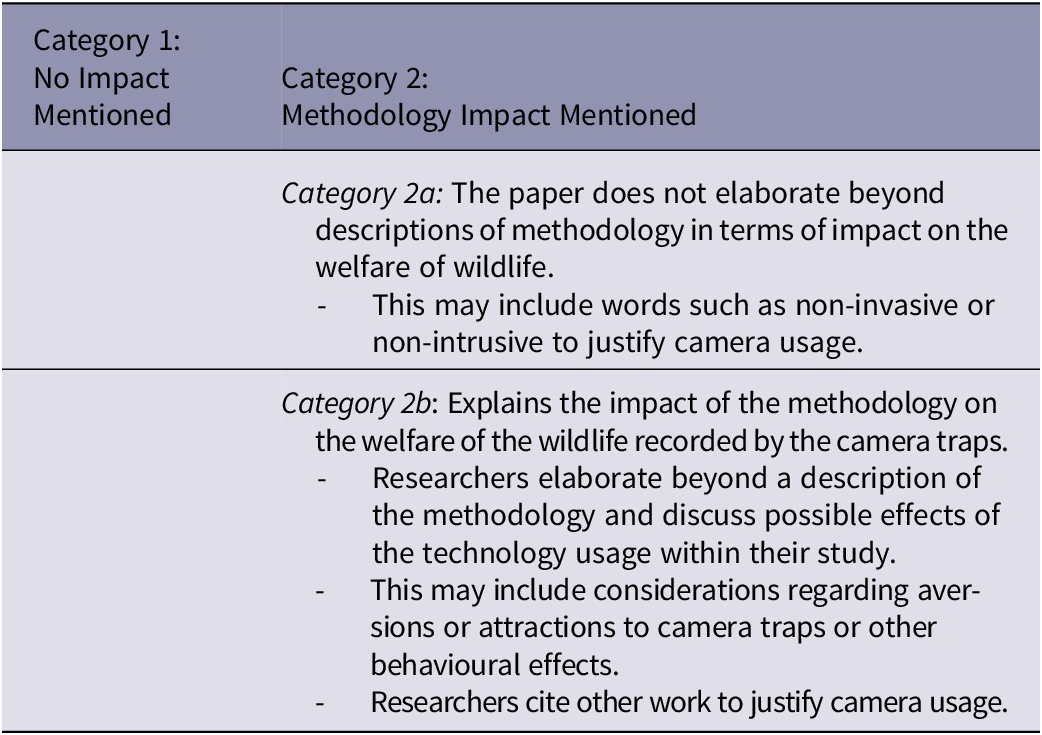
Data extraction reliability was performed on the same 20 papers selected at random during the full-text review by AA and EN. Having achieved 100% agreement, AA then proceeded with the remainder of the studies. During the data extraction, each paper was categorised as described above by first reading the abstracts and methods section and then screening the full text for the following keywords: disturbance*, invasive/non-invasive, behavio*, light, sound, flash, manipulative, attract, response, infrared, stress, fear, intrusive, react, ethics, indirect, welfare, and trap response (Figure 1). These specific screening terms were used to reduce errors in categorisation.
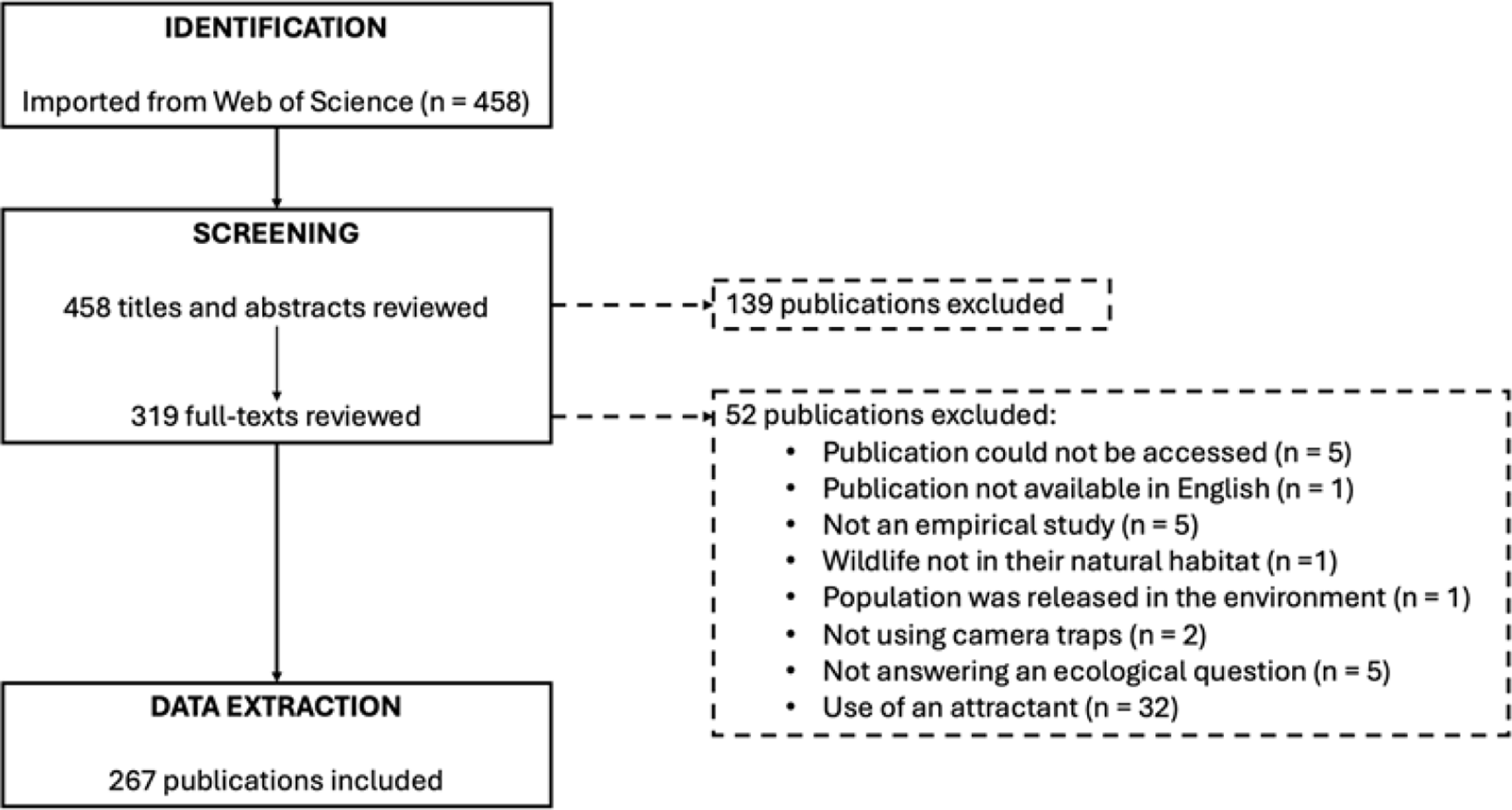
PRISMA (Preferred Reporting Items for Systematic Reviews and Meta-Analyses) study flow diagram (adapted from PRISMA 2020; Page et al. Reference Page, McKenzie, Bossuyt, Boutron, Hoffmann, Mulrow, Shamseer, Tetzlaff, Akl, Brennan, Chou, Glanville, Grimshaw, Hróbjartsson, Lalu, Li, Loder, Mayo-Wilson, McDonald, McGuinness, Stewart, Thomas, Tricco, Welch, Whiting and Moher2021) for a rapid systematic review of the potential impact of using camera traps for empirical research on wildlife welfare in their natural habitat. A search was conducted for the studies published between January 2019 and June 2023.
Results
Study selection
The flow diagram illustrates the screening and exclusion process (Figure 1). We initially started with 458 articles and excluded 191 based on the exclusion criteria, resulting in 267 studies that were used for data extraction.
Welfare considerations
Most of the papers identified in this rapid systematic review failed to consider possible camera trapping impacts on the welfare of wildlife species being studied. Of the 267 articles retained for data extraction: 203 papers (76%) were placed in Category 1, where the methodology impact of camera use on welfare was not mentioned. There were 44 papers (16.5%) assigned to Category 2a where the methodology impacts of cameras on welfare were mentioned but was limited to descriptive language. The remaining 20 (7.5%) papers were placed into Category 2b where the methodology impact of cameras on animal welfare was specifically mentioned and discussed for the wildlife species being studied.
The 44 papers categorised as 2a are listed online in the Supplementary material found at https://doi.org/10.5683/SP3/OJURD4. In sum, all the studies categorised as 2a utilised descriptors to positively frame camera trapping as an advantageous methodology because it is “observational” (Phumanee et al. Reference Phumanee, Steinmetz, Phoonjampa, Weingdow, Phokamanee, Bhumpakphan and Savini2021; p 9). Authors framed camera traps in a positive manner using descriptive terms such as “non-invasive” (Pal et al. Reference Pal, Panwar, Goyal and Sathyakumar2022; p 9), “nonintrusive” (Hazwan et al. Reference Hazwan, Samantha, Tee, Kamarudin, Norhisham, Lechner and Azhar2022; p 2), or “non-manipulative” (Lundgren et al. Reference Lundgren, Ramp, Middleton, Wooster, Kusch, Balisi, Ripple, Hasselerharm, Sanchez, Mills and Wallach2022; p 2,351). Six studies also used language to positively frame camera trapping by stating that alternative methods would be more aversive while camera traps allow data collection “without the need for invasive and costly collaring”, and without “handling, capture, or immobilization” (quotes from Müller et al. Reference Müller, Briers-Louw, Seele, Lochner and Amin2022; p 11 and Braczkowski et al. Reference Braczkowski, Schenk, Samarasinghe, Biggs, Richardson, Swanson, Swanson, Dheer and Fattebert2022; p 17; other references: Gimenez et al. Reference Gimenez, Gatti, Duchamp, Germain, Laurent, Zimmermann and Marboutin2019; Havmøller et al. Reference Havmøller, Tenan, Scharff and Rovero2019; Li et al. Reference Li, Xue, Zhang, Dong, Shan, Sun, Hacker, Wu and Li2020; Morris et al. Reference Morris, Boardman, Swanepoel, Simpson, Coetzee, Camacho and McWhorter2022). Two papers categorised as 2a (Soyumert et al. Reference Soyumert, Ertürk and Tavşanoğlu2019; Piña-Covarrubias et al. Reference Piña-Covarrubias, Chávez, Chapman, Morales, Elizalde-Arellano and Doncaster2023) did not discuss welfare concerns or potential invasiveness associated with the use of cameras aside from referring to the data captured as “indirect” evidence. Most of these papers were broad in their claims and offered no further justification for their reasoning as to how the technology was non-invasive nor applied these claims to the wildlife species within their study. A single study out of the 44 in Category 2a included a reference to support their choice of descriptor of the technology (Oberosler et al. Reference Oberosler, Tenan, Groff, Krofel, Augugliaro, Munkhtsog and Rovero2022).
The papers in Category 2b (n = 20) elaborate beyond descriptors for the technology and discuss possible welfare benefits or concerns when utilising camera traps for wildlife studies (metadata presented in Appendix 1; see Supplementary material; https://doi.org/10.5683/SP3/OJURD4). Animal welfare was considered mostly in terms of behavioural changes or responses that could occur in reaction to camera traps. Seven of these papers argued that there is minimal concern for behavioural changes in their wildlife species of interest. For example, Edwards et al. (Reference Edwards, Noack, Heyns and Rodenwoldt2019; p 522) state cameras were “passive detectors”. Satter et al. (Reference Satter, Augustine, Harmsen, Foster, Sanchez, Wultsch, Davis and Kelly2019; p 292) argued that the traps “were not baited” so it would be unexpected to have a behavioural response, and Gueye et al. (Reference Gueye, Brandlová, Rabeil, Diop, Diop and Hejcmanová2021; p 5) claim all photographs were taken “within the daylight period” minimising the effect of a flash and therefore reducing the chance of a behavioural response to the cameras. Palmero et al. (Reference Palmero, Belotti, Bufka, Gahbauer, Heibl, Premier, Weingarth-Dachs and Heurich2021), Green et al. (Reference Green, Young, Keller, Grace, Pendergast and Şekercioğlu2023), and Laporte-Devylder (Reference Laporte-Devylder, Ulvund, Rød-Eriksen, Olsson, Flagstad, Landa, Eide and Jackson2023) justified the use of the camera trap using statements regarding the welfare considerations of other sampling methods that are more “intensive” (Laporte-Devylder et al. Reference Laporte-Devylder, Ulvund, Rød-Eriksen, Olsson, Flagstad, Landa, Eide and Jackson2023; p 215) as they cause wildlife to be “manipulated in a way that would cause distress or pain” (Green et al. Reference Green, Young, Keller, Grace, Pendergast and Şekercioğlu2023; p 121) or subject animals to “stressful … immobilization” (Palmero et al. Reference Palmero, Belotti, Bufka, Gahbauer, Heibl, Premier, Weingarth-Dachs and Heurich2021; p 2) in comparison to camera traps that “minimize stress and disturbance” (Laporte-Devylder et al. Reference Laporte-Devylder, Ulvund, Rød-Eriksen, Olsson, Flagstad, Landa, Eide and Jackson2023; p 215). These seven papers out of the 20 in Category 2b all positively frame the welfare benefits of using camera traps.
Interestingly, although the papers in Category 2b discussed possible behavioural responses to the camera traps and the concerns associated with using the technology, only four papers (Lamichhane et al. Reference Lamichhane, Leirs, Persoon, Subedi, Dhakal, Oli, Reynaert, Sluydts, Pokheral, Poudyal, Malla and de Iongh2019; Brommer et al. Reference Brommer, Poutanen, Pusenius and Wikström2021; Farhadinia et al. Reference Farhadinia, Behnoud, Hobeali, Mousavi, Hosseini-Zavarei, Gholikhani, Akbari, Braczkowski, Eslami, Moghadas and Macdonald2021; Rather et al. Reference Rather, Kumar and Khan2021) considered a possible behavioural trap response as part of their data analysis models because they “expected the … behavior to change after being detected” (Farhadinia et al. Reference Farhadinia, Behnoud, Hobeali, Mousavi, Hosseini-Zavarei, Gholikhani, Akbari, Braczkowski, Eslami, Moghadas and Macdonald2021; p 366). These four publications were also the only studies that discussed how technology may impact the validity of the values of their recorded sightings. Jayasekara et al. (Reference Jayasekara, Mahaulpatha and Miththapala2021; p 144) also provided a behavioural change example where “elephants were highly reactive to the cameras and were often found attacking them”. Although this reactive behaviour may be unique to elephants exposed to camera traps, it does highlight the need to re-examine whether this technology may also be aversive to other species of wildlife as failing to do so may introduce bias unless proven otherwise. In contrast, Ünal et al. (Reference Ünal, Pekin, Oğurlu, Süel and Koca2019a) specifically stated that disturbances arising from the camera traps causing behavioural avoidance were limited to instances when humans visited the camera traps.
Six of the 20 papers in Category 2b introduced observations specific to the species within the study (Anile et al. Reference Anile, Devillard, Ragni, Rovero, Mattucci and Valvo2019; Satter et al. Reference Satter, Augustine, Harmsen, Foster, Sanchez, Wultsch, Davis and Kelly2019; Tang et al. Reference Tang, Tang, Li, Menghe, Bao, Xiang, Gao and Bao2019; Jayasekara et al. Reference Jayasekara, Mahaulpatha and Miththapala2021; Bhattacharya et al. Reference Bhattacharya, Chatterjee, Angrish, Meena, Sinha and Habib2022; Séguigne et al. Reference Séguigne, Coutant, Bouton, Picart, Guilbert and Forget2022). For example, Tang et al. (Reference Tang, Tang, Li, Menghe, Bao, Xiang, Gao and Bao2019; p 3) state how the “lynx did not show any fear from the infrared lights and the operators’ odor left on the digital cameras”; however, despite stating this the authors failed to provide clear evidence to this effect. In contrast, Séguigne et al. (Reference Séguigne, Coutant, Bouton, Picart, Guilbert and Forget2022; p 7) discussed how the species within their study, the Potos flavus (kinkajou), displayed avoidance behaviour toward flash photography, a finding that resulted in the researchers abandoning the flash camera in favour of an “infrared moving sensor camera”. Additional evidence that some animals react to the cameras comes from Jayasekara et al. (Reference Jayasekara, Mahaulpatha and Miththapala2021) who mentioned discarding their camera footage of Prionailurus viverrinus (fishing cats) and Viverricula indica (ring-tailed civets) because they were unable to observe natural behaviour. Fourteen studies addressed the limitations of their data collection method and were transparent in identifying possible biases, with some describing that the choice of camera type was meant to improve the reliability of their study results (e.g. Jayasekara et al. Reference Jayasekara, Mahaulpatha and Miththapala2021; Séguigne et al. Reference Séguigne, Coutant, Bouton, Picart, Guilbert and Forget2022).
Discussion
Rising anthropogenic pressures and loss of wildlife habitat have caused a biodiversity crisis and concern for the welfare of wildlife (Zemanova Reference Zemanova2020). Generally, conservation research is focused on addressing concerns about the population of a species within an ecological system, which at times can be at odds with animal welfare, a construct that encompasses the physical health, natural behaviour, and affective state of individual animals (Fraser et al. Reference Fraser, Weary, Pajor and Milligan1997; Beausoleil Reference Beausoleil2020; Lynch et al. Reference Lynch, Allen, Berger-Tal, Fidler, Garrard, Hampton, Lean, Parris, Sherwen, White, Wong and Blumstein2025). A perpetuated view in wildlife research is that the impacts of potentially harmful research methods are “outweighed by the benefits to the population or species” (Zemanova Reference Zemanova2020; p 9). However, ignoring the welfare of individual animals places society at odds with much of the wildlife conservation research. In contrast, by combining ecological and animal welfare research, more reliable field results to solve conservation issues would be achieved (Fraser Reference Fraser2010). More modern ethical frameworks, such as conservation welfare and compassionate welfare, combine these fields and argue collectively that the welfare of individual animals should be prioritised; research efforts should try to minimise harm to every animal being studied (Beausoleil Reference Beausoleil2020).
Some research methods involving wildlife fail to consider the animal’s welfare, and thus may cause undue suffering and increase the chances of mortality (e.g. when directly marking, capturing, or handling wildlife; Zemanova Reference Zemanova2020). Instead, accounting for welfare can favour positive conservation outcomes. For example, providing species-specific enrichments when rehabilitating wildlife encourages the expression of natural behaviours, which in turn increases reintroduction success (Reading et al. Reference Reading, Miller and Shepherdson2013). In addition, the use of affective- and behaviour-based deterrents (e.g. hazing) for urban wildlife, such as Canis latrans (coyotes), can reduce the need for lethal control (Sampson & Van Patter Reference Sampson and Van Patter2020). Welfare considerations have also led to the development of alternative methods of sampling and studying wildlife, such as camera traps, that are intended to be ‘non-invasive’ (Zemanova Reference Zemanova2020).
Camera trapping has provided researchers with the ability to document elusive wildlife in remote areas and study their behaviour to an extent that would not otherwise be possible (Caravaggi et al. Reference Caravaggi, Banks, Burton, Finlay, Haswell, Hayward, Rowcliffe and Wood2017; Houa et al. Reference Houa, Cappelle, Bitty, Normand, Kablan and Boesch2022). However, there is evidence that some species show behavioural responses to cameras and may avoid or be attracted to them (Rowcliffe et al. Reference Rowcliffe, Field, Turvey and Carbone2008; Wearn & Glover-Kapfer Reference Wearn and Glover-Kapfer2017). White-flash cameras “startle animals …[causing] a flight response” (Meek et al. Reference Meek, Ballard, Fleming, Schaefer, Williams and Falzon2014b; p 15), and even findings from infrared camera studies have shown that some species can detect the flash illumination. The “odour left by human contact on or around” (Houa et al. Reference Houa, Cappelle, Bitty, Normand, Kablan and Boesch2022; p 16) camera traps has also been observed to cause attraction at camera trap locations. Behavioural reactions can “bias negatively or positively density estimates” (Houa et al. Reference Houa, Cappelle, Bitty, Normand, Kablan and Boesch2022; p 3) of wildlife populations and lead to under or overestimates of populations. These behavioural responses to cameras may have implications for the reliability of population estimates; data that can have a profound influence on conservation decisions.
Unfortunately, most studies that were identified in this rapid systematic review remained silent on any potential welfare considerations regarding camera trapping. Somewhat worrisome is also that even within those that did discuss animal welfare, most refuted or only briefly acknowledged the possible disturbances to animals that may come with use of the technology, and only eight of 20 included a reference to support their claim. For example, behavioural disturbances are likely generalisable to all the studies included in this review, but four publications dismiss this risk on the basis that they are not luring, baiting, or otherwise modifying the environment around the camera (Satter et al. Reference Satter, Augustine, Harmsen, Foster, Sanchez, Wultsch, Davis and Kelly2019; Bhattacharya et al. Reference Bhattacharya, Chatterjee, Angrish, Meena, Sinha and Habib2022; Lombardi et al. Reference Lombardi, Stasey, Caso, Carvajal-Villarreal and Tewes2022; Green et al. Reference Green, Young, Keller, Grace, Pendergast and Şekercioğlu2023). When considering potential harms associated with using animals in research, most scientists are trained to trade-off potential benefits against possible harms (Schuppli & Fraser Reference Schuppli and Fraser2007). In the case of utilising camera traps the trade-offs have been argued as being lower than those associated with direct sampling methods, where higher cortisol levels from stress greatly increase the mortality rates of sampled individuals (Zemanova Reference Zemanova2020). Arguments in favour of the use of camera traps also include lowest impacts on wildlife and its relatively low cost which collectively have contributed to this technology being increasingly used for conservation work (Wearn & Glover-Kapfer Reference Wearn and Glover-Kapfer2017). However, we encourage researchers to reflect upon how to minimise harms and disturbances with camera traps as they have with other techniques considered to be more invasive (Jewell Reference Jewell2013).
Another statement used by some was that “animal welfare implications of research methods are simply not known” (Zemanova Reference Zemanova2020; p 9) due to the relatively new adoption of this sampling methodology (Burton et al. Reference Burton, Neilson, Moreira, Ladle, Steenweg, Fisher, Bayne and Boutin2015). Many ecologists and wildlife biologists who conduct conservation research may also be unaware of possible biases and harms that can arise from different types of sampling. Education regarding the effects of methods used in conservation studies on animal welfare have received little discussion in wildlife research programmes and very few universities require students to take these courses (Zemanova Reference Zemanova2023). Lastly, there may not be an emphasis on animal welfare or varied attitudes towards animals in the different geo-political and cultural regions where researchers originate from and where these studies took place (Sinclair et al. Reference Sinclair, Lee, Hötzel, de Luna, Sharma, Idris, Derkley, Li, Islam, Iyasere, Navarro, Ahmed, Khruapradab, Curry, Burns and Marchant2022).
Future directions
Through the application of conservation welfare, researchers working in the fields of ecology and conservation are encouraged to incorporate animal welfare knowledge when developing sampling methods as any form of data capture in wildlife habitats may negatively impact the well-being of individual animals (Fraser Reference Fraser2010: Beausoleil Reference Beausoleil2020; Caravaggi et al. Reference Caravaggi, Amado, Brook, Ciuti, Darimont, Drouilly, English, Field, Iossa, Martin, McElligott, Mohammadi, Nayeri, O’Neill, Paquet, Périquet, Proulx, Rabaiotti, Recio, Soulsbury, Tadich and Wynn-Grant2021). Placing more emphasis on animal welfare education and encouraging future ecologists to consider animal welfare, could help with the development of conservation study methods that are more humane. Examining the potential disturbance of cameras, despite being non-invasive, is essential for protecting the well-being of wildlife in ecological studies. The potential avoidance behaviour from the species studied can be detrimental, particularly for those studies conducted in ecologically sensitive locations (Kumbhojkar et al. Reference Kumbhojkar, Yosef, Mehta and Rakholia2020; Silva et al. Reference Silva, Rosalino, Alcobia and Santos-Reis2021). One of the studies included in this review reflected on the type of camera to use prior to data collection both to minimise welfare impact and ensure reliable data (Séguigne et al. Reference Séguigne, Coutant, Bouton, Picart, Guilbert and Forget2022: choice of using infrared over flash photography), and we encourage other researchers to follow a similar process. Although ethical approval is not always obtainable nor required, journals might consider requesting the inclusion of a reflection statement by the authors on the potential disturbances and welfare implications of the research on the individual animals studied.
Study limitations
As stated in the Materials and methods, this research arose out of an undergraduate-directed studies course. Given this constraint we only had a four-month window within which to run the search criteria as so the decision was made to target the last five years. Ideally, we would have liked to have included at least two additional search engines and have gone back at least a decade. Inclusion of more than one search engine increases the likelihood that we would capture a higher proportion of the work completed using camera traps.
We also had specific criteria that excluded papers that used attractants for wildlife and those that were an assessment of the efficacy of camera trapping methodologies. These two criteria and the focus of these papers within forestry and ecology fields of study were used to ensure only ecological studies intended to study wildlife without disturbance were being assessed. However, by excluding some papers we may have missed a portion that were transparent about their considerations for the welfare of the wildlife. Lastly, although the data extraction carried out by the authors was reliable, some relevant descriptors or welfare considerations may have later been missed.
Animal welfare implications
We hope this rapid systematic literature review will encourage researchers working in the field of ecology to carefully consider animal welfare, not only for the benefit of wildlife but also to improve sampling methods and the credibility of their scientific process and results. Research on the welfare impacts of using camera traps will no doubt continue to expand; our hope is that a more comprehensive understanding of how camera trapping affects wildlife behaviour and affective states will accompany this growth.
Conclusion
Our results indicate that consideration of animal welfare is relatively low in camera trapping conservation studies. Furthermore, researchers are cautioned from making assumptions regarding the non-invasive nature of camera trapping methodology in the absence of evidence. Researchers are also strongly encouraged to consider the sensitivity of animals to human disturbance when designing survey methods for certain wildlife species. As the usage of camera traps continues to grow, employing a conservation welfare framework in ecological research studies would lead to more valid results that could reduce stress or behavioural changes in the species being studied and allow more judicial use of funds in trying to protect wildlife populations.
Supplementary material
The supplementary material for this article can be found at http://doi.org/10.1017/awf.2025.10014.
Acknowledgements
AA completed this work as part of a directed studies course completed in Applied Biology (APBI 497) in the Faculty of Land and Food Systems at The University of British Columbia (UBC). No external funds were secured for this study.
Competing interests
None.


 Open access

