

Hostname: page-component-77f85d65b8-8v9h9 Total loading time: 0 Render date: 2026-03-29T04:14:51.076Z Has data issue: false hasContentIssue false

Responses of soil–plant C, N, and P concentrations and stoichiometry to contrasting application rates of biochar to subtropical paddy field

Published online by Cambridge University Press:  09 August 2023

Qiang Jin
Affiliation:
Key Laboratory of Humid Sub-tropical Eco-Geographical Process of Ministry of Education, Fujian Normal University, Fuzhou, China College of Resources and Environmental Science and Engineering, Hubei University of Science and Technology, Xianning, China
Weiqi Wang*
Affiliation:
Key Laboratory of Humid Sub-tropical Eco-Geographical Process of Ministry of Education, Fujian Normal University, Fuzhou, China
Xu Song
Affiliation:
Key Laboratory of Humid Sub-tropical Eco-Geographical Process of Ministry of Education, Fujian Normal University, Fuzhou, China
Jordi Sardans*
Affiliation:
CSIC, Global Ecology Unit CREAF-CSIC-UAB, 08913 Bellaterra, Catalonia, Spain CREAF. 08913 Cerdanyola del Vallès, Catalonia, Spain
Xuyang Liu
Affiliation:
Key Laboratory of Humid Sub-tropical Eco-Geographical Process of Ministry of Education, Fujian Normal University, Fuzhou, China
Shaoying Lin
Affiliation:
Key Laboratory of Humid Sub-tropical Eco-Geographical Process of Ministry of Education, Fujian Normal University, Fuzhou, China
Akash Tariq
Affiliation:
State Key Laboratory of Desert and Oasis Ecology, Xinjiang Institute of Ecology and Geography, Chinese Academy of Sciences, Urumqi, China Cele National Station of Observation and Research for Desert-Grassland Ecosystems, Cele, China
Fanjiang Zeng
Affiliation:
State Key Laboratory of Desert and Oasis Ecology, Xinjiang Institute of Ecology and Geography, Chinese Academy of Sciences, Urumqi, China Cele National Station of Observation and Research for Desert-Grassland Ecosystems, Cele, China
Josep Peñuelas
Affiliation:
CSIC, Global Ecology Unit CREAF-CSIC-UAB, 08913 Bellaterra, Catalonia, Spain CREAF. 08913 Cerdanyola del Vallès, Catalonia, Spain
*
Corresponding authors: Weiqi Wang; Email: wangweiqi15@163.com; Jordi Sardans; Email: j.sardans@creaf.uab.cat

Summary

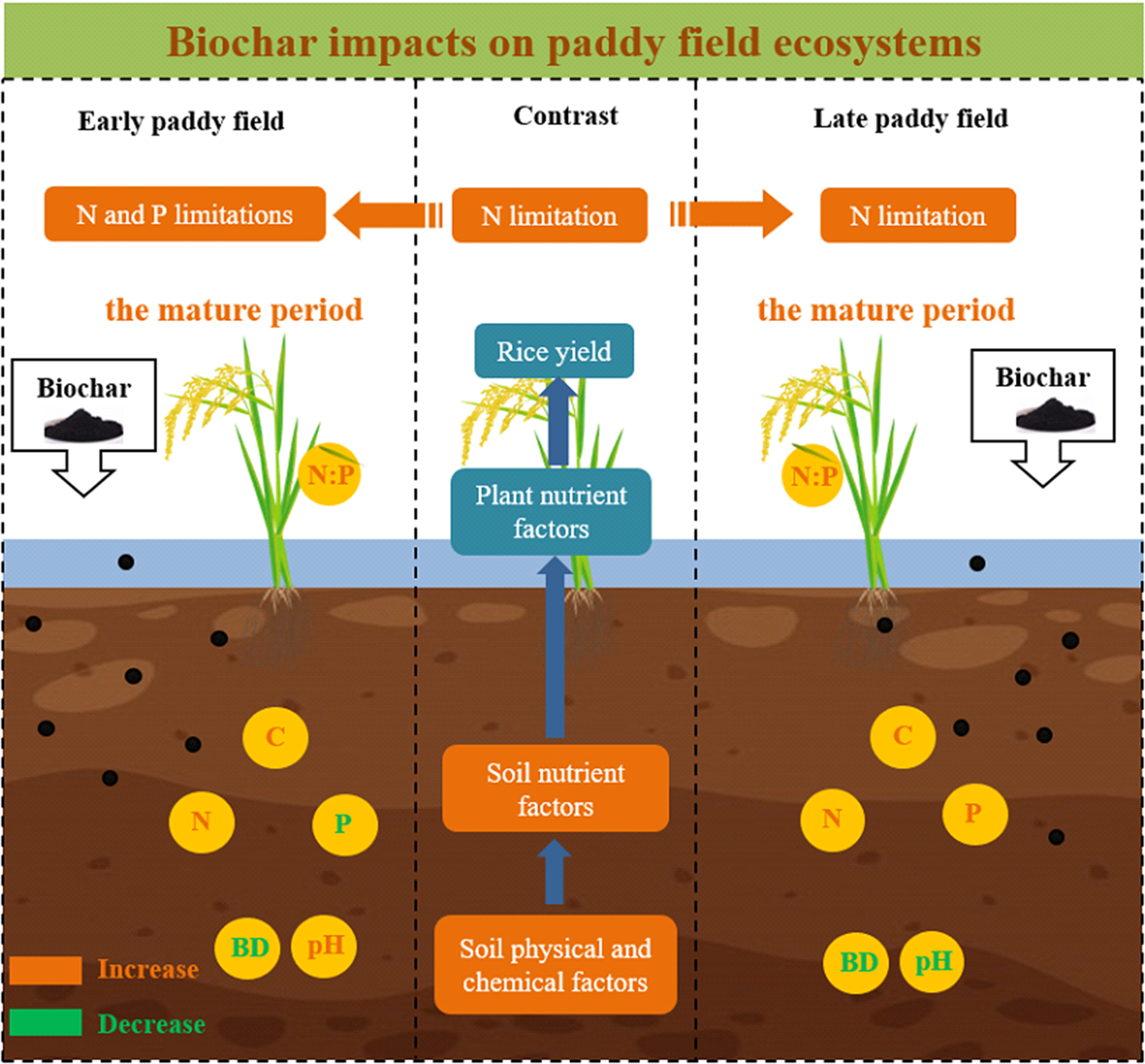
Biochar is increasingly used in crop production as a fertilizer; however, its effects on nutrient cycling and stoichiometry in rice paddy soil–plant systems are unclear. We tested for effects of contrasting rates of biochar on soil and rice plant organ carbon (C), nitrogen (N), and phosphorus (P) concentrations and stoichiometry and soil physicochemical properties in early and late paddies. Overall, biochar reduced soil bulk density by an average of 7.4%, while application at 10, 20, and 40 t ha−1 increased soil C and N concentrations in early paddies by 31.6, 41.3, and 104.2%, respectively, and by 8.0, 5.0, and 21.8%, respectively; in late paddies, there were increases of 23.0, 94.1, and 117.0%, respectively, and 6.7, 15.4, and 18.0%, respectively (P < 0.05). Following biochar application at 10, 20, and 40 t ha−1, soil concentration of P decreased in early paddies by 10.9, 19.0, and 13.9%, respectively, and increased in late paddies by 4.3, 16.4, and 20.1%, respectively. Biochar increased ratios of soil C:N and C:P in early and late paddies (P < 0.05), and there was no effect on concentration and stoichiometry of soil available nutrients. Biochar reduced rice plant organ concentration of N and P in early rice and increased leaf N:P ratios. Despite the biochar application improved nutrient status in plant–soil system, we did not observe a significant increase in yield (P > 0.05). According to the N:P value of leaves between treatments, it was found that biochar alleviated the current situation of N limitation in paddy fields during the mature period and transformed the N limitation of early rice into a joint limitation of N and P. These results show that the addition of biochar to subtropical paddy soils leads to a short-term reduction in soil bulk density and increases in soil C and N concentrations and soil fertility. Thus, biochar applied at optimal rates is likely to improve the sustainability of subtropical paddy rice production.

Information

Type
Research Article
Copyright
© The Author(s), 2023. Published by Cambridge University Press

Access options

Get access to the full version of this content by using one of the access options below. (Log in options will check for institutional or personal access. Content may require purchase if you do not have access.)

Article purchase

Temporarily unavailable

Supplementary material: File

Jin et al. supplementary material

Tables S1-S4 and Figures S1-S3

Download Jin et al. supplementary material(File)
File 738.9 KB