

Introduction
Pragmatic language competence sits in a complex, multi-factorial space characterised by interacting associations with cognitive and psychological functions and social and environmental parameters. Pragmatic skills have been variously described as ‘the skills underlying competence in contextually determined, functional language use’ (Turkstra, McDonald, & Kaufmann, Reference Turkstra, McDonald and Kaufmann1995), ‘the emergent consequence of interactions between linguistic, cognitive and sensorimotor processes which take place both within and between individuals’ (Perkins, Reference Perkins2005) and ‘the wide range of codified but subtle ways in which language use has evolved in a given culture’ (Snow & Douglas, Reference Snow, Douglas and Cummings2017). Given its multifaceted nature, it follows that the study of pragmatic competence is inherently multidisciplinary (Cummings, Reference Cummings2005) covering scholarly endeavours across philosophy, linguistics, speech language pathology, cognitive science and psychology.
The multifactorial structure of pragmatic language competence is illustrated in Figure 1: ‘A cup of competence’ (Snow & Douglas, Reference Snow, Douglas and Cummings2017). This figure depicts the various constituent functions of pragmatic competence (executive, language and social cognition functions) conceptualised in the context of individual psychological characteristics as well as social–environmental influences. As a result of this complexity, there are many levels at which skills can be compromised giving rise to substantial challenges for the reliable and valid assessment of pragmatic impairment (for review see Cummings, Reference Cummings2017; Douglas & Togher, Reference Douglas, Togher, Wilson, van Heugten, Winegardner and Ownsworth2017).
‘A cup of competence’: Constituent functions of pragmatic language competence and psychological and social influences. From Research in Clinical Pragmatics Volume 11 of the series Perspectives in Pragmatics, Philosophy & Psychology, Chapter 23, Psychosocial Aspects of Pragmatic Disorder, Reference Snow, Douglas and Cummings2017, pp 617–649, Snow & Douglas. With permission of Springer Nature.

Pragmatic deficits are encountered in a range of neurological conditions including those associated with focal damage (e.g., unilateral stroke, both right and left hemisphere); those associated with more diffuse damage (e.g., traumatic brain injury (TBI); as well as degenerative disorders (e.g., Alzheimer's disease, variant forms of primary progressive aphasia) (for review see Douglas & Togher, Reference Douglas, Togher, Wilson, van Heugten, Winegardner and Ownsworth2017; Snow & Douglas, Reference Snow, Douglas and Cummings2017). Each of these acquired neurological disorders affects a substantial proportion of the adult population. In Australia alone our prevalence rate of 2.2% (Australian Institute of Health and Welfare, 2007) means that one in 45 Australians are living with brain injury related disability and almost three quarters of these people are less than 65 years of age.
Lack of social integration and poor quality of social relationships are common and enduring experiences for many people who acquire neurological disorders during adulthood (Barry & Douglas, Reference Barry and Douglas2000; Clare et al., Reference Clare, Nellis, Whitaker, Martyr, Markova, Roth and Morris2012; Galski, Tompkins, & Johnston, Reference Galski, Tompkins and Johnston1998; Lefebvre, Cloutier, & Levert, Reference Lefebvre, Cloutier and Levert2008; Pound, Gompertz, & Ebrahim, Reference Pound, Gompertz and Ebrahim1998). Further, increasing evidence demonstrates that disorders likely to be associated with negative social outcomes are those that involve changes in the functional use of language (Douglas, Reference Douglas2015; Hilari et al., Reference Hilari, Northcott, Roy, Marshall, Wiggins, Chataway and Ames2010). Over recent years our understanding of the impact of these acquired pragmatic impairments on social outcome has benefited substantially from inclusion of the insider's perspective in our research evidence base. Indeed, a methodological shift to constructivist paradigms has enabled the development of a rich understanding of the devastating personal experience of impaired pragmatic competence and its impact on social living.
The aim of this paper is to review pragmatic language impairment in the context of evidence in the field of TBI, describe its impact on social integration particularly within relationships from the individual perspectives of those with TBI and their intimate partners/spouses and friends. The paper concludes with consideration of therapeutic developments and a brief look at a novel intervention designed to reduce the negative impact of pragmatic deficits and improve functional language use following TBI.
Understanding the Personal Experience: Theory, Practice and Research
Many scholars have emphasised the personal significance of the interplay between the individual and society. Notable among these theorists are those working in the tradition of symbolic interactionism, considered to be one of the most enduring social theories of the 20th century (Benzies & Allen, Reference Benzies and Allen2001; Oliver, Reference Oliver2012; Plummer, Reference Plummer and Turner2000). Symbolic interactionism views the individual and the context in which the individual exists as inseparable and mutually constructed in the course of social interactions. George Herbert Mead's (1863–1931) theory of the emergence of mind and self out of the social process of communication is generally considered the foundation of symbolic interactionism. Mead described the individual as ‘taking the attitudes of other individuals toward himself (sic) within a social environment or context of experience and behaviour in which both he and they are involved’ (Reference Mead1934, p. 203). Thus, from Mead's view, it is the individual's perception or interpretation of his/her own social world that influences the self.
Herbert Blumer (1900–1987), Mead's student, progressed the tradition of symbolic interactionism during the mid 20th century stating:
The term “symbolic interactionism” refers of course to the peculiar and distinctive character of interaction as it takes place between human beings. The peculiarity consists in the fact that human beings interpret or “define” each other's actions instead of merely reacting to each other's actions. Their “response” is not made directly to the actions of one another but instead is based on the meaning which they attach to such actions. Thus, human interaction is mediated by the use of symbols, by interpretation, or by ascertaining the meaning of one another's actions. This mediation is equivalent to inserting a process of interpretation between stimulus and response in the case of human behavior.” (Blumer, Reference Blumer and Rose1962, p. 180).
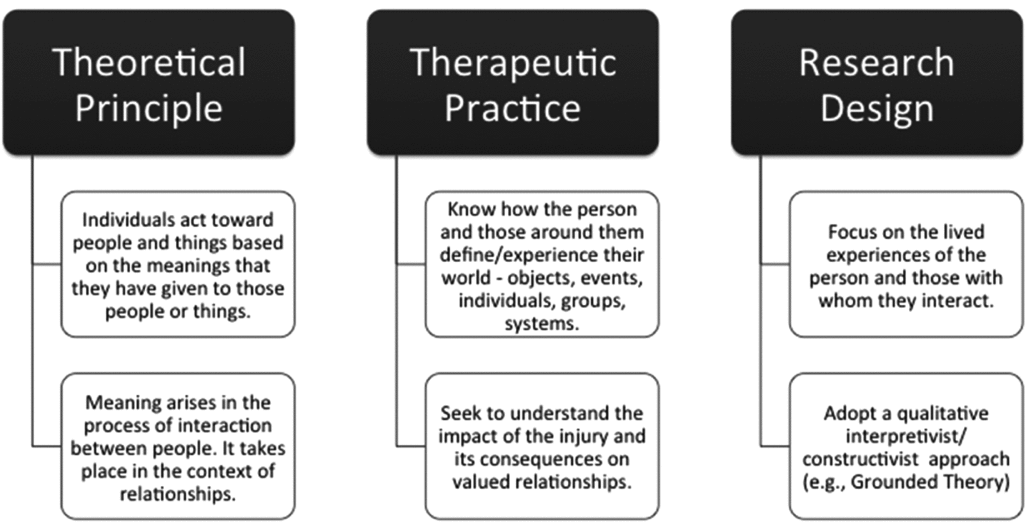
Blumer (Reference Blumer and Rose1962, Reference Blumer1969) went on to outline important tenets underpinning this theoretical stance. He described individuals as acting toward people and things based upon the meanings they have given to those people or things. Thus, meaning arises in the process of interaction between people; it is a social process taking place in the context of relationships. In turn, people are assumed to have the capacity to negotiate meaning through symbols giving rise to an interpretive process that is ever changing. In other words, he described human behaviour as emergent and continually constructed. Within this framework then, it can be seen that pragmatic competence, involving the use and interpretation of codified signs, makes a direct contribution to meaning as constructed within the interaction.
The theoretical tenets of symbolic interactionism have some important implications for practice within therapeutic or rehabilitation and research domains (Douglas, Drummond, Knox, & Mealings, Reference Douglas, Drummond, Knox, Mealings, McPherson, Gibson and Leplege2015) (Figure 2). In rehabilitation, appreciating the client's experience requires the clinician to understand the meaning of the situation from the perspective of the injured individual and those with whom the individual relates. In a symbolic interactionist framework, understanding cannot be fully developed based on what is typically captured through test administration; it requires shared interactions with the injured individual and close others and direct consideration of the role/s valued by that individual. In short, viewing the world as much as possible from the client's perspective. Similarly in the domain of research, symbolic interactionism demands the use of constructivist interpretivist approaches with a focus on exploring the lived experience of the person with injury and those with whom they interact.
Rehabilitation and research implications of symbolic interactionism.
Exploring Pragmatic Deficits in the Context of TBI
Globally TBI will surpass many diseases as the major cause of disability by 2020 (Hyder, Reference Hyder2007). As many as 70% of these people will report difficulties with communication including motor speech impairment (Wang, Kent, Duffy, & Thomas, Reference Wang, Kent, Duffy and Thomas2005), word finding problems (Bittner & Crowe, Reference Bittner and Crowe2006; Olver, Ponsford, & Curran, Reference Olver, Ponsford and Curran1996), comprehension difficulties (Olver et al., Reference Olver, Ponsford and Curran1996) and pragmatic impairment (Channon & Watts, Reference Channon and Watts2003; McDonald, Reference McDonald1993; Snow, Douglas, & Ponsford, Reference Snow, Douglas and Ponsford1997, Reference Snow, Douglas and Ponsford1998; Turkstra et al., Reference Turkstra, McDonald and Kaufmann1995). Further, longitudinal studies demonstrate that these communication deficits, particularly in the domain of pragmatics, persist into the long term and result in substantial ongoing demands on therapy resources (Snow et al., Reference Snow, Douglas and Ponsford1998). In fact data from one of our early studies showed that problems in conversation continued to be evident in 96% of speakers with moderate–severe TBI who were followed up over 2-years, despite having had considerable therapy (Snow et al., Reference Snow, Douglas and Ponsford1998).
While incidence and prevalence statistics illustrate the scope of the problem, personal description powerfully evokes the experience of pragmatic impairment faced by people with TBI everyday as they go about negotiating life in social settings. Table 1 presents a summary of quotes from research participants outlining the pragmatic communication behaviours that they perceive as challenging (Bracy & Douglas, Reference Bracy and Douglas2005; Douglas, Reference Douglas2010; Douglas, Reference Douglas2015; Mackey, Sloan, Starritt, & Douglas, Reference Mackey, Sloan, Starritt and Douglas2007; Shorland & Douglas, Reference Shorland and Douglas2010). These quotes show that people with TBI are well aware of the functional communication challenges they grapple with on a daily basis ranging from knowing what to say, when and how to say it, and keeping track of the interaction. Given the enormous challenges so effectively captured by these statements, it is unsurprising that many people with TBI experience social interaction as an anxiety provoking activity: ‘I get so anxious . . .there's so much happening, I never knew’ (Michael) (Douglas, Reference Douglas2015, p. 207).
The Personal Experience of Pragmatic Deficits

# Note: Participant quotes from (Bracy & Douglas, Reference Bracy and Douglas2005; Douglas, Reference Douglas2010; Douglas, Reference Douglas2015; Mackey et al., Reference Mackey, Sloan, Starritt and Douglas2007; Shorland & Douglas, Reference Shorland and Douglas2010).
The consequences of impaired communication skills following TBI are also well illustrated across several studies that have directly investigated the association between functional use of language and community integration (Dahlberg et al., Reference Dahlberg, Hawley, Morey, Newman, Cusick and Harrison-Felix2006; Galski et al., Reference Galski, Tompkins and Johnston1998; Snow et al., Reference Snow, Douglas and Ponsford1998; Struchen et al., Reference Struchen, Clark, Sander, Mills, Evans and Kurtz2008; Struchen, Pappadis, Sander, Burrows, & Myszka, Reference Struchen, Pappadis, Sander, Burrows and Myszka2011). Although these studies show variable findings with respect to the magnitude of the association, they generally yield modest to strong statistically significant correlations accounting for as much as 18.5% of variance in community integration scores.
Snow et al. (Reference Snow, Douglas and Ponsford1998) reported that clinician-rated discourse errors correlated significantly with (r = −0.36, p = .04) and accounted for 13% of the variance in social integration scores as measured by the Craig Handicap Assessment and Reporting Technique (CHART; Whiteneck, Charlifue, Gerhart, Overholser, & Richardson, Reference Whiteneck, Charlifue, Gerhart, Overholser and Richardson1992) in a group of 26 adults with severe TBI followed up 2 years after injury. In that same year, Galski et al. (Reference Galski, Tompkins and Johnston1998) reported similar findings between clinician-rated discourse parameters and the CHART (r ranging from .06 to .41) in a group of 30 participants with moderate to severe injuries. More recently, Dahlberg et al. (Reference Dahlberg, Hawley, Morey, Newman, Cusick and Harrison-Felix2006) showed that self-rated but not close other-rated social communication ability was significantly associated with social integration in a group of 60 participants with moderate to severe brain injury sustained 1–21 years previously. Correlation coefficients between self-rated social communication abilities and both the CHART and the Communication Integration Questionnaire (CIQ; Willer, Ottenbacher, & Coad, Reference Willer, Ottenbacher and Coad1994) ranged from 0.28 to 0.43. In 2011, Struchen et al. reported the findings of their evaluation of the contribution of self-rated social communication skills (La Trobe Communication Questionnaire (LCQ) self-report; Douglas, Bracy, & Snow, Reference Douglas, Bracy and Snow2007; Douglas, O'Flaherty, & Snow, Reference Douglas, O'Flaherty and Snow2000) to prediction of social integration outcomes (CIQ) using hierarchical multiple regression on data from 184 adults with TBI at least 6 months after discharge from acute care. After accounting for demographic and injury-related characteristics, social communication and affective/behavioural variables accounted for a statistically significant amount of variance in social integration functioning. Social communication measures accounted for 11.3% of the overall explained variance in social integration and the LCQ total score made a statistically significant and unique contribution to the prediction of CIQ scores.
Significant association between communication and social participation can be expected given that communication is the means by which we negotiate daily activities and relationships. Indeed, interpersonal communication skills contribute to vocational outcome in their own right, separable from the contribution made by executive cognitive function (Struchen et al., Reference Struchen, Clark, Sander, Mills, Evans and Kurtz2008). In addition, while executive control processes influence social communication competence, they do not explain pragmatic deficits and research shows that executive function measures leave a substantial proportion of variance (almost two thirds) in pragmatic impairment unexplained (Douglas, Reference Douglas2010).
The Experience of Pragmatic Deficits Within Relationships
Friendships
Friendship is characterised by mutual help and support. Willmott (Reference Willmott1987) defined a friend as someone you can trust, someone whose company you enjoy, and someone with whom you can discuss things freely. Friends typically have similar attitudes, beliefs and interests (Nussbaum, Reference Nussbaum, Hummert, Wiemann and Nussbaum1994). They also demonstrate similar values concerning communication (Burleson, Samter, & Lucchetti, Reference Burleson, Samter and Lucchetti1992). In particular, Burleson et al. (Reference Burleson, Samter and Lucchetti1992) found that pairs of friends rated the ability to ‘comfort’ as a communication skill important to maintaining their friendships. Thus, it can be anticipated that negative changes in a person's communication behaviours, especially those that convey mutuality and sensitivity, will have a negative impact on existing friendships. Further, if a person's communication behaviours reflect socially inappropriate behaviour, that person's ability to develop new friendships is likely to be reduced (Snow & Douglas, Reference Snow, Douglas and Cummings2017).
The negative impact of changed pragmatic competence on friendship after TBI has been highlighted by the findings of several qualitative studies (Karlovits & McColl, Reference Karlovits and McColl1999; Paterson & Stewart, Reference Paterson and Stewart2002; Shorland & Douglas, Reference Shorland and Douglas2010)). People with TBI identified social interaction as one of nine sources of stress in Karlovits and McColl's (Reference Karlovits and McColl1999) study. They described feeling that they no longer had ownership over what and how they contributed to conversations:
At times I tend to monopolize the conversation. I'm trying to keep an eye on that. I'd be roughly corrected in the past and I realize it doesn't win too many friends (Karlovits & McColl, p. 852).
Paterson and Stewart (Reference Paterson and Stewart2002) analysed focus group data from 11 participants deriving themes relating to how participants viewed their interactions and relationships. Participants linked lost friendships with their changed communication: ‘When you go somewhere, aye, they look at you, ‘oh he's alright.’ And as soon as you speak, it all flips over one side’ (Paterson & Stewart, Reference Paterson and Stewart2002, p.16). They identified strain on their day-to-day interactions particularly due to lost or reduced ability to be tactful: ‘You just say straight away what you want, there is no tactfulness involved’ (Paterson & Stewart, Reference Paterson and Stewart2002, p.16).
In 2010, we (Shorland & Douglas, Reference Shorland and Douglas2010) highlighted similar difficulties in the experiences of two young adults, Rachel and Dave, following severe TBI. Three key themes emerged from analysis of the in-depth interview data: evolution of friendships following TBI; perceptions of communication; and opening up to others. The participants’ perception of their ability to communicate contained many examples of their experiences of impaired pragmatic competence. Rachel commented on difficulties with interpreting turn-taking cues, leading to her tendency to interrupt:
Sometimes I have trouble if someone's speaking and I'm not quite sure when they've finished, like if they have a pause for a moment and then I want to go and say something but they actually haven't finished saying something so I butt in (Shorland & Douglas, Reference Shorland and Douglas2010; p. 574).
Rachel also remarked on problems with managing discourse structure and difficulties modifying prosody to convey emotional tone:
Sometimes I start with saying something then I go back to the beginning of what I should be actually saying to make, make more sense in my mind but I'm sort of speaking that out loud; I suppose I try and correct it [disjointed discourse] as best as possible. But yeah it happens sort of as I'm, as I'm speaking because my brain doesn't sort of do it beforehand like un-brain injured people's brains.’. . .‘She [friend] could tell by what I was saying that I was sincere, but not by the tone of my voice. (Shorland & Douglas, Reference Shorland and Douglas2010; p. 574).
Both Rachel and Dave highlighted difficulties with managing their contributions to conversations:
I had trouble with continuing a conversation. You say ‘hi how are you’ and then where do you go from there? (Rachel). (Shorland & Douglas, Reference Shorland and Douglas2010; p. 574).
. . ..sometimes I sort of run out of things to say and then, then sort of the other person doesn't, bring anything new into the conversation, you sort of get stuck (Dave). (Shorland & Douglas, Reference Shorland and Douglas2010; p. 574).
Approaching someone, initiating, is a little like strange, or unfamiliar to me and bringing conversations to a close I don't always know how to, how to end a conversation or how to leave a conversation in a, in a correct manner . . . (Dave). (Shorland & Douglas, Reference Shorland and Douglas2010; p. 574).
Although Rachel acknowledged that her communication might affect her friendships: ‘So the way I speak to people and communicate with them I suppose would affect the friendships that I have and am trying to make’ (Shorland & Douglas, Reference Shorland and Douglas2010; p. 574), she was surprised when her friends discussed changes in her communication that could impact the quality of their relationships: ‘I think it's the same but [my friends] were telling me things that they noticed that my communication is different . . . When they were telling me these problems, it made me feel a bit disheartened, a bit miserable.’ (Shorland & Douglas, Reference Shorland and Douglas2010; p. 574). Dave described the impact of his communication difficulties on relationships by reference to his lack of confidence: ‘Confidence is a big issue, when it, when it goes to walking up and talking to someone’ (Shorland & Douglas, Reference Shorland and Douglas2010; p. 574). His response is consistent with evidence that people with TBI take a passive role in conversation (Bogart, Togher, Power, & Docking, Reference Bogart, Togher, Power and Docking2012). Dave described himself in this manner but also noted that his passivity varied according to particular communication partners and settings. Finally, both Rachel's and Dave's experiences supported the importance of addressing the communication difficulties of this population using context-specific approaches that include social activities with friends and peers.
Intimate Relationships
Acquired communication impairments impact on relationships in general, and most significantly, on intimate spousal/partner relationships. Sustaining emotional intimacy in partner relationships relies on dialogue, transparency, vulnerability, and reciprocity (Perlman, Reference Perlman2008). Indeed, relational problems in couples have been conceptualised as a function of deficiencies in communication skills, resulting in dyadic distress and dissatisfaction (Rogge & Bradbury, Reference Rogge and Bradbury1999). As two-way conversations are the currency for sustaining intimacy in healthy partner relationships (Duck, Reference Duck1988), negative changes in pragmatic ability are likely to threaten the spousal bond. Evidence to support this contention can be found in the literature examining the experience of couples following TBI (Bracy & Douglas, Reference Bracy and Douglas2005; Gill, Sander, Robins, Mazzei, & Struchen, Reference Gill, Sander, Robins, Mazzei and Struchen2011; Godwin, Chappell, & Kreutzer, Reference Godwin, Chappell and Kreutzer2014; O'Flaherty & Douglas, Reference O'Flaherty and Douglas1997).
Individuals with TBI frequently struggle within intimate relationships as a result of communication challenges, information processing difficulties, and frequent emotional and sexual intimacy issues (Godwin et al., Reference Godwin, Chappell and Kreutzer2014). Similarly, their partners also experience communication difficulties as barriers to intimacy. Gill and colleagues (Reference Gill, Sander, Robins, Mazzei and Struchen2011) interviewed 18 couples at a mean length of 4.78 years post-injury. Most participants identified good communication as critical to maintaining their intimate relationship and negotiating the injury related changes they encountered. Partners noted that communication seemed to take place on a different level after TBI, with conversations lacking intellectual and emotional depth: ‘I think an intimate moment is when you pour your heart out. And we can't do that anymore’ (Gill et al., Reference Gill, Sander, Robins, Mazzei and Struchen2011, p. 62). Some also reported that their injured partner tended to avoid discussing issues that affected the relationship. Bracy and Douglas (Reference Bracy and Douglas2005) also noted topic avoidance in their study of couples following TBI. However, avoidance tended to be used as a coping strategy by partners to steer clear of topics that were likely to trigger negative, difficult or angry interactions.
Using a model of interpersonal communication, O'Flaherty and Douglas (Reference O'Flaherty and Douglas1997) explored the subjective experience of living with the consequences of TBI. The married participants in the study described fundamental changes to the dynamics of their relationship as a couple. Participants reported a substantial decline in social and leisure activities, with married dyads reporting a progressive tendency for the uninjured spouse to socialise alone. Participants identified increased tension in situations in which wider family and/or friends were together as one of the reasons for this outcome. Further, the injured partner's unpredictable and inappropriate communication was seen as the source of this tension for spouses, while injured partners reported feeling unable to ‘keep up’ in fast-moving and busy social situations, and therefore consciously chose to avoid them: ‘ . . . as I said I just don't go [to social activities at his wife's workplace] because I'm more of a hindrance or make it harder for her to enjoy herself’ (O'Flaherty & Douglas, Reference O'Flaherty and Douglas1997, p. 900).
Spouses also identified insensitive or violent outbursts, and difficulties with implicature and social banter as particularly challenging in their relationships:
. . . it's still very hard when someone's screaming and shouting at you (O'Flaherty & Douglas, Reference O'Flaherty and Douglas1997, p. 901).
. . . you know, if there's a trick in it. And she just won't get it. Won't get it; Some of the problem with friends . . . part of the friendship was always banter. Banter that you used to . . . and you [directed at injured partner] can't keep up with that now . . . You know jokes and asides (O'Flaherty & Douglas, Reference O'Flaherty and Douglas1997, p. 903).
Evidence not only in the TBI literature but also in the stroke (Bakas, Kroenke, Plue, Perkins, & Williams, Reference Bakas, Kroenke, Plue, Perkins and Williams2006; Grawburg, Howe, Worrall, & Scarinci, Reference Grawburg, Howe, Worrall and Scarinci2013) and dementia (Eloniemi-Sulkava et al., Reference Eloniemi-Sulkava, Notkola, Hamalainen, Rahkonen, Viramo, Hentinen and Sulkava2002; Pozzebon, Douglas, & Ames, Reference Pozzebon, Douglas and Ames2016) literature shows that intimate relationships are vulnerable to pragmatic impairments that result in even subtle changes in interpersonal communication. Further, these changes can progressively erode the fabric of a couple's relationship and pose a direct threat to the cohesion of that relationship. Consequently, it is important that we focus therapeutic attention on pragmatic competence, particularly in the context of intimate partnerships.
Communication Rehabilitation Following TBI
Despite the overwhelming negative impact of communication disability after TBI, high quality evidence to inform clinical management of this problem continues to be relatively scarce. To date only five randomised controlled trials (RCTs) of communication rehabilitation for adults with TBI have been published. In 2014, the international recommendations for management of cognition following TBI (INCOG guideline) (Bayley et al., Reference Bayley, Tate, Douglas, Turkstra, Ponsford and Stergiou-Kita2014) included seven recommendations regarding best practice for the assessment and management of communication disorders following TBI (Togher et al., Reference Togher, Wiseman-Hakes, Douglas, Stergiou-Kita, Ponsford and Teasell2014). Only three are based on evidence from at least one randomised trial with a relevant control group. Evidence currently available supports the effectiveness of context-sensitive interventions embedded in the person's everyday life, communication partner training, and metacognitive strategy training (Togher et al., Reference Togher, Wiseman-Hakes, Douglas, Stergiou-Kita, Ponsford and Teasell2014).
We have recently developed and completed preliminary evaluation of a new approach to intervention for communication disability (Douglas, Knox, De Maio, & Bridge, Reference Douglas, Knox, De Maio and Bridge2014; Douglas et al., in press). This approach focuses on coping in the context of communication breakdown which as we have seen is a frequent and stress provoking experience for people with TBI (Bracy & Douglas, Reference Bracy and Douglas2005; Douglas & Spellacy, Reference Douglas and Spellacy2000). Typically, people use communication-specific coping strategies in situations characterised by communication breakdown (Douglas et al., Reference Douglas, Knox, De Maio and Bridge2014). Productive coping strategies enhance message transfer, reduce stress and improve participation. In contrast, non-productive strategies do little to resolve problems, frequently exacerbate stress and promote social isolation. In a series of studies, our research has shown that people with TBI exhibit a pattern of communication-specific coping that deviates markedly from the norm (Friedman & Douglas, Reference Friedman and Douglas2005; Mitchell & Douglas, Reference Mitchell and Douglas2011; Muir & Douglas, Reference Muir and Douglas2007). We found TBI participants used significantly more non-productive coping strategies (e.g., Get angry and shout; Stop talking to the person) and significantly fewer productive strategies (Find out what the person is having trouble with; Use examples) than control participants matched for age, sex and education. We also found that the ability to cope with communication breakdown was significantly associated with improved social outcome (r = .51, p < .05) (Friedman & Douglas, Reference Friedman and Douglas2005). These findings support the functional importance of communication-specific coping. Indeed, our findings show that communication-specific coping accounts for more variance in social outcome (25%, Friedman & Douglas, Reference Friedman and Douglas2005) than communication impairment (Snow et al., Reference Snow, Douglas and Ponsford1998).
Given our results, we reasoned that an intervention developed to increase productive and reduce non-productive communication-specific coping strategies would have a substantial and measurable positive impact on functional communication, stress, and emotional wellbeing for those with communication problems. Consequently, we developed a new treatment, Communication-specific Coping Intervention (CommCope-I). We have now completed proof of concept testing using single case experimental design (SCED) with replication (Douglas et al., Reference Douglas, Knox, De Maio and Bridge2014) and a small feasibility trial (n=13) (Douglas et al., in press), both of which have shown clinically and statistically significant results supporting the effectiveness of the approach. Indeed participants in both studies showed substantial improvement on measures of communication-specific coping, psychological distress and functional use of communication with improved scores maintained 1 and 3 months later.
The CommCope-I program represents an innovative approach to functional communication problems. It is systematically underpinned by treatment principles with supporting evidence from multiple disciplines and areas of practice including cognitive behavioural therapy, self-awareness training, context-sensitive communication therapy with everyday communication partners, and self-management. It focuses on increasing positive behaviours rather than attempting to extinguish negative behaviours and as captured by Amanda, one of the participants, it produces results that make a difference to everyday functional language use: ‘now I see what strategies I've done, and I like watching it. I feel like, ‘That's me and I did it.’ I didn't like going into shops, I didn't like talking on the phone . . . but I think, I definitely know there's improvements, seeing myself at the start and finishing’.
Concluding Comments
People who display poor pragmatic language competence typically have difficulty engaging in social situations, leading to uncomfortable interactions with others. Such interactions contribute to rejection by others and poor community integration, which can in turn contribute to negative self-concept, depressed mood, loneliness, and withdrawal from efforts to engage in community activities. In turn, withdrawal from community activities further reduces opportunities for social encounters contributing to a vicious circle of continuing and increasing social isolation, loneliness and depression. Ongoing research and treatment development efforts with a focus on improving pragmatic competence and reducing the negative effects of pragmatic impairment continue to be essential to maximise long term social gains for the large number of people with pragmatic deficits acquired as a result of brain injury.
Acknowledgements
Much of the work referred to in this presidential address reflects collaboration with a number of researchers and clinicians who I would like to thank for their much valued contributions: Sandy Barry, Christine (O'Flaherty) Bracy, Helen Bridge, Carren (Mitchell) De Maio, Melanie Drummond, Abby Friedman, Amy (Muir) Ford, Lucy Knox, Jan Mackey, Margaret Mealings, Katie Pennycuick, Margaret Pozzebon, Joanna Shorland, Pamela Snow, Leanne Togher and Jo Whiteoak. I would also like to extend my thanks to those who have so generously participated in our research and provided such important input.



