


1. Introduction
Political scientists often want to study phenomena in text materials such as political speeches, administrative documents, or news reports written in different languages. Machine translation (MT) is a popular strategy for researchers who want to apply quantitative text analysis methods to such multilingual text collections (e.g., Baum and Zhukov, Reference Baum and Zhukov2019; Dancygier and Margalit, Reference Dancygier and Margalit2020; Düpont and Rachuj, Reference Düpont and Rachuj2022; Barberá et al., Reference Barberá, Gohdes, Iakhnis and Zeitzoff2024; cf. Baden et al., Reference Baden, Pipal, Schoonvelde and van der Velden2022; Dolinksy et al., Reference Dolinksy, Schoonvelde and van der Velden2022; Licht and Lind, Reference Licht and Lind2023). MT allows bridging language barriers by transferring documents written in different languages into a single target language. This not only enables researchers to analyze the resulting monolingual documents with standard text-as-data methods (e.g., Lucas et al., Reference Lucas, Nielsen, Roberts, Stewart, Storer and Tingley2015; Vries et al., Reference Vries, Schoonvelde and Schumacher2018; Reber, Reference Reber2019; Windsor et al., Reference Windsor, Cupit and Windsor2019; Courtney et al., Reference Courtney, Breen, McMenamin and McNulty2020; Lind et al., Reference Lind, Heidenreich, Kralj and Boomgaarden2021). It can also facilitate cross-lingual measurements’ validation and increase studies’ transparency (Baden et al., Reference Baden, Pipal, Schoonvelde and van der Velden2022; Licht and Lind, Reference Licht and Lind2023).
However, many scholars rely on commercial services for MT, such as Google Translate or DeepL (but see Laurer et al., Reference Laurer, van Atteveldt, Casas and Welbers2023; Licht, Reference Licht2023; Mate et al., Reference Mate, Sebők, Wordliczek, Stolicki and Feldmann2023). This approach comes with clear limitations. First, using commercial services limits transparency and reproducibility because the underlying translation models are closed-sourced (Chan et al., Reference Chan, Zeng, Wessler, Jungblut, Welbers, Bajjalieh, van Atteveldt and Althaus2020). Second, machine-translating large amounts of text can be expensive because commercial services charge users for each translated character.Footnote 1
This paper argues for the viability of a transparent, reproducible, and affordable alternative: using open-source models for MT. Open-source MT models, such as OPUS-MT (Tiedemann and Thottingal, Reference Tiedemann and Thottingal2020) or Facebook Research’s M2M model (Fan et al., Reference Fan, Bhosale, Schwenk, Ma, El-Kishky, Goyal, Baines, Celebi, Wenzek and Chaudhary2021), facilitate the reproducibility and transparency of research because they are versioned and publicly available for download. Moreover, existing models cover many translation directions similar to Google Translate or DeepL (see Table A2). And last but not least, using open-source models for MTs allows researchers to translate large text corpora without paying fees to a commercial translation service.
While open-source MT models promise reproducible and cheaper MT, applied researchers must know whether these models enable reliable cross-lingual quantitative text analysis of political text corpora. We thus assess whether machine-translating multilingual corpora with open-source models instead of a commercial service (Google Translate or DeepL) reduces reliability and yields substantially different measurements. We focus on two central computational text analysis methods: bag-of-words Latent Dirichlet Allocation (LDA) topic modeling and transformer (Blei et al., Reference Blei, Ng, Jordan and Lafferty2003) model fine-tuning for supervised text classification (cf. Wankmüller, Reference Wankmüller2024). First, we extend the seminal study by de Vries et al. (Reference Vries, Schoonvelde and Schumacher2018), who evaluated the MT approach for cross-lingual topic modeling. Second, we present an original large-scale comparative study of the reliability of MT for supervised text classification with transformer-based language models. The corpora used in these studies cover several Indo-European languages as well as languages from the Uralic and Turkic language families.
Our findings support the conclusion that open-source MT models can be a reliable replacement for commercial services when applying bag-of-words and transformer-based text analysis methods. We find only minor differences between the measurements obtained from corpora translated with open-source models and commercial services. In our topic modeling study, we find that the topics estimated by a model fitted to parliamentary speeches we machine-translated with the open-source M2M model are as similar to the topic model fitted to human-translated speeches as those estimated by a comparable model fitted to speech translations generated with Google Translate. In addition, both machine-translation-based topic models allocate speeches to similar topics as the human-translation-based model. In our supervised text classification study, we find that transformer-based text classifiers fine-tuned using translations from open-source MT models perform, on average, only 0.009 F1 score points worse than comparable classifiers fine-tuned using translations from a commercial MT model as input. Importantly, this result holds across many non-European languages in our sample.
We conclude that open-source MT is a very valuable addition to researchers’ multilingual text analysis toolkit. Our study adds to a growing body of work on multilingual text analysis methods and has direct practical implications for applied researchers. To facilitate the wider adoption of free MT in applied research, we provide an online translation application.Footnote 2
2. Machine translation for quantitative text analysis
MT has been extensively validated for various political text analysis tasks and languages. While a comprehensive review of this literature is beyond the scope of this article (see Licht and Lind, Reference Licht and Lind2023), Table A1 in the Supplementary Material provides an overview of this literature, and we highlight key insights from this literature below.
In their seminal study, Lucas et al. (Reference Lucas, Nielsen, Roberts, Stewart, Storer and Tingley2015) argue that comparative researchers can use MT to translate multilingual corpora into English to enable their joint analysis with standard bag-of-words methods. They demonstrate this strategy by analyzing Arabic and Chinese social media posts.
The study by de Vries et al. (Reference Vries, Schoonvelde and Schumacher2018) was the first to support the argument of Lucas et al. (Reference Lucas, Nielsen, Roberts, Stewart, Storer and Tingley2015) with more extensive comparative evidence. They base their study on a subset of the Europarl parallel corpus (Koehn, Reference Koehn2005), which contains the original text of speeches held in the European Parliament and their translations into the official languages of the EU by its expert translators. The authors constructed several bilingual parallel corpora from this dataset by pairing English texts’ expert translations with their German, Spanish, French, and Polish versions. De Vries et al. (Reference Vries, Schoonvelde and Schumacher2018) demonstrate that MT with Google Translate enables translation of texts from German, Spanish, French, Danish, and Polish into English with sufficient reliability for bag-of-words topic modeling when compared to the benchmark of translation by human experts.
The study by De Vries et al. (Reference Vries, Schoonvelde and Schumacher2018) has been highly influential. It is frequently cited in applied research to justify an MT approach to cross-lingual bag-of-words text analyses (e.g., Barberá et al., Reference Barberá, Gohdes, Iakhnis and Zeitzoff2024). In addition, it has been the point of departure for several other methodological advancements. For example, Reber (Reference Reber2019) systematically compares the reliability of alternative translation strategies and commercial MT services. Düpont and Rachuj (Reference Düpont and Rachuj2022), in turn, evaluate the MT approach for comparing the textual similarity of documents across languages. Courtney et al. (Reference Courtney, Breen, McMenamin and McNulty2020) present evidence on the reliability of MT for bag-of-words supervised text classification. They examine whether supervised text classifiers trained on English-language MTs of originally Spanish or German texts classify held-out texts as accurately as classifiers trained on English texts. More recently, Mate et al. (Reference Mate, Sebők, Wordliczek, Stolicki and Feldmann2023) have made a first step in adding to this finding by examining how the translation of Polish and Hungarian parliamentary speeches affects the reliability of transformer-based classifiers (see also Laurer et al., Reference Laurer, van Atteveldt, Casas and Welbers2023).
2.1. Open-source MT: a reproducible, transparent, and affordable alternative
The results summarized above underscore that MT can enable reliable and valid multilingual text analysis. However, using commercial services such as Google Translate raises concerns about the reproducibility and transparency of research (Chan et al., Reference Chan, Zeng, Wessler, Jungblut, Welbers, Bajjalieh, van Atteveldt and Althaus2020) and can be relatively expensive.
We argue that open-source MT models, such as OPUS-MT (Tiedemann and Thottingal, Reference Tiedemann and Thottingal2020) and M2M (Fan et al., Reference Fan, Bhosale, Schwenk, Ma, El-Kishky, Goyal, Baines, Celebi, Wenzek and Chaudhary2021), offer a reproducible, transparent, and cost-effective alternative.Footnote 3 Using open-source MT models is more transparent than a commercial service and ensures the reproducibility of analyses because researchers can freely download models and document the specific model version they used in their study. This accessibility further enables running MT on local servers or user-grade hardware, which is often necessary to conform to data privacy requirements, for example, when analyzing interview data or survey responses. Furthermore, freely available open-source MT models match many of the several hundred translation directions enabled by Google Translate and other commercial providers. For example, OPUS-MT and M2M can translate 151 and 99 languages to English, respectively (see Table A2 in the Supplementary Material). Last but not least, using open-source models is cheaper because researchers with some programming experience only need to invest in GPU computing resourcesFootnote 4 instead of paying a translation fee to a commercial service.
2.1.1. Transparency and reproducibility
Using commercial MT services, researchers have no control over the specific version of the model used for translation, as they are “closed source.” This prevents others from replicating their results later because the MT system used originally may have changed in the meantime (Chan et al., Reference Chan, Zeng, Wessler, Jungblut, Welbers, Bajjalieh, van Atteveldt and Althaus2020). This problem does not arise when using open-source MT models. They are typically versioned and available from publicly accessible platforms or repositories, such as the Hugging Face Model hub.Footnote 5 Researchers can therefore document the exact version of the model they have used, making research using open-source MT models reproducible.
Second, open-source MT models are transparent. The research teams providing them typically document the parallel corpora and model architecture used to train their models. Furthermore, it is a well-established best practice to report model performance in predefined test sets (benchmarks). This enables researchers to make informed decisions about which MT model to use in a specific application (cf. Licht and Lind, Reference Licht and Lind2023), for example, by assessing the reliability of the available models in the languages they want to translate.Footnote 6 In contrast, the information available about the performance of commercial services’ MT models often does not meet scientific standards, nor is it transparent what data has been used for training.
2.1.2. Cost efficiency and resource requirements
Using commercial services to machine-translate large text corpora can be expensive, as one pays for each translated character. For example, Google charges users of their Cloud Translation service U.S. $ 20 per 1 million characters, often implying three to four-digit sums for the translation.Footnote 7
Accordingly, researchers’ reliance on commercial services creates an undesirable barrier for those with limited budgets (Baden et al., Reference Baden, Pipal, Schoonvelde and van der Velden2022). Open-source MT models can lower this barrier. They are freely available for download and use, and researchers thus do not have to pay translation fees. Instead, the only financial cost arising when using open-source MT models results from the energy consumed for computing and, if necessary, from using cloud servers. Overall, this cost efficiency makes open-source MT models an attractive option for researchers on a tight budget and may even help level the playing field for smaller research teams.
Table 1 provides a cost comparison between two popular commercial MT services (Google Translate and DeepL) and a popular open-source MT model (M2M 418 M). The two main costs that MT incurs are money and time. For commercial translation services (APIs), financial costs are calculated on a per-character basis. For open-source models, the costs are based on GPU costs, which are easily accessible through services like Google Colab.Footnote 8 Our cost estimates show that, financially, using open-source models is significantly cheaper than commercial services. Translating 18 million characters costs more than EUR 300 via an API and less than EUR 3 with an open-source model.
Comparison of costs in Euro and compute time arising when translating a fixed amount of text with commercial services or the M2M open-source MT model

a We disregard the time elapsed for sending API requests.
b Estimates based on relative efficiency relative to A100 GPU.
However, using open-source MT models requires more computation time and expertise. Especially on older GPUs, translations with open-source models can take many hours to complete. Moreover, running the required software on a GPU requires some additional expertise (e.g., moderate Python programming skills). To tilt the balance further in favor of the open-source approach, we thus provide an interactive Google Colab-based online translation application, code base, and tutorial.Footnote 9 We have designed our app to ease the use of open-source MT models for researchers with no Python programming skills. Our accompanying tutorial and code base provide researchers with basic Python programming experience with a template that they can adapt to their needs. Given that the level of technical prowess in the (computational) social science community is steadily increasing (cf. Baden et al., Reference Baden, Pipal, Schoonvelde and van der Velden2022), these resources should lower the above-discussed barriers to using open-source MT models.
2.1.3. Advantage over generative LLMs
Although not a point of comparison in this paper, we find it worth pointing out that open-source MT models also compare favorably in terms of cost and resource efficiency to another alternative: using generative large language models (LLMs) for translation. LLMs such as GPT, LlaMa 3, & Co. can be prompted to follow specific task instructions, including translation between languages (cf. Lyu et al., Reference Lyu, Du, Xu, Duan, Wu, Lynn, Aji, Wong and Wang2024). Furthermore, similar to open-source MT models, many LLMs are “open-weights”Footnote 10 and thus also facilitate transparent and reproducible research. However, using LLMs for MT compares negatively to using the open-source MT models we consider in terms of resource requirements. Competitive LLMs have many more parameters than the open-source MT models we consider. For example, even the relatively large M2M model has only 1.2 billion parameters compared to the 32 to 70 billion parameters of medium-sized multilingual LLMs. This means that processing and generating a token with an LLM expends much more energy—and thus emits more CO2—than using a specialized MT model. The size of LLMs, moreover, likely makes local deployment infeasible for most applied researchers, which means that they have to fall back to using a commercial provider’s API or hardware.
3. Two studies on the comparative reliability of open-source machine translation
We believe the benefits of using open-source MT models for political science research outweigh the potential costs. However, researchers’ main concern should be whether they enable reliable cross-lingual quantitative text analysis in comparison to commercial services (cf. Vries et al., Reference Vries, Schoonvelde and Schumacher2018; Reber, Reference Reber2019; Windsor et al., Reference Windsor, Cupit and Windsor2019; Courtney et al., Reference Courtney, Breen, McMenamin and McNulty2020).
We address this question empirically by comparing results from open-source MT against commercial MT. The general intuition of our empirical strategy is simple. We first apply different text-as-data methods to texts that were translated with commercial MT services, open-source MT models, and, if available, by expert translators. We then compare the methods’ outputs obtained for the same documents using different translations. This allows us to assess whether translating with an open-source model instead of a commercial service yields systematically different measurements and, hence, levels of reliability.
We cover two widely used quantitative text analysis methods: topic modeling and supervised text classification. Our analyses are based on corpora from different domains of political communication (parliamentary speech, party manifestos, and social media). This broad scope makes our results relevant to a wide range of research applications.
3.1. Study 1: cross-lingual topic modeling
In our first study, we build on de Vries et al. (Reference Vries, Schoonvelde and Schumacher2018) to assess whether the translation source (commercial vs. free MT) affects the reliability of LDA topic modeling. The main strength of de Vries and colleagues’ original research design is that it allows one to compare the inputs and outputs of a topic model obtained from machine-translated texts to those obtained from human experts’ translations. This strategy provides an ideal comparison if we consider human experts “gold standard” translators. For both corpora, de Vries, Schoonvelde, and Schumacher pre-processed the text data,Footnote 11 created term-document matrices (TDMs) that count the number of occurrences of words (terms) in a speech (document), and fitted an LDA topic model (Blei et al., Reference Blei, Ng, Jordan and Lafferty2003). The authors then compare whether the topic content of the models fitted to human and Google Translate translations is similar in terms of word stems and whether the same documents have similar probabilities of being in a specific topic. This empirical strategy allows them to assess how (dis)similar the DFM and topic model outputs obtained from machine-translated documents are compared to those obtained from the human expert-translated corpus. We take advantage of the strength of their study in our analysis.
3.1.1. Empirical strategy
Like de Vries et al. (Reference Vries, Schoonvelde and Schumacher2018), we compare the reliability of MT for topic modeling by comparing topic model outputs to those of a model fitted directly to texts translated by human experts. The intuition of this comparison is the following. If we find higher discrepancies in the model fitted to human translations when we use an open-source MT model for MTs instead of Google Translate, this would indicate that relying on open-source models for translation impairs the reliability of LDA topic modeling. This finding would support the conclusion that open-source MT models’ translation quality is insufficient for applied bag-of-words text analysis. However, if the topic model fitted on open-source MT models’ translations fares no worse (or even better) than the benchmark model compared to an equivalent topic model fitted on translations obtained with Google Translate, we would conclude that open-source MT models enable comparatively reliable topic modeling of machine-translated texts.
Accordingly, we evaluate whether using open-source MT models for translation instead of Google Translate negatively affects topic models’ measurements compared to the human translation benchmark. To compare the quality of open-source MT, we translated the parallel corpora from the respective language into English with OPUS-MT (Tiedemann and Thottingal, Reference Tiedemann and Thottingal2020).Footnote 12 We then pre-processed the data in the same way as de Vries et al. (Reference Vries, Schoonvelde and Schumacher2018) did, created a TDM, and fitted an LDA topic model with 90 topics (using the same random seed, burn-in time, and number of iterations). Finally, we compare the inputs and outputs of topic models fitted to OPUS-MT or Google Translate translations to the ones obtained from human expert-translated texts.Footnote 13 We used the same metrics as de Vries et al. (Reference Vries, Schoonvelde and Schumacher2018): The similarity between documents’ bag-of-words representations. The similarity between the documents’ estimated topic proportions. And the similarity between the estimated topics’ document compositions. Overall, our empirical strategy allows us to evaluate whether, compared to the commercial Google Translate translations, the translations obtained from OPUS-MT led to stronger discrepancies vis-à-vis the expert translation benchmark.
To compare Google Translate and OPUS-MT, we compute how much the measurements obtained with the LDA topic models fitted to their translations differ from those obtained with the LDA topic model fitted to expert translations. We then assess how much these deviations from the “gold standard” model differ between the commercial and open-source MT-based topic models. However, statistical significance in difference-in-means tests does not answer the question of whether this particular difference is substantial.Footnote 14 We thus also rely on equivalence testing (Lakens et al., Reference Lakens, Scheel and Isager2018). In equivalence testing, researchers define the smallest effect size of interest before analyzing the data. The observed difference in means is then compared with this threshold to examine whether an effect size falls within a range of values considered equivalent to a null effect. If the test statistic and its confidence interval exceed the range of values defined as negligible, the equivalence hypothesis is rejected. We set the equivalence bound to ± 0.01.
3.1.2. Results
Overall, our results indicate that using the open-source OPUS-MT model for translation instead of Google Translate does not negatively affect topic models’ reliability compared to the human translation benchmark.
First, we look at how the MT source affects the bag-of-words inputs to the topic model. Specifically, we compare the TDM obtained from the human expert translations with the TDMs obtained from Google Translate and OPUS-MT at the document level by computing document-level cosine similarity scores. As summarized in Table 2, Google Translate and OPUS-MT result in very similar document input representations (see also Figure B1 in the Supplementary Material). Specifically, the two MT models are on par when comparing the total means of TDMs cosine similarity with the human translation benchmark. As with Google Translate, 92 percent of the OPUS-translated documents had a cosine similarity of 0.8 or higher with the human-translated English texts. Therefore, using OPUS-MT for MT resulted in document representations that are as similar to those obtained from human expert translations as when using Google Translate.
Summary statistics of cosine similarities between bag-of-words representations obtained from machine- and human-translated texts at the document level. Columns grouped by translation model

The discrepancies between the bag-of-words obtained by tokenizing texts translated with OPUS-MT instead of Google Translate seem to be explained by these models’ different vocabulary sizes. Upon closer inspection of the TDMs, it appears that both the texts translated by human experts and those translated with Google Translate contain a similar number of unique terms. In contrast, the number of unique terms in the corpus translated with OPUS-MT is lower (see Table B1 in the Supplementary Material). As a result, the overlap of unique terms between the human gold standard is slightly smaller for OPUS-MT than for Google Translate per language. This might be because OPUS-MT is an open-source model, and its English vocabulary is thus likely more limited than that of Google Translate’s model. This limitation in vocabulary size may explain other differences between Google Translate and OPUS-MT, as overlap in word frequencies is also important for topic modeling tasks.
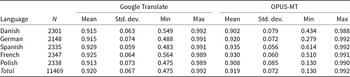
As the next step of our analysis, we assess how the MT source affects documents’ estimated topic proportions, one of the main outputs of the LDA topic model. As shown in Table 3, we find that documents’ estimated topic proportions are highly similar between Google Translate and the gold standard model and between the gold standard model and OPUS-MT (see also Figure B2 in the Supplementary Material). The average correlation between the measurements of the topic model using OPUS-MT translations and those of the model fitted to human translations is 0.785. For the model based on Google Translate translations, this correlation is 0.782. Looking at differences across languages, it is notable that OPUS-MT performs well for French, with an average correlation of 0.801. On the other hand, Google Translate has a slightly higher correlation with the gold standard for German and Danish, with an average correlation of 0.799 and 0.809, respectively. Overall, however, as these differences between the two models are small, we conclude that there are no substantial differences in topic proportions assigned to documents when using OPUS-MT instead of Google Translate.
Summary statistics of correlations between document-level topic proportion estimates obtained from machine- and human-translated texts. Columns grouped by translation model

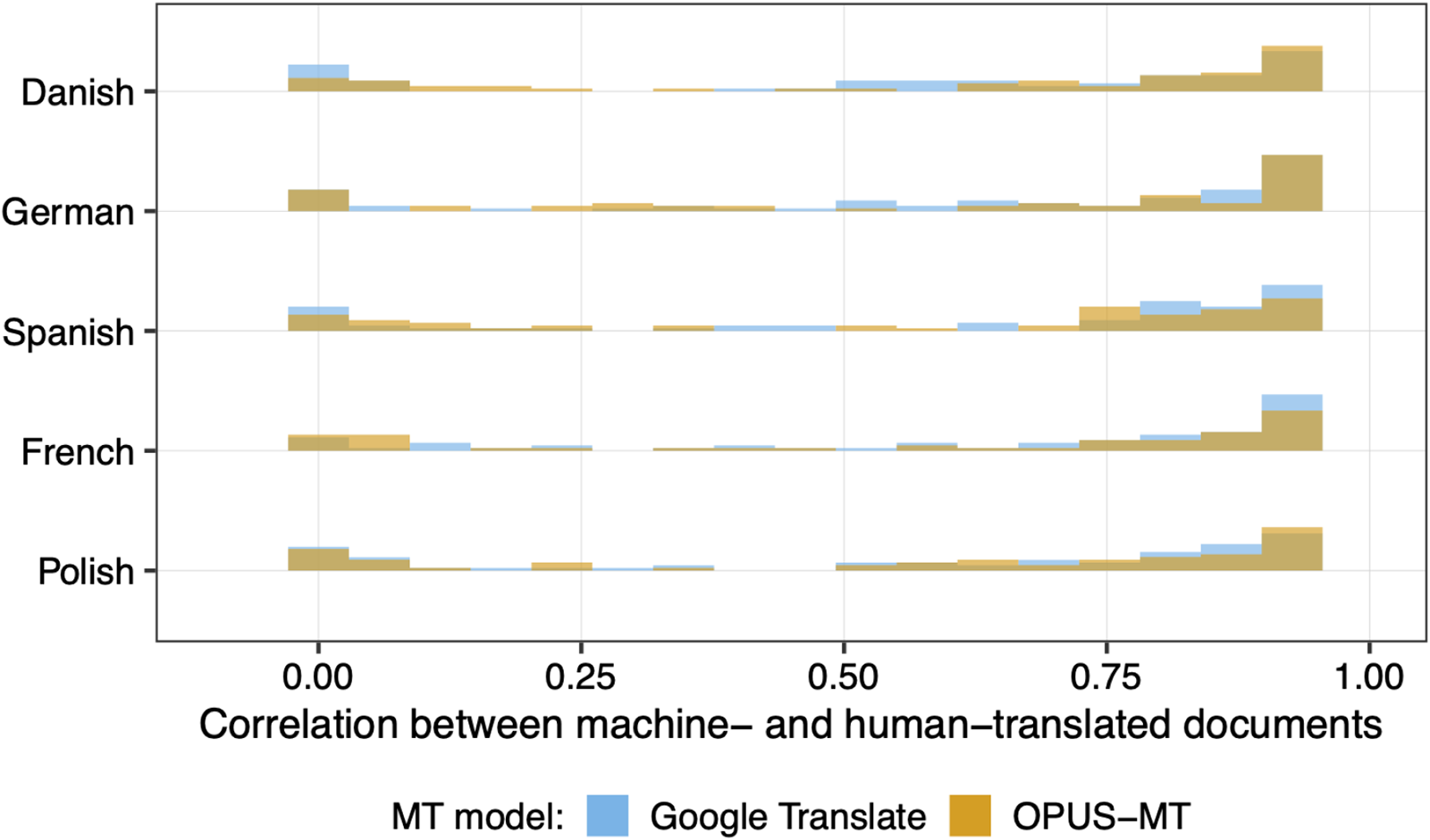
Lastly, we assess whether the topics learned by the models trained on machine-translated texts are comparable to those learned by the model using human expert translations. As shown in Figure 1, the correlations of learned topics’ prevalence across documents with those in the human translation benchmark are overall very high for both MT models. This holds regardless of the source language, and we hence did not observe any language bias when comparing the performance of OPUS-MT and Google Translate.Footnote 15 And as shown in Figure B3 in the Supplementary Material, there is also no substantial difference between MT models in terms of how the topics learned from their translation compared to the human translation benchmark in terms of content. The stems load similarly on topics extracted from the machine-translated texts as on the same topics extracted from human-translated data for French, Danish, and German. However, slight differences exist in the overlap of features for Polish and Spanish. Overall, the results do not indicate a substantial difference between Google Translate and OPUS-MT in their alignment with the word stems of topics in the human translation-based topic models, except for a minor difference for Danish speeches (see Table B2 in the SM).
Similarity of corpus-level topical prevalence between the human translated corpus and the Google Translate and OPUS-MT, respectively. Topical prevalence means the probability of the document being assigned to a specific topic.

3.2. Study 2: machine translation in supervised classification
Our second study examines the role of MT in transformer-based supervised text classification. We assess whether researchers should expect supervised classifiers to be less reliable in a labeling task when fine-tuned using texts translated with an open-source MT model instead of a commercial one.
We address this question with a large comparative classifier fine-tuning experiment. Our experiment allows us to estimate the expected differences in predictions for held-out texts and overall reliability between classifiers fine-tuned using an open-source MT model’s translations as text inputs to their counterparts fine-tuned with translations generated by a commercial MT model.
3.2.1. Data
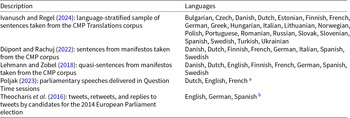
We have compiled a large benchmark of human-labeled multilingual political text datasets for our analyses. Our benchmark includes five datasets (Theocharis et al., Reference Theocharis, Barberá, Fazekas, Popa and Parnet2016; Lehmann and Zobel, Reference Lehmann and Zobel2018; Düpont and Rachuj, Reference Düpont and Rachuj2022; Poljak, Reference Poljak2023; Ivanusch and Regel, Reference Ivanusch and Regel2024). As shown in Table 4, these datasets jointly cover 31 languages from the Indo-European, Uralic, and Turkic language families and three domains of political communication (party manifestos, parliamentary speech, and social media).
Datasets

a Additional analyses conducted including speeches from Croatia written in Bosnian (bs) and Croatian (hr).
b Additional analyses conducted including tweets written in Greek (el).
We have obtained MTs into English for all non-English texts in our datasets. The CMP Translations corpus contributed by Ivanusch and Regel (Reference Ivanusch and Regel2024) contains English translations of sentences generated with DeepL, and we have added translations from two open-source MT models (M2M 1.2B and OPUS-MT).Footnote 16 For all other datasets, we have obtained English translations from two commercial services (DeepL and Google Translate) and three open-source MT models (M2M 418 M, M2M 1.2B, and OPUS-MT). In addition, all but the Lehmann and Zobel (Reference Lehmann and Zobel2018) data come with Google Translate translations that the datasets’ owners obtained when compiling them.Footnote 17
The texts in the five datasets included in our benchmark have been coded on multiple dimensions. As shown in Table 5, our benchmark thus covers various target concepts, ranging from policy topics to negative campaigning to incivility. We use this variation within and across datasets to define 15 classification tasks (see column two in Table 5). We adopt this comparative approach to facilitate the generalizability of our findings. By including tasks focusing on concepts with varying levels of difficulty in corpora from different domains, we ensure that our findings on the “reliability cost” of using open-source MT are not specific to a single dataset, target concept, or classification task.
Tasks overview

3.2.2. Empirical strategy
We proceed in two steps. First, we analyze the similarities of translations obtained with open-source and commercial MT models. This enables us to understand how using an open-source MT model instead of a commercial one might impact the inputs used to fine-tune a classifier.
Second, we turn to our main research question of whether using an open-source MT model instead of a commercial one to translate the texts taken as inputs when fine-tuning impacts a classifier’s predictions and reliability negatively. For this analysis, we fine-tune one text classifier per MT model, dataset, and task covered by our benchmark (see Table 5) on a training data split. This results in four classifiers per task in the CMP Translations corpus and six (five) classifiers per task for the other datasets with(out) old Google Translate translations.Footnote 18 In addition, we have fine-tuned one multilingual classifier per task to enable comparisons with the alternative strategy of aligning texts by embedding instead of translation (cf. Licht and Lind, Reference Licht and Lind2023).Footnote 19
We then use these classifiers to predict the labels of held-out texts in the corresponding test set splits. Holding constant the random seed, data splits, and training hyper-parameters used when fine-tuning,Footnote 20 the only factor that varies between classifiers fine-tuned for the same task is the translation model used to translate the source texts into English. We can thus attribute differences in classifiers’ predictions and out-of-sample classification performances to the MTs used to fine-tune them.
Specifically, we compare classifiers at two levels of analysis. First, we compare classifiers’ language- and label-class-specific reliability in labeling held-out texts using the F1 score.Footnote 21 Second, we analyze the agreement and discrepancies at the level of predicted labels of the test set examples.
3.2.3. Similarities between open-source and machine commercial translations
A first step to understanding how using an open-source MT model instead of a commercial one might impact the predictions and classification reliability of a classifier fine-tuned using these translations as inputs is to assess how similar or dissimilar the translations generated with alternative models are.
We address this question based on a sample of 500 sentences per language in our full-sentence sample of the CMP Translations corpusFootnote 22 by computing the similarity between translations obtained with M2M (1.2B), respectively, OPUS-MT, to the translations obtained with DeepL for each sentence in this sample.Footnote 23 To measure the similarity between two translations of the same source sentence obtained with different MT models, we rely on BERTScore (Zhang et al., Reference Zhang, Kishore, Felix, Weinberger and Artzi2020). BERTScore is a method for estimating the semantic similarity of two sentences by comparing the contextualized embeddings of their tokens obtained with a pre-trained transformer model.Footnote 24
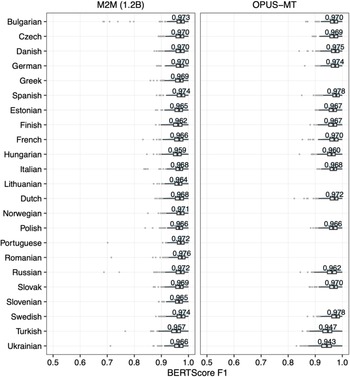
Figure 2 summarizes the distribution of BERTScore F1 scores for translations obtained with the M2M (1.2B) and OPUS-MT models compared to DeepL translations by language (y-axis) and open-source MT model (plot panels). Numbers plotted above box plots report average BERTScore F1 scores per language and open-source MT model. The closer the BERTScore F1 is to 1.0, the more similar a translation pair is.
Distribution of similarities of open-source MT models’ translations to DeepL translations by language and open-source MT model in sample of 500 sentences per language sampled from the CMP Translations corpus. Translation similarity measured with BERTScore at translation pair level. Note that no OPUS-MT translation to English was obtained for Greek, Lithuanian, Norwegian, Portuguese, Romanian, and Slovenian due to translation direction limitations.

Figure 2 shows that both open-source MT models typically generate translations highly similar to DeepL translations, as translations’ similarities are mostly between 0.9 and 1.0. This indicates that the two open-source MT models typically generate translations that are semantically highly similar to those produced by DeepL.
However, three observations are notable. First, as further illustrated in Figure C1 in the Supplementary Material, for each of the two open-source MT models we analyze, there are some languages whose translations’ similarities to DeepL translations are, on average, above the cross-language average (i.e., grand mean) of all languages, and some languages whose average translation similarities are below this cross-language average. For example, the similarity of the M2M (1.2B) model’s translations of Spanish and Swedish sentences to their DeepL translations is above average, while its Finnish, Hungarian, and Turkish translations are below average. Second, this sorting of languages into above- and below-average groups is partially consistent across open-source MT models (e.g., Hungarian, Spanish, Swedish, and Turkish). Assuming that DeepL yields on average higher quality translations, this suggests that the two open-source MT models share some strengths and weaknesses. Third, while the estimated pairwise similarity is above 0.9 for the vast share of sentences, there are a few “outlier” data points with BERTScore F1 scores below the lower whisker of the box plot for each language and open-source MT model. These are cases of high semantic discrepancy between open-source MT and DeepL translations, and we will pay greater attention to these outliers in an analysis reported in Section 3.4.
3.2.4 (No) reliability cost of open-source machine translation
Next, we compare the reliability of classifiers fine-tuned using open-source MT models’ translations to classifiers fine-tuned using commercial MT models’ translations. Specifically, we compare language- and label-class-specific F1 scores between classifiers trained on translations generated with different MT models within dataset, task, and language through regression modeling and complement these analyses with equivalence testing. While there is much heterogeneity in classifiers’ performance across datasets, tasks, and languages, our experimental setup allows us to focus on the translation model (type) as a factor shaping classifiers’ behavior. However, a detailed breakdown of classifiers’ F1 scores by dataset, task, label class, and/or language can be found in Table C9, Figures C2–C6, and Tables C10–C14 in the Supplementary Material.
We first present the results of the regressions that model the overall effect of the (type of) MT model used to translate texts on classifiers’ language- and label-class-specific F1 scores, and add interactions with source language indicators in a second step to assess heterogeneous effects across language.Footnote 25 To account for uncertainty in estimates of classifiers’ test set F1 scores, we bootstrap F1 estimates from each classifier’s test set predictions and use these bootstrapped scores in our analysis. Furthermore, to account for heterogeneity in F1 scores across datasets, tasks, languages, and label classes (cf. Figures C2–C6), all our regressions include dataset, task, source language, and label class fixed effects and cluster standard errors by source language, tasks, label class, and translation model.
Specifically, we estimate the following regressions:
 \begin{equation}{\textrm{F}}{1_d},t,c,l = {^{{\beta }}}0{ + {^{\beta }}}1{\textrm{MT model type }}{ + {^{\delta }}}d{ + {^{\theta }}}t{ + {^{\kappa }}}c{ + {^{\lambda }}}l{ +} ^d,t,c,l\end{equation}
 \begin{equation}{\textrm{F}}{1_d},t,c,l{ = {^{\beta }}}0{ + {^{\beta }}}1{\textrm{MTmodel}}{ + {^{\delta }}}d{ + {^{\theta }}}t{ + {^{\kappa }}}c{ + ^{{\lambda }}}l{ +} ^d,t,c,l\end{equation}
 \begin{equation}{\text{F}}{1_d},t,c,l{ = {^{\beta }}}0{ + {^{\beta }}}1{\text{MT model }}{ + {^{\beta }}}2{\text{language}}\end{equation}
 \begin{equation*}{ + {{\beta}} {\text3{(MT model \times language)}}}\end{equation*}
 \begin{equation*}{{ + \delta d + \theta t + \kappa c + \lambda l + \epsilon \ d,t,c,l}}\end{equation*}
where F1 score d , t, c, l represents a bootstrapped F1 score for dataset d, task t, label class c, and language l; in equation (1), “MT model type” is a categorical indicator differentiating between commercial MT-based classifiers (reference category), open-source MT-based translations, and multilingual Transformer-based classifiers; in equations (2) and (3), “MT model” indicates the MT model used for translation (using DeepL as the reference category); in equation (3), “language” indicates the source language; and δ, θ, κ, and λ are the dataset, task, label class, and source language fixed effects estimates, respectively.Footnote 26
If for model (1) our estimate of β1 for the open-source MT-based classifier category is negative, this would indicate that using an open-source MT model for translation instead of a commercial one results, on average, in a lower F1 score, indicating poorer reliability in labeling held-out texts. The magnitude of the coefficient estimate, in turn, indicates how much worse.
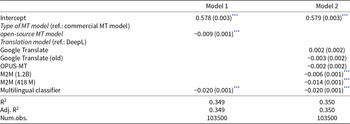
We first turn to the overall effect of open-source versus commercial MT (equation 1). Model 1 in Table 6 estimates the average difference in classifiers’ bootstrapped language and label-class-specific F1 scores when using an open-source MT model instead of a commercial one. This difference is estimated to be negative and statistically significant (t = −9.57, p < 0.000). However, the estimated magnitude is only 0.009, that is, less than a difference of 0.01 units on the [0, 1] F1 score scale.
OLS coefficient estimates of the effect of using open-source vs. commercial machine translation models for translating input texts on classifiers’ language-specific out-of-sample classification performance (F1 score)

*** p < 0.001; ** p < 0.01; *p < 0.05.
The F1 score is measured on a scale from 0 to 1. A coefficient estimate of, for example, +0.01 (+0.001) represents an average increase of the F1 score by 0.01 (0.001), that is, one (a tenth of one) F1 score point. All models include data set, task/outcome, and language fixed effects.
Standard errors clustered by data set, task/outcome, language, and, in case of tasks with more than two labels, by label class.
Thus, when fine-tuning a supervised text classifier, researchers should expect a reduction in its out-of-sample classification reliability if they use an open-source instead of a commercial MT model for translation. However, they can expect that this reduction will be negligibly small, considering that even classifiers fine-tuned on different folds of the same dataset (Licht, Reference Licht2023; Laurer et al., Reference Laurer, Van Atteveldt, Casas and Welbers2024) or with different seeds (Wang, Reference Wang2023) usually exhibit higher levels of variability in test set F1 scores than our estimate of 0.009.
Equivalence tests (Lakens et al., Reference Lakens, Scheel and Isager2018) support this conclusion (see Table C17 in the Supplementary Material). The difference between the average bootstrapped F1 scores of commercial and open-source MT-based classifiers is 0.006 and within the equivalence bound of [−0.02, 0.02] (t = −5.338, p < 0.000). Moreover, Model 1 in Table C15 in the Supplementary Material shows that these findings hold when we omit classifiers fine-tuned with input text translations generated with older versions of Google Translate from the comparison. And Model 2 in Table C15 presents evidence that the estimated F1 score difference of 0.009 reported in Model 1 in Table 6 drops by 53% if we remove classifiers fine-tuned with input text translations generated with the small (418B) M2M model from the comparison.
Model 2 in Table 6 adds nuance to these findings. It compares classifiers fine-tuned with DeepL translations to ones fine-tuned using one of the other MT model’s translations. This shows that using the open-source OPUS-MT instead of DeepL does not significantly reduce classifiers’ test set F1 scores. In the case of the M2M (1.2B) model, the difference is negative and statistically significant, but with a magnitude of only 0.006 on the [0, 1] F1 score scale, again small and arguably practically negligible.Footnote 27 Furthermore, Model 2 in Table 6 shows that even the “worst” alternative of using the smaller M2M (418 M) model only reduces classifiers’ test set F1 score by 0.014 compared to using DeepL.
Turning to cross-language heterogeneity, Figure 3 reports predicted values of the regression model fitted with equation (3) on page 19.Footnote 28 It shows that our finding of a very small reliability cost of open-source MT in supervised text classification holds for most high- and low-resource languages included in our benchmark.Footnote 29 In high-resource languages (top panel), open-source MT-based classifiers are predicted to perform, on average, slightly worse for Danish, German, Spanish, Dutch, and Swedish and better for French and Italian. However, these differences are within ± 0.01 on the [0, 1] F1 score scale for all these languages except Swedish. For low-resource languages (bottom panel), this pattern replicates in many languages, including those with other scripts (e.g., Bulgarian, Greek, and Russian) and/or from other language families than the Romance and Germanic families (Czech, Estonian, Finnish, Hungarian, Romanian, and Slovenian). Comparatively large negative differences (≤ −0.015) exist only for Norwegian, Polish, Slovak, Turkish, and Ukrainian. However, it is worth emphasizing that some of these languages are only represented in one dataset of our benchmark (see Table 4), which limits our ability to generalize the language-specific patterns we find for these languages.
Predicted language-specific F1 scores by language and type of MT model. Estimates based on regression reported in Table C18.

3.3. Example-level prediction agreement and win rates
The previous analysis has an important limitation. Classifiers can achieve a similar F1 score in a task even if they yield different predictions for individual examples. The F1 scores as a measure of predictive reliability might thus mask more nuanced example-level differences between classifiers.
To address this concern, we refocus the above analysis by using a measure of classifiers’ prediction-level pairwise agreement instead of the F1 score to compare MT models and their effect on classifiers’ classification behavior. Specifically, we compare the test set examples’ predicted labels between two classifiers trained using translations obtained with different MT models using DeepL-based classifiers as a reference.Footnote 30 This analysis shows that the labels predicted by OPUS-MT and M2M (1.2B)based classifiers agree to a similar extent with their DeepL-based counterparts’ predicted labels as Google Translate-based classifiers (see Table C20 and Figure C7 in the Supplementary Material). Specifically, the average agreement of Google Translate-based classifiers predicted labels with those predicted by their DeepL-based counterparts is 0.836. The agreement rates of the OPUS-MT and M2M (1.2B)-based classifiers are estimated to be only −0.011 lower, and this difference is found to be statistically insignificant.Footnote 31
3.4. Classification accuracy and translation quality
In a supplementary analysis reported in detail in Section C.4.2 of the Supplementary Material, we further analyze whether low-quality translation might be associated with less reliable classifications. This analysis is motivated by Figure 2, which shows that open-source and commercial models’ translations can diverge substantially in rare cases and therefore raises the question of whether we observe higher classification error rates in texts with strongly divergent translations compared to texts that the MT models translate very similarly.
We find that for both DeepL and M2M (1.2B)-based classifiers, unilateral classification errors are more likely in sentences whose translations diverge comparatively strongly between DeepL and M2M (1.2B). Importantly, this tendency is slightly more pronounced for classifiers relying on M2M’s open-source translations. If we assume that in cases where translations diverge, DeepL yields the higher-quality translation, this finding suggests that using open-source MT models for translations can indeed negatively affect the classification quality when the underlying MT model generates poor translations.
However, our analyses also show that the differences between DeepL and M2M-based classifiers’ accuracy at low levels of translation similarity and the differences between accuracies at low and high levels of translation similarity are very small. Moreover, we have shown in Figure 2 that cases of high disagreement between commercial and open-source MT models’ translations are rather rare. Thus, even if open-source MT models might occasionally yield comparatively poor-quality translations, this should impair supervised classifiers’ reliability only in the margins. Yet, we acknowledge that our evidence on the question of whether low-quality open-source translations impair classifiers’ measurement reliability more than in the case of using a commercial MT model would require further support to justify a conclusive judgment, as our analysis lacks direct indicators of translation quality or error.
4. Conclusion and discussion
Open-source MT models such as OPUS-MT (Tiedemann and Thottingal, Reference Tiedemann and Thottingal2020) and M2M (Fan et al., Reference Fan, Bhosale, Schwenk, Ma, El-Kishky, Goyal, Baines, Celebi, Wenzek and Chaudhary2021) are transparent, reproducible, and affordable alternatives to commercial MT services like Google Translate and DeepL. We have assessed whether translating multilingual corpora into English with available open-source MT models instead of a commercial service (Google Translate) yields substantially different results when applying two common computational text analysis methods. Our first study extends the study by Vries et al. (Reference Vries, Schoonvelde and Schumacher2018), who evaluated MT for cross-lingual topic modeling for four Indo-European languages. Our second study is an original analysis of the reliability of open-source MT for cross-lingual supervised text classification with transformer-based classifiers based on a large benchmark of human-annotated texts covering Germanic, Romance, Slavic, Indo-European, Uralic, and Turkic languages.
Our findings support the conclusion that open-source MT models can replace commercial services when applying bag-of-words topic modeling and transformer-based supervised text classification. We find only minor differences between the measurements obtained from corpora translated with open-source models and commercial services. In the case of our topic model analyses, we find that the topics estimated by a model fitted on parliamentary speeches we machine-translated with the open-source M2M model are as similar to the benchmark topic model fitted on human-translated speeches as those estimated by its counterpart model fitted on speech translations generated with Google Translate. In addition, both MT-based models allocate speeches to topics similar to those in the benchmark model. In the case of our supervised text classification study, we find that the difference between transformer-based classifiers fine-tuned using translations from open-source MT models performs, on average, only 0.009 F1 scores worse than comparable classifiers fine-tuned using translations from a commercial MT model as input.
Our findings have important implications for applied researchers. Given that using open-source MT models for topic modeling or fine-tuning transformer-based classifiers tends to result in no less reliable measurements than using a commercial MT service, applied researchers can benefit from the transparency and reproducibility advantage of open-source MT. Maybe as important from a practical point of view, using open-source MT models can save researchers costs. For example, relying on an open source instead of a commercial MT service to translate the non-English texts in the four benchmark data sets used in Study 2 would save them about US $ 1267 (see Table C8).
However, our study is not without limitations. First, our analyses focus mainly on MT from Germanic and Romance Indo-European languages. We address this limitation by including the Manifesto Translations corpus (Ivanusch and Regel, Reference Ivanusch and Regel2024) in our supervised classification benchmark, which includes texts written in Slavic Indo-European, Turkic, and Uralic languages. However, future research should extend or complement our benchmark and analyses to Asian and African languages.
Second, as is standard in the methodological literature (cf. Table A1), all our analyses use English as the target language. When researchers study corpora recording only Slavic or Nordic languages, for example, it might be better for measurement reliability to translate texts to the majority language in their corpus or a language from which other languages descended.
Third, researchers might find translation with open-source MT models technically challenging. While software packages such as the EasyNMT Python package provide a handy toolkit,Footnote 32 we acknowledge that deploying these models and using GPU computing environments are not trivial skills. The code base and online app we provide thus aim to lower this accessibility barrier.Footnote 33
Fourth, researchers might be concerned about the longer processing times for open-source MT models. While we acknowledge that translation with open-source models takes longer than querying commercial services APIs, we note that MT incurs a one-time cost. Many large multilingual, political text corpora, like ParlSpeech2 (Rauh and Schwalbach, Reference Rauh and Schwalbach2020) or the Manifesto Project Dataset (Lehmann et al., Reference Lehmann, Franzmann, Burst, Matthieß, Regel, Riethmüller, Volkens, Weßels and Zehnter2023), are widely used by many researchers. Translating these and other corpora is a one-time investment that would significantly contribute to the research community (e.g., Plenter, Reference Plenter2023).
Fifth, our topic modeling study only examines the LDA topic model, excluding neural topic modeling methods. Similarly, our supervised classification study only examines transformer encoder fine-tuning while ignoring recent developments in using generative LLMs for prompt-based zero- and few-shot political text classification (e.g., Gilardi et al., Reference Gilardi, Alizadeh and Kubli2023).
Last but not least, our studies focus on quantitative text analysis. Our research design does not take into account how humans understand machine-translated texts and whether translation errors lead to faulty interpretation, for example, in manual content analysis or text annotation.
Supplementary material
The supplementary material for this article can be found at https://doi.org/10.1017/psrm.2026.10102. To obtain replication material for this article, please visit https://doi.org/10.7910/DVN/8UOOEW.
Acknowledgements
We thank three anonymous reviewers and participants of the EPSA panel ME07 “Multilingual Text Analysis” for helpful comments and suggestions. This research has been funded by the Deutsche Forschungsgemeinschaft (DFG, German Research Foundation) under Germany’s Excellence Strategy – EXC 2126/1-390838866.





 Open access

