


What is the best form of governance for capitalism? It is often a balance between several different approaches tailored to local conditions. It is therefore useful to distinguish between three types of capitalist governance, namely liberty capitalism, solidarity capitalism, and community capitalism. I will examine these three types of capitalist governance one by one, and then explore how they have applied to Western Europe, as well as in the context of international cooperation.
1.1 The Typology of Liberty, Solidarity, and Community
Max Weber’s ‘ideal type’ is an effective tool for comparing events across long periods of time and within distinct linguistic spaces. These ideal types identify common characteristics that go beyond the diverse nomenclature used, which can vary depending on the country and the time.1 As Weber pointed out, ideal types are analytical categories that facilitate understanding. Consequently, they were not necessarily used by actors at the time, and run the intrinsic risk of falling into anachronism. All historians are potentially guilty of this. The French historian Marc Bloch observed that the term ‘feudalism’ was not coined in the medieval period, but in the early modern period to describe a past reality.2
Here ideal types will be used to identify types of capitalist governance according to their main principle, namely the ‘trinity’ of liberty, solidarity, and community.3 These forms of capitalism are driven by economic policies implemented by governments, as well as by patterns of relations between various actors both public (state, international organisations, courts, local authorities) and private (companies, trade unions, associations, experts, etc.).
Instead of focusing on artificial groupings based on political labels, ideological references, or official discourse, this typology instead highlights fundamental convergences or divergences. Indeed, identical terms can have different meanings in different countries. For example, the notion of ‘industrial policy’ is perceived negatively in federal Germany, but is central to French statist ideology. Yet in comparing the measures implemented to support enterprises, one could conclude that assertive industrial policies existed in most Western European countries at least until the late 1980s, including in West Germany (Chapter 5). Similarly, the connotations (positive or negative) surrounding the terms ‘liberal’ and ‘social-democratic’ have differed depending on the country and the time. For instance in West Germany, the term ‘liberal’ was increasingly used from the late 1960s onwards in association with ideas of reform and modernity, including on the left and by some environmentalists with the notion of ‘linksliberal’ (‘left-liberal’).4 By contrast, in France the equivalent term for ‘left-liberal’, ‘social-libéral’, is negative, as it refers to neoliberals falsely disguised as socialists. The term ‘communist’ is equally imprecise. There is nothing in common between bloodthirsty Stalinist apparatchiks, and the millions of Italians and French voters who choose communist parties (the PCI and the PCF) because of their emancipatory struggles (economic redistribution, decolonisation) and local networks of solidarity.5 The PCI was under the tutelary figure of Antonio Gramsci, who advocated a less violent approach than the USSR, while the PCF leadership followed Moscow more closely. Similarly, depicting an economic policy by referring to an economist is complicated; for instance, Keynes defended free trade in some of his work, and a more protectionist approach elsewhere.
Hence the importance of using principles such as liberty, solidarity, and community instead of political or ideological labels. A governance of capitalism based on liberty seeks to shape the economy according to the ideal of a market governed by pure and perfect competition, with a view to maximising growth, and thereby collective well-being. Solidarity capitalism attempts to reduce the detrimental consequences of capitalism by increasing the welfare of the weak and by protecting the environment. Community capitalism occurs when the main objective is to reinforce the group of belonging.
While chiefly socio-economic, this typology has larger political and philosophical underpinnings. It helps avoid the ‘state v. market’ binary. Markets do not exist in a vacuum, but rather are shaped by institutions, ideologies, and power relationships.6 Some neoliberals have understood that a strong state is actually necessary to promote radical free market policies, for instance to break up monopolies and oligopolies, to impose regressive taxation, and to resist groups motivated by solidarity or community. Marxists have long complained that state authorities have often been at the service of the dominant classes. Consequently, what is important is not the level of state intervention, but instead the guiding principle driving it.
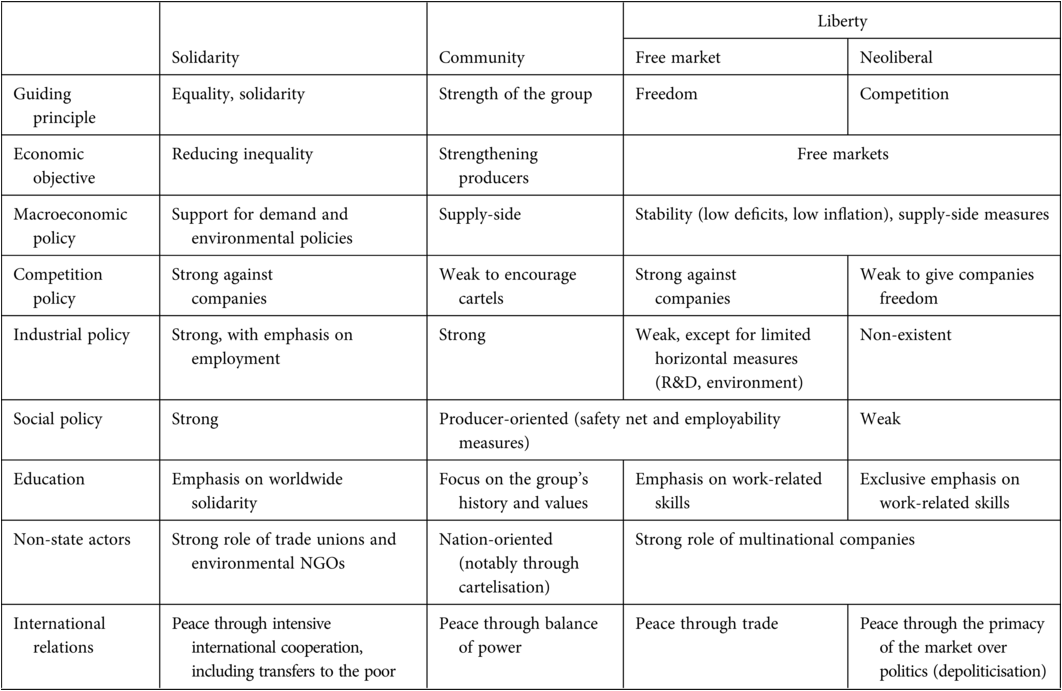
Under this trinity, any feature of capitalism can be geared towards one of the principles of liberty, solidarity, or community (see Table 1.1). For example, antitrust policy can promote liberty (by encouraging more competition), solidarity (by curtailing undue profits reaped by larger companies dominating the market), and community (if competition policy primarily targets foreign companies).
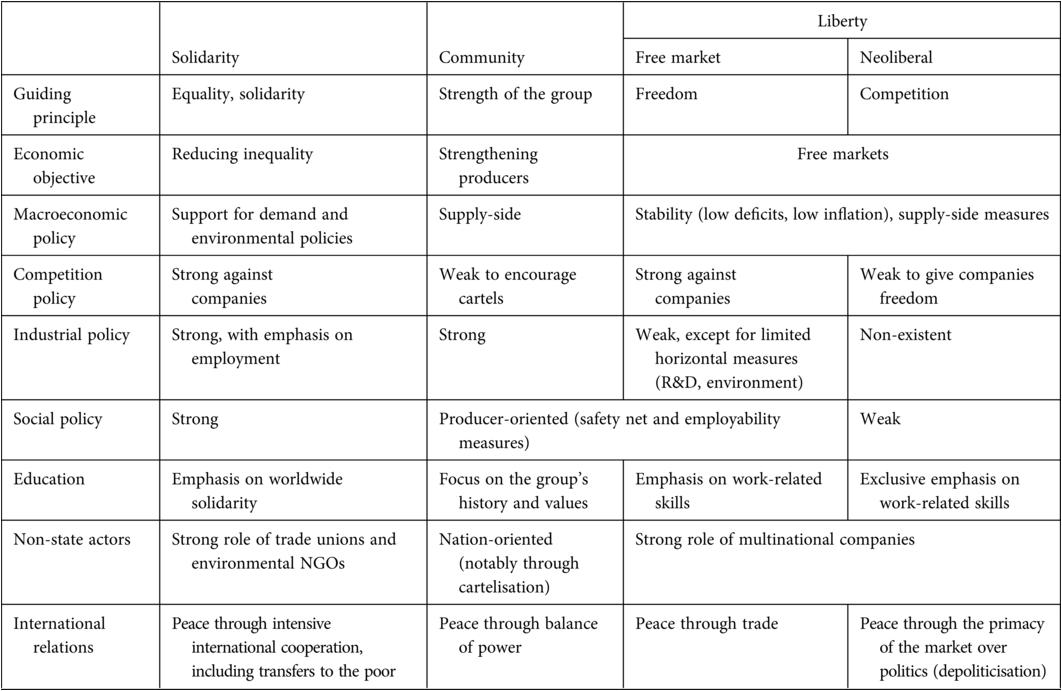
Table 1.1 Long description
The table details the four types of capitalism: solidarity, community and liberty, with the latter divided into free market and neoliberal. Each types is assessed according to 10 criteria as follows. Guiding principle, economic objective, macroeconomic policy, monetary policy, competition policy, industrial policy, social policy, education, non-state actors, and international relations.
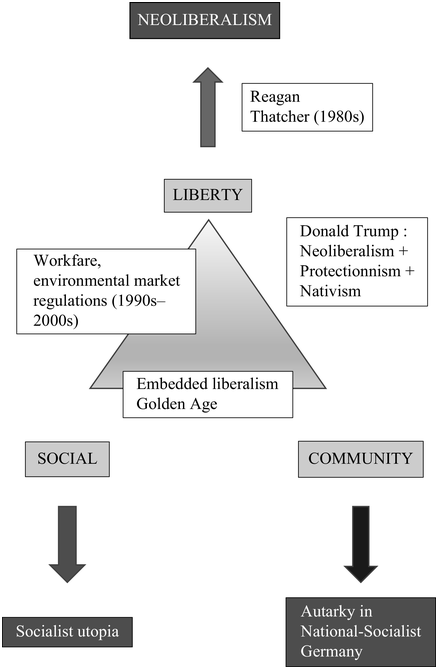
Each of these three types of capitalist governance has a radical variant. The extreme version of solidarity is the socialist utopia, while that of liberty is represented by neoliberals, mostly visible since the advent of Margaret Thatcher in London in 1979, and Ronald Reagan in Washington in 1980. The latter emphasise competition, and systematically attack the welfare state.7 The term ‘ultraliberals’ is better suited to describe those radical supporters of liberty capitalism, but seldom used. Finally, the extreme version of community is the warmongering of Nazi Germany (1933–45), when all economic decisions were completely subordinated to promoting the German community (with the exception of German Jews, communists, etc.) at the expense of other communities.8 The regime was capitalist but not liberal: Hitler preserved private property and capitalism, except for opponents of the regime, but competition was largely abolished by a general cartelisation of the economy to support the armament effort. The regime’s social dimension, eradicating unemployment and offering new leisure activities for the working class (such as the affordable cruises of the Kraft Durch Freude organisation, ‘strength through joy’), was illusory. Improved economic conditions were already apparent in late 1932, before Hitler came to power. He stimulated the economy through dictatorial mechanisms, such as banning strikes, plundering opponents (and later conquered and subjugated peoples), and forcing loans to be repaid through military conquests. Economic organisation was entirely driven by military concerns. Germans were deprived of everyday consumer goods (food and textiles), because the funds that would have been used to import these goods were primarily allocated for rearmament. Promises of everyday consumer products, such as the Volkswagen (the ‘people’s car’), never materialised, or did so only after the war (the Beetle finally came out in 1946); one exception was the radio, which was widely distributed, but at a higher price than its American equivalent, and mainly for propaganda purposes.
By definition, these ideal types are rarely found in their pure state in reality. Decisions often result from a combination of these approaches (see Figure 1.1 and the Conclusion). In a nutshell, in the West the years between 1945 and the 1973 oil crisis were marked by a balance between solidarity (strong and expanding welfare states, with a limited environmental dimension), community (ambitious industrial policies), and liberty (promotion of international free trade, implemented gradually and primarily from the 1960s onwards).
The three forms of capitalism
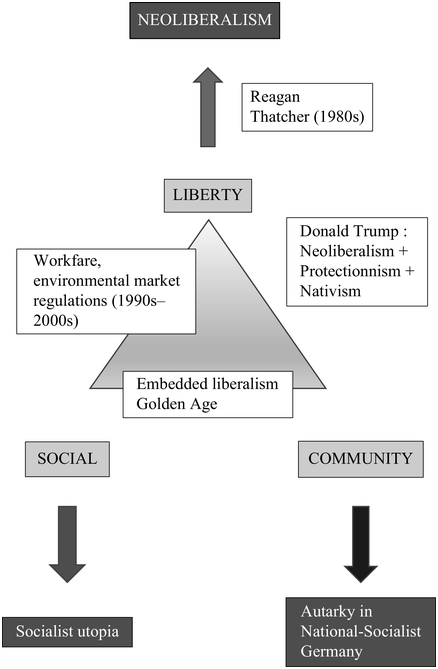
Figure 1.1 Long description
The diagram shows a triangle, with the upper tip labeled, liberty, and the radical variant, neoliberalism, labeled above it. The lower left tip is labeled, social, with the socialist utopia, labeled below it. On the lower right tip is the label, community with autarky in national-socialist Germany, labeled below it.
In the 1970s, emphasis shifted towards liberty, with the prevailing system being challenged due to financial difficulties, the failure of alternatives based on solidarity and community (Chapters 4 and 5), as well as the rising tide of neoliberal ideas. The latter gained ground in the 1980s (Chapters 6 and 7).
In the 1990s and 2000s, Western Europeans strove to reform the social aspect of economic policy through the notion of ‘workfare’, and through environmental policies combined with free market tools (Chapter 8). This was an attempt to strike a new balance between liberty and solidarity, but without community, for most protectionist measures and industrial policies were dismantled (Chapter 8).
Since the mid-2010s, community capitalism has been on the rise again, with more protectionist and nativist policies. Two approaches stand out: the first combines protectionism with socio-environmental measures (Chapter 9), while the second combines protectionism with neoliberalism, for instance under US President Donald Trump (Chapter 10). His supporters are divided between ‘national libertarians’, who are more neoliberal by virtue of their emphasis on deregulation, and ‘national protectionists’, who are more in line with a community approach via their support for a stronger state.9
1.2 Liberty: Market-Oriented Policy and Neoliberalism
Advocates of liberty capitalism believe that removing barriers to free competition will lower prices and stimulate growth, employment, and ultimately general welfare. The market is seen as an ideal tool for regulating conflicts at both the national and international level. This approach translates into the promotion of free trade, which provides low-cost imports, export opportunities (through the principle of reciprocity), and increased productivity. The state retains an important role in providing a framework conducive to economic activity, but does so without guiding companies, instead limiting itself to correcting negative externalities (such as pollution), and to managing natural monopolies.
Economic and political liberalism are often associated. Historians of early modern Europe have emphasised the emancipatory ideal of the market, which leads to a certain form of equality of status, in contrast to the practices of the society of privilege.10 The strong moral dimension in the thought of classical liberal economists such as Adam Smith has also been emphasised, notably by Karl Polanyi. They believed the market is simply a means to a more harmonious society, not an end in itself. The link between the two is nevertheless not automatic, with many dictatorships thriving in the market economy.
As with the two other categories, combinations exist. A moderate form of international free trade has been defended by left-wing globalists to secure peace since the nineteenth century.11 Some actors blend liberty and solidarity. For example, among the Swedish Social Democrats, the Rehn–Meidner model of 1951, named after two economists from the most important trade union, postulates that wage increases should be aligned with the productivity of export firms so as not to penalise them.12 While this system drives underperforming firms out of business, it is backed by a protective welfare state and an effective training system.
In the 1980s, the emergence of a radical form of free market fundamentalism led to a new type of economic policy – neoliberalism.13 The market and competition became supreme values, with humans reduced to materialistic consumers. This shift translated into a policy of dismantling the welfare state, a regressive fiscal system (with tax cuts mainly for the rich), and extending market logic to all domains of social life. The political framework becomes contingent on the market. Neoliberalism stands in sharp contrast to the emancipatory ideal of Enlightenment liberalism, which challenged authority, and valued critical thinking and autonomy.
Neoliberal policies spread in the 1980s, and especially in the 1990s and 2000s, for several reasons (Chapter 7), including the financial constraints linked to the oil crisis, a cultural shift to a more individualistic ethos, the zeal of neoliberal intellectual networks, and the failure of alternative approaches (Chapter 4).
The term neoliberalism is used here to describe radical free market policies, and not to designate participants in the Colloque Walter Lippmann (a conference of intellectuals organised in Paris in 1938), which is sometimes described as the cradle of neoliberalism because the expression was occasionally used at the time. This event was attended by a disparate group of non-Marxist economists, some of whom were hostile to state intervention (such as Friedrich Hayek), others who supported strong state regulation (such as Alexander Rüstow), and even Keynesian socialists (such as Robert Marjolin).14 The meaning of ‘neoliberal’ in the history of ideas is therefore not clear. By contrast, in this book, the concept is used as an ideal type to describe policies aiming to dismantle the welfare state and establish competition (rather than liberty) as the supreme guiding principle.15
Neoliberals do not place political liberalism at the heart of their thinking. Both authoritarian and neoliberal thinking converge in their support for inequality, whereas the classical liberals consider that political equality is the precondition for liberty. The first neoliberal state was Pinochet’s brutal Chilean dictatorship in the mid-1970s.16 Many neoliberal activists, such as Hayek and Friedman, along with Thatcher’s economic adviser Alan Walters, visited Chile under Pinochet, or cited it as an example of success for the Global South.17 In 1977, Hayek was critical of the sanctions against the Apartheid regime in South Africa, while Friedman often lamented the inefficiency of democracy versus markets. Within liberal democracies, the association between neoliberalism and social conservatism has often been emphasised, as exemplified by Margaret Thatcher and numerous American economists, although it is not systematic.18 Ten years before Thatcher, another leading British conservative, Enoch Powell, proposed a neoliberal economic programme in his so-called Morecambe speech on 11 October 1968, in which he called for massive tax cuts financed through privatisation, and the repeal of many social programmes.19 This statement was overshadowed by his infamous ‘rivers of blood’ speech, delivered six months earlier on 20 April 1968, in which he predicted chaos if immigration to the UK continued to increase. The subsequent adoption of neoliberal policies by authoritarian regimes such as Russia and China led to the concept of ‘authoritarian neoliberalism’.20 The Chilean dictator Pinochet was even a role model for certain Russian neoliberals, as he demonstrated the possibility of associating authoritarianism with neoliberalism.21 In 2025, the association of undemocratic arch-libertarian business leaders such as Peter Thiel with US President Donald Trump – who has launched a massive retrenchment of the state – has raised concerns regarding a new link between neoliberalism and authoritarianism.22
The case of German ordoliberals is ambiguous. By virtue of their attachment to market mechanisms and their rejection of the welfare state (for some), they can be linked to neoliberals. However, they do not reduce humans to a simple homo economicus, instead associating economic liberalism with political liberalism.23 The first generation of ordoliberals was less neoliberal than subsequent generations influenced by Hayek. Even some radical left-wing German politicians, such as Sahra Wagenknecht today, recognise their debt to original ordoliberalism. It actually began as a reaction against Nazism, which combined political totalitarianism, economic dirigisme, and capitalism. The promotion of ordoliberalism was thus inseparable from the creation of a democratic Germany. As Wilhelm Röpke has argued in Solution to the German Problem (1946), by breaking the excessive concentration of big business in Germany and making autarkic policies impossible, free trade would transform the country into a peaceful giant, an ‘enlarged Belgium’.24 Some German ordoliberals included a social and moral component in their approach, and were clearly opposed to the neoliberal second Chicago school when it came to competition policy (Chapter 8). Others argue that ordoliberals are neoliberals through and through, as demonstrated by German policy towards Greece during the eurozone crisis (2010–15).
Neoliberals have had an ambiguous relation to European integration. The project of a neoliberal Europe was presented by Hayek in a short text published in September 1939, at the outbreak of the World War II.25 He wanted to demonstrate that it was impossible to ensure peace exclusively through political union; it had to be combined with economic union based on the free movement of goods, labour, and capital. This economic union would make social policy superfluous, and even impossible. However, Hayek was less interested in European integration – an idea that was purely theoretical in 1939 – than in criticising state intervention in the economy. He took up the argument in his famous Road to Serfdom published in 1944.26 Many neoliberals have long been sceptical of European integration. Quinn Slobodian has pointed out that in the 1950s and 1960s, many ordoliberals and representatives of radical liberalism, such as Gottfried Haberler, saw the EC as an intolerable protectionist actor.27 In the 1980s, meetings of the Mont Pelerin Society, a hotbed of neoliberalism, remained highly concerned by the EC’s protectionist and dirigiste tendencies.28 However, many neoliberals gradually came to see some European institutions as being conducive to their policies, especially in the 1990s and 2000s (Chapter 8).
While neoliberalism cannot be combined with solidarity, it can integrate elements of community. The support of US President Donald Trump (2017–21, and since 2025) for polluting industries goes hand in hand with attacks on the welfare state, an aggressive protectionist trade policy, and tax cuts for the rich. Similarly, Brazilian President Jair Bolsonaro (2019–22) has abandoned the Brazilian forest to such intensive exploitation that the historian Antoine Acker has referred to his policy as ‘carbofascism’.29
1.3 Solidarity: Social and Environmental Components
Policies based on solidarity support the disadvantaged, such as the poor or any groups discriminated against on the basis of gender, sexual orientation, culture, skin colour, and so on. They also include an environmental component, as environmental degradation disproportionately impacts the poor,30 who are often deprived of access to the greenest and healthiest neighbourhoods, the best-insulated homes, and organic food. They also often perform the most dangerous jobs, as illustrated in Lowest of the Low by the German journalist Günter Wallraff, published in 1980.31 Disguised as an illegal Turkish immigrant working in Germany for two years, he endured a series of jobs that exposed him to health and environmental risks, including nuclear ones.
The solidarity approach has an affinity for Marxism, with its supporters being divided between reformists, and revolutionaries defending a more radical path. The former include social democrats and Greens won over by sustainable development. This concept was conceived in 1987 in order to reconcile economic growth and environmentalism.32 The latter encompasses communists and proponents of the degrowth movement, who are usually not the same people, as environmental movements have a strong anti-authoritarian (and hence anti-communist) element.
Politically, even if solidarity is defended by the left, it is sometimes also promoted by right-wing actors for ideological reasons, or to deprive their left-wing opponents of working-class support. The father of the German welfare state was the conservative Otto von Bismarck, while the inventor of the ‘welfare state’ was the British liberal William Beveridge. Similarly, environmental protection appealed to many conservatives.33
Conversely, the combination of solidarity and liberty produces a synthesis sometimes associated with the Indian economist Amartya Sen and his notion of ‘capability’.34 Sen defined capability as a possible choice and an effective realisation. Similarly, some environmentalists advocate the use of market mechanisms. For example, some German environmentalists have supported liberalising the energy market in order to break up the old oligopolies of fossil fuel companies, with a view to bringing in newer and greener producers.35
Those who defend solidarity must compensate for the imbalance between dominant capitalist entities and victims of the system, hence the need to build trade unions, non-governmental organisations, and grassroots movements. Large companies and their lobbies can capture the state by imposing lenient social and environmental policies, in addition to regressive taxation (favouring the rich). They can also influence the state through lobbying, sometimes doing so directly, and sometimes more indirectly via the scientific community in order to sow ‘doubt’ regarding the usefulness of regulation.36
1.4 Community: Protection and Assertion
Capitalism is not solely based on a compromise between liberty and solidarity. Community capitalism must also be taken into consideration, which is to say the willingness to organise capitalism in order to defend and promote the group.
Weber noted the importance of communities based on economic, political, or social interests, and not just common residence and/or ethnicity.37 Humanity has been organised around communities based on a territory, shared feelings of belonging, a common history, cultural elements (such as norms of appropriate behaviour), and sometimes ethnic proximity. As Francis Fukuyama has asserted: ‘Natural human sociability is based on kin selection and reciprocal altruism – that is, the preference for family and friends.’38 Communities are useful in providing a measure of stability and predictability, whereas a world organised entirely according to the principles of liberty or solidarity capitalism would be more disruptive. A family, tribe, religious group, local network, or nation provides anchors in life. Falling back on these communities is therefore natural.
Contemporary politics have been shaped by a particularly influential form of community: the nation-state. They have interacted with other forms of ‘imagined communities’, such as subnational regional identity, or as in the case of post-war Europe, with the European identity. For all that, European identity is weaker than national identity, for it is based on the shared but negative memories of the world wars, and the Soviet occupation of Eastern Europe.39 Community capitalism should therefore not be confused with the self-proclaimed European ‘communities’. Paradoxically, community capitalism has been fairly weak in the European communities, more of a political statement or programme to develop such communitarian feelings in the future rather than an existing reality.
From a philosophical point of view, Rousseau’s philosophy supports the idea that the republican political process is based on the existence of natural communities, what he referred to as ‘nations’ defined by common habits and way of life, and possibly a specific language.40 The concept of community has affinities with the ‘communitarian’ philosophers, who define the group by a shared history, territory, values, and common action.41 Beyond the communitarians, Amitai Etzioni, a philosopher influenced by his experience on a kibbutz during his teenage years, has emphasised the importance of community. Commentators on Etzioni’s work argue that communitarianism offers a ‘third way’ between ‘excessive liberalism’ and ‘state-run socialism’, and could serve as a ‘new paradigm of socio-economic analysis’.42 Once again we find the trinity of liberty, solidarity, and community.
Foreign policies based on community are both defensive and offensive. They include protectionism (high trade barriers), restrictive migration policy, and large military budgets. In terms of foreign policy, they can be either isolationists (refusing any solidarity with other states), or on the contrary imperialistic (acting militarily to gain immediate material advantage instead of upholding international law). The combinaition of European integration and community capitalism is aptly described in French by the expression ‘Europe puissance’.43 However, it cannot be translated literally into English, since the notion of ‘power’ is different. It is present in all three types of capitalist governance. In liberty capitalism, companies vie with each other using their market power. In solidarity capitalism, social and environmental activists are engaged in a power struggle with their opponents, and sometimes among themselves. Finally, there is no neat opposition between a rules-based liberty, solidarity capitalism, and law-of-the-jungle community capitalism. All forms of capitalist governance can be bound by rules or managed by power struggles.
Community capitalism could also include environmentally friendly policies. Many environmentalists are sympathetic towards the notion of a ‘commons’ as coined by Elinor Ostrom, winner of the 2009 Nobel Memorial Prize in Economics. She has argued that efficient management of common resources entails a clear identification of who belongs to the community (and has access to the resources), and who does not. Rules for using common resources should be defined by the local community via collective choice, and enforced in the same way. This translates, for example, into quotas given to a particular group for harvesting fishing resources, with no access given to outsiders.
Neomercantilism is an appropriate term for referring to economic policies based on community.44 The notion refers to mercantilism, an early modern policy aimed at protecting domestic producers via protectionism, subsidies, and other advantages. Since 1945, it has been combined with respect for the essential norms of international free trade, which prohibits the most heavy-handed protectionist practices, hence the prefix ‘neo’. On the theoretical level, government intervention can be justified to produce externalities (jobs, innovation, security), to correct market failure (limited long-term funding, high barriers to entry), and to provide activity-specific public inputs (infrastructure, health, education, justice, police). It is criticised for its rigidity (information deficit), as well as for political capture. But neomercantilist policies are not inherently effective or ineffective. According to Dani Rodrik and his co-authors, the most successful industrial policies are those that are single-oriented (pursuing one main objective at a time), flexible, based on interaction between public and private actors, and reactive: they can ‘pick a winner’, but must also ‘let the losers go’.45
The notion of community is useful in moving beyond the public v. private dichotomy. Community capitalism concerns both the state and private actors: a cartel of private companies is as efficient in protecting the interest of local producers as is a state-led industrial policy. Enterprises have often forcefully defended protections against the free market, either by obtaining state measures (banning or taxing imports, monopolies, etc.), or by establishing cartels to avoid a price war or exclude certain competitors. Even some of the most powerful multinationals of the late twentieth century continued to demand public protection, as illustrated by Bastian van Apeldoorn, who used the term ‘neo-mercantilism’ in the 1980s in reference to one of the two groups in the European Roundtable of Industrialists, a powerful lobby.46 Neomercantilists therefore oppose the free market in order to boost profits (and the strength of the community), not to promote solidarity.
The best way for an enterprise to maximise profits is not free competition, but rather monopoly, customs barriers, and/or cartels. The most famous is the Organization of the Petroleum Exporting Countries (OPEC), which seeks to fix oil prices worldwide, although many cartels have remained secret (Chapter 5).
The principle of community sheds light on the distributional conflicts at the core of public spending: not all public expenditure is directed towards the weak, with some subsidies instead propping up powerful economic actors. Neomercantilism is often justified for social reasons, as it can save jobs, but it does so at significant cost, including higher prices (making affordable imports more expensive) and higher taxes (to fund the subsidies for the protected companies). Sometimes state aid is combined with layoffs and/or factory relocations, while in other instances it is used to protect viable jobs in companies facing short-term threats (such as the Covid-19 lockdown in 2020–21) or unfair competition (everything depends on what qualifies as ‘unfair’). All in all, the solidarity element of neomercantilist measures is often difficult to gauge without measuring how regressive or redistributive the fiscal system and state expenditure are. Some authors call it ‘corporate welfare’, which is to say unconditional state aid to business under various forms, including private–public partnerships or quantitative easing.47 Some state subsidies are inefficient from a social standpoint if they create a windfall effect (an unexpected gain for a company that does not need to change behaviour), or if they artificially prop up a structurally inefficient company by limiting the losses of private shareholders without improving the long-term job prospects of their employees.
Similarly, neomercantilism must be distinguished from free market approaches. The West German approach of stable macroeconomic policy, based on low inflation and favouring investment over consumption, is sometimes described as ‘neomercantilist’, even though it is textbook ‘deflationary’ free market policy.48 The strategy pursued by Gerhard Schröder’s government (1998–2005) – to segment the labour market in order to reduce social protection and wages, and to relocate jobs to the East to reduce costs – is neoliberal rather than neomercantilist.
A West German neomercantilism nevertheless existed through: 1) multiple channels of discreet support for firms, such as the long-term financing provided by Landesbanken; 2) an effective vocational training system; and 3) productive social dialogue. This helps explain Germany’s long-term export success, as this combination between liberty, solidarity, and community provides stable working relationships, which encourage high levels of investment in both labour and production, thereby promoting high value-added production.
1.5 Community Capitalism in History
‘Mercantilism’ was originally associated with the policies of Jean-Baptiste Colbert, who held a role akin to that of a minister of economy under Louis XIV of France from 1665 to 1683.49 Noting that the French economy was lagging behind England and the Netherlands, he encouraged national production through financial aid to royal factories, but also to private factories and shipowners. These were combined with barriers to imports, and sometimes with monopolies. He complemented this action by setting high national standards to improve quality. He sought to unify the domestic market (tackling internal customs and other tolls), and facilitated the import of raw materials. He also sought to attract foreign entrepreneurs and skilled workers. Companies were set up to encourage commercial expansion in the colonies, including through sheer force. Colbert has had an enduring legacy: he founded the glassmaker Saint-Gobain in 1665 (known as the Manufacture des glaces at the time), which has remained a world leader ever since. Outside France, Jürgen Kocka described how the Dutch East India Company (the VoC) embodied mercantilism by merging trade and war:
The Dutch government had conferred on the VOC the right to operate all Dutch trading business east of the Cape of Good Hope, along with the authorization to wage war, conclude treaties, take possession of land, and build fortresses. … The distinction between conducting capitalist business and waging war was fluid. There were years in which the company apparently drew the major share of its income from the seizure of competing or enemy ships.50
Mercantilism was thus a mixture of dirigisme, militarism, and free market measures primarily designed to maximise the power of the national community.
Many countries adopted this mercantilist approach. The work of the German economist Friedrich List (1789–1846) emphasised the state’s crucial role in protecting fledgling industries from foreign competition, notably through customs duties. He influenced numerous German states, with some economic success; the German state (born in 1871) quickly overtook the UK in many industrial sectors. The US political economist Henry Carey was also an influential neomercantilist.51 On a global scale, colonisation was based on mercantilist logic, for colonising states generally forced open the markets of colonised or dominated states, for example, China, who signed several so-called unequal treaties in the nineteenth century, the first one in 1842. Trade preferences were established to favour metropolitan industrial producers over those from the colonies.
Mercantilism prevailed in the 1930s. After the stock market crash of 1929, the first country to withdraw into trade protectionism was the US with the Smoot–Hawley Tariff Act of 1930, while the first country to practise aggressive currency devaluation was the UK in 1931 (the pound being overvalued since 1925).52 Both countries benefited from this non-cooperative behaviour, which rewards the first, daring rule breaker. Soon after, Hitler’s National Socialist regime embodied the essence of authoritarian mercantilism, combining autarky, social repression, monetary manipulation, and industrial dirigisme, all while preserving capitalism. Albert Hirschmann remarked that interwar international economic relations were marked by an unrelenting ‘pursuit of power’ in which ‘the power of the state [was] the primary aim of economic policy’, an apt description of community capitalism.53
The post-war period saw a shift from mercantilism to neo-mercantilism: since blatant protectionism was seen as disruptive and conducive to nationalism, industrial policies had to be combined with international cooperation. Most Western European countries pursued active industrial policies (Chapter 5), while at the same time avoiding protectionist trade wars. These policies were called into question in the 1970s and 1980s due to their cost and perceived inefficiency. Significantly, at the time German criticism of French industrial policy fell within the lexical field of mercantilism. In 1982, Chancellor Helmut Schmidt stigmatised French ‘Colbertist prejudices’ in an interview with the British ambassador, while the European Commission’s Director-General for Competition, Manfred Caspari of Germany, used the phrase ‘Colbertistischer Wahn’ (‘Colbertist madness’) in connection with the French government in October 1981.54 In 2004, the Dutch commissioner Frits Bolkestein referred to ‘the mercantilist regime of Jean Baptiste Colbert’ in the Financial Times to criticise French and German projects pursuing industrial policy.55
The German case illustrates the interest of the principle of community. In their speeches, German leaders constantly affirm their country’s adherence to free market rules and their refusal of ‘industrial policy’. This has roots in the rejection of communism and Hitler’s dirigiste experience. Yet West German public aid to firms reached a level comparable to French aid in the late 1970s (before major structural reforms when French socialists came to power in 1981), and the proportion of nationalised firms was similar as well (Chapter 6). As in France, German investment in Airbus grew out of long-term industrial and strategic calculation (strengthening the national aeronautics industry). German tolerance for certain cartels, especially those dedicated to exports or associated with a period of crisis, are recognised in law. German subsidies have nevertheless been discreet, generally fiscal, and often allocated by the Länder or parallel programmes rather than by the central government.
Outside Europe, community-based policy such as neomercantilism has been widespread. Neomercantilism was theorised as a development policy for Latin America by Raul Prebisch, notably through import substitution policies.56 The most successful example can be found in East Asia, initially in Japan in the 1960s, later in connection with the Tigers (South Korea, Hong Kong, Singapore, Taiwan), and finally with their neighbouring countries and China beginning in the 1980s.57 They all developed strategies based on powerful national industrial polices, and partial closure of national market to Western products. The approach has been more or less protectionist, with micro-entities such as Singapore and Hong Kong necessarily adopting a more free trade approach.58 All of these countries have combined neomercantilism with international free trade to increase productivity, attract investment and expertise, and open foreign markets to their exports.
Even the champion of economic liberalism, the US, has resorted to targeted industrial policy. Washington has helped struggling strategic companies, as shown by the large public loan granted to Chrysler in 1979, as well as during the financial crisis of 2007–10, thirty years later.59 But these were ad hoc emergency measures rather than long-term industrial policy. On a more structural level, the US also uses certain tools linked to its geopolitical power. Massive funding for the military and space programmes provides a windfall for certain private firms, such as Boeing. This was one of the arguments made by Europeans when the Americans accused them of massively subsidising Airbus (Chapter 6). More generally, Washington has encouraged the emergence of a whole ecosystem of public and parapublic agencies financing innovation, such as the Defense Advanced Research Projects Agency (DARPA), which was created in 1958 by Republican President Dwight D. Eisenhower in the context of a technological war with the USSR (Moscow had launched Sputnik the previous year).60 In 1982 Ronald Reagan, another Republican president obsessed with technological competition with the USSR, launched the Small Business Innovation Research (SBIR) programmes to award innovation funding to SMEs. These American public institutions helped finance the beginnings of the Internet and GPS in the 1970s, and more recently Apple and the electric car manufacturer Tesla. Washington also used its diplomatic clout to secure contracts. For example, the US expected Bonn to make regular purchases of military equipment to offset the high cost of its military bases in West Germany (which the Germans desperately wanted in order to ensure security against the USSR).61 The US has also imposed major extraterritorial sanctions through its legal apparatus, a form of legal economic warfare known as ‘Economic Lawfare’.62 The most emblematic case was the €6.45 billion fine imposed on the French bank BNP Paribas in 2014 for violating US embargoes on Sudan, Cuba, and Iran. The fine represented over one year of profits (€4.83 billion in 2013), far more than the sanctions imposed by the European Commission on GAFAM.63 Finally, illegal means were also used by the US to pursue an industrial policy. The 2010 Wikileaks revelations have shown that the intelligence apparatus was used not only for political purposes, but also to collect economic information potentially useful to American firms.
1.6 The Trinity at National Level: Germany, France, and Britain
Each state has developed a mixed form of capitalism combining the three principles, whose success has depended on many factors such as:
geography: climate, topographic relief, access to the sea, availability of cheap sources of raw material, and of a wide range of domesticated species;64
the organisation of human society: stable societies with meritocratic leadership are more efficient than those dominated by rent-seeking elites capturing extractive institutions.65 The ‘varieties of capitalism’ literature highlights the efficiency of certain ‘coordinated market economies’, in which various political, financial, economic, and social actors are efficiently coordinated;66
history: notably the detrimental effect of certain episodes of natural disaster, war, or colonisation.
This typology can be applied to Europe’s three largest states, Germany, France, and Britain, which have different types of capitalism.
Germany’s orientation towards exports is based on the dazzling success of its industrialisation in the late nineteenth century (iron and steel, and later chemicals, automobiles, and electricity).67 In the absence of a substantial colonial empire, German trade representatives travelled the world in search of new markets. As early as 1896, Edwin Williams published Made in Germany to denounce the invasion of German industrial exports, which threatened British pre-eminence.68
The centrality of exports has remained a constant regardless of the government, and with it the need for prudent macroeconomic management, since any inflation outpacing that of its neighbours leads to a loss in competitiveness. The aversion to inflation is also rooted in the still-present memory of the hyperinflation crisis of 1923. The latter was caused by the heavy spending of the German government, which resorted to excessive money creation (the famous ‘money printing’) to finance its massive deficits, linked to the reparations owed under the Treaty of Versailles in 1919. The testimony of Sebastian Haffner, the son of a high-ranking Prussian civil servant, is revelatory in this regard. His family sank into hardship because his father had to spend his entire monthly salary in the hours after being paid, as hyperinflation would have made it worthless within days. The whole family rushed out to buy non-perishable foodstuffs that would last the whole month.69 This example shows that even middle-class families were ravaged by hyperinflation. The savings of entire generations vanished, while the lucky few who could transfer their capital abroad bought struggling companies for a pittance. Work and savings were no longer rewarded: the Weimar Republic was demonetised in all senses of the term. Germany’s first liberal democratic regime was thus deeply unstable. Ten years after this sad phenomenon, Hitler came to power and expanded monetary manipulation in order to conceal inflation and deficits.70 This explains why the new Federal Republic of Germany created in 1949 chose a completely different path, with a strong Deutsche Mark (the currency was created in 1948 even before the new state), and a commitment to free trade. Debt was low thanks to the cancellation of most internal debt with the monetary reform of 1948, and of international debt with the London Agreement of 1953.71 Even trade unions have supported this anti-inflationary and export-led consensus, because they have enjoyed a prominent role in this system. The varieties of capitalism literature explains Germany’s export success through its ‘concerted’ approach, in which national and local authorities, trade unions, business representatives, and actors in banking and manufacturing successfully coordinate to pursue long-term objectives.72
These factors explain Germany’s unwavering post-war support for free trade, except in areas where the country was less competitive (agriculture), or wished to preserve the distinctive features inherent to its model (the special status of regional bank, the Landesbanken, which provides long-term funding for companies, and various rules that protect companies from hostile takeovers).
In contrast, French governments were more protectionist and more keen on industrial policy to make up for the country’s industrial backwardness compared with its British and German neighbours. France has long been an export country in a few sectors, notably luxury goods, agricultural products, aeronautics, and cars (until recently), but far less than its German competitors. This was partly due to the dearth of coal (compared with Britain and Germany), and because French companies had little incentive to export, as they benefited from one of the largest internal markets in Europe, as well as a large colonial empire. France also suffered from the destruction of the two world wars. After the war, France waged costly colonial conflicts (between 1945 and 1962), and significantly (but belatedly) increased its socio-economic expenditures to develop its colonial empire.73
As a result, Paris supported trade liberalisation, all while preserving numerous protections. In 1945 France led an assertive industrial policy based on nationalisation and indicative planning. Jean Monnet, who shaped the first Plan in 1946, believed that it embodied a ‘concerted economy’, which is to say a free market economy in which the state plays a major role coordinating enterprises, trade unions, and public actors.74 When he returned to the helm in 1958, the conservative Charles de Gaulle combined industrial policy with a progressive return to international free trade (Chapter 3). This mix was successful: Paris did better than Bonn during this decade, whereas the opposite was true in the 1950s.
While France has been more protectionist than Germany, it has also always been dependent on its exports to pay for its imports of raw materials, coal and oil in particular. Statistics on the balance of trade in goods and services between 1960 and 2018 indicate surpluses every other year (twenty-nine years out of fifty-eight according to World Bank statistics). On average, France’s trade balance was in surplus in the 1960s. It deteriorated after the 1973 oil shock, like all other Western countries bar Germany, before delivering regular surpluses again in the 1990s. The share of exports (goods and services) in national wealth (GNP) was slightly higher in France than in Germany in the 1970s, and equal in the 1980s and 1990s. These statistics demonstrate that France could be considered, like West Germany, as a relatively successfully ‘coordinated’ economy during the Golden Age (1945–73), albeit with a different organisation. While the French official discourse does not embrace free trade, the country is too small and dependent on exports to avoid international trade.
On the other side of the Channel, the British commitment to free trade has been prominent and enduring. It dates back at least to 1846, when the Corn Laws were abolished, leading to reduced customs tariffs on grains, and ultimately the price of bread. The choice was rational for Britain, an island whose industry dominated the world at the time, but whose agricultural production costs were quite high.
However, the British simultaneously indulged in community capitalism. The colonial empire restricted the industrial development of certain overseas territories competing with British production (such as Indian textiles). In 1932, the Ottawa Agreements established imperial preference. When the UK joined the EEC in 1973, it had to lower its customs tariffs, which were higher than those of the Six in the industrial sector, even as the British continued to denounce the protectionist nature of the EC (true for the agricultural sector, but not for manufactured goods).75
Thatcher’s premiership, which started in 1979, ended this contradiction between a free trade discourse and a more protectionist practice, with London pursuing a radical free market policy ever since. It has supported sectors with a global reach, such as finance, insurance, and legal services for companies, and opened up its traditional manufacturing to foreign direct investment early on, notably to Japanese carmakers.
Of course, these countries have combined long-term preferences with radical changes reflecting their internal diversity. The shifts represented by Thatcher’s rise to power in 1979 shows that national strategies are not immutable and univocal, even if long-term structural elements remain. Besides, other national approaches exist. A small country such as Belgium or the Netherlands will be more structurally in favour of free trade than larger states with ample reserves of raw materials, which are more self-reliant.76 Small countries are also tempted to become tax havens if they struggle to attract foreign capital willing to invest in their small market. Consequently, each country must strike the right balance for itself, and then combine it with that of its neighbours.
1.7 The Trinity in International Cooperation
The trinity can also be applied to international cooperation. In theory, liberal strategies contribute to both prosperity and peace. As the French philosopher Montesquieu emphasised in the eighteenth century, ‘commerce’ (often translated as ‘trade’) fosters interaction and mutual understanding, although he defined ‘commerce’ broadly to include a wide range of human contact.77 Several eighteenth-century philosophers such as Montesquieu, Kant, David Hume, and Adam Smith linked international trade and peace, although not in an automatic way. Since free markets do not emerge spontaneously, international institutions were set up to shape them. International and European trade organisations are predicated on the Kantian ideal in Perpetual Peace. In his classical book from 1795, the German philosopher Immanuel Kant argued for developing a peace programmes based on liberal values, non-intervention in each other’s communities, and the eventual dissolution of standing armies.78
In the final third of the nineteenth century, the first permanent world institutions were created to identify common technical standards, initially for telegraphs with the International Telegraph Union (ITU, 1865), which became the still-extant International Telecommunication Union, followed by the General Postal Union (1874), and the International Union of Railways (1922), among others.79 After 1919, a more ambitious international organisation aimed at promoting peace was established: the League of Nations (LoN). It strove to promote ‘trade disarmament’, a revealing term combining both economic and political liberalism (free trade and peace). The Great Crash in 1929 unleashed economic and political nationalism. The LoN was ultimately replaced by the United Nations (UN) in 1944 and the General Agreement on Tariffs and Trade (GATT) in 1947 (in turn replaced by the World Trade Organization or WTO in 1995), all rooted in promoting certain basic liberal norms.
By contrast, the neoliberal view of international relations rests on a Darwinian race to the bottom rather than an enlightened liberalism fostering collective emulation. This can be seen in tax competition with the creation of tax havens, as well as in social and environmental dumping.
The solidarity governance of capitalism is naturally cosmopolitan, but difficult to implement on a large scale, as solidarity does not come spontaneously. Marxists strove to promote solidarity through several ‘internationals’. The International Labour Office (ILO), which was created in 1919, pursued a more moderate approach. Based on dialogue between trade unions, business interests, and governments, it strove to foster best practices, albeit without binding tools.80 After 1945, the ILO and the UN tried to develop solidarity in several transnational issues, such as migration and later pollution.
Lastly, community-based policies are by nature difficult to internationalise. Since they seek to favour one group at the expense of others, they see international cooperation as a zero-sum game. Colonisation and the autarkic totalitarian regimes of the 1930s are the most radical manifestations of bellicose mercantilism. The post-war years and their ‘embedded liberalism’ nonetheless saw the emergence of a more cooperative community capitalism combining solidarity and liberty. Some protection is useful in preserving local customs and the social fabric (such as the production of local food). Hence, international organisations are useful in easing conflicts between national forms of community capitalism.
1.8 Conclusion
To conclude, the governance of capitalism usually involves a mix of three approaches: liberty, solidarity, and community. This trinity is useful in making comparisons across time and space. This trinity has been applied in various combinations nationally, as well as internationally. Before examining the deployment of those approaches in post-war Europe, it is important to understand the original institutional environment that has shaped them.

 Open access