





Introduction
Democracy requires democrats: citizens’ commitment to the rights and procedures that ensure self-governance is widely considered indispensable for democratic functioning (Easton Reference Easton1957; Lipset Reference Lipset1959). In an empirical test of this classic political theory argument, Claassen (Reference Claassen2020) demonstrated that citizens’ beliefs in the desirability of democracy are positively associated with democratic endurance (but see Hu, Tai, Ko et al. Reference Hu, Tai, Ko, Woo and Solt2025a, Reference Hu, Tai and Solt2025b). It is therefore initially reassuring that surveys regularly document strong citizen support for democracy (Claassen Reference Claassen2020; Wuttke, Gavras and Schoen Reference Wuttke, Gavras and Schoen2022).
However, several trends – including the rising appeal of authoritarian movements across many established democracies – suggest that this endorsement of democracy may not be particularly deep-seated. Strong support for democracy in surveys might be partly driven by social desirability bias or by understandings of democracy that might be compatible with more authoritarian or technocratic forms of governance (Bertsou and Caramani Reference Bertsou and Caramani2022; Kirsch and Welzel Reference Kirsch and Welzel2019; König Reference König2022; König, Siewert and Ackermann Reference König, Siewert and Ackermann2022; Wuttke, Gavras and Schoen Reference Wuttke, Gavras and Schoen2022). Another possibility is that survey questions elicit ‘fair-weather’ assessments because they do not require citizens to weigh self-governance against competing needs or alternative decision-making procedures. Scholars have long argued that it is precisely such trade-offs that put support for democracy to the test. Lipset (Reference Lipset1959: 90) observed that the true legitimacy of democratic systems is revealed when they partially fail to provide effective problem solutions in the short term. Likewise, Easton (Reference Easton1975: 444) viewed ‘diffuse support’ as a ‘reservoir of good will’ that becomes salient when the political system fails to satisfy citizens’ more immediate needs.
The view that citizens’ commitment to democracy is mainly revealed under stress appears particularly relevant in contemporary societies, as they face complex challenges that may make it difficult to reconcile effective collective decision-making with principles of self-governance (e.g., Turner Reference Turner2003). When confronted with urgent threats like pandemics, war, or terrorism, citizens may view lengthy processes of preference formation, deliberation, and consensus-seeking as prohibitively costly. On other issues, some may believe that collectively optimal long-term goals, such as climate change mitigation, require significant short-term sacrifices even when they ignore substantial opposition from other citizens. We therefore ask a straightforward but important question: To what degree are citizens committed to the rights and procedures of democratic self-governance even when facing major societal challenges and the difficult trade-offs their management entails?
We use the context of Covid-19, which highlighted the delicate balance between democratic self-governance and effective public good provision, to contribute to a growing literature on citizens’ commitment to democratic principles when these must be weighed against other private or collective goods (Alsan et al. Reference Alsan, Braghieri, Eichmeyer, Minjeong, Stantcheva and Yang2023; Amat, Arenas, Falcó-Gimeno et al. Reference Amat, Arenas, Falcó-Gimeno and Muñoz2025; Arceneaux, Bakker, Hobolt et al. Reference Arceneaux, Bakker, Hobolt and Vries2026; Davis and Silver Reference Davis and Silver2004; Hetherington and Suhay Reference Hetherington and Suhay2011; Vasilopoulos, Mcavay, Brouard et al. Reference Vasilopoulos, Mcavay, Brouard and Foucault2022; Ziller and Helbling Reference Ziller and Helbling2021). During the pandemic, governments across the globe struggled to calibrate restrictions for containing viral spread, a task that was particularly challenging for liberal democracies (e.g., Goetz and Martinsen Reference Goetz and Martinsen2021): while autocratic regimes could rely on centralized power and repression to respond swiftly, liberal democracies faced intense public debate, contestation, and societal polarization (Greitens Reference Greitens2020; Stasavage Reference Stasavage2020). Democratic governments were not just challenged to make the right decisions; they also had to adhere to democratic rules of the game. The pandemic is thus uniquely suited for studying the importance citizens attach to democratic rights and procedures under stress.
The measures discussed and implemented in response to Covid-19 were concrete and immediately tangible in citizens’ daily lives. Thus, they are well suited to generate credible insights into citizens’ commitment to democratic principles beyond hypothetical assessments. Moreover, despite variation by age, socio-economic conditions, and other factors (e.g., World Health Organization 2021), the virus posed a significant threat to virtually all citizens, rendering trade-offs between collective and individual goods particularly salient. Finally, the Covid-19 pandemic was truly global, enabling cross-national comparisons.
Prior studies show that the pandemic initially created ‘rally-around-the-flag’ effects in support for government and affected citizens’ satisfaction with democracy (Bol, Giani, Blais et al. Reference Bol, Giani, Blais and Loewen2021; Esaiasson, Sohlberg, Ghersetti et al. Reference Esaiasson, Sohlberg, Ghersetti and Johansson2021; Johansson, Sohlberg and Esaiasson Reference Johansson, Sohlberg, Esaiasson, Johansson, Ihlen, Lindholm and Blach-Ørsten2023, Reference Johansson, Hopmann and Shehata2021). Our study addresses a related but different question: rather than examining the real-world effects of Covid-19 and the political decisions it triggered on citizens’ attitudes and perceptions, we use the pandemic as a setting for credible survey experiments that capture citizens’ commitment to fundamental democratic rights and procedures in a situation involving difficult trade-offs.
Work on such trade-offs has often focused on security and terrorism, suggesting that citizens are often willing to give up democratic liberties when facing collective threats (Davis and Silver Reference Davis and Silver2004; Hetherington and Suhay Reference Hetherington and Suhay2011; Ziller and Helbling Reference Ziller and Helbling2021). Research during the Covid-19 pandemic, however, has produced mixed results. Arceneaux, Bakker, Hobolt et al. (Reference Arceneaux, Bakker, Hobolt and Vries2026) fielded survey experiments in the UK and the US, finding rather strong resistance to limitations of protest rights or holding elections during the early months of Covid-19. In contrast, other studies suggest that individual-level fear of Covid-19 increased support for restricting civil liberties (Vasilopoulos, Mcavay, Brouard et al. Reference Vasilopoulos, Mcavay, Brouard and Foucault2022). Alsan et al. (Reference Alsan, Braghieri, Eichmeyer, Minjeong, Stantcheva and Yang2023) show that citizens across 15 countries became more willing to sacrifice fundamental civil and political liberties – such as privacy, free speech, and due process – as subjective health insecurity and objective mortality rates increased.
Our analysis starts from the Dahlian ideal of liberal democracy (Dahl Reference Dahl1971, Reference Dahl1989, Reference Dahl2000), which provides a clear, nonarbitrary benchmark that captures both political rights and meaningful participation in collective decision-making, while remaining minimalist and abstract enough to travel across different empirical manifestations of democracy. On this basis, we make three empirical contributions. First, we present two original survey experiments that require respondents to weigh private, civil, and political rights and procedures against each other, providing more direct evidence on the relative importance of democratic rights and procedures. Second, our data were collected during the Covid-19 Delta wave, when respondents had already experienced prolonged pandemic-related threats, restrictions, and public debates about crisis management, making the hypothetical scenarios especially concrete and policy-relevant compared with more abstract and temporally distant crisis settings. Third, we fielded our experiments in six countries with different levels of democratic quality, enabling us to identify both common patterns and potential variation along this axis.
We conducted two preregistered studies with 9,000 respondents (1,500 per country) in Germany, Hungary, Japan, Poland, South Korea, and Spain.Footnote 1 Study 1 uses a conjoint experiment to examine whether restrictions on core democratic rights affect citizen support for policy packages intended to contain the spread of a respiratory disease. We find that interventions affecting citizens’ private lives ‒ restrictions on freedom of movement and private gatherings, as well as closures of nonessential businesses ‒ strongly reduce policy support. However, contrary to our preregistered hypotheses and earlier findings (Arceneaux, Bakker, Hobolt et al. Reference Arceneaux, Bakker, Hobolt and Vries2026), the postponement of elections, bans on demonstrations or rallies, and enhanced governmental control of media freedom had little effect on support for governmental policies on average, indicating a relative indifference to restrictions on core democratic rights in our experimental setting.
Study 2 employs best-worst scaling (BWS) to elicit citizens’ relative preferences for different decision-making procedures. Here, procedures related to democratic self-governance in representative democracies rank low in citizens’ preference ordering, again contradicting our preregistered expectations. Expert input consistently ranks highest, whereas parliamentary votes and party consensus tend to rank lowest. Moreover, our findings indicate that citizens place substantial weight on output-oriented procedures, such as expert-driven decisions and quick action, when facing large-scale societal challenges, in line with related work showing increased deference to governments during the pandemic (Bol, Giani, Blais et al. Reference Bol, Giani, Blais and Loewen2021; Johansson, Sohlberg and Esaiasson Reference Johansson, Sohlberg, Esaiasson, Johansson, Ihlen, Lindholm and Blach-Ørsten2023). Notably, this pattern largely holds irrespective of whether citizens are primed to think of decision-making concerning Covid-19, climate change, or generic ‘societal challenges’.
Although additional analyses reveal some limited country-and individual-level variations, a careful discussion of both studies leads us to conclude that, in the crisis-related trade-offs captured by our experiments, the rights and procedures underpinning liberal democracy do not appear particularly important to citizens in relative terms. Our findings align with concerns about the declining value of democratic accountability in the literatures on technocratic attitudes (Bertsou and Caramani Reference Bertsou and Caramani2022) and stealth democracy (Hibbing and Theiss-Morse Reference Hibbing and Theiss-Morse2002) and thus underscore the need for more systematic research into citizens’ commitment to democratic principles under the trade-offs generated by the challenges of modern societies.
The democratic ideal and the realities of contemporary decision-making
Definitions of democracy vary greatly in scope and substance (Held Reference Held2006; Keane Reference Keane2009; Munck and Verkuilen Reference Munck and Verkuilen2002; Sartori Reference Sartori1987; Shapiro Reference Shapiro2003), ranging from minimal definitions based on the mere presence of elections (Przeworski Reference Przeworski, Shapiro and Hacker-Cordon1999) to more ambitious conceptions such as deliberative democracy (Dryzek Reference Dryzek2012; Habermas Reference Habermas1985). We adopt a Dahlian perspective (Dahl 1971, 1989, Reference Dahl2000), which is closely related to a liberal understanding of democracy. Compared with broader conceptions,Footnote 2 it is more minimalist and less constitutionally expansive while still capturing the institutional guarantees necessary for meaningful contestation, participation, and political equality. It is therefore abstract enough to apply across different empirical manifestations of democracy, but still substantive enough to avoid reducing democracy to the mere existence of elections. At the same time, this perspective is broadly compatible with, and in important respects underpins, current comparative debates and major data collection efforts on democratic quality (Boix, Miller and Rosato Reference Boix, Miller and Rosato2013; Claassen Reference Claassen2020; Coppedge et al. Reference Coppedge, Gerring, Altman, Bernhard, Fish, Hicken, Kroenig, Lindberg, McMann, Paxton, Semetko, Skaaning, Staton and Teorell2011; Wuttke, Gavras and Schoen Reference Wuttke, Gavras and Schoen2022).
Dahl puts forward ‘ideal standards […] against which procedures ought to be evaluated’, so that ‘any process that met them perfectly would be a perfect democratic process’ (Dahl Reference Dahl1989: 108–109). These include effective participation, voting equality, and an enlightened understanding of citizens, which is achieved by ‘adequate and equal opportunities for discovering and validating […] the choice on the matter to be decided’ (ibid.: 112), in particular through free media. Citizens must have agenda control, which does not rule out some limited form of delegation to representatives, judges, or the executive. These criteria are guaranteed by several key institutions, including the active and passive right to vote, freedom of expression, freedom of association, and access to alternative sources of information (ibid.: 220–223). These institutions enable citizens to ‘formulate their preferences’, to ‘signify their preferences’, and to ‘have their preferences weighted equally in the conduct of government’ (Dahl Reference Dahl1971: 2–3; see also Bobbio Reference Bobbio and Bellamy1987). Democracy, in this perspective, consists of citizen participation, debate, and preference aggregation procedures.
Our initial, preregistered expectations rest on the view that citizens in democracies have good reasons to subscribe to this ideal: they should cherish their influence on collective decisions and their ability to hold representatives accountable, while viewing non-majoritarian or primarily expert-driven decision-making with skepticism. Dahl likewise regarded technocratic rule as deficient and undemocratic – as a form of governance that violates equal and adequate participation, avoids accountability by delegating authority to actors who are not subject to direct control by the demos, and may curtail opportunities for open and public debate (Dahl Reference Dahl1989; Schmitter and Karl Reference Schmitter and Karl1991). Consistent with continued public support for democracy (Claassen Reference Claassen2020; Wuttke, Gavras and Schoen Reference Wuttke, Gavras and Schoen2022) and findings on the resilience of democratic norms during Covid-19 (Anghel and Schulte-Cloos Reference Anghel and Schulte-Cloos2023; Arceneaux, Bakker, Hobolt et al. Reference Arceneaux, Bakker, Hobolt and Vries2026; Lowande and Rogowski Reference Lowande and Rogowski2021), we therefore pre-registered the expectation of an ‘inviolability’ of core democratic rights and procedures.
However, we acknowledge that the realities of collective decision-making put the liberal democratic ideal to a severe test. Contemporary societies face multiple challenges with potentially far-reaching consequences for current and future generations. They are characterized by high complexity and uncertainty, tend to transcend national borders, and often require prompt political action. According to several observers, their persistence and pervasiveness over recent decades have rendered crisis and emergency politics the ‘new normal’ in contemporary democracies (Castells et al. Reference Castells2017; Peters Reference Peters2021; White Reference White2019).
This new normal might weaken citizens’ commitment to the democratic ideal for at least three reasons. First, following Maslow’s (Reference Maslow1943) hierarchy of needs, threats to health and well-being may shift attention away from democratic ideals and towards more immediate, basic needs. Similarly, if affluence and security are the foundation of post-materialist values (Inglehart and Welzel Reference Inglehart and Welzel2005; Marsh Reference Marsh2014), including support for universal political rights, then crises threatening health, economic well-being, or security may weaken support for these values.
Second, the complexity of societal challenges may overwhelm some citizens and lead them to retreat to the private sphere. The related ‘stealth democracy’ thesis, introduced by Hibbing and Theiss-Morse (Reference Hibbing and Theiss-Morse2002), questions the very core of the Dahlian ideal of democratic decision-making by describing the majority of citizens as apathetic and apolitical, particularly when it comes to complex policy questions with far-reaching consequences. Stealth democrats may expect political leaders to show empathy for the concerns of their daily lives, but rather than getting involved and taking responsibility themselves, they will gladly transfer political power to others.
Third, high stakes and the complexity of contemporary societal challenges may render deference to specialist expertise particularly attractive. In this vein, Bertsou and Caramani (Reference Bertsou and Caramani2022) argue that a growing segment of the population has become alienated from mainstream party politics and prefers greater reliance on or even delegation to experts. Using Spanish panel data, Lavezzolo, Ramiro and Fernández-Vázquez (Reference Lavezzolo, Ramiro and Fernández-Vázquez2021) and Amat, Arenas, Falcó-Gimeno et al. (Reference Amat, Arenas, Falcó-Gimeno and Muñoz2025) show that such technocratic preferences deepened during the Covid-19 pandemic.
In a benign reading, these three explanations capture specific ‘situational logics’ in moments of crisis that only temporarily override citizens’ more general orientations (Popper Reference Popper2002: 136). In such a reading, their basic democratic commitment would not be fundamentally endangered. Citizens and observers might perceive the partial suspension of democratic ideals as temporary measures confined to emergencies. Yet, for several reasons, indifference to core democratic principles should not be dismissed lightly, even if it appears limited to times of crisis.
Different strands of democratic theory have emphasized that democratic stability requires a strong commitment to democratic values (Almond and Verba Reference Almond and Verba1963; Claassen Reference Claassen2020; Easton Reference Easton1975; Fuchs Reference Fuchs, Dalton and Klingemann2007; Lipset Reference Lipset1959; Norris Reference Norris1999). Yet we could hardly speak of a deep-seated commitment if the democratic ideal is suspended precisely when democratic societies face challenges requiring especially difficult collective decisions.
Moreover, temporary citizen indifference can have lasting consequences. If citizens ascribe little or no value to the democratic ideal in times of crisis, such periods offer windows of opportunity for governments, parties, or other political entrepreneurs to permanently alter rights and procedures in ways that deviate from the idea of citizen self-governance (e.g., Carlin, Love and Zechmeister Reference Carlin, Love and Zechmeister2014; White Reference White2019). This concern has been raised prominently with a view to democratic backsliding during the Covid-19 pandemic (Amat, Arenas, Falcó-Gimeno et al. Reference Amat, Arenas, Falcó-Gimeno and Muñoz2025; Bansak, Hainmueller, Hopkins et al. Reference Bansak, Hainmueller, Hopkins and Yamamoto2021a; Chiru Reference Chiru2023; Edgell, Lachapelle, Lührmann et al. Reference Edgell, Lachapelle, Lührmann and Maerz2021; Guasti Reference Guasti2020; Guasti and Bustikova Reference Guasti and Bustikova2022; Lewkowicz, Woźniak and Wrzesiński Reference Lewkowicz, Woźniak and Wrzesiński2022; Lozano, Atkinson and Mou Reference Lozano, Atkinson and Mou2023).Footnote 3 It is also supported by evidence that some pandemic emergency measures facilitated problematic restrictions on democracy and civic freedoms, including unlawful states of emergency and securitized restrictions on civic space (Bjørnskov and Voigt Reference Bjørnskov and Voigt2025). In addition, crisis periods may lead to lasting attitudinal shifts (Sales Reference Sales1973) as they foster major re-evaluations of decision-makers and political institutions (Maestas and Atkeson Reference Maestas and Atkeson2012). Emerging evidence from the Covid-19 pandemic suggests that such effects can persist over time and extend to broader political discontent and, in some cases, to more anti-democratic orientations (Jørgensen, Bor, Rasmussen et al. Reference Jørgensen, Bor, Rasmussen, Lindholt and Petersen2022; Roccato, Russo, Colloca et al. Reference Roccato, Russo, Colloca and Cavazza2021; Russo, Colloca, Cavazza et al. Reference Russo, Colloca, Cavazza and Roccato2022). At a minimum, such indifference may facilitate democratic erosion, even if not outright autocratic rupture.
Whether our initial expectation of a deep-seated citizen commitment to the Dahlian ideal holds is thus an empirically and normatively important question. In our view, an assessment of this commitment requires two complementary perspectives: citizens’ willingness to uphold democratic rights when they come under pressure and their support for decision-making procedures meaningfully anchored in citizen involvement and political equality.
Study design, country selection, and data collection
Our ethics-approved, preregistered research design centers on two experimental studies intended to capture commitment to democratic ideals in the face of major societal challenges. The first elicits support for policy packages that restrict core democratic and other rights to fight a pandemic. The second experiment elicits citizens’ preference rankings concerning democratic and alternative decision-making procedures. The detailed setup of these experiments is described in Sections Restrictions of democratic rights in pandemic countermeasures (Study 1) and Preferred decision-making procedures (Study 2) below. The full questionnaire, the codebook, and the collected data are provided in the replication archive accompanying this article.
Regarding country selection, the universe of relevant cases comprises all democracies. While country differences are not the primary focus of this study, our selection logic is geared to assess the robustness of our findings across two dimensions that may plausibly shape citizens’ views on democratic rights and procedures. First and most importantly, this is the quality of liberal democracy as captured by the V-Dem index (Lührmann et al. Reference Lührmann, Maerz, Grahn, Alizada, Gastaldi, Hellmeier, Hindle and Lindberg2020). Second, prior work on Covid-19 management (Li, Akaliyski, Heisig et al. Reference Li, Akaliyski, Heisig, Löbl and Minkov2022; Oey and Rahardjo Reference Oey and Rahardjo2021) emphasizes socio-cultural orientations in terms of individualism vs. collectivism and flexibility vs. monumentalism. Maximizing variation on these contextual dimensions and subject to practical constraints (data collection costs and accessibility of high-quality online panels), we ran our study in Germany, Hungary, Japan, Poland, South Korea, and Spain. Online Appendix A.2 provides more detail on the selected countries in comparison to other democracies, including their specific Covid-19 experiences up to the start of fieldwork. Information on individual-level data collection and ethical considerations is provided in Online Appendix A.3.
Based on an ex-ante power analysis for Study 1 (A.4.3), we surveyed 1,500 respondents in each of the six countries through established IPSOS online panels. We targeted the voting-age population between 18 and 75 and used quota sampling with respect to country-specific regional, gender, age, and education distributions (detail in Online Appendix A.3).Footnote 4 All analyses apply post-stratification weights to correct for minor deviations from target quotas (e.g., underrepresentation of citizens with low educational attainment). The country-specific weights all sum to the respective original sample size, ensuring that each country has the same overall weight in pooled analyses.
Respondents were surveyed between November 3 and 30, 2021, close to the peaks of the Covid-19 Delta waves in all countries. Data collection thus took place more than 18 months into the pandemic, when citizens had experienced repeated government interventions aimed at containing the spread of the virus (Online Appendix A.2 provides data on Covid-19 caseloads, deaths, and restrictions). Whereas other crises such as natural disasters or wars are often confined to particular regions, the near-universal experience of the pandemic and the governmental decisions it triggered provide a unique opportunity to study how strongly citizens support democratic ideals when faced with drastic yet realistic interventions across a diverse set of democratic countries.
We preregistered the data collection, case selection, experimental designs, and analytical strategy. The preregistration took the form of an umbrella registration for several empirical studies (more detail in Online Appendix A1). The present paper therefore addresses only a subset of the preregistered expectations, while adhering closely to the other preregistered elements, including the experimental designs and the logic of selecting countries and respondents. The core preregistered expectation was that citizens would, on average, support and defend rights and procedures in line with liberal democracy, even under crisis conditions. As we show below, this expectation was not borne out and, if anything, proved overly optimistic. We therefore state it transparently but organize the analysis around arguments about why such support might or might not emerge as well as checks assessing whether the observed weak support for democratic rights and procedures is stable across countries and population subgroups. Because the core preregistered expectation is generally not supported, several more specific follow-up hypotheses and related tests are not pursued.
Restrictions of democratic rights in pandemic countermeasures (Study 1)
Study 1 examines restrictions on citizens’ rights. Government responses to a pandemic such as Covid-19 tend to come as packages that vary in the extent to which they restrict different rights and liberties. Given our research question, we are particularly interested in how citizens respond to restrictions on liberal democratic rights relative to other rights.
Conjoint experiments effectively and efficiently estimate causal effects of individual attributes in such multiple-treatment settings (Hainmueller, Hopkins and Yamamoto Reference Hainmueller, Hopkins and Yamamoto2014). They have been successfully used to address related questions on how partisanship affects democratic accountability (Graham and Svolik Reference Graham and Svolik2020) or how perceived leader competence might overshadow undemocratic behavior in voters’ eyes (Frederiksen Reference Frederiksen2022). Our first experiment uses such a design and asks respondents to repeatedly choose between two policy packages that differ in terms of the rights being restricted or suspended. The severity of the public health threat is held constant at a projected mortality rate of one percent in the absence of countermeasures, broadly comparable to estimated Covid-19 fatality rates in the pre-vaccine period for the types of countries examined here (cf. COVID-19 Forecasting Team 2022).Footnote 5 We deliberately excluded vaccine mandates or other vaccination-related policies in the policy packages. Given the politicized and polarized nature of debates about these policies, their inclusion might have dominated respondents’ choices and deflected attention from the restrictions on private and political rights that are of primary substantive interest here.
Respondents were primed with a screen introducing the experiment in more general terms (A.4.1). They were asked to abstract from the current pandemic and to think of a similar one (in terms of transmission and health risks) that ‘might happen some time in the future’. We wanted respondents to abstract from idiosyncratic aspects of their country’s Covid-19 trajectory while still drawing on the unprecedented and, by then, familiar phenomenon of a global pandemic to elicit respondents’ evaluations of far-reaching yet realistic restrictions on key democratic, civic, economic, and social rights. Whether we achieved this goal is, of course, an open question, and we discuss possible variation by country-level pandemic severity below.
The introductory screen was followed by five pairwise conjoint tasks, each of them introduced as follows:
A highly infectious respiratory disease threatens the health of the population in [COUNTRY]. Approximately 1 in 100 people would die if no countermeasures were taken.
The government considers the following two policy options for controlling the pandemic threat. Both would initially be limited to two months:
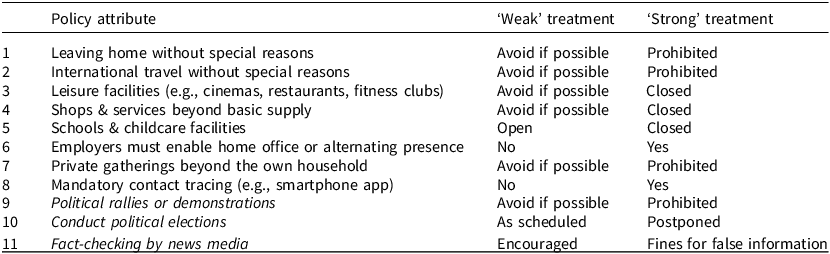
The conjoint attributes and levels were informed by actual policies implemented during Covid-19. The ‘weak’ version of an attribute mostly takes the form of a governmental recommendation (‘avoid if possible’) or a phrase signaling business as usual (e.g., schools are described as ‘open’). The ‘strong’ treatment entails a rather strict but still realistic intervention. Attribute levels were fully randomized (subject only to the constraint that the two packages differed in at least one dimension).
Each conjoint task consisted of two policy packages, presented side by side in tabular form. To keep respondent burden acceptable (Bansak, Hainmueller, Hopkins et al. Reference Bansak, Hainmueller, Hopkins and Yamamoto2021b) and achieve good statistical power (Schuessler and Freitag Reference Schuessler and Freitag2020, see A.4.3), we limited the tasks to 11 policy attributes with two levels each. The order of attributes was randomized across respondents to avoid priming and order effects but held constant within respondents to reduce cognitive burden.
For each task, respondents chose their preferred policy package, generating the outcome of interest: a binary variable indicating whether a given package was chosen (1) or not (0). In total, respondents considered 90,000 policy packages (9,000 respondents × 5 conjoint tasks × 2 policies), with 44,941 pairs and thus 89,982 individual packages receiving a valid choice.Footnote 6 Following standard practice, we use linear probability models with respondent-level cluster-robust standard errors to model whether a given policy package was selected. The resulting coefficients ‒ the attributes’ ‘average marginal component effects’ (AMCEs) ‒ can be interpreted as the average causal effect of a given restriction.
Table 1 shows the full set of attributes and attribute levels. If citizens are committed to the Dahlian democratic ideal in a major public health emergency, restrictions on rallies and demonstrations, elections, and media freedom (marked in italics) should systematically decrease policy support.Footnote 7
Attributes & treatment levels for Experiment 1
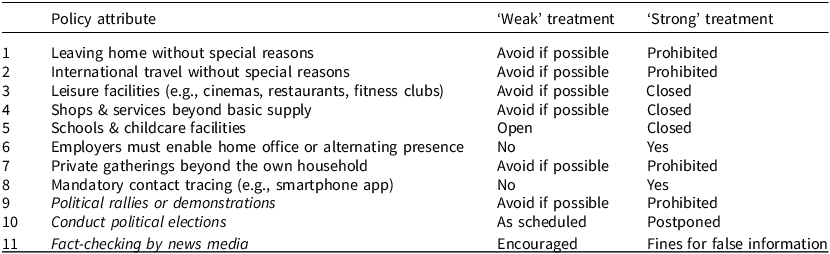
Table 1. Long description
A table with three columns and eleven rows. The columns are labeled Policy attribute, Weak treatment, and Strong treatment. The rows list various policy attributes and their corresponding treatments. Row 1: Leaving home without special reasons, Avoid if possible, Prohibited. Row 2: International travel without special reasons, Avoid if possible, Prohibited. Row 3: Leisure facilities (e.g., cinemas, restaurants, fitness clubs), Avoid if possible, Closed. Row 4: Shops & services beyond basic supply, Avoid if possible, Closed. Row 5: Schools & childcare facilities, Open, Closed. Row 6: Employers must enable home office or alternating presence, No, Yes. Row 7: Private gatherings beyond the own household, Avoid if possible, Prohibited. Row 8: Mandatory contact tracing (e.g., smartphone app), No, Yes. Row 9: Political rallies or demonstrations, Avoid if possible, Prohibited. Row 10: Conduct political elections, As scheduled, Postponed. Row 11: Fact-checking by news media, Encouraged, Fines for false information.
Source: Authors’ elaboration.
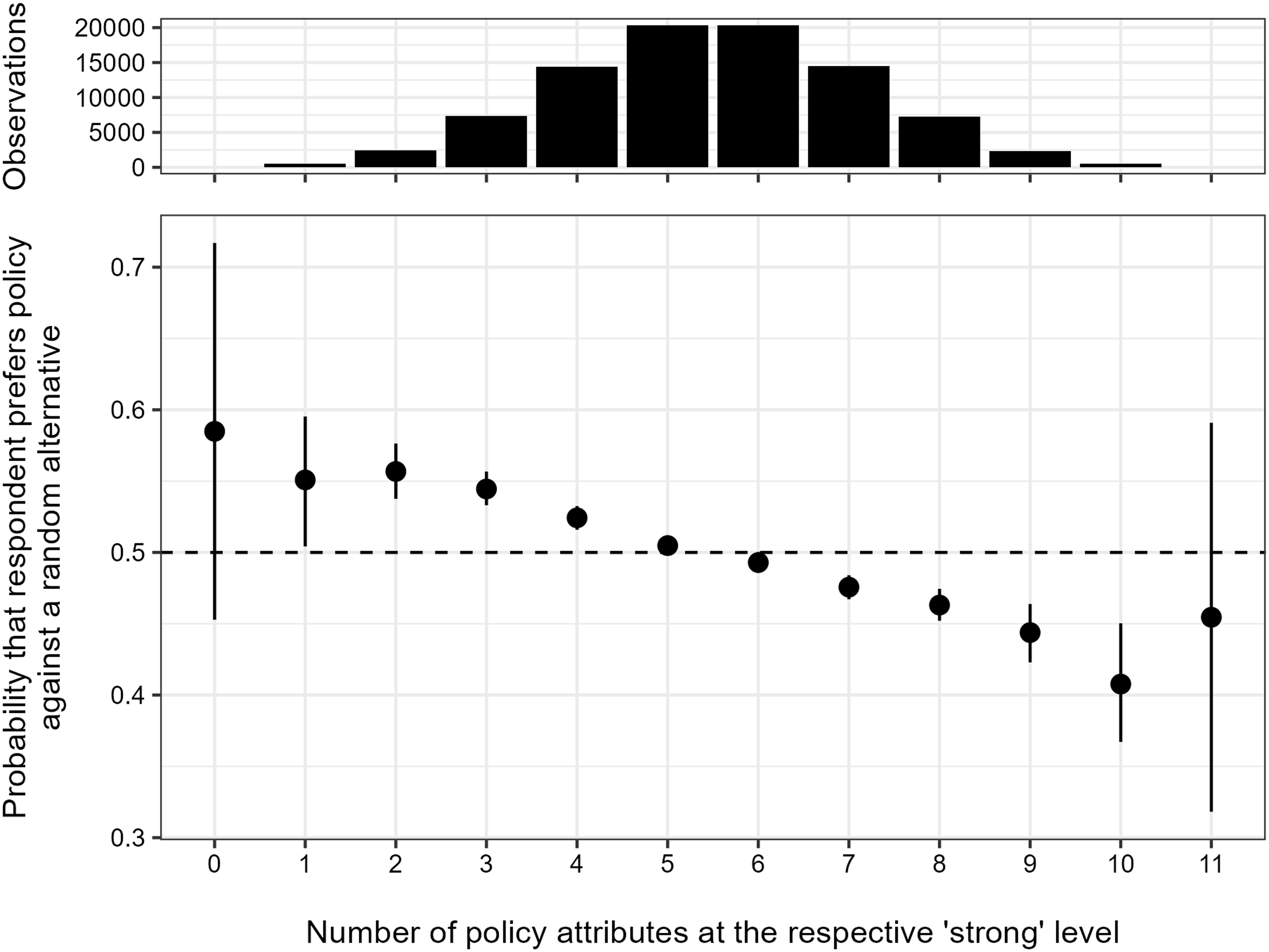
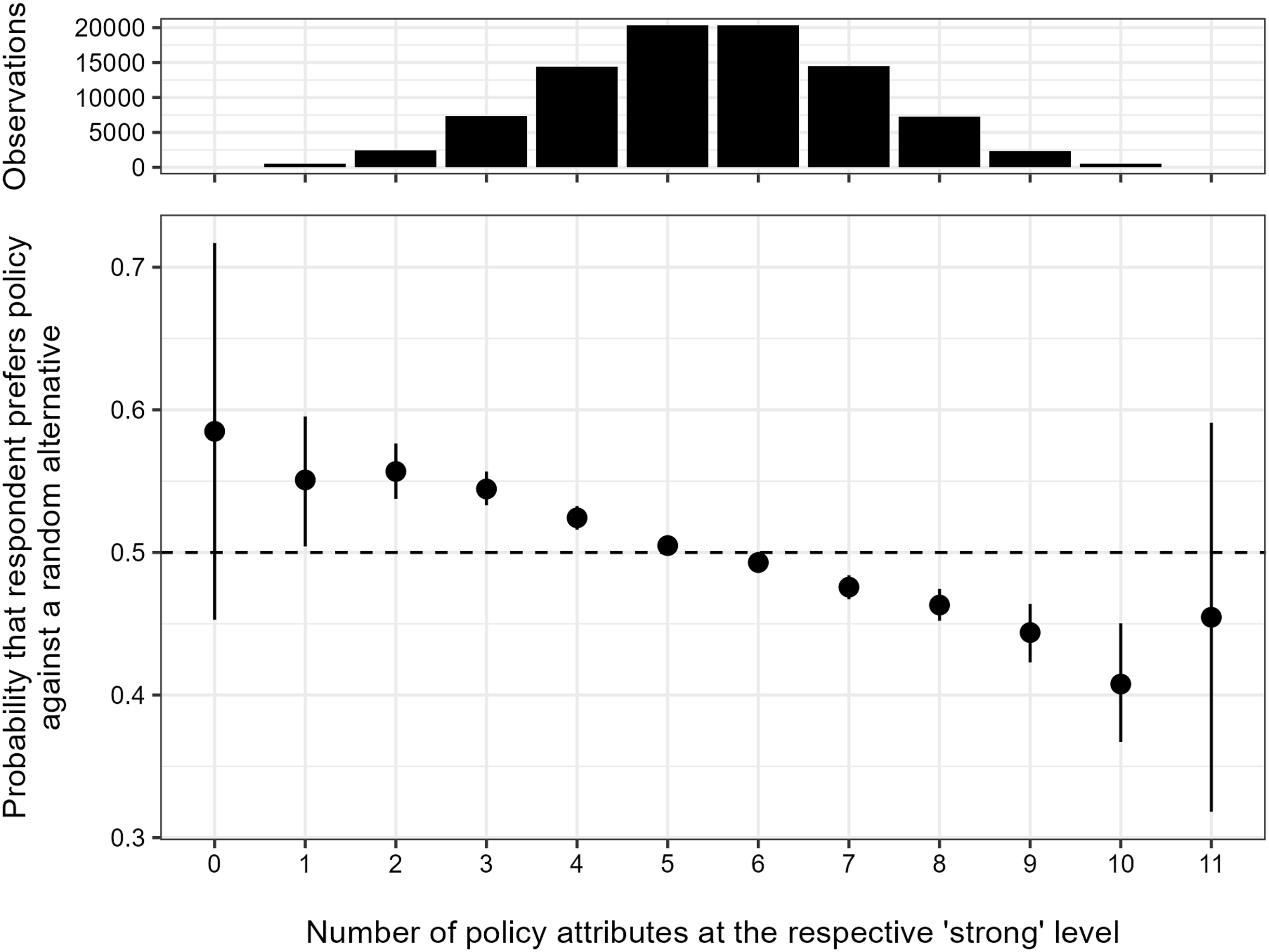
Figure 1 groups the policy packages according to the number of attributes set to their ‘strong’ level. The histogram at the top shows that randomization worked as intended. The lower panel shows that citizens tend to be wary of restrictions: the larger the number of policy attributes set to their ‘strong’ level, the less likely a policy package is to be chosen over a random alternative (exact values in Online Appendix Table A3).Footnote 8
Probability of policy choice conditional on number of restrictions therein.
Note: Bottom panel shows the proportion of policy packages preferred over a random alternative package in the pairwise conjoint task, conditional on the total number of attributes set to their strong/strict level (see Table 1). Vertical lines depict two-sided 95% confidence intervals. Top panel shows the number of policy packages in each group. Estimates are based on 89,892 policy packages from 49,491 pairwise conjoint tasks from 8,997 respondents in Germany, Hungary, Japan, Poland, South Korea, and Spain. In total, 90,000 policy packages (45,000 conjoint tasks) were shown to 9,000 respondents (1,500 from each country, 5 tasks per respondent). For 118 packages (59 tasks), respondents did not indicate their preference, and 3 respondents did not complete any conjoint task.
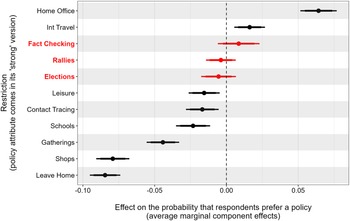
However, not all policy attributes affect respondents’ preferences equally. Figure 2 plots the AMCE for each policy attribute, that is, the effect of specifying the ‘strong’ rather than the ‘weak’ version of the intervention in a given domain (exact values in Online Appendix Table A4).
Average marginal component effects of individual policy attributes.
Note: Figure shows AMCEs of a policy attribute being set to the strong/strict rather than weak level (see Table 1). Positive (negative) AMCEs indicate that a policy package is more (less) likely to be selected when the respective policy attribute is set to the strict level. Horizontal lines depict two-sided confidence intervals (thick: 95%; thin: 99%). Estimates are based on 89,892 policy packages from 49,491 pairwise conjoint tasks from 8,997 respondents in Germany, Hungary, Japan, Poland, South Korea, and Spain. In total, 90,000 policy packages (45,000 conjoint tasks) were shown to 9,000 respondents (1,500 from each country, 5 tasks per respondent). For 118 packages (59 tasks), respondents did not indicate their preference, and 3 respondents did not complete any conjoint task.
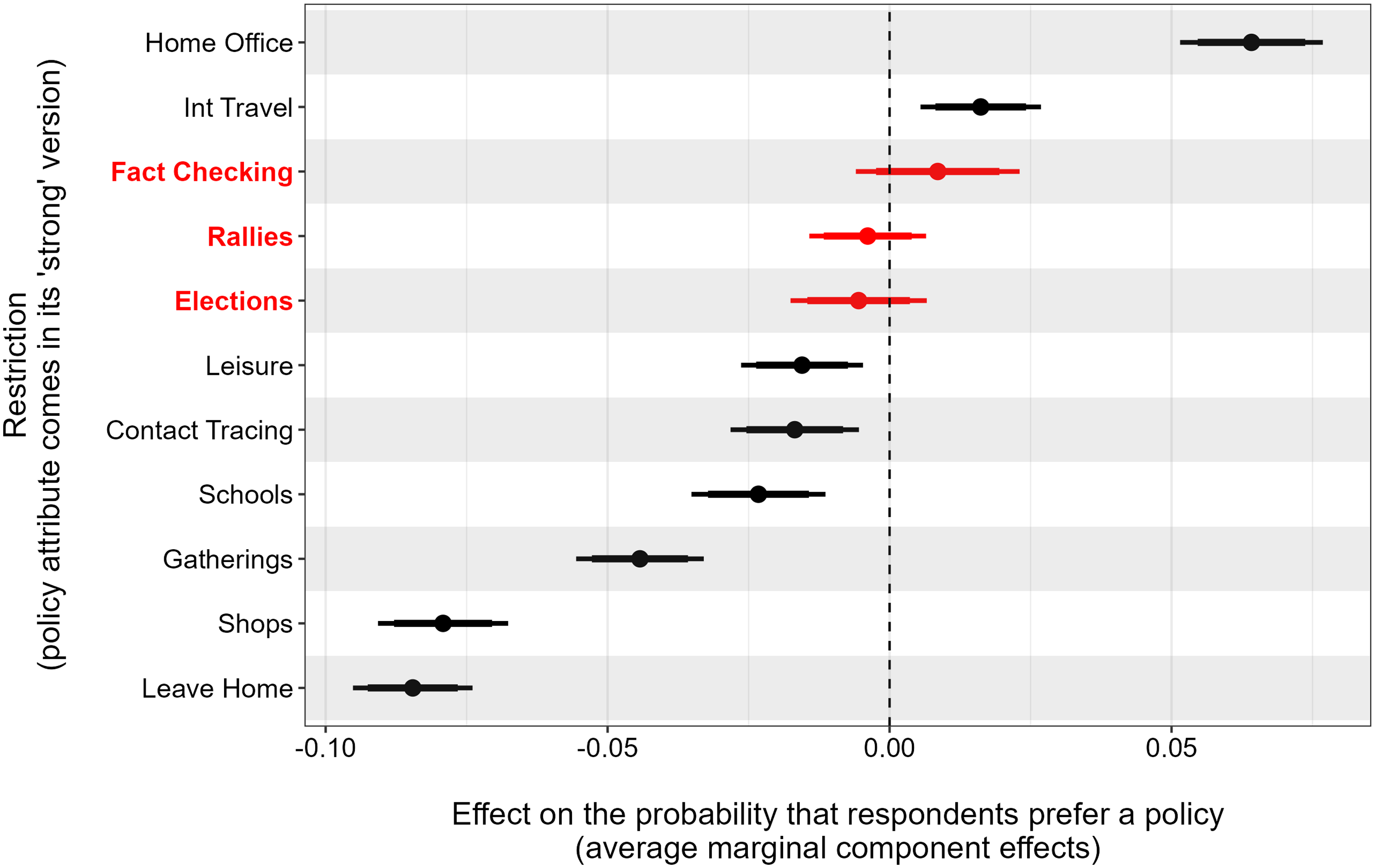
Citizens react most negatively to policies that prohibit them from leaving their homes: this measure reduces support for a policy package by 8.5 percentage points. Respondents react almost as negatively to mandatory closures of shops (−7.9 pp). Several other measures also have statistically significant and substantively meaningful negative effects. In descending order of absolute effect size, these are bans on private gatherings (−4.4 pp), school closures (−2.3 pp), mandatory app-based contact-tracing (−1.7 pp), and closures of leisure facilities (−1.6 pp). At the other end of the spectrum, two measures increase policy support; restrictions on international travel have a modest effect (+1.6 pp), whereas home office mandates have a strong one (+6.4 pp).
What about restrictions on core democratic rights? Strikingly, and contrasting our pre-registered expectation, these do not seem to matter much for citizens’ evaluations of pandemic policies. Selection probabilities are hardly affected by whether the government postpones elections, prohibits rallies and demonstrations, or enhances governmental media control. The effects of these measures are substantively small and statistically indistinguishable from zero. In this experimental setting, citizens attach relatively little weight to restrictions on liberal self-governance when evaluating pandemic policies.
How do these results vary across the six countries in our study? We explore this question in Online Appendix 4.4 along country-specific AMCE estimates and Bonferroni-adjusted analyses of country differences. These country-specific results add some nuance to the average effects. Figure A7 shows that bans on rallies and demonstrations reduce policy support in the three countries with the lowest quality of democracy (according to the V-Dem Liberal Democracy Score): respondents in Hungary, Poland, and Japan are approximately 2.5 pp less likely to support a package that includes such a ban, whereas the effect is statistically insignificant in Germany and Spain and positively signed and significant in South Korea. These estimates suggest some cross-national variation, with greater sensitivity in the less liberal democracies in our sample, in tension with our preregistered expectation that opposition to such restrictions on democratic rights would be stronger in more liberal democracies. This result is intriguing but should not be exaggerated. Restrictions on private liberties such as mobility restrictions and closures of nonessential shops remain substantially more unpopular than bans on rallies and demonstrations even in Hungary and Poland (Figure A5), and the other restrictions of core democratic rights follow a more complex cross-national pattern: while we find strong opposition to the postponement of elections in Hungary (−7.1 pp), respondents in Poland and Japan tend to slightly favor packages that include this policy. Restricting media freedom does not have a statistically significant effect in Hungary, Poland, and South Korea but slightly increases policy support in Japan, Spain, and Germany. Overall, we thus find some evidence that restrictions of democratic rights reduce policy support in parts of the sample, but country differences remain limited, often fail to reach statistical significance, and follow patterns that are at most loosely aligned with contextual democratic quality.
Online Appendix Figure A8 relates cross-country differences in the effects of democratic-rights restrictions to cumulative Covid-19 mortality. If respondents’ evaluations had been strongly shaped by their country’s pandemic trajectory, one would expect greater acceptance of such restrictions in countries with higher death rates. Yet the results show no systematic relationship, suggesting that respondents either abstracted from the actual pandemic context as instructed or that differences in pandemic severity were not a major driver of the small cross-country variation we find.
Robustness: We subjected the results of Study 1 to preregistered robustness checks by excluding the fastest and slowest 5% of respondents, as well as respondents who failed both or at least one of two attention checks. Figure A11 in the Online Appendix shows that AMCEs hardly change under these conditions. The only notable difference is that the effect of enhanced government media control becomes statistically significant (and remains positively signed) when respondents failing both attention checks are excluded.
A further threat to the validity of our conjoint experiment is that some policy packages may be implausible in a ‘true population’ of realistic policy options (De la Cuesta, Egami and Imai Reference De la Cuesta, Egami and Imai2022). We therefore designed an additional, unregistered robustness test centered on the ‘leave home’ restriction. This restriction not only elicits the strongest negative reaction in Figure 2, but may also generate implausible policy scenarios: A policy that bars citizens from leaving their homes while allowing all shops, restaurants, and schools to remain open would presumably provoke not only major public opposition but outright consternation.
Building on this intuition, our robustness test (Online Appendix Figure A12) excludes policy pairs that contain at least one ‘implausible’ policy package, defined as packages that impose restrictions on leaving home but no or few restrictions in other domains. We then iteratively broaden the definition of ‘implausibility’: first excluding only pairs that include a package with a leave-home restriction no other restriction, then pairs including a package with a leave-home restriction and at most one additional restriction, and so on – thereby excluding an ever-larger share of profile pairs. Across this series of tests, the estimated effects of most attributes change very little. In particular, the effects of election postponement and enhanced media remain unaffected. Bans of rallies and demonstrations do show slightly more negative effects when potentially implausible profile pairs are excluded, but at barely more than-1 percentage point, the estimated effect remains small and statistically insignificant throughout.
Summary: The results of Study 1 show that citizens unsurprisingly care a lot about whether the government intrudes into their private lives in the name of containing a pandemic. However, they appear rather indifferent to restrictions or suspensions of political rights related to democratic self-governance. Despite some limited country-level heterogeneity, these results provide little evidence of a strong commitment to core democratic rights when a pandemic threat requires citizens to trade them off against health or other rights and liberties.
Preferred decision-making procedures (Study 2)
What about views on how the government should take decisions in the face of pressing societal challenges? Executives can use different approaches to justify collectively binding decisions. The Dahlian ideal emphasizes procedures that aggregate citizen preferences, for example, through referenda and polls and through partisan competition, elections, and parliamentary votes. However, decision-makers might also rely on information from specific interest groups, engage in international coordination, or prefer to follow expert advice. All of these procedures are backed by normative arguments, are actually used in democracies, and will most likely find some citizen support at face value (Hibbing, Theiss-Morse, Hibbing et al. Reference Hibbing, Theiss-Morse, Hibbing and Fortunato2021). In practice, however, these alternatives often generate trade-offs. Expert opinion or international commitments may clash with citizen preferences and are less democratically legitimized. Broad consensus and support in parliament might be difficult to achieve. Incorporating and balancing alternative decision-making procedures can also be time-consuming and thus unattractive in the face of urgent threats. Citizens may therefore prioritize some procedures over others when forced to choose.
To elicit citizens’ rankings of potentially conflicting decision-making procedures, our second study uses a best-worse scaling (BWS) approach, which simplifies the cognitively demanding task of ranking a complex set of alternatives (Louviere, Flynn and Marley Reference Louviere, Flynn and Marley2015; Mühlbacher, Kaczynski, Zweifel et al. Reference Mühlbacher, Kaczynski, Zweifel and Johnson2016). Instead of requiring respondents to rank the full set of alternatives, BWS asks them to repeatedly choose the best (in our case: ‘most important’) and the worst (‘least important’) options from a subset of alternatives (in our case: decision-making procedures). If each option is compared with all others at least once, the responses can be translated into a preference ranking.
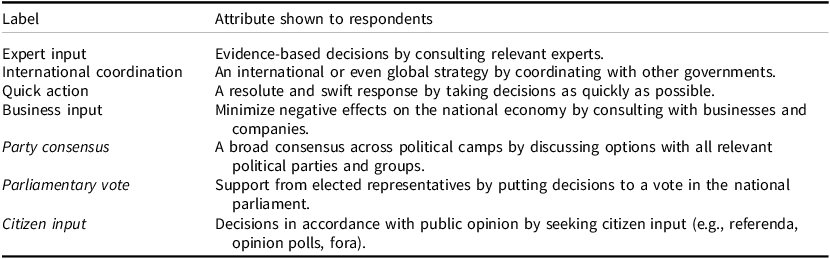
We used a balanced incomplete block design that included each pairwise comparison twice to achieve better reliability. More specifically, our respondents saw seven subsets of alternatives, each of which included four out of the seven decision-making procedures displayed in Table 2. The order of the blocks (i.e., the quartets of alternatives) and the ordering of alternatives within blocks were fully randomized. Online Appendix A.4.2 provides an example task, and Section A.4.3 specifies the design.
Attributes for experiment 2
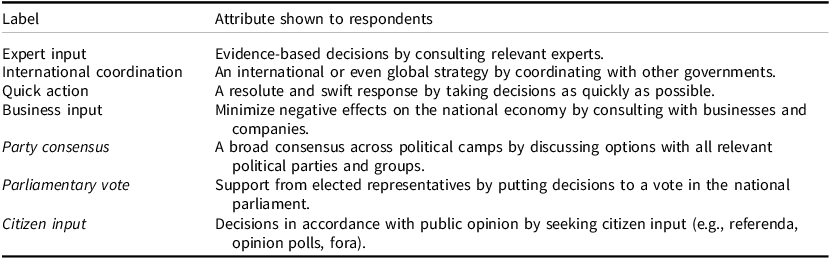
Table 2. Long description
A table with two columns and seven rows. The first column is labeled ‘Label’ and the second column is labeled ‘Attribute shown to respondents’. Row 1: Expert input, Evidence-based decisions by consulting relevant experts. Row 2: International coordination, An international or even global strategy by coordinating with other governments. Row 3: Quick action, A resolute and swift response on the national economy by taking decisions as quickly as possible. Row 4: Business input, Minimize negative effects on the national economy by consulting with businesses and companies. Row 5: Party consensus, A broad consensus across political camps by discussing options with all relevant political parties and groups. Row 6: Parliamentary vote, Support from elected representatives by putting decisions to a vote in the national parliament. Row 7: Citizen input, Decisions in accordance with public opinion by seeking citizen input (e.g., referenda, opinion polls, fora).
Source: Authors’ elaboration.
Table 2 shows the seven decision-making procedures. For each procedure, we provided respondents with a short sentence highlighting its purpose and potential benefit. The last three procedures build on citizen preferences (either directly or as mediated through parties and elected representatives) and are thus closest to the Dahlian ideal of self-governance. With this broader list of procedures and forcing respondents to prioritize, we expand on Lowande and Rogowski (Reference Lowande and Rogowski2021), who did not find a clear effect on support for Covid-related policies in the United States conditional on whether decisions are taken unilaterally by the President or enacted by Congress.
We convert individual choices into preference scores by counting how often each option was chosen as the ‘best’ or ‘worst’ to then normalize the difference between these two according to the overall number of comparisons a respondent has made. The resulting score ranges from +1 (indicating that an option was always selected as the ‘best’ when it appeared in a subset) to −1 (always selected as the ‘worst’).
We combined the BWS setup with a framing experiment, implemented in both the intro screen and each task (Online Appendices A.5.1 and A.5.2). The frames primed respondents regarding the nature of the threat at stake, referring to either ‘major societal challenges like the Coronavirus pandemic’, ‘major societal challenges like climate change’, or generic ‘major societal challenges’ (without further qualification). This treatment was fixed for individual respondents but fully randomized within each country sample. This enables us to see the extent to which rankings are robust beyond the pandemic context. It also allows us to explore whether preferences vary with the (perceived) urgency of a societal threat. Our preregistered expectation was that priming respondents with the ‘Coronavirus pandemic’ as a more immediate threat than ‘climate change’ or generic ‘societal challenges’ would lead them to place greater emphasis on output-oriented procedures such as quick action and expert input relative to input-oriented democratic procedures such as parliamentary votes and citizen input.
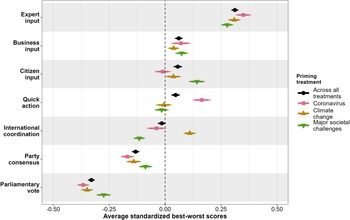
Figure 3 shows average best-worst scores in the pooled sample, based on 61,509 individual comparisons by 8,787 respondents. Ordered by the average BWS score of each decision-making procedure across all three framing treatments (black symbols), the data show that ‘expert input’ is the highest-ranked decision-making approach by a substantial margin. ‘Business input’, ‘citizen input’, and ‘quick action’ follow at some distance and are roughly equally important procedures for respondents. Respondents are indifferent to reliance on ‘international coordination’, meaning that this approach is selected as the ‘most important’ and as the ‘least important’ procedure in similar proportions. ‘Partisan consensus’ ranks second lowest in respondents’ preference order, while taking collective decisions through parliamentary votes is clearly considered least important: In comparisons against triplets of alternative procedures, parliamentary voting is 32 percentage points more likely to be chosen as ‘least important’ than as ‘most important’.
Best-worst scores of different decision-making logics.
Note: Figure shows average standardized best-worst scores for seven decision-making procedures (cf. Table 2). Symbols and colors indicate the level of the priming treatment received by the respondent, with circles in black print depicting averages across all treatments. Best-worst scores are calculated as the number of times a procedure was selected as ‘most important’ minus the number of times it was selected as ‘least important’, divided by the number of choice tasks that included the procedure. Scores range between −1 and +1, with positive values indicating that the procedure is more likely to be selected as most important than as least important (and vice versa). Horizontal lines depict two-sided confidence intervals (thick: 95%; thin: 99%). Estimates are based on 61,509 choice tasks (7 per respondent) from 8,787 respondents who completed the full best-worst scaling module. 213 of the 9,000 respondents were excluded from this analysis because they failed to complete at least one of the choice tasks. Choice tasks followed a balanced incomplete block design ensuring that every respondent saw each option four times and each pair of options twice (details in text and Online Appendix A.5)
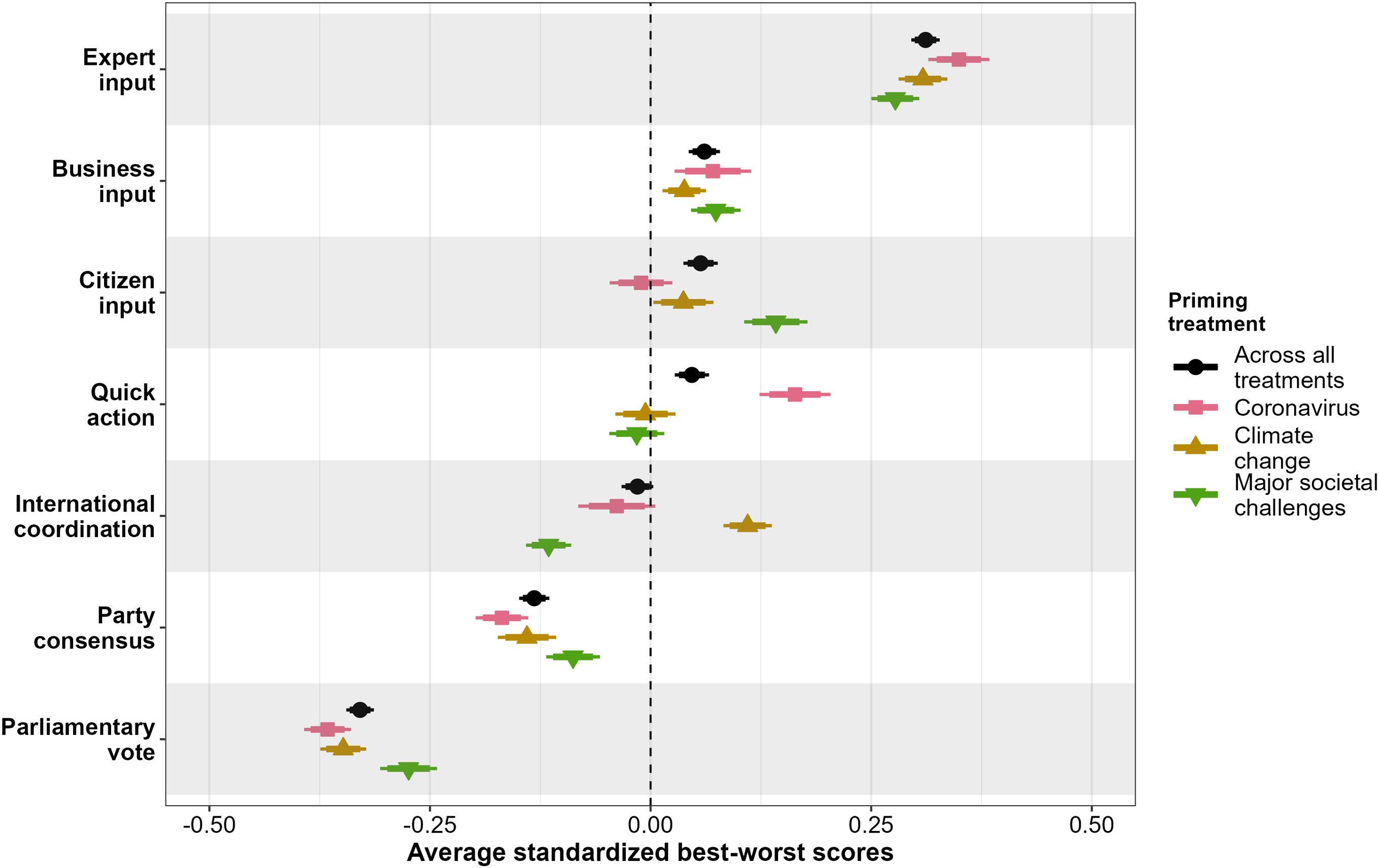
Figure 3. Long description
A horizontal dot plot representing the average standardized best-worst scores for different decision-making logics across various priming treatments. The horizontal axis represents the average standardized best-worst scores ranging from -0.50 to 0.50. The vertical axis lists different decision-making logics: Expert input, Business input, Citizen input, Quick action, International coordination, Party consensus, and Parliamentary vote. Each dot represents a score for a specific priming treatment: Across all treatments, Coronavirus, Climate change, and Major societal challenges. The colors black, pink, yellow, and green are used to differentiate these treatments. The plot shows clusters of dots for each decision-making logic, indicating varying levels of support across different treatments. For example, Expert input has higher scores for all treatments, while Parliamentary vote has lower scores. Notable patterns include higher scores for Expert input and lower scores for Parliamentary vote across all treatments.
This average preference ranking sits uneasily with the Dahlian ideal of democracy. Citizens’ strong preferences for relying on experts and, to a lesser extent, business interests or quick executive action stand in clear tension with the principle of equal and adequate participation. When forced to choose, citizens appear willing to give substantial weight to actors that are not directly accountable to them. This does not mean that direct forms of citizen input are unimportant, but they are considered much less important than expert opinion. Even more strikingly, key mechanisms of representative democracy – reliance on parties and elected representatives – are considered rather unimportant in our six-country sample.Footnote 9
While these patterns broadly hold across the different societal challenges that we primed respondents with, there are some intuitive exceptions. In line with our preregistered expectation, respondents who assessed governmental decision-making on Covid-19 rate expert input and, especially, quick governmental action as more important than those primed with climate change or a generic societal challenge. Those assigned to the climate change treatment – a challenge involving substantial cross-national externalities – attribute greater importance to international coordination. Citizen input is considered much more important in the sample for which the societal challenge remained unspecified. It remains a clear second behind expert input, however, and partisan consensus and parliamentary votes as representative democratic mechanisms rank lowest in citizens’ preferences, irrespective of the prime.
The questionnaire also included a question asking for the importance of procedures directly (Online Appendix A.5.5). Although this additional question cannot provide a noncrisis baseline, it shows that the alternatives used in the BWS-design are substantively meaningful to respondents: across frames, fewer than 3% of respondents do not consider any of the alternatives important.
Figures A13 and A14 in the Online Appendix show that citizens’ preference rankings are relatively similar across the six countries. Expert input emerges as the highest-ranked procedure in all countries and for all types of societal challenges, with two minor exceptions: Japanese respondents place ‘quick action’ slightly higher when primed with the Covid-19 pandemic, while South Korean respondents place it second after ‘citizen input’ when asked to consider generic societal challenges. At the other end of the spectrum, parliamentary votes consistently rank lowest for all priming treatments in five of the six countries. The one exception is Germany, where this procedure tends to rank closer to the middle of the preference order, with some variation across primes. Similar to the results in Study 1, additional analyses reported in Online Appendix Figures A15 and A16 reveal no clear and consistent relationships between cross-country differences in preferences for democratic procedures (parliamentary votes, party consensus, and citizen input) and either contextual democratic quality or pandemic severity.
Robustness: The results of Study 2 are robust to excluding (a) very slow and very fast respondents, and (b) respondents who failed at least one or both of the two attentiveness checks (Online Appendix Figure A19). The main results of Study 2 are also robust to a different outcome measure based on an anchoring question that asked respondents to select all the procedures that they considered ‘very important’ after the BWS module (Online Appendix Figures A17 and A18). Pooling across countries (Figure A17), expert input was selected as very important more frequently than any of the other procedures, by 55.7 to 61.1% of respondents, depending on the priming treatment. By contrast, party consensus (22.9% to 28.3%) and especially parliamentary votes (11.8% to 17.2%) were least likely to be considered very important.
Summary: Just like the findings of indifference towards democratic-rights restrictions, the results on procedural preferences in Study 2 speak against a strong commitment to the Dahlian ideal of citizen self-governance. Parliamentary votes and party consensus, the two procedures most central to the translation of citizen preferences into political decisions in representative democracies, are located at the bottom of the average citizen’s preference ranking. Citizen input, at least, is ranked substantively higher while, expert input, which embodies a technocratic approach to decision-making, consistently ranks highest.
Discussion
Contrary to our preregistered expectations, the results of both studies suggest that – when facing a major public health emergency – citizens in the six democracies we study attach limited relative importance to the rights and procedures central to the Dahlian ideal of democracy. Study 1 suggests relative indifference to restrictions on political rights and public debate, while Study 2 shows a strong preference for expert consultation over decision-making procedures designed to ensure citizen input and representative control. This general pattern exhibits some variation across countries, yet even where citizens express some opposition to restrictions of self-governance, the effects remain limited – both in absolute terms and especially relative to other rights and procedures.
At face value, these findings point to a pessimistic view on democratic resilience. Citizens do not seem to treat democratic rights and procedures as nonnegotiable – at least in times of crisis – which may leave societies more vulnerable to authoritarian or technocratic influences in times of particularly thorny decision-making (Amat, Arenas, Falcó-Gimeno et al. Reference Amat, Arenas, Falcó-Gimeno and Muñoz2025; Carlin, Love and Zechmeister Reference Carlin, Love and Zechmeister2014; Guasti and Bustikova Reference Guasti and Bustikova2022; White Reference White2019). Yet, such inference can only be taken with considerable caution. In this regard, we must first acknowledge that our setup also allows for three more benign readings in principle.
The first may be that citizens trust political leaders to act in their best interests and expect any deviations from democratic ideals to be both necessary but also temporary. In fact, our conjoint experiment introduction in Study 1 stated that restrictions would initially be limited to two months. This plausible alternative reading can thus not be fully ruled out with our data, but two separately uncovered patterns speak against it. At country-level, this interpretation implies greater citizen sensitivity to democratic-rights restrictions in less democratic contexts where less trustworthy leaders could more easily exploit crises as windows of opportunity for anti-democratic measures. Some of the cross-national results from Study 1, particularly those for bans on rallies and demonstrations, are initially consistent with this interpretation. However, the effects of the remaining restrictions, as well as the cross-country pattern of procedural preferences in Study 2, do not track contextual democratic quality closely (Online Appendices A4.4 and A5.4). The trust-in-government interpretation would furthermore suggest systematic differences according to respondents’ levels of trust in the national government and their satisfaction with the national political system. For Study 1, low-trust/low-satisfaction individuals are somewhat more sensitive to restrictions on rallies and demonstrations, but not to the other democratic-rights restrictions (Figure A9 in Online Appendix). In Study 2, they rank citizen input somewhat higher than high-trust/high-satisfaction respondents but express an even stronger preference for expert input (Figure A20). These mixed patterns provide only limited support for the idea that weak commitment to democratic rights and procedures is driven by trust in political elites.
A second benign reading may emphasize that the unprecedented health threat posed by Covid-19 justifies particularly drastic measures in the eyes of citizens. One could even argue that the Dahlian ideal may call for postponing elections, because individuals facing elevated health risks might be effectively excluded from in-person voting. But also for this plausible alternative reading, we find limited evidence in our country-and individual-level data. Variation in the effects of democratic-rights restrictions (Online Appendix Figure A8) and preferences for decision-making procedures (Figure A16) is not systematically related to the county-level severity of Covid-19, as measured by cumulative case incidences and death rates. Online Appendix Figures A10 and A21 examine heterogeneity along self-rated health on the individual level. If response behavior was primarily driven by health concerns, we would expect those in worse health to trade off democratic rights and procedures more willingly (Alsan et al. Reference Alsan, Braghieri, Eichmeyer, Minjeong, Stantcheva and Yang2023; Vasilopoulos, Mcavay, Brouard et al. Reference Vasilopoulos, Mcavay, Brouard and Foucault2022). However, while respondents with lower levels of self-rated health are somewhat more favorable toward democratic-rights restrictions in Study 1, group differences are substantively small and statistically insignificant. In Study 2, expert input ranks highest for all health groups, and those with poor health even rate citizen input slightly higher than others.
A third benign reading, focusing on the procedural preferences revealed in Study 2, might argue that a strong preference for expert input is not necessarily as undemocratic as Dahl’s opposition to technocratic forms of governance suggests. If handled transparently and in good faith by elected representatives and officials, such consultations may not only improve the outcomes of the political process but also remain electorally sanctionable, making a plausible case for expert consultation in genuinely democratic polities (Manville and Ober Reference Manville and Ober2023; Strøm Reference Strøm2000). We acknowledge this more optimistic interpretation and, in the absence of pertinent empirical evidence in our data, must leave it to future research to analyze citizens’ rationales for championing expert input more thoroughly.
However, two related literature strands make us somewhat skeptical: First, strong preferences for expert input expressed in Study 2 are consistent with Bertsou and Caramani’s (Reference Bertsou and Caramani2022, Reference Bertsou and Caramani2020) claim that ‘technocratic’ attitudes are on the rise, a dynamic that has apparently deepened during Covid-19 (Amat, Arenas, Falcó-Gimeno et al. Reference Amat, Arenas, Falcó-Gimeno and Muñoz2025; Lavezzolo, Ramiro and Fernández-Vázquez Reference Lavezzolo, Ramiro and Fernández-Vázquez2021). Citizens alienated from representative democracy may turn either towards populists or expert governance, but our findings are consistent with the view that the stronger reaction is technocratic, as support for expert input clearly exceeds support for more citizen-centered alternatives. At the same time, this does not mean that deviations towards populism are absent in our data. Citizen input occupies an intermediate position in our revealed procedural rankings and may capture both democratic-participatory and more populist-majoritarian impulses. More broadly, technocratic and populist orientations can overlap in their criticism of party-mediated representative democracy. Beyond stressing a simple technocracy-populism dichotomy, our findings are primarily consistent with a broader weakening of support for representative democracy.
Second, our findings are also consistent with the ‘stealth democracy’ thesis (Hibbing and Theiss-Morse Reference Hibbing and Theiss-Morse2002), which challenges the liberal ideal of self-governance by claiming that citizens are largely apathetic when it comes to thorny policy questions. Stealth democrats may expect decision-makers to be empathetic to the needs of their daily lives, but rather than getting involved themselves, they will gladly transfer their political authority to others, including actors not subject to electoral control.
While we acknowledge that our data cannot rule out alternative and more benign readings in full, the patterns we find and their relation to extant literature, lead us to the more skeptical interpretation of our findings with a view to democratic resilience: when support for core democratic rights and procedures is put to the test and citizens are required to trade them off against competing rights, policy goals, and procedures, it may prove weaker than standard survey items suggest. At the same time, no single study is decisive, and the strength of survey-experimental approaches such as ours – requiring respondents to make concrete trade-offs – also constitutes a limitation regarding generalizability, specifically to noncrisis periods or temporarily unconstrained restrictions about which we can draw no conclusions here.
Our study nevertheless complements analyses of democratic resilience during Covid-19 specifically. Using conventional survey items, Alsan et al. (Reference Alsan, Braghieri, Eichmeyer, Minjeong, Stantcheva and Yang2023) likewise find that substantial shares of citizens are willing to accept restrictions on democratic rights. However, their respondents’ willingness to sacrifice their own rights and freedoms tends to be even higher than their willingness to sacrifice democratic rights, which deviates from the pronounced negative effects of private liberty restrictions in our first experiment. Other studies reach more optimistic conclusions regarding democratic resilience. Becher et al. (Reference Becher, Longuet-Marx, Pons, Brouard, Foucault, Galasso, Kerrouche, Alfonso and Stegmueller2024) show that experimentally induced variation in satisfaction with the government’s handling of the pandemic affects satisfaction with democracy, but not support for democracy as an ideal. Similarly, Arceneaux, Bakker, Hobolt et al. (Reference Arceneaux, Bakker, Hobolt and Vries2026), using a conjoint design broadly comparable to our Study 1, find more resistance to restrictions such as postponing elections and banning protests during the first Covid-19 wave in the United States and, to a lesser extent, the United Kingdom. These differences are not necessarily contradictory. They likely reflect variation in timing, country context, treatment wording, and – above all – the distinction between abstract democratic commitments and citizens’ willingness to accept concrete restrictions and procedural trade-offs.
At the very least, reading our findings together with the related work discussed here suggests that caution is needed when taking the high support for democracy in citizen surveys at face value. Conclusions about democratic resilience depend strongly on how support is measured and on the concrete trade-offs citizens are asked to evaluate – a point reinforced by recent conceptual and measurement-related critiques of this literature (Hu, Tai, Ko et al. Reference Hu, Tai, Ko, Woo and Solt2025a, Reference Hu, Tai and Solt2025b). Even if contextually specific, our empirical approach does support the view that the trade-offs involved in crises such as Covid-19 can open windows of opportunity for partial democratic backsliding, underscoring the need for more systematic analysis of whether emergency measures are fully rolled back once crises subside (Bjørnskov and Voigt Reference Bjørnskov and Voigt2025). Related research stresses that leaders’ crisis rhetoric or even manufactured crises can be used to justify democratic erosion explicitly (e.g., Gessler and Kaftan Reference Gessler and Kaftan2025).
At the same time, several limitations should be kept in mind when assessing the implications of our analysis. First, our results are, to some extent, contingent on the specific features of the experiments, including the selection and wording of the experimental items. Second, some items remain inherently ambiguous. Whether, and to what extent, respondents interpret time-limited suspensions of democratic and other rights as a credibly temporary emergency response or as a step toward democratic backsliding is an open question and has obvious implications for the extent to which indifference to democratic-rights restrictions signals a deeper indifference to democratic principles. Third, our study was conducted in the context of a major public health emergency and in six countries with varying levels of democratic quality and may thus not readily travel to any kind of crisis/country combination. Fourth, while we believe that requiring respondents to rank and prioritize is useful for revealing what matters most to them, it may also sharpen trade-offs that are less pronounced in political practice. Relatedly, Abramson et al. (Reference Abramson, Kocak and Magazinnik2022) offer a broader social-choice critique of conjoint designs, arguing that AMCEs need not recover the preferences of any coherent ‘average citizen’. Respondents in our experiments were required to make forced choices in a hypothetical setting. Although we deliberately designed rights restrictions and procedures to resemble realistic options, it remains possible that respondents’ attitudes and preferences would differ in a contested real-world setting.
In addition, we acknowledge that our interpretations conceptually hinge on the Dahlian understanding of democracy, which places particular emphasis on political contestation, participation, and procedures through which citizens can convey preferences on equal terms. This lets us treat restrictions on elections, demonstrations, and media freedom (Study 1), as well as parliamentary votes and other procedures aggregating citizen preferences (Study 2), as especially central to democracy. Other conceptions of liberal democracy, however, emphasize civil liberties such as freedom of movement and other individual or collective rights as constitutive elements and may thus normatively weigh private rights and non-majoritarian decision-making procedures higher than we do here. This does not overturn our main finding that citizens do not seem to consider Dahlian political rights and procedures nonnegotiable in crisis settings, but it does qualify how unambiguously the results can be read as evidence of democratic indifference.
Conclusions
Contemporary democracies face a growing range of complex and often urgent challenges. In this article we asked to what extent citizens remain committed to democratic rights and procedures when such challenges create concrete trade-offs. Across two preregistered survey experiments in six democracies during the Covid-19 pandemic, our findings suggest that, when citizens are asked to evaluate democratic rights and procedures under major societal challenges and crisis-related trade-offs, they do not treat the rights and procedures central to the Dahlian ideal as especially nonnegotiable. In Study 1, respondents asked to imagine a hypothetical pandemic comparable to Covid-19 reacted strongly to restrictions affecting their private lives but much less to restrictions on elections, demonstrations, and media freedom. In Study 2, expert input was consistently valued more highly than parliamentary votes and party consensus, while citizen input occupied an intermediate position – irrespective of whether respondents were primed to think of a pandemic, climate change, or major societal challenges without further specification. Although we find some cross-national variation – especially in responses to specific democratic rights restrictions in Study 1 – the overall pattern remains broadly similar across countries, and neither democratic quality nor pandemic severity consistently explains the observed differences.
At the same time, our detailed discussion shows that these findings should not be read as evidence that citizens would readily endorse outright authoritarian rupture or immediate democratic collapse. The experimental treatments used here were intentionally realistic and comparatively moderate, and many of them fall into a democratic gray zone rather than amounting to clear-cut authoritarian violations. Their significance lies elsewhere. They suggest that citizens may be comparatively willing to tolerate incremental departures from democratic self-governance when these are framed as temporary, pragmatic, or effective responses to pressing challenges. This is precisely why such attitudes matter politically: democratic erosion often proceeds not through abrupt regime replacement but through step-by-step adjustments to rights, procedures, and accountability that may appear limited in isolation, yet cumulatively weaken self-government. This interpretation is also compatible with recent work suggesting that contemporary democracies, especially more developed ones, may prove resilient to full breakdown even when backsliding or erosion occurs (Beramendi, Boix and Stegmueller Reference Beramendi, Boix and Stegmueller2025).
More broadly, our study complements a growing literature on democratic resilience by moving beyond abstract survey measures and examining how citizens evaluate democratic rights and procedures under concrete conditions of stress and trade-offs. In doing so, it highlights the need to pay closer attention to when citizens treat democratic rights and procedures as nonnegotiable – and when they do not. Future research should therefore examine more systematically under what conditions citizens accept temporary restrictions, when such measures are fully rolled back, and when they instead become normalized as lasting departures from democratic self-government. This also includes the question of whether gradual democratic erosion feeds back into citizens’ own orientations by weakening democratic commitments over time and thereby lowering resistance to further encroachments.
Supplementary material
The supplementary material for this article can be found at https://doi.org/10.1017/S1475676526101613
Data availability statement
All data and programming scripts used in the present study are permanently available at https://doi.org/10.5281/zenodo.20509198.
Acknowledgements
We are strongly indebted to Arne Carstens for his assistance in preparing the survey. The manuscript has furthermore benefitted from useful feedback at the 2023 EPSA conference, the WZB Global Governance Colloquium and the WZB Talk Series. We are particularly grateful for comments by Federica Genovese, Macartan Humphreys, and Michael Zürn.
Funding statement
We gratefully acknowledge financial support from the Cluster of Excellence ‘Contestations of the Liberal Script (SCRIPTS)’, which is funded by the German Science Foundation (DFG; EXC 2055, Project-ID: 390715649), and from the WZB Berlin Social Science Center. The open access publication was funded by the WZB Berlin Social Science Center.
Competing interests
The authors have no competing interest.
Ethical standards
The study has been approved after review by the WZB Berlin Social Science Center Research Ethics Board (procedure: 2021/3/123).
Use of AI
GPT-5.3 has been used to cross-check individual phrasings or for shortening selected paragraphs of the main text. All corresponding text edits have been carefully cross-checked and remain the sole responsibility of the authors.


 Open access

