

Introduction
When the bloodshed and fighting of the First World War ended on 11 November 1918, Germans, along with the people of other belligerent nations, began to transform their war experiences into a set of personal recollections and memories. This was a highly selective process: while some aspects of the war receded quickly into the background, others acquired a heightened symbolic meaning with growing temporal distance from the actual events. These personal recollections, to be sure, not only had relevance for the individual and his close family and friends; they also fed into a pattern of public commemorations of war that ultimately served political purposes. German veterans’ associations in particular were highly politicised, and dwelled upon those commemorative themes that they knew would resonate among their members. Compared with France and Great Britain, however, the commemoration of war in Germany took place in a radically altered political context. Only two days before the armistice, on 9 November 1918, Majority Social Democrat Philipp Scheidemann had pronounced the German Republic from the Reichstag in Berlin. Yet there was more than only a temporal coincidence between the abolition of the Hohenzollern monarchy and German military defeat. In the recollection of many German war veterans, the proclamation of the Republic was the positive corollary of a defeat that had been, in the first instance, the result of the extreme imperialist ambitions of the monarchy and its ruling elites.
These pro-republican recollections of the First World War are the subject of this study. This book will investigate the shaping of those war memories that were, in one way or another, supportive of the Weimar Republic as a political project. It will scrutinise the symbolism, language and performative power of public commemorations of war that were based on these more private reminiscences. With such a focus, this book goes against the grain of a long-established interpretation that found its seminal formulation in the late George L. Mosse’s comparative study of war remembrances. Here, Mosse analysed a pattern of public representations and symbols that he called the ‘myth of the war experience, which looked back upon the war as a meaningful and even sacred event’. This myth ‘was designed to mask war and to legitimize the war experience’.1 While such mythological representations of the front-line experiences emerged in all belligerent nations, they were most ‘urgently needed’ and most widely appreciated ‘in the defeated nations’. But it was only in Germany, Mosse insisted, that nationalist war remembrances ‘informed most postwar politics’, and it was this country that ‘proved most hospitable to the myth’.2 This argument chimes in with the more general and widely accepted point that post-war Germany was in denial about the inevitability of military defeat in 1918, and that the majority of German war veterans had tremendous difficulties adapting to peace and contributing to a ‘cultural demobilization’.3
Experts in the field have argued for some time that it would be wrong to assume that the war experience forced a whole generation of former German soldiers to seek refuge ‘in a life of violence in paramilitary uniform’ or at least to ‘glorify violence and things military’.4 Such an interpretation of war remembrances in Weimar Germany is, as Richard Bessel has pointed out, ‘inconsistent with the fact that the largest interest-group formed by veterans’ was actually organised by Social Democrats.5 The ‘Reichsbund of War Disabled, War Veterans and War Dependants’ (Reichsbund der Kriegsbeschädigten, Kriegsteilnehmer und Kriegerhinterbliebenen), founded in the spring of 1917, and with a peak membership of 830,000 in 1922, was by far the largest of all associations that represented disabled war veterans in Weimar Germany.6 In the latter half of the 1920s, the Reichsbund often collaborated with the ‘Reichsbanner Black–Red–Gold’ (Reichsbanner Schwarz–Rot–Gold), established in the spring of 1924 as a ‘League of Republican Ex-Servicemen’. The designated purpose of the Reichsbanner was to defend the Republic, and support the campaigning of the parties that had formed the Weimar coalition in 1919, i.e. the Social Democrats, the Catholic Centre Party and the left-liberal German Democratic Party (DDP). In practice, however, the Reichsbanner was dominated by members and supporters of the Social Democratic Party (SPD), who accounted for 90 per cent of its membership. With its very substantial presence in a wide array of associations in the socialist working-class milieu, the Reichsbanner and its approximately one million members played a pivotal role in the representation of republican war memories both for individuals and the wider public. As the following chapters will demonstrate, Reichsbund and Reichsbanner were at the forefront of attempts to develop a pro-republican language of war remembrance, and to elaborate an appropriate set of commemorative symbols and rituals in the public sphere. Yet these champions of a democratic commemoration of war did not act in a political vacuum. Rather, their interventions have to be understood against the backdrop of narratives established in nationalist circles, by, for example, former members of the Freikorps, writers and novelists who wrote using the tropes of soldierly nationalism, and, last but not least, the Stormtroopers and other members of the National Socialist Party.7
Contested commemorations
Throughout the Weimar Republic, right-wing authors and associations on the one hand, and Social Democrats on the other, were locked into an intense and often bitter dispute over public representations of the war experience. For this reason, and owing to the substantial range and presence of pro-republican recollections of the Great War, there was ‘no dominant memory of the war’ in Germany until 1933, as Alan Kramer has observed.8 When members of Reichsbund and Reichsbanner contemplated the meaning of their front-line service and constructed its memory in various ways, their contributions were part and parcel of the contested commemorations of the Great War in Weimar Germany. In the highly polarised public sphere of post-war Germany, the mechanisms of contestation worked both ways. Social Democrats were indeed able to deny the legitimacy of many powerful right-wing war myths. But when they offered their own symbols and narratives of the war experience and claimed that these would express popular sentiment more properly, their interventions also reflected the discursive limits imposed by the already existing nationalist framework of interpretation.9
In the following, I will focus on the two associations, Reichsbund and Reichsbanner, in order to investigate the politics of republican commemorations of war, to analyse the selective nature of these memories and to unravel the key narratives that Social Democrats used to engage with their past participation in a brutal conflict. Such an endeavour requires more than a simple, conventional institutional history of these two associations and their relative position in the field of German veterans’ politics.10 As far as the primary source material allows, the construction of war memories will be contextualised in the associational culture of the local Reichsbanner branches in particular. Both Reichsbund and Reichsbanner were democratic and hence by definition pluralistic organisations, in which ordinary members were able to voice the symbols, ideas, and narratives that they thought best represented their personal memories of the Great War, in meetings, in articles for the membership journals and in public speeches. Little is still known ‘about the historical circumstances that encourage practices of personal remembering and vernacular commemoration’.11 It is thus necessary to question whether Reichsbanner members tended to gloss over memories of hardship and disillusionment at the front and started to frame their recollections in more positive terms, emphasising their ability to cope with and endure the circumstances of war. Which notions of German national identity did pro-republican war veterans prioritise, and how were they embedded in their own personal experiences, both during the war and in post-war society? Situating republican war memories in their proper social and cultural context also requires an understanding of the problems and constraints Reichsbanner members faced when they tried to reconcile their personal recollections with the public discourse on the mythologised ‘war experience’.
Performative aspects of Weimar democracy
As an investigation of republican war memories in Weimar Germany, this study contributes to the growing literature on the remembrance of the First World War, both with regard to Germany, and in a wider, European perspective.12 Yet it is necessary to admit that memory as a field of research, as Alon Confino noted fifteen years ago, does ‘not offer any true additional explanatory power. Only when linked to historical questions and problems’ can it be ‘illuminating’.13 Heeding this important suggestion, this study of republican war memories above all aims to contribute to our understanding of the participatory potential and performative power of Weimar democracy. Earlier historiography on Germany after 1918 faced no difficulties at all when explaining the failure and ultimate destruction of the republican system by the Nazis in 1933 in terms of a multiplicity of problems. Inherent weaknesses of the republican settlement were crucial in this historiographical framework, as was the assumed ‘lack of legitimacy’ of the democratic system, which seemed to be based on a more general ‘lack of active commitment to the new order’.14 The determination and brutality of those who resented the Republic from its inception added to these difficulties. By drawing lines of continuity from the war experience, and especially from the experience of the trenches, it seemed appropriate to explain the rise of Nazism and the concomitant surge of political violence in the post-war period in terms of a brutalisation thesis. Participation in the killing and shelling from 1914 to 1918 had prepared the ground for authoritarian attitudes and hatred against Jews, and indeed anyone else who seemed to symbolise the democratic system.15 All in all, then, the primary aim for historians was to account for the failure of the Weimar Republic.
However, the historiographical agenda has fundamentally changed, instigated by a landmark article by Peter Fritzsche, in which he asked the provocative question, ‘Did Weimar fail?’16 His intention was not to suggest ‘no’ as a possible answer. Rather, his essay was an invitation to think outside the box and to develop more imaginative lines of argument for the study of the first German Republic. In this view, it seems appropriate to consider Weimar as a laboratory of modernity, in which a broad range of social, political and cultural experiments were conducted, and people tried to grapple with the modern condition in a variety of ways. Some of these experiments led to no conclusive results, some were disappointing, others ended soon in outright failure even before the Nazi seizure of power moved the goalposts in the political field. But seen together, all these experiments make it abundantly clear that the history of the Weimar Republic cannot simply be written as a narrative of tragic demise.17
Amidst this wider shift in the overall framework of historical work on Weimar, two aspects are of particular importance with regard to the contested republican commemorations of the Great War. First, this shift has led to a renewed emphasis on the semantic structures that framed temporality and informed the horizon of expectations among contemporary actors. From this perspective, it makes sense to investigate the present futures, i.e. the possible states of politics and society in ten or fifteen years as they were anticipated and expressed at any given point after 1918. Such an inquiry reveals the large number of rather optimistic visions of the future throughout the 1920s. Even after the carnage of war, Weimar contemporaries did not simply abandon their belief in the possibility of progress, not least because the constitutional framework of the Republic itself opened up a whole raft of promising opportunities and allowed people to work towards positive change.18 This reassessment of the semantics of the future has crucial implications for the attempts of Social Democratic war veterans to boost support for the republican project. Leaders of the Reichsbanner in particular used every opportunity to stress that they were working towards a better future for Germany, and that only a fair and democratic society could ensure a recovery of the nation. Yet such a rhetorical orientation towards the future stood in a stark contrast to the ceaseless exploitation of the legacy of the fallen soldiers. With their immersion in the remembrance of the First World War, the Reichsbanner members defended the Republic against right-wing mythologies. But at the same time, they tended to neglect or perhaps even to obfuscate Weimar’s present future, a temporal marker that was of paramount importance as a motivation for republican activism. In that sense, the obvious obsession of a veterans’ association with the past hindered the equally necessary engagement with the future.
A second relevant aspect of this historiographical shift is the attention devoted to the performative aspects of politics. In this perspective, the theatrical dimensions of the political process are seen not only as a mere façade or an empty shell that adds nothing to the political content. On the contrary, this approach focuses on the ways in which rituals and public speech acts regulate change in the status of individuals or institutions and facilitate or reintegrate challenges to an established social order.19 Such a perspective is vital for an understanding of the promises and pitfalls of republican politics in the 1920s. The new regime itself was based on the transition from monarchy to a republic, and hence lively and attractive performative rituals were required in order to make the structures of a participatory democracy tangible.20 Earlier historiography has often stated that the proponents of Weimar, and the Social Democratic left in particular, tended to underestimate the significance of symbolic politics. Based on a sober, rationalistic notion of politics as a debate among the reasonable, they neglected the persuasive potential of colourful and emotional rituals, speech acts and other symbolic performances.21 Recent research, notably the important study by Nadine Rossol of the ‘staging of the republic’, has substantially revised this interpretation. These studies have highlighted how the office of the Reichskunstwart and its ambitious head, Edwin Redslob, who was responsible for the official state pageantry and the shape of state symbols, aimed to develop an appropriate symbolism for the Republic. One important part of these endeavours was the festivities on 11 August. From 1921 onwards, the day on which Reich President Friedrich Ebert had signed off and thus promulgated the constitution in 1919 was celebrated as Constitution Day. Beginning on 11 August 1924, the Reichsbanner was a key driving force for attempts to stage marches, speeches and other Constitution Day festivities in even the remotest corners of the Reich, and thus to shape a distinctively democratic and inclusive political ritual around the founding document of the new polity.22
Against this backdrop of recent work on the performative aspects of Weimar democracy, pro-republican commemorations of war have a wider significance that goes far beyond the field of memory studies. The legacy of the First World War was one of the pivotal political battlegrounds in Weimar. When Reichsbund and Reichsbanner members intervened in this field, they not only offered an alternative reading of past events that were of primary interest for the community of war veterans, widows and orphans. Unveiling a war memorial, paying tribute to the fallen soldiers on Constitution Day or on other national holidays, or displaying military decorations during a republican rally were only some examples of a whole raft of symbolic performances that ultimately contributed to the political fabric of Weimar democracy. From this perspective, it should also be clear that the history of republican war remembrances is more than a mere complement to the existing historiography on the nationalist war mythologies of the anti-democratic right. To be sure, a proper assessment of the memory politics of Social Democratic war veterans can add both nuance and substance to the already established arguments about the contingent nature of Weimar’s collapse, and for the openness of political possibilities in the 1920s.23
Nonetheless, the story of the Reichsbund and Reichsbanner war veterans is not simply a straightforward alternative narrative that can offer consolation and historical optimism, based on the insight that not all German war veterans were brutalised, ready to glorify violence and use war remembrances for an assault on the Republic. The history of republican war memories has to be cast in a wider and more complicated fashion. It should not merely underpin a superficial success story, and should instead highlight the ambivalence of Social Democratic engagement with the past. These ambivalences stemmed from the fact that Social Democrats had their own difficulties in coming to terms with the initial support of the party for the war in 1914, and the subsequent division into pro- and anti-war factions as the fighting continued.24 However, these legacies of the decision to support national unity in 1914 were not the only ambivalence of republican commemorations of war. As the following chapters will explore in more detail, Reichsbanner activism was characterised by substantial inherent contradictions, especially with regard to the articulation of gender roles and the formulation of a coherent anti-war stance. While the association affirmed progressive Social Democratic ideals of female emancipation in principle, it did not admit women as members and thus excluded them from pro-republican work. Additionally, although Reichsbanner members supported moderate pacifist and anti-militarist ideals, they presented themselves – at least to some degree – as a paramilitary formation. These are only the two most important contradictions in Social Democratic attempts to turn the trauma of war from a liability into an asset of the new democratic system.
However, it would be unbalanced and counterintuitive to stress only ambivalence in the attempts by moderate socialists to come to terms with their own participation in total war, and to foster political allegiances on these shared memories. Republican commemorations of war were an important element of the political culture in 1920s Germany. They mattered because they injected a convincing point of reference and a strong sense of commitment and emotional justification into the social democratic discourse on the Republic, harking back to the injustice workers had experienced in the Imperial Army. Contrary to conventional wisdom, the term ‘republic’ had not lost semantic currency, but encapsulated the hopes and achievements of the many front-line soldiers among Weimar’s Social Democrats.25 It is all the more surprising that historians who have studied the rich organisational culture of Social Democracy during the Weimar period, and the attempts of party members to defend the Republic against the onslaught from the right, have failed to identify war remembrances as an important cultural element in the tightly knit associational fabric of the Social Democratic milieu.26
Comparative aspects
Thus, a historical investigation of republican war remembrances has relevance beyond the field of memory studies. It casts light on the wider problem of how the moderate German left tried to turn the social and cultural legacy of total war into symbolic capital that could strengthen their overall political stance. Ultimately, such a re-description of collective war remembrances in Weimar Germany also has implications for a comparative history of the post-war period in the main belligerent nations. In George L. Mosse’s seminal account, the cult of the fallen soldiers was a more general phenomenon, as heroic mythologies were also voiced in France and Britain. Yet a pervasive and much more aggressive hero-worshipping and poisoned political culture only emerged in Germany, paving the way for the violent Nazi onslaught on democratic institutions.27 The slightly paradoxical nature of this highly influential argument is rather obvious. Commemorative practices faced similar challenges in all countries where young men had died for their nation since 1914: they had to transcend the contingency of violent mass death and endow it with higher meaning, to offer consolation to the grieving and bereaved, and to demonstrate how the loss of the fallen soldiers could be turned into a positive example for the living. These tasks transcended national borders, and their form and urgency rested on the similar patterns of war experience that the battles of materiel had created on both sides of no man’s land. Only by a sleight of hand could the more universal aspects of war remembrance be turned into an argument that made the case for a German Sonderweg or ‘special path’ of remembrance that directly led to 1933.
Critics spotted this paradox early on and have suggested framing the comparative history of war remembrances more broadly. Rather than being a direct result of the war experience, Antoine Prost argued, the greater acceptance of mass death in inter-war Germany was actually ‘a continuation of prewar attitudes into postwar conditions’.28 From this perspective, the strong chauvinistic currents in the German ‘cult of the fallen soldier’ were not the consequence of a mysterious wartime brutalisation, but have to be contextualised in the long-term affirmation of force in German power politics and in the stronger exclusionary tendencies of its nationalism. When we compare Germany with France in a more subtle fashion, Prost insisted, it becomes obvious that the veterans’ pacifism of the French anciens combattants was firmly rooted in the more inclusionary rhetoric of nationalism in the Third Republic, in which individuals could easily reconcile their decision to join and cherish the nation with an emphatic commitment to humanism.29 Comparative study of commemorations has also dismissed the rather simplistic notion that the German special path in terms of war remembrance was due to its status as a vanquished nation. Investigating the symbolism of war memorials in Germany and the UK, Stefan Goebelhas detailed how medievalism was a common theme, and how commemorative practices in both countries harked back to an ‘idealised past’ in order to link the hope for ‘personal salvation and national regeneration’. In their quest to find cultural pillars of stabilisation in the face of an unprecedented catastrophe, victors and losers shared a yearning for an ‘affirmation of continuity’.30
Building on these insights, the results of this study suggest a more complicated picture of the comparative position of German war remembrances. Taking the scope and scale of republican activism in the Reichsbund and Reichsbanner into account, the story of German war veterans moves even closer to their French counterparts than previously thought. To be sure, not many French veterans were organised in associations with a close affiliation to one political party. Founded by Henri Barbusse and close to the Communist Party, the ‘Association républicaine des anciens combattants’ (ARAC) was an exception, and could muster no more than 20,000 members. Most former front-line soldiers were represented by the ‘Union fédérale’, a left-leaning league of disabled veterans, and by the ‘Union nationale des combattants’, founded in 1918 and representing Christian-conservative political opinions. The most striking and overarching feature of the French anciens combattants was their republican anti-militarism and their commitment to peace, disarmament and international reconciliation. These core values accompanied a sometimes righteous patriotic attitude, which denounced the hypocrisy of jingoistic and chauvinistic nationalism and proudly demanded that France should be a beacon of humanity. Only as a democracy and republic, these veterans insisted, could France claim to be a superior nation and to represent universal rights.31 Thus, they all shared a ‘patriotic pacifism’, even though tremendous differences in the relative significance and actual meaning of these two terms existed.32
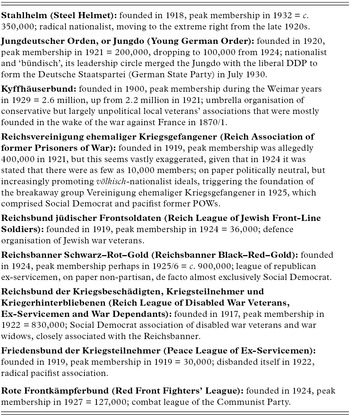
In many respects, these republican and anti-militaristic values resembled those held by the veterans gathered in the Reichsbund and Reichsbanner. ‘Patriotic pacifism’ is indeed an appropriate term for the political core values of the Reichsbanner members in particular, as they abhorred war, criticised armaments and were convinced that the Republic represented a better Germany which had left the legacy of Prussian militarism behind. Since the members of these two organisations represented a substantial proportion of all German war veterans, it would be misleading to construe a German Sonderweg in the commemoration of the Great War by former front-line soldiers. Major differences between the remembrances in France and Germany existed. Yet the crucial point was not the insignificance or even total lack of any republican currents in the German ‘cult of the fallen soldier’.33 Where Germany indeed diverged from France was in the lack of a shared framework of core political assumptions that allowed veterans to speak with one unified voice whenever they thought it was necessary. The various French associations were able to establish a national confederation in 1927 ‘which left each association independent but which coordinated collaboration’.34 Such a limited cooperation stood in stark contrast to Weimar, where polarisation and confrontation between competing political camps were the hallmarks of a highly fragmented political culture. Lack of even basic agreement on how a good polity was meant to work, and on a set of shared symbols for the unity of the German nation, characterised political communication across the Rhine. The three major political camps – Social Democrats and Left Liberals as the main proponents of the Republic; the nationalist and conservative right as its main opponents; and the Catholics, represented by the Centre Party, in the middle – were worlds apart in their core assumptions on the rules of political engagement.35 Veterans’ politics, and hence also the commemoration of war, reflected these fissures and even aggravated them further. Disagreement about the aims and content of remembrance abounded. As will be explained in more detail below, there were only very few instances when the pro-republican veterans and their counterparts on the right could agree on the symbolism and significance of the Great War. Post-war Germany saw a proliferation of veterans’ leagues of different political leaning and different purposes, such as specialist leagues solely representing disabled veterans or former POWs. In order to facilitate an understanding of this crucial field for the commemoration of war, the most important veterans’ leagues are mentioned in Table 1, with a first brief indication of their relative strength, purpose, and political orientation.
Table 1 Veterans’ associations in the Weimar Republic

A systematic investigation of republican war remembrances will also allow a reassessment of the distinctiveness of the French monuments aux morts, or war memorials, relative to their German equivalents, the Kriegerdenkmäler. The different terminology is in itself indicative of the different meaning of these memorials. In France, local memorials were primarily a reaffirmation of the ‘communities of mourning’ that gathered around them, consisting of the relatives and former comrades of those who had lost their lives in service for the Third Republic.36 Based on a widely shared and inclusive notion of republican citizenship, the dominant symbolism of French war memorials represented the soldier as a citizen in uniform, as someone who had served at the front in order to protect a community of civilians that he himself belonged to and was part of. Women and children were thus integral to this style of commemoration, and many memorials depicted the pivotal scene of mutual recognition and appreciation, when the soldier returned home to his loved ones.37 The established German term Kriegerdenkmäler, however, invoked the soldier as a warrior and thus set him apart from the civilians who had stayed at the home front. Implicit in this terminology, and explicit in the iconography of many memorials that depicted combat-ready soldiers in uniform, bent on renewing the conflict against the Western Allies, was the idea that the example of the fallen should motivate the living to revise the Versailles settlement with violent means.38 Such a comparison of local memorials in France and Germany is certainly correct with regard to the iconography and epigraphy of the Kriegerdenkmäler. A third and at least equally important dimension of the commemorative culture around war memorials was, however, their ‘ceremonial role’, or the interpretations and dedications delivered during the unveiling of a monument and on subsequent festive occasions.39 Only when these performative aspects of remembrance are properly investigated, and the presence of pro-republican interpretations of violent death during many of these celebrations has been established, is it possible to put Weimar’s memorial culture properly into a comparative perspective. It is certainly wrong to state, as Reinhart Koselleck has done, that the Weimar Republic ‘left the cult of the dead to the Conservatives alone’, and that this is a ‘key’ to understanding the demise of the Republic.40
The populist framing of remembrance
In 1926 Hermann Cron, an archivist at the Reichsarchiv in Postdam, which kept – among many other records – the files of the Prussian army and the general staff for the years 1914–18, published the first of a series of short booklets for internal use in the archive. They were inventories of some of the many large collections of Feldpostbriefe, or war letters, that the Reichsarchiv had acquired from a variety of corporate donors, for instance those of various branches of the Social Democratic ‘Free Trade Unions’, including the miners’ and transport workers’ association, and some confessional student associations. In addition to a short description of the provenance and content of the collection, Cron included a number of significant excerpts from the letters themselves.41 Introducing the series in a brief foreword, Ernst Müsebeck, head of the archive department in the Reichsarchiv, claimed that a ‘German cultural history of the World War’ could ‘absolutely’ not be written without collections of war letters like these. While the ‘repercussions and consequences’ of the war on ‘all areas of national life’ could still not be fully ascertained, it was already apparent to Müsebeck that the ‘greatest event in universal history for the past few centuries’ required a new approach to collective remembrance. It was a duty of the Reichsarchiv, Müsebeck was sure, to view the memory of the Great War ‘not only from above, from the state’, but also ‘from the depth of the German people and from all its social strata’.42 Collecting Feldpostbriefe served this aim, as they offered seemingly authentic insights into the perceptions of those ordinary soldiers who had encountered the face of battle at close range.
Müsebeck’s remark encapsulates two significant elements that shaped the wider framework of war remembrance in Germany. The first was its populist structure, which replaced the established notion that the elites, and the military elites in particular, had made a particularly important and privileged contribution to the overall war effort. Instead, a premium was placed on the sacrifice, endurance and perceptions of the wider populace. In the context of the army this implied that it was not the memoirs of officers or even generals that offered the best vanishing point for the broader canvas of war remembrances, but rather the worm’s-eye perspective of the front-line soldier. Only here, in the mud of the trenches, had truly significant Erlebnisse, or experiences, been generated, that were worthy of remembrance as an example for future generations or as proper reflections of the consciousness of the German people during the war. As various social and political groups in Weimar embarked on a race to re-enact the proper meaning of the Fronterlebnis in rituals of collective remembrance, they all agreed that the testimony of ordinary soldiers was the crucial benchmark from which to establish the relative authenticity of certain recollections. Thus, whilst eyewitness accounts, such as the various edited collections of Feldpostbriefe by fallen soldiers, could be the subject of conflicting interpretations, all participants in these debates shared the understanding that these voices from the past had a specific dignity.43
To frame the memory of the war in a populist fashion, from the ‘depth’ of the people, also implied a second characteristic element of German war remembrance. More than in any other country with the one exception of France, former soldiers were the primary stakeholders in the raft of cultural activities that were intended to transform past events into a meaningful present. To some extent, this was simply a belated result of the vast scale of German mobilisation during the war. Throughout the 1920s, men who had served in the army during the war still accounted for ‘more than one-quarter of the German electorate’, and, if the lower turnout among women is factored in, for an even larger part of the actual voters.44 But the hegemony of veterans in the embattled field of war remembrance had not only a quantitative dimension. It was first of all the result of a process by which other potential contributors to the commemoration of war, such as war widows as one severely affected constituency, were crowded out through the overwhelming presence of veterans.45 Any study of war memories in the Weimar period is thus also a contribution to the cultural and political contexts for the formation of the ‘front generation’. This generation should not be understood literally. It was not bound together by a shared set of memories. Rather, it was the result of a complicated process by which a highly diverse range of experiences were transformed into the mythological notion of a generation.46 As Jay Winter has observed, the ‘soldiers’ memory of the war is not at all the same as the cultural memory of the war’.47 This cultural memory was the result of a permanent reinterpretation of the meaning of violent mass death that was centred around the ‘soldier’s tale’, i.e. the notion that veterans were in a privileged position to talk authoritatively about these matters.48
There is no need here to consider in detail the vast theoretical literature on cultural memory and on the application of this concept to the study of the Great War.49 Two brief remarks should suffice. The first concerns the transformation of individual memories into collective remembrances. War memories were not simply the preserve of the individual, even though each war veteran could refer back to an individual set of recollections that reflected the trajectory of his own biography. But ‘every individual memory constitutes itself in communication with others’, as Jan Assmann has contended, following Maurice Halbwachs in this point.50 Only on rare occasions is it possible to identify the conversations that shaped individual memories. But there can be no doubt that the members of the Reichsbund and Reichsbanner attached significance primarily to those aspects of the past that they shared in many encounters with fellow socialist workers in their town or neighbourhood. These individual memories were transformed into collective remembrances when certain groups of people acted together to specify their understanding of the past and make it public.51 The second remark is a reminder that the connotations of some key terms in English and German differ. Memory can be translated in straightforward fashion as Erinnerung, but the English term remembrance covers a wider range of connotations. Its German equivalents can be both Erinnerung, denoting the shifting, dynamic process through which individuals rework their past experiences, and Gedächtnis and Gedenken, terms that refer to the performative rituals that identify certain elements of the past as particularly noteworthy and exemplary for the living.
Available sources
Analysing republican war memories is not the easiest task, particularly when personal remembrances and their possible articulation in the framework of public commemorations constitute one element of the historical argument. As published sources, the membership journals of the Reichsbund and Reichsbanner respectively offer crucial insights into all aspects of this investigation. In addition, press coverage by a variety of local newspapers can illuminate the performative aspects of memory politics, during the inauguration of war memorials and on many other occasions.52 As a result of the Nazi seizure of power in 1933, the paper trail of the head offices of the Reichsbund and Reichsbanner have not survived. An exceptionally rich documentation at the regional level are the files of the Reichsbanner Hanover Gau, which include correspondence with local branches.53 The personal papers of some leading Reichsbanner members were also confiscated by the Gestapo and most probably later destroyed.54 Others, such as Karl Höltermann, who served from 1924 as the deputy head of the Reichsbanner and finally headed the association from July 1932, had to leave their papers behind when they fled the Nazis and went into exile. Nonetheless, the still available personal papers of some leading Reichsbanner members and SPD politicians contain valuable material.55
It is ironic that the most comprehensive and systematic insights into the inner workings of local Reichsbanner branches are provided by sources that were gathered through police surveillance. Even though the Reichsbanner aimed to defend the democratic state, the political police in Bavaria, working on the premise that political disorder mainly emanated from the left, decided to put the Reichsbanner under constant surveillance. Desk-workers filed pertinent newspaper clippings, while police informers attended meetings of ReichsbannerKameradschaften (comradeships) in various neighbourhoods across Munich.56 These reports offer detailed insights into the inner workings of local Reichsbanner groups, and give a lively and vivid picture of the discussions held among rank-and-file members. Additional information was provided by a number of regional studies of the Reichsbanner that have been published in recent years, mostly relying on a thorough analysis of the local press and snippets of archival evidence.57 The commemorative practices at war memorials are mainly documented in newspaper clippings. For the purposes of this book, it was also possible to extract relevant information from a number of regional studies.58
Structure of the argument
In the following chapters, the structure and the significance of republican war remembrances will be situated in their social, political and cultural context. While the bulk of the argument is based on the commemorative activities of the Reichsbund and Reichsbanner, other agents and media of memory occasionally come into play. In the first chapter in particular, a string of popular booklets and brochures on the inner workings of the German army during the war will be examined. Mostly published in the period from 1919 to 1922 by leftist and radical-democratic authors, they sketched out a republican narrative for the causes of the German collapse in 1918, laying the blame at the door of the Wilhelmine elites and quite effectively rejecting the stab-in-the-back myth. The chapter will situate these published recollections in the early debates about the legacy of the war.
When it was established in 1924 as a republican defence formation, the Reichsbanner Schwarz–Rot–Gold quickly attracted a mass membership of roughly one million men, mostly Social Democrats. But the Reichsbanner acted not only as the security guard of the Republic. Its members, two-thirds of whom were veterans of the First World War, also engaged in an intense and differentiated cultural practice of war remembrances. Chapter 2 will analyse the key features of these commemorations and their connections with the republican activism of these veterans. It will thus highlight the significance of the Reichsbanner as the veterans’ association of the socialist working-class milieu. Chapter 3 will trace individual recollections of the war as personal motives that fed into the republican activism of ordinary Reichsbanner members. Drawing on an example from a small provincial town, these motives will be contextualised in the local setting of veterans’ politics and working-class everyday life, thus avoiding the pitfall of detaching discourses about the war from the social contexts in which they were embedded. The chapter will also shed light on the problems Reichsbanner members faced when they tried to reconcile their personal memories with the public discourse on the ‘war experience’.
Chapter 4 will outline the public rhetoric of war remembrances employed by the Reichsbanner and Reichsbund. Both associations tried to use the commemoration of the war dead as a means of strengthening the legitimacy of the Republic, thus criticising the exploitation of the legacy of the fallen for anti-republican purposes. A particular focus will be on the attempts to symbolise and to assign meaning to mass death, and on the ambivalent results of a discourse that focused on the victimisation of front-line soldiers. Chapter 5 will provide a detailed account of the unsuccessful attempts to build a Reichsehrenmal, a central national memorial for the commemoration of the fallen soldiers of 1914–18 in Germany. It will chart the various proposals, their political motives and symbolic implications. Outlining the reasons for the reluctance to adopt the idea of the ‘Unknown Soldier’, the chapter will explain the failure of the Reichsehrenmal in terms not of a lack but of an abundance of (contradicting) symbols for German national unity.
Military history was another crucial battleground for the contested commemorations of the First World War. Chapter 6 will outline how the republican camp aimed to attribute responsibility for German defeat to the imperial general staff and to criticise the smokescreens offered by the official historiography produced by Reichswehr officials. For these purposes, the Reichsbanner could rely on a number of former officers in the Imperial Army who had turned into outspoken and devoted supporters of the Weimar Republic, advocates of reconciliation with France and critics of the rearmament politics of the Reichswehr. The chapter will examine the biographies of these former officers and the reasons for this dramatic shift in their political allegiances. It will then analyse their contributions to the politics of military history up until 1933. Chapter 7 will focus on the years from 1928 to 1933, when the memories of the Great War became the subject of a massive wave of literary and other artistic representations.59 It will explore how the increasing polarisation of war remembrances in this period affected the position and the interpretations of the republican camp.
Finally, some remarks on terminology. Throughout this book, men who had been conscripts in the German army during the First World War will be called ‘veterans’. This English word has an equivalent in German parlance, Veteranen, but it was rarely ever used in the inter-war period.60 The political left and centre preferred to call veterans Kriegsteilnehmer, as the name of the Reichsbanner (‘Bund republikanischer Kriegsteilnehmer’) indicates, thus using a rather sober and descriptive term that simply indicated that someone had participated in the war. In the nationalist camp, Frontsoldaten, or front-line soldiers, was the preferred semantic label, as it situated the veterans at precisely those spots where the actual fighting had been taking place, and facilitated denunciations of the left as cowards who had never seen the enemy in the first place. Accusations like these forced the moderate left to adopt the term Frontsoldaten for themselves, and occasionally even to include the notion of Kampf or fighting into the set of connotations associated with a republican Frontsoldat.61 Tapping into the competitive logic of ascribing proper wartime service only to the in-group, and injecting further militancy, veterans could also describe themselves as Frontkämpfer, or front-line fighters. This terminology largely remained the domain of the extreme left and right. Its systematic use was spearheaded by the Communist Party, which called its own veterans’ league, founded in 1924, the Rote Frontkämpferbund, or Red Front Fighters’ League.62 But as we will see below, moderate Social Democrats were also sometimes tempted to adopt this aggressive term and thus to outbid the nationalist camp. In a nutshell, the semantics of these self-descriptions already indicate that contestation and disunity were key elements of war remembrances in Weimar Germany.
1 George L. Mosse, Fallen Soldiers: Reshaping the Memory of the World Wars (New York; Oxford: Oxford University Press, Reference Mosse1990), p. 7.
2 Ibid., pp. 7, 10. It is a testament to the innovative nature of Mosse’s research that he actually discussed the war experience as a challenge for the post-1918 political left, particularly in Germany, also touching upon the Reichsbanner. As often, however, he presented sweeping generalisations, here on the militarism of the Reichsbanner and its ‘imitation of the right’, with hardly any empirical evidence. See George L. Mosse, ‘La sinistra Europea e l’esperienza della guerra (Germania e Francia)’, in Rivoluzione e reazione in Europa, 1917–1924: Convegno storico internazionale, Perugia, 1978 (Rome: Avanti, Reference Mosse1978), pp. 151–67 (quotes on p. 159).
3 See, for instance, Wolfgang Schivelbusch, The Culture of Defeat: On National Trauma, Mourning, and Recovery (London: Granta, Reference Schivelbusch2004), pp. 189–230; Boris Barth, Dolchstoßlegenden und politische Desintegration: Das Trauma der deutschen Niederlage im Ersten Weltkrieg 1914–1933 (Düsseldorf: Droste, Reference Barth2003); Laurence Van Ypersele, ‘Mourning and Memory, 1919–45’, in John Horne (ed.), A Companion to World War I (Chichester: Wiley, Reference Ypersele and Horne2010), pp. 576–90 (p. 583). On the notion of ‘cultural demobilization’ see John Horne, ‘Kulturelle Demobilmachung 1919–1939: Ein sinnvoller Begriff?’, in Wolfgang Hardtwig (ed.), Politische Kulturgeschichte der Zwischenkriegszeit 1918–1939 (Göttingen: Vandenhoeck & Ruprecht, Reference Horne and Hardtwig2005), pp. 129–50.
4 Richard Bessel, Germany after the First World War (Oxford: Clarendon Press, Reference Bessel1993), p. 258. See also the pathbreaking study by Bernd Ulrich, Die Augenzeugen: Deutsche Feldpostbriefe in Kriegs- und Nachkriegszeit 1914–1933 (Essen: Klartext, Reference Ulrich1997).
5 Bessel, Germany, p. 258.
6 Robert W. Whalen, Bitter Wounds: German Victims of the Great War, 1914–1939 (Ithaca, NY; London: Cornell University Press, Reference Whalen1984), p. 150.
7 On these nationalist narratives and mythologies, see, among others, Matthias Sprenger, Landsknechte auf dem Weg ins Dritte Reich? Zu Genese und Wandel des Freikorpsmythos (Paderborn: Schöningh, Reference Sprenger2008); Roger Woods, ‘Die neuen Nationalisten und ihre Einstellung zum 1. Weltkrieg’, Krieg und Literatur/War and Literature 1 (Reference Woods1989), 59–79; and Gerd Krumeich (ed.), Nationalsozialismus und Erster Weltkrieg (Essen: Klartext, Reference Krumeich2010); as well as the older but still valuable study by Kurt Sontheimer, Antidemokratisches Denken in der Weimarer Republik (Munich: Deutscher Taschenbuch-Verlag, Reference Sontheimer1978 [1962]), pp. 93–111.
8 Alan Kramer, ‘The First World War and German Memory’, in Heather Jones, Jennifer O’Brien and Christoph Schmidt-Supprian (eds.), Untold War: New Perspectives in First World War Studies (Leiden; Boston, MA: Brill, Reference Ther, Jones, O’Brien and Schmidt-Supprian2008), pp. 385–415 (p. 390); Bernd Ulrich, ‘Die umkämpfte Erinnerung: Überlegungen zur Wahrnehmung des Ersten Weltkrieges in der Weimarer Republik’, in Jörg Duppler and Gerhard P. Groß (eds.), Kriegsende 1918: Ereignis–Wirkung–Nachwirkung (Munich: Oldenbourg, Reference Ulrich, Duppler and Groß1999), pp. 367–75 (p. 368).
9 As a first provisional outline of this argument see my ‘Republikanische Kriegserinnerung in einer polarisierten Öffentlichkeit: Das Reichsbanner Schwarz–Rot–Gold als Veteranenverband der sozialistischen Arbeiterschaft’, HZ 267 (Reference Ziemann1998), 357–98. For Austria, see now the innovative study by Oswald Überegger, Erinnerungskriege: Der Erste Weltkrieg, Österreich und die Tiroler Kriegserinnerung in der Zwischenkriegszeit (1918–1939) (Innsbruck: Wagner, Reference Überegger2011).
10 The standard account on the Reichsbanner is Karl Rohe, Das Reichsbanner Schwarz Rot Gold: Ein Beitrag zur Geschichte und Struktur der politischen Kampfverbände zur Zeit der Weimarer Republik (Düsseldorf: Droste, Reference Rohe1966); two valuable regional studies, on Munich and Saxony respectively, are Günther Gerstenberg, Freiheit! Sozialdemokratischer Selbstschutz im München der zwanziger und frühen dreißiger Jahre, 2 vols. (Andechs: Edition Ulenspiegel, Reference Gerstenberg1997); and Carsten Voigt, Kampfbünde der Arbeiterbewegung: Das Reichsbanner Schwarz–Rot–Gold und der Rote Frontkämpferbund in Sachsen 1924–1933 (Cologne: Böhlau, Reference Voigt2009). All three studies touch upon the commemorative politics of the Reichsbanner only briefly, and are mostly concerned with its role as a republican defence league. Cf. James M. Diehl, ‘Germany: Veterans’ Politics under Three Flags’, in Stephen R. Ward (ed.), The War Generation: Veterans of the First World War (Port Washington: Kennikat Press, Reference Diehl and Ward1975), pp. 135–86.
11 Peter Fritzsche, ‘The Case of Modern Memory’, Journal of Modern History 73 (Reference Fritzsche2001), 87–117 (p. 108).
12 On Germany, see in particular Stefan Goebel, The Great War and Medieval Memory: War, Remembrance and Medievalism in Britain and Germany, 1914–1940 (Cambridge University Press, Reference Goebel2007); Greg Caplan, Wicked Sons, German Heroes: Jewish Soldiers, Veterans and Memories of World War I in Germany (Saarbrücken: VDM Verlag, Reference Caplan2008); Philipp Stiasny, Das Kino und der Krieg: Deutschland 1914–1929 (Munich: edition text + kritik, Reference Stiasny2009); and Anton Kaes, Shell Shock Cinema: Weimar Culture and the Wounds of War (Princeton University Press, Reference Kaes2009). More generally, see the seminal studies by Jay Winter, Sites of Memory, Sites of Mourning: The Great War in European Cultural History (Cambridge University Press, Reference Winter1996); and Remembering War: The Great War between Memory and History in the Twentieth Century (New Haven; London: Yale University Press, Reference Winter2006).
13 Alon Confino, ‘Collective Memory and Cultural History: Problems of Method’, American Historical Review 102 (Reference Confino1997), 1386–1403 (p. 1388). An excellent overview on the growing literature on memory studies is Karin Tilmans, Frank van Vree and Jay Winter (eds.), Performing the Past: Memory, History and Identity in Modern Europe (Manchester University Press, Reference Tilmans, Vree and Winter2010).
14 Detlev Peukert, The Weimar Republic: The Crisis of Classical Modernity (New York: Hill & Wang, Reference Peukert1993), p. 6.
15 Again, Mosse, Fallen Soldiers, pp. 159–81, was a crucial reference point. As a critique, see Benjamin Ziemann, ‘Germany after the First World War: A Violent Society? Results and Implications of Recent Research on Weimar Germany’, Journal of Modern European History 1 (Reference Ziemann2003), 80–95.
16 Peter Fritzsche, ‘Did Weimar Fail?’, Journal of Modern History 68 (Reference Fritzsche1996), 629–56.
17 For further references and reflections see Benjamin Ziemann, ‘Weimar was Weimar: Politics, Culture and the Emplotment of the German Republic’, German History 28 (Reference Ziemann2010), 542–71.
18 See Rüdiger Graf, Die Zukunft der Weimarer Republik: Krisen und Zukunftsaneignungen in Deutschland 1918–1933 (Munich: Oldenbourg, Reference Graf2008).
19 In memory studies, performative aspects were analysed in the pathbreaking study by Adrian Gregory, The Silence of Memory: Armistice Day, 1919–1946 (Oxford: Berg, Reference Gregory1994).
20 See Ziemann, ‘Weimar was Weimar’, pp. 560–4.
21 See the references in Manuela Achilles, ‘With a Passion for Reason: Celebrating the Constitution in Weimar Germany’, CEH 43 (Reference Achilles2010), 666–89 (pp. 666f.).
22 Nadine Rossol, Performing the Nation in Interwar Germany: Sport, Spectacle and Political Symbolism 1926–1936 (Basingstoke: Palgrave, Reference Rossol2010), esp. 58–79. See also Achilles, ‘Celebrating’; and Manuela Achilles, ‘Performing the Reich: Democratic Symbols and Rituals in the Weimar Republic’, in Kathleen Canning, Kerstin Barndt and Kristin McGuire (eds.), Weimar Publics/Weimar Subjects: Rethinking the Political Culture of Germany in the 1920s (New York: Berghahn, Reference Achilles2010), pp. 175–91; Bernd Buchner, Um nationale und republikanische Identität: Die deutsche Sozialdemokratie und der Kampf um die politischen Symbole in der Weimarer Republik (Bonn: J. H. W. Dietz, Reference Buchner2001).
23 As a summary, see Ziemann, ‘Weimar was Weimar’; an important case study is the book on the political culture of parliamentary debates by Thomas Mergel, Parlamentarische Kultur in der Weimarer Republik: Politische Kommunikation, symbolische Politik und Öffentlichkeit im Reichstag (Düsseldorf: Droste, Reference Mergel2002).
24 The most thorough account of this decision and its consequences is Wolfgang Kruse, Krieg und nationale Integration: Eine Neuinterpretation des sozialdemokratischen Burgfriedensschlusses 1914/15 (Essen: Klartext, Reference Kruse1993).
25 For the claim that the term ‘Republik’ had lost semantic currency, see Dieter Langewiesche, Republik und Republikaner: Von der historischen Entwertung eines Begriffs (Essen: Klartext, Reference Langewiesche1993), p. 46.
26 See for instance Peter Lösche and Franz Walter, ‘Zur Organisationskultur der sozialdemokratischen Arbeiterbewegung in der Weimarer Republik: Niedergang der Klassenkultur oder solidargemeinschaftlicher Höherpunkt?’, GG 15 (Reference Lösche and Walter1989), 511–36; Donna Harsch, German Social Democracy and the Rise of Nazism (Chapel Hill: University of North California Press, Reference Harsch1993).
27 Mosse, Fallen Soldiers, p. 159.
28 Antoine Prost, ‘The Impact of War on French and German Political Cultures’, Historical Journal 37 (Reference Prost1994), 209–17 (p. 211).
29 Ibid., p. 212–14.
30 Goebel, Great War, pp. 287, 290.
31 Antoine Prost, Les Anciens Combattants et la société francaise, 1914–1939, 3 vols. (Paris: Presse de la Fondation Nationale des Sciences Politiques, Reference Prost1977); see the abridged translation as Antoine Prost, In the Wake of War: ‘Les Anciens Combattants’ and French Society 1914–1939 (Providence, RI; Oxford: Berg, Reference Prost1992), pp. 40, 51–93. For a revisionist interpretation see Chris Millington, From Victory to Vichy: Veterans in Inter-War France (Manchester University Press, Reference Millington2012).
32 Prost, In the Wake of War, quote on p. 79; for context, see John Horne, ‘Der Schatten des Krieges: Französische Politik in den zwanziger Jahren’, in Hans Mommsen (ed.), Der Erste Weltkrieg und die europäische Nachkriegsordnung: Sozialer Wandel und Formveränderung der Politik (Cologne: Böhlau, Reference Horne and Mommsen2000), pp. 145–64 (pp. 146–57).
33 A point that is reiterated by Oliver Janz, ‘Trauer und Gefallenenkult nach 1918: Italien und Deutschland im Vergleich’, in Ute Daniel, Inge Marszolek, Wolfram Pyta and Thomas Welskopp (eds.), Politische Kultur und Medienwirklichkeiten in den 1920er Jahren (Munich: Oldenbourg, Reference Janz, Daniel, Marszolek, Pyta and Welskopp2010), pp. 257–78 (p. 277).
34 Prost, In the Wake of War, p. 37.
35 See the chapters in Detlef Lehnert and Klaus Megerle (eds.), Politische Teilkulturen zwischen Integration und Polarisierung: Zur politischen Kultur in der Weimarer Republik (Opladen: Westdeutscher Verlag, Reference Lehnert and Megerle1990).
36 See Stéphane Audoin-Rouzeau and Annette Becker, 14–18, Understanding the Great War (New York: Hill and Wang, Reference Audoin-Rouzeau and Becker2003), pp. 203–25 (quote on p. 204).
37 Michael Jeismann and Rolf Westheider, ‘Wofür stirbt der Bürger? Nationaler Totenkult und Staatsbürgertum in Deutschland und Frankreich seit der Französischen Revolution’, in Reinhart Koselleck and Michael Jeismann (eds.), Der politische Totenkult: Kriegerdenkmäler in der Moderne (Munich: Fink, Reference Jeismann and Westheider1994), pp. 23–50; see also Daniel J. Sherman, ‘Bodies and Names: The Emergence of Commemoration in Interwar France’, American Historical Review 103 (Reference Sherman1998), 443–66.
38 See Jeismann and Westheider, ‘Totenkult’, pp. 29, 36–42; and the examples in Kai Kruse and Wolfgang Kruse, ‘Kriegerdenkmäler in Bielefeld: Ein lokalhistorischer Beitrag zur Entwicklungsanalyse des deutschen Gefallenenkultes im 19. und 20. Jahrhundert’, in Koselleck and Jeismann, Der politische Totenkult, pp. 91–128 (pp. 111–14).
39 See Goebel, Great War, pp. 23f.
40 Reinhart Koselleck, Zur politischen Ikonologie des gewaltsamen Todes: Ein deutsch–französischer Vergleich (Basel: Schwabe, Reference Koselleck1998), p. 39.
41 See Ulrich, Augenzeugen, pp. 266f.
42 Ernst Müsebeck, ‘Vorwort’, in Hermann Cron (ed.), Das Archiv des Deutschen Studentendienstes von 1914, Inventare des Reichsarchivs, Series 1: Kriegsbrief-Sammlungen 1 (Potsdam: Reichsarchiv, Reference Cron1926), pp. 2f.
43 Ulrich, Augenzeugen, pp. 228–44.
44 Bessel, Germany, p. 271.
45 For one of the few attempts to remember the fate of war widows see Helene Hurwitz-Stranz (ed.), Kriegerwitwen gestalten ihr Schicksal: Lebenskämpfe deutscher Kriegerwitwen nach eigenen Darstellungen (Berlin: Heymann, Reference Hurwitz-Stranz1931); see also Bernd Ulrich and Benjamin Ziemann (eds.), Krieg im Frieden: Die umkämpfte Erinnerung an den Ersten Weltkrieg (Frankfurt am Main: Fischer, Reference Ulrich and Benjamin1997), pp. 118f. See also Karin Hausen, ‘The German Nation’s Obligations to the Heroes’ Widows of World War I’, in Margaret Higonnet, Jane Jenson, Sonya Michel and Margaret Collins Weitz (eds.), Behind the Lines: Gender and the Two World Wars (New Haven; London: Yale University Press, Reference Hausen, Higonnet, Jenson, Michel and Weitz1987), pp. 126–40.
46 Richard Bessel, ‘The “Front Generation” and the Politics of Weimar Germany’, in Mark Roseman (ed.), Generations in Conflict: Youth Revolt and Generation Formation in Germany 1770–1968 (Cambridge University Press, Reference Bessel and Roseman1995), pp. 121–36.
47 Winter, Remembering War, p. 104.
48 Ibid., p. 116.
49 For perceptive remarks, see Goebel, Great War, pp. 14–18; Winter, Remembering War, pp. 1–51.
50 Jan Assmann, ‘Collective Memory and Cultural Identity’, New German Critique 65 (Reference Assmann1995), 125–33 (p. 127).
51 Winter, Remembering War, pp. 4f.
52 For these and other aspects, the newspaper clippings produced by the head office of the former Reichslandbund provide an unparalleled range of coverage. See BArch, R 8034 II, 7690–2.
53 See the files in NHStAH, Hann. 310 II A, nos. 2–25.
54 See for instance, with regard to Karl Mayr, Wolfgang A. Mommsen (ed.), Die Nachlässe in den deutschen Archiven, 2 vols., Vol. I (Boppard: Boldt, Reference Mommsen1971), p. 327.
55 Most of these are held by the AdsD in Bonn.
56 For context on the political police in Bavaria, see Martin Faatz, Vom Staatsschutz zum Gestapo-Terror: Politische Polizei in Bayern in der Endphase der Weimarer Republik und der Anfangsphase der nationalsozialistischen Diktatur (Würzburg: Echter, Reference Faatz1995), pp. 63–77.
57 In addition to Voigt, Kampfbünde, see David Magnus Mintert, ‘Sturmtrupp der deutschen Republik’: Das Reichsbanner Schwarz–Rot–Gold in Wuppertal (Wuppertal: Edition Wahler, Reference Mintert2002); and Axel Ulrich, Freiheit! Das Reichsbanner Schwarz–Rot–Gold und der Kampf von Sozialdemokraten in Hessen gegen den Nationalsozialismus 1924–1938 (Frankfurt am Main: SPD–Bezirk Hessen Süd, Reference Ulrich1988).
58 See, for instance, Christian Saehrendt, Der Stellungskrieg der Denkmäler: Kriegerdenkmäler im Berlin der Zwischenkriegszeit (1919–1939) (Bonn: J. H. W. Dietz, Reference Saehrendt2004).
59 The most comprehensive study of war literature in the Weimar Republic is Jörg Vollmer, ‘Imaginäre Schlachtfelder: Kriegsliteratur in der Weimarer Republik. Eine literatursoziologische Untersuchung’, Ph.D. dissertation (Freie Universität Berlin, Reference Vollmer2003); on individual authors see Thomas F. Schneider and Hans Wagener (eds.), Von Richthofen bis Remarque: Deutschsprachige Prosa zum I. Weltkrieg (Amsterdam; New York: Rodopi, Reference Schneider and Wagener2003).
60 See Jakob Vogel, ‘Der Undank der Nation: Die Veteranen der Einigungskriege und die Debatte um ihren “Ehrensold” im Kaiserreich’, MGZ 60 (Reference Vogel2001), 343–66 (pp. 356f.).
61 As flagged up in the title of Hermann Schützinger, Der Kampf um die Republik: Ein Kampfbrevier für republikanische Frontsoldaten (Leipzig: Ernst Oldenburg, Reference Schützinger1924).
62 See Voigt, Kampfbünde, pp. 115–26, esp. p. 119.

 Open access