

For more than two centuries, Mozart’s operas have occupied a central position in our musical culture, both as mainstays of the repertory and as objects of sustained, critical attention. Although the widespread fascination these works inspire may be attributed to any number of their musical features (to say nothing of the contingencies that shape the canon), one point often emphasized is the human depth with which Mozart imbues his characters. The fictional beings who populate his operas, even those from whom modern-day moral intuitions sharply diverge, are constructed in such a way that they seem to exude a richness of thought, and even a subjectivity, not always present in the creations of other composers.Footnote 1 Yet if critics have been quick to locate essential selves within Mozart’s characters, comparatively little ink has been devoted to the question of how, indeed whether, these selves undergo psychological change over the course of any given opera. In many cases, perhaps the issue is moot: Mozart’s characters often emerge fully formed during their initial entrances and continue to inhabit a single, coherent persona until the curtain falls. When development takes place — here Fiordiligi, Dorabella, and Tamino spring readily to mind, along with some others with whom they share the stage in Così fan tutte and Die Zauberflöte — what we witness may be interpreted not as a wholesale reimagining but as an actualization of potential that was present, if veiled, all along.Footnote 2 Yet one figure who does undergo significant expansion is Donna Elvira, whose transformation over the two acts of Don Giovanni is arguably the most marked among any character in Mozart’s oeuvre, a metamorphosis that is all the more striking because it is the only such psychological development in an opera whose inhabitants are otherwise comparatively rigid in habit and persona.Footnote 3
Elvira’s appearance in Act I is laden with trappings of the comic, even the ridiculous. She enters in traveling garb (‘in abito di viaggio’); she is smelled before she is seen (Giovanni whispers: ‘Zitto: mi pare/Sentir odor di femmina!’); her first aria is interrupted repeatedly by Giovanni’s leers (if the gesture is dramaturgically humorous, it is also demeaning, since arias generally provide a haven for characters’ self-expression, free from interpolation by outsiders); and she is made to listen, humiliated, during Leporello’s ‘Catalogue’ aria simply so that she can deliver a brief, deflated recitative following his enumeration of Giovanni’s exploits.Footnote 4 Musically, too, Elvira seems frenzied during these scenes. Even accepting Elaine Sisman’s argument that Elvira’s style, with its Handelian contours, is ‘positive and strong, revealing her as a wielder of law, calling on the stylistic authority of an older tradition’, the fact remains that, as most commentators have pointed out, her phrases are marred by rhythmic asymmetries, comical orchestral outbursts, excessive repetition, and awkward melodies with leaps of sevenths, octaves, and ninths.Footnote 5
Yet midway through Act I, a transformation begins.Footnote 6 In the opening phrase of the Quartet ‘Non ti fidar’, Elvira adopts a noble manner, imitating the staid alla breve of the seria characters, hesitating for the length of a dotted minim before launching into her appeal, singing motifs that will, in Edmund Goehring’s words, take on a ‘form-bearing role’ in this and a number of subsequent phrases, and cadencing with a gesture that resounds through the orchestra, as if all parameters of the texture hear and respond.Footnote 7 The process continues, and by Act II Elvira’s motivations have thoroughly realigned, replacing the onetime desire for vengeance with an impulse to forgive, and establishing her as the sympathetic core of the opera. In Wye J. Allanbrook’s reading, the work’s entire tonal landscape shifts to accommodate this newfound perspective. Elvira meditates on the ‘dark place’ in which the Act II Sextet unfolds, gracefully inhabiting E♭ major — a key that, in Allanbrook’s words, had represented merely a ‘fool’s paradise’ during Elvira’s first aria in Act I, bookended by numbers in D,Footnote 8 but which has now become the opera’s moral and tonal frame of reference:
…the thought of death intrudes itself unwelcome on Elvira’s delicate sensibilities; she absorbs it from the night air. The stage setting sets the psychic climate of the opera at this moment: in the meditative twilight of the ‘bujo loco’ E-flat is the tonic and D the unstable degree; Ottavio’s and Anna’s public tableau of wooing and withstanding is the mode which strikes a false note.Footnote 9
Four decades after publication, Allanbrook’s analyses remain among the most sensitive readings of these operas; and, as the quoted passage demonstrates, Allanbrook is not unaware of Elvira’s talismanic presence in the second act of Don Giovanni. Yet she does not give Elvira’s transformation as expansive a treatment as she might. She focuses her remaining analyses almost exclusively on Elvira’s presence in the Act II Finale, dismissing the scena culminating in ‘Mi tradì quell’alma ingrata’ (composed for voice of Caterina Cavalieri in the 1788 Viennese production) as adding little or nothing to Elvira’s character.Footnote 10 Allanbrook is by no means opposed to Mozart’s revisions: she even heralds ‘Dalla sua pace’ as imbuing a previously stiff Ottavio with a warmth resembling that of the Countess in Le Nozze di Figaro. Footnote 11 Yet where Allanbrook credits Ottavio’s aria with introducing a far-reaching change in the affective scope of the opera, she accords Elvira’s only the briefest of discussions, treating it in both word and spirit as superfluous.
This view is widely shared among recent interpreters of Don Giovanni. Daniel Heartz, quick to acknowledge that Elvira ‘deepens and changes into a real person in the course of her sufferings’, makes no mention of the aria, citing as substantiation only the opening phrase of the Act II Sextet.Footnote 12 A still more famous rebuke comes from Joseph Kerman, who, despite having found Elvira to be the most interesting of the opera’s women, deemed ‘Mi tradì’ a ‘thoroughly gratuitous’ piece, ‘forced into the last act’ to accommodate Cavalieri.Footnote 13 To be sure, Kerman’s assessment is reasonable from the perspective of plot. The conflicting desires that lead Elvira to intervene at Giovanni’s banquet are, strictly speaking, already transparent in the libretto by the close of the Sextet. It is therefore true that the scena has little to add in terms of narrative.Footnote 14 Musically and especially psychologically, however, the issue is different. There is a strange gap between the earnest depth of Elvira’s words throughout the opera and the music to which Mozart sets her text in the original 1787 Prague version, which generally seems to offer little room for sustained emotional development. The ‘dark place’ of the Sextet is conjured almost exclusively through the libretto: against the melancholic words Elvira intones as she is seized by fear, the music seems incongruously cheerful. Chromatic shadings, which animate other charged passages in the opera, occur only in the first bar (a passing E♮ that suggests a conventional Fonte schema rather than a marked intrusion),Footnote 15 as well as around the solitary interrupted cadence and chromatic ascent in the orchestra, an effect improbably dismissed by Heartz as simply alluding to the ‘rather pleasant’ chromatic figuration heard earlier in the Act II Trio.Footnote 16 If the aural shift described by Allanbrook has taken place, then, Elvira’s presence in this new musical environment has not yet been actualized. It is perhaps for this reason — the possible mismatch between textual evocation and musical style, and attendant curiosity as to the nature of Elvira’s actual self — that Michael P. Steinberg claims that ‘the most difficult and persistent question about the characters [of Don Giovanni] seems to remain “Who is Elvira?”’Footnote 17 I will argue that a satisfying answer appears only with the addition of ‘Mi tradì’. In this aria alone, Elvira inhabits the personal realm towards which the Sextet hints, bringing textual and musical content into alignment.
That the aria accomplishes this has, in the recent critical literature,Footnote 18 been recognized almost exclusively by Kristi Brown-Montesano, who allows that ‘Mi tradì’ constitutes a gratifying and redeeming addition to Elvira’s role, the only point in the entire opera at which Elvira ‘[expresses] herself fully without the distracting commentary of other characters’.Footnote 19 Even Brown-Montesano, however, immediately qualifies her statement: ‘it is not that the scena significantly alters what we already know about Donna Elvira, but it does allow her to revisit and explore the conflicting passions’ to which she has been prey throughout the work.
In the following pages, I re-open the case of ‘Mi tradì’. My goal, in part, is to offer a close reading that foregrounds structural and rhetorical elements overlooked by previous critics, which, I argue, come together in a striking depiction of Elvira’s inner world. My analysis is guided by the conviction that her characterization has not yet reached its resting-point at the close of the Sextet, and that this aria therefore contributes much to our understanding of her struggles — not through a simple explication of her thoughts or motivations, since the libretto already makes these abundantly clear, but through its evocation of the rich, complex process with which she moves through the feelings that grip her, and whose playing-out establishes in her a capacity for depth towards which other scenes hint but which finds satisfying expression only here. It may seem unlikely that a single analysis is sufficient to contravene decades of received wisdom concerning the scena’s status as a superfluous addition to Don Giovanni; however, it is noteworthy that the communicative and expressive devices I detect in this aria, and indeed even elements of the critical approach on which my reading depends, have come into focus only recently in the analytic literature on eighteenth-century music. The judgments levelled by earlier listeners are, therefore, ripe for re-evaluation. To this end, although I argue that the aria derives meaning from Mozart’s charged use of familiar devices such as tonal structures, rhythmic gestures, vocal and instrumental interplay, form, text-setting, and the like, I also look beyond, focusing on the broader associative meanings whose explication has been enabled by the burgeoning literatures on topic theory, schemata, variation techniques, and the interplay of performative constraints with Mozart’s compositional imagination. I hope to show that, despite being a late addition to the opera, ‘Mi tradì’ does far more than satisfy the requirement that each leading singer receive an aria per act. By the time Elvira sings the final phrase, she has become a richer and more deeply feeling character than she had been at any previous point. In addition, however, and beyond this ‘local’ interpretive matter, the view of Elvira I pursue in these pages carries broader implications for our understanding of Mozart’s operatic fictions and the status of the characters who inhabit them, as well as for the trajectory of Mozart’s compositional career: implications I take up following my analysis of the aria.
[N.B.: bar numbers in the following discussion correspond with those in the Neue Mozart-Ausgabe. Some examples are given, but the reader may wish to consult a complete score.]
Accompanied Recitative and the Inward Turn
| In quali eccessi, o Numi, in quai misfatti
Orribili, tremendi È avvolto il sciagurato! Ah no, non puote tardar l’ira del cielo,… La giustizia tardar! Sentir già parmi La fatale saetta, Che gli piomba sul capo…Aperto veggio Il baratro mortal … Misera Elvira, Che contrasto d’affetti in sen ti nasce!… Perchè questi sospiri, e queste ambascie? |
In what excesses, o gods, in what horrible, Tremendous misdeeds Is the scoundrel involved? Ah no, the wrath of heaven cannot be delayed… Nor justice delayed! I seem to hear already The fatal thunderbolt, That crashes down on his head…I see The mortal abyss … Miserable Elvira, What conflict of passions rises in you… Why these sighs and these anguishes?Footnote 20 |
Although Elvira’s development takes place primarily in the aria, the accompanied recitative sets the trajectory for the entirety of her scena. The recitative is delivered in solitude — a norm, perhaps, for Mozart’s seria soliloquies, but the only such case in an opera whose other accompanied recitatives, shared by Anna and Ottavio, dramatize dialogues rather than private meditations. Elvira addresses her words to two distinct entities: the external forces whom she enjoins in the first section, and, in the final lines, her own self. In comparison with Mozart’s other Da Ponte operas, this dual focus is handled unusually. Elsewhere, exhortations of the gods are punctuating interjections woven throughout a character’s other reflections. Elvira’s recitative, however, moves through two distinct modes of address, one after the other, each directed towards a different interlocutor and buoyed by its own approach to musical expression.
The recitative begins with Elvira’s gaze set on the external world. She addresses her remarks to the gods, she meditates almost exclusively on Giovanni and his fate rather than on her own inner turmoil, and her senses are attuned to the supernatural forces whose impending censure she alone foresees. It is towards these elements that the musical content points, with declamatory string unisons in the opening bars and celestial thunderbolts in the word-painting of bars 18 and 20. Equally striking, if less frequently noted, is the chromaticism harnessed in the orchestral material, which alludes to processes that unfold elsewhere in Don Giovanni. Perhaps counterintuitively considering Mozart’s proclivities for daring chromatic writing, the opera as a whole features little pervasive chromaticism outside a handful of charged sequences. The opening of the Overture, the Commendatore’s death at Giovanni’s hands, Donna Anna’s narration of her attack by Giovanni, the ‘shock tutti’ in the Sextet, and of course the climactic sequence of the Act II Finale, are full of rhetorically charged chromatic writing that finds little match elsewhere, aside from the present scena. Footnote 21 Thus, from its first bars, the accompanied recitative calls up associations with the uncanny that frames the opera but which intrudes only rarely on the human dramas played out among the other characters.
The orchestra’s opening material in the recitative traces a chromatic ascent (Example 1a). These chromatic steps accomplish three rhetorical moves at once. First, they confirm that although Elvira has sustained a mezzo carattere for much of the opera and indeed is often enmeshed against her will in comic episodes, in her solitude she is associated with music more appropriate to the seria world. Second, inasmuch as the gesture exceeds any foregrounded chromaticism in the opera’s other accompanied recitatives, it suggests an affinity with the supernatural forces to which Elvira is attuned, and which are excluded from other characters’ perceptual spheres.Footnote 22 Finally, the chromatic motion, especially alongside the frequent shifts of dynamics and articulation, constitutes a topical reference to the instrumental genre of the fantasia,Footnote 23 which in the late eighteenth century was defined almost exclusively by its rejection of stylistic and structural norms, and was therefore associated with early evocations of musical individuality and self-consciousness.Footnote 24 (The opening gestures bear notable resemblance to those of compositions such as the Fantasia in C minor, K.475, Example 1b, where the initial idea, encompassing the first steps in a chromatic scale — descending in K.475, ascending in the recitative — is repeated once in sequence before continuing to new material.) To be sure, in the process of invoking the fantasia topic, one crucial contextual element of the gesture is altered. In a keyboard fantasia, sudden changes of dynamic, articulation, tempo, and texture gained currency as mirrors of real-time thought precisely because in a soloist’s hands the quasi-improvisatory flight could suggest a freedom from external constraint. Yet the very nature of an orchestral unison of the type that opens the recitative eliminates the possibility of hearing the material as improvisatory or spontaneous. Such contextual abstraction is, however, taken for granted as the basis for topic theory, and therefore the reference is no less striking for being played by an entire orchestral string section.Footnote 25 From the outset, Mozart signals that the rhetorical trappings of this recitative and aria will draw not only from the familiar universe of topics used throughout the original Prague Don Giovanni, but from a broader set of performative associations — an implication cashed out repeatedly in the music that follows. This reference introduces the scena, sets the tone for Elvira’s soliloquy, and lays the groundwork for depictions of subjectivity and feeling pursued in the aria.Footnote 26
Mozart, ‘In quali eccessi’, bars 1–5.

Mozart, Fantasia K.475, bars 1–4.

As the recitative unfolds, its focus shifts towards Elvira’s sphere of self-awareness. The final three lines of text represent the last in a series of her self-addresses arrayed throughout the opera — a series that includes, for instance, the opening phrases of the Act II Trio. Mozart’s treatment of the lines in the present recitative marks a decisive change of musical focus. The process begins with an alteration of orchestral texture. Following the final ‘thunderbolt’ in bar 20, a four-bar orchestral transition brings a varied restatement of the opening idea (Example 2). Although the first violins repeat material that opened the recitative, the surrounding musical environment is thoroughly reconceived. No longer a declamatory, monolithic bass line played unisono by the orchestra, the figure becomes a melodic voice whose harmonization opens a window onto parameters which, previously absent, bring new depth to the depiction of Elvira’s conflicted emotions. Beginning in bar 23, Mozart sets the motif in D minor and introduces a different style of chromaticism: not one that follows a relentless ascending course, but one filled with local dissonances that tug and resolve. The C♯ that once pushed the music through its fantasia-like ascent is now an appoggiatura, and this tone sears against the C♮ of the bass. The remainder of this phrase effects a beguiling move to C minor, a key suggested briefly in bar 3, and whose subsequent appearance in bar 15 is interrupted by the ‘thunderbolt’ passage. Functionally, the progression charts a simple predominant, treating the D minor of bar 23 as ii of C minor and arriving ultimately on V (G major, bar 26). As the music unfolds moment-to-moment, however, it is laden with uncertainties. The scalar bass initially calls up associations with lament (a muted reference, perhaps, to a similar descending tetrachord at the outset of the Overture and the Commendatore’s entrance in the Act II Finale), and the harmonies, derived contrapuntally through the sliding, adjacent semitones Mozart reserved for his most ethereal modulations,Footnote 27 lead through a series of unusual sonorities including a half-diminished seventh chord in bar 24. From here, Mozart arrives at a fully diminished seventh in the first half of bar 25; and although what follows is a straightforward iv6 in C minor, it, too, arises through an unusual and disorienting gap of an augmented second in the bass line. These amorphous harmonies bring melodic disorientation as well. The motif that began the recitative is presented in bar 23 in D minor, yet when it recurs in bar 25 with lowered E♭ and A♭, it, too, seems to have lost its way: the once-declamatory gesture searches in the dark for tonal footing. The process comes to rest on a dominant pedal with an appoggiatura in the first violins (bar 26), and this prepares a further unusual effect, one not heard in modern-day performances but which may have been intended by Mozart. Elvira’s entry in bar 27 (‘Misera’) would probably have been presented with an appoggiatura, echoing the gesture played moments earlier by the violins.Footnote 28
Mozart, ‘In quali eccessi’, bars 23–27.

This rhyming appoggiatura represents the second instance (following the opening phrase’s fantasia topic) in which historical performing conventions, though largely excluded from earlier analytic approaches to these operas, take on hermeneutic significance in the scena. In one sense, the appoggiatura may constitute a subtle instance of psychological portraiture: as Allanbrook notes, Elvira responds keenly to any environment in which she finds herself. Yet placed at the outset of her self-address, this turn of phrase also suggests a projection of her own consciousness. The musical shift effected here is almost cinematic in its presentation of a new vantage point. The orchestra, often intuitively associated with objectified, external reality,Footnote 29 now suggests an inner landscape that Elvira is only beginning to expose. Mozart’s ability to effect such changes of viewpoint — to move through an array of perspectives — has been discussed by authors from Edward T. Cone to Scott Burnham and especially Roman Ivanovitch, who finds within echoes such as these a dramatization of active, sympathetic listening between musical entities.Footnote 30 Yet where such effects are often deployed in ensemble numbers amidst the interactions of multiple characters, here Mozart implies two distinct perspectives within the music for a single character. The struggles of which Elvira repeatedly speaks, previously evoked textually, now find musical expression.
The suggestion of interiority goes still further in the following bars. Having used the recitative’s opening idea to imply a transition from one mode of perception to the next, Mozart abandons this theme. He effects a shift of metre, exchanging the common time of the opening (whose rhythmic figures moved and resolved by the crotchet) for an alla breve as the violins play new sighing figures, shot through with dissonances that recall the appoggiatura of bar 24. No longer does the recitative course purposefully through its chromatic bass; instead, the closing lines fixate on gentler cadential pre-dominants that pull toward the aria’s key of E♭.
The two worlds mapped in the recitative suggest the duality of objectivity and subjectivity. First come the unisons that trace predictable, schematic patterns whose presence would be a matter of convention to Mozart and his listeners. Paired with these are textual references to a supernaturally regulated fate, that most inexorable force. In the second position come references to Elvira’s inner world, the domain of self-perception, where ambivalence reigns. Musical elements that were once fixed become changeable. Chromaticism is no longer used in inexorable sequences, but instead allows a range of dissonances and tonal centres to slide in and out of view. In these phrases, Mozart presents the germ of processes taken up in the aria, which elevate the contrast between the external and the internal to the level of a structural premise through the alternation of rondo theme and episodes.Footnote 31 In the recitative, such implications are nascent; yet they prepare what is to come, focusing the ear on elements of the texture — chromaticism, harmony, and orchestration — that will soon conjure the vicissitudes of Elvira’s heart from both within and without.
The Aria
| Mi tradì quell’alma ingrata,
Infelice, oddio! mi fa. Ma tradita e abbandonata, Provo ancor per lui pietà. Quando sento il mio tormento, Di vendetta il cor favella: Ma se guardo il suo cimento, Palpitando il cor mi va. |
That ungrateful soul betrayed me, He makes me, oh God, unhappy. Though betrayed and abandoned, Still I try to have pity for him. When I feel my torment, My heart tells of vengeance: But if I see his danger, My heart begins to throb. |
The rondo theme
In his essay ‘The Analysis of Mozart’s Arias’, James Webster lists three domains in which interpretive significance arises: text, voice, and orchestra. Webster begins his discussion with the last, for it is in the externalized world of the orchestra that the atmosphere of most arias is established, the main themes presented, and the expressive or topical universe delimited, even before the character sings and defines his or her relationship to that world.Footnote 32 Yet unlike the arias that feature in Webster’s analyses, ‘Mi tradì’ launches directly into the vocal melody that serves as the principal theme for the aria.
The decision of whether to include a ritornello in an extended scena was not dictated solely by convention. Although some comparable arias dispense with ritornello, since the accompanied recitative may serve as a de-facto introduction (‘Dove sono’ and ‘Or sai chi l’onore’ are examples), others contain at least a brief orchestral statement (including ‘Non mi dir’). One consideration is the aria’s form. Because ‘Mi tradì’ is a rondo (Table 1), the addition of a ritornello would have necessitated modifications to the theme at each reprise to maintain the flow of text and music.
Formal Structure of ‘Mi tradì’
| Rondo theme | Episode 1 | Episode 2 | Coda | |
|---|---|---|---|---|
| Bars | 37–50, 76–89, 118–31 | 51–75 | 90–117 | 132–65 |
| Text lines | 1, 2, 2, 2 | 3, 4, 4, 4 | 5, 6, 7, 8, 8, 8 | 3, 4, 4 |
| Keys | E♭ | B♭ (F) B♭ | e♭ (G♭) g | E♭ |
Mozart allows Elvira no orchestral introduction, yet he crafts for her a rondo theme that immediately foregrounds the orchestra. This is most evident in the wind writing: the solo clarinet and bassoon echo the contours of Elvira’s opening gesture. Such emphasis on orchestral colours, particularly those provided by obligato winds, was Mozart’s default practice when writing for Cavalieri’s voice across the 1780s: a third point of alignment between performance considerations and internal, musical structure. Yet here the effect goes beyond the balanced ‘social interplay’ Mozart achieved in other arias for Cavalieri.Footnote 33 In ‘Mi tradì’ the winds subsume the vocal line, whose tessitura in the first seven bars is routinely placed beneath that of the clarinet, creating the effect of a continuous melody of quavers shared between singer and instrumentalists, rather than of a more straightforward vocal melody with accompaniment. Here, as elsewhere, Elvira is ensconced in a local atmosphere: she is heard by, and absorbed into, the orchestral texture.Footnote 34 Thus, although she in one sense enters into ‘unassailable solitude’ (as Brown-Montesano puts itFootnote 35), she nonetheless maintains layers of resonance with other entities — with her instrumental partners most concretely and, perhaps by metaphorical extension, with the voices of other characters who have previously interpolated themselves into her music. Kierkegaard claims, in his extended analysis of Don Giovanni, that Elvira never sings alone, that she is always in the presence of the titular antihero, whose voice he regarded her as constantly channellingFootnote 36 — and although Kierkegaard’s reading is not directed at this aria in particular, the luminous wind interplay bears out his stance. Even when Elvira at long last appears in a scena into which other characters cannot intrude, she does not present a self-contained melody, but moves collaboratively.
The shape and flowing character of the melody, too, are noteworthy. The aria’s opening gesture marks a decided increase in Elvira’s capacity for lyricism, which later finds voice in a series of musically significant melismas in the aria’s episodes. Previously, in Act I, Elvira’s angular material allowed only the occasional elongated gesture, often in the form of extended, melismatic outbursts during moments of unbridled rage — at the culmination of both her earlier arias, for instance, and in the Act I Quartet as she shrugs off the poise originally lauded by Anna and Ottavio. In the original Prague version of Act II, meanwhile, Elvira’s previous melismatic tendencies disappear entirely. As noted above, her material in the Sextet is understated, and in the trio ‘Ah taci, ingiusto core’ she is allowed a bare hint of lyricism only in the final bars. The disappearance of melismas in the Prague Act II may have been Mozart’s attempt to create the implication of growth and change by distancing her from the rage she so often expressed through melismatic writing in the first act; yet her music in the original version of Act II does little to establish her new associations with ‘pietà’ and forgiveness. The first bar of ‘Mi tradì’ changes this, however; and although the suggestion of melismatic writing in the theme is modest — Elvira is, after all, initially allocated only two notes per syllable — it nonetheless marks a departure from the style she adopted earlier in this act, and indeed in the rest of the opera. Moreover, the aria’s initial vocal lyricism is amplified by the clarinet, bassoon, and cello, whose bar-length slurs immediately group Elvira’s motivic material into a longer line than the character herself sings. At the outset of the number, her newfound capacity for legato is merely suggestive; we do not yet know that significant melismas will occur in the episodes and coda. Yet already her character has undergone a distinct change in affective associations. For the first time, her music makes audible the claims of forgiveness and sentiment that were so far confined to text alone.
Although the opening theme suggests a dawning sincerity of purpose on Elvira’s part, deepening the ‘pietà’ so often invoked in her Act II text, this does not mean that the music here offers a complete image of Elvira’s inner-world. Elements of the rondo theme also seem to operate ‘externally’ to the rest of the scena, synthesizing material from previous moments of the opera rather than continuing the practice, specific to Don Giovanni, of creating ‘permeable boundaries’ between accompanied recitatives and arias. Elvira’s characteristic dotted rhythms (which, to Webster, are obsessive in ‘Ah chi me dice mai’Footnote 37 and which also recur prominently in ‘Ah fuggi’) are here referenced in bars 41–43, as are the syncopated accents and leaps heard in both Act I arias, now softened into more lyrical utterances in bars 44–48. Yet if the theme gathers material already associated with Elvira, the expressive scope of these elements as they appear here is curiously muted. Few parameters acknowledge or respond to the desperation described in the text. Instead, the music plays out a series of well-behaved cadential patterns in the tonic, which repeat in close succession in bars 37–40, 41–42, 43–44, 46–47, and 49–51. The irregularity of phrasal structure is somewhat unusual: despite the straightforward ottonario meter of the poetic text, the theme is built from overlapping units of four, three, three and five bars (adding up to fifteen bars rather than the more conventional sixteen). Yet such metrical play serves primarily to maintain musical interest in a theme that is otherwise constrained in motivic and harmonic content alike. Elvira’s pain gleams through only for a moment, when the leap of an ascending seventh in bar 45 repeats with a more chromatic, intense accompaniment in bar 48. All these features — the foregrounding of the orchestra, the intertextual echoes of previous numbers, and the comparatively straightforward musical content — suggest that the rondo theme functions as a perspectival frame for the aria, with music rooted in a ‘third-person’ understanding of Elvira’s words. This will allow the theme to function as a point of reference: Mozart shows Elvira at an objectified remove, preparing the dichotomy of external and internal that the episodes flesh out.
The first episode
The first episode sets in motion the journey into Elvira’s inner world. It begins, as is Mozart’s custom in both vocal and instrumental concertante writing, with transitional material derived from the preceding phrases. These transitions serve a rhetorical function, smoothing the shift from one mode of perception to the next. The motifs used here recall the aria’s opening, yet they are abstracted from the vocal line, given first to the bassoon and then to a solo flute who together effect a move to the dominant. Other thematic resonances, too, occur in this episode: the violins’ gentle syncopation in bar 55 harkens to the figure in bar 45 as well as its chromatic aftershock in bar 48. This economy of material suggests a persistent musical presence that will be maintained even as the affect, scope, and vantage-point shift from one episode to the next.Footnote 38 The echoes lend a ‘thread’ of coherence, and this becomes crucial as we attempt to understand the aria as a reflection not of a static persona but of Elvira’s developing experiences and feelings. Amidst the aria’s frequent changes of mood, it is by emphasizing such unity that Mozart evokes in Elvira an identity that deepens as it moves through a series of expressive states.
The textural shift at the outset of the episode also prepares the subsequent vocal entrance. By reallocating the initial melody to the orchestra and allowing Elvira three bars of silence, Mozart plays on the word ‘Ma’ in line 3. In the text, this word is parsed in hindsight, as part of the sentence that emerges from it. Correctly, the line states that Elvira loves Giovanni despite his having betrayed and abandoned her. Reading forward, however, in light of the musical pacing, some ambiguity surrounds this interjection, which seems for a moment to respond to the wind lines just played (bars 51–55). The caesuras in the vocal part heighten this ambiguity: six bars elapse between the appearance of ‘Ma tradita’ and the grammatical clarification of its syntactic role in the sentence. In the meantime, the words and music animate an internal struggle. ‘Ma tradita’ seems a rejoinder to the winds as they restate material that, moments earlier, Elvira herself sang. The episode thus opens not only with a motivic continuation of the rondo theme, but with the character subtly distancing herself from what she had voiced previously. Mozart begins to disentangle the persona displayed in the externalized safety of the rondo theme from the inner world that now takes shape.
The implication of self-dialogue is soon extended. ‘Ma tradita’ is followed by a series of repetitions of the next line of text, ‘provo ancor per lui pietà’, in bars 60–75 (see Table 1, above, for an overview of the aria’s textual repetitions). Mozart’s strategy here draws from an aesthetic associated with variation procedures. The single line of verse provides the basis for three distinct settings. We hear, first, the text as an extension of Elvira’s previous words and music, carrying over the rondo theme’s interplay of voice and winds (bars 57–63). In this first instance, the text completes the sentence constituted by lines 3–4 of the libretto, providing a grammatical endpoint to the clause in which Elvira references her betrayal and abandonment. However, the subsequent two repetitions of line 4 are made musically self-sufficient: Elvira does not fixate on the wrongs Giovanni has committed, instead elaborating on her feelings of pity for him. This repetition — the second setting of line 4 — brings a textural shift (bars 64–67), with the introduction of dotted minims (a rhythm introduced briefly in the vocal line in bars 50 and 54, and which takes on increasing significance in the coda), chorale-like parallel motion between soprano and bass line, and a sweetening of the orchestration with strings in octaves carrying the original melodic idea. This iteration is capped by an interrupted (deceptive) progression and darkened by an entry from the bassoon (bar 67) — a favourite effect of Mozart’s, also deployed in ‘Porgi amor’, ‘Ach, ich fühl’s’, and other soliloquy arias.Footnote 39 The original ‘Mi tradì’ idea is now absorbed by the strings; yet the effect is not one of static repetition, but of a melody newly elongated, no longer segmented by syllabification or multi-instrumental counterpoint, but instead crossing bar lines in a single voice and binding together the phrase. The line of text repeats once more, and now Elvira herself takes up the long melody, singing the first extended melisma heard until this point in the aria, indeed the first melisma she sings in the entire act, suspended over a gently scored cadential progression whose hints of chromaticism harken to the reharmonized bar in the rondo theme (bars 68–75). This melisma sets a precedent that will be developed more pointedly in the following episode and coda, where long phrases will emphasize loaded words such as ‘palpitando’ and ‘pietà’. Here, however, the melisma is placed on the neutral word ‘provo’, and seems to derive purpose not so much from textual emphasis as from the musical effect, a drawn-out reciprocal repetition between the violins’ melodic line and Elvira’s. Indeed, it is these final two iterations of the line of text, beginning in bars 64 and 68, whose shared bass line and harmonic progression suggest that the one can be heard as an ‘extrageneric’ variation of the other.Footnote 40
These variations serve several purposes. Most simply, they allow Elvira to emphasize the second of the two lines of text set in this episode. Mozart pushes her swiftly through line 3’s reflections on Giovanni’s cruelty; but as the text turns to her attempts to feel pity for him, the pace of the setting slows considerably. Musically, the variation contributes to the implication of a deepening fixation on these words: she does not pass forward to new material but lingers over the chorale-like harmonies and unfurling violin melody of bars 64–67, even, in bar 70, extending them, all the while casting the musical material in a new timbral light. Such varied repetitions are akin to a musical act of self-interpretive criticism;Footnote 41 in Carl Dahlhaus’s poetic formulation, they resemble ‘a commentary “meandering” about [a] theme, illuminating it from different sides’.Footnote 42 Thus we observe as Elvira works through and elaborates on her empathies for the Don. Though her ruminations do not yet bring about a conclusion — perhaps another reason Mozart focuses the expressive weight on the word ‘provo’, reserving ‘pietà’ for a subsequent melisma when the same text repeats during the coda — they suggest a first stage of the internal processes evoked in the aria. Finally, these variations serve to establish a structural premise that will soon recur: one that takes as its very basis the notion of multiplicities of meaning and intent. As the aria proceeds, similar repetitions come to govern both the internal unfolding of music within each episode and, more broadly, each episode’s formal relation to the others.
The second episode
The first episode begins the process of demonstrating the range of Elvira’s thought, after which the return to the rondo theme (bar 76) offers a brief reminder of the third-person vantage established at the outset. Indeed, the implication of changing perspective may be the reason the rondo form appealed for this aria: not only to strengthen what Julian Rushton describes as the aria’s representation of the character’s obsessions (brought out in the constant working-over of the recurring motivic material),Footnote 43 but to keep the ‘externalized’ perspective foregrounded in the theme so that the episodes might provide all the more vivid a contrast. This is certainly the case in the second episode, which eschews many of the harmonic and rhetorical norms at play elsewhere in the opera, suggesting a plunge into the subjectivities of Elvira’s inner world, and an opening into the darker reaches of experience.Footnote 44
The end of the rondo theme brings a sudden turn to E♭ minor (bar 90), a strained, remote key that, elsewhere in this opera, is associated with recollections of Giovanni’s transgressions.Footnote 45 The harmonies underlying the original theme are maintained even beneath the attendant changes of texture, motivic structure, and accompaniment figuration; yet Mozart now introduces three consecutive iterations of a tonic-dominant clarion call, whose melodic descents from $ \hat{1} $
to
$ \hat{1} $
to $ \hat{5} $
paint a severe image of the new tonal landscape. Even the original ‘Mi tradì’ motif is reshaped, and now oscillates bleakly between tonic and dominant (bars 90–95).
$ \hat{5} $
paint a severe image of the new tonal landscape. Even the original ‘Mi tradì’ motif is reshaped, and now oscillates bleakly between tonic and dominant (bars 90–95).
As in the previous episode, the text setting swiftly dispatches the first line of this segment. Her subsequent turn to vengeance (‘di vendetta il cor favella’) in bar 95 brings a brief change of melodic shape when the dotted minims introduced in the first episode are now given as high-flown, angular leaps redolent of her music in Act I. This phrase is accompanied by a sudden tonal pivot: D♮, previously the leading-tone, is lowered to D♭ (bar 97), and the music plunges down the circle of fifths to G♭ major. Having tonicized G♭, Mozart immediately initiates a chromatic progression whose ascending soprano line and descending bass prefigure a motion played out during the statue’s visit (Example 3).Footnote 46 From there, the episode arrives in G minor (bar 102), where we remain even as Elvira continues to resist phrasal closure, escaping first through a deceptive resolution (bar 106) and then, in the process of expanding a cadential phrase, through a Neapolitan digression (bars 108–09).
Mozart, ‘Mi tradì’, bars 98–117.

The restlessness palpable in this episode arises partly from the structure of the text and Mozart’s handling of the setting. There is, to begin, the sense of purpose with which Elvira moves through the words: the first two lines of the episode (5–6), which focus on her torments and desire for vengeance, are each set to a mere three bars of music; and the subsequent pair of lines (7–8), each of which receives an initial setting of four bars, slows this pace only slightly. Elvira does not meditate on these words or linger over them, but rushes past them. This fleetness is facilitated by the metrical construction of the text: whereas the first four lines of the aria’s text, which provide the basis for the theme and first episode, are given in two pairs of two lines, each of which combines one line of ottonario with, in the next, a decisive tronco line-ending, the second episode contains three lines of smooth ottonari before a solitary tronco ending on the final line. Meanwhile, in these final four lines, the internal parallelism of ‘il’ phrases (‘il mio tormento’, ‘il cor favella’, ‘il suo cimento’, ‘il cor mi va’) binds the verses together, suggesting a smooth, flowing passage from one line to the next. The smooth flow of the text provides the basis for a ferocious momentum in the musical setting. Part of Mozart’s purpose is, surely, to arrive at line 8’s ‘palpitando’ as quickly as possible, since this allows him both a moment of word-painting as the characteristic dotted minim figures used elsewhere in the aria are here replaced with halting crotchets and rests (bars 103–05) as well as the introduction of a melisma that emphasizes what is clearly the main subject of this episode — the throbbing heart at the aria’s core. The speed with which Elvira moves through the earlier lines of text also slots neatly alongside elements of the previous episode’s setting: by pushing so quickly through the references to vengeance and torment, she is able, as before, to present an idea and immediately dismiss it. The ‘ma’ in bar 99 serves largely the same purpose as the ‘ma’ in bar 54.
The chromatic progression that underpins lines 7–8 (bars 98–102) and effects the move from G♭ major to G minor is, too, worth dwelling on. In addition to its reference to the statue’s music in the Act II Finale, this omnibus suggests resonances with a number of topics, including, significantly, the lament — the descending bass from which Paula Telesco, in her survey of eighteenth-century omnibus patterns, hypothesizes that the progression was derived.Footnote 47 This resonance with the lament, and its attendant descending tetrachord in the bass, recalls the flash of a descending bass in the accompanied recitative, during the passage in which Elvira’s externalized perceptions first enact their inward turn. The second episode’s omnibus thus pinpoints this signal moment in the recitative, ladening the device now with significant contrapuntal complexity precisely alongside the arrival of a tortured modulation, the appearance of pity in Elvira’s thoughts, and a ‘ma’ that engages the mechanisms of feeling.
All this leads up to Elvira’s extraordinary melisma (bars 107–11, ‘palpitando’), the vocal centrepiece of this episode. The melisma provides, in some sense, yet another variation of the aria’s opening idea — yet its structural logic is shattered, and it wanders restlessly through a host of implications and inflections. At times, the bottom seems to fall out, as when an expected A drops to A♭ (bar 108), prompting a Neapolitan digression. Although Elvira’s other flattened substitutions (including the F♯ in bar 110 which is soon lowered to F♮ in bar 111) are entangled with the harmonic motion of the orchestra, the rhetorical effect of this passage is that the vocal melody sags, conforming to the underlying progression only minimally. The cadence does ultimately arrive, though not without another extension as the dominant chord in bar 110 proves abortive and must be steered further before reaching a point of rest in bar 113. Yet even this cadence is problematized immediately: a chromatic descent begins in both soprano and bassoon/cello as D drops to D♭ and C drops to C♭. This brief circle-of-fifths retransition superimposed with a descending chromatic line is a device whose diatonic cousin served Mozart as a standard modulatory procedure, and whose chromatic variant occasionally appears in his misterioso slow movements.Footnote 48 Here, Mozart briefly reprises the word ‘palpitando’, a text-setting decision unique to this episode, as if Elvira were not quite ready for her pained reflections to end. She stretches the word over three bars in halting gasps, merging it with the descending chromatic motion heard previously in the bass accompaniment but now brought within her own line.
The complexities of this writing, and Mozart’s frequent recourse to layered chromaticism, lamenting bass descents, and palpitated gasps, are remarkably effective in rendering the darker reaches of Elvira’s feelings. These are already enough to give the second episode an air of pained interiority. Yet equally significant for the suggestion of interiority are other elements of the aria’s structure. One point of significance is the cumulative, formal progress from the first episode to the second, and particularly the large-scale suggestion of extrageneric variation prepared earlier. It is striking that both episodes share identical structures, moving through the first line of text during an initial modulation that plays upon the original ‘Mi tradì’ motif, a second line of text that briefly tonicizes another key, and then a series of internal, nested repetitions that follow the same ascending bass motion (punctuated by a deceptive progression) and the same timbral logic (Table 2). These parallelisms of form invite us to hear in the second episode a warped version of processes that occur in the first. If the minor-key episode paints a darker picture of Elvira’s psyche, part of its effectiveness derives from this variation-like echo of what came before. By referring to the tidier music heard previously, we are invited to perceive the new departures more clearly, watching as, step after chromatic step, Elvira reaches beyond order and structure, entering a more private and pained musical space. We find not only the usual strains programmatically linked with chromaticism in Don Giovanni, but a mind that seems to have been partly unravelled by the torments to which it has been subjected.Footnote 49 The sense of variation here, as before, shows Elvira moving through a series of reflections within a consistent and recognizable musical landscape — perhaps the stand-in for her consciousness — and undergoing change rather than simply proceeding to new ideas. By emphasizing the variation-like structures, Mozart allows Elvira both the presentation of thought in the aria as a whole and, now, its eventual fraying.
Episode structure of ‘Mi tradì’
| Initial modulation; first text line | Internal modulation; second text line | Elvira dotted minims; Violin quavers/octaves; Bass I6–ii6–V–vi | Elvira melisma; variation of previous; extension with chromatic syncopations | Retransition | |
|---|---|---|---|---|---|
| Episode 1 | 51–59 | 60–63 | 64–67 | 68–73 | 74–75 |
| Episode 2 | 90–95 | 96–102 | 103–06 | 107–13 | 114–17 |
Broader associative implications, too, arise in this episode. The harmonic techniques Mozart marshals as he pulls Elvira through her reflections would have been familiar to contemporaries as staples of the instrumental free fantasia.Footnote 50 In the eighteenth century, fantasias were associated primarily with improvisation (either real or feigned), and as such served a distinctly theatrical function, advertising their apparently spontaneous origins by eschewing any semblance of compositional planning, as a result being appraised by many contemporaries as reflecting the unmediated thoughts and feelings of the performer as they moved through a series of emotional states.Footnote 51 Although rhythmic and metrical shifts were often used to create the impression of spontaneity and attendant authenticity, any musical parameter could be manipulated for the desired theatrical end. Richard Kramer observes in an essay on emotion and sincerity in the late eighteenth century that the harnessing of music as a language of feeling demands only that the composer or performer ‘rule out [music’s] efficacy to embody […] the rational mode of grammar and syntax’.Footnote 52 Thematic development, harmonic structures, modulatory conventions, and formal planning could all be strained, or abandoned outright, in order to signal untrammelled improvisatory rambling. The result, as Annette Richards puts it, was a widespread belief that ‘to fantasise […] was to expose naked consciousness’, allowing listeners access to the deepest reaches of a musician’s mind.Footnote 53
Yet the fantasia was not only defined by a refusal of convention. The genre, and thus its topical references, also carried positive norms. Some arose as expedients used during actual improvisations, including the scalar bass lines that would provide performers with a ready-made harmonic outline.Footnote 54 Others included enharmonic substitution and modulations using sliding chromatic semitones, both of which would provide simple escape-routes from any far-flung tonalities in which performers might become mired. Though such tools evolved as aids for improvised performance, they were also available to composers, who could draw from them so as to suggest the volatility and spontaneity of real-time musical creation. Once the episode breaks free of E♭ minor, it exhibits virtually every device associated with the fantasia, including not only modal shifts, but daring extensions of parenthetical harmonies, and, most of all, scalar chromatic lines embedded into the outer voices, as when the brief hint at G♭ major is followed by a slide into G minor — or, indeed, when the episode’s final bars are made heavy through the layering of a chromatic descent. Even the motivic regularity sustained through this aria — an unusual feature in Mozart’s operatic output — participates in the evocation of the fantasia genre, recalling passages in his keyboard fantasias where patterns of figuration are adopted and maintained during extended modulations.Footnote 55
Like many topics used in Mozart’s operatic music, such conventions arose in the instrumental sphere. But these particular references to the fantasia genre, even beyond the associations they suggest, are also striking for the consistency with which they feature throughout this scena. We saw at the outset that the very framing of the recitative, when Elvira first appears in solitude, signals the inclusion of the fantasia in the opera’s topical universe. We also encountered previsions of the fantasia’s flagship scalar basses and sliding semitones midway through the recitative. Markers of this topic receive their densest treatment, however, in the second episode. As described above, the significance of these referents is partly the way their content suggests a stepping-beyond of musical convention, as if Elvira’s feelings, exposed at the heart of the aria, are too tormented to obey normative harmonic laws. However, there is also a higher level of significance. Mozart’s inclusion of fantasia elements within the aria represents not only an expansion of the topical universe associated with this opera, but an expansion of the topical universe generally identified with his operatic output — and thus, the very use of the topic is itself charged with meaning. Elvira has to reach beyond the range of gestures available elsewhere in either this opera or indeed in the Da Ponte trilogy as a whole.Footnote 56 Perhaps this is one reason that Elvira has proven elusive to so many critics: because she operates using a different referential language from other characters, she resists analysis when the vocabulary at hand has been adapted for the explication of less ambivalent figures such as Donna Anna and Zerlina. This possibility is, perhaps, latent in her music from the rest of the opera. (To take one example, whereas the other noble characters sing virtuoso, melismatic material as a matter of course, dictated by the aria di bravura convention,Footnote 57 Elvira’s melismas take on a more self-conscious meaning. They appear and then disappear as elements of her character’s changing priorities, and thus problematize a musical device that other figures in the opera, even those who share her social status, take for granted.) The consistent use of fantasia references in ‘Mi tradì’ brings the same quality into focus. Allanbrook’s description of Elvira as one who ‘[lives] beyond convention’ is, then, even more apt than she acknowledges.Footnote 58 Elvira’s musical style during her most intimate and revealing moments calls up a topic that, in these operas, is available only to her.
In her association with expressive styles that reach beyond the normal language of Mozart’s arias, Elvira is singular not only among characters in Don Giovanni, but in his operas more broadly. Despite Mozart’s facility with chromaticism and variation, devices such as those explored in the second episode of ‘Mi tradì’ are rarely used so explicitly outside of his instrumental output. The most plastic characters in Figaro and Così do not come to life through daring modulations in a single number, but rather arise from the longer-term accretion of topical associations, melodic resonances, vocal style, and other such technical matters as they unfold over the entirety of an opera. This is true not only for Mozart’s comic characters but for his tragic figures as well. Even Konstanze from Die Entführung aus dem Serail (described by Pasha Selim in Act I as ‘immer in Tränen’), whose G minor ‘Traurigkeit’ aria is a touchstone for a recent subjectivity-orientated analysis by Richard Kramer,Footnote 59 does not match Elvira’s degree of movement in her feelings. Konstanze sings within an orchestral environment that is laced with yearning dissonances; yet her own delicate melodies are tuneful and diatonic, rarely responding to the darkness that surrounds her. Pamina, another tearful heroine, is perhaps a different case — yet she owes much to Elvira, and particularly to ‘Mi tradì’, whose second episode ultimately takes root in G minor, and whose strained melisma (‘confused’, full of ‘terror’ and ‘internal strife’, in the words of Brown-MontesanoFootnote 60) prefigures Pamina’s own wandering line in ‘Ach, ich fühl’s’.
Konstanze and Pamina, however, are single-minded in their sadness. Elvira, by contrast, treats feelings not as brute facts, but variation-like affective states through which her music moves. It is significant that, even in the pained second episode, Mozart does not enter immediately into the world of fantasia but begins instead by repeatedly asserting the minor-mode tonic and reshaping the rondo theme to participate in this new insistence. It is only when the tonal grounding has been confirmed that Elvira seems to break free and probe the darker places of the heart. And it is partly the juxtaposition of such disparate processes both within the episode and in the aria as a whole that gives rise to a sense of ambivalence and conflict. A self slowly takes shape and assumes depths of feeling and a capacity for inner motion that, earlier, is implied only textually.
Coda and culmination
Although a return to the rondo theme is de rigueur, the re-emergence of the major mode seems to offer new insights after the trials of the preceding phrases. It is frequently said that Mozart’s retransitions create a sense of renewal and grace, particularly when they are achieved through complex contrapuntal or chromatic processes.Footnote 61 In ‘Mi tradì’, the return of the theme occasions, yet again, an effective alternation between the aria’s two frames of reference. The rondo form offers both the familiarity of a recurring theme and a freedom to explore reaches of expression that lie beyond the theme’s ambit. The resulting juxtaposition of viewpoints, particularly following the second episode, allows us to keep grasp of the surface of Elvira’s self — the outward persona she projects to other characters, couched in her familiar key and surrounded by her usual instrumental tinta — while also taking measure of depths not exhibited elsewhere in her music. The rondo form also establishes an overarching expressive and structural trajectory for the aria. The first episode grows from the theme, deepening the sense of inner conflict but not yet fully manifesting it. The second episode moves further, introducing more radical techniques.
In the coda, these processes culminate. Mozart’s rhetoric reinforces a sense of climax, first with a change in orchestral dynamics. In an aria whose accompaniment has been muted throughout (the mfp and sfp accents in the rondo theme always revert to piano) the coda sees the orchestra unleashed. Sforzando bursts occur twice per bar in the first phrase. Motifs heard throughout the aria come together in a new, varied repetition, this time in a contrapuntal setting that superimposes the opening melodic gesture over the dotted minim rhythm introduced in the first episode. Where the dotted minims featured initially as tentative, ambiguous transitional cells from theme to first episode, they are here expanded with bold leaps; and where they previously occurred one after another, confined to vocal line alone, they are here stacked in a quasi-stretto that incorporates strings and winds together. The counterpoint suggests resonances with the ‘learned style’, a topic Mozart associates elsewhere with reason, religion, and nobility, here perhaps nodding to Elvira’s ultimate retreat to a convent — all supplemented with a hint of the pastoral in the accented, repeated tonic pedal in the bass.Footnote 62
As in the first episode, Elvira pauses for three bars, absorbing the orchestra’s gesture. When she responds (bar 135), she does so with a resolute flourish. If her words, which reprise the third and fourth lines of text, are identical to those with which she began the first episode, they no longer enact the ‘falling sigh’ heard previously but complement and amplify the orchestral material. When the gesture repeats in bar 139, Elvira extends the phrase into a melisma that encompasses a series of rhetorically potent closing patterns passing through a submediant (bars 139-40) and then flirting briefly with a move to B♭ (bar 141) before returning to E♭ (bar 142), rising in tessitura with each reiteration (Example 4). This drawn-out melisma represents a significant achievement as both a performative and musical effect. On the level of performance, it would have been a crowning feat for the aging Cavalieri, who was past her vocal prime by 1788 and whose successful execution of the passagework may itself have suggested an overcoming of technical obstacles.Footnote 63 Musically, too, it signals Elvira’s culminating self-sufficiency in an aria whose opening idea (the source of the melisma’s motif) was previously shared among solo voice and orchestral winds. These phrases also suggest a broader shift in outlook. Whereas the episodes, and perhaps the rondo theme itself, seemed to begin tentatively, in search of momentum, the coda now combines a confident, sweeping forward motion with an emphatic sense of rhetorical closure, each phrase drawn out to its maximum length. Most significantly, the melisma focuses and extends the word ‘pietà’, thus marking the culmination of a psychological process referred to repeatedly in the libretto in Act II but given musical voice only here, in the final moments of the aria (and not, notably, in the first episode where Mozart set the same two lines of text).
Mozart, ‘Mi tradì’, bars 138–50.

This drive to closure, and its interaction with the word ‘pietà’, subverts one of Elvira’s defining traits from Act I. Although her two previous arias are laced with cadential patterns, Elvira seems unwilling to allow musical closure to take its course. Her previous arias end clumsily, and in both cases with a measure of comic bombast. She consistently reiterates ‘sì’ or ‘no’ on weak metrical beats and with broad leaps, and the repetitions in both her Act I arias are humorous or demeaning in part because they are melodically and harmonically superfluous, contributing little beyond static elongations. The coda of ‘Mi tradì’, by contrast, achieves its closure more naturally, with musical continuities that overflow beyond their original formal segments. The aria could come to a satisfying end any number of times, yet the phrases are, one after another, resuscitated and elongated. Elvira initiates a deceptive cadence in bar 139, but rather than reiterating the gesture for emphasis, as she might have done in Act I, she continues, providing a new variant of the initial thematic idea and passing into the extended, valedictory melisma on ‘pietà’. Later, in bar 148, Elvira’s cadential figure repeats four times, and each repetition brings new melodic shapes. First, her crotchet leaps in bar 150 are presented with chromatic embellishments in bar 154; then, the dotted-crotchet descending third (borrowed from the opening phrase but worked into the gesture in bars 148 and 152) is inverted to form a rising figure in bar 156. Finally, in bar 158 the dotted rhythm is presented in its original shape but extended with an additional internal repetition. Unlike the endings of her previous arias, these extensions are not tacked on; instead, they propel the music forward as Elvira reaches heights of both tessitura and resolve, building each time on, and emphasizing, the same word.
Nor are the effects of culmination entangled only with vocal range and phrase length. Rhythm, too, tells its story. In the space of two bars, Elvira abandons the alla breve pulse in which the rest of the aria is set, adopting instead a harmonic-metrical profile that moves by the crotchet (bars 141–43, shown in Example 4 above). This shift is brief; Elvira soon returns to the alla breve she has inhabited throughout the number. Yet the effect is striking. One implication involves the rhetoric of genre. Although ‘Mi tradì’ is structured unambiguously as a rondo, with episodes interspersed among the thematic repetitions, the ramped-up harmonic rhythm suggests a passing resonance with a different form, that of the rondò (associated with Mozart’s seria heroines and set in two distinct tempos). Although ‘Mi tradì’ by no means qualifies as a rondò, the change of tactus evokes a comparable ratcheting-up of speed, and with it a resonance with this more heavily weighted form. Perhaps when revisiting the opera in 1788 Mozart sought to invest Elvira’s character with the gravitas he accorded Donna Anna, whose own rondò, ‘Non mi dir’, follows soon after ‘Mi tradì’.Footnote 64 Naturally, writing a true rondò for Elvira was not an option: as Webster has observed, the mixing of mezzo carattere roles with seria conventions was a recipe for absurdity rather than profundity, one that Mozart exploits in Elvira’s Act I music and to which he would return with the use of incongruously high-flown style in Dorabella’s Act I aria.Footnote 65 This would most likely have cheapened Elvira’s character in the eyes and ears of contemporary listeners. The mixing of harmonic pulses within the safe confines of a simpler form, however, allowed Mozart the best of both worlds. He approximates musical traits of seria characters without conveying the wrong impression.
The change of tactus does not mark the end of rhythmic play in the coda of ‘Mi tradì’. Immediately following the adoption of an accelerated harmonic motion, and just as Elvira crests her ascent, the quaver motor that has accompanied her for the duration of the aria ceases, for the first time. Bars 144–45 represent, quite literally, the only moment at which Elvira sings without any underlying rhythmic pulse — and this means that the performer, too, has the freedom to flex her sense of expressive rubato: to stretch, to linger, and to relish the valedictory setting into which this this familiar tune has grown. No longer is the opening motif associated with the strict syllabification heard at the outset; nor is this final melisma marred by the pained searchings of the second episode. Although the rhythmic motor returns in bar 146, the new, altered flow of the music persists. Quavers are foregrounded only as a series of sensuous surges in the strings and winds (bars 148–49 and 152–53), as well as, of course, in the closing material in the postlude. Here, for the first time, the orchestra does not provide an atmosphere to which Elvira listens and responds: rather, its contribution seems to have been inspired by her own expressive transformations of the theme.
If this coda enacts apotheosis, what we witness is in part a triumph of pietà. Throughout Don Giovanni, Elvira does not beg other characters to pity her; she enjoins their sympathy only in the protection of others. (It is Anna who demands pity, and whose rondò is prompted by her frustration at Ottavio’s impatience.) Although Elvira has rarely voiced a need for sympathy, however, she becomes its proper object. She neither begins nor ends the opera as a heroic figure: she is consigned throughout to the muted accompaniments of clarinets and, in the final scene, to the convent to which she retreats. Along the way, and especially through the journeys animated in ‘Mi tradì’, she follows a complex path, moving through tortured depths from which the other characters are largely insulated.
The unfolding of this process involves not only the harmonic and topical language Elvira summons during the second episode, but the temporal experience suggested by the entire aria. The sense of momentum conveyed here is not maintained at a regular clip but seems to flow at a changing pace throughout each formal segment. The episodes in particular move forward more slowly than the coda — or perhaps they do not move forward at all. This possibility, too, is implied by the variation structures woven throughout, which suggest a simultaneity, as if each phrase in the episodes, and indeed the two episodes on the whole, represented different facets of the same experience. The potential of variation structures to play against notions of progress and telos has long been recognized in the domain of instrumental music; as Benedict Taylor writes in a recent study of musical temporality, the similarities and overlaps among variations suggest that each is ‘added to the former […] in such a way as to occupy the same point in time’.Footnote 66 In the context of ‘Mi tradì’, we may wish to interpret the first two-thirds of the aria as concentrating within a single, dense moment the struggles Elvira has faced throughout the opera. In this view, the feelings Elvira expresses in each episode become facets of the others, held in delicate and painful balance, and the complexity of her inner world is brought out all the more poignantly. When the coda at last offers a departure from these variation-like recurrences in the manner outlined above, it casts the familiar text and musical material into a hopeful, new light. The melisma and the repeated, emphatic cadences shift focus to ‘pietà’ as musical time accelerates. Elvira courses forward, moving beyond the dark places in which her previous phrases were moored.
Conclusion: Donna Elvira, Mozart, and Don Giovanni, 1787–88
Does this close reading, and the view of Elvira’s experience and process it helps to construct, go any distance in contravening the many critical rebukes quoted at the outset? It is striking, as I have pointed out, that many elements of the present interpretation draw their significance from beyond the usual remit of operatic analysis, particularly the fantasia topic and the aesthetic associated with extrageneric variation. Still other elements of my discussion depend on issues that have only recently become mainstays of studies in eighteenth-century music — and here I refer particularly to considerations of Mozart as a performing composer, a figure for whom the exigencies of public showing would have featured in the crafting of musical detail, as too would technical concerns associated with the improvisation of fantasias, variations, appoggiaturas, and other devices considered in these pages.Footnote 67 It is a distinct possibility that such issues never crossed the minds of Kerman or the other critics who have dismissed ‘Mi tradì’, and that indeed in an earlier scholarly milieu it would have been considered strange to locate such devices in this music.
There are, of course, also broader considerations at stake in my reading of ‘Mi tradì’, beyond matters of topical vocabulary. For instance, critics’ insensitivity to the aria may be symptomatic of a particular orientation concerning Mozart’s aesthetic aims as an operatic composer. It has become an interpretive commonplace that Mozart was primarily concerned with dramatic action: that he brought the momentum of plot within numbers in which time and drama would, in earlier operatic works, stand still. Such is the underlying assumption structuring countless appraisals of these operas, from Charles Rosen’s location of sonata form in the Figaro Sextet (where the supposed recapitulation coincides with the reconciliation of Susanna and Marcellina), to Karol Berger’s discussion of the ‘arrow of time’ that courses through Mozart’s music more generally.Footnote 68 Even Allanbrook’s notion that Mozart engages in musical dramaturgy when various interjections from the orchestra are read as dictating stage action (the Count bearing down on Basilio; Figaro cocking his ear at a horn call; Leporello’s sardonic bow in the ‘Introduzione’) are symptomatic of the same mindset.Footnote 69 As Allanbrook later puts it in her posthumously published treatise on musical mimesis, it is owing to the ‘conventions of opera buffa in the late eighteenth century [that] characters […] reveal themselves in the motions of action’ rather than through introspection.Footnote 70 And it is certainly true that against the many instances of action and intrigue in Mozart — especially against the second act of Don Giovanni — Elvira’s scena may seem high-flown but static. Yet the richness of the scena serves as a reminder that action is not Mozart’s sole object. He also seeks to depict the inner workings of knowing, feeling characters. Mozart’s pursuit of this end does not consist in the mere announcement of Elvira’s consciousness or her urge to pity; it is not enough that in the libretto she should dub herself ‘Misera Elvira’ or repeatedly implore her heart to cease its throbbing. The music, too, must consummate processes of thought and feeling if the inward turn expressed in the text is to be credited.
That the music Mozart provided to depict such processes was a late addition to the opera is a noteworthy point, and one that casts light on elements of his creative practice in the years 1787–88 as well as on the metaphysics of his operatic creations. To argue as I have that this aria solidifies elements of Elvira’s character hinted at, but not actualized, in the original version of the opera raises several questions, some of which concern the nature of his fictional characters. It is widely accepted that operatic characters in the late eighteenth century were collaborative creations, assembled from the contributions of various figures involved in productions — not only the composer and librettist, but patrons, poets, and perhaps most importantly the singers who would perform individual roles, whose voice types, abilities, stage personae, and musical and dramatic predilections featured centrally in artistic planning.Footnote 71 Mozart, like all his contemporaries, viewed successful performances as the ultimate goal of musical creation, and was therefore known to shape and reshape characters’ arias according to the identity of the singer cast in each role. Because new productions often introduced cast changes, and with them edits to or substitutions of various solo numbers, many of Mozart’s stage works have sustained an existence in multiple, conflicting versions, and this has meant that, in Mary Hunter’s words, these operas are ‘a moving target’ both textually and interpretively.Footnote 72 Such a view, which takes historical context as its point of departure, would seem to undermine the notion of a fixed essence of Elvira’s character that could be revealed across different iterations of Don Giovanni. Yet while the historical point is well taken, it risks downplaying the richness and, we might say, the internal reality of the fictional world evoked by the opera’s plot.Footnote 73 Within that world, there is indeed an answer to the question of Elvira’s identity: and Mozart’s task when composing ‘Mi tradì’ in 1788 was not only to accommodate a new singer but to do so in a way that was consistent with, and indeed would amplify, elements of Elvira’s character that had been latent in the 1787 original. Mozart helped create that initial version of Elvira; but the content of ‘Mi tradì’, and its subtle interrelations with other elements of the opera, suggest that when constructing the aria in 1788 he was as much an interpreter of her existing character as he was a composer, seeking to discover and make manifest her attributes as they had already come into being the previous year.Footnote 74
With this in mind, we might invest additional layers of significance in the fact that Mozart pursued this task by reaching beyond the normative topical and stylistic vocabularies already at play in the opera. One explanation for these compositional choices may be that, in a theatrical world in which characters are more usually defined through action, the very effort to give Elvira a singular sense of introspective depth (epitomised by her valorising of sympathy and ‘pietà’) would have demanded recourse to a vocabulary not already bound up with other figures in Don Giovanni. Allanbrook has repeatedly emphasized that the topical system that lends meaning to these operas generally allows characters’ selves to shine through only in occasional glints, and that the language of convention is largely antithetical to the evocation of psychological depth. This is unproblematically true of Elvira, too — at least for the earlier portion of Act I, where her other two solo arias are heard. However, action alone ceases to define her character as the opera proceeds. She continues to act, most notably when she arrives at Giovanni’s dinner in the Act II Finale. Yet our interest in her, and even our crediting of this final attempt at external action, ultimately centres on what she feels and, perhaps more, on how she parses those feelings. To the extent that Elvira differs in this respect from many of Mozart’s other characters, it is no surprise that in the end he chose to draw from a more idiosyncratic language of associative reference — especially one that targets an instrumental genre explicitly bound up with evocations of subjectivity and interiority. It may be due partly to this choice of topical language that critics sense within Elvira a depth of personhood unique among characters in Don Giovanni.
Mozart’s recourse to such devices, and what seems to have been his broader expressive ambition for Elvira’s character, may have found motivation not only within the fictional world of the opera, but in his real-life professional career. Christoph Wolff has argued that Mozart’s appointment to Joseph II’s court in December 1787 — less than two months after the Prague premiere of Don Giovanni — exerted a demonstrable effect on the composer’s style and musical aims during the final years of his life.Footnote 75 Wolff charts the rise of what he terms Mozart’s ‘imperial style’, noting that, beginning in early 1788, his compositions became more ‘innovative, ambitious, expansive, complex, technically sophisticated, [and] conceptually erudite though on the surface simple and elegant’.Footnote 76 During the first months of 1788, Mozart pursued these aesthetic ends not only in the creation of new music, but in his efforts to ‘upgrade’ and expand a number of existing compositions, most notably the Rondo K.494, which came to serve as the basis for the last movement of the contrapuntally rich, chromatically daring, and unprecedentedly lengthy Piano Sonata K.533. It is intriguing to consider the possibility that similar aims motivated the stylistic differences between the original 1787 Don Giovanni and the 1788 additions, including ‘Mi tradì’. In addition to the May 1788 Viennese production for which Mozart crafted the aria, he was anticipating that the piece would be performed in Leipzig and Frankfurt shortly thereafter, and given what Wolff describes as the composer’s eagerness to make ‘major musical [statements] in his newly elevated position’, it is possible that he viewed a widening of the opera’s already impressive vocabulary and scope as a means to pursue this broader goal.Footnote 77 ‘Mi tradì’, alongside the less critically neglected ‘Dalla sua pace’, is of historical and stylistic interest in part because it marks a fulcrum in Mozart’s musical ambitions. If the aria seems out of place alongside the original Prague Don Giovanni, it offers a glimpse of nascent stylistic changes that would find increasingly clear voice in the remaining years of the composer’s life, particularly in his late sacred works.Footnote 78
Such perspectives cast ‘Mi tradì’ in a more complex light than has been admitted by critics of recent decades. Yet for all the ways in which these contextual matters bolster the arguments I have already pursued, we should recall the intrinsic interests available when treating Elvira as an abstract but real entity and ask how Mozart’s music — its content and compositional history alike — point to the essence she embodies. ‘Mi tradì’ builds on implications about Elvira already deducible from events spelled out in the Prague Don Giovanni, yet the scena actualizes them in a way that is provocative and rich, and provocatively at odds with the modes of expression available elsewhere in the piece. It may be clear from Elvira’s initial entrance in Act I that she is on some level an ‘individual’ (as are, on some level, all characters in a coherent drama), and even that her inner world is laden with feeling (which, again, may be true of the other characters as well). Yet this aria’s multifaceted depiction of the striving for depth lends it potency. The ideas and interpretations outlined here suggest that interiority for Mozart’s characters is not to be taken for granted. ‘Mi tradì’ dramatizes the process, rather than simply the content, of thinking and feeling. To ask, then, as we might have been tempted to do at the outset, what essential self the aria reveals within this character, is the wrong approach. In ‘Mi tradì’, Mozart allows Elvira to break free of the conventions in which her earlier music sat. If she pushed against those conventions to begin with — if she always seemed either too ridiculous or too pitiable to remain in mezzo carattere — it is not until the final phrases of this aria that the breadth of humanity towards which the text repeatedly gestures is fully evoked in the music. Elvira has long been understood as the opera’s most complex and human character, and it is in ‘Mi tradì’ that these traits find eloquent expression. The dark places of her heart are, here, brought to light.
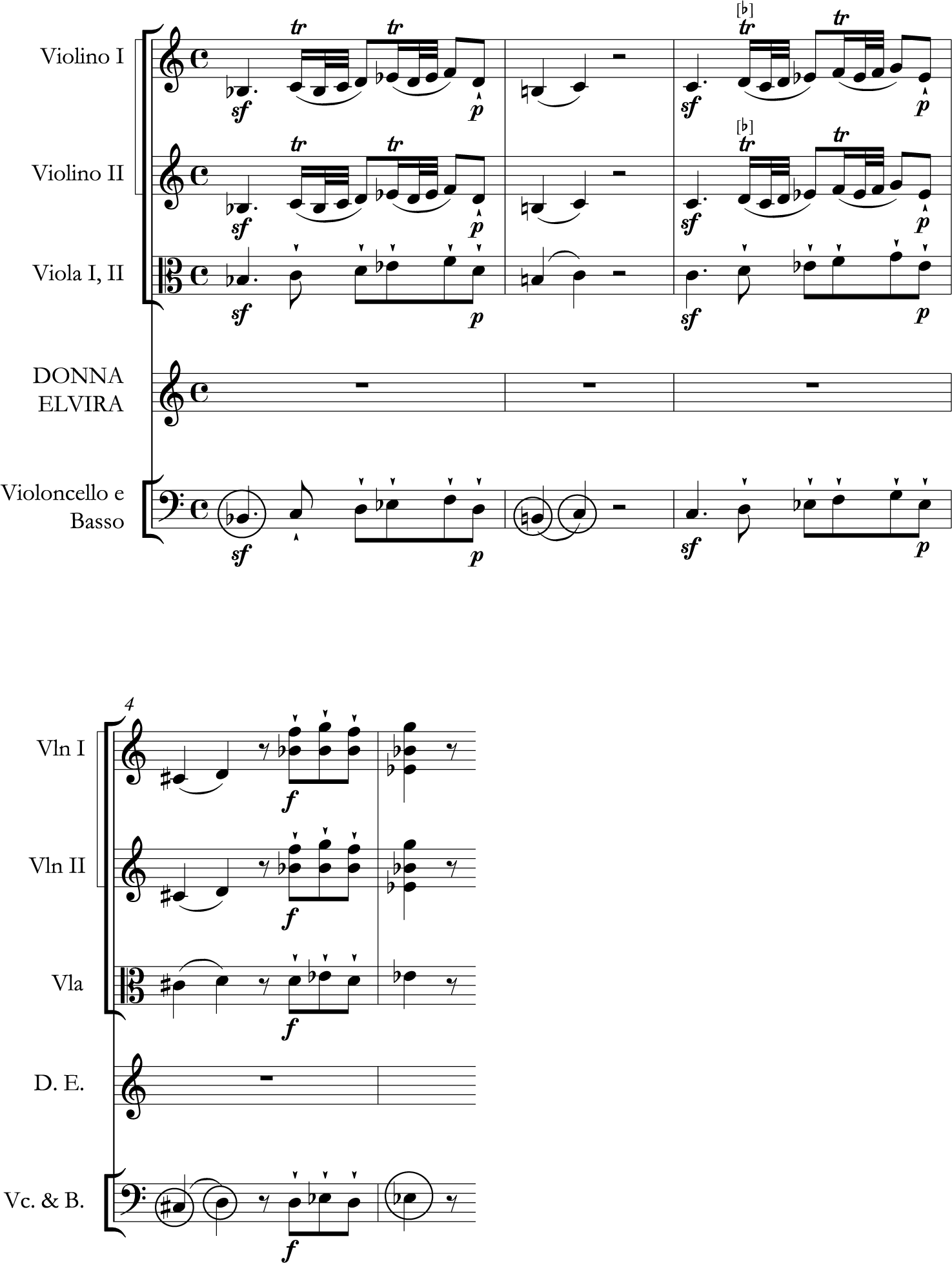

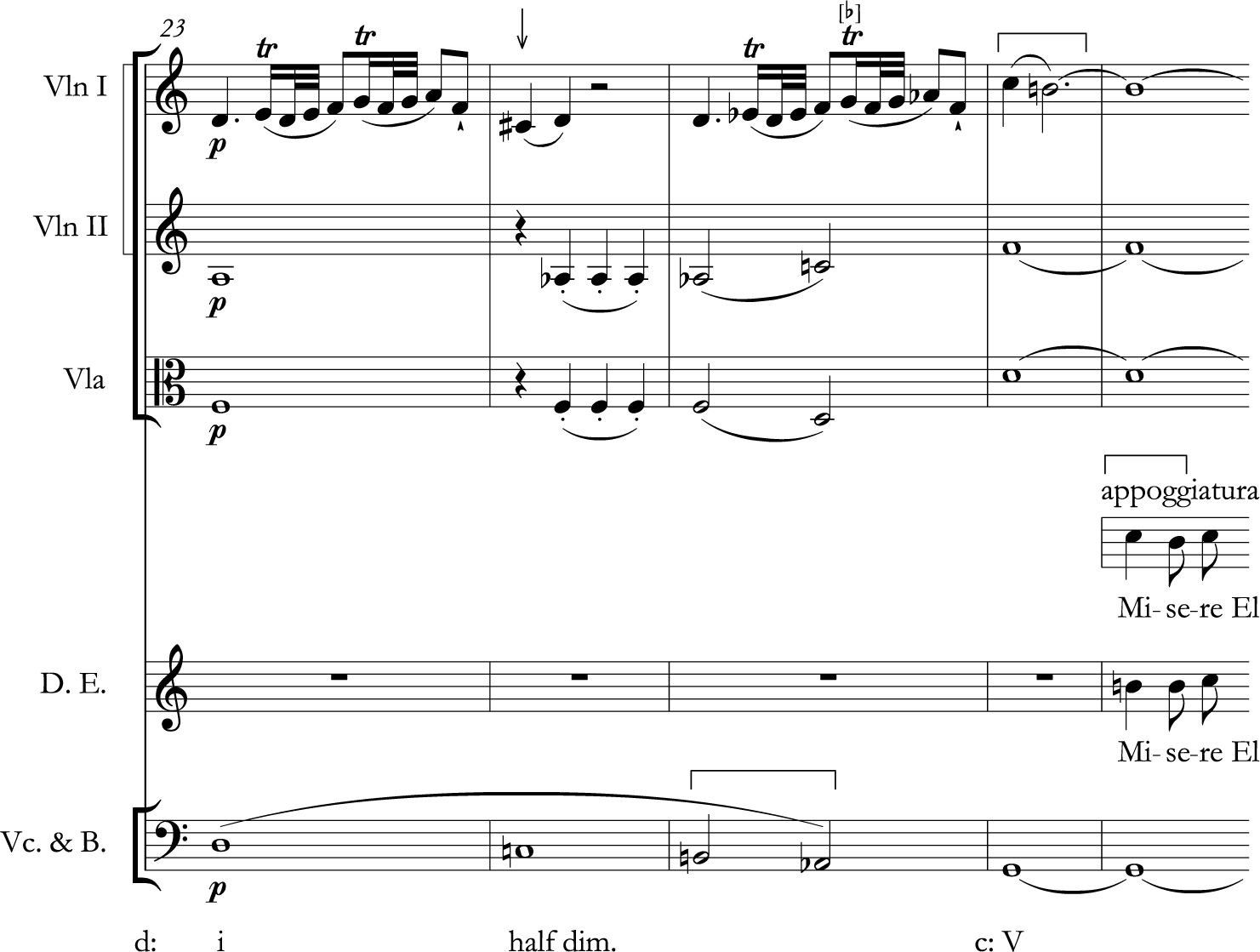


 Open access

