

1 Introduction
The “Great Divergence,” in which Western Europe industrially outpaced the rest of the world by the early 19th century, has puzzled scholars for centuries. Recent studies tracing its origins increasingly point to a deeper, underlying political divergence that may have begun much earlier (Cox, Reference Cox2017; Dincecco and Wang, Reference Dincecco and Wang2018; Stasavage, Reference Stasavage2020; Huang and Yang, Reference Huang and Yang2022; Fernández-Villaverde et al., Reference Fernández-Villaverde, Koyama, Lin and Sng2023; Chen, Wang, and Zhang, Reference Chen, Wang and Zhang2025). Central to this political divergence is the role of institutions, such as European parliaments. These parliaments limited the power of rulers through checks and balances, while the resulting credible commitments fostered political stability to a degree far greater than what was seen in many other parts of the world (Blaydes and Chaney, Reference Blaydes and Chaney2013).
We argue in this Element that an important parallel institutional development in East Asia was the Imperial Civil Service Examination System, hereafter referred to as Keju (科举). Keju served as a method of recruiting officials for the imperial government through a standardized written test on Confucian classics and literature – a test that was open to most males. Emerging sometime between 587 and 622 ce and lasting until 1905 ce, Keju was not only an outcome of political development but also a potential contributor to the political divergence that set the East and West on different historical paths. Crucially, Keju enabled Chinese monarchs to maintain political stability comparable to that of their European counterparts, without the need for concessions resembling parliamentary constraints (Figure 13 and Table 2).
1.1 Twin Arguments
This Element makes two arguments regarding the link between Keju and long-run political development.
Argument 1
Keju contributed to stability and the consolidation of absolutism by fulfilling a political function. By evaluating candidates based on exam performance rather than family background or social status, and with its inclusiveness toward most males, Keju expanded political access to a broader segment of the population and promoted upward mobility.
Borrowing terminologies from the “selectorate” theory in De Mesquita et al. (Reference Mesquita, Bueno, Smith, Siverson and Morrow2005), Keju essentially expanded the selectorate. By increasing the pool of eligible candidates for office, Keju rendered each member of the monarch’s “inner circle” more replaceable and, consequently, more reliant on the monarch (Huang and Yang, Reference Huang and Yang2022). We demonstrate with extensive evidence in the following sections that this political function withstood the test of time with a surprising level of resilience. The magnitude of aristocratic advantage continued to decline, and the level of social mobility within the broader elite continued to rise over time. Moreover, leveraging a cross-country panel dataset, we show that the Keju was associated with an increase in ruler stability that was comparable to the impact of parliaments in Europe.
Keju was “proto-meritocratic.” It had the aforementioned meritocratic tendencies, but the meritocracy was only “proto” because it primarily equalized opportunities within the broader elite, as many commoners were not wealthy enough to afford the books and time (away from agriculture) to prepare for the exams.Footnote 1 The term “proto” suggests a continuum, indicating that the system’s capacity to equalize opportunities could either increase or decrease. Sections 3 and 4 detail efforts made by rulers to maintain Keju’s equalizing potential. These efforts included ad hoc but consistently applied affirmative actions against the powerful families during the 9th century, the narrowing of the curriculum and the standardization of exam format, and the expansion of the school system over the second millennium.
Keju was also proto-meritocratic because the exams might not test people’s “true” competence. There was a considerable gap between what was being tested and the skills necessary for effective administration or statecraft. Candidates usually succeeded by writing highly formulaic and predictable answers within a predominantly Confucian framework. We clarify, however, in Section 5.2.4 that selection based on true competence is not a precondition for Argument 1 to hold. There could even be a potential trade-off between the equalizing dimension and the competence dimension of meritocracy: a hypothetically perfect device to identify “true” talents could quite possibly end up selecting the political know-hows, who would have predominantly come from families with officeholding traditions. History seems to suggest that, at times, the emperors were willing to sacrifice talent in favor of the equalizing effect.
Argument 2
However, it’s crucial not to conflate the “effect” of an institution with its “origins” (Pierson, Reference Pierson2004). The long-term political consequences of Keju could hardly have been foreseen by powerholders in the late 6th and early 7th centuries when the system first took shape. Even though one of Keju’s key political consequences was to enhance the ruler’s power vis-à-vis the upper elites, it is unlikely that the “designer” of Keju, if there was one to speak of, had this purpose in mind. And even if he did, Keju would not be able to achieve this goal until a century later. The Keju system, originating from gradual institutional change over the long durée since the 2nd-century ce, evolved in a context where events that now appear as “breakthroughs” were merely incremental steps at their time. The eventual development in 622 ce, which endowed the system with the potential to expand political access, emerged as a contingent response to urgent issues at the time, revealing a functional logic rather than a deliberate political strategy. Given the gradual nature of Keju’s development, its initial impact was minimal and difficult to discern, thus encountering little resistance. Over time, as its significance grew and in conjunction with unforeseen political developments, both the ruler and the elites came to view the institution as beneficial to their interests, thereby making Keju a self-enforcing institution. The emergence of Keju was a process, not a shock.
By treating Keju as both an outcome and a contributor to political development, and focusing on the positive feedback for the participants in the institution, our work borrows insights from the literature on historical institutionalism (Mahoney and Thelen, Reference Mahoney, Thelen, Mahoney and Thelen2009). This Element presents the evolution of bureaucratic selection in imperial China as an excellent example of gradual institutional change over the very long run, in which Keju itself had attained at least 1,200 years of prominence. This process saw changes take place incrementally as rulers and elites responded to unforeseen and exogenous events.
1.2 Keju versus Parliament
A new scholarship in historical political economy now distinguishes between an institution’s consequences from its origins, though much of this literature chiefly concerns with representative institutions. Recent studies demonstrate that the ruler-constraining and mass empowerment functions of modern parliaments differed from the purpose of their emergence, which was to collect information and assist governance for the ruler (Stasavage, Reference Stasavage2020; Boucoyannis, Reference Boucoyannis2021). Boucoyannis (Reference Boucoyannis2021), in particular, shows how national parliaments were initially judicial institutions employed by rulers to extend control over the population and territory. Its original purpose was not to constrain the crown, a completely opposite political function that only materialized much later. Similarly (and conversely), it was also unlikely that Keju was “invented” to undermine the aristocracy (Sections 2 and 3), a consequence that took almost a century to materialize.
Another similarity is that sufficient ruler strength is required for the consolidation of both institutions. In the European case, nobles initially resented the heavy burden of serving their judicial duties in the parliament for the ruler. The national parliament was successful in England because ruler strength there was the highest across European polities and enough to achieve “elite compellence” (Boucoyannis, Reference Boucoyannis2021). The Chinese emperor was even more powerful than the English monarch in the following sense. The upper elites in imperial Chinese history, for the most part, had to operate within a bureaucratic framework and derive their power, prestige, and, to some extent, wealth from bureaucratic performance, the ultimate evaluator of which was the ruler herself. It was in this context, as Section 3 documents, that the elites’ pursuit of their own political benefit furthered their alignment with the Keju. Despite the similarly contingent origins, European parliaments would eventually become ruler-constraining and facilitate credible commitment to underpin high state capacity (Dincecco, Reference Dincecco2017). In contrast, Keju’s long-term consequence was to further empower an already powerful monarchy, the absolutism of which eventually inhibited state development (Wang, Reference Wang2022).
1.3 Organization of the Element
We substantiate our arguments by analyzing a diverse array of quantitative data and qualitative evidence, drawing on both primary materials and secondary literature. As this research studies a historical institution, we organize the sections in a semi-chronological order. We start with Argument 2 in Sections 2 and 3 and end with Argument 1 in Section 5, while the second half of Section 3 and most of Section 4 substantiate both arguments.
To give readers unfamiliar with Chinese history a concise context before exploring the detailed analysis of long-term institutional evolution, we include the following brief historical overview of the Keju system.
1.4 Brief Historical Overview
Before the consolidation of Keju, China’s bureaucratic selection limited candidacy either formally or informally to a select few. The “Chaju” system, initiated in the 2nd-century bce, involved local officials nominating individuals for entry into the bureaucracy via examination. The Nine-Rank Rectifying System (NRRS), dominant from the 3rd to 5th centuries, categorized men into different grades based on their virtue and pedigree, with entry into the bureaucracy largely reserved for those with high grades.
Keju began to take shape during the Sui dynasty (581–618 ce) as an outgrowth of previous recruitment methods, still restricting participation to those nominated by government officials. However, in 622 ce during the Tang dynasty (618–907 ce), the exam was opened to most men and continued to mature throughout the 7th–9th centuries.
The Song dynasty (960–1279 ce) refined the system by institutionalizing multiple levels of exams and strictly enforcing regional quotas. Participation further broadened at the societal level with the state’s commitment to promoting broader education and advancements in printing technology. The Ming and Qing Dynasties (1368–1911 ce) further refined the Keju with more rigorous qualification exams and the widespread establishment of public schools to standardize preparation.
The system was abolished in 1905 as the Qing dynasty faced internal and external pressures, including modernization demands and Western colonialism.
2 The Origins
2.1 Motivation
The core of this Element begins in the year 622 ce, when a significant institutional change seemed to have happened to the Keju. By then, what would later be recognized as the Keju system had been in its nascent stage for approximately two to three decades, albeit participation in the examination was limited to individuals nominated by senior government officials. Now, with an imperial edict by Emperor Gaozu of the Tang dynasty (唐高祖), the examination had been made open to the majority of adult males. From the perspectives of social science grand narratives, this was a monumental development. It essentially represented a “selectorate expansion” (Huang and Yang, Reference Huang and Yang2022). By enlarging the pool of potential bureaucratic candidates, the ruler increased his leverage over the existing elite, making them more reliant upon him (De Mesquita et al., Reference Mesquita, Bueno, Smith, Siverson and Morrow2005). Relatedly, it’s also tempting to view this policy as a deliberate move to promote social mobility, a key contributor to political stability as theoretical work of authoritarian politics would have us believe (Leventoğlu, Reference Leventoğlu2005; Jia, Roland, and Xie, Reference Jia, Roland and Xie2023).
Intriguingly, what should have marked a paradigm shift in the politics of the then world’s largest empire largely escaped mention in its standard histories. The paramount texts for the political history of the Tang dynasty, where this pivotal change occurred, are the Old Book of Tang (《旧唐书》), New Book of Tang (《新唐书》), and Comprehensive Mirror in Aid of Governance (《资治通鉴》). These texts meticulously document many significant policy shifts of the dynasty, but this particular transition is conspicuously absent.Footnote 2
More intriguingly, not a single historical source from the Tang makes mention of resistance or even debate regarding this policy. This notable silence stands in stark contrast to the grand narratives presented in social sciences about the Keju. For instance, a recent publication, specifically attributing the Keju as the primary cause of the “Great Divergence” between China and the West, describes this reform as possessing a transformative potential that “few actions in human history can match” (Huang, Reference Huang2023, p.43).Footnote 3 The same book also posits that this shift in policy was a calculated move to “disrupt, weaken, and decimate the incumbent aristocratic class” (p. 41). If there were indeed a single class so powerful as to be “incumbent,” why didn’t its members resist, or at least voice some complaints, about this dramatic shock?
Of course, we should not automatically equate the lack of recorded activities, be it discussions, debates, or resistance, with the lack of activities. It’s possible that any resistance or dissent from the aristocrats was omitted or erased from the records. Another possibility is that the records from the Tang are simply scarce, given that the event of interest transpired over 1,400 years ago. Naturally, the farther back we look, the fewer records remain. However, both scenarios are unlikely. The chief compilers of neither Old Book of Tang nor New Book of Tang were “aristocrats” by Tang standards. If anything, they were emblematic of the new elite that emerged from the 10th century onwards through Keju, long after the influence of the Tang dynasty aristocracy had already waned (Lu, Reference Yang2016; Wen, Wang, and Hout, Reference Fangqi, Wang and Hout2024). The author of Comprehensive Mirror was in the same category. For the argument’s sake, suppose that the purpose of manipulating history here was to protect the reputation of the “villains” in this event, the Tang aristocrats. Then post-Tang new elites would be the last one to do so. Had there been any dissenting views voiced by the aristocrats in 622 ce, the chroniclers of Tang history would be the least likely to hide them in protection of the aristocrats’ reputation. Indeed, 11th-century writers, like the authors of Comprehensive Mirror and New Book of Tang, were actually quite keen on casting aristocrats in a negative light.Footnote 4 Equally importantly, critiques of Keju are actually quite prevalent across historical records covering the Tang, so it is also unlikely that the absence of recorded debate suggests that the later compilers, despite their ascension through this system, intended to deflect criticisms about Keju.
More generally speaking, the Chinese historiography is not at all shy of recording the details of policy change, or the vigorous controversies, debates, and objections that might follow suit. A casual reader of imperial Chinese history could immediately think of the Wang Anshi Reform (王安石变法) in the mid-11th century, the “Single Whip” Reform (一条鞭法), and the submersion of the poll tax within the land tax (摊丁入亩) in early 18th century, all of which met fierce resistance from the vested interests.Footnote 5 Even prior to the Tang dynasty, when historical records were scarcer, there are detailed discussions of reforms that challenged the established powerholders, such as the Monopoly over Salt and Iron in the late 2nd-century bce (Wagner, Reference Wagner2001) and the state-building reform in the late 5th century that laid the foundation for the country’s reunification later on (Chen, Wang, and Zhang, Reference Chen, Wang and Zhang2025).
The Tang dynasty where the selectorate expansion via Keju happened was an era of great transformation. Numerous policies instituting profound changes were enacted in the dynasty. Some of them, such as the “Two-Tax Reform” (两税法) of 780 ce and the reform of 819 ce that divided military authority in the provinces, have recently been subjects of quantitative political science research (Wang, Reference Wang2022; Chen and Wang, Reference Chen and Wang2024). The former, in particular, was highly controversial and intense debates and critiques have been well-documented in the records.Footnote 6 The latter, while itself not causing much controversy, was set in motion in a larger context where the Tang rulers became increasingly intolerant of rebellious military commissioners in the provinces (Chen and Wang, Reference Chen and Wang2024). Debates and conflicts between the “doves” and “hawks” toward the provinces were on full display from the historical records.Footnote 7
Given the depth of Chinese historiography on policy reforms, the silence on the 622 ce Keju change is revealing. Perhaps the most logical interpretation is that the resistance from the powerholders, in this case the aristocrats, was indeed negligible. The lack of opposition or even discussion is puzzling in hindsight. Both the evidence in Sections 3 and 4 and the works by others reviewed in this Element, including Huang (Reference Huang2023), suggest that Keju would go on to have a profound impact. However, from the eyes of the early 7th-century beholders, such as the Tang aristocrats and even the emperor himself, it might not appear as if anything transformative had happened. The imperial edict in 622 ce, as we argue, was simply an incremental step in the longue durée of gradual institutional change over the course of medieval Chinese history. Rather than a jolting change, it might well have been perceived as a continuation of past developments, thus not triggering vigorous discussion, let alone fierce opposition.
The rest of this section and Section 3 explain the origins and early development of Keju. This section documents the gradual institutional evolution of China’s bureaucratic selection system prior to the 7th century. Section 3 addresses the evolution of Keju in the second half of the 7th century, focusing on the rising importance of this institution under Empress Wu. It then employs both quantitative and qualitative evidence to show how Keju eventually became a self-reinforcing institution in which both the ruler and the elites saw benefits from participating. These sections integrate insights from historical institutionalism (e.g. Mahoney, Thelen et al., Reference Mahoney, Thelen, Mahoney and Thelen2009) to focus on institutional layering and positive feedback that made Keju eventually self-reinforcing. A key takeaway from this section is that institutional changes that are ex post transformative like the Keju should often be understood as a process, not a shock. This understanding is also in line with recent findings on the emergence of European parliaments (Boucoyannis, Reference Boucoyannis2021).
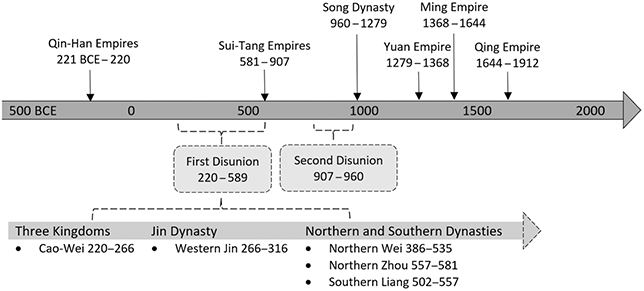
As this Element, especially in this section, extensively mentions numerous polities in Chinese history, Figure 1 presents a timeline featuring the relevant regimes.
Timeline of regimes studied in the Element
2.2 Gradual Institutional Change Over the Long Durée (The 2nd-Century bce to 622 ce)
We begin by examining the historical evolution of methods and institutions for bureaucratic selection prior to the Keju. The narrative focuses on two primary methods: one based on exams, though participation was limited to a select few; and the other based on pedigree, with those assessing pedigree also belonging to a privileged group. Chronologically, the latter method was layered on top of the former, although the exam-based approach was never completely crowded out. In the 6th century, however, there was a reversal of fortune between the two methods. The exam-based approach began to rise again, with the emergence of Keju viewed as an outgrowth of this revival.
Throughout this long durée of institutional change, it is undeniable that rulers were concerned about political selection coming under the control of a small group of privileged elites. However, our account emphasizes other, more functionalist factors, such as the need to reassert central government authority over localities and to recruit talent in the absence of reliable information. These factors were arguably more pivotal to the eventual emergence of Keju, which, in any case, was unlikely viewed by contemporaries as a transformative strategy by the ruler to undermine the aristocracy.
2.2.1 Han Dynasty (202 bce to 220 ce): Exam for the Nominated
Although exams were a defining feature of Keju, recruiting bureaucrats through examinations was not new in imperial China. In fact, the practice dates back to the Former Han dynasty (202 to 9 ce), the “time zero” of our historical explanation for the rise of Keju (Bielenstein, Reference Bielenstein1986). It was the first durable empire in Chinese history and employed a sizable bureaucracy (Zhao, Reference Zhao2015). The recruitment system for this bureaucracy was Chaju (察举制), which further matured in the Later Han dynasty (25–220 ce). Under this approach, imperial officials would identify individuals in possession of high morals or talent within their local jurisdictions and then nominate these individuals to sit for an examination in the capital. Upon successful completion of this test, the nominees would be recruited into the bureaucracy (Doran, Reference Doran, Denecke, Li and Tian2017).
In some aspects, exams were even more crucial for bureaucratic selection under the Chaju system during the Han than under the Keju system in the Tang. During the 7th–9th centuries, success in Keju exams only made an examinee a candidate for imperial bureaucracy, with actual appointments depending on a separate vetting process by the Ministry of Personnel (吏部), often leading to significant delays and challenges (Lai, Reference Lai2008).Footnote 8 In contrast, passing a Chaju exam more directly and swiftly led to official positions.
As emphasized earlier, the transformative aspect of Keju lies not in the use of exams per se but in the broader eligibility for exam participation. Under Chaju, exam takers were limited to a select few, as only those nominated by officials were allowed to participate. The predominant method of political selection from the 2nd-century bce to the 2nd-century ce could be described as “exam for the nominated.”
In Later Han, Chaju increasingly relied on the collective opinion of elite society in each locality to recruit new blood into the bureaucracy. Local notables in each prefecture held gatherings akin to social clubs, where they discussed and provided informal ratings for young men in their locality (Zhang, Reference Zhang2015). These ratings, though never standardized across elite societies in different prefectures, were broadly based on the men’s possession of morals and talents as perceived by the local elite.Footnote 9 As prefects in the Han took very seriously the opinion of the local elites (Brown and Xie, Reference Brown and Xie2015), the rise of an informal local “rating” system heavily influenced bureaucratic selection via the Chaju.
As the Han empire crumbled in the late 2nd century amidst civil wars, its successors faced a deeply flawed Chaju system. Functionally, the system struggled as wars and upheaval dispersed local elites, disrupting the collective assessments crucial for individual ratings. Politically, the new rulers viewed the system’s reliance on local elite opinion for appointments as a threat, fearing it could lead to state capture by localist interests.
2.2.2 The 3rd to 5th Centuries ce: Nine-Rank Rectifying System
This subsection explains the rise of another recruitment institution that was originally designed to resolve the flaws of the examination-based Chaju system. Its core mechanics, however, soon rendered the new institution equally (if not more) prone to state capture by the politically and socially privileged few.
By the early 3rd century, the fragmented warlord territories in northern China were progressively unified under the leadership of Cao Cao (曹操). Cao sought to remedy the functional and political shortcomings of the Later Han Chaju, while still incorporating the more recent development of individual rating practices. The resultant “Nine-Rank Rectifying System” (九品中正制, hereafter NRRS) was initially an effort to address both challenges. Acknowledging the absence of a stable elite society due to the civil wars and mass migrations, Cao strategically appointed members from the most prominent clans of each region to identify and recruit local talents for his government. This approach was based on the belief that these prominent clans were more resilient and retained their influence despite the turmoil of war and disasters, and, as a result, they would remain as the best “know-how” and “know-who”s in the region and could offer valuable information for bureaucratic selection (Zhang, Reference Zhang2015). Politically, the prestigious elites appointed for such roles were, by definition, Cao’s own government officials. This way, Cao made sure that those in charge of assessing and recruiting local talents shared with him the same political vision.Footnote 10
A historian writing in the late 5th-century ce considered Cao’s invention to be just an “ad hoc” (权立) solution.Footnote 11 Yet, toward the end of Cao’s reign, this assessment method had become formalized into a system where male individuals from each locality would expect an assessment of his quality from the government (Zhang, Reference Zhang2015). It was his son Cao Pi (曹丕), the founder of the “Cao-Wei” dynasty, who fully institutionalized this new method of bureaucratic selection around 220 ce (Ebrey, Reference Ebrey1978).
A simplified description of the NRRS is as follows. Each locality had a “rectifier” (中正) responsible for evaluating the “quality” of local men. Every three years, rectifiers would assign a grade from one to nine (hence the phrase “nine-rank” in the name of the system) to each educated male, with higher grades indicating superior quality. These assessments were then forwarded to a higher-level government organ for approval (e.g. Ebrey, Reference Ebrey1978; Zhang, Reference Zhang2015).
When applying for government positions, individuals were assigned entry-level roles by the Ministry of Personnel based on their most recent quality grades. These entry-level positions varied significantly in office rank, importance, and prestige. Generally, individuals with higher quality grades received more prestigious entry-level positions with higher office ranks. Starting from these positions often led to advancement to senior roles in the national bureaucracy, reaching the pinnacle of political power. Notably, these quality grades influenced not only initial bureaucratic placements but also the peak positions attainable in one’s career. Individuals with higher quality grades faced no “cap” on their career advancement, whereas those with lower grades were typically confined to lower bureaucratic levels for life.
Initially, the NRRS seemed to be a highly centralized system (Tang, Reference Tang2010; Zhang, Reference Zhang2015). A rectifier’s appointment must satisfy two eligibility conditions. One is that the appointee must originate from the locality in question. The other is that the person holding the rectifier position must be a central government official holding the post concurrently. The second requirement thus built upon Cao Cao’s practice of having government officials, rather than local elites outside the political system, make evaluations of men’s quality.Footnote 12
However, the NRRS soon fell under the control of local “aristocrats,” a term commonly referring to prestigious and wealthy landed families (such as the prominent clans mentioned earlier) from the 3rd to 6th centuries (Ebrey, Reference Ebrey1978). Typically, those selected as local rectifiers belonged to these families, as they held the cultural and moral high ground and possessed unparalleled knowledge about their locality. As one could expect, these aristocrats often assigned high grades to their own kind in the locality, who then entered civil service through prestigious and advantageous posts, conducive to further career advancement. Once these individuals secured influential positions in the bureaucracy, capable of impacting the appointment of rectifiers, they tended to favor their own kind for such roles. This practice perpetuated a cycle of intergenerational aristocratic advantage in officeholding (e.g. Miyazaki, Reference Miyazaki1977; Tang, Reference Tang2010; Zhang, Reference Zhang2015).
2.2.3 The 6th-Century ce: Decline of the NRRS and the Revival of the Examination Method
This subsection documents the decline of the NRRS and the corresponding revival of exams as a recruitment method. It emphasizes that the Chaju system was never abandoned but simply became less prominent. The rise of NRRS as part of China’s recruitment system should thus be seen as institutional layering (Mahoney, Thelen et al., Reference Mahoney, Thelen, Mahoney and Thelen2009). When different polities in the 6th century gradually downplayed or even repurposed the NRRS, we see that the examination method became prominent again, and the eventual emergence of Keju is arguably an outgrowth of this trend of revival.
There are two prevalent misconceptions in recent social science works on early Keju. The first is that examinations were “discontinued” from the 3rd to 6th centuries as the NRRS “arose to replace” the Chaju (Huang, Reference Huang2023, pp. 32–33). The second misconception, reflected in the likes of Chen, Fan, and Huang (Reference Chen, Fan and Huang2023), is that the NRRS remained the dominant method of bureaucratic recruitment until the exogenous introduction of Keju. However, these assertions are in fact fundamental misunderstandings.
Examinations were never discontinued as a recruitment method between the 3rd and 6th centuries. What happened was akin to institutional layering (Mahoney, Thelen et al., Reference Mahoney, Thelen, Mahoney and Thelen2009). Just as in the Han dynasty, those individuals nominated by local officials, once passing the exam, could still begin their careers in the bureaucracy swiftly.Footnote 13 Chaju did take a back seat from the 3rd to 5th centuries, when the majority of elites who would eventually secure ranked positions in the bureaucracy entered the civil service through the NRRS route. In contrast, those who entered via the Chaju typically secured less prestigious entry-level positions and consequently had limited career progression. Individuals opting for the Chaju route often came from relatively modest backgrounds (Zhang, Reference Zhang2015). However, starting from the late 5th century, the situation began to shift significantly in both north and south.
Northern Wei (386–535 ce): The NRRS Declined While Chaju Became Prominent Again
The Cao–Wei regime in the north was later toppled by the House of Sima, leading to the brief Western Jin dynasty (266–316 ce), which conquered the south but soon fell apart due to internal strife and pressures from the so-called barbarian groups who originated beyond the imperial frontiers. In the ensuing chaos, a Sima prince founded the Eastern Jin dynasty (317–420 ce) in today’s Nanjing, controlling the empire’s southern half. This period transitioned into the Southern Dynasties era (420–589 ce), marked by successive regimes in the south.
Meanwhile, numerous warring kingdoms in northern China, founded in the aftermath of Western Jin’s collapse, struggled to exert control over rural areas, which had become turfs of the powerful local aristocrats. In the late 4th century, nomadic warriors from the steppes established the Northern Wei dynasty (386–535 ce) under the House of Tuoba, soon conquering other northern kingdoms. A major reform in 485–486 ce allowed Northern Wei to impose direct rule over the countryside. To compensate for the aristocrats’ loss of local autonomy, the regime integrated them into the national bureaucracy, converting them from local powerholders into stakeholders of the imperial state (Chen, Wang, and Zhang, Reference Chen, Wang and Zhang2025).
Revival of Chaju was key to the recruitment of local aristocrats. From the late 5th century onward, the number of elites who entered civil service through Chaju dramatically increased. Unlike prior regimes and southern dynasties, where Chaju was left to those of lower birth, in the Northern Wei dynasty, aristocrats eagerly participated in Chaju (Yan, Reference Yan2021). Perhaps the most remarkable change was the rapid rise of Chaju as a predictor of career success. According to Yan (Reference Yan2021), among the fifty-five elites who entered the civil service through the xiucai examination (a category of Chaju for which we have the most comprehensive data), a significant 82.1% achieved ranks above Rank Five Junior.Footnote 14 Furthermore, an impressive 52.3% reached positions above Rank Three Junior, a threshold distinguishing senior government roles.Footnote 15
Yan (Reference Yan2021) also collects data for imperial and national academy students in Northern Wei. The academy system had been part of the broader Chaju institution since the Han dynasty, where students who studied in imperially sanctioned venues in the national capital could enter civil service upon passing an exam. When the Northern Wei regime revived the Chaju, it boosted the academy system as well. Among the forty-seven students for whom the data were available, a stunning 96% attained positions above Rank Five Junior, and 61.9% surpassed the Rank Three Junior threshold. Northern Wei, the regime that laid the foundation for the unified Sui and Tang empires where Keju took shape (e.g. Huang, Reference Huang1996; Yan, Reference Yan2017), witnessed the resurgence of the examination method as a prevalent and the most elitist route to the bureaucracy.
Meanwhile, the Northern Wei regime undermined the primacy of the NRRS in various ways. The first is its underutilization. Recall that, via the Reform of 485–486 ce, the regime imposed direct rule over areas that local aristocrats once enjoyed autonomy. As a part of the political deal, the Northern Wei rulers disproportionately recruited aristocrats from these areas into the upper echelon of the imperial bureaucracy. This was a crucial episode of Chinese history in which rulers substantially increased state penetration at the local level via a “compensation” package that transformed the erstwhile local powerholders into national stakeholders (Chen, Wang, and Zhang, Reference Chen, Wang and Zhang2025). These compensated aristocrats became more likely, during and after the Reform, to take a variety of important, prestigious, and powerful offices at both national and regional levels, even including ones that could constrain the rulers’ own power (Chen, Wang, and Zhang, Reference Chen, Wang and Zhang2025). One may naturally expect that the rectifier positions central to the NRRS would also be used by rulers in this master stroke of political maneuvering, but it was not the case at all.Footnote 16
Besides its diminishing role as a political tool, the prestige of the NRRS also appeared to erode during the Northern Wei period. Notably, the Tuoba emperors began appointing two groups of men from humble backgrounds to rectifier positions. The first group comprised individuals who, in the eyes of the elite society, had apparently fabricated their aristocratic identities.Footnote 17 The second group consisted of eunuchs (Yan, Reference Yan2021). This shift was particularly striking, considering that, traditionally, rectifier positions were exclusive to elites with distinguished family pedigrees. Yet now, it appears that even those considered the most despised in Chinese history could become rectifiers!
Northern Zhou (557–581 ce): The NRRS Became Largely Ceremonial
It was under Northern Zhou that the NRRS became completely sidelined. Zhou was a new regime in northwestern China that arose from the division of Northern Wei in 534 ce under the House of Yuwen. By 579 ce, the Yuwens had unified much of northern China and laid critical political groundwork for the subsequent centuries under the Sui and Tang Dynasties, with the Sui established in 581 ce via a palace coup.
Critically, the emerging consensus in historical research suggests that Northern Zhou rulers completely repurposed the NRRS to a ceremonial system, with rectifiers serving in decorative roles rather than their former bureaucratic recruitment function. The examination method via Chaju continued to rise until it blossomed into Keju in the early 7th century.Footnote 18 Contrary to the aforementioned misunderstandings, Keju did not “replace” the NRRS. There was a significant hiatus between the founding of Northern Zhou and 605–607 ce (discussed next) when Keju was allegedly introduced, during which the NRRS was already marginalized and Chaju was in full use. The emergence of Keju therefore followed a much more gradual process than a “replacement.”
Parallel to the institutional evolution in the north was a similar process in the south, where the rulers fostered “selectorate expansion” by making a qualification exam for entering the bureaucracy open to most adult males in 509 ce. This development was also built on the gradual revival of examination via Chaju even though the NRRS in the south remained vital unlike in Northern Zhou (Yan, Reference Yan2021). It should now become even clearer that selectorate expansion through examination could and did evolve from Chaju’s revival and that it did not occur as a replacement of the NRRS.
2.2.4 Keju in 605–607 and 622 ce
This subsection explores the early development of the Keju system, highlighting how it was more a continuation of gradual institutional changes rather than a revolutionary shift. Keju in the early Tang era carried the legacy of nomination and recommendation from the Chaju system, and was in fact an outgrowth of Chaju. It thus remained limited as a recruitment tool. This gradual evolution suggests that the modest changes in 622 ce were unlikely to have been seen as transformative in the eyes of the beholders.
The institution later known as the Keju formally began in the early 7th century. However, pinpointing the exact year of its inception has been a subject of intense debate among historians. This debate primarily revolves around multiple proposed dates. Dominant among these are the perspectives of the “pro-Sui camp” and the “pro-Tang camp.” The pro-Tang camp’s rationale is straightforward: They argue that the Keju, known for offering individuals from modest backgrounds a chance to compete, could only have started when examinees were allowed to participate through self-nomination. In their view, Keju began when it was no longer the Chaju, examination for those nominated by government officials. For them, Keju began when it “expanded” in 622 ce, under the Tang dynasty, for the exact reason discussed in the beginning of this section.Footnote 19 On the other hand, the pro-Sui camp suggests two possibilities: 587 and 605–607 ce, with the latter receiving more emphasis.Footnote 20 In 605–607 ce, the examination category known as Jinshi (进士科) was introduced.Footnote 21 By the late imperial China (14th to 19th centuries), Jinshi had become synonymous with the highest and final degree of the Keju examination.
The very existence of this debate itself is important for social scientists interested in institutions. It suggests that significant institutions like the Keju often do not emerge as sudden, transformative shocks with immediate impact. If the Keju had been such a pivotal institution effecting immediate change upon its inception, then its founding year, and specifically what kind of institutional changes should really constitute as the inception of Keju, would likely not be as disputed. By examining these years chronologically, we demonstrate that neither marked a significant change at their respective times. Rather, the developments in these early years of the 7th century were simply a continuation of the long history of gradual institutional change that began in the Han dynasty and continued until the end of the 6th century, as documented earlier.
Between 605 and 607 ce, Emperor Yang of the Sui dynasty (隋炀帝) promulgated a series of edicts that some modern historians cite as marking the inception of Keju.Footnote 22 A detailed examination of these edicts reveals that this so-called inception was more a continuation of an existing trend rather than a new beginning.Footnote 23 In 605 ce, Emperor Yang decreed that officials should “identify and recruit talent based on their abilities” within their respective jurisdictions. This decree also included a provision for talented individuals who chose not to join the bureaucracy, stipulating that such individuals should still receive a state salary “proportional to their abilities and their family pedigree.”Footnote 24 In 607 ce, the emperor issued another edict, part of which simply said: “Those who hold government positions at Rank Five or above should nominate people to participate in one of the ten categories of the imperial examination.”Footnote 25 Taken together, these two edicts do not reveal any significant departure from the Chaju tradition since the Han dynasty. The eligibility for the imperial examination continued to be limited to individuals nominated by government officials. Thus, the Imperial Examination System of the Sui dynasty appears as a natural progression of the Chaju system. This evolution should be viewed in the context of the revival of Chaju and the decline of the NRRS over Northern Wei and Northern Zhou, the predecessors of Sui regime. In short, the institutions “created” in 605–607 ce were, just as Chaju was, exam for the nominated. The 607 edict is of particular importance because there seems to be a technical connection between this edict and the one in 622 ce marking the selectorate expansion, which we address next.
In 622 ce, as previously mentioned, Emperor Gaozu of Tang issued an edict expanding the Keju system. The provisions regarding imperial examinations in this edict closely resembled those from the 607 ce edict, with both requiring officials of “Rank Five” and above to nominate talented individuals.Footnote 26 The edict of 622 ce, however, included a minor addition at the end: “those talents not nominated by these officials should self-nominate to participate (in the exams).”Footnote 27
There are several reasons to doubt that the developments in 622 ce would have been perceived as revolutionary at the time. First, these developments were a direct continuation of the preceding institutional changes, particularly the revival of recruitment through examinations and the decline of NRRS. Second, the 622 edict essentially built upon its 607 predecessor, with the addition of self-nomination – a discernible yet minor refinement – appearing only at the end of the provision regarding the imperial examination.
One way to appreciate the minimal nature of this step is by examining the composition of top officials in the Tang dynasty. During the reigns of the first two emperors, when this selectorate expansion occurred, fewer than 22% of chief ministers entered the bureaucracy initially through Keju. Among these six chief ministers, five had prestigious family background, with only one being a complete outsider to the system.Footnote 28 Data from Tang dynasty epitaphs, representing a broader elite spectrum, paints a similar picture (Wen, Wang, and Hout, Reference Fangqi, Wang and Hout2024). Among the elites who passed away before 649 (the end of the second Tang emperor’s reign), only 3.8% held a Keju credential. Throughout the 7th century, merely 8% of new recruits into the bureaucracy had Keju credentials. In short, statistics from both the highest echelons of political power and the broader elite society reveal that Keju’s role in early Tang politics was not only quite limited as a tool for general recruitment, but it also predominantly functioned as a pathway for the powerful few to attain office, even following the expansion in 622.
These figures should not be surprising to those familiar with early Tang history, where the nascent examination system continued the legacy of nomination, and the political selection process still mirrored the entrenched interests of the incumbent elite. A notable instance is the case of Zhang Chujin (张楚金), who was selected by his local government to take the imperial exam in the capital, over his brother. Zhang offered to relinquish this opportunity, arguing to the local authorities that his brother was more talented. This act caught the attention of Xu Shiji (徐世绩), a regional superintendent and high-ranking government official, who intervened to have both brothers nominated for the exam. Xu, a distinguished founding elite of the Tang dynasty and a close ally of the first two emperors, had earned the privilege of adopting the imperial surname “Li.” The Zhang brothers were related to another high-ranking founding elite, once a colleague of Xu in the central government.
While Tang historical records depict this episode as demonstrating Zhang’s talent and humility, and Xu’s knack for recognizing true talent, it also unwittingly reveals how patronage and privilege could manipulate the system. Notably, the record ends with the phrase “he nominated both to pass the final exam” (emphasis added).Footnote 29 This implies that, from the perspective of Tang contemporaries, Xu’s intervention was seen as ensuring their success in the final stage of the exam, not just their chance to participate. More significantly, this episode highlights that despite the 622 Keju expansion allowing for self-nomination, the long-standing tradition of Chaju, particularly nominations by government officials, continued to play a pivotal role in the examination system.
To sum up, by documenting the abundant primary and secondary evidence, this subsection demonstrates that the beginning of Keju was very much a continuation of gradual institutional change over the long durée. The legacy of prior institutions, especially the Chaju system, still loomed large in the early years of Keju. Furthermore, in the early Tang era, Keju’s role was quite constrained both in and of itself as a recruitment institution and as a political tool to expand the selectorate. Its limited use appeared to be practically (though not legally) restricted to those with patronage and power. Consequently, it seems highly improbable that the modest adjustment in 622 ce (and even less so in 605 or 607 ce) was regarded as a groundbreaking change by the “aristocrats,” however they are defined.Footnote 30 Instead, the bulk of evidence points toward a “business as usual” sentiment prevailing among the elite of that era.
2.2.5 Keju as Ad Hoc Solution
While it’s challenging to ascertain the emperor’s exact intentions behind the 622 Keju expansion, attributing it solely to an effort to undermine the aristocracy overlooks a more plausible functionalist explanation that is well aligned with critical political developments preceding the Tang. A notable trend was the administrative and political centralization initiated during the Northern Zhou period and pursued vigorously by the Sui. This legacy of centralization was inherited by the Tang and would persist throughout the subsequent history of imperial China for over a millennium. It’s beyond the scope of this work to elaborate on these policies in detail, but the essence of the most pivotal one was that, previously, prefects had the autonomy to appoint their own staff, typically drawn from local elites, for their prefecture governments. Now, the central government appointed virtually all officials within the prefecture government. This shift was viewed as a transformational strategy that significantly redirected power from local governments and local elites toward the central government (e.g. Ebrey, Reference Ebrey1978; Jin, Reference Jin2015). However, this change undoubtedly placed a burden on the central government to devise mechanisms for official selection, as officials even at the very local level now required direct appointment from the center.Footnote 31 Keju, though still in its early stages, emerged as one of the centralized responses to this need for centralized recruitment.Footnote 32
Another significant trend is the migration of local aristocrats to the imperial capitals, a phenomenon referred to as the “centralization of the aristocracy.” This movement began in the late 5th century (Chen, Wang, and Zhang, Reference Chen, Wang and Zhang2025), intensified during the 6th century (Ebrey, Reference Ebrey1978), and by the 8th century, most Chinese aristocrats had severed ties with their original hometowns (Tackett, Reference Tackett2020). Such developments challenge the notion that the emergence of Keju, particularly as a substitute for the NRRS, aimed to undermine the “aristocracy.” To the extent that the NRRS and Chaju benefited the aristocrats, it’s because both systems were locally organized in a way that particularly put aristocrats into the formal (as in NRRS) or informal (as in Chaju) position to favorably grade (as in NRRS) or nominate (as in Chaju) their own kind from the same locality for political office. Their relevance for the reproduction of political power by the aristocrats (allegedly for generations) now diminished as aristocrats became less localized. Consequently, the discontinuation of the NRRS (and similarly, Chaju) arguably did not significantly weaken aristocratic influence as much as some grand narratives suggest. In fact, the centralized nature of Keju, in this very sense, could be seen as beneficial to the aristocrats, now increasingly centralized in residence. Candidates from the capital enjoyed numerous advantages in the Keju (Fu, Reference Xuancong2020).Footnote 33 The decline of the NRRS, once beneficial to local powerholders, occurred as aristocrats shifted from local powerholders to centralized elites. This transition, coupled with the rise of Keju that would favor centralized elites, suggests that Keju’s introduction was unlikely to undermine the aristocracy. This is not to say that Keju would not facilitate social mobility, which it did in the Tang (Section 3). Our argument is simply that the rationale for it was unlikely anti-aristocratic in as early as 605 or 622 ce.
The particular “breakthrough” in 622 likely reveals a functionalist logic as well. The Tang dynasty was founded in 618 as a series of peasant and elite rebellions destroyed the Sui empire. It was initially a regime based in Chang’an (长安) and its surrounding regions, but later reconquered the rest of China, then dominated by numerous rebellion leaders fighting with one another. There is abundant evidence that elites (outside the Guanlong “northwestern” regions) in the early years of the dynasty were uninterested in politics, perceived as unstable, chaotic, and dangerous.Footnote 34 The aforementioned centralization efforts of the Tang’s predecessor regimes had already posed recruitment challenges for the Ministry of Personnel. Thus, the Tang faced particularly significant difficulties in political selection, especially given the urgent need to staff the new government amidst widespread chaos and uncertainty. Coupled with the unprecedented need for local talents was the lack of information allowing the rulers to identify them. The centralization of aristocrats and a century of elite migration amidst waves of wars and upheavals in the 6th century had only worsened the information gap. At one point, the founding emperor was so desperate that he even reinstated the NRRS in 624 ce so that “an aristocrat in each locality would be a rectifier to evaluate people’s quality.”Footnote 35 Yet, precisely because the aristocrats were no longer in their ancestral homes (“choronyms”), this initiative faltered and was quickly discontinued (Jin, Reference Jin2015, p.38). It seemed only natural that amid the desperate need for talents and the severe lack of information to identify them, the edict in 622 would allow individuals to self-nominate. The method of examination, from an informational perspective, was now also more important than ever.
To sum up, via detailed analysis of primary materials and secondary literature, we have highlighted the rise of Keju as a continuation of the gradual institutional change in early and medieval China over the long durée. The eventual breakthrough, the political effect of which could only manifest itself ex post (Sections 3 and 4), was most likely an ad hoc technical solution to new challenges in bureaucratic recruitment. The mechanism of institutional change in our account is similar to “layering” in historical institutionalism (e.g. Mahoney, Thelen et al., Reference Mahoney, Thelen, Mahoney and Thelen2009). The initial policies that scholars would later attribute the Keju to could be best understood as new layers added to the Chaju system whose evolution had a reversal of fortune vis-à-vis the NRRS.
Our account also contributes to the theory of bureaucracy as a solution to address informational asymmetries between the ruler and the ruled (Stasavage, Reference Stasavage2020). The bureaucratic solution would not be feasible if the initial level of information gap is prohibitively high: To recruit bureaucrats who would sustain the bureaucracy, one needs some information about local talents to begin with. In contexts where such knowledge was severely lacking, Keju arose as a solution.
Keju in 622 ce as Magna Carta in Reverse?
The Keju breakthrough in 622 ce, in our analysis, can be viewed as a Magna Carta moment in Chinese history, albeit in reverse. Like the royal Charter of 1215 ce, the edict issued by Emperor Gaozu had a profound impact on the balance of power between the ruler and the upper elites; however, in the Chinese case, the balance tilted in favor of the ruler rather than the nobles, as in the English context. The more significant similarity between these two moments is that the transformative nature of each could not have been envisaged by contemporaries. In England, it was subsequent political developments later in the century – such as “Henry III’s minority, his foreign ambitions, his lack of funds, and the general unpopularity of his government” – that eventually elevated the Charter’s importance in politics and the future institutionalization of parliament (Maddicott, Reference Maddicott2015, p.24). Similarly, this section discusses how regime changes, rulers’ centralization efforts, drastic civil wars, and elite migrations induced the emergence of Keju as a contingent solution. The next section details additional forces at play in the following three centuries that retrospectively make 622 ce appear eventful in a reverse Whiggish manner.
2.2.6 An Existing Study
Before moving on, we address an existing economics study that attempts to use 605 ce as the “treatment” year for the emergence of Keju (Chen, Fan, and Huang, Reference Chen, Fan and Huang2023). The paper analyzes a limited set of biographies from Chinese dynastic histories spanning from 265 to 1644 ce. Its core finding is that after 605 ce, bureaucrats who last served as local administrators were more likely to be purged than those who last served in central ministries. The authors use this result to argue that Keju undermined the aristocracy. Our critique underscores a key point: Keju did not emerge as a sudden shock but rather as a gradual process, evolving alongside various other developments over an extended period.
We outline four major flaws in the study, with a detailed analysis provided in the Online Appendix. First, the authors misreported the timing of the treatment. They cite Miyazaki (Reference Miyazaki1981) to support 605 ce, despite this source clearly stating that Keju began in 587 ce, with no mention of 605 ce in its timeline of institutional changes. Notably, 587 ce falls just before the treatment decade in the authors’ event study. Second, as discussed in Section 2.2.4, any form of Keju before 622 ce still limited candidacy to those nominated by incumbent elites, likely reinforcing rather than undermining aristocratic dominance. Third, the authors’ operationalization of aristocracy is highly unconventional, equating local (central) administrators with “commoners” (“aristocrats”), a view not supported by the historical sources they cite.Footnote 36 Lastly, as detailed in the Online Appendix, numerous events and political changes in the decade following 605 ce likely altered the fortunes of both nobility and commoners, further confounding the study’s results, but the authors did not disclose these well-known historical facts.
Our critique highlights the gradual nature of Keju’s emergence, making it impossible to pinpoint a singular “treatment” effect. Historians have identified at least ten different eras for the emergence of Keju (Liu, Reference Liu2000). These ambiguities and controversies arise because Keju evolved gradually as an outgrowth of earlier institutions, rather than emerging as a significant, singular event.
3 Early Development
This section explains how Keju gradually became the dominant pathway to power despite its minimal and ad hoc beginnings. First, it uses qualitative evidence to show how the aristocrats failed to recognize that Keju would eventually promote social mobility, leading to their lack of collective resistance. Specifically, Keju’s rise was so gradual that the “signal” of this development was hard to discern from the various noises of politics. Next, it quantitatively confirms the gradual increase in the importance of Keju, establishing that it had indeed become significant over time. Finally, it explores the institution’s positive feedback (Mahoney, Thelen et al., Reference Mahoney, Thelen, Mahoney and Thelen2009), in which both rulers and the broader elite came to see Keju as beneficial. The rulers gradually realized that Keju had the potential to equalize political opportunities and expand the selectorate, while specific political developments in the latter half of the Tang made Keju more central to career success for the elites.
3.1 Signal versus Noise: What Happened under Empress Wu?
Thus far, we have demonstrated that Keju emerged from a gradual institutional evolution spanning four hundred years. This period witnessed the initial decline and subsequent revival of examinations in bureaucratic recruitment. To the contemporaneous elites, its “inception” – if there was one to speak of – would likely have been perceived not as a revolutionary break, but as a continuation of an ongoing process. However, there is no denying that by the end of the Tang, Keju had become a game changer. By the mid-7th century, less than 22% of the Tang chief ministers entered the bureaucracy through Keju, but this proportion increased to a stunning 85% for chief ministers in the 9th century. Furthermore, only 3.8% of the male elites had examination credentials by the mid-7th century, but the number increased to 17.6% for male elites in the 9th century.Footnote 37
Given its modest beginnings, what explains Keju’s rise over the next three hundred years? A popular theory credits Empress Wu (武则天) in the late 7th century. As the only female monarch in a Confucian society, she faced strong opposition from the aristocracy and is thought to have promoted Keju to weaken their influence by introducing new talent into the bureaucracy. This idea, proposed by historian Chen Yinke in the 1940s, has faced significant criticism over the years but has recently been revisited by social scientists like Huang (Reference Huang2023), who argue that Keju strengthened autocratic rule.Footnote 38
While several changes under Empress Wu could have elevated Keju – such as allowing more people to pass exams, holding exams more frequently, and shifting the exam focus toward literature – there was no significant aristocratic dissent recorded, making this narrative difficult to substantiate. This lack of resistance returns us to our initial puzzle: Why did the aristocracy not resist more? In what follows, we explore this question through a thought experiment.
Unlike the minimal changes in 622 ce, the shifts in Keju during Empress Wu’s reign may have been significant enough to be noticed. However, political selection is a noisy process, and for the powerholders to react, the signal of what these changes meant for political power needed to be clear. In Tang politics, a clear signal would have been the rising importance of Keju in appointing chief ministers, but it’s possible that the powerholders struggled to distinguish signal from noise.
Among the 105 individuals who served as chief minister during Empress Wu’s era (649–705 ce), 32.11% began their bureaucratic careers through Keju.Footnote 39 This percentage represents a 50% increase from the era of the dynasty’s first two emperors (618–649 ce), a rise that could have been noticeable at the time. The key question, however, is whether these Keju-credentialed chief ministers became chief ministers because of Keju. This question is not one of “causal identification” in the pedantic sense. It is simply whether the incumbent powerholders at the time intuitively perceived that success in Keju, a competition with a relatively level playing field even for their own children, was becoming increasingly important for officeholding.Footnote 40 The answer is: unlikely.
When someone ascends to a top bureaucratic position after decades of service, many of his traits would have been observed, with passing a written exam decades earlier being just one of them. In this thought experiment, we suggest that discerning the rise of Keju as a key factor in appointing a chief minister, amidst other “confounding” factors, would be challenging for a powerholder. Take the example of Di Renjie (狄仁杰), whose administrative competence and moral integrity were widely praised by contemporaries. During his term in the Ministry of Justice, he reportedly resolved 17,000 backlogged cases in one year without any complaints of injustice. He also saved an official from wrongful execution, even daring to openly confront the Emperor Gaozong for this cause. The Emperor later rewarded him for his courage and integrity.Footnote 41 It seems unlikely that other elites would attribute his eventual promotion to chief minister to his earlier Keju success rather than to his widely recognized qualities. Another example is Wei Siqian (韦思谦). His exemplary county governance early in his career earned significant acclaim. Then as an imperial censor, he was praised for impartiality. He even launched anti-corruption charges against a chief minister, who revenged by demoting him. Several years later, the same chief minister was killed for opposing Wu’s promotion to Empress. Wei’s career subsequently advanced, attaining important positions. Wei then got promoted again, attaining important positions throughout his career. When Wei became chief minister at the age of seventy-four, it would have been difficult for others to see this as a result of passing the Keju four decades prior, rather than his administrative capabilities and a political gamble that eventually paid off.
To systematically document these “noises,” we compile original data on recorded qualities. For each of the thirty-five chief ministers with a Keju background, we examined their biographies in the Old Book of Tang and New Book of Tang, assessing whether they were also noted for merits or achievements in areas relevant to high office promotion: morality, literature, military, civil administration, knowledge of rituals, and notable political deeds.Footnote 42 Remarkably, 91.4% had merits recorded in at least one of these dimensions. Excluding “literature,” a dimension often seen as closely tied to Keju success, this percentage still stands at a significant 77.1%. This exercise confirms our idea that the aristocratic powerholders were unlikely to detect the signal of Keju’s rising primacy from the “noises” as far as political power was concerned.
The rise of Keju continued throughout the era of Empress Wu. While the changes it had brought to political power were noisy enough initially, they had become clearer over time. After dividing Empress Wu’s era into earlier (649–689 ce) and later (690–705 ce) periods, we see that the 32.3% of the chief ministers were Keju-credentialed in the earlier period, but the number grew to 43.1% in the later period.Footnote 43 Following a brief interlude after Wu stepped down in 705 ce, Tang China entered its stablest and most prosperous era under Emperor Xuanzong, which lasted until 755 ce. Between the end of Wu and the end of Xuanzong, this percentage rose to 61.9%. Given that becoming a chief minister was the ultimate aspiration for Tang elites, the majority having ascended through the examination system was a clear indicator of Keju’s significance. By the mid-8th century, Keju had arguably become the primary route to the highest echelon of political power. Should a time machine have existed, a Tang elite from the mid-7th century traveling forward a century would likely find the politics of bureaucratic recruitment dramatically transformed upon looking back.Footnote 44
3.1.1 What the Data Says
Now we illustrate the gradual yet significant rise of Keju throughout the Tang dynasty with more systematic data. Our analysis is based on career data from 3,640 epitaphs of adult males from the Tang period, drawn from Wen, Wang, and Hout (Reference Fangqi, Wang and Hout2024).Footnote 45 Unlike biographies from dynastic histories that predominantly feature high-ranking elites and political “winners,” epitaphic data is widely acknowledged by historians of medieval China as providing a more representative sample of the broader Tang elite society (e.g. Jiang, Reference Jiang2006, Reference Jiang2012; Tackett, Reference Tackett2014, Reference Tackett2020).Footnote 46 We use the following specification:

The level of analysis is individual, the deceased person for whom the epitaph was written. The outcome is the rank of the last office obtained in his career, which takes zero if he had not been in the bureaucracy. X denotes k number of independent variables, including whether he had passed the Keju, the rank of the highest office taken by his father, the rank of the highest office taken by his grandfather, whether he belonged to a prominent aristocratic branch, and whether he belonged to the elite marriage network based in the two capitals of the Tang dynasty (Tackett, Reference Tackett2020).Footnote 47 This specification therefore follows Wen, Wang, and Hout (Reference Fangqi, Wang and Hout2024) to decompose “medieval aristocracy” into two dimensions. One is the power of the individual’s immediate ancestors, measured by the office ranks of the father and grandfather. Another is the pedigree of the bloodline itself, proxied with membership in a prominent branch of a choronym-surname.Footnote 48
The person’s decade of birth is denoted by t, which we refer to as “time.” We evaluate the effects of these variables, Keju in particular, on the individual’s political achievement over time by including the interaction between them and the square and cubic terms of birth year with T and
 . The province-time fixed effects are denoted by
 , where p denotes the modern province in which the epitaph was excavated, and
 is the interaction between time dummies and ancestral regime dummies. As China was divided into three regimes in the northwest, northeast, and south before unification under the Sui-Tang empire, elites serving in the Sui and Tang Dynasties might belong to different factions based on the geopolitical identities of the regime their family descended from.Footnote 49
Figure 2(a) shows that the significance of Keju success as a predictor of an elite’s political achievement increased over the course of the dynasty. Initially, its predictive power for office rank was indistinguishable from zero. However, the lower bound of the confidence intervals went above zero for cohorts whose political coming-of-age coincided with the initial ascendancy of Empress Wu. Since then, the significance of Keju had continued to grow. For cohorts active in the late Tang, passing the Keju could translate into a career advantage of two full ranks within the bureaucracy’s nine-rank system.Footnote 50 The continuously increasing trend of Keju’s importance, gradual but substantial, is consistent with our qualitative analysis at the beginning of this section.
shows the effect over time of passing the Keju on one’s office rank.
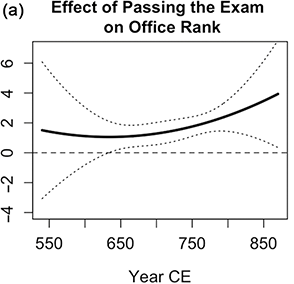
shows the effect over time of being a member of a prominent aristocratic branch on one’s office rank. Both are with 95% confidence intervals.
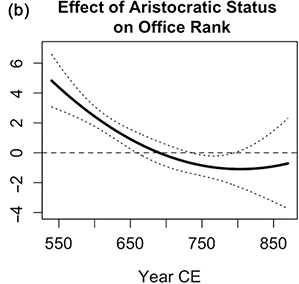
We now explore the association between aristocratic status and political success, where two key observations emerge from the right panel. First, the significance of belonging to a prominent aristocratic branch for securing office positions declined throughout the Tang dynasty. By the generation born in the mid-7th century, aristocratic status ceased to be a reliable predictor of career success. Because whether an individual could be credibly traced to a prominent aristocratic branch is technically measured “before” his father and grandfather office ranks, his status in the marriage networks, and his success in the Keju, X in the specification excludes such control variables.Footnote 51 Second, this downward trend in the value of aristocratic lineage predated the rise in importance of Keju, as evidenced in the left panel. This contrast further casts doubt on the grand narrative critiqued throughout this Element that early Tang Keju aimed to undermine the “aristocracy.”
The empirical results here, alongside Wen, Wang, and Hout (Reference Fangqi, Wang and Hout2024), challenge the recent “persistent school” in Tang studies, which downplays the significance of Keju and overemphasizes the enduring influence of aristocratic advantage in officeholding (e.g. Tackett, Reference Tackett2014, Reference Tackett2020).Footnote 52
This does not imply that family background was inconsequential. In fact, findings in Wen, Wang, and Hout (Reference Fangqi, Wang and Hout2024) indicate that the office ranks of both fathers and grandfathers had a positive impact on the office rank of sons, with these trends remaining stable over time (neither increasing nor decreasing). Given that the significance of immediate ancestors in an individual’s success is a universal phenomenon across various cultures and eras, its consistent importance in the Tang dynasty is hardly surprising.Footnote 53 By comparing the steady influence of immediate ancestors’ ranks with the declining significance of broader ancestral prestige, it can be argued that in the era of examinations, the bureaucracy in medieval China became less “medieval” and aristocratic.
What about the effect of family background on examination success? A prevailing notion in the literature on Keju during the Tang dynasty states that the overwhelming majority of Keju passers (those who succeeded in the exam) were themselves “aristocrats” (Sun, Reference Sun1980; Mao, Reference Mao1988; Kung, Reference Kung2022). This statistical claim is problematic on multiple levels. First, a complete government roster of Keju passers (those who succeeded in the exam) from the Tang dynasty was never preserved. Any effort by post-Tang historians to compile a complete “list” of Tang Keju passers has had to either rely on reading biographies from dynastic histories, a sample that is severely biased for various reasons (e.g. Jiang, Reference Jiang2006, Reference Jiang2012; Tackett, Reference Tackett2014, Reference Tackett2020), or rely on secondary “catalogues” (e.g. Dengke Jikao 《登科记考》), which in turn relied heavily on dynastic histories.Footnote 54 When historians compute the proportion of aristocrats in any such “list,” those outside the list and those inside the list but without detailed family information are essentially omitted from the denominator, leading to upward bias in favor of aristocratic dominance as prestigious family backgrounds were more likely to be recorded in history.Footnote 55
Second, works claiming that the overmajority of Keju passers were aristocrats employ definitions of “aristocrats” that not only are excessively expansive but also fundamentally deviate from the Tang reality. Their definitions rely solely (as in Kung, Reference Kung2022) or significantly (as in Sun, Reference Sun1980 and Mao, Reference Mao1988) on “choronym-surname” combinations (“choronym” meaning an elite’s ancestral hometown).Footnote 56 There is overwhelming consensus among historians that the fabrication or “concoction” (建构郡望) of choronyms was widespread in the Tang (e.g. Qiu, Reference Qiu2016; Fan, Reference Fan2014).Footnote 57 Anyone with surname Li, an extremely common surname in Chinese history and today, could claim to come originally from the choronym Longxi or Zhaojun and enter the data in these works as a member of the aristocratic clan “Li of Longxi” (陇西李氏) or “Li of Zhaojun” (赵郡李氏).Footnote 58 In addition to these two major problems, the methodology of computing
 from any “list” of Keju passers is itself inherently flawed as it selects on the dependent variable.
The more adequate approach would be to obtain a sample of Tang elites, which would inevitably contain individuals with Keju credential and individuals without it, and employ a precise definition of aristocrats that reduces the fabrication bias inherent in choronym-based measures that has been well-documented in the historical literature. The epitaph sample and the methodology of measuring the pedigree dimension of medieval Chinese aristocracy in Wen, Wang, and Hout (Reference Fangqi, Wang and Hout2024) underpins this approach. Our simple calculation suggests that only 38% of the Keju passers in the epitaph sample could be credibly traced to prominent aristocratic branches, much lower than prior estimates.Footnote 59
More importantly, econometric analyses by Wen, Wang, and Hout (Reference Fangqi, Wang and Hout2024) suggest that none of the family background measures consistently predicts exam success, whether they are father or grandfather office ranks, membership in elite marriage networks based in the Tang capitals (a measure of aristocracy preferred by Tackett (Reference Tackett2014)), or membership in a prominent aristocratic branch.Footnote 60 These nonresults should not be misconstrued to suggest that the Keju contest was entirely equitable across all societal classes or groups. The epitaph sample primarily reflects the elite segment of Tang society – individuals who were highly educated and could afford epitaphs. However, these nonresults in Wen, Wang, and Hout (Reference Fangqi, Wang and Hout2024), along with the concurrent trends of increasing Keju importance and diminishing aristocratic influence reported in Figure 2, support our argument in Section 1 that Keju broadened the “selectorate” by leveling the playing field within the elite class. The remainder of this section will explore how Keju evolved into a self-enforcing institution perceived as beneficial by both the emperor and (to some extent) elites, where we will further illustrate the equalizing nature of the Tang Keju through additional qualitative and quantitative evidence.
3.2 Self-reinforcing Institution
We now move to the next question: Why did Keju become an institution that sustains itself. Our answer is that both the ruler and the elites increasingly found it beneficial. For the ruler, although we initially minimized the notion that Keju was intentionally implemented to weaken the aristocracy or existing political powerholders, from a certain point onward, it became increasingly clear to the Tang emperors themselves that Keju indeed could serve such a political purpose. For the elites, they adapted to the new paradigm and began to view the Keju-credential as a key step in their political promotion. Our discussion starts with the perspective of the ruler.
3.2.1 The Equalizing Potential of Keju
Even in the subsection discussing Empress Wu, whom some historians and social scientists view as a crucial advocate of Keju with the aim of undermining the upper elites, we remain agnostic regarding her actual intentions, emphasizing instead the incremental and “noisy” evolution of Keju and consequently the absence of elite resistance. Nonetheless, it prompts the question of when Tang emperors eventually began to recognize Keju’s potential to serve the purpose often attributed to it: enhancing the ruler’s power. While it is impossible to look inside a ruler’s mind, we consider the increasing attention to a specific political issue as indirect evidence of Tang emperors acknowledging Keju as a tool to broaden the “selectorate.” This issue pertains to the participation of zidi (子弟) in the exam.
Zidi (子弟): children of powerful political families. The term zidi literally translates to “young offspring,” but within the Tang dynasty’s context, it specifically denotes the descendants and nephews of high-ranking officials, up to two generations (e.g. Lu, Reference Yang2016). In the Tang system, officials ranked five or higher would have a limited number of their offspring automatically entitled to certain entry-level bureaucratic positions (a system known as men-yin 门荫). However, the majority of zidi were ineligible for these positions and thus competed in the Keju for bureaucratic entry. Notably, as the importance of Keju for officeholding grew over time, even those zidi who qualified for automatic entry increasingly opted to partake in the Keju. Needless to say, zidi were perceived to have an inherently unfair advantage because of their familial ties. Imperial court discussions regarding the entry of zidi into the bureaucracy via the Keju were predominantly negative. Such pronounced worries about zidi’s participation in the Keju clearly indicate the emperor’s concern for maintaining fairness in the competition. The rulers’ attention to and efforts in preserving the “equalizing” aspect of the Keju should, in turn, be seen as evidence that they had indeed recognized its potential to broaden political access across a wider spectrum.
The earliest mention of the zidi issue in the historical records referred to the demotion of a Keju examiner in 789 ce. The emperor punished him specifically for “awarding many degrees to the zidi of high-ranking and influential officials.”Footnote 61 Contrast this incident and its historical description with the anecdote in Section 2.2.4, which illuminates the early Tang dynasty’s more favorable view of a similar phenomenon. In the case of Zhang Chujin, facilitated by Xu Shiji’s intervention, the narrative positively portrays the selection of officials’ children through the Keju system. This account signifies a time when such practices were not only exempt from punishment but were also celebrated as a means of recognizing and advancing genuine talent. This stark contrast marked a notable shift in the approach to merit and influence within the imperial examination system. Notably, the word zidi wasn’t even used in the historical records describing phenomena of patronage in the early Tang Keju. It was in the 9th century, however, that the issue of zidi truly intensified, notably during the so-called Niu-Li Factional Strife (牛李党争) and its aftermath. We now turn to this important episode in the development of Keju, an episode as fascinating as it is misunderstood.
Affirmative Actions in the Keju
In 846 ce, the governor of Xuanshe Province received a letter from his friend, Du Mu (杜牧), one of the most renowned poets in Chinese history. Enclosed was a vehement political critique, disguised as an argumentative essay, targeting a chief minister in the Tang court.Footnote 62 The essay opens with:
Since five years ago, those in charge have proposed that the selection of bureaucrats through Keju examinations should be reserved for scholars from humble backgrounds, and that zidi should not be advanced this way. This idea has become ingrained in the Emperor’s mind, firmly held in his heart, and implemented rigorously, as unyielding as metal and stone. Consequently, zidi find themselves hiding like fish in deep waters or mice in burrows, with no path to enter the bureaucracy. This perplexes me.
Du Mu was someone who “checked all the boxes.” A descendant of a distinguished ancient house from the Tang capital, Chang’an, Du Mu boasted of his grandfather’s notable tenure as a chief minister. Additionally, one of his elder cousins was a son-in-law of Emperor Xianzong. In 828 ce, Du Mu excelled in the Keju exam at the age of twenty-five as a zidi, achieving fifth place. He then went on to succeed in a special Keju test, securing expedited entry into officialdom.Footnote 63 Yet, at the time of writing this letter, Du Mu had only six years remaining in his life and had not yet secured any significant position within the central government.Footnote 64 The remainder of his essay voices a passionate outcry against the discrimination toward zidi highlighted at the outset, so intense that a keen reader couldn’t help but speculate that Du Mu attributed his own career underplacement to this policy.
“The very point of Keju, as envisioned by our enlightened founding emperors, was to recruit talents irrespective of family background, be it humble or noble. In ancient times, when in urgent need, rulers would recruit talents from all walks of life, including thieves, enemies, or even barbarians. How illogical then, that we employ Keju to identify talent, yet exclude zidi from selection?”
Du Mu fervently argued. He proceeded to enumerate a total of seventy ancient figures who not only had significant political achievements but also came from privileged backgrounds. He then highlighted that in more recent history, “countless” descendants from high-ranking officials have been recognized as great figures. “Why then, would we assume that zidi cannot be talented today?” He lamented.
The essay then drifts to a defense of Keju itself, countering claims that those chosen through the exam were “frivolous” (浮华) and untalented. Du enumerated nineteen distinguished historical figures from the Tang dynasty with Keju credentials. “All these nineteen esteemed individuals have made significant contributions to the state’s well-being. What, then, is the issue with Keju?” Du Mu asked in despair. The essay concludes with commendation for the provincial governor’s third son, who had reached adulthood. Du Mu lauded the son’s exceptional essays, noting that had this son participated in the Keju five or six years earlier, he would by now be serving as an esteemed official in the central government. Yet, Du expressed regret that the recent anti-zidi stance had imposed significant obstacles. “The vetting in the Keju has become akin to laying nets and traps, as if warding off thieves. Zidi suffer in silence, burdened and disheartened, longing to discard their noble attire and join the lower class, facing a deadlock so bizarre and unprecedented in both ancient and modern times,” Du Mu mourned in depression.
The profound frustration and despair conveyed in Du’s essay starkly highlight the anti-zidi sentiment in the Tang court during his lifetime. The chief minister anonymously criticized in Du’s piece is Li Deyu (李德裕), the “Li” in the so-called Niu-Li Factional Strife. Li came from an even more illustrious lineage than Du’s. He clashed with another influential official, Niu Sengru (牛僧孺), over policies and personal issues, leading to a broader rivalry involving allies of Niu and Li, marked by accusations of factionalism.
Historian Chen Yinke boldly argued that the Niu-Li Strife was rooted in differing views on the Keju: Li’s faction opposed it, representing aristocrats whose status was threatened, while Niu’s faction supported it, representing new elites from modest backgrounds. Chen’s thesis was refuted in 1950 by another historian who found no significant differences in either Keju credentials or family backgrounds between the two factions (Cen, Reference Cen2020). This rebuttal was then supported and enriched by scholars in Japan and the United States.Footnote 65 Later historians have even questioned the existence of distinct factions (Wang, Reference Wang2018; Fu, Reference Xuancong2023).
The consensus since the 1980s has underscored that Li Deyu, though a zidi of noble lineage himself, notably strongly favored promoting individuals from humble backgrounds into the bureaucracy via Keju, rather than zidi. In contrast, his adversaries sought to support the advancement of each other’s children as zidi to the highest ranks of political power (e.g. Wang, Reference Wang2018; Fu, Reference Xuancong2023). Li’s stance on the Keju is another source of confusion. Despite the availability of automatic entry into the bureaucracy for zidi like himself and his father through the men-yin system, many ambitious zidi opted for the Keju, believing that having such credentials could help them in their careers. However, Li and his father abstained from the Keju, influenced by their family’s deep respect for ancient rituals and Confucian classics, which led them to critique the shift toward lavish literary expression in the Keju (Chen, Reference Chen1982). Ironically, Li’s own literary talents, particularly in styles crucial for Keju success, were widely admired among the elite (Lu, Reference Yang2016). Nevertheless, he frequently rebuked Keju’s overemphasis on literary skills and criticized the Jinshi degree holders as “frivolous” (a point raised in Du’s essay). Li’s cultural and familial background created the misunderstanding that he opposed Keju out of a desire for aristocrats to retain political power (Wang, Reference Wang2018). In truth, Li enacted policies to reform the Keju, reducing corruption and preventing other powerful officials from co-opting the institution as a means of elite reproduction. Li envisioned it instead as a pathway for elites from humbler background to join the bureaucracy (Wang, Reference Wang2018; Fu, Reference Xuancong2020, Reference Xuancong2023).
While we agree with the historians’ “rehabilitation” of Li Deyu, the literature misses the bigger picture. It’s the Tang emperors, not just Li, who had consistently taken actions to preserve the equalizing potential of the Keju. The anti-zidi policies were not Li’s alone. Tang chief ministers rarely acted independently of the emperor, as their positions were ultimately at the emperor’s discretion, who could dismiss them for deviating from his will. There were 364 chief ministers in total, with an average of 6.248 chief ministers serving an emperor in any given year, and the average tenure was only 2.157 years. Li’s continuous role as chief minister throughout Emperor Wuzong’s full six-year reign was an exception. Annually, there were about 3.667 colleagues serving as chief ministers alongside Li, each with an average tenure of 1.875 years. Emperor Wuzong saw Li as a loyalist whose anti-zidi stance aligned with his own ambition of unleashing Keju’s equalizing potential. The Emperor once noted, “the examiners didn’t fully grasp the true intention (of affirmative action). Not letting any zidi pass the exam is a bit too extreme. The point is to select talents without bias towards the low-born or zidi.” Li adeptly aligned with his Emperor in the conversation, smoothly picking up on the Emperor’s cues, by replying that zidi were also useful for the empire.Footnote 66 This exchange underscores that the emperor was the principal architect of the policy, which was enacted to such an extent that he felt compelled to moderate it.
These policies were not exclusive to Wuzong’s reign, either. The first recorded instance of such actions dates back to 789 ce, as previously noted. Throughout the 9th century, efforts to curtail zidi’s edge in the Keju unfolded to varying degrees under every emperor except one.Footnote 67 In the 9th century, it was common for a newly announced list of Keju passers to be scrutinized by the emperor, who, upon noticing numerous sons and relatives of high-ranking officials among the passers, would command the examiners to explicitly remove some of them from the list (“令落下”). Similarly, if public outcry arose over the presence of zidi on a publicly announced list, the emperor would mandate a “re-test” (“覆试”), leading to the revocation of some zidi’s degrees as a result.Footnote 68 These efforts also continued beyond the Tang. In 985 ce, Emperor Taizong (宋太宗) of the Song dynasty (960–1279 ce), upon noticing the cousins and sons of three senior officials from the degree list, famously said: “These were all from powerful families. Even if they passed the exam with true talent, people would think that I am playing favors!” He revoked all their degrees afterwards.Footnote 69 It seems that Tang and early Song rulers were less concerned with procedural fairness itself than with ensuring equality of outcomes. Measures under Emperor Wuzong were particularly harsh, as they were not merely about “leveling” the playing field between privileged and underprivileged groups; they actively discriminated against the privileged, even to the extent of barring them from passing the Keju (Wu, Reference Zongguo1992, chapter 12). For Wuzong and Li, given that well-connected officials had numerous methods to secure political power for their zidi at the expense of social mobility, simple equality of opportunity was deemed insufficient for achieving true equality of outcomes. They had to take more drastic actions.
The Broader Context in Data
Our qualitative analysis aligns with the quantitative discussion in Section 3.1.1, where Wen, Wang, and Hout (Reference Fangqi, Wang and Hout2024) reports scant evidence for the association between father or grandfather ranks and the likelihood of sons passing the Keju. This subsection digs further into Keju’s equalizing potential. Our analysis is “inspired” by a logical shift in Du Mu’s critique of Li Deyu for barring zidi from the Keju. Recall that the essay devotes a long paragraph to proving through numerous examples that zidi could also be great statesmen. The conclusion speaks again on the difficulties facing zidi as the door of Keju was being shut to them. Yet, the essay also accuses Li of undervaluing those who had already obtained Keju degrees, and defends the Keju by enumerating the respected Tang politicians that Keju produced. This part of the essay seems to shift the concern from zidi attempting the Keju to those (zidi or non-zidi) who have succeeded. It implies that Du perceived general career obstacles for Keju passers under Wuzong and Li. Notably, Du was not the only one who had made such an accusation against Li.Footnote 70 Modern historians have largely debunked these accusations as factional vendettas, showing Li was in fact celebrated by those from modest backgrounds aiming for officialdom through the Keju (e.g. Wang, Reference Wang2018; Fu, Reference Xuancong2020, Reference Xuancong2023). Our quantitative evidence in Figure 2 further disproves these accusations, demonstrating the growing value of a Keju degree over time in the Tang.
These discrepancies between assertions and reality leads us to speculate that perhaps the accusations weren’t about Li Deyu’s general aversion to Keju passers, but rather his specific disfavor toward Keju passers who were zidi. Considering Tang rulers’ deep concern about equality of outcomes, it’s plausible that they also tried leveling the playing field for elites beyond the examination stage. In other words, there might have been actions to curtail the advantages zidi had over others even after the examination stage. The likes of Du Mu, with the dual-identity of Keju passers and zidi, could feel underplaced given their distinguished family background, leading to their perception that performance on the exam did not improve their careers.Footnote 71 In what follows, we quantitatively demonstrate that Du Mu’s frustration as a zidi who passed the Keju reflects the broader context of Keju’s equalizing potential, or efforts to preserve such potential, beyond a particular ruler and chief minister.
Following the sociologists’ approach in studying the equalizing effect of education (e.g. Torche, Reference Torche2011; Hout, Reference Hout2012), we divide our epitaph sample into sons with Keju-credential and sons without, and then conduct the analysis using the specification in Section 3.1. Figure 3(a) shows a consistent association between father office rank and son office rank for non-Exam passers, and the magnitude seems to trend upwards in the 9th century, signaling the rise of zidi. Yet, for those who passed the Keju, the association between father position and son’s career success, as measured by office ranks, is not statistically distinguishable from zero throughout the dynasty. Within the broader elite society, conditional on passing the Keju, family background no longer mattered. These results provide a macro-level backdrop against which one could understand the frustration of Du Mu and many others. They also support our overarching argument that Keju was a platform through which rulers equalized within the broader elite, keeping the “selectorate” relatively large. Importantly, the discussions and actions toward preserving the equalizing effect of Keju in light of the quantitative results showing that it was having an equalizing effect suggest that the emperors by the 9th century had fully understood the political functions of Keju that were not so obvious two centuries earlier.
shows the effect over time of father’s office rank on son’s office rank for non-Exam passers.
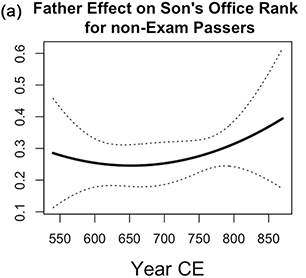
shows the effect for Exam passers. Both are with 95 % confidence intervals.
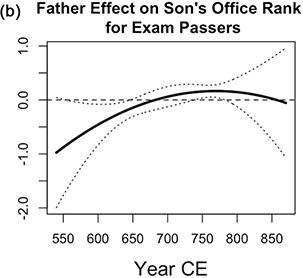
3.2.2 New Political Developments Affecting Elite Incentives
We now turn to the elite perspective, examining the political developments in the latter half of the Tang that further amplified and entrenched Keju’s appeal among the Tang elites. There were two interconnected transformations after 755 ce that made Keju all the more important for their careers.
Provincial Military Commissioner
The first is the militarization and secessionism of the provinces. For a long time, Tang rulers actively pursued and maintained hegemonic status over East Asia and central Eurasia. To do so, the emperors delegated substantial power to the “provincial military commissioners” (节度使) along its western and eastern borders, who controlled the majority of the imperial armies. In 755 ce, one commissioner named An Lushan launched one of the biggest rebellions in Chinese history, a massive civil war that the dynasty barely survived. In the process of defeating the rebels, the emperors had to allow military generals and local officials across China to raise their own troops. As these generals and officials amassed military power, they increasingly asserted their autonomy. In response, the Tang court formally recognized their elevated status by appointing them as military commissioners to take charge of the inland provinces. A key aftermath of the civil war is therefore the proliferation of semi-autonomous military commissioners not just along the empire’s borders but across the Chinese hinterland.
Via a series of war, diplomacy, political maneuvers, and centralization reforms, the Tang rulers eventually reasserted central control over the provinces and were able to appoint, demote, and rotate commissioners at will (Chen and Wang, Reference Chen and Wang2024). To restore loyalty in the provinces, historians note that emperors throughout the 9th century often appointed civilian officials as provincial military commissioners, as they were viewed as more loyal (Qiu, Reference Qiu2018). It’s plausible that possessing a Keju credential was a crucial factor for appointment as a commissioner, as it demonstrated a vested interest in the central government’s strength and the empire’s unity. The dedication of time, energy, and resources to master literature and the classics, and to prepare for the exam, signified a family’s investment in the dynasty’s future. Thus, having passed the Keju exam was a signal of a family’s loyalty to, and integration within, the Tang political system, distinguishing them from secessionist forces. These provincial commissioner positions were both powerful and lucrative, making them highly coveted by the elite. Equally importantly, governing a province enhanced one’s prospects of attaining the position of chief minister. The posts were among the most prestigious and powerful roles available, surpassed only by the chief minister. In short, in the eyes of the elites, a natural path from Keju to the provinces, and eventually to the top job in the bureaucracy, had become clear by the 9th century.Footnote 72
Hanlin Academian
The second is the position of “Hanlin Academian” (翰林学士) as a pathway from Keju to chief minister (McMullen, Reference McMullen1988; Lu, Reference Yang2016). These academians originated from the Edict Drafting system within the Tang bureaucracy, where the drafting of edicts was integral to all actions taken by the central government. Beginning in the early 8th century, select edict drafters who garnered the emperor’s favor were relocated to a new workspace, closer to the emperor’s daily activities, dubbed the “Hanlin Academy.” This move facilitated the development of close and personal relationships with the emperor. Their daily interactions with the emperor allowed him to micro-manage policy details, bypassing the often cumbersome bureaucratic procedures. Initially, this setup was in a nascent stage, and the Academy’s utilization was irregular. Nonetheless, by the late 8th and early 9th centuries, the system had become fully institutionalized, marking a significant evolution in its role and influence. Following the An Lushan Rebellion of 755 ce, the dynasty confronted unparalleled challenges in finance, local governance, and military affairs. Additionally, the upheaval from the Rebellion and subsequent civil wars disrupted the court system itself, occasionally forcing emperors to make crucial policy and political decisions while away from the capital. These unprecedented circumstances compelled the Tang rulers to circumvent the formalities and procedures of their sophisticated, rule-based bureaucracy for the sake of timely decision-making. Consequently, this desire facilitated the rise of the Hanlin academians, primarily serving as edict drafters within the emperor’s inner court.Footnote 73
As the academians worked closely with the emperor and developed personal relationships with him, their careers often advanced rapidly, frequently culminating in promotion to chief minister. Recent historical research highlights another dimension that further solidified the significance of the Hanlin academians in Tang politics. In the aftermath of the Rebellion of 755 ce, as the Tang court struggled with maintaining the level of centralized control over its territories it once had, it increasingly leveraged soft power. This approach involved the extravagant display of authority through literature to sustain legitimacy among its subjects. Edicts and other documents crafted by the emperor’s close associates acted as subtle instruments of propaganda (Lu, Reference Yang2016; Qiu, Reference Qiu2018). These exogenous developments collectively elevated the Hanlin academians to the most distinguished cadre of officials within the bureaucracy, often seen as the stepping stone to becoming chief minister. Hence, the Hanlin Academy came to be known as the “reserve for Chief Ministers” (Lu, Reference Yang2016, p. 113). The task of edict drafting demanded exceptional writing abilities, particularly in parallel prose, making Keju passers, who were rigorously tested on their literary skills during the Tang, prime candidates for the role.
We augment the qualitative discussion with quantitative analyses within the causal mediation framework (Imai et al., Reference Imai, Keele, Tingley and Yamamoto2011), assessing the extent to which Keju’s influence on an individual’s likelihood of becoming chief minister is mediated by its role in facilitating the individual’s appointment as a Hanlin academian or provincial military commissioner. However, due to the stringent assumptions required for causal mediation analysis – particularly when involving two mediators – our findings should be considered indicative of associations rather than causal relationships. Nonetheless, identifying a positive association between Keju and achieving the position of chief minister, mediated by becoming a provincial military commissioner or Hanlin academian, lends credence to the notion that the pathways from Keju to chief minister, via these roles, reflect the developments post-755 ce at a systematic scale.
Figure 4 reports results obtained by using X (which includes the Keju variable) and the fixed effects from the specification in Section 3.1 as the right-hand side for four models. In the total effect model, the outcome variable is a binary indicator for chief minister appointment. In the two mediator models, the outcomes are binary indicators for Hanlin Academy appointment and provincial military commissioner appointment, respectively. In the direct effect model, we regress chief minister appointment on the right-hand side from the first three models plus the Hanlin Academy and commissioner appointments as two mediators. We run these analyses using data consisting of epitaphs examined in Wen, Wang, and Hout (Reference Fangqi, Wang and Hout2024), but we restrict the focus to individuals who died after 755 ce. We match this restricted dataset with our original dataset of Hanlin academians and data for provincial military commissioners from Chen and Wang (Reference Chen and Wang2024).
The direct and indirect effects of having passed the Keju on becoming a chief minister, with 95% confidence intervals
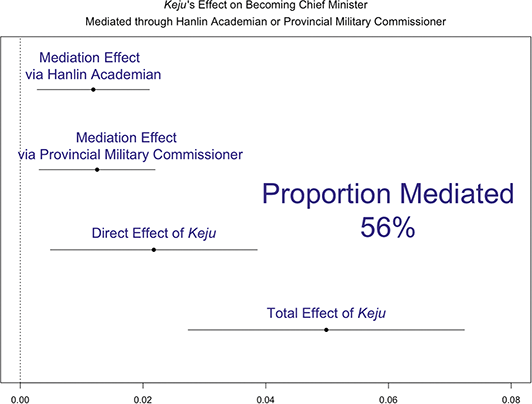
Our quantitative results show that Keju is a strong predictor of chief minister appointment, and as much as 56% of this effect is mediated by the stepping stones of Hanlin academian and provincial commissioner. These analyses suggest that, in the eyes of the elites, the lucrative pathways from Keju to chief minister had become clear in the latter half the Tang. They thus confirm our narrative that exogenous political and institutional developments further buttress the self-reinforcing nature of the Keju institution.
3.3 Conclusion
This section continues to highlight the gradual nature of Keju’s evolution, making its rising importance hard to discern initially. Since the late 7th century, however, both quantitative and qualitative analyses suggest that Keju had increasingly become the game in town for political selection regarding top government positions. Keju’s significance for overall social mobility had also dramatically risen over time, while the importance of aristocratic pedigree for officeholding rapidly diminished. The Tang emperors eventually recognized Keju’s role in expanding the “selectorate,” and consequently took consistent efforts to preserve such equalizing potential. Other political and institutional developments facilitating the rise of provincial military commissioners and the Hanlin academians further enhanced and entrenched elites’ incentives to compete in the Keju. Abundant evidence makes it clear that Keju in the Tang dynasty played a far more significant role than the “mere sideshow” characterization suggested by Kung (Reference Kung2022).
4 Evolution of Keju over Time
This section traces the development of Keju from the 10th century until its eventual demise in the early 20th century. Leveraging micro-level individual data from over 74,000 Jinshi degree holders (Jinshi, in the second millennium, refers to those who passed the Keju exams) across multiple dynasties, we unveil the implicit selection criteria embedded within the Keju system. In addition, complemented by information on more than 2,100 top government officials (ministers) and their descendants from various dynasties, we investigate the correlation between exam performance and career outcomes. The goal is to shed light not only on the selection criteria of Keju per se but also on general political selection in the imperial government.
Our findings reveal a diminishing impact of family background on the career trajectories of elite descendants. Two changes have occurred over the centuries after the Tang dynasty. First, Keju became increasingly competitive, and the influence of family background on exam performance declined substantially.Footnote 74 Second and especially since the 14th century, non-Keju pathways to offices in the civilian government were gradually shut down, and Keju became the vital element in shaping one’s political career. The combined outcome was that, over the millennium after the Tang dynasty, the top political elites found it increasingly difficult to pass power onto their children. And political participation was extended to a larger portion of the population. These insights suggest a pivotal role played by the Keju system in mitigating the perpetuation of political power within elite familial circles. This section and the next will report the empirical results and discuss them in conjunction with political economy theories.
A clarification on the terms “aristocracy” and “elite” is necessary before proceeding. In medieval European contexts, “aristocracy” and “nobility” often refer to heritable titles bestowed by a monarch. While similar titles and enfeoffment certainly existed in imperial China, they by themselves did not signal profound political influence within the Chinese imperial bureaucracy beyond their legal privileges. The “medieval Chinese aristocracy,” as studied in Sections 2 and 3, was not defined by such government-sanctioned titles. Instead, it was a sociopolitical status based on a family’s perceived political influence, economic power, and cultural capital. A historian of medieval China has compared the medieval Chinese aristocracy, especially during the Tang dynasty, not to the knights and dukes of medieval Europe but to the senatorial aristocracy of the Roman empire (Tackett, Reference Tackett2014).
In contrast, the term “elite,” as used in Sections 2 and 3, refers to a broader group that included the aristocracy but also encompassed other privileged individuals. This group was viewed as a higher stratum above commoners and merchants, with the aristocracy being the most socially prominent within it.
This section and Section 5 focus on the second millennium after the Tang dynasty. Since the medieval Chinese aristocracy had largely disappeared by the 10th century, we will no longer use the term “aristocracy.” Instead, we will use “elite” in a broader and looser sense, consistent with how the term is commonly used in political science literature, except in cases where formal models define it specifically. In our empirical analyses, particularly those underpinning Figures 10–12, we do define “top political elites” concretely as ministers and their sons.
4.1 Keju’s Development After the Tang
Peasant uprisings and the ensuing warlordism since 880 ce was an exogenous shock that further shaped the Keju system. Research within the “Tang-Song Transition” tradition argues that these violent upheavals, which particularly devastated the Tang capitals, effectively eliminated the medieval Chinese aristocracy (Tackett, Reference Tackett2014, Reference Tackett2020). As shown in Section 3 and Wen, Wang, and Hout (Reference Fangqi, Wang and Hout2024), however, the aristocracy’s advantage in officeholding had already declined significantly before 880 ce.
This shock was nevertheless significant because it dramatically altered the political geography of ruler–elite relations. During the Tang, most top political elites, aristocratic or otherwise, were concentrated in the capitals, Chang’an and Luoyang, which were themselves geographically close and connected. This high concentration made it unsurprising that regional quota for Keju – which would limit the number of candidates from each province, including the capitals – were never strictly enforced during the Tang. With the centralized elites effectively eliminated, the new rulers, such as those of the Song dynasty (960–1279 ce), were able to implement a quota system that ensured more balanced representation across regions compared to the capital-heavy Tang period, a principle that later dynasties all followed rigorously.
The Song rulers also implemented several other changes. Under the Song system, regular exams were held every three years, progressing from the prefectural level to the central government and then the imperial court. Stringent measures were implemented to prevent cheating or favoritism. Exam papers were transcribed and anonymized. Notably, candidates were strictly forbidden from circulating their essays and poems in the capital before the exams to prevent influencing the examiners with their writings (Chen, Reference Chen2017). To encourage widespread participation, the imperial government funded a network of public schools at the prefecture level across the nation.
The reforms implemented during this era not only established Keju as a cornerstone of governance but also encouraged broader societal participation in the political sphere. Significantly, advancements in paper-making and printing technologies contributed to this period of social transformation. Although paper had long existed in China, its production became substantially more cost-effective and accessible in early Song. This resulted in an unprecedented surge in book production throughout the Song, making education feasible and attainable for a larger population (Ho, Reference Ping-ti1962; Cheng, Stasavage, and Wang, Reference Cheng, Stasavage and Wang2023).
The Mongol invasion in the 13th century briefly interrupted Keju. However, it didn’t take long for the Mongol-Yuan administration to acknowledge the merits of Keju. In 1315, they reinstated Keju, heavily borrowing from the structures and curriculum of the Song era. Nonetheless, political access remained largely restricted. After all, the Yuan dynasty was established by an alien ethnic minority, and the highest echelons of power remained reserved for nobles of this minority.
Following this temporary setback, Keju entered a second phase of rapid development with the ascension of the Ming dynasty (1368–1644 ce). Keju exams since the Ming followed a three-level structure similar to that of the Song. To become eligible for the first level of Keju exam, one had to pass other qualification exams. During this period, public schools gained increased prominence, extending their reach from prefectural to county levels. Several imperial decrees directly from the emperors mandated the establishment of public schools in every county throughout the country. Quotas were rigorously enforced to maintain relatively balanced representation from different regions of the country and prevent dominance by any single area. Over the Ming dynasty’s 277-year reign, a total of eighty-nine regular exams took place, averaging around eighty-nine Jinshi degree holders (those who passed the exam) annually. This resulted in a considerable number of Jinshi degree holders, totaling more than 24,000. Although Keju encountered a brief disruption during the Manchu invasion in the 17th century, it quickly resumed regular operations and retained its central role in bureaucratic recruitment.
Keju finally met its end in 1905. The Manchu-Qing dynasty (1644–1911 ce) government grappled with significant external pressures from colonial powers and internal demands for modernization reforms. As a symbol of entrenched traditions and perceived backwardness, the rulers of the declining dynasty eventually abolished the 1,300-year-old institution.
To quantitatively demonstrate the evolution of the Keju, in Figure 5, we plot the annual number of Jinshi (进士) degree holders (Jinshi, hereafter). The Jinshi were individuals who passed the highest level of exams and were legitimate for government positions. The annual number of Jinshi can serve as a proxy for the scale of the Keju. A fifty-year moving average is taken to smooth out excessive fluctuations in the time series. The time trend in Figure 5 matches the historical narratives mentioned above, with two boosts recorded during the Song and the Ming dynasties and two busts during the Yuan (13th century) and the early Qing dynasties (17th century). Overall, it has been a relatively consistent institution throughout the millennium, enabling our cross-time analysis in this section.
Average number of Jinshi degree holders per year
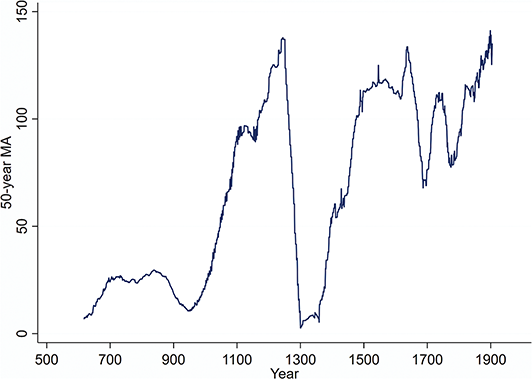
In what follows, we quantitatively trace the development of the Keju across time through four dynasties from the 10th century till 1903. By leveraging biographic information and exam ranking of approximately 74,000 Jinshi degree holders from various time periods, we aim to uncover the selection criteria of the Keju. As a complement, we also compile a dataset of more than 2,100 ministers from the 2nd-century bce until the end of imperial China to illustrate changes in the composition of the ruling elites. The main takeaway is that Keju limited political reproduction within the top elite families.
The data comes from multiple sources. Data on Jinshi degree holders comes from the Chinese Biographic Database (CBDB), which includes the name, exam year, birth year, family relationships, hometowns, and other basic biographic information of more than 74,000 candidates. We complement this data with other sources. We hand-collected information on the ranking of the Song dynasty Jinshi degree holders based on Song-dai Deng-ke Zong-lu (Reference Yanming and Hui2014), while that of the Ming dynasty is from Huang and Yang (Reference Huang and Yang2022). The ranking of the Qing dynasty Jinshi is based on original records in the CBDB. Family relations and their government positions for the Song and the Ming dynasties come from the CBDB and Huang and Yang (Reference Huang and Yang2022), respectively. Population data is digitized based on the Historical Atlas of China (2012) and is available for the years 1102, 1290, 1391, 1460, 1565, and 1820. We also collect information on government ministers for the entire imperial period based on the official Twenty-Four Histories of the Chinese dynasties, which is then matched with the CBDB to retrieve additional family information. The following subsections discuss the variables and regression models. More details on data and variable construction can be found in the Online Appendix.
4.2 The Selection Criteria of Keju
In this subsection, we use a regression model to uncover the implicit selection criteria of the Keju and trace their development over time. With quantitative analysis, we hope to answer a few simple questions: What factors contributed to a candidate’s success in Keju? And how did the relative importance of different factors change over time?
Specifically, the major outcome variable we examined is a dummy variable, which equals one if the candidate ranked among the top three during his cohort (i.e. Tier One, 一甲) and zero otherwise. Here, we use a dummy for the top-tier candidates instead of the general ranking for all candidates largely because of data availability.Footnote 75 Since this subsection focuses on capturing the time trends rather than quantifying the coefficients, we use the top-tier dummy as our primary outcome variable. In the Online Appendix, we also use the general ranking and the regional total number of Jinshi as robustness checks, and the findings are similar. Because all the data points are Jinshi themselves, our analyses using “top tier” as the outcome among the Jinshis are comparisons within those who passed the Keju exam. These intensive margin analyses are nonetheless important because a “top tier” was a prominent status in and of itself and those who earned the honor were more likely to enter the bureaucracy via higher-ranked or more prestigious offices than those taken by their peers in the same Jinshi cohort.
The two main independent variables we examine are: (a) family background, indicated by whether a candidate’s father held government positions before him, and (b) regional economic development, indicated by the population density of the candidate’s hometown.Footnote 76 Readers may notice that the characterization of family background here differs from that in Section 3. In Section 3, we decompose “medieval aristocracy” into two dimensions. The first one is based on the power of the immediate ancestors, measured by the ranks of the highest offices held by one’s father and grandfather. The second one hinges on the pedigree of the bloodline itself, proxied with membership in a prominent aristocratic branch. Throughout this section, we omit the second dimension of ancestral prominence and revert back to a one-dimensional measurement based on the father’s officeholding.
There are two reasons for this approach. First of all, the second dimension had already ceased to matter in political selection even during the Tang dynasty, when the so-called medieval aristocracy was still in existence (Section 3.1; e.g. Wu, Reference Zongguo1992; Lu, Reference Yang2016; Wen, Wang, and Hout, Reference Fangqi, Wang and Hout2024). With the utter disappearance of the aristocracy in post-Song times, historians almost unanimously agree that bloodline pedigree never regained its prominence.Footnote 77 Father’s officeholding would be a more appropriate proxy to measure politically privileged family background for this sample period. Secondly and more importantly, this section aims to document the temporal evolution of the Keju. To this end, father’s officeholding is a measure that can be easily applied to different time periods and retains a relatively consistent and straightforward interpretation. Hence, we use father’s officeholding as our main measurement of family background.
We employ several model specifications. The benchmark model includes only two variables, Father Office and Population Density, plus a time fixed effect. The regression equation is as follows:
 (1)
(1)
In this preferred model, we intentionally do not control for province fixed effects. There were ample examples of prominent political families throughout Chinese history who derived power from regional affiliations. Political reproduction within elite families could thus be intertwined with or disguised as regional inequalities in political access. Since this subsection focuses on capturing the overall family impact on Keju success, we want to include the part of the effect disguised as regional inequality as well.
In the revised models, we include province fixed effects, as well as individual controls, such as age, household registration status (such as civilian, military, artisan, or merchant), parental status (alive or deceased), and exam fields (such as poetry, rites, and classic books). Table 1 summarizes the regression results. The estimation of the preferred model is given in Column (1), while Columns (2)–(4) provide various robustness checks.
| Variables | (1) | (2) | (3) | (4) | (5) |
|---|---|---|---|---|---|
| Dummy_top3 | Dummy_top3 | Rank_inv | Rank_inv | Rank_inv | |
| Dummy_ | 0.735*** | 1.139*** | 0.0927*** | 11.33*** | 0.0768*** |
| father office | (0.187) | (0.403) | (0.0195) | (1.696) | (0.0245) |
| Pop density | 0.315*** | 0.539*** | 0.0481*** | 5.113*** | 0.0314* |
| (0.0830) | (0.144) | (0.0126) | (1.799) | (0.0169) | |
| Age | 0.00513 | 0.0964 |
 0.0099***
 |
 1.113***
 |
 0.0116***
 |
| (0.0168) | (0.0849) | (0.00159) | (0.154) | (0.00239) | |
| Urban |
 0.0162
 |
 0.305*
 |
 0.0111*
 |
 0.527
0.527 |
 0.0151**
 |
| center | (0.0527) | (0.165) | (0.00598) | (0.985) | (0.00724) |
| Household | Y | Y | |||
| status | |||||
| Parental | Y | Y | |||
| status | |||||
| Exam field | Y | Y | |||
| Model | Logit | Logit | Rank order | Panel | Rank order |
| logit | logit | ||||
| FE | Year | Year | Prov | Prov-Year | Prov |
| Observations | 12,511 | 3,962 | 12,463 | 12,457 | 8,051 |
Note: The unit of analysis is individual. Robust standard errors are in parentheses.
*** indicates
 , **
, **
 , and *
 .
.
Overall, both family political background and regional economic development contributed positively to exam success. The coefficients are positive and consistent throughout different model specifications. In terms of the magnitude of the impact, based on the preferred model in Column (1), having a father who was a government official would, on average, increase a candidate’s odds of obtaining the top tier ranks by 108%. Similarly, when the candidate’s hometown population density increased by one unit of national standard deviation, his odds of obtaining the top tier ranks would increase by 37%.Footnote 78 To interpret the magnitude in terms of probability, the average probability of obtaining the top tier ranks is 2.14% for candidates with father officials and 1.38% for others, which is equal to a 55% increase for candidates with father officials.
In the following, we move on to another main task of this section – to uncover the evolution of Keju selection criteria over time. We still employ a logistic regression model similar to Equation (1). However, instead of estimating the average impact of a variable for the whole sample, we employ a flexible estimating equation that evaluates the impact of the variables separately for every decade.
We first examine family background in isolation. Figure 6 plots the impact of Father Office on exam ranking with no controls other than year fixed effects. From the beginning of the Song dynasty around 970 ce until the end of the Ming in the early 17th century, the impact of Father Office has been largely positive but with a declining magnitude. The only exception to this pattern was the early Ming dynasty when the newly established imperial government periodically reverted to recruitment based on recommendation (Hucker, Reference Hucker, Mote and Twitchett2008). This exception was quickly corrected, however, within a few decades.
The impact of family background on exam ranking
Note: the coefficients plotted in Figure 6 to 8 are logit coefficients, not the marginal impact on top-tier probability.
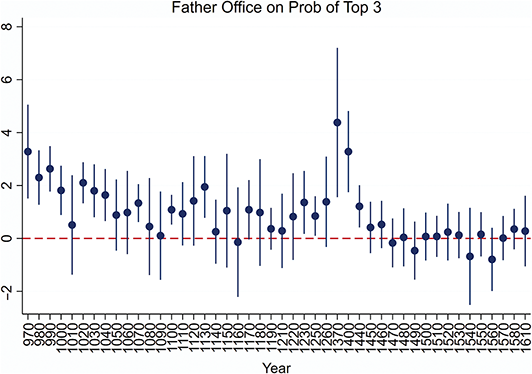
We then examine the impact of regional economic development. Figure 7 plots a similar graph for Population Density with no controls other than year fixed effects. The coefficients for Population Density show a consistent and increasing trend throughout the millennium. The impact rose from mild significance in the early 11th century to significantly positive toward the end of the imperial period, with growing magnitudes.
The impact of regional economic development on exam ranking
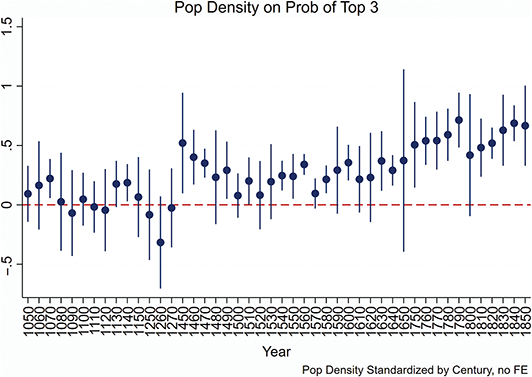
Figure 8 performs a multivariate logistic regression, including both Father Office and Population Density as independent variables. Because there is a substantial gap in the coverage of the two variables, the coefficients of this multivariate regression are estimated for every fifty years. The pattern remains the same. The impact of family background weakened over time, whereas that of regional economic development strengthened. In other words, the exam ranking increasingly reflected the regional economic development level rather than the political connection of the candidate’s family.
Multivariate regression, family background vs. regional development
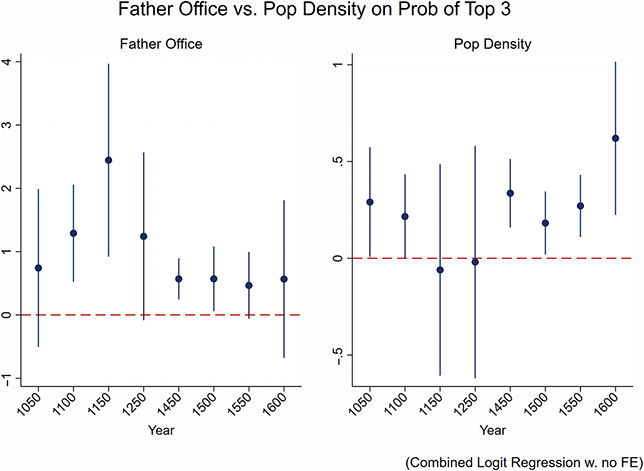
The evidence fits well with the prevailing narrative in the literature. Historians largely agreed on the increasingly competitive nature of the Keju in the late imperial period. Several historians, such as Ho (Reference Ping-ti1962), Chaffee (Reference Chaffee1995), and Elman (Reference Elman2013), noted that consecutive governments during this period initiated a number of reforms to make the Keju more impartial and equitable and, by extension, more competitive. The exams of the Tang emphasized poetry and prose, which allowed a certain level of flexibility to demonstrate creativity and individuality but also more room for subjective interpretation. The retention of poetry and prose in the exams became a focal point of debate and reform during the Song (Chaffee, Reference Chaffee1995, p. 71), and was abruptly ended at the beginning of the Ming (Elman, Reference Elman2013). A new school of interpretation for the Confucian canons, sometimes called Neo-Confucianism, became the political orthodoxy for the Keju since the 14th century onward. During the Ming dynasty, Keju experienced further narrowing of its content with the eight-legged essay legislated as the only permitted format (Elman, Reference Elman2013). Over time, the exam increasingly emphasized memorization and moral cultivation, especially concerning loyalty to the emperor, and allowed less room for improvisation. The intellectual merit of these reforms is highly debatable, but they could help level the playing field for the less privileged or less connected.
Additional procedures were also introduced to minimize clientelism. During the Tang dynasty, it was not only permissible but also desirable for candidates to submit samples of their writing to examiners before the date of the exam, so that “reputation and character” could be taken into account. This practice was discontinued during the Song, when strict anonymization protocols were introduced during the Song dynasty (Chaffee, Reference Chaffee1995). Not only were the names of the candidates covered, but the exam papers were also transcribed before being presented to the examiners to ensure that the handwriting would not betray the identity of the candidates.Footnote 79 These protocols were followed by later dynasties. Bribing and cheating in the Keju exams were considered a felony and punishable by demotion, flogging, exile, and even death.
As a demonstration of the impact of these reforms, the number of individuals participating in the exams grew substantially, and Keju became much more competitive. Chaffee (Reference Chaffee1995, p. 35) noted that, despite a relatively stable quota of successful candidates passing the first stage prefectural exams (Ju-rens, 举人), the average ratio of successful candidates to the number of participants decreased from 5/10 in the year 1009 to 1/200 in 1275. Assembling information from various sources and local gazetteers, Chaffee’s (Reference Chaffee1995) estimation illustrates a remarkable growth of participants in the first-stage exams not just in absolute numbers but also as a percentage of the total population.Footnote 80 For the Ming–Qing period, according to estimates by Elman’s (Elman (Reference Elman2013), p. 152), there were some 30,000 licentiates (i.e. individuals allowed to participate in the first-stage provincial exams) out of an approximate population of 85 million around the year 1400, a ratio of almost one licentiate per 2,800 persons. In 1700, this increased to 500,000 licentiates in a total population of 268 million, or a ratio of one licentiate per 540 persons.Footnote 81
There are at least three points that we can take away from these numbers. First, the number of exam participants had grown substantially in the late imperial period, and this must have made the exams more competitive. Second, even though Keju was probably never truly accessible for the entire male population because of financial reasons, the percentage that had indeed participated in the exams was still very impressive. It would not be much of a stretch to conclude that Keju in the late imperial period broadened political participation to the lower elites or even some commoners. Lastly, from an alternative perspective, the cost of exam preparation was substantial. The fact that more and more people from humbler backgrounds found it worthwhile to give it a try suggests that the perceived advantage of family background in Keju must have declined remarkably, as can be seen in Figures 6–8.
4.3 Political Reproduction within the Elites
The preceding subsection examines the selection criteria employed within the Keju system. However, for many readers, the broader interest lies not in Keju per se but, rather, in the criteria shaping overall political selection. This subsection directs attention toward the interaction between Keju and political selection in general. Here, we focus on the apex of the political hierarchy – the central government’s top officials. The driving inquiries underpinning this subsection are simple: Who constituted the upper echelons of governmental authority? Did ascension to these positions necessitate familial affiliations or exceptional performance in the Keju? Moreover, how did the relative significance of diverse determinants evolve over time?
To answer these questions, we gathered information on a list of top government officials from the beginning of the imperial period in the 2nd-century bce till the early 20th century. They were the “chief operating officers” or “ministers” of the central dynastic governments. The criteria for inclusion in this dataset require holding the highest official positions, directly answering to the emperor, and managing the daily operation of the government. Among these figures are prominent examples such as the Three Excellencies (三公) from the Qin–Han dynasty, the Grand Secretariats (Da-xue-shi, 大学士) during the Ming–Qing period, the Grand Councillor (Jun-ji-da-chen, 军机大臣) of the Qing dynasty, and those colloquially referred to as “chief minister” (宰相) in the Tang and Song. A comprehensive list of positions included in the dataset can be found in the Online Appendix. To streamline discussions, we will henceforth refer to these top government officials as “ministers.”
The data covers the major dynasties as well as the short-lived ones that are sometimes overlooked, such as the Liao, the Jin, and the Five Dynasties. This effort yields a dataset of 2,441 ministers, with records of names, positions, years in office, and modes for entering office, such as inheritance (men-yin, 门荫), imperial service exam (Keju), or military exam (Wu-ju, 武举). We then manually match the ministers after the 7th century (post-Tang era) with our Jinshi to retrieve their exam performance, if any, and with the CBDB dataset to obtain their biographic information and kinship networks. The CBDB offers comprehensive coverage of biographic information of historical individuals in China, including kinship relationships and government positions, which we utilize to identify the family backgrounds of the ministers.Footnote 82 For more information on the minister dataset, please see the Online Appendix.
Figure 9 plots the percentage of ministers with examination backgrounds, including informal or irregular exams preceding the formal Keju institution. Panel (a) uses a 50-year moving average, while (b) uses a 100-year moving average. There is a substantial upward trend in the percentage of ministers coming from exam backgrounds – the ratio started from zero before the 6th century and soared to above 80% in the Ming dynasty. The ratio dipped at the beginning of each dynasty when new political hierarchies were established, likely based on military successes. Yet, the temporary setbacks did not derail the overall upward trend.
Percentage of ministers with examination background
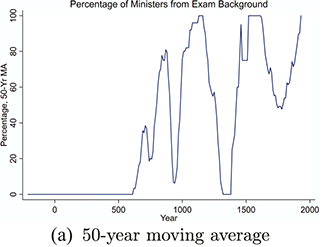
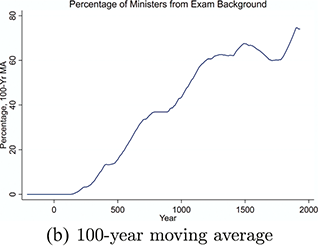
What about the family backgrounds of the ministers? In Figure 10(a), we present the century-average percentage of ministers whose fathers held government positions previously. The solid line traces the percentage of all ministers. As a robustness check to ensure data consistency across various dynasties, the dashed line is calculated as the percentage of ministers for whom father-related information is available. Notably, the index commenced at a remarkably high level when the Tang dynasty had just begun. Approximately 60%–80% of ministers in the 7th century had parental ties to the government, with several cases of father–son ministerial pairs.Footnote 83 However, this trend began to wane progressively over subsequent centuries, reaching an eventual low level of below 20% during the Qing dynasty.
Family background of ministers
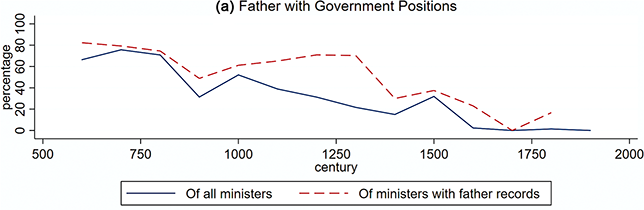
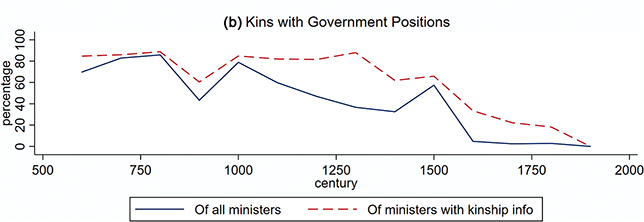
One might raise the concern that parental officeholding was one of many channels through which family connections could play a role.Footnote 84 Marriage networks, as well as extended family connections, could also prove tremendously beneficial in historical China.Footnote 85 As a robustness check, Figure 10(b) plots a similar time trend for the percentage of ministers with at least one extended family member holding a government position within three older generations. Again, the solid line traces the percentage of all ministers, while the dashed line is calculated as a ratio of ministers with kinship information available.Footnote 86 The pattern remains similar. Both Figure 10(a) and (b) confirm a downward trend in ministers’ elite family backgrounds after the Tang dynasty and more significantly after the Song.Footnote 87
Now we have some evidence to answer the question raised at the beginning of the subsection: Who became the top officials in imperial China? The answer is that since the late Tang and especially since the Song dynasty, an increasingly larger portion of ministers had exam backgrounds and came from less politically prominent families.
The evidence presented here shows the increasing popularity of Keju among the political elites. Unfortunately, it cannot be used as direct evidence to prove the importance of Keju in determining one’s political career. One potential confounding factor is the growing population of exam candidates. Even if Keju had no impact on the political career of officials, we would still see a larger percentage of ministers with exam backgrounds simply because the underlying population with Jinshi degrees had grown larger. This is an inherent issue with studies that suffer from survival bias – a problem that happens when one focuses on the successful few and ignores the ones who did not make it.
To address the survival bias, we need a sample that includes both those who made it and those who did not. We construct such a sample by collecting information on the ministers’ sons.Footnote 88 The ministers serve as a sample of the top political elites, excluding the royal families. The career outcomes of their sons can be an indicator to illustrate the level of political reproduction within the top elite families.
Figure 11 examines the career outcomes of the ministers’ sons over time. In Panel (a), the solid line shows the century-average percentage of ministers with at least one son obtaining a government position. This indicator is calculated as a percentage of all ministers, while the dashed line provides a robustness check, using the subsample of ministers with son records as the denominator.Footnote 89 Panel (a) shows that the percentage of ministers’ sons who obtained government positions had declined substantially since the latter half of the Tang dynasty – a pattern that perfectly echoes Figure 10. Furthermore, this declining trend became even sharper later on. If we treat the year 1200 as the dividing year, around 49% of ministers could secure government positions for at least one of their sons before the 13th century. That ratio dropped remarkably afterward and eventually reached an average of 5.6% after the 16th century.
Career outcome for ministers’ sons
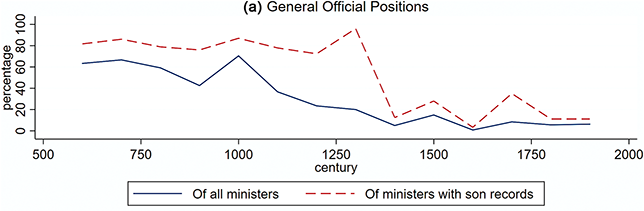
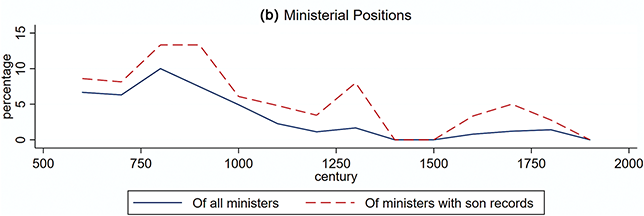
Admittedly, this index can be subject to several limitations. Most notably, the records of government officials may not be consistent over time. To address this issue, we recalculated a similar index based on the portion of ministers’ sons who obtained top ministerial positions. The justification for this approach is that we have much more complete records of ministers, compared to data on general official positions. Hence, we can safely treat a missing data point as a negative value for ministerial positions. Figure 11(b) plots this modified index, and the pattern remains similar. In the Online Appendix, we perform more robustness checks on the career outcomes of ministers’ offspring, including their grandchildren, and the pattern remains the same.
Both Figures 10 and 11 confirm the same phenomenon – that the level of power perpetuation within the top elite families, at least at the minister level, had started to decline since the Tang dynasty and more dramatically since the 11th century.Footnote 90
To shed light on the cause of this decline, we examine the impact of a Jinshi degree (passing the Keju exam) on the career outcome of a minister’s son using the following regression model:
 (2)
(2)
where i index the individual and t the century. The century
 equals one when s equals t, and zero otherwise. This equation estimates a series of century-specific Jinshi impacts
 . The goal of the equation is to trace the fluctuations in the impact of Jinshi degrees across different time periods.
The results are plotted in Figure 12. For comparison, the solid trend line plots the average probability of obtaining an office for a minister’s son if he had no Jinshi degree. The vertical confidence intervals are the estimated additional impacts of a Jinshi degree. Figure 12 shows that the significance of having a Jinshi degree increased dramatically during the Ming–Qing period, at a time when the probability of securing a government position dropped for those without a degree.Footnote 91 Even though having a Jinshi degree had always been a positive factor, the magnitude of its impact rose substantially after the 15th century. Before the 14th century, having a Jinshi degree enhanced the probability of obtaining an office by 24 percentage points on average. Afterward, the average contribution of a Jinshi degree soared to a 58 percentage point increase in the probability. These statistics are based on the subsample of ministers with sons’ information available, and, hence, not likely due to differences in data coverage.
Regression on career outcomes for ministers’ sons, subsample
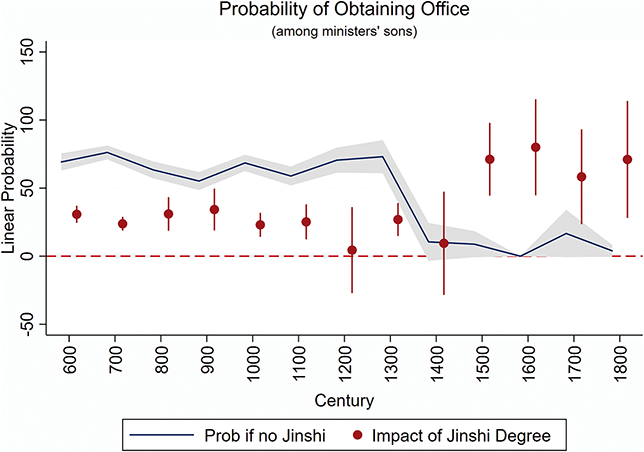
Figure 12 illustrates a turning point in political selection during the 15th century. Two changes occurred simultaneously. First, success in the Keju became a more prominent predictor of career success. And secondly, it became much more challenging for the political elites to pass power onto their children outside the Keju system.
The evidence accords well with historians’ observations. During the Song dynasty, hereditary privilege (yin, or royal protection, men-yin 门荫) was still an important way to enter office. Royal protection was a political privilege granted to relations of the royal family, top officials, or individuals with outstanding contributions to the empire. It allowed their descendants, usually their sons, to obtain some kind of office on the basis of birth. According to Chaffee (Reference Chaffee1995, p.25), in the year 1213, about 40.8% of administrative government officials in ranks six to nine held a Jinshi degree, while 52.5% entered offices through royal protection. During the Ming dynasty, until 1467, all civil officials of ranks one through seven, after certain years of satisfactory service, were entitled to “protect” (yin) one son or grandson each, who would become automatically eligible either for office or for enrollment as an imperial academy student. From 1467 on, this privilege was restricted to the highest-ranking officials, who were in ranks one through three, and those with enfeoffment. And even their heirs had to pass qualifying tests and could only be enrolled in the imperial academy, not directly appointed to office (Hucker, Reference Hucker, Mote and Twitchett2008). At the same time, the path of recommendation to officialdom almost disappeared by the late 15th century (Hucker, Reference Hucker, Mote and Twitchett2008, p. 30). By the Qing dynasty, the scope of the yin privilege was further restricted for civilian officials. Note that even prior to these efforts to curtail the yin privilege, it was already widely acknowledged among elite circles since the 9th century that those who entered the bureaucracy via royal protection generally would not be able to advance very far in the bureaucratic echelon. Keju had always been viewed as the most promising mode of entry since late Tang, and its perceived advantage over the yin only grew further with these aforementioned efforts to explicitly restrict the yin system.
By 1764, Ho (Reference Ping-ti1962, p. 48) estimated that about 72.5% of local officials between seventh and fourth ranks, which formed the backbone of local administration, had a Keju background. In comparison, purchase contributed to 22.4% and yin privilege only 1%.Footnote 92 Similarly, relying on a completely different dataset of household registration in the 18th to the 19th century, Campbell and Lee (Reference Campbell and Lee2003) show the existence of substantial downward mobility among the sons of prominent families, as well as upward mobility for the commoner, even after accounting for the influence of distant kin. The development of the Keju was no doubt accompanied and, to some degree, aided by the gradual dismantling of elite privileges.
In summary, the results in this section illustrate a declining level of power perpetuation within the top elite families from the 10th to the 19th centuries. This phenomenon is likely driven by a combination of two forces. On the one hand, the Keju system itself became more competitive over time, and the advantage enjoyed by top elite families declined substantially. On the other hand, outside the Keju system, additional pathways to officeholding were gradually shut down or pushed away as secondary means. Keju was eventually elevated to a level that shadowed all other government recruitment methods in both scale and prestige. This long process also highlights that no institution at the scale of the Keju can be built overnight; it will require an extensive process and the co-development of supporting institutions.
4.4 Conclusion
To summarize, we provide two sets of quantitative evidence in this section. The first set of evidence illustrates the development of Keju and uncovers the implicit selection criteria it employed. The finding suggests that, since the 10th century (the earliest century for which data is available for this long-term analysis), exam performance reflected less on the family backgrounds of the candidates and more on regional economic development.
The second set of evidence investigates the overall rule of political selection in the imperial governments. We approximate the level of political reproduction among the top elite families using two measurements: the percentage of ministers with fathers or relatives holding government positions before them, and the percentage of ministers’ sons who obtained government positions after them. Both indicators had started to decrease since the Tang dynasty and more rapidly after the Song, at a time when the Keju was further expanded and institutionalized. Using data on ministers’ sons as a representative sample of the descendants of top elite families, we show that family background gradually lost weight in predicting an individual’s political career. In comparison, exam performance remained a significant factor throughout the millennium and gained even more influence from the 14th century onward.
Combining results from both sides leads naturally to the conclusion that Keju had played a pivotal role in limiting the perpetuation of political power among elite families in historical China. At the very least, Keju helped maintain a selection rule that put limited weight on family backgrounds. All elites, except the royal family, were subject to political competition via Keju. The popularity and importance of Keju ensured that members of elite families would not be able to monopolize political access, and individuals from non-elite backgrounds could enter the political arena in a regular fashion. This would have helped reshuffle the political elite and prevent the emergence of powerful political families in competition with the royal family.
Lastly, the results in this section illustrate the gradual development of the Keju system and emphasize the coevolution of institutions. One of our main arguments is that Keju expanded political participation beyond the top elite families to include lower elites and even some wealthier commoners. However, Keju could not have achieved this on its own. Broader participation was made possible by the spread of books, the growth of schools, and dynastic support for educational infrastructure. Additionally, the rise of Keju was facilitated by the gradual dismantling of hereditary privileges outside the system. Just as Rome wasn’t built in a day, an institution of Keju’s scale needed to be tested, contested, and refined over time.
5 Keju and Political Stability
This section investigates the intricate relationship between Keju and political stability. Keju was established in China during the 7th century. The idea of Keju later extended to other East Asian countries via traveling monks and diplomats. Analogous exam systems emerged in Korea (from 958 to 1894), Vietnam (from 1075 to 1913), Japan (briefly during the Heian period, 794–1185), and Ryukyu (from the early 15th century until the Japanese occupation in 1609). In Korea and Vietnam, Keju evolved into a pivotal – if not the preeminent – pathway to political offices, profoundly shaping their subsequent political and social development.
We first conduct a cross-country regression analysis encompassing 4,119 rulers across 112 historical states from the 1st to the 18th centuries. This empirical exercise reveals a positive relationship between the establishment of the Keju system and improvements in ruler stability. Remarkably, the magnitude of this correlation rivals the impact observed for the establishment of parliamentary systems in Europe.
Building upon the empirical evidence, we advance a theoretical discourse by synthesizing insights from various literatures to explore plausible mechanisms through which the Keju system may affect political stability. These mechanisms include the installation of meritocracy, expansion of the selectorate, augmentation of regional representation within the government, facilitation of social mobility, and the cultivation of a state ideology emphasizing homogeneity and loyalty toward the ruler.
5.1 Empirical Evidence on Stability
Western Europe witnessed a sustained increase in ruler duration since the 9th century (Blaydes and Chaney, Reference Blaydes and Chaney2013). Scholars emphasize the role of parliamentary institutions in facilitating political stability (e.g. Strayer, Reference Strayer1970; Downing, Reference Downing1992). Parliaments offered powerholders a venue to communicate with each other, to bargain with the ruler collectively, and to exercise institutional checks and balances against the ruler. They thus facilitated the ruler’s credible commitment to the preservation of the elite’s interest, reducing incentives for coup or revolt (e.g. North and Weingast, Reference North and Weingast1989; Stasavage, Reference Stasavage2003; Blaydes and Chaney, Reference Blaydes and Chaney2013).
Recall the prominent observation in Blaydes and Chaney (Reference Blaydes and Chaney2013) that ruler duration in Europe outpaced that of the Muslim world since the 9th century. This divergence in political stability was rooted in Europe’s “feudal revolution,” which gave rise to executive constraints, culminating in the development of parliamentary institutions – an evolution not paralleled in the Middle East (Blaydes and Chaney, Reference Blaydes and Chaney2013). We now compare ruler duration in Europe with that of polities in East Asia, which, like the Middle East, lacked parliamentary institutions. However, unlike the Muslim world, all East Asian polities except Japan adopted the Keju system. Figure 13 compares the trends in ruler duration between Europe and East Asia from 800 ce, arguably the beginning year of Europe’s “feudal revolution.” We use data from Morby (Reference Morby1989) due to its broader temporal coverage compared to that of Blaydes and Chaney (Reference Blaydes and Chaney2013). The dashed line substantively reproduces the observation in Blaydes and Chaney (Reference Blaydes and Chaney2013) about the enhancement of ruler stability in Europe.
Ruler duration in East Asia and Europe
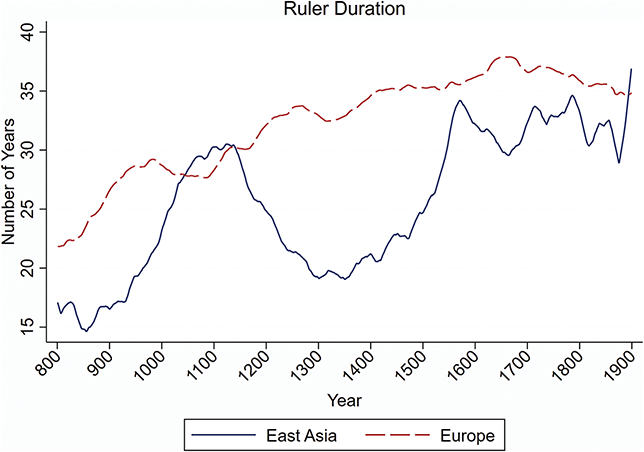
Interestingly, at various points in time, East Asia appeared to catch up with Europe in terms of ruler duration. The 100-year moving average of ruler duration in East Asia began increasing around the mid-9th century, with a sharp rise during the Northern Song dynasty, coinciding with the expansion of the Keju system and the implementation of additional institutions and policies that solidified its dominance. By the early 12th century, ruler duration in East Asia had even surpassed that of Europe. The trend dipped after northern China fell to several alien empires that would eventually be conquered by the Mongols, whose dynasty failed to regularize Keju except for a brief period. Also contributing to the dip were the various political upheavals during the Hojo regency in Japan’s Kamakura period, a country that never adopted the Keju. However, following the Ming dynasty’s founding in the 14th century, Keju was restored and further expanded (Section 4). Correspondingly, ruler duration in East Asia sharply increased once again, drawing much closer to European levels by the 19th century.
Figure 13 suggests that the Keju system may offer a unique possibility: Monarchies without institutions of credible executive constraint could still achieve political stability. We gather a cross-country panel to empirically investigate the relationship between different institutions (parliament and Keju) and political stability. The panel covers 112 historical states spanning the Eurasia continent from the 1st to 18th centuries. The data is collected from multiple sources, including Morby (Reference Morby1989) for ruler information, Blaydes and Chaney (Reference Blaydes and Chaney2013) for the timing of parliamentary systems, and Kukhak-Charyowon (Reference Charyowon and Bangmok1993), Hoan and Khai (Reference Hoan and Thuc Khai1963), Jin et al. (Reference Jin, Zhang and Wu2015) and Chen (Reference Chen2015) for information on Keju systems in other East Asian states.Footnote 93 The resulting dataset covers 4,119 rulers in 564 dynasties from 112 historical states. We estimate the following model:
 (3)
(3)
where i indicates the ruler, t the century, and j the historical polity. The variable
 is a dummy taking one if the ruler held at least one parliament meeting during his reign, while
 takes one if the ruler held at least one Civil Service Examination during his reign. We measure ruler stability with two indicators: the number of years that a ruler stayed in power (Ruler Duration) and the annual probability of a ruler being deposed by unnatural means (Depose Probability). The results for Equation (3) are provided in Table 2.
| Variables | (1) | (2) | (3) | (4) |
|---|---|---|---|---|
| Ruler duration | Ruler duration | Depose prob. | Depose prob. | |
| Parliament | 4.947*** | 4.786** |
 0.0274
 |
 0.0234
 |
| (1.906) | (1.903) | (0.0319) | (0.0319) | |
| Keju_dummy | 6.044*** |
 0.146***
 | ||
| (1.540) | (0.0528) | |||
| Keju_scale | 0.141** |
 0.00312***
 | ||
| (0.0281) | (0.000670) | |||
| Century and | Y | Y | Y | Y |
| polity FE | ||||
| Observations | 4,058 | 4,042 | 2,581 | 2,565 |
 -squared
 | 0.191 | 0.198 | 0.167 | 0.174 |
Note: The unit of analysis is ruler-reign. Robust standard errors are in parentheses.
*** indicates
 , **
, **
 , and *
 . The variable Keju_Scale is the average annual number of graduates who passed the Keju exams during the ruler’s reign.
Table 2 shows that both parliamentary meetings and Keju exams were associated with improved ruler stability. Moreover, Column (1) allows for a direct comparison of the magnitudes of their correlation. The occurrence of parliamentary meetings was associated with a 4.9-year increase in ruler duration, while that of the Keju with a 4.8-year increase. The Keju system had an even stronger negative correlation with deposition probability than parliament.
The findings presented here suggest the intriguing possibility that the same outcome of political stability could be achieved through diverse institutional solutions. In Western Europe, parliaments offered a venue for peaceful conflict resolution by placing constraints on the monarchs; In East Asia, the establishment of exam-based bureaucratic recruitment could have improved political stability through entirely different channels (discussed in the following subsection). In the Muslim world, neither institution was established, and ruler stability remained relatively low after the medieval period (Blaydes and Chaney, Reference Blaydes and Chaney2013).
5.2 Theoretical Mechanisms
Historians have long recognized the importance of Keju for the stability and coherence of dynastic rules in China. In Elman’s words, the Keju system “was the sine qua non for gentry officials and aristocratic rulers to maintain their proper balance and direction between each other and vis-a-vis the society at large” (Elman, Reference Elman2013).
This subsection discusses several theoretical mechanisms that might explain the link between Keju and political stability. Here, the literature is vast and multidisciplinary. Our survey is by no means exhaustive.
5.2.1 Elite Politics
There has been an extensive debate over the meritocratic nature of the exam system (see Section 5.2.4). Leaving that debate aside, it is important to note that a system does not need to achieve perfect meritocracy to enhance political stability. As long as Keju improved social mobility to some extent, it would allow a broader segment of society to be considered for office, ultimately benefiting the ruler. This idea is rooted in the selectorate theory pioneered by De Mesquita et al. (Reference Mesquita, Bueno, Smith, Siverson and Morrow2005), which argues that rulers rely on a core group of supporters (the “winning coalition”) drawn from a larger pool of political insiders known as the “selectorate.” A ruler’s political survival is most secure when the selectorate is much larger than the winning coalition, as the ruler can easily replace members of the winning coalition with others from the selectorate, drawing on a larger base of support.
In the Chinese context, the bureaucracy, or its upper echelon consisting of the top political elites, can be thought of as the winning coalition. The exam system expanded the size of the selectorate by opening up bureaucratic eligibility to more individuals, particularly from the lower elites, reducing the importance of birth, family prestige, and other restrictive factors for office. As the selectorate grew larger, individual members became more interchangeable, giving the ruler greater control and reducing the bargaining power of any particular family or group within the top political elite.
There is a rich historical literature on the importance of Keju in China’s transition away from an age dominated by the aristocracy (e.g. Bol, Reference Bol1992; Lu, Reference Yang2016), recently further validated by the empirical work of Wen, Wang, and Hout (Reference Fangqi, Wang and Hout2024) and in Section 3. Huang and Yang (Reference Huang and Yang2022) were among the first to propose an explanation of Keju’s stability implication based on a formal political theory. Our empirical results in Section 4 also collaborate with this argument. The exam system indeed broadened political access to a much larger population and limited the impact of birth and family.
5.2.2 Popular Support
Scholars have long underscored how the exam system facilitated an impressive degree of social mobility within the confines of a premodern society (e.g. Ho, Reference Ping-ti1962; Chaffee, Reference Chaffee1995; Elman, Reference Elman2013). This prospect for upward advancement, albeit modest, offered people an avenue to pursue personal aspirations without disrupting the ancien régime. Crucially, it elevated the opportunity cost of rebellion against the ruler.
This mechanism applied particularly well to the Chinese gentry, the elite group that benefited most from the exam system. However, its impact extended beyond the elite to broader society. Although immediate success in the exams and entry into elite circles was difficult for the lower classes, who made up the majority of society, the system offered the hope of eventual social mobility through the accumulation of wealth and educational resources over generations (Elman, Reference Elman2013). The prospect that their sons and grandsons could attain such status likely fostered a pacifying attitude toward the regime among the lower classes, encouraging them to focus on improving their own well-being through legal means and reducing potential dissent.
Empirically, Bai and Jia (Reference Bai and Jia2016) show that the abrupt termination of the exam system in 1905 directly contributed to popular uprisings against the dynastic regime in the early 20th century. With avenues of social mobility now closed, those would-be elites resorted to revolution against the regime. Liu (Reference Liu2023) argues that meritocracy can be used to co-opt large numbers of ordinary citizens by providing them with an opportunity of socioeconomic advancement in lieu of income redistribution (which is theoretically seen as detrimental to the interest of autocrats), as long as the selection process is viewed as inclusive and rule-based. Even though Liu (Reference Liu2023) focuses on civil service examinations in contemporary China, the same mechanism would have worked in a historical setting as well. On the negative side, Kuipers (Reference Kuipers2023) shows that failing the civil service exam can decrease applicants’ belief in the legitimacy of the process and levels of national identification, relying on the contemporary example of Indonesia.
5.2.3 Regional Representation
In 1397, in one of the first Keju exams ever administered for the new Ming dynasty, the founding emperor was furious to find all fifty-one candidates who passed the palace exam that year coming from the southern provinces of China. Following an extensive investigation, he ordered the execution of several high-ranking court officials and banished numerous others. He personally reviewed all the exam papers and selected an additional sixty-one candidates, this time all from the north (Hucker, Reference Hucker, Mote and Twitchett2008).
At the time, the southern regions of China boasted considerably higher levels of development than the north. To the extent that wealth could readily translate into educational investment and human capital, it is reasonable to expect better exam performance from southern candidates. To complicate the matter further, the founding emperor of the Ming dynasty, as well as the great majority of his generals, were originally from the south. The south had contributed significantly more resources and manpower to his earlier military campaigns. If a ruler’s primary concern was to reward loyal followers, the logical course for the founding emperor should be to prioritize exam candidates from the south.
Yet, rather remarkably, he chose to extend political benefits to groups that hadn’t played a direct role in his ascent to power. This deliberate choice was probably rooted in his belief that, for his government to garner widespread support, it was imperative to encompass members from all regions.
Section 4 already highlighted how the elimination of the centralized elite by war in the late 9th and early 10th centuries inadvertently allowed future rulers to enforce regional quotas more strictly. Since the Song dynasty, candidates from all regions of China were admitted to the final stages of the exam, where they competed for Jinshi degrees and the final rankings. However, due to the ongoing North versus South controversy, further reforms were deemed necessary: not only should the body of contestants reflect regional diversity, but also the final winners. Under the Ming, a quota system was introduced at the highest level (for the Jinshi holders) – dividing China into northern, southern, and central regions.Footnote 94 The later Qing dynasty further refined this quota structure in a way that allowed the emperors to easily adjust the regional composition of governmental personnel.
Political representation lies at the core of modern democratic politics. In democratic regimes, a representative pursues the interest of the people who have the right to elect her. However, Rehfeld (Reference Rehfeld2006) argues that political representation does not have to be a democratic phenomenon at all. Political representation could also arise in nondemocratic settings.
Strictly speaking, the regional representation within the Keju didn’t align precisely with modern concepts of political representation. Rather, it functioned as a mechanism for the emperor to distribute political rents and allocate power strategically. Nonetheless, to the extent that the interests of officials might partially overlap with those of their native regions, their presence in the central government could also serve to advance the interests of their hometowns. In this light, Keju might be viewed as an example of a premodern, nondemocratic form of political representation. Xue and Zhang (Reference Xue and Zhang2021) show that a provincial quota system reform initiated in 1712 expanded opportunities for individuals from underrepresented provinces and mitigated cross-provincial inequality in political access. Chen, Kung, and Ma (Reference Chen, Kai-sing Kung and Ma2020) document a wide range of positive impacts that the Keju had on local communities, including better educational infrastructure, a higher level of social capital, and a culture that valued education. Thus, the exam system likely contributed to political stability by enhancing regional representation within the imperial government and facilitating greater inclusion across provinces. Another mechanism linking regional representation to political stability is that a geographically diverse body of government officials also makes it difficult for elite coordination and collusion against the ruler.Footnote 95
5.2.4 The Debate on Meritocracy
An intellectual tradition in the English literature that traces back to Enlightenment thinkers, such as Voltaire and Quesnay, and later Weber, considered the Keju system a form of meritocratic governance. Many China scholars, coming from entirely different traditions, also view Keju as, at least, relatively meritocratic for a premodern institution (e.g. Elman, Reference Elman2013; Chen, Kung, and Ma, Reference Chen, Kai-sing Kung and Ma2020; Huang, Reference Huang2023). However, the exact definition of meritocracy seems to vary across individuals and disciplines. While some scholars regard it a critical feature of meritocracy to provide equal opportunities for all social groups, others emphasize that meritocracy is a system that rewards competence and effort. Often, studies do not explicitly distinguish the two definitions as it is implied that one would naturally lead to another.
The literature continues to engage in debates regarding the extent of Keju’s meritocratic nature due to at least two unresolved issues. Regarding the first definition of meritocracy as equalizing opportunities, opponents highlight the enduring advantage wielded by affluent families and political insiders within the Keju system (Huang, Reference Huang2016b; Paik, Hong, and Yun, Reference Paik, Chul Hong and Yun2022; Peng, Reference Peng2023).Footnote 96 Regarding the second definition emphasizing competence selection, opponents point to a wide gap between the necessary skill set required for a government job – arguably, administrative capacity and statecraft – and the actual content of the exams, which primarily focused on a formulaic, politically correct understanding of Confucian classics (Bai, Reference Bai2019; Huang, Reference Huang2023; Peng, Reference Peng2023, but see Kung, Liu, and Zhang, Reference Kung, Zhengcheng Liu and Zhang2025).
However, the literature overlooks a crucial third aspect: a potential trade-off between equalizing opportunity and competence-based selection. The extent of this trade-off hinges on the natural distribution of talent within the population. Should innate talent be randomly distributed across various social groups, a competence-based system automatically necessitates equalizing opportunities. On the other hand, if family backgrounds affect personal competence via the bequeath of cultural capital and political know-how, a genuinely competence-based “meritocratic” system might still reflect a certain level of insider advantage and wealth effect. From this perspective, determining the meritocratic nature of Keju entails the formidable empirical task of gauging the output of the exam system against the underlying “competence distribution” in the population, which is beyond the scope of our Element.
Nonetheless, it is worth noting that all three political mechanisms discussed from Section 5.2.1 to 5.2.3 require equalizing opportunity, but not necessarily competence-based meritocracy. Combining with competence-based meritocracy would certainly amplify the impact, but even if mobility was engineered by random reshuffling of social status, it would have an impact on political stability as well. In other words, equalizing opportunity can be more important than competence-based meritocracy from the perspective of political stability.
This equalizing consideration could explain why the exam curriculum became narrower and more stringent over time, as a limited curriculum emphasizing memorization would help minimize the advantage of family background. A related argument can also be made to explain why the Qing dynasty rulers failed to incorporate modern scientific studies into the Keju curriculum when calls for modernization were on the rise as China suffered military defeats and territorial encroachments by Western powers in the 19th century. An exam testing candidates on modern science would primarily benefit elite families, especially the already wealthy ones from southeastern regions of China that had enjoyed high exposure to the West since the mid-19th century, and thus diminish Keju’s equalizing effect. We have no direct evidence to prove whether the Chinese monarchs were acutely aware of this trade-off. Still, many of their policies throughout history constantly reflected efforts to navigate the trade-off between equality and competence. Sections 3 and 4 detailed numerous procedures adopted by the imperial governments to preserve the equalizing potential of the exams, such as affirmative action policies that discriminated against the Zidi in the Tang, anonymization and transcription of the exam paper in the Song, regional quota at various levels in the Ming and Qing sometimes even at the expense of regions with great human capital, and the establishment of publicly funded schools throughout the second millennium. Many such reforms were initiated under the name of “meritocracy.” Even though their impact on personal competence might be debatable,Footnote 97 they all effectively promoted equal opportunity.
5.3 Conclusion
This section explores the potential influence of the exam system on political stability. To contextualize our discussion, we start with a cross-country panel regression based on 112 historical states. Our findings reveal a positive correlation between the adoption of the exam system and ruler stability. Notably, the significance of this correlation rivals the impact observed for the establishment of parliamentary systems in Europe. To establish theoretical underpinnings, we propose three potential mechanisms that explain the connection between the Keju system and political stability. Finally, to conclude this section, we engage in a discussion regarding the definition and implications of meritocracy within the context of political stability.
It is worth emphasizing that Keju was not the only path to autocratic stability in general or the sole reason for monarchical supremacy in China. The Chinese state was already moving toward recentralization before the establishment of Keju (e.g. Chen, Wang, and Zhang, Reference Chen, Wang and Zhang2025). Sections 2 and 3 underscore the gradual and concurrent institutionalization of the exam system alongside other political developments that could also influence political stability. Additionally, Chinese rulers since the 9th century likely recognized the political implications of Keju and deliberately promoted the system alongside other measures to reinforce imperial power. Section 2.2.6 already highlights the futility of quantitatively identifying the “causal effect” of the Keju treatment. The mixed-methods approach in this Element is better suited for the question at hand, and the more plausible verdict is that Keju made an already powerful monarchy even more so.
Lastly, another issue often associated with Keju is Confucianism. This ideology was central to the Keju system and exam materials and was promoted alongside the exam apparatus for millennia. It validated state authority and advocated loyalty to the ruler as the highest moral conduct dedicated to state welfare. Confucianism’s influence on China’s political development and stability is well-documented, and Keju likely contributed to its indoctrination. Due to space constraints and the extensive literature on this topic, we do not elaborate further (see Elman (Reference Elman2000) and Zhao (Reference Zhao2015) for more details).
Acknowledgments
The authors thank Iza Ding, Patricia Ebrey, Pierre Landry, Xiaobo Lü, Xiao Ma, and Ashutosh Varshney, as well as the participants at the 2023 American Political Science Association Annual Meeting, the 2023 Symposium on Comprehensive Modernization and Political Development at Zhejiang University, and the 2024 Deep Roots Conference at the Complexity Science Hub Vienna, for their thoughtful feedback. We are deeply grateful to Cameron Campbell for his helpful advice on data. We also greatly appreciate the comments and support from David Stasavage, Mark Dincecco, and an anonymous referee, which have been invaluable in shaping the development of this work. Finally, we are thankful to Ao Ge, Yuying Jiang, Lulu Li, Sunny Junyang Li, Jiahui Xu, and Yunzhong Zhang for their superb research assistance.
Mark Dincecco
University of Michigan
Mark Dincecco is Professor of Political Science at the University of Michigan. His research analyzes the long-run historical determinants of the political and economic development patterns that we observe today, with a focus on Europe and Eurasia. Dincecco has published numerous articles in leading academic journals across both political science and economics. His most recent book is From Warfare to Wealth: The Military Origins of Urban Prosperity in Europe, the winner of the William Riker Best Book Award. Dincecco received his PhD in Economics from UCLA.
About the Series
The Element Series Political Economy provides authoritative contributions on important topics in the rapidly growing field of political economy. Elements are designed so as to provide broad and in-depth coverage combined with original insights from scholars in political science, economics, and economic history. Contributions are welcome on any topic within this field.


 Open access