


1. Introduction
The identified victim effectFootnote 1 refers to a heightened willingness to contribute to victims whose identities are clearer, presented with details such as their first name or a picture. Kogut and Ritov (2005a) investigated the boundary conditions and the mechanisms underlying the identified victim effect by examining varying group sizes and identifiability. They found that the identified victim effect was stronger on both willingness-to-contribute and empathic emotions (e.g., distress) when the target of contribution was a single individual than when the target was a group of victims. The authors, therefore, demonstrated an interaction between two factors previously shown to have an impact on charitable giving and emphatic emotions—singularity and identifiability.
We sought to revisit this classic finding and re-examine the conditions which encourage or discourage helping intention. We report an independent close replication of the identified single victim effect demonstrated in Kogut and Ritov (Reference Kogut and Ritov2005a) Study 2 along with two extensions, testing the effect of group belonging as a conceptual replication of Kogut and Ritov (Reference Kogut and Ritov2007) and examining perceived responsibility (Erlandsson et al., Reference Erlandsson, Björklund and Bäckström2015).
We begin with a brief literature review on the identified victim effect, with sub-factors of identifiability and singularity, as impacting charitable giving. We then discuss our motivations for the current replication and review Kogut and Ritov (Reference Kogut and Ritov2005a) as our chosen article. We then outline our chosen studies for replication from the target article, the target’s experimental design, and our adaptations and extensions.
1.1. Factors impacting charitable giving and empathic concern
We considered the identified victim effect as an umbrella term that combines several phenomena, which scholars in this literature at times tend to confound. Some scholars emphasize ‘identifiability’—whether the victims are identified or not, whereas some emphasize the number of people affected, which we refer to as ‘singularity’—contrasting a single person to a group dichotomizing two related phenomena of ‘compassion fade’ and ‘scope insensitivity’ looking at the number of people as a continuous factor. Our chosen target article for replication, Kogut and Ritov (Reference Kogut and Ritov2005a), examined the interaction of these two factors.
1.1.1. Identifiability
The identifiability effect is the tendency to provide greater aid to (a) specific identified victim(s) than to (an) unidentified victim(s) (Small and Loewenstein, Reference Small and Loewenstein2003). This is now considered a classic effect in the social psychology and decision-making literature, with many follow-up studies reporting empirical evidence in support of the phenomenon (Slovic, Reference Slovic2010; Small et al., Reference Small, Loewenstein and Slovic2007; but see recent replication of their paper by Maier et al., Reference Maier, Wong and Feldman2023). The primary argument was that emotional reactions are the main underlying mechanism of the phenomenon, as emotions tend to dominate reasoning when the target’s representation is specific and vivid (Hamilton and Sherman, Reference Hamilton and Sherman1996; Sherman et al., Reference Sherman, Beike, Ryalls, Chaiken and Trope1999).
1.1.2. Singularity and compassion fade
The singularity effect is the tendency to provide greater aid to a single victim than to a group of victims facing the same need. This seems related to a similar phenomenon of ‘compassion fade’ or ‘scope insensitivity’, which treats the number of people affected as a continuous measure and refers to people’s decreasing ability to emphasize and willingness to help the more suffering, victims, or people in need are involved (Västfjäll et al., Reference Västfjäll, Slovic, Mayorga and Peters2014). Some have shown that this not only happens regarding the number of people affected but also extends to the proportion of people helped (Fetherstonhaugh et al., Reference Fetherstonhaugh, Slovic, Johnson and Friedrich1997; but see recent replication of their paper by Ziano et al., Reference Ziano, Li, Tsun, Lei, Kamath, Cheng and Feldman2021c). The general argument was that people experience psychic numbing—they become more psychologically numb and are therefore less likely to take action to step in and help the more people are involved (Slovic, Reference Slovic2007). If this phenomenon was indeed true, then this would mean that helping behavior does not maximize social benefits, as resources are more likely to be allocated to a single identified victim than to the greater population of people in need.
1.1.3. Interaction between singularity and identifiability
The literature about the identified victim effect covers a wide spectrum of findings at the intersection of identifiability and singularity. In a series of papers, Kogut and Ritov (Reference Kogut and Ritov2005a, Reference Kogut and Ritov2005b, Reference Kogut and Ritov2007) demonstrated an interaction between singularity (one vs. many victims) and identifiability (identified vs. unidentified). The authors argued that identifiability is limited to situations in which the target of contribution is a single victim. Kogut and Ritov (Reference Kogut and Ritov2005b) suggested that the processing of information about individuals and groups is fundamentally different because a single victim is perceived as a more psychologically coherent unit than a group of victims (Hamilton and Sherman, Reference Hamilton and Sherman1996; Susskind et al., Reference Susskind, Maurer, Thakkar, Hamilton and Sherman1999). People pay attention to individuals, yet their attention begins to lose focus and intensity when targeting groups since they are psychologically more distant, resulting in the decline of helping behaviors toward groups of statistic victims (Hamilton and Sherman, Reference Hamilton and Sherman1996; Slovic, Reference Slovic2010; Susskind et al., Reference Susskind, Maurer, Thakkar, Hamilton and Sherman1999). To prevent themselves from suffering overwhelming levels of negative affect, people would then engage in emotional regulation by turning away their attention from the group of victims. Thus, the increased number of victims leads to motivated down-regulation of emotions and fewer donations. Some of the follow-up literature has shown some support for those findings (Dickert et al., Reference Dickert, Kleber, Peters and Slovic2011).
1.1.4. Mixed findings
In recent years, several replications of the effect have resulted in very mixed evidence, some by the very same authors who demonstrated identifiability and singularity. We summarized an incomplete list of some of the recent mixed findings in Table 1.
Identifiability and singularity/compassion-fade: Mixed findings in the literature
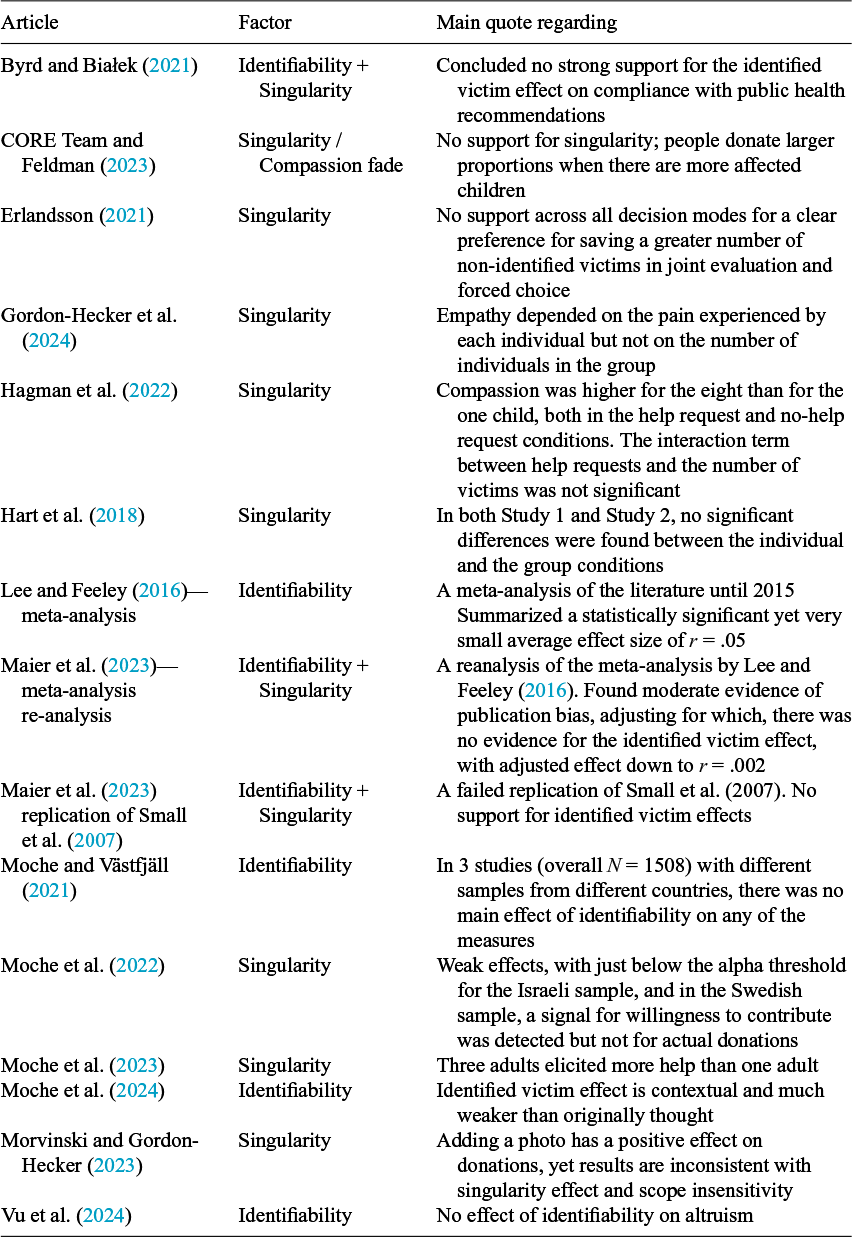
Two findings are especially noteworthy. Lee and Feeley (Reference Lee and Feeley2016) conducted a meta-analysis of 41 effects from 22 experiments and concluded only a weak identified victim effect (r = .05), with the three highest-powered studies in the dataset showing effects that are almost zero (e.g., 1 study: 12,802 participants, r = 0.004). Further statistical analyses on the studies included in Lee and Feeley (Reference Lee and Feeley2016) by Maier et al. (Reference Maier, Wong and Feldman2023) uncovered ‘moderate evidence of publication bias and strong evidence for the absence of an identified victim effect (BF01 = 14.93), with a model-averaged mean effect size estimate of r = 0.002 (95% CI [0; 0.004])’. In that same article, Maier et al. (Reference Maier, Wong and Feldman2023) also reported a failed conceptual replication of the seminal study by Small et al. (Reference Small, Loewenstein and Slovic2007).
1.2. Choice of the article for a direct replication: Kogut and Ritov (Reference Kogut and Ritov2005a)
We chose to replicate and extend the article by Kogut and Ritov (Reference Kogut and Ritov2005a) because of its impact and the theoretical and practical implications of its findings. We felt that the mixed findings in the literature exemplify the need for and value of direct, independent, and pre-registered replications of seminal impactful work.
1.2.1. Importance and impact
Willingness to help unrelated others, in situations where reciprocity is not a factor, is a common form of altruism. The identified victim effect is theoretically important because it suggests that such acts of altruism are more likely when people can identify the victim. Kogut and Ritov (Reference Kogut and Ritov2005a) have had a major scholarly impact on the social psychology and judgment and decision-making literature. At the time of writing (February 2024), there were 1019 Google Scholar citations of the article and many important follow-up theoretical and empirical articles.
At the institutional and political level, decisions concerning the allocation of resources for offering aid to humanitarian crises are often determined by individuals’ perceptions of victims’ needs (Slovic and Västfjäll, Reference Slovic and Västfjäll2010). Kogut and Ritov’s (Reference Kogut and Ritov2005a) work has potentially important practical implications because it could be applied to the development of public policy and the advertisement campaigns of charities.
1.3. Choice of study for replication: Study 2
Kogut and Ritov’s (Reference Kogut and Ritov2005a) empirical work consisted of 3 studies, and the current replication focused on Study 2 with modifications in the research design. In Study 2, the authors randomly assigned participants to one of four conditions of 2 (single vs. group of victims) × 2 (identified vs. unidentified victims). The authors found support for an interaction effect of singularity and identifiability of victims on willingness to contribute. However, the authors did not find support for the main effect of singularity and identifiability on willingness to donate.
We focused our replication on Study 2 as the most straightforward demonstration of the identified victim effect and interaction between singularity and identifiability. Kogut and Ritov’s (Reference Kogut and Ritov2005a) Studies 2 and 3 reported similar findings in support of the proposed mechanisms (i.e., affect) and boundaries (i.e., singularity) of the identified victim effect, with Study 2 using hypothetical contributions and Study 3 using real monetary contributions.
In contrast to the target’s findings, we did not find support for singularity, identifiability, or an interaction effect on willingness to contribute. We summarized the findings of the target article and the replication findings in Table 2.
Comparison of target article to replication findings: Effects of singularity and identifiability on willingness to contribute
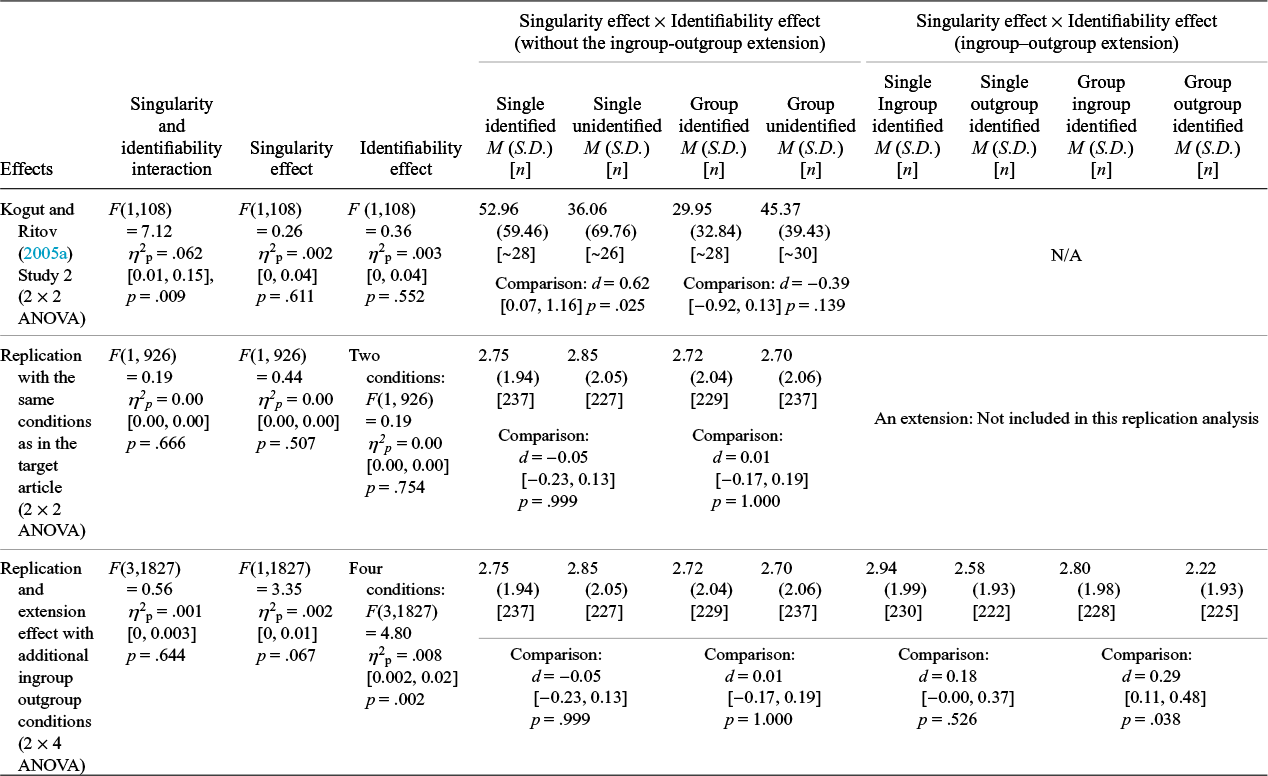
Note: N/A, not available since the original article of Kogut and Ritov (Reference Kogut and Ritov2005a) did not have a comparison for ingroup outgroup victims; We used 95% confidence intervals for Cohen’s d and 90% confidence intervals for η 2 p because η 2 p cannot assume negative values. For the target article, we reported the uncorrected p-values as was reported by the original authors. For the replication and extension analysis, all the p-values reported for the pairwise comparisons are Tukey corrected.
We classified our attempt as a ‘close replication’ using the LeBel et al. (Reference LeBel, McCarthy, Earp, Elson and Vanpaemel2018) replication classification (Supplementary Table S18). We tried to adhere as closely as possible to the target’s methods and design yet note that compared to the original study—we ran this with a different target sample and in a different context and made some adjustments regarding procedural aspects aiming to maximize fit to the target sample and increase the chances for a successful replication.
1.4. Extensions
1.4.1. Perceived responsibility
The sense of responsibility and obligation plays a crucial role in the moral decision-making process. Erlandsson et al. (Reference Erlandsson, Björklund and Bäckström2015) investigated possible mediators of different helping effects and found that perceived responsibility was responsible for the identified victim effect. In the current replication, we investigated the identified victim effect with both boundaries (i.e., singularity and group belonging) and aimed to examine whether the effect was limited to single ingroup victims (the identified ingroup single victim effect). We expected that the rating of perceived responsibility would be affected by an interaction between identification and singularity, such that people tend to express greater moral responsibility when considering a single identified ingroup victim than any of the other conditions.
1.4.2. Group belonging: Conceptual replication of Kogut and Ritov (Reference Kogut and Ritov2007)
People are more likely to provide aid to unrelated and unknown others when they categorize the victims as being in the same social category as themselves (Levine et al., Reference Levine, Cassidy, Brazier and Reicher2002, Reference Levine, Prosser, Evans and Reicher2005; Levine and Thompson, Reference Levine and Thompson2004). This categorization shortens the psychological distance between the perceiver and the victims, thus evoking feelings of greater emotional closeness (Brewer and Gardner, Reference Brewer and Gardner1996). Kogut and Ritov (Reference Kogut and Ritov2007) found that the effect of singularity and group belonging might interact as determinants of helping behaviors toward identified victims. Other studies found that support for group belonging is a boundary condition for the identified victim effect (Dovidio et al., Reference Dovidio, Piliavin, Gaertner, Schroeder, Clark and Clark1991, Reference Dovidio, Gaertner, Validzic, Matoka, Johnson and Frazier1997; Goetz et al., Reference Goetz, Keltner and Simon-Thomas2010). Therefore, we aimed to extend Kogut and Ritov’s (Reference Kogut and Ritov2005a) study by incorporating a manipulation as a conceptual replication of Kogut and Ritov (Reference Kogut and Ritov2007). In the present article, we added additional levels of group belonging in the independent variable of identifiability (i.e., unidentified, identified, identified ingroup, and identified outgroup) to explore the ingroup effect on the willingness to contribute toward identified single victims.
1.5. Pre-registration and open science
We first pre-registered the experiment on the Open Science Framework (OSF; https://osf.io/bjafe/), and data collection was launched later that week. Open-science details and disclosures, power analyses, and all materials used are detailed in the Supplementary Material. All pre-registration, materials, data, and code were made available on the OSFFootnote 2 : https://osf.io/9qcpj/.
All measures, manipulations, and exclusions conducted for this investigation are reported. All studies were pre-registered with power analyses reported in the supplementary, and analyses were only conducted after all data had been collected.
2. Method
2.1. Power analysis
We determined the required sample size in our replication by conducting a power analysis (95% power with alpha = 5%). In the original study, 120 participants were asked about their willingness to contribute to the costly life-saving treatment of sick child/children, as well as their feelings of empathic concern and distress toward the victims. The required sample size was calculated from the smallest effect size in the original study by G*Power 3.1.9.4 (Faul et al., Reference Faul, Erdfelder, Lang and Buchner2007), detailed in the ‘Power analysis of Study 2 of Kogut and Ritov (Reference Kogut and Ritov2005a, Reference Kogut and Ritov2005b) to assess the required sample for replication’ subsection in the Supplementary Material. After pre-registration, based on the budget we had allocated for this project , we increased the sample size to around 2000, which, after pre-registered exclusions, resulted in 1835 participants. We provided details of the exclusion criteria in Supplementary Table S17. A sensitivity analysis indicates that this sample is sufficiently powered to detect weak effects (Cohen’s f < 0.1 or η2 p < .01; power = 95%, alpha = 5%; groups = 8), far weaker than the interaction effect reported in the target article (η2 p = .062). We noted the deviation in ‘Pre-registration plan versus final report’ in Supplementary Table S18.
2.2. Participants
We recruited U.S. American participants online through Amazon Mechanical Turk (MTurk), using CloudResearch/TurkPrime (Litman et al., Reference Litman, Robinson and Abberbock2017). A total of 2003 participants completed the study. We retained 1835 participants (M age = 40.5 years, SD = 13.0 years; 972 males, 851 females, 12 other/would rather not disclose) after applying the pre-registered exclusion criteria. Analyses before and after exclusions were very similar overall.
2.3. Design
Kogut and Ritov (Reference Kogut and Ritov2005a) Study 2 design employed a 2 (Singularity: single victim vs. a group of eight victims) × 2 (Identifiability: identified vs. unidentified) between-subject design. Our replication design included their design and further extended it by adding two identified conditions, employing a 2 (Singularity: single victim vs. a group of eight victims) × 4 (Identifiability: unidentified vs. identified vs. identified ingroup vs. identified outgroup) for a total of eight conditions between-subject design. Given the between-subject design, our extensions do not impact on the target article’s design. We summarized the experimental design in Table 3.
Replication and extension experimental design
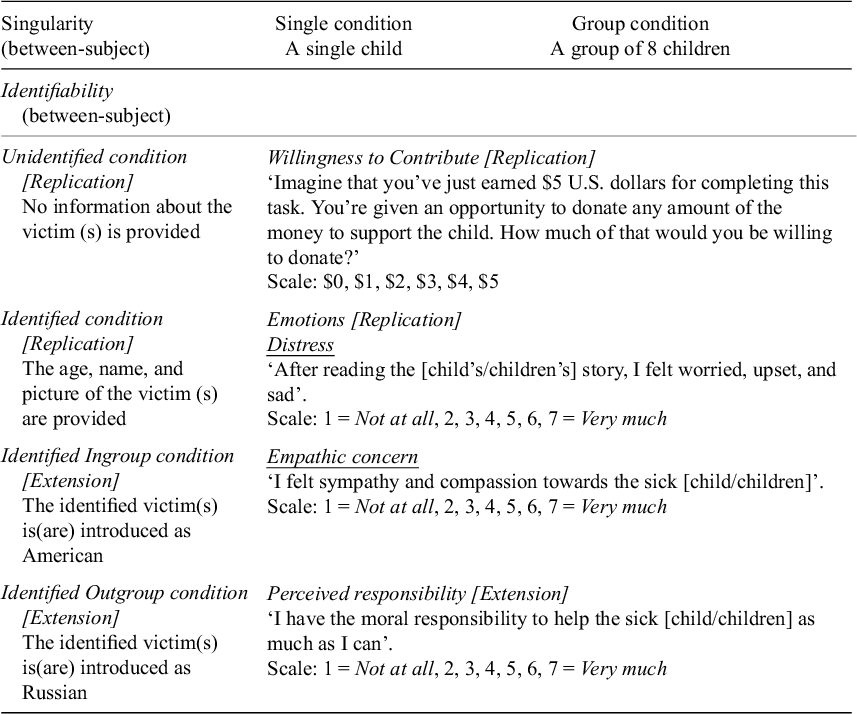
There were six total identified victim conditions, where we provided pictures of the victim(s). We used a group portrait of eight white children (four boys and four girls) for the identification of the group and eight separate pictures of the same eight children for the identification of the single individual (using sections of the group portrait presented in the group conditions).Footnote 3 Common American names were used in both the identified and identified ingroup conditions, whereas common Russian names were used in the identified outgroup condition. The image stimulus was identical to the one used in Kogut and Ritov (Reference Kogut and Ritov2005a), with distortion to limit identification. See ‘Deviation from the original study’ in the Supplementary Material for more elaboration (summary of deviations in Supplementary Table S15).
2.4. Procedure
We conducted data collection using a Qualtrics survey. Participants were randomly assigned to one of eight conditions. All participants then read the same basic scenario describing a sick child or a group of eight sick children being treated in a medical center whose lives are in danger. In the identified condition, we provided the participants with information such as name, age, and picture of the sick child or children. Additional information on the nationality was presented in the identified ingroup (American) or outgroup (Russian) condition. Then, participants read the following:
Recently, a new drug was developed that cures the disease. Unfortunately, this drug is extremely expensive, and unless a sum of US$500,000 is raised soon, it will no longer be possible to save the life (lives) of the sick child (children).
Then, participants read the following:
Imagine that you’ve just earned $5 U.S. dollars for completing this task. You’re given an opportunity to donate any amount of the money to support the child. How much of that would you be willing to donate?
Participants were then given a choice to contribute any round amount from nothing to $5 U.S. dollars (0 = US$0, 5 = US$5). Immediately following the measurement of the willingness-to-contribute (WTC), we presented participants with the following statement to measure their distress: ‘After reading the child’s story, I felt worried, upset and sad’ (1 = Not at all; 7 = Very much). To measure empathic concern, we presented the participants with the statement: ‘I felt sympathy and compassion towards the sick child’ (1 = Not at all; 7 = Very much). To measure participants’ perceived responsibility toward the victims (our extension), we used the scale item originally used in Erlandsson et al. (Reference Erlandsson, Björklund and Bäckström2015): ‘I have the moral responsibility to help the sick [child/children] as much as I can’ (1 = Not at all; 7 = Very much).
After the ratings, participants then answered a funneling section and provided demographic information, which contained items corresponding to the exclusion criteria of the study, before the end of the survey. For more information regarding the Qualtrics survey, please refer to the ‘Instructions and experimental material’ in the Supplementary Material and our shared Qualtrics on the OSF and in our pre-registration.
2.5. Evaluation criteria for replication findings
We aimed to compare the replication effects with the original interaction effect between singularity and identifiability on willingness to contribute. Using the criteria by LeBel et al. (Reference LeBel, McCarthy, Earp, Elson and Vanpaemel2018), we classified our replication as ‘close replication’, with details summarized in the Supplementary Material (refer to Supplementary Table S16).
3. Results
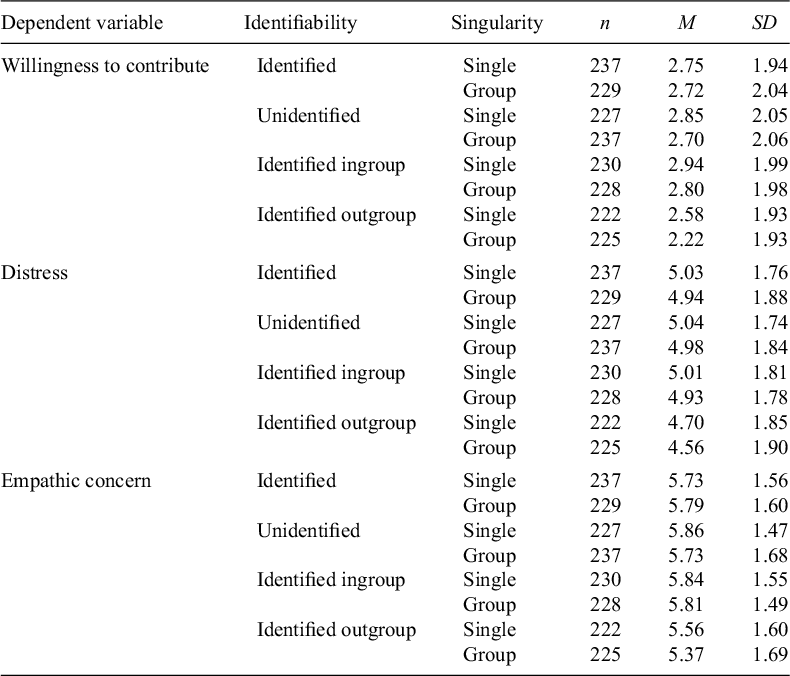
We report our analyses after applying the pre-registered exclusion criteria. We summarized descriptive statistics in Table 4.
Replication: Descriptive statistics per condition across identifiability and singularity
3.1. Full design (pre-registered extension): With ingroup–outgroup conditions
We first conducted 2 (singularity: single vs. group of eight victims) × 2 (identifiability: unidentified vs. identified victims) ANOVAs of all dependent variables in order to isolate the effects of victim identifiability, without considering the ingroup-outgroup extension, and directly compared the results with the respective findings from the target article. For the extensions, we also ran our analysis on the complete 2 (singularity: single vs. group of eight victims) × 4 (identifiability: unidentified vs. identified vs. identified ingroup vs. identified outgroup victims) ANOVAs of all dependent variables combining both the replication and the extension to the outgroup victims.
We found no support for an effect of singularity, identifiability, or interaction effect of singularity and identifiability on any of the dependent variables. In Table 2, we focused on presenting the comparison of the findings of the effect of singularity and identifiability on willingness to contribute for both the target article and the current replication and extension.
In our extension, we failed to find support for the findings by Kogut and Ritov (Reference Kogut and Ritov2007) that there is a higher likelihood of helping single victims over a group if they belong to the ingroup (vs. the outgroup). In addition, in our extension, we also failed to find an interaction effect of singularity and identifiability on perceived responsibility (for detailed analysis, Supplementary Figure S7). In Table 5, we compared the findings of the effect of singularity and identifiability for all the dependent variables for both the target article and the current replication and extension.
Summary and comparison of the findings in the original study and the replication based on the LeBel et al. (Reference LeBel, Vanpaemel, Cheung and Campbell2019) criteria
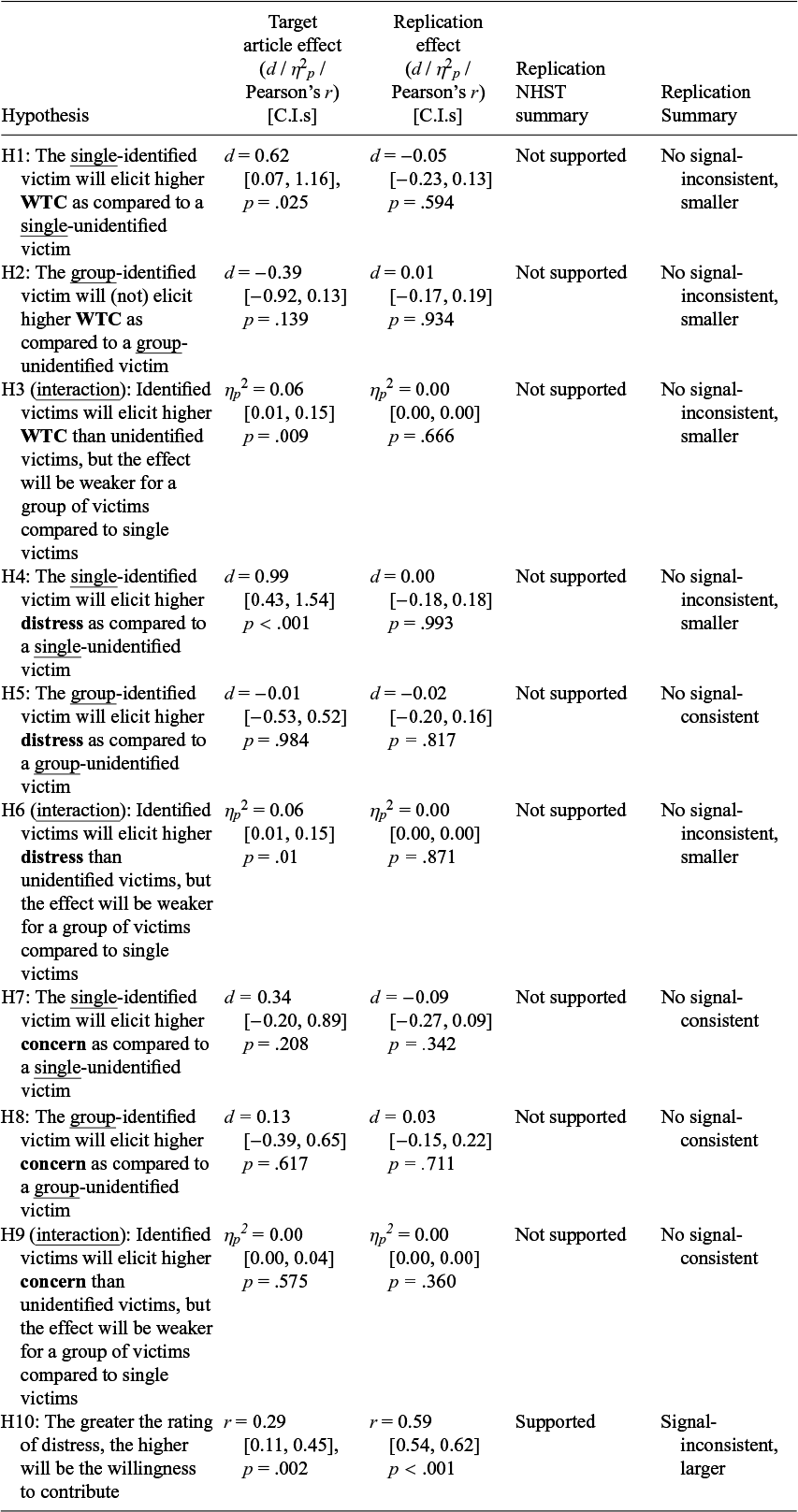
Note: ‘No signal-inconsistent, smaller’: The replication effect size 95% confidence interval includes 0 (no signal) and also excluded the point estimation of the original effect size (inconsistent). The replication effect size is in the same direction but smaller than the original effect size (smaller). ‘Signal-inconsistent, larger’: The replication effect size 95% confidence interval excluded 0 (signal) but also excluded the point estimation of the original effect size (inconsistent). The replication effect size is in the same direction but larger than the original effect size (larger). WTC refers to Willingness To Contribute. WTC refers to Willingness To Contribute. This table compares the 2 (singularity: single vs. group of eight victims) × 2 (identifiability: unidentified vs. identified victims) ANOVA findings of the replication with the same from the target article. We used 95% confidence intervals for Pearson’s rs and Cohen’s d and 90% confidence intervals for η 2 p because η 2 p cannot assume negative values. For the target article, we reported the uncorrected p-values as was reported by the original authors. For the replication and extension analysis, all the p-values reported for the simple effects are Holm’s corrected p-values and the p-values reported for the interaction effects are Tukey corrected.
3.1.1. Willingness to contribute
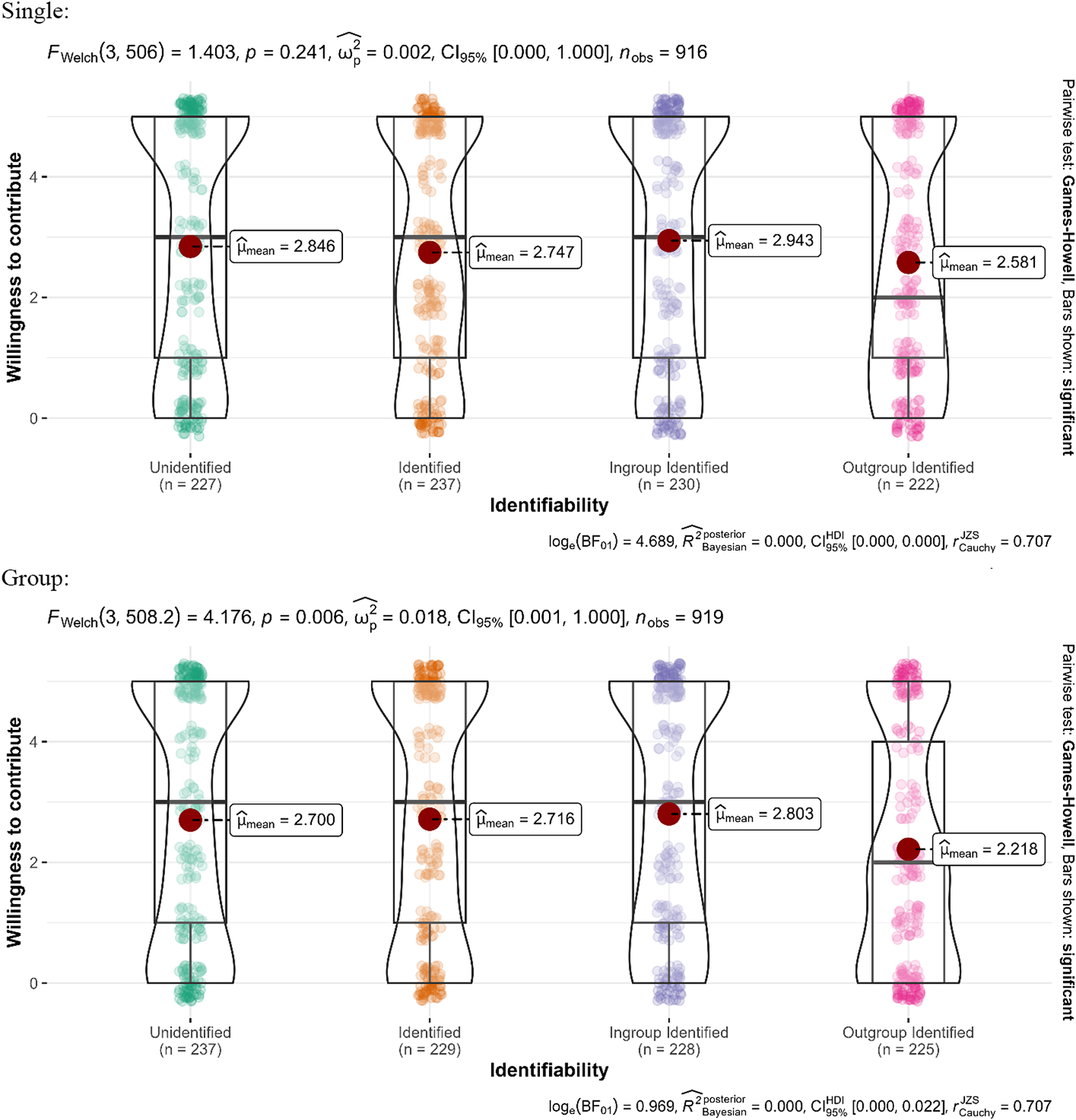
We conducted a 2 (single victim vs. a group of eight victims) × 4 (unidentified vs. identified vs. identified ingroup vs. identified outgroup) between-subjects ANOVA and did not find support for an effect of the interaction between singularity and identifiability on willingness to contribute, F(3,1827) = 0.56, p = .644, η 2 p = .001, 90% CI [0, 0.003], and found no support for an effect of singularity on willingness to contribute, F(1,1827) = 3.35, p = .067, η 2 p = .002, 90% CI [0, 0.007]. We found support for a main effect of identifiability on willingness to contribute, F(3, 1827) = 4.80, p = .002, η 2 p = .008, 90% CI [0.002, 0.015].
Since we only found support for an effect of identifiability,Footnote 4 we then conducted Tukey-corrected posthoc pairwise comparisons to test whether there were any differences between subgroups depending on their identifiability, which showed that participants were willing to contribute less money in the identified outgroup condition compared to the identified ingroup condition (p Tukey = .002, d = −0.24), and the unidentified condition (p Tukey = .024, d = −0.19), and similar to the identified condition (p Tukey = .057, d = −0.17). All the other pairwise comparisons showed very small effect sizes (all Cohen’s ds < 0.06) and very high p-values (all > .80) because the identified, unidentified, and identified ingroup conditions had very similar average willingness to contribute values. Kogut and Ritov (Reference Kogut and Ritov2005a) found support for an interaction effect of singularity and identifiability on willingness to contribute (p = .009; for detailed analysis, refer to Table 2), and our findings are not consistent with their results in several ways. We did not find support for the interaction effect. Further, in the supported main effect, the differences between conditions were about our ingroup-outgroup extension and not about the identifiability effect. The results are depicted in Figure 1.
Willingness to Contribute: Interaction between singularity and identifiability.
Note: The box plots represent the interquartile range and the median value. The red circles represent average values. Data density is represented by the violin plot, and actual data points are represented as jittered. p = Holm’s p-value.
3.1.2. Distress
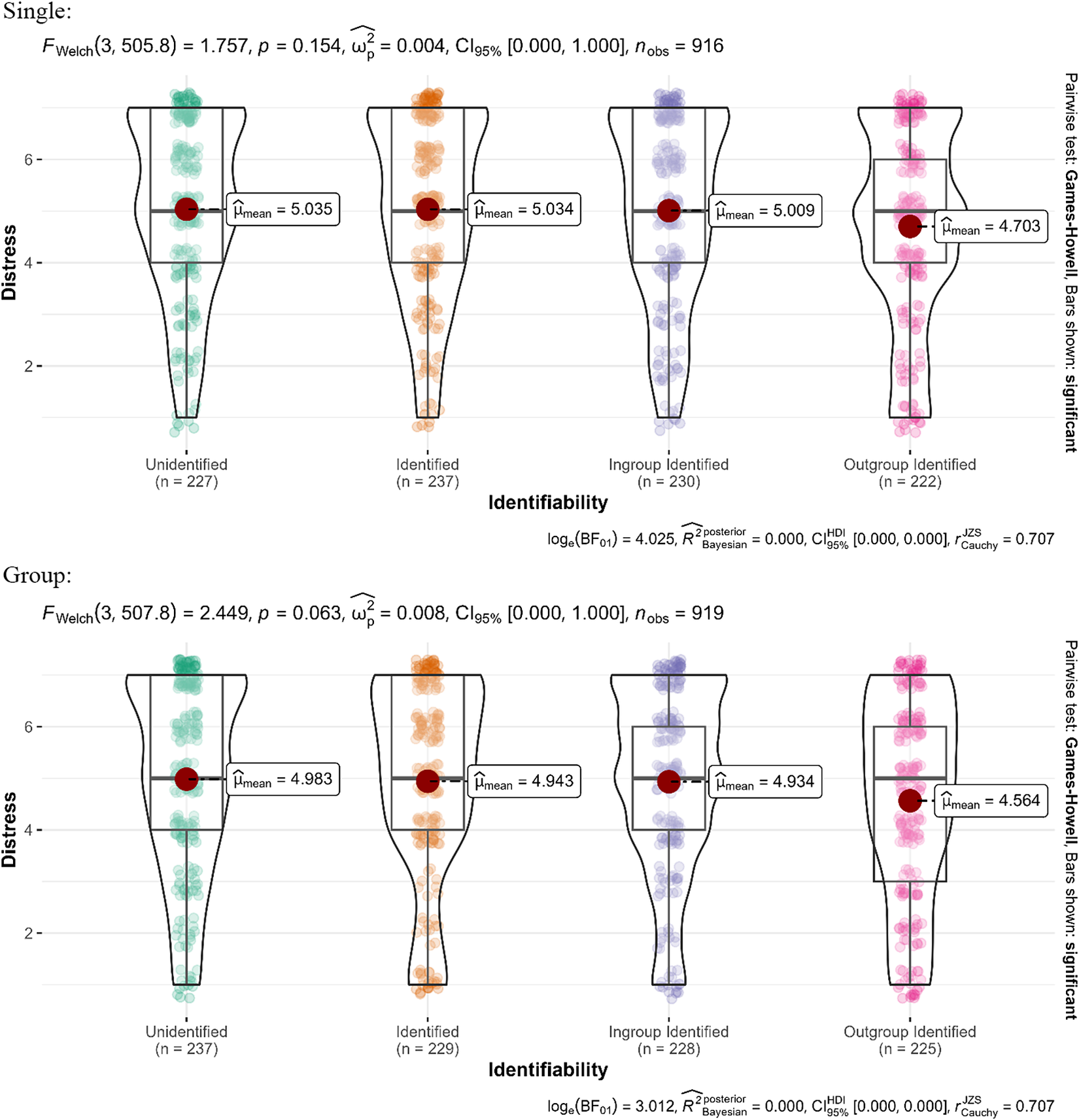
We conducted a 2 (single victim vs. a group of eight victims) × 4 (unidentified vs. identified vs. identified ingroup vs. identified outgroup) between-subjects ANOVA on distress and did not find support for an interaction between singularity and identifiability on distress, F(3,1827) = 0.05, p = .987, η 2 p = .000, 90% CI [0, 1.00], and found no support for an effect of singularity on distress, F(1,1827) = 1.09, p = .296, η 2 p = .001, 90% CI [0, 0.004]. We found support for an effect of identifiability on distress, F(3,1827) = 4.35, p = .005, η 2 p = .007, 90% CI [0.001, 0.014].
Since we only found support for an effect of identifiability,Footnote 5 we then conducted Tukey-corrected posthoc pairwise comparisons to test whether there were any differences between subgroups depending on their identifiability, which showed that participants expressed less distress in the identified outgroup condition compared to the identified ingroup condition (p Tukey = .027, d = −0.19), the unidentified condition (p Tukey = .01, d = −0.21), and the identified condition (p Tukey = .017, d = −0.19).
Kogut and Ritov (Reference Kogut and Ritov2005a) found support for an interaction effect of singularity and identifiability on distress (p = .01; for detailed analysis, refer to Supplementary Tables S8 and S9), and our findings are not consistent with their results in several ways. First, we did not find support for their interaction. Second, in the supported main effect, the differences between conditions were about our ingroup-outgroup extension and not about the identifiability effect. The results are depicted in Figure 2.
Distress: Interaction between singularity and identifiability.
Note: The box plots represent the interquartile range and the median value. The red circles represent average values. Data density is represented by the violin plot, and actual data points are represented as jittered.
3.1.3. Empathic concern
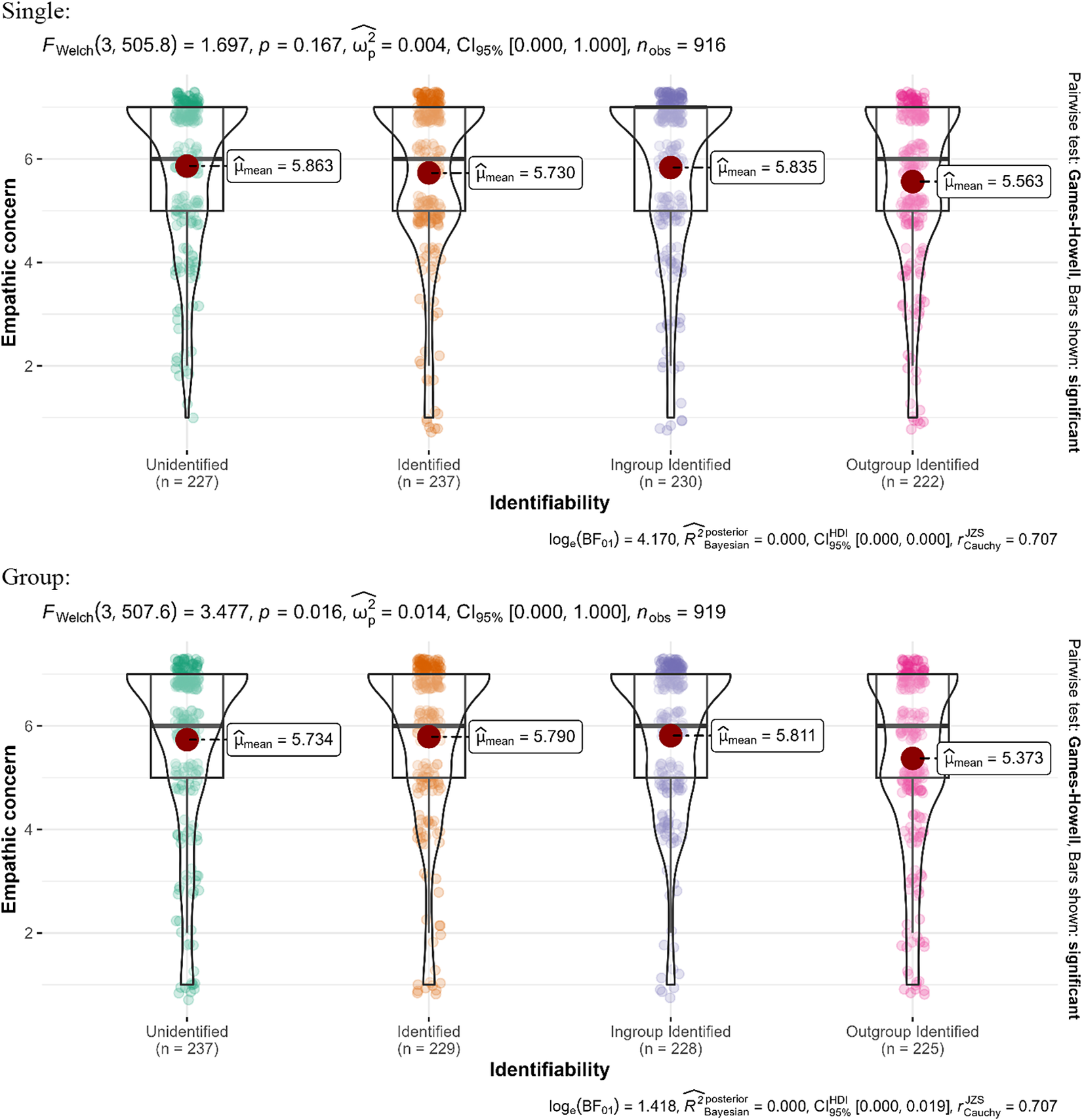
We conducted a 2 (single victim vs. a group of eight victims) × 4 (unidentified vs. identified vs. identified ingroup vs. identified outgroup) between-subjects ANOVA on empathic concern and did not find support for an interaction between singularity and identifiability on distress, F(3, 1827) = 0.57, p = .638, η 2 p = .001, 90% CI [0, 0.003], and found no support for an effect of singularity on empathic concern, F(1, 1827) = 0.91, p = .340, η 2 p = .000, 90% CI [0, 0.004]. We found support for an effect of identifiability on distress, F(3, 1827) = 4.91, p = .002, η 2 p = .008, 90% CI [0.002, 0.015].
Since we only found support for an effect of identifiability, we then conducted Tukey-corrected posthoc pairwise comparisons to test whether there were any differences between subgroups depending on their identifiability, which showed that participants showed less empathic concern in the identified outgroup condition compared to the identified ingroup condition (p Tukey = .004, d = −0.23), the unidentified condition (p Tukey = .009, d = −0.21), and the identified condition (p Tukey = .027, d = −0.19). These findings are consistent with the original findings by Kogut and Ritov (Reference Kogut and Ritov2005a). The results are depicted in Figure 3.
Empathic concern: Interaction between singularity and identifiability.
Note: The box plots represent the interquartile range and the median value. The red circles represent average values. Data density is represented by the violin plot, and actual data points are represented as jittered. p = Holm’s p-value.
3.1.4. Replication: Mirroring Kogut and Ritov’s (Reference Kogut and Ritov2005a, Reference Kogut and Ritov2005b) design and analysis
Mirroring the target article’s design, we conducted 2 (single victim vs. a group of eight victims) × 2 (unidentified vs. identified) between-subjects ANOVA on all dependent variables (refer to Supplementary Table S21), where we did not find evidence for either the interaction effect or the main effects of singularity and identifiability. See summary of main analyses in Table 2.
Furthermore, we have outlined in the Supplementary Material 2 × 4 ANCOVA analyses on willingness to contribute with different control variables (refer to Supplementary Table S22); and a comparison of the 2 × 4 ANOVA analyses conducted before and after implementing the exclusion criteria (refer to Supplementary Table S23).
4. Discussion
We conducted a replication of Kogut and Ritov’s (Reference Kogut and Ritov2005a) Study 2. We summarized our replication findings alongside the findings of the original article for the main hypothesis in Table 5 and the extension hypothesis in Table 6.
Summary of the extension findings
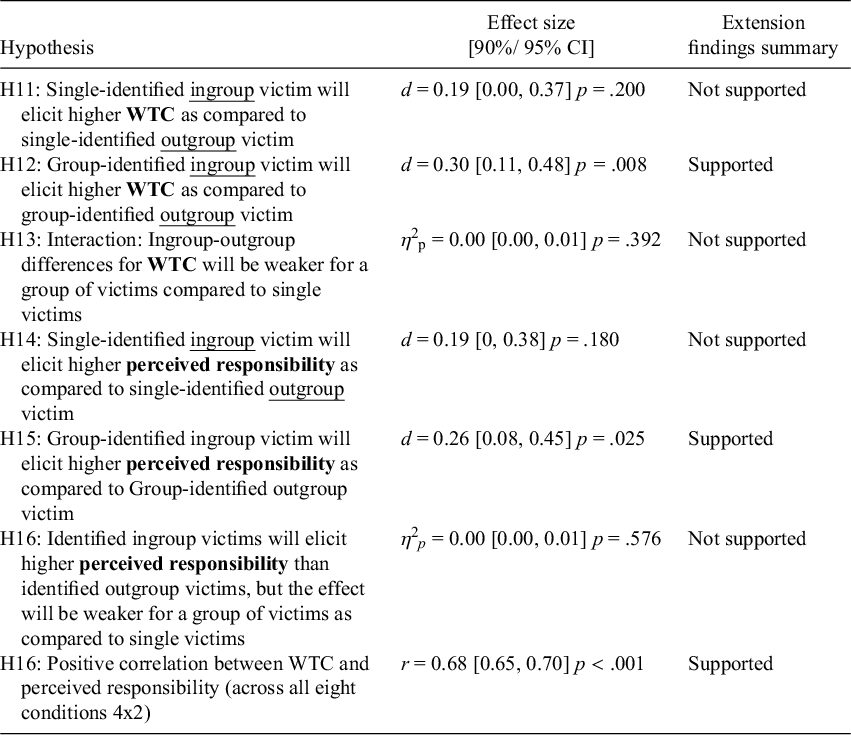
Note: Results and summary of the extension that used 2 (singularity: single vs. group of eight victims) × 2 (identifiability: identified ingroup vs. identified outgroup victims) ANOVA with willingness to contribute and perceived responsibility as DV. WTC indicates willingness to contribute. All the p-values reported are Tukey corrected from the post hoc analysis.
Our results were largely inconsistent with the original results. We were unable to find support for any main effects or interaction effects of singularity (single vs. group) and identifiability (unidentified vs. identified victims) on willingness to contribute, distress, and empathic concern. The willingness to contribute, distress, and empathic emotions evoked by a single victim were similar to those evoked by a group of victims. However, we did find support for participants reporting they were willing to contribute less money, felt less distressed, and less empathically concerned toward the identified outgroup victims compared to the victims in the other identifiability (unidentified, identified, and identified ingroup victims) conditions. We found positive correlations between willingness to contribute, distress, and empathic concern. Overall, our findings failed to find support for the findings by Kogut and Ritov (Reference Kogut and Ritov2005a) on the interaction between identifiability and singularity.
Similarly, in our extension (reported in the Supplementary Material), we did not find support for an interaction effect of singularity and identifiability on perceived responsibility, although perceived responsibility was found to be positively correlated with willingness to contribute. Participants felt a lower degree of perceived responsibility for identified outgroup victims than the victims in the other identifiability conditions.
The main hypothesis about the identified single victim effect was not supported, and thus, we concluded that this study could be classified as an unsuccessful replication using the criteria set by LeBel et al. (Reference LeBel, Vanpaemel, Cheung and Campbell2019).
The current study adds to the literature on the identified victim effect. Past research (Kogut and Ritov, Reference Kogut and Ritov2007) showed that willingness to help was greater when a single victim was identified with details such as name and picture and belonged to the respondent’s own group. However, the current study was unable to replicate the interaction effect of singularity and identifiability on willingness to contribute, distress, and empathic concerns.
While the original study failed to find a correlation between willingness to contribute and empathic concern, our results were consistent with other research that provided evidence in favor of the relationship between sympathy and helping behaviors (Ritov & Kogut, Reference Ritov and Kogut2011; Lee and Feeley, Reference Lee and Feeley2016).
We found no interaction effect of singularity and identifiability on perceived responsibility. Participants reported stronger feelings of perceived responsibility in the identified, unidentified, and identified ingroup conditions compared to the identified outgroup condition. Social categorization of the victims belonging to the same group as oneself increases the feeling of responsibility and amplifies the emotional response to their plight (Brewer and Gardner, Reference Brewer and Gardner1996; Dovidio et al., Reference Dovidio, Piliavin, Gaertner, Schroeder, Clark and Clark1991, Reference Dovidio, Gaertner, Validzic, Matoka, Johnson and Frazier1997). This result is in line with the previous research (Erlandsson et al., Reference Erlandsson, Björklund and Bäckström2015) as we see perceived responsibility to be highly correlated with willingness to contribute. This indicates respondents will be more willing to contribute to helping victims they categorize as belonging to their own social category because a greater sense of responsibility is triggered toward the victim compared to outgroup victims.
4.1. Rethinking the effect and its meaning?
Even if people are willing to contribute about the same amount for single and groups of victims (independent of their identifiability), this effect may still be interpreted as evidence of peculiar decision-making. In fact, larger groups of victims should—all else equal—evoke stronger feelings such as empathic concern, distress, and perceived responsibility, which in turn should increase willingness to contribute, if anything, because there are more individuals affected by the same tragedy. The fact that we could not find such a difference may be interpreted as violating the principle of proportionality, that is, the notion that larger issues should be tackled with more resources. This interpretation of our results offers a nuanced view of rationality in charity decision-making.
4.2. Limitations and future research
4.2.1. Measurement
We were unable to replicate the interaction effect of singularity and identifiability on willingness to contribute. We found no difference in willingness to contribute between single victims and groups of victims or in the identified versus unidentified condition. One factor that might explain these findings may be the willingness to contribute measures used in the current study. In the original study, participants were asked whether they were willing to contribute money to save the victim(’s) lives and, if so, how much money they would donate at the moment. It was an open-ended question (i.e., no scale was provided), and participants could choose any amount they would like to donate. However, the scale we used to measure participants’ willingness to contribute was round numbers from $0 to $5. We observed that a proportion of subjects in all conditions had a maximum willingness to contribute scores. With the instrument measuring hypothetical donation in the current study, consequently, the participants might be willing to maximize their contribution to helping the victim. If many subjects had scores of willingness to contribute at the upper limit of our instrument, it might reduce variability in the gathered data to some extent, and some actual variation in the data might not be reflected in the scores obtained from the instrument. Furthermore, we point out that the average willingness to contribute for all conditions of singularity and identifiability was approximately $3, and approximately 36% of the participants were willing to contribute the maximum amount for the identified ingroup condition. The new measure might have reduced the sensitivity of our design to some extent, where the highest amount of $5 contribution might have been felt not enough by the participants, such that the average score of willingness to contribute for the single identified victim was similar to the average of other groups. Future research can use the original dependent variable of open-ended questions to measure willingness to contribute, although that would likely require a logarithmic transformation of the values for further analysis.
4.2.2. Participants
The original study was conducted with 112 undergraduate students at the Hebrew University. The current study recruited U.S. American participants on Mechanical Turk. One might argue that a different sample might have caused the failed replication. MTurk workers represent a more diverse population than undergraduate students (Berinsky et al., Reference Berinsky, Huber and Lenz2012; Mullinix et al., Reference Mullinix, Leeper, Druckman and Freese2015). Yet, there are several findings where the sample from Amazon MTurk produces similar results to U.S. American representative samples (Coppock, Reference Coppock2019; Coppock et al., Reference Coppock, Leeper and Mullinix2018; Mullinix et al., Reference Mullinix, Leeper, Druckman and Freese2015). Further, previous research (Ziano et al., Reference Ziano, Li, Tsun, Lei, Kamath, Cheng and Feldman2021c, Reference Ziano, Mok and Feldman2021b) showed consistent results between MTurk and other samples (e.g., university students). Hence, we believe that, at the very least, the present replication can be used to update our understanding of how the effect may generalize to other populations. Future research can attempt to replicate this result with Israeli undergraduates to test the effect in closer settings to that of the original paper. Note that if the identified victim effect is limited to a specific group of participants, this reduces its generalizability and, therefore, its theoretical and practical importance.
4.2.3. Time (on or before 2005 vs. 2019)
Our replication study was conducted in 2019, whereas for the original study, the authors collected data on or before 2005. We believe that it is not likely that the passage of time has caused the anomaly between our results and the original results. Further, past replication research (Ziano et al., Reference Ziano, Li, Tsun, Lei, Kamath, Cheng and Feldman2021c, Reference Ziano, Mok and Feldman2021b) successfully replicated findings of studies on the better-than-average effect and money illusion originally conducted in 1985 and 1997, respectively. Thus, we believe it unlikely that this failed replication is due to the passage of time.
4.2.4. Stimuli
In the original study, a group portrait of eight children was used for identification.Footnote 6 We used the same pictures, which were slightly distorted, in order to remain as close as possible to the original procedure. It is possible that this slight distortion may have affected our results. Previous research (Cryder et al., Reference Cryder, Botti and Simonyan2017) showed that a recipient’s attractiveness can lead to greater psychological distance from the donor, which might influence their donation decision. However, to the best of our knowledge, no research evaluated the interaction of singularity and attractiveness of the recipient on the donation intention. In such a situation, we might anticipate that a number of considerations, including the donor’s perceived distress and the level of sadness that may be provoked, may outweigh the attractiveness component when deciding whether or not to donate. Prior studies (Harel and Kogut, Reference Harel and Kogut2021; Kogut, Reference Kogut2011; Västfjäll et al., Reference Västfjäll, Slovic, Mayorga and Peters2014) on charitable donation have explicitly specified the identification condition with both the names and photographs of the victims, which indicates that a picture by itself cannot compromise the elicitation process in the participants. Furthermore, Hart et al. (Reference Hart, Lane and Chinn2018) found no significant effect of image on donation amount in their study 2 (p = .42). Future research may nonetheless attempt to use the unmodified original pictures to attempt to replicate the present effect. If the identified victim effect can only be replicated with a specific set of stimuli, this might nonetheless reduce its theoretical and practical implications.
In the original study, the names of the eight children provided in the identified condition were Sharon, Avi, Ronit, Shiran, Yonatan, Rachel, Oma, and Yotam, all common Israeli names. We recruited U.S. American participants in the current replication, and thus, we picked eight common American names in 2015 for the children in the identified and identified ingroup conditions (Pappas, Reference Pappas2018). In our replication, the children in the identified outgroup condition were described as Russian. Hence, we also chose eight common Russian names: Vladimir, Dmitry, Sergey, and Mikhail for boys and Anastasia, Yelizaveta, Yelena, and Ludmila for girls (Nikitina, Reference Nikitina2019). In Studies 2 and 3 of Kogut and Ritov (Reference Kogut and Ritov2007), the authors used Indian, Argentinian, and African names for outgroup victims and Israeli names for ingroup victims. The authors were able to find results consistent with their hypothesis, which showed greater willingness to contribute for ingroup victims compared to outgroup victims. This is in line with our finding from the replication analysis, in which respondents were willing to contribute more to ingroup victims than outgroup victims. Furthermore, Västfjäll et al. (Reference Västfjäll, Slovic, Mayorga and Peters2014) conducted studies with Swedish participants and used common African and Muslim names for the identified condition. Thus, we believe that having American and Russian victim names was unlikely to influence our results. However, future research may attempt to replicate the identified victim effect using the Israeli names used in the original study for ingroup names and Indian, Argentinian, and African names for outgroup names. As we observed above, however, if the identified victim effect can only be observed with a specific set of stimuli, it is hard to draw wide-ranging theoretical or practical implications from it.
5. Conclusion
We summarized the current research as an unsuccessful replication of Kogut and Ritov’s (Reference Kogut and Ritov2005a) Study 2. Our findings failed to replicate the interaction effect of singularity and identifiability on both willingness to contribute and empathic emotions. Hence, the main hypothesis about the identified single victim effect and empathic emotions as the source of the effect was not supported. However, our investigation showed a positive relationship between willingness to contribute, distress, and empathic concerns. Apart from replicating findings from Kogut and Ritov (Reference Kogut and Ritov2005a), the current study also added 2 extension designs on top of the original study. Despite finding no support for the interaction effect of group belonging and identifiability (and therefore finding not in support of Kogut and Ritov, Reference Kogut and Ritov2007), we were able to identify the ingroup bias in helping behaviors and the contribution of both empathic emotions and perceived responsibility.
Supplementary material
The supplementary material for this article can be found at https://doi.org/10.1017/jdm.2024.31.
Data availability statement
All pre-registration, materials, data, and code were made available on the OSF: https://osf.io/9qcpj/.
Acknowledgments
We thank Prasad Chandrashekhar and Maximilian Maier for their useful and kind feedback on an earlier draft. We thank the authors of the target article—Prof. Kogut and Prof. Ritov, for providing us with their stimuli, data, and materials, which have greatly helped us with our replication efforts.
Author contributions
Conceptualization: Y.L.T.; Data curation: Y.L.T.; Formal analysis: R.M., Y.L.T., I.Z.; Funding acquisition: G.F.; Investigation: Y.L.T.; Methodology: Y.L.T.; Pre-registration: Y.L.T.; Pre-registra tion peer review/verification: G.F.; Project administration: Y.L.T., G.F.; Resources: G.F.; Validation: R.M., I.Z.; Visualization: R.M., Y.L.T., I.Z.; Writing—original draft: R.M., Y.L.T., I.Z.; Writing—review and editing: R.M., I.Z., G.F. R.M. and Y.L.T. contributed equally to this work and joint first authors.
Funding statement
The authors received no financial support for the research and/or authorship of this article.
Competing interest
The authors declared no potential conflicts of interest regarding the authorship and/or publication of this article.
Ethical standards
The authors confirm that the manuscript adheres to ethical guidelines specified in the APA Code of Conduct as well as the authors’ national ethics guidelines. This includes requirements that research is conducted ethically, results are reported honestly, the submitted work is original and not (self-) plagiarized, and authorship reflects individuals’ contributions.


 Open access

