


1. Introduction and motivation
The increasing urgency to reduce the environmental footprint of industrial products is transforming sustainability from a peripheral consideration into a core design requirement. Companies are now expected to respect environmental targets, under the pressure of customers and emerging regulations such as the EU Ecodesign for Sustainable Products Regulation. Despite this demand, sustainability is still often addressed too late in product engineering processes, primarily during detailed design or final validation phases, when the potential for improvement is limited and design freedom is significantly reduced (Reference Peigné, Ben Rejeb, Monnier and ZwolinskiPeigné et al., 2024).
Early design phases offer the greatest leverage to influence a product’s environmental and economic performance. At these stages, decisions regarding material selection, manufacturing processes, energy consumption and End-of-Life (EoL) strategies can determine the life cycle impact of a product. However, early design is characterized by high uncertainty and limited data availability, which prevent the systematic use of established environmental impact assessment tools such as Life Cycle Assessment (LCA), regulated by standards (in particular ISO 14040 and 14044). Standard LCA methods require detailed process inventories and are tailored to be applied retrospectively after that design decisions are made. This makes them impractical for early-stage, iterative design, where only conceptual parameters are available. As a result, environmental impact is often considered too late, despite decisions at early-stage have the greatest potential to influence environmental impacts.
To address these challenges, this research develops a parametric LCA model tailored for the early embodiment design, a phase where conceptual solutions are translated into preliminary system architectures. The method expresses environmental impacts as functions of key design parameters such as component mass, material type, recycled content, and End-of-Life recyclability, enabling rapid estimation of environmental indicators across the design space. The proposed LCA model supports design exploration for first embodiments of new concepts and comparison between different product generations, connecting design modelling and environmental assessment. Its aim is to enable environmental thinking when parametric design decisions are still flexible and impactful.
2. State of the art
2.1. Sustainability in product engineering
Product engineering, which encompasses the entirety of product planning, product development and production systems development (Reference Albers, Gausemeier, Anderl, Eigner, Sendler and StarkAlbers & Gausemeier, 2012), has nowadays the key role of creating more sustainable products, since up to 80 percent of the environmental impacts of a product are determined in the early development phase (Reference Bragança, Vieira and AndradeBragança et al., 2014). Therefore, the requirement for developing products with a lower environmental impact is that all phases of the life cycle and their impact on the environment are considered early in product engineering processes. Eco-Design represents an approach that integrates environmental considerations into every stage of product engineering and throughout the product’s entire lifecycle. Its goal is to reduce environmental impact by guiding decisions throughout the product’s lifecycle, from material selection and manufacturing methods to End-of-Life. Examples of methods in this context include preliminary selection of materials with a reduced CO2 footprint (Reference Stolte, Rader and HaberkernStolte et al., 2025), Design for X Strategies (Reference Ross, Ferrero and DuPontRoss et al., 2022) and LCA (Reference Saidani, Joung, Kim and YannouSaidani et al., 2022).
In industrial practice, product engineering rarely starts from scratch. Companies typically evolve their products through successive generations, each of them representing an incremental improvement towards improved performance, cost efficiency or environmental impact. This approach is formalized in the model of SGE—System Generation Engineering (Reference Albers, Rapp, Krause and HeydenAlbers & Rapp, 2022)—which describes product engineering as a sequence of system generations in which a new generation is synthesized from a reference system by variation. The Extended Target Weighting Approach (ETWA) by Reference Albers, Revfi and SpadingerAlbers et al. (2017) integrates mass, cost and CO2 footprint evaluations at a functional level to identify lightweight design potentials and guide design thinking in early phases. This approach is an example of how LCA metrics can be integrated in the SGE framework to support environment-oriented decisions. The necessity to adopt methodologies to support the structured comparison and benchmarking of new product generations with prior ones in terms of environmental impact, cost and functionality is defined. In this context, the ability to assess and compare multiple design variants, even with limited data, is essential (Reference Jäckle, Seidler, Tusch, Rapp and AlbersJäckle et al., 2023).
Connecting design parameters and life cycle environmental indicators in initial design iterations require fast and scalable methods. Parametric LCA approaches address this need by enabling predictive and iterative evaluation of environmental impact as design concepts evolve.
2.2. Parametric LCA for early design
LCA is the most recognized methodology for quantifying environmental impact of products and systems. According to the ISO 14040 and ISO 14044, LCA quantifies the environmental impact of a product or service across its entire life cycle, from raw material extraction to end-of-life (cradle-to-grave). The method is usually used for a finalised design while product engineering requires many iterations for optimizing concepts into embodiment designs, by analysing alternative scenarios as different materials, geometries or EoL strategies. To address this limitation, predictive and scalable LCA workflows that can support iterative decision-making rather than retrospective validation are being developed. Some examples are the integration of LCA within Model-Based Systems Engineering (MBSE) frameworks, for allowing parametrization of processes and materials (Reference Lipšinić, Pavković and SattlerLipsinic & Pavkovic, 2023), or within machine learning (ML) methods for estimating environmental indicators across large design spaces (Reference Manuguerra, Cappelletti and GermaniManuguerra et al. 2024). Within this landscape, parametric LCA (PLCA) has emerged as an efficient approach for design space exploration. PLCA expresses life cycle environmental impacts as mathematical functions of key product or process parameters such as material mass, geometry, manufacturing processes or recycled material content. Reference Gehin, Zwolinski and BrissaudGehin et al. (2009) and Reference Kamalakkannan and KulatungaKamalakkannan and Kulatunga (2021) introduced systematic PLCA methodologies that integrate parametrization techniques within the standard LCA framework that enable analysis and optimization of design parameters, reducing time for eco-design decisions. Reference Filippatos, Markatos, Tzortzinis, Abhyankar, Malefaki, Gude and PantelakisFilippatos et al. (2024) and Reference Imperiali, Menzi, Kolar and HuberImperiali et al. (2024) embedded LCA indicators directly in multi-objective optimization frameworks for aerospace and power electronics applications, demonstrating the potential of parametric LCA to bridge the gap between design modelling and environmental impact evaluation. However, these contributions are not validating their models against conventional ISO-compliant LCAs and consequently not addressing the reliability of using such methods for predicting environmental impact of new concepts.
Out of the scope of this paper, but mentioned for completeness, is research focusing on future-oriented techniques, such as prospective LCA, which model the product system at a future point in time by using futuristic scenarios (Reference Arvidsson, Svanström, Sandén, Thonemann, Steubing and CucurachiArvidsson et al., 2024; Reference Buyle, Audenaert, Billen, Boonen and Van PasselBuyle et al., 2019), for example by varying future electricity mixes, recycling infrastructures or technology maturity assumptions.
The method proposed in this work applies a parametric LCA structure to evaluate environmental impacts at early embodiment design. In a second phase, the approach is benchmarked against a conventional, ISO-compliant LCA, to assess methodological consistency and reliability for practical use.
3. Research objectives and methodology
The previous section highlighted the need for scalable, reliable methods to assess environmental impact during the early embodiment phase, when only limited product information is available. At this stage, designers define initial system layouts and explore multiple variants. For this reason, parametric models that can link design parameters to environmental impacts are needed. This paper introduces a novel parametric LCA model—Fast LCA—and validates it against a conventional ISO 14040/14044-compliant LCA, demonstrating the model’s quantitative consistency as well as methodological reliability for cross-generational comparison between a reference product with a set of design variants for a new generation. The model formulation and assumptions are derived in accordance with relevant sector-specific guidelines and Product Category Rules (PCR), ensuring methodological transparency and alignment with standard LCA practice. This approach allows the use of simplified datasets and assumptions typical of embodiment design, while maintaining the rigor of standard LCA practice.
This contribution addresses the following research question:
RQ. How can a parametric LCA model be structured to enable scalable and reliable environmental impact assessment during early embodiment design and allow for comparison of consecutive product generations?
With the objectives of:
-
1. Developing the Fast LCA as a parametric model that translates the information typically available in early embodiment design into Life Cycle Inventory (LCI) inputs and environmental impacts, using a structure suitable for evaluating multiple design variants.
-
2. Validating the proposed Fast LCA model against a conventional ISO-compliant LCA for cross-generational comparison and demonstrate its support by evaluating multiple early-stage variants (e.g., material substitutions, recycling rates) using the available input data.
The work follows the Design Research Methodology (DRM) framework by Reference Blessing and ChakrabartiBlessing and Chakrabarti (2009). In Descriptive Study I (DS-I), the information typically available after the first embodiment of a concept is identified by reviewing preliminary 3D CAD models to determine which parameters can be extracted for a simplified life cycle model, as for example component masses, candidate materials and manufacturing assumptions. Based on this, the Prescriptive Study (PS) is dedicated to the formulation of the Fast LCA through a parametric structure in which environmental impacts are linked to the design variables using linear relationships and unitary environmental impact factors (i.e., environmental impact per unitary mass or volume). The parameters chosen for design-space variation are defined through an initial “hot-spot” analysis that identifies the life cycle stage or components with the highest contribution to total environmental impact. Finally, the Descriptive Study II (DS-II) evaluates the Fast LCA model on two generations of load break switch drives for switchgears: a reference product from the previous generation and the first 3D representation of a new design intended to lower the environmental impact. Initially, the results are compared with those obtained by using a commercial software (SimaPro 10.2 with ecoinvent 3.11 database), evaluating the model’s accuracy and consistency. In a second analysis, the validated model is used to demonstrate its applicability for exploring the design space at initial embodiment design. By modifying parameters such as material selection and recycled content, multiple design variants are evaluated to identify the optimal solution in terms of environmental impact.
4. Fast LCA method
The proposed LCA method provides rapid and transparent estimation of environmental impact of first embodiment of new design concepts, when, typically, detailed process data are not yet available. For this reason, traditional LCA methods have limited applicability for the exploration of the design space at this stage.
To overcome these limitations, it is proposed a parametric LCA model that expresses life cycle environmental impact through linear relationships between a limited set of design variables, namely components mass estimation, preselected materials, recycled content, and End-of-Life recyclability potential (IEC/TR 62635, 2012), enabling rapid estimation of environmental indicators across the design space. To ensure that the model keeps realistic, system boundaries and assumptions are made in accordance with the Product Category Rules (PCR) relevant to the product in analysis.
This formulation makes it suitable for design space exploration and for comparing successive product generations within mechanical systems. The method is fully parametric, linking environmental impacts directly to design parameters, and independent of specific databases, as it can be adapted to any environmental dataset. In this work, the model is validated using secondary data from the ecoinvent 3.11 database.
4.1. Model formulation
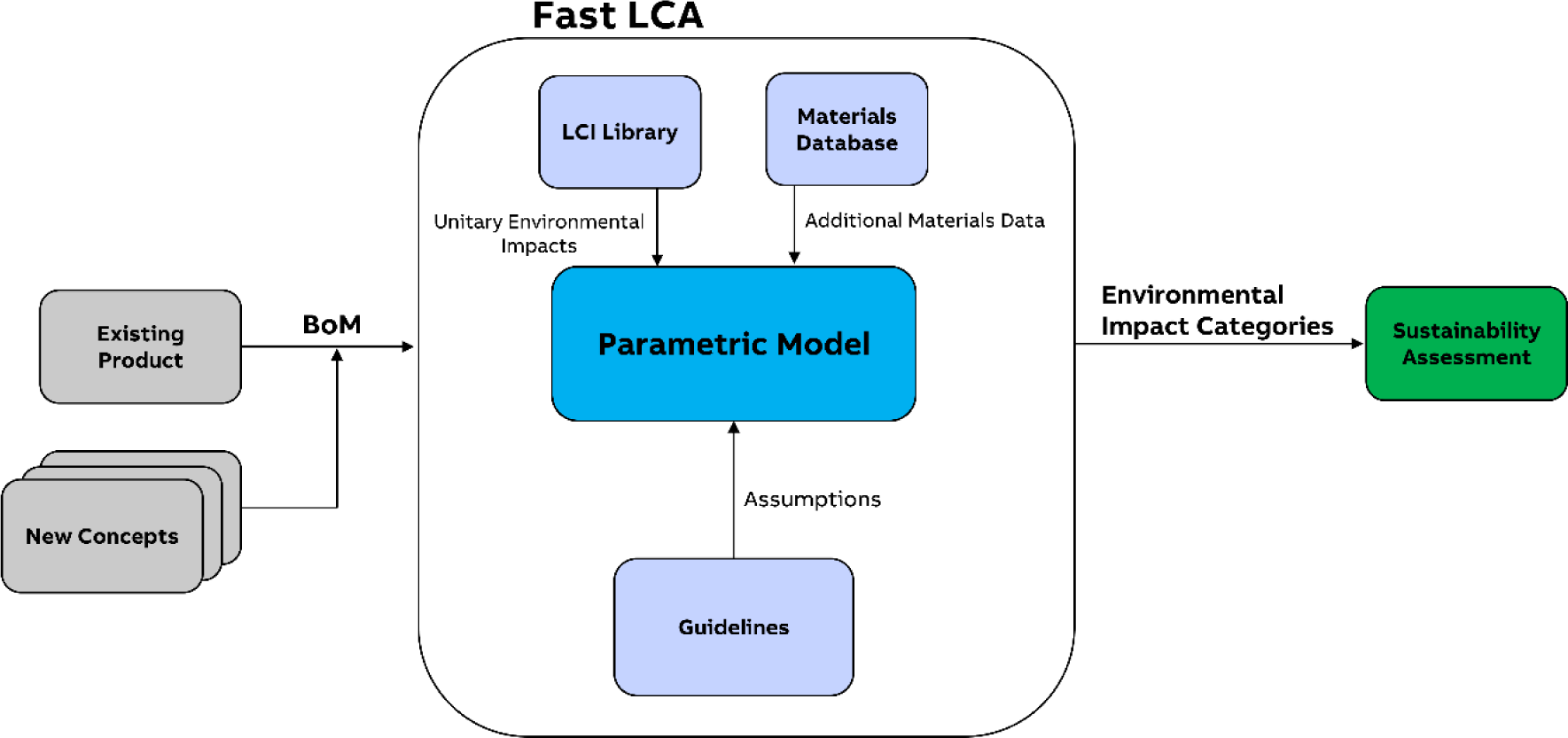
The data flow of the proposed Fast LCA model is shown in Figure 1. The model is intended to be used at early embodiment design phase, where preliminary system architectures are defined and some candidate materials are preselected. Design data is sourced from preliminary Bill of Materials (BoM), which are derived from the first 3D model of the new concepts, and includes the estimation of components’ weight.
For each material, additional data such as recycled content rate and recyclability potential are retrieved from dedicated sources (Granta Selector 2022 R1 and IEC/TR 62635, 2012). These inputs are processed by the parametric model together with unitary environmental impact factors obtained from a LCI. When specific information about manufacturing or distribution phases is not available, the model applies assumptions and generic data based on standardized guidelines such as ISO 14040/14044 and specific PCRs (e.g., Sub-PCR EPDItaly012 for switches assumes a 300 km over land transport distance in the distribution phase).
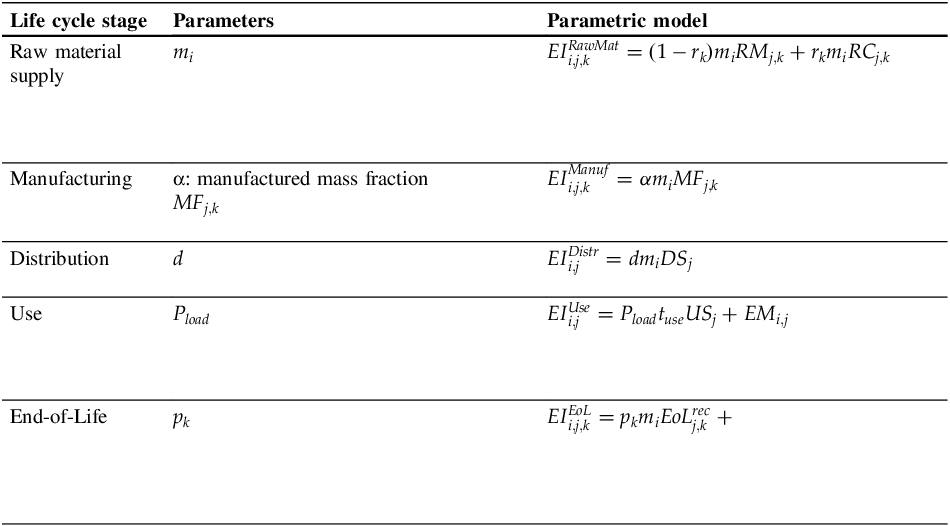
By combining these inputs, the model defines a parametric Life Cycle Impact Assessment (LCIA) in which the environmental impacts of each life cycle phase are calculated as a linear combination of design variables and unitary environmental factors, as shown in Table 1.
For each environmental impact category j, the contribution of component i with material k is calculated as below (Equation 1):
 $$E{I_{i,j,k}} = EI_{i,j,k}^{RawMat} + EI_{i,j,k}^{Manuf} + EI_{i,j}^{Distr} + EI_j^{Use} + EI_{i,j,k}^{EoL}$$
And the environmental impact for the j-th impact category of the whole product is (Equation 2):
 $$E{I_{TOT,j}} = \mathop \sum \limits_{i = 1}^I E{I_{i,j,k}}$$
The proposed model performs a cradle-to-grave analysis adopting the “polluter pays” principle for the treatment of waste and recyclable materials. This principle assumes that if a material is recycled, the primary producer does not receive credit for the provision of recyclable materials and so they are available burden-free to recycling processes; this implies that secondary (recycled) materials bear only the impact of the recycling processes (ecoinvent Association, 2024).
The model can be used for calculating both midpoint indicators, such as climate change (or Global Warming Potential) or acidification, which focus on single environmental problems or their aggregation in a single overall score through a normalization and weighting process defined by the Environmental Footprint method version 3.1 (EF 3.1). The model is meant to be data-source independent, allowing to use any LCI dataset or corporate internal database if available. This gives also the flexibility to apply the model at different stages of product engineering, integrating more refined data like for example primary data from the supply chain. For this work the Fast LCA model is implemented in MATLAB and the obtained results are compared with those obtained by performing an ISO-standard LCA with the software SimaPro 10.2.
Data flow in the Fast LCA

Parametric model for the impact contribution of component i with material k

5. Results
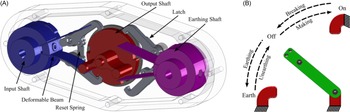
The Fast LCA model presented in the previous sections is validated by applying it to two different actuators (drives) of a load break switch (LBS) for switchgear: the first one is the reference from a previous generation while the second one (Figure 2a) is the first embodiment design of a new generation that has the goal to reduce the environmental impact while maintaining the same functional requirements. A LBS is a component designed for connecting or disconnecting power lines under nominal load conditions (switching operations) for which the drive provides the necessary energy. The drive provides the energy to a switching mechanism that transfers it into kinetic energy of moving blades, which transfer the current from the switch input to the output. The drive is typically a purely mechanical system, consisting of more than 100 components, which stores and provides the required energy for the switching operations through springs. The new generation of the drive is a deformable beam-based actuation system that replaces a traditional torsion spring-based mechanism with a new one composed of four independent deformable beams that store and release elastic energy and are optimized for each switching operation (Figure 2b): making, breaking, earthing and unearthing (Reference Sarvestani, Ravindran, Shi and GranhaugSarvestani et al., 2025). This concept represents a new generation design aiming to reduce components number, total mass and environmental impact and is a relevant case for validating the Fast LCA model, demonstrating how eco-design choices can be quantitatively evaluated and compared across consecutive product generations.
New load break switch drive concept (2a) and its switching modes (2b) (Reference Sarvestani, Ravindran, Shi and GranhaugSarvestani et al., 2025)

Figure 2 Long description
Panel A: A diagram of a load break switch drive concept. The diagram includes an input shaft, deformable beam, reset spring, output shaft, latch, and earthing shaft. These components are interconnected to form a mechanical structure. Panel B: A diagram illustrating the switching modes of the load break switch drive. The diagram shows the transitions between off and on states, including breaking, making, earthing, and unearthing processes. The components and their interactions are depicted to show the functional relationships and sequence of operations.
5.1. Fast LCA accuracy
As first analysis the Fast LCA is benchmarked against the conventional LCA for the two system generations. To maintain consistency between the two models, same materials and manufacturing processes are selected in the LCI as well as the recycled content rate in the raw material and the EoL recyclability potential. Most of the components of the two products are made of structural steel and their manufacturing processes selected in the LCI, if specific information is not available, are an average of processes to transform a specific material from a semi-manufactured into a final product. The environmental impact indicators and the impact assessment method used are defined by EN 15804:2019+A2 and are aggregated in a single score using with the EF 3.1 normalization and weighting factors. For this study no use phase environmental impact is considered because the drives are purely mechanical systems and are meant to be manually loaded by an operator, so no energy consumption is involved during their use phase.
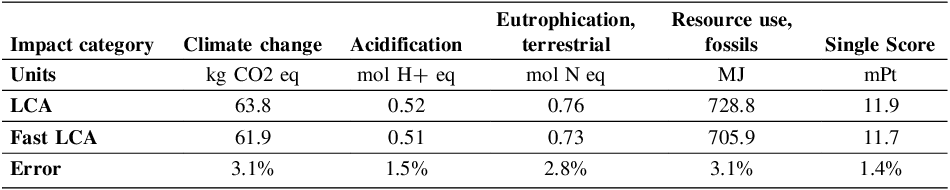
Table 2 shows a selection of environmental impact categories obtained with the conventional and the Fast LCA for the reference product. The error of the estimated environmental impact on the j-th impact category with the Fast LCA with respect to the values obtained with conventional LCA is also reported in the table and is calculated as follows (Equation 3):

It is noticed that error is below 5% for all the impact categories (17 in total) and their Mean Absolute Percentage Error (MAPE) is 2.4%.
The same results for the new drive are reported in Table 3. In this case the error between conventional and Fast LCA is below 10% for all the impact categories and the MAPE is 4.4%.
These results demonstrate a high accuracy of the model for the analyzed products, with the error rate in estimating the environmental impacts below 10% which is considered as an equivalence threshold, consistent with the level of variation generally considered significant in LCA sensitivity analysis (Reference Lee and InabaLee and Inaba, 2004). Therefore, deviations within this range can be interpreted as non-significant differences between the two models.
LCA and Fast LCA for reference product

LCA and Fast LCA for new generation

Additionally, the accuracy of the Fast LCA with respect to a conventional LCA is evaluated in its application to six different design variants. These correspond to alternative housing materials, which influence the resulting environmental impacts (see Section 5.2 for details). This analysis aims to verify the reliability of the proposed model for environmental calculations when design parameters, such as material type, vary. For each j-th environmental impact category, the percentage error between conventional and Fast LCA results is computed using Equation 3. Figure 3 summarizes these deviations using box charts, showing the distribution of the percentage error of the Fast LCA relative to the conventional LCA for each impact category and for each variant in which the housing is made of the k-th considered material. The following information is displayed for each distribution: the median, the lower and upper quartiles and any outliers.
Deviation between conventional and Fast LCA for each environmental impact category

The box chart shows that, for 15 out of 17 indicators, the median percentage error remains below the 10% equivalence threshold, confirming that no statistically significant difference exists between the two models. Errors above the threshold could be given by the assumptions made and possible non-linearities not detected by the parametric model proposed. Anyway, the values are still acceptable at this stage since the objective is to quickly compare different design variants and not to obtain absolute environmental impact indicators.
5.2. Fast LCA for design space exploration
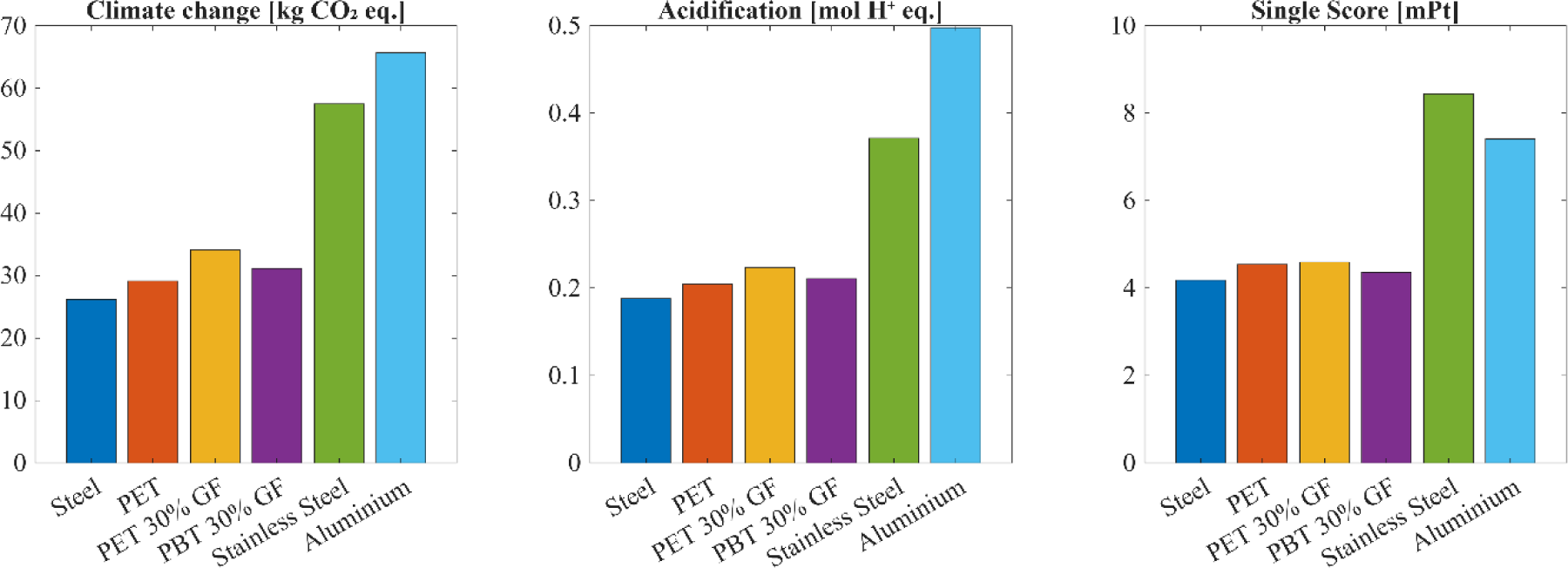
After proving the accuracy of the Fast LCA model, it is applied as a design tool to identify the optimal solution in terms of environmental impact. The goal is to demonstrate how the model can support the designers in decision-making by rapidly assessing the environmental impact of multiple design variants under realistic constraints. The drive housing is selected as the target component, as it accounts for about 50% of the total impact due to its elevated mass. In addition to the base configuration in steel, five alternative materials are assessed: PET, PET reinforced with 30% glass-fiber, PBT reinforced with 30% glass-fiber, stainless steel and aluminium. To ensure functional equivalence across material variants, the housing plate thickness t is adjusted such that the nominal bearing stress
 $${\sigma _{bear}}$$
at the internal diameter
$${\sigma _{bear}}$$
at the internal diameter
 $${D_i}$$
of the hole (considered constant for all the variants) does not exceed the yielding stress
$${D_i}$$
of the hole (considered constant for all the variants) does not exceed the yielding stress
 $${\sigma _{yield}}$$
of the considered material. Using the projected-area approximation for bearing contact at a hole (Reference Budynas and NisbettBudynas & Nisbett, 2015), the average bearing stress can be approximated as (Equation 4):
$${\sigma _{yield}}$$
of the considered material. Using the projected-area approximation for bearing contact at a hole (Reference Budynas and NisbettBudynas & Nisbett, 2015), the average bearing stress can be approximated as (Equation 4):
 $${\sigma _{bear}} = {{F}\over{{{D_i}t}}}$$
Where F is the constant bearing load. Enforcing
 $${\sigma _{bear}} \le {\sigma _{yield}}$$
in Equation 4, an inverse relationship between yielding stress and housing thickness is defined.
$${\sigma _{bear}} \le {\sigma _{yield}}$$
in Equation 4, an inverse relationship between yielding stress and housing thickness is defined.
Figure 4 shows three environmental impact categories for design variants with alternative housing materials, accounting for recycled content as modelled in ecoinvent 3.11.
Environmental impact categories for design variants with alternative housing materials

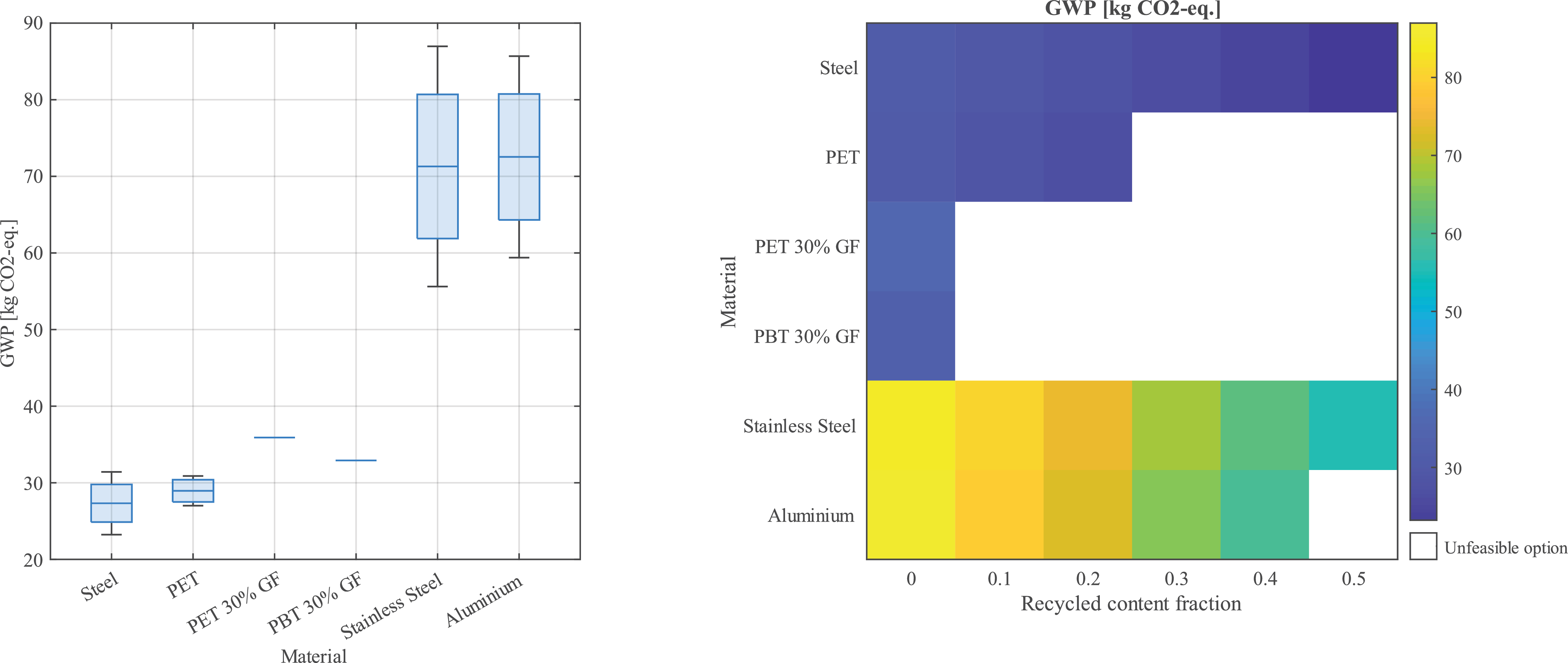
An additional parameter considered is the typical recycled content rate of the new materials sourced from Granta Selector, creating a multidimensional design space that combines material type and recycling parameters. Figure 5a presents, for each material, a box chart showing the variance in Climate Change (GWP) indicator due to changes in recycled content rate, enabling rapid sensitivity analysis with the Fast LCA. Materials with higher environmental impact show the greatest reduction potential through increased recycling, suggesting that when such materials are necessary, a high recycled content rate can significantly lower the overall product impact. For glass-fiber reinforced polymers, no variance is observed because their recycling remains limited by technical constraints.
The aim of the Fast LCA is to support early-stage decision-making by helping designers explore the design space and identify parameter combinations that minimize environmental impact. Figure 5b visualizes the same dataset as a heatmap, mapping the relationship between material type, recycled content fraction and environmental impact (in this example GWP).
Sensitivity analysis (5a). Parameters combination for decision-making (5b)

The graphical representation allows quick identification of the combination of design parameters with lowest environmental impact.
The entire analysis process of 22 variants required 12 seconds, which is considered promising for scaling the method to a wider design space in future applications.
6. Conclusion and future work
The proposed Fast LCA model uses several assumptions to enable rapid environmental assessment in the early embodiment design phase. These include the use of unitary environmental indicators per material and process, a linear formulation of environmental impact categories and the use of only secondary data for all the life cycle stages. However, these assumptions are consistent with Product Category Rules (PCRs) and ISO 14040/14044 guidelines. The low deviations observed between the Fast and conventional LCA results (typically under 10%) confirm that the adopted simplifications do not compromise the methodological accuracy and reliability of the results. The results of the design space exploration confirm that the Fast LCA model can effectively support in rapid decision-making in the early stages of product development, instantly evaluating the environmental impact of different design variants and identifying design directions by linking environmental performance directly to design parameters such as material type and recycled content. Future work will further explore integrating the parametric LCA data flow with formal development and variation paths based on the model of SGE. This integration aims to enable predictive cross-generational environmental assessments and to support the systematic transfer of product substance into higher-value retention paths (Reference Moser, Weber, Spekker, Schwarz, Schlegel, Düser and AlbersMoser et al., 2026).
This first application defines the possibility of considering additional parameters such as geometrical properties or alternative manufacturing processes and the possibility to integrate the Fast LCA in an overall design methodology as part of the GreEner Tech project (Reference Rader, Rosebrock, Meyer, Sahlab, Juhlin, Bickel, Buschbeck, Schoch, Quast, Geist, Balle, Yu and KurratRader et al., 2025). This methodology should support the designer in developing new products through a structured process combining material preselection, mechanical assessment, Fast LCA and Life Cycle Costing (LCC) and multi-criteria decision-making (MCDM) to balance environmental, cost and performance objectives. To facilitate working with different data types and file formats for the assessment of design variants, a standardized and structured representation will be used: the Asset Administration Shell (AAS). The AAS is an information model used to represent different aspect of assets, i.e. switchgear (Reference Sahlab, Rimaz, Juhlin, Lo Guzzo and RaderSahlab et al., 2025). Modelling design variants using the AAS facilitates data processing, comparison between designs as well as visualizing relevant environmental parameters.
Acknowledgement
The project GreEner Tech, on which this paper is based, was funded by the German Federal Ministry for Economic Affairs and Climate Action under the funding code 03EI6101A.



 Open access

