


Our hypothesis was that perceived discrimination is associated with psychological distress and that this association could be explained by socio-economic disadvantage.
METHOD
The Swedish National Survey of Public Health 2004 (Reference Boström and NyqvistBoström & Nyqvist, 2005) comprised 15 406 men and 17 922 women aged 18–84 years. Data were derived from a self-administered postal questionnaire and registry data from Statistics Sweden. The response rate was 63%. Respondents were informed by letter about data linkage on demographic variables (age, marital status, education and income). The study reported here was approved by the research ethics committee at the Swedish National Board of Health and Welfare and the ethics committee at the Karolinska Institutet. Detailed information about this survey is published elsewhere (Reference Wamala, Merlo and BoströmWamala et al, 2006).
Psychological distress was coded as present if the respondent endorsed three or more symptoms from the 12-item version of the General Health Questionnaire (GHQ–12; Reference Goldberg and WilliamsGoldberg & Williams, 1988).
Perceived discrimination was based on the generic measure of unfair treatment that results in humiliation, including frequency and reasons, as documented by Williams & Chung (Reference Williams, Chung, Gibson and Jackson1997). Frequency of perceived discrimination was based on the question, ‘Have you during the past 3 months been treated in a way that made you feel humiliated?’ Possible answers were ‘no’ (none), ‘yes, once’ (some) or ‘yes, several times’ (frequent). Participants who reported discrimination were asked to give the reason for discrimination: the choices were ethnic background, sex/gender, sexual orientation, age, disability, religion, unspecified or ‘don't know’.
Other covariates were: age; long-term illness, based on whether the respondent had any long-term illness, disability or infirmity; socio-economic disadvantage, categorised as ‘none’, ‘mild’ or ‘severe’, based on four different indicators of economic deprivation – social welfare beneficiary, unemployed, financial crises or lacking cash reserves (Reference Wamala, Merlo and BoströmWamala et al, 2006).
Multiple logistic regression analyses were conducted to estimate the association between perceived discrimination and psychological distress. Regression coefficients (standard errors) were used to obtain odds ratios and 95% confidence intervals (if the lowest CI value exceeds 1.0 this implies a statistically significant likelihood of psychological distress; Reference Hosmer and LemeshowHosmer & Lemeshow, 1989). In the first model we adjusted for age and long-term illness, and in the second we further adjusted for socio-economic disadvantage. The magnitude explained by socio-economic disadvantage was calculated as [(ORmodel 1–ORmodel 2)/(ORmodel 1–1)]×100 (Reference Wamala, Merlo and BoströmWamala et al, 2006). We used Stata version 9 for Windows for these analyses.
RESULTS
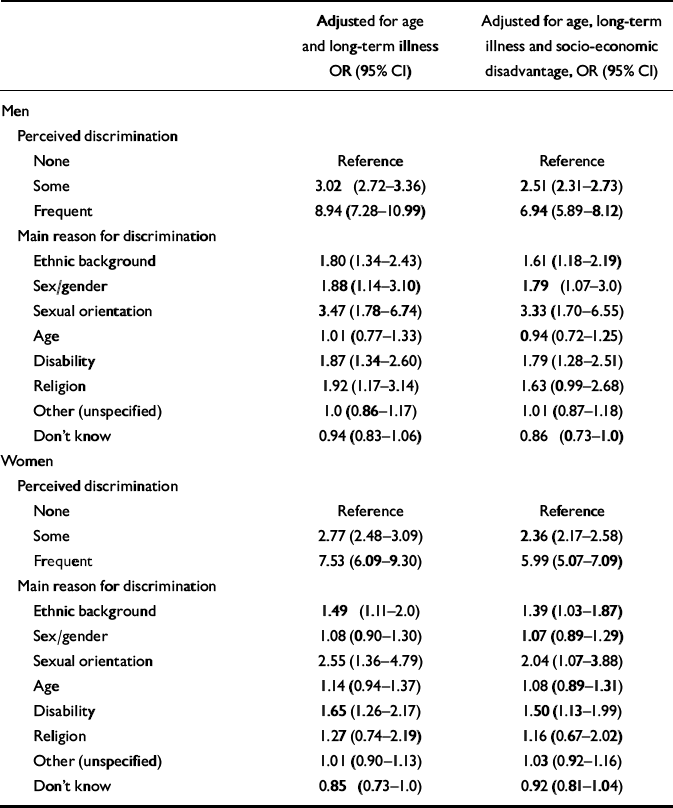
Psychological distress was present in 22% of women and 14% of men, whereas perceived discrimination was reported in 30% and 22% respectively. Socio-economic disadvantage was associated with both psychological distress (r=0.21) and discrimination (r=0.23). The likelihood of psychological distress increased with the frequency of discrimination in a dose–response fashion (Table 1). Adjustment for socio-economic disadvantage explained 25% of this association for men and 20% for women.
Odds ratios for psychological distress in relation to perceived discrimination
| Adjusted for age and long-term illness OR (95% CI) | Adjusted for age, long-term illness and socio-economic disadvantage, OR (95% CI) | |
|---|---|---|
| Men | ||
| Perceived discrimination | ||
| None | Reference | Reference |
| Some | 3.02 (2.72-3.36) | 2.51 (2.31-2.73) |
| Frequent | 8.94 (7.28-10.99) | 6.94 (5.89-8.12) |
| Main reason for discrimination | ||
| Ethnic background | 1.80 (1.34-2.43) | 1.61 (1.18-2.19) |
| Sex/gender | 1.88 (1.14-3.10) | 1.79 (1.07-3.0) |
| Sexual orientation | 3.47 (1.78-6.74) | 3.33 (1.70-6.55) |
| Age | 1.01 (0.77-1.33) | 0.94 (0.72-1.25) |
| Disability | 1.87 (1.34-2.60) | 1.79 (1.28-2.51) |
| Religion | 1.92 (1.17-3.14) | 1.63 (0.99-2.68) |
| Other (unspecified) | 1.0 (0.86-1.17) | 1.01 (0.87-1.18) |
| Don't know | 0.94 (0.83-1.06) | 0.86 (0.73-1.0) |
| Women | ||
| Perceived discrimination | ||
| None | Reference | Reference |
| Some | 2.77 (2.48-3.09) | 2.36 (2.17-2.58) |
| Frequent | 7.53 (6.09-9.30) | 5.99 (5.07-7.09) |
| Main reason for discrimination | ||
| Ethnic background | 1.49 (1.11-2.0) | 1.39 (1.03-1.87) |
| Sex/gender | 1.08 (0.90-1.30) | 1.07 (0.89-1.29) |
| Sexual orientation | 2.55 (1.36-4.79) | 2.04 (1.07-3.88) |
| Age | 1.14 (0.94-1.37) | 1.08 (0.89-1.31) |
| Disability | 1.65 (1.26-2.17) | 1.50 (1.13-1.99) |
| Religion | 1.27 (0.74-2.19) | 1.16 (0.67-2.02) |
| Other (unspecified) | 1.01 (0.90-1.13) | 1.03 (0.92-1.16) |
| Don't know | 0.85 (0.73-1.0) | 0.92 (0.81-1.04) |
Analyses of the association between reasons for perceived discrimination and psychological distress showed statistically significant associations with ethnic background, sexual orientation and disability among both men and women, after adjustment for age, long-term illness and socio-economic disadvantage. Discrimination due to gender was associated with psychological distress only among men. Other unspecified reasons or not knowing the reason were not associated with psychological distress (Table 1).
DISCUSSION
To our knowledge, this is the first study to show empirical evidence of the association between perceived discrimination and psychological distress in a large population-based sample in Sweden. Our results are consistent with previous studies in the USA and UK of unfair treatment and psychological disorders. Discrimination has been demonstrated to manifest itself as socio-economic disadvantage (Reference NazrooNazroo, 2003) and to produce and perpetuate socio-economic differences in mental health (Reference Fryers, Melzer and JenkinsFryers et al, 2003). In our study socio-economic disadvantage explained about a quarter of the association between discrimination and psychological distress. Other factors seem to explain the remaining proportion. Discrimination is suggested to be a stressor, as daily experiences of discrimination and unfair treatment may constitute chronic stress, in the long run leading to psychological disorders (Reference Landrine and KlonoffLandrine & Klonoff, 1996) and to pathological physiological reactions such as high blood pressure and cardiovascular reactivity (Reference Guyll, Matthews and BrombergerGuyll et al, 2001). Lack of participation in society, lack of social relations and contextual factors are also possible mediators.
Results of this research should be interpreted in the light of its limitations. First, the cross-sectional design of the study makes it difficult to draw conclusions about causal relationships. Second, our measure of discrimination, which is based on treatment that makes people feel humiliated, may not capture ‘discrimination’ as a concept (Reference Krieger, Smith and NaishadhamKrieger et al, 2005). However, individuals who did not indicate any specific reason for discrimination (e.g. ethnicity, gender, sexual orientation, age, disability or religion) had no greater likelihood of psychological distress than those who did not report any discrimination. The major social constructs (ethnicity, gender, disability, age and sexual orientation) are documented to be potential reasons for perceived discrimination (Reference Williams, Neighbors and JacksonWilliams et al, 2003). Third, our measure does not include the verbal maltreatment dimension. It is also plausible that perceived discrimination may reflect other personality traits such as paranoia rather than real experiences (Reference Janssen, Hanssen and BakJanssen et al, 2003). Nevertheless, Taylor et al (Reference Taylor, Stephen, Lana, Zanna and Olson1994) in a series of laboratory-based experiments demonstrated high sensitivity and consistency of responses to unfair treatment. Fourth, the low response rate is problematic. However, the non-responders in this study included a large proportion of men, the socially disadvantaged and immigrants. Thus results presented here underestimate the magnitude of the true association between discrimination and psychological distress.
The strengths of our study include a large data-set that represents the normal population and a generic measure of perceived discrimination that addresses various groups in Swedish society. More studies are needed to replicate our results and to demonstrate pathways for the association between discrimination and psychological distress.




eLetters
No eLetters have been published for this article.