

Introduction
As women have become a pillar of labour markets in Western democracies, work–family conflict has become a salient social issue (Gornick and Meyers, Reference Gornick and Meyers2008; Williams and Boushey, Reference Williams and Boushey2010; van Breeschoten et al., Reference van Breeschoten, Roeters and van der Lippe2018). Public family policies have expanded accordingly (Ray et al., Reference Ray, Gornick and Schmitt2010; Daiger von Gleichen and Seeleib-Kaiser, Reference Daiger von Gleichen, Seeleib-Kaiser and Shaver2018), yet employers also play an important role in providing work–family reconciliation (Chung, Reference Chung2019; Daiger von Gleichen, Reference Daiger von Gleichen, Dobrotić, Blum and Koslowski2022). Despite longstanding recognition of employers’ welfare role, comparative social and family policy research remains primarily focused on the state, leaving an incomplete understanding of how organisational characteristics relate to employer family policy and interact with public policy (Titmuss, Reference Titmuss1956; Swenson, Reference Swenson2002; Farnsworth, Reference Farnsworth and Greve2019; Kossek and Ollier-Malaterre, Reference Kossek, Ollier-Malaterre, Poelmans, Greenhaus and Maestro2013; Daly and Ferragina, Reference Daly and Ferragina2018).
We address this gap by applying a theory-testing approach at the meso level, using employer data from Germany and the United States to assess the relative explanatory power of competing theoretical logics across policy contexts. This requires identifying organisational actors through whom normative and economic pressures are likely to be mediated. Building on research linking welfare outcomes to class- and gender-based mobilisation (Korpi, Reference Korpi1983; Hobson and Lindholm, Reference Hobson and Lindholm1997), we focus on two such employee segments: organised labour and female leadership. While these actors have been central to the development of welfare regimes, their roles at the organisational level and their relevance for employer family policy provision remain insufficiently understood. This paper thus asks: How relevant are female leadership and organised labour to employer provision of family policies in Germany and the United States?
To guide this investigation, we develop an analytical framework that draws on theories that primarily imply an underlying normative or economic logic. On the economic side, we address mechanisms underlying the Varieties of Capitalism framework (Hall and Soskice, Reference Hall and Soskice2001), as well as theories of politics against markets (Korpi, Reference Korpi1983) and capitalists against markets (Swenson, Reference Swenson2002). On the normative side, we discuss mechanisms underlying theories of organisational legitimacy (Meyer and Rowan, Reference Meyer and Rowan1977), isomorphism in organisational fields (DiMaggio and Powell, Reference DiMaggio and Powell1983), and relational claims-making (Tomaskovic-Devey and Avent-Holt, Reference Tomaskovic-Devey and Avent-Holt2019). Rather than expanding on these theories, our framework operationalises the underlying logics for comparative analysis, enabling their practical application to distinct policy contexts. Furthermore, we address how the dimension of gender can affect these mechanisms.
Importantly, unlike most studies that apply both normative and economic arguments to explain the same employer behaviour, our framework generates distinct empirical predictions from each, allowing an evaluation of their relative explanatory power in a given context. This approach not only addresses our main empirical question but also provides a tool for engaging with the broader theoretical debate.
Our comparative analysis draws on data from the IAB Establishment Panel in Germany and the National Study of Employers in the United States. Although a two-case study limits the inferences we can draw, our approach enables specific contextual analysis of the selected countries and can further be applied to other countries for which comparable macro- and meso-data exist.
Theoretical background and analytical framework
Most research into why employers provide occupational family policies tends to explain employer behaviour drawing on economic or normative logics, or both. Economic perspectives typically emphasize deliberate, cost–benefit driven decisions by employers (Estévez-Abe et al., Reference Estévez-Abe, Iversen, Soskice, Hall and Soskice2001; Beauregard and Henry, Reference Beauregard and Henry2009; DeMenezes and Kelliher, Reference DeMenezes and Kelliher2011), while normative perspectives highlight pressures of social legitimacy, often treating economic considerations as secondary (Chuang et al., Reference Chuang, Church and Ophir2011; Everly and Schwarz, Reference Everly and Schwarz2015; Bergqvist and Saxonberg, Reference Bergqvist and Saxonberg2017). Most studies of employer family policy acknowledge that both economic and normative factors matter (Osterman, Reference Osterman1995; Davis and Kalleberg, Reference Davis and Kalleberg2006; Seeleib-Kaiser and Fleckenstein, Reference Seeleib-Kaiser and Fleckenstein2009). Yet few studies systematically distinguish or compare the merit of these logics in differing contexts.
This lack of distinction has likely developed because in most contexts, economic logics alone effectively explain how organisational characteristics relate to employer family policies. For instance, employers dependent on female employees are more likely to offer family policies to reduce costly turnover (Lyonette and Baldauf, Reference Lyonette and Baldauf2019). The relationship is nuanced: work–family conflict often stems from women’s lack of schedule control at work, as well as greater family demands at home (Grönlund and Öun, Reference Grönlund and Öun2018), and evidence shows the conflict is sharpest for mothers specifically, not women generally (Reimann et al., Reference Reimann, Peters and Diewald2022). Yet studies interpreting a positive correlation between female employees and employer family policy typically attribute it to employers’ efforts to reduce turnover costs caused by work–family conflict (Osterman, Reference Osterman1995; Seyler et al., Reference Seyler, Monroe and Garand1995; Den Dulk et al., Reference Den Dulk, Peters and Poutsma2012), a fundamentally economic argument.
Based on such an economic logic, we would expect generous public family policy provision to coincide with limited employer provision – a mechanism termed “crowding-out” (Wiß and Greve, Reference Wiß and Greve2020).Footnote 1 The underlying assumption is that employers refrain from providing policies already offered by the state because this is seen as an inefficient use of resources. The exact economic mechanism depends on the theory in question. Korpi (Reference Korpi1983, Reference Korpi2006) argues that employers resist generous public policy because it makes it economically feasible for employees to reject less desirable terms, thereby raising labour costs. In the Varieties of Capitalism framework, employers with specific skill needs favour public provision of a welfare floor to prevent market failure in skill formation, but only to a level that still allows firms to offer occupational policies that bind employees to them (Hall and Soskice, Reference Hall and Soskice2001). Swenson (Reference Swenson2002) extends this argument by emphasizing employers’ interest in stable labour markets to prevent ruinous labour competition.
Across these accounts, state expansion is expected to “crowd out” employer provision by transforming firm-specific benefits into standardized public entitlements, thereby reducing employers’ incentives to offer similar policies. While economic arguments also allow for employer provision in generous public policy contexts – for example, as a strategic tool to attract highly qualified personnel (Farnsworth, Reference Farnsworth and Greve2019) – these logics share the expectation that public and employer policies should not substantially overlap. Thus, in economic logic, the expectation is that in more generous policy contexts, employees’ needs are more likely to be met by the state, lowering employers’ incentives to provide supplemental policies.
Despite the dominance of such economic logics in comparative social policy, empirical studies in comparative family policy give reason for critique. “Crowding-in,” where generous public policy coincides with widespread employer family policy, has been repeatedly observed across policy measures and national contexts (Den Dulk et al., Reference Den Dulk, Groeneveld, Ollier-Malaterre and Valcour2013; Mun and Jung, Reference Mun and Jung2018; Natali et al., Reference Natali, Keune, Pavolini and Seeleib-Kaiser2018; Kaufman and Petts, Reference Kaufman and Petts2022). These findings are better explained by a normative logic, which posits that the state exerts pressure concerning the appropriateness of employer provision (Lewis and Smithson, Reference Lewis and Smithson2001). Again, the exact mechanism depends on the theory in question. Neo-institutionalist theorists argue that organizations are subject to normative pressures rooted in socially defined conceptions of legitimate organizational work (Meyer and Rowan, Reference Meyer and Rowan1977), as well as in collective social expectations (DiMaggio and Powell, Reference DiMaggio and Powell1983). These pressures define what is deemed proper or appropriate, encouraging conformity to social expectations with less regard to economic efficiency. Applying this logic to the relationship between public and employer policy, generous public provision may take the role of norm-builder, institutionalizing family support as a social standard. In this normative environment, employers provide family policies, similar to those provided by the state, to satisfy heightened stakeholder expectations and maintain legitimacy.
Tomaskovic-Devey and Avent-Holt (Reference Tomaskovic-Devey and Avent-Holt2019) further conceptualize this process as relational claims-making, where the allocation of organizational resources is determined by whether an actor’s demand is recognized as a legitimate claim by influential others. Within this framework, generous public provision serves as an institutional resource that bolsters the normative legitimacy of employees’ demands, strengthening their power to successfully claim family support as a right rather than a discretionary perk. Thus, for theories that apply such a normative logic, the posited mechanism is “crowding-in,” whereby generous public policy encourages more employer policy, such that the set of policies offered by the state and employer will resemble each other or even overlap.
Which logic is supported by the evidence? Because economic and normative logics imply opposing dynamics – crowding-out versus crowding-in – they generate distinct predictions about the relationship between public and employer family policy. Comparative variation in public policy levels allows these predictions to be evaluated: when policy levels are similar, normative pressures can be treated as constant, making economic logics more informative for explaining observed differences; when policy levels differ, opposing expectations permit a test of whether economic or normative logics better account for observed outcomes.Footnote 2
Our analytical framework does not build on the theories discussed in this section but rather operationalises key mechanisms therein for comparative analysis. This requires some simplification. While each theory includes more nuanced distinctions than economic versus normative, we intentionally simplify to enhance their utility as comparative tools. By spelling out the expectations these theories imply, our framework provides a meso-level approach to assess whether mechanisms related to normative or economic logics more reasonably apply in specific contexts.
Organisational characteristics
We focus on two organisational characteristics – female leadership and organised labour – as potentially significant for employer family policies, given their institutional task of exerting pressure on behalf of employees. While the relevance of structural factors, such as employer size, sector, and industry, is well documented (Osterman, Reference Osterman1995; Seeleib-Kaiser and Fleckenstein, Reference Seeleib-Kaiser and Fleckenstein2009; Den Dulk et al., Reference Den Dulk, Peters and Poutsma2012), less is known about the importance of specific employee segments to employer family policy provision. Female leadership and organised labour, therefore, remain underexplored despite their potential to illuminate the mechanisms underlying competing theoretical perspectives (Heywood and Jirjahn, Reference Heywood and Jirjahn2009; Kowalewska, Reference Kowalewska2020).
Female leadership
The evidence on female leadership and employer-provided childcare is limited but suggests a positive association (Witkowski, Reference Witkowski1999; Daiger von Gleichen, Reference Daiger von Gleichen2023). Gagliarducci and Paserman (Reference Gagliarducci and Paserman2015) find that establishments with more women in top management are more likely to implement “female-friendly” policies like childcare. However, they also note significant sorting of female managers into smaller establishments that pay lower wages but are more female-friendly, suggesting that these associations may partly reflect establishment characteristics rather than causality. Results for flexible working are mixed. A German study found a positive association (Heywood and Jirjahn, Reference Heywood and Jirjahn2009), but cross-national research found no significant link overall (Chung, Reference Chung2019). A US study reported a negative association (Witkowski, Reference Witkowski1999). Comparative evidence and thus conclusions about employer behaviour across policy contexts are rare (Yu et al., Reference Yu, Chau and Kühner2019; Rummery, Reference Rummery2021), but they suggest normative explanations may be underappreciated (Daiger von Gleichen, Reference Daiger von Gleichen2023).
Organised labour
The evidence for organised labour’s role in employer family policy is richer but mixed. Organised labour in the United States operates primarily through labour unions, which negotiate collective bargaining agreements directly with individual or groups of employers within a given industry. Yet evidence suggests unions have limited relevance for employer family policies (Osterman, Reference Osterman1995; Kelly, Reference Kelly2003). In Germany, organised labour’s impact depends significantly on its institutional foundations, which are organised through two main pillars: collective agreements and works councils. Collective agreements, negotiated at the industry level, establish broad conditions such as wages and working hours, while works councils operate at the employer level, addressing workplace-specific issues. Both pillars are legally codified: works councils hold formal co-determination rights under German law, giving them substantial authority in workplace-level decision-making, while collective agreements are binding for covered firms and carry legal force within Germany’s industrial relations framework. While these two components often collaborate, their influence on employer family policy differs. Works councils show positive associations with employer-provided childcare, while collective agreements show negative or no significant associations (Heywood and Jirjahn, Reference Heywood and Jirjahn2009), echoing US findings (Davis and Kalleberg, Reference Davis and Kalleberg2006). This suggests that differences between the two pillars are relevant to how they leverage or parry pressures in the institutional environment.
Policy measures: Childcare and flexible working
Our choice of policy measures follows the distinction between work-facilitating and work-reducing policies (Misra et al., Reference Misra, Budig and Boeckmann2011; Pettit and Hook, Reference Pettit and Hook2009). Work-facilitating policies address work–family conflict by adjusting work or care conditions, while work-reducing policies focus on reducing working time. Leave is typically work-reducing, whereas flexible work and childcare are work-facilitating (Chung, Reference Chung2019; Misra et al., Reference Misra, Budig and Boeckmann2011). Our analysis focuses on work-facilitating policies, which align employee and employer interests more effectively. Most studies use composite measures to assess public policy generosity (Farnsworth, Reference Farnsworth2004; Den Dulk et al., Reference Den Dulk, Peters and Poutsma2012, Reference Den Dulk, Groeneveld, Ollier-Malaterre and Valcour2013), despite organisational-level research showing that associations vary by policy (Seeleib-Kaiser and Fleckenstein, Reference Seeleib-Kaiser and Fleckenstein2009). For maternity leave, studies reveal an inverted U-shaped relationship: employer-provided leave is least common in contexts with low or high public provision and peaks at medium levels (Evans, Reference Evans2001; Chung, Reference Chung2019). This suggests crowding-out occurs beyond a public generosity threshold, around 1 year of statutory leave (Chung, Reference Chung, Nieuwenhuis and Van Lancker2020). While composite measures often suggest crowding-in (Den Dulk et al., Reference Den Dulk, Peters and Poutsma2012), maternity leave findings highlight crowding-out, reflecting differences in employer behaviour across policies. This underscores the need to analyse childcare and flexible work policies separately.
Country cases
Germany and the United States occupy contrasting positions in the welfare triangle that structures relations between the state, market, and family (Esping-Andersen, Reference Esping-Andersen2002; Leitner, Reference Leitner2003; O’Connor et al., Reference O’Connor, Orloff and Shaver1999), making them well-suited for applying our analytical framework. The two countries differ sharply in public childcare provision: Germany offers a universal right to childcare from a child’s first birthday, alongside paid leave and job guarantees of up to 3 years, whereas US provision at the federal level remains means-tested,Footnote 3 with no paid leave and limited job protection. By contrast, neither country provides a statutory right (or right to request) flexible working, creating similar regulatory conditions for this policy.
Despite these differences, Germany and the United States share economic and cultural features that support meaningful comparison (McGinnity and McManus, Reference McGinnity and McManus2007; Grunow and Aisenbrey, Reference Grunow and Aisenbrey2016). Both rely heavily on employers for welfare provision, though within distinct institutional arrangements, and both are shaped by a historical male-breadwinner model that continues to influence work–family expectations. Historical research further shows that employer involvement in childcare in both countries emerged from paternalistic corporate initiatives (Allen, Reference Allen2017; Gerlach, Reference Gerlach, Gerlach and Schneider2012).
At the organisational level, the influence of female leadership and organised labour differs across the two cases. Female leaders in the United States operate in a more fluid labour market that allows greater leverage of transferable skills, while Germany’s more rigid skill structures limit such economic power. Organised labour, by contrast, is institutionally stronger in Germany, supported by legal protections for works councils and collective agreements. Together, these contrasts provide a balanced comparative setting for examining how public policy contexts shape the relevance of employee segments in employer family policy provision.
Hypotheses
The analysis proceeds in two steps: first, we compare the prevalence of employer-provided policies, and then the predictive power of female leadership and organised labour. We do this first for employer childcare (H1, H2) and then for flexible working (H3, H4).
H1: Employer-provided childcare is more widespread in Germany than in the United States. ConfirmationFootnote 4 is in line with the normative logic that Germany’s generous public childcare policies generate stronger normative pressures than the weaker U.S. policy framework. Rejecting this hypothesis would support an economic logic, which posits that weaker public childcare policies in the U.S. create stronger economic pressures.
H2: Female leadership (H2.1) and organised labour (H2.2) are more clearly associated Footnote 5 with employer-provided childcare in Germany than in the United States. Confirmation would suggest that normative pressures bolster claims-making in Germany. Rejection would suggest that economic logics have greater explanatory power.
For flexible working, where public policy is absent in both countries, normative logics are excluded.
H3: Employer-provided flexible working is more prevalent in the United States than in Germany. Confirmation would be in line with an economic logic, which attributes greater prevalence to stronger economic pressures for flexible work in the US.
H4: Female leadership (H4.1) is more clearly associated with employer-provided flexible working in the United States, while organised labour (H4.2) is more clearly associated in Germany. This hypothesis tests evidence of employee segments leveraging economic pressures for more employer policy in the absence of public policy.
Data, variables, and methods
For the US analyses, we used the 2016 National Study of Employers, a nationally representative survey of private-sector organisations with at least 50 employees (Matos et al., Reference Matos, Galinsky and Bond2017). For Germany, we used the 2016 IAB-Establishment Panel, a representative sample from the Research Data Centre of the German Federal Employment Agency (Ellguth et al., Reference Ellguth, Kohaut and Möller2013).Footnote 6 To improve comparability between datasets, German observations with fewer than 50 employees were dropped. At the time of writing, these are the most recent and only nationally representative datasets in Germany and the United States that provide establishment-level information on both the share of female leadership and detailed, disaggregated measures of family policy provision (i.e., separate indicators for childcare and flexible work, rather than general statements about family-friendliness). Because of differences in data structure and variable design, the datasets could not be fully harmonized, introducing limitations that are addressed in more detail in the variables, methods, as well as findings and discussion sections. Incomplete cases were excluded, and the final sample sizes for the two policies were: childcare (Germany: 4,405; United States: 906) and flexible working (Germany: 4,407; United States: 909).
Variables
The dependent variables are binary, indicating whether employers provide childcare or flexible working. For Germany, employer childcare includes direct provision, partnerships with external providers, and financial support, while in the United States, it excludes flexible spending accounts.Footnote 7 Flexible working is measured as “Vertrauensarbeitszeit” in Germany (employees choosing working hours without attendance recording) and as the option to change start and end times daily in the United States.
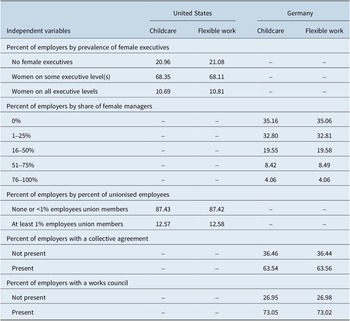
Female leadership is operationalised as an ordinal variable: in Germany, five categories capture the percentage of women in management (none, 1–25%, 26–50%, 51–75%, and 76–100%); in the United States, three categories indicate whether women are present on none, some, or all executive levels. Organised labour reflects institutional differences: in the United States, we distinguish employers with over or under 1% unionized employees (Davis and Kalleberg, Reference Davis and Kalleberg2006), while in Germany, binary variables capture the presence of collective agreements and works councils (Heywood and Jirjahn, Reference Heywood and Jirjahn2009). Given that the datasets are not harmonized, female leadership and organised labour are captured differently. These measurement differences limit comparability, and we take this into account in our interpretation.
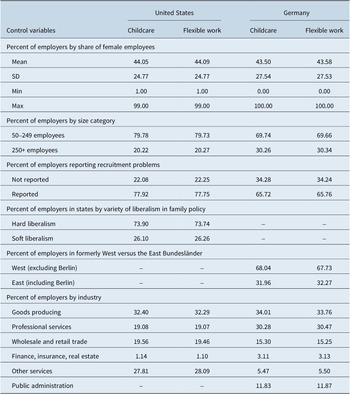
Control variables include employer size, industry, and recruitment problems as exhaustively listed for each finding table. These are standard controls in the literature (for a useful overview, see Chung, Reference Chung, Nieuwenhuis and Van Lancker2020), but they also reflect how our data allows us to account for additional sources of economic and normative pressures beyond public policy. For example, reported recruitment problems capture employer-specific economic pressures: when employers struggle to recruit staff, they may face greater economic incentives to offer family policies as a competitive advantage in attracting talent. Meanwhile, the east–west control accounts for some variability in normative pressure on employers stemming from historical differences in the acceptability or expectation around maternal employment and childcare provided outside the home.
The east–west control also functions as a proxy for regional policy differences in Germany (Mätzke, Reference Mätzke2019), while US models control for state-level family policy (Daiger von Gleichen and Parolin, Reference Daiger von Gleichen and Parolin2020) and female employee share (Daiger von Gleichen, Reference Daiger von Gleichen2023). This latter control is excluded in German models due to high correlation with female leadership (Field, Reference Field2013; eta-squared = 0.36, p < .001). This reflects not just a statistical issue but a structural feature of the German labour market, where companies with high female leadership and low female workforce share are exceedingly rare. The comparability issues stemming from non-harmonized data apply to all control variables, so caution is warranted when interpreting control variables across countries. Tables A1 and A2 in the Appendix provide descriptive statistics.
Methods
We employed a comparative method to investigate the relevance of female leadership and organised labour for employer family policy provision. For childcare (H1 and H2), we used a different-systems comparative analysis, while flexible working (H3 and H4) was analysed using a similar-systems approach. These methodologies rely on selecting comparative countries to evaluate the role of public family policy (or its absence) in employer outcomes (Anckar, Reference Anckar2008). We used logistic regression analyses for each policy-country pair, with marginal effects improving comparability across models (Mood, Reference Mood2010). However, because the datasets are not fully harmonized, even marginal effects do not guarantee full comparability of effect sizes across country models. For this reason, instead of estimating a pooled model or interpreting coefficient sizes directly, we estimate separate models for each country and compare the consistency of direction and significance of patterns between them. This allows us to evaluate whether similar variables behave differently under distinct institutional conditions, rather than attributing meaning to absolute effect sizes. We address this limitation by highlighting relevant constraints in the interpretation of findings. Full models are provided in Appendix, Tables A3 and A4.
Findings and discussion
This section examines each hypothesis test and interprets the results within broader theoretical debates. We do not adjudicate between theoretical traditions, but rather assess whether the empirical patterns are more consistent with the implications of economic or normative logics.
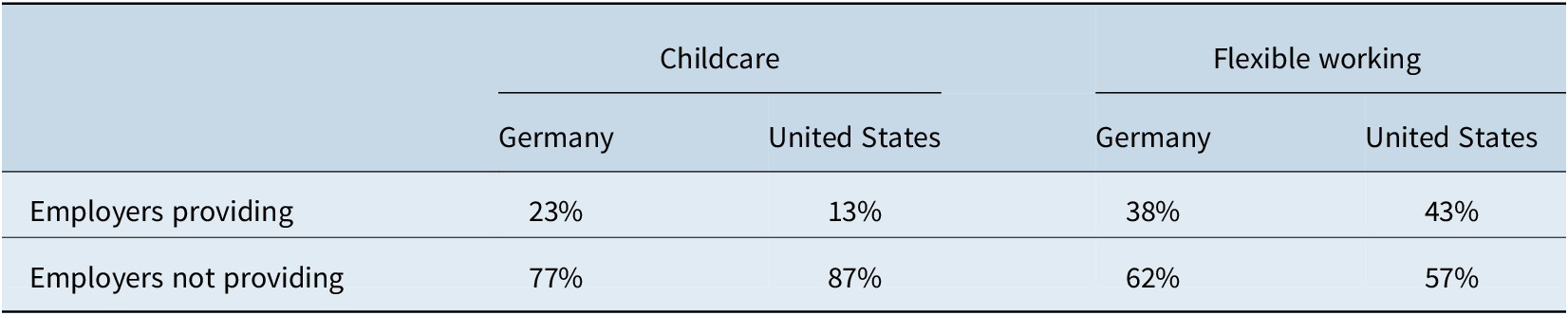
H1: Comparative prevalence of employer childcare
Table 1 shows that 23% of sampled employers in Germany provide childcare, compared to 13% in the United States, a statistically significant 10% difference. This confirms H1, as employer-provided childcare is more prevalent in Germany.Footnote 8 Within our analytical framework, this pattern is consistent with normative logics as theorised by Meyer and Rowan (Reference Meyer and Rowan1977) and DiMaggio and Powell (Reference DiMaggio and Powell1983), the underlying mechanism being that generous public childcare provision in Germany legitimizes childcare as an appropriate organisational responsibility. In the United States, such normative pressures would be weaker, explaining the lower prevalence of employer-provided childcare.
Employer family policy provision by country.

Note: Distributions significant at p <.001.
A Varieties of Capitalism perspective offers an economic alternative to such a normative interpretation. In this framework, employer provision is linked to production regimes and skill strategies, with firms expected to complement public arrangements where this supports the retention of valued skills (Estévez-Abe et al., Reference Estévez-Abe, Iversen, Soskice, Hall and Soskice2001; Hall and Soskice, Reference Hall and Soskice2001). Although we do not observe skill profiles directly, industry differences provide a limited test of this account (Tables A3 and A4).
In the United States, employer childcare is not systematically patterned by industry, suggesting that skill-based strategies do not explain provision there. In Germany, by contrast, childcare is more prevalent in selected service sectors, particularly professional services and finance, insurance, and real estate, than in goods-producing industries. This pattern does not align with classic Varieties of Capitalism expectations, which treat goods-producing sectors as paradigmatic cases of specific-skill production. Instead, it appears more consistent with gendered employment patterns, as the sectors with higher provision also tend to employ larger shares of women. This partially aligns with the argument put forth by Estévez-Abe et al. (Reference Estévez-Abe, Iversen, Soskice, Hall and Soskice2001) that employers may support family policy provision when they depend on women’s labour under conditions of limited male labour supply. However, because it is not evident that such male labour shortages characterise these German service sectors, the Varieties of Capitalism framework, even where it refers to gender, remains inconclusive in explaining the observed sectoral patterns. This illustrates why it is problematic when scholars of occupational welfare disregard gender, and why more such scholarship with gender at the centre of the analysis is needed.
Taken together, these findings suggest that while skill-based political-economy arguments offer some explanation within Germany, they do not fully account for the cross-national gap between Germany and the United States, which is consistent with differences in normative expectations surrounding employer childcare.
H2: Relevance of employee segments to employer childcare
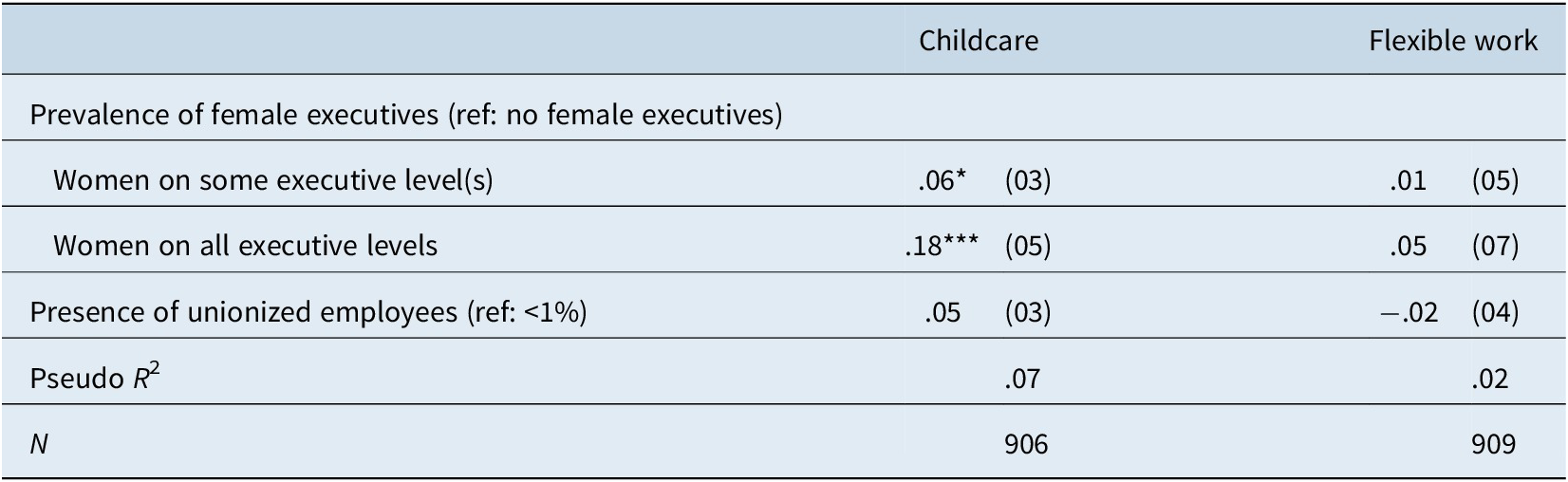
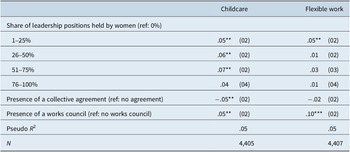
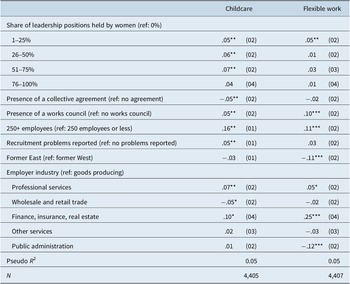
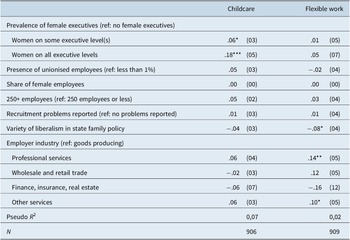
H2.1: Female leadership and employer childcare. As Tables 2 and 3 show, female leadership is associated with employer childcare in both countries, but patterns differ. In the United States, employers with women on all executive levels are 18% more likely to provide childcare than those with no female executives, a significant association. Germany shows significant positive marginal effects for employers with 1–75% female leadership, but not for employers with 76–100% female leadership.
Logistic regression results United States.

Note: This table shows two models: one for each policy, with average marginal effects and standard errors in brackets. Both models control for share of female employees, employer size by number of employees, whether recruitment problems were reported, variety of state-level family policy, and industry. *p $ < $
.05, **p
$ < $
.05, **p $ < $
.01, ***p
$ < $
.01, ***p $ < $
.001.
$ < $
.001.
Logistic regression results Germany.

Note: This table shows two models: one for each policy, with average marginal effects and standard errors in brackets. Both models control for employer size by number of employees, whether recruitment problems were reported, by east–west divide, and industry. The models do not control for share of female employees as the effect strength of the correlation with the share of women in leadership positions is significant and large (post-anova eta-squared of .36***). *p $ < $
.05, **p
$ < $
.05, **p $ < $
.01, ***p
$ < $
.01, ***p $ < $
.001.
$ < $
.001.
Importantly, as mentioned in the data section, the datasets are not harmonized, which is why we do not compare coefficients directly across countries, but rather draw conclusions by interpreting each model separately and then comparing the overall pattern of results. The relationship between widespread female leadership and employer childcare is clearer in the United States because here, significance straightforwardly increases with more female leaders. In Germany, by contrast, it vanishes at the highest level. This likely reflects the lack of control for female employees’ share in the German model, as female leadership and the overall share of female employees are closely aligned in the German labour market (and thus in our data).
The clearer relationship in the United States compared to Germany allows for two interpretations: either female leaders in Germany demand more childcare but are less effective in influencing employer policy, or they are less likely to make such demands. The former is consistent with the relative scarcity of female leaders in Germany, which may limit their ability to leverage normative pressures (OECD, 2023). The latter argument is also plausible, as fewer female leaders in Germany may have direct childcare needs, and prior research suggests that the presence of mothers, rather than women per se, is central to advocacy for work–family policies (Reimann et al., Reference Reimann, Peters and Diewald2022).
Taken together, these patterns suggest that the relative clarity of association between female leadership and employer childcare in the United States is more robustly explained through economic rather than normative logics. If female leaders primarily mobilised institutionalised norms surrounding childcare, a stronger association would be expected in Germany, where such norms are more firmly established. Instead, the US pattern aligns with political economy accounts emphasising employer responsiveness to labour market incentives, in which firms support family policies when they enhance recruitment and retention, especially of employees in leadership (Swenson, Reference Swenson2002; Farnsworth, Reference Farnsworth and Greve2019).
H2.2: Organised labour and employer childcare. Organised labour shows distinct patterns across the two countries (see Tables 2 and 3). In the United States, organised labour has no significant association with employer-provided childcare. In Germany, the results for organised labour differ by pillar: Works councils are linked to a 5% higher likelihood of employer-provided childcare, while collective agreements are associated with a 5% lower likelihood. Thus, our hypothesis that employer childcare is more strongly and positively associated with organised labour in Germany is rejected for collective agreements but confirmed for works councils. This divergence suggests that the two pillars of organised labour operate through different mechanisms. Works councils, as workplace-based institutions embedded in everyday organisational relations, are more directly exposed to employees’ normative claims (Tomaskovic-Devey and Avent-Holt, Reference Tomaskovic-Devey and Avent-Holt2019). In this sense, they may be more responsive to childcare as a legitimate workplace concern, particularly in contexts where childcare is normatively recognised as an appropriate employer concern. By contrast, collective agreements are negotiated at a greater distance from the workplace and are more strongly shaped by cost considerations and distributive trade-offs, potentially making them more responsive to economic constraints than to normative claims (Korpi, Reference Korpi1983; Swenson, Reference Swenson2002; Farnsworth, Reference Farnsworth and Greve2019). Differences in gender composition may further reinforce this divide, as works councils tend to be more gender diverse and therefore potentially more attuned to childcare-related concerns than collective bargaining institutions (Dribbusch and Birke, Reference Dribbusch and Birke2019).
H3: Comparative prevalence of employer-provided flexible work
Beyond childcare, Table 1 also shows that flexible working is provided by 38% of employers in Germany and 43% in the United States. With a 5% greater prevalence of employer-provided flexible working in the United States, the findings confirm H3.
Flexible working thus appears slightly more prevalent in the United States than in Germany, consistent with political economy accounts that emphasise employer responsiveness to market pressures in liberal market economies. In the absence of public regulation or statutory rights to flexible working, US employers face stronger competitive pressures to offer flexibility as an employer-level benefit that supports recruitment and retention (Hall and Soskice, Reference Hall and Soskice2001; Swenson, Reference Swenson2002; Farnsworth, Reference Farnsworth and Greve2019). Unlike childcare, there is no theoretical assumption that flexible working carries strong normative expectations of employer responsibility in either country, making employer provision more readily explained by economic logics. However, this aggregate pattern is complicated when examined at the organisational level by employee segment, as shown in H4 below.
H4: Relevance of employee segments to employer-provided flexible work
H4.1: Female leadership and employer-provided flexible work. Female leadership (H4.1) is mildly but positively associated with flexible working in Germany (Table 3) but shows no significant association in the United States (Table 2). In Germany, this weak association is limited to companies with 1–25% of female leaders compared to those with none. No significant differences are observed at higher levels of female representation. In the United States, there is no evidence that the proportion of women in leadership positions is associated with flexible working, contradicting H4.1.
These findings suggest that flexible working may not primarily be a family policy targeting female leaders. Instead, the observed comparative provision pattern is consistent with political economy accounts that do not centre on gender (Hall and Soskice, Reference Hall and Soskice2001; Swenson, Reference Swenson2002; Farnsworth, Reference Farnsworth and Greve2019). The weak and inconsistent association with female leadership, particularly the absence of any effect in the United States, stands in contrast to the patterns observed for employer childcare. This indicates that flexible working is shaped by organisational strategies that cut across gendered employee groups. This interpretation aligns with research that frames flexible working as a mainstream management practice rather than a targeted family policy (Chung, Reference Chung2019; Chung and van der Horst, Reference Chung and van der Horst2020).
H4.2: Organised labour and employer-provided flexible work. In Germany, collective agreements show no significant link to flexible working, contradicting our prediction. However, works councils align with our hypothesis, as employers with such councils are 10% more likely to offer flexible working. This difference may stem from works councils being more gender diverse than those negotiating collective agreements (Dribbusch and Birke, Reference Dribbusch and Birke2019). Yet, this interpretation appears inconsistent with the notion that flexible working is not a gendered policy.
The question arises why flexible work arrangements function differently in the context of organised labour. One possible explanation is that works councils, as more localized and dynamic bodies, may be better positioned to address contemporary flexibility needs, whereas collective agreements focus on traditional labour priorities such as wages and job security (Dribbusch and Birke, Reference Dribbusch and Birke2019). Further research is needed to clarify why the two pillars of organised labour exhibit such different patterns in relation to flexible working. In the United States, the absence of any significant association between organised labour and flexible working aligns with the limited role of unions in shaping employer-provided policies (Korpi, Reference Korpi1983; Swenson, Reference Swenson2002; Farnsworth, Reference Farnsworth and Greve2019).
Conclusion
This study asked: How relevant are female leadership and organised labour to employer provision of family policies in Germany and the United States? To answer this question, we developed an analytical framework that distinguishes between economic and normative logics, based on the underlying mechanisms assumed by specific political economy and neo-institutionalist theories. In doing so, we undertook a meso-level attempt to test selected theories for capturing the role of female leadership and organised labour in employer family policy provision.
We found that public policy context helps explain the prevalence of employer family policies, shaping the conditions under which female leadership and organised labour are relevant. Employer-provided childcare is more prevalent in Germany than in the United States, aligning with normative logics emphasizing that normative pressures on employers to provide should be higher in the context of generous public policy. Flexible working, in contrast, is more prevalent in the United States, consistent with economic logic. At the organisational level, the links between female leadership, organised labour, and family policies vary by context and employee segment. In the United States, female leadership is strongly tied to employer-provided childcare, while in Germany it shows modest links to flexible working. Organised labour differs: in Germany, works councils positively influence family policies, while collective agreements yield mixed results. In the United States, organised labour shows no significant association, explained by the weaker influence of unions there. These patterns are consistent with structural legacies shaped by wider class- and gender-based struggles over labour and social policy (Korpi, Reference Korpi1983; Hobson and Lindholm, Reference Hobson and Lindholm1997). While we do not examine these macro-level dynamics directly, our focus on female leadership and organised labour speaks to how such historical power structures may continue to shape organisational fields.
This study has limitations that future research should address. Focusing on two countries trades depth for generalizability, while cross-sectional data reflect challenges in obtaining comparable employer surveys. Operationalising employee segments also differed across countries, and in Germany, the effects of the share of female employees and female leadership could not be fully distinguished. Furthermore, because the data are not harmonized, we do not compare models directly but instead interpret each model separately and compare patterns of direction and significance across countries. Despite these limitations, our analytical approach provides a foundation for a nuanced analysis of organisational behaviour that future research can adapt to other contexts.
In sum, these findings tell a story about the relationship between public and employer family policies and the roles of female leadership and organised labour. They contribute to the evolving conversation about employer family policies, which are still predominantly explained by economic logics as captured in political economy theories of welfare provision (Korpi, Reference Korpi1983; Hall and Soskice, Reference Hall and Soskice2001; Swenson, Reference Swenson2002; Farnsworth, Reference Farnsworth and Greve2019). Yet increasingly, studies highlight the underappreciated role of normative logics, rooted in neo-institutionalist theories (Meyer and Rowan, Reference Meyer and Rowan1977; DiMaggio and Powell, Reference DiMaggio and Powell1983; Tomaskovic-Devey and Avent-Holt, Reference Tomaskovic-Devey and Avent-Holt2019). Our findings align with this emerging view but add nuance, highlighting that the extent to which normative logics can explain empirical patterns depends on comparative context, policy type, and employee segment.
Acknowledgements
This research was conducted as part of the research group FOR 5173: Reconfiguration and Internalization of Social Structure, which is funded by the Deutsche Forschungsgemeinschaft (DFG, German Research Foundation) – project number 439346934. Rosa Daiger von Gleichen further acknowledges support from the United Kingdom Economic and Social Research Council, as well as the Heinrich Böll Foundation. The authors also thank Martin Seeleib-Kaiser, Brian Nolan, Marek Naczyk, and Cassandra Engeman for valuable feedback on earlier drafts.
Disclosure statement
The authors declare none.
Appendix
Descriptive statistics for independent variables (unweighted)

Descriptive statistics for control variables (unweighted)

Full logistic regression results Germany

Note: This table shows two models: one for each policy, with average marginal effects and standard errors in brackets. Both models control for employer size by number of employees, whether recruitment problems were reported, by east–west divide, and industry. The models do not control for share of female employees as the effect strength of the correlation with the share of women in leadership positions is significant and large (post-anova eta-squared of .36***). *p $ < $
.05, **p
$ < $
.05, **p $ < $
.01, ***p
$ < $
.01, ***p $ < $
.001.
$ < $
.001.
Full logistic regression results United States

Note: This table shows two models: one for each policy, with average marginal effects and standard errors in brackets. Both models control for share of female employees, employer size by number of employees, whether recruitment problems were reported, variety of state-level family policy, and industry. *p < .05, **p < .01, ***p < .001.

 Open access

