


1. Introduction
Honey is a vital product because of its significant market value, health benefits, and pollination service functions, which critically support the food supply (Pless et al., Reference Pless, Ferreira, Bergstrom and Rabinowitz2021). The global honey market was valued at USD 9.21 billion in 2020, and it is expected to grow at a compounded annual growth rate of 8.2% (Statista, 2020). The U.S. retail honey market alone accounts for USD 832 million (Nielsen, 2020). Honey demand is continuously growing because of rising awareness of healthy lifestyles, and honey is an excellent source of numerous nutritional ingredients, including vitamins, minerals, calcium, and antioxidants. Thus, wide applications of honey in food, beverages, cosmetics, and pharmaceuticals further increase its demand. Nevertheless, honey production faces a challenge in increasing the quality of honey products to meet the increasing demand. As a result of the shortage of high-quality honey, honey has become one of the most adulterated food products in terms of the market value of fraudulent food products globally (Olmsted, Reference Olmsted2016; The Economist, 2018).
Adulterated honey in the market is increasingly becoming a critical issue for both honey producers and consumers. The most common honey adulteration practice is diluting honey with water or cheaper sweeteners while claiming that the product is pure, raw, or natural (Soares et al., Reference Soares, Amaral, Beatriz, Oliveira and Mafra2017). For honey producers, adulterated honey negatively affects consumers’ perception of the quality and reliability of honey products. Moreover, increasing the supply of adulterated honey decreases honey prices. This outcome forces beekeepers to focus more on honey pollination to maintain a steady source of revenue, leading to longer traveling distance for bees and putting hives at risk of exposure to new diseases (Walsh Bryan, 2013). Ultimately, this vicious cycle induced by adulterated honey causes long-term adverse impacts on bees and leads to less authentic honey in the market. For consumers, honey adulterants can increase their blood sugar, potentially resulting in a higher propensity for diabetes, abdominal weight gain, obesity, high levels of blood lipids, and high blood pressure (Fakhlaei et al., Reference Fakhlaei, Selamat, Khatib, Razis, Sukor, Ahmad and Babadi2020). Fakhlaei et al. (Reference Fakhlaei, Selamat, Khatib, Razis, Sukor, Ahmad and Babadi2020) further indicate that the most common organs affected by honey adulterants are the liver, kidney, heart, and brain. Due to the above adverse effects of adulterated honey on producers and consumers, it is crucial to provide consumers with easily identifiable honey information in the market.
Unfortunately, the current honey labeling system makes it challenging for consumers to shop for honey. The complexity and ambiguity of the existing honey product information reduce consumers’ confidence in the authenticity of honey (National Honey Board, 2020). For example, honey composition claims include terms such as “pure,” “raw,” or “natural” honey. There are no clear and mandatory regulations on labeling terminology or uniform standards to define the composition of honey. In 1985, the U.S. Department of Agriculture (USDA) amended the Honey Grading System, classifying honey products into grades (A, B, and C) based on moisture content, absence of defects, flavor, aroma, clarity, and color (USDA, 1985). However, the Honey Grading System is voluntary; thus, no product compliance enforcement can be legally implemented to avoid labeling fraud. Despite the existence of the Honey Grading System, not all consumers are familiar with this practice and what it means to them. Having a precise and reliable labeling system is essential to reduce consumers’ uncertainty about honey product quality. When product quality doesn’t match consumers’ expectations, consumers experience a sense of loss (Zhang and Li, Reference Zhang and Li2021). Consumers often feel more sensitive or painful to such losses than equivalent gains. In behavioral economics, this behavioral phenomenon is called loss aversion (Arrow, Reference Arrow1964; Pratt, Reference Pratt1964). Managing such psychological losses has profound implications for economic analyses (Schmidt and Zank, Reference Schmidt and Zank2005) and consumer behavior (Neumann and Böckenholt, Reference Neumann and Böckenholt2014).
Several factors can affect consumer behavior and, in turn, their honey choices. Studies have shown that consumers’ preferences vary across different honey attributes, such as prices (Gyau et al., Reference Gyau, Akalakou, Degrande and Biloso2014; Murphy et al., Reference Murphy, Cowan, Henchion and O’Reilly2000; Ványi et al., Reference Ványi, Csapó and Kárpáti2011; Yeow et al., Reference Yeow, Chin, Yeow and Tan2013), packing (Ghorbani and Khajehroshanaee, Reference Ghorbani and Khajehroshanaee2009; Murphy et al., Reference Murphy, Cowan, Henchion and O’Reilly2000), color (Gámbaro et al., Reference Gámbaro, Gastónares, Giménez and Pahor2007; Ghorbani and Khajehroshanaee, Reference Ghorbani and Khajehroshanaee2009), and product origin (Bissinger and Herrmann, Reference Bissinger and Herrmann2021; Brščić et al., Reference Brščić, Šugar and Poljuha2017; Jensen and Mørkbak, Reference Jensen and Mørkbak2013; Ritten et al., Reference Ritten, Thunström, Ehmke, Beiermann and McLeod2019; Unnevehr and Gouzou, Reference Unnevehr and Gouzou1998; Vapa-Tankosić et al., Reference Vapa-Tankosić, Ignjatijević, Kiurski, Milenković and Milojević2020; Vita et al., Reference Vita, Pippinato, Blanc, Zanchini, Mosso and Brun2021). In addition to the above conventional product attributes to inform consumers of honey information, consumer product reviews seem to be a more appealing and accessible way for some consumers to inform honey choices. An increasing number of consumers share their product experiences online, and it is becoming more routine for people to rely on online consumer reviews to assist their purchase decisions (Bolton et al., Reference Bolton, Greiner and Ockenfels2013; Chevalier and Mayzlin, Reference Chevalier and Mayzlin2006; Fradkin et al., Reference Fradkin, Grewal and Holtz2018). Studies have shown that product reviews disclosing real customers’ past experiences can influence potential consumers’ purchasing decisions (Mudambi and Schuff, Reference Mudambi and Schuff2010; Weathers et al., Reference Weathers, Swain and Grover2015). The implications of online product reviews and digital customer experience are even more relevant to business owners and consumers after the impact of the COVID-19 pandemic on digital transformation (KPMG, 2020; McKinsey, 2020). Since several factors could affect honey demand, investigating consumers’ honey purchase behavior toward complex honey product information is of interest.
To date, studies investigating consumers’ preferences and willingness to pay (WTP) for honey products have been done using different approaches, including using scanner data (Ghorbani and Khajehroshanaee, Reference Ghorbani and Khajehroshanaee2009; Unnevehr and Gouzou, Reference Unnevehr and Gouzou1998) and survey data (Gámbaro et al., Reference Gámbaro, Gastónares, Giménez and Pahor2007; Murphy et al., Reference Murphy, Cowan, Henchion and O’Reilly2000; Yeow et al., Reference Yeow, Chin, Yeow and Tan2013; Brščić et al., Reference Brščić, Šugar and Poljuha2017; Jensen and Mørkbak, Reference Jensen and Mørkbak2013; Vapa-Tankosić et al., Reference Vapa-Tankosić, Ignjatijević, Kiurski, Milenković and Milojević2020). So far, only a few recent studies have applied an experimental approach to investigate consumer preferences for honey products. Wu et al. (Reference Wu, Fooks, Messer and Delaney2015) conducted an auction to evaluate consumer behavior related to the origin of honey products and product information. Their results show that consumer demand for honey varies significantly in terms of packaging and the geographic location of production. Cosmina et al. (Reference Cosmina, Gallenti, Marangon and Troiano2016) implemented a choice experiment to evaluate consumer purchase intentions and found a higher WTP for honey produced from the respondents’ country of origin and for honey produced in operations that practiced organic beekeeping. Ritten et al. (Reference Ritten, Thunström, Ehmke, Beiermann and McLeod2019) used a controlled economic laboratory experiment and found that producers can potentially increase revenues and reduce the prevalence of food fraud by conveying honey laundering information. Nevertheless, the response of consumers’ honey purchase decisions to complex honey labeling and adulteration information is still underexplored. Little is known about how complex honey information influences consumers’ visual attention, and it is not clear how consumers’ visual attention and awareness of adulteration information affect their purchasing decisions.
To explore consumer responses to distinct sources of honey information, this study incorporates an eye-tracking experiment to investigate how consumers react to various information on commercially available honey when making honey choices. Specifically, this study used adulterated honey information as a treatment in a choice experiment to examine consumers’ honey preferences based on the presence or absence of honey product attributes, such as organic, raw, pure, experience information (product reviews), and third-party verification information (certified Real Texas honey seal). The information was presented on a computer screen in an eye-tracking laboratory setting. With this experimental design, this research aims to test the following hypotheses and explore associated implications:
H1: Honey adulteration information affects consumers’ WTP for honey products.
As the National Honey Board (2020) pointed out, consumers are less confident in the quality of honey products due to the complexity and ambiguity of the existing honey product information in the market. A study also shows that honey producers can potentially increase revenue and reduce the prevalence of food fraud by conveying honey laundering information (Ritten et al., Reference Ritten, Thunström, Ehmke, Beiermann and McLeod2019). This study uses adulterated honey news information as the treatment to test whether awareness of honey adulteration makes subjects feel less confident in the quality of honey products and leads to lower WTP for honey products.
H2: The presence of a Real Texas local honey seal increases consumers’ WTP for Texas honey.
The geographic location of honey production has been found to be an effective way to increase consumers’ WTP for honey products (Cosmina et al., Reference Cosmina, Gallenti, Marangon and Troiano2016; Wu et al., Reference Wu, Fooks, Messer and Delaney2015). However, the existing studies couldn’t explain whether subjects observed the product origin information while making the purchase decision (i.e., treatment effects versus intent-to-treat). Thus, this study first tests if the product origin attribute can affect consumers’ WTP and then utilizes the advantage of eye-tracking technology to examine if there is a difference in WTP between subjects observing and not observing the Real Texas local honey seal.
H3: Product reviews affect consumers’ WTP for honey products.
Studies have shown that an increasing number of consumers rely on online consumer reviews to assist their purchase decisions (Bolton et al., Reference Bolton, Greiner and Ockenfels2013; Chevalier and Mayzlin, Reference Chevalier and Mayzlin2006; Fradkin et al., Reference Fradkin, Grewal and Holtz2018). Product reviews have been shown to have an impact on potential consumers’ purchasing decisions (Mudambi and Schuff, Reference Mudambi and Schuff2010; Weathers et al., Reference Weathers, Swain and Grover2015). This study provides a controlled information attribute for product reviews to test whether the positive/negative reviews had similar but opposing effects. If the effect magnitudes are different, this hypothesis can also examine whether consumers have a loss aversion tendency (Arrow, Reference Arrow1964; Pratt, Reference Pratt1964).
This study provides the following contributions. Firstly, it leverages eye-tracking technology to gain deeper insights into the decision-making processes of consumers when faced with complex honey product information. Secondly, it provides empirical results that are directly applicable to policymakers, industry professionals, and honey producers. Thirdly, while previous studies investigating honey preferences have predominantly employed conventional choice modeling techniques like the logit model (Gyau et al., Reference Gyau, Akalakou, Degrande and Biloso2014; Ritten et al., Reference Ritten, Thunström, Ehmke, Beiermann and McLeod2019) and the multinomial logit model (Cosmina et al., Reference Cosmina, Gallenti, Marangon and Troiano2016), this research breaks new ground by applying the logit-mixed logit (LML) model to analyze eye-tracking data. The LML model has been shown as a more robust approach for estimating WTP (Balcombe et al., Reference Balcombe, Chalak and Fraser2009; Bazzani et al., Reference Bazzani, Palma and Nayga2018; Thiene and Scarpa, Reference Thiene and Scarpa2009; Train and Weeks, Reference Train and Weeks2005). Therefore, our study utilizes both the LML and the mixed logit (MXL) model to examine the outcomes of choice experiments conducted with eye-tracking data. Lastly, by considering traditional honey attributes (such as price, packaging, color, honey type, and origin), information on honey adulteration, and product reviews, we enhance our comprehension of how consumers arrive at decisions when purchasing honey. These findings carry significant implications for the honey industry and policy development for food fraud.
2. Eye-tracking and consumer behavior studies
Eye-tracking technology has been widely applied in consumer behavior and choice experiments (van Loo et al., Reference van Loo, Grebitus, Nayga, Verbeke and Roosen2018). Eye-tracking devices can provide visual metrics on areas of interest (AOI), including the time to first fixation (ms), first fixation duration (ms), fixation time spent (ms or percentage of total time spent), fixation count, and revisits count. However, one of the challenges of using eye-tracking devices is interpreting visual attention measurements and deriving economic implications in a behavioral context. Using visual metrics captured by eye-tracking devices alone is hard to provide meaningful economic implications, so eye-tracking studies need to find an appropriate link between the research content and visual attention. Some studies evaluate the correlation between visual metrics and the economic variables of interest, such that the visual attention data can provide economic intuition to explain subjects’ behavior (Samant and Seo, Reference Samant and Seo2016; van Loo et al., Reference van Loo, Caputo, Nayga, Seo, Zhang and Verbeke2015). In addition, incorporating interaction terms between product attributes and visual metrics in an econometric model is another way to explain the relationship between visual attention and consumer choice outcomes (Rihn et al., Reference Rihn, Khachatryan, Campbell, Hall and Behe2016; van Loo et al., Reference van Loo, Caputo, Nayga, Seo, Zhang and Verbeke2015). Nevertheless, this approach raises potential endogeneity concerns because unobserved subjects’ background factors are possibly correlated to those visual metrics (Takahashi et al., Reference Takahashi, Todo and Funaki2018). Alternatively, segmenting participants by identifying visual metrics on distinct AOI allows researchers to investigate choice decisions among different types of participants (Balcombe et al., Reference Balcombe, Fraser and McSorley2015; Behe et al., Reference Behe, Campbell, Khachatryan, Hall, Dennis, Huddleston and Fernandez2014; Drexler et al., Reference Drexler, Fiala, Havlíčková, Potůčková and Souček2017; van Loo et al., Reference van Loo, Grebitus, Nayga, Verbeke and Roosen2018).
Some studies have applied eye-tracking devices to investigate preferences for agricultural commodities. Behe et al. (Reference Behe, Campbell, Khachatryan, Hall, Dennis, Huddleston and Fernandez2014) studied consumer preferences for plant attributes and their visual searching behavior using conjoint analysis and eye-tracking devices. Their results showed that subjects, who were classified into cohorts based on their preferences for specific production methods, spent more time looking at labeling information that was related to production methods. Their results also suggested that retailers should carefully consider the impacts of retail signs on different types of consumers. van Loo et al. (Reference van Loo, Caputo, Nayga, Seo, Zhang and Verbeke2015) utilized eye-tracking measures to identify the relationship between visual attention and the subject’s preferences for sustainability attributes of coffee products in the United States, such as their carbon footprint, having an organic label, or belonging to the Rainforest Alliance. Their results show that consumers who pay more visual attention to sustainability attributes have a stronger preference and a higher WTP for sustainable attributes. Rihn et al. (Reference Rihn, Khachatryan, Campbell, Hall and Behe2016) investigated the purchasing likelihood (PL) and visual search behavior for ornamental plants using conjoint analysis and eye-tracking technology. They found that organic production methods and domestic origin positively influenced the participants’ PL for ornamental plants. A study also showed that the level of ethnocentrism affects visual attention paid to origin labeling on cheese products (van Loo et al., Reference van Loo, Grebitus and Roosen2019).
Thus far, no studies have applied eye-tracking devices to investigate honey product choices with adulteration news and product review information. The study uses eye-tracking technology to investigate how consumers respond to complex information in honey decision-making processes. The research results help food policymakers and honey product marketers understand the potential effect of food adulteration issues on consumers’ product choices and WTP. The associated behavioral and economic implications also provide valuable insights into how to nudge consumers to make food choices and potentially increase honey revenues.
3. Experimental design and data collection
3.1. Treatment design and product attributes
The experiment consisted of an eye-tracking choice experiment and a post-experiment survey. The treatment of the experiment was a description of the adulteration problem in the global honey industry, cited from the Netflix documentary: “Rotten” (Fig. 1). This information treatment was only displayed to the randomly assigned treatment group. Subjects assigned to the control group didn’t read the information about the honey adulteration fact.
Treatment description.

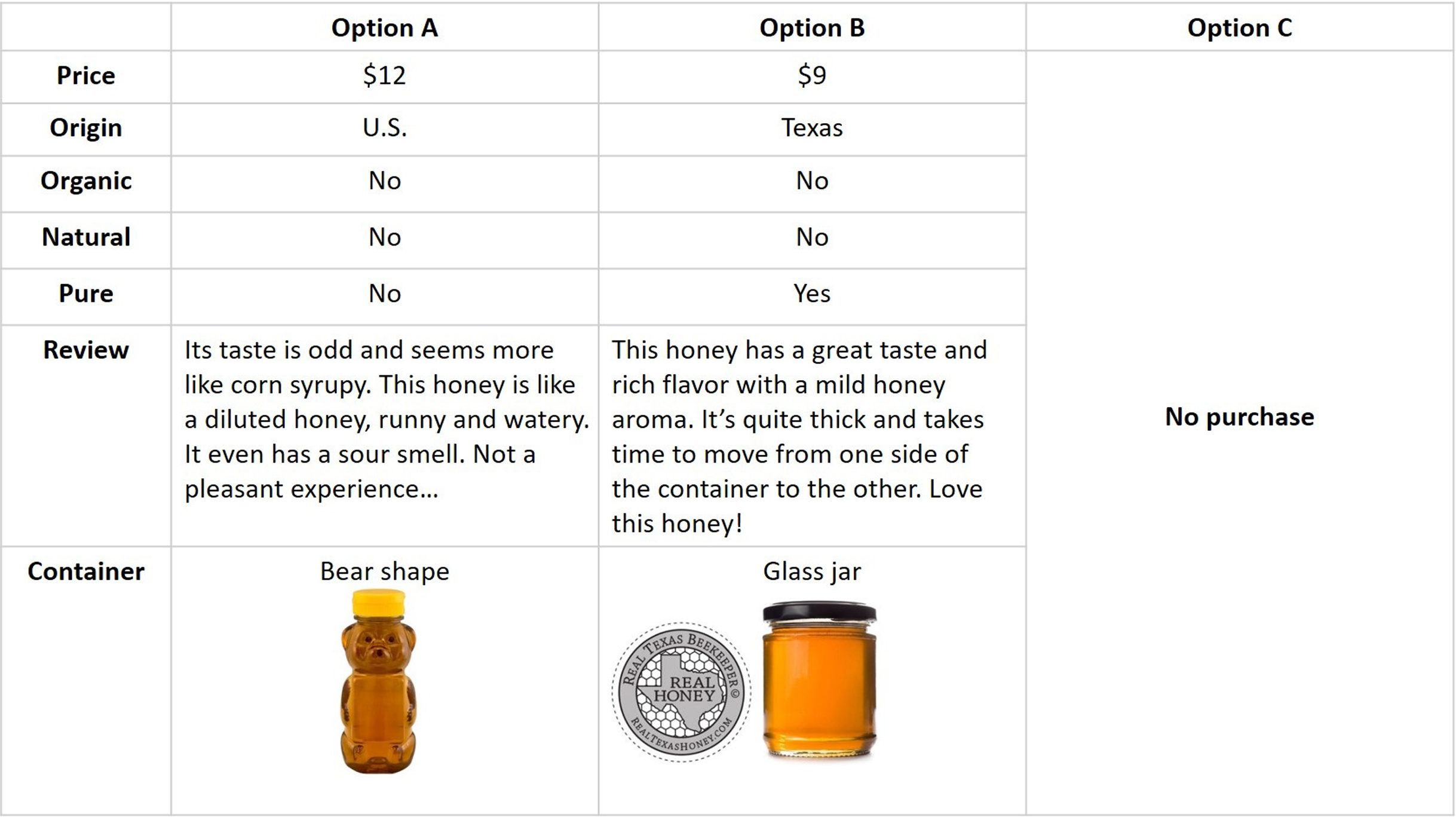
The choice experiment had twelve choice tasks for each subject. Each choice task was comprised of two alternatives plus one no-purchase option (Fig. 2). The attributes considered in this choice experiment include price, origin, honey features (i.e., organic, natural, and pure), product reviews, and container types. The product attributes were selected based on interviews with local honey producers and a review of previous literature. The price attribute was defined using three levels (i.e., it takes three values): $6, $9, and $12 per honey product, reflecting the price range of most honey products in the reference Nielsen data. The origin attribute included whether the product was imported honey, U.S. honey, or Texas honey. The organic, natural, and pure attribute claims were displayed as either “yes” or “no” options. The product reviews attribute showed either a “positive” review, a “negative” review, or “no review.” The positive and negative reviews used in our study were real honey product reviews taken and slightly revised for length from Amazon (refer to Table A1 of the Appendix for more details). Lastly, the container type was either a bottle in a standard plastic jar, a bear-shape plastic jar, or a standard glass jar. All product attributes and their corresponding levels are shown in Table 1.
Illustration of the eye-tracking experiment and the Real Texas honey seal. (a). Logit-mixed logit; (b). Mixed logit.
Attributes and levels for the choice experiment

Note: The above attributes and corresponding levels were used to construct the experimental design of twelve choice sets, which was generated in Ngene using D-optimal design matrices.
The experimental design of twelve choice sets was generated in Ngene using D-optimal design matrices, and the resulting D-error was 1.95. To investigate the effect of the Real Texas honey seal on the subjects’ WTP, whenever an alternative included a Texas origin, the Real Texas honey seal was displayed next to the container. Additionally, there is no certified organic honey produced in Texas. Thus, in order to reflect this reality, a restriction was added to the design. If an alternative was that the honey had a Texas origin, it could not be organic honey.
The post-experiment survey included subjects’ demographic backgrounds, such as gender, age, income, education, weight, height, household size, number of kids, ethnicity, and employment status. In addition, the survey also asked subjects’ perceptions of the provided product reviews to examine whether subjects misread or misunderstood the product reviews (Table A1).
3.2. Experimental procedure
The procedure of the experiment is described as follows. Upon arrival, the subjects signed a consent form and were randomly assigned to a control or a treatment group. At the beginning of the experiments, subjects in the treatment group were asked to read the information treatment (Fig. 1). In contrast, those in the control group did not read the description. After this, subjects were directed to the eye-tracking stations and conducted a calibration process with the eye-tracking device. The eye-tracking device specification is Tobii Pro Spectrum (300 Hz, accuracy 0.3°, precision 0.06° RMS). After the calibration, subjects began the eye-tracking experiment, which was a hypothetical choice experiment consisting of twelve choice tasks, as described in Section 3.1.
Once the eye-tracking choice experiment was completed, subjects were directed to complete the post-experiment survey. The participant’s identity was kept anonymous using randomly assigned subject numbers, so the participant’s identity was not connected to their responses. All records of this study are kept confidential. Upon completing the survey, subjects collected their payment and ended the experiment.
3.3. Recruitment process
The recruitment process used local newspaper ads and bulk emails associated with an existing grocery shopper database in Bryan and College Station, Texas, which included the general population and student subjects. To minimize possible inaccuracy of eye-tracking devices, the recruitment information indicated that participants must not have had eye corrective surgery and cannot wear bifocal/trifocal glasses (regular glasses and contact lenses are acceptable). Participants were informed that they would receive a compensation fee of $30 for participation once they finished all the required tasks.
A total of 177 subjects participated in the experiment in July and August 2018. Eye-tracking calibration failed for four subjects. Thus, valid responses of 173 subjects (or 2,076 observations) were compiled: 87 subjects (or 1,044 observations) in the control group and 86 subjects (or 1,032 observations) in the treatment group. The sample characteristics and the balance test are shown in Table 2. Most variables passed the balance test between the number of subjects in the control and treatment groups, except for the subjects’ weight variable.
Sample characteristics
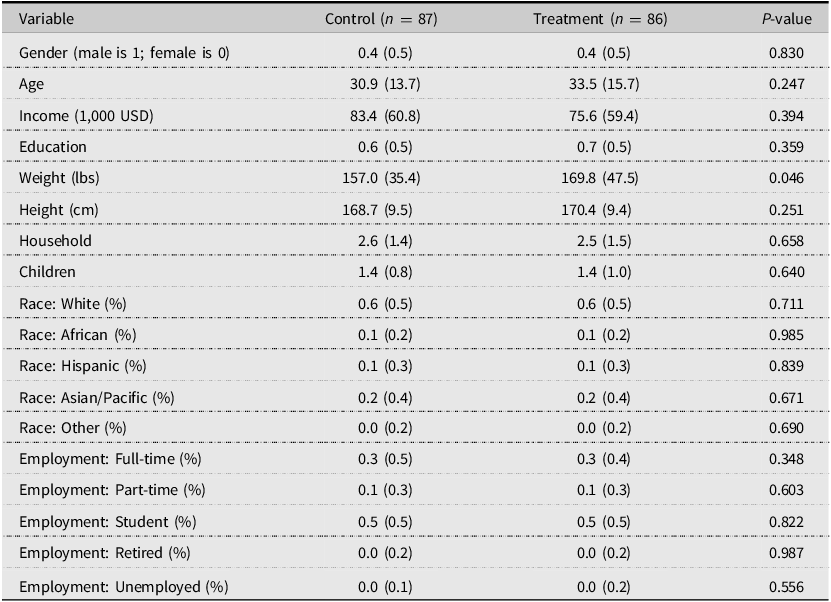
Note: Means, standard deviations (in parentheses), and p-values of bivariate t-test for balance tests between two groups are reported.
4. Methods
4.1. Estimation methodology
This study applies the LML and MXL models to analyze the experimental data. The MXL allows for the use of random preference parameters and can be used to estimate WTP for each product attribute from choice experiments in preference space (Chavez et al., Reference Chavez, Palma, Byrne, Hall and Ribera2020). Thus, researchers derive the WTP for non-price attributes by calculating the negative ratios of the non-price attribute and price coefficients. However, previous studies point out that WTP estimated in the preference space may have less robust WTP estimates compared to WTP estimated in the WTP space (Balcombe et al., Reference Balcombe, Chalak and Fraser2009; Bazzani et al., Reference Bazzani, Palma and Nayga2018; Thiene and Scarpa, Reference Thiene and Scarpa2009; Train and Weeks, Reference Train and Weeks2005). This is because the price/scale coefficient is viewed as random with a more flexible distributional assumption for random parameters of each product attribute. Nevertheless, despite LML’s advantages of robust estimation and the flexibility of distribution assumption, a study pointed out a concern about the stability of random parameters estimated by the LML with small samples (Scarpa et al., Reference Scarpa, Franceschinis and Thiene2021). Therefore, this study applies the LML and MXL models to estimate WTP.
The model framework of the LML used in this study is described as follows. Specifically, following Train (Reference Train2016), the utility of the LML for individual n choosing alternative j in choice situation t can be expressed as:
 $${U_{njt}} = \beta _n^{'}{x_{njt}} + {\varepsilon _{njt}} = - {\sigma _n}\left( {{p_{njt}} + wtp_n^{'}{x_{njt}}} \right) + {\varepsilon _{njt}}$$
where β
n
is a corresponding vector of utility coefficients varying randomly over subjects, and ε
njt
is an error term capturing the unobserved component of utility. A random scalar, $\sigma _{n}={\pi _{n} \over k_{n}}$
, where π
n
is the price coefficient in a preference space, and k
n
is the scale parameter of individual n. p
njt
is the price variable. A vector of WTP for each non-price attribute of individual n is
$\sigma _{n}={\pi _{n} \over k_{n}}$
, where π
n
is the price coefficient in a preference space, and k
n
is the scale parameter of individual n. p
njt
is the price variable. A vector of WTP for each non-price attribute of individual n is $wtp_{n}={\gamma _{n} \over \sigma _{n}}$
, where γ
n
is the vector of non-price coefficients in a preference space. In this study, product attributes x
njt
included origin, (Texas, U.S., or imported), whether the honey was organic, natural, or pure, the container type (standard plastic jar, bear-shaped plastic, or glass jar), and product reviews (positive, negative, or no review). The probability of choosing alternative i in choice situation t by individual n conditional on β
n
can be expressed as:
$wtp_{n}={\gamma _{n} \over \sigma _{n}}$
, where γ
n
is the vector of non-price coefficients in a preference space. In this study, product attributes x
njt
included origin, (Texas, U.S., or imported), whether the honey was organic, natural, or pure, the container type (standard plastic jar, bear-shaped plastic, or glass jar), and product reviews (positive, negative, or no review). The probability of choosing alternative i in choice situation t by individual n conditional on β
n
can be expressed as:
 $${Q_{nit}}\left( {{\beta _n}} \right) = {{{e^{\beta _n^{'}{x_{njt}}}}} \over {\mathop \sum \nolimits_{j \in J} {e^{\beta _n^{'}{x_{njt}}}}}} = {{{e^{ - {\sigma _n}\left( {{p_{nit}} + wtp_n^{'}{x_{nit}}} \right)}}} \over {\mathop \sum \nolimits_{j \in J} {e^{ - {\sigma _n}\left( {{p_{njt}} + wtp_n^{'}{x_{njt}}} \right)}}}}$$
The unconditional choice probability is:
 $$Prob\left( {n\;chooses\;i} \right) = \mathop \sum \nolimits_{r\varepsilon S} W\left( {{\beta _r}{\rm{|}}\alpha } \right) \cdot {Q_{ni}}\left( {{\beta _r}} \right) = \mathop \sum \nolimits_{r\varepsilon S} \left[ {{{{e^{\alpha ' \cdot z\left( {{\beta _\gamma }} \right)}}} \over {\mathop \sum \nolimits_{s \in S} {e^{\alpha ' \cdot z\left( {{\beta _S}} \right)}}}}} \right]\, \cdot \left[ {{{{e^{\beta _r^{'}{x_{ni}}}}} \over {\mathop \sum \nolimits_{j \in J} {e^{\beta _r^{'}{x_{nj}}}}}}} \right]$$
where $W\left( {{\beta _r}{\rm{|}}\alpha } \right) = {{{e^{\alpha ' \cdot z\left( {{\beta _\gamma }} \right)}}} \over {\mathop \sum \nolimits_{s \in S} {e^{\alpha ' \cdot z\left( {{\beta _S}} \right)}}}}$
is the probability mass of β
r
, which is in a finite support set S (β
r
∈ S). z(β
γ
) is a vector-valued function of β
r
, which is chosen to capture the shape of the probability mass function and can be represented as a logit function of higher order polynomials, splines, or step functions. α is a corresponding vector of coefficients. The associated log-likelihood function can be defined as:
$W\left( {{\beta _r}{\rm{|}}\alpha } \right) = {{{e^{\alpha ' \cdot z\left( {{\beta _\gamma }} \right)}}} \over {\mathop \sum \nolimits_{s \in S} {e^{\alpha ' \cdot z\left( {{\beta _S}} \right)}}}}$
is the probability mass of β
r
, which is in a finite support set S (β
r
∈ S). z(β
γ
) is a vector-valued function of β
r
, which is chosen to capture the shape of the probability mass function and can be represented as a logit function of higher order polynomials, splines, or step functions. α is a corresponding vector of coefficients. The associated log-likelihood function can be defined as:
 $$LL=\sum\nolimits_{n=1}^{N}\ln \left(\sum \nolimits_{r\epsilon S}W\left(\beta _{r}|\alpha \right)\cdot L\left(\beta _{r}\right)\right)$$
The log-likelihood function was estimated using simulations in MATLAB with 5,000 random draws, following the code provided by Train (Reference Train2016).
Another estimation approach in this study, the MXL model, is well-documented, and its detail can be found in Train (Reference Train2012). The MXL in this study assumes normal distributed random parameters for product origin, organic, natural, pure, container types, and product reviews. The MXL estimation was also done by 5,000 random draws.
4.2. Identification of attribute nonattendance
To investigate the effect of the Texas local honey seal on WTP estimations with a consideration of attribute nonattendance, this study used the fixation count data collected from the eye-tracking devices to classify subjects into two groups: seal-observing (SO) and non-seal-observing (NSO) subjects. Subjects were considered SO if their fixation counts on the Real Texas honey seal were equal to or above a particular cutoff value. The cutoff value of fixation counts was set at six, which ensures we have a balanced number of samples between the control and treatment groups for both SO and NSO (Table 3). Namely, a subject was classified as SO if she/he fixated on the product attribute at least six times. A fixation is counted when subjects’ eyes remain still for around 200–300 ms. Both LML and MXL were used to estimate WTP for the SO and NSO groups.
Sample size breakdown by fixation count

Note: Integer values denote the number of subjects in each subgroup, and percentages indicate the corresponding share of the total samples.
5. Results
5.1. Model specification test
Before conducting the LML model to obtain more robust WTP estimates for each attribute, an appropriate functional form needs to be identified first (Train, Reference Train2016). Thus, this study tested LML with polynomial, step, and spline functions and various numbers of degrees/steps/knots from 2 to 10. The numbers of draws for the simulation procedure were tested in 2,000 and 5,000 draws. After obtaining the results for all the above specification combinations, the 9-knot-spline function with 5,000 draws was selected as the best model fit in terms of log-likelihood values. The result of model selection metrics is available in Table A2.
5.2. Estimated WTP for honey product attributes
Figure 3a presents the LML estimation result given different significance levels between the control and treatment groups. The WTP of natural attribute is significantly higher in the treatment group compared to the control group at the 90% confidence level, implying that subjects who belonged to the treatment group that read the adulterated honey information had a significantly higher WTP for natural honey than those who did not read the article. In contrast, the mean WTP for other attributes in the treatment group is not significantly different from the control group. Furthermore, our results indicate that the magnitude of the effects of negative reviews is about five times larger than that of positive reviews, implying that subjects exhibit a tendency of loss aversion for a negative product review compared to a positive review.
Estimated WTP by the logit-mixed logit (LML) and mixed logit (MXL). Note: Error bars indicate 95% confidence interval of the estimated mean. The LML result used the 9-knot-spline specification with 5,000 draws. WTP estimated by the MXL were calculated by the negative ratios of the MXL coefficients for non-price attributes and the price coefficient. The number of subjects is 173 (Control: 87, Treatment: 86); namely 2,076 observations in total (Control: 1,044, treatment: 1,032). The Bear attribute refers to a bear-shaped plastic jar. (a). LML; (b). MXL.
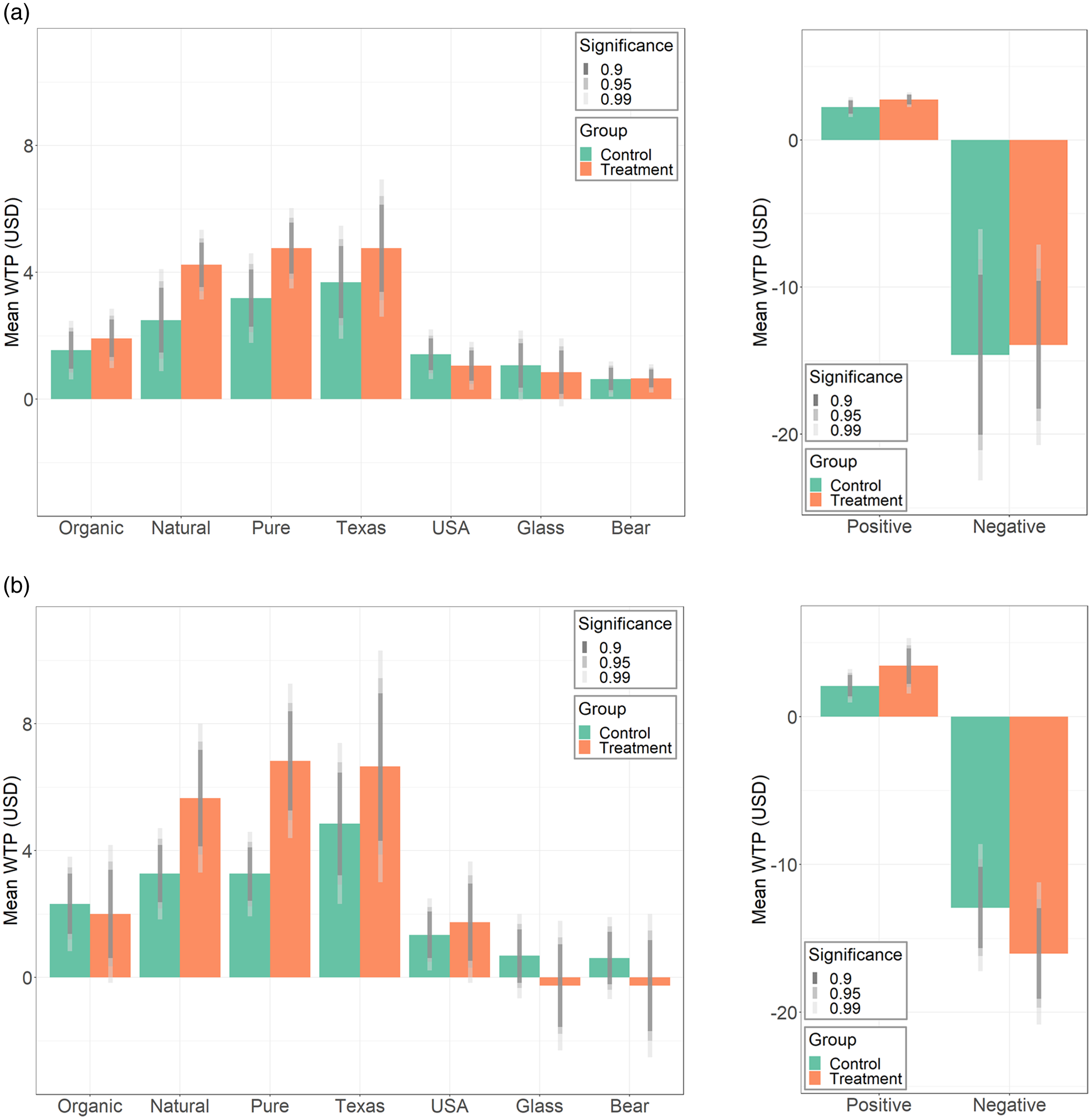
The MXL results show similar estimation patterns, but overall, with larger standard errors (Fig. 3b). It is worth noting that the adulteration of honey information also leads to increased quality-related attribute WTP estimated by MXL. For instance, the WTP of the pure attribute is significantly higher in the treatment group compared to the control group at the 95% confidence level, indicating that subjects in the treatment group that read the adulterated honey information had a significantly higher WTP for pure honey compared to those who did not read the article. Moreover, the result is evident that Texas honey seems to have higher WTP than honey labeled with U.S. origin. The estimated price premium for Texas honey is as high as other quality attributes (e.g., natural and pure) from both LML and MXL. The detailed estimation result of Fig. 3 is available in Table A3.
5.3. Examination of attribute nonattendance for the Texas local honey seal
Fixation counts from eye-tracking equipment were used to identify whether subjects noticed the Texas honey seal while making honey decisions. Table 4 shows summary statistics for fixation on the Texas honey seal and other attributes for the total 173 valid subjects. The results show that subjects had the highest average fixation counts on the review attribute among all attributes, as the review attribute is textual content instead of binary options, numbers, or location names. Textual content also requires more time to comprehend the meanings and implications. In contrast, the Texas honey seal had the lowest average fixation counts among all attributes, indicating that subjects didn’t pay too much attention to the Texas honey seal relative to other attributes. P-values reported in Table 3 are the results of balance tests, showing no significant difference in fixation counts for all attributes between the control and treatment groups.
Fixation count summary statistics

Note: Means, standard deviations (in parentheses), and p-values of bivariate t-test for balance tests between two groups are reported.
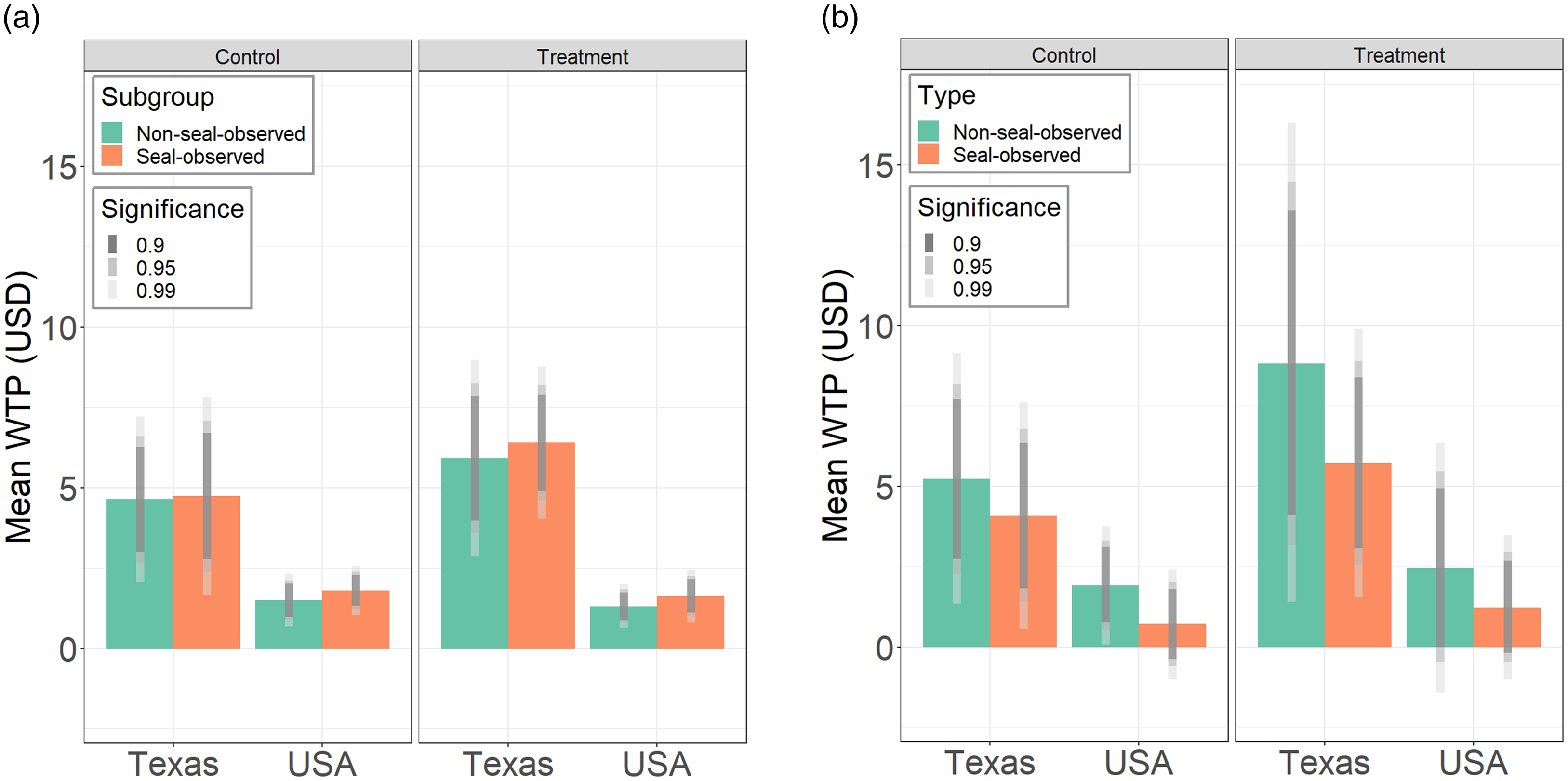
To examine the effect of the certified Real Texas honey seal on the subjects’ WTP with the consideration of attribute nonattendance, subjects were classified into SO and NSO subjects, as described in Section 4. Figure 4a presents the effect of the Real Texas honey seal on WTP estimated by the LML model. The results show that 95% confidence intervals between Texas and U.S. origin attribute within the same group don’t overlap, but various confidence intervals between SO and NSO subjects overlap. These outcomes indicate that regardless of SO/NSO subjects or control/treatment groups, WTP for Texas honey is consistently higher than honey labeled with the U.S. origin, but the difference in WTP between SO and NSO subjects within each origin attribute is not statistically significant. This result implies that whether subjects observed the Real Texas honey seal, they had an indifferent WTP for the Texas and U.S. origin attributes. In addition, the difference in WTP for the same origin attribute between the control and treatment group is also not statistically significant. Note that since the baseline is the import attribute, the above Texas and U.S. honey WTP estimations are relative to the imported honey feature. Figure 4b presents the estimation result using the MXL. Overall, the results are similar to the LML estimation but with larger standard errors. The detailed estimation result of Fig. 4 is available in Table A4.
Effect of the Texas seal on WTP by product origins (attribute-attendance). Note: Error bars indicate 95% confidence interval of the estimated mean. The logit-mixed logit result used the 9-knot-spline specification with 5,000 draws. WTP estimated by the mixed logit (MXL) were calculated by the negative ratios of the MXL coefficients for non-price attributes and the price coefficient. The number of NSO subjects is 91 (Control: 47, Treatment: 44), and the number of associated observations is 1,092 (Control: 564, Treatment: 528); the number of SO subjects is 82 (Control: 40, Treatment: 42), and the number of associated observations is 984 (Control: 480, Treatment: 504).
5.4. Economic implications of honey adulteration and corresponding strategies
As the incidence of honey adulteration continues to rise, it’s worth considering the potential economic benefits of raising awareness of adulteration issues in the honey industry. Our findings reveal that the WTP estimates derived from the LML model for honey products with the ‘natural’ attribute differ significantly between the control and treatment groups, with values of $2.49 and $4.24 per honey product, respectively (as depicted in Fig. 3a and detailed in Table A3). Namely, being aware of honey adulteration can translate into a $1.75 price premium for honey products marketed as “natural.” According to data from the honey production report (USDA, 2023), Texas alone produced 8.32 million pounds of honey in 2022, equivalent to roughly 11.09 million 12 oz bear-shaped honey products. Consequently, raising awareness about the honey adulteration issue has the potential to generate an annual revenue increase of approximately $19.41 million for natural honey products.
Figure 3b and Table A3 also show that the estimated WTP derived from the MXL for “pure honey” in the control and treatment groups are $6.83 and $3.27 per honey product, respectively. In other words, this suggests that awareness of the honey adulteration issue could result in a $3.56 price premium for honey products labeled as “pure” compared to those without such labeling. Therefore, raising awareness of honey adulteration has the potential to generate an annual revenue increase of about $39.48 million through the sale of pure honey products.
These findings underscore the importance of implementing more stringent quality control measures for honey products and ensuring the reliability of labeling within the industry. The notable price premiums associated with natural and pure honey can potentially incentivize to engage in more honey adulteration activities. Moreover, the economic benefits estimated above highlight the critical role of awareness in addressing food fraud issues within the honey market.
6. Discussion
This study applied both LML and MXL models to analyze data from the eye-tracking choice experiment. Overall, the estimated mean WTP from both approaches are similar. Nevertheless, the standard errors of the mean from LML are smaller than MXL. This outcome is aligned with the literature indicating that LML’s estimated WTPs are more reliable because it overcomes the issue of the inflexible parametric distribution assumption in preference space models (Bazzani et al., Reference Bazzani, Palma and Nayga2018; Caputo et al., Reference Caputo, Scarpa, Nayga and Ortega2018). Nevertheless, Scarpa et al. (Reference Scarpa, Franceschinis and Thiene2021) studied the tradeoff between bias and variance using both MXL and LML and suggested that the tradeoff favors the LML when the sample size is larger than 500 respondents. With the sample size of 173 respondents in this study, it may be hard to justify whether one estimation results are better than another. After all, which specification works better depends on the nature of the data set used and adequate experimental designs (Caputo and Scarpa, Reference Caputo and Scarpa2022). Hence, this study reports both LML and MXL model results for readers’ reference.
The three research hypotheses and the corresponding findings are reviewed and discussed as follows:
H1: Honey adulteration information affects consumers’ WTP for honey products
Our study examined the influence of honey adulteration information on consumers’ WTP for honey products. The results reveal that individuals who received information about honey adulteration exhibited a significantly higher WTP for honey products labeled as “natural” and “pure” when compared to those who were not exposed to such information. In other words, the perception of honey adulteration information has the potential to increase WTP for “natural” and “pure” honey by approximately 70% [=(4.24−2.49)/2.49] and 109% [=(6.83−3.27)/3.27], respectively. This finding aligns with previous research (Ritten et al., Reference Ritten, Thunström, Ehmke, Beiermann and McLeod2019), which suggested that assuring consumers of honey’s authenticity can potentially increase producers’ revenues by up to 27%. These results highlight the importance of effectively communicating honey quality attributes, particularly emphasizing the “natural” and “pure” features, to customers. This can lead to higher WTP, in turn, ultimately resulting in increased honey revenues, as discussed in Section 5.4. An extensive implication of these findings is the necessity for robust and trustworthy labeling regulations to ensure the quality of honey products.
H2: The presence of a Real Texas local honey seal increases consumers’ WTP for Texas honey.
Figures 3 and 4 illustrate that honey with the Texas origin attribute has a higher WTP compared to other origin attributes and certain other product attributes, regardless of the control or treatment groups. It’s worth noting that since our experiment was conducted in Texas, the study participants were Texas residents. Therefore, the preferences measured in this study reflect the preferences of local residents rather than the general population’s WTP for a Texas product. The price premium of local honey is also found in previous studies (Bissinger and Herrmann, Reference Bissinger and Herrmann2021; Brščić et al., Reference Brščić, Šugar and Poljuha2017; Cosmina et al., Reference Cosmina, Gallenti, Marangon and Troiano2016; Jensen and Mørkbak, Reference Jensen and Mørkbak2013; Ritten et al., Reference Ritten, Thunström, Ehmke, Beiermann and McLeod2019; Unnevehr and Gouzou, Reference Unnevehr and Gouzou1998; Vapa-Tankosić et al., Reference Vapa-Tankosić, Ignjatijević, Kiurski, Milenković and Milojević2020; Vita et al., Reference Vita, Pippinato, Blanc, Zanchini, Mosso and Brun2021; Wu et al., Reference Wu, Fooks, Messer and Delaney2015). An intriguing finding in the present study is that being aware of honey adulteration information does not result in a higher WTP for Texas honey (Fig. 3). Furthermore, the presence of the Real Texas Honey seal alone does not necessarily lead to a higher WTP for the Texas origin attribute either (as depicted in Fig. 4). This suggests that the higher WTP for Texas honey appears to be primarily associated with the Texas origin attribute label itself rather than the presence of the Texas honey seal. One plausible explanation could be the relatively small size of the seal, which may not be salient to everyone.
H3: Product reviews affect consumers’ WTP for honey products.
The results regarding the impact of product reviews on consumers’ WTP for honey product indicate that negative reviews had a more pronounced negative effect on WTP, leading to a decrease in WTP. In contrast, positive reviews had a positive influence, leading to an increase in WTP (as depicted in Fig. 3). The magnitude of the reduction in WTP caused by negative reviews was five times larger than the increase induced by positive reviews. This finding suggests that individuals exhibited loss aversion preferences (Schmidt and Zank, Reference Schmidt and Zank2005). Such asymmetric consumer behavior toward losses and gains is also found in other product choices (Neumann and Böckenholt, Reference Neumann and Böckenholt2014; Sharma et al., Reference Sharma, Park and Nicolau2020; Zhang and Li, Reference Zhang and Li2021), highlighting the importance of managing negative product information and its managerial implications.
7. Conclusion
This study employed an eye-tracking choice experiment to explore consumer responses to various honey attributes, product reviews, and perceptions of the adulterated honey issue. The results suggest that information about honey adulteration can enhance consumers’ WTP for specific quality-related attributes. Additionally, Texas honey products are expected to have a higher price premium, but such price premium is not necessarily linked to the presence of honey adulteration information or the inclusion of the Texas honey seal. Moreover, the results also show a notable discrepancy in the impact of negative product reviews, which significantly reduces WTP, compared to the relatively modest influence of positive product reviews.
While this study provides valuable insights, there are a few limitations to this study. Firstly, the generalizability of the experimental results might be subject to the non-incentive-compatible design, despite the fact that it is less likely for participants to irrationally respond to the choice set questions under the given choice experiment design. Moreover, since the study focuses on investigating how subjects react to the local honey seal, product reviews, and product attribute information, a table format presentation of choice sets was used in the eye-tracking experiment (Fig. 2) rather than presenting actual product packages. Both approaches have their advantages. The table format presentation lays out information in an organized way, which is more frequently seen in an online shopping environment but not in onsite grocery shopping situations. On the other hand, presenting product packages could reflect a more realistic onsite grocery shopping scenario, but the information of interest will be less salient to subjects. Finally, this experiment considers three types of honey containers: standard plastic jar, bear-shaped plastic jar, and standard glass jar. This design could not investigate the bear shape in other materials except for the bear-shape plastic jar considered in this study.
Despite these limitations, the findings of this study provide significant implications for food policymakers and honey marketers. Firstly, food retailers may want to thoughtfully address food product reviews, especially negative ones since negative reviews can substantially impact consumers’ WTP. Secondly, from an international trade perspective, if a country wants to market its food products in foreign countries, the country’s food administration may want to manage consumers’ impression of national foods carefully. For example, in the case of this study, the adulteration media information causes price discounts for honey products from foreign developing countries. Lastly, when firms determine their honey products’ pricing strategies, they can leverage the adulterated honey information and the food safety concern to create price premiums of natural and pure attributes. Taken together, emphasizing quality-related features and strategically framing food product information with the adulteration honey fact could make products more appealing and profitable, while mishandling consumer perceptions of food products can significantly harm honey marketers’ profitability.
Appendix
Product reviews and subjects’ corresponding evaluation

Note: Subjects were asked how they feel the above honey product reviews collected and revised from Amazon. Counts of subjects and corresponding percentages of total subjects (in parentheses) are presented. The result shows that most subjects have positive feelings for the positive review and have negative feelings for the negative review. Thus, the outcome rules out the possibility that subject misread or misunderstand the product reviews.
Model selection of the LML

Note: 9-knot-spline function with 5,000 draws was selected as our final model since it had the best model fit in terms of log-likelihood values (LL).
Estimated WTP between the control and treatment groups

Note: The LML result uses the 9-knot-spline specification with 5,000 draws. Parentheses indicate 90% confidence interval of the estimated mean. WTP estimated by the MXL with 5,000 draws were calculated by the negative ratios of the MXL coefficients for non-price attributes and the price coefficient.
Estimated WTP between SO and NSO groups

Note: The LML result uses the 9-knot-spline specification with 5,000 draws. Parentheses indicate 90% confidence interval of the estimated mean. WTP estimated by the MXL with 5,000 draws were calculated by the negative ratios of the MXL coefficients for non-price attributes and the price coefficient.


 Open access

