

Introduction
In part of Palermo's historic centre, the streets, squares and alleyways are marked by trilingual signs in Italian, Hebrew and Arabic. There is no accompanying text explaining why they are there, or how they came to be. Nonetheless, anyone with some knowledge of Sicilian history might make the reasonable assumption that Arabic and Hebrew speakers once lived here, or perhaps that they still do. This presumes that the observer knows that these scripts are Hebrew and Arabic, or can guess as much. At first glance, the placement of these signs appears haphazard, almost random. On a winding walk through the historic centre, they begin abruptly; outside a narrow cluster of streets, they are no longer there. After turning a few corners, they might materialise again.
Their placement is in fact not haphazard, but by design. They are contained within an area once known as the Meschita: Palermo's medieval Jewish quarter. Without local knowledge and an interest in medieval history, however, casual observers have little way of knowing this. For those able to interpret these signs as they were intended, they recall a time when Sicily had a thriving Jewish minority. Although many historians dispute the idea that an ‘exemplary spirit of tolerance’ characterised this period (Cassarino Reference Cassarino and Nef2013, 123), some nonetheless argue that various religious communities coexisted in relative harmony in medieval Sicily, compared to elsewhere in Europe (Simonsohn Reference Simonsohn2011, 56). Referring to these trilingual signs, William Granara writes that ‘the impulse to recognise Palermo's mosaic past, whatever its motivation, has produced the most modest of outcomes – a small yet significant aide-mémoire representing a multiplicity that is no more’ (2010, 53, emphasis added). But what is the motivation behind this impulse, and what are its effects for Palermo and its inhabitants?
I argue that these trilingual signs, installed at the turn of the twenty-first century, both reflect and stimulate a growing contemporary interest in Palermo's historic Jewish presence. This, in turn, is part of a broader re-evaluation of Sicily's ‘multicultural’ heritage, and of developments in ‘Jewish space’ (Pinto Reference Pinto1996) in the Mediterranean, including elsewhere in Italy. Both phenomena are influenced by factors including tourism, international relations in Europe and the Mediterranean, and demographic changes resulting from migration. Although multilingual signs may appear subtle changes in the urban landscape, they offer an insight into how local identities are constructed and redefined by numerous actors, including local government, heritage organisations, religious communities, and civil society groups. The construction of a cosmopolitan local identity, in turn, has a bearing on local politics, intensified by Palermo's recent and ongoing importance as a port of arrival for trans-Mediterranean migration.
This article is based on in-person ethnographic fieldwork conducted in Palermo between September and October 2021, and between April and May 2022; structured and semi-structured interviews with local officials, specialists in Jewish history, and individuals connected to the heritage industry; and participant observation in lectures and heritage-related events. I was particularly interested in the work of organisations raising awareness of Jewish history, such as the Charta delle Judeche and the Sicilian Institute of Jewish Studies, and of institutions promoting research on this topic, including Palermo's Office of Medieval Studies. My questions explored the motivations behind this work, how it was being carried out, and what it means for the twenty-first-century city. I also paid special attention to the urban environment of the former Meschita, including the placement of these signs and their textual features, and assessed how media sources and works by local historians represent Palermo's Jewish past.
My approach has more in common with anthropology – the study of ‘emergence’ (Handelman Reference Handelman, Kalb and Tak2005) – than with strictly historical methods. It also differs from ‘historical anthropology’: the ‘application of … cultural anthropology to historical sources’ (Magnússon and Szijártó Reference Magnússon and Szijártó2013, 39). Instead, this is a micro-scale anthropological study of heritage: ‘a new mode of cultural production in the present that has recourse to the past’ (Kirshenblatt-Gimblett Reference Kirshenblatt-Gimblett1995, 369). I examine the present development of discourses about history, using one case study in a small neighbourhood.
I begin by placing Jewish space in contemporary Palermo within its regional and transnational context, demonstrating that Palermo shares features with other sites in the Mediterranean that receive more attention for their Jewish heritage. I trace the history of the Meschita, before exploring how the trilingual signs came to be installed, and how they have been interpreted by some of Palermo's residents. I show that this intervention in the ‘linguistic landscape’ (Landry and Bourhis Reference Landry and Bourhis1997) exemplifies Palermo's rebranding as a cosmopolitan city, and the broader ‘heritagisation’ of its historic centre. Tourism is often cited as a major catalyst for such developments, but I argue that other important factors are also at play. The emergence of these sites of memory (Nora Reference Nora1989), I contend, functions as ‘banal cosmopolitanism’, aimed at altering how residents relate to their city. They contain conscious echoes of famous multilingual remnants from medieval Sicily, and for some Palermitans they have come to symbolise both their city's multi-religious history and their aspirations for its cosmopolitan present and future. As I will show, this self-perception is by no means universally shared; it is just one of numerous competing ideas about Palermitan identity.
Palermo and the re-evaluation of Jewish space in the Mediterranean
In many places in the Mediterranean, the presence of Jewish communities – whether contemporary or in the recent or distant past – plays a role in constructing local and national identities. That role is not always in proportion to the size of the present Jewish community, or to the visibility of its historic traces. In countries including Morocco (Boum Reference Boum2013; Gottreich Reference Gottreich2020) and Spain (Flesler and Pérez Melgosa Reference Flesler and Pérez Melgosa2020; Hirschkind Reference Hirschkind2021), claims about an historic ‘tolerance’ towards Jews are sometimes used to symbolise an intrinsic cosmopolitanism in the supposed local character. I do not take such claims at face value. On the contrary, I understand them as tools for constructing local identity, tools that often reflect ‘contemporary concerns with multicultural societies and cosmopolitanism’ (Ballinger Reference Ballinger2003). Pamela Ballinger argues that this is the case for Trieste, where she identifies a strong narrative about a multicultural past that has some similarities with my Palermitan case study.
In parts of the Mediterranean where the idea of a ‘cosmopolitan’ local character is influential, Jewish space is also being re-evaluated in the twenty-first century, giving it newfound public visibility. To name but two examples: numerous Jewish museums have been founded in Spain (Flesler and Pérez Melgosa Reference Flesler and Pérez Melgosa2020, 198), over five centuries after its remaining Jews were exiled in 1492. In Bragança, Portugal, a growing interest in the enduring presence of Crypto-Jews – who secretly maintained Jewish practices after being forced to convert to Christianity – has brought about a new synagogue and Jewish museum, albeit not with the full involvement of the pre-existing Jewish population there (Pignatelli Reference Pignatelli2021).
Jewish spaces in southern Italy, although generally less internationally well known than their Iberian counterparts, are also undergoing important transformations. A synagogue was opened in Serrastretta, Calabria, in 2006, for example, motivated by its founder's desire to reconnect bnei anusim – ancestors of Jews forced to convert to Christianity in the fifteenth century – with their Jewish roots. In Trani, Apulia, a medieval synagogue was refurbished and reopened in 2015, after centuries of use as a church; the following year, a Jewish museum was inaugurated in Lecce. In some ways, these southern Italian examples have more in common with ‘revivals’ in Spain and Portugal than with sites further north in Italy, like Rome and Venice, which have had continuous Jewish communities for centuries. Jews in southern Italy, including Sicily – then under Spanish control – were also expelled or forced to convert in the late fifteenth century, as they were in Iberia.
As this article shows, there are also places in Sicily undergoing a ‘revival’ of Jewish space. Sicilian case studies should therefore be considered alongside other sites in the Mediterranean where the visible presence of lived Judaism has been interrupted by centuries of absence. In 2008, a revert to Judaism, having ‘discovered his Jewish roots in 1983’, founded a small synagogue in an apartment in Syracuse, Sicily (Corsale and Krakover Reference Corsale and Krakover2019, 470).Footnote 1 A medieval miqweh, or Jewish ritual bath, was also discovered in Syracuse in 1991 and is now open for public visits (Corsale and Krakover Reference Corsale and Krakover2019). The revival of a religious interest in Judaism in Sicily is therefore roughly contemporaneous with the ‘rediscovery’ of the island's Jewish heritage. Judaism has not simply ‘arrived’ in Sicily: rather, it is sometimes said to be ‘returning’. This formulation anchors contemporary Judaism in historic Sicilian foundations, and in the few visible remains of its medieval presence.
Although Sicily's capital, Palermo, had an important Jewish community before 1492, it may not seem the most obvious starting point for studying Jewish space in southern Italy. Visible signs of its Jewish heritage are less prominent than in some other parts of southern Italy. The miqweh of Syracuse, for example, is well preserved, and has been made accessible to visitors. Trani and Lecce both have Jewish museums. No such museum exists in Sicily, although they have previously been proposed (e.g. Mancuso Reference Mancuso2006). It is by no means the case, however, that Palermo altogether lacks Jewish space. On the contrary, as I will show, parts of Palermo evoke the memory of the city's Jewish history, at least for those who know how to ‘read’ them. Even the author of a guidebook on Palermo's medieval Jewish quarter admits that ‘only by resorting to the imagination is it possible to rediscover the charm of [these] places’ (D'Agostino Reference D'Agostino2018, 66). Nonetheless, the very existence of such a book presupposes and confirms the existence of readers interested in making this imaginative leap. It invites them to depart ‘from the few traces that remain, and from the atmosphere that this quarter continues to provide’.Footnote 2
I argue that attempts to ‘uncover’ Palermo's Jewish history are inseparable from the city's present political context. The narrative that Palermo is a cosmopolitan city has been vocally supported by local government, and especially by Leoluca Orlando, its mayor between 2012 and 2022, who also held this role for much of the 1980s and 1990s. Relatedly, some Sicilians, especially in activist and left-wing circles, seek to distinguish Sicily's political culture from the dominant nationalism of mainland Italy and Europe. Immigration since the late twentieth century increased the presence of non-Catholic religious groups in Palermo; indeed, some members of the city's very small Jewish community were born outside Sicily. If the experiences of the present affect the questions we ask of the past, then it is apt that some in Palermo today show a keen interest in the city's historic religious diversity.
The idea that Palermo's history proves its inhabitants’ natural predisposition towards cosmopolitanism impacts how identity is articulated in the present, which is political per se. Those who celebrate Palermo's supposed historic convivenza – a narrative of peaceful co-existence that pervades contemporary public discourse about Palermo's medieval heritage – are aware, especially in the present climate, that they are proudly describing a way of living that challenges the dominant political rhetoric in mainland Europe, not least in Italy. ‘[P]ublic and political discourse in Italy has steadily shifted toward cultural and political conservatism and extremism vis-à-vis the nation's imagined external others’ (Nathan Reference Nathan2023, 116). This includes both a rising ‘current of islamophobia’, especially since the early twenty-first century (Burdett Reference Burdett2016, 94), and antisemitism, with antisemitic incidents forming a significant proportion of the instances recorded in the latest Hate Crime Report for Italy from the Office for Democratic Institutions and Human Rights (ODIHR 2022). When compared to migrant rights activism, for example – an important feature in Palermo's political ecosystem – celebrations of Sicily's historic and present religious diversity are not always self-consciously political. Indeed, the capacity of such celebrations to tackle ‘material difficulties and structural inequalities’ has been questioned (e.g. Giglioli Reference Giglioli2018, 12). Nonetheless, as with projects elsewhere that emphasise multicultural heritage and challenge the idea of religious minorities as threatening ‘others’, the ‘rediscovery’ of Jewish Palermo is also charged with political symbolism.
This article examines one relatively new way in which Palermo's Jewish past is being ‘rediscovered’, articulated and experienced in the present. The sites of memory I analyse do not have the visual prominence of Palermo's UNESCO World Heritage Sites, nor the political prominence of sites dedicated to remembering victims of the Mafia, for example (e.g. Tassinari Reference Tassinari, Scandariato, Tassinari and Zisa2021). Nonetheless, when taken together they provide a valuable insight into the contemporary cultural memory of Jewish Palermo, and into the formation of a cosmopolitan local identity that embraces religious pluralism.
Background: the Meschita
In an essay on the Jewish minority in Palermo during the Emirate of Sicily (831–1091), William Granara observes that a street like Via Calderai, where craftspeople still make metalwork in public view,Footnote 3 ‘remains powerfully evocative of a medieval suq’ (2010, 43). From certain angles, he is right. But Palermo is a layered city: its post-medieval history – indeed, its modernity – is never far away. Walking westwards down Via Calderai, the medieval vision is rudely interrupted by the ruler-straight Via Maqueda, which dates from the late sixteenth century. It contains some of Palermo's most emphatically baroque architecture, as well as fashionable ‘street food’ outlets, and bars playing the latest pop remixes. The medieval suq comparison stretches only so far.
Via Calderai once formed part of the Meschita: an historic neighbourhood that no longer exists per se in a meaningful sense. A harat al-yahud, or Jewish quarter, was located here. This area was not exclusively Jewish, but rather a place where Jews tended to live, not least in order to be near one another, as well as near a kosher butcher, a place of worship and other such necessities. Palermo's medieval Jewish quarter has been described as a ‘stable place of settlement, with no evidence of forced movements in or out, and also a permeable space’ (Streit and Stiefel Reference Streit, Stiefel and Kilde2022, 363). The Giudecche of medieval southern Italy, especially during the Emirate period and in the early years of subsequent Norman rule, must be differentiated from the enforced ghettos later established by the papacy in the sixteenth century. As Benjamin Ravid emphasises, ‘not all Jewish quarters were Ghettos’ in the ‘compulsory, segregated and enclosed’ sense (Reference Ravid2008, 6); Palermo's medieval Meschita was a case in point.
The word Meschita comes from the Arabic root s-j-d (س -ج -د), meaning to prostrate. The quarter was named after the mosque of Ibn Siqlab, which stood there during the Emirate period. As an historic Jewish quarter bearing the Arabic-origin name of a Muslim place of worship, and a neighbourhood where Muslims, Jews and Christians are imagined to have once lived side by side, the Meschita can be employed as a geographical embodiment of a past convivenza. This was historically a residential neighbourhood, which distinguishes it from the ‘Arab-Norman’ structures on the UNESCO World Heritage List: many of these monumental buildings synthesise the cultural and architectural traditions of multiple religious communities. The Mediterranean has been described as ‘fertile ground’ for ‘religious interweaving’ and ‘interfaith convergence’ by scholars citing historic and contemporary examples of ‘shared sacred sites’ throughout the region, from the Tunisian island of Djerba to the Turkish city of Istanbul (Albera, Barkey and Pénicaud Reference Albera, Barkey, Pénicaud, Barkey, Albera and Pénicaud2018, 20). I do not intend to assess whether the Mediterranean is in fact exceptional in this regard. It is nonetheless noteworthy that a common perception ‘that … local societies were and are cosmopolitan in nature’ recurs in a striking number of Mediterranean port cities (Driessen Reference Driessen2005, 135). This perception is also prevalent, though not universal, in Palermo.
In 1487, the Italian Rabbi Obadiah da Bertinoro observed that the synagogue of Palermo ‘had no equal in all of the world’.Footnote 4 The historian Bartolomeo Lagumina uses this description of its grandeur to support his thesis that the synagogue itself was none other than the former mosque of Ibn Siqlab, which gave the Meschita quarter its name (1897, 16n1). The Normans captured Palermo from its Muslim rulers in 1072, after which its Muslim population declined (Granara Reference Granara, Miller and Bertagnin2010). Some converted to Christianity, the religion of the island's new ruling class, while others fled (Metcalfe Reference Metcalfe2009, 221–222, 275). By the mid-thirteenth century, following Muslim revolts against Norman rule, Sicily's last Muslims had been deported to Lucera, on the Italian mainland (Metcalfe Reference Metcalfe2009, 287). The neighbourhood was already home to a Jewish population, so it may well have been convenient to give or sell them this abandoned building to be used as a synagogue (Cassuto Reference Cassuto, La Franca, Fatta and Caselli1994). Like many questions regarding Palermo's medieval history, this is a subject of dispute; the historian Giuseppe Mandalà, for example, calls this particular hypothesis ‘wholly mistaken’ (Reference Mandalà and Nef2013, 483).
If the synagogue had indeed been a converted mosque, this would go some way towards explaining why the building, as well as the neighbourhood, was called the Meschita by Christians (Ashtor Reference Ashtor1979). Christians referred to synagogues as meschite or muschite in much of Sicily (Lagumina Reference Lagumina1897), but only from the mid-thirteenth century onwards – that is, following a decline in the Muslim population (Cassuto Reference Cassuto, La Franca, Fatta and Caselli1994, 36), and perhaps even after the last Muslims had been deported.Footnote 5 Lagumina therefore hypothesises that Palermo's great synagogue might not have been the only one in Sicily to have occupied the site of a former mosque (1897). To some, this may be a more appealing explanation than the idea that meschita was simply a Sicilian shorthand for a non-Christian place of worship.
The Meschita is no longer a distinct neighbourhood, officially or in the minds of Palermitans. Most Palermitans know the street names Via Meschita and Vicolo Meschita, but not all the locals I spoke to were aware that these were named after the old Meschita neighbourhood, of which these streets were a part. The historic quarter is now split by Via Maqueda, which today marks the boundary between two administrative districts: Albergheria to the west and the Kalsa to the east. Even before this geographic rupture, however, the Meschita abruptly lost its Jewish character in 1492, when Sicily's Jews were expelled by the island's rulers, Ferdinand of Aragon and Isabella of Castile.
The idea of the Meschita as a site of peaceful coexistence is complicated, therefore, by the historical fates of its non-Christian communities, both Muslim and Jewish. Some in Sicily emphasise the idea that the expulsion of the Jews was a ‘foreign import’ (Simonsohn Reference Simonsohn2011, 567), imposed by Sicily's Spanish rulers. It is also true in Palermo, as in other parts of the Mediterranean, that cosmopolitanism is frequently invoked by expressing ‘nostalgia for a more tolerant past’ (Hanley Reference Hanley2008, 1346). As Ruth Ellen Gruber argues regarding ‘revivals’ of Jewish space across Europe in the aftermath of the Shoah, cosmopolitan histories are often remembered, and mourned, through a romanticising lens (Reference Gruber2002, 42).
Signposting the Meschita
The proposal to install trilingual signs in the former Meschita came towards the end of the year 2000, from the president of the Charta delle Judeche.Footnote 6 The Charta delle Judeche began as an association of localities in Sicily that had had a Jewish presence before the 1492 expulsion. One of its aims is to commemorate and draw attention to Sicily's historic Giudecche, or Jewish quarters. A similar such organisation, now on a considerably larger scale – the Red de Juderías de España (Network of Jewish Quarters of Spain) – was founded in Spain in 1995 (Flesler and Pérez Melgosa Reference Flesler and Pérez Melgosa2020, 98–99). Palermo's local government accepted the proposal, and in November 2000, its Office for Toponyms (Ufficio Toponomastica) requested translations of 16 street names in the former Meschita into Arabic and Hebrew. The Charta delle Judeche arranged for these to be provided, and the Office had the signs installed. For the most part, the trilingual signs appear alongside the pre-existing Italian street signs, rather than in their place.
Part of the wider legacy of the ‘Palermo Spring’ – the transformations in late twentieth-century Palermo, characterised by an increase in anti-Mafia activism – has been the reframing of the city's historical buildings, or what some call the ‘heritagisation’ of the city centre.Footnote 7 The idea that local pride, or ‘self-respect’, is a bulwark against Mafia activity has long been a central tenet of Palermo's anti-Mafia movement.Footnote 8 With the aim of stimulating civic-mindedness and community spirit – both recurring key phrases in local political discourse – local government supported initiatives such as ‘The School Adopts a Monument’, pairing schools with a nearby historic building and encouraging research projects about the ‘adopted’ monument.Footnote 9 In 1996, the first year this took place in Palermo, the Giudecca in its entirety was ‘adopted’ by a middle school in the city (D'Agostino Reference D'Agostino2018, 11).Footnote 10 Taken as a whole, ‘rediscoveries’ of the city's heritage, with enthusiastic state backing, amount to ‘technologies of memory’: vehicles that produce and mediate cultural memory (Sturken Reference Sturken2008, 75). They foster a sense of connection with the city's past, and, in some cases, a sense of stewardship over its visible traces.
In 2015, UNESCO added the city's ‘Arab-Norman’ monuments to its World Heritage List. The idea to install trilingual signs in the former Meschita predates this by 15 years. It also predates the festival that began in 2006 at the University of Palermo, the Vie dei Tesori (literally, the Roads of Treasures), which aims to increase knowledge and awareness of the city's diverse cultural heritage and now hosts events throughout Sicily. In other words, the trilingual signs represent an early phase in the twenty-first-century ‘heritagisation’ of the city centre, as well as a subtle catalyst for an increased public curiosity about Palermo's historic multiculturalism.
In her research on Mazara del Vallo, a town in southern Sicily with historical connections to Tunisia, Ilaria Giglioli interprets changes in the urban landscape that ‘celebrate Mazara's medieval Arab heritage and its connection to Tunisia’ as examples of ‘ethnic packaging’ (2018, 52). She uses this to refer to the ‘rebranding’ of a city in a way that formally celebrates migrant or minority communities (Giglioli Reference Giglioli2018, 12, citing Hackworth and Rekers Reference Hackworth and Rekers2005). In their study The Linguistic Landscape of the Mediterranean, Robert Blackwood and Stefania Tufi reach a similar conclusion about Palermo's trilingual street signs, although they do not use the same terminology as Giglioli. They write:
The average tourist … will be intrigued by the exotic scripts. These in turn contribute to the construction of a mysterious past for what is already perceived to be a mysterious and arcane culture in the collective imagination. The clever manipulation of existing understandings of Sicily is generated by current practices of island branding so that the link between the visitor's expectation (the demand) and a certain construction of the past-cum-present (the supply) is established. (Blackwood and Tufi Reference Blackwood and Tufi2015, 143)
Although it is tempting to attribute initiatives such as these to the lucre of tourism – and it is undeniable that the tourist industry both stimulates and benefits from the heritagisation of the city centre – such an approach would be over-simplistic here. ‘Ethnic packaging’ is indeed one effect of Palermo's many heritagisation initiatives, which include the trilingual signs. Nonetheless, in the case of these particular signs, tourism was not a primary motivation. The Charta delle Judeche is a Sicilian civic society organisation, aimed at raising awareness of Jewish history among Sicilians. Palermo's ‘heritagisation’ initiatives have at least two audiences: visitors, yes, but residents too. Many events on the Vie dei Tesori take place in Italian. These include an annual Jewish history tour: ‘The Giudecca: When Palermo Was Also Jewish’ (La Giudecca: Quando Palermo era anche ebrea). The tours I attended in October 2021 had a majority of Sicilian participants.
I do not dispute that the trilingual signs in Palermo's former Meschita contribute to the ‘rebranding’ of Palermo as a multicultural city. It might even be true that, for tourists to the city, they do encourage a sense that Palermo's past is ‘mysterious and arcane’, as Blackwood and Tufi put it, and therefore unknowable and exotic. However, their intended purpose, as far as residents are concerned, is the precise opposite. Palermitans are supposed to see these signs and feel that the Arabic and Hebrew scripts they contain, unfamiliar though they may be, are part of their city's intrinsic identity, and therefore part of their own identity. The initial intention is not exoticisation but its opposite: familiarisation.
Banal cosmopolitanism
It may appear unconventional to use street signs to examine Palermo's relationship to its medieval past, and to analyse the present political significance of that relationship. However, the aggregate of street-level texts – the ‘linguistic landscape’ (Landry and Bourhis Reference Landry and Bourhis1997) – is only apparently ‘neutral’ (Azaryahu Reference Azaryahu2012). Maoz Azaryahu notes that ‘the apparent banality of street signs derives from the predominance of their practical use in everyday contexts, which are ostensibly detached from the sphere of ideology and the realm of politics’ (2012). But he concludes that they can readily be used as vehicles of ‘banal nationalism’, borrowing Michael Billig's influential phrase (Reference Billig1995). Street signs, therefore, offer a way of manipulating the urban landscape to political ends.
There is nothing overtly ‘nationalist’ about the trilingual street signs in Palermo. However, they still carry a political weight, drawing attention to one particular aspect of the past, which has important reverberations in Palermo's multicultural present. If these signs do not represent ‘banal nationalism’, then I contend that they instead articulate a form of ‘banal cosmopolitanism’ – symbolising the idea that plurilingualism, and therefore multiculturalism, is and always has been at the heart of the city's identity.Footnote 11
Palermo's medieval history is often referred to as ‘forgotten’ or ‘lost’. Such terms, along with their companions, ‘revival’ and ‘rediscovery’, should be read between imaginary quotation marks. Their frequent use in local historical discourse functions as a rhetorical framing device. As Elizabeth Jelin notes, there is something paradoxical to such a framing: ‘if total erasure is successful, its very success impedes its verification’ (2003, 18). In other words, if this history really had been forgotten, then we would not know or ‘remember’ to talk about it, even if only to talk about how we had forgotten it. Nonetheless, Jelin goes on to note:
There are cases when pasts that seemed ‘definitively’ forgotten reappear as a result of changes in cultural and social frameworks and acquire a new symbolic or political presence. Those changes prompt a re-examination and the assignment of new meanings to traces and residues that had not been significant for decades or even centuries. (Jelin Reference Jelin2003)
The Meschita, I argue, is just such a case. As Jelin observes, traces of the past do not per se constitute memory, ‘unless they are evoked and placed in a context that gives them meaning’ (2003, 18). The installation of trilingual signs to demarcate the former Meschita provides this crucial context. It charges this network of medieval streets, which superficially do not look much different from other streets nearby, with new meanings, albeit meanings rooted in an idea of the medieval Mediterranean. In other words, in a small and subtle way, it produces these streets, and this neighbourhood, as ‘heritage’.
Creating a site of memory
The installation of trilingual signs in this area is a catalyst for the Meschita's transformation into a lieu de mémoire, or a ‘site of memory’. Pierre Nora defines this as a site that ‘by dint of human will or the work of time has become a symbolic element of the memorial heritage of any community’ (Nora Reference Nora and Arthur1996, xvii). But for which community, or for which communities, is the Meschita, with its trilingual signs, an inchoate site of memory, and what effects does this produce? Some Palermitans I spoke to did not know that the signs demarcate the Meschita; a number erroneously assumed that they had something to do with the UNESCO World Heritage designation. Both projects are products of, and catalysts for, a reassessment of Palermo's medieval heritage, but from the literal perspective of urban planning, the two initiatives are entirely separate.
A Palermo-based tour guide and an active member of the Sicilian Institute of Jewish Studies (Istituto Siciliano di Studi Ebraici) suggested to me that it was a shame that there were so many mistakes in both the Arabic and the Hebrew lettering, which I discuss in detail later. At the same time, however, she felt that ‘at bottom, it is a useful project, because it reminds the people of Palermo of their own history, and of the fact that the Meschita was here. There are other small traces of the historic Jewish presence in the area, but they are faint; the signs remind you to look for them.’Footnote 12
This is true for certain Palermitans, but it still presupposes a basic knowledge of the city's historical geography, which is not universal. There is no explanatory text accompanying the signs, after all, to explain the thinking behind their installation. I contend that they do produce the Meschita as a site of memory, but principally for those with the necessary tools to ‘remember’ – at least an ability to recognise that these scripts are Hebrew and Arabic, and a knowledge that this area was once a Giudecca. Neither of these is a given. For those of a certain disposition, the signs can then function as an aide-memoire: a trigger for imagining the Meschita as the neighbourhood it may once have been. The intention to ‘revive’ an awareness of Palermo's ‘lost’ Jewish presence can only be achieved with a contextual knowledge that not all residents or visitors have to hand.
Those who see Sicily's Norman period as a ‘golden age’ emphasise the cosmopolitanism symbolised by its linguistic diversity. They often cite Peter of Eboli's 1196 epic, calling Palermo a ‘fortunate city, endowed with a trilingual people’.Footnote 13 The idea that the city's fortune and its cosmopolitanism are linked – that linguistic diversity led not to a Babelic cacophony, but to productive collaboration and creative syncretism – is a central tenet of the convivenza narrative. Conversely, this narrative proposes that abandoning cosmopolitanism has been a cause of the island's misfortune. As a Sicilian folk saying puts it: ‘The Jews went away, and they sustained half of Sicily!’Footnote 14
Echoes of medieval multilingualism
I discussed the signs with an official who co-ordinated their installation at the Office for Toponyms in Palermo. He pointed out that they echo the famous Stele di Anna, a funerary stone inscribed in Latin, Greek, Arabic and Judeo-Arabic (the vernacular language of the Jewish community in medieval Sicily, which renders Arabic in the Hebrew script [Bresc Reference Bresc2001]). This stone therefore represents the four religious communities of Norman Sicily: Greek (i.e. Byzantine) Christians, Latin (i.e. Roman Catholic) Christians, Muslims and Jews. It is the only known public text from Norman Sicily that employs four scripts (Johns Reference Johns and Spingou2018).
The parallels between the Stele di Anna and the contemporary trilingual signs in Palermo go beyond the obvious fact that they both contain multiple scripts. The archaeologist and historian Jeremy Johns argues that using plurilingual texts in general, and the quadrilingual Stele di Anna in particular, ‘exemplifies the deliberate and studied multiculturalism that characterised the art and architecture of the Norman kings’ (2018, 1449). In other words, texts like these supported an aspirational project with governmental backing, claiming power over the island's various religious and linguistic groups. Palermo's contemporary trilingual signs are also the product of a governmental initiative: a collaboration between the Charta delle Judeche, which involves a number of Sicilian local authorities, and Palermo's Office for Toponyms.
Although the contemporary trilingual signs do not literally exercise political power over the few Hebrew speakers and the many more Arabic speakers in Palermo, they nonetheless interpellate them into the narrative that they are inheritors of an essential Palermitan cosmopolitanism. In other words, they exercise power over the city's cultural memory, ‘guiding’ how present and future are interpreted using references to the past. They encourage those who encounter the former Meschita to be attentive to one particular feature of the Arab and Norman past: its plurilingualism and its multi-religious neighbourhoods.
The Stele di Anna was commissioned by Grisandus, a priest in King Roger's palace chapel, in memory of his late mother. In an additional parallel, Johns writes that ‘it is unlikely to have mattered to [Grisandus] that very few would have actually read his quadrilingual inscription. Even an illiterate viewer would have understood, or could have been told, that the four scripts represented the four religious communities of the kingdom’ (Johns Reference Johns and Spingou2018, 1453). Similarly, even many monolingual readers could see the other two scripts on the signs, make a small deductive leap, and get the gist. As the following section shows, the current trilingual signs are ineffective in practical terms, but I argue that this is no barrier to their symbolic power.
Lost in translation
Plenty of residents in contemporary Palermo read Arabic, and a much smaller number read Hebrew. However, there are very few in the city who read Arabic but do not so much as understand Latin script. It is less likely still that, among Palermo's few Hebrew speakers, there are residents who exclusively read Hebrew script. When I argue that the signs are of limited practical utility for speakers of Arabic or Hebrew, however, I also mean that the language used in the translations is inaccurate: ‘sbagliatissimo’, as a teacher of biblical Hebrew in Palermo put it to me.Footnote 15 Even if there were residents or visitors who understood only Arabic or Hebrew script, the text would convey imperfect information to them, making them of limited help as street signs.
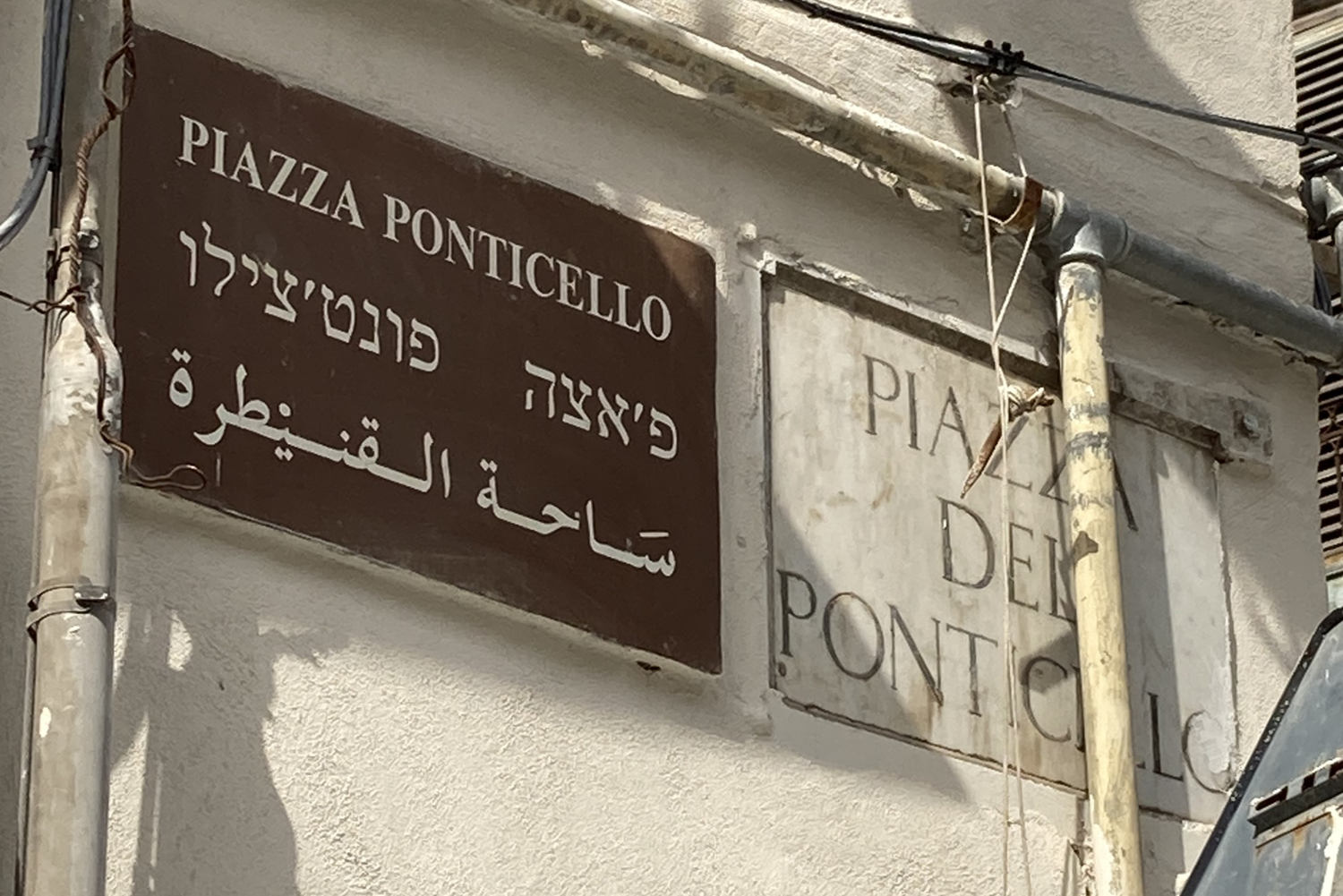
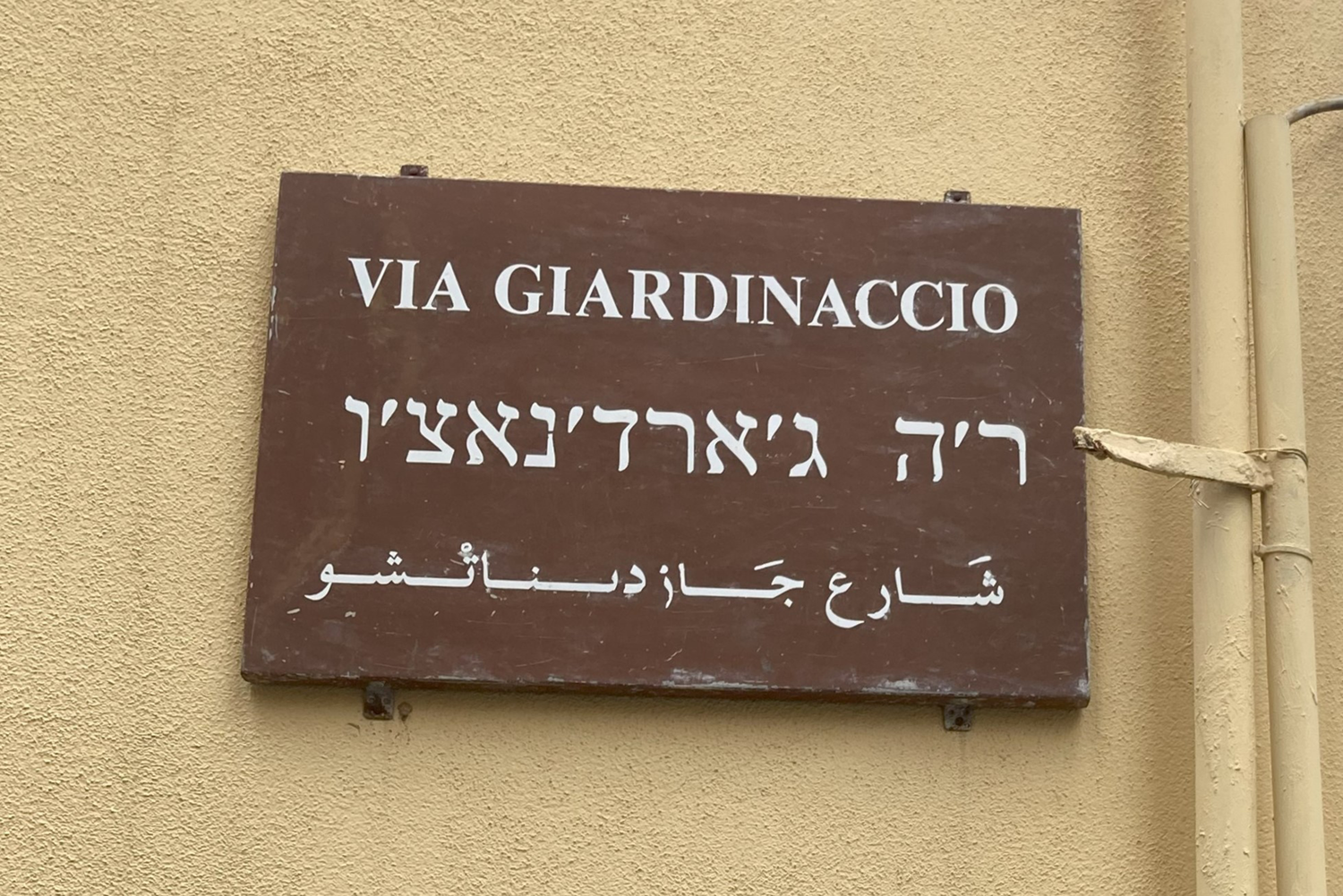
Using the original plans provided to me by the Office for Toponyms, I located 12 of the 16 trilingual street signs first proposed by the Charta delle Judeche. The remaining four were either never installed or were damaged or removed in the intervening two decades. For those who read Arabic or Hebrew, a number of basic typographical errors are apparent. In the Hebrew, Latin-script apostrophes are sometimes used in place of the Hebrew yodh (י), for example (see Figure 1), which looks similar but serves an entirely different function: yodh is a letter, not a punctuation mark. The Arabic features numerous spelling mistakes: Figure 2, for example, contains a zayn (ز) where there should be a ra (ر). Taken together, the errors suggest that both the Hebrew and Arabic translations either were provided by individuals with a scant understanding of these languages, or were imperfectly transcribed between the drawing board and the typesetter.
Trilingual street sign in Italian, Hebrew and Arabic, for Piazza Ponticello, Palermo (photo by author).

Trilingual street sign in Italian, Hebrew and Arabic, for Via Giardinaccio, Palermo (photo by author).

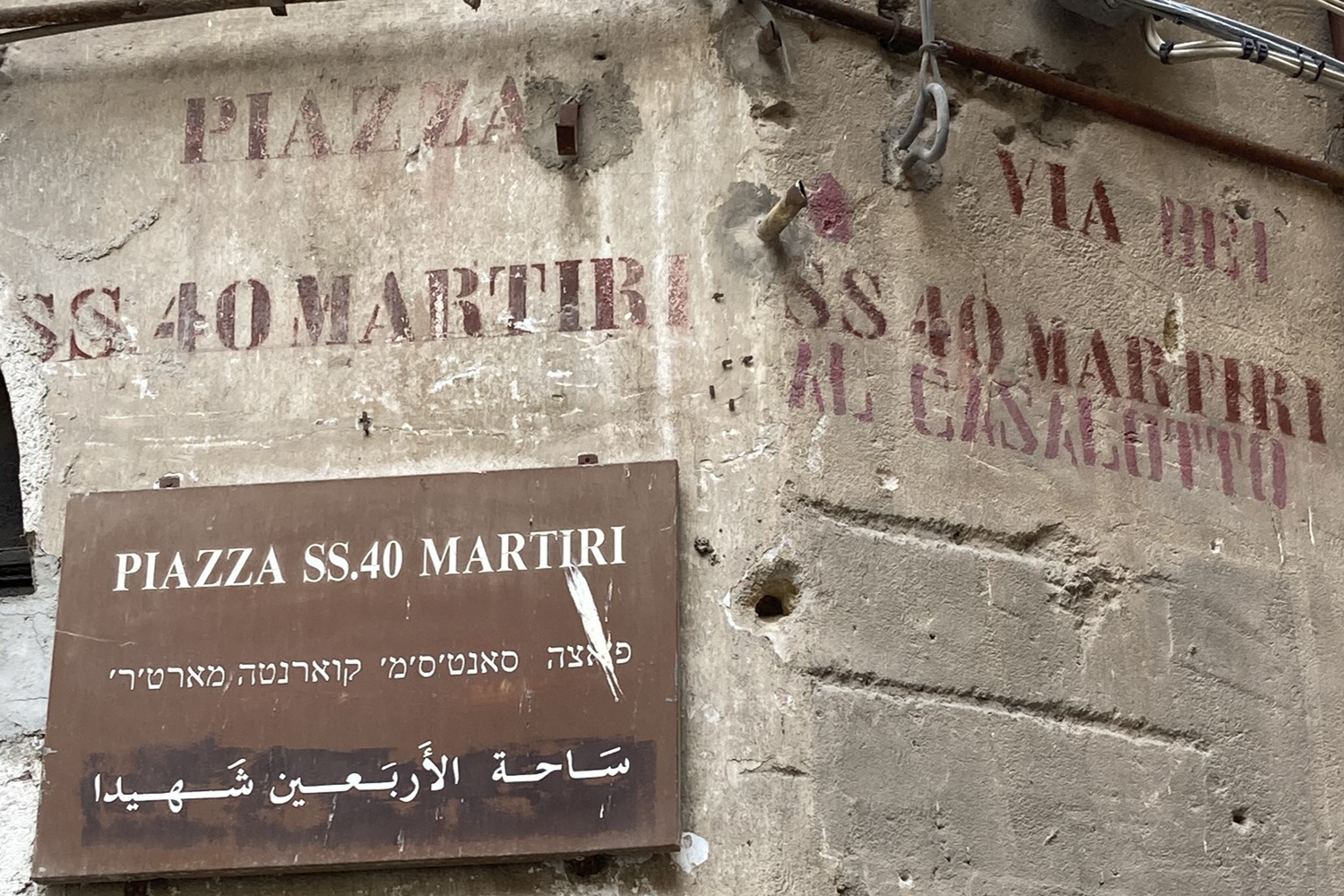
An attempt has been made to provide literal Arabic translations, using Arabic terms for ‘street’ and ‘alleyway’, and two different words for ‘square’. There was even some effort to translate the street names themselves: ponticello, ‘little bridge’, becomes al-qantara (القنطرة), albeit with some spelling mistakes (Figure 1); martiri, ‘martyrs’, becomes as-shuhada’ (الشهداء), although the sign does not render the plural correctly (Figure 3). In the Hebrew script, in contrast, the guiding principle, although imperfectly executed, is strictly to transliterate the original Italian, rather than translating. Thus not only are the Hebrew words for ‘bridge’ and ‘martyrs’ not used; neither are the Hebrew words for ‘street’, ‘square’ or ‘alleyway’. The signs instead attempt to approximate the Italian words via, vicolo, piazza, etc. in Hebrew script.
Trilingual street sign in Italian, Hebrew and Arabic, for Piazza SS. 40 Martiri, Palermo, with traces of vandalism damage (photo by author).

I was unable to find a definitive reason behind this discrepancy. When I asked members of the Sicilian Institute of Jewish Studies, they told me that their organisation, which is separate from the Charta delle Judeche, had previously attempted, unsuccessfully, to identify who carried out the original translations, and to have them corrected on the signs.Footnote 16 The most plausible explanation is that two separate translators were commissioned and were given relatively free rein in their briefing. In other words, whoever commissioned them did not stipulate whether literal translations or phonetic transliterations should be provided, and the Arabic and the Hebrew translators simply took diverging routes.
This work was commissioned in 2000, when digital communication was less ubiquitous. It is at least plausible that the original translations may in fact have been accurate, but were provided in hard copy to a typographer unfamiliar with these scripts. They do not appear to have been copied and pasted from an inaccurate electronic document: the errors go beyond mere occasional spelling mistakes. This would explain why the Arabic and Hebrew bear some resemblance to ‘correct’ translations, but with errors that a typographer unfamiliar with these languages could easily make. As an illustrative example: when studying the Hebrew script on a course with Palermo's Office of Medieval Studies, I found that I sometimes confused the vav (ו), often written with a short serif to the top left, with a resh (ר), which has a long horizontal line in roughly the same place. This same mistake, easily made by a complete beginner, but impossible for someone proficient in Hebrew to overlook, appears to have resulted in street signs reading ria where they should read via (‘street’) (see Figure 2).
From the perspective of their symbolic weight, it is of little importance that the signs contain typographical errors. Pointing out inaccuracies in the signs feels pedantic precisely because of the distance, in linguistic terms, between medieval and contemporary Palermo. It does not matter, in any concrete practical sense, whether the Hebrew and Arabic scripts signify what they are supposed to. It would certainly be more scandalous if the state had mistranslated signs in nearby Piana degli Albanesi, where the protected minority language Arbëreshë is spoken, because this would be a failure in its duty to communicate with speakers of that language.
The very fact that the trilingual signs have existed for some two decades without being corrected brings into relief their real significance: not as texts that ‘index’ the presence of a particular community, but instead as ones that ‘symbolise’ something else entirely – in this case, an historic religious pluralism (Scollon and Scollon Reference Scollon and Scollon2003, 26–27).Footnote 17 This is a pluralism that, in some political quarters – including in the mayor's office, both when the signs were commissioned and during my fieldwork – is perceived as a sign of Palermo's hospitable ‘essence’, and as a model for its multi-religious future. As the next section demonstrates, these signs are also interpreted and defended as symbols of opposition to xenophobia, and of solidarity with religious minorities.
The politics of plurilingualism
Although their practical value is limited, the signs nonetheless remain politically charged. This is because they represent an interpretation of the past, and a vision for a plurilingual and multi-religious future, which remains contentious across Europe, including in Palermo. An official from the Office for Toponyms described to me what he called a ‘curious episode’ from 2009. A police force in Palermo took note of the signs, which had already been up for some years, and contacted the Office for an explanation, assuming that they had been installed illegally and ‘fearing that this was an initiative by certain Arab immigrants in Palermo’, as the official put it.Footnote 18
The Office reassured the police that the signs had the mayor's approval. I was shown the Office's letter of response, explaining that the signs mark an area that ‘in the distant past was the core of the Jewish community of Palermo’. Put otherwise, they could be defended as uncontentious because they served no purpose for living immigrant communities in Palermo; they were ‘safe’ because they symbolised the distant past. It is strongly implicit that the police force's ‘fear’ came from the recognition that some of the text was probably in Arabic: a language used, among others, by Muslims, whose contemporary presence in Palermo is predominantly the result of immigration in recent decades. Although one should be wary of generalising based on one incident, the UN Committee on the Elimination of Racial Discrimination has expressed concern about the ‘widespread use of racial profiling by law enforcement officials’ in Italy as a whole (CERD 2023, 9), and an analysis of police data shows that the national arrest rate for migrants to Italy is 6.8 times higher than the rate for Italian nationals (Palidda Reference Palidda2015, 68).Footnote 19 In other words, this particular episode is not out of step with the general attitude of law enforcement officials towards migrant communities in Italy.
In the case of Palermo's trilingual street signs, the way to assuage the police force's fears was to reassure them that the signs represented a dead (i.e. historical) presence, and that they were neither by nor for the city's Arabic-speaking residents. The Norman court made creative use of multilingual texts to demonstrate its command over the island's various communities, but in contemporary Palermo, not all organs of the state have adopted a similar approach. Local government bodies using multilingual communications, however symbolic their role, must still justify the presence of these texts in the public sphere by appealing to their purely historic significance: in other words, to their status as (mere) ‘heritage’.
In 2017, the Arabic and Hebrew texts were erased from a trilingual street sign, leaving only the Italian. The mayor at the time, Leoluca Orlando, condemned this not merely as a ‘simple act of vandalism’ but as a ‘racist gesture’.Footnote 20 For Orlando, to resist acknowledging Palermo's multicultural history was to oppose its ‘vocation’ as an ‘intercultural’ city (2017). The perpetrator sought to erase something they (mis)recognised as a sign of foreignness. In contrast, according to a cosmopolitan understanding of Palermitan culture, they sought to erase a constitutive part of the city: to suppress or deny an integral part of themselves. It is for this reason, I contend, that community groups in the city, including SOS Ballarò – a local neighbourhood organisation – mobilised so quickly to clean away the graffiti that covered the Arabic and Hebrew text, without waiting for state involvement (Figure 3 shows that some trace of the restoration work remains). Some Palermitans interpreted the erasure as an affront to their understanding of what their city does and should represent. The contested linguistic landscape of the former Meschita, therefore, although it may seem innocuous at first glance, goes to the root of ongoing disputes over the city's ‘true’ identity.
Conclusion
There are Jewish heritage sites in the Mediterranean that are far more prominent than Palermo's. I do not wish to understate the differences between Sicily and somewhere like Andalusia, with its successful Jewish heritage tourism industry and its developed infrastructure for promoting the ‘production of … Jewish space’ (Flesler and Pérez Melgosa Reference Flesler and Pérez Melgosa2020, 9). Nonetheless, the comparison is instructive. There are commonalities in the ways in which identity and cultural memory are actively constructed through heritagisation, using minor reconfigurations of the urban landscape. In Spain, too, these reconfigurations are sometimes as subtle as plaques or small street signs, serving to ‘differentiate’ spaces being (re-)designated as ‘Jewish’ (Flesler and Pérez Melgosa Reference Flesler and Pérez Melgosa2020, 120).
Like all signifiers, the trilingual signs in Palermo's former Meschita have been interpreted in a variety of ways since their installation. For some, as I have suggested, they serve their intended function as reminders of the city's historic Jewish presence, and as markers of local pride in the city's cosmopolitan identity. For others, they merely represent ‘banal cosmopolitanism’. For sceptics of the historic centre's heritagisation, they may be interpreted as ‘ethnic packaging’: a marketing technique directed at visitors. For others still, however, they symbolise a threat to monoculturalism, and perhaps to Palermo's (and Italy's) Roman Catholic hegemony: hence the various challenges to these seemingly innocuous signs, both from state authorities (the police) and from disgruntled residents (the individual who painted over the multilingual signs). Palermo's linguistic landscape, therefore, has become an arena in which the city's multicultural identity, both past and contemporary, is at turns asserted and contested.
The emergence of Palermo's former Meschita as a site of memory is an early manifestation of the wider ‘rediscovery’ of Jewish heritage in Palermo, which envisages Palermitans themselves as a primary audience. My focus has been on the nascent stage of this rediscovery, but since the signs were first proposed, there have been various instances in which the city's Jewish space has been developed or re-evaluated. Examples include Palazzo Chiaramonte (Steri), which was used as a prison during the Inquisition, where prisoners’ graffiti, including some text in Hebrew script, has been uncovered and displayed to the public since 2008; and the former Oratorio di Santa Maria del Sabato, a deconsecrated chapel where Palermo's medieval synagogue once stood, which was granted in 2017 to the city's small Jewish community. Palermo's Jewish heritage is in motion, and with it, as I have sought to demonstrate, the idea that Palermo has an age-old vocation as a city of convivenza. The signs marking the former Meschita – small reminders of the city's multilingual and multi-religious history – play an underacknowledged role in these developments.
Acknowledgements
I would like to thank my interlocutors in Sicily, who made this research possible. This article was enabled by a research grant from the American Ethnological Society, and an Emslie Horniman Scholarship from the Royal Anthropological Institute. I am very grateful for this support, and for Rosie Gosling's mentorship during the scholarship. This research has been improved by responses to papers I presented at conferences of the Association for the Study of Modern Italy and of the Association of Social Anthropologists. Diya Mukherjee, Maggie Neil, Davide Puca, Carlo Andrea Tassinari, Mia Fuller, Charles Hirschkind, Rhiannon Welch and Charles Burdett generously read and commented on earlier drafts. I am grateful to the journal editors; to this special issue's guest editors, Vanda Wilcox and Maria Stella Chiaruttini; and to two anonymous peer reviewers for their helpful suggestions. All remaining errors are my own.
Sean Christian Wyer is a Powys Roberts Postdoctoral Fellow in Modern Languages at St Hugh's College, Oxford, and holds a PhD in Italian Studies from the University of California, Berkeley. His work on Sicily and the Mediterranean has previously been published in The Italianist (2023, co-authored with Margaret Neil) and Modern Italy (2024), and his research on Roman and Jewish-Roman cuisine can be found in Gastronomica (2023) and Food, Culture & Society (2024).

 Open access

