

Introduction
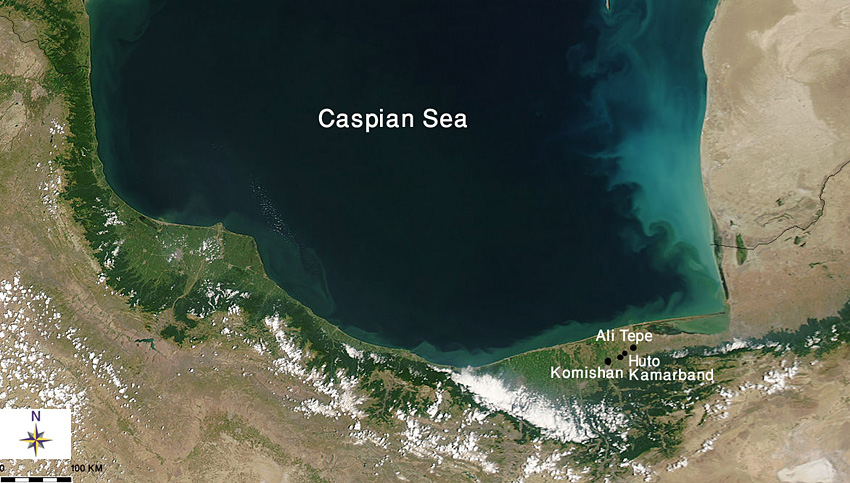
Location of Epipalaeolithic sites at the southern shore of the Caspian Sea.

The Epipalaeolithic archaeology of the southern shore of the Caspian Sea is relatively little known. There is a limited number of Palaeolithic sites recorded within this region (Figure 1), and few have been excavated. During the 1950s C.S. Coon conducted the first Palaeolithic excavations in two caves at Huto and Kamarband and reported the presence of Epipalaeolithic, Neolithic and Iron Age materials (Reference CoonCoon 1951 & 1952). A decade later C. McBurney conducted limited excavations at the cave of Ali Tepe (Al Tepe). Based on absolute dating and artefact typology, he assigned Ali Tepe to the Epipaleolithic period (Reference McburneyMcBurney 1964). New results from Komishan Cave, briefly reported here, add to our knowledge of this period in the region.
The excavation at Komishan Cave
Komishan Cave, located 6km from the sites of Huto and Kamarband in direct line and 10km west of the city of Behshar, was selected for a small excavation in the spring of 2009 to address questions concerning the lack of stratigraphic and chronological information for the region under study and in order to update some of the older excavations at Huto, Kamarband and Ali Tepe.
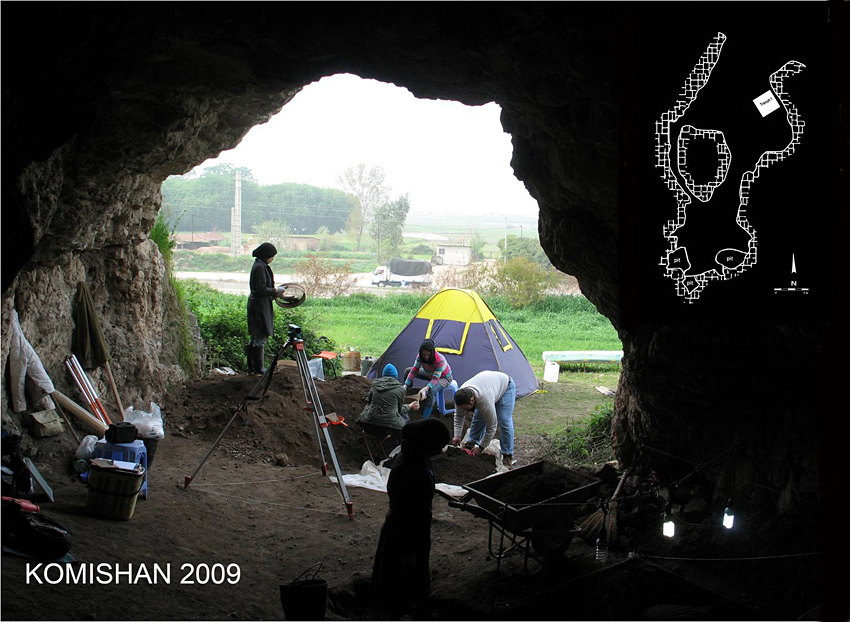
The cave was formed by dissolving the carbonate calcium of the karstic massif which belongs to the extension of the Hutokash Mountains of the northern Alborz. The cave's maximum height is 15m and its altitude is 45m asl. Its 6m wide entrance faces north, and the cave contains two main chambers (Figure 2).
Komishan cave, view from inside.

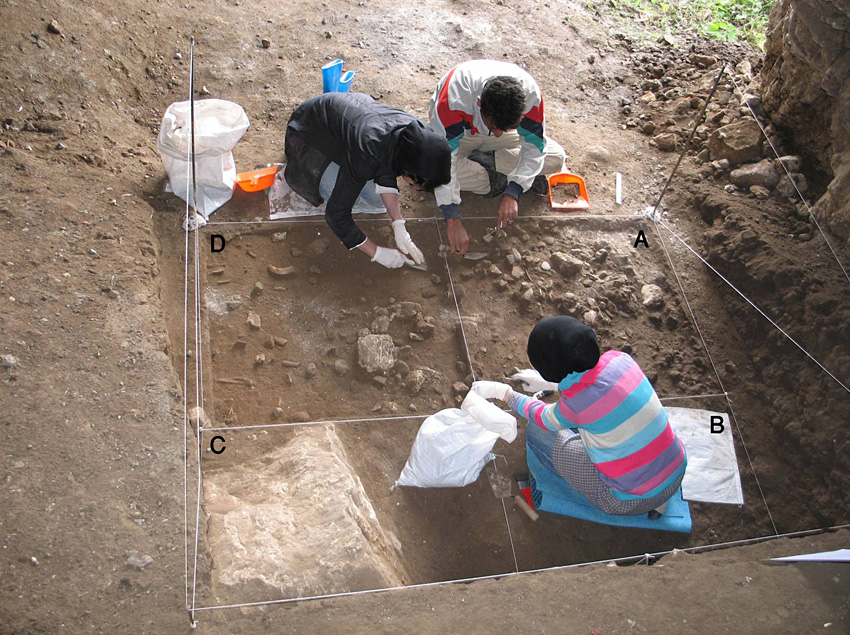
Trench 1 under excavation.

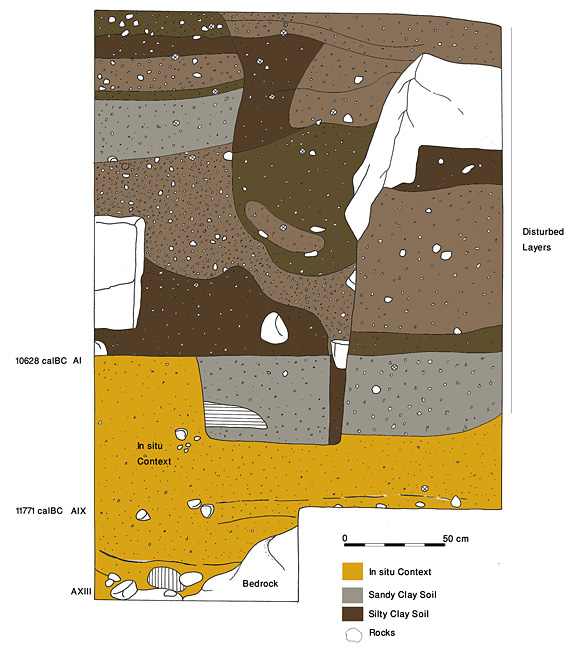
Stratigraphic section of Trench 1.

In order to test the stratigraphic sequence, a 2 x 2m trench was opened at the entrance of the cave. This trench was divided into four 1 x 1m squares (Figure 3). Because of the presence of some large rocks, the excavation only continued in two quadrants, A and D. All the excavated soil was collected for flotation. Artefacts recovered from the in situ deposits were recorded in 3 dimensions with x, y and z coordinates.
The trench was excavated up to a depth of 2.78m from the surface. The top 1.64m of deposits was disturbed (the surface of the cave having been disturbed by dozer blade) but the lower 1.14m was undisturbed (Figure 4). The excavation stopped when bedrock was reached at a depth of 2.78m from the surface. The excavation of the undisturbed deposit proceeded in 13 arbitrary spits, each 5cm thick (levels AIAXIII). There was no clear differentiation in soil throughout the levels; the whole layer was considered as one context. Techno-typological analysis of the lithics recovered from this context (no ceramic was found) indicates that all 13 levels in this context demonstrated an identical pattern (Vahdati Nasab et al. in prep).
Two AMS dates were obtained for the undisturbed deposit. One determination of 10 800±45 BP from level AI (OxA-22611) belongs to the beginning of the context, and the second of 12 000±60 BP from level AIX (OxA-22572) was obtained from some 30cm above the bedrock (see Figure 4). The calibrated dates shown on Figure 4, i.e. 10 628 cal BC for the upper level and 11 771 cal BC for the lower one have been calibrated (at 95.4% probability) using the Oxcal program (v4.1) of C. Bronk Ramsey, using the 'INTCAL09' dataset.
The materials recovered
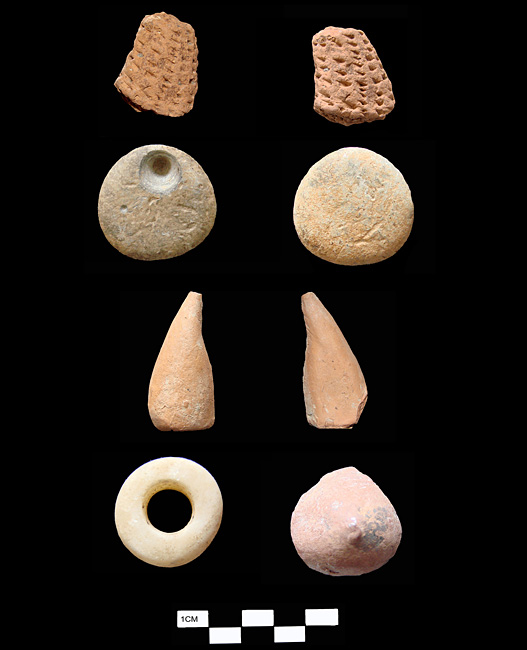
Upon completion of the excavation, analysis concentrated on comparing diagnostic artefacts and proposing relative chronologies for them. Unfortunately the severe damage to the upper deposits limited the amount of information available for these: our preliminary analysis of the pottery indicates that the disturbed layers contained a mix of Neolithic, Chalcolithic, Bronze, and Iron Age materials (Figure 5).
Artefacts from the disturbed deposits.

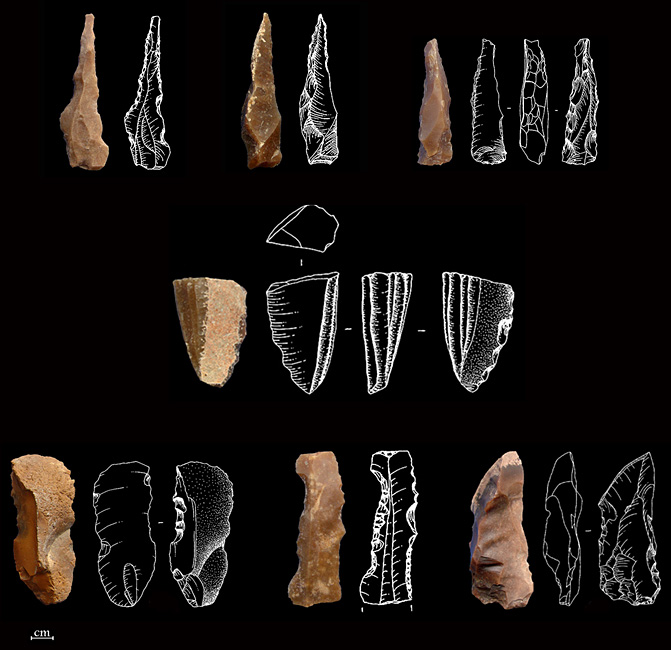
Lithics from the undisturbed context at Komishan.

On the other hand the data recovered from the undisturbed context are significantly homogenous in nature. The assemblage is characterised by large concentration of bladelets, notch/denticulates, scrapers of all forms (especially end scrapers), borers and backed pieces, as well as a complete absence of ceramics (Figure 6).
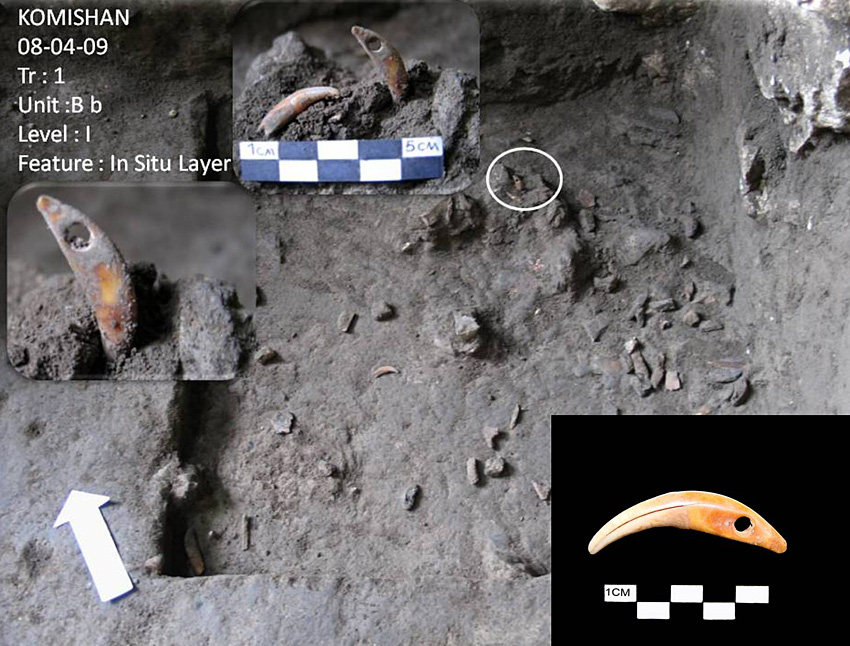
The perforated teeth and their position in situ.

Perhaps the most striking discovery at Komishan consists of three perforated canines, discovered in the undisturbed deposit a few centimetres from each other (Figure 7). Such artistic elements have previously been reported from excavations in Kamarband by Coon (1951: 115) but there their dating was uncertain. The teeth from Komishan, recovered in the layer dated to 10 800±45 BP, can therefore be considered one of the oldest expressions of artistic endeavour in Iran.
Conclusions
The techno-typological analysis of the lithics recovered in the excavation in Komishan cave, together with the absolute dates obtained, confirm that the site has been in use since the Epipaleolithic/Pre Pottery Neolithic period; thus the cave might provide an exceptional opportunity to investigate the process of Neolithisation on the south-eastern shore of the Caspian Sea. In addition it is clear that Komishan had witnessed later occupation episodes (Chalcolithic, Bronze and Iron Ages), encountered in deposits disturbed at this location within the cave. The Komishan site is also remarkable for its rich archaeological assemblage, producing 60 000 archaeological finds from a very small trench. Such wealth plus preliminary analysis of the fauna, the seeds and the lithic material suggest that the cave could have been used, at least on some occasions, as a base camp.
Acknowledgements
We would like to thank the excavation crew, M. Zareh Khalili, R. Mojtabaee, M. Abolfathi and Z. Lotfalikhani for their work as well as Mr. E. Jafarian for taking on the logistics of the excavation.