

3 The personal microcosm of Reichsbanner activism
The Reichsbanner Black–Red–Gold was able to attract a mass following as the veterans’ association of the moderate socialist camp, combining active support for the Republic with the provision of a framework of memories that endowed the wartime service of working-class men with meaning. It is possible to reconstruct the most important discursive elements of the war remembrances promoted by the Reichsbanner by studying the membership journal and reports of internal meetings. It is not sufficient, however, to analyse only the publicised versions of these war narratives, even though they were to a large extent based, as we have seen, on the contributions of Reichsbanner members, and thus had a bottom-up dynamic. In addition, it is also necessary to unearth the personal and political relevance and the particular contours of these memories within the individual microcosm of members of the league. How did their personal recollections of the Great War inform the political worldview and Reichsbanner activism of rank-and-file members? To what extent did they share these memories with other people in a local context or neighbourhood, thus contextualising their own perception of the past in a dense network of personal encounters and day-to-day interactions? Which social and political factors facilitated or impeded the public articulation of these war memories in the highly circumscribed setting of a local community?
In order to answer these questions, it is necessary to interrogate primary sources that shed light on the individual perception and formulation of war remembrances in a specified social context, i.e. some form of personal testimony. In this chapter, we will analyse and contextualise a significant piece of evidence that allows us to address these questions. Written in the mid 1920s, at some point after the founding of the Reichsbanner and well before the deepening of economic depression and political instability from 1930 onwards, this document offers a highly detailed glimpse into the personal life of a war veteran and Reichsbanner member, and into the connections between war experiences and pro-republican activism. As we will see, an external event prompted the author to feed this document into the ongoing struggle over the contested commemorations of the First World War. Yet it originated in the highly personal process in which an individual revisited and reassessed his own recollections of war and the military against the backdrop of the contemporary political setting in Weimar Germany.
Historian Ludwig Bergsträsser (1883–1960) worked from 1920 to 1933 in the research department of the Reichsarchiv in Potsdam and later in Frankfurt, where he conducted research on the Paulskirche, the revolutionary parliament in 1848/9. A Reichsbanner member from 1924, he began to serve as a Reichstag deputy for the left-liberal German Democractic Party (DDP) in the same year.1 In that capacity, Bergsträsser was a member of the parliamentary subcommittee that investigated the ‘causes of the German collapse’ in 1918. Within this highly polarised forum, fierce battles raged between a majority of conservative deputies and their expert witnesses, who aimed to whitewash the Army Supreme Command from any responsibility for the German defeat in 1918. They were confronted by a small group of Democratic politicians and historians – also including fellow Reichsarchiv staff member and Reichsbanner activist Martin Hobohm – who sought to counter the Dolchstoß myth and other anti-republican narratives of the military endgame in 1918.2 In this struggle about the recent past, each camp was eager to present and exploit a range of primary evidence that would corroborate their respective positions. The nationalist proponents of the Dolchstoß preferred to call former staff officers and generals as expert witnesses, whereas their republican counterparts aimed to provide documentation on the inevitability of defeat from a worm’s-eye perspective. Bergsträsser in particular advocated the use of war letters written by soldiers. This first-hand evidence, he argued, would allow insights into the immediate ‘psychological reality’ of front-line soldiers, and thus into the factor of troop morale, which had not been accessible to the officers at the time.3
On 31 March 1926, Bergsträsser published a piece entitled ‘Front and Peace’ on the front page of the respected liberal broadsheet Vossische Zeitung.4 The gist of his article was a firm rejection of the stab-in-the-back myth. Based on war letters that had been sent to him and his wife from the front, he sketched out a brief history of the changing expectations among the troops. Beginning in mid 1915, when leave was first granted on a regular basis, the soldiers perceived the war to be an ‘instrument for peace’, and believed that to ‘fight was a chance to arrive at a peace’. Only by achieving a victory, according to such expectations, would it be possible to escape from the authoritarian straitjacket of life in the army and to return home. As such, longing for peace provided German soldiers with a crucial combat motivation. Yet as soon as the German offensives in spring 1918 stalled, the last hopes for victory were shattered. Eventually, combat no longer appeared to be a means for achieving peace, and morale deteriorated at a rapid rate. In order to substantiate this line of argument, Bergsträsser appealed for the help of the readers and asked them to send in war letters and diaries: materials that would help to counter the ‘wicked slander’ of the Dolchstoß myth. ‘Thence, help!’5
Fritz Einert
On the very next day, a certain Fritz Einert responded to this call and wrote to Bergsträsser.6 He had read the piece in the Vossische and was more than happy to help the historian with his ‘task’ – dispelling right-wing myths – by ‘providing you with something from my experiences [Erlebnissen]’ (p. 214). Some time previously, Einert had ‘submitted himself to the trouble’ of rereading all his surviving Feldpostbriefe, had transcribed all particularly ‘critical’ passages and collated them in chronological order. As his language indicates, conjuring up recollections of his front-line service had not been a pleasant task for Einert, but reasons for doing so were not just personal: ‘Since I am a member of the Reichsbanner, I have combined my thoughts and experiences with Reichsbanner ideas. After many years one can obviously not recall everything that one has experienced over four years, and I have based [the manuscript] only on those details of which I still have a very precise recollection’ (p. 214). Einert had laid down his recollections and reflections on the front-line experience in a manuscript entitled ‘Thoughts of a Reichsbanner Man Based on Impressions and Experiences’, which he enclosed in his letter to Bergsträsser.7 Both the content and context of this manuscript require detailed attention. But before we analyse them, it seems worthwhile to turn to an initial reflection on the more intricate mechanics of memory that can be illuminated through this document. Einert was clearly aware of the selective and unstable nature of his individual memory. As the member of a veterans’ association, it seemed obvious to him to connect his own personal recollections with the wider framework of ‘Reichsbanner ideas’, and it is interesting to examine the extent to which both were entwined or even blended into one another. But the starting point for his endeavour of revisiting the war experience had been rereading his own war letters, most of which seem to have been addressed to his parents. Einert had not kept a war diary, as any ‘appetite’ for this type of autobiographical documentation had already ‘worn off’ during the first days of his wartime service (p. 214). Instead, he used his own war letters as a medium for autobiographical renegotiation and reflection, and as a reminder about specific situations where his personal memory of details had faded away quickly.
Such a use of Feldpostbriefe was not unusual in the broader context of post-war Germany. Throughout the 1920s, various edited collections of war letters had been a crucial reference point for public debates about the Kriegserlebnis, as these documents seemed to guarantee an immediate access point to the solders’ inner selves.8 And Einert was surely not the only war veteran who revisited his war experience through a rereading of his own letters from the front.9 For Einert, his specific focus was on those passages ‘that gave some vent to my heart during the war’, even though postal censorship had often been able to suppress his urge to describe the bitter reality of war in more detail (p. 225). He included eight typewritten pages with these excerpts in his manuscript, covering the period from February 1915 to May 1918 only, as he had misplaced the letters for the remaining period until the armistice. All in all, these letters were an almost perfect corroboration of Bergsträsser’s argument, as Einert had noted his longing for peace as early as June 1915, and – despite a deep-felt war weariness – had kept his hopes alive until spring 1918. On 25 March 1918, four days into the German spring offensive, Einert was still hopeful that these ‘colossal events’ would finally ‘really’ bring about peace (p. 231).
War letters were thus a crucial medium of war remembrance for Einert. They allowed him to prop up and to corroborate his personal recollections in a way that also served the political aims of Bergsträsser’s appeal. Einert expected that the historian could use some of his thoughts for his fight against the Dolchstoß. But in his covering letter, he was adamant in insisting that the document should not be used in public:
The whole matter is a completely private affair of my own and has nothing to do with the public; also I do not wish to involve the latter. For this reason, I also ask you for complete discretion, because I am a salaried employee in a manufacturing business and – naturally – economically dependent. Unfortunately it is still the case that we are not yet free men, despite the Republic. The former Feldgraue, who was once so much glorified, is today again the subject [Untertan] of someone who is economically stronger. Nobody is interested in asking what the former front-line fighter once accomplished; he is nowadays again an object of exploitation, just as he was during the war.
Written by an active and devoted Reichsbanner member during Weimar’s allegedly ‘stable’ or ‘golden’ years, this statement could be read as a devastating verdict on the achievements of the republican state. Einert explicitly employed the term Untertan to describe the current situation of war veterans. In his novel of the same title, published as a book in 1919 and an immediate runaway success, the writer Heinrich Mann had popularised its use as a generic term for the authoritarian political system of imperial Germany.10 It would thus appear that not a lot had changed in the wake of the revolution, and that Weimar’s democratic constitution was unable to safeguard the rights of its supporters among former front-line soldiers. In some respects, Einert’s bitter résumé of power relations in German society was one of many examples of the huge gap between the expectations raised because of the transformation to a democratic system, and the almost inevitable disappointment about the failure of subsequent political action to transform social relations.11 But as we will see, Einert’s disappointment about the precarious state of war veterans was also motivated by specific incidents he had observed in his local community, and was to some extent balanced by the sense of entitlement the Reichsbanner ideas instilled in him. At any rate, Einert’s insistence on the private character of his recollections prevented Ludwig Bergsträsser from using them for his public rebuttal of the Dolchstoß through an extensive documentation of war letters and other testimony.12
Fritz Einert (1893–1962) spent his whole life in Schmalkalden (Thuringia), a town with about 10,000 residents in 1925.13 The son of an awl-maker, he married Luise Paula Bamberger in 1922, the daughter of a pliers-maker. As the parents of both were toolmakers, the family background of the couple was a perfect match to the economic structure of the town, which had been known as a centre for iron smelting and processing since the sixteenth century. From the late nineteenth century, iron production in Schmalkalden had been an industrial business, and Einert spent his working life with the H.-A. Erbe AG, which was, with 329 employees in 1926, the largest company in town. The firm was widely known by the colloquial name ‘Löffelbude’ (‘Spoon Booth’), as cutlery was the main product. The Great War had – incidentally – presented the firm with the welcome opportunity to mass-produce knifes and forks for the army. Coming from an artisanal working-class background, Einert was a salaried employee and worked as a correspondence clerk, a fact that also explains his excellent and nuanced command of written German, which can be found in his typewritten manuscript. But Einert did not only depend economically on the H.-A. Erbe company – which thrived throughout the 1920s before the Depression forced the owners to make compulsory redundancies – he also lived in a house owned by his employer.
Most probably joining in 1921, Einert was a member of the Social Democrat Party (SPD) until it was disbanded by the Nazis in 1933. According to his own testimony, he had not had any interest in politics before and during the war (p. 214). Describing his – in hindsight, for him, deplorable – political ignorance, Einert recalled how he had cheered some of his company comrades who tore down the red flag from a public building when the regiment marched home in November 1918. Arriving at the polling station for the January 1919 election to the National Assembly, he had to inquire about his options, not knowing any of the parties and candidates (p. 225). The town of Schmalkalden had already been a Social Democrat stronghold before 1914, and the SPD managed to expand its position as the strongest party at the ballot box in the 1920s before it was relegated to second place by the Nazis in the September 1930 Reichstag elections. As elsewhere, the local Reichsbanner branch was founded with some delay in August 1924 and, not surprisingly, the preparations were discussed in a meeting of the local SPD group in the context of a debate on ‘upcoming tasks of the party’.14 Einert may have been one of the founding members of the local Reichsbanner branch, and if not, he surely joined early on. For an extended period that cannot be established with certainty, he also served, using his professional skills, as the keeper of the minutes: a fact that indicates his practical commitment to Reichsbanner activism. As in many other towns across the country, the Schmalkalden branch of the republican defence league made regular public appearances on 1 May and on 11 August – constitution day – while the number of other public outings in the mid 1920s seems to have been rather limited. However, in September 1926, the local Reichsbanner members celebrated their flag consecration with a march through the town.
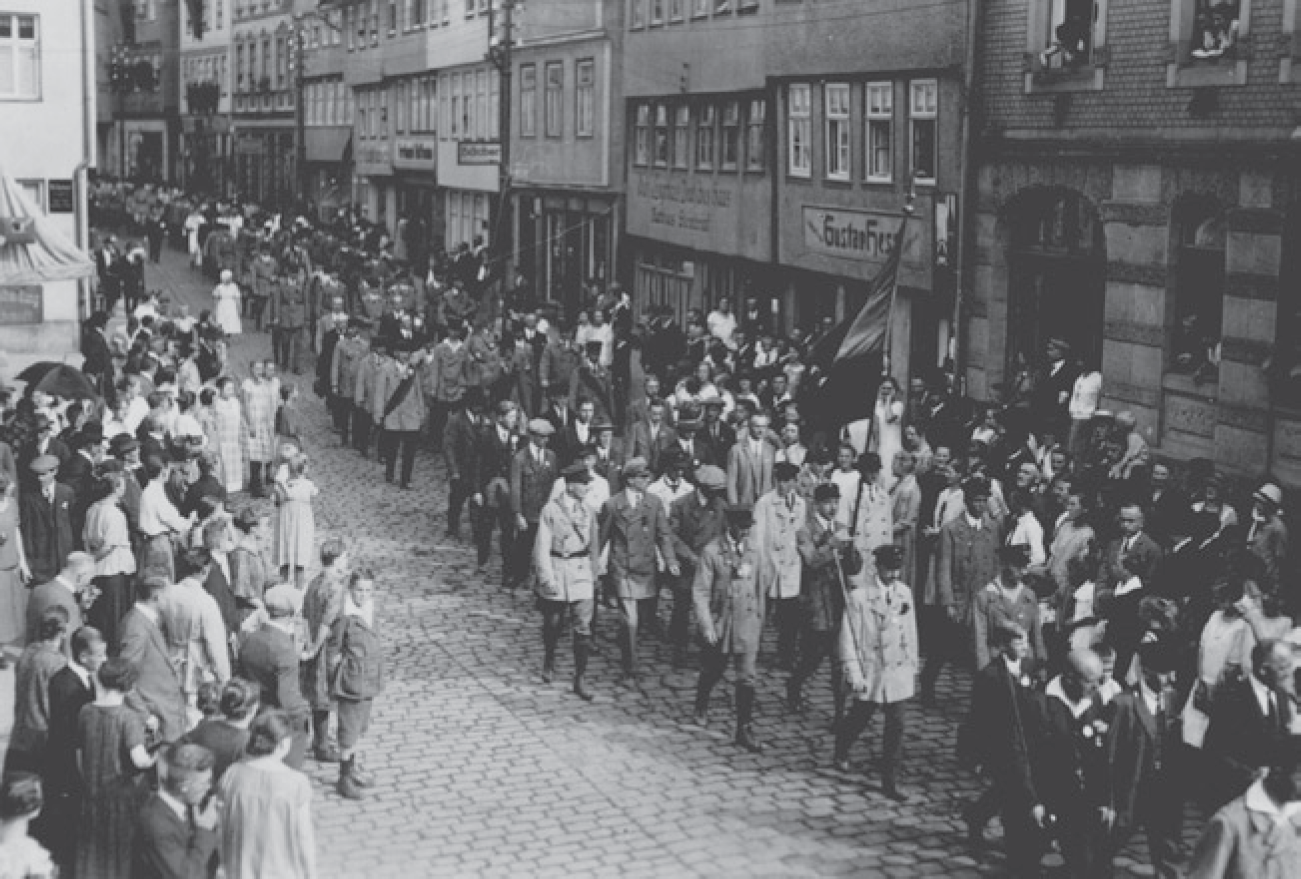
Figure 5 Reichsbanner flag consecration in Schmalkalden, 5 September 1926.
Einert’s war experiences
Einert was drafted in 1914, but it was only in March 1915 that he moved to the front. He served in the 71st Infantry Regiment, a Thuringian unit, which had its garrison in Erfurt. It was first deployed at the eastern front, where Einert saw action in Russia, Serbia and Macedonia, before the regiment was transferred to the western front in spring 1916. There he served until the armistice, was decorated with the Iron Cross Second Class and with the Schwarzburger War Medal, and was discharged in the rank of an NCO (p. 214). In his manuscript, Einert was blunt in outlining his overall assessment of the military as an institution. ‘Entry into the military’, he wrote, ‘was, for the common man, the beginning of a time of gagging and oppression.’ The constant extended, useless drill and grind were the prerogative of the superiors in the ‘Prussian military system’, meted out against the ‘sons of the working people’ who had ‘naturally’ to be at the receiving end of the ‘disciplinary rod’ (p. 216). He recalled a number of examples where NCOs and young lieutenants had inflicted the pain of endless drill on muddy ground upon the soldiers, and was particularly bitter about a sergeant who was already well known for his brutal exercise of power from the garrison, but was rarely ever seen close to the front line. Referring to this particular individual, but also summing up his experiences with superiors, he expected that ‘surely it should be possible to write books about the continuing drudgery exerted by these tormentors’ (p. 217).
This last remark is highly revealing for at least two reasons. First, it indicates that Einert longed for a more elaborate literary narrative that could do justice to the whole spectrum of negative experiences he and other ordinary men had accumulated in the Prussian army. Even though he recalled and described some of these incidents in great detail across several pages of his manuscript, he must have felt that his literary means were not sufficient to express the bitterness and humiliation soldiers had suffered at the hands of their superiors. Secondly, the figure of the brutal NCO who can terrorise private soldiers in the garrison and at the rearguard, but cannot cope with front-line action, is a crucial element of the narrative in Erich Maria Remarque’s All Quiet on the Western Front. In the drill sergeant Himmelstoß, he epitomised this particular aspect of military life for many readers.15 Einert’s brief remark thus indicates an important element of the framing of popular expectations in the republican camp, expectations that helped to turn Remarque’s novel into an immediate commercial success.
In Einert’s description, the injustice and brutality of the power structures in the wartime army were a direct correlate of class rule, as the ‘working people’ had to endure maltreatment and abuse. His sentiment was widely shared by moderate socialist workers in the 1920s, as an academic inquiry revealed in 1923. This inquiry was based on many informal talks with and between miners at the Ruhr, and was thus a kind of early anthropological study, employing participatory observation as the main tool of data gathering. In these talks with the researcher, a Ph.D. student, the miners produced endless examples of young lieutenants who had behaved like ‘masters’ (Herrenmenschen), and had thus had a vested interest in the war.16 Such a class-based explanation of the inherent cruelty of the Prussian military worked neatly as far as young officers with a middlle-class background were concerned. With regard to NCOs this approach was problematic, as Einert admitted, pre-empting the objection that they were in fact recruited from the ‘lower people’ (p. 217). His response was to describe the majority of the sergeants and NCOs as ‘scum of the earth’ (Ausschuß der Menschheit): as people who were not capable of earning their living through a ‘peaceful craft’ (p. 217).
Throughout his manuscript, Einert referred to many wartime episodes that further reinforced the overall message of how unjust and brutal the military machinery had been. One case in point was ‘tying-up’ (Anbinden) – the equivalent to Field Punishment No. 1 in the British army – where soldiers were tied to a wheel or tree in lieu of a detention room.17 While the regiment was in Macedonia, one of his comrades had been punished for stealing some food. In blazing heat, he was tied up to the wheel of the field kitchen for three days – just long enough, as Einert commented with cynicism, ‘to restore his patriotic feeling’ (p. 224). But while the brutality of the class-based Prussian military system was one of the most deeply felt and enduring legacies of the war experience for Einert, his perception of the army had already been framed well before the war. His older brother, who was drafted in 1913, had told him often about ‘the suffering under the Prussian military system, the oppression and the slave-like treatment by the superiors’ (p. 219). Thus, the war experiences could to a large extent only confirm what he had already expected to be the predominant features of military service. Precisely at this point of his reflections, Einert also attacked the notion of a ‘spirit of 1914’. He debunked nationalist mythologies of a rush to arms, explaining the readiness of young men to volunteer in August 1914 as an attempt to seek ‘relief’ from the oppression they had endured in the barracks (p. 219).18
Einert’s text was an attempt to connect his front-line experiences with contemporary political struggles about the proper remembrance and overall meaning of the wartime past in Weimar Germany. He organised his core argument around a couple of related juxtapositions, which were repeated and slightly rephrased throughout his manuscript. Taken together, these juxtapositions not only reveal the core of his convictions as a ‘Reichsbanner man’ – a theme that the title of the piece had flagged up clearly – they were also meant to offer a comprehensive interpretation of the fault lines or cleavages that divided the political system of the Republic, as seen from the bottom-up perspective of a small provincial town. The first of these juxtapositions served to dispel the charge that the republican left, rallied and represented by the Reichsbanner, lacked patriotism. Einert first touched upon this topic when he discussed the fatal consequences of the pre-war arms trade and the vested interests manufacturers had in armed conflicts. He characterised the representatives of ‘big industry’ by their eagerness to make profits, thus tapping into a discourse that had already gained currency during the war.19 But these ‘war profiteers’ would nowadays pretend to be the ‘most nationalist men in the world’, even though they had only ‘robbed and deceived’ both the ordinary people and their fatherland.20 A case in point was the fact that German arms had been traded to prospective enemy countries before the war, although there had been a general knowledge – even in Einert’s school, conveyed through the teachers – that a war was imminent.21 Einert recalled an incident in the summer of 1915 when his regiment had attacked a village in Serbia. When it finally managed to capture an abandoned Serbian artillery position, one of the cannon bore the sign of its manufacturer, the ‘Krupp Company, Essen’.22 Anyone claiming to be ‘nationalist’ would have refrained from delivering war materials to foreign countries, he maintained. But nowadays, Einert insisted, those who did so would claim to be ‘much more “nationalist” than the front-line soldiers, who had their bones crushed by the fire’ of exactly these cannon (p. 216).23
He returned to this theme in a deliberation on the rule of the officers and the changing social structure of the front-line army during the war. Once active, Einert claimed, pre-war officers had realised that the war would not be over within a few months, and as such, they started to withdraw from front-line service. Thus, teachers had to serve as troop officers in the final years of the war and, in terms of social strata, the front-line army more generally consisted of teachers as leaders, and ‘of workers, salaried employees and lower civil servants as enlisted men’. High-ranking civil servants, industrialists, ‘big landowners’ (Großagrarier) and the higher strata of the military, conversely, ended up serving in the Etappe, or back home in Germany, and such men were precisely those who would, in the post-war period, exaggerate their claims to be ‘nationalist’ (p. 218). Thus, Einert followed the already well-developed pattern of socialist war remembrance, which contrasted the sacrifice of the ordinary people at the front with the past profiteering and current wealth of those who had sought a safe place behind the lines.
Delineating the republican camp
Einert presented this line of reasoning in a series of four rhetorical questions that juxtaposed the respective claims of being ‘nationalist’, by those ‘braggarts’ who were now gathered in the right-wing combat leagues on the one hand, and by the ‘working man’ who ‘had had for years to endure the suffering of this bloody war, but is nowadays a member of the Reichsbanner’ on the other (pp. 218f.). In this rhetorical sweep, Einert associated wealth with a lack of patriotism, and in contrast characterised those who were on a ‘meagre weekly wage’ and also Reichsbanner members, as national (p. 218). With these rhetorical juxtapositions, Einert shifted his argument on the terrain of a discourse to what it meant to be nationalist. On the one hand, this was a smart move, as he could tap into the well-established Social Democrat argument that stated that only the wealthy few could afford to have pretensions about their nationalism. Unmasking the egoistic reasons for patriotic posturing, he effectively deconstructed a crucial element of nationalist discourse: the claim that only the right could legitimately speak about it. Every claim for a peculiar Reichsbanner patriotism was, on the other hand, tainted with the toxic legacy of service in the Imperial Army. Apart from that, Einert’s claim was also tautological: in four consecutive rhetorical questions, he insisted that being a Reichsbanner member was the equivalent of being national – to use the German term – without ever qualifying this claim any further. As a positive assertion, it was an empty rhetorical gesture: convincing on a personal level bearing in mind his service record, but lacking firepower in the public arena. Throughout his text, Einert never detailed why he had a reason to be proud of the German nation. His Reichsbanner nationalism was like an empty shell.24
As we will discuss in more detail below, it was crucial for Einert’s insistence on being part of the truly ‘patriotic’ political camp that he knew the members of both camps in person, owing to the small town setting of Schmalkalden. But such claims to be nationalist were quickly undermined, not least when doubts were cast on the front-line service of Reichsbanner activists. This happened in the small town of Eutin near the Baltic Sea when the local Reichsbanner branch was founded in July 1924. A secondary school teacher from nearby Kiel was scheduled to speak at the very first foundation gathering, but he had to be withdrawn and replaced by an SPD functionary from Hamburg because the local Stahlhelm had mocked the meagre front-line service record of the preferred speaker.25 Einert himself was well aware that even extended front-line service did not make Reichsbanner members immune against charges that the republican league and its members lacked patriotism:
A Frontkämpfer with many years of service, who has made sure that the German people were spared the misery of foreign occupation and who has also ensured that the pockets of these ‘nationalist’ heroes have been filled, but who nowadays wants nothing else than to live a well-ordered and peaceful life, is immediately branded an unpatriotic fellow [vaterlandsloser Geselle] as soon as he joins the Reichsbanner.
More than any other passage in his text, these lines indicate the contradictory nature of Einert’s war memories, particularly the perennial tension between his personal wish to forget the past and the political need to remember it. Precisely because of the degradation, maltreatment and suffering he had had to endure during the war, Einert was keen to leave this world of misery behind and pursue his own personal advancement in a civilised social environment. But this urgent desire was hampered by his commitment to the Republic and to the veterans’ league that defended it.26 Via his Reichsbanner activism, Einert had entered the contested field of veterans’ politics, and the continuing struggles between the right-wing associations and the republican league that shaped this field forced him to rework and articulate his war memories in a more coherent fashion. In that sense, Einert’s manuscript did not present anything private or personal, since his own narrative of events was charged and suffused with the overarching pattern of ‘Reichsbanner ideas’, as he had explained in his covering letter (p. 214).
The first juxtaposition – between those who falsely claimed to be patriotic, and those who really had served their fatherland during the war – was thus complemented and expanded by a second juxtaposition, between those who were members of nationalist combat leagues – for which Einert invariably used the term ‘right-wing leagues’ (Rechtsverbände) – and those who had joined the Reichsbanner (pp. 218, 221). Einert insisted that it was easy to convey a correct picture of these competing organisations in a small town such as Schmalkalden, where he could know almost all local members of both Reichsbanner and Jungdo ‘in person’ (p. 220). Thuringia was one of the strongholds of this league, which adopted some of the principles of the bourgeois youth movement and combined an aggressive nationalism with an anti-democratic and anti-Semitic ideology. The political style of the Jungdo was political romanticism rather than fascism. Nevertheless, Fritz Einert preferred to characterise Jungdo members as bearers of the ‘swastika’ (p. 221).27 A local Jungdo branch had existed in Schmalkalden since 1920, and it was strong enough to publish a monthly newsletter in the latter half of the 1920s, and to gather 600 people for a festive event in the summer of 1927.28 The relation between Reichsbanner and Jungdo might have been less confrontational in other regions and at other times, particularly during the late 1920s, when the Jungdo lost members and hence moved closer to the bourgeois parties, ultimately merging with the DDP to form the German State Party in July 1930. Yet also in Baden, where the political cleavages were less pronounced, Reichsbanner members in Schiltach ‘raged’ against the DDP in 1930, apparently agitated by the merger with the Jungdo, which had made the loss of any liberal substance in the DDP obvious.29
Reasons for joining a right-wing league
Obviously, the first point of Einert’s juxtaposition regarded the claim to be a veterans’ association. Only very few veterans had joined the Jungdo, Einert maintained.30 He tried to refute the claim of a right-wing MP who had ‘recently’ argued in the Reichstag that no former front-line soldiers at all were represented in the Reichsbanner.31 Quite to the contrary, Einert insisted, again referring to his own personal encounters, all those ‘from my town and vicinity who were in the field together with me are without exception Reichsbanner members’ (p. 220). Einert then offered a detailed survey of the different social strata and motives for joining of those who were organised in the Rechtsverbände. The key categories of this analysis were economic advantage and status interest. Small artisans, for instance, would often join as they expected to gain business contracts, or in the belief that their property would be safer if they were Hakenkreuzler. Similar reasons motivated the broad category of the ‘war and post-war profiteers’ (p. 221). With the latter term, he was referring to those who had amassed a fortune during the inflationary period until 1923. Another category were businessmen who believed that, on average, the more affluent customers were to be found in the right-wing camp. Another group of joiners consisted of those with a secondary school diploma, Abitur or equivalent. These young men, Einert was convinced, believed that the reintroduction of a large ‘standing army’ would also bring the renewal of extra privileges for the Einjährigen (one-year volunteers) as in the imperial system, who were fast-tracked for promotion and could then abuse their authority and ‘play the “lieutenant”’ (p. 221).32
In a later passage, Einert returned to this theme and explained that these Einjährigen were usually members of the ‘propertied class’. While their status had allowed quick advancement, the war had demonstrated that they were lacking ‘aptitude’ for military leadership. Long-serving men with a background in the ‘working class’ (Arbeiterschaft), on the other hand, had been denied advancement to the rank of a junior officer, even though they were ‘proficient’, as they did not match the status-centred promotion criteria (p. 222). This was a remarkably insightful deconstruction of the social dynamics of the Einjährigen privilege, and of the peculiar combination of class and estate (Stand) that underpinned its selection mechanism. In many ways, it bore a close resemblance to the equally sharp, seminal analysis of this military institution that the young leftist historian Eckart Kehr published only three years later in 1928.33 In 1929, Einert’s trenchant criticism of the lack of appropriate upward mobility in the wartime army was also repeated by Reichsbanner member and historian Martin Hobohm in his expert opinion on the causes of the German collapse.34
According to Einert’s observations, members of the lower and upper middle classes joined nationalist combat leagues primarily because of a set of different economic incentives. They all shared, however, an additional motive: their ‘arrogant self-conceit’ (Hochmuts-Dünkel). In the end, it was the ‘delusion’ of being something better and representing a higher status, and, on the flipside, fears of being stigmatised in social encounters that drove middle-class people into right-wing associations. But it was not only members of the middle class who joined nationalist leagues; so did working-class men. In order to account for their behaviour, Einert adopted a much more straightforward explanation that avoided any recourse to collective mentalities or issues of status interest.35 Workers who joined the right-wing leagues were simply ‘forced’ to do so under ‘economic pressure’ (p. 221). Two categories in particular stood out here. There were, first, those long-term unemployed who – as a last resort – took the step of joining the Jungdo or Stahlhelm in order to get a job. Often, they did so with success, as many employers used these connections to hire reliable staff who did not support the political left. In doing so, they followed official Stahlhelm policy, as the league encouraged entrepreneurs to prioritise members when offering jobs, and in 1928 opened the Stahlhelm ‘self-help’, a special labour branch, in order to facilitate this process.36
The second category of workers had joined the right-wing leagues in the wake of industrial action. Some time before he wrote his manuscript, Einert had met a worker who was a Stahlhelm member, and who had told him about the circumstances of his entry. The workforce of one company had gone on strike, and once the dispute had ended, the ‘factory masters’ (Fabrikherren) only rehired those former staff who could legitimise themselves as members of a nationalist combat league (p. 221). Schmalkalden, to be sure, was not the only place where this occurred. It seems that it was the standard practice of Stahlhelm supporters among employers either to retain or rehire only those staff who were members of the combat league.37 Einert himself drew two conclusions from these observations. First, it reinforced his own reluctance to use any of his recollections in the struggles on war remembrance that permeated the public arena. We do not know whether the owners of the H.-A. Erbe AG were organised in the Stahlhelm, but Einert’s name is on a list of company employees who had gone on strike in 1924.38 When he insisted in his covering letter to Ludwig Bergsträsser that, as an economically dependent person, he could not agree to the publication of his manuscript, Einert clearly knew what he was talking about. His case may not have been the only one where economic pressure prohibited the public dissemination of republican war memories. It is fair to assume, on the other hand, that Reichsbanner members in the more anonymous setting of big cities were less likely to face social control of their political activism, and if they did, then only by chance.39
Secondly, Einert was adamant in his insistence that any working-class members of right-wing leagues could never be deemed to be positively ‘convinced supporters of nationalist ideas’. Only sheer economic pressure, rather than any idealist notions, drove them into the other camp. Einert was equally firm in his belief that the demarcation lines between the respective political camps were in principle well established. Anyone who crossed the divide between these camps apparently did so without proper conviction. Once, he had encountered some former Communists who had then joined the Jungdo. But such a ‘strong change in the way of thinking’ (Gesinnungswechsel), he wrote, was at least ‘in my opinion, impossible’ (p. 221). Einert did not mince his words when he accused the proponents of the nationalist camp of hypocrisy and of a misrepresentation of the wartime past. But as he tried the reasons for joining the right-wing camp, he never expressed any ideas that could be interpreted as a deliberate ‘dehumanisation’ of either the internal, political or external enemy. Yet such a ‘dehumanisation’ has been described by historian George Mosse as ‘one of the most fateful consequences’ of the alleged process of ‘brutalisation’.40 Like the majority of all Reichsbanner members, Einert was not at all interested in continuing the aggression and enmity of the war. Rather, his aim was to contribute to a cultural demobilisation and to settle peacefully in a civilian environment.
The first two juxtapositions – truly nationalist or not, Reichsbanner or right-wing league – were both reinforced and transcended by a third one, between ‘black–red–gold’ and ‘black–white–red’. When the National Assembly in Weimar had made decisions about the state symbols of the new Republic in July 1919, the search for a national flag had yielded only what the legal scholar Carl Schmitt later called a ‘dilatory formula compromise’ that carefully avoided and postponed a clear-cut decision.41 Only the Majority Social Democrats (MSPD) had unanimously supported black–red–gold as the colours of the Republic, a choice that in their view stressed the emancipatory potential of German nationalism and harked back to the democratic heritage of the revolution in 1848/9. But it was not only the right-wing German People’s Party (DVP) and German National People’s Party (DNVP); a majority of the left-liberal DDP and many Centre deputies were also keen to retain black–white–red, which had only been the official national flag of the Kaiserreich since 1892.42 A majority for black–red–gold was only secured when the deputies adopted a compromise that retained the old imperial colours for the flag of the merchant fleet, with the new Reichsfarben black–red–gold only visible in the upper-left corner of the flag.43 From the early 1920s until 1933, symbolic conflicts between the two options black–red–gold and black–white–red not only permeated the political culture at the grassroots level; they also shaped high politics. Here, they took centre stage when the presidential elections in 1925 were fought between the ‘people’s bloc’ – with Centre politician Wilhelm Marx as candidate, and rallying behind black–red–gold – and the ‘Reich bloc’, which supported former general Paul von Hindenburg in rallies that were decked in black–white–red.44
Black–red–gold and the flag controversy
Fritz Einert was clearly agitated by these conflicts. As a Reichsbanner man, he was passionate about black–red–gold, very much in accordance with the republican league, which already flagged up its unequivocal support for the new Reichsfarben in its name. It was one of the key characteristics of Reichsbanner mobilisation that it rallied hundreds of thousands of working-class Social Democrats behind the colours of the nineteenth-century national democratic movement, and not behind the traditional symbol of socialist labour, the red flag.45 Einert touched upon the symbolism of these two competing flags when he discussed the banners that the troops had carried at the front. According to his recollection, black–white–red had been on display only during the very first battles, and was hardly ever seen in the following years.46 More importantly, he insisted that these colours had not been ‘chosen’ by the army, but had rather been ‘forced upon it’. It was hence wrong to claim that the soldiers had fought for black–white–red ‘out of conviction’ – even more so as the ‘military system’ that stood behind these colours had weighed upon their minds like a ‘nightmare’ (Alp; p. 220) With these remarks, Einert referred to a crucial element of the right-wing commemoration of war. In speeches at war memorials and on many other occasions, representatives of the nationalist camp stressed that the German army as a collective had fought for black–white–red. Einert tapped into the official Reichsbanner rhetoric, which aimed to refute this claim. During the founding celebration of the ReichsbannerGau in Lower Bavaria in 1924, the poet Karl Bröger maintained, according to a police informer:
Who of the servicemen had really gone to the front in order to fight for black–white–red? The two million dead soldiers had not fallen for black–white–red, but under black–white–red. Then, no defender of the fatherland used to bother about the colours. And who had actually seen black–white–red at the front? … Nowadays, there is a lot of pretension in public as if all ex-servicemen are located in the black–white–red camp. Finally demonstrating that this is not the case is the actual aim of the Reichsbanner Black–Red–Gold (…).47
There is a remarkable, almost verbatim, resemblance in the ways in which both Fritz Einert and Karl Bröger connected the contested issue of the national flag with the legacy of the fallen soldiers. This is not a mere coincidence, but rather demonstrates that the need to reclaim the remembrance of front-line service for the republican camp stood at the very heart of Reichsbanner activism. Einert, however, went one step even further as he not only put the alternative between the two flags in sharp relief, but also explained the underlying symbolism of both options. His choice of words to describe this mechanism indicates that Einert clearly recognised the fundamental significance of the flag issue as a symbolic conflict. This was not only a superficial struggle about the public display of politics. For him, it spoke to the core of his political beliefs, and in that sense it was the culmination of the four major juxtapositions that structured his attempt to reflect on Weimar politics in the light of his war experiences. Again highlighting that soldiers in the Imperial Army had not had any choice or agency of their own in reality, he couched this juxtaposition in the form of a hypothetical vote: ‘If during the war someone had put the question to each soldier whether he would like to fight for the black–white–red ruler’s flag [Fürstenfahne], which stood for “war”, or for the black–red–gold people’s flag [Volksfahne], which stood for “peace and reconciliation between the peoples”, I know for sure what the result would have been’ (p. 220). In the perception of this Reichsbanner activist, the flag colours black–red–gold did more than just delineate a particular camp that was interested in peace. They also emphatically represented the Republic as a legitimate state in its own right, based on the sovereignty of the people, rather than that of the rulers as in imperial Germany. Einert clearly associated black–white–red not only with – in his view – a misguided nationalism, but also with the authoritarian monarchical system.48
Only one month after Einert had sent his manuscript to Bergsträsser, the inconsistency of the 1919 flag compromise was laid bare when the Reich cabinet decided that all German consulates should hoist black–red–gold only in conjunction with the flag of the merchant navy, which was dominated by black–white–red. This decision triggered an outpouring of public protests by Social Democrats across the country. A mass rally in Bremen, staged by the local Reichsbanner branch, was attended by 2,000 people, and was followed by a number of verbal skirmishes with detachments of the Jungstahlhelm on the streets of the city.49 But the cabinet decision also met resistance from the parliamentary group of the DDP and the Centre Party. In the short term, this ‘flag struggle’ (Flaggenstreit) led to the downfall of non-party chancellor Hans Luther, whose cabinet had been based on a bourgeois right-wing coalition and who had started the conflict when he tabled the proposal in late April.50 Its medium-term consequences are more difficult to ascertain. As historian Heinrich August Winkler rightly states, the Flaggenstreit was indicative of the extent to which the Republic still lacked a ‘strong political core consensus’.51
From the perspective of Reichsbanner activism, however, three other points need to be stressed. Black–red–gold were, first, not just the colours of a flag. These colours symbolised the legitimate claim of the Reichsbanner to situate the republican state in the longue durée of progressive currents and the longing for national unity in German history. In 1927, a certain professor Quenzer gave a talk in the Reichsbanner branch in the small town of Schiltach in Baden. He spoke about ‘Black–red–gold in history’, and explained to an attentive audience that this ‘banner’ had ‘already been the imperial colour in earlier German histories’.52 Apparently he referred to an oft-cited late medieval genealogy of the Reichsbanner, according to which, starting in the fourteenth century, depictions of the black imperial eagle coloured his beak and fangs in red, on a golden shield. Whatever the exact factual merits of this explanation, it could certainly claim a more pronounced historical heritage than the colours black–white–red. These had been ‘artificially’ cobbled together as late as 1867 from Prussian black–white and the white–red of the former Hanseatic League for the newly founded North German Federation.53
Secondly, it is necessary to emphasise that Reichsbanner members had already moved to the centre and contributed to a possible consensus with their support of the republican flag. Einert supported black–red–gold as the colours of peace, and not the red flag of the socialist labour movement, to which he also belonged as a party member. With the founding of the Reichsbanner, many socialists had deliberately abandoned the red flag, the dominant colour in the revolution of 1918/19.54 Reichsbanner speakers also stressed adamantly that they would never disrespect or disparage black–white–red, not least because it had been used for the ‘grave-clothes of two million German soldiers’.55 Yet bourgeois observers still scorned black–red–gold as mere ‘party colours’, as a newspaper in the Franconian city of Hof suggested in 1927, thus indicating its own partisan stance.56 Consensus, in other words, was not lacking because the Republic did not offer grounds for it, but because its right-wing opponents rejected it out of hand.
Thirdly, it should be noted that the supporters of the republican flag were not simply propping up a lost cause. Einert’s text indicates his confidence that the republican colours could muster stronger forces, and this sentiment was widely shared among Reichsbanner members in the mid 1920s. During a social event in a Reichsbanner section in Munich in early 1925, two boxers appeared on stage, wearing a black–red–gold and a black–white–red ribbon respectively, and battled the conflict over symbols out. To the ‘stormy applause’ of the audience, the former prevailed, driving home the message ‘that the German Republic would hold the field and succeed’.57 This was shadow-boxing of some kind. But it also shows the extent of the historical optimism that the Reichsbanner galvanised, at least during the first years of its existence, and the ‘pride’ and ‘enthusiasm’ they felt when they displayed their banners.58 Optimism is a rather vague analytical category. Yet as a historical perception it is of utmost relevance, as it encapsulates the ‘horizon of expectations’ that was prevalent among contemporary actors.59
The fourth juxtaposition that structured Einert’s exposition of his war memories was actually the first one in order of appearance. His text commenced with a reflection on the pre-war ideology that had justified the military as a means to defend the fatherland. ‘But why’, he asked in the kind of rhetorical question typical of his prose, ‘can it happen that an attack [Angriff] by one country against the other occurs, and what are the causes [Ursachen] for this?’ (p. 215). This issue had apparently been the topic of many previous discussions, as he referred to people who had ‘on various occasions’ told him that when a country was ‘assaulted’ [angefallen], it had to defend itself. This was the ideology of a defensive war that had stood at the heart of government rhetoric and nationalist discourse during the war. But Einert obviously did not buy into it. Quite on the contrary, his rhetorical question might suggest that he believed Germany had deliberately started a war of aggression in August 1914. Even if this was not the case, Einert had a strong point to make that the causes of war were not located in the need for defence, but rather in the vested interests of the capitalists. This insight was based on his ‘experiences during the war’, which had ‘taught’ him that ‘the working people, thus the workers, salaried employees and civil servants, and these surely make up the by far largest part of a people, do not at all contemplate attacking each other and taking something away’ from each other (p. 215).
Like so many other aspects of Einert’s political worldview, this insight was based on personal encounters – in this case on discussions with the civilian population in those countries where he had fought during the war. He specifically referred to France, where people had told him they did not understand why the two countries were at war, ‘as we [the people] were good together and would not harbour any enmity’. The French had always mentioned capitalisme as the true reason for the war, and Einert agreed with them that ‘indeed a war is only a way to settle capitalist interests’. ‘The people’, on the other hand, and ‘particularly the lower strata of the people, are only the instruments that are needed to settle these interests’. And the military system that Einert so much despised was in place precisely to make the ordinary people ‘submissive’ to this peculiar form of exploitation, war in the service of capitalism (p. 215). Einert knew the buzzwords of imperialist discourse all too well. Perhaps with a hint of irony, he referred to the famous dictum by former imperial chancellor Bernhard Count von Bülow, who had claimed in 1897 that Germany had to secure a ‘place in the sun’ (Platz an der Sonne) in competition with other imperialist powers. But provided there was a ‘fair distribution’, Einert opined, the produce of the world should be sufficient to feed all human beings. ‘Economic reasons’ were thus always only a pretence to wage war. In reality, apart from capitalist corporate interests, the ‘ambitious drive’ of the ‘former rulers’ and the higher echelons of the military were the driving forces behind wars (p. 216). The fourth juxtaposition Einert used to make sense of his war experiences was almost a perfect echo of the relevant parts of the Reichsbanner discourse to be found in the membership journal. It pitted the elementary solidarity of the ordinary people in all belligerent countries against the vested interests of the rulers, military leaders and capitalists, who were the driving forces behind the war. And the latter particularly, as Einert had shown with the Krupp example mentioned above, were always ready to betray the real interests of their country for short-term financial gain.
Armistice and defeat as a moment of liberation
Explaining the reasons for the Great War based on these premises, Einert had still to account for the fact that the German army had successfully fought until autumn 1918, and that he and other ordinary soldiers had continued to fulfil their orders up to that point. In some passages he had already offered the lust for power and status as the main motives of troop officers and NCOs. But what about the positive motivation of private soldiers to carry on fighting? They had not had any, Einert insisted. Tapping into the victimisation discourse that was widely used in the Reichsbanner to portray the troops as passive cogs in the workings of the war machine, he highlighted brute force, cheap incentives and censorship as the three main reasons why the soldiers had functioned. Contrary to the claims of right-wing commemorative speeches, the German soldiers had not willingly sacrificed their lives. Rather, they were ‘driven into death like a flock’ (p. 219).
‘We know from the front line’, Einert explained in one of the rare instances in which he used the plural to denote the front-line soldiers as a collective, ‘that, once death was coming close, all options for a rescue were still tried out, but without will-power everyone had to succumb to his fate’. The bottom line was that once ordinary soldiers tried to escape to the rear, they were threatened with death by shooting (p. 219). In addition, the military provided extra rations and handed out schnapps as ‘offensive-food’ ahead of offensive action and major battles. Thus, many soldiers had actually died in a state of ‘intoxication’, rather than being driven by idealist motives (p. 223). Again speaking for a collective subject, he offered censorship as an additional explanation for why the right-wing rhetoric of a ‘spirit’ (Geist) that had motivated the ‘fallen’ was utterly wrong. Only ‘we as front-line soldiers’, who used to march next to the fallen, actually knew their motivation, Einert claimed. And he recalled how during marches, in dug-outs, trenches and rear-area quarters, all soldiers used to swear constantly ‘not only against the war, but even more so against the oppressive system’ they were in. But they made sure to keep their real thoughts among themselves, and not did let them be known to the officers.60 In addition, a thorough censorship of their correspondence had made it virtually impossible to convey the real situation at the front to their relatives at home (p. 219). Oppression and censorship thus formed the third crucial factor that had concealed the fact that ordinary soldiers had not had any authentic combat motivation. They had fought, as Einert expressed this argument in symbolic terms, under, but not for the imperial flag.
Ultimately, though, the accumulation of ‘tremendous physical hardship during the war, the mental suffering, the systematic oppression from above’ and other factors led up to a point where the soldiers broke down in an ‘inner collapse’ and were absolutely ‘indifferent’ to whether they would achieve a ‘victory’ or not. The ‘main issue’, then, was that ‘finally’ the war had ‘to come to an end’ (p. 223). These remarks inaugurate the final section of Einert’s manuscript, in which he detailed his account of the German endgame in 1918. It is worth quoting from this passage at some length, as it not only offers Einert’s personal recollections, but has to be read – in the context of Weimar’s contested war remembrances – as an eminently political statement with far-reaching implications. Throughout his manuscript, Einert had presented his rebuttal of nationalist discourse as something he could legitimately speak about, as he embodied and relied upon the worm’s-eye perspective of the former soldier who had seen front-line action. This was, by implication, the only authentic and privileged position from to talk about the legacy of the war. Einert scorned Carl Günther Fürst zu Schwarzburg-Sondershausen, who had been the colonel-in-chief of his regiment from 1889. The ‘tiny ruler’, as he disparagingly called him, would always ‘show off his chest full of gongs’ when he talked about the war, but had never actually been with ‘his’ regiment during the war. Einert took the opportunity to criticise the Dolchstoß myth, which he directly mentioned only once, and rather in passing (p. 223). Thus, he made sure he stated that he had ‘never noticed anything’ about leaflets or other attempts coming from Germany which had aimed ‘to influence’ the soldiers at the front. At any rate, these would have been unnecessary ‘machinations’ as ‘we were finished anyway’ (p. 224). But his assessment of the German endgame was much more than a mere rebuttal of the stab-in-the-back accusation:
From mid 1918 onwards it was over; everyone was completely shattered and tried as hard as possible to rescue his life after the long ordeal. Troops were hardly ever replaced, the [enemy] artillery became more terrifying by the minute, and the aircraft squadrons arrived in their droves. German soldiers came in captivity in divisional strength. Replacements who arrived at the front were totally exhausted and had already been shot into pieces; many were just a penny’s worth and could hardly walk more than a few kilometres. The Americans went into battle in full marching columns. Thus, the end had to come if we should not totally collapse. Even before the armistice everyone was heading at full pace in a backward direction, sometimes six marching columns next to each other; nothing could stop this. The armistice was the hour of liberation from the yoke of the terrible sufferings and deprivations, but also from the yoke of Prussian militarism. If someone claims that we could have battled on thence, this only goes to prove that he has seen absolutely nothing of the front line. Had the armistice not come, and so much the Army Supreme Command knew for sure, we would have been driven across the Rhine, and the Entente would have transformed our beautiful Rhineland into a wasteland, in order to make us feel the same suffering as those who lived in the occupied territory, since what the people living in the occupied territories of the enemy countries had to endure, those [Germans] who stayed at home do not know. It would have been a pleasure for the Entente if they could have marched through the Brandenburg Gate into Berlin.
Several elements of this comprehensive account of the dying months of imperial Germany are worth noting in particular. The first is the timeline Einert suggests. In his perception, the final collapse of the German field army had already commenced in the summer of 1918. That was at least two months before 29 September, when the Army Supreme Command finally called on the government to initiate negotiations about an armistice. German defeat was overdetermined, and had more than just one major cause: both the material superiority of the Allies and the lack of proper replacements contributed towards it. What military historian Wilhelm Deist has called the ‘covert strike of the soldiers’ added to these material factors, as front-line troops marched back home on their own in droves.61 Now, as shirking and deserting had turned into a mass phenomenon, ‘nothing could stop this’ (‘ein Halt gabs nicht mehr’). It is also worth pointing out again why Deist describes this mass movement as ‘covert’ (verdeckt).62 In 1918 it was not covered in the media, and when Weimar contemporaries recalled it, as Einert did, they did not have a proper name for it, and would not dare to publicise their memories.
But Einert not only provided a comprehensive account of the reasons for German collapse from the worm’s-eye perspective. He detailed a recollection that was in fact an utterly significant political statement: the armistice had not been the moment when defeat was ratified, but rather a moment of liberation and emancipation. Throughout his text, Einert explained the various social structures and organisational procedures that had turned the Prussian army into a ‘total institution’ (Erving Goffman), a place of unmitigated exercise of power. On 11 November 1918, the spell of this regime was broken. Finally, the Germans could usher in a new republican order that promised to end the degradation of human beings inherent in the now defunct imperial system. For an attentive reader of his text, the gist of Einert’s stance vis-à-vis the military would not have required further explanation. Yet he employed the metaphor of a ‘yoke’ to summarise it again, thus comparing the soldiers to cattle harnessed to pull a plough. This demonstrates not only how deep-felt his emotional attachment to the armistice was, but also how political – in the widest sense of the word – this moment of emancipation appeared to be. But Einert not only recalled his own liberation; he also expressed his empathy with the plight of the civilians under German occupation. More than any other rhetorical device, this expression of understanding of the perspective of the other side marks his text as a truly pacifist document.63 At the same time, it is also fair to assume that Einert was not particularly bothered about the terms of the Treaty of Versailles, and of its condemnation of German atrocities in particular. He knew that the armistice had averted foreign occupation of German territory – a possibility that he clearly resented – and that the German conduct of war went a long way to explain the harsh stance the Allies had taken.
Reichsbanner ideas as collective memory
Before we develop some more general conclusions based on Einert’s text, it is worthwhile to consider the factors that shaped and framed his memories again. To begin with we have stressed the fact that – in the first instance – his manuscript was a conversation with himself, based on the rather painful process of rereading and collating his war letters, in the clear knowledge of the limits of this medium of self-reflection due to military censorship. Throughout his manuscript, another element of the way in which Einert developed and organised his recollections came to the fore. Whenever he pondered the details and the meaning of his own war experience, and its significance for his own Reichsbanner activism, Einert referred to personal encounters, both during and after the war. His text tried to make sense of the trajectory of his own service history and his post-war biography, and the ‘Reichsbanner ideas’, flagged up in his covering letter, were of importance as signposts and an overall memory framework for that endeavour (p. 214). In the manuscript, however, he often talked about the significance of this organisation, but never referred to any ideas for which the Reichsbanner positively stood.
It seems that something else was much more important for Einert as he embarked on the process of working through his recollections and presenting them in a coherent fashion. His recollections were of course unique, as his own personal war remembrances. Yet he had not been alone in facing these experiences, as he stressed time and again, but had rather shared them with many other ordinary working-class people from Schmalkalden and its vicinity. As he presented his memories in his manuscript and pondered their significance for the post-war period, Einert referred to them as part of a collective experience. This mechanism can be best described as a ‘collective memory’ in the way in which French sociologist Maurice Halbwachs used this term in his two seminal books on this topic from the 1920s. ‘The individual’, Halbwachs wrote, ‘calls recollections to mind by relying on the frameworks of social memory’.64 And these social or collective memories were nurtured in the setting of close encounters on a day-to-day basis, a mechanism Halbwachs described in more detail by taking the family as an example.65 Einert foregrounded this collective framing of his own personal memories when he stressed the fact that he ‘knew’ both the members of the national camp and of the Reichsbanner ‘in person’, and insisted that ‘all those from my town and vicinity who have been with me in the field’ were Reichsbanner members (p. 220).
Remarks like these, however, do not only hint at the dense network of personal encounters and the many conversations that had nurtured, sustained and framed the range of collective memories Einert expressed in his manuscript. They also served a strategic function, which was to unmask the official rhetoric of nationalist commemorations as hollow phrases. In a scathing remark about right-wing circles he complained that they would always ‘get worked up to commemorate the fallen soldiers during the unveiling of memorials’, but would not know that the fallen, ‘were they still alive, for the greatest part would not stand in their camp’. During his ‘affiliation with an active unit at the front’, Einert continued, ‘I have got to know hundreds of comrades more closely’, many of whom were killed. And ‘from the personal attitude’ of these fallen comrades, he insisted, ‘I know for sure’ that they would not have joined right-wing leagues, ‘were they still alive’ (p. 220). In his reference to an active field unit, Einert did not mean to invoke the culture of his former regiment as the framework for collective memory. Such a rose-tinted form of remembrance was championed by those nationalist circles that sought to preserve the collective honour and tradition of imperial regiments into the post-war period.66 For Einert, the regiment was only the institutional structure for his wartime memories, a frame that had to be filled with the sociability and solidarity among working-class conscripts. And with bitter irony, Einert identified one of the perennial contradictions of war memorials, which is, in the words of historian Reinhart Koselleck, ‘The dead are supposed to have stood for the same cause as the surviving sponsors of memorials want to stand for. But the dead have no say in whether it is the same cause or not.’67
Maurice Halbwachs had analysed the family as an important site for the production of collective memories, and, in some respects, the process of retrieving and organising his memories of war and the military was for Einert a matter of kinship.68 Right at the beginning – not of the text, but in chronological order – he referred to his older brother, who had already introduced him to the notion of Prussian militarism even before he himself had been drafted (p. 219). And at a later point in his narrative, he mentioned his first son, who had been born in 1923. In his sweep against the brutality of the NCOs and drill sergeants, he loathed the fact that, in the context of the military, this ‘scum’ could pretend to be the ‘educator of other, more civilised human beings’. Resorting to sarcasm he added: ‘I would say thank you if my son fell into the hands of such educators’ (p. 217). For Einert, the process of memory was an element of kinship, as relatives conveyed to each other the most crucial insights they had gained in their life. And he was determined to make sure that the next generation would learn from the catastrophe that he had had to endure. Over decades, and well into the post-1945 period, Fritz Einert never tired of relaying his revulsion for the Prussian military when he talked to his sons. They knew the content of his manuscript by heart even though they had never had a chance to read it.69 That the power of Prussian militarism over male adolescents had been broken, and that the memories of its destructiveness were kept alive, were for Einert crucial achievements of the Republic and of the veterans’ league that defended it.
As a detailed, reflexive and highly personal piece of testimony on republican war remembrances in the Weimar Republic, Fritz Einert’s manuscript is a unique document. It also has no parallel among the documentation that is available for nationalist veterans’ and combat leagues, as one of the very few texts that were not written with immediate publication in mind. In 1938, American sociologist Theodore Abel published a small selection from more than 600 written autobiographies of early Nazi followers he had obtained via a call to submit manuscripts.70 Many of these Stormtroopers and Nazi Party members were war veterans, and their front-line experiences and personal transformation through war played a crucial role in their autobiographical self-representation.71 But the manuscripts were written in 1934, after the Nazi seizure of power. Thus, they can only partially be understood as contemporary interventions into the Weimar struggles over war remembrances. They were also, or perhaps even more so, individual attempts to tap into the then official mythological explanations for the motives of early Nazi Party followers.72 Einert’s manuscript, on the other hand, reflected his personal take on the significance of war memories for the political struggles in the embattled Republic, written down during Weimar’s supposedly calm and stable middle years. But as his memories were nurtured and framed by the collective experience of class and his Reichsbanner membership, they have significance beyond the individual case. Some more general insights that can be drawn from his text will conclude this chapter.
Einert expressed his interpretation of the war experience in a pair of clearly distinguished sets of signifiers. On each side of the divide between the republican and the national camp, these signifiers formed an equation in which the meaning of each single signifier corroborated and enhanced that of the others. For the nationalist camp, the equation was ‘Etappe = falsely nationalist = right-wing leagues = pro-war = vested capitalist interests = black–white–red’. With regard to the republican camp, it was ‘front = truly nationalist = Reichsbanner = peace = solidarity with the enemy = black–red–gold’. While every single element in these two chains of signifiers articulated the overall meaning of each set, two signifiers carried particular weight: the black–red–gold flag and the Reichsbanner were in essence synonyms, as the republican league had vowed to display and defend the colours of the Republic. Einert’s juxtaposition between the two flag options emphasises the tremendous significance of this particular symbolic struggle for German history in the 1920s. It was one of the deepest and most enduring fissures in Weimar politics well before the ‘flag controversy’ in 1926 had raised the stakes even higher. This important point is not properly appreciated in those historiographical accounts that tend to downplay or ignore the relevance of symbolic politics.73
For Einert, the differences between the socialist and the nationalist or right-wing camp were clearly discernible. Their conflict permeated all levels of political engagement, from the circumscribed setting of a small provincial town such as Schmalkalden, all the way up to the Reichstag as the centre stage of national politics, whose debates Einert followed with close attention. There has been extensive historiographical debate on the internal organisational and ideological coherence of the moderate socialist camp between 1918 and 1933.74 A particularly contentious point in this debate is the significance of nationalist ideologies and mythologies for socialist workers, and the extent to which Social Democrat voters defected to the nationalist camp.75 Similar points have been raised with regard to the performative politics of the republican camp, for instance by historian Eric Weitz, who asked whether ‘the similarity of demonstration forms’ perhaps trumped ‘the divergent ideological content’.76 The highly detailed snapshot provided by Fritz Einert for the mid 1920s as the evidence presented in Chapter 2 allows us to answer the latter question with ‘no’. There are also good reasons to doubt that the nationalist imaginary of a class-transcending community really appealed to Social Democrat workers, at least inasmuch as they were war veterans. Historians such as Heinrich August Winklerhave argued that the rhetoric of the Volksgemeinschaft had had a ‘firm place in the everyday language’ of the Reichsbanner.77
This is certainly true for the publications of the league, which frequently tapped into nationalist discourses of an overarching national community.78 Yet many of these articles were written by the DDP and Centre Party members among the Reichsbanner leadership, or by Social Democrats with a bourgeois background. Such rhetoric was, however, rarely employed in speeches in local branches, as it contradicted the experiences working-class veterans had had in the Imperial Army.79 Events in Berlin in 1932/3 corroborate the resistance among Reichsbanner rank-and-file members against excessive nationalist rhetoric. Hubertus Prince Löwenstein (1906–84), a member of the Centre Party and a journalist with an affluent family background, had joined the league in 1930, and quickly established himself as the leader of the ‘Vanguard’ (Vortrupp) – a special section for boys aged fourteen to seventeen.80 But many parents and local functionaries in Berlin disliked his authoritarian leadership style. Even more, they openly criticised Löwenstein’s promoting the notion of a ‘Volksgemeinschaft that encompassed all social strata’.81 ‘Patriotic speeches’ and Volksgemeinschaft rhetoric from Reichsbanner leaders also met with opposition by leftist rank-and-file members in other cities.82 Thus, together with evidence like this, Einert’s repeated insistence on core ideological differences between the camps rather corroborates a point made by historian Karl Rohe. Based on both quantitative and qualitative data on voter fluctuation, Rohe argued that the Weimar years saw the ‘climax of a three-camp system’ in which the cleavages between the socialist, nationalist and Catholic camps further intensified, and realignment across the camps was a rare exception.83
But Fritz Einert’s testimony does not only allow us to answer questions about the ‘reception’ of cultural forms such as the flag controversy, and to highlight the fact that the Reichsbanner added another important pillar to the organisational framework of the socialist milieu.84 Precisely because it offers unparalleled detailed insights into the factors that shaped the memory and political ideology of an ordinary war veteran, Einert’s text invites reflections on wider conceptual issues in the debate on Weimar politics. Is it true, as historian Eric Weitz has argued, that the ‘de-emphasis on political economy’ has led to a ‘narrowing of vision’ for the historian? Are recent trends in historiography, and in particular the analysis of pro-republican cultural currents, really ‘devoid of investigating and reflecting upon the real … material conditions’ in which ordinary people lived?85 Or, in other words, is it necessary to reinstate the material dimension of and economic constraints on politics, as opposed to the symbolic dimension of the political?
It should be obvious why a thorough analysis of Einert’s text has to eschew such a false alternative between the material and the symbolic. His narrative is saturated with references to the material circumstances of political action and everyday life, from the hardship and ‘hunger’ he had to endure at the front to the significance of affluence and social class for the setting of veterans’ politics (p. 224). Not least, economic dependence hindered him from granting permission to Bergsträsser to publish his piece. But it would be wrong to understand these economic aspects of his recollections as set apart from the panorama of symbolic differences that Einert provided. Quite on the contrary, only the use of these signifiers allowed him to express the significance of those material factors that had a bearing on his war memories. The symbolic dimension was not something external, but rather intrinsic to the social terrain of these contested commemorations.
1 On his work and biography see Hans Schleier, Die bürgerliche deutsche Geschichtsschreibung der Weimarer Republik (Berlin: Akademie Verlag, Reference Schleier1975), pp. 303–45; Stephanie Zibell, Politische Bildung und demokratische Verfassung: Ludwig Bergsträsser (1883–1960) (Bonn: J. H. W. Dietz, Reference Zibell2006).
2 Ulrich Heinemann, Die verdrängte Niederlage: Politische Öffentlichkeit und Kriegsschuldfrage in der Weimarer Republik (Göttingen: Vandenhoeck & Ruprecht, Reference Heinemann1983), pp. 177–91.
3 Ulrich, Augenzeugen, pp. 248–55 (quote on p. 248).
4 Ludwig Bergsträsser, ‘Front und Frieden’, Vossische Zeitung, 31 March 1926; the article was later reprinted as an appendix to the published proceedings of the subcommittee: Verhandlungsbericht: Die allgemeinen Ursachen und Hergänge des inneren Zusammenbruches, 2. Teil, WUA 5 (Berlin:Deutsche Verlagsgesellschaft für Politik und Geschichte, 1928), pp. 257–61.
5 Ibid. For a later rebuttal of the Dolchstoß see Ludwig Bergsträsser, ‘Das Ende der Dolchstoßlegende’, Berliner Tageblatt no. 137, 21 March 1928.
6 Fritz Einert to Ludwig Bergsträsser, 1 April 1926: BArch, R 9350, 275, fo. 23. For the full German text of this letter and of the attached manuscript, see my ‘“Gedanken eines Reichsbannermannes auf Grund von Erlebnissen und Erfahrungen”: Politische Kultur, Flaggensymbolik und Kriegserinnerung in Schmalkalden 1926. Dokumentation’, Zeitschrift des Vereins für Thüringische Geschichte 53 (Reference Ziemann1999), 214–32. In the following, all page numbers in brackets refer to this text.
7 The original of this manuscript, entitled ‘Gedanken eines Reichsbannermannes auf Grund von Erlebnissen und Erfahrungen’, n.d., neatly typrewritten on twenty-two pages, is located in BArch, R 9350, 275, fos. 1–22.
8 Ulrich, Augenzeugen, pp. 228–44.
9 Karl Dürkefälden suggested in May 1933 to his younger brother Willi, who had served at the front in 1917/18, that he might want to write his ‘war memories’ on the basis of his Feldpostbriefe. But Willi refused, claiming that this would be ‘too tedious’. and (eds.), ‘Schreiben wie es wirklich war …’: Aufzeichnungen Karl Dürkefäldens aus den Jahren 1933–1945 (Hanover:Fackelträger, 1985), p. 53.
10 , Der Untertan: Roman (Frankfurt am Main: Fischer Taschenbuch Verlag, 1991 [1919]). On contemporary reception see Rainer Rumold, ‘Rereading Heinrich Mann’s Der Untertan: The Seeds of Fascism, or Satire as Anticipation’, in Volker Dürr, Kathy Harms and Peter Hayes (eds.), Imperial Germany (Madison: University of Wisconsin Press, Reference Rumold, Dürr, Harms and Hayes1985), pp. 168–81; and , ‘Heinrich Manns Untertan: Prüfstein für die “Kaiserreich-Debatte”?’, GG17 (1991), 370–89.
11 Thomas Mergel, ‘High Expectations – Deep Disappointment: Structures of the Public Perception of Politics in the Weimar Republic’, in Canning, Barndt and McGuire, Weimar Publics, pp. 192–210.
12 This collection of extracts from war letters and diaries was published in the proceedings of the subcommittee: WUA 5, pp. 262–335. Bergsträsser did not, however, return the original of Einert’s manuscript, as requested by the author.
13 All following information on Einert and the local context is referenced in Ziemann, ‘Gedanken’, pp. 201–7. In administrative terms, Schmalkalden had, since 1866, actually been a Prussian exclave in Thuringia. Negotiations about a territorial transfer in 1919 had not led to any results.
14 Quoted in Volksstimme: Schmalkalder Tageblatt, 14 August 1924.
15 See , All Quiet on the Western Front (London: Putnam, 1929), pp. 31–5, 54–9.
16 Walter Friedrich, ‘Die Ideenwelt der mehrheitssozialistischen Bergarbeiter des Ruhrgebiets’, Ph.D. dissertation (University of Bonn, Reference Friedrich1923), p. 54.
17 For details, see Ziemann, War Experiences, pp. 59f.
18 Socialist miners at the Ruhr also rejected the notion of unanimous enthusiasm in August 1914; Friedrich, ‘Ideenwelt’, p. 54. On the different popular responses in August 1914 see Jeffrey Verhey, The Spirit of 1914: Militarism, Myth and Mobilization in Germany (Cambridge University Press, Reference Verhey2000).
19 See Martin H. Geyer, Verkehrte Welt. Revolution, Inflation und Moderne: München 1914–1924 (Göttingen: Vandenhoeck & Ruprecht, Reference Geyer1998), pp. 243–8; and, in a comparative perspective, Jean-Louis Robert, ‘The Image of the Profiteer’, in Jay Winter and Jean-Louis Robert (eds.), Capital Cities at War: Paris, London, Berlin 1914–1919 (Cambridge University Press, Reference Robert, Winter and Robert1997), pp. 104–32.
20 Throughout his text, Einert uses the term national to describe nationalist discourses and arguments.
21 This argument was common fare in the Reichsbanner. See , ‘Reichsbanner und Pazifismus’ (1925), Zehn Jahre Kampf für Frieden und Recht (Hamburg: Fackelreiter, 1929), p. 116.
22 Serbia had actually ordered only one small batch of cannon from Krupp in 1871. The ordnance Einert encountered must have been provided by Russia. See Zdeněk Jindra, ‘Zur Entwicklung und Stellung der Kanonenausfuhr der Firma Friedrich Krupp/Essen 1854–1912’, in Wilfried Feldenkirchen (ed.), Wirtschaft, Gesellschaft, Unternehmen: Festschrift für Hans Pohl zum 60. Geburtstag (Stuttgart: Steiner, Reference Jindra and Feldenkirchen1995), pp. 956–76 (pp. 969, 974).
23 For a similar indictment against the lack of patriotism by the Krupp firm in a Reichsbanner meeting in Bremen, see ‘Eine Friedensreise über Frankreichs Schlachtfelder’, Bremer Volkszeitung, 20 October 1928: StA Bremen, 7, 88, 50/2.
24 On the difficulties of articulating progressive nationalism in official Reichsbanner rhetoric, see Rohe, Reichsbanner, pp. 245–7.
25 Stokes, ‘Anfänge’, 335.
26 A similar tension characterises the war memoirs of Willibald Seemann; see Martin Hobohm, ‘Soldat aus Berlin-Ost’, RB no. 25, 5 August 1928.
27 Donald R. Tracey, ‘Der Aufstieg der NSDAP bis 1930’, in Detlev Heiden and Gunther Mai (eds.), Thüringen auf dem Weg ins ‘Dritte Reich’ (Erfurt: Landeszentrale für Politische Bildung, Reference Tracey, Heiden and Mai1996), pp. 65–93 (pp. 75ff.).
28 Ziemann, ‘Gedanken’, 206.
29 ‘Protokollbuch Ortsgruppe Schiltach’, 21 December 1930: StA Schiltach, AS-2055a.
30 Schumann, Political Violence, p. 117 argues that the Jungdo did not define itself ‘as a veterans’ organization’. But the founding manifesto had proclaimed the aim to educate the German youth ‘in the spirit of the front line soldiers’ (Fricke, Lexikon, Vol. II, p. 140), and Artur Mahraun, the Jungdo leader and former career officer, published a string of articles on the meaning of the front-line experience (, ‘Das Martyrium der Frontsoldaten’, Der Meister: Jungdeutsche Monatsschrift für Führer und denkende Brüder1.2 (1925/6), 6–11; and ‘Das Fronterlebnis’, ibid. 3 (1927), 3–7). At any rate, Einert understood that the Jungdo claimed to be a veterans’ association.
31 Incidentally, this remark allows us to narrow down the time when Einert wrote his manuscript to the period between July 1925 and March 1926. Einert most probably referred to an assertion by Jürgen von Ramin, a former career officer and MP for the Nationalsozialistische Freiheitspartei. In a Reichstag speech on 17 July 1925, Ramin had implied that, in contrast to the Kyffhäuserbund, the Reichsbanner had no war veterans among its members. See ‘Deutscher Reichstag, 97. Sitzung’, 17 July 1925: Verhandlungen des Reichstags. Stenographische Berichte 386 (1926), 3311.
32 For a similar analysis in the Saxonian Reichsbanner see Voigt, Kampfbünde, pp. 348f.
33 , ‘Zur Genesis des Königlich Preußischen Reserveoffiziers’ (1928), in Der Primat der Innenpolitik: Gesammelte Aufsätze zur preußisch-deutschen Sozialgeschichte im 19. und 20. Jahrhundert, ed. Hans-Ulrich Wehler (Frankfurt am Main; Berlin; Vienna: Ullstein, 1976), pp. 53–63.
34 Gutachten des Sachverständigen Dr. Hobohm, Soziale Heeresmißstände als Teilursache des deutschen Zusammenbruchs von 1918, WUA 11.1 (Berlin:Deutsche Verlagsgesellschaft für Politik und Geschichte, 1929), pp. 104–10. In his often unreliable book, Alexander Watson falsely claims that the restrictive entry criteria for officers were ‘discarded’ in late 1917. Alexander Watson, Enduring the Great War: Combat, Morale and Collapse in the German and British Armies, 1914–1918 (Cambridge University Press, Reference Watson2008), p. 121.
35 Social Democrat critics of nationalist commemorations of war usually tried not to answer the question as to why ordinary people would join these events against their own very best interests. See Dieter Schott, Die Konstanzer Gesellschaft 1918–1924: Der Kampf um Hegemonie zwischen Novemberrevolution und Inflation (Constance: Stadler, Reference Schott1989), p. 355.
36 Klotzbücher, Der politische Weg des Stahlhelm, pp. 44ff.; Schumann, Political Violence, p. 159.
37 Eric D. Weitz, Creating German Communism, 1890–1990: From Popular Protests to Socialist State (Princeton University Press, Reference Weitz1997), p. 145; Wolfgang Jäger, Bergarbeitermilieus und Parteien im Ruhrgebiet: Zum Wahlverhalten des katholischen Bergarbeitermilieus bis 1933 (Munich: C. H. Beck, Reference Jäger1996), p. 276.
38 Ziemann, ‘Gedanken’, p. 202.
39 See the example from Breslau in Hans Thomas, ‘Mein politisches Leben’ (1982): BArch, SAPMO, SgY 30, 2167, fo. 39.
40 Mosse, Fallen Soldiers, p. 172.
41 See Carl Schmitt, Verfassungslehre (Berlin: Duncker & Humblot, 1954 [1928]), pp. 31ff.
42 On this and other often neglected technical details see Theodor Schieder, Das Deutsche Kaiserreich von 1871 als Nationalstaat, 2nd edn (Göttingen: Vandenhoeck & Ruprecht, Reference Schieder1992), p. 83. For the clear awareness of these details in the Reichsbanner see ‘Fahnenweihe der Abteilung Brandenburg-Altstadt’, RB no. 20, Gaubeilage Berlin-Brandenburg, 15 October 1927.
43 See Buchner, Um nationale Identität, pp. 45–52; Winkler, Von der Revolution, p. 230.
44 See Ziemann, ‘Gedanken’, 207f.; Buchner, Um nationale Identität, pp. 105–9; Nadine Rossol, ‘Flaggenkrieg am Badestrand: Lokale Möglichkeiten repräsentativer Mitgestaltung in der Weimarer Republik’, Zeitschrift für Geschichtswissenschaft 56 (Reference Rossol2008), 617–37; Peter Fritzsche, ‘Presidential Victory and Popular Festivity in Weimar Germany: Hindenburg’s 1925 Election’, CEH 23 (Reference Fritzsche1990), 205–24 (pp. 212–15).
45 Buchner, Um nationale Identität, pp. 99–101. In 1928, a Reichsbanner branch in the Saxonian city of Zwickau consecrated a new flag, black–red–gold on the one side, red on the other. This incident demonstrates how difficult it was for many socialists to abandon their colours for the national flag; Voigt, Kampfbünde, p. 288.
46 Black–white–red had in fact only been introduced as the national cockade of German troops, alongside the traditional flags of their respective rulers, in 1897. See Schieder, Kaiserreich, p. 83.
47 Pol. Dir., 25 July 1924: StAM, Pol. Dir. 6888. The italics are mine.
48 Rohe, Reichsbanner, p. 241, denies the prevalence of such a connection in the perception of Reichsbanner members.
49 ‘Bericht über die Protestkundgebung des Reichsbanners’, 10 May 1926: StA Bremen, 4, 65, 1030; see Buchner, Um nationale Identität, pp. 109–15.
50 , Der Schein der Normalität: Arbeiter und Arbeiterbewegung in der Weimarer Republik 1924 bis 1930 (Berlin; Bonn: J. H. W. Dietz, 1988), pp. 265–9.
51 Ibid., p. 267.
52 ‘Protokollbuch Ortsgruppe Schiltach’, 19 February 1927: StA Schiltach, AS-2055a.
53 Schieder, Kaiserreich, p. 83.
54 Buchner, Um nationale Identität, pp. 52–8.
55 ‘Fahnenweihe der Abteilung Brandenburg-Altstadt’, RB no. 20, Gaubeilage Berlin-Brandenburg, 15 October 1927; see Harter, ‘Schiltach’, p. 283.
56 Cited in Macht, Niederlage, p. 108; see Stokes, ‘Anfänge’, p. 337.
57 PND no. 494, 7 February 1925: StAM, Pol. Dir. 6887.
58 Kurt Hirche, Immer in Bewegung: Lebensweg eines deutschen Sozialisten, 3 vols., Vol. I: Unruhe und Aufbruch (Marburg: Schüren, Reference Hirche1994), p. 354.
59 See Graf, Die Zukunft der Weimarer Republik, p. 83. On the ‘horizon of expectation’ see the seminal article by Reinhart Koselleck, ‘“Space of Experience” and “Horizon of Expectation”: Two Historical Categories’, in Futures Past: On the Semantics of Historical Time (New York: Columbia University Press, Reference Koselleck2004), pp. 255–75.
60 To be sure, Einert did acknowledge that some troop officers – he explicitly mentioned company-commanders – had actually cared for their subordinates, and that some of these were still ‘respected’. But, he added, not many had been like this, and most officers of this category were nowadays Reichsbanner members (p. 223). While he was keen to differentiate his assessment of the officer corps, Einert certainly did not buy into the idealist notion of an overarching front-line community.
61 See Deist, ‘Military Collapse’, 207.
62 Ibid., 206. Watson, Enduring the Great War, p. 206, misrepresents this argument.
63 See Vollmer, ‘Imaginäre Schlachtfelder’, p. 161.
64 Maurice Halbwachs, On Collective Memory, trans. and ed. Lewis A. Coser (Chicago; London: University of Chicago Press, Reference Halbwachs and Coser1992), p. 182; see Maurice Halbwachs, La Mémoire collective, ed. Gérard Namer (Paris: Albin Michel, Reference Halbwachs and Namer1997), pp. 51–96.
65 Halbwachs, Collective Memory, pp. 54–83.
66 See the sometimes uncritical analysis by Wencke Meteling, Ehre, Einheit und Ordnung: Preußische und französische Städte und Regimenter im Krieg, 1870/71 und 1914/19 (Baden-Baden: Nomos, Reference Meteling2010), pp. 292–315, 375–411.
67 Reinhart Koselleck, ‘War Memorials: Identity Formations of the Survivors’, in The Practice of Conceptual History: Timing History, Spacing Concepts (Stanford University Press, Reference Koselleck2002), pp. 285–326 (p. 288).
68 On memory as a form of kinship see the lucid remarks by Jay Winter, ‘Forms of Kinship and Remembrance in the Aftermath of the Great War’, in Jay Winter and Emmanuel Sivan (eds.), War and Remembrance in the Twentieth Century (Cambridge University Press, Reference Winter, Winter and Sivan1999), pp. 40–60.
69 Based on a telephone conversation with Helmut Einert, his younger son, in June 1998.
70 Theodore Abel, Why Hitler Came into Power (Cambridge, MA: Harvard University Press, 1986 [1938]).
71 For a subtle interpretation of the narratives of war remembrance in this material see Patrick Krassnitzer, ‘Die Geburt des Nationalsozialismus im Schützengraben: Formen der Brutalisierung in den Autobiographien von nationalsozialistischen Frontsoldaten’, in Dülffer and Krumeich, Der verlorene Frieden, pp. 119–148; see Peter Fritzsche, ‘The Economy of Experience in Weimar Germany’, in Canning, Barndt and McGuire, Weimar Publics, pp. 360–83.
72 Krassnitzer, ‘Geburt’, pp. 128f.
73 Schumann, Political Violence, p. 200, mentions the issue only in passing. Mommsen, The Rise and Fall of Weimar, p. 209, presents the Flaggenstreit as a mere cabinet crisis.
74 Useful summaries are provided by Lösche and Walter, ‘Organisationskultur’; Klaus Tenfelde, ‘Historische Milieus: Erblichkeit und Konkurrenz’, in Manfred Hettling and Paul Nolte (eds.), Nation und Gesellschaft in Deutschland: Historische Essays (Munich: C. H. Beck, Reference Tenfelde, Hettling and Nolte1996), pp. 247–68.
75 Both points are emphasised by Fritzsche, ‘Did Weimar Fail?’, pp. 640–3, 647.
76 Eric D. Weitz, ‘Weimar Germany and Its Histories’, CEH 43 (Reference Weitz2010), 581–91 (p. 588).
77 Winkler, Schein der Normalität, p. 383.
78 See Rohe, Reichsbanner, pp. 245–58. But see the explicit critique by Dr Elling, ‘Der Weg zur Volksgemeinschaft’, RB no. 4, 15 February 1925.
79 Based on evidence from Saxony, see Voigt, Kampfbünde, pp. 346f.
80 See Rohe, Reichsbanner, pp. 121f.
81 Gerhard Alt, Vortrupp leader in Berlin-Prenzlauer Berg, 9 February 1933 to Löwenstein: BArch, SAPMO, Ry 12/II, 113, 8, fo. 16f.; on the Vortrupp see the material in BArch, SAPMO, Ry 12/II, 113, 7. Löwenstein’s own account glossed over these conflicts. See , The Tragedy of a People: Germany, 1918–1934 (London: Faber & Faber, 1934), pp. 92–5.
82 See Gündisch, Wetzlar, p. 259.
83 See Karl Rohe, Wahlen und Wählertraditionen in Deutschland: Kulturelle Grundlagen deutscher Parteien und Parteiensysteme im 19. und 20. Jahrhundert (Frankfurt am Main: Suhrkamp, Reference Rohe1992), pp. 140–63.
84 Quote: Weitz, ‘Weimar Germany’, 589.
85 Ibid., 589.

 Open access