

Die deutsche Gesellschaft mit beschränkter Haftung ist eine rationale Neuerfindung zum Ersatz der für die Zwecke kleinerer und familienhafter, speziell erbengemeinschaftlicher Unternehmungen rechtlich nicht adäquaten, speziell durch den modernen Publizitätszwang unbequemen Aktiengesellschaft.
—Max WeberFootnote 1In 1892, Germany introduced an entirely new legal form for business enterprises: the Gesellschaft mit beschränkter Haftung (GmbH), a company with limited liability. The new form, which reflected a period of ferment in German (and broader) thinking about organizational forms, combines elements of the partnership and the corporation, offering entrepreneurs both flexibility and limited liability. The GmbH proved popular; by 1912, some 30 percent of new enterprises took this form and GmbHs had a presence in a variety of sectors. Today the GmbH is the most popular enterprise form in Germany.Footnote 2
The pressure for a new enterprise form reflected three intersecting issues in the 1870s and 1880s. First, the introduction of general incorporation in 1870 had led to a stock market bubble owing in part to abuses of the corporate form. Reform legislation enacted in 1884 made the corporate form suitable only for the largest enterprises. Second, Germany acquired colonies starting in 1884. Existing commercial law made it difficult to exploit colonial business opportunities; several early proposals for a new enterprise form focused on the colonies. The debate over business forms for colonial enterprises spurred discussions of new enterprise forms for domestic firms. Finally, both the colonial enterprise debate and discussions of more general enterprise law took place against a backdrop of rising rivalry with Britain. German critics argued that Britain's more flexible approach to corporations amounted to an abuse of the enterprise form that gave British entrepreneurs an unfair advantage.
Some legal scholars today downplay the importance of liability rules, arguing that firms can limit their liability through contract. This view abstracts from transactions costs.Footnote 3 German debates in the 1870s and 1880s, in contrast, put liability at the center of organizational law. As Herman Veit Simon argues, “The core difference between the corporation and the ordinary partnership lies in the liability structure of owners; the firm's organization is just the internally necessary consequence of the liability structure.”Footnote 4 Discussion in the 1880s and 1890s assumed a distinction between associations of people (or “individualistic” forms) and associations of capital (or “collectivistic” forms). Associations of people, such as partnerships, place individual effort and reputation front and center. Their rules presume the identity of owner and manager and require unlimited liability. On the other hand, associations of capital, such as the corporation, lack close ties to specific individuals. Shareholders can change without altering the enterprise; managers are employees who can come and go. Only associations of capital had enjoyed limited liability prior to the GmbH.
This article traces the origins of the GmbH up to World War I, focusing on debates over the new form. The 1870 and 1884 Corporations Acts bookended one stage of a long set of debates about the corporate form. Germany also reformed its cooperatives law in 1889.Footnote 5 Lessons drawn from the 1884 and 1889 reforms played a role in the 1892 GmbH statute. For most of this period, the intention to introduce a new civil code (Bürgerliches Gesetzbuch, or BGB) and commercial code (Handelsgesetzbuch, or HGB) influenced the pace of other legislation. The HGB's introduction had to wait for the long-delayed BGB; both took force in 1900.
The GmbH's introduction involves related questions that cannot be adequately addressed in a single article. Two are especially important. First, the GmbH reflects broader conversations about reforms to company law taking place in Britain and other countries.Footnote 6 Second, both advocates and opponents of the GmbH made confident predictions about how the new form would be used (and abused). A brief empirical overview below demonstrates the weight of GmbHs in the German economy prior to World War I, but these issues require serious attention and are part of the larger project.
The article contributes to a growing literature on the legal form of enterprises in the nineteenth and early twentieth centuries. Following Alfred Chandler, many economic and business historians hold the corporation to be essential to the formation of the modern economy. As Harmut Berghoff notes, Chandler's towering influence led to the neglect of small and medium-sized enterprises (SMEs), even in the German business historiography. Economists especially have paid the most attention to issues that pertain only to large, publicly traded firms. A growing literature stresses the prevalence and importance of enterprises other than corporations as well as innovations in company law during the nineteenth and early twentieth centuries. This literature stresses the popularity of legal forms other than the corporation and the role of new forms such as the GmbH.Footnote 7
Before the GmbH
Most German states adopted the 1861 Allgemeine Deutsche Handelsgesetzbuch (ADHGB) as their commercial code. Entrepreneurs establishing a multi-owner firm under the ADHGB had two basic options: the partnership or the corporation.Footnote 8 There were two types of partnership. All owners in an ordinary partnership (Offene Handelsgesellschaft, or OHG) bore unlimited liability for the firm's debts and could participate in running the enterprise. A limited partnership (Kommanditgesellschaften, or KG) had general partners who ran the firm and bore unlimited liability for the firm's debts as well as limited partners who ordinarily did not participate in management but whose losses were limited to the amount of their investment.Footnote 9 Under the ADHGB, a registered partnership enjoyed several advantages over partnerships in Britain or the United States. They had some “entity” protection. They could also act in their own name, buying land, taking on debt, and so on.Footnote 10
The German corporation (Aktiengesellschaft, or AG) shared the basic attributes of corporations today: all owners had limited liability and the enterprise locked in capital. Before 1870, most German governments required concessions to create a corporation.Footnote 11 General incorporation came in 1870, soon followed by a huge capital inflow in the form of France's prompt payment of its war indemnity. The result was a stock market bubble (Gründerboom) and then crash (Gründerkrach). An index of Berlin stock prices (1870=100) reached 186 in November 1872 and fell to 75 in 1877; the index did not reach 100 again until the end of that decade.Footnote 12 Critics held the 1870 act largely responsible. Some corporations created during the bubble had a limited future as operating entities; their promoters had found ways to profit from creating an undercapitalized corporation. The years following the crash saw calls for significant reform to corporation law. The 1884 Corporations Act introduced or strengthened rules intended to protect investors and corporate creditors and, in so doing, made the corporate form more expensive and cumbersome to use, especially for relatively small firms.
These reforms strengthened a distinctive feature of the German corporation: rules that emphasize the preservation of corporate capital to protect the firm's creditors. A corporation has a fixed number of shares. After 1884, corporations could not register until all those shares were subscribed. A new corporation needed at least five shareholders, each with at least one share of 1,000 marks. Registration required that at least 25 percent of the capital be paid in. Increasing the firm's authorized capital was difficult; the only practical way to acquire more capital was to call for more paid-in capital on outstanding shares, which shareholders resisted. British firms organizing under the 1862 Companies Act, on the other hand, stated an authorized capital but only required seven subscribers to start. There was no minimum share value and the firm could later sell additional shares. Levin Goldschmidt gives a hypothetical example of an English company that has £10,000 capital divided into one hundred shares of £100 each. The required seven owners could each buy a single share and the firm could begin with £700 in capital. When it needed more capital, this British company could issue additional shares, up to its authorized capital.Footnote 13
The choice of a legal form and decisions about details within that legal form reflect entrepreneurs’ judgment on the best way to deal with contracting problems in a multi-owner firm. The firm faces a trade-off. Untimely dissolution implies that firm-specific, illiquid investments may not realize their full return if an investor's death or withdrawal can provoke the firm's demise. Partnership agreements (even those that specified a term for the enterprise) were effectively at-will, making these firms vulnerable to dissolution. Businesspeople entering into such agreements could not credibly commit to staying in the enterprise. Partners could also die.Footnote 14 The corporate form protects owners from the risk of untimely dissolution: shareholders might withdraw from the enterprise by selling their stakes, but they could not force the firm to dissolve or refund investments.Footnote 15 This protection came at a cost, however, because corporations subjected their members to the risk of minority oppression. Minority oppression arises when one group of investors cannot prevent others from engaging in actions with private benefits that reduce the value of the shares owned by the minority. The GmbH's rules reflect an effort to mitigate that trade-off for all enterprises seeking to organize this way. Its great flexibility permitted each firm latitude over how it would balance control and other rights.
Pressure for a New Enterprise Form
Calls for a new enterprise form preceded the 1884 Corporations Act, but restrictions on the corporation introduced that year played a central role in advancing debate. Most German states had been slow to adopt general incorporation, and many thought the corporate form should be available only to ventures that required unusually large sums of capital and served some public end. In 1888, the Handelstag still noted with disapproval that many extant corporations were essentially private organizations with the minimum number of investors. In its view, these enterprises should not have been corporations at all. This view of the corporation's proper place appears in legal writings as well.Footnote 16 Robert Esser, who favored a new enterprise form, wanted to restrict incorporation to firms large enough to list their shares on equity markets. Otto Bähr, who opposed the GmbH, thought the 1884 Corporations Act should have excluded enterprises that did not appeal to “großer Kapitalien” exclusively.Footnote 17
The 1884 reform forced businesses to choose between partnerships that were inappropriate for some ventures and a corporate form that had been made unsuitable for smaller firms. The new form's proponents used the metaphor of a “gap” (Lücke) between the partnerships and the corporation. Critics pointed to the efforts that various enterprises adopted to avoid being an 1884 corporation, stressing examples of firms that went to ludicrous lengths to organize as a mining company, which was a more flexible form (see below).Footnote 18
Wilhelm Oechelhäuser saw the partnership's unlimited liability as the core issue.Footnote 19 He stressed two types of situation where the pre-GmbH law made firms unworkable. To play an active role in a partnership, an investor had to be a general partner and thus shoulder unlimited liability. This requirement discouraged the formation of firms with investors who could not devote full time to the activity. The problem made it especially difficult to carry on family firms. Some critics of corporations objected to heirs creating a corporation to carry on a founder's enterprise after that entrepreneur died. This kind of firm could not really be a corporation, as the critics saw it, even if it followed the rules of the company law; it lacked the public character they thought essential to the corporation. If the heirs could not run the firm themselves, the partnership form would force them to assume unlimited liability for an enterprise run by a manager.Footnote 20
The Handelstag added that the existing law also discouraged some types of new enterprises. Because partnerships do not lock in capital, they do not work well as a vehicle for research and development, which is especially vulnerable to hold-up problems. A corporation could use intellectual property to meet its capitalization requirements, but after 1884 this practice required an external evaluation that might not assign much value to “ideal” property such as a patent.Footnote 21
The 1884 Corporation Act's publicity rules also came in for considerable criticism. The 1884 reforms required the enterprise to publish balance sheets. This seemed attractive after the abuses of the early 1870s, but forcing corporations to make their results public was unusual at the time. Critics thought that a corporation's financial results revealed too much about the firm's operations. As Bähr put it, the publicity rules gave “every competitor a free view into the enterprise.” According to the Handelstag, “As soon as an industrial corporation succeeds in bringing about a new idea and informs its shareholders of this in public, the competing foreign countries hasten to direct their manufacture to the same goals which have given us success.”Footnote 22
A final worry turns on something a partnership could do and corporations could not. Some German corporations had tried to make ownership of their stock conditional on the investor providing some service to the firm or agreeing that the firm would be the investor's exclusive buyer or seller. Several discussions mention sugar-beet processors in eastern Prussia. Local beet producers wanted to create their own processing plants and to require that all owners also contribute raw beets; otherwise, outsiders could take over the firm and reduce the price they paid for inputs. This danger reflects a classic hold-up problem.Footnote 23 German courts in the 1870s and 1880s had struck down such provisions in corporations as contrary to the idea of corporate securities, which must be freely tradable.Footnote 24
The legal problem of colonial enterprises. The first detailed proposals for a new enterprise form stem from the organizational-law problems that enterprises faced in German colonies. Germany acquired its first colony in Southwest Africa (now Namibia) in 1884. By the end of the nineteenth century, Germany had acquired additional colonies in Africa, Asia, and the Pacific. The colonies, at times, played an important role in domestic politics, providing one justification, for example, for the creation of a significant navy. Germans concerned about extensive emigration viewed the colonies as a place to send people who would create “new Germanys” and thus not be absorbed by the U.S. “melting pot.” To some businesspeople, the colonies offered export markets and investment opportunities.
Otto von Bismarck was a late and reluctant convert to the wisdom of empire. He saw colonies as enormously expensive and unlikely to yield returns justifying their costs.Footnote 25 For this reason, he and Germans of many political views stressed the importance of colonial business development. German commercial law applied in the colonies. Most discussions dismiss the partnership forms as unsuitable to raising significant capital for ventures thousands of miles from the oversight of German investors. Partnerships require a least one investor with unlimited liability. An active partner willing to live in a colony would likely not have enough wealth to reassure other investors, and a partner resident in Germany would not want to bear unlimited liability for actions thousands of miles away. Britain and other colonial powers had successful corporations operating in their colonies, but these firms did not operate under the strict rules in place for German corporations after 1884. The corporation's fixed capital requirement would force them to predict in advance the capital their project would require. In addition, under the 1884 act's governance provisions, members of the supervisory board especially faced civil and criminal penalties for false statements on the mandatory financial reports. In a world of slow travel and expensive communications, a firm headquartered in Germany would have to certify results it could not meaningfully verify.Footnote 26
Not a single colonial enterprise organized under the 1884 Corporations Act. Rather, four large firms created in the period from 1885 to 1887 obtained special charters from the Kaiser (in his capacity as Prussian king) under the provisions of the Prussian General Code (Allgemeine Landrecht, or ALR). Veit Simon notes that these concessions reflected both the political importance of the enterprises and the “tough and narrow” (scharfen und engen) restrictions of the 1884 Corporations Act. Both Viktor Ring and Veit Simon argued that after the 1884 act, Prussia lacked the right to charter enterprises whose structure contravened Reich law. Chartering special firms also put the king's ministers in an uncomfortable oversight role—an important reason German states had abandoned the chartering system in the first place.Footnote 27
The 1888 revision to the colonies law authorized the Federal Council (Bundesrat) to charter limited-liability enterprises in the colonies (§§8–10).Footnote 28 Under the 1888 act, each colonial enterprise negotiated an individual charter with the government. The 1888 act thus marked a step backward to the days of corporate concessions and codified the government's role in overseeing such corporations. At the same time, the 1888 measure created the possibility of small, flexibly organized, corporation-like firms. They just had to be in the colonies.
Rivalry with Britain. Critics of German company law in the 1880s had two specific sets of concerns: the strictures written into the 1884 Corporations Act, and the problems German enterprises faced in the new colonial possessions. These critics did not need to point to abstract alternatives; they were acutely aware of British law.Footnote 29 Discussions of the colonies and other matters reflect the sense that Britain's company law gave its firms an unfair advantage over German enterprises. Such complaints have to be set in the broader context of a rivalry that took many forms. Harold James stresses the centrality of economic development in nationalist visions of the second half of the nineteenth century. To some Germans, economic development would provide the basis for true Great Power status. Comments on some signs of German economic backwardness have overtones of humiliation. The literature's emphasis on “relative British decline” and the debate over possible British policy responses should not obscure the fact that German entrepreneurs, while enjoying considerable success, felt that some British policies put Germans at an unfair disadvantage.Footnote 30
Whatever its limitations, the 1884 Corporations Act defined the form strictly and in accordance with the circumscribed role most Germans thought corporations should play in the economy. German critics saw Britain's 1862 Companies Act as entirely too permissive and thus not something to emulate.Footnote 31 Critics claimed that the United Kingdom's 1862 Companies Act allowed British firms to establish corporations that were really a single entrepreneur and six straw men. This was a “formal abuse” (formelle Mißbrauch) of the corporate form. In his comments for the 1884 Corporations Act, Oechelhäuser referred dismissively to English corporations as relying on “three or four straw men” to achieve the required seven initial investors and to British companies “not bothering at all to observe the requirements of a corporation.”Footnote 32 He worried that German firms might follow suit if there was no legal way to compete with the British.
Oechelhäuser argued that the corporation rules made some potentially valuable firms unworkable. Germany thus sent capital and labor overseas instead of producing in Germany: “The significant relief afforded by this new company [the proposed GmbH] to the union of capital with human intelligence and industry must also contribute to counteracting the increasing outflow of German capital abroad over the last few years, and to the increased export of German goods and products in place of the emigration of capital and people.”Footnote 33 His remark about emigration reflects a recent upswing; a third emigration wave (1880–1893) saw 1.78 million Germans emigrate overseas.Footnote 34 Even Goldschmidt, no fan of the GmbH, acknowledged that “there are undertakings for which the provisions of our Corporations Act appear impracticable or at least inexpedient, although these operations can only be carried out under the limited liability of all parties involved.”Footnote 35
Defining the New Form
Perhaps the first call for what became the GmbH came in Ludolf Parisius's 1876 analysis of German cooperative law.Footnote 36 He advocated allowing all firms to organize as mining companies (bergrechtliche Gewerkschaft, or bG). This apparently odd idea reflects the bG's flexibility. In 1865, Prussia codified this medieval organizational form as part of its reformed mining law. Other states such as Saxony had similar forms. A bG issued a fixed number of limited-liability shares (called Kuxe). A Kux entitled the owner to a share of the mine's profits and participation in governance. Unlike a corporation's shares, transferring the Kuxe requires the enterprise's permission. The bG could also require owners to make additional capital contributions (Zubuße). The flexible capital calls allowed a mine to cope with the natural unpredictability of its costs and returns. Thus, the bG has, in contrast to the corporation, no fixed capital.Footnote 37
The first widespread public discussions of a new enterprise form came in connection with the 1884 Corporations Act. That act's Begründung raised the question of whether a new form based on the bG should be added to the commercial code.Footnote 38 During the three required readings of the draft bill, several Reichstag members took the opportunity to push for a new enterprise form. Oechelhäuser did so during the first reading, calling the creation of a new form possibly as important as the corporation reform. He argued that “the country that offers the safest, simplest and most diverse legal forms for the combination of capital and people will enjoy an advantage over other nations.”Footnote 39
Oechelhäuser published a proposal for an OHG with limited liability prior to the final reading of the 1884 corporations law. In basing his new form on the OHG, he took a different approach from Parisius and others who stressed the bG as their model. Oechelhäuser did not insist on his approach, however; in 1888 he sent a memorandum (Denkschrift) to the Prussian Handelskammer defending his proposal but also supporting a reform that would allow any firm to organize as a bG.Footnote 40 Four other, more detailed proposals provided templates for public discussions. The first three owed their readership to the colonial issues discussed above, but their authors had larger aims. Esser's proposal was printed at the urging of colonial interests. He required at least five owners, each investing a minimum of five thousand marks (§3). He defends the capitalization figure, which was greater than required under the 1884 act, as necessary to keep out “klein Kapital.” He wanted at least five owners (the same as for an 1884 corporation) to guarantee the enterprise's “seriousness” (Ernstlichkeit). Ring called for a new enterprise form with a total minimum capitalization of one million marks, with each share worth at least five thousand marks. Ring's firm, however, could have Zubuße, just like the bG, and would not have to publicize its results. Veit Simon's proposal resembled Ring's but would be restricted to colonial firms.
A fourth proposal more nearly shared Oechelhäuser's stress on smaller, domestic firms. Jakob Rießer called for a new enterprise form available to all enterprises as part of his extensive discussion of a new commercial code.Footnote 41 He required at least two owners who each contributed at least three thousand marks (§1). (Oechelhäuser's own proposal, true to partnership rules, had no minimum capitalization.)
These four proposals reflect and contributed to public discussions that started with the 1884 corporation reform and continued in the discussions of the revised colonial law enacted in 1888. Friedrich Hammacher used Reichstag's debates on colonial reform to discuss problems of colonial enterprises and to push for expansion of the menu of legal forms available to firms operating in the Reich.Footnote 42 He preferred a new enterprise form based on the bG. At this measure's second reading, Oechelhäuser added to the voices calling for colonial reforms before repeating his call for one or more new enterprise forms for German firms.Footnote 43
The government initiated a formal consultation process in April of 1888, sending a circular to individual Handelskammer asking whether German firms needed an additional enterprise form. Of the thirty-eight Handelskammer expressing an opinion, thirty-one “more or less” called for a new enterprise form.Footnote 44 Only two said it would be a bad idea. Overwhelming support for something new, however, did not provide clarity on what the new form should look like. Most Handelskammer approved of something based on the bG, while the Berlin Aeltestenkollegium took Oechelhäuser's view that Germany needed a variant on the ordinary partnership that had limited liability.
The Reich Justice Office developed the general principles for the new form, and the Bundesrat approved a draft. The Reichstag undertook its first reading on February 19, 1892. A vote sent the draft to a committee for minor revisions (discussed below). The second reading took place on March 19. The Reichstag accepted the revised bill en bloc. After receiving the Kaiser's assent, the new statute was published on April 20, 1892. The extraordinary speed with which the measure passed reflects the extensive earlier debate and the draft bill's accommodations in response to many concerns raised earlier.Footnote 45
Legislation. The GmbH's Begründung dealt specifically with the nature of the new legal object and implicitly explains drafting decisions that differ from earlier proposals.Footnote 46 The Begründung avoids saying whether the GmbH constitutes a legal person, calling the question “mostly theoretical.” The law instead assigns to the GmbH rights using the same language as appears in the corporation and cooperative acts.Footnote 47 The GmbH required a capitalization (Stammkapital) of at least 20,000 marks, of which 5,000 marks had to be paid in at the firm's creation. The GmbH's capital was divided into shares—called “quotas” (Anteilen) in this case—that could be of unequal size. A quota had to be at least 500 marks, and the minimum paid-in capital for any quota was 250 marks (§§5, 7).
The GmbH owners had limited liability with some exceptions. They faced joint, several, and unlimited liability for the consequences of misstatements at the commercial registry (§9). If any owner failed to pay the required capital contributions, the other owners were required to make up the difference in proportion to their quotas (§24). These requirements, which reflect the desire to offer creditors clarity on the GmbH's capital, differ significantly from the rules for the corporation: there, an investor who paid in 50 percent of a share's value was liable for, at most, the other 50 percent.
Members could and did use physical assets or intellectual property to make their capital contributions. Real assets owned by an earlier firm could serve as the Stammkapital. The articles of association (Gesellschaftsvertrag) had to list such in-kind contributions (§5). New GmbHs also used “ideal” property such as patents as capital, although the practice was controversial. After 1884, any corporation using such assets as paid-in capital had to provide independent verification of their value. There was no such requirement for the GmbH.Footnote 48
The term “quota” reflects the new enterprise's nature: the GmbH is a contract among specific persons, like a partnership. Corporate shares (Aktien) had to be transferable, and some were listed on exchanges. Transferring ownership from one person to another in a GmbH, in contrast, required a notarial contract, and the quotas could not be listed on exchanges. This provision reflects an effort to tie the owners more closely to the firm and forms the core of the “individualistic” aspect of the new form. On the other hand, the law required that GmbH shares be alienable and heritable. The articles of association could limit transferability in several ways, such as by requiring agreement of the other owners if a share was to be sold to someone not currently an owner.
The GmbH's capital rules also address the criticism of the inflexible capitalization required of the corporation. A GmbH could reduce its capital, so long as it observed rules pertaining to its creditors, but could never go below the twenty-thousand-mark minimum stated in the law (§59). The firm could also (optionally) require that members pay in capital in addition to their quotas (§26). These payments (Nachschüsse) resemble the bG's Zubuße, except the GmbH's articles of association must state whether additional contributions can be called. The articles of association could specify either limited or unlimited contributions. The firm could return Nachschüsse to its owners (§30).
The firm was required to start with at least two owners, but owners could buy each other out. While not a subject of discussion during the drafting stage, the “one-man GmbH” quickly emerged as a point of controversy. Germans criticized British company law for allowing an entrepreneur to assemble six straw men and achieve the benefits of incorporation; the GmbH dispensed with the need for straw men.Footnote 49 The GmbH could require its owners to have a relationship with the firm beyond contributing capital (§15). One owner might be required to provide services, while another might be required to provide particular inputs. Such provisions were forbidden to corporations until the revised HGB introduced in 1900.
The Reichstag's revision committee made a few small modifications to the original draft. The first draft forbade using a personal name in the company name. The Bundesrat had wanted to avoid confusion with the OHG or KG, the names of which must include the personal name of at least one unlimited-liable owner (ADHGB §17). The Reichstag committee worried that this rule would deter older enterprises with valuable reputations from using the new form and stressed that the requirement to add “mit beschränkter Haftung” (with limited liability) to each firm's name was enough. The committee also required that GmbHs in banking publish their balance sheets, the only GmbHs to face this publicity requirement.Footnote 50
The GmbH relied heavily on default rules. The corporation required detailed, mandatory rules to protect the broad investing public; such rules were not needed for the GmbH.Footnote 51 Governance and distribution of returns are largely contractual. In one of the only governance requirements, the firm had to have a manager (Geschaftsführer) who could be one of the owners or an outsider (§35). The firm's articles of association could not, however, require that a specific person serve as manager permanently; the firm had to be able to dismiss the manager (§38). Thus a GmbH could not have the permanent “dictator” that characterized partnerships, where a partner could retain control of a firm even if his capital share was less than half. GmbHs could, however, adopt rules that made it difficult to remove a manager. For example, hiring or firing the manager could require a supermajority of shares, owners, or both.Footnote 52 Managers had to be owners in Esser's proposal (§9) but there is no such provision in the 1892 legislation.
The GmbH could dispense with any formal leadership other than the manager. The firm could also go in the other direction: it could have a management committee (Vorstand) and supervisory board (Aufsichtsrat) like a corporation, but neither was required (§53). Even under the default rules, minority shareholders had one recourse: at any time, owners representing at least one-tenth of the firm's capital could demand a special shareholders’ meeting and, if not satisfied, could ask a court to inspect the firm's records and, potentially, wind up the firm.
Like the corporation, the GmbH counted as a commercial firm (Handelsgesellschaft) but could be used for any legal purpose (§13). Some critics of existing corporation law had objected to the practice of using the corporate form to organize not-for-profits, such as fraternities.Footnote 53 There were some complaints about this feature of the GmbH as well. Prussia's representatives in the Bundesrat insisted on a provision (§62) that allowed the government to suppress any GmbH whose activities harmed public welfare. This language also appears in the 1889 Cooperatives Act and should not be surprising in a time and place where freedom of association had only a tenuous legal hold.Footnote 54
Backers of the GmbH sought a new enterprise form more suitable to SMEs. Neither the ordinary nor the limited partnership had any minimum capitalization. The GmbH's minimum capital of 20,000 marks was about forty times the per capita income in 1892.Footnote 55 Five thousand marks of that had to be paid in for the firm to operate. An enterprise organized under the 1884 Corporations Act could have less capital, with five shares of 1,000 marks each, with only 1,250 marks paid in. In contrast, the GmbH required only two investors to the corporation's five. Thus the GmbH required more capital but fewer investors than the corporation. Some corporations after 1892 continued to have less capital than the GmbH's minimum, but these were rare. The GmbH's minimum paid-in capital could more easily be satisfied using physical assets or even intellectual property such as patents. The GmbH also dispensed with many of the governance and reporting formalities that increased the cost of running a corporation organized under the 1884 act.
The Begründung stresses that the compromise between the partnership and the corporation lies at the heart of the new form and accounts for some of the specific rules. The GmbH locks in capital, just like a corporation. The Begründung argues that partnership forms make it difficult for firms to execute long-term investment plans because owners can withdraw from the firm. On the other hand, the statute recognizes that efforts to limit dissolution increased the chance of minority oppression. Several provisions of the GmbH law reflect efforts to reduce the problem of minority oppression. Advocates of a new form had worried about the bG template on these grounds; the majority could demand Nachschüsse (subsequent capital contributions) the minority could not afford, driving out the latter. In its report to its members, the Bremen Handelskammer refers to the danger of the bG form where “by majority decision, owners can be required either to increase their capital investment or to sell their shares.”Footnote 56 For example, section 54 requires that if the GmbH increases the obligations of any owner, that owner has to agree to the change. The requirement that GmbH owners be able to sell their shares reflects the rights of (personal) creditors as well as the need to avoid minority oppression.Footnote 57 The Begründung defends the provisions that forbid permanent managers by noting that the GmbH's manager plays a role similar to that of the managing board (Vorstand) in a corporation. The new form's ability to tailor specific voting rights, however, makes it possible for the GmbH's manager to have a role more similar to that of a partner in an OHG or KG.Footnote 58
The GmbH's flexibility permits the firm to take a wide variety of shapes. On the one hand, a firm could come close to a corporation: it could be large, have many owners with relatively small shares, and use the management and supervisory committees required of corporations. On the other hand, the GmbH could adopt rules that more nearly resembled a partnership. The GmbH could not quite be a corporation (most importantly, it could not sell its shares on exchanges) and it could not quite be a partnership (unlike a partnership, a GmbH's manager had to be dismissible), but law created a flexible form that enabled entrepreneurs to adopt a structure to fit their needs.
Some GmbH Empirics
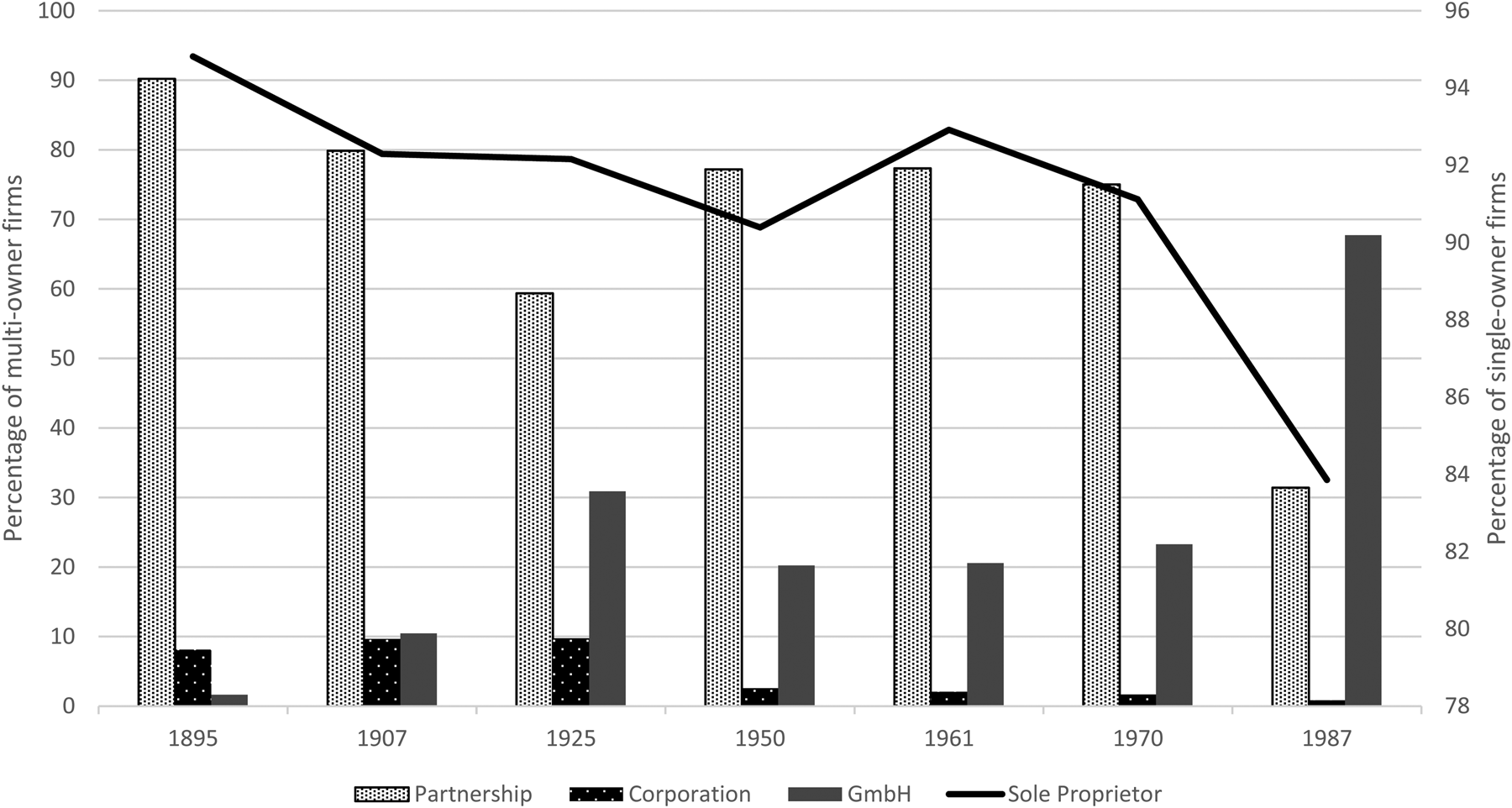
How many GmbHs existed in the first decades, and how did they compare to firms organized in other ways? Sources allow us to look at both the flows (the number of gross registrations using each legal form) and the stocks (the number of firms reported in the census). The GmbH accounted for about 10 percent of new firms in 1897, five years after its creation, and about 35 percent of new firms by 1912. The GmbH's popularity came mostly at the OHG's expense.Footnote 59 The census of establishments and industry (Betriebs-und Gewerbezählung) reports the stock of existing firms and provides a better idea of the GmbH's weight in operating firms.Footnote 60 Figure 1 includes the important reminder that the overwhelming majority of business firms have a single owner. Among multi-owner firms, GmbHs had a serious foothold before World War I but did not achieve their current role in business life until later.Footnote 61
The legal form of enterprise in Germany, 1895–1987.
Note: “Partnership” combines the ordinary and limited partnerships (OHG and KG); “corporation” includes share partnerships (KGaA). (Sources: for 1895: Statistik des Deutschen Reichs, vol. 119, 173; for 1907: Statistik des Deutschen Reichs, vols. 220–221, 218; for 1925: Statistik des Deutschens Reichs, vol. 418, 165–70; for 1950: Statisches Jahrbuch für die Bundesrepublik Deutschland [1954], 196–97, Table 5; for 1961: Statisches Jahrbuch für die Bundesrepublik Deutschland [1966], 202–3, Table 2; for 1970: Statisches Jahrbuch für die Bundesrepublik Deutschland [1974], 188–91, Table 2; for 1987: Statisches Jahrbuch für die Bundesrepublik Deutschland, Jahrgang [1990], 120–21, Table 7.3.)
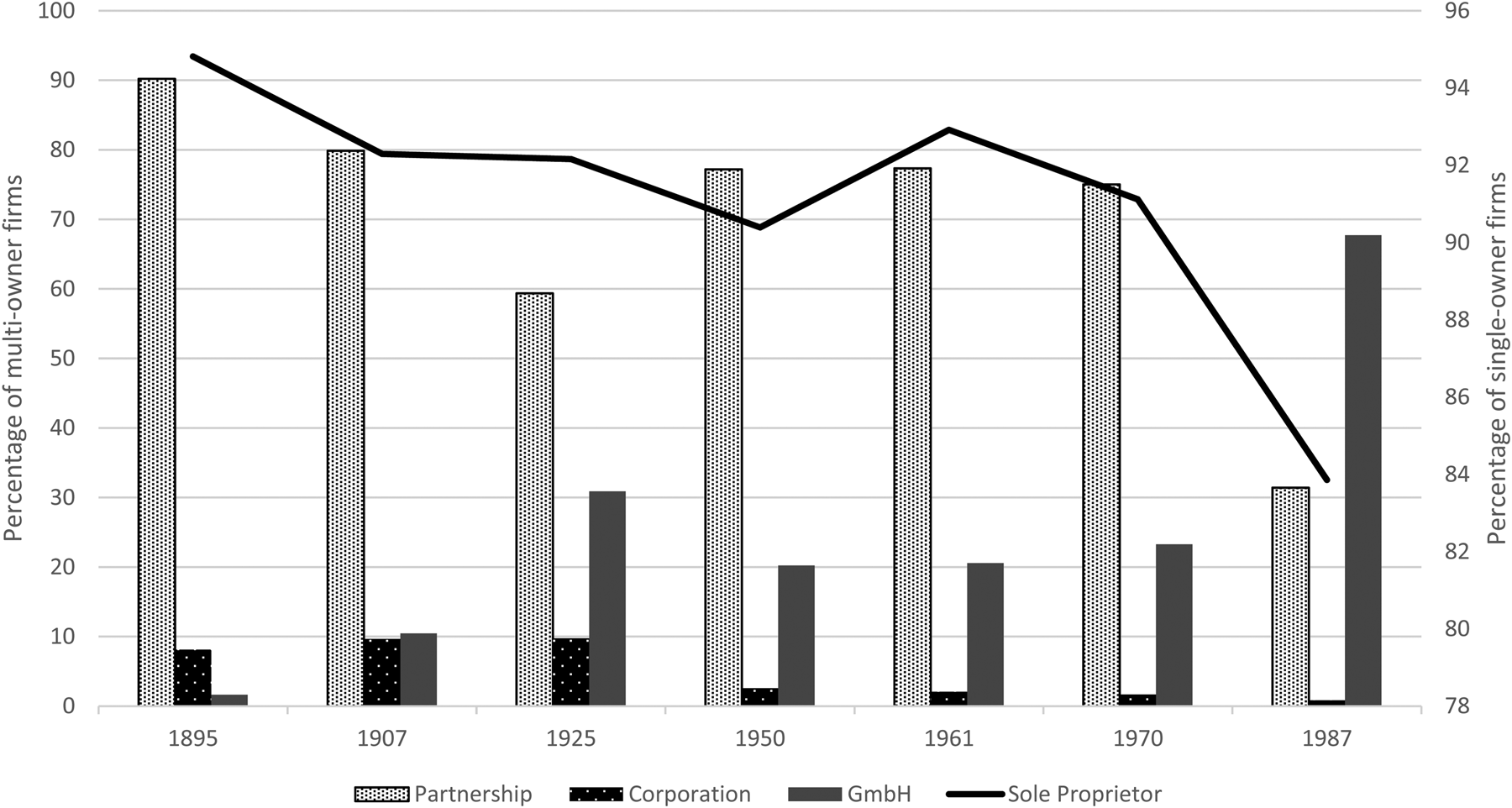
Worry that the GmbH would displace the corporation formed part of the opposition to the new form (sections 78 and 79 provide a mechanism to transform a corporation into a GmbH). Goldschmidt saw this fear as overblown; the GmbH could not compete for firms that wanted to list their shares on markets. Unfortunately, no systematic source allows us to address this question directly, but it appears that corporation-to-GmbH transformations were rare.Footnote 62 Many more GmbHs had seen some earlier incarnation as partnerships or sole proprietorships.
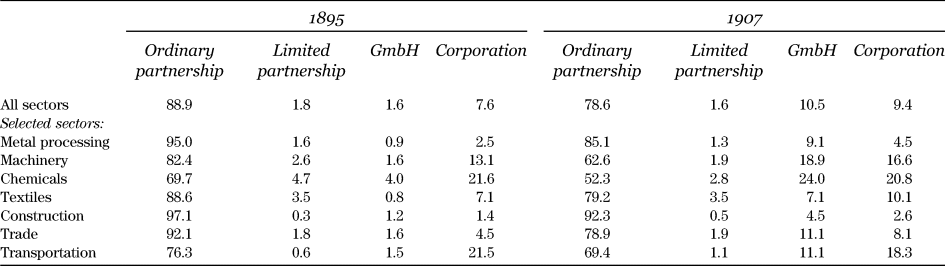
Advocates of a new enterprise form speculated on the kind of enterprises expected to organize this way. Table 1 reports the distribution of enterprise forms for all firms and for several of the establishment census's standard sector categories. The censuses of 1895 and 1907 were the only two post-GmbH enumerations of this type prior to World War I. The ordinary partnership dominated multi-owner firms overall and all of the sectors reported in the table. The GmbH's popularity in transportation and distribution would not have surprised anyone in 1892. The form's popularity in “high-tech” sectors such as machinery and chemicals might be less expected. The GmbH worked well for developing new technologies, especially patents. Founders could claim a patent's estimated value as part of the GmbH's Stammkapital. The GmbH also did not have to disclose financial results to anyone but its owners.
Percentage of Firms Organized as Partnerships, GmbHs, or Corporations, 1895 and 1907

Sources: Statistik des Deutschen Reichs, vol. 119 (1895), 173; Statistik des Deutschen Reichs, vol. 220–221 (1914), 218.
Note: The source, the Betrieb- and Gewerbezählung, covers industry (Gewerbe) alone and thus excludes firms that, for example, own real estate. The number of employees includes owner-employees where relevant. In 1895 and 1907, the category “ordinary partnership” corresponds to “mehrere Gesellschafter,” which is imprecise. The denominator is the sum of firms organized using one of these enterprise forms and thus excludes the bG, cooperatives, and share partnerships, etc. The category “corporation” is limited to Aktiengesellschaften. Categories are those of the census.
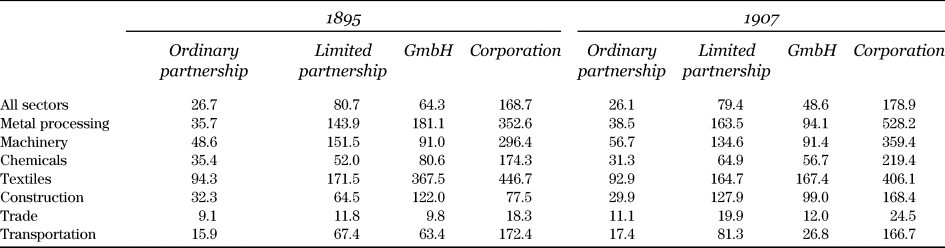
The various GmbH proposals anticipated enterprises of differing sizes. We have two measures of the sizes of GmbHs in published data, neither ideal. No aggregate source reports financial benchmarks such as capitalization for all enterprise forms. Table 2 reports a proxy, the average number of employees. In 1907, by this account, the GmbHs were on average smaller than limited partnerships and much smaller than corporations. Some sectors such as textiles had GmbH firms with more than one thousand workers. Comparing 1895 with 1907 shows that in its very first years the GmbH form attracted (among those counted here) some unusually large firms; as more firms entered, the average number of employees declined.
Average Number of Employees by Enterprise Form, 1895 and 1907

Sources: Statistik des Deutschen Reichs, vol. 119 (1895), 173; Statistik des Deutschen Reichs, vol. 220–221 (1914), 218.
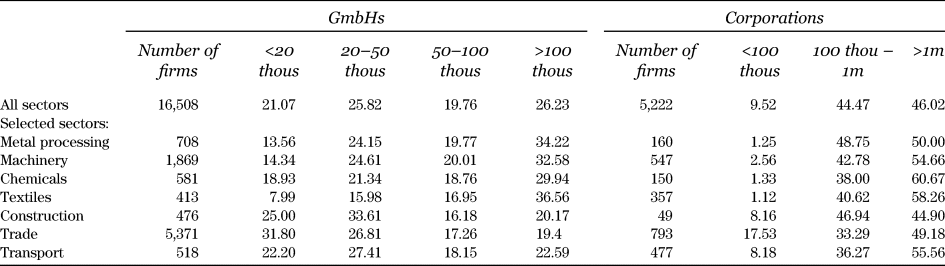
Several published sources reported financial information on the GmbH and the corporation and thus allow some comparisons of these two forms. Table 3 summarizes a particularly detailed report from 1909. By that year, operating enterprises organized as GmbHs outnumbered corporations more than three to one. The GmbHs were much smaller; 21 percent had the minimum capitalization of twenty thousand marks, compared with only a handful of corporations of that size. Only 3 percent of GmbHs had capital of a million marks or more, compared with almost half of corporations. The most important stock markets (Berlin and Frankfurt) each required a minimum capitalization of a half-million marks for local firms and one million marks for others; few GmbHs could have listed even if they had taken the corporate form.Footnote 63 The smallest GmbHs existed in every sector, and even in textiles, the sector with the most large GmbHs, the corporations’ capitalization dominated the GmbH's.
Sizes of GmbHs and Corporations Operating in 1909

Note: The table reports percentage of all firms of that legal form with capitalization (in marks) in the given range, for all firms and for selected sectors. Corporations include share partnerships (the KGaA); the source does not disaggregate the two forms. While the sector definitions here correspond to those used in the source for Tables 1 and 2, the universe of firms does not. Source is “Die Aktiengesellschaften, Gesellschaften mit beschränkter Haftung und sonstigen in deutschen Handelsregistern eingetragenen juristischen Personsen. Bestand 30. September 1909,” Vierteljahresheft zur Statistik des Deutschen Reichs Ergänzungsheft z 1910, II.
Critics anticipated the form would attract small, poorly capitalized enterprises. The official tabulations do not provide much detail beyond Tables 1, 2, and 3. As part of its discussion about adding the GmbH to the enterprises subject to an income tax, however, the Prussian Landtag assembled information on GmbHs operating in Berlin in 1906. These can hardly stand as representative of Germany as a whole, if for no other reason than the popularity of real-estate investment vehicles organized as GmbHs in the capital, but the figures are nonetheless useful. About 10 percent of the 1,125 GmbHs enumerated had a single owner; another 65 percent had two. Thirty-eight percent of firms had less than fifty thousand marks capital.Footnote 64
From 1892 to 1914
The GmbH sailed through the Reichstag with little serious opposition, but the new form did have its opponents. Legal academics thought the purpose of commercial law was to codify long-standing practice, not to invent institutions that had no historical basis. As Ernst Neukamp put it, an economic institution is the Prius and the legal institution the Posterius; the GmbH switched those roles. As the legislature's “creation” (Schöpfung), the GmbH was outside the logic of the law. Goldschmidt referred to the GmbH as “never before tried anywhere in the world.”Footnote 65 Franz Fränkel, who wrote one of the first detailed scholarly studies of the new form, called it “an ordinary partnership with limited liability, a limited partnership with no general partner, a corporation without shares, a company with one member.”Footnote 66 He did not intend this as a compliment.
Creditor protection was a major concern. Several Handelskammer had raised this concern in the 1888 consultations.Footnote 67 Bähr's attack on the GmbH reflects worries about limited liability in general but stresses that the GmbH law lacked some of the rules that protected a corporations's creditors. He spoke bluntly about the GmbH being a vehicle for “swindles.”Footnote 68 A partnership's creditors had the pledge of unlimited liability to assure repayment; the GmbH had the corporation's limited liability without the corporation's strict rules about capitalization. Bähr acknowledged that informed lenders had little to fear from the GmbH but argued that “Dummen” required protection. Carl Greulich noted somewhat later that the largest German banks had lent to GmbHs by the time he wrote, but the borrowers he listed were relatively large firms. He did not say how many of these firms had pledged additional security such as an owner's assets.Footnote 69 Critics of the GmbH pointed to the fact that firms organized this way were more likely than corporations to end up in bankruptcy, although there was considerable debate over which type's creditors fared better.Footnote 70
The GmbH generated considerable jurisprudence (Rechtsprechung) in its first years, which is probably not surprising for a new enterprise form. Some of the issues reflect the statute's application of corporate-law language to something rather different. Two issues were especially important. The GmbH's drafters thought of the manager as taking the place of a corporation's management committee (Vorstand). The analogy is imperfect; many GmbH managers were both employees and owners of significant portions of the firm's equity. Courts had to sort out these two distinct roles. The valuation of capital paid in kind was another difficult issue. In the absence of an external valuation of such contributions, there were difficult questions regarding how to treat contributions that were not worth what had been stated in the articles of association.Footnote 71
Two important changes in the early twentieth century altered the way the form was used. Income taxes had initially treated GmbHs like partnerships: the firm's owners paid tax on the income from the firm, but the firm itself paid no income tax. This favored status changed as the GmbH became more common. Prussia, for example, started taxing GmbHs as entities starting in 1906.Footnote 72 This new tax treatment led to a significant legal innovation. In the late nineteenth and early twentieth centuries, attempts were made to combine enterprise forms (Typenmischung), for example, allowing a corporation to be a partner in an OHG. The law was unclear on the matter; the ADHGB's language implied that a partner could be a legal as opposed to a natural person, but firms that attempted to set up this way found themselves rebuffed by the commercial register. The taxation of GmbHs made the question more urgent because now there were many more taxable firms. If a GmbH is the general partner (Komplementär) in a limited partnership, the firm can assign most of the profits to the limited partnership, thus reducing or eliminating the enterprise tax. The resulting “GmbH & Co KG” reduces taxes. Combining forms in this way has other uses, however. The owners of the GmbH and the partnership are not always identical. A single GmbH can serve as general partner in several GmbH & Co KGs, with different limited partners who invest in different but related projects, for example. The Bayerisches Oberstes Landesgericht (Bavarian Supreme Court) ruled this combination of forms legal in 1912. The Reichsgericht confirmed this ruling in 1922.Footnote 73
Why the GmbH?
Accounts of the GmbH's introduction typically stress one level of historical contingency: the problems created by the 1884 Corporations Act's strict capitalization, governance, and reporting rules. True as far as it goes, this explanation cannot account for the specific debates and some of the history. Parisius proposed a new legal form based on the bG before the 1884 Corporations Act, and the government claimed to be considering the idea even as it presented the 1884 legislation to the Reichstag. Two other features of the GmbH's origins warrant attention. The first thorough airing of competing proposals for a new form arose from the problems facing firms trying to operate in German colonies. The 1888 revision to the colonial law made the issue moot, but the importance of the colonial project lent discussions of new enterprise forms a legitimacy they might otherwise lack. More generally, growing commercial rivalry with England made it easy to point to the supposed unfair advantages its 1862 Companies Act offered to businesspeople. Advocates of the GmbH did not admire British company law and often explicitly denied wanting to emulate it. However, claiming that German company law shared the blame for Germany's relative economic backwardness elevated this narrow issue of commercial law to national importance.
The GmbH quickly achieved an important role in economic life and now seems central to distinctive features of German business life. Yet the GmbH as such has attracted relatively little attention outside of legal circles, especially regarding its early years, so understanding its full impact requires much more research. Its advocates predicted that the new form would appeal to family businesses, allowing them to allocate responsibility and control in each generation as they saw fit. We know little, in general, about how the form was used in its early years and are in no position to say how it appealed to family enterprises. After World War II, many family firms changed their legal form to the GmbH, but we know little about precisely why or how they used GmbH's features.Footnote 74 Advocates of the GmbH also assumed the new form would appeal to “high-tech” firms, allowing an enterprise to develop and refine ideas without worrying about dissolution (as in a partnership) or impatient equity markets (as with corporations). The late nineteenth-century periodical literature contains scattered references to the question, but the extensive modern research literature on German patenting and technological progress has not addressed the GmbH's role in enabling firms to develop new products or processes.
Full appreciation of the GmbH's role requires partial reconsideration of some old themes, as well. As Jeffrey Fear and Christopher Kobrak note, the extensive literature on the role of banks in German governance focuses for good reason on corporations; the GmbH issues no public equity and does not ordinarily have a supervisory board (Aufsichtsrat), so it lacks two of the primary channels through which banks exert control. Banks might have influenced GmbHs through credit channels, but the literature has not addressed the matter. This question becomes especially important in the decades after World War II, when public corporations became smaller relative to German GDP, reflecting, in part, the GmbH's rise.Footnote 75 Finally, the GmbH may play a still unappreciated role in other questions. For example, Fear and Kobrak note that German corporate accountancy standards lagged behind those of the United States well into the twentieth century.Footnote 76 Perhaps this reflects the importance of an enterprise form that does not need to publish its results.
The GmbH (and other forms like it in other places) is so ubiquitous in modern economic life that we might not recognize it for what it was: in the German context especially, a radical break from past thinking about business organizations. Oechelhäuser and other advocates talked about the extension, over time, in the use of limited liability. Before 1870, most German firms with limited liability were corporations. With the exception of the bG, which was limited to mining, enterprises with limited liability required state concessions because the corporate form was a privilege granted only under restricted circumstances. To obtain that privilege a company had to demonstrate that it served a wider end and required sums of capital not available in other ways. The 1870 act waved concessions, but limited liability still came bundled with detailed rules concerning the corporation's formation and operation. The 1884 Corporations Act added further requirements that made the corporation less attractive to many firms. In 1889 Germany broke with earlier practice, extending limited liability for the first time to much smaller organizations, its cooperatives. Like corporations, cooperatives are associations of capital, but this development reflected the growing sense that limited liability without strict regulation could work for organizations that had little capacity to harm the broader public.
Cooperatives could not take the place of many business organizations, however. The GmbH takes this development a step further. The Begründung stresses that the GmbH reflects a compromise between the OHG, a form with an “individual basis” (that is, an association of people), and the corporation, which has a “collective basis” (and is an association of capital). The GmbH statute adapts the basic notions of limited liability in an association of capital to make the form much more flexible than the corporation and thus suitable to a wide variety of mostly smaller enterprises. Oechelhäuser did not get the “ordinary partnership with limited liability” that he wanted. Yet he got the result he wanted, an enterprise form that offered limited liability to smaller enterprises and did not require all the formalities of the corporation.