


A. Introduction
Constitutional amendment rules keep the constitutional text safe from political volatility and the caprices of occasional majorities by demanding higher requirements than the amendment of ordinary laws. An “optimal degree of flexibility” would be in the delicate balance of having a constitution not too easy yet not impossible to amend.Footnote 1 It is important to remember that amendment rules “are both sword and shield,” as they define which constitutional subjects can and cannot be changed or require severe hurdles to do so. Footnote 2
Nevertheless, that ideal degree of flexibility varies across countries in response to many local determinants. Constitutions adjust mainly through formal amendment and informal interpretation. Footnote 3 In broad terms, constitutional rigidity means that the constitution is more difficult to amend than ordinary laws.
In this Article, we pursue an empirical exploration of procedural amendment rules—rules that regulate the process by which a constitutional amendment is passed—and substantial amendment rules—rules that limit what can be amended. Due to significant limitations concerning information about substantial amendment rules—particularly, potential implicit limits—we restrict the sample to the member states of the European Union plus some other countries in its periphery for a total of thirty-seven countries. We innovate at four levels: We expand the previous empirical discussion to explicitly account for substantial amendment rules in contrast with previous empirical approaches, which have historically focused primarily, if not solely, on procedural amendment rules; we combine factor analysis—that is, rather than subjective assessments, we let variance across jurisdictions drive the indicators—with conventional regression analysis; we explicitly compare previous indicators for “amendment difficulty” in order to assess their relative importance; we also explore possible explanatory variables within the sample of countries and find some relevant regularities across indicators.
Our findings suggest that there is no clear substitution effect between procedural and substantial amendment rules. If a procedure to amend is hard, then there is less need for substantive limits. Conversely, if a procedure to amend is easy, then there may be more substantive limitations. We cannot find empirical support to this reasoning in the context of the thirty-seven countries we include in our analysis.
Our findings must be interpreted in the context of comparative constitutional scholarship. If a decade ago, the field was starting to comprehend and measure the “actual determinants of the rate or difficulty of constitutional amendments,” Footnote 4 today, such studies are flourishing. Footnote 5 This new academic path seems quite promising. Clearly, constitutional design shapes structural choices, such as the enforcement of fundamental rights, influence on public policy, or the weight of social welfare. Footnote 6
Initially, the challenge of written constitutions is creating permanence within plural societies, permeable to dynamic idiosyncrasies and polities. Footnote 7 Without a doubt, amendment rules are quite relevant, as they minimize the risk of abusive constitutionalism and enable people to revisit their constitution. Footnote 8
Modern constitutionalism usually relies on written and, therefore, rigid constitutions positioned on the top of the normative hierarchy or at least above ordinary state law. However, there are some exceptions to this tendency—including the well-known examples of the constitutional law of the United Kingdom and Israel—which are not codified in a single, unified document labeled as “the constitution.” Footnote 9 The Constitution of Canada is also an interesting case because it is partially compiled in an uncodified document and is one of the world’s most difficult democratic constitutions to change by formal amendment, even harder than the United States Constitution. Footnote 10
Not surprisingly, measuring amendment difficulty Footnote 11 has hurdles of its own. Traditionally, the amendment rate was closely linked to the amendment procedure itself and to the several institutional factors that constrained constitutional amendments, such as high voting thresholds or intervention by numerous political actors. In this sense, stringent procedures would lower the number of constitutional amendments, and generous procedures would raise them. With this in mind, some scholars Footnote 12 prefer to measure constitutional rigidity not using amendment rule metrics but by focusing on the infrequency of amendments. Footnote 13 When amendment frequency is too high, it might suggest the likelihood of a constitutional replacement. Footnote 14 In this respect, there has been a proliferation of empirical measurements of and controversies over amendment difficulty in the last decade or so. Footnote 15
Our findings confirm that different statistical methodologies produce inconsistent classifications to a degree. Correlations across indicators are not as high as expected, suggesting that different scholars may have measured different things under the same label of amendment difficulty. It could be that ongoing debates partially reflect the use of different datasets under the same designation of amendment difficulty.
This Article is structured as follows: In Section B, we develop our approach to amendment difficulty. In Section C, we present our empirical exploration. The results are contextualized in Section D, where we review current discussions on amendment difficulty across comparative constitutional law and empirical legal studies. Final conclusions and remarks about future research are presented in Section E.
B. Defining Concepts: From Amendment Difficulty to Substance and Procedure
This section introduces the important concepts about amendment difficulty and substantial and procedural amendment limits. We also discuss why previous literature failed to focus on this important distinction.
I. Why Substantial and Procedure Amendment Rules Matter
Most constitutional democracies share the common trait of having rigidly written constitutions, comprised of a formal entrenchment under a higher-than-ordinary rule of change. Therefore, this rigidity among constitutional democracies invites an important point: Constitutional rigidity can occur a priori (formal or substantial limitations or both) or a posteriori (judicial review of constitutional amendments).
Within an a priori model, limits can be formal—procedural, temporal, and circumstantial—substantial, or both. Footnote 16 Formal limits impose several requirements to constitutional reform, such as procedural, temporal, and circumstantial rules that bind the constitutional veto players. Footnote 17
In fact, procedural limits can demand that the power to initiate a constitutional amendment belongs to a singular actor or multiple actors, single or multiple procedures for amendment, approval by multiple houses—a common trait in bicameral and presidential systems—super-majority threshold in Parliament, multiple rounds of voting, popular participation either direct (referendum) or indirect (dissolution of Parliament), and intervention or approval by other bodies such as councils, head of state, executive branch or a convening special constituent assemblies. Additionally, temporal limitations might establish a timeframe between amendments, and circumstantial limitations can impede amendments during a state of siege, a state of emergency, or a state of war amongst others.
Substantial limits relate to the constitutional core of a given society that is immune to change—these limitations are called unamendable clauses, gag rules, immutable clauses, entrenchment clauses, or eternity clauses. If some of the eternity clauses are intrinsic traits of a democratic state such as the separation of the state and the church, others reveal a specific political choice— federation or unitary state—or “re-join with the old idea of a natural law above the national and international legal positivation—human dignity and natural rights.” Footnote 18
Substantial limitations can be explicit or implicit. Explicit—or express—substantial limitations are consecrated in the constitution, such as the famous Article 79(3) of the German Basic Law, the intriguing Article 121 of the Constitution of Norway, Footnote 19 or, the longest unamendable clause in the world, Article 288 of the Portuguese Constitution. Footnote 20
In practice, many states recognize implicit unamendable clauses. Recent years have witnessed that not only states without eternity clauses such as Slovakia, Colombia, or India, but also states with eternity clauses, such as Brazil or Italy, have acknowledged some basic principles immune to constitutional change. To use John Rawls’ famous expression, the “constitutional essentials” might be the constitutional core of liberal democracies and the basic traits of a given constitution. Footnote 21
Within an a posteriori model—meaning after amending the constitution—there may be signs of rigidity if the amendment is subjected to constitutional review. For example, in Turkey and the Czech Republic, constitutional amendments were invalidated for violating explicit unamendable clauses. Footnote 22 Worth noting in the African context is the African Court on Human and People’s Rights, which has a wider material jurisdiction than other international judicial courts, such as the European Court of Human Rights, and can challenge regressive constitutional amendments. Footnote 23 However, the doctrine of unconstitutional constitutional amendment “has not yet matured into a global norm of constitutionalism.” Footnote 24
In Europe, it is important to mention the recent decision of the Constitutional Court of Slovakia, in which the Court declared the unconstitutionality of a constitutional amendment. This decision is of paramount importance, as it was the first time in Europe that a constitutional court exercised substantial judicial review of constitutional amendments grounded on implicit unamendable clauses. Footnote 25
The degree to which constitutional text is shielded from futile or impulsive changes depends on its measure of rigidity. Footnote 26 To some extent, rating constitutional amendments over a predetermined period of time Footnote 27 might be deceptive, as we would be comparing old and new constitutions. Footnote 28 The same goes for measuring constitutional change by frequency, as the amount of constitutional change can vary: There can be extensive amendments that significantly change a constitution, whereas minor amendments might be just slight cosmetic changes. Footnote 29 Thus, it is relevant not to treat all formal amendments as mere numbers irrespective of their “purpose, content, or scope.” Footnote 30
II. Previous Empirical Literature has not Explored the Distinction Between Substantial and Procedure Amendment Rules
In search of the ideal amendment rate, Donald Lutz presented some important propositions in his seminal work:
The longer a constitution is (the more words it has), the higher its amendment rate, and the shorter a constitution, the lower its amendment rate. . . . The more difficult the amendment process, the lower the amendment rate, and the easier the amendment process, the higher the amendment rate. . . . The more governmental functions dealt with in a constitution, the longer it will be and the higher its rate of amendment will be. . . . A low amendment rate, associated with a long average constitutional duration, strongly implies the use of some alternate means of revision to supplement the formal amendment process. Footnote 31
However, Rasch and Congleton argue that Lutz’s, and also Ferejohn’s, empirical relationship between stringency and amendment rates lacks consistency. Footnote 32 With this in mind, these authors state that the amendment rate is “an imperfect measure of constitutional stability” and that it “neglects other elements of change.” Additionally, amendment counts “assign equal importance” to both major and minor amendments.
Developing this idea, Tom Ginsburg and James Melton astutely outline the “amendment culture” as a far more important predictor of constitutional change than the constitutional amendment design. Footnote 33 Consequently, amendment difficulty did not relate to the traditional metrics of institutional indices or variables, but instead to extra-institutional forces such as constitutional behavior. Footnote 34 Ginsburg and Melton define “amendment culture” as “the set of shared attitudes about the desirability of amendment, independent of the substantive issue under consideration and the degree of pressure for change.” Footnote 35 In other words, stringent amendment procedures depend not only on institutional forces but also on more vague assertions, such as the “perceptions about the place of constitution in society.”
In either event, “both procedure and culture affect flexibility.” According to Contiades and Fotiadou, “the constitutional and political culture are sources of factual rigidity that blocks constitutional change even when it is procedurally available.” Footnote 36 In fact, there can be factual rigidities that block the constitutional amendment process even in the absence of explicit procedural or substantial limits. Footnote 37 Rather than respecting the constituent democratic will of the people, the apparent legislative omnipotence is restricted by other obstacles, such as judicial activism, the legal culture, or political liability.
Contrary to Ginsburg and Melton’s assertion, Tsebelis returns to Burgess’s statement that constitutional amendment rules do have a significant impact on amendment frequency, and argues that the relationship between constitutional rigidity and significant amendment frequency is “heteroskedastic.” Footnote 38 Besides this, Tsebelis introduced two innovations to the traditional approach: First, an index of constitutional rigidity on the basis of veto players, not just a subset of institutional rules; Footnote 39 second, one should consider amendment rules only in democratic states where institutional rules are expected to apply.
Additionally, instead of measuring the frequency of all constitutional amendments, Tsebelis explores their “significance” Footnote 40 and concludes that “constitutional rigidity leads to fewer significant amendments, and constitutional flexibility may or may not lead to the adoption of significant amendments.” Footnote 41
The outcomes of Tsebelis’s research proved that “constitutional rigidity affects the frequency of significant amendments in the following way: High rigidity makes amendments rare, but low rigidity simply enables amendments, which may or may not occur, depending on political, social, or economic factors. As a result, low constitutional rigidity produces a higher average rate and a higher variance of significant constitutional amendments. The higher the significance of amendments, the stronger the above relationship.” Footnote 42
In sum, there are two different schools of thought concerning the measurement of amendment rigidity, but neither has explicitly explored the distinction between substantial and procedural dimensions. The distinct role of procedural amendment rules—rules that regulate the process by which a constitutional amendment is passed—and substantial amendment rules—rules that limit what can be amended although widely recognized by the normative literature, has not been studied through the lens of empirical analysis. This Article aims to fill that gap.
C. Exploring the Data
This section explores the empirical question. We start by describing the dataset using factor analysis. This exercise allows us to suggest two distinct indicators to measure substantial and procedural amendment limits. The following step is to apply the same methodology to a different dataset on constitutional amendments. The third stage is to compare all indicators and debate possible patterns of correlation. A final robustness check is to detect and interpret possible regularities across these different indicators by means of regression analysis.
I. Dataset
The authors have collected information about substantial and procedural amendment limits or rules as they were de jure in 2018 for all member states of the European Union plus a sample of countries in the European Union’s periphery. The nine additional countries are not a random sample, but those for which information about substantial amendment rules are available; information about procedural amendment rules per country is easier to find in the conventional literature. The thirty-seven countries included in the study are shown in Table 1, with particular reference to the twenty-eight members of the European Union—as it was in 2019. For each of the thirty-seven countries, the collected information about substantial and procedural amendment rules and other available indicators is detailed in Tables 2A and 2B.Footnote 43
List of Countries

Variables Included in Procedure and Substance

Other Indicators and Variables

Procedure includes eight dummy variables concerning amendment rules satisfying the following procedural requirements: (i) explicit constitutional regulation, (ii) approval by multiple houses of parliament, (iii) approval by supermajority, (iv) approval by referendum; (v) timeframe for approval is regulated by the constitution, (vi) approval requires dissolution of parliament and new general elections, (vii) approval by additional political bodies (excluding constitutional court), and (viii) approval by the constitutional court and subject to constitutional review.
Substance also includes eight dummy variables, but in this case concerning amendment rules satisfying the following substantive requirements: (i) comply with material limits to amendments, (ii) these material limits are explicit in a codified constitution, (iii) these explicit limits concern the form of government, (iv) these explicit limits concern the form of government as well as other political issues, (v) these explicit limits concern individual rights, (vi) these material limits are also implicit, (vii) these implicit limits concern general principles of law—such as the rule of law—and (viii) these implicit limits concern general principles of law as well as other legal issues.
Based on the collected information for each of the thirty-seven jurisdictions, we used factor analysis to construct two indicators—procedure and substance. Factor analysis provides for a statistical indicator that summarizes information about a set of variables by exploring differences in variance. Footnote 44 Both procedure and substance reflect in statistical ways the variance across the underlying eight dummy variables. Footnote 45 Therefore, the reported indicators are driven by data considerations rather than subjective conjectures about each variable’s nature or additivity. For example, the weight each of the eight dummies has on a given indicator—procedure or substance—is determined by factor analysis and not some ad hoc consideration.
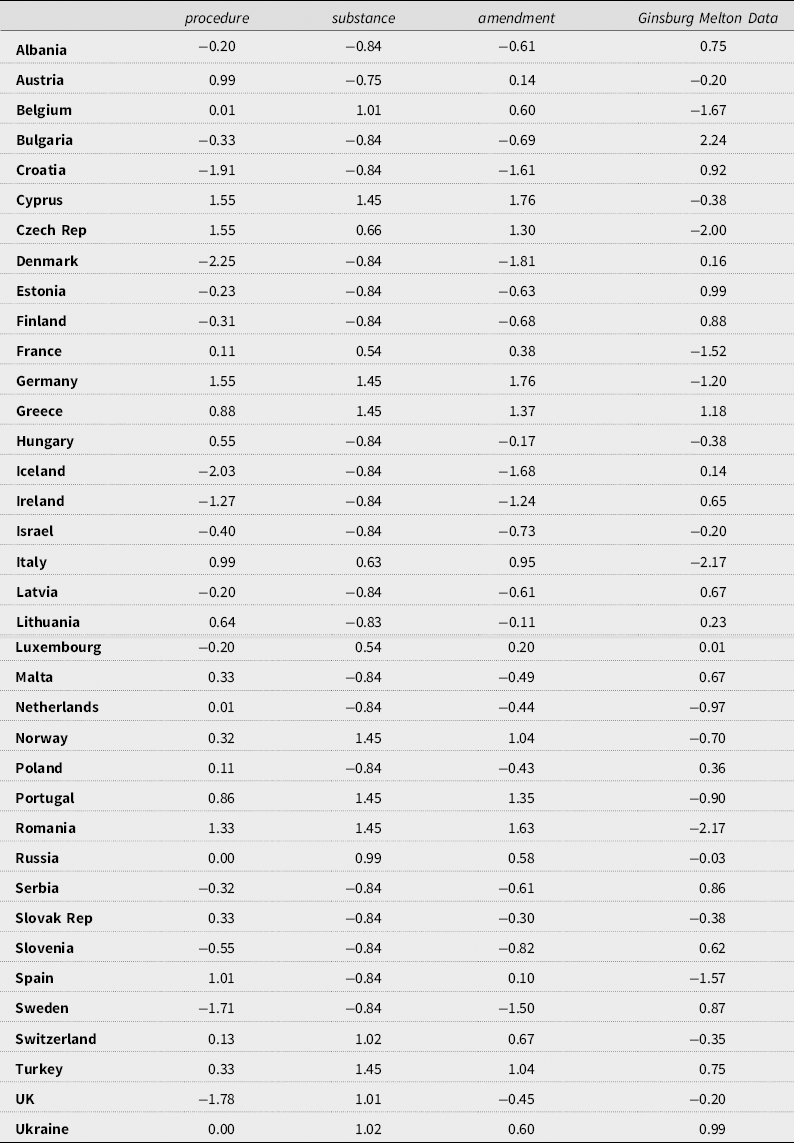
Considering procedure, we include the dummy variables from regulated to review in Table 2A. Denmark emerges with the lowest value, easy procedure for amendment, followed closely by Iceland and Croatia. Cyprus, the Czech Republic, and Germany emerge with the highest value, most complex and distinct procedure for amendment, followed closely by Romania. Statistically, this indicator reflects all included variables except dissolution, which does not seem significant for statistical purposes due to low variance because very few jurisdictions have such formal requirements.Footnote 46
The same methodology follows for substance, with the dummy variables from limits to more than general on Table 2A. A group of countries exhibits the lowest value: Albania, Bulgaria, Denmark, Finland, Hungary, Iceland, Ireland, Israel, Latvia, Malta, the Netherlands, Poland, Slovak Republic, Serbia, Slovenia, Spain, and Sweden. All of them have very few substantive restrictions according to our data collection. With the highest value, we find Cyprus, Germany, Greece, Norway, Portugal, Romania, and Turkey. Notably, this indicator is more polarized—in the sense that more countries are at each extreme—than procedure because only a subset of variables matters statistically. In fact, substance is mainly determined by the explicit rather than implicit substantive limits. Again, this is a statistical artifact derived from the low variance of implicit, general, and more than general. In our sample of countries, very few jurisdictions are coded as having implicit substantive limits.Footnote 48
So now, by using factor analysis, we have reduced sixteen variables to two statistical indicators: Procedure and substance. In this next stage, we created a third indicator, amendment, which results from the previous two. Cyprus and Germany come out as the countries with the highest value—more procedural and substantive limits when combined. The opposite position goes to Denmark.Footnote 49
Table 3A shows the distribution of countries per indicator. A few countries are considered low across both indicators: Croatia, Denmark, Iceland, Ireland, Slovenia, and Sweden. Another group is reported as high across both indicators: Cyprus, Germany, Greece, Portugal, and Romania. The other twenty-six countries have different positions in between. We can also find the UK as low procedure and high substance, mainly due to the common law principle. At the opposite end, we have Austria, Hungary, Lithuania, and Spain as high procedure and low substance.
Distribution of Countries per Procedure and Substance

Distribution of Countries per Amendment

Distribution of Countries per Amendment and Ginsburg and Melton (2015)

Table 3B shows the distribution of countries in the composite indicator amendment. Countries considered low or high across both indicators are easily assigned in this table. The more interesting countries are those in the minor diagonal of Table 3A, with one high and one low indicator. One example is the UK, low procedure, high substance, which is assigned to low amendment as expected. A different example is Spain, high procedure, low substance, which is allocated to the opposite group, high amendment, also as expected.
In terms of correlation, following table 4A, we can see that amendment is highly correlated with the partial indicators (85%). However, the partial indicators are only correlated between themselves at a lower degree (45%). By factor analysis, amendment reflects equally procedure and substance. However, procedure and substance are only mildly positively correlated.
Correlations with 37 countries

Correlations with 35 Countries (Excludes Malta and Russia)

Correlations with twenty-two countries (Excludes Albania, Croatia, Cyprus, Estonia, Iceland, Israel, Latvia, Luxembourg, Malta, Romania, Russia, Serbia, Slovak Rep, Turkey, Ukraine)

II. Ginsburg and Melton (2015) Dataset
In their seminal article, Tom Ginsburg and James Melton Footnote 50 explore a rich group of variables about constitutional amendments by making use of the Comparative Constitutions Project Footnote 51 data. These variables provide extensive information about constitutional amendments in mainly three areas—the number of proposers, the number of approvers, and the political body making the last step in the constitutional amendment process. Following the previously explained methodology, we applied factor analysis to each group of variables. Factor analysis was applied a second time to encompass the three dimensions. The resulting indicator—CRIGM—measures “amendment difficulty” according to the data used by Ginsburg and Melton.Footnote 52 It increases with both the number of approvers and final approver dimensions—an amendment is more difficult if it requires a significant number of actors. It decreases with number of proposers’ dimension—an amendment is easier if more actors can start the process. Under this new indicator, Italy and Romania come out as the least rigid while Bulgaria is the most rigid jurisdiction.
Table 4A compares CRIGM and a second indicator using Ginsburg and Melton’s data—a simple sum of all variables in their dataset SUMGM—thus each variable has the same unitary weight as our own factor analysis indicators. Remarkably, CRIGM and procedure seem orthogonal. In fact, CRIGM has a zero correlation with procedure, a negative 21% correlation with substance, and a negative 11% with amendment. Therefore, reflecting the data’s actual dimensions, we might argue that CRIGM and our indicators measure very different constitutional limitations. Furthermore, our indicators have a significant negative correlation with SUMGM.
Table 3C reports the distribution of countries per amendment and CRIGM. The orthogonality is clear. The main diagonal is where we would expect countries to be, yet only eleven countries are there, including Israel and UK. The minor diagonal should be intrinsically exceptional because these are jurisdictions for which amendment and CRIGM provide contradicting numbers. Twenty-six countries are located in the minor diagonal.
III. Correlation Across Constitutional Rigidity Indicators
We turn now to comparisons with other available indicators, namely constitutional rigidity measured by Tsebelis (CRI1 in Table 2B) Footnote 53 , Lorenz (CR2 in Table 2B) Footnote 54 and Anckar and Karvonen (CRI3 in Table 2B) Footnote 55 as documented by Lorenz. Confirming previous analyses, we find limited correlation across all these indicators.
Tables 4B and 4C show the results for thirty-five and twenty-two countries respectively. The reason for not using thirty-seven countries is that previous studies do not use the exact same sample of countries as we do. Amendment does not seem strongly correlated with any other indicator. However, CRIGM has a reasonable degree of correlation with CRI3, suggesting that both measure procedural rigidity on the same lines. In fact, CRI3 has a 45% correlation with procedure itself. CRI1 and CRI2 also come out as somehow related—about 40% correlation—while CRI2 is negatively correlated to CRIGM—about 35%.
In sum, the indicators on amendment rigidity are not entirely consistent. CRI1 and CRI2 seem familiar to each other but unrelated to procedure or substance. CRIGM seems positively related to all previous indicator, namely CRI1, CRI2 and CRI3. However, procedure and CRI3 emerge as significantly related. Finally, our own amendment seems to stand on its own—that is, with no strong correlation to any other previous indicator. Therefore, it is an empirical shortcoming that a collection of so many indicators on amendment rigidity reflects disturbing variations.
IV. Regression Analysis
In order to help or provide some guidance over which indicators of amendment rigidity seem more robust, we can investigate possible determinants. Such exercise is useful to assess the quality of the indicators by discussing how they respond to simple institutional variety. This is not empirical research about explaining amendment rigidity across countries as other authors have usefully done, but merely shedding some light on how different indicators reflect diversity over legal tradition or socioeconomic variables.
We start by studying the determinants of the partial indicators, procedure and substance. We apply a standard three-stage least squares (3SLS) method of regression due to the possibility that procedure determines substance and vice-versa, hence a simultaneous equation model. A simple least squares (OLS) method of regression would be wrong due to likely endogeneity, hence producing potentially spurious statistical results. As to amendment, combining both factors in this case, a simple OLS suffices.
The independent variables of the regression analysis are summarized in Table 2B: Year of the current constitution; the number of constitutional amendments as of 2018; GDP per capita as of 2017 (International Monetary Fund); the rule of law indicator as of 2016 (World Bank); linguistic and religious diversity; and a group of dummy variables reflecting EU membership as of 2018 such as common law, Scandinavian and former socialist legal families—as in the standard legal origins literature—no formal constitutional review, no formal codified constitution, and federal country.
The results are reported in Table 5A. Footnote 56 Due to the limited sample, all regressions exhibit a decent degree of statistical power.Footnote 57 Concerning procedure, there are four negative statistically significant coefficients: Scandinavian countries; former socialist countries; countries with uncodified constitutions—Israel and the UK, only at 10% significance; and GDP per capita—only at 5% significance. No other variable seems statistically significant.
Regression Analysis

*** significant at 1%, ** significant at 5%, *significant at 10%
Regression Analysis

*** significant at 1%, ** significant at 5%, *significant at 10%
As to substance, there are two negative statistically significant coefficients: Year of the current constitution; former socialist countries; and countries without formal constitutional review—only at 10% significance level. Everything else seems statistically insignificant.
Finally, for amendment— which combines both partial indicators by factor analysis—we find that “amendment difficulty” has two negative statistically significant coefficients: Scandinavian countries—only at 5% significance—and former socialist countries. No other variable seems statistically significant.
Therefore, the only variable that seems statistically significant across the three regressions is former socialist countries with a negative coefficient in all specifications. Also, notice that any possible concern about using amendrate on the right-hand-side of the estimated equations are reduced when we find that it has very little statistical power.Footnote 58
We also explore the determinants of two alternative indicators: CRIGM and CRI1. Concerning the indicator using Ginsburg and Melton’s data, we find that former socialist countries have a positive impact on the indicator—at 10% significance level. With CRI1, we lose two observations—Malta and Russia. The main result is that the number of constitutional amendments in the past is negatively related to rigidity in 2018, not a surprising result given the way Tsebelis has built the indicator he reports. It also shows that common law jurisdictions, at a significance level of 10%, seem to have a negative impact on the indicator, a result we would not emphasize given the lower number of common law jurisdictions in our European sample.
Overall, by comparing the three regressions stated in Table 5B, we can see that our amendment indicator seems more robust to institutional variety, while the other two indicators, CRIGM and CRI1, seem somehow more random. Additional indicators, CRI2 and CRI3, were not inspected by regression analysis due to the limited number of observations, only twenty-two.
In conclusion, our amendment indicator seems to capture institutional variety in more consistent ways within the sample of thirty-seven countries we have than the other two alternative indicators. This, by itself, does not imply in any way that our indicators are superior to the other existing indicators. In our view, it simply reflects that using factor analysis seems to be a more consistent method to absorb institutional differences in relation to procedure, substance, and amendment.
D. Limits of Comparative Constitutional Theory
This section contextualizes our findings in the previous section in a critical way. The existing contradictions across available indicators reflect variations on methodology and confusing conceptualization in relation to procedural and substantial amendment rules. It is important to explore current understandings of constitutional rigidity. At the same time, contradicting empirical evidence seems to support skepticism by the more traditional literature towards recent trends in scholarship. On the contrary, we suggest that contradicting empirical evidence requires a more nuanced view of results and legal implications.
A liberal democracy’s “minimum core,” Footnote 59 “constitutional DNA,” Footnote 60 or “the alma mater of modern constitutionalism” Footnote 61 could offer protection against populist constitutional transformations that have recently taken hold in certain modern constitutional liberal democracies. Footnote 62 Unsurprisingly, supporters of illiberal democracy argue for unlimited constitutional amendment powers, which means “an absolute primacy of politics over the rule of law.” Footnote 63 The weakness, however, concerns the inability of unamendable theories to prevent “democratic backsliding.” Footnote 64
For one thing, unamendable clauses are not a common constitutional trait. In fact, “out of the 742 constitutions that were examined, 212 constitutions (28%) include or included unamendable provisions.” Footnote 65 Substantively constraining the power of constitutional amendment is the same as prohibiting total constitutional amendments, hence tightening the range of democratic deliberation. Therefore, the constitutional amendment process will always be a partial one, as some aspects of a given constitutional identity are shielded by the constitutional text.
I. Current Arguments Against and for Measuring the Quantum of Change in Dissimilar Constitutional Experiences
When compared with the interpretation of ordinary norms, constitutional interpretation poses different challenges. Footnote 66 On the one hand, constitutional design is often abstract, flexible, and drawn with high substantial density. To maintain its democratic legitimacy, a constitution should accommodate many worldviews. Footnote 67 Thus, it is abstraction that allows the existence of several societal and political choices under the same constitutional roof. Footnote 68 On the other hand, constitutional text tends to be more laconic than ordinary laws, although one should stress that some aspirational constitutions, such as the Portuguese or the Brazilian, are quite prolix. Footnote 69
For these reasons, in democracies with written constitutions, the constitution is rigid and more difficult to amend than ordinary norms. Footnote 70 As noted above, formal constitutional amendment usually requires a stricter procedure, super-majorities or double-majorities, and involves more actors than the amendment of ordinary rules. The use of qualified majorities protects minorities as it “creates constitutional inertia.” Footnote 71 As Ginsburg and Melton point out, “entrenchment is at the heart of constitutional stability.” Footnote 72
Nevertheless, adjusting the “living constitution” within the realm of a constitutional text is difficult. What are the relevant societal, political, and cultural factors worthy of constitutional consecration and constitutional change? One can easily think of a few.
In many European states, before the failed referenda for the approval of the European Constitution, there was a need to adapt some constitution to allow the potential loss of national constitutional sovereignty. Likewise, many states had to adapt their constitutions to increasing international integration. That was the case, for example, of the International Criminal Court, which has jurisdiction over genocide, crimes against humanity, war crimes, and crimes of aggression committed by a state party national, in the territory of a state party, or in a state that has accepted the jurisdiction of the court.
Moreover, there are a host of problems that come with evolving constitutional interpretation. In states encouraging dialogic communication between constitutional or supreme courts and legislatures, formal constitutional amendments can also play a significant role in constitutionalizing some changes through judicial interpretation.Footnote 72 Epistemically, constitutional or supreme court judges and legislators are “fellow interlocutors of the requisite demands of a constitutional democracy.” Footnote 74
Constitutional interpretation is not exclusive to the judiciary; if it were, it would form a hermeneutical circle. If constitutional courts, in some states, have the final word regarding the constitutionality of legislation, the legislator is the first constitutional interpreter. Footnote 75 With this in mind, Rosalind Dixon stresses that constitutional amendment can allow legislative and popular actors to either influence or be influenced by constitutional courts’ interpretation of the constitutional design. Footnote 76
Last but not least, formal amendments might also constitutionalize previously accomplished informal constitutional changes. These are the “quasi-constitutional amendments” where constitutional actors circumvent the “onerous rules of formal amendment” and “resort instead to sub-constitutional means—for instance, legislation or political practice—whose success requires less or perhaps even no cross-party and inter-institutional coordination.” Footnote 77 Alternatively and more broadly, others refer to “controlled” or “uncontrolled silent constitutional change caused by facts that are not accompanied by a demonstrable intention or awareness of the change on the part of constitutional actors.” Footnote 78
The possibility of amending a constitutional text is of paramount importance. First, amending a constitution somehow resembles the foundational moment and allows the current generation to completely or partially untie itself from the “constitutional handcuffs” entrenched by the constitutional founders. Footnote 79 Second, amending the constitution allows the constitutional text to remain normative and adapt to evolving constitutional culture.
More importantly, the amount of constitutional rigidity is clearly a constitutional design option. Rigidity can be perceived as the guardian of constitutional stability or its enemy, as distancing the constitution from the people can provoke revolutionary attitudes. For a constitution, the norma normarum of the internal legal order, an amendment is consequently a higher challenge than ordinary norms amendments.
In fact, “if the Constitution is swept away by the unpredictability, manipulation, and the caprices of the given times, it will not be able to influence and to serve as a barometer of the legal, political, and societal tissue.” Footnote 80 Constitutional amendment rules thus appear as absorbers of external shocks that, if not neutralized, can irritate the constitutional tissue and transform constitutional stability into constitutional “amendmentitis.” Footnote 81
The power to amend a constitution lies in a “gray area” between the constituent and the constituted power. Footnote 82 When constitutional actors amend the constitution, they act through a constituted power—as the rules of the amendment process are entrenched and defined in the constitution—but there is a kind of constituent power renaissance. The constituent part of amending a constitution can be, for example, the insertion of a new right in the fundamental rights catalog or the consecration of increased constitutional justice guarantees.
The degree of constitutional entrenchment depends on the constitutional amendment’s difficulty or, to use Yaniv Roznai’s words, on the idea of a “constitutional escalator.” Footnote 83 On the one hand, demanding amendment procedures reflects a romanticized recollection of the constituent power as a complete, inclusive, and democratic process of constitutional design. Thus, the idea is to entrench the amendment formula as much as possible so that the constitutional amendment would be a renaissance of the constituent moment.
On the other hand, more relaxed amendment procedures somehow distance amendment power from the foundational constitutional moment. Footnote 84 Additionally, new constitutional rigidity trends are arising, such as detailed norms that impose strict limitations to constitutional actors—for example, courts, legislators, and the executive. Footnote 85
Some states’ constitutional design, such as Spain, adhere to a “selective rigidity,” where some constitutional provisions demand a more robust process for alteration, whereas other non-fundamental constitutional provisions can benefit from easier amendment processes. Footnote 86
II. Empirical Approach to the Study of Constitutional Amendments in the Comparative Constitutional Literature: Villain or Ally?
As we have previously addressed, though constitutional amendment was not initially a favorite subject of legal scholarship, by now, comparative law amendment is a solid and distinct field of study in public law. Footnote 87 Similarly, empirical constitutionalism, which developed in the 1970s, is increasingly focused on constitutional amendment rates and their interpretation. Footnote 88 Yet empirical legal studies are often perceived as less intellectually sophisticated, with the criticism that the scholarship merely addresses quantitative approaches. These preconceived notions tend to obscure rather than illuminate the debate on comparative constitutional law.
The supposed inferiority of empirical legal studies is more evident in civil-law countries with highly dogmatic legal traditions. Footnote 89 Specifically, empirical causal inferences can distress traditional normative mindsets. However, the relevant question remains: Is the empirical approach enriching to constitutional scholarship or, on the contrary, is it a “distinct way of understanding constitutional law[?]” Footnote 90
There might be a powerful response to that question. We have reason to believe that in medio stat virtus, or, in other words, the right answer lies in between. The normative and empirical perspectives have different methodological and epistemological approaches. Footnote 91 To a larger extent, the normative legal approach focuses on the perfection of a legal system through the theoretical discussion about what the law—or, in this case, the amendment rules—“ought” to be. In contrast, the empirical legal approach explores what amendment rules “are” in a given polity, their concrete manifestations, and quantitative relevant data.
This distinction resembles the Kantian dualism amid “is” and “ought” and flanked by “constitutional text and constitutional reality” (die Unterscheidung von sein und sollen, (Verfassungs-)Recht und (Verfassungs)Wirklichkeit). Footnote 92 One can wonder if either the “is” and “ought,” or the “text” and “reality” are truly separate or if they connect on some level.
An interesting way to unveil this theoretical oxymoron is by recalling Karl Löwenstein’s famous dilemma. Löwenstein was a German philosopher exiled in the United States during World War II. Having experienced the fragility of human rights protection and how constitutions lacked the strength to block fundamental rights’ violations, he longed to discover the magic formula for a lasting constitution. Footnote 93 In his search for how to balance old constitutional texts with new societal and political scenarios, he designed the “theory of the normative force of the constitution,” still very popular in European academia. Footnote 94 According to his theory, to prevent being merely semantic or nominal, the constitutional text should not be detached from political and sociological realities—the living constitution or the law in action. In this sense, both constitutional text and constitutional reality, in other words the living constitution, are of paramount importance and influence one another. What a constitution “is” and what it “ought” to be are not worlds apart. Likewise, joint normative and empirical studies on constitutional amendments are bound to be a combined line of inquiry.
Notwithstanding the current official rhetoric, bridging normative and empirical approaches—the former more focused on the theoretical and qualitative questions and the latter more concerned with the interpretation of quantitative data—will certainly contribute to the development of legal scholarship and guide pertinent legal reforms.
Constitutional design, either through a constitutional foundation or constitutional change, is one of the most intriguing and fascinating subjects of constitutional theory. Constitutional theory scholars discuss the deepest theoretical constitutional dilemmas: What is a constitution? Why the need for a constitution? Is there an ideal constitution? Can there be constitutionalism without a written constitution? What is the material constitution? Which cultural, societal, and historical factors determine constitutional design? Is it better to have a prolix or a laconic constitutional text? Do social, economic, and cultural rights belong in the constitution? Should constitutions be entrenched? Can entrenchment reveal a given constitutional identity? Are substantial limitations to the amendment power consistent with deliberative democracy? How can constitutionalism survive its intrinsic democratic paradox? Can constitutional or supreme courts declare the unconstitutionality of constitutional amendments? How can a constitutional text survive inconsistency over time? What is the normative force of a constitution? How can a constitutional text truly reflect and influence the living constitution? Footnote 95
If amendment rules are “the gatekeepers” Footnote 96 of the constitutional text, how should scholarship approach such a delicate constitutional law subject? Should it only be through doctrinal studies? Or is there room for empirical analysis?
As Lutz emphasized, “little has been written about the empirical patterns that result from constitutional choice.” Footnote 97 It seems that a good constitutional design will have a constitutional text that is neither too easy nor too difficult to amend, therefore balancing the democratic volatility with constitutional endurance.
Measuring constitutional design will always be a challenge to empirical studies. Constitution-making and amending are not entirely predictable, as neither are precise exercises of constitutional design. Footnote 98 In fact, many factors contribute to this volatility, such as political bargaining, popular participation, and historical and sociological predispositions. The “overwhelming variety of national constitutional amendment procedures” results in complex methodological challenges. Footnote 99 Even when a constitutional text consecrates highly-rigid procedures or entrenches several subjects from ever being amended through eternity clauses, empirical evidence shows us that: (i) informal constitutional change works around these limitations through judicial review or the approval of new legislation, Footnote 100 or (ii) in extreme circumstances, obsolete eternity clauses are indeed abolished through constitutional amendment. Footnote 101
E. Conclusions
Our Article pursues an empirical exploration of the institutional process for constitutional amendments, or amendment difficulty, by looking at procedural and substantive limits. We make use of a unique dataset collected by the authors, the dataset explored by Tom Ginsburg and James Melton Footnote 102 and three past indicators, namely George Tsebelis, Footnote 103 Astrid Lorenz, Footnote 104 and Dag Anckar and Lauri Karvonen Footnote 105 as reported by Lorenz.
Our indicators result from factor analysis. They reflect procedure—a standard dimension already echoed by previous authors—and substance—an additional dimension usually neglected. The inclusion of explicit and implicit substantive limits constrains the sample of countries to the European Union and other jurisdictions in its periphery.
Previous literature has underlined the lack of consistency across indicators of constitutional rigidity. Although we find some similar patterns of results, we identify a few important features. Some indicators are related to a certain degree and measure to procedural limitations. However, no indicator seems to capture the mix of procedure and substance in the way we suggest in this Article.
Extending the present methodology to a larger group of countries would be an important test on the consistency across indicators and the relationship between procedure and substance when determining the amendment indicator. However, gathering information about explicit and implicit substantive limits might pose a challenge to empirical research.
The visible differences in the way certain countries are characterized in each indicator—for example, Bulgaria or the Czech Republic—suggest that the process of aggregating constitutional mechanisms and instruments is inevitably controversial and subject to varying empirical assessments. Rather than taking this as a shortcoming, we should view it as an exploring exercise that helps scholars identify regularities that require further research and more detailed country analysis.
Most empirical studies presuppose that codified rules matter, meaning that they actually succeed in constraining or shaping constitutional amendment. This is not always the case, even with democratic constitutions. Inevitably, expanding the traditional empirical analysis of procedural rules to account for substantive amendment rules is not enough. A further step in the research agenda should be to include uncodified rules that are respected. As Richard Albert points out, “rankings of amendment difficulty are doomed to failure unless they become much more sophisticated in what they set out to measure and why.” Footnote 106
The motivation behind constitutional amendment rules is not always crystal-clear. In fact, that is why Xenophon Contiades and Alkemene Fotiadou interestingly wrote that constitutional change “is an enigmatic process.” Footnote 107 In this sense, amendment rates may not truly capture the essence of a given constitution. The visible constitution can certainly be measured and rated in comparison with other constitutional texts. However, the invisible constitution, which lies beneath constitutional reality and constitutional culture, is difficult to manifest in pure statistical numbers. Footnote 108
At the same time, in the vein of Tom Ginsburg and James Melton, Footnote 109 the contradictions observed in the literature on indicators might simply reinforce the view that amendment rules, both procedural and substantive, are much less important than a certain political tradition or amendment culture.
Appendix
Procedure, Substance, and Amendment Indicators


 Open access

