


The policy implementation guidance for the development of services for people with personality disorder, published by the National Institute for Mental Health in England (2003), comments on the prerequisites for the ‘worker in personality disorder’. This is not just any member of the caring professions, but rather someone with more than ‘generic competencies’, who shows ‘personal resilience and particular personal qualities that allow them to maintain good boundaries, survive hostility and manage conflict’. Such workers need to be effective multidisciplinary team players, with the ‘ability to withstand the particular emotional impact that working with personality disordered patients can have on relationships within a team and service’ (National Institute for Mental Health in England, 2003: 44).
The guidance notes the importance of continuing professional development, and suggests training that is ‘team-focused, supported by the organisation, appropriately targeted and context specific’. While applauding these aims, we feel it has underplayed the need for understanding and communication between teams and different agencies - the capacity of people with personality disorder to ‘suck in’ the services of many professionals in a reactive and unproductive way being well known (Reference Perry, Lavari and HokePerry et al, 1987; Reference Menzies, Dolan and NortonMenzies et al, 1993).
Origins and aims
In developing a training course, we started from the premise that theoretical training alone is of little use in this field, and that the course would need to incorporate an experiential component. This premise was based on four factors, the first of which was our own view of the attributes needed by those working with people with personality disorders. A wish to know about personality disorder is not enough; indeed, knowing - or purporting to know - may be a problem in itself. This is not only because of the limited state of knowledge about personality disorder, but also because study cannot prepare one for the biggest problem in clinical practice, which is how to ‘ be’ with patients; how to manage one’s own anxieties, and how to help patients safely to be in contact with their anxieties. Trainees need to be curious about their interactions with others - in the workplace with both patients and staff - and willing to reflect on their own internal processes and what they bring to the exchange. Above all, trainees may need to become comfortable with the anxiety of not knowing, and able to tolerate this, often over long periods.
The second factor was our experience of the limitations of conventional medical and nursing training, and the revelations afforded in psychotherapeutic institute training (where attention to one’s own personal development is regarded as essential); the third was our good experiences of supporting front-line mental health professionals, including nurses and junior doctors, through supervision, teaching and ‘borderline workshops’. These had provided reflective space arranged around discussion of case material and journal articles. In contrast, we encountered severe difficulties conducting staff groups on the acute wards where, in spite of the desperation of staff to provide a therapeutic milleu, significant resistance to thinking about the anxieties, frustrations and inconsistencies in the management of personality disorder was evident. We felt that ‘ seeding’ of the wards and agencies with a few professionals who had completed a specific training in personality disorder (even if brief) might be more effective.
The fourth factor was our belief in parallel processes between groups. These, although often a source of disturbance, have considerable therapeutic potential if recognised. This suggested the need for a setting in which we would be able to operate freely and feel contained, in order to enhance the communication and learning of trainees and model a way of working that, by extension, would lead to greater containment for clients. What is containing for clients may also be containing for staff; hence, applying parallel processes to Bateman & Tyrer’s (Reference Bateman and Tyrer2002) ‘Guiding Principles of Effective Therapy for Personality Disorder’, we suggest that training should be well structured; devote effort to achieving adherence; have a clear focus; and be theoretically coherent to both trainer (therapist) and worker (patient).
They note that good treatment should be ‘relatively long term’. In this regard, we believe that training, like therapy, should create manageable frustration and anxiety, and last long enough to foster feelings of belonging and loss, and to allow expression and exploration of these mixed feelings. In place of developing a strong ‘treatment alliance’ between therapist and patient, we envisage a strong ‘work group alliance’ between trainers and trainees, and their call for therapy to be well integrated with other services available to the patient brings in the parallel need for multi-agency membership of the training process.
Based on the above, we defined the following aims:
-
• to deliver an adaptive training sensitive to the needs of trainees with different professional backgrounds, experience and formal knowledge, anticipating the training agenda recommended by the National Institute for Mental Health in England (2003);
-
• to promote a developing theoretical base, self-reflection, curiosity about interactions with clients and other professionals, and communication, as vital factors in the understanding, management and treatment of personality disorder;
-
• to foster new professional relationships and better understanding between professionals and users, and between agencies.
Structure, content and evaluation
The problem was how to provide a flexible structure in which objective training needs could be met, while allowing the necessary exploration of, and sensitivity to, the subjectivity of course members, their patients and colleagues. The natural solution for us was the use of psychoanalytic and group analytic understanding within a group analytic structure, allowing us first to engage in and orient course members before a more gradual development of understanding within a clear theoretical and experiential frame. We hoped that an adequate technical language would be acquired and used, not in a mechanical way, but instead anchored by the coming together of thought and feeling - the training equivalent of what, in the therapeutic context, Robert Hobson called a ‘feeling language’ (Reference HobsonHobson, 1985).
We decided that the course should consist of 15 weekly 3 hour sessions, offered out of hours to mental health professionals and workers in primary care, social services, the police, the probation service, and housing and voluntary agencies; it should be run twice a year. The course requirements were:
-
• an interest in the subject;
-
• contact with the client group in the workplace;
-
• willingness to explore feelings towards, and relationships with, other professionals and the client group;
-
• willingness to read and present journal articles, and participate fully in group activities;
-
• an undertaking to attend at least 12 out of 15 sessions (necessary for continuity).
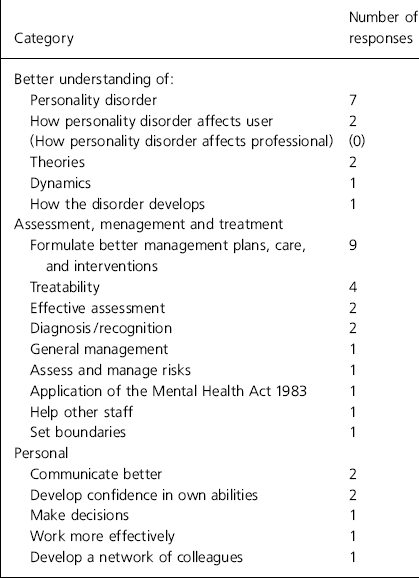
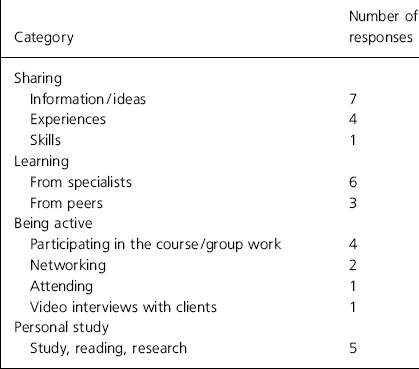
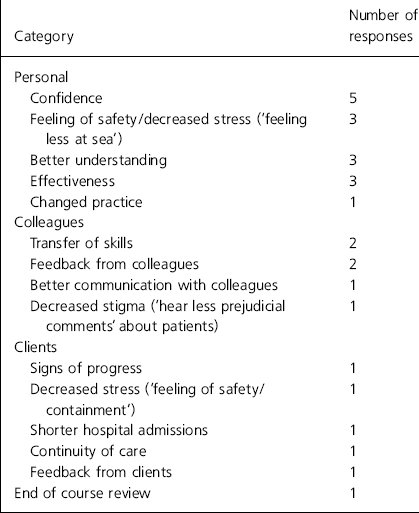
Previous formal knowledge was not expected. Interviews were conducted in groups at which candidates presented previously completed individual ‘ learning contracts’, the questions for which are shown in the main headings for Tables 1, 2, 3. The learning contracts were to be revisited and reviewed at the final session of the course.
Learning objectives: ‘What would you like to achieve by the end of the course?’
| Category | Number of responses |
|---|---|
| Better understanding of: | |
| Personality disorder | 7 |
| How personality disorder affects user | 2 |
| (How personality disorder affects professional) | (0) |
| Theories | 2 |
| Dynamics | 1 |
| How the disorder develops | 1 |
| Assessment, menagement and treatment | |
| Formulate better management plans, care, and interventions | 9 |
| Treatability | 4 |
| Effective assessment | 2 |
| Diagnosis/recognition | 2 |
| General management | 1 |
| Assess and manage risks | 1 |
| Application of the Mental Health Act 1983 | 1 |
| Help other staff | 1 |
| Set boundaries | 1 |
| Personal | |
| Communicate better | 2 |
| Develop confidence in own abilities | 2 |
| Make decisions | 1 |
| Work more effectively | 1 |
| Develop a network of colleagues | 1 |
Means: ‘How do you feel these objectives could be met?’
| Category | Number of responses |
|---|---|
| Sharing | |
| Information/ideas | 7 |
| Experiences | 4 |
| Skills | 1 |
| Learning | |
| From specialists | 6 |
| From peers | 3 |
| Being active | |
| Participating in the course/group work | 4 |
| Networking | 2 |
| Attending | 1 |
| Video interviews with clients | 1 |
| Personal study | |
| Study, reading, research | 5 |
Results:‘How will you know that these objectives have been achieved?’
| Category | Number of responses |
|---|---|
| Personal | |
| Confidence | 5 |
| Feeling of safety/decreased stress (‘feeling less at sea’) | 3 |
| Better understanding | 3 |
| Effectiveness | 3 |
| Changed practice | 1 |
| Colleagues | |
| Transfer of skills | 2 |
| Feedback from colleagues | 2 |
| Better communication with colleagues | 1 |
| Decreased stigma (‘hear less prejudicial comments’ about patients) | 1 |
| Clients | |
| Signs of progress | 1 |
| Decreased stress (‘feeling of safety/containment’) | 1 |
| Shorter hospital admissions | 1 |
| Continuity of care | 1 |
| Feedback from clients | 1 |
| End of course review | 1 |
The first hour and a half of each session was an interactive seminar arranged around reading material presented briefly by a course member; the remaining time was used to associate to the material. Alternatively, the seminar might be a talk by an invited speaker, team or user organisation, or a video presentation. The second half of each session consisted of two small analytic groups conducted by each of the course convenors, who maintained boundaries, as far as possible, around a focus on the work situation.
True to psychoanalytic principles, considerable effort was devoted to both the beginning and the end of the course. The first seminar, ‘ beginnings’ - intended to provoke thought about the dynamics and feelings involved in new relationships - consisted of a guided, small-group exercise to construct a vignette of a client with a personality disorder. The purpose was both to establish what the group already knew, and to develop confidence in their own good sense and in working together. Vignette construction also provided our second method of evaluation when repeated at the final session.
Subsequent seminars presented first an overview of the field, followed by an introduction to psychoanalytic thinking and major theories of personality from Freud, Klein, Winnicott, Kohut and Kernberg; attachment theory; defence mechanisms (in particular primitive defences based on splitting); assessment; boundaries and communication; understanding and managing self-harm; risk assessment; problems in organisations; groups and therapeutic communities; and other treatment methods. In one seminar, Dr Rex Haigh and ex-users of Winterbourne Therapeutic Community created a temporary therapeutic community; in another, users from Borderline UK gave a presentation on a subject, and in a format, of their choice. Finally, we devoted a seminar to ‘ endings’, to complete evaluation of the course and process feelings about leaving.
Following the final session, members completed a questionnaire consisting of seven positive statements about the course rated on Likert scales (1, strongly disagree; 5, strongly agree), with space to qualify their answers.
Results
Members
Thirteen applications were received, all meeting the course criteria, from four ward-based registered mental nurses, one community psychiatric nurse, one accident and emergency liaison registered mental nurse, one consultant adult psychiatrist, two clinical psychologists, two approved social workers, one mental health charity worker and one housing worker. No application was received either from the police or the probation services; however, subsequent courses have included probation and police officers.
Learning contracts
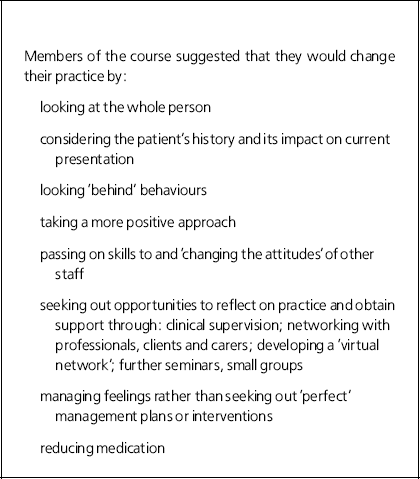
Tables 1, 2, 3 gather together learning contract responses at intake under three headings: learning objectives, means and results. The categories were suggested by the material but are to some extent arbitrary and overlapping. To our reading they revealed a largely practical orientation - a need to know what to do and how to resolve professional dilemmas, with little curiosity about the experiences of patients. This was tempered by a wish to communicate with and learn from other professionals. Managing stress was rarely referred to directly but could be inferred. The convenors’ aims were less finite - containing anxiety, communicating distress, and staying with a problem rather than necessarily taking action. Verbal reports from the whole group at the final seminar indicated less interest in these often concrete objectives, showing instead an appreciation of a greater capacity to reflect on their experiences and share these with others. User presentations were highlighted as important to these changes, having forced a consideration of clients’ subjectivity and challenged expert roles. There was an acceptance that learning is ongoing and that necessarily the course was incomplete. Members suggested a number of ways in which they hoped to change practice (Box 1).
Intentions to change practice
| Members of the course suggested that they would change their practice by: |
| looking at the whole person |
| considering the patient's history and its impact on current presentation |
| looking ‘behind’ behaviours |
| taking a more positive approach |
| passing on skills to and ‘changing the attitudes’ of other staff |
| seeking out opportunities to reflect on practice and obtain support through: clinical supervision; networking with professionals, clients and carers; developing a ‘virtual network’; further seminars, small groups |
| managing feelings rather than seeking out ‘ perfect’ management plans or interventions |
| reducing medication |
Vignettes
The first seminar vignettes revealed a sophisticated knowledge of phenomenology and of the impact of clients with personality disorder on the wards and other agencies. Clients were known, in the main, through their behaviour, with less sense of their distress and motivations. Significantly, all three vignettes described people with borderline personality disorder. Other traits were mentioned (particularly antisocial, paranoid, narcissistic and dependent), but were not the groups’ main concerns. The vignettes were based on clients who caused the greatest problems: those with severe disorders. This is consistent with the contention that as severity of personality disorder increases, multiple diagnoses may be made, but borderline personality disorder predominates as the most frequent diagnosis (Reference Dolan, Warren and NortonDolan et al, 1997).
At the final session the vignette exercise was repeated in the same groups, with a supplementary question: ‘Having carried out this exercise again, in what ways do you feel you have approached this differently, if any?’ The convenors’ observations and the groups’ responses to the supplementary question tallied well: the groups completed the task more quickly; were more positive, thoughtful and open, and less guilty and frightened; they also personalised their accounts, giving their clients names and complex histories with a developmental perspective. They acknowledged a range of feelings in themselves and in clients, and greater tolerance of these. Perhaps above all, they were more comfortable with the feeling of ‘ not knowing’. One member, echoing Winnicott, said that they felt ‘ good enough’. This was taken up and agreed by others.
Overall, members expressed much greater confidence in their ability to work with people with personality disorders.
Small analytic groups
The two small groups moved from a position in which they could not explore intense feelings about patients and the work situation or obvious differences (including rivalries) between members, to a position of open and honest discourse. Both were remarkably consistent in their main preoccupations, typically following up the theme of the previous seminar before shifting to the concerns of the current session. Anxiety was located outside the group, and attacks on the convenors for their failure to take up the roles of expert leaders were projected on to managers, senior medical staff, other teams or agencies, and topically the protagonists in the Iraq war. In this phase the groups can be thought of as functioning in dependence mode and in the paranoid/schizoid position.
Group members moved on to explore their mixed countertransference feelings towards clients, colleagues and each other, and were able to think about guilt and reparative wishes as important motivators for their work with clients. Comments such as ‘staff really need looking after’ and ‘if the staff are contained’ the clients will benefit spontaneously emerged. The groups showed facility with a number of concepts, including parallel processes, mirroring and primitive defence mechanisms as applied to case material and the small group process itself. In the final weeks of the groups, feelings of loss emerged and a wish to maintain working relationships after the course was expressed. In this phase, the groups could be thought of as facing depressive anxieties and operating in work group mode.
The boundaries of the groups, that is, to facilitate working relationships and not offer therapy, were surprisingly easily managed.
Questionnaires
High satisfaction was recorded (response rate 11 out of 13 members), with average Likert scale ratings of 4.1 to seven positive statements about the course and changes in their responses to clients. The lowest average score was 3.6, assessing the statement ‘the small groups were helpful and met my expectations’.
Discussion
Limitations of this largely subjective account include the absence of a control group; failure to distinguish between professional groupings in reporting results; and the use of satisfaction ratings, reported changes in attitude and intentions to change practice, rather than any prospective measures of benefit to professionals and clients. However, the multi-agency, experiential and group-based format appears to have been successful as a way of engaging course members, helping them to learn about personality disorder while developing their abilities to process and share their emotional responses to clients and each other, and has increased their confidence to work with clients with personality disorder, pass on their skills and continue to network. Differences in training and levels of experience appeared not to hamper the ability of individual course members to respond to challenging prereading (2 weeks in advance of seminars) and use it as a source of understanding and to develop a common feeling language. Above all, we hope that those who attended the course remain aware of the vital importance of staff attending to their own needs, in order to allow them to look after the needs of others.
We believe that a setting in which we could operate comfortably was essential to facilitate learning and contain anxieties raised by the course. Consequently, the course would be easily transferable to settings where psychoanalytic understanding and experience in group work are available. We are aware that such resources are not evenly distributed, and that other theoretical models may be valid. For these reasons we would recommend a thoroughgoing appraisal both of the skills available and the enthusiasm of staff to act as group facilitators for a course before deciding on a particular format.
This September, the course will be running for the fourth time. It has developed a wider multi-agency membership with the inclusion of participants from police, probation and education services. It continues to be rated highly. Future developments will include ‘refresher’ study days, open to all previous members with an emphasis on learning, reflective practice and extension of professional networks. Group feedback analysis will form part of each study day to determine the impact of the course over time. The psychotherapy service is now one of the new Department of Health pilot sites for personality disorder.
Acknowledgements
We would like to thank Dr Martyn Dyer-Smith, University of Northumbria, who helped us to think of methods of evaluation that could easily be integrated into the course format. Thanks are also due to Dr Peter Whewell, Dr Rex Haigh and users from Winterbourne Therapeutic Community, and to Dale Ashman and members of Borderline UK, who all presented on the course.


 Open access


eLetters
No eLetters have been published for this article.