




Descending into the storm
In this paper, we invoke the figure of the storm as a motif for thinking-with and co-creating-with the precariousness of relationships within our worlds today. A storm conjures up a variety of images, ranging from frenzied, electrifying forces that destroy everything in their path to foreboding, ominous pressures that build before striking with little warning. Storms swell oceans, pollute skies, churn up soils, test the strength of tall trees and overflow rivers. Storms determine the food we eat, the songs we sing, the rituals we perform, the materials we use to build our homes. We sense storms with/in our bodies as they enter our lungs, seep into our skins, unsettle our emotions, shake our spirits. Storms remind us of our intrinsic animal connections to place, our genealogies and identities, the traumas we have experienced and the hopes for our futures. We suggest that storms do not arrive and then depart, but that they are always present, always in-relation, always ready to irrupt, rage, quell, withdraw. Storms are our pastpresentfutures. Storms remind us that we are all part of a breathing planet in constant flux; a planet that continuously reshapes its processes and systems, inextricably linking us to multiple, more-than-human worlds as we undergo simultaneous transformations. We, humans, are always in-relations-with storms, always in the messy middle, always mutually co-becoming. We are all the storms.
We—Charlotte and Hannah—situate this paper with/in a relational paradigm to explore how “we are part of the world in its differential becoming” (Barad, Reference Barad2007, p. 185). We write as animal-human-educator-researchers in-relations-with a myriad of literal and metaphoric storms that are created by climate changing worlds. Drawing on our experiences as educational researchers in alternative spaces, we build on the genre of Climate Fiction (Cli Fi), a term first proposed in 2008 by author and climate activist Dan Bloom (as cited in Wright, Reference Wright, Baumbach and Neumann2019, p. 99), and the emerging field of Posthuman Cli-Fi, to produce more-than-human writings. Posthumanist approaches to Cli-Fi engage with “rethinking basic concepts of subjectivity, agency, personhood, materiality, and embodiment” and “question the assumptions of human mastery and exceptionality that led to anthropogenic climate change (via a history of capitalist and colonial exploitation of the nonhuman world)” (Caracciolo et al., Reference Caracciolo, Ferebee, Toivonen, Ulstein and Lambert2022, pp. 8–9). Intrigued by the potential of Posthumanist-Cli-Fi, we experimented with speculative, attentive writing practices to explore their potential to respond to the disruptive and galvanising storms that we are constantly becoming-with (Haraway, Reference Haraway2016). By thinking-feeling-doing (Hankin & Hogarth, Reference Hankin and Hogarth2025) playful, immanent, experimental approaches to creative and scientific writing, we attempt to write with more-than-humans in our research. We assert that writing-with, thinking-with, becoming-with Posthumanist-Cli-Fi illuminates the “radical aliveness” (Barad, Reference Barad2007) of our uncertain worlds. This does not limit “our” human experiences but demands a response-ability (Haraway, Reference Haraway2016) to the more-than-human storms we are all enmeshed with/in.
Zzzzt-zzzt-zzzt
(Mangrove Cicadas, Bali, 2025)
Why are we writing this paper?
Uneven experiences of climate change drive this paper. Vulnerable communities who have historically contributed the least to current climate change are disproportionately affected (IPCC, 2023; see https://www.carbonmap.org/). Climate change is not created nor experienced equally across humans (Barratt Hacking et al., Reference Barratt Hacking, Bastos and Hogarth2024) and this is most evident in the ways that extreme climate events have devastated communities and also reported through mainstream media (e.g. the typhoon in Philippines, 2021; flooding in Pakistan, 2022, and Libya, 2023; Cyclone Freddy in Southeast Africa, 2023; heatwave in India, 2023; and East African Drought 2020–present). Of course, Global Minorities have not been excluded from extreme weather disasters: The Australian Bushfires, “Black Summer,” 2019–2020; North American Winter Storm, 2021; Italian floods, 2023, Hurricane Ian, Helene and Milton in the United States, 2022; 2024, and most recently, the Californian wildfires, 2025. However, with better resources, Global Minority nations are better equipped to save, rescue and respond to the devastation created by these unpredictable and extreme weather events and, therefore, not suffer as severely.
The disparity amongst humans in terms of vulnerability and suffering in climate changing worlds exists with animals and plants. Over the past 50 years (1970–2020), the average size of monitored wildlife populations has shrunk by 73% (WWF, 2022, 2024) due to destruction of habitats, overexploitation, pollution and climate change. These statistics and harms are not prevalent in considerations for living in increasingly climate changing worlds, despite recognising that “biodiversity sustains human life and underpins our societies” (WWF, 2024, p. 7). The ongoing impact of “treating other species in ways that would be wrong to treat our own would be “speciesism” (Jickling et al., Reference Jickling, Lotz-Sisitka, Olvitt, O’Donoghue, Schudel, McGarry and Niblett2021, p. 79), and such ongoing neglectful attention can also be considered a form of “collective suicide” (Guterres, Reference Guterres2022). The ways that we (some more than others) respond to climate change can, therefore, be considered unfair and unjust in several ways. After all, “our planet is talking to us and telling us something,” but for many, it appears that there is no listening (Guterres, Reference Guterres2021).
We pause here to discuss the terms used throughout this paper: “multispecies” (drawing on Haraway, Reference Haraway2008, to refer to animals, plants, fungi, bacteria and so on), “animal” (referring to all animals including humans, a useful term when differentiating within multispecies) and “more-than-human” (drawing on Abram, Reference Abram1996, to refer to species, geologies, water, vegetation, materials) all work in different ways. They have contentious histories, some deriving from different genealogies, others are conceptualised more recently. But we use them in the context of the research in which they were produced, drawing on different ontologies and recognising that none of them are “catch all” concepts that do all the work that we need them to do. So, throughout this paper, we engage with all three terms, noticing how sometimes plants, rocks, soils, air, fish, birds, lizards and others are excluded from and stir up conversations. Without having a concept that straddles all ontologies and is recognised by all researchers, this acknowledgement is the best we can do for now. For this paper, we employ “Posthumanist-Cli-Fi” to include multispecies, geologies, waters and materials as a more all-encompassing term, compared to “Multispecies Cli-Fi,” which would feel more limited to species only.
Woof Woof!
(Cici, Companion Dog, 2025)
To help orientate the reader, we take another pause here to address the presentation and structure of this paper. As a genre, Climate Fiction (Cli-Fi) encompasses a vast array of literary creations that are broad multimedia, multi-genre expressions that artists employ to tell stories of climate change or tell stories in a climate changing world. Inspired by these varied styles, we write this paper with different genres and as such, sprinkle quotations from scientific reports, global conferences, films, poetry, literature and animal sounds throughout. We hope this approach to academic writing provokes connections for the reader, which might open new paths, territories and possibilities. Our varied creative practices allow us to write-with, think-with and become-with more-than-humans in our research and to invite speculation and ignite potential to transform alternative material realities. Our paper is regularly interrupted by more-than-humans, by thoughts and ideas of people we are reading with. We also work with marginalia as a way to share our readings-with. Marginalia is a practice of making spontaneous notes in the margins of texts. This common practice has become an area of research interest and more recently, has been used as a research-creation practice to encourage participants to engage with literature. Truman et al.’s project Intra-textual Entanglements worked with an experimentation where 34 participants engaged with texts using marginalia (see Chapter 2 in Truman et al., Reference Truman, McLean Davies and Buzacott2022). We are inspired by marginalia as a way to engage with the act of reading and as activating text. In Figure 1, we share our marginalia of a poem about a storm in order to expose our thinking-with. Writing over text acknowledges the act of reading and thinking. Ideas, thoughts, feelings proliferate in unpredictable ways and we share these here to make explicit our learnings with/in/through Posthumanist-Cli-Fi, resisting the rigidity of the written word.
Thinking-with Teweiariki Teaero (Reference Teaero2004) and the storms of the South Pacific Islands.

There is no Plan B, because there is no Planet B.
(Ban Ki-moon, Opening remarks at the UN Climate Summit, Reference Ban2014)
Situating Posthumanist-Cli-Fi
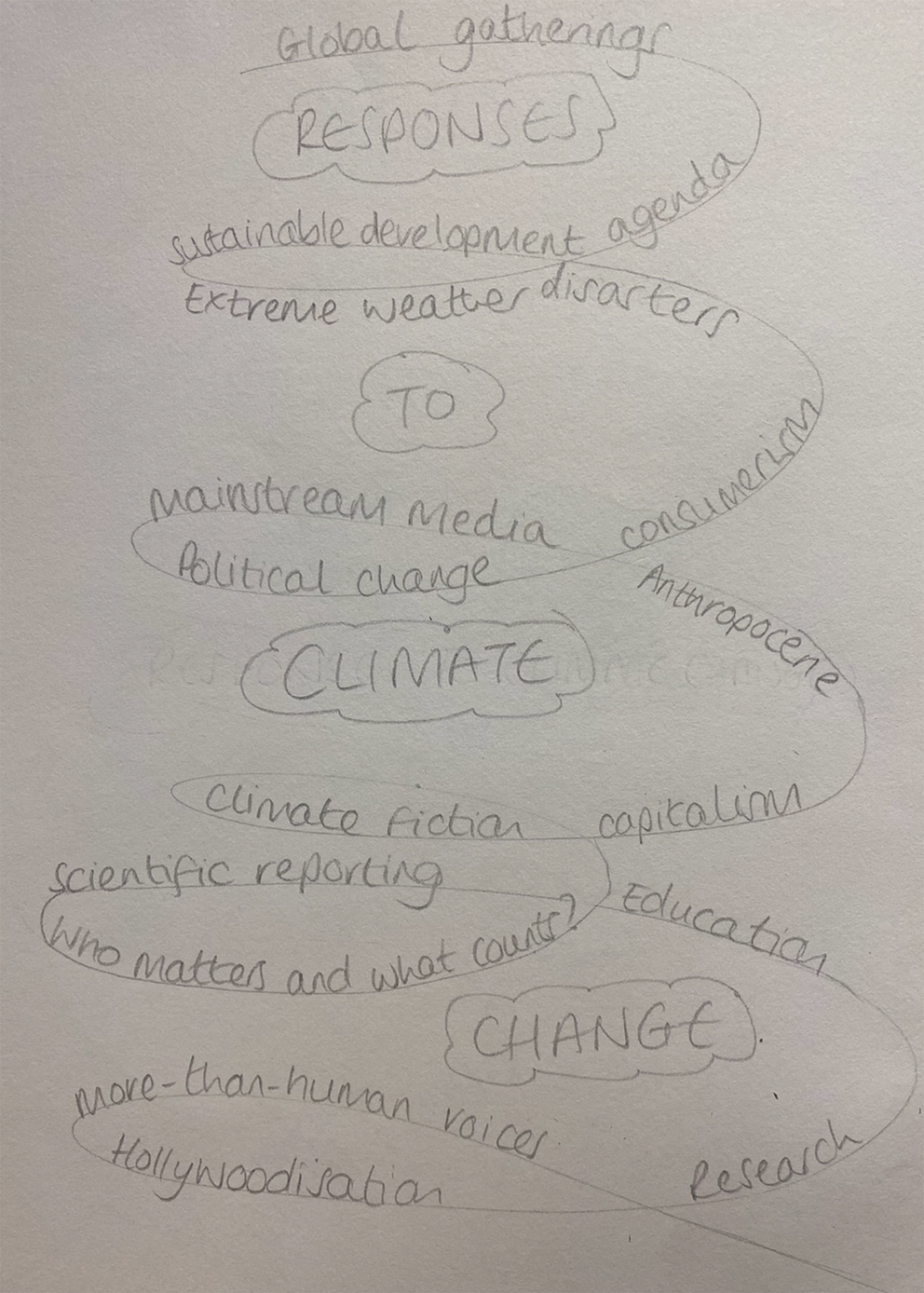
Our Posthumanist-Cli-Fi is a response to climate change that has emerged through and alongside Cli-Fi, educational futures and practice-as-research writings. In this section, we discuss a range of responses to climate changing worlds that all overlap and galvanise, which we summarise in the stormy swirl of Figure 2. With this, we situate how and why Posthumanist-Cli-Fi is a more-than-human approach that enables more response-able educational futures.
A swirl of responses to climate change.
Scientific reporting
As a backdrop to Cli-Fi, it is necessary to discuss the Anthropocene (Crutzen & Stoermer, Reference Crutzen and Stoermer2000), a geological epoch that has been slow in the making and a term that describes how Earth has been significantly influenced by human activity. Human extractive processes, which dramatically increased during the 18th century when fossil fuels were used as an energy resource to power the Industrial Revolution, have led to multiple crises of climate change, biodiversity loss, pollution and more. The prefix “Anthropos,” the Greek for matters pertaining to man or human being, centralises the human in response to environmental damage, thus reinforcing the anthropocentric logic that contributes to ecological neglect, aiding the separation of human from her worlds. The term succeeded in galvanising global concerns for planetary health, putting climate change into our collective consciousness. From the 1970s onwards, concerns have increased and the number of scientists researching climate has risen exponentially since. In 1988, the Intergovernmental Panel on Climate Change (IPCC) was formed to collate and assess evidence on climate change and has published six assessment reports, the most recent one published in 2023. The reports have suggested that the “global temperatures have risen by more than 1.5 °C above the pre-industrial level” (CS3, 2024).
We’re not meant to save the world. We’re meant to leave it.
(Nolan & Nolan, Reference Nolan, Nolan and Nolan2014, in Interstellar, 00:55:00)Footnote 1
Climate change education (CCE) and research
Responding to an anthropogenic climate changing Earth requires education to make a cultural shift, one that reconfigures “the overall habitus embedded in education vis a vis the wider society, biodiversity, and society futures” (Irwin, Reference Irwin2019, p. 494). Changes in climate call for education to reconsider, what future/s are we preparing students for? How might we prepare them for this? And, which approaches to educational research and practice might help us all to navigate so much uncertainty? These questions are challenging for teachers and schools to answer since they “challenge our known way of doing things” and most of us “are ill equipped to properly think it through or instigate constructive changes” (Irwin, Reference Irwin2019, p. 493). However, we wonder whether the questions that we should ask are not just about educational futures but also about educational pasts and presents that are co-constituted by shared worlds. To help more response-able everyday choices, educational spaces should enable ways for children and young people to speculate about uncertain futures and live in response-able presents.
Climate change education (CCE) is one such response for schools. As an emerging field of practice and research, CCE employs innovative pedagogical approaches that help children and young people grapple with the uncertainties of climate change brought forth by generational injustices (Cutter-Mackenzie & Rousell, Reference Cutter-Mackenzie and Rousell2019). CCE seeks to quell agitations towards precarious futures and prepare future generations for surviving and thriving in hotter/wetter/drier worlds, but it has largely focused on delivering scientific knowledge about climate change. Through erring on protectionist, operationalised measures that the human can control, such as capturing animals for observational scrutiny, measuring the weather via temperature, implementing solar panels and water conservation projects. The hope is that this will encourage behaviour change but studies have found that this is not the case (Cutter-Mackenzie & Rousell, Reference Cutter-Mackenzie and Rousell2019) and arguably, galvanises anthropocentric behaviours. Instead, a focus on relationships within, between, amongst interconnected more-than-human worlds may do more to bring children and young people into closer relations with climate issues. CCE has, therefore, ignited conversational storms about how education and schools can enact a pedagogical approach that harmonises the consumption of scientific knowledge with the co-creation of more-than-human relationships. With this, CCE needs to also strike a delicate balance between articulating the climate change urgency whilst also supporting escalating levels of eco-anxiety.
The choices and actions implemented in this decade will have impacts now and for thousands of years.
(IPCC, 2023)
To reconsider education’s anthropocentric praxis, where schools build physical and metaphorical walls and doors to separate children from the world/s around them, we orientate our education research. Both of our inquiries are situated in spaces where climate and more-than-human encounters are possible. Charlotte’s inquiry in a school without walls in a jungle in Bali and Hannah’s in an early childhood forest school setting in an urban park in London challenge natureculture binaries that are imbued throughout our educational systems, such as indoor-outdoor, learner-teacher, adult-child, animate-inanimate (Hankin & Hogarth, Reference Hankin and Hogarth2025). In response to human-centric, scientific approaches to climate change and sustainability education, we advocate for messy, arts-based practices, research and pedagogies (Hogarth & Hankin, Reference Hogarth and Hankin2024). These pedagogies create spaces for children and young people to co-produce knowledge with more-than-humans. We argue that these approaches help to bridge gaps between humans and others, deepening relationships and exploring climate change in more expansive and situated ways. Our approach to Posthumanist-Cli-Fi contributes to the growing field of CCE to explore speculative futures in creative ways, challenging anthropocentric attitudes and behaviours within more-than-human worlds. In the next section, we discuss Climate Fiction as a genre, considering how and why it emerged, its growing popularity and the possibilities it offers for educational research and practice.
There is a rapidly closing window of opportunity to secure a liveable and sustainable future for all.
(IPCC, 2023)
Climate fiction (Cli-Fi)
Inspired by the 2006 IPCC, Bloom (2008) framed Cli-Fi as a distinct genre to focus on human and ecological responses to climate disruption. He began “thinking of ways to raise awareness of novels and movies about climate change issues” (Wright, Reference Wright, Baumbach and Neumann2019, p. 100) and after a sustained media blitz, the term entered our academic and journalistic lexicons. Since then, the rise in popularity of the genre (Fernandes, Reference Fernandes2016) is “unsurprising given our growing awareness of the ways that our actions are impacting the planet and given the increase in speculative fiction about the possible end results of unchecked human activity” (Wright, Reference Wright, Baumbach and Neumann2019, p. 100).
We knew it was all going to go to hell, and we just stood by and watched it happen anyway …
There ought to be a prize for that kind of stupidity.
(Bacigalupi, Reference Bacigalupi2015, in The Water Knife, p. 29)
Climate Fiction (Cli-Fi) emerges from “an anxious now” and “unspools an imagined and endangered future” (Hennessy et al., Reference Hennessy, Cothren and Matthews2022, p. 1). It is a loose and emergent genre that responds to the urgency of the climate crises by narrating imagined, speculative and fictional past present futures within climate changing worlds. Cli-Fi describes “an already significant body of narrative work broadly defined by its thematic focus on climate change and the political, social, psychological, and ethical issues associated with it” (Goodbody & Johns-Putra, Reference Goodbody and Johns-Putra2019, pp. 1–2). However, there are ongoing debates about the Cli-Fi “genre” including about its purpose (does it need to be didactic?), its definition (is it possible to define?), its focus (should it include explicit reference to climate change?) and its potential (can it change attitudes, behaviours, relationships?). Cli-FI is also multimodal and transdisciplinary with literary, multimedia, academic, educational and arts-based approaches all engaging with the genre.
Cli-Fi is deeply grounded in the embodied and material experience of climate change. For this reason, Cli-Fi often depicts dystopian, masculine, violent and apocalyptic speculative scenarios, focusing on human survival on planet Earth. In these imaginaries, the protagonist is either human, part-human or has human qualities, sometimes presented as an expert in control, capable of battling, escaping, casting spells, creating innovations and carrying out experiments to mitigate devastation and save human civilisation. “Nature” “plays a major role in these narratives, as a ubiquitous and overwhelming danger for humanity” (Gebauer, Reference Gebauer2022, p. 104), presented as something to be feared; a force outside; a separate entity, where the white, wealthy human is special and under threat from external forces that he struggles to master or tame. This reinforces a nature/culture binary and anthropocentric notions whereby the human is depicted as all-powerful and resilient, even in face of extreme environmental disasters. Furthermore, this contributes to an ongoing dismissal and erasure of previous and ongoing injustices involving Indigenous rights, biodiversity loss, species extinction, social injustices and more. There is a correlation, therefore between climate change reporting and Cli-Fi storying that demonstrates our (human) limitations with and as the world. According to Truman (Reference Truman2023, p. 27), this also correlates with “a colonial crisis of imagination,” perpetuating continuous cross-industry feedback loops of anthropocentric, extractive thought and action, confronting us with some ponderings: How do we come to terms with our inseparable vulnerabilities with the natural world and all her inhabitants? How might we think/feel/do differently to respond with the urgent demands of reconciling our climate changing futures with multiple others?
Mankind survived the last Ice Age. We’re certainly capable of surviving this one. All it takes is the will to act.
(Emmerich & Nachmanoff, Reference Emmerich, Nachmanoff and Emmerich2004, Jack Hall’s speech in The Day After Tomorrow)
In other Cli-Fi imaginaries, the human is presented as vulnerable, exasperated, apathetic and questioning how things were ever allowed to become so dire. The destruction and degradation of Earth is often set in a post-apocalyptic setting where there is oppressive rule (for humans) and a search for accountability.
Who killed the world?
(Miller, McCarthy, & Lathouris, Reference Miller, McCarthy, Lathouris and Miller2015, spoken by Angharad in Mad Max: Fury Road, 00:37:30)
The assumption is that the world will die with humans, as it exists in an abandoned state due to environmental issues such as extreme pollution and heat. To respond, humans often survive in controlled, artificial environments such as spaceships or underground bunkers, yearning for better lives through a rediscovery of human connection with the natural world and its climate.
I don’t want to survive; I want to live!
(Stanton & Reardon, Reference Stanton, Reardon and Stanton2008, spoken by Captain McCrea in WALL-E, 01:09:00)
In other notable Cli-Fi depictions, climate change is presented as a systemic predicament where the human has clear choices about how to respond and how to care. In these examples, humans recognise the need for humanity to come together, recognising the dark situations they face and appealing to one another for solutions—not just for a few but for everyone on the planet.
So until the climate was actually killing them, people had a tendency to deny it could happen.
(Robinson, Reference Robinson2020, in The Ministry for the Future, 349)
Alternative approaches in Cli-Fi
The critique of the often anthropocentric, dystopian focus of Cli-Fi has widened but there are alternative approaches. Indigenous scholars have written what we have come to know as “Cli-Fi” for millennia and write about living-with changing climates. Isaacs, cited in Phillips et al. (Reference Phillips, McLean Davies and Truman2022, p. 172), has said, “all Indigenous literature is climate literature.” Indeed, Truman notes that “anti-colonial and Indigenous authors around the world have been writing about the relationship between extraction, capitalism, and climate for a long time” (Reference Truman2023, p. 36). In recent times, there has been a rise in Cli-Fi creations that offer broader depictions of climate change as an interconnected issue for all life on Earth. Relational ontologies such as posthumanism and agential realism, along with the animal and plant turns, trouble anthropocentric, positivist accounts of Cli-Fi and education for more-than-human knowledge-making. Caracciolo et al. (Reference Caracciolo, Ferebee, Toivonen, Ulstein and Lambert2022, p. 18) explored posthumanist framings of Cli-Fi literature and considered how they “push us beyond familiar forms of thinking and storying climate change” by suggesting ways we might create narratives with more-than-humans. This not only includes multiple others but presents them as valuable and worthy to plot and structure, offering more promising steps towards shaping our collective imaginations for healthier futures.
Imminent, at the speed of people, is too late. The law must judge imminent at the speed of trees.
(Powers, Reference Powers2018, in The Overstory, p. 498)
We draw on these relational ontologies to create our Posthumanist-Cli-Fi, and in the following section, we introduce our theoretical and conceptual toolkit to explore how we might co-create practice-as-research in climate-induced storms. Our intention with this paper, therefore, becomes broadly threefold: 1) to expand the genre of Cli-Fi to co-create writing with more-than-human voices; 2) to develop practice-as-research writings as a creative, generative response to climate change; 3) to utilise these emergent practices and co-produced knowledges as a pedagogical approach to widen the speculative field of CCE and educational futures.
Relational ontologies for responding otherwise
Nothing, no creature or stone or flake of paint on the wall, escapes the shattering imperative of the thunderbolt’s shout–the way it undoes and re-creates us in a moment…all of us are gathered into the same electric present by the sudden violence of this exchange between the ground and the clouds.
(Abram, Reference Abram2010, p. 151)
Barad’s “agential realism” situates the human as enmeshed with/in her world, not separated or observing from a distance, but always in-relations (Fairchild, Hogarth, & Hankin, Reference Fairchild, Hogarth and Hankinin press); shifting, changing and responding with the multiple actors in any event (Jukes et al., Reference Jukes, Stewart and Morse2022; Riley, Reference Riley, Thomas, Dyment and Prince2021). We are always becoming-with the “agency of the assemblage” (Bennett, Reference Bennett2010, p. 20), a swirl of simultaneous and vital materialities that produce and distribute agency with the human, as she is entangled, not apart from, nor in control of events. With agential realism, humans, animals, climate, materiality co-constitute the other/s, interwoven in and through dynamic assemblages. Barad suggests that practices of knowing and being are not isolable; they are mutually implicated. We do not obtain knowledge by standing outside the world; we know because we are of the world” (Reference Barad2007, p. 185). The theories discussed in the previous sections support our initial invitation to all consider ourselves as part of the stormy assemblages of climate changing worlds. We are drawn to write Posthumanist-Cli-Fi that acknowledges the ways we are inextricably entangled with climate change as an intra-active process.
Hiss, hiss, hisssssss!
(Python, Bali, 2025)
We, both white women born in the UK, find posthumanism an unsettling and hopeful challenge to the humanist, anthropocentric, Cartesian ontologies and epistemologies we were educated with/in. The foundations on which our educational experiences were based are being dismantled through these relational philosophies. Introducing new concepts can help do the work to shift us towards more capacious, creative and relational approaches in education, and we recognise how important it is to consider the ways that “ancient wisdoms” (such as Indigenous knowledges, Taoism, Jainism, Buddhism, Confucianism, Mohism, animism) relate with their worlds. By foregrounding sensory, embodied and situated modes of inquiry, these philosophies offer alternative approaches to knowledge production that reconfigure relationality and existence, while expanding the ways in which we perceive, feel and imagine. These alternative or “other” ways of knowing—that is, they do not align with humanist, anthropocentric, Cartesian ontologies and epistemologies—produce visibility for those who may previously have been overlooked, marginalised or erased. As such, engagement with alternative research is critical to resist reinforcing educational practice-as-research that is homogeneous and monolithic. However, we also acknowledge the extractive processes of taking from ancient knowledge systems and furthermore, do not suggest that these relational ontologies are new, since they have existed in communities for centuries, invoking living in ways that are less damaging to Earth’s systems (McGregor et al., Reference McGregor, Sritharan and Whitaker2023).
In efforts to think-with other ontologies and research practices, we acknowledge how these alternative ways of living with/in worlds have much to offer the ways we all live and educate. Rosiek et al. (Reference Rosiek, Snyder and Pratt2020) illuminate the ways in which western scholarship has neglected Indigenous scholarship for too long. Encouragingly, Reid et al. (2024) note that there has been a “fervent uptick” in western scientists seeking to engage with Indigenous knowledge systems and that this not only signals a change in attitudes but also brings significant risk, particularly considering colonial and extractive histories. The challenge for us, as non-Indigenous scholars, is to engage with other ways of knowing, and we need to listen with greater attentiveness and care. Yunkaporta’s Sand Talk (Reference Yunkaporta2019) offers an entry point for non-Indigenous scholars. He challenges the asymmetrical power relations where communication between Indigenous and non-Indigenous scholars has been “one way” and suggests an open dialogue with the metaphor ngak lokath, the brackish water that forms in the wet season when freshwater floods into the sea. Yunkaporta (Reference Yunkaporta2019, p. 233) considers how this gives more opportunities “for the brackish waters of hybridity to stew up something exciting” (p. 233), and we are inspired to work in these liminal spaces where more-than-human knowledge-making produces something other. We suggest that environmental education should be working in these brackish waters of hybridity with knowledge systems that have previously been overlooked, including Indigenous peoples, children, animals and plants.
Relational ontologies also challenge the ways we might conceptualise time. Yunkaporta (Reference Yunkaporta2019) describes “deep time” as cyclical conceptualisations of time, creating a responsibility to maintain relationships with our ancestors, the land, other beings and future generations. There are resonances with the ways in which posthumanist scholars challenge linearity. Barad suggests, with the neologism “pastpresentfuture,” that the “past” and “future” are reworked and enfolded through the iterative practices of “spacetimemattering” (Barad, Reference Barad2014). They argue that “there is no overarching sense of temporality, of continuity, in place. Each scene diffracts various temporalities within and across the field of spacetimemattering” (Barad, Reference Barad2010, p. 240). Barad suggests that to “address the past (and future), is not to entertain or reconstruct some narrative of the way it was, but to respond, to be responsible, to take responsibility for that which we inherit” (Reference Barad2014, p. 264). The brackish waters of these ontologies, therefore, remind us that we inherit the future, not just the past, and that the past is never closed. Our Posthumanist-Cli-Fi works with spacetime rather than attempting to write about fixed positions, times and locations. Often, Cli-Fi is situated in a particular date in the future, in a particular place, but these relational ontologies suggest that we work with different, more fluid and responsible understandings of place, space and time.
Wheeeeeek
(Guinea pigs, England, 2025)
The relational ontologies discussed in this section call us to ask questions about how we could relate otherwise to current responses to climate change and education. We, therefore, consider this paper a posthuman enactment and write Posthumanist-Cli-Fi with more-than-human protagonists to deepen our relationships with them. How are we to expand our response-abilities with a changing Earth without these considerations? And, what do these more-than-human storms expect of us all? After all, if we do not include those who are different to ourselves in our climate imaginaries, who are we, humans, mutually becoming-with? In the next section, we consider the practices that we employ to create spaces for experimentation, co-creation and storying with/in these complex and mysterious more-than-human worlds.
Gathering more-than-human writings as practice-as-research
As humans-in-relation, we turn to practice-as-research as an inquiry approach that is integrated into and emerges through creative practices. Practice as research refers to “an entwining of contemporary creative practice and academic research landscapes” (Hickey-Moody, Reference Hickey-Moody, Hickey-Moody and Page2016, p. 169). Barrett (Reference Barrett2007, p. 12) suggest that it involves piecing together “multiple practices.” Instead of considering research as separate from practice, it perceives the two as intertwined, where knowledge emerges through creative practices and is “philosophically informed” (Hickey-Moody, Reference Hickey-Moody, Hickey-Moody and Page2016, p. 169). These approaches to inquiry have long been practised by Indigenous communities. McGregor, an Anishinaabe scholar from Whitefish River First Nation, suggests that “theoretically, practice is embedded in inquiry: one does not really know until knowing occurs” (2021, p. 147). She insists that inquiry is, therefore, both an ethical and political endeavour.
In this paper, our approach to practice-as-research for Posthumanist-Cli-Fi focuses on co-creating with other species as protagonists, employing the terms “animal/s” and “multispecies” in our discussions. Again, we acknowledge that the terms “animals” and “multispecies” may stir up their own storms of categorisation and reduction, drawing from ontological fields that are not relational. Furthermore, Indigenous peoples have their own, incredibly rich, grammars for describing or storying what we might call a plant, an animal, a species, or an ecosystem” (Price & Chao, Reference Price and Chao2023, p. 183), and we do not intend to privilege some ways of knowing over others with our language choices. We do, however, need to use the language that the research originates from.
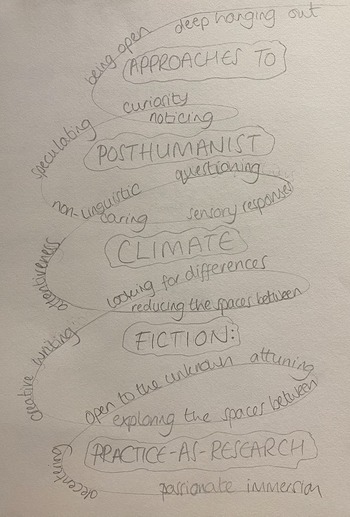
Several researchers have written with more-than-humans as practice-as-research. These are explored in the stormy swirl of Figure 3 not as separated methodologies but as overlapping, thickening and yet distinct approaches for how we might inquire with and without linguistic (human) communication. We consider how they provoke speculations for how Posthumanist-Cli-Fi could enlargeCCE and educational futures.
A stormy swirl of Posthumanist-Cli-Fi practice-as-research approaches.

Practice 1: Exploring differences as an act of care and curiosity
One of the most well-known examples of practice-as-research with another species is Haraway’s (Reference Haraway2008) exploration of her shared worlds with Cayenne, her dog, who “make each up in the flesh” (16). Haraway writes about their intimate and entangled relationship, declaring that they are “significantly other to each other in specific difference” (16). It is in their differences where Haraway finds “a provocation to curiosity” (7), a game of “response and respect” where “learning to pay attention” (19) is all “part of training each other in acts of communication we barely understand” (17). With her practice-as-research with dogs and other animals, Haraway (Reference Haraway2015) builds on Despret’s (Reference Despret2016) research with birds to propose “a curious practice,” an inquiry approach that requires the researcher to hone an attentive, sensitive and curious approach to the world around. This involves “going visiting” and “demands the ability to find others actively interesting” (Haraway, Reference Haraway2015, p. 5). A curious practice outlines how a researcher might gain greater comfortability with all that is unknown, unplanned, unpredictable when inquiring-with animals, to be open to taking “off-the-beaten practices” and “to retune one’s ability to sense and respond–and to do all this politely!” (Haraway, Reference Haraway2015, p. 6).
To work with a curious practice and be responsive “in the moment,” Tsing (Reference Tsing2015) offers further guidance through her explorations with matsutake mushrooms. She advocates for inquiry that nurtures “the art of noticing,” which involves paying “attention to mushroom picking. Not that it will save us—but it might open our imaginations” (19). Tsing posits that capitalist obsessions with progress, development and scalability have removed our abilities to notice more-than-human worlds, and in doing so, we are failing to understand that “these livelihoods make worlds too—and they show us how to look around rather than ahead” (22). Noticing differences through sensory activations illuminates how we are sharing moments with more-than-humans. These noticings are a critical approach when engaging in practice-as-research, not to create divides but to “give substance to noticing” because otherwise, “we are left imagining that all trees, or Asians, look alike” (293).
Similarly, van Dooren, Kirksey and Münster (Reference Van Dooren, Kirksey and Münster2016, p. 8) suggest we learn how to “cultivate the art of attentiveness” when exploring differences with more-than-humans by “being in the field.” They discuss a distinction between “noticing” and “attentiveness,” the latter taking on a “passionate immersion” with “distinctive experiential worlds, modes of being, and biocultural attachments of other species” (6). This passionate immersion requires a researcher to become sensorially affected by the encounter when engaging in practice-as-research. Noticing these senses helps move “beyond viewing other creatures as mere symbols, resources, or background for the lives of humans” (6). With this, a researcher can then give “careful attention to what matters to them—attention to how they craft shared lives and worlds” (6).
A final approach that a researcher could employ to explore differences is a “deep hanging out” (Somerville & Powell, Reference Somerville and Powell2019). With this approach to inquiry, “Everything, especially the very mundane and every day, is regarded as fascinating and thought provoking” (829), which is essential for practice-as-research. Drawing on their research in preschool settings, Somerville and Powell (Reference Somerville and Powell2019) spend a lot of time without purpose, sitting alone, playing with mud and children, responding to play invitations and having conversations. This approach enables the researcher to focus on being present with more-than-human research participants and that afterwards, researchers have conversations to “talk through our experiences and wonderings, at the very limits of language, in our struggle to find words to attach to what this might mean in, and for, the world” (830). These conversations would be accompanied by journal notes, photographs, an exploration of embodied experiences and any materials from the research site, such as leaves, twigs and even mud. This collapses the idea that “data” is produced in “real-time” with participants, but instead, it proliferates “after” the research event.
Provocation: How might we curiously and politely notice differences between ourselves and other species so that we deepen care for our shared worlds?
Practice 2: Reducing the space between “us”
Despite acknowledging and recognising differences as discussed in Practice 1, it is also important to find likenesses. These are complementary, relational practices, not binaries in competition with one another, but placing difference and likeness in conversation.
Rautio (Reference Rautio2017) demonstrates how to notice similarities within and across more-than-human relationships with birds as co-authors. Together, they inquire into the concept of multiple species, as “a deconstruction and a reconsideration of life divided by species lines (94).” Rautio (90) argues that when we form relations with persons, we “look for characteristics that we share, recognise and/or value.” This prompts researchers to consider likenesses with other species, as a response to one another and the environments they share, not as a fixed entities and separated categories. Rautio expands (90) how this might be enacted, as “a question of simple reframing. What if you defined who counts as your family by including all who eat from the same fridge?” Exploring likenesses is one way to mitigate distances between species, to build relationships from a position of openness, togetherness and generosity as opposed to categorisation, division and exclusion.
Similarly, Abram (Reference Abram2010, p. 46) writes how “the things of the world have a great deal more in common with us than we tend to allow.” To explore these commonalities, Abram (Reference Abram2010, p. 58) suggests that we start with “rendering ourselves vulnerable” to “the sensuous world,” to open ourselves to acts of reciprocity, which helps us explore ongoing exchanges, such as “exploring moss with our fingers while feeling the moss touching us back.” This kind of sensory attunement is what helps us to bridge divides that have been previously created by humanistic hubris, creating, instead, a likeness and closeness between more-than-humans. Kimmerer works with this bridge as a Potawatomi botanist, writer and professor known for weaving Indigenous knowledge with Western science. She sees touch as a relational act, a way of knowing between human and more-than-human:
Hold out your hands and let me lay upon them a sheaf of freshly picked sweetgrass, loose and flowing, like newly washed hair. Hold the bundle up to your nose…Breathe it in and you start to remember things you didn’t know you’d forgotten. (Reference Kimmerer2013, iv)
Provocation: How might we attune-with our sensory perceptions to find likenesses, not differences, that reduce the spaces between ourselves and more-than-human worlds?
Practice 3: Attending to the distributed agency of the assemblage
Practice-as-research provides opportunities to create-with more-than-humans so that human-centred ways of knowing do not dominate research. Attuning-with more-than-human voices as distributed agency of an assemblage (Bennett, Reference Bennett2010) helps us to conceptualise this.
Nordstrom, Nordstrom and Nordstrom (Reference Nordstrom, Nordstrom and Nordstrom2020) provide an example of how to create-with Amelie and Coonan, her domesticated cats, as a multispecies assemblage to explore the death of Amelie. Notably, Amelie and Coonan are credited as co-authors of this research, formally recognised as worthy contributors. In this multispecies narrative, the paper explores how they “tune and tend each other in our rhythmic practices of living–dying together” (1236), considering the different ways in which they listen, communicate and become-with beyond human voice and words. Nordstrom et al. (Reference Nordstrom, Nordstrom and Nordstrom2020) co-write in ways that do not centre any singular being in their multispecies life, acknowledging how “human-centered narratives forget the response-abilities we have to each other, humans and nonhumans alike.” Instead, they write a “kin story” (1239) together, “a passionate, vulnerable, and evocative narrative ‘that’ allow us to think our lives differently” (1239). This multispecies (writing) inquiry shares concerns for the ways that human language inescapably carries a “human-centered Cartesian framework,” which can “cage our bodies” in practice-as-research “that seeks to uphold the hierarchy that our daily lives subvert” (1239).
Of course, the human writer can never know what it is like to live as a cat or any other species, since “We live immersed in intelligence, enveloped and informed by a creativity we cannot fathom (Abram, Reference Abram2010, p. 129).” A researcher will, therefore, need to attend and respond with humility to the needs, interests and appreciations of the more-than-human assemblages and not just the human—this is no easy task for the anthropocentric amongst us, who enjoys visibility and special treatment. Asking questions helps to explore these shared worlds, considering how they “mean both asking what another finds intriguing and also how learning to engage that changes everybody in unforeseeable ways” (Haraway, Reference Haraway2015, 6, emphasis in original). With creative writing as an approach to practice-as-research with other species, a researcher is compelled to write at the edges of their imaginations, employing the power of language to “speculatively write riddles of between spaces without clear answers and incite possibilities of futures to come” (Nordstrom et al., Reference Nordstrom, Nordstrom and Nordstrom2020, p. 1239). Speculative fabulations “stitch together improbable collaborations without worrying overmuch about conventional ontological kinds” (Haraway, Reference Haraway2016, p. 136). This practice, therefore, generates alternative ideas, opinions and affects that enable the creation of new more-than-human possibilities. As discussed by de Freitas and Truman (Reference De Freitas and Truman2021) speculative fabulation “can spur us on to act with more-than-human sympathy in posthuman ecologies that demand a pluralist and plastic sense of worldly belonging” (531). This is the response-ability that we argue Posthumanist-Cli-Fi can expand.
Provocation: How might we tend to the ways that more-than-humans participate in our shared worlds and with this, speculate to reduce human-centric paradigms?
Practice 4: Becoming-animal through creative writing
In this practice-as-research, we gather philosophers and writers who have storied through animal writings, philosophising what it means to be animal, to be humananimal and to write with animals. We draw on Practice 3 by discussing creative writing as a specific process for becoming-with and for “becoming-animal” (Deleuze & Guattari, Reference Deleuze and Guattari1987).
Reinhold (Reference Reinhold2018) draws on Deleuze and Guattari’s concept of becoming-animal to explore how to create “animal writing” with a bear. Instead of writing mainstream academic texts that “almost automatically excludes the feminine, the animal, the dirty, the child,” Reinhold (Reference Reinhold2018, p. 319) calls for researchers to attend to “the leaky, the weak, the hesitating or dancing body” to create academic texts that are “powerful,” aligning well with the diminished voices of climate change that Posthumanist-Cli-Fi seeks to elevate. Animal writing involves “feminine writing, dirty writing or interruptive writing” (328) that does not attempt to tidy nor satisfy its forms for the reader. Rather, it “does not necessarily need to rely only on animals to reach convincing effects but it has to engage with them sensually, which is very different from simply acknowledging of their presence” (328). Animal writing, therefore, works with approaches in Practice 1 to go beyond rational thinking to create knowledge that includes “shouting, fleeting, scratching, finding a voice for animals living inside us” (328). To enact this style, the researcher is encouraged to think beyond words and instead with smells, tastes, colours and even “traces on the ground” (322), blurring their words, creating confusions with/out punctuation, utilising unexpected word combinations and nonsense words—all designed to create more questions, rather than clarity. Creating animal writing can be a challenging endeavour for the reader-writer relationship, especially an anthropocentric one, since it may be impossible to reach a “full” understanding of it. This is the humility that is required when decentering human perceptions and responding with shared worlds.
Provocation: How might we write with animal sensualities to explore alternative Cli-Fi futures?
Co-creating Posthumanist-Cli-Fi in/with/for stormy worlds
Upon consideration of the various practices, we consider how we might enact these in experimental and playful ways for research. Our intention is to utilise the teachings from these practices to write-with multispecies for Posthumanist-Cli-Fi. At this point, it is important to address the concept of anthropomorphism that some readers might be pondering. Are we attributing human traits and intentions to other species, and if so, what does this do for entangled relationships and research? Is this another form of anthropocentrism that enhances the potential of the human, whilst diminishing the capacities of other species?
In their work on crafting with birds, Aure and Fredriksen (Reference Aure, Fredriksen, Jokela, Coutts and Härkönen2022) illuminate the tensions that emerge as well as the potential when creating with other species:
Our forms of imaging the birds’ position through our human bodies, and our use of anthropomorphisms, might contradict [our] initial aims… Since neither we nor the natural scientists can experience the world as a bird, this is our best option to try to empathically connect with them. Nevertheless, creative approaches as well as anthropomorphisms can be sources of ideas. (141)
Similarly Rautio (Reference Rautio2011, p. 107) suggests that rather than viewing anthropomorphism as anthropocentric, we might explore the former as a practice “to be understood in light of individuals’ everyday lives as ways of grasping and communicating neither proximity nor distance per se, but the perceived interplay of them.” We, therefore, acknowledge the tensions that anthropomorphism may arouse, but since we cannot know how differently the world is experienced with tentacles, whiskers, roots and fur, we approach this concept affirmatively. After all, Posthumanist-Cli-Fi requires us to notice, speculate, question those who are different to us, those who lived before us, those not yet born and those who live in the seas, soils and skies—critical anthropomorphism may just be the leverage that we need to shift fluidly between differences and likenesses to co-create knowledge that expands response-abilities with and for more-than-human worlds. If we perceive the creative potential for the practice of critical anthropomorphism, we may also expose uneven knowledge-making and power-producing practices, which could inspire us to respond otherwise with climate change. With the research practices in mind, we hold these questions: How might anthropomorphising make relations? What relations might make anthropomorphism possible? What does it do to the anthropomorphised other?
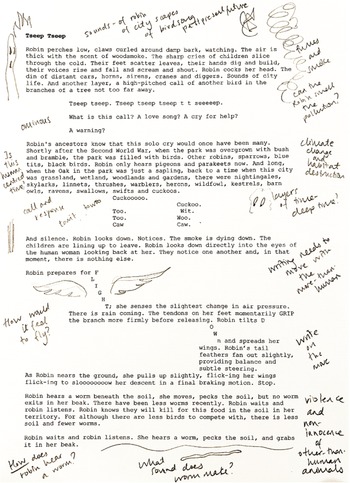
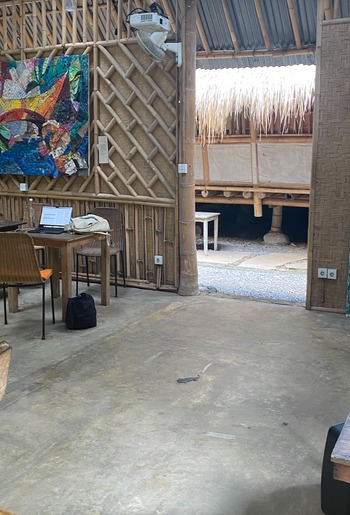
In the next section, we share our Posthumanist-Cli-Fi, drawing on our postqualitative doctoral research. Hannah’s inquiry with young children as co-researchers explores childhoodnature play and nature relations in an urban forest school in London. Here, she explores a surprising moment when coming eye-to-eye with a Robin, whilst tidying up an area after a learning experience with children. The children had left and returned to the classroom when Robin arrived (see Figure 5). Charlotte’s inquiry explores animal–child relations in an international school in Bali and her Posthumanist-Cli-Fi draws on a startling encounter with a Tokay Gecko, as it fell from the ceiling to the floor of a classroom (see Figures 7 and Figure 8). In both immanent encounters, we both felt called to write with Robin and Gecko, resulting in bouts of unplanned scientific research and creative writing. We put our practices to work, and Figures 4 and 6 present the data that emerged. Marginalia deepen our reading of our writings and the encounters. These practices are returnings that make explicit the iterative and ongoing nature of encounters.
Posthumanist-Cli-Fi with Robin-in-relations-with.

Posthumanist-Cli-Fi: Practice-as-research-as-pedagogy
In this penultimate section, we discuss the process of writing Posthumanist-Cli-Fi and explore how this practice made a difference. Our practice involved engaging with an encounter. In our educational research settings, we came face to face with Robin and Gecko. These moments, already in the middle of our Robin-human and Gecko-human relations, caught our attention. We noticed. We took a photograph. We turned to what we may previously have ignored. We wanted to document this encounter somehow. Meeting the other in the eye of the storm is one way we can face climate changing futures.
We wanted to co-create climate fiction with the encounter and write the encounter with Robin and Gecko. We felt compelled to carry out a considerable amount of research to learn more about Robin and Gecko to allow us to think-with and write-with our more-than-human companions. We researched anatomies, senses, histories with place, cultural significance, migratory patterns, reproductive qualities, diet, predator/prey behaviour and of course, how Robin and Gecko’s world/s are affected by climate change. We were surprised with the ways that our research transcended genre and times. Questions emerged about whether it is possible to write from another’s perspective. Is this ethical? We became acutely aware of our human limitations. We continued to imagine, to speculate and to write.
When we write, we are “animals who write” (Cooper, Reference Cooper2019), constantly intra-acting (Barad, Reference Barad2007), not writing as siloed authors at a distance to the world but with/in its becoming. As practice-as-research, “writers participate in their own and the world’s emergence” (Cooper, Reference Cooper2019, p. 5), both simultaneously remaking the world and being remade by their world in ongoing processes of mutual co-becoming. Through writing, we were learning how to expand our ethical response-abilities by continuously paying attention to our differential sensory relationships, speculating and experimenting with the unpredictable, which requires a humility to always entertain the possibility that “‘what everyone knows’ - and what you believe - might be wrong” (Cooper, Reference Cooper2019, p. 6). This craft was unfolding in real and imaginary spaces that are foregrounded in climate change and enmeshed in times of pastpresentfutures, which create the conditions for the “world’s radical aliveness comes to light in an entirely nontraditional way” (Barad, Reference Barad2007, p. 33). Therefore, writing Posthumanist-Cli-Fi with other species as protagonists is a relational, speculative, situated, embodied and experimental practice and process that compels us to explore how we are writing with, not writing about climate changing relationships.
Our writings went through several iterations. Marginalia helped us to illuminate the practical application and usefulness of our Posthumanist-Cli-Fi as we worked dynamically with our writing, intra-acting with the words (and worlds) that we had already committed to page. This reinforced our approach, offering new ideas for what our writing could offer for the potential of practice-as-research-as-pedagogy. Marginalia helped us to see/feel/experience this in creation.
The process of writing this paper illuminated the importance of the practical inquiry approaches outlined in the section above that we call “Gathering more-than-human writings as practice-as-research.” As we wrote and re-wrote our Posthumanist-Cli-Fi we found that the processes we were engaging with were generating new feelings, understandings and questions. Our writing emerged iteratively, and we found that the insights continued to flow throughout (and still are!). Our research practices unknowingly generated a pedagogical approach that enabled us to work with a framework for writing. We came to see this as practice-as-research-as-pedagogy and suggest this has much to offer education, creating opportunities for children and young people to participate in their climate changing worlds in ways otherwise.
Becoming changing climates
Co-creating Posthumanist-Cli-Fi with other species has taught us much about climate change and educational futures. We consider climate change as a storm we all weather together, evoking fears of “social upheavals, civilization collapse, abandoned cities, violence, authoritarian rule, along with environmental degradation, extinctions, and loss of land” (Ismail, Reference Ismail2024, p. 248). Climate change is not just about rising temperatures; it is crises of relationships with/in ourselves and the ways that we respond with others in our shared worlds. We assert that we are all implicated in climate change albeit in uneven and multiple ways as perpetrators, colluders, bystanders, enablers, casualties, victims, innocents, as well as the apathetic, the complacent and everything beyond and in between. We are all always becoming changing climates, but the acknowledgement and dynamics of our specific participation is crucial to avoid the “unprecedented looking away” (Haraway, Reference Haraway2016); to expand our response-abilities; to learn and unlearn how to take action that relieves the burden/s that some face at the hands of others. Posthumanist-Cli-Fi offers the promise of co-creating with the more-than-human worlds that we encounter in our everyday lives—inviting speculation, decentring the human, sparking potential and deepening relationships towards more response-able, educational futures.
The promise: It matters what storms stormy worlds
We end the paper not with a conclusion but with an opening. We invite readers to engage in Posthumanist-Cli-Fi creation for practice-as-research-as-pedagogy. We found that working with posthumanism to work-write-feel climate with more-than-human speculative fiction was a generative and surprising process. We write Posthumanist-Cli-Fi:
-
Because the stories we tell are part of who we were, are and who we become.
-
Because humans are not the only knowledge creators. Knowledge is never ours to own. Knowledge making is the ongoing process of mutual becoming-with.
-
Because we are the animals who write. But to write, we need to listen.
-
Because we need to stop. Slow down. Do less. Notice. Immerse. Attend. Attune.
-
Because we need to deepen our more-than-human relations.
-
Because we need to make and do as part of our worlds, where geckos and birds (and moss, and sweetgrass, and water, and mud, and-and) also have stories to tell.
-
Because uncertain, changeable futures require us to shape-shift as we become climate change, adapting to the storms that are within us all.
-
Because it enables us to grasp the contours of our radical aliveness to co-create alternative pastpresentfutures that might just be more response-able.
-
Because living in the Anthropocene means we need fresh pedagogies for thinking-feeling-doing with/in a changing Earth.
-
Because we can no longer write alone. We were never one. Cli-Fi is always posthuman.
-
Because…?
Robin-in-relations-with. Despret asks, “What would animals say if we asked the right questions?” (2016). Here we wonder, what would Robin say if we asked the right question? What might the right question be?

Posthumanist-Cli-Fi with Gecko-in-relations-with.

Tokay Gecko falls into class. What would Gecko say if we asked the right question? (Despret, Reference Despret2016). What might be the right question?

What does this Tokay Gecko and human encounter invite for us all? (Despret, Reference Despret2016).

Acknowledgements
We – Hannah and Charlotte – would like to acknowledge Robin and Tokay Gecko for inspiring us to learn more about their worlds and encouraging us to slow down and pay attention to the small moments of every day. These encounters probably mean so much more than we realise. We also thank our reviewers for all their close reading and generous feedback as we crafted this paper through its many iterations.
Financial support
Hannah Hogarth’s doctoral research was funded by a University of Bath University Research Studentship Award.
Ethical standard
The research received ethical approval from the University of Bath Social Science Research Ethics Committee (S21-051), and British Educational Research Association (BERA) ethical guidelines have been adhered to throughout.
Author Biographies
Charlotte Hankin is a PhD researcher in the Department of Education, University of Bath. Her doctoral inquiry explores animal-child relations to consider how international schools might shift from human-exceptionalism to more regenerative pedagogical practices. Charlotte employs posthumanist and feminist new materialist theories and practices to co-create research with animals and children.
Hannah Hogarth is a Senior Lecturer in the Department of Education, University of Northampton. Her research interests include childhoodnature relations, posthuman, postdevelopmental approaches to childhood and post-anthropocentric approaches to early childhood education. She recently completed a postqualitative doctoral inquiry exploring the possibilities of/for childhoodnature play during childhoodnature encounters in an urban forest school in London, UK





 Open access

