


Introduction
Despite the ongoing trend of secularization and a decline in the relevance of religion in public life, religiosity continues to be one of the key determinants of fertility. More-religious people have been found to be more likely to have children in comparison to the less religious in many different country settings (Adserà, Reference Adserà2006b; Hubert, Reference Hubert2015; Peri-Rotem, 2016; Okun, Reference Okun2017; Dilmaghani, Reference Dilmaghani2019). Explanations for the positive association of religiosity and fertility are manifold. It has been argued that religions encourage their followers to have children by providing social support and networks for families (Krause et al., Reference Krause, Ellison, Shaw, Marcum and Boardman2001; Okun, Reference Okun2017), by promoting traditional gender roles and family values (Sherkat, Reference Sherkat2000; Goldscheider, Reference Goldscheider, Derosas and van Poppel2006; Klingorová & Havlicek, Reference Klingorová and Havlicek2015) or by direct teachings such as the Biblical command ‘be fruitful and multiply’.
Another mechanism of how religiosity may facilitate childbearing relates to how religious people perceive, and how strongly they react to, various costs and benefits of having children. Religions encourage their followers to have children by accentuating and communicating the benefits of parenthood. The support that religious faith gives in different life situations may also lead to lower perceived costs of having children. Furthermore, it may lead to the belief that a deep faith can shield religious people from high costs of having children (Philipov, Reference Philipov2011). It follows that even those religious people who perceive high costs of having children may still want to have them. Previous research using German data confirmed a positive relationship between religiosity and higher perceived benefits of having children (Brose, Reference Brose2006), and showed that this is one of the reasons why the more religious are more likely to start a family (Arránz Becker & Lois, Reference Arránz Becker and Lois2017). What is, however, not clear from this literature is whether these results hold for other countries, too. Also, the exact mechanism of how the perceived costs and benefits of children intertwine with religiosity is yet to be established.
The goal of this study was to contribute to the literature by examining the interrelations between religiosity and perceived costs and benefits of having children in the context of Poland, and in regards to fertility intentions. Poland, as a majority-Catholic country with a low fertility rate, constitutes an interesting case study due to its marked contrast to the German context of earlier studies. Moreover, and in contrast to previous studies, this has focused on fertility intentions. If the whole fertility decision-making process is considered (Miller, Reference Miller1994, Reference Miller2011), fertility intentions are the link between the perceived costs and benefits on the one side, and behaviour on the other. By focusing on intentions, this study was able to go deeper into the role of religiosity in the fertility decision-making process.
The study used the second wave of the Polish version of the Generations and Gender Survey. Of the countries that participated in the survey, Poland was the only one to include a series of items tapping into perceived benefits and costs of having children, which allowed for a thorough analysis of their relationship with religiosity and fertility. The study aimed to examine the extent to which the costs and benefits of having children act as mediators for the effect of religiosity on fertility intentions and to assess whether religiosity acts as a moderator on the relationship between perceived costs and benefits and fertility intentions.
Theoretical background
Religiosity and perceived costs/benefits of having children
Perceived costs and benefits of children are a key component of numerous theoretical models of fertility decisions. These models assume that high perceived costs and low perceived benefits have a negative effect on the decision to have a child. This assumption is part of many economic models (e.g. Becker, Reference Becker and Bureau1960; Schultz, Reference Schultz1973) as well as models formulated in psychology and sociology (Hoffman & Hoffman, Reference Hoffman, Hoffman and Fawcett1973; Miller, Reference Miller1994; Nauck, Reference Nauck2014). In economic theory, direct monetary costs and indirect costs related to the allocation of time to housework and foregone wages are most frequently considered (Becker, Reference Becker1965, Reference Becker1981; Schultz, Reference Schultz1973). Costs also cover other possible negative aspects of having children, such as stress, worries over children, discomforts of pregnancy and limited time for leisure (Miller, Reference Miller1995; Guedes et al., Reference Guedes, Pereira, Pires, Carvalho and Canavarro2015). Similarly, benefits of children encompass numerous motivations or reasons for which people have children. They include emotional aspects such as affiliation, a sense of accomplishment and novelty (children bring new experiences), but also instrumental aspects such as economic utility and fulfilling norms regarding morality and religion (Hoffman & Hoffman, Reference Hoffman, Hoffman and Fawcett1973; Miller, Reference Miller1995; Guedes et al., Reference Guedes, Pereira, Pires, Carvalho and Canavarro2015).
The role of costs and benefits of children for fertility choices has already been tested in a wide range of studies (e.g. Bulatao, Reference Bulatao1981; Shah & Nathanson, Reference Shah and Nathanson2004). These have shown that, for the first child, emotional and psychological benefits are the most relevant, while for higher parities, economic and instrumental values grow in importance (Bulatao, Reference Bulatao1981). They have also indicated that emotional values of children became central in modern societies, while the importance of instrumental values have diminished (Nauck, Reference Nauck2007; Mayer & Trommsdorff, Reference Mayer and Trommsdorff2010; Nauck, Reference Nauck2014). In terms of costs, it has been highlighted that due to rising employment of women, opportunity costs of having children have risen considerably (Moss, Reference Moss1988) and represent an important part of the overall costs of childbearing (Duggan, Reference Duggan2003).
Despite the recognized importance of perceived costs and benefits of children in fertility decisions, one missing link is the possible role of religiosity. Theoretically, Goldscheider (Reference Goldscheider1971) and McQuillan (Reference McQuillan2004) identified the perceived costs and benefits as one possible link between religiosity and fertility. This link seemed apparent in traditional societies, where instrumental values of children related to fulfilment of norms regarding morality and religion also had a large influence on the decision to have children (Westoff & Jones, Reference Westoff and Jones1979; van Poppel, Reference van Poppel1985; Lesthaeghe & Meekers, Reference Lesthaeghe and Meekers1987). The Second Demographic Transition theory suggests that those norms have, however, become less relevant over time in Western countries, as secularization has spread and welfare systems have expanded (Lesthaeghe, Reference Lesthaeghe2010). Yet, a large number of studies have found that religiosity still matters in individual childbearing decisions (Philipov & Berghammer, Reference Philipov and Berghammer2007; Buber-Ennser & Skirbekk, Reference Buber-Ennser and Skirbekk2016; Peri-Rotem, 2016; Bein et al., Reference Bein, Gauthier and Mynarska2017; Dilmaghani, Reference Dilmaghani2019), and some findings have even suggested that its importance has grown over time (Adserà, Reference Adserà2006a, b). In light of the continuing relevance of individual religiosity for childbearing decisions despite the general context of a decline in the influence of religions, the question emerges how religiosity relates to, and might influence, other perceived costs and benefits of having children. The current study considered two possible mechanisms: the mediating mechanism and the moderating mechanism.
The mediating mechanism
Considering the role of religiosity for fertility choices, it is postulated that more-religious people might perceive more benefits of having children overall. This becomes apparent by looking at the ways in which religions encourage their followers to have children. One aspect is the influence of direct religious teachings or commands (McQuillan, Reference McQuillan2004). The Catholic Church, which is the most influential religious institution in Poland, has a particularly explicit pronatalist stance in its teachings. In the Social Doctrine of the Catholic Church, children are seen as a gift from God to parents, family and the whole society (Pontifical Council for Justice and Peace, 2004). The prime goal of marriage – one of the sacraments of the Church – is seen as procreation. The Catholic Catechism states that large families are to be seen as a sign of God’s blessing (Catechism 2366-2379). Beyond pronatalist stances, many religions also put an emphasis on family values and traditional gender roles (Lehrer, Reference Lehrer2004; McQuillan, Reference McQuillan2004). These examples show that many religious doctrines emphasize the positive sides and benefits of having children. Brose (Reference Brose2006) showed, in a study using German data, that more-religious people indeed attach more positive values to children than less-religious people and suggested that they might therefore be more likely to have them. Moreover, among the more religious, a stronger association between the number of children and happiness has been reported (Cranney, Reference Cranney2017).
Religiosity may also impact childbearing decisions by reducing the perceived costs of having children. For instance, a perceived cost of childbearing that is mentioned in the literature is the difficulty in combining family and career. The opportunity costs that stem from this conflict are particularly high for women and play an important role in childbearing decisions (McDonald, Reference McDonald2000; Thévenon & Gauthier, Reference Thévenon and Gauthier2011; Goldscheider et al., Reference Goldscheider, Bernhardt and Lappegård2015; Baizan et al., Reference Baizan, Arpino and Delclos2016). As many religions promote traditional gender roles and view childrearing and housework as areas of women’s specialization (Sherkat, Reference Sherkat2000; Goldscheider, Reference Goldscheider, Derosas and van Poppel2006; Seguino, Reference Seguino2011; Klingorová & Havlicek, Reference Klingorová and Havlicek2015), these costs may be perceived as less relevant by religious people. Moreover, some religious institutions help reduce the costs of childbearing by providing activities and childcare for families (Blume, Reference Blume2014). Another reason is related to differences in the interest in material gains. Previous research has indicated that more-religious people might be less materialistic than the less religious (Jensen & Jensen, Reference Jensen and Jensen1993; Veer & Shankar, Reference Veer and Shankar2011; Rakrachakarn et al., Reference Rakrachakarn, Moschis, Ong and Shannon2015). It might therefore be possible that the religious perceive lower costs of children because they think less in terms of economic benefits and costs in their decisions. In other words, there can be a mediating effect at work through which religiosity leads to higher fertility by influencing perceived costs and benefits of having children. This mediating effect has already been found for perceived benefits in a German study by Arránz Becker and Lois (Reference Arránz Becker and Lois2017) on the likelihood of having a first child. Therefore, the first hypothesis is:
H1: The effect of religiosity on fertility intentions can be explained by more-religious people perceiving higher benefits and lower costs of having children than less-religious people.
The moderating mechanism
It is also possible that religiosity controls, or moderates, how much costs and benefits actually influence the decision to have a child, which is another mechanism considered in the current study. Highly religious people are frequently in contact with other highly religious people due to their involvement in Church activities, gaining valuable sources of social support in coping with problems and stressful situations that may arise in larger families (Krause et al., Reference Krause, Ellison, Shaw, Marcum and Boardman2001). Religious faith can also give further spiritual support in stressful situations (Maton, Reference Maton1989), and more-religious people might rely on their faith to be shielded from high costs of children (Philipov, Reference Philipov2011). Consequently, the second hypothesis refers to a moderating role of religiosity:
H2: The negative effect of perceived costs of having children on fertility intentions is less pronounced for more-religious people.
On the one hand, there is no reason to expect that emotional values have different effects on childbearing intentions among religious and non-religious individuals. On the other hand, as benefits of parenthood include instrumental ones as well as benefits related to traditional values, it could be expected that they have a stronger effect for religious individuals. In contrast to this assumption, the already mentioned study of Arránz Becker and Lois (Reference Arránz Becker and Lois2017) found that the effect of both perceived costs and benefits on fertility is weaker among the highly religious. That study argued that religious individuals are generally less inclined to consider childbearing in terms of costs and benefits. Yet, only emotional benefits were included in that study.
Consequently, no explicit hypothesis on how religiosity moderates the impact of perceived benefits of childbearing on fertility intentions was formulated. Nonetheless, to gain a full picture of all possible channels of influence, this effect was tested as well.
The Polish context
Poland is religiously homogenous and can be characterized as highly religious as compared with most other European countries. A recent Pew Survey on religion in Europe found that a vast majority of the population in Poland (87%) is affiliated with the Catholic Church. Around 61% of the population indicated that they attend religious services at least monthly (the highest value of all countries surveyed in Europe), compared with 24% in Germany, 11% in the Czech Republic and 17% in Russia. Only 7% indicated that they did not identify with a faith, which is lower than in neighbouring countries like Russia (15%), the Czech Republic (72%) and Germany (24%) (Pew Research Center, 2018). Among younger adults, who are on average less religious than the general population, Poland still stands out as comparably religious. According to findings from the European Social Survey conducted in 2014–16, young people in Poland are the most likely to identify with a faith and attend religious services and pray at least weekly among all European countries surveyed (Bullivant, Reference Bullivant2018). The comparably high religiosity of the population is also reflected in the influence of the Catholic Church on society and government (Zuba, Reference Zuba2010; Szwed & Zielińska, Reference Szwed, Zielińska, Ramet and Borowik2017). Part of that influence is rooted in the fact that during the communist period, the Church was one of the leading opposition forces and played an important role in overcoming the previous regime and introducing democracy. Consequently, after the collapse of communism, the Church gained a strong position in society (Szwed & Zielińska, Reference Szwed, Zielińska, Ramet and Borowik2017). That position, for example, enabled the Church to successfully lobby for stricter abortion laws, turning them into one of the most restrictive rules within Europe (Szelewa, Reference Szelewa2016).
At the same time, the fertility rate in Poland is very low. The total fertility rate declined from around 2.1 children per woman in 1990 to the lowest-low level of 1.2 in 2003, which was related most of all to the economic shock that the country experienced after the end of communism. Changes in the labour market, high unemployment and less-stable employment, as well as the reduced state support for families, increased the vulnerability of families and resulted in profound changes in family formation (Kotowska et al., Reference Kotowska, Józwiak, Matysiak and Baranowska2008). In the following years, and especially after the accession to the EU in 2004, Poland has been on a sustained growth path and even posted economic growth during the crisis in 2009 (Duszczyk, Reference Duszczyk2014). At the time of data collection for the current study (2014 and 2015), Poland continued its strong growth and had a declining unemployment rate of around 8% (Eurostat, 2019). Nevertheless, the fertility rate recovered only slightly to 1.3 children per woman (Eurostat, 2019). This has been partly explained by the weak governmental support for families (Matysiak & Weziak-Bialowolska, Reference Matysiak and Weziak-Bialowolska2016) and the difficulties for women to combine career and family. These economic and institutional changes have been argued to be one of the reasons why the comparably high religiosity of Poland has not been able to shield Poland from fertility decline (Matysiak & Vignoli, Reference Matysiak and Vignoli2013). Neither has the high religiosity prevented the widespread use of contraceptives (Mynarska, Reference Mynarska, Kotowska, Matysiak and Mynarska2016). Only for the most religious people, religiosity matters in their decision on contraceptive use (Mishtal & Dannefer, Reference Mishtal and Dannefer2010). Nevertheless, the more religious in Poland express more positive attitudes towards marriage and are more inclined to choose marriage over cohabitation (Baranowska-Rataj et al., Reference Baranowska-Rataj, Mynarska and Vignoli2014). The religious also express larger desired family sizes (Mishtal, Reference Mishtal2009).
Overall, there is a pronounced contrast between Poland and Germany, the focus of the previous studies of Arránz Becker and Lois (Reference Arránz Becker and Lois2017) and Brose (Reference Brose2006). Even though Germany is also characterized by low fertility, its institutional and cultural setting differs. Compared with Poland, gender attitudes in Germany are less traditional (Matysiak & Weziak-Bialowolska, Reference Matysiak and Weziak-Bialowolska2016) and childlessness is more tolerated (Merz & Liefbroer, Reference Merz and Liefbroer2012). Germany is also characterized by a more mixed and more secularized religious landscape (Pew Research Center, 2018). Therefore, testing those mechanisms in the Polish context may add to a further understanding of how religiosity shapes childbearing decisions in different contexts.
Methods
Dataset
The dataset used in this study was the second wave of the Polish version of the Generations and Gender Survey conducted in 2014 and 2015 (Kotowska et al., Reference Kotowska, Józwiak, Mynarska and Kocot-Górecka2019). The Generations and Gender Survey (GGS) is a survey with nationally representative samples having a target population of all 18- to 79-year-old non-institutionalized residents. So far, it has been conducted in nineteen countries. Its questionnaire encompasses a wide range of items on causes and consequences of family change. In the second wave of the Polish version of the survey, a wide range of statements regarding perceived costs and benefits of children were introduced and asked to be evaluated in terms of their relevance for having children by each respondent.
In the first wave of the Polish GGS, which was conducted in 2010 and 2011, 19,987 people were interviewed. The initial sample of the second wave, conducted in 2014 and 2015, consisted of 12,294 respondents, bringing the attrition to 38.4%. The sample in the second wave was expanded by a number of respondents aged 18–22, who were not interviewed in Wave 1, bringing the total number to 13,480 respondents at Wave 2. Despite this sizeable attrition, patterns of fertility intentions were the same when comparing respondents present at both waves and respondents who dropped out of the sample after Wave 1 (Brzozowska & Mynarska, Reference Brzozowska and Mynarska2019). This indicates that any attrition biases that might have occurred due to the exclusive use of the second wave of the survey can be considered negligible in studying fertility intentions.
For this study, the sample was restricted to those of childbearing age (N = 5459), i.e. men aged 18–49 and women aged 18–44. Furthermore, cases in which the female respondent or the partner of the male respondent was pregnant, as well as cases in which the respondents declared themselves or their partner infecund, were removed, further reducing the sample to 5176 respondents. Cases in which information was missing on fertility intentions (47 cases), religiosity (226 cases), the importance of perceived costs and benefits of having children (9 cases) and on the control variables (2 cases) were dropped as well. The final analytical sample consisted of 4892 respondents.
Variables
In the models, the dependent variable ‘fertility intentions’ was constructed based on the question: Do you intend to have a/another child during the next three years? Respondents were given the following four response categories: ‘definitely not’, ‘probably not’, ‘probably yes’ and ‘definitely yes’. For the purpose of this study, the variable was dichotomized by grouping the responses ‘definitely not’ and ‘probably not’ into ‘No’ and the responses ‘probably yes’ and ‘definitely yes’ into ‘Yes’.
The main explanatory variables were ‘religiosity’ and ‘perceived costs and benefits of children’. There are many ways in which religiosity could be conceptualized and measured, such as the frequency of attending religious services or the importance of religion in one’s life. In this paper, the latter was used, as this more-subjective way of measuring religiosity aligns with the subjectivity of perceived costs and benefits. It was asked in the survey on a 5-point scale ranging from ‘completely unimportant’ to ‘very important’.
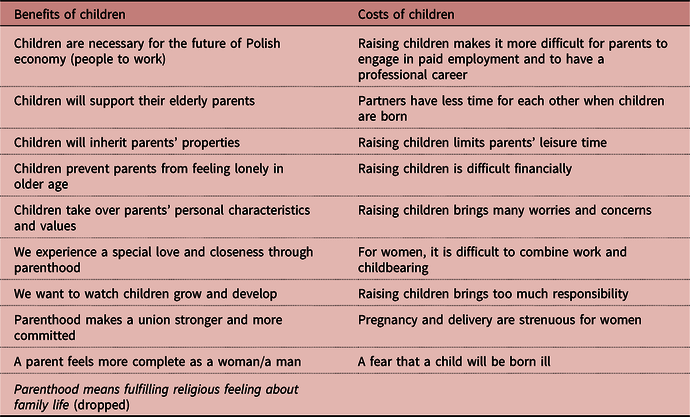
The Polish GGS included nineteen items on perceived costs and benefits of having children. Respondents were presented with each of these items and then asked to evaluate their importance for them at the moment. Table 1 shows all of the benefits and costs of having a child included in the survey. Answers were given on a 5-point scale. They were re-coded so that the highest value corresponded to ‘very important’ and the lowest to ‘completely unimportant’. On the basis of these items, two scales were then computed: one encompassing the perceived benefits and the other the perceived costs. They were calculated as the average scores of importance across benefits and costs for each individual. However, for the perceived benefits scale, the item related to religiosity (Parenthood means fulfilling religious feeling about family life) was removed, because of its collinearity with religiosity itself. Cronbach’s alpha for the scale of perceived costs amounted to 0.88 for men and 0.88 for women. For the scale of perceived benefits, the corresponding values were 0.86 for men and 0.83 for women.
List of items used to measure perceived costs and benefits of having children
Individual religiosity in part also depends on personal characteristics, such as education (Aleksynska & Chiswick, Reference Aleksynska, Chiswick, Nijkamp, Poot and Bakens2015). Within the models, this was taken into account by adding additional variables to control for age, age squared (to take the non-linear relationship between age and fertility intentions into account), partnership status (married or cohabiting vs single or not living with a partner) and education level (re-coded into: low – up to basic vocational training; medium – up to post-secondary education; and high – academic education).
Analysis
The analytical strategy of the study consisted of two parts, in which the two different mechanisms of how religiosity may matter for shaping fertility intentions were considered. In the first part, the goal was to verify whether, and to what extent, religiosity affects fertility intentions through perceived costs or benefits of parenthood, i.e. whether and to what extent its effect is mediated by them. Therefore, the total effect of religiosity on fertility intentions was disentangled into the direct and indirect effect. The direct effect describes the effect of religiosity on intentions independently of the perceived costs and benefits. The indirect effect, on the other hand, describes that part of the total effect that emerges because more- and less-religious respondents perceive costs and benefits to a different degree and therefore differ in their fertility intentions.
In the analysis, the part of the indirect effect that goes through perceived costs and the other part that goes through perceived benefits were distinguished. To capture both, the khb-package developed by Kohler et al. (Reference Kohler, Karlson and Holm2011) for Stata was used. In the case of linear models, the decomposition of the total effect into the direct and the indirect effect would be straightforward, as the coefficients of the model with and without the mediator could be compared and the difference between them captures the indirect (mediated) effect. Since the models in this study were logistic models, confounding as well as the re-scaling of the model, which can take place when additional variables are introduced, needed to be considered. The khb-package does not only take these issues into account but also provides the necessary tools to decompose the effects of multiple mediator variables.
In the second step, possible moderation effects of religiosity on the effects of perceived benefits and costs of having children on intentions were examined. The primary goal of this step was to determine whether the effect strength of perceived costs on fertility intentions declines with increasing religiosity. In order to present a complete picture, interaction effects between perceived benefits and religiosity were included as well, even though there were no specific hypotheses regarding this moderation in this study. For these analyses, four logistic regression models on fertility intentions were run. All models included religiosity as an explanatory variable. Models 1 and 2 included perceived benefits and models 3 and 4 included perceived costs. The moderation effect was assessed by the interaction effect between religiosity and perceived benefits or costs in Models 2 and 4 respectively.
For both the mediation and moderation analysis, all models were constructed separately for men and women.
Results
Descriptive results
Table 2 shows the descriptive statistics separately for women and men for all variables used in the models. Women on average ascribed a higher importance to religion in their daily lives than did men. Overall, both men and women scored higher on the index on perceived benefits of having children than on the index of perceived costs. Furthermore, there were only slight differences between men and women in their average index scores on benefits and costs and virtually no difference in their intentions. Around 22% of women and 21% of men intended to have a/another child over the next three years. In terms of the number of children respondents already had, there were some notable differences between men and women. More than a half of the men in the sample reported being childless, compared with around 40% of women. In turn, almost 40% of women had 2 or more children, compared with around 32% of men. Differences appeared in level of education and partnership status as well: women were better educated and were more likely to live with a partner and less likely to be single than men.
Descriptive statistics of analytical sample used in models: means and standard deviations for continuous variables; percentage distribution for categorical variables

a On a scale of 1–5; higher index values indicate higher religiosity or benefits and costs of having children.
Perceived benefits and costs as mediator for effect of religiosity on fertility intentions
The results of the mediation analyses were summarized in Table 3 and 4. In the upper part of Table 3, the results of the mediation analysis are summarized and the total effect of religiosity is split into direct and the indirect effects (the part mediated by perceived costs and benefits). The lower part of the table shows the share of the total effect that was mediated by each mediator separately and by both combined. Table 4 shows the associations between religiosity and the two mediator variables of perceived costs and benefits.
Separation of the total effect of religiosity on short-term fertility intentions (over the next three years) into the direct effect and the indirect effect, mediated through perceived benefits/costs (mediation analysis)
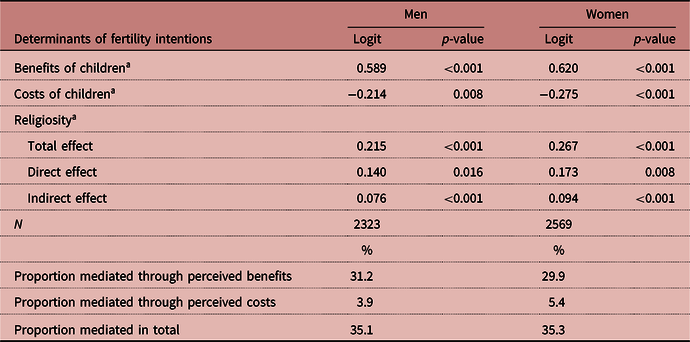
a On a scale of 1–5; higher index values indicate higher religiosity or benefits and costs of having children. All models controlled for: age, age squared, parity (number of children), partnership status, education level.
Linear regression of the relationship between religiosity and the two mediator variables (perceived costs and perceived benefits)
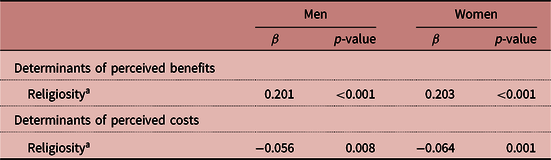
a On a scale of 1–5; higher index values indicate higher religiosity or benefits and costs of having children. All models controlled for: age, age squared, parity (number of children), partnership status and education level.
Table 3 shows a significant positive total effect of religiosity on men’s fertility intentions. Around 65% of the total effect for men was not mediated by perceived benefits and costs of having children. The remaining 35.1% of the total effect could be explained by the mediation effect of the perceived costs and benefits. Most of this mediation was carried by perceived benefits of having children: more-religious men perceived higher benefits to having children, which can be seen in Table 4. These perceived benefits themselves were associated with higher fertility intentions, as shown in Table 3. This pathway explained 31.2% of the total effect of religiosity on intentions and constituted a large part of the mediation effect. The other mediation pathway went through perceived costs, and explained the remaining 3.9% of the total effect and therefore only a small part of the mediation. Even though the effect was much weaker, more-religious men showed higher fertility intentions also because they perceived less costs of having children (Table 4) and higher perceived costs themselves were associated with lower fertility intentions (Table 3).
The results for women resembled those of men. Overall, women’s fertility intentions were also higher among the more religious. Again, this total positive effect of religiosity was split up into the direct effect, which accounted for 65% of the total effect, and the indirect (mediated) effect, which was responsible for the remaining 35%. There were some slight differences in the distribution of the mediation effect in comparison with men: around 30% of the effect of religiosity on fertility intentions was mediated by the fact that more-religious women saw higher benefits in having children, which then were associated with higher fertility intentions. Compared with men, the share of the total effect mediated by the perceived costs, again associated with lower fertility intentions, was higher for women and stood at 5.4%.
All in all, the results showed that a part, but not all, of the positive effect of religiosity on fertility intentions could be explained by more-religious people perceiving children as more beneficial. Notably, the proportion that was mediated was almost identical for men and women. Furthermore, only a very small part of that overall effect could be explained by religious people perceiving lower costs of having children. Among women, perceived costs explained a slightly larger part of the total effect than among men.
The moderating impact of religiosity
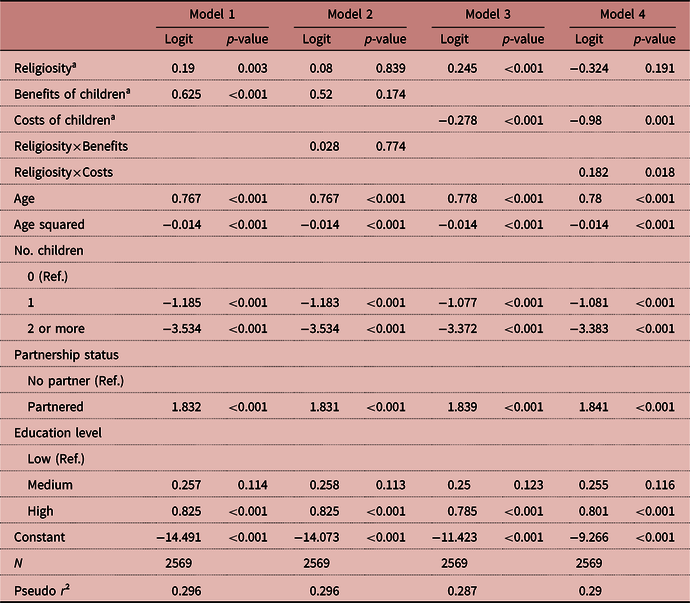
Tables 5 and 6 show the result of the models on the moderating impact of religiosity on the effect of perceived benefits and costs on fertility intentions for men and women respectively. These tables are accompanied by Fig. 1, which shows the predicted probabilities of fertility intentions for all calculated interaction effects in the models.
Results of the logistic moderation analysis of the effects on short-term fertility intentions (over the next three years) for men
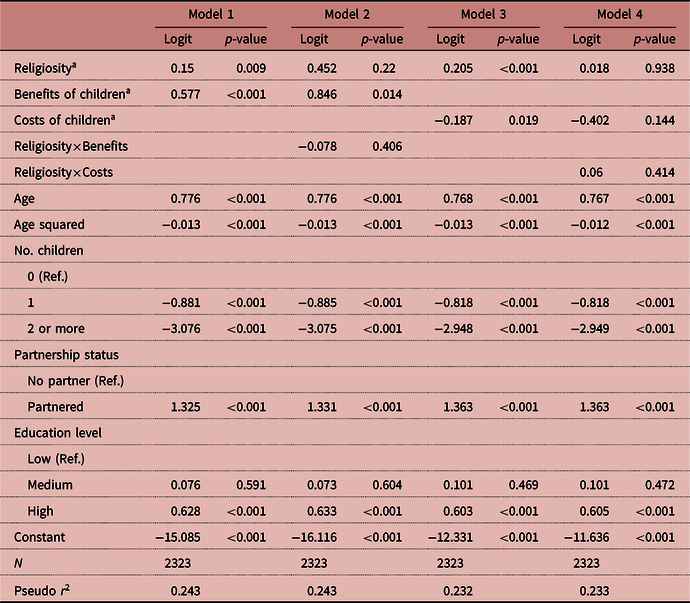
a On a scale of 1–5; higher index values indicate higher religiosity or benefits and costs of having children.
Results of the logistic moderation analysis on the effects on short-term fertility intentions (over the next three years) for women
a On a scale of 1–5; higher index values indicate higher religiosity or benefits and costs of having children.
Predicted probabilities of intending to have a/another child over the next three years by religiosity and perceived benefits or costs of having children. Graphical representation of all interaction effects.
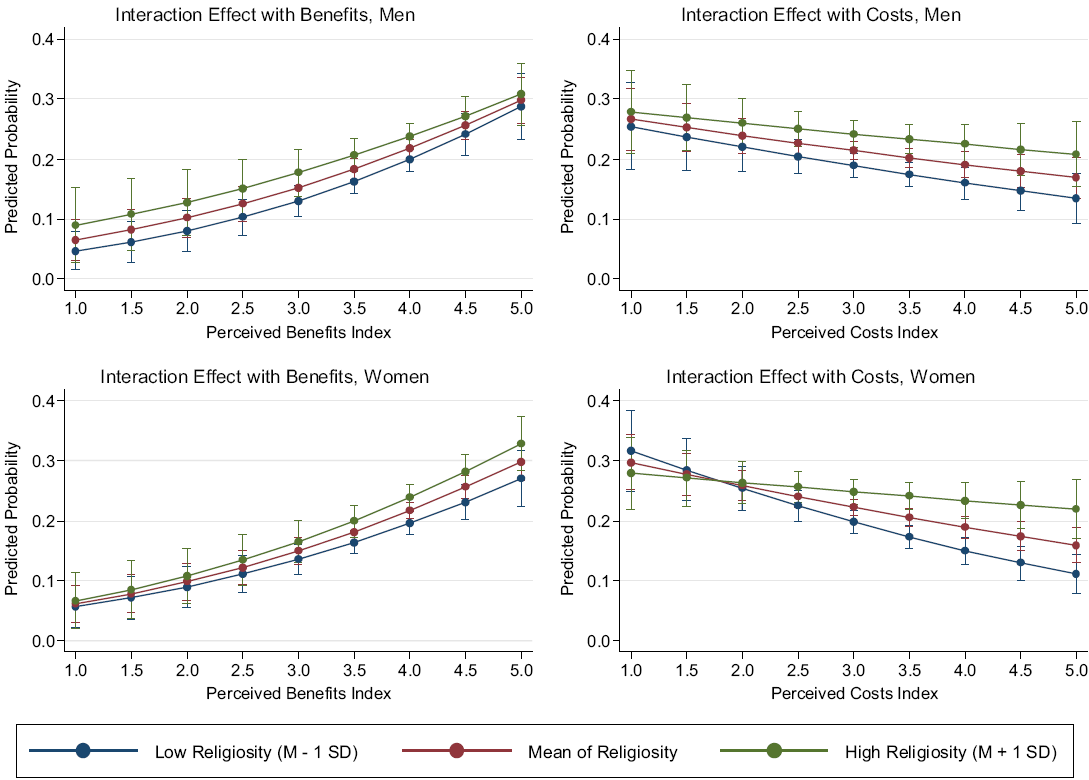
The results of the first model mirrored those found in the mediation analysis and demonstrated that men who perceived higher benefits of having children and more-religious men were significantly more likely to intend to have a/another child over the next three years than men who perceived lower benefits and less-religious men, respectively. In Model 2, an interaction term between religiosity and perceived benefits was introduced. This interaction term was not significant, however, and Fig. 1 shows that fertility intentions increased with higher perceived benefits irrespectively of the level of religiosity.
Model 3 assessed the impact of religiosity and perceived costs of having children on fertility intentions. Similarly to the first model, there was a significant positive effect of religiosity. In line with expectations, higher perceived costs of children significantly reduced fertility intentions. The last model again incorporated an interaction term, this time between religiosity and perceived costs. While that interaction effect was positive, which would be in line with the theoretical expectations, it was not significant.
In the case of women, the results in the first two models resembled those of men. Again, there was a significant positive effect of religiosity and perceived benefits of having children on fertility intentions. The interaction term was not significant, and Fig. 1 shows only marginal differences in the relationship between perceived benefits and fertility intentions by the level of religiosity, akin to the situation of men. Model 3 repeated the findings for men as well – a significant negative effect of perceived costs of having children on the likelihood of intending to have a/another child over the next three years. In the fourth and last model, the interaction effect between religiosity and perceived costs was introduced. For women, this interaction term was positive and significant. It indicated that the negative effect of perceived costs on fertility intentions was weaker for more-religious women than for less-religious women. Figure 1 shows that for highly religious women, fertility intentions stayed at a relatively high level independently of the amount of costs perceived. For less-religious women on the other hand, fertility intentions dropped considerably as the perceived costs increased.
Summarizing the findings on the moderation analysis, it follows that only in the case of women, higher religiosity led to a lower impact of perceived costs on fertility intentions. For men, no significant effect was observed. Furthermore, there were no moderation effects of religiosity on the impact of perceived benefits of having children for men nor women, indicating that higher perceived benefits increased the likelihood of intending to have a/another child irrespective of religiosity.
Discussion
The aim of this study was to investigate the mechanisms behind the positive influence of religiosity on fertility intentions that has been observed in many countries (Philipov & Berghammer, Reference Philipov and Berghammer2007; Bein et al., Reference Bein, Gauthier and Mynarska2017). Following theoretical considerations and previous research on this topic (Brose, Reference Brose2006; Arránz Becker & Lois, Reference Arránz Becker and Lois2017), two possible mechanisms linking religiosity, perceived costs and benefits of having children, and fertility intentions were examined. First, it was hypothesized that religions influence how people perceive costs and benefits of having children: religious individuals might perceive higher benefits and lower costs of parenthood and consequently, they might be more likely to intend to have a/another child compared with their less-religious counterparts. In other words, it was hypothesized that the effect of religiosity on childbearing intentions is mediated by the perceived costs and benefits of children (H1).
As for the second possible mechanism, it was postulated that religiosity moderates how perceived costs translate into fertility intentions. It was hypothesized that the negative effect of perceived costs on fertility intentions may be weaker among the more religious, meaning that for the more religious, perceptions of cost play only a small role in the formation of their fertility intentions (H2). To get a full picture, the moderation effect of religiosity was tested also in relation to how perceptions of benefits impact fertility intentions.
The results indicated that, in this Polish sample, around one-third of the effect of religiosity on fertility intentions was mediated by perceived costs and benefits for both men and women, bringing some support to Hypothesis 1. Two additional findings appeared: first, while both perceived costs and benefits played a role in the mediation effect, perceived benefits mediated the lion’s share of the effect. This suggests that religions mostly encourage their followers to have children by emphasizing benefits of parenthood, for example by promoting children as a blessing and stressing their emotional value (Catechism 2366-2379). Those findings are generally in line with the two previous studies on fertility behaviour in Germany (Brose, Reference Brose2006; Arránz Becker & Lois, Reference Arránz Becker and Lois2017).
Secondly, a substantial direct effect of religiosity on fertility intentions remained that was not explained through the perceived benefits and costs of having children. On the one hand, it is possible that the selection of items on perceived costs and benefits of children used in the Polish survey did not cover all relevant aspects of parenthood. For example, fulfilling expectations of significant others or continuing the family among the benefits, and increased instability of partnership or possible hardships for the partner among the costs were not part of the questionnaire used in this study (Miller, Reference Miller1995; Guedes et al., Reference Guedes, Pereira, Pires, Carvalho and Canavarro2015). If religious people attach more importance to these missed aspects, part of the mediation effect could have remained hidden in the presented analyses. Another possible explanation is that the remaining direct effect stands for the influence of the particularized theology, which represents direct pronatalist religious teachings eminent in the Catholic Church. Those pronatalist teachings may exert an independent normative pressure on religious individuals, prompting them to have children regardless of their personal beliefs on positive or negative aspects of parenthood. That way, the findings give support to the notion that particularized theology still plays a non-negligible role in the overall impact of religiosity on fertility.
As for the second examined mechanism, the study brings only limited support to Hypothesis 2. It was found that religiosity moderated the impact of the perceived costs of childbearing on fertility intentions only for women. In line with expectations, the results revealed that the negative effect of perceived costs on fertility intentions becomes weaker as religiosity increases. Among very religious women, perceived costs of children had only a small effect on fertility intentions, while for the least religious women, perceived costs were a strong negative determinant of intentions. In other words, highly religious women seem to be inclined to have children regardless of any costs children may carry for them. No such effect was found for men. Several possible explanations may be applied here. For instance, it is possible that women either benefit, or believe that they can benefit, more than men from practical and emotional support in religious communities when a child is born (e.g. by family members, friends, religious groups and institutions). It is also possible that the overall negative impact of perceived costs on intentions is weaker for men, thus leaving fewer possibilities for likely interactions. Some of the items on costs included in the Polish survey are also more important for women (pregnancy is strenuous, difficult to combine work and childbearing for women) and thus, they impact men’s fertility intentions indirectly and probably to a lower degree. Furthermore, even the items that apply to men directly (e.g. having less time for leisure or for a spouse) may not impact them as much as they impact women in a country like Poland, where traditional gender roles are still widespread and women are expected to provide most of the care and time for children (Mills, Reference Mills2010; Szelewa, Reference Szelewa, Auth, Hergenhan and Holland-Cunz2017). In that situation, more-religious women may count on help from their religions and social networks that support them in their decision to have large families regardless of the costs. In a more-egalitarian gender context like Germany on the other hand, evidence of a moderating effect has been found for both men and women (Arránz Becker & Lois, Reference Arránz Becker and Lois2017).
The picture that has emerged in this study is that the effect of religiosity on fertility is mostly mediated through perceived benefits of parenthood, while the moderating effect of religiosity relates to the perceived costs. Specifically, religions seem to amplify perceived benefits of having children and at the same time limit the impact of costs related to childbearing. Furthermore, the study demonstrated that these mechanisms are visible for fertility intentions already, pointing to the role of religiosity at the early stage of the fertility decision-making process. A future avenue of research may thus be to examine the fertility decision-making process in more detail. First, fertility intentions could be analysed together with their realization in order to verify whether high religiosity leads to having more children by helping people to cope with the high costs associated with childbearing (the second part of the mechanism). Second, the process could also be examined by parity, since previous research on determinants of fertility intentions has suggested some parity-specific effects (Philipov & Berghammer, Reference Philipov and Berghammer2007). Due to limitations in the sample size, it was not possible to carry out the analysis by parity in this study.
In future and more-detailed analyses, it would be crucial to consider different categories of perceived benefits and costs of children. While costs and benefits were modelled here as single dimensions, it is possible that different categories, like direct economic consequences, opportunity costs or non-economic costs and benefits, might have varying effects for religious and non-religious people. Making a distinction between different types of costs and benefits of children could allow the depiction of more-refined mechanisms in which religiosity shapes fertility. Importantly, these mechanisms might play out differently in various economic contexts. While the current study took place during a relatively good economic situation in Poland, the monetary and indirect costs of children may be perceived in a different way under more-challenging economic conditions.
Overall, future studies need to investigate whether the relationships described here hold true across time and space. Longitudinal studies and cross-country comparisons would also shed light on the question of whether the identified mechanisms can be applied across other cultural settings. In very secular countries, for instance, where highly religious people are a more-select group and religion has less influence in society, the nature of these mechanisms may be different than in Poland or Germany.
Funding
Monika Mynarska acknowledges support from the National Science Centre (Poland), grant number 2015/17/B/HS4/02086.
Conflicts of Interest
The authors have no conflicts of interest to declare.
Ethical Approval
The authors assert that all procedures contributing to this work comply with the ethical standards of the relevant national and institutional committees on human experimentation and with the Helsinki Declaration of 1975, as revised in 2008.


 Open access

