


Previous translations and analyses of the prophecies present many issues. The first, and main one, has been the poor management of the language, as Hanks already pointed out for Edmonson’s translation (Hanks Reference Hanks William1988). I will not expand on this criticism, since I already have done it somewhere else (Le Guen and Machault Reference Le Guen and Machaultin press). Also, Bricker and Miram (Reference Bricker and Miram2002), have since shown that a correct translation is possible and, indeed, necessary.
Another issue is that the Books of Chilam Balam have often been translated and analyzed individually, as if each one constituted a single, cohesive book: The Chilam Balam of Kaua (Bricker and Miram Reference Bricker and Miram2002), of Tizimín (Edmonson Reference Edmonson1982), of Chumayel (Edmonson Reference Edmonson1986), and so on. However, as I mentioned earlier, these so-called books are actually compilations of highly heterogeneous texts, whose main commonality is often that they were found together in a single folder or transcribed by a single individual.
Finally, and the main critique I address in this paper, the texts from the so-called Book of Chilam Balam have been studied only from a historiographic perspective. Researchers such as Roys (Reference Roys1933, Reference Roys1949), Edmonson (Reference Edmonson1982, Reference Edmonson1986), Barrera Vásquez and Rendón (Reference Barrera Vázquez and Rendón1948), and others have treated the writings in the Chilam Balam books as potential emic historical sources. Chuchiak even goes so far as to state: “I consider the Chilam Balam books to be historical chronicles of events experienced by the Maya community, and not mythological or esoteric events, as has often been concluded” (Chuchiak Reference Chuchiak2013:16). Similarly, Gunsenheimer (Reference Gunsenheimer2002, Reference Gunsenheimer2009) argues that most of the prophecies concern the relationship between the colonized Maya and the Spanish. However, many interpretations verge on speculation, particularly because scholars often allow themselves to interpret pre-Hispanic Maya metaphors whose original referents have arguably been lost, making the precise meanings of these metaphors nearly impossible to determine.
The analysis I propose here is based on the notion of intertextuality and focuses on one specific genre: the prophecies. This approach offers several advantages. First, it allows for the analysis of comparable texts, making comparison meaningful. Second, in terms of translation and methodology, it enables parallel translation of similar texts, which not only simplifies the task but also helps to avoid decontextualized interpretations. Finally, it allows us to observe possible evolutions in the interpretation and modification of the texts by the original authors and/or copyists, as well as shifts in the meanings of certain words or roots.
I will show, on the one hand, that three types of prophecies can be identified: traditional, transitional Christianized, and Christianized. Several features are used to distinguish these categories, such as the presence of loanwords, modifications in the structure of the prophecy, and grammatical changes. On the other hand, I will argue that specific words and concepts should be interpreted differently depending on the textual context of each prophecy. Crucially, I will demonstrate how certain words and concepts have been deliberately semantically modified to align with new Christian ideas. While traditional Maya prophecies primarily focus on concerns about good governance by local rulers, the same passages are later reinterpreted as predicting (and explaining) the rule of a universal Christian God and put emphasis on individual values in accordance with the Catholic doctrine.
Introduction
The colonial context. Reducción, language, and Maya intellectuals
The process of the reducción, as pointed out by Hanks (Reference Hanks William2010), was more than merely the congregating of Maya populations in urban centers; it endeavored to shape Indigenous people into Spanish subjects and Christian worshippers, modifying their ethics, worldview, and morality. Hanks also shows how Franciscan friars managed to understand, describe, and also alter the Maya language for the purpose of conversion.
Importantly, for the conversion to be successful, the friars were rapidly forced to delegate the spreading of the new words to native people. The maestros cantores, Maya intellectuals converted to Christianity, were instrumental in this endeavor. They were local Maya speakers who learned Spanish, sometimes Latin, but, crucially, knew how to write in Spanish and Maya. Although Christianized and educated by the Franciscans, it was they who often presided over religious activities (leading prayers, processions, and even sometimes consecrating Mass elements) in remote villages (Campos León Reference Campos León2006). As pointed out by Christensen, friars often recruited for the position of maestros cantores local elites such as aj k’iin (traditional Maya priests) and aj t’síib kaaj (town scribes) who themselves saw an opportunity in this new colonial structure to maintain their religious and intellectual authority (Christensen Reference Christensen2016:4). These new authorities were formed as Christian leaders and religious authorities but, because of their ancestry, still knew ancient (probably mainly oral) texts and rituals, which they likely put in writing. It is probable that the maestros cantores wrote—and authored, as I will show—many parts of the Books of Chilam Balam, in particular the prophecies.
The sources: the Books of Chilam Balam and the prophecies
The Books of Chilam Balam are colonial manuscripts written in Maya using the Latin alphabet. Contrary to what the label suggests, these “books” are in reality collections of writings gathered in a single folder. The contents and dates of the texts can differ greatly. The main genres are translations and adaptations of European texts (e.g., almanacs, treatises of cosmology or astrology), medicinal recipes (usually a mix of European and local Maya treatments), tsol k’iin (Maya almanacs that focus on the intrinsic qualities of the days), prophecies (texts meant to explain the k’atun, or 20-year periods, and to predict the content of each period in terms of calamities and political regimes), and, finally, what has often been misidentified as prophecies: the k’ajlay. These texts are the closest thing to a Maya historiography and many are “disguised” as prophecies, beginning with k’atun 11 or 13 (e.g., f. 85–86 in the Chumayel), but they are of Hispanic tradition. Additionally, many k’ajlay were later mis-titled in the compiled books as Profecías, “prophecies” (e.g., Chumayel f. 104–107; Maní f. 37–45). In this study I focus only on the prophecies as defined below.
The prophecies are usually presented as a cycle of 13, one for each k’atun in the following order: 11, 9, 7, 5, 3, 1, 12, 10, 8, 6, 4, 2, and 13. My corpus is based on five cycles taken from four different Books of Chilam Balam: one complete cycle from the Chilam Balam of Kaua (manuscript from the Princeton University Library, f. CXIX–CXXIV), two compete cycles from the Tizimín (Mayer Reference Mayer1980:f. 16r–22r) (note that in the original edition some page are repeated and 18r is actually 20r), one complete cycle from the Chilam Balam Oxkutzcab (in the Perez notebook 2, pp. 187–224), and one compete cycle from the Chumayel (Gordon Reference Gordon1913:f. 83–100). Since two prophecies are missing from the Tizimín, the corpus amounts to a total of 63 prophecies.
Importantly, the prophecies are not historical texts. Their content is primarily prophetic and these texts are ritual and political in nature. They have no dates in the original text (besides the name of the k’atun of course), they do not describe historical events, and they are basically impossible to date. I consider that they constitute a subgenre and are self-contained texts. I will explain in detail the structure and characteristics of the prophecies below, but let us first consider the methodology and process of translation.
The methodology
All the prophecies from the corpus were translated using the methodology employed in Le Guen and Machault (Reference Le Guen and Machaultin press), based on a four-line translation with interlinear gloss.
The first line shows the precise paleography of the original text. The second line is an interpretation of the paleography written using modern orthography. In most previous translations of the Books of Chilam Balam (as well as many colonial texts), authors kept the original Maya text in colonial orthography. However—although they do not tell the reader—they all interpreted and reconstructed the text, inferring the missing elements (glottal stops, tones, etc.). In Le Guen and Machault (in press), we wanted to make this phase visible to readers and offer our honest interpretation of the original text using a writing system that represents pronunciation (in other words, that accurately reproduces the phonology of the language using tools that colonial writers lacked). It is crucial to point out that it is in no way intended to rewrite colonial Maya into an equivalent of modern Maya. According to this methodology, the path of interpretation is explicit and carefully presented, with the intention that other researchers can understand the reading of the original text and be able to critique the analysis. The third line clarifies the second by providing a linguistic analysis through an interlinear gloss of the words and morphemes in line 2 (with a gloss provided below). The fourth line is the translation into the target language. This translation tends to be quite literal, as it attempts to closely represent the content of the Maya text. Consider the following example, in (1).
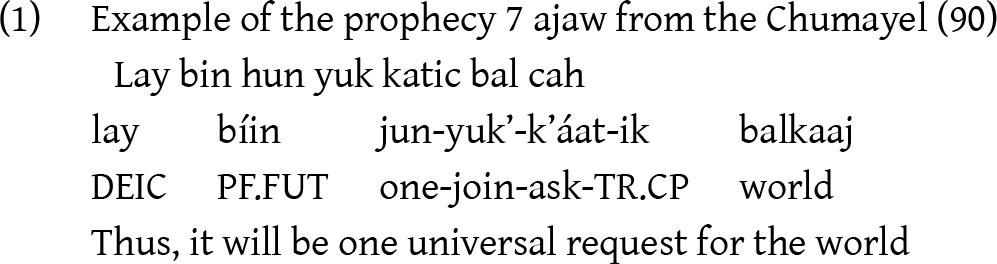
In the colonial orthography, tones were not marked. As a result, a word like bin could be interpreted in multiple ways—for example, as “to go” or as a prophetic future. The latter is pronounced with a high tone, unlike the third-person form of the verb “to go” (bin-ø, “he/she goes/went”). By transcribing the original text using a modern orthography and providing a gloss, readers are better equipped to evaluate the interpretive process. A similar case arises with hun yuk katic, which is interpreted here as a compound meaning “one universal request.” A literal, word-by-word translation that ignores grammar might produce a nonsensical result such as jun, “one,” k’at, “tremble,” and k’aat, “clay pot.” Supporting my interpretation, note that the Diccionario de Motul (Motul dictionary) indicates that, in compound forms, yuk’ refers to cosa universal que comprende todo (“a universal thing that encompasses everything”) (Barrera Vázquez Reference Barrera Vázquez1980:981). Additionally, another dimension considered in the translation is intertextuality, a crucial notion thoroughly discussed by Hanks (Reference Hanks William1992, Reference Hanks William2000, Reference Hanks William2010) in relation to colonial Maya texts. As I shall discuss below, in the prophecies, the universal dimension becomes increasingly prominent in Christianized versions. Therefore, coming back to the example in (1), the use of yuk’ (“join, universal”) and balkaaj (“world”) is not coincidental but reflects a recurring theme in more Christianized texts.
This approach aligns with the critiques by Hanks (Reference Hanks William1988) and Bricker and Miram (Reference Bricker and Miram2002) of earlier translations, which tend to be “essentially word translations, rather than grammatical translations” (Bricker and Miram Reference Bricker and Miram2002:9). However, the methodology I employ improves on these by including grammatical analysis and preserving the original oral structure of the text—particularly its use of parallelism. Moreover, a comparative translation of similar prophecies from different cycles enables an intertextual interpretation.
The structure of the prophecies
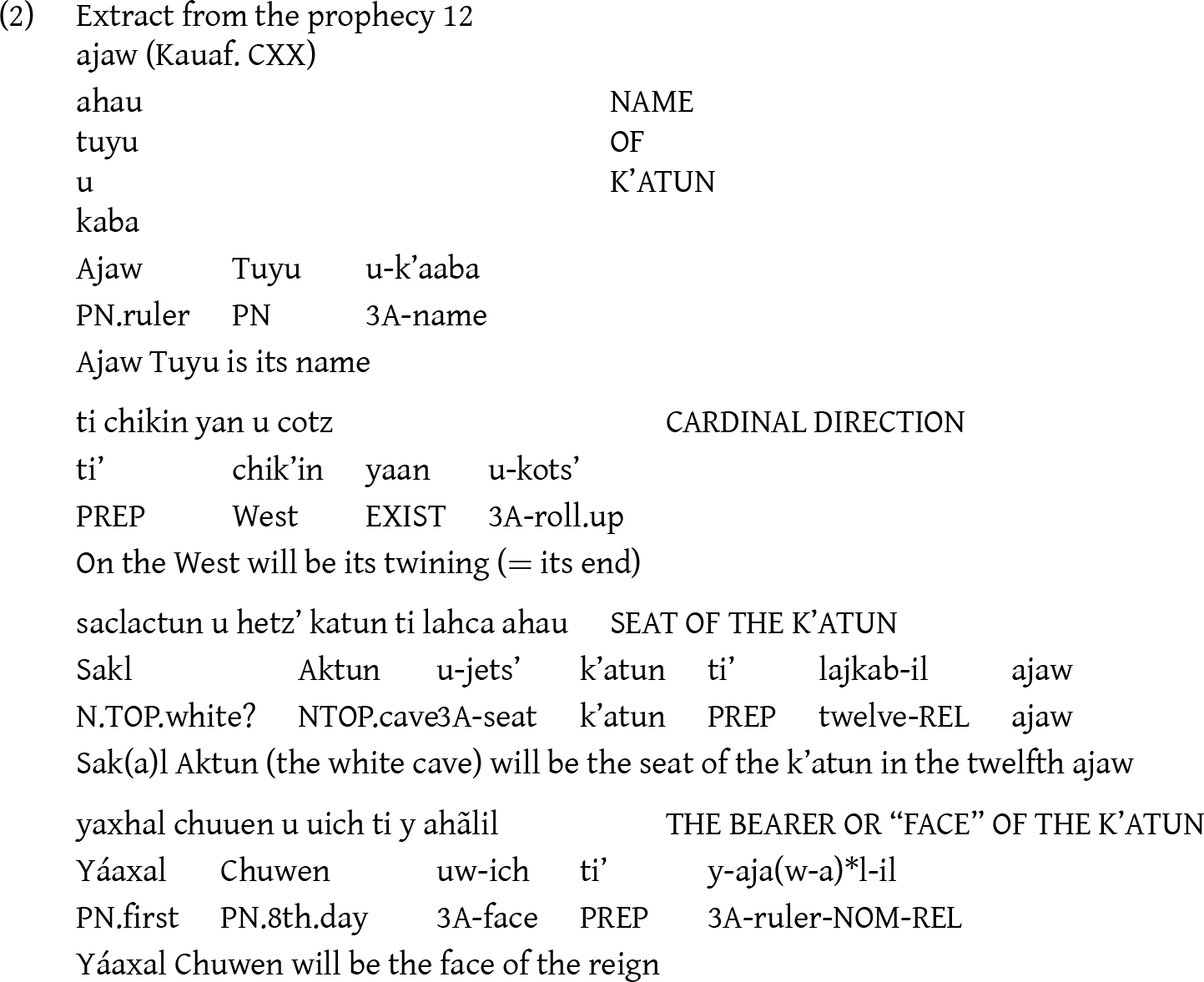
The prophecies form a coherent body of texts due to specific defining characteristics. The most notable—though not exclusive—is the mention of the ajaw number of the k’atun, which gives the cycle its name. This designation is based on the final day of the cycle, as in k’atun lajkab ajaw (the k’atun 12 Ajaw). However, this feature is not unique to prophetic texts; it also appears at the beginning of k’ajlay or “historical chronicles,” which may explain why the two genres have often been confused by researchers.
A second feature, although not present in every prophecy, appears to have been traditional: the mention of the bearer of the k’atun, referred to in Maya as “its face” (uy-ich). This bearer is always a Maya entity—perhaps the reason it tends to appear less frequently in more Christianized prophecies. The seat of the k’atun—an identifiable city in the Yucatán Peninsula—is also always mentioned, and occasionally accompanied by a cardinal direction. These last two features highlight that the k’atun cycle was closely tied to political and geographical (or symbolic) shifts in power across the peninsula. In Christianized prophecies, approximately half identify Ichka’ansijo’ (present-day Mérida) as the k’atun seat. This reflects their more recent composition and serves as a reminder that by the time these texts were written, the traditional practice had already fallen into disuse.
To illustrate these features, consider the beginning of the 12 Ajaw prophecy from the Kaua manuscript, in (2).
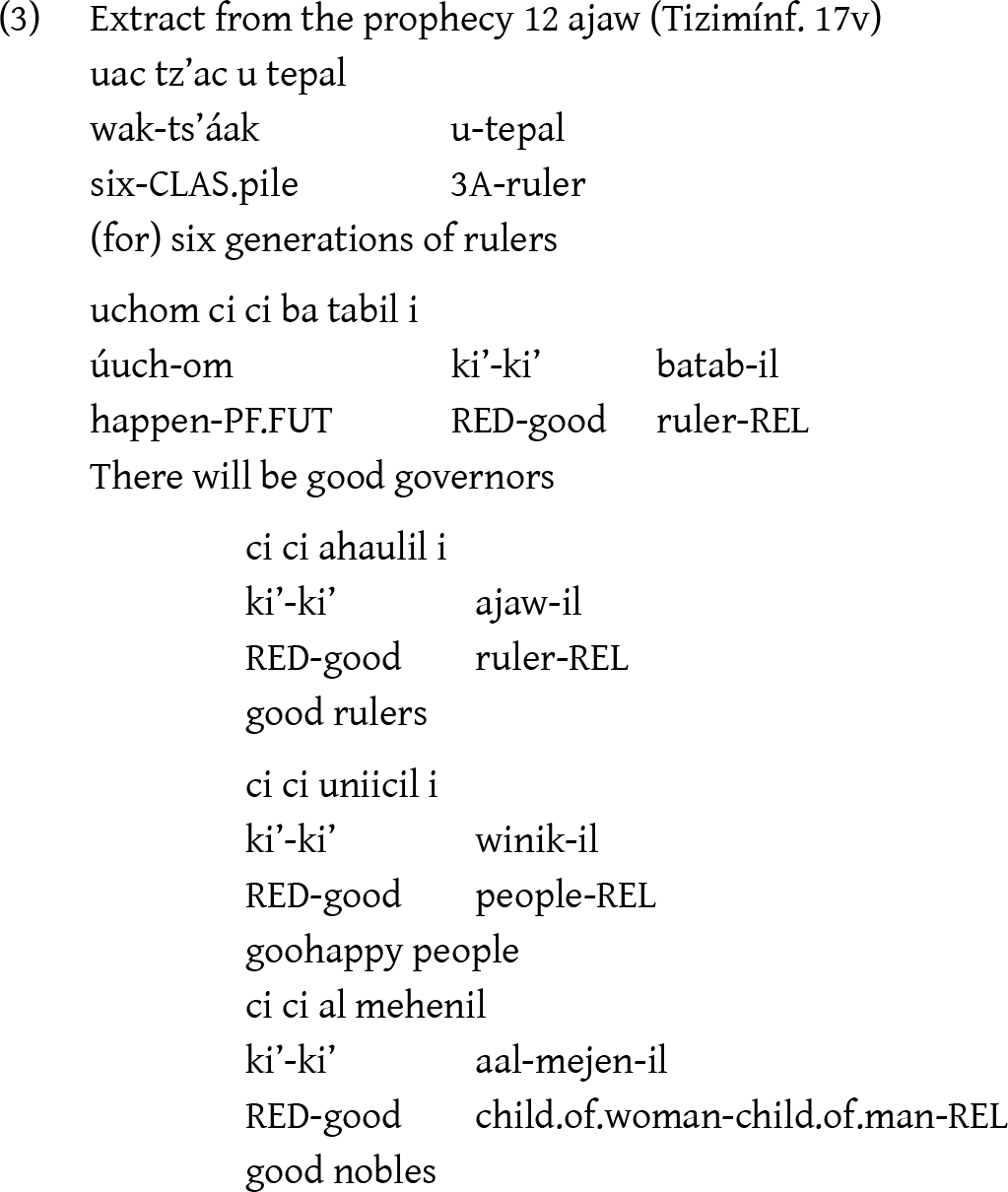
In addition to these features, a crucial component of the prophecies is the description of the main events associated with each k’atun, typically conveyed through recurrent diphrasism. Some of these serve merely to indicate the general valence of the k’atun—whether positive or negative—while others are more specific in content. Consider, for example, the éemom taab//suum, “The ropes//cords will descend,” a recurrent diphrasism in many prophecies, which appears to signal a negative event. In other cases, such as an example extracted from the prophecy 10 ajaw (Tizimín, f. 17v–18r), the main event involves a more concrete description: péeknom so’ot, péeknajom kantúul bakabil, “the rattles will sound, the four Bakab will dance,” that is, the sounds and dance performed by the representative of power, the Bakab. Traditional prophecies almost always include some commentary on rulers (see example in [5] below). On the contrary, good governance makes people happy and seems to have been encouraged, as in the following example in (3).
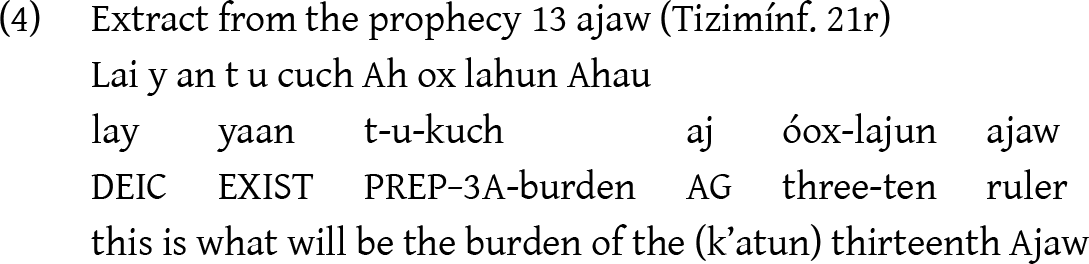
Finally, many prophecies end with a specific sentence that marks the end of the text, typically something like the following sentence, in (4).
In addition to these specific characteristics, some prophecies refer to the words pronounced by the priest Chilam Balam. However, and although the books are called after this title and these priests were crucial in the reading and deciphering of the book, the name Chilam Balam is only mentioned once in the prophecies and two other times as aj k’iin Chilam, “the sun priest Chilam.” Two other features, which I will not detail either here but must be mentioned, are the increasing use of direct speech in more Christianized prophecies and the mention of the Itzaj, employed as a literary metaphor for the imagined ancient Mayas. Both direct speech and the mention of the Itzaj often appear together, indicating the creation of a new literary Maya style influenced by the Hispanic tradition.
Three types of prophecies
The study of the 63 prophecies from four Books of Chilam Balam indicate that, although they belong to a similar subgenre of “prophecies,” they do not all display the same content. Specifically, the prophecies can be classified in three groups: the traditional, the transitional Christian ones, and the Christianized prophecies. Let’s detail each type.
The traditional Maya prophecies
What I refer to as traditional prophecies display specific formal features: no Spanish loan words, short and often disconnected sentences, recurrent and abundant parallelistic structures (like diphrasisms). Regarding the content, one main issue regards local politics and the behavior of rulers. There is also a greater mention of Maya entities (most likely Gods). Following proposals from various authors (Gunsenheimer Reference Gunsenheimer2009; Love Reference Love1994), these prophecies are the most likely to be direct adaptations of a pre-Hispanic codex, although this hypothesis remains largely speculative. More likely, such texts were transmitted through oral literature.
We know from Landa (Tozzer Reference Tozzer1941: 27) that the priests—likely the Aj K’iin Chilam or Chilam Báalam—regularly gathered to interpret the prophecies and explain their content and prognoses to the rulers. Since this process was likely subjective and influenced by contemporary political and religious concerns, as well as climatic and agricultural conditions, the priests’ interpretations were probably shaped by the specific context in which they were delivered.
To provide a more concrete example of a traditional prophecy, consider the 5 Ajaw prophecy in (5). For reasons of space, only the version rendered in modern orthography and its translation are included here.

The main focus of this brief text is clearly the role and ethics of the rulers. They are mentioned five times, with two key features standing out: their relationship to the land—yajaw(al)ilo’ob kaabi’ (“the rulers of the earth” or “the lords of the land”)—and their morality, as reflected in expressions such as ma’ suybe’en paalal (“impure children,” where mention to children often denotes noble lineages) and usiits’ilo’ob ajaw(a)lil (“ambitious rulers”). The text emphasizes that these rulers are to be like “foxes” or “opossums”—metaphors for poor governance—because they are constantly engaged in conflict with one another. This is expressed through the use of the reflexive reciprocal form -tambal (in u-chi’ib-il-tambal, literally, “they will bite each other”). In traditional prophetic discourse, ineffective rulers are frequently likened to certain animals. The text further states that no one will respect these leaders, forcing them to walk alone and hide—though the exact implications of this remain unclear, the tone suggests a negative judgment. This condition is attributed to their neglect of the people and of sustenance, a point underscored by the diphrasism aj tu’ubul waaj/ja’ (“those who forget about food and water”).
Transitional Christianized prophecies
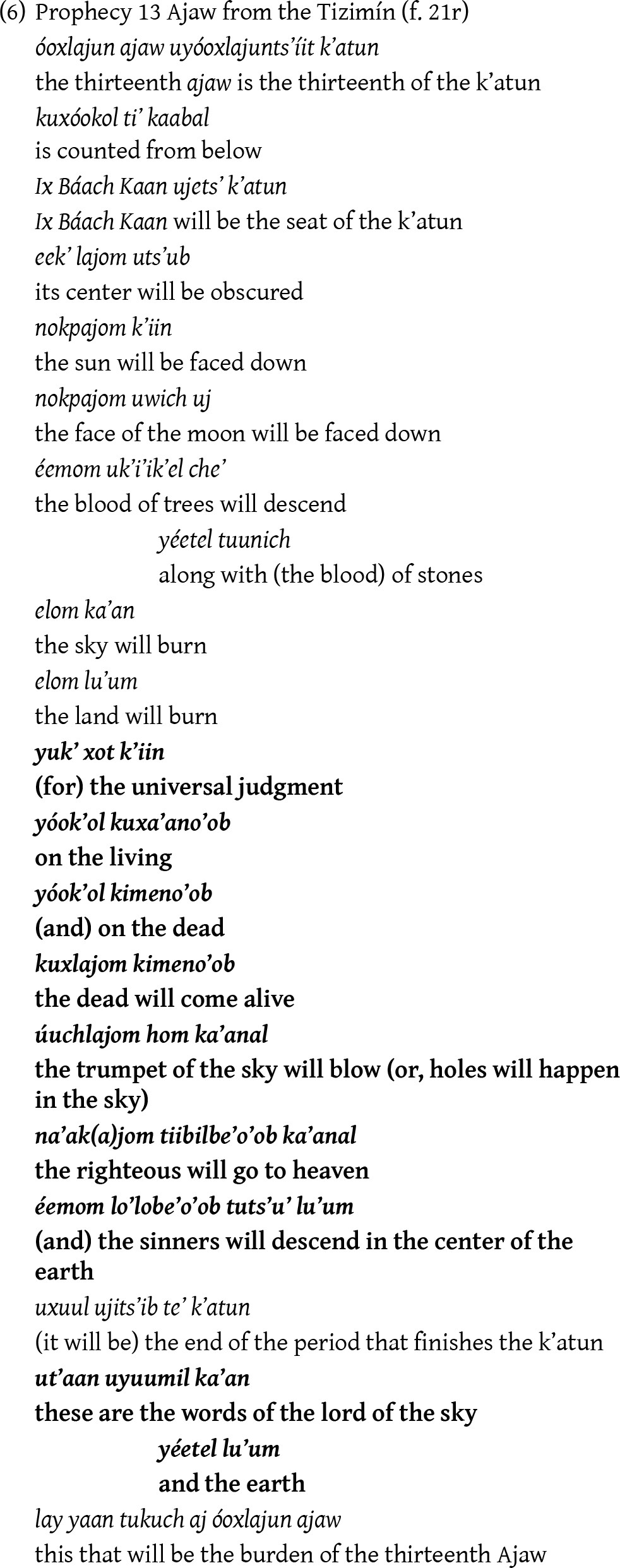
The defining characteristic of the transitional Christianized prophecies is, as the name suggests, the discreet incorporation of Christian ideas. I use the term subtle because Christian concepts and terminology are consistently rendered in the Maya language. These prophecies contain relatively few Spanish loanwords, and their structure differs slightly from that of traditional prophecies: they tend to be somewhat longer and more explicitly centered on Christian themes. Many times, we can even notice insertion of Christian texts, as in the case of following example from the prophecy 13 ajaw, in (6). Once again, for reasons of space, only the version rendered in modern orthography and its translation are included here.
As noted above, the first half of the prophecy follows the structure and themes typical of traditional k’atun prophecies. It names the k’atun and its corresponding seat, and includes several diphrasisms referring to potential calamities during this period: the sun and moon will be cast down, the blood of trees and stones will flow, and the sky and land will burn. Although these metaphors are difficult to interpret precisely, they clearly suggest negative prognoses.
The Christian insertions are clear even though the passage remains entirely in the Maya language. Notably, the categories of “the living” and “the dead” appear here for the first time in the prophetic corpus. Also significant is the application of the universal qualifier yuk’ (“whole, universal”)—already mentioned in example (1)—to the Franciscan neologism xot k’iin, referring to the Day of Judgment. This section conveys the Christian concept of resurrection, articulated in Maya: Judgment Day will concern both the living and the dead; the dead will rise again, the righteous will ascend to heaven, and sinners will descend into “hell,” expressed here as tuts’u’ lu’um—literally, “the center of the Earth.” This will occur while the trumpet of the sky is blown, as stated in the Bible (e.g., 1 Corinthians 15:52: “for the trumpet shall sound, and the dead shall be raised incorruptible”). Note that another possible translation for this sentence is “holes will occur in the sky,” although it is less likely.
Interestingly, references to the Christian God are never made using Spanish terminology. Instead, the deity is consistently named in Maya, either as Hunáab K’u’ (“the one divine”) or, as in this passage, uyu’umil ka’an yéetel lu’um (“the lord of the sky and the earth”).
The Christian prophecies
The third category I propose is Christian prophecies, that is, texts that are more clearly influenced by Christian themes but also Spanish writing style and that provide extracts that seem directly taken from sermons. The loan terms from Spanish, especially for religious, are now abundant, for instance Dios, “God,” anticristo, “Antichrist,” xptianoili, “Christianity,” Justicia, “(divine) Justice,” obispo, “bishop,” etc. The main issues dealt in these prophecies are themes from the Cristian faith and the idea of universality. We also notice the frequent use of direct speech and the mention of the Itza’ as idealized pre-Hispanic Mayas. Several words are also resemanticized, as I will establish below.
In order to demonstrate how Christian prophecies differ from traditional ones, but also how the linguistic motives have been reinterpreted to fit the Christian message, let’s consider the following example in (7), comparing an extract from the same prophecy 2 Ajaw from the Tizimín and the Chumayel. Only the text with modern orthography and the translation are presented.
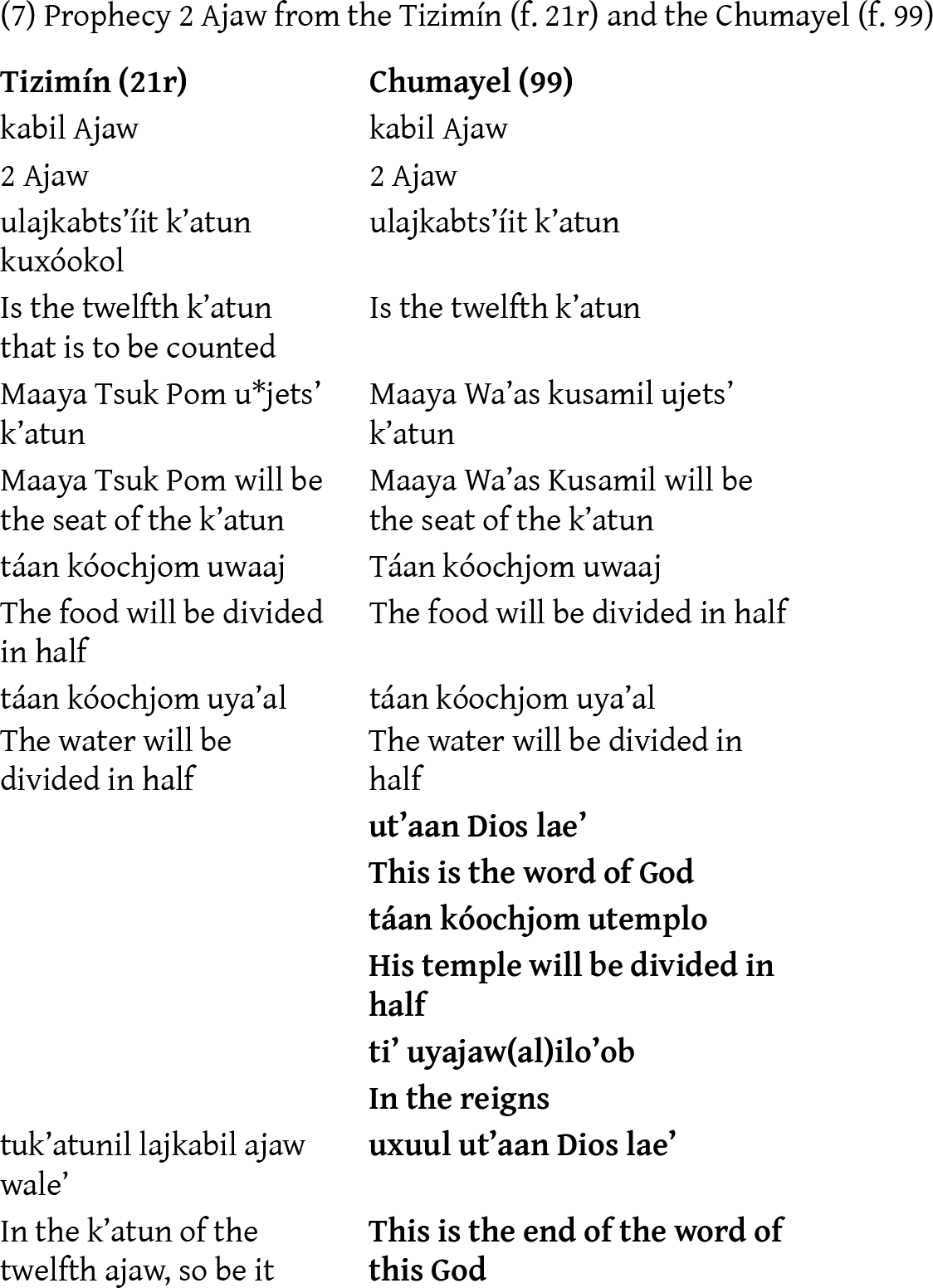
A comparison of the two versions of the same prophecy reveals that part of the text from the traditional Maya prophecy has been retained. While the seat of the k’atun changed from Maaya Tsuk Pom to Maaya Wa’as Kusamil, the sentence structure remains consistent. However, the second half of the Christian prophecy diverges significantly with a clear insertion of a Christian segment. This part addresses the word of God (referred to as Dios, a Spanish loanword) and His temple (also termed templo, again using a Spanish loanword). The central theme of the prophecy concerns the division of food and water in half. Notably, the Christian prophecy revisits this motif but applies it to God and Christianity, explaining that the temple of God will likewise be divided, employing the same Maya construction táan.kóoch-j-om (glossed as half-CP-PF.FUT).
Other features of Christian prophecies include more complex and lengthier sentences, as well as recounting of past events. There is also an evident alignment with Spanish lexicon and grammatical structures. For example, traditional prophecies consistently denote noble lineage using aal-mejen (“child of woman-child of man”), whereas Christian prophecies favor mejen as the sole term for “children,” reflecting a patrilineal emphasis consistent with Hispanic tradition. Finally, the number of parallelistic structures and diphrasisms is considerably reduced.
Summary of the types of prophecies from the corpus
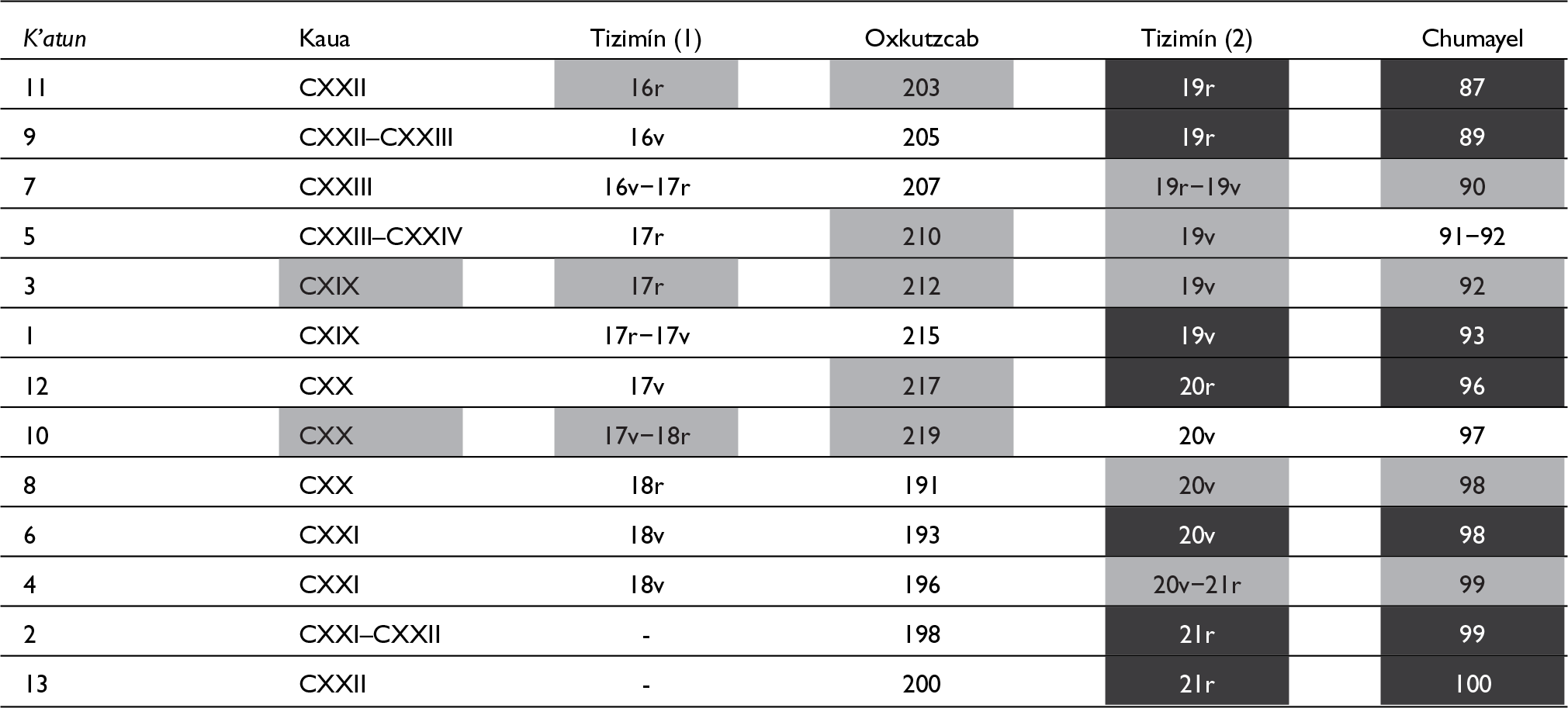
Table 1 displays the prophecies from the corpus classified according to the three categories established above. The white cells indicate the traditional prophecies, the light gray cells the transitional Christianized prophecies and, the cells in black the Christian prophecies. The numbers correspond to the original folios.
Types of prophecies from the corpus and the corresponding folios
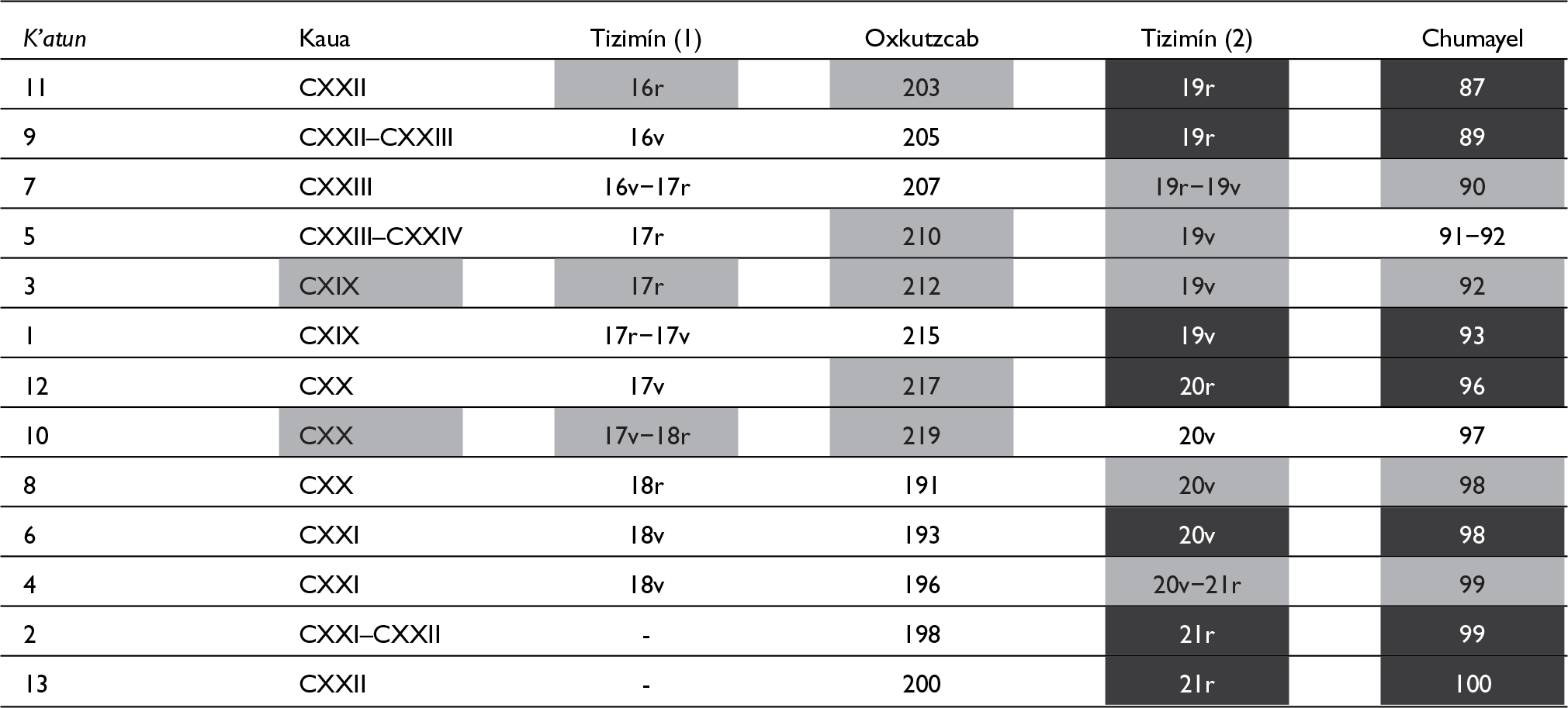
Note: white cells = traditional prophecies; light gray cells = transitional Christianized prophecies; black cells = Christian prophecies. Numbers correspond to the original folios: v = verso; r = recto.
A preliminary examination of the distribution of prophecy types reveals that each prophecy must be considered individually. While it is true that all the Christian prophecies are present in the Chilam Balam of Chumayel, it would be erroneous to classify this Chilam Balam as “Christian.” Alongside the Christian prophecies, there are also two traditional prophecies that remain largely unaltered, as well as four that have been transitionally Christianized.
This distribution suggests that the traditional prophecies are the oldest, the transitional Christianized ones are intermediate, and the explicitly Christian prophecies are the most recent. This interpretation is grounded in the historical evolution of liturgical traditions on the Yucatec peninsula. As previously mentioned, the Franciscans’ initial efforts to Christianize the Maya population relied heavily on vernacular language, as prescribed by their doctrine. To this end, they employed Maya terms to express Christian ideas and concepts—for example, Hunáab K’u’ for God—and coined neologisms based on existing Maya metaphors (see Hanks Reference Hanks William2010 for a detailed analysis). This process gave rise to a liturgical Maya language, known as maya reducido (“reduced Maya”), which is the language of the transitional Christianized prophecies. However, with the secularization of the “doctrines” initiated by the Bourbon Reforms in the mid-eighteenth century and the forced expulsion of the Franciscans in the nineteenth century, the Roman Catholic clergy continued the spiritual conquest using Spanish exclusively, abandoning the use of maya reducido altogether. The presence of the more numerous Spanish loanwords in the Christian prophecies likely might reflect this linguistic and cultural shift.
The Christianization of Maya concepts
When examining colonial Maya dictionaries like the Motul dictionary or the Diccionario de San Francisco (San Francisco dictionary), it is not uncommon to find individual entries with markedly different meanings (Barrera Vázquez Reference Barrera Vázquez1980). Frequently, a secular or non-religious definition is followed by a religious one, often illustrated with an example drawn from a Christian verse. This phenomenon is not surprising, given that the Franciscan friars, as previously discussed, studied the Maya language and compiled dictionaries explicitly for the purpose of evangelizing Maya speakers in their own language (Hanks Reference Hanks William2010).
As we have seen, loanwords are one way to introduce new concepts into a language. However, a more subtle strategy involves the creation of neologisms—terms from the same language that are either newly coined or modified to refer to novel ideas. In his analysis, Hanks (Reference Hanks William2010) discusses neologisms in Maya created by Franciscan friars. His main argument is that, in order to preserve a degree of semantic transparency in their Maya neologisms, the friars drew on the language’s own morphosyntactic resources—especially the forms that allow for the transitivization of roots and the creation of compounds from existing lexical material.
What remains insufficiently explored, however, is how this semantic shift—or resemanticization—took place. More crucially, under what circumstances should we translate a given word using one meaning rather than the other? This section addresses these questions through an analysis of two terms whose meanings evolved over time. Central to this analysis is attention to textual context—specifically, the type of prophecy in which the term appears: depending on the degree of Christianization of a given prophecy, the same word can carry significantly different connotations.
ok’ol óolal. From “pain” to “contrition”
The first example I will discuss is not technically a word but an expression—or more precisely, compound—ok’-ol óol-al, which refers to the concept of “pain” but evolved into the idea of Christian “contrition” or “repentance”.
As pointed out by Hanks (Reference Hanks William2010), who discusses it in his book, the root ok’ literally means “to cry” and óol refers to the vital energy, sometimes translated as “heart” (the expression ok’ol óolal is the nominal form). Hanks notes that ok’, meaning “to cry” or “to repent,” is used with object incorporation, often involving parts of the body—such as óol, which is variously translated as “heart” or “soul,” and ich, meaning “eye.” The compound ok’ol óol(-al) is of particular interest because, as Hanks notes, in colonial dictionaries it is glossed with both secular meanings (“to cry,” “pain”) and explicitly Christian ones (“contrition”). In the Motul dictionary, the semantic range of the term is quite broad, including translations such as “fatiga, pena, dolor, pesar, pasión, angustia y amargura,” “fatigue, sorrow, pain, regret, passion, anguish, and bitterness” (Barrera Vázquez Reference Barrera Vázquez1980:602).
In both the Motul and the San Francisco dictionaries, we also find a Christianized reading associated with the word k’eban (“sin”), as in: ok’om olal tumen k’eban, “contrición, dolor del pecado,” “contrition, sorrow for sin” (literally, “the pain caused by sin”) (Barrera Vázquez Reference Barrera Vázquez1980:602). As Hanks analyzes it, the use of the transitive form that takes a direct object intensifies the Christian reading, as illustrated in the following entry from the Motul: ok’om olte u numya k-ah lohil, “feel sorrow for the Passion of Our Redeemer” (Barrera Vázquez Reference Barrera Vázquez1980:602). Here the suffix -te’ functions as a transitivizer but carries a reflexive sense—indicating an action directed toward oneself; in this case, “to weep over oneself.” In this example, written by a friar, we can see that there is no borrowing from Spanish: numyaj is to be understood here as “suffering” or “pain”—specifically, the pain of Christ’s Passion. Similarly, there is no direct mention of the Christian God, only a Maya expression referring to Him: k-ah lohil, literally “our cleanser,” derived from the root loj, which in contemporary Maya means “to cleanse ritually.” Such formulation belongs to the transitional Christianized type of prophecies. However, as previously mentioned, the friars soon began to rely more heavily on Spanish loanwords when referring to God or Jesus Christ, in order to avoid ambiguity in the minds of new converts. For instance, in the San Francisco dictionary, we find the following example: ok’om in wol tin si’pki ti’ Dios, “pésame porque pequé contra Dios,” “I am sorrowful because I sinned against God” (Barrera Vázquez Reference Barrera Vázquez1980:602). In this context, the semantics of ok’ óol are clearly tied to Christian doctrine, and the name of God is here given using the Spanish loanword. Additionally, the term síip’il is introduced, which will come to represent the Christian concept of “sin” in the Maya language.
When we examine the appearance of the root ok’ in the corpus of prophecies, we quickly notice that its meaning is far from uniform. In traditional prophecies, the meaning is “to cry,” although probably in a metaphorical sense, as in the frequent diphrasism: ok’om ya’axkach//ok’om bulkum, “the greenflies//the large flies will cry.” In this context, it reflects the traditional Maya meaning of “to cry (from pain).” If it is difficult to explain exactly what this metaphor means, it surely translates to a dramatic event. Note that this diphrasism is mostly present in traditional prophecies and sill keeps the same meaning even in more Christianized prophecies.
The same meaning of “to become sorrowful” is also recurrently present in phrases such as ok’om (u)yóol (t)uyajawlil, “the reign will become sorrowful/painful,” indicating that the 20-year period of the k’atun will be unfavorable. This interpretation is made explicit by subsequent formulas (generally at the end of the prophecy) such as: lay ukuuch jun ajaw k’atun lae’, “this will be the burden of this Hun Ahau k’atun” (an extract from the prophecy 1 ajaw from Tizimín [f. 13v]).
Examining the occurrence of the same root, but now embedded in Christianized contexts, we notice a change of meaning alongside a universalist aspect to what is being prophesied. In such cases, ok’ol óol must be translated as “repentance” in relation to God and the arrival of the word of God. For example, in the Tizimín (f. 19v), bíin ok’omak uyóol balkaaji’ can be rendered as “the world will repent” or “the world will perform an act of contrition.” Similarly, in the prophecy 1 ajaw from the Chumayel (f. 93), we find the following sentence: bíinix ok’omak yóol balkaaj tusiinil, “the entire world will also repent,” with the addition of tusiinil (“in its entirety”) to balkaaj (“world”) to emphasize the universal scope of the prophecy.
In the same prophecy from the Chumayel, we find the following excerpt: bíinix ok’omak yóolo’ob ujalach winikil balkaaj, ts’ets’éek oka’an ti’ yóol, ma’ix oka’an ti’ yóol xani’e’, “the Jalach Winik (rulers) of the world will also repent; some will have faith, while others still do not have faith.” Here, repentance is directed at the Jalach Winik, or (Maya) leaders, and another neologism constructed by the friars is introduced: oksaj óol or “to have faith.” This expression is composed of the verb ok-s- (“to enter”) and óol (“heart”), and literally means “to make enter into the heart” (see Hanks Reference Hanks William2010 for a detailed analysis of this conceptual construction). Later, again in the same prophecy, we encounter the root in its intransitive and nominalized form ok’olal, now situated within a Christian discourse: yéetel Saul uk’áat ok’ol-al yéetel kristyaanoil, “together with Saul they will ask for compassion through Christianity.” Given the clearly Christian nature of the text, the most appropriate translation here is “compassion” rather than “weeping.”
Because the root ok’ appears within compound expressions, it displays morphological variation. Alongside the semantic shift previously discussed, we also observe a grammatical evolution—most notably, an increasing alignment with Spanish structures. Mayan languages are root-based, with extensive morphological processes that enable verbo-nominal flexibility (see Lois and Vapnarsky Reference Lois, Vapnarsky, Lois and Vapnarsky2006 for a detailed discussion). In contrast, Indo-European languages such as Spanish are word-based and tend to express concepts primarily through nominal forms. The grammatical development of ok’ reflects this alignment with Spanish, revealing a tendency toward lexicalization. Let’s first consider the following examples, in (8) and (9).
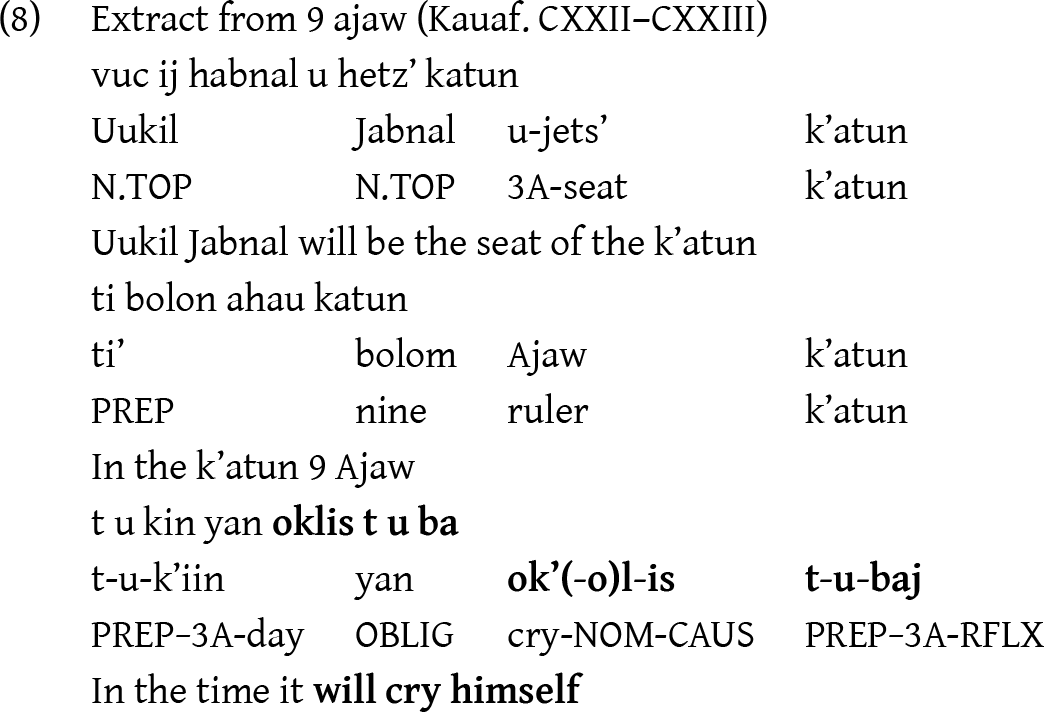
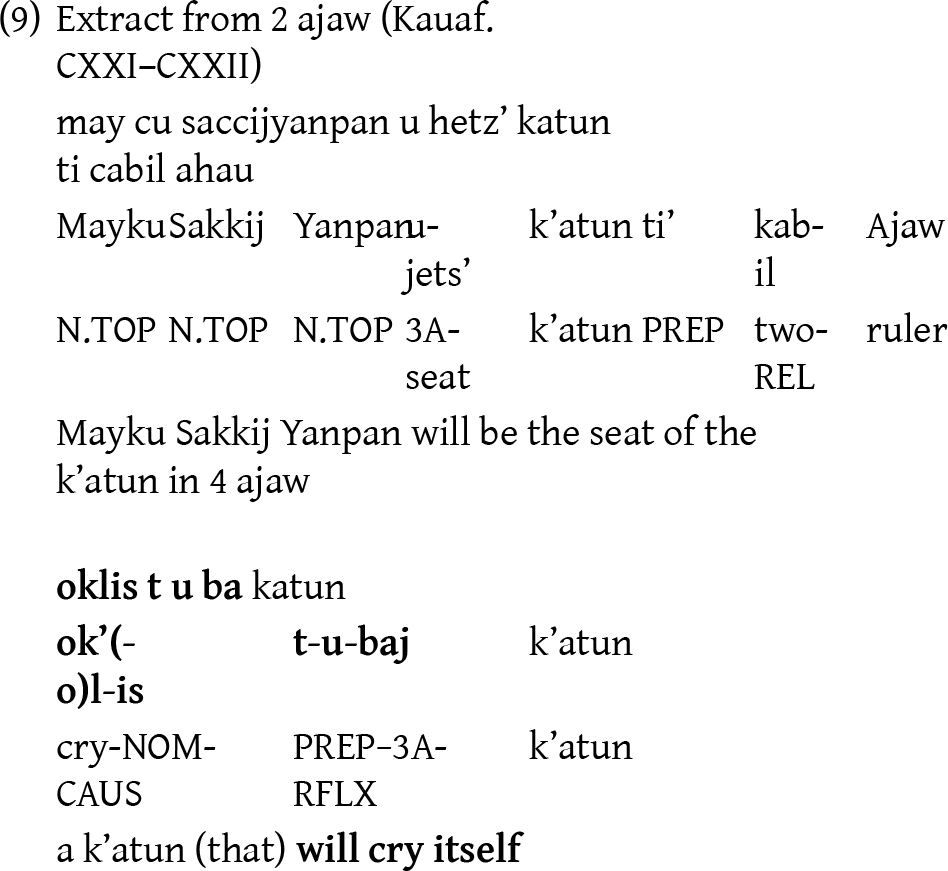
In both examples, drawn from traditional prophecies of the Kaua, the verb ok’ (“to cry”) appears in a reflexive form, conveying a sense akin to “to cry itself.” While its precise meaning is difficult to articulate, this usage suggests a negative prognosis for the k’atun. However, alongside the traditional meaning, we start to notice in transitional Christianizes prophecies, the use of the Franciscan neologism pointed out by Hanks (Reference Hanks William2010:196), as in the following example in (10).

As mentioned above, the neologism involves a body part—in this case, óol (“vital energy”). In the first line of the extract, the meaning is that of “pain” and is probably inherited from more traditional prophecies (the intransitive form with the prophetic future -om sustains this hypothesis). However, the second mention conveys the meaning of “contrition.” This interpretation is based on the textual context that further confirms that this is a transitional Christianized prophecy, as evidenced by the presence of the Spanish loanword justicia, referring to the justice of God, alongside the Maya mention of God as Jajal K’u’ (“the True Divine”).
The later meaning is also present in Christianized prophecies but in the form of a nominal phrase k’áat ok’ óolal, “asking for contrition.” In total, three mentions of this new term are present in the 63 prophecies examined. Consider the example extracted from a Christianized prophecy in (11) and consider also the textual context.

The presence of Spanish loanwords referring to God (Dios) and the Holy Church (Santa yglesia mayor), as well as the qualifier santo in santo ok’ óolalil (referring to the notion of contrition), leaves little doubt that this is a Christianized prophecy. Additionally, we observe the use of a lasting neologism coined by the Franciscans for “baptism,” ok ja’ (literally “to enter water” [Hanks Reference Hanks William2010]) in the phrase yookol ja’ tak poolo’ob, literally “the entering of water on our heads.” In these more Christianized prophecies, the style more closely resembles that of Catholic sermons. The transformation of the grammatically complex reflexive form has been completed, now replaced by the simpler and more readily translatable noun ok’ óolal for “contrition.”
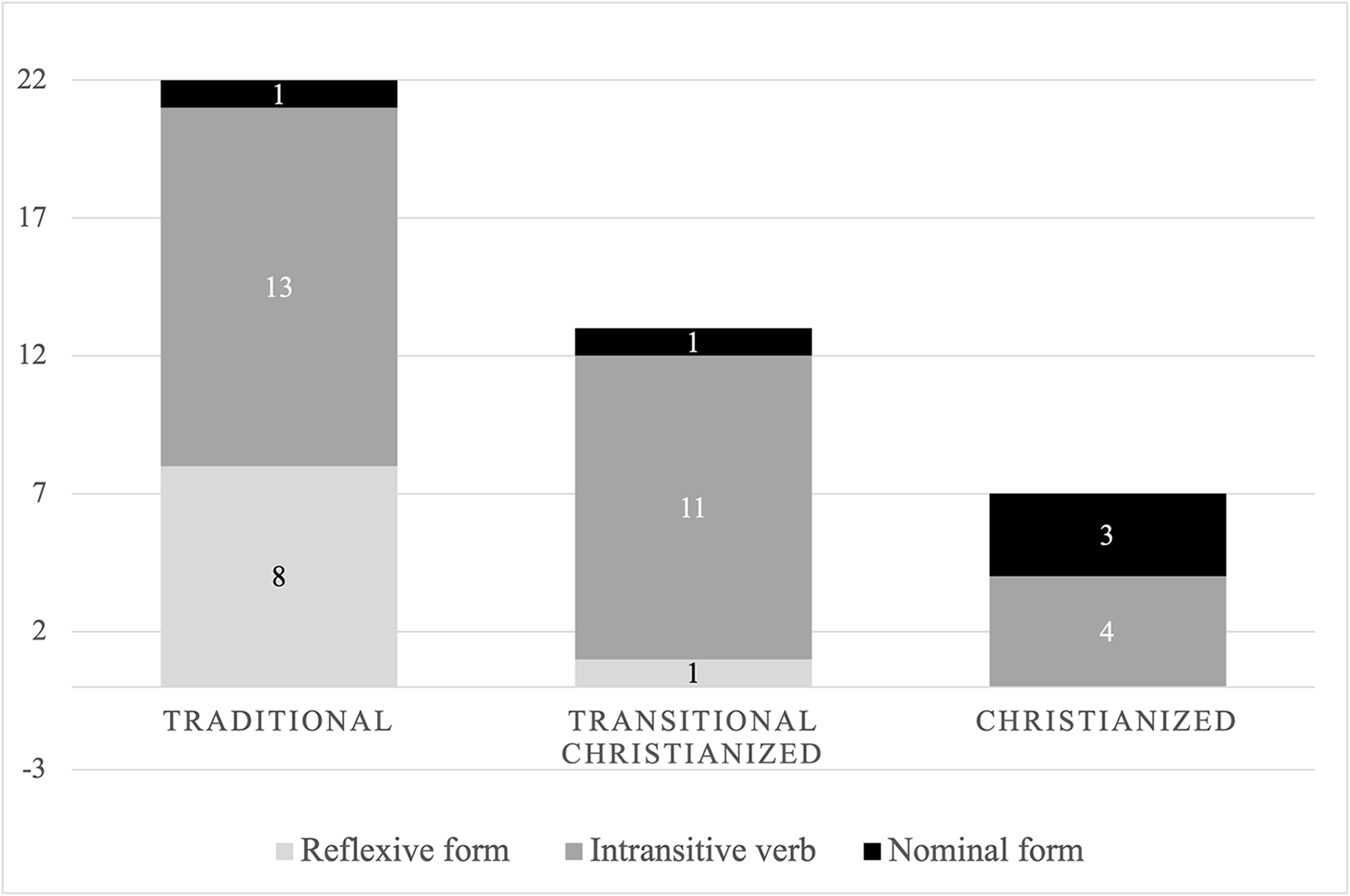
A statistical analysis of all 43 occurrences of the root ok’—in its various forms—across the prophecies in the corpus reveals a clear correlation between grammatical structure and semantic evolution, as illustrated in Figure 1. The intransitive form appears across all types of prophecies, primarily due to its inclusion in the aforementioned fixed diphrasism ok’om ya’axkach//bulkum (“the green fly//the great fly will cry”). In contrast, the reflexive form occurs mainly in traditional prophecies and appears only once in a transitional Christianized context from the Tizimín. The distribution of the nominal form, present once in a transitional Christianized prophecy and three times in Christian ones, clearly reflects a Catholic innovation in meaning (although we note its presence once in a traditional prophecy from the Oxkutzcab and once in a transitional prophecy from the Tizimín).
Number of occurrences of the various forms of the root ok’ in the corpus and according to the type of prophecies.

From politics to religion: the resemantization of siits’
This section discusses the semantic evolution from a traditional Maya meaning to a Christian one of the root siits’ (or siits’il in its nominal form). In traditional as well as transitional Christianized prophecies, siits’ refers to the concept of “(political) ambition.” However, as the prophecies became more Christianized, the meaning evolved to designate “greed” in the Catholic sense.
In the entries of colonial dictionaries, the friars themselves took note of the Maya concept of political ambition. For instance, the Motul dictionary provides the example sits’en ti’ alkaldeil, “desire to become alcalde,” and sits’ kuchil, “to strongly desire honors and offices” (Barrera Vázquez Reference Barrera Vázquez1980:734). A similar entry appears in the San Francisco dictionary: sits’ kuchil u ka’h Pedro, “Pedro desires what does not belong to him, such as becoming a batab or something else” (Barrera Vázquez Reference Barrera Vázquez1980:734). Note that in this example, the Maya text does not mention the function of “batab or something else” and this might have come from the explanation provided by the friar’s informant. The agentive form aj added to the same root also elicit a political sense and evokes the idea of a tyrannical ruler: (ah) sits’il, “tyrant, unjust lord” (Barrera Vázquez Reference Barrera Vázquez1980:735). It is worth noting, however, that this notion, at least initially, did not seem to carry a negative connotation, as the Motul also defines it as “to covet and strongly desire something good or bad” (Barrera Vázquez Reference Barrera Vázquez1980:734).
Once again, the textual context proves fundamental to elicit the meaning of such a concept. As an illustration, consider the following example from the Tizimín in (12) that describes what follows from a meeting to decide how the power will be distributed among the rulers (as the plural reciprocal construction with -tambal suggests).

In the example in (12), the text points out the usurpers or people temporary of the power through the expression in parallelism majan k’ooj //ts’am // póop, “the ones who borrowed the image//throne//mat.” The idea of this extract seems to be that a fair distribution of power will end the political ambition of the (illegitimate?) governors. As I mention above, political affairs are a recurrent theme in traditional prophecies. The next example is extracted from the prophecy 5 ajaw, the only traditional one in the Chumayel. It puts forward the idea that, because of the pain of the k’atun, political ambitious rulers will be punished by hanging. In traditional prophecies, the idea of political ambition is frowned upon and is said to lead to suffering.

With Christianization, a new meaning came to be imposed upon the root siits’. For instance, in the Motul dictionary, we find the following example of usage under the entry for siits’-bal (formed with the derived root in the passive manner): in sits’ba benel Kumk’al, “I desired to go to Kumk’al,” but also in a more religious sense: bin sits’bate benel ti’ ka’an, “I will desire to go to heaven” (Barrera Vázquez Reference Barrera Vázquez1980:734). Here, we observe that the concept of “desire” aligns with Spanish semantics: one may express the wish to travel to a village, as well as the desire to go to heaven—clearly referring, in this case, to the Christian heaven, or paradise.
In the prophecy 1 ajaw from Tizimín (f. 15v), the meaning of the term has already shifted. Consider the following excerpt: ukuuch k’atun uts’ok siits’il, uts’ok koots ti’ aj ts’u’utul ts’u’uto’ob, “the burden of the katun (is) the end of greed, the end of theft from the avaricious ones.” The semantics and scope of the term have changed and are now aligned with explicitly individual Christian values, as framed by the textual context. The idea of siits’il now appears alongside terms for theft (koots) and avarice (ts’u’ut), departing from the original Maya meaning of political ambition.
In the transitional Chrisian prophecy 3 Ahau (Tizimín f. 14r)—the notion of the end of greed (uts’ok siits’il) appears once again, within an even more overtly Christian textual context: úuchom uts’ok usiits’il úuchom maktsil ti’ ka’an Junáab k’u’ yóojel, “The end of greed will come to pass, a miracle will occur in the heavens, the One Divine (= God) knows it.” The reference to a miracle in the heavens (maktsil ti’ ka’an) and to the Christian God (Junab K’u’) indicates that the meaning of siits’il is no longer that of political ambition, as in earlier prophecies. Two excerpts from the 1 ajaw prophecy from the Chumayel (f. 93) suggest a similar interpretive shift. The first is as follows: taal ka’anali’, ti’ taali’ chak siits’il, ma’ ya kimlal, xeej k’i’ik’ chak mitan wi’ij ukuuch jun ajaw k’atun oknáal k’uchil, “the coming of the great greediness, (the coming of) the great death, (the coming of) the blood vomit, (the coming of) the great hunger, (will be) the burden of the k’atun 1 Ajaw (with) the arrival of the guilt.” In this passage, which recounts the afflictions of the k’atun 1 Ajaw, we encounter multiple illnesses—possibly attributable to the arrival of the Spanish, especially the xeej k’i’ik’, “vomiting of blood,” which may refer to smallpox. Whatever the case, the idea of the coming of chak siits’il, “great greed,” as the cause of these calamities, is perhaps better understood as a punishment by God for the sins of the people. Note also the presence of the nominal root k’uch defined by friars as “guilt” and “avarice” (Barrera Vázquez Reference Barrera Vázquez1980:418). A second excerpt in (14) from the same prophecy directly echoes a Christian textual framework.

In this passage, the textual context clearly reveals a Christian prophecy, particularly through the inclusion of Spanish terms for “bishop,” “Holy Inquisition,” “Saul,” and “Christianity.” We also observe the use of the previously discussed concept ok’ óolal, here meaning “contrition” or “compassion.” The notion of universality is likewise present, conveyed through the plea for an end to greed and suffering “in the world.” In this context, the notion of siits’ “(ndividual) greed” is embedded within a Christian framework and appears in parallel with the expression numsaj (ti’) yaj, which the Motul dictionary defines as “atormentar y dar mala vida, martirizar, padecer hacer,” “to torment, to inflict a miserable life, to martyr and cause suffering” (Barrera Vázquez Reference Barrera Vázquez1980:588). This meaning aligns with the Christian ideal of individual morality and ethical conduct promoted by the Franciscans. A comparable parallelistic structure appears in the transitional Christianized prophecy of 1 Ajaw from the Tizimín manuscript (f. 19v): uts’ok siits’il uts’ok koots ti’ aj ts’u’utul ts’u’uto’ob, “the end of the greed, the end of the stealing among the greedy.” Here again, siits’ appears in parallel with a morally negative term from a Christian perspective—koots, “theft”—and applied to the ts’u’utul ts’u’uto’ob, “greedy people.”
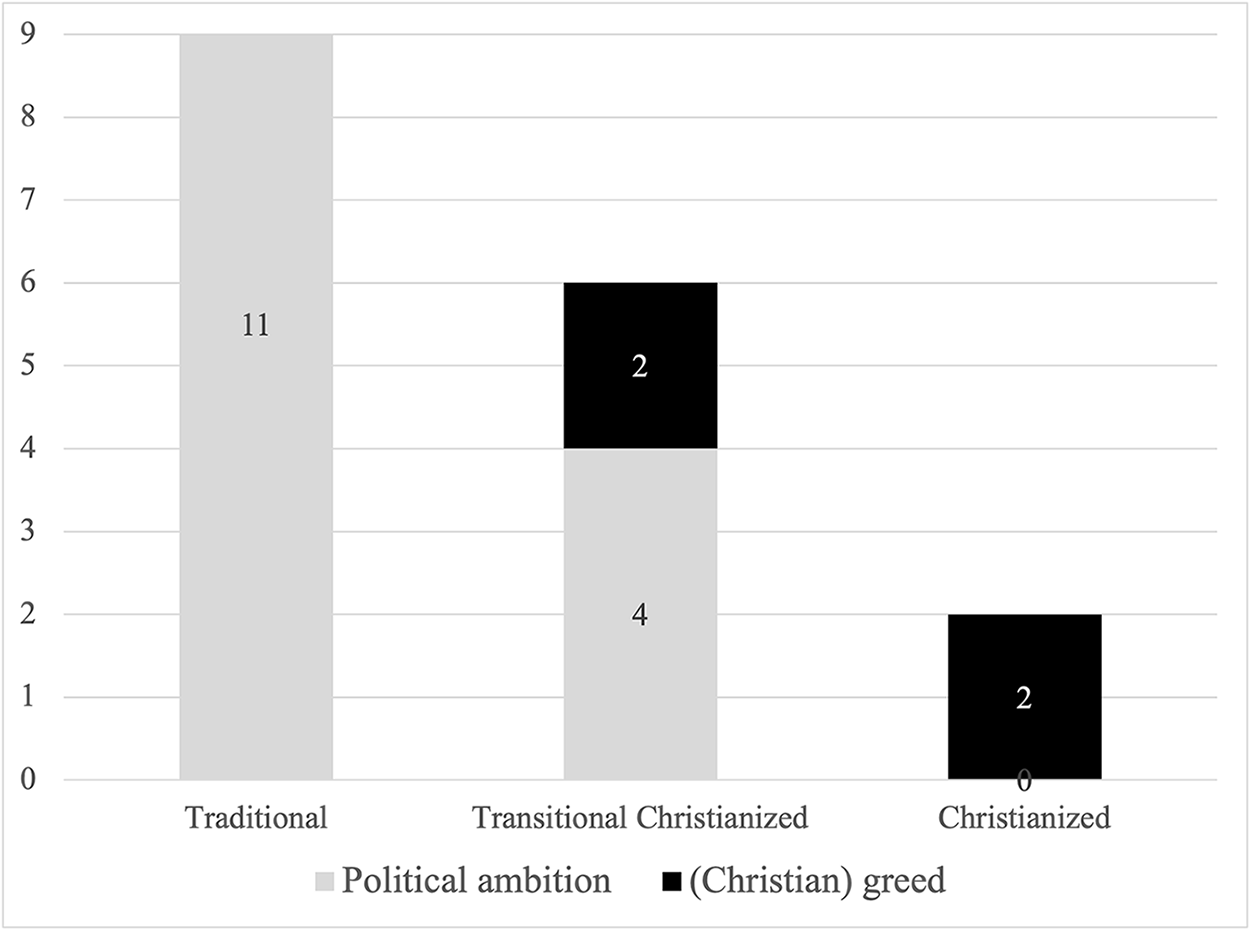
Analysis of the distribution of the root siits’ according to its meaning (“political ambition” or “greed”) and the types of prophecies.
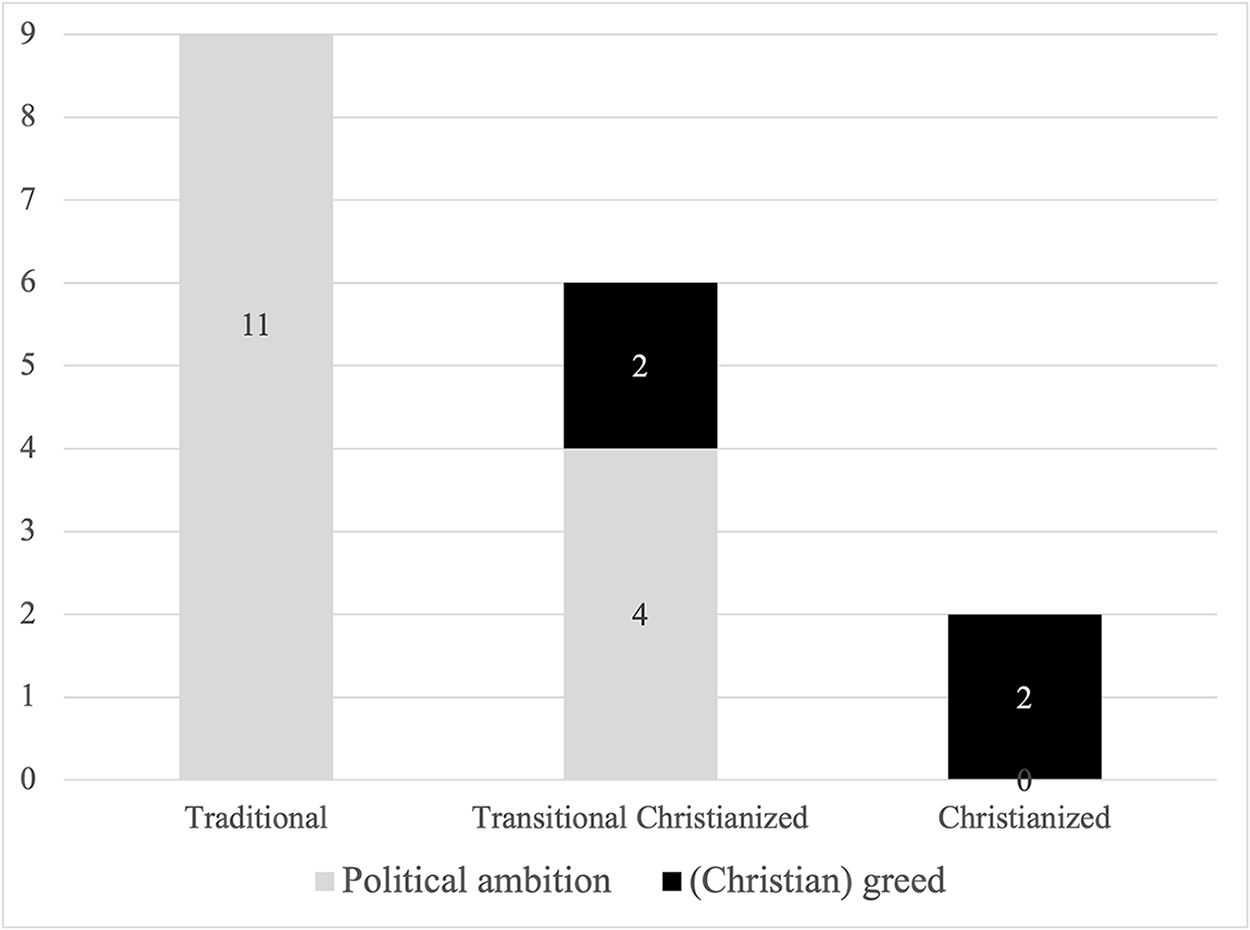
Once more, the textual context proves essential. While traditional prophecies present siits’ as the notion of political ambition—a characteristically Maya concept within the genre of prophecy—as Christian ideas become embedded within prophetic texts, the meaning of the same term evolves, now referring to the individual notion of “greed.” No longer limited to rulers, this notion extends to common people, or more precisely, to the individual. It is marked by an impure and selfish desire, as defined by Christian precepts—an interpretation also sustained by the terms used in parallel constructions with siits’. This shift is consistent with the late sixteenth-century concern among ecclesiastical authorities that Indigenous peoples should be genuinely converted—not merely in outward appearance (Law Reference Law, Hull and Carrasco2012; Tedlock 1993). Moral ideas take on a more prominent role, a development reflected in the transformation of the concept of siits’ in Maya.
A statistical analysis of the 19 occurrences of the root siits’ within the corpus (Figure 2), combined with an examination of its meaning in textual context, once again reveals a correlation between the resemanticization of the root—from denoting the political ambition of rulers (in traditional and transitional prophecies) to reflecting a Christian notion of individual greed and sin (in some transitional and Christianized prophecies).
Conclusion
Throughout the process of evangelization, and more broadly within the reducciones, various terms were adapted by friars who sought to reshape their meanings, introducing new concepts aligned with Christian doctrine. These texts eventually came into the hands of Christianized Maya writers (probably maestros cantores), who began incorporating them into prophecies they were copying. This process reflects not only a willful evangelization on the part of the Maya themselves, but also (as seen in other texts on medicine or astrology) an attempt to reconcile Spanish worldviews with traditional concepts. In other words, prophecy became a discursive space through which to explain and integrate change while still adhering to the framework of ancient Maya ideology.
This study has proposed a new typology for the Chilam Balam prophecies, distinguishing between traditional, transitional Christianized, and overtly Christian texts. This classification enables a more nuanced understanding of the ways in which colonial-era Maya authors navigated the imposition of Christian discourse while retaining core elements of pre-Hispanic prophetic structures.
In addition, the analysis of key terms—particularly those that exhibit signs of semantic shift—reveals how language became a space of negotiation. Roots such as ok’, originally grounded in Maya cosmology and ritual expression, demonstrate processes of resemanticization under colonial influence. Tracing these shifts not only highlights the complex interplay between Indigenous and European conceptual worlds but also provides insight into how prophetic authority was preserved, transformed, or rearticulated.
Ultimately, this study contributes to the ethnohistorical understanding of colonial Maya writing practices by emphasizing the importance of linguistic analysis in historical interpretation. Methodologically, although translation of colonial Maya texts must be systematic, it cannot be uniform; textual context should always be taken into account.
Key to interlinear gloss
? = uncertain interpretation; * = reconstructed word; 1 = first person; 3 = third person; A = SET A; AG = agentive marker; AP = antipassive; CAUS = causative; CLAS = classifier; CONJ = conjunction; CP = complative; DEIC = deictic; EXIST = existential; FUT = future; INCH.CP = inchoative completive; N.TOP = toponym; NEG = negation; NOM = nominal suffix; OBLIG = obligative; PF = perfective; PF.FUT = Prophetic future; PL = plural marker; PN = proper noun; PP = personal pronoun; PREP = preposition; RED = reduplication; REL = relational suffix; RFLX = reflexive; RFLX.DISTR = distributive reflexive; SBJ = subjunctive; SP = Spanish loan; TR.CP = transitive completive; VE = Vital Energy.