



Introduction
Polypharmacy is often defined as the concurrent prescription of at least four or five medications (Johansson et al., Reference Johansson, Abuzahra, Keller, Mann, Faller, Sommerauer, Höck, Löffler, Köchling, Schuler, Flamm and Sönnichsen2016) and is associated with a variety of negative outcomes (Flaherty et al., Reference Flaherty, Perry, Lynchard and Morley2000; Espino et al., Reference Espino, Bazaldua, Palmer, Mouton, Parchman, Miles and Markides2006; Kuijpers et al., Reference Kuijpers, Van Marum, Egberts and Jansen2008; Cahir et al., Reference Cahir, Fahey, Teeling, Teljeur, Feely and Bennett2010; Calderón-Larrañaga et al., Reference Calderón-Larrañaga, Poblador-Plou, González-Rubio, Gimeno-Feliu, Abad-Díez and Prados-Torres2012; Pasina et al., Reference Pasina, Brucato, Falcone, Cucchi, Bresciani, Sottocorno, Taddei, Casati, Franchi, Djade and Nobili2014). Due to a higher prevalence of morbidity and multimorbidity (Barnett et al., Reference Barnett, Mercer, Norbury, Watt, Wyke and Guthrie2012; Fuchs et al., Reference Fuchs, Busch, Lange and Scheidt-Nave2012), elderly patients are more often affected by polypharmacy and associated negative events. As patients do not always volunteer that they take medications not prescribed by a medical professional, or that they have altered their medication regimen (Stevenson et al., Reference Stevenson, Barry, Britten, Barber and Bradley2000; Levine et al., Reference Levine, Xu, Gaebel, Brazier, Bédard, Brazil, Lohfeld and MacLeod2009; Moen et al., Reference Moen, Bohm, Tillenius, Antonov, Nilsson and Ring2009; Bokhof and Junius-Walker, Reference Bokhof and Junius-Walker2016), general practitioners (GPs) can be unaware of patients’ real medication consumption, which can lead to the overlooking of the use of potentially inappropriate medications or medication underuse. Even if potentially inappropriate medications are identified, there are barriers to deprescribing on the part of patients (Reeve et al., Reference Reeve, To, Hendrix, Shakib, Roberts and Wiese2013) and prescribers (Anderson et al., Reference Anderson, Stowasser, Freeman and Scott2014). Nonetheless, while polypharmacy and its negative effects can be worsened by patient behaviours (Cantlay et al., Reference Cantlay, Glyn and Barton2016), patients can also contribute to more appropriate medication therapy. The aim of our exploratory study was to gain initial insights into the perceptions of elderly patients and their GPs regarding communication on polypharmacy and medication safety, as well as empowerment approaches patients and GPs identify which might be useful to guide future research.
Method
Design and participants
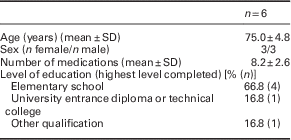
We conducted interviews in a comparably large group practice providing a typical broad range of primary care services for a rather rural population. The practice is attended by ~950 patients over 65 years of whom about 480 take five or more medications. A medical assistant, who is a regular employee of the healthcare centre, approached eligible patients during a common practice week. Patients were eligible to participate if they were 65 years or older, prescribed at least five medications and were physically and cognitively able to be interviewed. The patients were given an information sheet about the study and had time to think about their participation. Half of the patients approached agreed to participate and arranged a special appointment for an interview several days later. The interviews were held in a calm atmosphere in a remotely situated meeting room within the practice premises. Patients were informed that the GPs have no access to the information about who is participating or the recordings and transcripts. We asked all four specialist GPs, three GP trainees and one final-year medical student working at the time of the interviews in the practice (excluding one person due to conflicting interests) to participate in our study and provided them with an information sheet; four agreed to take part, matching the existing gender proportions. All participants provided written informed consent. In total, 10 interviews were conducted, one of which had to be excluded due to technical problems. The remaining interviews lasted between 16 min and 40 s and 76 min: six with patients (Table 1), one with a GP, one with a GP trainee and one with a final-year medical student. The patients attended their GPs for two to three chronic medical conditions, such as diabetes, kidney disease, asthma, cardiovascular diseases and chronic pain. All medical professionals were male, aged: M=41.0 (SD=20.42) and had worked for an average of 13.8 years (SD=20.2) as a doctor and 9.3 years (SD=15.3) as a GP.
Characteristics of patients
Semi-structured interviews
The interviews addressed on the active role of patients in communication with focus on important topics associated with polypharmacy and what – other than the GPs’ behaviour – might help patients to engage actively during GP appointments. The semi-structured interview schedule was designed by the first and last authors. The schedule consisted of open-ended questions, core questions and additional questions associated with the core questions. All interviews were conducted by the first author, face-to-face (except one interview conducted by telephone). The interviewer did not know the participants before the interviews. The interviews were recorded and transcribed verbatim.
Analysis
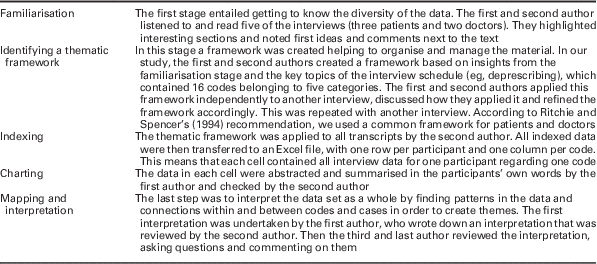
We analysed the data using a framework analytical approach (Ritchie and Spencer, Reference Ritchie and Spencer1994; Gale et al., Reference Gale, Heath, Cameron, Rashid and Redwood2013; Parkinson et al., Reference Parkinson, Eatough, Holmes, Stapley and Midgley2016). Table 2 shows how we implemented the five steps described by Ritchie and Spencer (Reference Ritchie and Spencer1994).
Data analysis process
Results
We identified three main themes, each of which is discussed below.
Differing medication plans: causes?
The actual intake of medications can change between GP visits because of alterations by other medical specialists, additional self-medications, or the alteration or discontinuation of medication by the patient. If these changes are not communicated clearly during each consultation, the patient’s medication plan will become inaccurate, severely affecting medication safety. All GPs stated that not all patients address changes, or might even conceal them. In contrast, all patients declared that they spoke openly with their GPs, although it became apparent during the interviews that the patients do not always report all changes. The reasons for this phenomenon are manifold. The patients reported that compatible personalities, the friendliness of the GP and continuous care by the same GP promote an open discussion. Hindering factors are, among others, their own personality (as it is necessary to have courage), fear, pain, forgetfulness, embarrassment, lack of trust in the GP, the perception that side-effects are less important in old age and no desire for more information. The reasons that inhibited patients from addressing a change in their medication plan also depended on the source of the change (eg, changes by other specialists were seen as least problematic).
GPs thought that patients, particularly elderly ones, did not mention over-the-counter (OTCs) or herbal drugs as they felt uncomfortable revealing their use. Patients did not tell their GPs about non-adherence as they considered this an exception or they felt that they did not need to justify themselves, forgot, thought the GP was already aware of it, or did not want to be seen as incompliant. One GP said that patients assumed that they had to fulfil certain expectations.
IFootnote 1 : And do you have assumptions why patients…?
GP2: Yes, sometimes they perhaps think they somehow have to fulfil expectations, which they do not want to fulfil because they think the medication is stupid or – there are different reasons – or they have the feeling that it doesn’t help, but they do not want to put a strain on the doctor-patient relationship, because they think that it could make the doctor angry. Although that’s actually not the case, but I think that many people think that.
Dialogue concerning medication: whose responsibility?
The main responsibility for the dialogue and decisions regarding medications is assigned to the GPs. One explanation is the trust that patients have in their doctors based on their expected medical competence and knowledge of the individual case. One patient’s comments also reflect the asymmetry between the doctor and herself as she is ‘…only the patient and he is the doctor, the boss’ (P6).
Discussion and preparation of an accurate medication plan
While one GP explicitly stated that it is the responsibility of the doctor to undertake a systematic review of the medication plan of each patient, several patient comments show that the plan is not always or sometimes only partly reviewed. The discussion itself is seen as a conjoint task, particularly by the patients. The GPs see the patient as an important source of information, but the discussion can be hindered by insufficient patient knowledge concerning their medication. Moreover, GPs agree that it is often necessary to actively ask patients about their real medication intake, as reflected in the following patient comment:
I: Can you think of anything else that could help you or other patients address things in the doctor consultation, particularly if it is about tablets?
P6: What should I say, say to that? I mean…he’s always looking it up, he has it in the computer…but he has never asked whether I also take it (laughing).
The patients generally stated that they could openly address these topics and gave examples of their participation. However, the interviews also revealed that some patients altered their medication regimen (eg, by reducing the dosage) without telling their GPs.
Deprescribing potentially inappropriate medication
GPs see it as their responsibility to check for potentially inappropriate medications. While patients and GPs generally have positive attitudes towards deprescribing, there are also barriers. The GPs mention legal concerns, as well as lack of time and guidance. The patients fear that their condition might worsen and that they take up too much time of the doctor’s time, or they have concerns as the medication was prescribed by another specialist. Therefore, the GPs think that it is their responsibility to explain the reasons for deprescribing and to motivate the patients.
In our sample, it is usually the GP who addresses potentially inappropriate medications. According to the GPs, if patients ask for a discontinuation, they are usually young and only use the medication for a short time. This confirms patients’ comments that there are no discussions about medications or their risks and side-effects if they have taken the medication for a long time. One GP stated that patients could help if they questioned what they were taking and then mentioned it in the consultation. However, this type of engagement might prove problematic for some patients. One patient who stated that she had a good relationship with her doctor demonstrated her wish to discontinue a tablet, but then stated that she had to take the medication in order to be an obedient patient:
P6: … the [medication] for the thyroid. This one I would like to leave out. The daughter has said: ‘Just don’t take them’. Then I said: ‘I know, I have already taken that for years’. And leaving them out, I don’t know. I will talk to the GP, that at least one or two…
I: And do you find it difficult to address that?
P6: No, so he is … open. He is … one can talk to him. Also with Dr [former GP], we also talked about this, but that … as I said, that I have to take. That is the thyroid (laughing). Then you just take it. As you behave: obedient and (laughing).
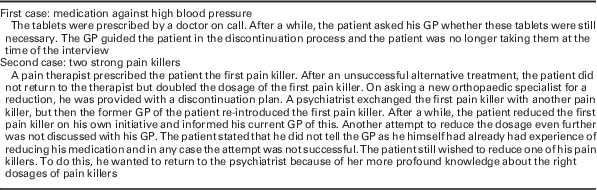
In contrast, another patient stated that he initiated a discontinuation process twice, an experience that strongly differed depending on the type of medication and the prescriber. While the first case was straightforward, the other showed the complexity of the discontinuation processes and that, even if patients usually communicate openly, they might not mention all information. These two processes for the same patient are illustrated in more detail in Table 3.
Two discontinuation processes
Patient knowledge concerning medication
As argued by a doctor:
You trust a patient who can accurately tell their medications more than one who reads it from a list and then the list is changed three times because of a doctor or another doctor or a nurse … (GP1)
This comment shows the importance of patient knowledge in the doctor–patient relationship, but also the significance of discussions concerning the medication plan. The patients generally thought that the GPs provided them with sufficient explanations regarding their medications. They differed regarding the amount and the type of information they wanted. One patient stated that he asked the reason for a new medication, while two other patients said that they would neither question the GP’s decision nor ask for more information as they trusted that the doctors would know what they were doing.
I: When you are discussing the medication, do you also talk about the side effects or the risks and benefits of the medications?
P5: I always assume that the medications are prescribed in such a way that the doctor knows what he is doing. I assume that he knows about the effect of the medications and he knows how the medications interact with each other. That he knows that. That the deliberation regarding me already took place in the background. So I do not ask for that at all.
This shows that trust is a double-edged sword. Patients say that trust is important for open communication, but as a consequence of trust, they do not ask for important information.
Supporting patients’ engagement: how?
Both patients and GPs, but especially the latter, considered the behaviour of GPs important in supporting patients’ openness, particularly by asking patients about their medications. When asked about other ways of empowering patients, the GPs listed a few possibilities. One GP thought that a public campaign might motivate patients to address difficult topics during consultations. The pharmacy was mentioned as an additional entity that could motivate patients to contact their GPs if they had any medication-related problems. Another GP mentioned that it is important that patients come prepared to the consultation, including informing themselves, for example by reading a reliable journal provided in the waiting area. Other possibilities were to bring medication plans, relevant documentation from other providers and diaries, for example concerning blood pressure.
While patients found preparation important, including updating their own medication plans, none of the patients could initially name any ways of supporting them to be more active. Patients thought that notes of questions and information would prevent them forgetting what should be discussed and considered that they were more self-confident when they came to the consultation on an informed basis. The Internet was seen as an important source of information.
I: And do you think it is helpful if you have a bit of information beforehand, before you go to the doctor?
P3: Yes, yes sure. Yes, then you can talk differently. You are better informed then and … in this respect I find the Internet good again, where you can inform yourself. (laughing)
This patient also mentioned relatives as an important means of support. As they are more used to the Internet, her daughters look up information for her. In addition, she discusses her disease and treatment with her daughters, who motivate her to go to the doctor and address difficult topics. The daughters sometimes accompany her, so they are informed and ask questions.
I: And could you perhaps think about something to motivate patients to address it anyway or what could help them?
P3: I just think that the young ones, the children or whoever takes care of you, should influence you. I know that from my daughters, who say: ‘Now you are going to the doctor and also tell him that’ and so on. Perhaps that is less the case with some people who are totally alone or so on. So, one sometimes needs a bit of a push. (laughing)
[…]
I: But you, would you go alone to the doctor or do you have someone (overlap)?
P3: Yes, that is no. Depending on what it is about, one of the daughters comes with me. She will probably talk more than me. Because one probably talks more openly at home after all or in my case I forget it again and think: ‘Oh dear! You wanted to say that as well’. I have to start with making notes. That and what I want to know.
Discussion
Patient–GP communication is a two-way process, which is why we included the perspectives of patients and GPs in our analysis. Although our sample size is small, the interviews provided interesting insights regarding the sometimes diverging perceptions of elderly patients and GPs of the communication process and about potential foci for further research. GPs are seen by patients and GPs as having primary responsibility for the dialogue and decisions regarding medications, but the patients have an important role in this process. While GPs identified problems with patients’ participation, patients’ answers initially implied that there are no communication problems and that they perceived the patient–GP communication regarding medication as very open. However, due to the qualitative nature of the study, the narratives of the patients could unfold, and it was possible to identify potentially problematic sequences during the course of the interviews. The patients recounted situations which revealed that their GPs were not aware of all medication changes or concerns. Despite patients’ affirmation that they have a trusting, good relationship with their GPs, these problems in open communication might be caused by social desirability, as well as by an understanding of trust which implies not posing questions. Thus, while it is important that patients trust their GPs, this may also militate against patients’ involvement, for example in decision making (Blumenthal-Barby, Reference Blumenthal-Barby2017). As in a synthesis of qualitative studies on GPs’ and elderly patients’ perceptions regarding the reduction in polypharmacy (Bokhof & Junius-Walker, Reference Bokhof and Junius-Walker2016), the GPs in our study felt that patients tended not to inform them completely about their actual medication intake and potential side-effects. The synthesis also illustrated that patients do not always inform their GPs of medication changes. This is in line with the results of Barat et al. (Reference Barat, Andreasen and Damsgaard2001), who revealed a deviation of 22% regarding medications and 71% regarding doses between what patients reported and the information collected from GPs. Our study did not only agree with previous studies about GPs’ potential ignorance regarding the actual consumption but also shed light on the issue that patients might not be aware that this ignorance might cause problems. While this signifies that patients might need support in engaging more actively, here the main role was again assigned to the GPs.
Patients and GPs in our study also found it difficult to name ways of empowering patients to be more prepared for and active during medication discussions. While a bigger sample might have provided more ideas, the problem of naming empowerment strategies for patients can also be seen as a reflection of research into patient–physician communication in general. The majority of research has focused on physician behaviour, interventions to improve their communication skills and guidelines and electronic support tools for GPs to avoid inappropriate polypharmacy. The scarcity of interventions to empower patients for discussions with their doctors might explain why they did not come to participants’ minds as empowering strategies. This shows that future research on communication skills interventions and their implementation must find creative ways to reach patients as they might not look for them. This is particularly important as communication skills interventions for patients seems a promising strategy, as reviews and further studies show that interventions targeting patients’ communication skills have the potential to influence patients’ communicative behaviour and outcomes (Post et al., Reference Post, Cegala and Miser2002; Rao et al., Reference Rao, Anderson, Inui and Frankel2007). Three broad types of interventions can be distinguished: (a) provision of materials, such as workbooks, web-based platforms or CDs; (b) a combination of materials and individual coaching sessions; and (c) group training (D’Agostino et al., Reference D’Agostino, Atkinson, Latella, Rogers, Morrissey, DeRosa and Parker2017). While it might not be feasible to conduct coaching sessions or group trainings in a GP practice, patients could be easily provided with booklets or access to a web-based intervention which helps them to prepare for their visits and engage more actively. For example, Cegala et al. (Reference Cegala, McClure, Marinelli and Post2000) compared the effects of a work booklet sent some days before the appointment (trained patients) with a brief summary of the information provided only before the consultation (informed patients) and a control group on patients’ active behaviour. These authors found that trained patients asked more medical questions and obtained more medically related information in general and per question than informed or control patients. While limited, there have also been some reports of positive results for specific booklets and pre-visit sessions for elderly patients, which increased their involvement in primary care consultations (Wetzels et al., Reference Wetzels, Harmsen, Van Weel, Grol and Wensing2007). A specific area regarding polypharmacy is deprescribing. While there are few direct-to-consumer interventions, Tannenbaum et al. (Reference Tannenbaum, Martin, Tamblyn, Benedetti and Ahmed2014) found that elderly patients receiving a short booklet with information regarding the risks of benzodiazepine use and including a self-assessment element led to a higher discontinuation rate of benzodiazepine use.
During the interviews, participants also mentioned to involving third parties to improve the communication about medications. One GP mentioned the involvement of pharmacies. The action plan for improving medication therapy safety of the German Federal Ministry of Health includes an important role for pharmacists (Bundesministerium für Gesundheit, 2016). A Cochrane review of outpatient pharmacists’ non-dispensing roles shows that most studies confirm that pharmacists can positively influence the management of medications and therapies (Nkansah et al., Reference Nkansah, Mostovetsky, Yu, Chheng, Beney, Bond and Bero2010). The benefits for patients of pharmacists and GPs cooperating with each other is not yet clear. For example, Geurts et al. (Reference Geurts, Talsma, Brouwers and de Gier2012) reported contradicting study results, for example regarding hospital (re)admissions. One explanation for the differences might be the training that pharmacists received.
In our study, participants also mentioned relatives, particularly younger relatives, as support. The open communication about medications between elderly patients and GPs might benefit from the involvement of younger persons. Studies have shown that younger patients tend to be more positive about a more equal relationship and patient participation. In a study by Farin et al. (Reference Farin, Gramm and Schmidt2013), compared to older patients, younger patients showed a higher preference for patient participation and orientation as well as effective and open communication. Levinson et al. (Reference Levinson, Kao, Kuby and Thisted2005) found that the preference for an active role in medical decision making increases up to 45 years and declines thereafter. Building on these findings, future research could address how many elderly patients with polypharmacy would like younger relatives involved in the communication process, how the communication process has changed and whether there are positive but also negative effects due to the involvement of a third party.
Limitations
One limitation of the study is the sample size and the fact that all the GPs and patients were from the same practice. Thus, we must be careful when generalising our results. Studies including patients from various GP practices in different catchment areas might provide more solutions in terms of how patients can be empowered. Ways of empowering might also be different depending on gender or between different age categories. Moreover, all patients had multimorbidity and were experienced with taking several medications and consulting their GP. Interviews with patients who were only just prescribed or started to take more than four medications recently might have added another perspective. That said, it should also be noted that both GPs and patients had difficulties articulating how they communicated exactly in certain situations. Talking about talking can be challenging as we tend not to think consciously about the communication process. Therefore, additional tape-recordings of consultations, or tape-assisted recall, could provide important additional information.
Conclusions
To take an active role in addressing polypharmacy, patients must be aware of the significance of their involvement and empowered to voice issues, including those that are uncomfortable. In addition, elderly patients with polypharmacy might benefit from having a better understanding of why medication needs might differ in older age and why deprescribing of medications can be beneficial.
Due to the time restrictions of consultations and also some patients’ reluctance to speak openly with their GP, research can support patients by designing patient interventions. One step is to raise patients’ awareness of the importance of their contribution and to increase their communication skills. Previous communication skills interventions tend not to be about specific communication situations related to polypharmacy. Therefore, studies should investigate whether a combination of communication skills training and other interventional components, such as the provision of information concerning deprescribing, can increase medication safety. Also, GPs can support patients by encouraging them to express their ideas, concerns and expectations (Larsen and Neighbour, Reference Larsen and Neighbour2014). As patients might not be used to this, GPs can provide them with medication plans, prompting patients to note medication changes, potential side-effects, questions and concerns, thus highlighting the importance of this information and reducing the probability that these details will be forgotten. The invitation to write this information down might also contribute to the patient’s understanding that voicing questions and concerns is not a sign of a lack of trust.
Acknowledgements
The authors thank all patients and GPs who participated in the interviews and the entire practice team, particularly the medical assistant who coordinated the patient interviews.
Financial Support
This research received no specific grant from any funding agency, commercial or not-for-profit sectors.
Conflicts of Interest
None.
Ethical Standards
The authors assert that all procedures contributing to this work comply with the ethical standards of the relevant national and institutional guidelines on human experimentation at the University of Freiburg, Germany and with the Helsinki Declaration of 1975, as revised in 2008. The ethics committee of the University of Freiburg approved the study (approval number 99/16).



