





Introduction
In the aftermath of the Cold War, states have increasingly used economic sanctions to impose pressure on targeted governments to achieve desirable goals. The objectives of these sanctions are diverse, ranging from ending wars to changing policies, with common goals often including intervention in human rights violations and the promotion of democratic institutions abroad. However, the majority of sanctions fail to fully change the behavior of targeted governments in ways that meet the sender’s intended goals (e.g., Lektzian and Patterson Reference Lektzian and Patterson2015). Both recent and past studies suggest that, despite wide variations in effectiveness, economic sanctions exert influences on domestic politics in targeted regimes beyond their original objectives. In targeted countries, these sanctions may create more opportunities for opposition groups and trigger political protests (Grauvogel, Licht and Von Soest Reference Grauvogel, Licht and Von Soest2017), threaten the survival of the leaders (Escribà-Folch and Wright Reference Escribà-Folch and Wright2010; Marinov Reference Marinov2005), rally the public around the incumbent government or leader (Baker and Oneal Reference Baker and Oneal2001; Hellmeier Reference Hellmeier2021; Tir and Singh Reference Tir and Singh2013), or reduce public support for the sanctioning actors (Frye Reference Frye2019; Sung and Park Reference Sung and Park2022).
This study focuses on economic sanctions aimed at externally promoting democracy, which are defined as democratic sanctions that can be imposed by international or regional organizations, or by sovereign states. In past decades, sanctioning actors’ interests in enforcing democratic norms have been primarily driven by safeguarding security and economic interests (Gutmann, Neuenkirch and Neumeier Reference Gutmann, Neuenkirch and Neumeier2020; Von Soest and Wahman Reference Von Soest and Wahman2015b), which makes democratic sanctions a tool to promote both domestic and foreign policy goals. Western leaders employ these sanctions to signal to domestic and international audiences their commitment to democratic norms, thereby positioning democracy promotion as a strategic objective (Von Soest and Wahman Reference Von Soest and Wahman2015b). However, the enforcement of democratic sanctions is less likely to be found in geopolitically important countries or political allies (Donno Reference Donno2013). In this sense, these sanctions signify a rhetoric of democratic superiority, which is justified as a reaction to authoritarian stability and democratic decline in certain targeted states.
There is an ongoing debate about whether democratic sanctions have achieved the goal of increasing the level of democracy. Some studies suggest that economic sanctions are associated with an increase in human rights violations (Perry and Peksen Reference Perry and Peksen2024) or with greater resilience of authoritarian regimes in the targeted states (e.g., Grauvogel and Von Soest Reference Grauvogel and Von Soest2014; Levitsky and Way Reference Levitsky and Way2010; Peksen Reference Peksen2009; Peksen and Drury Reference Peksen and Drury2010). Similarly, economic sanctions ‘increase the risk of regime change leading to a new autocracy’(Escribà-Folch and Wright Reference Escribà-Folch and Wright2015: 120). Therefore, nongovernmental organizations came to favor technical programs for democracy promotion, which became more common than sanctions targeting dictatorships (Bush Reference Bush2015). Other studies find that democratic sanctions destabilize authoritarian leadership and regimes, thereby promoting democratic liberalization (Von Soest and Wahman Reference Von Soest and Wahman2015a). Furthermore, scholars are concerned about the adverse effects of US-led democratic sanctions on individuals’ political rights, but evidence shows that these sanctions are ineffective in promoting basic human rights protection (Drury and Li Reference Drury and Li2006; Gutmann, Neuenkirch, and Neumeier Reference Gutmann, Neuenkirch and Neumeier2020).
The imposition of democratic sanctions sends an alarming signal of democracy and human rights infringements, with existing studies primarily focusing on how these sanctions influence the level of democracy in targeted countries. However, their effects on popular opinion on democracy remain largely unexplored. Scholarly discussions have highlighted that pressuring autocracies to change regime through economic pain is morally problematic (Marinov and Nili Reference Marinov and Nili2015; Nili Reference Nili2023), yet its broader implications for public orientation toward democracy in those countries remain understudied. In these countries, public political orientation significantly contributes to the stability of the incumbent leadership and the durability of the regime. In this article, we examine how democratic sanctions affect popular opinion on democracy in targeted countries. In line with the logic that foreign pressure to promote democracy generates a motivation to defend the country, which in turn gives rise to a popular backlash against democracy, we argue that this opposition represents a form of outward hostility.
To evaluate the arguments empirically, we conduct an analysis using observational survey data and macro-level data (2010–2019) from the Arab states. The results from multilevel modeling strongly support the finding that in countries exposed to democratic sanctions, the public shows less support for establishing democratic regimes. To address potential endogeneity, we conduct instrumental variable (IV) estimations and further confirm the causal relationships. Moreover, we find evidence that regimes with stronger patriotic indoctrination are more likely to trigger public backlash against democracy during the period of ongoing democratic sanctions. This finding highlights the role of state-led indoctrination in shaping public perceptions of foreign pressure.
Taken together, this study makes at least three contributions. First, it extends previous work beyond the political stability examined in research on the effects of economic sanctions on regime legitimacy (Escribà-Folch Reference Escribà-Folch2012; Grauvogel, Licht, and Von Soest Reference Grauvogel, Licht and Von Soest2017; Hellmeier Reference Hellmeier2021) by including popular political orientation. Second, it discusses the potential impact of economic sanctions that lack moral justification on public opinion. The results indicate that morally problematic actions can produce negative effects beyond their original objectives, providing new insights into the broader question of whether international sanctions as a foreign policy tool are effective in strengthening the targeted regime (Lektzian and Patterson Reference Lektzian and Patterson2015). Finally, it emphasizes the role of state-led indoctrination in understanding how foreign interventions are perceived by the public. More importantly, our research supports that a state’s patriotic indoctrination is a condition for effectively mobilizing public hostility outward under foreign pressure.
Theoretical discussion
Democratic sanction exposure and public backlash against democracy
We know that economic sanctions, understood as a form of coercion aimed at punishing a government or forcing it to change its policies and behaviors by imposing economic pressure, generate political backlash in public opinion in targeted countries. As scholars show, the public tends to develop hostility toward the sanctioner as a response to external pressure (e.g., Alexseev and Hale Reference Alexseev and Hale2020; Grossman, Manekin and Margalit Reference Grossman, Manekin and Margalit2018; Sung and Park Reference Sung and Park2022). For the senders, using economic sanctions as a policy tool may generate spillover effects beyond their original objectives.
In the literature, three main mechanisms are commonly identified as underpinning the backlash effect in public opinion under foreign intervention. The most-cited mechanism, known as the rally-round-the-flag theory, suggests that crisis-induced suffering creates social conditions that facilitate political integration, thereby driving increased public support for the incumbent government or leadership in targeted countries (e.g., Galtung Reference Galtung1967; Mueller Reference Mueller1970). It is expected an increasing support for both sanctioned policies and targeted regimes under economic sanctions, as external threats rally the public through the voluntary intensification of in-group solidarity (Grossman, Manekin, and Margalit Reference Grossman, Manekin and Margalit2018; Van Hauwaert and Huber Reference Van Hauwaert and Huber2020). Evidence shows that individuals who support the sanctioned policies or incumbent governments are more likely to be hostile toward the sanctioning states (e.g., Seitz and Zazzaro Reference Seitz and Zazzaro2020; Sung and Park Reference Sung and Park2022). This effect occurs even in authoritarian regimes exposed to economic sanctions, such as Iran, where even moderate opponents turn to support the government (RezaeeDaryakenari, Ghafouri and Kasap Reference RezaeeDaryakenari, Ghafouri and Kasap2025).
Another mechanism emphasizes a shift-blaming model, which suggests a strategy in which policymakers deflect blame for contested policies by shifting it onto other actors (Heinkelmann-Wild and Zangl Reference Heinkelmann-Wild and Zangl2020). The economic pain caused by sanctions often induces various political effects in target countries (Kaempfer and Lowenberg Reference Kaempfer, Lowenberg, Sandler and Hartley2007), and one possible outcome is that the public attributes the country’s economic hardship to the sender state. However, Frye (Reference Frye2019) found that sanctions on Russia reduced public preference for the sanctioning state while also leading to a withdrawal of support from the Russian government. This finding also suggests that the government’s strategy of outward blame attribution does not necessarily lead to increased support for the ruling authorities.
Complementing these perspectives, scholarship has shown that public perceptions of the nature of certain events are often endogenous to the domestic political environment, including how the political elites frame these events to their own advantages (e.g., Entman Reference Entman2004; Groeling and Baum Reference Groeling and Baum2008). Particularly in non-democratic regimes, political leaders can increase their control over media through concentrating propaganda resources, which enables them to channel hostility outwards (Geddes, Wright and Frantz Reference Geddes, Wright and Frantz2018). When a country becomes a target, autocrats provide a new interpretation of the sanctions, portraying them as an attack on national sovereignty and interests (Alexseev and Hale Reference Alexseev and Hale2020; Hellmeier Reference Hellmeier2021). Although it differs from the other two mechanisms, how political leaders rhetorically portray sanctions can also affect the public’s salience of national identity (Hale Reference Hale2018) as well as their blame attribution (Brutger and Guisinger Reference Brutger and Guisinger2025).
Regardless of whether the sanctioned government adopts strategies to mobilize the masses, we expect that the in-group solidarity increases as direct responses to foreign pressure (e.g., Giles and Evans Reference Giles and Evans1985; Porat et al. Reference Porat, Tamir, Wohl, Gur and Halperin2019; Van Hauwaert and Huber Reference Van Hauwaert and Huber2020). Even without increased support for the incumbent government or the existing political regime, such in-group solidarity could evolve into hostility toward democracy, as democracy becomes the justification for foreign interventions. We therefore argue that when a regime is subjected to democratic sanctions, the public’s hostility toward external actors or sanctions may manifest as opposition to democracy. Since democratic sanctions are used as a strategic tool under the banner of democracy promotion to pursue specific policy goals, our argument is mainly applicable to countries that are authoritarian or hybrid regimes with flawed, incomplete, or transitional democracies. The public’s motivation to defend their own country translates into outward hostility that manifests as a backlash against democracy, even when the country is characterized by authoritarianism or democratic decline.
The premise of our argument is that the public’s reasoning under exposure to democratic sanctions is motivated to place national identity at the center, which constructs a goal of defending their own country through a muscular response to national threat (Huddy Reference Huddy, Huddy, Sears, Levy and Jerit2013; Kuehnhanss, Holm and Mahieu Reference Kuehnhanss, Holm and Mahieu2021). In line with the motivated reasoning theory, people who feel strongly about an issue tend to evaluate supportive arguments as more compelling than opposing ones (e.g., Druckman and Leeper Reference Druckman and Leeper2012; Kruglanski and Webster Reference Kruglanski and Webster1996; Taber and Lodge Reference Taber and Lodge2006). We posit that the theory also applies when examining public out-group hostility in countries subjected to democratic sanctions. As feelings of threat to the nation intensify, the most characteristic motivated belief is the construction of an enemy image (Herrmann Reference Herrmann2017). Thus, the motivated goal of in-group protection from external threats drives selective information processing that influences subsequent attitudes and behaviors (Taber and Lodge Reference Taber and Lodge2006; Zaller Reference Zaller1992). Once individuals anchor their goals in defending their countries, they seek out more evidence of the domestic economic hardship caused by democracy promotion imposed through external pressure, and rely more on such information when evaluating the justification of democratic sanctions, thereby perceiving Western-style democracy as hypocritical.
For the public in targeted countries, some established democracies fail to demonstrate a consistent commitment to the democratic values and human rights they promote, mainly because these democratic sanctions harm the basic interests of the population, contradicting the promotion of democratic norms and human rights protection that sanctioning actors profess to value (Nili Reference Nili2023; Norris Reference Norris2017). The public perceives democracy as hypocritical because western political leaders conduct actions in ways that are inconsistent with their rhetorical claims of the moral virtue of democracy (Spektor Reference Spektor2023). Thus, one’s opposing attitudes toward Western-style democracy are aroused even after conscious awareness of the targets’ oppressive authoritarianism. Based on this theoretical discussion, we formulate our first hypothesis as follows:
H1: Democratic sanctions would trigger public backlash against democracy in targeted countries.
The role of patriotic indoctrination
At the domestic level, the formation of public opinion is a function of the interplay between knowledge considerations and existing value predispositions, which relates to how citizens are informed within a certain political context (e.g., Zaller Reference Zaller1992). Citizens’ perception and evaluation of ongoing events largely depend on the information framing, which highlights the role of state-led indoctrination in shaping public attitudes toward internal and external crises because the process of propagating controls the flow of information and the portrayal of events (Baum and Zhukov Reference Baum and Zhukov2015; Hellmeier Reference Hellmeier2021; Lott Reference Lott1999). States use patriotic narratives as a nonviolent strategy to control public opinion by manipulating significant events or symbols, thereby inducing public compliance and facilitating regime resilience (Forestal Reference Forestal2021; Mattingly and Yao Reference Mattingly and Yao2022). Given this, we advance this research by investigating how foreign interventions interact with state-led patriotic indoctrination in influencing the political orientation.
For most political authorities, a top-down process of instilling desired values in the public mind is a common tool for maintaining regime stability and promoting political legitimacy. Through channeling information through the mass media or compulsory education, states can exert control over the information citizens receive, enabling indoctrination of the masses with pro-regime values (Lott Reference Lott1999; Neundorf et al. Reference Neundorf, Nazrullaeva, Northmore-Ball, Tertytchnaya and Kim2024). Scholars have pointed out that in terms of the state-led indoctrination, mass media functions as a propaganda tool to disseminate pro-government messages, while compulsory education is a long-term process through which individuals learn to accept their roles and adjust to a society of certain norms and ideologies (Brandenberger Reference Brandenberger2012; Lott Reference Lott1999).
As an important dimension of socialization, patriotic indoctrination provided by state authorities aims to instill in citizens the value of patriotism, thereby strengthening their sense of attachment to the country (e.g., Brubaker Reference Brubaker2004; Mummendey, Klink and Brown Reference Mummendey, Klink and Brown2001). As a form of positive in-group evaluation, patriotism signifies feelings of belonging and responsibility that motivate people to care about the country’s well-being (Kulchytskyi and Sopiha Reference Kulchytskyi and Sopiha2018; Mummendey, Klink and Brown Reference Mummendey, Klink and Brown2001). Consequently, patriotic orientation is often reflected in citizens’ policy preferences, such as support for counter-terrorism and anti-foreign policies. State-led patriotic indoctrination may take the form of a long-term process or a situational reinforcement of patriotic narratives in response to external threats (Sumino Reference Sumino2021). In both democratic and non-democratic settings, prolonged regime-led indoctrination cultivates ‘ideal-type’ citizens who have internalized core political values of the regime (Neundorf et al. Reference Neundorf, Nazrullaeva, Northmore-Ball, Tertytchnaya and Kim2024; Paglayan Reference Paglayan2022). In the context of sustained patriotic indoctrination, citizens have the habit of preserving the character of their homeland and resist foreign interventions. In response to foreign pressure, states tend to increase situational propaganda by strengthening patriotic narratives and framing the intervention in an evocative way, thereby triggering citizens’ anti-foreign sentiment and exerting social control (Gadarian Reference Gadarian2010; Hellmeier Reference Hellmeier2021; Huang Reference Huang2015). Such a coherent patriotic narrative shapes public sentiment and fuels in-group–out-group conflicts.
Patriotic indoctrination mobilizes the mass support by invoking positive emotions associated with national territory and perceived loss. Research has found that domestic economic hardship resulting from international sanctions produces an opportunity for state propaganda to frame the hardship as originating from external powers and promote patriotic mobilization (Sirotkina and Zavadskaya Reference Sirotkina and Zavadskaya2020). When a surge in patriotism coincides with a major economic downturn produced by democratic sanctions, the public becomes more willing to adopt a hostile stance, because situational patriotic indoctrination has its potential to mobilize citizens to view democracy as an external threat. Under democratic sanctions, when the targeted country sustains patriotic indoctrination or escalates patriotic propaganda, the public’s hostility toward outsiders as well as anti-democratic orientations intensifies.
Therefore, we formulate our second hypothesis as follows:
H2: The public backlash against democracy under democratic sanctions intensifies in countries with stronger patriotic indoctrination.
Research design
The Arab states during the period from 2010 to 2019 provide a valuable focus for this study. For a long time, the region was considered one of the most robustly authoritarian in the world (Bellin Reference Bellin2012). However, the uprisings of the Arab Spring at the end of 2010 to some extent changed the political landscape of the region. During this period, the Arab world experienced a series of democratization movements, and some countries established democratic institutions, though these were incomplete or flawed and the initial transition away from authoritarianism was largely reversed in the following years. The public raised hopes for democratization at the onset of the Uprisings, but later became disappointed with the authorities’ poor economic and political performance and withdrew their support for democracy (Kilavuz and Sumaktoyo Reference Kilavuz and Sumaktoyo2020). Therefore, the Arab world serves as a useful case for exploring how external forces can affect popular opinion on democracy.
Data and variables
Data on democratic sanctions are taken from the Global Sanction Database (GSDB), which provides a comprehensive dataset of economic sanctions in country-year format. The most recent database covers all bilateral, multilateral, and plurilateral sanctions worldwide from 1950 to 2022, across three dimensions: type, political objective, and extent of success (see also: Felbermayr et al. Reference Felbermayr, Kirilakha, Syropoulos, Yalcin and Yotov2020). The variable democratic sanction includes economic sanctions with objectives of promoting democracy and protecting human rights. Figure 1 shows the new imposition of economic sanctions in the Arab world from 2000 to 2019. In most years during this period, economic sanctions aimed at promoting democracy and protecting human rights make up the majority of new sanctions imposed on Arab countries.
Trends in new sanctions and new democratic sanctions in the Arab world, 2000–2019.
Note: The figure is produced by the authors using data from the GSDB.

The Arab Barometer data (2010–2019) are utilized to investigate individuals’ political orientations and other control variables at the individual levelFootnote 1 . The dataset includes 4 survey rounds and a total of 42 country-level observationsFootnote 2 . In 2010 and 2011, the pro-democracy protests and uprisings spread across this region, which indicates that citizens had become aware of living under authoritarian regimes. However, some countries that established flawed or fragile democratic institutions remained characterized as hybrid regimes or experienced failed transitions to democracy (e.g., Brown Reference Brown2013; Lefèvre Reference Lefèvre2015). Despite the persistence of authoritarian or hybrid regimes, most Arab countries have become increasingly open to survey research, making the Arab Barometer data particularly valuable (Benstead Reference Benstead2018). Moreover, most citizens in the target countries are likely to be aware of democratic sanctions, as sanctions are found to be associated with increased state control of the press and decreased media freedom (Peksen and Drury Reference Peksen and Drury2010). Based on the estimated Media System Freedom (MSF) data from 2010 to 2017 (Solis and Waggoner Reference Solis and Waggoner2020)Footnote 3 , Online Appendix Figure A1 also presents the annual scores of media system freedom for those under democratic sanctions. Although Lebanon and Libya score relatively higher than the other three countries, Solis and Waggoner (Reference Solis and Waggoner2021) used a threshold of approximately 0.7 based on 2016 data to divide the upper and lower bounds of media system freedom. According to this criterion, all five countries fall within the lower bound of the point estimates across countries in the year of their exposure to democratic sanctions. The strict control over information channels suggests that information on sanctions is primarily communicated to the public through government framing.
Support for democracy is measured using data that assess the extent to which respondents believe that ‘Democracy is suitable for your country’. This statement does not directly reflect a respondent’s attitude toward the principles of democratic politics but instead captures the extent to which respondents prefer the establishment of a democratic regime, even under external pressure. The more appropriate a respondent believes a democratic regime is for their country, the greater their support for democracy. In the Arab Barometer, the item in Wave 2 was measured on a 1–10 scale, while the other three waves used a 0–10 scale. To maintain consistency, we recoded Waves 3–5 to a 1–10 scale by recoding 0 as 1. Figure 2 visualizes the estimated probability density function (PDF) of the sample distribution for the variable support for democracy, using kernel density estimation to approximate the underlying distribution. The PDF represents the relative likelihood of different values falling within a certain interval. According to Figure 2, compared to countries not exposed to democratic sanctions, the estimated density at values indicating pro-democratic attitudes between 5 and 9 is evidently lower for regimes subjected to democratic sanctions. In addition, the mean value of support for democracy (dotted line) appears to be slightly lower in the presence of democratic sanctions, suggesting a potential shift in the overall distribution.
The probability density of public attitudes toward democracy.

We estimate models with a slate of country-level controls that may affect popular opinion on establishing democratic systems. The country-level data cover the period 2010–2019. We capture economic conditions using measures of GDP per capita and the unemployment rate, with data provided by the World BankFootnote 4 . Levels of democracy are included as control variables, as they can be associated with electoral system and human rights protection (Landman Reference Landman2018; McAllister Reference McAllister2008; Schedler Reference Schedler2002). Due to the long-standing presence of a powerful coercive apparatus in the Arab world that has repressed democratic initiatives originating from society (Bellin Reference Bellin2012), a bias may exist in the results if we do not control for the levels of democracy at the country-level when using evidence from Arab states. The Varieties of Democracy (V-Dem) project provides data on electoral democracy worldwideFootnote 5 , while the Fund for Peace supplies data on violations of human rights. We also include measures of overall globalization and social division in the estimations. As the literature has shown, national openness facilitates the spread of democratic ideas (Li and Reuveny Reference Li and Reuveny2003), while social division reflects the extent to which a group can be inclusive in the democratization process. These two sets of data are, respectively, developed by ETH ZurichFootnote 6 and the Fund for PeaceFootnote 7 . Online Appendix Table A2 provides descriptive statistics for the country-level variables.
At the individual level, age, gender, and level of education from the Arab Barometer data are included as demographic control variables. Gender is a dummy variable coded as 1 if the respondent is male and 2 if the respondent is female. Whether a respondent is Muslim is also incorporated as an individual-level variable, since Islamic political values have been found to be related to attitudes toward democracy in the Muslim world (e.g., Ciftci Reference Ciftci2010).
Data on patriotic indoctrination at country-level comes from The Varieties of Indoctrination (V-Indoc) datasetFootnote 8 . The dataset provides country-year data as the unit and presents novel indices and indicators, particularly on the politicization of education and the media for more than 160 countries. In this study, indoctrination is considered a regime-led socialization process aimed at strengthening citizens’ adherence to their country’s positions and interests in response to foreign pressure. This dataset includes an indicator for measuring a state’s patriotic content of indoctrination. The indicator is constructed by asking respondents to what extent is the indoctrination content in education and the media patriotic, and then aggregating the individual-level responses to the country level (Neundorf et al. Reference Neundorf, Nazrullaeva, Northmore-Ball, Tertytchnaya and Kim2024).
Estimation strategy
Since the study involves multiple geographic units at the country level, multilevel modeling allows us to simultaneously assess both individual-level and country-level (or contextual-level) effects (Steenbergen and Jones Reference Steenbergen and Jones2002). Given the multilevel nature of our data, hierarchical linear modeling (HLM) is used to test the correlation between democratic sanction exposure and popular opinion on democracyFootnote 9 . We conduct a series of estimations with varying specifications of random intercepts and fixed effects. Employing different specifications across models allows us to assess the robustness of the baseline model. Due to the state fragmentation in 2011, Sudan is no longer a consistent country-level unit over time. The country-level random intercept and fixed effects cannot be consistently specified across the 2010–2019 period. Sudan is therefore excluded from the estimations but retained in the case description to provide contextual background for the analysis. The model provides distinct coefficient estimates for each specification’s change between fixed effects and random intercepts, taking the form as followsFootnote 10 : $\eqalign{ {Y_{ij}} = & \;{\beta _0} + {\beta _1}\;{\rm{Sanctio}}{{\rm{n}}_j} + {\beta _2}\;{\rm{CountryControl}}{{\rm{s}}_j} + {\beta _3}\;{\rm{IndividualControl}}{{\rm{s}}_{ij}} \cr & + \left[ {F{E_j}\left] \,+ \, \right[R{I_j}\left] \,+ \, \right[F{E_t}\left] \,+ \, \right[R{I_t}} \right] \,+ \, {e_{ij}} \cr}$
To identify the causal relationship between exposure to democratic sanctions and mass attitudes toward democracy, we account for a potential endogeneity problem: a decline in democracy may take the form of mass resistance to democracy, which can itself lead to external sanctions. To address this endogeneity, we employ a multilevel instrumental variable approach and use two-stage residual inclusion (2SRI) estimates to establish the causal relationship (Geraci, Fabbri, and Monfardini Reference Geraci, Fabbri and Monfardini2018). The complete approach is based on the following two estimations: ${\rm{Sanctio}}{{\rm{n}}_{ij}} = {\alpha _0} + {\alpha _1}\;{\rm{Instrumen}}{{\rm{t}}_j} + {\alpha _2}\;{\rm{CountryControl}}{{\rm{s}}_j} + Residual$ $\eqalign{ {Y_{ij}} = & \; {\beta _0} + {\beta _1}\;{\rm{Sanctio}}{{\rm{n}}_j} + {\beta _2}\;Residua{l_j} + {\beta _3}\;{\rm{CountryControl}}{{\rm{s}}_j} + {\beta _4}\;{\rm{IndividualControl}}{{\rm{s}}_{ij}} \cr & + \left[ {F{E_j}\left] \,+ \, \right[R{I_j}\left] \,+ \, \right[F{E_t}\left] \,+ \, \right[R{I_t}} \right] \,+ \, {e_{ij}} \cr}$
Empirical results
Democratic sanctions exposure and mass attitudes toward democracy
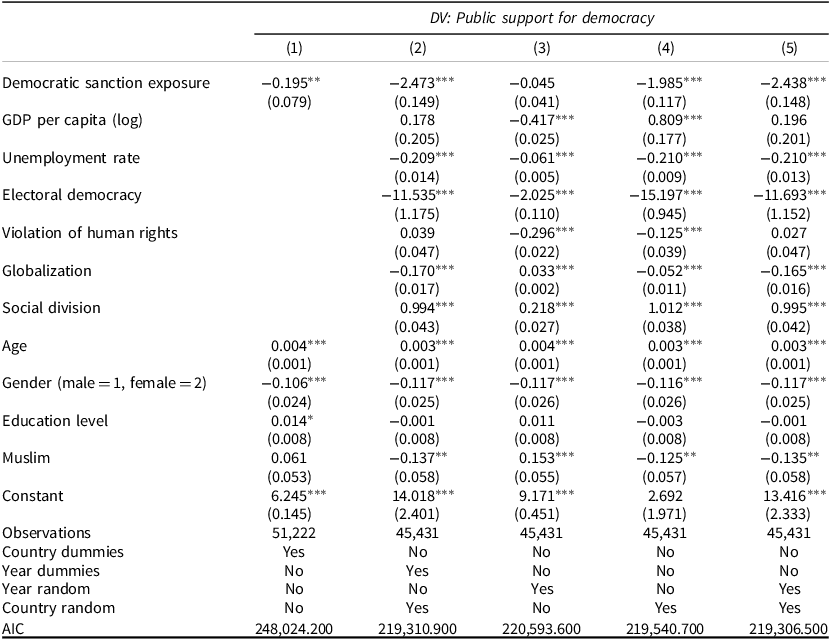
We begin with an analysis of the association between exposure to democratic sanctions and popular opinion on democracy. The estimation results are reported in Table 1. Model 1 presents the multilevel regression results without accounting for country-level controls but with country fixed effects. The coefficient for public pro-democratic attitudes is significantly negative. In Model 2, we estimate a revised hierarchical linear model that incorporates country-level controls, a random intercept for country, and year fixed effects, obtaining a statistically significant coefficient of −2.473. Models 3 to 5, respectively, include a random intercept for year, for country, and for both year and country, based on the complete multilevel specifications. The results show that in models with a random intercept for country or for both year and country, the coefficient for mass support for democracy remains negative and statistically significant. Since the Akaike information criterion (AIC) values are lower for Models 2, 4, and 5, these three models exhibit a better fit. Based on their results, we find that when a country is subjected to democratic sanctions, the public tends to adopt an opposing stance toward establishing democratic systems.
Democratic sanctions exposure and mass attitudes toward democracy

Note: ${^{\rm{*}}}P \lt $
0.1;
${^{\rm{*}}}P \lt $
0.1; ${\rm^{**}}$ $P \lt $
0.05;
$P \lt $
0.05; ${\rm^{***}}$ $P \lt $
0.01
$P \lt $
0.01
Regarding other control variables, across all estimation models, the public in countries with lower unemployment rates and lower levels of democracy, as well as higher levels of social division, is more likely to expect the establishment of a democratic regime in their countries. At the individual level, men and older individuals tend to be more pro-democracy. Based on Models 2, 4, and 5, which have higher goodness of fit, individuals in less-globalized countries show more supportive attitudes toward democracy, which is inconsistent with widely accepted views, and non-Muslims display the same tendency.
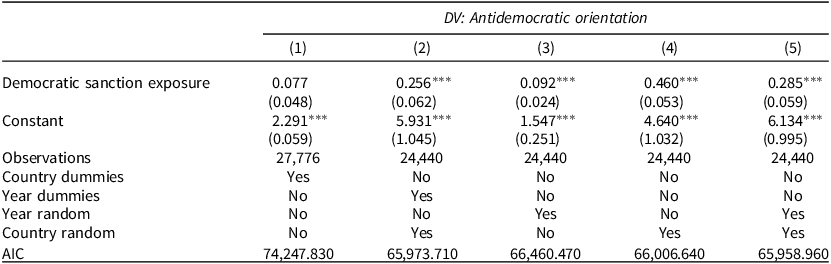
As robustness checks on the association between exposure to democratic sanctions and public attitudes toward democracy, we use an alternative indicator of democratic opinion and estimate alternative multilevel models. The Arab Barometer Survey asks respondents to indicate the extent to which they agree with the statement: ‘The citizens in your country are not prepared for a democratic system’. This item reflects respondents’ preferences regarding the establishment of a democratic regime in their country. The more strongly a respondent agrees with this statement, the greater his/her anti-democratic attitude. Compared with the question about the appropriateness of democracy in one’s country, this question elicits a more objective attitude rather than an emotional response. However, because this item is included only in survey rounds 2, 3, and 4, the number of observations is substantially reduced. The results in Table 2 show that exposure to democratic sanctions is positively associated with the public’s anti-democratic orientation at the 95% significance level across Models 2 to 5. Meanwhile, the AIC values suggest that the specifications with year fixed effects and a random intercept for country (Model 2), with a random intercept for year (Model 4), and with random intercepts for both year and country (Model 5) exhibit a higher quality of fit, which is consistent with the model specifications having the better fit quality in Table 1.
Democratic sanctions exposure and mass attitudes toward democracy: Using alternative indicator of dependent variable

Note: Country-level controls are included in Models 2–5; demographic controls are included in all models. Full regression results are reported in Online Appendix Table A3. $\;{{^{*}P }} \lt 0.1$
,
$\;{{^{*}P }} \lt 0.1$
, ${\rm^{**}{P }} \lt {\rm{0}}.{\rm{05}}$
,
${\rm^{**}{P }} \lt {\rm{0}}.{\rm{05}}$
, ${\rm^{***}{P }} \lt {\rm{0}}.{\rm{01}}$
.
${\rm^{***}{P }} \lt {\rm{0}}.{\rm{01}}$
.
Causal identification
Public orientation helps legitimize the political regime, which implies that democratic sanctions may be endogenous. To address this potential endogeneity, we employ a multilevel instrumental variable approach using 2SRI to examine whether public attitudes toward democracy result from foreign pressure. We use UN voting similarity between a country and the US as the instrumental variable. The fundamental reasoning behind this selection is that voting similarity in the United Nations General Assembly reflects the extent to which two countries share common interests on issues (Bailey, Strezhnev and Voeten Reference Bailey, Strezhnev and Voeten2017; Häge and Hug Reference Häge and Hug2016; Voeten Reference Voeten and Reinalda2013). Existing research has found a positive correlation between US-imposed sanctions and dissimilarity in UN votes between the US and its targets (Adhikari, Jeong and Peksen Reference Adhikari, Jeong and Peksen2022), whereas there is little evidence of a direct relationship between UN voting alignment with the US and public opinion on establishing a democratic regime. From 2010 to 2019, the US imposed more democratic sanctions on Arab states than any other sanctioning country. The voting similarity index with the US is calculated based on whether a country votes to approve, disapprove, or abstain on an issue in the same way as the US (Bailey, Strezhnev and Voeten Reference Bailey, Strezhnev and Voeten2017; Fjelstul, Hug and Kilby Reference Fjelstul, Hug and Kilby2025). To measure the instrumental variable, we use the United Nations General Assembly Ideal Points dataset, first released in 2009 and updated through 2023, available on the Harvard Dataverse (Voeten Reference Voeten2009)Footnote 11 . As shown in Figure 3, for countries subjected to democratic sanctions, the probability density of UN voting alignment with the US is concentrated at lower values, and their median similarity scores are also lower.
Distribution of UN voting similarity index with the US by exposure to democratic sanctions.

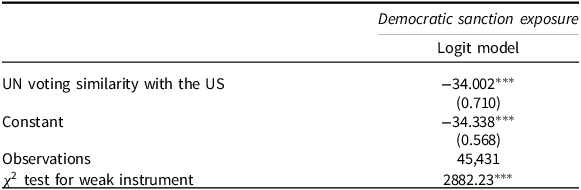
Table 3 presents the first-stage regression results for the IV estimation based on a logit model. Controlling for all country-level and demographic variables, the coefficient of UN voting similarity with the US is negative and statistically significant, indicating that countries sharing more interests with the US are less likely to be subjected to democratic sanctions. In the first-stage model, adding the instrument UN voting similarity with the US significantly improves goodness-of-fit compared to a reduced model without it ( ${\chi ^2} = 2882.23$
,
${\chi ^2} = 2882.23$
, ${{P }} \lt 0.001$
), providing strong evidence that the instrument is strong. A likelihood ratio test (LRT) further confirms this result (see: Online Appendix Table Table A4).
${{P }} \lt 0.001$
), providing strong evidence that the instrument is strong. A likelihood ratio test (LRT) further confirms this result (see: Online Appendix Table Table A4).
First-stage regression results for IV estimation

Note: Country-level controls are all included in the logit model. $^{\rm{*}}$ $ P \lt $
0.1;
$ P \lt $
0.1; ${\rm^{**}}$ $P \lt $
0.05;
$P \lt $
0.05; ${\rm^{***}}$ $P \lt $
0.01
$P \lt $
0.01
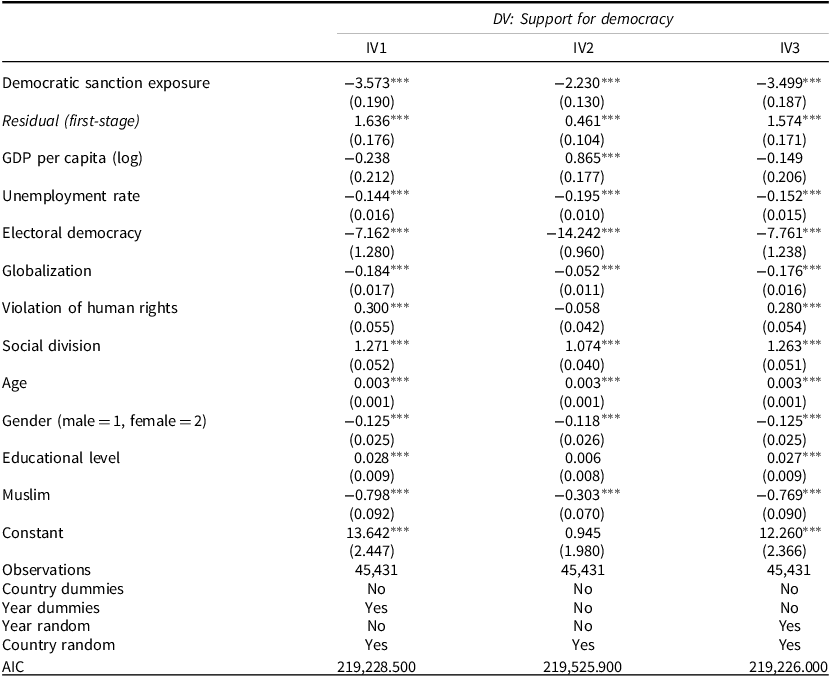
The second-stage regression results for the IV estimations are presented in Table 4. The first-stage residual is included as a regressor along with the endogenous variable in each model specification. The coefficient of the residual is positive and statistically significant across specifications, suggesting that endogeneity is indeed a concern in the baseline correlation estimation. In these models, democratic sanctions are found to trigger antidemocratic orientations, as indicated by the negative and significant coefficients. The three models respectively show that public support for democracy in countries exposed to democratic sanctions is approximately 3.57, 2.23, and 3.50 points lower than in countries without such exposure. On the 1-10 scale measuring support for democracy, these results indicate that democratic sanctions cause a substantial decline in public support for democracy in targeted countries.
Second-stage regression results for IV estimation

Note: ${^{\rm{*}}}$ $P \lt $
0.1;
$P \lt $
0.1; ${\rm^{**}}$ $P \lt $
0.05;
$P \lt $
0.05; ${\rm^{***}}$ $P \lt$
0.01
$P \lt$
0.01
As shown in Figure 4, both the mean and median values of economic decline in countries exposed to democratic sanctions are higher than in those without such exposureFootnote 12 . Yet, in some cases, sanctions may have limited economic effects on the target (e.g., Allen and Lektzian, Reference Allen and Lektzian2013), or feelings of economic hardship may not be salient. Therefore, a mediation analysis is conducted to examine whether exposure to democratic sanctions influences public attitudes toward democracy through individuals’ perceptions of economic hardship. This helps to confirm whether individuals in target countries rely more on their feelings of economic downturns when evaluating the justification of democratic sanctions and to reveal whether the backlash effect in popular political orientations can be generalized. Table 5 presents the results for the mediation effects of democratic sanction exposure on public support for democracy through evaluations of the economic situation. The average causal mediation effects, average direct effects, and total effects of the three models are all significantly negative. The results demonstrate that democratic sanctions can trigger public antidemocratic orientations in target countries by strengthening their feelings of economic hardship. This also indicates that individuals’ feelings that democratic sanctions harm ordinary people’s well-being fuel their perception of democracy as hypocritical.
Comparison of mean and median values of economic decline with standard errors (SEs).

Regression results for the mediation effects of democratic sanction exposure on public support for democracy by economic situation evaluation

Note: Models 1–3 are estimated based on Models IV1–IV3 in Table 4. The confidence intervals (CIs) in brackets are 95% CIs from 1,000 nonparametric bootstrap replicates.
The results reported in Online Appendix Table A5 examine how the public in countries exposed only to economic sanctions not aimed at democracy promotion tend to perceive democracy, without concerns about endogeneity. Four models (except for Model 3, which has the second-highest AIC value) show that exposure to non-democratic sanctions is positively associated with public support for democracy. These results suggest that economic sanctions without an explicit promotion of democracy do not provoke similar popular opposition to democracy.
Furthermore, since the empirical evidence is drawn from Arab states during the period 2010–2019, which began with a series of pro-democratic and anti-government protests in the region, we further examine whether varying levels of political protest prior to the imposition of democratic sanctions could trigger similar backlash effects in public orientations. To address this concern, we include the context of mass mobilization prior to democratic sanctions as a control variable in the estimation models. Online Appendix Tables A6–A7 present the 2SRI causal identification results incorporating mass mobilization for democracy as a control variable. The mass mobilization variable is measured by the frequency and magnitude of pro-democratic mobilization events in each country and year from the V-Dem datasetFootnote 13 . The results show that, after controlling for mass mobilization for democracy in the IV estimation across three models, the negative effects of democratic sanctions on public support for democracy in targeted countries remain robust. The findings further support the political-psychological mechanism explaining the public backlash against democracy. The key driver of the public’s anti-democratic orientations in states targeted by democratic sanctions is the motivation to defend their own country, which is rooted in individuals’ identification with their country.
Patriotic indoctrination and democratic sanction exposure
We now turn to test how patriotic indoctrination through media and education moderates the effects of democratic sanction exposure on the likelihood of adopting antidemocratic orientations under external threats. By examining this moderating role, we can confirm how the effects of sanction exposure vary with the state’s patriotic indoctrinationFootnote 14 .
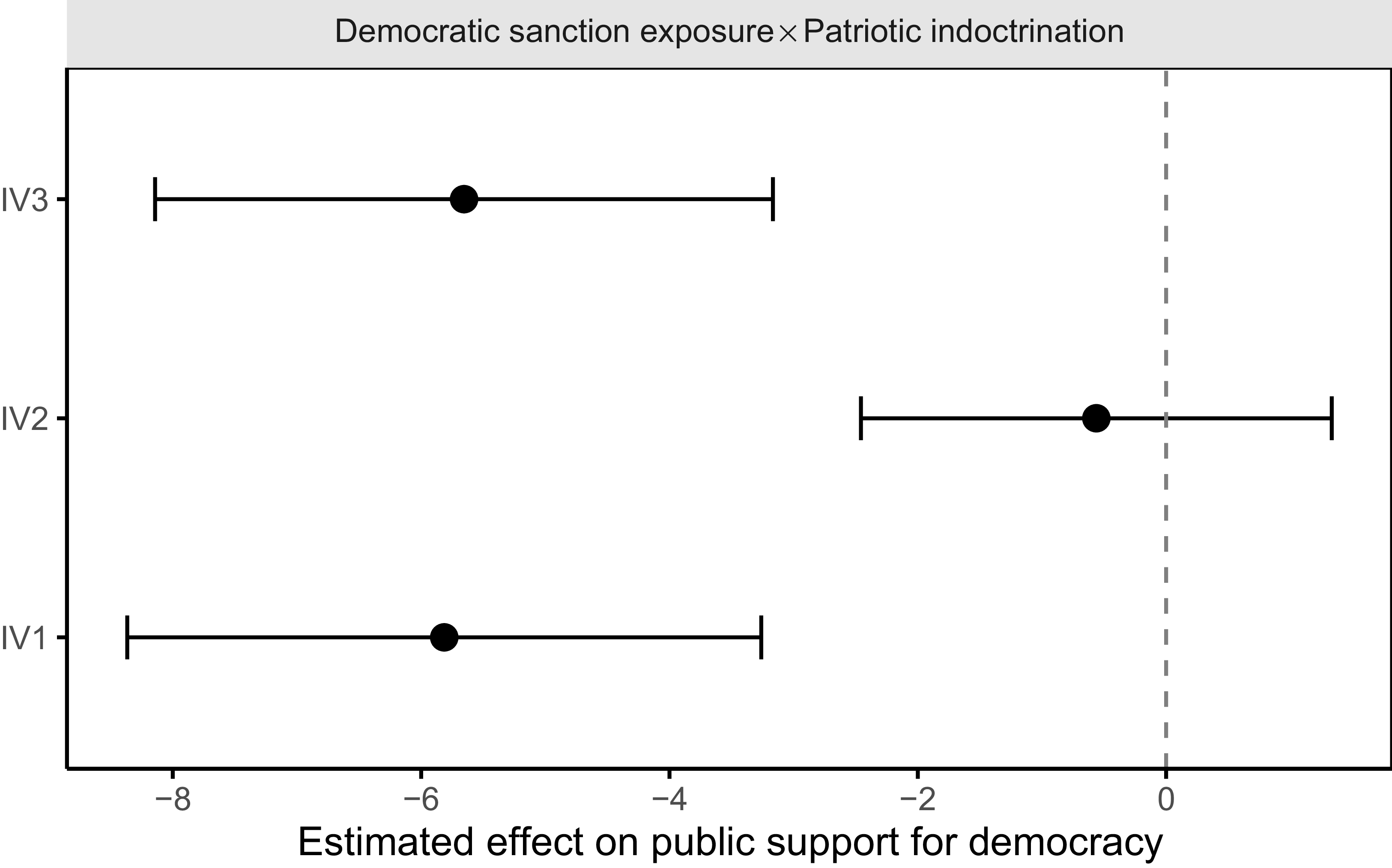
Figure 5 illustrates the direction and magnitude of the estimated coefficients, which reveals how the effect of democratic sanctions on public support for democracy varies conditional on the state’s patriotic indoctrination. The figure includes three estimated effects based on varying specifications. The coefficients of model specifications based on IV1 and IV3 in Table 4 are negative and statistically significant at the 95% confidence level. The full regression results shown in Online Appendix Table A8 present lower AIC values for the IV1-based model (Model 1) and IV3-based model (Model 3), which indicates that these two models provide better fitness. This suggests that the state’s capacity for patriotic indoctrination interacts with exposure to democratic sanctions in shaping public resistance to foreign pressure. More specifically, the anti-democratic orientation triggered by sanctions becomes more pronounced in target regimes that more actively promote patriotic sentiments. We also use the patriotic education index as an alternative measure of patriotic indoctrination, and the moderating role of patriotic education remains unchangedFootnote 15 .
Interaction effects of democratic sanctions and patriotic indoctrination on public support for democracy.
Note: The interaction effects are estimated based on Models IV1, IV2, and IV3 in Table 4. Error bars represent 95% confidence intervals. Full regression results of interaction effects are shown in Online Appendix Table A8.

It is worth noting that in countries subject to democratic sanctions, the intensity of patriotic indoctrination does not drastically increase after the imposition of such sanctions. As shown in Online Appendix Figure A5, the patriotic indoctrination indices in Egypt and Lebanon remained very stable from one year before their exposure to democratic sanctions. In the cases of Sudan, Libya, and Yemen, the intensity of patriotic indoctrination even declined during their exposure to democratic sanctions. According to the figure, the decline of patriotic indoctrination tended to emerge following the collapse of centralized power in these three countries. More specifically, a military junta led by Omar Hassan Ahmad al-Bashir seized power in Sudan in 1989, further polarizing the country along ethnic and religious lines (Deng Reference Deng1995). Libya has undergone a series of political turmoil and crises since the fall of Gaddafi’s regime in 2011 (Badi Reference Badi2021). Yemen has been embroiled in a civil war since 2014 between the Rashad al-Alimi-led Presidential Leadership Council and the Mahdi al-Mashat-led Supreme Political Council, both claiming to represent the legitimate government of Yemen. It is possible that severe political fragmentation may undermine the regime’s ability to mobilize nationalist sentiment in response to external sanctions.
Discussion and conclusion
Despite the extensive literature on the impacts of economic sanctions on the democratization of targeted countries, little is known about how economic sanctions, particularly those aimed at promoting democracy and human rights protection, affect the public’s attitudes toward democratic rule. As one of the most authoritarian regions, with increasing demands from protesters for democratic reforms, the Arab world between 2010 and 2019 provides a rare opportunity to study how democratic sanctions would shape popular attitudes toward democracy. This study not only extends existing work on public opinion in targeted countries under democratic sanctions but also contributes to the understanding of how foreign pressure and state-led indoctrination potentially interact to influence popular political orientations, which is of vital importance to a country’s political development.
The central finding of this study is that democratic sanctions trigger a political backlash in targeted regimes. The results from the baseline estimations provide evidence that exposure to democratic sanctions increases the likelihood of the public opposing democracy. Based on this, we use a country’s UN voting similarity with the US as an instrumental variable. The results of the 2SRI estimations across specifications address the endogeneity of democratic sanctions in shaping public political orientations and further confirm that the correlation is also causal.
This study also reveals that the public’s increasing resistance to democracy under democratic sanctions depends on patriotic mass mobilization. We find that when a country is subjected to democratic sanctions, public backlash against democracy intensifies as the state escalates patriotic indoctrination through education and the media. Under such conditions, citizens are exposed to homogeneous narratives portraying external threats, which instigates nationalist sentiment and invokes outward hostility, thereby leading them to perceive democracy promotion as an excuse for foreign interventions.
As a first effort to map the effects of economic sanctions on the ideological dimension of public opinion, some implications from international relations and comparative politics are worth mentioning. First, our findings add to the already considerable amount of evidence supporting that external threats or pressure produce a backlash effect. This suggests that sanctions motivate citizens’ in-group protective actions and reject external pressure (see also: Grossman, Manekin, and Margalit Reference Grossman, Manekin and Margalit2018; Porat et al. Reference Porat, Tamir, Wohl, Gur and Halperin2019; Seitz and Zazzaro Reference Seitz and Zazzaro2020), thereby producing the opposite of their intended goals. When the public directs its frustration and resentment outward, it tends to question the moral virtue claimed by democracy itself or by the sanctioning actors. The findings are also consistent with the common phenomenon that non-military threats as a punitive tool are not necessarily effective (Pape Reference Pape1997) and raise doubts about the viability of economic sanctions.
Second, the study highlights the importance of how foreign pressure, particularly economic coercion aimed at promoting democracy and human rights, interacts with patriotic indoctrination. This reveals the role of patriotic indoctrination in manipulating anti-foreign sentiments as a strategic response to foreign pressure. To some extent, it also relates to work emphasizing that powerful mobilization frames can control how foreign intervention or international conflicts are perceived in targeted countries (Hale Reference Hale2018; Hellmeier Reference Hellmeier2021). More importantly, in the case of Arab states from 2010 to 2019, the effects of patriotic mobilization are not limited to stable authoritarian settings, as some scholars suggest. Even in regimes facing growing public demands for political and human rights, such as Egypt, domestic patriotic mobilization can suppress democratic demands when these regimes are subjected to external threats.
Lastly, the results contribute to the broader debate on the effectiveness of economic sanctions in instigating democratization. The findings suggest that democratic sanctions can be counterproductive, as they may motivate the public to rally around the flag. However, when targeted governments lack the efforts to fuel anti-foreign sentiments, external pressure may instead catalyze public support for democratization as citizens pursue political stability and economic prosperity (Zagrebina Reference Zagrebina2020). From a broader regional perspective, some regimes fail to mobilize the masses, thereby creating a window of opportunity for sanctions to effectively promote democratic transitions.
It is undeniable that this study has some limitations. Although we take a deeper step in investigating the backlash effect in public opinion, our analysis does not examine whether public political orientations shift after the termination of democratic sanctions. Future research could focus on a single country and conduct parallel trend tests to examine whether public attitudes toward democracy follow similar patterns in the absence of democratic sanctions.
Supplementary material
The supplementary material for this article can be found https://doi.org/10.1017/S1475676526101182
Data availability statement
The data availability statement and replication code are provided in the Supplementary Material.
Acknowledgments
We thank two anonymous reviewers for their valuable comments. Earlier versions of this article were presented at 2025 Beijing Young Scholars Forum in Political Science hosted by the University of International Business and Economics, the 2025 Development Politics Conference hosted by Sun Yat-sen University, and the panel ‘Support for Democratic Institutions in a Comparative Context’ at the 2025 Annual Meeting of the American Political Science Association. We also thank the discussants for their insightful feedback.
Ethical standards
No ethical approval is required for this research.
Funding statement
This research received financial support from Humanities and Social Science Fund of Ministry of Education of China (No. 23YJC810002) and the ‘2115 Talent Development Program’ of China Agricultural University.
Competing interests
The authors declared no potential conflicts of interest with respect to the research, authorship, and/or publication of this article.







 Open access

