


Introduction
The year 2024 in Czech politics was marked by an unusually dense electoral calendar. Citizens voted in three separate elections: the European Parliament election in June, followed by Senate and regional elections in the autumn. These contests not only indicated public support for political parties at various levels of governance but also served as midterm tests for the ruling coalition led by Prime Minister Petr Fiala. The results revealed both continuity and volatility, as established parties faced challenges from emerging alliances. ANO 2011, led by the previous Prime Minister Andrej Babiš, reinforced its leading position across all three elections.
Alongside the elections, the year saw notable shifts within the executive branch. Five changes occurred in the composition of the government, including high-profile Cabinet reshuffles and the eventual exit of the Czech Pirate Party from the ruling coalition in October. These developments reflected both strategic repositioning after electoral setbacks and internal tensions among coalition partners. The personnel changes also highlighted the difficulties of maintaining coalition cohesion under the strain of declining approval ratings and external shocks.
Institutional change extended beyond the executive. Two sitting members of Parliament, Senator Roman Kraus and MP Jaroslav Bašta, passed away while in office. The upper chamber also experienced a shift following the 2024 Senate elections, where ANO made gains, and five senators were elected in the first round, a rare outcome in the Czech two-round electoral system. These developments were combined with the legislative passage of voting reform, which granted Czech citizens living abroad the option to vote by mail.
Election report
In 2024, the Czech Republic held European Parliament elections, an election to the upper house of Parliament (Senate), and regional elections.
European parliamentary elections
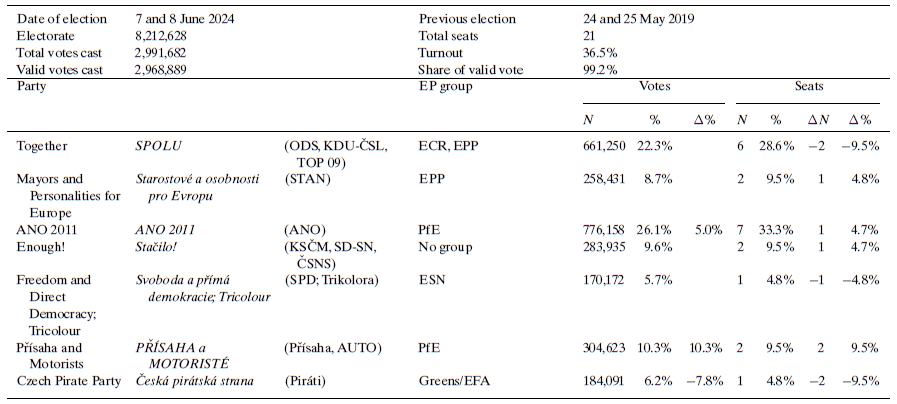
European Parliament elections took place on 7 and 8 June. With turnout reaching 36.5 per cent (Table 1), this marks the highest level recorded across the five European Parliament elections held since the Czech Republic's accession to the EU in May 2004, with the lowest turnout observed in 2014 at just 18.2 per cent. ANO 2011 (ANO) received the largest vote share at 26.1 per cent and increased its seat count from six to seven. The new electoral alliance, Přísaha (Oath) and Motorists for Themselves (AUTO), gained 10.3 per cent of the vote and entered the European Parliament with two seats. Similarly, Stačilo! (Enough!) coalition, which includes primarily the Communist Party of Bohemia and Moravia (KSČM), and the government party Mayors and Independents (STAN), each won two seats, both formations gaining one seat, compared to the previous election.

Notes:
1. Blank spaces indicate that votes cannot be compared with previous EP elections due to changes in coalitions.
2. Přísaha and Motorists were new parties (running as an electoral alliance).
Source: Czech Statistical Office (2025).
SPOLU (Together) coalition, which includes Civic Democratic Party (ODS), Christian and Democratic Union–Czechoslovak People's Party (KDU-ČSL), and Tradition Responsibility Prosperity (TOP 09), received 22.3 per cent of the vote cast, but the constituent parties lost two seats, ending with six after the 2024 EP elections. A coalition of the parties Freedom and Direct Democracy (SPD) and the Tricolour (Trikolora) secured one seat, meaning a drop of one MEP. Finally, the Czech Pirate Party (Pirates), which earned 6.2 per cent of the vote, lost two seats and now holds only one MEP. It is important to note that due to changes in coalitions and the emergence of new political alliances, some results are not directly comparable with previous European Parliament elections.
The electoral campaign mostly focused on international politics. Specifically, the Green Deal, migration, and the Russian war on Ukraine took the central stage (České noviny 2024). Moreover, the Prague Police Extremism and Terrorism Department launched criminal proceedings against the SPD party over election posters allegedly inciting hatred. One poster shows a dark-skinned man with a bloody knife, implying threats from migrants, while another AI-generated image depicts two Roma boys smoking. The SPD leader Tomio Okamura defended the posters as a reaction to the EU Migration Pact (ČT24 2025). Despite this, the Chamber of Deputies approved the prosecution of Tomio Okamura over these hate-inciting campaign posters in February 2025 (ČT24 2025).
Parliamentary elections
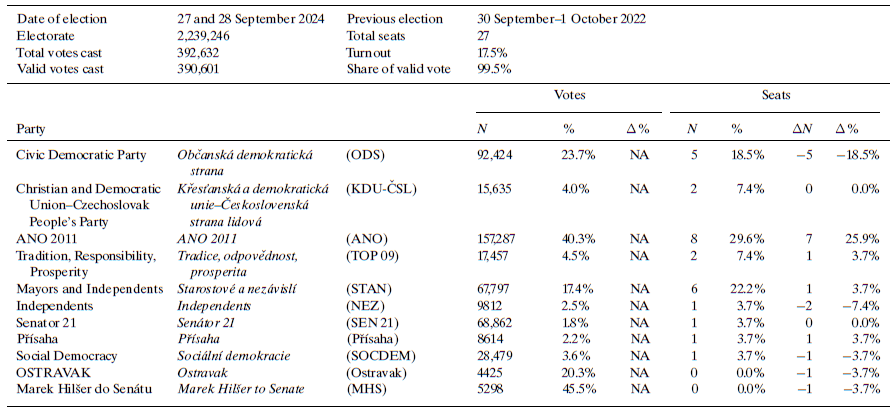
Elections to the Senate of the Parliament of the Czech Republic took place on 20 and 21 September (first round) and subsequently on 27 and 28 September (second round), in 27 Senate constituencies out of 81 (Table 2). Senators are elected for six years, and the Senate elections are designed to elect one-third of the upper chamber in a two-round majority system every two years. The first round of Senate elections is usually held in parallel with other elections, such as regional elections in 2024. The concurrence of these two elections resulted in a higher turnout in the first round (30.47 per cent) than in the second round (17.54 per cent) of the Senate elections.

Notes: 1. Results presented in this table refer to the second round of the Senate elections and to the first round in five constituencies where candidates were elected. The first round took place a week before (20 and 21 September 2024) with 30.5% turnout.
2. Percentage changes in votes are not calculated because Senate candidates often change the nominating party or are endorsed by different coalitions.
Source: Czech Statistical Office (2025).
In the Senate elections, candidates are not commonly elected in the first round. However, five candidates (Jana Mračková Vildumetzová, ANO; Pavel Fischer, TOP 09; Jiří Čunek, KDU-ČSL; Martin Bednář, ANO; Petr Vícha (Social Democrats [SOCDEM]) managed to obtain a majority of votes (i.e., more than 50 per cent of valid votes cast) and got elected in the first round. This represents the largest number of senators elected in the first round since the adoption of the two-round majority electoral system. Pavel Fischer, Petr Vícha, and Jiří Čunek were incumbents. With these five candidates elected early, 22 second-round runoffs were held the following week.
In the 2024 Czech Senate elections, several parties experienced notable shifts in their mandate counts, compared to the 2018 results, when elections were last held in the same 27 constituencies. ANO emerged as a dominant force by securing eight mandates with a significant gain of seven seats, compared to previous elections. While the ODS obtained five mandates, this only amounted to half of their 2018 count. STAN improved their standing by winning six mandates, an increase of one seat, whereas the KDU-ČSL maintained two mandates with no change, and TOP 09 also received two mandates, which is a gain of one seat. Among the smaller parties, Independents, Senator 21, Přísaha (Oath), and Social Democrats each secured one mandate. Notably, Přísaha received one seat, which was secured by its leader and former head of the influential Unit for Combating Organised Crime, Robert Šlachta.
Regional elections
Regional elections were held on 20 and 21 September, in the aftermath of serious floods, which impacted most drastically the eastern regions of the Czech Republic. Elections to regional councils are held every four years in 13 out of 14 Czech regions (representatives to the City Assembly of Prague are elected in municipal elections). Turnout was 32.91 per cent, about 5 percentage points lower than in the previous regional elections held in 2020 (37.95 per cent).
The main opposition party, ANO, achieved a decisive victory, securing 292 of the 685 seats across all 13 regions (a gain of 114 seats from the previous election). ANO triumphed in 10 out of 13 regions. ODS, the senior party of the ruling coalition government led by Petr Fiala, finished second with 106 seats, while the Czech Pirate Party suffered a significant setback, dropping from 99 to just three seats. The poor results led to the resignation of the Pirates’ leader, Ivan Bartoš, and contributed to the party's departure from the coalition government.
Cabinet report
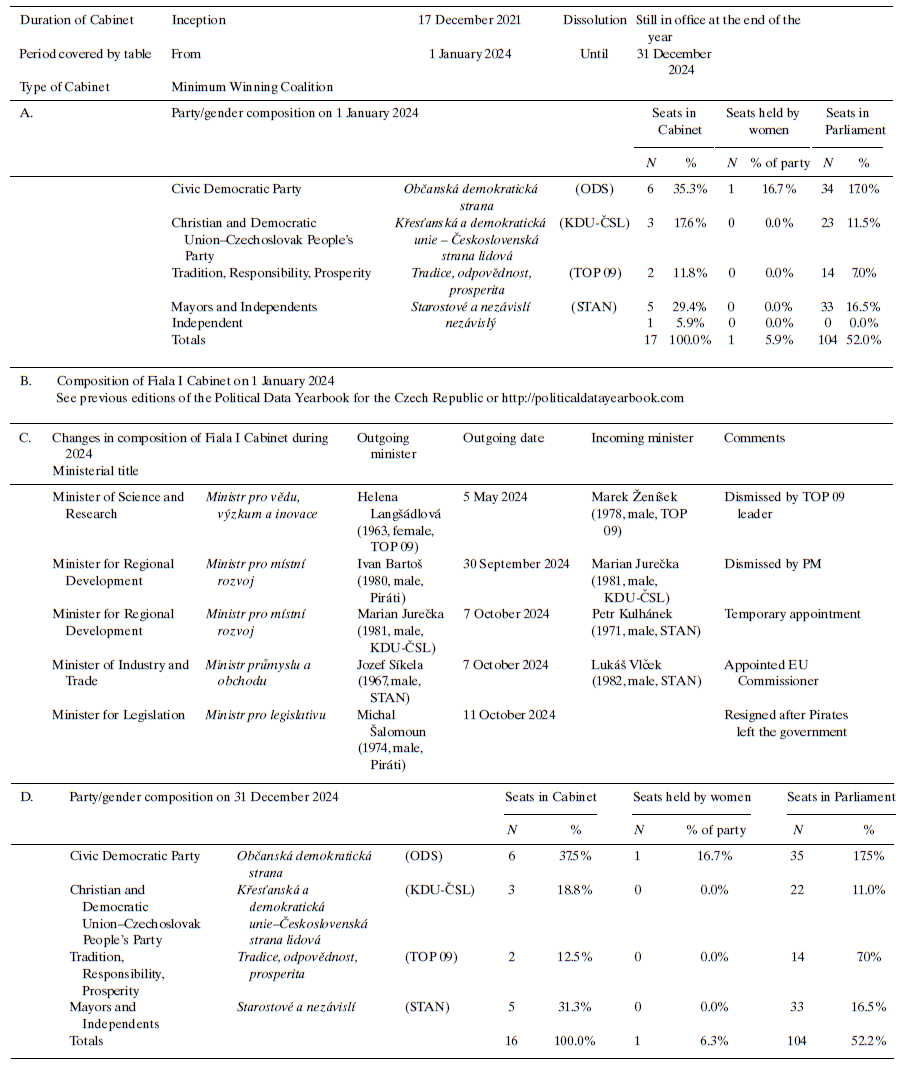
Five changes occurred in Fiala's Cabinet during 2024 (Table 3). The first change took place on 5 May, when Helena Langšádlová (TOP 09), Minister of Science and Research, resigned at the order of the leader of her party, Markéta Pekarová Adamová, due to unsatisfactory communication of her work to the public. She was replaced by her party colleague Marek Ženíšek (TOP 09).

Note: Jan Lipavský stayed in the government as independent (he left Pirates).
Source: Government of the Czech Republic website (2025).
The second and third Cabinet changes involved the Ministry for Regional Development. Ivan Bartoš (Pirates) was dismissed by the Prime Minister, Petr Fiala, because of his failure to secure the digitalization of construction management. Ivan Bartoš was dismissed on 30 September, and the ministry was temporarily led by Marian Jurečka (KDU-ČSL). This interim solution was intended to be only short-term. Petr Kulhánek (STAN) was appointed as the new Minister for Regional Development on 7 October. The fourth change occurred on the same day. Minister of Industry and Trade, Jozef Síkela (STAN), resigned after being nominated to serve as the new European Commissioner for International Partnerships. His resignation led to the appointment of Lukáš Vlček (STAN) as his successor in the ministry.
The final change of 2024 was connected to the departure of the Czech Pirate Party from the government. Following this decision, Michal Šalomoun (Pirates) resigned from his position as the Minister for Legislation on 11 October. Unlike the other ministerial vacancies in 2024, no replacement was appointed to this post after Šalomoun's resignation. The Minister for Legislation's agenda was subsumed under the Ministry of Justice.
Parliament report
The opposition obstructionism in the Chamber of Deputies, which heightened in 2023 (Kudrnáč & Petrúšek Reference Kudrnáč and Petrúšek2024), continued throughout 2024. This obstructionism culminated in January 2024, when the SPD leader Tomio Okamura delivered a record-breaking 10-hr and 44-min speech without a break. Okamura used his priority speaking right to block the entire parliamentary day in a protest against the coalition bill proposal to allow voting by mail for the Czech citizens living abroad. Okamura surpassed his previous record of 7 hrs and 7 mins from February 2023 (Aktualne.cz 2024). Despite the extensive obstruction efforts, the bill was passed by both chambers of the Parliament and was subsequently signed into law by the President Petr Pavel in August 2024.
Aleš Juchelka (male, 1976, ANO) was elected as the new Vice-Speaker of the Chamber of Deputies on 26 June 2024, running as the sole candidate. Juchelka replaced his party colleague Klára Dostálová (1971, female, ANO), who had resigned from the Vice-Speaker position two days earlier after being elected as a member of the European Parliament.
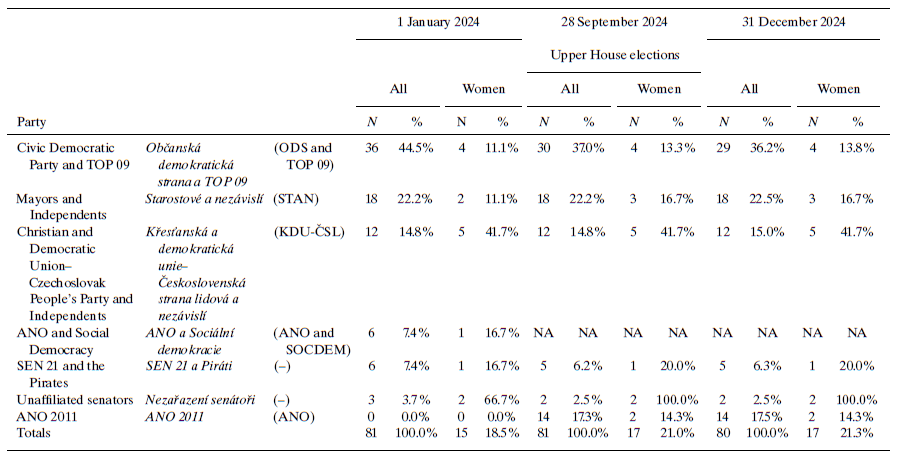
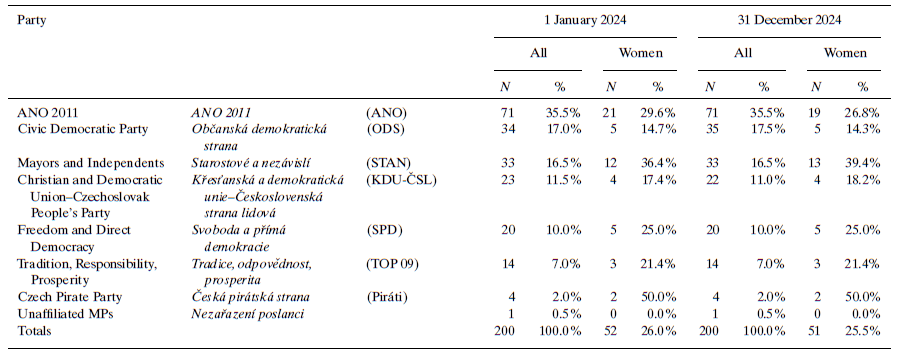
Detailed information on the composition of both Parliament chambers is presented in Tables 4 and 5. Eight MP changes occurred in the Chamber of Deputies during 2024. The 2023 presidential candidate Jaroslav Bašta (1948, male, SPD) died after a long illness on 7 April 2024. He was immediately replaced by Marcel Dlask (1974, male, SPD). Other personnel changes resulted from the 2024 European Parliament election, when four newly elected MEPs resigned from their Chamber of Deputies seats. Three of these changes were from the major opposition party, ANO. The Vice-Speaker of the lower chamber, Klára Dostálová, was replaced by Jaromír Dědeček (1958, male, ANO). Jaroslav Bžoch (1983, male, ANO) was replaced by Kamila Bláhová (1976, female, ANO). Jaroslava Pokorná Jermanová (1970, female, ANO) was replaced by Miroslav Samaš (1966, male, ANO). The last change took place in the TOP 09 party, when Ondřej Kolář (1984, male, TOP 09) was replaced by Martin Dlouhý (1970, male, TOP 09).

Notes:
1. ANO and Social Democracy parliamentary group ceased to exist after the 2024 Senate elections. After its electoral success, the ANO party created a new caucus called ANO 2011.
2. SEN 21 and Pirates parliamentary group was renamed after the 2024 Senate elections to Caucus for Liberal Democracy–Senator 21 and Czech Pirate Party.
Source: Czech Senate 2024.

Source: Chamber of Deputies (2024).
Another three personnel changes were a consequence of the September Senate elections. If a member of the Chamber of Deputies is elected to the Senate and accepts the Senate mandate, their mandate as a lower chamber member terminates due to the incompatibility of these two parliamentary functions. Three MPs became senators after the Senate elections and thus had to be replaced in the lower chamber. Jana Vildumecová Mráčková (1973, female, ANO) was replaced by Josef Váňa (1952, male, ANO). Ondřej Lochman (1980, male, STAN) was replaced by Silvia Doušová (1974, female, STAN). Last, David Šimek (1977, male, KDU-ČSL) was replaced by Radim Jirout (1971, male, ODS). This last change led to a shift in the number of seats held by two government parties (KDU-ČSL losing one, while ODS gained one seat), which ran as part of the SPOLU electoral alliance in the 2021 general election.
The September Senate elections affected the composition of the upper chamber. The caucus of the ODS and TOP 09 lost six seats, dropping from 36 to 30. Furthermore, Senator Roman Kraus suddenly passed away on 30 October 2024, reducing the number of senators in the ODS and TOP 09 caucus to 29. By the end of 2024, the electoral district number 60 (Brno-City) was left without a senator, and a by-election was scheduled for January 2025. Meanwhile, ANO achieved historic success, securing 14 Senate seats and becoming the third-largest caucus. SOCDEM and Robert Šlachta (Přísaha) also joined the ANO caucus.
The Senate elected its leadership at the first post-election meeting on 30 October. Miloš Vystrčil (1960, male, ODS) successfully defended his position as the Speaker of the upper chamber with 62 votes. As was the case two years ago, Vystrčil was the only candidate for this role. The elected Senate leadership also included Jiří Drahoš (1949, male, STAN) as the First Vice-Speaker, while the other elected Vice-Speakers were Jitka Seitlová (1954, female, KDU-ČSL), Jiří Oberfalzer (1954, male, ODS), and Ladislav Václavec (1967, male, ANO). Except for Václavec, who replaced Tomáš Czernin (1962, male, TOP 09), the Senate leadership from the previous term remained unchanged (cf. Petrúšek & Kudrnáč Reference Petrúšek and Kudrnáč2023: 120).
Political party report
Due to unsatisfactory electoral results, two parliamentary parties underwent a leadership change in 2024 (Table 6). Ivan Bartoš, who had been re-elected as the Czech Pirate Party leader at a general conference in January, resigned a day after the September regional elections. At the subsequent party conference on 9 November, Zdeněk Hřib (1981, male, Czech Pirate Party) was elected the new party leader. In a tight second-round contest, Hřib received 454 votes, beating the former Senator Lukáš Wagenknecht, who obtained support from 401 party members.

KDU-ČSL held their electoral conference in October. The party delegates elected Agriculture Minister Marek Výborný (male, 1976, KDU-ČSL) as its new leader, who won the second round of voting with 159 out of 288 votes cast, defeating Labour and Social Affairs Minister and the outgoing party leader Marian Jurečka (Novinky 2024). Thus, after nearly five years under Marian Jurečka's leadership, Výborný has once again become the leader of KDU-ČSL.
Three other parliamentary parties held their general conferences in 2024. However, since only the respective party leaders were running for re-election, they were all confirmed party leaders. Andrej Babiš, the previous Prime Minister (2017–2021) and the leader of the main opposition party (ANO), gained support from 88 out of 98 party delegates in February. The current Prime Minister, Petr Fiala, was confirmed as the leader of the ODS in April, receiving 424 votes from the 525 delegates present. Tomio Okamura was re-elected as the chairman of the opposition SPD party in April. He was supported by 195 out of 215 voters.
Institutional change report
The Czech Republic enacted an amendment to the Election Administration Act (Act No. 268/2024 2024), which allows Czech citizens residing abroad to vote by mail in parliamentary, European Parliament, and presidential elections. This change aims to enhance electoral participation among expatriates who previously faced several challenges in voting due to the necessity of travelling to embassies or consulates. To vote by mail (from the year 2025), a Czech citizen must prove their citizenship and identity, be registered on the special list of voters at the appropriate Czech diplomatic mission abroad, no later than 40 days before the election and actively request the option to vote by mail (Act No. 268/2024, section 8).
In March 2024, the Czech Senate approved a constitutional amendment establishing fixed dates for regional, Senate, and municipal elections. Beginning in 2026, these elections will be held at the end of the first week of October (Czech Radio 2024). This change aims to prevent elections from being scheduled during the summer months, which reduces voter turnout. The amendment also standardizes the boundaries of the 81 Senate constituencies, allowing adjustments only once every 12 years to ensure consistent electoral cycles. This reform addresses concerns about frequent constituency boundary changes that previously led to irregular election intervals for some voters (Czech Radio 2024).
Issues in national politics
As mentioned above, international issues such as the Russian war on Ukraine, the EU Green Deal, and migration dominated party discourse during the European Parliament election campaign. The ruling coalition, particularly the ODS, supported continued support and assistance to Ukraine and expressed general alignment with the EU's climate agenda, though it called for greater flexibility and consideration of national circumstances. ANO, while also maintaining support for Ukraine, adopted a more cautious stance on the Green Deal, frequently warning of its potential high economic costs for the Czech industry and households. In stark contrast, the SPD opposed economic sanctions imposed on Russia, rejected the Green Deal outright, and focused its campaign on migration, framing it as a security threat. The SPD also strongly opposed the EU Migration Pact and used provocative campaign materials to highlight its resistance to immigration and European integration.
The Stačilo! (Enough!) coalition, composed of hard Euroskeptic forces including KSČM, went even further by advocating for the withdrawal from the European Union and NATO. The coalition strongly criticized the Green Deal, migration policies, and the EU's influence over national decision-making, presenting itself as the only political force committed to restoring full sovereignty. Similarly, the Přísaha and AUTO alliance focused on themes of national control and sovereignty, especially in areas such as energy policy or the EU's planned phase-out of combustion engine vehicles.
One of the major issues in national politics was the departure of the Czech Pirate Party from the government. Although Prime Minister Petr Fiala emphasized that his decision to dismiss Ivan Bartoš from the position of Minister for Regional Development did not signal the termination of the coalition agreement, the Pirates chose to leave the government. Michal Šalomoun followed the Pirate Party's decision and resigned from his ministerial position, while the Minister of Foreign Affairs, Jan Lipavský, opted to remain in the government as an independent member. Later, he terminated his membership in the Czech Pirate Party due to differing views on certain issues within the party.
Another noteworthy issue was severe floods that hit the Moravian-Silesian and Olomouc regions in September 2024. This natural disaster endangered the regional elections in about 30 municipalities. Although the possibility of postponing elections was discussed, the Ministry of Interior argued that it was not legally possible (Radio Prague International 2024b). The Czech Parliament quickly approved an amendment to the 2024 budget, which was signed by President Petr Pavel on 3 October, increasing the deficit by CZK 30 billion to accommodate flood relief expenditures (Ministry of Finance 2024).
Acknowledgments
This work was supported by the European Regional Development Fund project “Beyond Security: Role of Conflict in Resilience-Building” (Reg. No.: CZ.02.01.01/00/22_008/0004595).


 Open access

