
Skip to main content Accessibility help
×
  • Cited by 3
    • Show more authors
    • You may already have access via personal or institutional login
    • Select format
    • Publisher:
      Cambridge University Press
      Publication date:
      26 November 2020
      17 December 2020
      ISBN:
      9781108883917
      9781108835411
      Dimensions:
      (253 x 177 mm)
      Weight & Pages:
      0.71kg, 266 Pages
      Dimensions:
      Weight & Pages:
    You may already have access via personal or institutional login
  • Selected: Digital
    Add to cart View cart Buy from Cambridge.org

    Book description

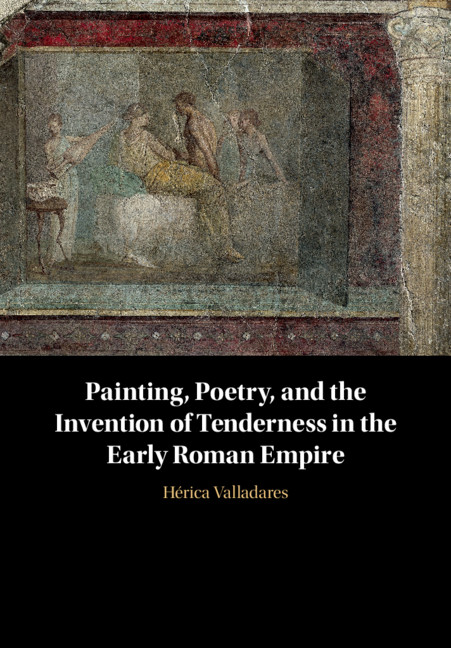
    Tenderness is not a notion commonly associated with the Romans, whose mythical origin was attributed to brutal rape. Yet, as Hérica Valladares argues in this ground-breaking study, in the second half of the first century BCE Roman poets, artists, and their audience became increasingly interested in describing, depicting, and visualizing the more sentimental aspects of amatory experience. During this period, we see two important and simultaneous developments: Latin love elegy crystallizes as a poetic genre, while a new style in Roman wall painting emerges. Valladares' book is the first to correlate these two phenomena properly, showing that they are deeply intertwined. Rather than postulating a direct correspondence between images and texts, she offers a series of mutually reinforcing readings of painting and poetry that ultimately locate the invention of a new romantic ideal within early imperial debates about domesticity and the role of citizens in Roman society.

    Reviews

    ‘Valladares's book nicely complicates the Rome of our popular imagination. The Romans have become so tied to imperialism and brutality that 'Roman tenderness' sounds like an oxymoron. But tenderness and brutality are not always easily disentangled Roman imperialism in fact enabled this shift toward the personal. Roman private leisure, after all, relied upon the enslavement of others and the cultural appropriation of Greek art and literature. Tenderness and brutality stand juxtaposed. By focusing on the softer side of the Romans, Valladares shines a welcome light on their complexity.’

    Stephanie McCarter Source: Hyperallergic

    ‘In this lucidly written, highly engaging book, Valladares traces a Roman evolution of what she perceives to have been an unprecedented kind of desire. This desire looks nothing like the sexually explicit scenes found on Athenian vases or on the walls of Pompeian brothels, imagery that has shocked modern sensibilities and attracted much scholarly attention over the years. Valladares' subject is not sex, but love; not eroticism, but tenderness. Few would describe the Romans, a people whose foundation stories centre on rape, as tender; even fewer would claim that tenderness was a Roman invention. The book's bold premise is backed up by close, comparative and contextual readings of carefully chosen case studies from Latin love elegy and Roman and Campanian wall painting. Valladares situates her findings within the history of scholarship on ancient sexuality, but they should also be seen as an invaluable contribution to the study of ancient emotions.’

    Charlie Pemberton Source: Bryn Mawr Classical Review

    Refine List

    Actions for selected content:

    Select all | Deselect all
    • View selected items
    • Export citations
    • Download PDF (zip)
    • Save to Kindle
    • Save to Dropbox
    • Save to Google Drive

    Save Search

    You can save your searches here and later view and run them again in "My saved searches".

    Please provide a title, maximum of 40 characters.
    ×

    Contents

    Metrics

    Altmetric attention score

    Full text views

    Total number of HTML views: 0
    Total number of PDF views: 0 *
    Loading metrics...

    Book summary page views

    Total views: 0 *
    Loading metrics...

    * Views captured on Cambridge Core between #date#. This data will be updated every 24 hours.

    Usage data cannot currently be displayed.

    Accessibility standard: Unknown

    Why this information is here

    This section outlines the accessibility features of this content - including support for screen readers, full keyboard navigation and high-contrast display options. This may not be relevant for you.

    Accessibility Information

    Accessibility compliance for the HTML of this book is currently unknown and may be updated in the future.
