


In jurisdictions that empower judges to review and invalidate legislation on constitutional grounds, there has long been a debate about the democratic legitimacy of this practice. Criticisms of judicial review often reference Bickel’s (Reference Bickel1962) “counter-majoritarian difficulty,” which highlights the issue of unelected judges reviewing and invalidating laws passed by elected officials. Hogg and Bushell (Reference Hogg and Bushell1997) introduced dialogue theory in their article, “The Charter Dialogue between Courts and Legislatures (Or Perhaps the Charter of Rights Isn’t Such a Bad Thing after All).” The article contends that judicial review establishes a democratic dialogue between courts and legislatures. It sparked significant debate concerning the extent to which legislatures respond to the Supreme Court of Canada’s decisions finding legislative violations under the Charter of Rights and Freedoms. Footnote 1 The extent of this Charter dialogue has not been systematically and empirically studied in well over a decade, however. Further, few scholars have attempted to identify common factors present in legislative replies. This paper consequently provides a systematic, empirical study of legislative replies between 2010 and 2023, and demonstrates that interest-group support is a common factor present in noncompliant replies.
To do so, the paper constructs a dataset of all applicable Charter cases between 2010 and 2023 (thirty cases). It finds that the legislatures overwhelmingly complied with Charter rulings made by the Supreme Court of Canada (SCC) in 93.3 percent of the cases (twenty-eight out of thirty). It nevertheless identifies two notable exceptions (or deviant cases), which were replies by the federal Parliament following Bedford (on sex work) and Carter (on medical assistance in dying (MAID)) that diverged from the policy prescriptions set out by the SCC. The research also examines the positions of third-party interveners for all thirty cases. While interest groups most often intervened in the cases studied to challenge the constitutionality of the impugned laws, the two deviant cases are exceptional in that they featured strong interest-group support for upholding the challenged provisions and thus departing from the Court’s rulings that invalidated them. This paper argues that, while legislatures overwhelmingly comply with Charter rulings, interest-group support was present for the rare instances of legislative noncompliance. To do so, this paper first provides an overview of the scholarly debate concerning dialogue theory, including an examination of the criticisms and limitations in the existing literature. It then discusses research objectives and methods. Next, it analyzes the legislative replies to the SCC’s rulings and interest-group support for all thirty cases, including more in-depth analyses of Bedford and Carter. Finally, it concludes with a discussion of the significance of the findings for the study of legislative replies to judicial rulings.
Literature review
Dialogue theorists
As the original proponents of dialogue theory, Hogg and Bushell (Reference Hogg and Bushell1997, 75–77) sought to respond to normative claims that judicial review under the Charter is illegitimate and undemocratic by defending the process as a “‘dialogue’ between courts and legislatures.” The authors contend that courts “almost always” allow legislative responses to invalidations under the Charter. They hold that these legislative responses often maintain the original policy objectives while influencing the policy’s design, usually by including some added rights protections. They indicate that structural components of the Charter including s 1 (the reasonable limits clause), s 33 (the notwithstanding clause) and internal rights limitations in various Charter provisions facilitate legislative responses to judicial rulings (Hogg and Bushell Reference Hogg and Bushell1997, 105). Hogg and Bushell provide the statistic that “dialogue”—which they define as “any action by the competent legislative body” in response to invalidation—occurred in 67.7 percent of cases (forty-four of sixty-five cases) studied (Hogg and Bushell Reference Hogg and Bushell1997, 80–82).
Roach (Reference Roach2001, 9)—another dialogue theorist—similarly argues that ss 1 and 33 allow court rulings to offer a “legitimate, but not final, contribution” to democratic debates over rights. Roach describes how s 1 fosters democratic dialogue by making legislatures explain the reasonableness of rights limitations, while s 33 does so by having the legislature reconsider the use of the clause every five years (Roach Reference Roach2001, 59). He proposes that the Court should only uphold legislative replies when the legislature has adequately justified any rights limitations using s 1 and that the Court should not submit to legislatures’ constitutional interpretations; rather, such “extraordinary claims” should be made using s 33 (Roach Reference Roach2001, 251). Roach also notes, however, that these provisions sit uneasily with theories of judicial review, such as that of John Hart Ely. Ely’s (Reference Ely1980) representation reinforcing theory of judicial review limits judicial review to matters of participation or instances in which representative democracy cannot be trusted because it is excluding minorities from participation. In such instances, issues cannot be referred back to the legislature to limit and override the rights of minorities (Roach Reference Roach2001, 231).
Roach (Reference Roach2001) is similarly reluctant to refer matters back to legislatures. For example, he rejects “in-your-face” legislative replies to R v Daviault (concerning an extreme intoxication defence) and R v O’Connor (1995) (regarding access to complainants’ counselling records in sexual-assault cases) because Parliament did not invoke s 33 in these noncompliant legislative responses (Roach Reference Roach2001, 272–81). In his analysis of the reply to Daviault, Roach comments that this “trivializes the Court’s precedents, and allows the rights of the most unpopular to be defined by elected politicians” (Roach Reference Roach2001, 276–77). Evaluating the Court’s acceptance of Parliament’s noncompliant response to O’Connor in R v Mills (1999), Roach criticizes: “Parliament will have an interest to maximize the rights of more popular groups, such as women’s groups, and to minimize the rights of less popular groups, such as those who stand accused of sexual assault” (Roach Reference Roach2001, 280–81). Fehr (Reference Fehr2022, 86–87) endorses Roach’s exclusion of “in-your-face” legislative responses from being considered part of democratic dialogue. Moreover, he is critical of the Court’s individualized instrumental rationality jurisprudence in s 7 cases including Bedford and Carter, specifically because these decisions allow coordinate (or noncompliant) legislative responses (Fehr Reference Fehr2022, 85–94; 2024, 95–111). In the Senate committee reviewing the legislative response to Carter, Hogg also testified that Parliament needed to comply with the constitutional parameters for eligibility set by the Court (Nicolaides and Hennigar Reference Nicolaides, Hennigar and Macfarlane2018).
The literature has also addressed other issues, including the time required for a legislative response. For example, Roach suggests that the consensus in favour of suspended declarations of invalidity may foster dialogue between courts and legislatures. He notes, however, that this consensus should perhaps be abandoned in certain cases in favour of injunctions or immediate declarations of invalidity to ensure that Charter applicants receive meaningful remedies (Roach Reference Roach2002). Leckey (Reference Leckey2019) has since written that even the twelve-month suspensions often provided may be too short for major policy issues, such as MAID.
Despite supporting a dialogue between courts and legislatures, dialogue theorists ultimately support judicial interpretive supremacy or a final say for the courts in interpreting the Constitution. Hogg and Bushell (Reference Hogg and Bushell1997, 79) hold that legislatures must “obey” judicial interpretations of what the Charter requires. In a later article by Hogg, Bushell Thornton and Wright (Reference Hogg, Thornton and Wright2007, 31), the authors clearly state that “the final authority to interpret the Charter rests properly with the judiciary.” Roach (Reference Roach2001, 243) similarly rejects a role for legislatures in Charter interpretation because it “risks making the legislature a judge in its own majoritarian causes” and allows it to minimize “the rights of its most unpopular citizens.” Knopff, Evans, Baker and Snow (Reference Knopff, Evans, Baker and Snow2017) indicate that Canada has “court-centric dialogue,” in which judicial interpretations often remain interpretively supreme.
Dialogue critics
Scholars have levelled normative and empirical criticisms against dialogue theory for this and other reasons. Manfredi and Kelly (Reference Manfredi and Kelly1999) and Huscroft (Reference Huscroft and James2009) criticize Hogg and Bushell for maintaining their normative position in favour of judicial interpretive supremacy. Morton (Reference Morton, Howe and Russell2001, 111) also contends that “[o]beying orders” is not dialogue. He proposes that rulings often eliminate the choice of the policy status quo, minimizing the usefulness of tools such as s 33 (116). Manfredi and Kelly (Reference Manfredi and Kelly1999, 522–23) note that dialogue may lead to policy distortion. Huscroft (Reference Huscroft and James2009, 54–55) concludes that dialogue seeks to “rationalize” judicial interpretive supremacy by “exaggerating” legislatures’ ability to respond. He also warns that judicial interpretive supremacy can create “disincentives to political action” (65). Petter (Reference Petter2007, 149) is critical of the manner in which dialogue theory minimizes the privileged positions of judges and judicial interpretations in Charter dialogues, policy debates, public discourse and political life.
Several authors criticize various components of the empirical case selection and measurement in the original article by Hogg and Bushell, including that the authors limit their study to cases in which the Court’s remedy was invalidation and that they count any legislative response as a legislative sequel (Manfredi and Kelly Reference Manfredi and Kelly1999; Hennigar Reference Hennigar2004; Petter Reference Petter2007; Macfarlane Reference Macfarlane2013). On the latter point, for instance, Petter (Reference Petter2007, 149) critiques the article for treating all forms of legislative responses alike, regardless of whether the legislature was able to maintain its original policy objectives. Manfredi and Kelly (Reference Manfredi and Kelly1999, 520–21) argue that simply repealing and replacing invalidated provisions should not count as dialogue, but rather reflect a form of “Charter ventriloquism.” The authors instead consider the measurement of “true dialogue” to include the legislative amendment (rather than the repeal) of the impugned provisions, finding that only twelve out of thirty-six cases were examples (Manfredi and Kelly Reference Manfredi and Kelly1999, 520–21). Similarly, Macfarlane (Reference Macfarlane2013, 40–47) analyzes legislative responses to the Court’s Charter decisions between 1982 and 2009; he finds that only 17.4 percent of responses were genuinely dialogic (twelve out of sixty-nine cases). By Macfarlane’s definition, genuinely dialogic responses stray from the SCC’s policy prescriptions in some manner, including a “creative element or partial disagreement” with the judicial decision (Macfarlane Reference Macfarlane2013, 44). While Hennigar (Reference Hennigar2004, 8) notes that such definitions of dialogue exclude the possibility of genuine agreement between the courts and legislatures (as “genuine agreement and grudging compliance ‘look’ identical”), he rightly identifies the methodological requirement for researchers to only count creative legislative responses that reverse, modify or avoid the judicial decisions as dialogue. In recognizing these methodological issues, this paper considers cases with all types of remedies and only counts as dialogic the legislative replies that stray from the SCC’s policy prescriptions in some manner.
Others suggest that the usefulness of dialogue theory has run its course. Mathen (Reference Mathen2007) questions the usefulness of the term. Manfredi (Reference Manfredi2007) gives the SCC’s rejection of Parliament’s legislative reply—along with the broader dialogue metaphor—in Sauvé II (2002) (concerning prisoner voting rights) as a key example of dialogue’s death. Kavanagh (Reference Kavanagh2016, 85) writes that “dialogue is a misleading metaphor, which we should abandon in our constitutional discourse.” A central theme in her criticism is that the metaphor “distorts” our understanding of the relationship between courts and legislature in rights protection, notably viewing legislative compliance with judicial decisions negatively (as capitulation or acquiescence) but legislative noncompliance positively (as resistance or defiance) (Kavanagh Reference Kavanagh2016, 112–13; 2024, 81). As Kavanagh notes, arguments over “dialogue” or “true dialogue” have largely devolved into antagonistic, dichotomous debates concerning which branch should have the final say in rights interpretation (Kavanagh Reference Kavanagh2024, 76–81). Kelly (Reference Kelly2024, 21) echoes Kavanagh’s call to abandon the dialogue metaphor. He instead describes how the SCC is an “implementer-dependent” institution with a complex implementation context, including federal, provincial and territorial legislatures in addition to private actors (Kelly Reference Kelly2024, 4–22). He also later suggests that the legislative response to Carter was dialogue’s “undoing” (Kelly Reference Kelly2024, 264). Macfarlane, Hiebert and Drake (Reference Macfarlane, Hiebert and Drake2023) observe that the empirical and conceptual utility of dialogue theory is so contested that they have chosen to abandon it as a lens of analysis. They also emphasize the complex interinstitutional relationships involved in crafting policy responses in the Charter era, specifically examining government justifications, parliamentary debates and bureaucratic assessments.
Coordinate constructionists
Coordinate constructionists support the fulsome consideration of policy issues by the legislative and executive branches, even if this leads to disagreements with the judiciary. Coordinate constructionists agree with Waldron’s (Reference Waldron2016, 1406) statement that “people can disagree about rights while still taking rights seriously.” In Canada, coordinate constructionists such as Slattery (Reference Slattery1987) argue that the courts, legislatures and executives all have duties to protect rights. Baker (Reference Baker2010, 6) describes that, while dialogue theory maintains a judicial “final say” by only allowing a dialogue about balancing rights (as interpreted by judges) or between rights and other societal interests, coordinate construction suggests a more robust dialogue that may include challenging judicial interpretations. Coordinate constructionists thus argue that legislatures and executives can legitimately challenge courts’ interpretations of rights and choose to adopt policies that they believe protect rights, even if they differ from judicial rulings. For instance, Baker suggests that coordinate interpretation is appropriate in response to tightly split or “wrong” judicial decisions (Baker Reference Baker2010, 103). In contrast to Roach’s disapproval of the “in-your-face” legislative reply to O’Connor (as discussed above), Baker supports Parliament’s “minority-retort,” in which it adopted the approach of the minority of the Court (Baker Reference Baker2010, 121).
Various other scholars support noncompliant legislative responses. Dixon (Reference Dixon2009) contends that dialogue theory should include deference by the SCC to reasonable legislative sequels. Hiebert (Reference Hiebert2002, 166) notes that legislatures have greater institutional capacity than courts to craft complex policies that balance competing rights and interests. Baker (Reference Baker, Sigalet, Webber and Dixon2019) similarly argues that Canada’s “coordinate moment” in its law on MAID is a positive example of interinstitutional dialogue given the complex policy issues at stake. Sigalet (Reference Sigalet, Sigalet, Webber and Dixon2019) also defends the coordinate construction, including the “interrogative, interruptive, and constructive” values of dialogue between the branches.
Limitations of dialogue theory and examining interest-group support
This study seeks to help fill empirical and theoretical gaps. Empirically, there has been no systematic examination of legislative replies since Macfarlane’s study (which covers up to 2009). Both empirically and theoretically, the literature is wanting of systematic examinations of common factors supporting noncompliant legislative responses. Morton (Reference Morton, Howe and Russell2001, 116) identifies issue salience as a key factor; that is, the decision about whether to comply with the ruling may be shaped by whether the policy is integral to the government’s policy agenda.
To help fill this gap, this paper systematically analyzes interest-group support for legislative replies by using the positions of third-party interveners. Third-party interveners are nonparty participants (such as governments or interest groups) that submit legal arguments to the courts. These actors have a clear interest in legislative policy responses. Examination of third-party interventions may therefore have predictive value, providing early indications of 1) interest-group disagreement with the Court’s decisions and probable support for noncompliant legislative responses and 2) interest-group support for policy alternatives from which the legislature may choose.
While analyzing interest-group and expert-witness support in legislative committees is important (McGrandle Reference McGrandle2025), groups that participate in committees only do not have the ability to shape the tabled bill. Moreover, the government may be intent on defending the bill as tabled from significant amendments and may prioritize the views of witnesses that support the bill’s policy direction. Scholarly work confirms these trends in the bills on sex work and MAID (Johnson, Burns, and Porth Reference Johnson, Burns and Porth2017; Nicolaides and Hennigar Reference Nicolaides, Hennigar and Macfarlane2018). For instance, Johnson, Burns and Porth (Reference Johnson, Burns and Porth2017) analyze the transcripts of the hearings of the House and Senate committees that examined the legislative response to Bedford. They find that both committees chose to hear proportionally more testimonies from witnesses (primarily groups or organizations) whose briefs supported the bill than those whose briefs criticized the bill (Johnson, Burns, and Porth Reference Johnson, Burns and Porth2017, 926–28). The authors conclude that the committee deliberations, particularly by members of the Conservative Party of Canada, were biased against critics of the bill (Johnson, Burns, and Porth Reference Johnson, Burns and Porth2017, 940–41).
Why might the positions of third-party interveners be a useful factor to consider in analyzing legislative replies to judicial decisions? First, numerous studies highlight the importance of third-party interventions for the decisions of the SCC (Welch Reference Welch1985; Koch Reference Koch1990; Alarie and Green Reference Alarie and Green2010; Radmilovic Reference Radmilovic2011; Callaghan Reference Callaghan2020; McNabb Reference McNabb2023; Nicolaides Reference Nicolaides2023). Second, other work details the impacts of legal mobilization or the use of the law to achieve policy reform (McCann Reference McCann1992; Epp Reference Epp1998; Manfredi Reference Manfredi2004; Riddell Reference Riddell2004; Smith Reference Smith2005; Vanhala Reference Vanhala2009; Manfredi and Maioni Reference Manfredi and Maioni2018). Third, various theories of the policy process identify the significant role of interest groups in policymaking (see, as examples, Mettler and Sorelle Reference Mettler, Sorelle, Weible and Sabatier2018; Shanahan et al. Reference Shanahan, Jones, McBeth, Radaelli, Weible and Sabatier2018; Zahariadis and Petridou Reference Zahariadis and Petridou2024; Jenkins-Smith and Weible Reference Jenkins-Smith and Weible2025).
Fourth, several case studies discuss the roles of interest groups in the legislative responses to judicial decisions (Hiebert Reference Hiebert2002; Froc and Sheehy Reference Froc and Sheehy2022). For example, Hiebert (Reference Hiebert2002, 86–112) makes repeated references to the role of interest groups when discussing legislative responses to cases such as RJR-MacDonald (concerning tobacco advertising), R v Seaboyer (concerning raising sexual history in sexual assault trials) and R v O’Connor (regarding defence counsel access to complainant’s private medical records). Froc and Sheehy (Reference Froc and Sheehy2022) emphasize the role of extensive consultations with women’s groups in informing the legislative response to Daviault (concerning the extreme intoxication defence) and criticize the limited consultations in response to Brown (the case concerning the constitutionality of Parliament’s noncompliant response to Daviault). Fifth, various studies on the Bedford and Carter cases have, to differing degrees, highlighted the role of interest groups in shaping debates surrounding the legislative responses (Lawrence Reference Lawrence2015; Johnson, Burns, and Porth Reference Johnson, Burns and Porth2017; McMorrow Reference McMorrow2018; Nicolaides and Hennigar Reference Nicolaides, Hennigar and Macfarlane2018; Claggett Reference Claggett2023; Macfarlane, Hiebert, and Drake Reference Macfarlane, Hiebert and Drake2023; Kelly Reference Kelly2024).
Extensive sets of literature emphasize the importance of the positions of interest groups in both judicial and legislative decision-making, including in shaping noncompliant legislative responses to judicial rulings. Yet, the study of interest groups in the literature on legislative replies has been largely ad hoc and episodic. This paper therefore endeavours to systematically examine the positions of interest groups to determine whether there is interest-group support for distinct types of legislative responses. While the literature identifies legitimate limitations to dialogue theory, scholars rightly note the importance of continuing to study legislative responses to judicial rulings. These studies have examined the complex overlay of factors impacting legislative responses, including: policymaking processes in federal, provincial and territorial legislatures; bureaucratic Charter vetting; Charter statements and government justifications for bills; as well as the input of societal actors, including interest groups, experts and the broader public (Macfarlane, Hiebert, and Drake Reference Macfarlane, Hiebert and Drake2023; Kelly Reference Kelly2024). To this end, this paper stresses the importance of systematically examining the role of interest-group support for legislative replies. While detailed case studies are invaluable to the examination of these complex processes, systematic study of all legislative responses is arguably still needed to identify the common factors present in distinct types of legislative replies. This informs the methods and case selection in the paper.
Research objectives and methods
The first research objective is to analyze legislative replies to the SCC’s Charter decisions. The research first identifies all Charter cases between 1 January 2010 and 31 December 2023 in which the impugned law(s) or provision(s) thereof were deemed unconstitutional. There are thirty cases. The paper examines all remedies; these include declarations of invalidity, reading down or severing certain provisions and declaratory relief. After searching the records of the legislatures that passed the impugned laws, it codes first whether there was a legislative response and second whether the legislative response was compliant (by offering no response and letting the decision stand or repealing, replacing or amending the law in compliance with the ruling) or genuinely dialogic (by replacing or amending the law in a manner that diverged from the policy prescriptions of the Court).Footnote 2
The second research objective is to analyze the positions of third-party interveners in all thirty cases. There are 333 interventions. First, the paper codes the interveners’ positions on the constitutionality of the law. There are four main categories: constitutional, unconstitutional, mixed position or no clear position. It then analyzes three types of majority positions: all interveners, government interveners or “other” (primarily interest-group) interveners. For each case and each category of intervener, it codes whether the majorities were in favour of deeming the challenged law unconstitutional. There are five main categories: no (constitutional), yes (unconstitutional), mixed, no clear position by interveners or no interveners.Footnote 3 The objective is to determine whether interest-group support for finding the law unconstitutional (in favour of a compliant legislative response) or constitutional (in favour of a genuinely dialogic legislative response) may correspond with the eventual types of legislative responses.
Analyzing legislative responses and interest-group support
Legislative responses
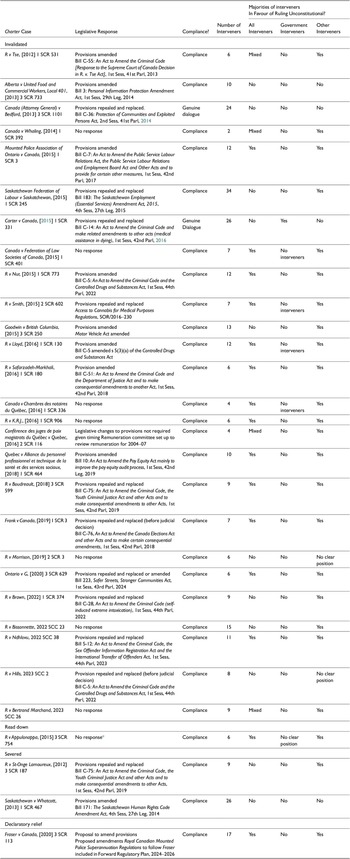
The findings provided in Table 1 affirm that very little genuine dialogue occurs in response to Charter rulings. In only two out of thirty cases (6.7%) was the legislative reply genuinely dialogic in the sense that the legislature diverged in some manner from the policy prescriptions of the Court. This was lower than the 17.4 percent of genuinely dialogic responses that Macfarlane (Reference Macfarlane2013) found (in twelve out of sixty-nine cases). The two genuinely dialogic responses were both made by the federal Parliament, in the first instance under the Harper government in response to the Bedford decision concerning sex work and in the second under the Trudeau government in response to Carter concerning MAID. It is also notable that the percentage of dialogic responses would be counted as twenty-two out of thirty (73.3%) when using the method of Hogg and Bushell, in which only cases with “no response” by the legislatures (eight out of thirty cases) would be deemed non-dialogic.
Charter Cases, Legislative Responses and Interventions
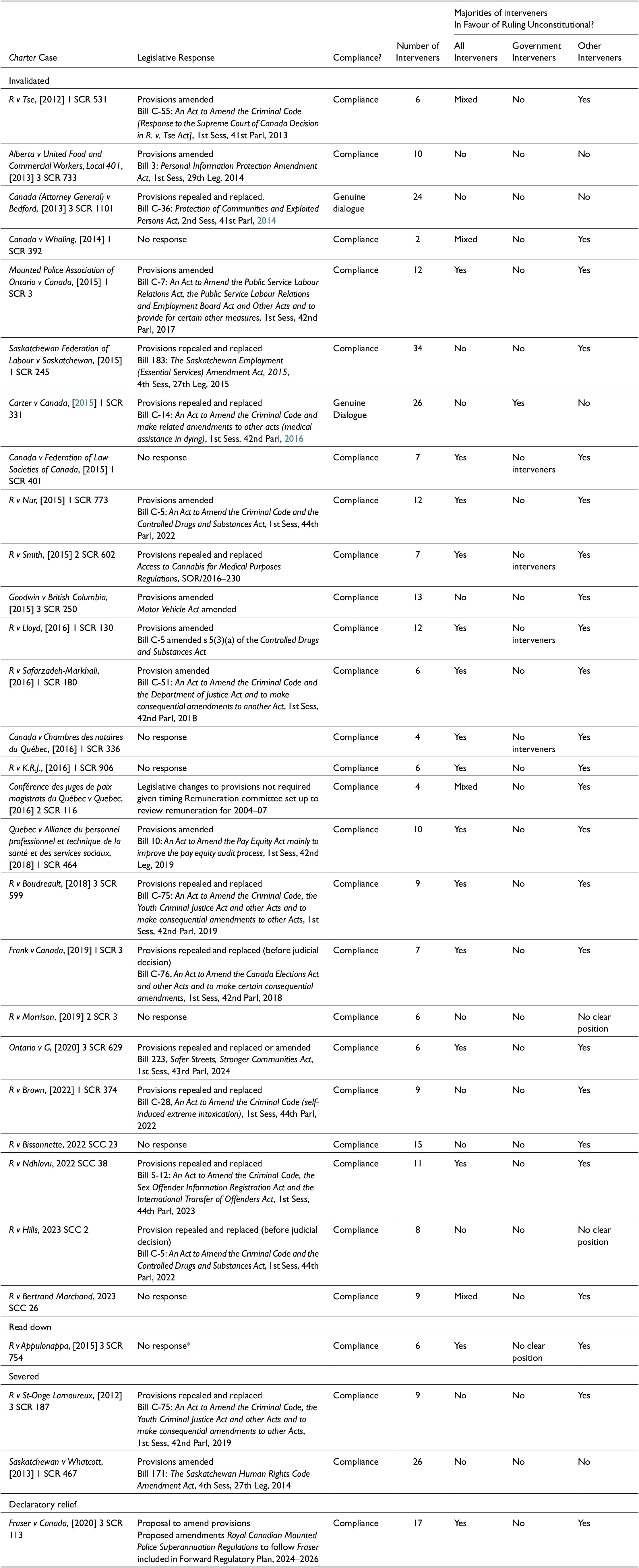
Table 1. Long description
The table is organized into remedy sections: Invalidated, Read down, Severed, and Declaratory relief. Each section contains rows with the following columns: Charter Case, Legislative Response, Compliance, Number of Interveners, and three columns for Majorities of interveners in favour of ruling unconstitutional (All interveners, Government interveners, Other interveners).
For Invalidated: Cases include R v Tse (2012), Alberta v United Food and Commercial Workers, Local 401 (2013), Canada (Attorney General) v Bedford (2013), Canada v Whaling (2014), Mounted Police Association of Ontario v Canada (2015), Saskatchewan Federation of Labour v Saskatchewan (2015), Carter v Canada (2015), Canada v Federation of Law Societies of Canada (2015), R v Nur (2015), R v Smith (2015), Goodwin v British Columbia (2015), R v Lloyd (2016), R v Safarzadeh-Markhali (2016), Canada v Chambres des notaires du Québec (2016), R v K.R.J. (2016), Conférence des juges de paix magistrats du Québec v Quebec (2016), Quebec v Alliance du personnel professionnel et technique de la santé et des services sociaux (2018), R v Boudreault (2018), Frank v Canada (2019), R v Morrison (2019), Ontario v G (2020), R v Brown (2022), R v Bissonnette (2022), R v Ndhlovu (2022), R v Hills (2023), R v Bertrand Marchand (2023). Legislative responses vary: some provisions are amended, repealed and replaced, or have no response. Compliance is generally marked as ‘Compliance’, with exceptions such as ‘Genuine dialogue’ in Bedford and Carter. Number of interveners ranges from 2 to 34. Majority positions are listed as Yes, No, Mixed, No clear position, or No interveners for each group.
For Read down: R v Appulonappa (2015) is listed, with no legislative response, compliance, 6 interveners, and majority positions Yes, No clear position, Yes.
For Severed: R v St-Onge Lamoureux (2012) and Saskatchewan v Whatcott (2013) are included, with legislative responses, compliance, 9 and 26 interveners respectively, and majority positions No, No, Yes for St-Onge Lamoureux and No, No, No for Whatcott.
For Declaratory relief: Fraser v Canada (2020) is listed, with a proposal to amend provisions, compliance, 17 interveners, and majority positions Yes, No, Yes.
Bolded text in the Compliance column indicates ‘Genuine dialogue’ for Bedford and Carter, and in the Other interveners column for Bedford and Carter indicates ‘No’. The table footnote clarifies that for Appulonappa, the provision was amended in 2012 through Bill C-31: Protecting Canada’s Immigration System Act.
* Though provision amended in 2012 through Bill C-31: Protecting Canada’s Immigration System Act, 1st Sess, 41st Parl, 2012.
Bedford
How did these two legislative responses diverge from the Court’s decisions? In Canada (Attorney General) v Bedford (2013), the Court ruled that the Criminal Code provisions restricting common bawdy houses, living off the avails and public communication for the purposes of prostitution violated s 7 of the Charter (life, liberty and security of the person). These Criminal Code provisions reflected a policy choice by Parliament: to allow prostitution to be legal, but to limits street workers to street prostitution or “out-calls.” The applicants argued that this policy approach deprived them of security of the person by preventing them from taking safety measures such as working in secure indoor locations, hiring drivers or security guards and screening clients for risks of violence or to health. Given that selling and purchasing sex in exchange for money were themselves legal, the Court agreed with the applicants that the provisions infringed their rights (paras 1–73). The Court found that, by blocking safe havens, the restriction on common bawdy houses was grossly disproportionate to the legislative goal of preventing nuisance and that, by preventing the screening of clients to enhance sex workers’ safety, the limitations on communication were grossly disproportionate to the goal of removing prostitution from the streets. The Court also determined that the ban on living on the avails was overbroad relative to the legislative goal of targeting parasitic relationships with pimps, as it also criminalized relationships that are not exploitative, such as hiring bodyguards (paras 130–159).
The Harper government’s response to Bedford was Bill C-36, the Protection of Communities and Exploited Persons Act (2014). Bill C-36 avoided the Bedford ruling by criminalizing the purchase of sexual services—an activity that was legal at the time the Court decided Bedford. For instance, the law added ss 286.1–286.5 to the Criminal Code; these sections created criminal penalties for those obtaining or communicating for the purpose of obtaining the sexual services of another person, receiving financial or material benefits from these offences, procuring a person to facilitate these offences and advertising to provide sexual services. Section 286.5 provides immunity from the provisions for those providing their own sexual services. Yet, the law also added ss 213(1) and 213(1.1), which established offences for stopping or impeding traffic in a public place or communicating to offer or provide sexual services in a public place on or next to a school yard, playground or daycare centre.
Peter MacKay, then the justice minister, described that, with C-36, the policy approach shifted from targeting nuisance to preventing exploitation. The bill responded to Bedford, which he argued was clear in that it did not prevent Parliament from “imposing limits on where and how prostitution may be conducted” (House of Commons of Canada 2014). While MacKay described the policy approach as distinctly Canadian approach, C-36 broadly follows the Nordic model by criminalizing pimps and johns, rather than sex workers.
Carter
In Carter v Canada (2015), the Court unanimously concluded that the Criminal Code ban on MAID infringed all three interests under s 7 (life, liberty and security of the person). The SCC invalidated the ban, requiring that the law allow MAID for competent, clearly consenting adults, with grievous and irremediable medical conditions that cause enduring and intolerable suffering. The Court’s prescriptions included that the law must avoid overbreadth (i.e., capturing those who are not vulnerable) by using individual assessments of vulnerability, decision-making capacity and consent. Together with safeguards to ensure minimal impairment under s 1, these measures would take the place of blanket bans (paras 105–116).
In response, the Liberal government introduced Bill C-14, An Act to Amend the Criminal Code and to make related amendments to other Acts (medical assistance in dying) (2016). Bill C-14 legalized MAID for competent, clearly consenting adults with grievous and irremediable medical conditions that cause enduring and intolerable suffering. Contrary to Carter, however, it developed stricter eligibility criteria for defining a grievous and irremediable medical condition through s 241.2(2), which defined it as a “serious and incurable illness, disease or disability” where the individual is in an “advanced state of irreversible decline in capability” and their “natural death has become reasonably foreseeable.”
The last criterion recreated a narrower blanket ban for those whose deaths were not reasonably foreseeable. C-14 was a rare instance of coordinate interpretation because Parliament did not adhere to the judicially defined limit from the Carter decision, specifically that individual assessments (rather than blanket bans) were required. Jody Wilson-Raybould, then the justice minister, was nevertheless committed to defending the bill, despite criticism from legislators, interest groups and expert witnesses concerning its constitutionality and susceptibility to future Charter challenges. The Liberal government also rejected the recommendations of the Special Joint Committee, allowed only technical amendments to the bill in the House Committee and rejected the Senate’s key amendment to restore Carter’s eligibility criteria (Nicolaides and Hennigar Reference Nicolaides, Hennigar and Macfarlane2018). Notably, the preamble to the bill noted the need to protect vulnerable persons from being influenced into seeking MAID.
Interest-group support
The research also examines the positions of interveners to determine whether they may be associated with the types of legislative responses. As indicated, the paper analyzes three types of majority positions: all interveners, government interveners or “other” (primarily interest-group) interveners (see Table 1). As expected, majorities of government interveners were in favour of upholding the law in twenty-four out of thirty cases (80.0%). In fifteen out of thirty cases (50.0%), majorities of all interveners were in favour of the law being deemed unconstitutional.
The positions of the “other” (interest-group) interveners were most consistent with the legislative responses to comply with the Court’s decisions. Majorities of “other” interveners were, indeed, in favour of the law being deemed unconstitutional in twenty-four out of thirty cases (80.0%). Consequently, in eighty percent of the cases examined, majorities of “other” interveners received these results with both the Court’s decisions and the compliant legislative responses. In two of the remaining six cases (Morrison and Hills), the interveners took no clear positions on the constitutionality of the impugned provisions.
In the last four cases (UFCW, Local 401, Bedford, Carter and Whatcott), majorities of “other” interveners were not in favour of the Court’s ultimate decisions to deem the provisions unconstitutional. In two of these cases (UFCW, Local 401 and Whatcott), legislative compliance was uncontentious, however, due to the minor policy changes required. In the former case, the Personal Information Protection Act (PIPA) only needed to be amended to allow the collection of personal information by trade unions concerning a labour dispute. Of the interest-group interveners, the Coalition of British Columbia Businesses and Merit Canada defended the PIPA’s constitutionality, while the British Columbia Civil Liberties Association and Alberta Federation of Labour challenged its constitutionality. Three privacy commissioners that had defended the PIPA’s constitutionality were included in the “other” interveners category,Footnote 4 though the even split between interest groups is of greater importance to the present analysis (Supreme Court of Canada 2025). In the latter case, the Court simply severed the broader language in the hate-speech provision of the Saskatchewan Human Rights Code to correspond to existing judicial interpretation. This was uncontroversial for the majority of interest-group interveners that had defended the provision’s constitutionality. The final two cases (Bedford and Carter) are the deviant cases in which the federal Parliament enacted “genuinely dialogic” responses that strayed from the policy prescriptions of the Court.
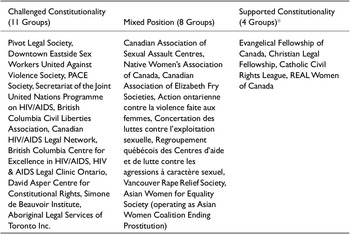
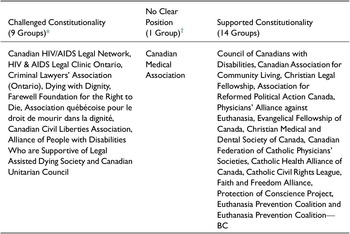
The two deviant cases involve salient policy issues (sex work and MAID) with competing societal interests. Both are s 7 cases in which the Court took an individualistic approach to instrumental rationality principles (which include arbitrariness, overbreadth or gross disproportionality) in its analyses of the principles of fundamental justice (an internal rights limitation in s 7), which Fehr (Reference Fehr2022; Reference Fehr2024) rightly notes facilitate coordinate legislative responses.Footnote 5 The cases stand out, however, due to the strong interest-group support for upholding the challenged laws, in full or in part. In Bedford, no single position attracted a majority; a plurality (eleven groups) of interveners challenged the constitutionality of the provisions. However, a majority (twelve groups) of interveners favoured upholding the impugned provisions, in full or in part, when including groups with a mixed position or that fully supported the constitutionality of the provisions (see Table 2 for an overview). In addition to the conservative and religious groups that fully supported the constitutionality of the impugned provisions, a wide array of women’s groups (including those focused on addressing sexual violence) put forward mixed positions, suggesting the provisions were unconstitutional in their application to “prostituted persons,” but constitutional in application to pimps and johns.Footnote 6 Carter is similarly notable in that a majority (fourteen groups) of interest-group interveners (including an array of disability and religious groups) supported the constitutionality of the challenged law; a minority (nine groups) challenged the provisions’ constitutionality (see Table 3 for an overview).
Positions of Interest-Group Interveners in Bedford
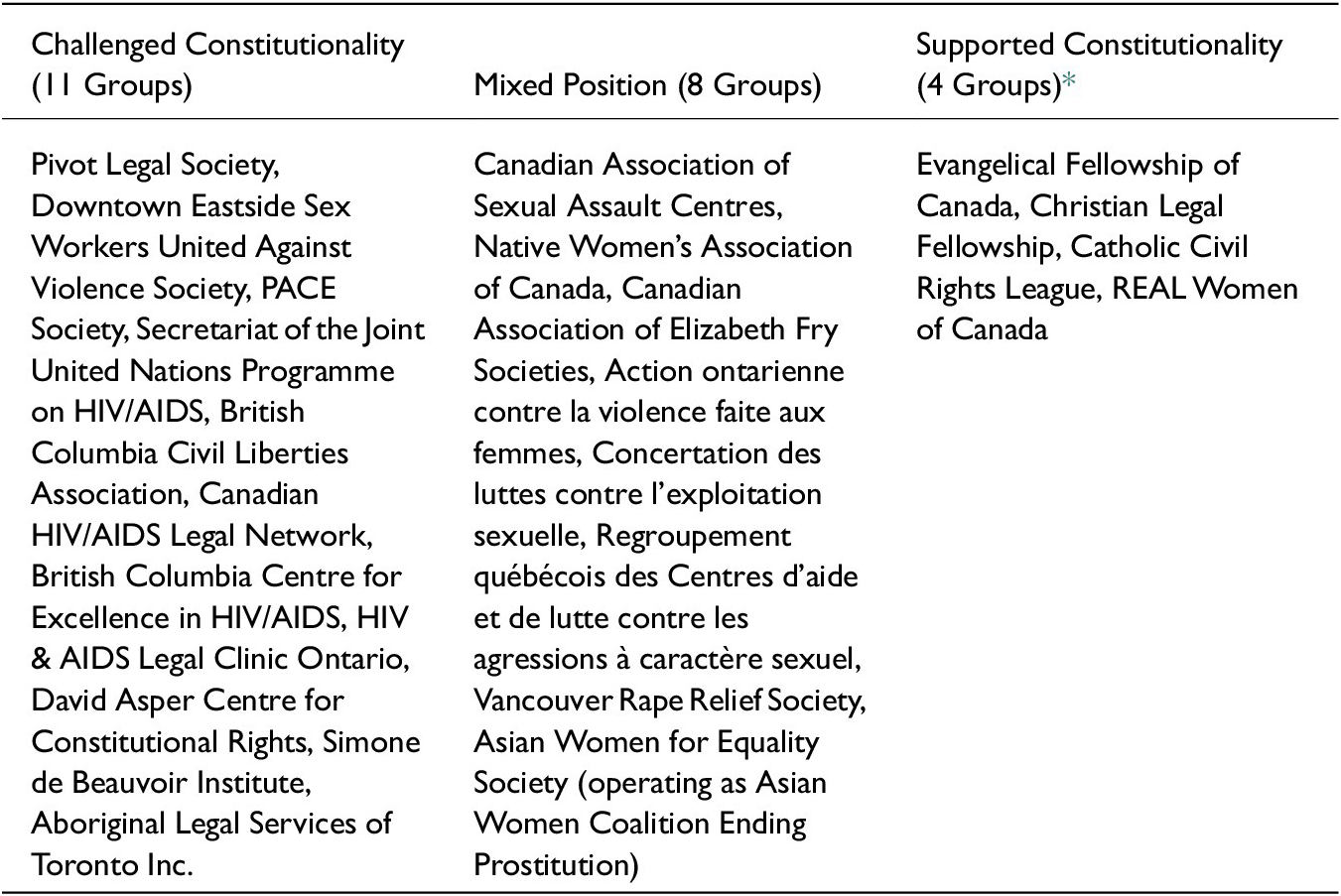
Table 2. Long description
From left to right, the first column is labeled Challenged Constitutionality with 11 groups: Pivot Legal Society, Downtown Eastside Sex Workers United Against Violence Society, PACE Society, Secretariat of the Joint United Nations Programme on H I V slash A I D S, British Columbia Civil Liberties Association, Canadian H I V slash A I D S Legal Network, British Columbia Centre for Excellence in H I V slash A I D S, H I V and A I D S Legal Clinic Ontario, David Asper Centre for Constitutional Rights, Simone de Beauvoir Institute, Aboriginal Legal Services of Toronto Inc. The middle column is Mixed Position with 8 groups: Canadian Association of Sexual Assault Centres, Native Women’s Association of Canada, Canadian Association of Elizabeth Fry Societies, Action ontarienne contre la violence faite aux femmes, Concertation des luttes contre l’exploitation sexuelle, Regroupement québécois des Centres d’aide et de lutte contre les agressions à caractère sexuel, Vancouver Rape Relief Society, Asian Women for Equality Society operating as Asian Women Coalition Ending Prostitution. The rightmost column is Supported Constitutionality with 4 groups: Evangelical Fellowship of Canada, Christian Legal Fellowship, Catholic Civil Rights League, R E A L Women of Canada. A footnote states that the Attorney General of Quebec also supported constitutionality.
* The Attorney General of Quebec also supported the constitutionality of the provisions.
Positions of Interest-Group Interveners in Carter
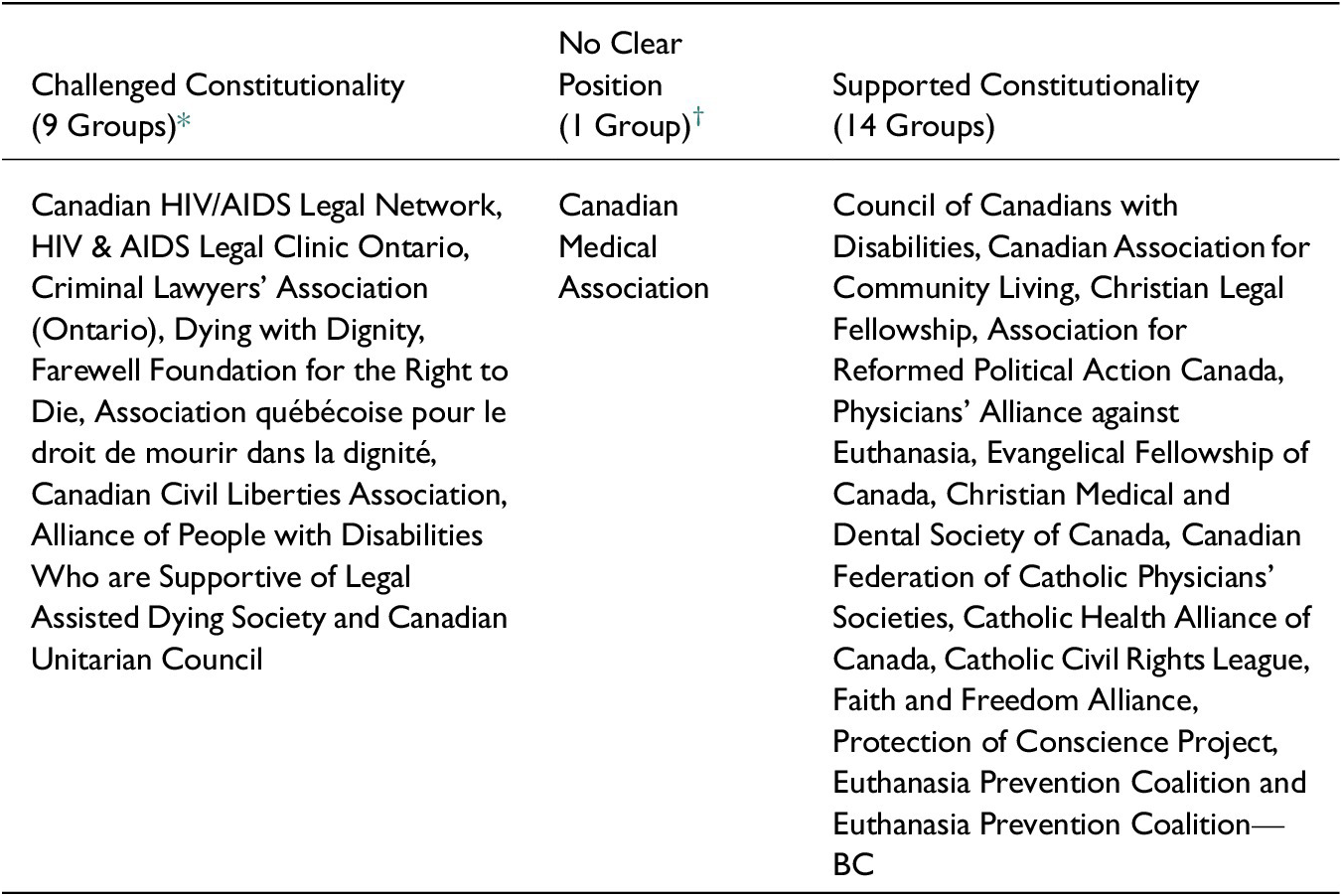
Table 3. Long description
From left to right, the first column is titled Challenged Constitutionality and lists nine groups: Canadian H I V forward slash A I D S Legal Network, H I V and A I D S Legal Clinic Ontario, Criminal Lawyers’ Association Ontario, Dying with Dignity, Farewell Foundation for the Right to Die, Association québécoise pour le droit de mourir dans la dignité, Canadian Civil Liberties Association, Alliance of People with Disabilities Who are Supportive of Legal Assisted Dying Society, and Canadian Unitarian Council. The second column, No Clear Position, lists one group: Canadian Medical Association. The third column, Supported Constitutionality, lists fourteen groups: Council of Canadians with Disabilities, Canadian Association for Community Living, Christian Legal Fellowship, Association for Reformed Political Action Canada, Physicians’ Alliance against Euthanasia, Evangelical Fellowship of Canada, Christian Medical and Dental Society of Canada, Canadian Federation of Catholic Physicians’ Societies, Catholic Health Alliance of Canada, Catholic Civil Rights League, Faith and Freedom Alliance, Protection of Conscience Project, Euthanasia Prevention Coalition, and Euthanasia Prevention Coalition dash B C. Footnotes indicate that the Attorney General of Quebec also challenged constitutionality, and the Attorney General of Ontario intervened without taking a clear position.
* The Attorney General of Quebec also challenged the constitutionality of the ban.
† The Attorney General of Ontario also intervened but took no clear position on the constitutionality of the ban.
Considering interest-group support in legislative committees, the most common position among organized groups testifying before the House of Commons’ Standing Committee on Justice and Human Rights (2014) was in favour of the criminalization of johns and pimps through Bill C-36. However, these groups were still critical of the provisions criminalizing sex workers (e.g., s 213). Full support for C-36 was limited to primarily police associations and anti-trafficking groups. The second-most common position was in favour of decriminalization to foster safe conditions for sex workers. Critics argued that s 213 was likely to be found to be overbroad in subsequent litigation and that ss 286.1–286.4 would continue to pose the same dangers as identified in Bedford by limiting communication for the purpose of screening clients and by undermining the hiring of others by restricting material benefit from sexual services (Standing Committee on Justice and Human Rights 2014).Footnote 7
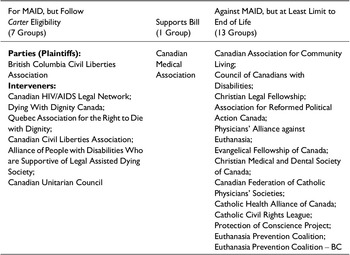
In Carter, a majority of “other” (interest-group) interveners had defended the criminal prohibition on MAID. In anticipation of the legislative response, various interveners from disability and religious groups came together to endorse the Vulnerable Persons Standard, which called for an end-of-life condition and more broadly for requirements such as the arm’s-length authorization of MAID requests (Vulnerable Persons Standard 2017). As such, many interveners advocated for at least the restriction to those at the end of life (among other restrictions) in the policy response, even if they remained opposed to MAID. Table 4 provides an overview of the available reactions from Carter interveners to Bill C-14; as it shows, many believed that Bill C-14 was too permissive, but at least preferred the reasonable-foreseeability criterion over the broader eligibility in Carter. Comparatively fewer interveners were in favour of legalizing MAID, but urged the government to maintain the broader eligibility from Carter.
Available Reactions from Carter Interveners to Bill C-14*
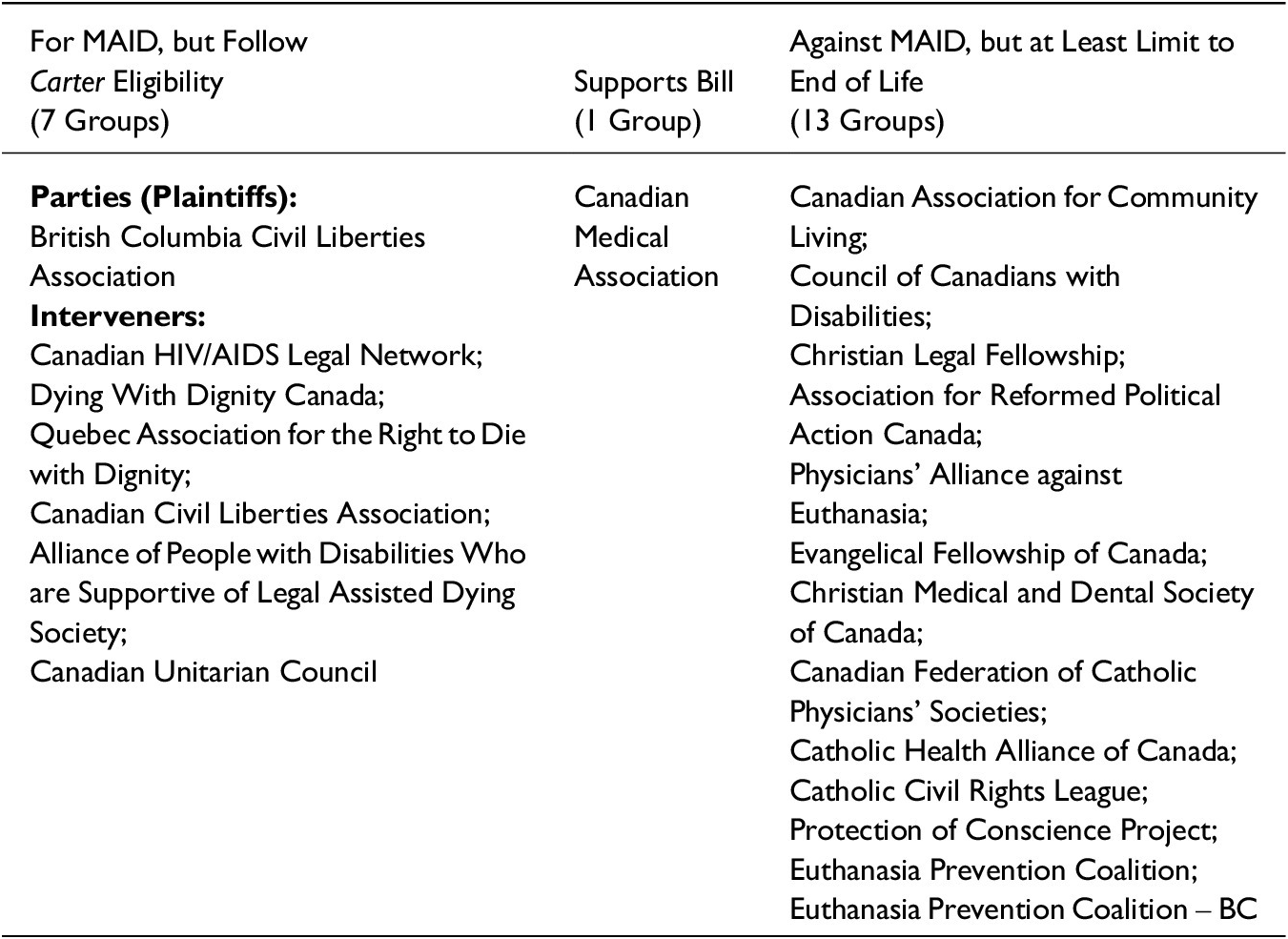
Table 4. Long description
From left to right, the first column is titled For MAID, but Follow Carter Eligibility (7 Groups). Parties listed are British Columbia Civil Liberties Association. Interveners include Canadian H I V forward slash A I D S Legal Network, Dying With Dignity Canada, Quebec Association for the Right to Die with Dignity, Canadian Civil Liberties Association, Alliance of People with Disabilities Who are Supportive of Legal Assisted Dying Society, and Canadian Unitarian Council. The middle column, Supports Bill (1 Group), lists Canadian Medical Association. The rightmost column, Against MAID, but at Least Limit to End of Life (13 Groups), includes Canadian Association for Community Living, Council of Canadians with Disabilities, Christian Legal Fellowship, Association for Reformed Political Action Canada, Physicians’ Alliance against Euthanasia, Evangelical Fellowship of Canada, Christian Medical and Dental Society of Canada, Canadian Federation of Catholic Physicians’ Societies, Catholic Health Alliance of Canada, Catholic Civil Rights League, Protection of Conscience Project, Euthanasia Prevention Coalition, and Euthanasia Prevention Coalition dash B C. Column headers are centered. The table is referenced as Table 4, with a footnote indicating some responses were provided via social media or press releases, and committee briefs and transcripts are available from the Standing Committee on Justice and Human Rights 2016.
* For committee briefs and transcripts of witness testimonies, see Standing Committee on Justice and Human Rights (2016). Some responses were provided on social media or through press releases.
Conclusion: The Importance of examining interest-group support for legislative replies
This paper has provided an analysis of legislative responses to Charter rulings that emphasizes the importance of interest-group support. It found that there was little genuine dialogue, with the legislatures replying in a manner that diverged from the policy prescriptions of the Court in only two out of the thirty applicable cases (6.7%). When the positions of interveners in these court cases were examined, the positions that were the most consistent with the legislative decisions to comply with the judicial ruling were those of the interest-group interveners, which usually challenged the constitutionality of the impugned provisions. The two cases with genuinely dialogic legislative replies were in response to Bedford and Carter, which were also exceptional in that they featured strong interest-group support for upholding the constitutionality of the challenged provisions and thus legislative noncompliance with the rulings in C-36 and C-14, respectively. Future research should assess whether types of legislative responses also have interest-group support.
What is the importance of these findings? The findings suggest that noncompliant legislative responses occur infrequently but, when they do, there is strong interest-group support for the policy options selected by Parliament. Conservative, religious and women’s groups supported C-36 on sex work. Disability and religious groups supported the restrictions on MAID in C-14. For coordinate constructionists, these cases represent positive examples of legislatures formulating policies in complex issue areas, in which they are willing to stray from the Court’s rulings to protect other rights or interests. Whether one accepts these framings or not, Parliament framed these policies as seeking to protect vulnerable groups (“prostituted persons” or persons with disabilities) from harm (exploitation or being pressured into MAID), echoing how these issues were framed by conservative, religious, women’s and disability groups. As such, “prostituted persons” and persons with disabilities are socially constructed or framed by these groups and the legislative responses as deserving and in need of protections through public policies (see Schneider and Ingram Reference Schneider and Ingram1993; Schön and Rein Reference Schön and Rein1994; Stone Reference Stone2002; Shanahan et al. Reference Shanahan, Jones, McBeth, Radaelli, Weible and Sabatier2018; Schneider and Ingram Reference Schneider and Ingram2019). C-14 largely avoided the fears of dialogue theorists that Parliament may target marginalized groups in legislative responses; instead, it specifically diverged from the Court’s ruling out of concern for protecting persons with disabilities. The removal of the reasonable-foreseeability requirement through Bill C-7 (further discussed below) may nevertheless raise concerns for coordinate constructionists. Disability and religious groups have also been key opponents to this expansion of eligibility for MAID.
For dialogue theorists, these responses may represent inappropriate challenges to judicial interpretations. C-36 may be a key example of targeting politically marginalized groups such as sex workers and framing the sex industry in ways that many sex workers reject. The Canadian Alliance for Sex Work Law Reform et al. (Reference Forrester, Scott, Perrin, Jane, Mason and Anwar2022) has indeed worked to challenge the framing of sex work as exploitation by C-36 and its supporters. The Alliance has instead framed the law as “exacerbat[ing]” rather than “correcting constitutional deficiencies” identified by the Court in Bedford and sex workers as “primarily women with intersecting and marginalized identities” who are being subjected to danger and threats to bodily autonomy by the law, rather than by the sex industry itself. In other words, while the Conservative government framed C-36 as protecting vulnerable sex workers from the industry, many sex workers observe that it is the law itself that poses barriers to sex workers’ protecting themselves. Sex workers in the United States have similarly used rights-based frames over victim frames that seek to associate sex work with trafficking (Jackson Reference Jackson2016). The difficulty for the Canadian Alliance for Sex Work Law Reform remains that various women’s groups have continued to support victim frames, arguing—as echoed in C-36—that sex work is a form of gender- and race-based exploitation. The framing by these groups and C-36 has so far prevailed, including in the SCC’s recent decision in R v Kloubakov (2025), in which the Court upheld (for now) the constitutionality of ss 286.2 and 268.3 of the Criminal Code (the material benefit and procuring provisions). What is troubling about Kloubakov is that the Court declined to hear interventions from sex workers (and particularly the Canadian Alliance for Sex Work Law Reform), while hearing from the Women’s Equality Coalition (which supported the criminalization of johns and pimps in Bedford). If democratic dialogue is the aim, then this ought to properly include the participation of relevant stakeholders, particularly sex workers and sex workers’ rights groups. Future litigation and law reform should properly include the perspectives of these groups (see Benoit et al. Reference Benoit, Unsworth, Healey, Smith and Jansson2021).
For its part, C-14 now poses less of a challenge to dialogue theorists because claimants successfully challenged the reasonably foreseeable natural death criterion in Truchon v Procureur général du Canada (2019). Parliament then repealed the criterion through Bill C-7, An Act to Amend the Criminal Code (medical assistance in dying) in 2021 (see Nicolaides Reference Nicolaides, Puddister and Macfarlane2022). Bill C-7 nevertheless currently faces competing legal challenges: one by disability groups to the expansion of access to those whose deaths are not reasonably foreseeable and the other by right-to-die activists to the exclusion in Bill C-7 of those suffering solely from mental illnesses (The Canadian Press 2024a, 2024b). Canada’s MAID policy has largely been shaped by the SCC’s interpretation in Carter, though the continued litigation demonstrates the ongoing desire of interest groups to influence this policy area.
Noncompliant legislative responses do not rely solely on the support of interest groups. Support from experts and the public is also important. Further, legislative actors and the political executive and bureaucratic actors (such as Department of Justice officials) ultimately make and implement the policies (Nicolaides and Hennigar Reference Nicolaides, Hennigar and Macfarlane2018; Nicolaides Reference Nicolaides, Puddister and Macfarlane2022; Macfarlane, Hiebert, and Drake Reference Macfarlane, Hiebert and Drake2023; Kelly Reference Kelly2024). At a minimum, however, interest-group positions may help to delineate the range of acceptable policy alternatives from which the legislatures may choose. Interventions may also signal the level of societal and interest-group support that the legislature may expect for noncompliant legislative responses. Given that noncompliant legislative responses are often criticized as Charter-infringing and susceptible to future litigation, as both C-36 and C-14 were, societal support—particularly from vulnerable groups with competing rights claims—is crucial to political justifications for noncompliance with Charter rulings.
Perhaps the most important lesson here is that there has been too much ado about metaphors and institutions. To be sure, both courts and legislatures are important, but these actors do not make decisions in a vacuum, without consideration of societal support. Societal support is particularly important in noncompliant legislative replies, which face criticisms of infringing Charter rights and SCC rulings, and therefore require justification. It is, indeed, quite possible that the literature has paid too little attention to the positions of interest groups in these policy decisions. Future research should expand upon and deepen our understanding of the role of interest-group support and strategies. After all, Charter dialogues are complicated; as such, they inevitably involve more than just courts and legislatures.
Acknowledgments
The author would like to thank the CJLS editors and anonymous reviewers for their valuable feedback. This article draws on research supported by the Social Sciences and Humanities Research Council of Canada.

 Open access

