




The age of the Mongol Empire and its successors was marked by an intensified interest in foreign languages, texts, and the circulation of knowledge across Eurasia. Among the languages circulating widely, Persian played a notable role in Mongol–Yuan and early Ming bureaucratic offices, functioning as a medium of communication linking the eastern and western reaches of the Mongol Empire. The demands of multilingual governance and diplomacy led to the creation of new institutions dedicated to translation and interpretation, which fostered the production of texts that carried the intellectual and administrative legacy of the Mongol Empire into its successor states and beyond.Footnote 1
A longstanding debate concerns whether Persian functioned as a true lingua franca across Mongol-ruled Eurasia and how extensively it circulated in China. Scholarship has alternated between emphasizing the wide cross-regional uses of Persian and questioning its official status under the Yuan.Footnote 2 Nile Green suggests that while Persian likely never became a formal administrative language in Yuan China, it nevertheless traveled farther east than ever before, facilitated by the Mongol Empire’s open diplomatic and intellectual frontiers.Footnote 3 Richard Eaton provides another line of related discussion that frames Persian as a portable, prestige language of literary works in the cultural and demographic diaspora formed in the aftermath of the Mongol invasions of Central Asia and the Iranian plateau.Footnote 4 Against this historical and historiographical backdrop, Graeme Ford examines Ming institutions for translating Persian, situating its linguistic presence within the eastern reaches of the Persianate cosmopolis.Footnote 5
Existing studies have tended to either frame Persian in China within the broader context of cross-regional exchange under Mongol rule or focus on the institutional structures of the Yuan and Ming courts. What has been less pursued is the close reading of the Persian texts that were actually exchanged—a perspective that can yield direct evidence of how Persian appeared in this context, how it was translated, and how it functioned in the transmission of knowledge. Moreover, the question of how Persian’s influence in China declined or changed its form remains underexplored. David Brophy’s article, while valuable for examining the decline of Persian in Qing China, uncritically adopts Stephen Haw’s position, which too readily dismisses Persian’s presence in Yuan and Ming China, leaving a significant gap in understanding its changing status during the Ming period.Footnote 6
Conversing with this body of work, this article examines Persian’s linguistic presence and translation strategies in Mongol- and post-Mongol-era China through a set of astronomical and astrological vocabulary from the fifteenth-century Persian–Chinese glossary produced within the Ming bureaucracy. The article addresses the following questions: How were Persian and Chinese lexical items translated and compiled in the Yuan and Ming capitals? What do these translations reveal about the forms of Persian circulating in the eastern reaches of the Persian cosmopolis? And what legacy did Persian leave in China after the end of Mongol rule, and for how long did its influence persist?
The glossary
In 1407, the Yongle emperor created the College of Foreign Translation (Siyi Guan 四夷館) within the Hanlin Academy, in conjunction with his launch of large-scale maritime and overland diplomatic and exploratory missions, attesting to the continued importance of multilingual exchange.Footnote 7 This college was divided into eight language sectors and was responsible for translating official documents and training translators.Footnote 8 The Huayi yiyu 華夷譯語,Footnote 9 a standardized series of bilingual glossaries, was produced by the college and used within each of its eight language sectors. In 1597, the college expanded to include two additional sectors, and the Huayi yiyu collection was subsequently supplemented with an expanded wordlist and compilation of diplomatic correspondence samples (laiwen 來文) in the respective languages.Footnote 10 This study focuses on the output of the Persian sector, namely the Huihui Guan Zazi (回回館雜字) or Huihui Guan Yiyu (回回館譯語) (hereafter HHZZ).Footnote 11
Scholarly attention to the HHZZ has developed in stages across several dimensions. In the early twentieth century, references to the HHZZ appeared sporadically, largely due to the scattered state of its manuscripts across Europe, China, and Japan. Japanese scholars such as Kōdō Tazaka were among the first to investigate the vocabulary of the HHZZ.Footnote 12 Building on these earlier efforts, Honda Minobu published the first comprehensive examination of the HHZZ in 1963.Footnote 13 His work includes an introduction to multiple manuscripts as well as a critical edition of both the wordlists and the bilingual correspondence texts, and remains a foundational resource on the topic to this day.
Later, several Chinese scholars further examined the extant types and manuscripts of the bilingual linguistic materials produced in China since the Yuan period.Footnote 14 It has become increasingly recognized that the HHZZ is a Persian source and that its study benefits from being situated within the broader Persianate and Mongol context.Footnote 15 Another line of research has focused on the phonetic transcription of Persian into Chinese, yielding notable insights into historical phonology and cross-linguistic transcription.Footnote 16 Regarding the content of the HHZZ, Liu Yingsheng conducted a series of studies on the HHZZ in the late twentieth century, culminating in his monograph “Huihui guan za zi” yu “huihui guan yi yu” yan jiu, which remains the most comprehensive work on the subject in Chinese. In addition to a detailed survey of available manuscripts and existing scholarship, as well as commentary on the vocabulary, Liu’s significant contribution lies in his comparison of each Persian entry with its occurrences in contemporary Chinese sources.
Nevertheless, the HHZZ remains insufficiently explored in several critical respects. Beyond the fact that scholarship on the text has been conducted primarily in Japanese and Chinese, a number of significant gaps and issues warrant attention.
First, the semantic and historical implications of the vocabulary, particularly in relation to Islamic and Mongol history, call for more nuanced investigation. For instance, Honda identifies the linguistic origins of entries in the wordlists as including Arabic, Persian, Turkish, and Mongolian. While this information greatly enriches our understanding of the vocabulary, it also invites deeper inquiry into the historical processes by which Persian words, in various categories, came under such diverse linguistic influences. Second, a number of recent studies rely heavily on modern Standard Iranian Persian (Farsi) as a reference point when analyzing orthography and interpreting lexical meaning. This approach occasionally results in reading Persian terms out of context or misidentifying non-standard handwriting as erroneous.Footnote 17 Such interpretations overlook the historical stage of Arabo-Persian development to which the HHZZ manuscript belongs—one that offers valuable orthographic and linguistic evidence in its own right.
Astronomy and astrology vocabulary
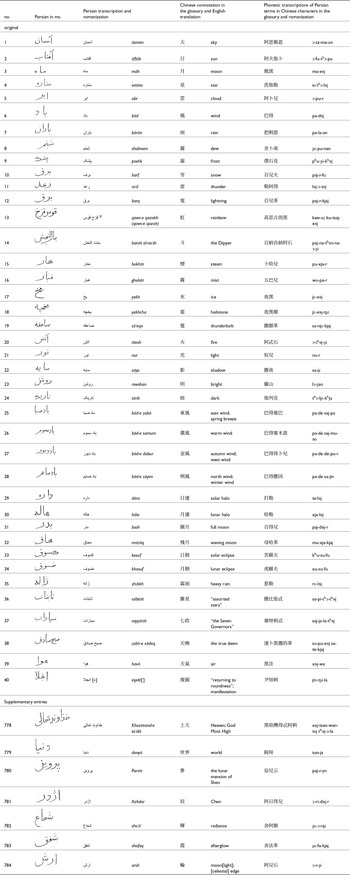
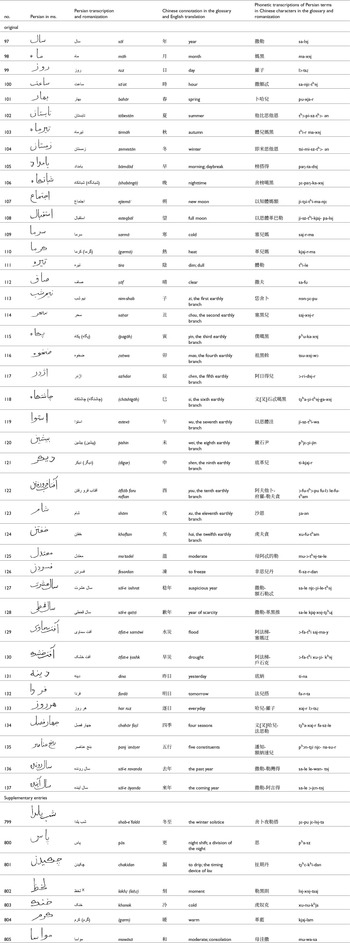
The HHZZ, like other glossaries within the collection of the Huayi yiyu, encompasses a range of lexical categories, including but not limited to astronomy and astrology, geography, time and seasons, personal names, fauna and flora, clothing, directions, and numbers. While each category reflects distinct linguistic features and contextual implications, and thus merits careful study in its own right, this article focuses on two specific categories: tianwen 天文 (celestial phenomena), which contains forty entries in the primary list and seven in the supplement, and shiling 時令 (times and seasons), which contains forty-one entries in the primary list and seven in the supplement.Footnote 18 Together, these lists provide textual evidence for the transmission of astronomy and astrology knowledge between the Chinese and Islamic cultural spheres, as mediated through Persian and Chinese.
This focus is closely tied to the historical context of knowledge exchange under Mongol and post-Mongol rule, where astral sciences held a special place: both the Yuan and Ilkhanid courts shared a deep interest in celestial observation, divination, and calendrical calculation. These common pursuits fostered the cross-regional movement of astronomers, the construction of observatories, and the translation and study of each other’s texts and systems.Footnote 19
One indication of this highly mobilized intellectual atmosphere was the collection of Arabic and Persian books once housed in the Yuan dynasty’s Palace Library (Mishujian 秘書監) in Beijing, which was later transferred to the Ming capital at Nanjing after the dynastic transition.Footnote 20 In 1382, Emperor Hongwu ordered the translation of these works, beginning with texts on astronomy, divination, and calendrical science.Footnote 21 Although the originals have not survived, the Mishujian catalogue remains extant, recording an inventory of twenty-two titles of Arabic and Persian texts and four astronomical instruments.Footnote 22 Scholars generally agree that these included works such as Ptolemy’s Almagest, Kūshyār ibn Labbān’s Kitāb al-madkhal fī ṣināʿah aḥkām al-nujūm (Introduction to the Art of Judgments of the Stars), al-Tūsī’s Zīj-i Īlkhānī, and ʿAbd al-Raḥmān al-Ṣūfī’s Kitāb suwar al-kawākib thābita (The Book of Fixed Stars), among others.Footnote 23 Sino-Islamic works derived from these translations, such as the astrological manual Tianwen shu 天文書 and the Islamic calendars Huihui lifa 回回曆法, further attest to this legacy.Footnote 24 Yet many links in this chain remain obscured by the absence of surviving Arabic or Persian source materials. Against this backdrop, relevant vocabulary in the bilingual glossary offers fresh, if limited, insight into the transmission of astral sciences across cultures.
In this context, the following sections examine the processes of translation and knowledge transmission as reflected in the lists themselves, rather than in institutional records, and trace the direction of their flow through textual analysis. This study is anchored in a close reading of the two lists, accompanied by an appendix containing a full transcription and annotation based on the Berlin manuscript—a high-quality source that has not been sufficiently engaged in prior scholarship.Footnote 25
As part of a series of bilingual glossaries produced within the College of Foreign Translation, the HHZZ shares the structural layout of other glossaries and likely draws from a common core vocabulary. To identify what sets the HHZZ apart, I concentrate on idiomatic and technical terms—both words and phrases—that are unique to it and absent from other glossaries in the same manuscript. The translation of idiomatic expressions offers insight into the compilers’ linguistic competence, collaborative practices, and the broader context of knowledge exchange. Words found only in the Persian glossary illuminate the particular importance or perceived uniqueness of Persian among foreign languages at the Ming court.
In addition, I contextualize these distinctive entries by tracing their appearance in relevant Persian and Chinese texts from the Mongol and post-Mongol periods. Unlike high-frequency, easily translatable terms, these technical entries require specific domain expertise and cultural literacy. They thus provide valuable evidence of the intellectual milieu of the Ming bureaucracy and the broader networks of knowledge exchange linking China and the Islamicate world.
Approaching the HHZZ vocabulary with the stated methods and focus reveals key aspects of Persian in the Mongol and post-Mongol world. The original HHZZ, likely compiled during the Yongle reign (1403–1424), constitutes a layered corpus of lexical knowledge shaped across disciplines. In astronomy and astrology, specialized scientific terms are rendered with remarkable precision, reflecting sustained textual and conceptual exchange and demonstrating a bidirectional flow of knowledge between China and the Islamic world. In this way, the glossary preserves clear evidence of the Mongol legacy in intellectual exchange while bearing traces of multiple historical moments. By contrast, the supplementary glossary—completed more than a century later—shows signs of waning Persianate influence and a diminished intellectual engagement by the Ming bureaucracy with the “western regions.”
Knowledge transmission through translation
Precision
Translating terms in bilingual glossaries requires careful methodological choices, which not only affect linguistic accuracy but also reflect broader cultural and epistemological dynamics. In the two target lists, many of the more “uncommon” phrases cannot be interpreted literally in either language. In such cases, the dominant translation strategy employed is conceptual or functional equivalence. Remarkably, the glossary is effective in identifying close or exact Chinese equivalents of these Persian phrases without resorting to rigid literalism.
This approach is exemplified by a number of entries in the list of “celestial phenomena.” For example, four distinct types of winds are recorded: ṣabā-dongfeng (東風), samum-xunfeng (熏風), dabur-jinfeng (金風), and ṣāyim-shuofeng (朔風) (nos. 25–28). Ṣabā (P < A), often translated as “zephyr,” designates an east wind and shares with its Chinese equivalent the connotation of a gentle spring breeze. Samum, “hot wind,” is paired with xunfeng, “warm wind.” Although the Chinese term suggests pleasant warmth while the Persian conveys scorching heat, the conceptual overlap is clear. Dabur, meaning “west wind,” is matched with jinfeng, “golden wind,” a reference to the autumn wind, which may function synonymously with “west wind” in poetic or seasonal contexts. Finally, ṣāyim, a variant of Arabic ṣāʾim (صائم, “abstaining” or “standing still”), may imply stillness or calmness when applied to wind, and is rendered as shuofeng, “north wind” in Chinese.Footnote 26 The connection is uncertain, perhaps hinging on the idea of dryness. Although tentative, these entries illustrate the compilers’ broader approach: when faced with inevitable mismatches in meaning, they tended to rely on omission or generalization—such as capturing a salient characteristic of the wind—rather than inventing new words or forcing strict lexical equivalence. The priority was idiomatic expression and contextual fluency over strict word-for-word translation, showing that communicative clarity guided the interplay between the two languages.
Further, the precision of certain technical entries suggests that the compilers possessed both linguistic competence and specialized field knowledge. An example is ṣobḥ-e sādeq (no. 38), “true dawn.” Technically, this term denotes the moment of daybreak, contrasted with “false dawn” (ṣobḥ-e kāzeb), the time just before the dawn.Footnote 27 The glossary renders ṣobḥ-e sādeq as tianxiao (天曉), an exact equivalent. In contrast, Liu’s interpretation of the term as tian da liang (天大亮, broad daylight) may reflect a literal reading of the Persian term and is inaccurate.Footnote 28
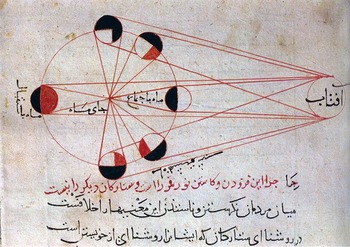
Another instance is the pair ejtemāʿ and esteqbāl, two contrasting phases of the lunar cycle in this context. As al-Bīrūnī’s Kitāb al-Tafhīm illustrates, ejtemāʿ (conjunction) refers to the alignment of the Moon between the Sun and Earth, marking the month’s beginning, while esteqbāl (opposition) designates the full moon at mid-month (Figure 1). The glossary renders these terms as shuo (朔, first day of the lunar month) and wang (望, full moon/mid-month), precise and contextually faithful translations within the lunisolar framework. Yet these meanings were not clearly interpreted by Honda or Liu.Footnote 29
“Phases of the Moon” in al-Bīrūnī’s Kitāb al-Tafhīm. Ms. 6565, Teheran, Parlamentsbibliothek.

Figure 1 Long description
The illustration depicts the phases of the moon with Arabic text. It features several circles representing different moon phases, connected by red geometric lines to a larger circle. The background resembles an old manuscript with a parchment-like texture. The Arabic text explains the lunar phases and their relation to the sun, translated as 'Phases of the Moon' from al-Bīrūnī’s Kitāb al-Tafhīm. The diagram includes prominent red lines connecting the moon shapes, enhancing the visual emphasis. The layout shows the moon phases in a circular pattern, with lines radiating from the larger circle, which is labeled in Arabic. The overall tone is scholarly and historical, reflecting an ancient astronomical chart. The text provides context and explanation for the visual representation of the moon's phases, enhancing understanding of the diagram's purpose and relationships.
These cases reveal two key points. First, the glossary demonstrates careful conceptual translation of technical astral terms, preserving knowledge exchange across cultural and linguistic boundaries. Second, the limitations of modern scholarship in fully grasping these terms signal the need for further research that combines linguistic expertise with historical scientific vocabularies.
Exchange
The direction of translation in the HHZZ glossary offers important insights into the movement of knowledge. While there is little doubt that Chinese functioned as the main source language across the series of Huayi yiyu bilingual glossaries, several features of the HHZZ’s “uncommon” Persian entries complicate the picture of how each glossary was compiled. Idiomatic expressions and technical terms that appear only in the HHZZ, and not in glossaries of other languages, though limited in number, point directly to the study of Islamicate astronomical and astrological texts, reflecting the importation of these categories into the Ming scholarly milieu. At the same time, they indicate that translation and knowledge exchange operated in both directions—a pattern consistent with the multilingual intellectual environment of the Mongol period and later initiatives, such as the early Ming imperial translation projects.
For example, consider the pair “fixed stars” and “planets” (nos. 36–37). The Persian terms sābitāt and sayyārāt form a conceptual binary—“fixed” versus “moving”—within the framework of Islamicate astronomy. The idea was most famously systematized by ʿAbd al-Raḥmān al-Ṣūfī in his Book of Fixed Stars, which combined Ptolemaic star catalogs with the indigenous Arabic Anwāʾ system, a treatise that is generally speculated to have been held in the Yuan Palace Library under the phonetically transcribed title Suwali-kewaqibi (速瓦里可瓦乞必).Footnote 30 In the HHZZ, sābitāt and sayyārāt are rendered in Chinese as zaxing (雜星), “assorted stars,” and qizheng (七政), “the Seven Governors,” i.e., Mercury, Venus, Mars, Jupiter, and Saturn, along with the Sun and Moon.Footnote 31 While broadly accurate, the Chinese equivalents do not inherently convey the Arabo-Persian binary of “fixed” versus “moving” celestial bodies, carrying different connotations and emphases. As the designation “the Seven Governors” suggests, the naked-eye visible luminaries within the solar system were often regarded as guides for worldly affairs. The Book of Jin (晉書), for instance, states that the Sun governs life, grace, and virtue and serves as the image of the ruler; the Moon is paired with the Sun; and “wherever the Five Luminaries rise, travel, or align in the heavens, the corresponding terrestrial state possesses its position.”Footnote 32 The “assorted stars,” by contrast, encompass all others: “there are auspicious stars, baleful stars, guest stars, and shooting stars.”Footnote 33 Although such descriptions represent primarily an earlier divinatory perception of celestial phenomena in Chinese cosmology, they nevertheless reveal that the initial perspectives and underlying astronomical–astrological frameworks differed markedly from those of the Hellenistic–Islamic tradition. Here, the translation clearly proceeds from Arabic or Persian into Chinese, carrying with it the underlying core concepts of the Islamicate astronomical system.
On the other hand, some entries suggest the opposite direction of knowledge flow—from Chinese to Persian. A prominent example is the Twelve Earthly Branches (nos. 113–124), a foundational concept in Chinese cosmology and astrology, widely used to represent hours, seasons, and broader temporal cycles.Footnote 34 This set is absent from other Huayi yiyu glossaries but appears under the “time and seasons” category of the HHZZ and corresponds to the twelve double-hours of the day, that is, a unit dividing a calendar day into twelve equal intervals.Footnote 35 These concepts are uniquely Chinese and have no direct equivalents in Arabic or Persian. The glossary therefore renders them descriptively in Persian, indicating the approximate times of day each branch represents. For example, nim-shab, “midnight,” is used to gloss zi (子), the earthly branch designating the double-hour corresponding to 11 pm to 1 am; estevā, “the solar noontime,” is used here to gloss wu (午), the earthly branch designating the double-hour corresponding to 11 am to 1 pm.
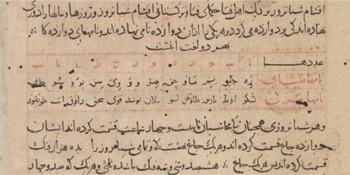
Their inclusion can be no coincidence: the system of earthly branches had already entered the Islamic world through the work of Naṣīr al-Dīn al-Ṭūsī, who introduced it in the “Tārīkh-i Qitā” (Chinese calendar) chapter of his Zīj-i Īlkhānī (1272). This calendar subsequently appeared in several later Persian and Arabic zījes.Footnote 36 The Twelve Earthly Branches appear at the very beginning of al-Ṭūsī’s chapter, presented in a table that pairs their Chinese names phonetically transcribed with the corresponding animal in Turkish (Figure 2), illustrating the twelve-animal cycle adopted by the Turko-Mongols and popularized during the Ilkhanid period. The table is accompanied by explanations of the associated double-hours and other units of time.Footnote 37 Unlike the Zīj-i Īlkhānī, the HHZZ omits the zodiac animals associated with the earthly branches, except for a single instance of the dragon (no. 117). This translation choice aligns with the broader absence of Mongol loanwords in the glossary, though this last observation remains tentative and warrants further research.
Twelve Earthly Branches in al-Ṭūsī’s Tārīkh-i Qitā of Zīj-i Īlkhānī, f. 3v, PPN635599538, Staatsbibliothek zu Berlin. http://resolver.staatsbibliothek-berlin.de/SBB00002D7800000000.
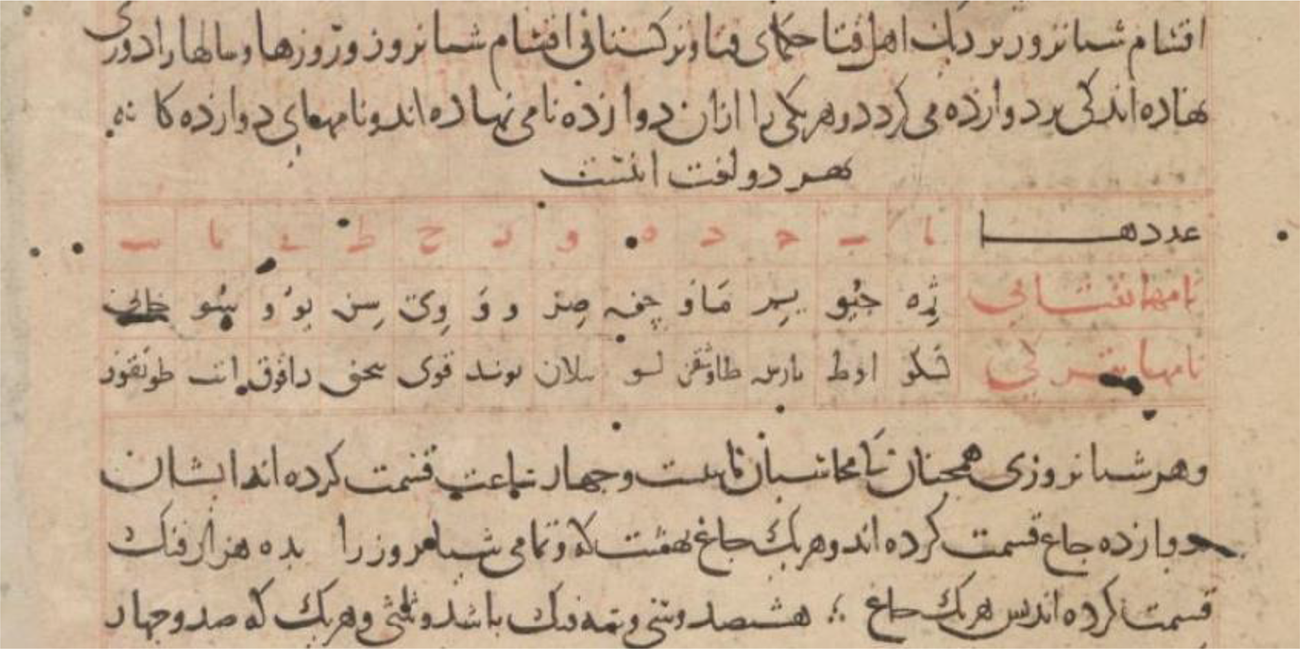
Figure 2 Long description
A scanned handwritten Arabic manuscript page. The main body text is written in black ink across multiple lines. Red ink appears in several locations, including above certain lines and within the body text, functioning as emphasis markers or commentary-style annotations. Interlinear notes are visible between main text lines. A prominent red ink heading or section marker is present near the upper centre of the page. The word باب is visible, indicating a chapter or section division. The word مدخل is also present. The text is arranged in a single-column layout with consistent right-to-left Arabic script. The script is dense and formal in character. Additional shorter red ink phrases appear in the upper portion of the page above the main text block. The lower portion of the page contains further lines of black script with occasional red markings. The tone of the script is formal. The full content is not fully legible due to the handwritten nature and image resolution. No clear diagrams or tables are present. The page background is pale brown with visible ageing marks.
Another example indicating the vocabulary transmission direction from Chinese into Persian is the term wuxing (五行), “five constituents” (no. 135). The wuxing—water, fire, wood, metal, and earth—represent the foundational elements of a cosmological and correlative system central to classical Chinese thought. In the context of divination, wuxing provide a dynamic framework for interpreting transformations in the natural and political order through correspondence among celestial, terrestrial, and human phenomena. The topic of wuxing often constitutes a separate chapter within the zhi (志, treatises on various aspects of governance) section of China’s “official dynastic histories.”Footnote 38 Such chapters typically follow those on tianwen (天文, celestial phenomena) and record calamities and anomalies. For instance, occurrences of floods would be classified under “water,” while locust infestations would fall under “wood.” It is therefore fitting that the term wuxing appears a few entries below those on calamities within the glossary; its placement aligns closely with the Chinese divinatory framework that organizes such correlations.Footnote 39
Taken together, the examination of these two wordlists reveals strategies of conceptual translation and a bidirectional flow of astral and cosmological knowledge. The vocabulary seems to have been drawn from a larger pool of terms circulating in contemporary texts. For instance, al-Ṭūsī’s Zīj-i Īlkhānī translates and explains a much broader range of Chinese terms, covering numerous components of the solar calendrical system.Footnote 40 Similarly, the translated Hellenistic-Islamic astronomical treatises compiled at the Ming court contain more specialized vocabulary, including the lunar mansions and planetary houses, which carry greater scientific depth but are not seen in the HHZZ.Footnote 41 Naturally, this absence reflects the practical purpose of the College of Foreign Translation: to equip officials with linguistic tools for handling official documents, rather than to provide specialized disciplinary training. Nevertheless, the HHZZ’s astronomy and astrology vocabulary demonstrates a two-way flow of knowledge, grounded in collaborative textual study, in which Chinese and Persianate scholars each contributed distinct conceptual repertoires.
Decline
The supplementary glossary was added to the corpus in the late sixteenth century, more than a hundred years after the compilation of the original glossary. The added entries in astronomy and astrology, though few in number, offer several instructive observations, especially when compared with those in the original lists. Although supplementary lists follow the same formatting standards and show no discernible differences in handwriting or visual quality, they nonetheless present several discrepancies from the main list, thereby exhibiting a subtle decline in entry quality and a shift in compilation methods. These discrepancies offer valuable insight into the changing status of Persian within the Ming bureaucracy.
Most notably, the method of selecting Persian equivalents appears to have become less contextually accurate compared to the original lists, whose word choices are notably precise and often reflect genuine scientific exchange. For example, the correspondence between the Chinese astronomical terms Shen (參, no. 780) and Chen (辰, no. 781), both denoting specific celestial bodies, and their Persian counterparts is vague. In the case of Azhdar/Chen (辰, no. 781) in particular, since the same pairing already appears in the original list, it seems likely that the compiler simply reused it without considering its meaning in this specific context.
Next, lou 漏 (no. 801), placed immediately after geng (更)/pās, “a portion of the night” (no. 800), would be readily understood by an informed Chinese reader as referring to a timekeeping device such as a water clock or hourglass. If the conceptual translation approach seen in the original glossary had been applied, lou would have been rendered as the Persian term for a comparable time-measuring instrument, even if the form might differ. Instead, the Persian equivalent given conveys the meaning of lou as a verb (“to drip”), which, while correct at the lexical level, misses the contextual sense.
Even more problematic is the glossing of he (和, no. 805). Within a cluster of terms relating to weather and temperature, he clearly connotes moderation or mildness. Yet, it is glossed as mowāsā, meaning “ease” or “benevolence,” which is indeed another connotation of he, but entirely unrelated to the semantic field of time or seasons.
Viewed as a whole, the entries in these two supplementary lists appear less systematic, as if drawn sporadically from disparate sources. Ford notes that some terms of the supplementary glossary came from diplomatic correspondence and the laiwen, citing expressions such as Khozāvand-e Taʿālā (God Most High, no. 778) found repeatedly in these texts.Footnote 42 While these materials likely contributed, other, unexamined sources of different types must also have been used, suggesting a more ad hoc approach to term selection.
These findings point to a decline in the quality and coherence of the astronomy and astrology vocabulary in the supplementary lists. The brevity of the glossary is also noteworthy. While adding to an already substantial glossary is inherently more difficult than compiling one from scratch—and brevity alone should not be taken as conclusive evidence of a decline in Persian’s status—the two lists under consideration have, in fact, shrunk considerably in size compared to other supplementary wordlists. This observation aligns with the series of challenges faced by the Ming government after the Yongle reign (1403–1424), including fiscal contraction, the Tumu Crisis, and the subsequent inward-looking diplomatic policies. Together, these changes led to the College of Foreign Translation’s declining status within the Ming bureaucracy and a corresponding decrease in the scholarly level of its faculty and students.Footnote 43 On the other hand, a significant portion of the new entries added to the HHZZ are miscellaneous in nature, grouped under “general,” and consist largely of words and phrases suited to everyday or travel contexts.Footnote 44 Although these vocabularies are not the focus of close analysis in this article, their presence suggests that less specialized exchanges continued to take place—much in line with the Central Asian merchant Ali Akbar Khatayi’s report of China in the early sixteenth century.Footnote 45 Taken together, these patterns reveal a stagnation in the development of astral sciences terminology after the completion of the original glossary, likely reflecting a reduced level of scholarly and technical collaboration between the Chinese and Persianate cosmopolises after the Yongle reign. The patterns may also indicate the disappearance of a genuinely multilingual intellectual working environment, though the shifting status of Persian in other spheres requires further investigation.
Conclusion
Analysis of the “celestial phenomena” and “times and seasons” wordlists in the HHZZ reveals the text as a layered record of cross-cultural intellectual encounter. The original compilation reflects a high level of conceptual translation, where precision in rendering technical and idiomatic terms points to a multilingual environment shaped by close reading of scientific texts exchanged under Mongol rule. Within this framework, a bidirectional flow of astral and cosmological knowledge emerges, with Chinese and Islamicate scholars each contributing distinct conceptual repertoires, though without fundamentally altering each other’s astronomical systems.
The supplementary vocabulary in the same field, however, marks a shift: its inconsistencies, limited scope, and reduced contextual accuracy signal the erosion of that earlier intellectual vibrancy. In tracing this trajectory from precision and balance to fragmentation, the HHZZ offers not only a snapshot of Persian instruction within the Ming bureaucracy but also a window into the broader arc of specialized knowledge transmission between China and the Persianate world—from the Mongol-period dynamism to its gradual contraction in the later Ming.
The findings presented here are based on a close examination of two HHZZ vocabulary categories selected for their relevance to astral-science exchange. In addition to the insights into knowledge transmission discussed above, these lists reveal discrepancies in linguistic representation across subject matter as well as occasional features suggestive of varied Persian dialects—points that warrant further investigation in conjunction with the other vocabulary in the glossary. Moreover, the remaining sections of the glossary, both as discrete semantic fields and in relation to one another, need to be situated within their respective historical contexts. Such studies promise to shed further light on the linguistic influences and orthographic traits of the New Persian circulating on the eastern edges of the Persianate cosmopolis between the thirteenth and sixteenth centuries. The present article therefore underscores the importance of further close textual analysis of the HHZZ and its sources. Beyond building on existing comprehensive studies, this article also makes the material accessible to a wider readership and illuminates the shifting dynamics between the “western regions” and China in the aftermath of Mongol hegemony.
Acknowledgements
I am grateful to Qiu Yihao, Kaveh Hemmet, Geoffrey Humble, Aslisho Qurboniev, Lin Lianghao, Sholeh Quinn, Sara Miramadi, Yoichi Isahaya, Yang Qiao, and András Barati for their valuable comments at various stages of drafting this article. I also wish to thank Philip Bockholt and Bruno De Nicola for the opportunity to present a preliminary paper based on this research at the workshop “Translation and Multilingualism in Mongol and Post-Mongol Eurasia” at the University of Münster in June 2025.
Appendix 1: The wordlists
In the following table, I present my transcription of both the Persian and Chinese entries from the tianwen (天文, celestial phenomena) and shiling (時令, times and seasons) lists, accompanied by monochromatic images of each original Persian entry from the Berlin manuscript of the HHZZ. This format highlights how these terms are interpreted and presented within the HHZZ, rather than how the Persian or Chinese terms might be understood in other contexts. Each Persian-Chinese pairing does not necessarily reflect the most common correlation in standardized, contemporary Iranian Persian and Chinese. These semantic nuances are, in fact, among the most valuable features of the HHZZ, as they reveal how Persian was understood as the “language of the Huihui” within the Ming College of Foreign Translation.
Transcription notes
1. The English translation is based on each term’s registered Chinese equivalents and semantic context. The translation does not necessary reflect the most common or “correct” rendering of the Persian term in present-day usage; this approach constitutes a major difference from Honda’s.
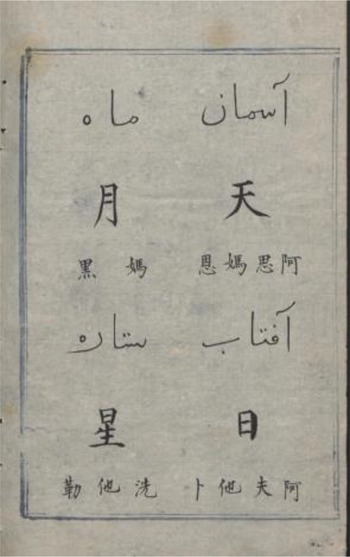
2. In the HHZZ, Persian terms are also written using Chinese characters to approximate their pronunciation (Figure 3)—presumably for the benefit of Chinese-speaking users. To reconstruct how these phonetic transcriptions might have been pronounced at the time, I followed Pulleyblank’s system of romanization for Yuan-period Chinese.Footnote 46
3. The numbering of the entries corresponds to their positions in the complete HHZZ, hence the gap between the wordlists. This numbering aligns with that indicated in both Honda’s and Liu’s work, allowing for easier comparison and reference.
4. Transcription errors in the manuscript are marked with an “X” with explanation and correction provided in the annotation section.
5. Dialectal variants (e.g., د vs. ذ) are reproduced as they appear. For historical Arabo-Persian orthographic conventions (e.g., بــ for پــ; كـ for گــ; جـ for چـ), I supply the standard spelling in brackets without further comment.
a sample page of the HHZZ. PPN334615730X, Staatsbibliothek zu Berlin. http://resolver.staatsbibliothek-berlin.de/SBB000103AF00000000.
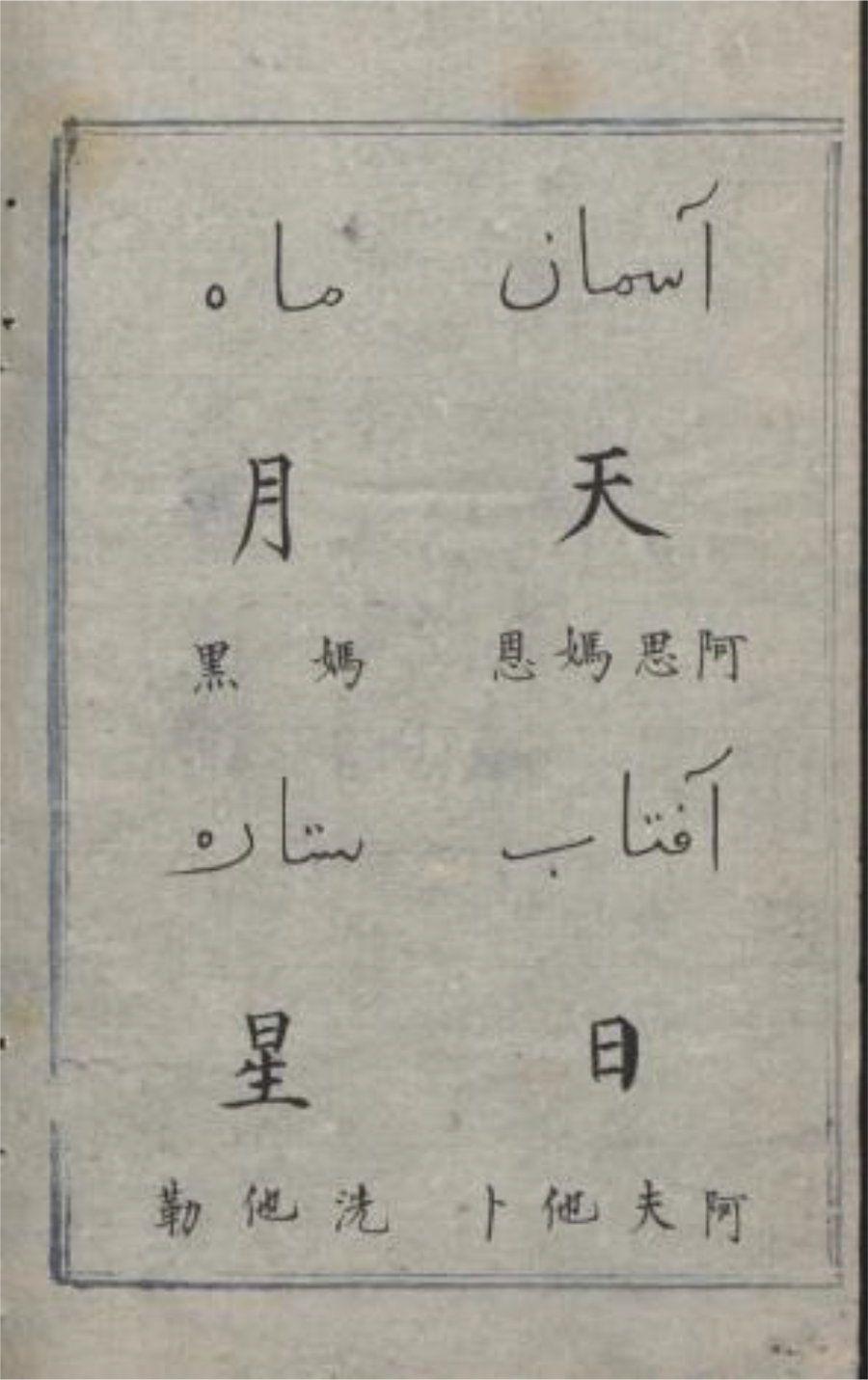
Figure 3 Long description
The image shows a printed page with a bordered layout, containing Persian and Chinese text arranged in pairs. Each Persian term is followed by its Chinese equivalent. The page appears to be from a bilingual glossary or primer. The text is organized in two columns, with Persian terms on the left and corresponding Chinese characters on the right. Examples include: Persian 'ماه' with Chinese '?', Persian 'آسمان' with Chinese '?', Persian 'آفتاب' with Chinese '?'. The text is printed in a clear, formal font, suitable for educational purposes.
The wordlist of the “celestial phenomena” category (tianwen men, 天文門)
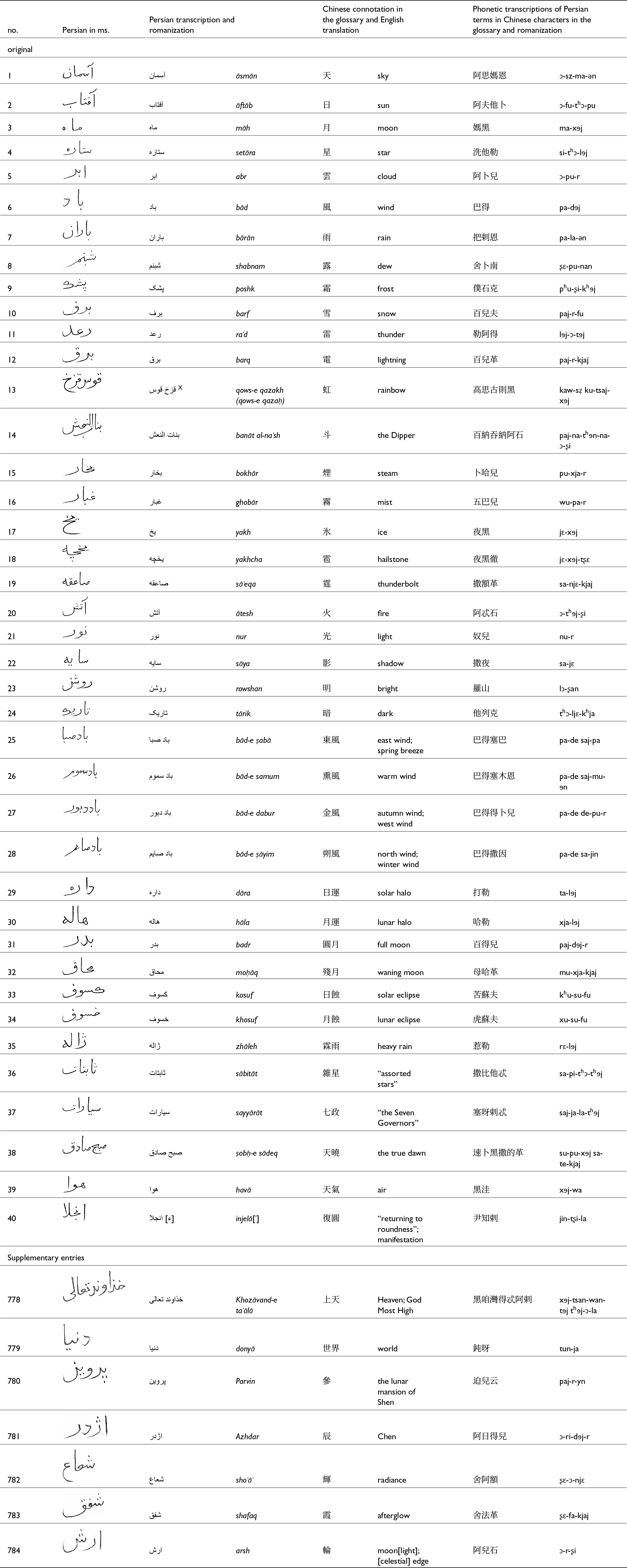
Table 1 Long description
The table is a numbered wordlist that links each Persian term to (1) a Persian transcription/romanization, (2) a Chinese gloss with an English meaning, and (3) a Chinese-character phonetic transcription with romanization. The main list runs from 1 to 40 and includes core celestial and meteorological items such as sky, sun, moon, star, cloud, wind, rain, dew, frost, snow, thunder, lightning, rainbow, and the Dipper. Several entries specify directional or seasonal winds (east/spring, warm, west/autumn, north/winter) and lunar/solar phenomena including solar and lunar halos, full and waning moon, and solar and lunar eclipses. Astronomical groupings also appear, such as “assorted stars” and “the Seven Governors,” alongside “true dawn” and “air/weather.” A supplementary section adds seven more items (numbers 778–784), including Heaven/God Most High, world, and named celestial references such as Parvin and Chen, plus radiance and afterglow. The “Persian in ms.” column is blank throughout, so the table primarily documents meanings and pronunciations rather than manuscript spellings.
The wordlist of the “times and seasons” category (shiling men, 時令門)
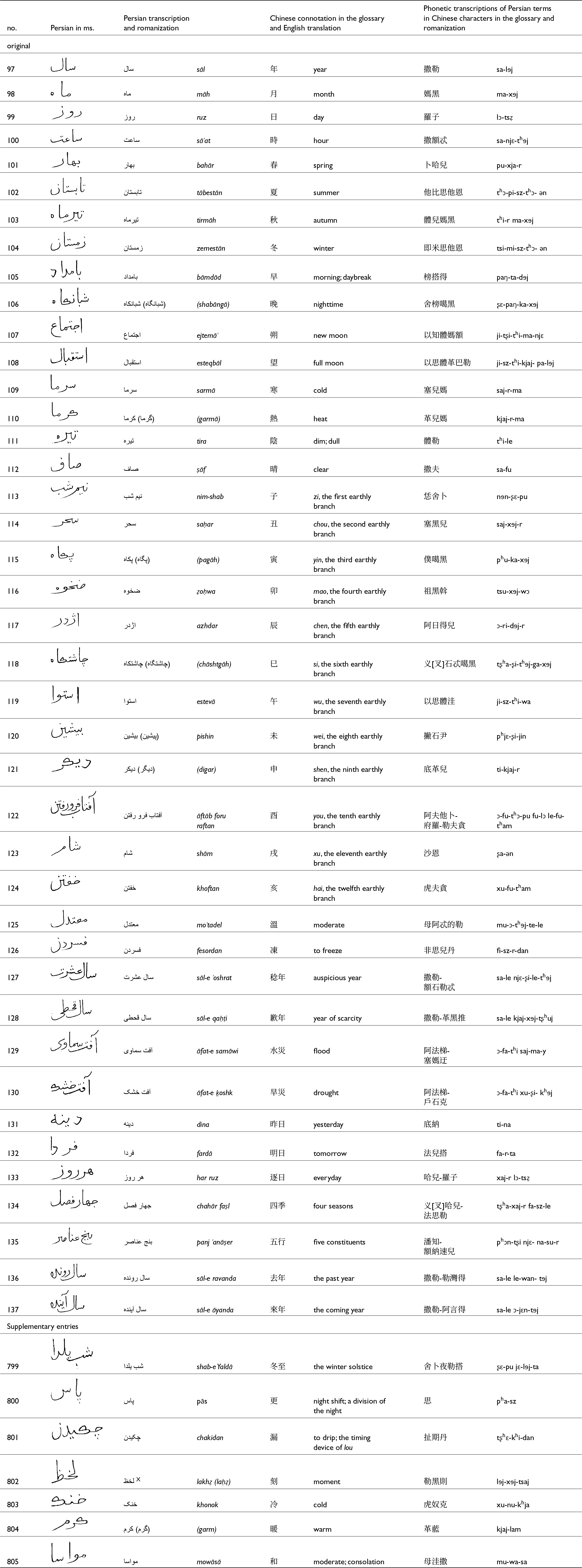
Table 2 Long description
The table lists glossary entries that pair Persian terms with their Chinese semantic equivalents and with Chinese-character phonetic transcriptions (plus romanization) of the Persian words. Each row provides an entry number, the Persian word (in script and romanization), the Chinese connotation with an English gloss, and the Chinese phonetic rendering. Core time units appear first: sāl (year), māh (month), ruz (day), and sāʿat (hour). Seasonal vocabulary follows—bahār (spring), tābestān (summer), tirmāh labeled as autumn, and zemestān (winter)—along with parts of the day such as bāmdād (morning/daybreak) and shabāngāh (nighttime). Lunar-phase terms are included: ejtemāʿ for new moon and esteqbāl for full moon. A sequence maps Persian time-of-day expressions to the twelve Chinese earthly branches from zi through hai, indicating a structured correspondence rather than a narrative trend. Later entries add evaluative and event terms such as moderate, freeze, auspicious year versus year of scarcity, flood versus drought, and relative days (yesterday, tomorrow, everyday), plus supplementary items like winter solstice and night watch divisions. Interpretive caveat: the table reflects glossary equivalences and transliteration conventions, so some mappings (for example, tirmāh associated with “autumn”) may be category-based rather than literal word-for-word meanings.
Appendix 2: Annotations
The annotations focus on idiomatic, technical, and glossary-specific terms, and do not engage with common high-frequency entries unless orthographic or transcriptional clarification is needed. Annotation numbers correspond to those in the wordlists above.
9. “پشک” is commonly pronounced pashak.Footnote 47 The pronunciation pushk is a reconstruction based on the word’s phonetic annotation in Chinese.
13. In the Persian entry, ḥ (ح) is incorrectly transcribed as kh (خ).
14. The phrase banāt al-naʿsh (P < A, lit. “daughters of the bier”) refers to the constellations Ursa Major and Ursa Minor. The Chinese word dou (斗) often refers to the Big Dipper, an asterism consisting of seven stars within Ursa Major.
The Chinese syllable tun (吞) in the phonetic annotation corresponds to the syllable tun in the assimilated Arabic pronunciation of banātu al-naʿsh → banā-tun-naʿsh, demonstrating the phonological assimilation (idghām) of ـت (tu) and النـ (al-n → an-n).
25. Saba (P < A), often translated as “zephyr,” denotes an east wind, opposed to dabūr (west wind). Both the Persian and Chinese phrases can connote a gentle spring breeze.
26. Samum (P < A), meaning “hot wind,” typically carries connotations of intense, scorching heat, whereas the Chinese equivalent xunfeng (熏風) implies a pleasant warm wind. There is a nuanced difference in emotional or environmental implication.
27. Dabur (P < A) means “west wind,” while the Chinese phrase jinfeng (金風, golden wind) typically refers to the autumn wind, which may function synonymously with west wind in poetic or seasonal contexts.
28. This entry is somewhat ambiguous. Ṣāyim (صايم), a variant of ṣāʾim (صائم) in Arabic, commonly means “abstaining” or “standing still.” When applying to wind, it could denote stillness or calmness.Footnote 48 In this glossary, it may refer to the dryness of the wind. The Chinese phrase shuofeng (朔風) means “the north wind.”
29 & 30. Both dāra (P < A) and hāla (P < A < G) mean “ring” or “halo,” and more specifically refer to a moon halo in both Persian and Arabic.Footnote 49
36. Sābitāt (ثابتات), “fixed stars,” refers to luminaries that appear stationary relative to one another in the night sky. The Chinese equivalent zaxing (雜星), meaning “assorted stars,” refers to various types of celestial bodies other than the visible luminaries within the solar system; its connotation and scope are broader and less specific than those of “fixed stars.”
37. Sayyārāt (سيارات), “wandering stars,” refers to the planets. The Chinese equivalence qizheng (七政) means “the Seven Governors,” that is, seven celestial bodies governing worldly affairs. There had been varying interpretations of the term.Footnote 50 In Ming-era astrological texts, the term refers to Mercury, Venus, Mars, Jupiter, and Saturn, along with the Sun and Moon.Footnote 51
40. Injelā (انجلا), a variant of the Arabic verbal noun injilāʾ (انجلاء), means “to be manifest.” In the astronomical context, it refers to the final phase of an eclipse. The Chinese equivalent fuyuan (復圓, lit. “returning to roundness”) captures this phase precisely.
103. Tirmāh is the fourth month of the solar calendar, during which the Sun is in the sign of Cancer. Occasionally, the term denotes autumn or leaf-fall.Footnote 52 Although pāyiz (پاییز) is the standard Persian term for “autumn,” tirmāh is retained in some eastern Persian dialects, e.g., тирамоҳ (tiramoh) in Tajiki. Honda marks this entry as “questionable,” but it appears accurate within the glossary and likely reflects the dialects used by the compilers.Footnote 53
105. Hui Muslims or other Chinese-speaking Muslims may refer to the fajr prayer as bangdade (榜打得) or bangda (榜答), derived from the term bāmdād, “daybreak.”Footnote 54
107. Ejtemāʿ (P < A), “conjunction,” refers to the alignment of the Moon between the Sun and Earth, marking the beginning of the lunar month. The Chinese term shuo (朔) refers to the new moon/first day of the lunar month.
108. Esteqbāl (P < A), “opposition; going forth to meet,” denotes the full moon phase, when the Sun and Moon are on opposite sides of the Earth, marking the midpoint of the month. The Chinese term wang (望) refers to mid-month or full moon.
113. Nim-shab (P), “midnight,” is used to gloss zi (子), the first earthly branch, which is associated with the rat and designates the period from 11 pm to 1 am.
114. Saḥar (P < A), “time just before the dawn,” is used to gloss chou (丑), the second earthly branch, which is associated with the ox and designates the period from 1 am to 3 am.
115. Pagāh (P), “early dawn,” is used to gloss yin (寅), the third earthly branch, which is associated with the tiger and designates the period from 3 am to 5 am.
116. Ẓoḥva (P < A), “the time shortly after the sun has risen,” is used to gloss mao (卯), the fourth earthly branch, which is associated with the rabbit and designates the period from 5 am to 7 am.
117. For most earthly branches, the Persian terms describe the corresponding times of day. Chen (辰) is the only exception, as the associated zodiac animal, the dragon (azhdar), is given. The time of chen corresponds to 7 am to 9 am. Notably, azhdar (اژدر) appears two other times in the HHZZ, designating the celestial body Chen (辰, no.781) and dragon (animal) respectively.Footnote 55
118. Chāshtgāh (P), “forenoon,” is used to gloss si (巳), the sixth earthly branch, which is associated with the snake and designates the period from 9 am to 11 am.
119. The term estevā (استوا) is an alternate form of the Arabic verbal noun istiwāʾ (استواء), “to become equal or balanced.” It is used here to denote the solar noontime, i.e., when the Sun is balanced at its zenith point. It is used here to gloss wu (午), the seventh earthly branch, which is associated with the horse and designates the period from 11 am to 1 pm.
120. Pishin, the Persian equivalence of Arabic ẓuhr (ظهر), means “noon” or “the time when the Sun has passed its zenith.” It is used here to gloss wei (未), the eighth earthly branch, which is associated with the goat and designates the period from 1 am to 3 pm. Hui Muslims or other Chinese-speaking Muslims may refer to the ẓuhr prayer as pieshen (撇申), derived from pishin.Footnote 56
121. Digar, the Persian equivalent of Arabic aṣr (عصر), means “afternoon.” It is used here to gloss shen (申), the ninth earthly branch, which is associated with the monkey and designates the period from 3 am to 5 pm. Hui Muslims may refer to the aṣr prayer as dige’r (底革兒) or digaile (底蓋勒), derived from digar. Footnote 57
122. Āftāb foru raftan (P), “sunset,” is used to gloss you (酉), the tenth earthly branch, which is associated with the rooster and designates the period from 5 pm to 7 pm.
123. Shām (P), “evening” or “nightfall,” is used to gloss xu (戌), the eleventh earthly branch, which is associated with the rooster and designates the period from 7 pm to 9 pm.
124. Khoftan (P), “to sleep.” In the context of prayer times, it is the equivalence of Arabic ʿishāʾ (عشاء), “evening.” It is used here to gloss hai (亥), the twelfth earthly branch, which is associated with the pig and designates the period from 9 pm to 11 pm. Hui Muslims may refer to the ʿishāʾ prayer as hufutan (虎夫灘), derived from khoftan.Footnote 58
129. The term āfat-e samāwi (آفت سماوی), lit. “celestial calamities,” refers in agriculture to atmospheric damages affecting crops, such as hail, frost, or locusts.Footnote 59 The Chinese term shuizai (水災) specifically denotes flood.
135. The wuxing (五行), the “five constituents” of water, fire, wood, metal, and earth, represent the foundational elements in a cosmological and correlative system central to classical Chinese thought. Each element embodies specific qualities, movements, and transformations whose balance or disruption signifies harmony or disorder in the cosmos. While the Persian entry panj ʿanāṣer does not convey the full range of connotations associated with the Chinese term, it nevertheless captures the literal meaning with precision.
778. Khozāvand-e Taʿālā, “God Most High” or “the Exalted God,” is the combination of the dialectal/archaic Persian form of khodāvand (خداوند), “lord,” and the Arabic term taʿālā (تعالى), “exalted.” This expression is a respectful way to refer to God and is commonly seen in Persian texts. Timurid chroniclers employed Khozāvand-e Taʿālā to translate the Chinese concept Tian (天)—often rendered as “Heaven”—in their versions of the diplomatic correspondence between the Yongle emperor and Shahrukh.Footnote 60 In the Chinese context, Tian refers to “the Supreme Power” or the source of the Mandate of Heaven, and is used to underscore imperial legitimacy and divine authority.
780. Parvin is often identified with the Pleiades star cluster, though its precise referent can vary across sources.Footnote 61 The Chinese term Shen (參) designates the twenty-first lunar mansion in Chinese cosmology.
781. Azhdar appears more than once in the HHZZ (see note 117). In this entry, it may denote the constellation corresponding to Draco. However, the correlation between the Persian and Chinese terms is unclear, as the Chinese Chen (辰), in an astronomical context, can refer broadly to celestial bodies or specifically to the planet Mercury.
784. The Persian and Chinese terms, though each rich in associations, do not correspond directly in this case. Given that the entry appears within the context of celestial phenomena, the most plausible explanation is that the Chinese term lun (輪) refers to the celestial rim or heavenly arch. This would align with the connotation of ‘arsh (عرش) as the “outermost celestial sphere.” Accordingly, the appearance of the word as arsh (ارش) is likely the result of a transcription error. A similar hypothesis has also been suggested by Liu.Footnote 62
799. Both Yaldā and dongzhi (冬至) mark the beginning of winter and the end of autumn, and thus carry nearly identical meanings. The Persian term shab-e Yaldā in the list more precisely refers to “the night of Yalda,” which is the longest night of the year.
800. With the connotation of “a portion of the night” or “night watch,” the Persian pās and the Chinese geng (更) share closely related meanings. The Chinese term is more precise, as the night is traditionally divided into five gengs.
801. Lou (漏), derived from its meaning “to drip,” refers to a time-measuring device that operates through the steady flow of sand or water. The Persian term corresponds to lou’s verbal sense.
802. In the Persian entry, ḥ (ح) is incorrectly transcribed as kh (خ).
805. Mowāsā (P < A) denotes ease, rest, favor, and benevolence. While the Chinese term he (和) encompasses similar meanings, it can also refer to mild or temperate weather, which makes it a more appropriate fit within the category of “times and seasons.”

 Open access

