





Strengths and limitations
-
(a) This study represents one of the largest real-world implementations of electronic patient-reported outcome measures (e-PROMs) in routine out-patient mental healthcare in Spain.
-
(b) The multicentre design enhances the generalisability of findings across diverse out-patient psychiatric populations within a major regional healthcare network.
-
(c) The cross-sectional study design does not allow for causal inference, and therefore temporal relationships between PROMs scores and clinical outcomes could not be evaluated.
-
(d) Participation required access to an active patient portal account, which may have introduced selection bias and limited the inclusion of digitally underserved populations.
-
(e) All outcomes were self-reported, and clinician-rated assessments were not available for validation or comparison.
Over the past decade there has been increasing recognition that traditional clinical outcomes alone are insufficient to fully capture the quality and effectiveness of healthcare. In response, patient-reported measures have emerged as essential components of value-based and person-centred care models. Reference Koczwara, Bonnamy, Briggs, Brown, Butow and Chan1–Reference Baumhauer and Bozic3 Patient-reported outcome measures (PROMs) are standardised tools that assess healthcare from the patient’s perspective, focusing on symptoms, quality of life, physical functioning and psychological well-being. Reference Migchels, Zerrouk, Crunelle, Matthys, Gremeaux and Fernandez4 By integrating patients’ voices into the assessment of services, these instruments enable clinicians and policy-makers to align care more closely with patient needs and expectations. Reference Damman, Jani, de Jong, Becker, Metz and de Bruijne5
Originally developed within specialties such as oncology and orthopaedics, Reference Koczwara, Bonnamy, Briggs, Brown, Butow and Chan1,Reference Sabah, Alvand, Knight, Beard and Price6,Reference Rolfson, Eresian Chenok, Bohm, Lübbeke, Denissen and Dunn7 PROMs have progressively gained traction in mental health, where subjective experience, perceived well-being and symptom burden play central roles in recovery. Reference Roe, Slade and Jones8 However, despite their potential, mental health settings face persistent challenges in implementing these measures consistently. These include scepticism among healthcare professionals regarding the objectivity of patient-reported data, variability in tools and scoring systems, lack of validated instruments in local languages and inconsistent integration into clinical workflows. Reference McCabe, Rabi, Bele, Zwicker and Santana9–Reference Gelkopf, Mazor and Roe11 Furthermore, evidence remains limited regarding the impact of routine PROMs use on treatment adherence, symptom improvement or overall care quality in psychiatric populations, Reference Kendrick, El-Gohary, Stuart, Gilbody, Churchill and Aiken12 as well as their correlation with adverse clinical outcomes such as adherence to treatment, secondary effects of medication, self-harm and suicide attempts.
Digital health initiatives have increasingly sought to embed PROMs within electronic health record (EHR) systems to promote real-time, scalable data collection and feedback to clinicians. Reference Makhni, Swantek, Ziedas, Patterson, Allard and Day13 Within this context, a Spanish value-based healthcare network developed a digital framework for collecting PROMs through a patient web application. This framework, known as the E-Res Salud program, enables automatic deployment of validated questionnaires, allowing patients to report on well-being, symptom severity and care experiences via a secure online platform, with data integrated directly into the EHR. Reference del Olmo Rodríguez, Córdoba, Gómez-Meana, Herrero González, Pascual Martínez and Cabello Úbeda14
The present multicentre, cross-sectional study aimed to describe demographic characteristics and PROMs outcomes among patients attending out-patient mental healthcare across four Spanish academic hospitals and participating in the E-Res Salud program. We also aimed to explore associations between validated PROMs and patient-reported indicators including adherence to pharmacological treatment, adverse effects, self-harm and suicidal behaviour. By systematic evaluation of these relationships in a large, real-world cohort, this study aims to contribute to the growing body of evidence supporting the clinical integration of PROMs in routine mental health practice.
Method
Study design
This was a multicentre, cross-sectional study featuring individuals attending out-patient mental healthcare appointments at four Spanish academic hospitals from October 2023 to March 2025, and who agreed to participate in an e-PROMs initiative. We aimed to describe the demographic characteristics of participants and the overall results of self-reported outcomes measurements, and to analyse associations between the results of validated PROMs and patient-reported prevalence of clinical outcomes, including adherence to pharmacological mental health treatment, secondary effects of medication, self-harm and suicidal attempts.
Setting
The study took place in the out-patient mental health facilities of four Spanish academic hospitals from the Madrid Regional Healthcare System of Madrid, Spain. The participating centres were Fundación Jiménez Díaz University Hospital, Infanta Elena University Hospital, Rey Juan Carlos University Hospital and General Villalba University Hospital. Recruitment took place from 23 October 2023 to 18 March 2025, with a follow-up of 12 months from the index appointment.
Participants
All patients referred to mental health out-patient care at the participating centres during the study period were invited to participate in the e-PROMs initiative. Patients were invited to participate via the patient web application, the Quirónsalud patient portal. We excluded patients younger than 18 years, as well as those without an active patient portal account.
The e-PROMs collection initiative took place in the context of a network-wide, value-based project, E-Res Salud. Reference del Olmo Rodríguez, Córdoba, Gómez-Meana, Herrero González, Pascual Martínez and Cabello Úbeda14,Reference Córdoba, Rodríguez, Ramos, García, Morillo and Pérez-Sáenz15 A team of highly experienced psychiatrists performed a qualitative literature review to select featured PROMs instruments. Selected instruments had an available validated Spanish language translation and a robust trajectory in the literature. In collaboration with the Information Technology and Systems Department, a digital framework for PROMs collection was developed within the hospital network’s EHR system. This framework facilitates the automatic deployment and web-based completion of PROMs questionnaires via the Quirónsalud patient portal. When patients attended scheduled out-patient mental healthcare appointments, psychiatrists informed them of the PROMs collection program, including potential benefits and estimated completion times. Attendance triggers the automated delivery of designated PROMs questionnaires over the patient portal during the 12 months following the appointment. Patients may opt out of responding to the questionnaires at any time. Patient responses are automatically integrated directly into the patient’s EHR, thereby ensuring data traceability. Anonymised data are automatically uploaded to the centralised E-Res Salud database.
Patient and public involvement
Patients were involved in the validation of several of the PROMs measures included in the E-Res Salud initiative. Although patients were not directly involved in the research design, our project was in line with patient-centred care, which seeks to place patients’ opinions and values at the heart of healthcare, and patient-reported outcomes were, in fact, the objective of this study.
Variables, data sources and measurements
Variables included demographic factors such as age and gender, and the results of the PROMs survey. PROMs instruments included were the World Health Organization-Five Well Being Index (WHO-5), Patient Health Questionnaire-9 (PHQ-9), Generalized Anxiety Disorder-7 (GAD-7), Alcohol Use Disorders Identification Test (AUDIT-C), Drug Abuse Screening Test-10 (DAST-10) and Primary Care PTSD Screen for DSM-5 (PC-PTSD-5) scales.
WHO-5 is a brief, five-item scale measuring positive well-being over the past 2 weeks, with each of the five statements rated on a six-point Likert scale. Scores were calculated as percentages by multiplying the raw score by 4. Results were classified from 0 to 100, where 0 was ‘worst imaginable well-being’ and 100 was ‘best imaginable well-being’. A score of 50 or less signified poor well-being. Reference Topp, Østergaard, Søndergaard and Bech16
PHQ-9 is a 9-item instrument for screening, diagnosing, monitoring and measuring the severity of depression based on DSM criteria. Reference Kroenke17–Reference Kroenke, Spitzer and Williams19 Each of the nine symptoms is rated on a four-point Likert scale to indicate frequency. The scores for all nine items are added to give a total score ranging from 0 to 27. Patients scoring 0–4 are classified as having either an absence of depressive symptoms or minimal depressive symptoms; those scoring 5–9 as having mild depressive symptoms; those scoring 10–14 as having moderate depressive symptoms; those scoring 15–19 as having moderately severe depressive symptoms; and those scoring 20–27 as having severe depressive symptoms. For analysis, we grouped patients with moderately severe and severe symptoms because both categories warrant active treatment.
GAD-7 is a seven-item, self-reporting instrument for measuring and monitoring the severity of generalised anxiety disorder symptoms over the past 2 weeks. Reference Spitzer, Kroenke, Williams and Löwe20,Reference Sapra, Bhandari, Sharma, Chanpura and Lopp21 Responses are scored on a scale from 0 to 3, with total scores ranging from 0 to 21. Outcomes are classified as 0–4 (minimal anxiety), 5–9 mild anxiety, 10–14 (moderate anxiety) and 15–21 (severe anxiety). A score of 10 or above indicates probable generalised anxiety disorder, warranting further evaluation from a mental health professional.
AUDIT-C is a brief, three-item screening tool used to identify persons who are hazardous drinkers or have an active alcohol use disorder. Answers are scored from 0 to 4, with a total score ranging from 0 to 12. A positive screening result is considered as 4 and above for men, and 3 and above for women. Reference Levola and Aalto22
DAST-10 features ten yes/no items to identify the extent of drug use problems over the past year. Each positive answer scores one point. Total scores range from 0 to 10, where 0 means no problems reported, 1–2 signifies a low level of problems, 3–5 a moderate level of problems and 6–10 a substantial or severe level of problems. For our analysis we classified responses as ‘no risk of substance abuse’ for a score of 0 and ‘risk of substance abuse’ for scores greater than 0.
PC-PTSD-5 is a brief, five-item, self-report screening tool designed for rapid identification of individuals who may have post-traumatic stress disorder (PTSD) and require further assessment. Reference Williamson, Stickley, Armstrong, Jackson and Console23 The screen starts with a question on lifetime trauma exposure; if the answer is ‘no’, the screen is complete (score 0); if ‘yes’, the patient answers five ‘yes/no’ questions about how the trauma has affected them in the past month. Total scores range from 0 to 5, with a cut-off point of 3 for probable PTSD.
We also included self-reported information about adverse outcomes over the past year, including adherence to medication, medication side-effects, self-harm and suicidal attempts. These were measured using structured numerical responses in the patient questionnaire.
Statistical analysis
Quantitative variables describing the study population are expressed as median and interquartile range; qualitative variables are described as frequencies and percentages. Quantitative data were compared using the Mann–Whitney U-test, and qualitative data were compared using the chi-square test. Odds ratios with 95% confidence intervals were calculated. A Cochran–Armitage chi-square test for trend was performed to test for association between nominal and ordinal variables, Pearson’s correlation to demonstrate association between two continuous variables and Spearman’s rank correlation to test for association between ordinal and continuous variables.
Multivariate analysis was performed using a generalised linear regression model with a logit link function, and iteratively reweighted least squares methods for modelling binary outcomes (adherence to medication, medication side-effects, self-harm and suicide attempts). We designated suicide attempts and self-harm incidents as primary outcomes, with medication adherence and side-effects considered as exploratory.
Predictors were entered simultaneously into the models. Prior to inclusion, multicollinearity was assessed using the variance inflation factor (VIF). Due to high collinearity between GAD-7 and PHQ-9 (VIF > 11), the former was excluded from the final multivariable models to ensure coefficient stability; all remaining variables demonstrated acceptable collinearity (VIF < 5.0).
To account for the increased risk of type I error due to multiple comparisons across four clinical targets, global Bonferroni correction was applied to all p-values. Model performance and calibration were evaluated using the area under the receiver operating characteristic curve (ROC AUC), alongside sensitivity (recall) and precision metrics calculated on independent training and testing subsets to ensure generalisability. Statistical analysis was performed using Python v. 3.11.14.
Ethical standards
The authors assert that all procedures contributing to this work comply with the ethical standards of the relevant national and institutional committees on human experimentation, and with the Helsinki Declaration of 1975 as revised in 2013. All procedures involving human subjects/patients were approved by the Fundación Jiménez Díaz Research Ethics Board (approval no. PIC120/2016). Due to the retrospective nature of the data analysis and the pseudo-anonymised nature of the data, the need for informed consent was waived.
Results
Over the study period, 73 140 individuals were referred for first out-patient mental health appointments at participating centres, of whom 7925 (10.85%) decided to participate in the e-PROMs program. Median age of participants was 48 years (37–57 years), and 5451 (68.79%) were women.
Demographics and PROMs
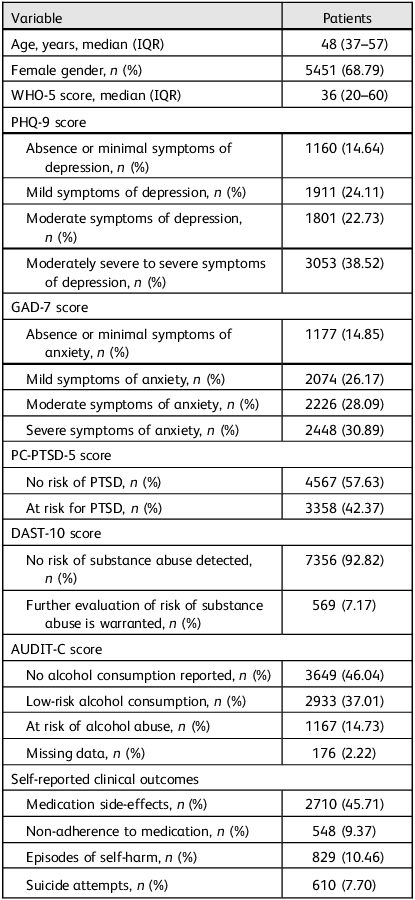
PROMs results are shown in Table 1. Median WHO-5 results were 36 (range 20–60), indicating poor overall well-being. A total of 3053 (38.52%) individuals reported moderately severe to severe depressive symptoms. Severe anxiety symptoms were present in 2448 (30.89%) individuals, with 3358 (42.37%) participants reporting symptoms indicating risk of PTSD. Regarding substance abuse, risk of substance abuse was detected in 569 (7.18%) participants, with 1167 (14.73%) patients self-classified as at risk for alcohol abuse based on the results of the AUDIT-C scale.
Demographical, clinical and PROMs data for participating individuals attending mental health out-patient care from October 2023 to March 2025

Table 1 Long description
The table presents demographic, clinical, and patient-reported outcome measures data for individuals attending mental health out-patient care from October 2023 to March 2025. The median age is 48 years with an interquartile range of 37 to 57 years. 68.79 percentage of the participants are female. The median WHO-5 score is 36 with an interquartile range of 20 to 60, indicating poor overall well-being. The PHQ-9 score reveals that 14.64 percentage of participants have absence or minimal symptoms of depression, 24.11 percentage have mild symptoms, 22.73 percentage have moderate symptoms, and 38.52 percentage have moderately severe to severe symptoms. The GAD-7 score shows that 14.85 percentage have absence or minimal symptoms of anxiety, 26.17 percentage have mild symptoms, 28.09 percentage have moderate symptoms, and 30.89 percentage have severe symptoms. The PC-PTSD-5 score indicates that 57.63 percentage are at no risk of PTSD, while 42.37 percentage are at risk. The DAST-10 score reveals that 92.82 percentage have no risk of substance abuse, while 7.18 percentage warrant further evaluation. The AUDIT-C score shows that 46.04 percentage report no alcohol consumption, 37.01 percentage have low-risk consumption, 14.73 percentage are at risk of alcohol abuse, and 2.22 percentage have missing data. Self-reported clinical outcomes include 45.71 percentage experiencing medication side-effects, 9.37 percentage showing non-adherence to medication, 10.46 percentage reporting episodes of self-harm, and 7.70 percentage reporting suicide attempts.
PROMs, patient-reported outcome measures; IQR, interquartile range; WHO-5, World Health Organization-Five Well Being Index; PHQ-9, Patient Health Questionnaire-9; GAD-7, Generalized Anxiety Disorder-7; PC-PTSD-5, Primary Care PTSD Screen for DSM-5; PTSD, post-traumatic stress disorder; DAST-10, Drug Abuse Screening Test-10; AUDIT-C, Alcohol Use Disorders Identification Test.
Significant differences were observed between genders, with women presenting lower average well-being scores (38.93 ± 23.83 v. 42.36 ± 25.76, 95% CI −4.55 to −2.24, p < 0.001), higher rates of moderately severe to severe depressive symptoms (2211 (40.56%) v. 842 (34.03%), p < 0.001), higher rates of severe anxiety (1804 (33.09%) v. 644 (26.03%), p = 0.003) and more frequent risk of PTSD (2466 (45.24%) v. 892 (36.05%), p = 0.002). On the other hand, male patients had higher risk of substance abuse (240 (9.70%) v. 329 (6.03%), p = 0.033) as well as higher self-reported risk of alcohol abuse (404 (16.33%) v. 763 (13.99%), p = 0.034).
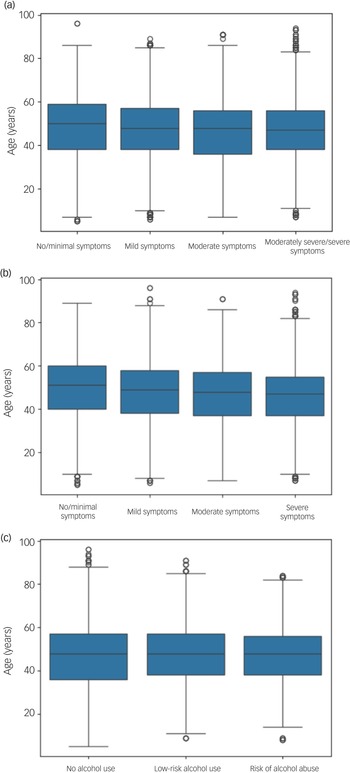
Regarding age-related differences, a weak but significant negative correlation was observed between age and WHO-5 scores (r = −0.039, p < 0.001). A weak but statistically significant correlation was observed between younger age and severity of depressive symptoms (r s = −0.039, p < 0.001) (Fig. 1(a)), and between younger age and anxiety symptoms (r s = −0.08, p < 0.001) (Fig. 1(b). Patients at risk of substance abuse were significantly younger than those not considered at risk (41 (30–51) v. 48 (38–57), 95% CI 4.96–7.22, p < 0.001), with a weak but statistically significant correlation observed between older age and risk of alcohol abuse (r s = 0.02, p < 0.001) (Fig. 1(c)). Finally, no difference in age was observed between patients reporting symptoms of PTSD and those without.
Correlation between age and (a) severity of depressive symptoms (Patient Health Questionnaire-9), (b) severity of anxiety symptoms (Generalized Anxiety Disorder-7) and (c) risk of alcohol abuse (Alcohol Use Disorders Identification Test).

Fig. 1 Long description
The image contains three box plots. The first box plot (a) shows the correlation between age and severity of depressive symptoms measured by the Patient Health Questionnaire-9. The x-axis categorizes symptoms into no/minimal, mild, moderate, and moderately severe/severe, while the y-axis represents age in years. The second box plot (b) illustrates the correlation between age and severity of anxiety symptoms assessed by the Generalized Anxiety Disorder-7. The x-axis categorizes symptoms into no/minimal, mild, moderate, and severe, with the y-axis again representing age in years. The third box plot (c) depicts the correlation between age and risk of alcohol abuse as determined by the Alcohol Use Disorders Identification Test. The x-axis categorizes alcohol use into no alcohol use, low-risk alcohol use, and risk of alcohol abuse, with the y-axis representing age in years. Each box plot shows the distribution of ages within each symptom or risk category, highlighting the median, quartiles, and outliers.
Association of PROMS with adverse clinical outcomes
Based on univariate analysis, poorer WHO-5, PHQ-9, GAD-7, DAST-10 and PC-PTSD-5 scores were linked to higher rates of self-reported medication side-effects, self-harm and suicidal attempts (Appendix 1), whereas AUDIT-C scores were found to be associated with higher rates of self-harm. Interestingly, older age, severe anxiety and risk of post-traumatic stress were associated with adherence to treatment, whereas self-reported substance and alcohol abuse were higher for patients reporting non-adherence. Younger age was a risk factor for all clinical adverse outcomes, with female gender being associated with all studied outcomes except for non-adherence.
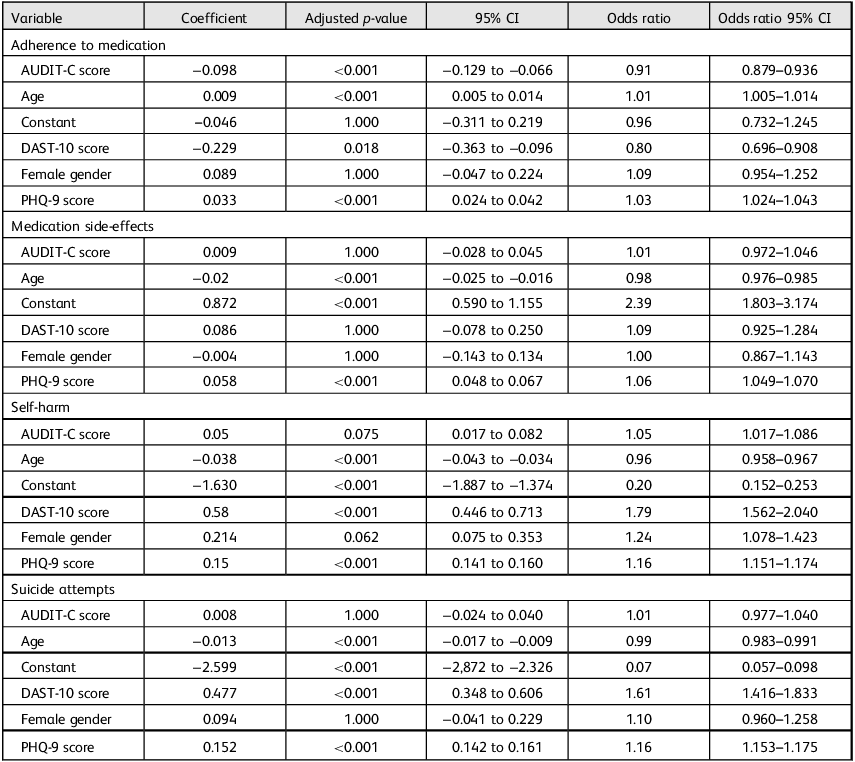
Multivariate analysis confirmed the association of the variables found to be significant on univariate analysis with adverse clinical outcomes (Table 2), with severe depressive symptoms emerging as the strongest predictor of adverse effects, self-harm and suicide attempts. Risk of substance abuse was also found to be a strong predictor of self-harm and suicide attempts. Regarding adherence to medication, poorer well-being and more severe anxiety and depression were independent predictors of adherence, whereas substance and alcohol abuse were associated with non-adherence.
Results of multivariate analysis testing for association between PROMs results and clinical outcomes (adherence to medication, medication side-effects, self-harm and suicide attempts)
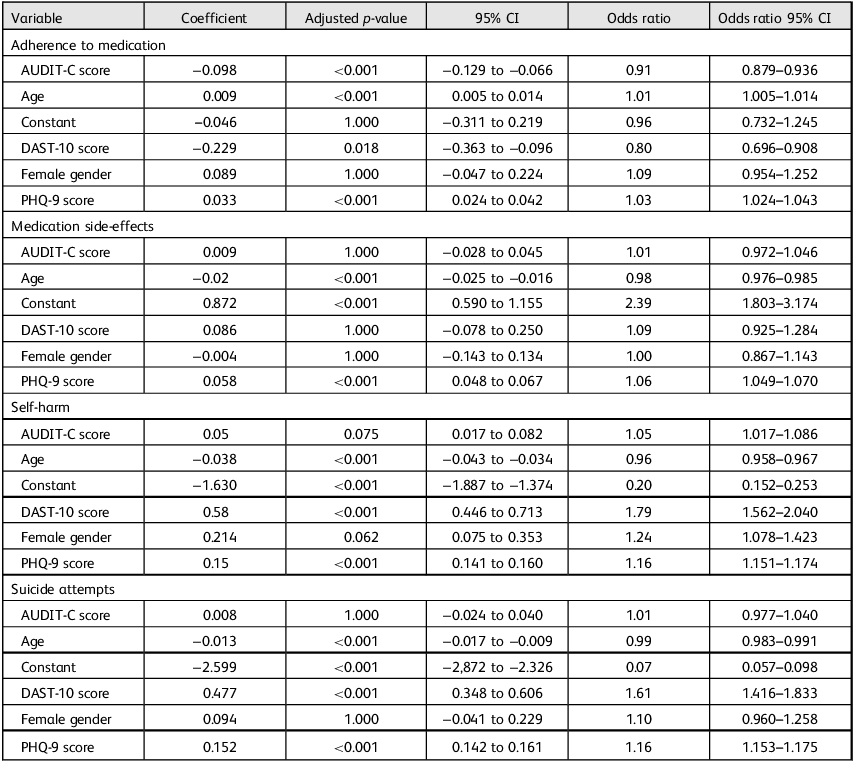
Table 2 Long description
The table presents results of a multivariate analysis examining the association between patient-reported outcomes and clinical outcomes, including adherence to medication, medication side-effects, self-harm, and suicide attempts. It includes variables such as AUDIT-C score, age, DAST-10 score, female gender, and PHQ-9 score. The table has six rows for each clinical outcome category and columns for coefficients, adjusted p-values, 95% confidence intervals, odds ratios, and odds ratio 95% confidence intervals. Notable trends include significant associations between PHQ-9 score and all clinical outcomes, with severe depressive symptoms being a strong predictor of adverse effects, self-harm, and suicide attempts. Substance abuse risk is also a significant predictor of self-harm and suicide attempts. Adherence to medication is influenced by well-being, anxiety, depression, substance abuse, and alcohol abuse.
PROMs, patient-reported outcome measures; AUDIT-C, Alcohol Use Disorders Identification Test; DAST-10, Drug Abuse Screening Test-10; PHQ-9, Patient Health Questionnaire-9.
Discussion
This multicentre, cross-sectional study represents a large, real-world implementation of e-PROMs in out-patient mental healthcare in a European setting, demonstrating the feasibility and clinical value of integrating validated instruments such as WHO-5, PHQ-9, GAD-7, PC-PTSD-5, AUDIT-C, and DAST-10 into routine clinical workflows through a patient web application. The results provide a snapshot of the mental health status of individuals seeking out-patient psychiatric care across four academic hospitals, revealing substantial symptom burden and significant gender-related disparities in areas such as mental well-being, anxiety and depression.
Overall, participants reported poor well-being and a high prevalence of depressive and anxiety symptoms, with nearly 40% exhibiting moderately severe to severe depression and 30% showing severe anxiety. The median WHO-5 score of 36 – well below the threshold indicating poor well-being – is consistent with studies in similar populations. Reference Lara-Cabrera, Mundal and De Las Cuevas24 Additionally, 42% of participants screened positive for risk of PTSD, reflecting the elevated psychosocial burden seen in tertiary mental health services.
Marked gender differences were observed across several domains. Women reported significantly lower well-being and higher rates of depression, anxiety and PTSD symptoms compared with men, echoing trends consistently observed in population-based and clinical studies. Reference Schuch, Roest, Nolen, Penninx and De Jonge25–Reference Olff27 Conversely, men were more likely to report symptoms pointing to risk of illicit substance use, consistent with known epidemiological patterns of substance-related disorders. Reference Smith28 Although men reported higher mild alcohol consumption, no significant gender differences emerged regarding risk of alcohol abuse – findings supporting a narrowing gender gap in hazardous drinking behaviours in Spain over past decades. Reference Romo-Avilés, Marcos-Marcos, Tarragona-Camacho, Gil-García and Marquina-Márquez29,Reference Alvarez and del Río30 Younger age was associated with worse PROMs results, including risk of substance abuse and anxiety and depression symptoms, except regarding risk of alcohol abuse, for which older age was a risk factor. Although the relationship between older age and higher risk of alcohol abuse was weak, our findings serve as a reminder of the importance of screening for inappropriate use of alcohol in this population. Reference Blazer and Wu31,Reference Berks and McCormick32
Importantly, based on univariate analysis, worse WHO-5, GAD-7 and PHQ-9 scores were associated with higher prevalence of pharmacological adverse effects, self-harm and suicidal behaviour, whereas DAST-10 and AUDIT-C scores were predictors of non-adherence to treatment. These associations reinforce the clinical utility of PROMs as sensitive indicators not only of symptom severity but also of functional and behavioural outcomes relevant to treatment planning. Crucially, our multivariable models for the primary outcomes of self-harm and suicide attempts demonstrated robust discriminative power, with test ROC AUC values of 0.815 and 0.805, respectively. This level of performance indicates an ‘excellent’ ability to differentiate between high- and low-risk patients in an out-patient setting. Reference Simon, Johnson, Lawrence, Rossom, Ahmedani and Lynch33,Reference Hosmer, Lemeshow and Sturdivant34 Although the precision of the suicide attempt model was lower (0.22) due to the low base rate of the event, the high recall ensures that the majority of at-risk individuals were identified for clinical review. Reference Belsher, Smolenski, Pruitt, Bush, Beech and Workman35 Prior studies in different areas have highlighted the value of PROMs in identifying early deterioration and guiding clinical decision-making. Reference Córdoba, Rodríguez, Ramos, García, Morillo and Pérez-Sáenz15,Reference del Olmo Rodríguez, Martos Martinez, Pascual Martínez, Miranda Castillo, Short Apellaniz and Pfang36 Systematic integration of PROMs into care could facilitate proactive risk identification and promote individualised, measurement-based interventions.
Although international evidence supports PROMs as valid tools for monitoring mental health outcomes, large-scale implementation remains limited due to technical, organisational and cultural obstacles. Reference Gelkopf, Mazor and Roe11 From a systems perspective, embedding PROMs into the EHR via a patient web application demonstrates the feasibility of scaling digital feedback systems across large healthcare networks. Reference del Olmo Rodríguez, Córdoba, Gómez-Meana, Herrero González, Pascual Martínez and Cabello Úbeda14 Routine, automated data collection enables clinicians to access real-time information to enhance shared decision-making, personalise treatment and improve care coordination.
The strengths of this study include its large sample size, multicentre design and the use of validated PROMs administered through a standardised digital platform integrated within routine clinical workflows. However, some limitations should be considered. First, the cross-sectional design precludes causal inferences between PROMs and clinical outcomes. Second, participation was limited to patients with active patient portal accounts, introducing possible selection bias favouring digitally literate individuals. Third, reliance on self-reported data may be affected by recall or social desirability bias. Fourth, clinician-rated measures were not available for triangulation with PROMs, which would have enriched validity analysis. Fifth, although it may seem obvious, it is important to consider that the potential benefits of completing PROMs are applicable only to patients who choose to complete the surveys; in our case, although many patients completed PROMs, they accounted for only 10.9% of the total mental health patient population. Further investigation is required to elucidate strategies for improving participation rates. Sixth, although we applied global Bonferroni correction to mitigate the risk of type I error, the large sample size and numerous outcomes examined increase the susceptibility to multiple comparison artefacts; therefore, nominal significances should be interpreted with caution. Seventh, our models demonstrated higher recall than precision. From a clinical safety perspective, we prioritised sensitivity (recall) to minimise missed high-risk cases, acknowledging that this has resulted in a higher rate of false-positive screens requiring clinical triaging. Finally, although validated Spanish versions of all PROMs were used, cultural and linguistic nuances might have influenced response patterns.
Future research should examine longitudinal PROMs trajectories to assess sensitivity to change and predictive validity for clinical outcomes such as remission, hospitalisation or suicidality. Integration of clinician dashboards and automated alerts based on PROMs thresholds could improve usability in daily practice. Expansion to include patient-reported experience measures would also provide a more comprehensive assessment of person-centred care. Collaboration among clinicians, informaticians and policy-makers remains crucial to ensuring the ethical, equitable and sustainable use of PROMs within mental health systems.
This study demonstrates the feasibility and clinical relevance of large-scale digital PROMs collection in Spanish out-patient mental health services. The high prevalence of depressive, anxiety and post-traumatic stress symptoms underscores the burden faced by this population, whereas associations between PROMs and adherence, side-effects and suicidal behaviour highlight the potential of patient-reported data for early risk detection and quality improvement. Embedding PROMs within EHR systems represents an important step towards more transparent, data-driven and patient-centred psychiatric care.
Supplementary material
The supplementary material is available online at https://doi.org/10.1192/bji.2026.10111
Data availability
De-identified participant data used in this study are not publicly available but may be made available to qualified researchers upon reasonable request. Requests may be directed to the corresponding author.
Acknowledgements
The authors thank the patients and mental health departments of Fundación Jiménez Díaz University Hospital, Infanta Elena University Hospital, Rey Juan Carlos University Hospital and General Villalba University Hospital for their collaboration in the implementation of the e-PROMs program. The authors also acknowledge the Information Technology and Systems Department for their role in integrating PROMs into the EHR infrastructure.
Author contributions
Conceptualisation and study design: M.d.O.R., J.S.A., R.C., E.B.-G. Methodology and statistical analysis: B.P., C.P.C., M.A.V.G. Data curation: E.B.-G., R.A.-G., B.P. Drafting of the manuscript: C.P.C., B.P. Validation: M.d.O.R., J.S.A. Supervision: E.B.-G. Critical revision for important intellectual content: all authors. All authors approved the final manuscript and accept accountability for the work.
Funding
This research received no specific grant from any funding agency, commercial or not-for-profit sectors.
Declaration of interest
M.d.O.R., J.S.A., C.P.C., B.P., R.A.-G. and E.B.-G. are employees of the Quirónsalud Healthcare Network. M.A.V.G. and R.C. have no conflicts of interest to disclose.


 Open access


eLetters
No eLetters have been published for this article.