


Introduction
Clinical and translational science (CTS): building success
Clinical and translational science (CTS) helps turn laboratory discoveries into real-world health solutions that can directly benefit patients. Since the inception of the Institute for Translational Medicine and Therapeutics (ITMAT), Perelman School of Medicine University of Pennsylvania, in 2005, research at the interface of basic and clinical research focusing on developing new and safer therapeutics has been promoted through substantial investments in infrastructure, human capital, and collaborative culture. Several transformational discoveries speak to the success of this model. ITMAT is the home of development for the gene therapy of genetic forms of blindness [Reference Bennett, Wellman and Marshall1], CAR-T cell therapy [Reference Melenhorst, Chen and Wang2], mRNA technology [Reference Kariko, Muramatsu, Ludwig and Weissman3,Reference Weissman and Kariko4], and most recently the clinical application of CRISPR gene-editing technologies for rare diseases [Reference Musunuru, Grandinette and Wang5]. These achievements underscore the extraordinary potential of how institutional commitment empowers CTS to bridge the gap between laboratory research and real-world health solutions.
Science communication: call to action
While the scientific community has made significant strides in research and innovation, a growing cultural gap remains between scientists and society, especially when it comes to effectively communicating novel scientific findings. A 2019 Pew Research Center survey found that while 89% of Americans view scientists as intelligent, only 54% believe they are effective communicators [Reference Funk and Hefferon6]. Pew reported a further decline in public opinion to 45% by 2024 [Reference Tyson and Kennedy7]. Without clear, accessible communication, public understanding, trust, and engagement with science may erode, risking the public’s acceptance of scientific discoveries and may stymie access of the public to the benefits of advanced and emerging therapeutic modalities.
Addressing this challenge requires creative solutions that not only advance scientific discovery but also strengthen scientists’ capacity for public engagement. Integrating disciplines like the visual and performing arts into scientific training combined with outreach initiatives can help bridge the divide. By creating a reciprocal process – where societal feedback is meaningfully integrated into the research pipeline through effective science communication – public perception of the scientific enterprise is elevated [Reference Hunter8]. At ITMAT, we established an artist-in-residency (AiR) and embedded artists into our Translational Research Immersion Program (TRIP) to develop a new skillset among undergraduate students, the next generation of the CTS workforce, to communicate science with accessible and culturally resonant narratives [Reference Skarke, German and Meagher9]. This process provides a mechanism for the public to share feedback in a participatory approach and thus have an impact on formulating research priorities. We propose that this scalable paradigm contributes meaningfully to rebuilding trust in science and reinforcing the social contract between biomedical research and the communities it serves.
Methods
Leveraging existing infrastructure: experiential research education for undergraduate students in CTS
Spearheaded in 2009, the ITMAT TRIP continues to engage undergraduate students interested in pursuing an MD, PhD, or MD-PhD from 12 partner institutions comprising Bryn Mawr College, Haverford College, Howard University, Florida A&M University, Franklin & Marshall College, Lincoln University, Morehouse College, Spelman College, Swarthmore College, University of Pennsylvania, University of Puerto Rico, and Xavier University of Louisiana. These partnerships help extend our initiative to engage undergraduate students in CTS from institutions beyond the network of the 60+ members within the Clinical Translational Science Award (CTSA) Program. The 10-week summer immersion program provides ∼12–14 students/year a mentored CTS research experience working with ITMAT investigators and an interactive curriculum comprised of research seminars, professional skills development workshops, and exposure to careers in biomedicine through career panel discussions. Students receive one-on-one advising from their mentor(s) and ITMAT Education leadership. The current mentor pool of ∼2205 ITMAT investigators represents a rich environment across the University of Pennsylvania, the Children’s Hospital of Philadelphia and the Wistar Institute. Students live on campus within walking distance from their mentor labs, receive a competitive stipend, and transportation allowance.
In summary, ITMAT’s CTS pathway initiative attracts undergraduate students to pursue careers in biomedical sciences and as such these young professionals become the target audience for paradigms to improve the capacity to communicate science with clarity, creativity, cultural relevance, and scientific integrity, ultimately helping to build public trust in science and medicine.
Implementing the AiR program
Modeled after pilot studies in experimental medicine, the AiR program was introduced over three years with four key phases:
-
1. Admissions (October–May): Recruit and onboard one artist annually.
-
2. Immersion (May–August): Artist participates in TRIP curricular events (∼13 hours/week).
-
3. Production (Fall): Artist creates and develops artwork informed by student research.
-
4. Engagement (Winter–Spring): Artist shares work with students, stakeholders, and the public.
Artists were expected to (i) engage with students and their research mentors to learn about their research projects, (ii) develop concepts for artwork that actively engages the community, (iii) collaborate with program leadership through regular meetings to share updates and receive feedback, and (iv) submit a proposal detailing how the artwork will be shared with stakeholders and how they plan to engage with community members. The artists received a stipend, funds for art-related expenses, and a courtesy appointment at the University of Pennsylvania to access institutional resources. All artwork created during the residency remained the property of the artist with the provision that the artist grants the institution the right to display artwork created during the residency at its facilities, on social media, in print, or other materials.
Data collection and analysis
To inform iterative program refinement, students completed an end-of-program survey each year with four questions related to the AiR experience: (i) “Did you understand the role of the Artist in Residence?,” (ii) “Did the Artist in Residence enrich your experience in TRIP?,” (iii) “Please describe how the Artist in Residence enriched/did not enrich your experience here.” and (iv) “Add any additional comments about the Artist in Residence program here.” This project was undertaken as a Quality Improvement Initiative and as such was not formally reviewed by the University of Pennsylvania’s Institutional Review Board. Free text responses to the third question were submitted separately for each TRIP year to JMP® Pro (version 17.2.0) for unstructured text mining. Frequency tables were constructed for words and phrases without stemming and text data were visualized as word clouds with syncategorematic words removed and centered layout and arbitrary colors as settings. Next, the sentiment analysis assigned numerical scores to words and phrases to quantify the positive and negative sentiment expressed in the unstructured text responses based on the default dictionary. Lastly, free text responses were submitted to ChatGPT 5.1 (OpenAI) for thematic content analysis using the University of Pennsylvania’s ChatGPT Edu environment for enterprise-level security and confidentiality. Starting with the prompt “Summarize survey responses into common themes,” a strict codebook was developed based on a set of in- and exclusion criteria for each of the themes (Supplementary Table 1). To ascertain the impact of the program, artists were surveyed on 5-point Likert scales with “This residency was effective at providing you an opportunity to learn and grow in the art and science space.” and “My participation in this residency lead me to new artistic paths that I would not have pursued without participating.” and provided free text descriptions. Due to the low sample size, a formal thematic analysis was not conducted.
Iterating the AiR program
Although AiR was structured into four phases as outlined above, elements were amended each year to accommodate program growth and programmatic support. For example, the public engagement component of the first iteration (J.R.) occurred jointly with the second iteration (A.M.). The increased interaction between artists, students, and communities (e.g. focus groups, an elevator pitch workshop, and a public art exhibit) along with the students’ feedback to get more involved in the art-making process, led to the creation of hands-on, art-specific immersive events integrated into the TRIP curriculum during the third iteration (M.H.).
Results
TRIP alumni outcomes
Given that the AiR program is integrated within TRIP, we begin by presenting alumni outcomes to provide context for its educational impact. Since 2009, 202 students have participated in the TRIP. Of the TRIP alumni from 2018–2023, 54% (33/61) responded to an alumni survey to indicate the status of their careers in 2024. Of the 33 responses, 29 (88%) completed undergrad and 22 (67%) were enrolled in a master’s degree and/or doctoral program. Specifically, master’s degree (4,2%), PhD (29%), MD/DO (12,6%), MD-PhD (2,9%), PharmD (1,5%), and one person (5%) indicated they are in a Fulbright Research Fellowship and then will pursue a PhD. In 2024, the respondents held the following positions: clinical trainee (n = 1), lab tech/research tech (n = 3), clinical research professional (n = 4), healthcare provider (n = 1), and student (n = 7). A total of 86% of 2018–2023 alumni who completed their undergraduate studies intend to pursue a career in the biomedical sciences.
Science and art in translation: from the laboratory to the public
Since its inception in 2022, the ITMAT AiR has evolved from small-scale dialog to immersive experiences that foster trust and connection. In 2022–2023, the inaugural residency featured focus group interviews and lab visits to enable dialog between artists and students, culminating in reflective essays and paintings later displayed in public exhibitions. In 2023–2024, the residency expanded to include a science communication workshop and a public event, where students presented their research to non-expert audiences. Community engagement deepened through The Battles Within, a book of anonymous submissions on mental health and resilience, and a month-long exhibition (Visions of Complexity) that showcased works by artists, TRIP alumni, faculty, and community members. The opening reception drew approximately 80 guests from diverse backgrounds, creating opportunities for informal conversations about biomedical research. In 2024–2025, immersive art-making sessions such as “Paint Your Shield” transformed research concepts into tangible artworks, culminating in a public critique. The artist hosted the Philadelphia Open Studio Tour, attended by nearly 90 visitors, showcasing the 2024–2025 ceramic shields from students, mentors, and program leadership. Collectively, these activities illustrate how art became a multiplier of science communication, creating shared experiences that humanize research and reinforce the social contract between biomedical science and the communities it serves. Supplementary Table 2 shows an overview of the milestones and deliverables accomplished during the three-year pilot phase of the ITMAT AiR.
A majority of students completed the end-of-program evaluation each year which addresses specific questions related to the AiR experience (93.8% [15/16] in 2022, 100% [13/13] in 2023, and 100% [14/14] in 2024). Their evaluations indicated that a majority understood the role of the AiR; that is, 75% (12/16) in 2022, 92% (12/13) in 2023 and 79% (11/14) in 2024, and responded that the AiR enriched their experience in TRIP, that is, 63% (10/16) in 2022, 77% (10/13) in 2023, and 79% (11/14) in 2024. Only a few did not understand the role of the AiR, 13% (2/16) in 2022, 0% (0/13) in 2023, 14% (2/14) in 2024, nor felt that the AiR enriched their experience in TRIP, 19% (3/16) in 2022, 8% (1/13) in 2023, 14% (2/14) in 2024. Few responded that they didn’t know how to answer about the role, 6% (1/16) in 2022, 8% (1/13) in 2023, 7% (1/14) in 2024, or if AiR enriched their experience, 13% (2/16) in 2022, 15% (2/13) in 2023, 7% (1/14) in 2024.
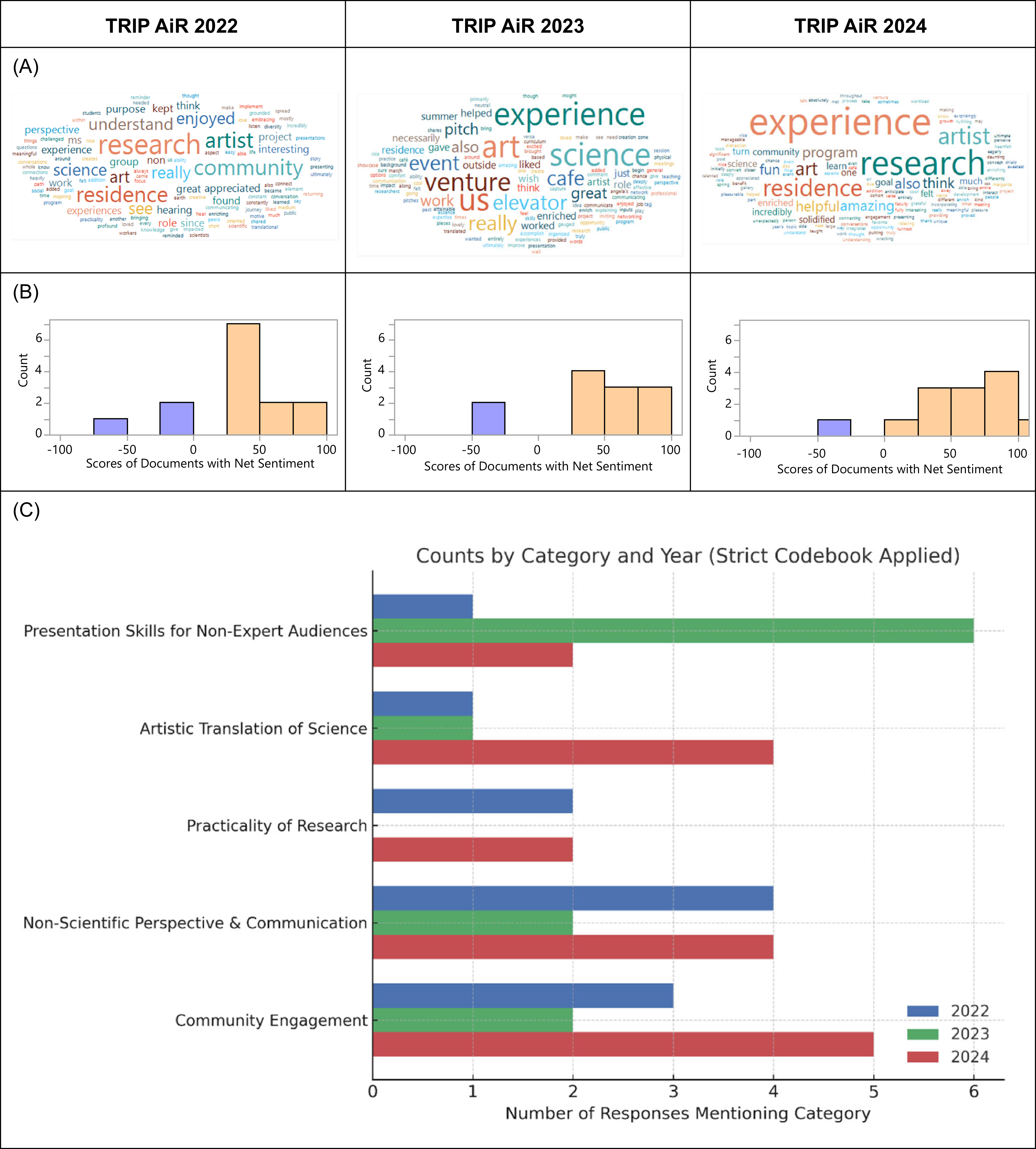
The students’ free-text survey statements (described as documents in Figure 1), prompted by the question “Please describe how the Artist in Residence enriched/did not enrich your experience here.,” mainly centered around “community,” “research,” “science,” and “art” as summarized in the word clouds (Figure 1 A). Importantly, “experience” emerged as a term that progressively increased in frequency year-to-year to become the most frequent term in the last year. This finding may reflect the increasing collaborative and art-immersive character of the AiR program. We consider the increasing co-occurrence of “experience” with the high-frequency words “research” and “science” as intensified experiential learning linked to the internal changes of the program over the three years. Among students, the emotional tone quantified by a sentiment analysis (JMP® Pro 17.2.0) increased in net positive documents from a mean score of 44.5 in 2022 (11 documents), to 55.9 in 2023 (10 documents) reaching 63.1 in 2024 (12 documents) while net negative documents remained steady at −30 in 2022–2024 (Figure 1 B). The number of score documents (survey answers) were n = 14 in 2022, n = 12 in 2023 and n = 14 in 2024. The ChatGPT prompt (GPT 5.1 Edu model, OpenAI) regarding how to thematically analyze the survey data suggested that while community engagement and presentation skills for non-expert audiences was of similar importance year to year, the artistic translation of science came into focus during the third year of the pilot phase (Figure 1 C).
Qualitative and quantitative analysis results. Building a framework to measure outcomes for the immersive artist-in-residency program. (A) Word clouds generated from free-text survey statements (11 documents in 2022, 10 in 2023, and 12 in 2024) prompted by the question “Please describe how the Artist in Residence enriched/did not enrich your experience here” using JMP® Pro 17.2.0. with syncategorematic words removed and centered layout and arbitrary colors as settings (B) its emotional tone quantified by sentiment analysis (JMP® Pro 17.2.0). (C) (D) Survey data summarized as thematic bar chart by ChatGPT Edu (GPT 5.1 model, OpenAI).

A longitudinal follow-up among students has not been conducted. However, during the TRIP experience, students commonly expressed initial uncertainty regarding their ability to use artistic approaches to communicate scientific research. Over the course of the program, students demonstrated increased confidence and facility in using visual and narrative strategies to explain their work. Through public presentation of their artistic outputs, students employed storytelling, metaphor, and visual representation to describe complex research concepts. While these approaches fall outside conventional scientific communication training, they appeared to support students’ ability to articulate their research to non-specialist audiences. Early exposure to arts-based communication may provide students with additional tools for research translation that could complement traditional scientific dissemination practices.
All three artists strongly agreed that the residency was effective at providing opportunities to learn and grow in the art and science space. This was described as a front row seat facilitating access to research, scientists, and fellow artists. Furthermore, two out of three artists strongly agreed that their participation led to new artistic paths that they would not have pursued without participating, while one artist somewhat agreed to this statement. The new artistic paths were described, for example, as bridging disciplines in a more intentional and innovative way as well as strengthening confidence and expanding the artist’s vision.
Science and art amplify each other
The iterative nature of our approach positioned us to define the mission of the AiR by four foundational objectives:
-
1. Teach undergraduate health science professional students how to apply creative practices in communicating research;
-
2. Engage the broader public by translating science through creative engagement;
-
3. Expand the reach of scientific knowledge beyond academic settings; and
-
4. Foster public trust in science through accessible, human-centered storytelling.
The stepwise implementation of AiR elucidated several elements of its success. At first, the TRIP environment was conditioned to welcome the artist, to enable the artist’s exposure to science, and to define data collection instruments for the artist to inform artwork and method of community engagement. During this process, we observed that art and science formed a new communication framework between TRIP students, ITMAT faculty/staff and the public by leveling the playing field. Art interpreted science in ways novel to scientists. Most importantly, the initiative has created “beneficial friction,” which we define as a productive tension that encouraged scientists and artists to step outside their disciplinary comfort zones. The public has responded positively to these interdisciplinary collaborations, rewarding scientists’ efforts to communicate through artistic media with meaningful engagement and dialog. A frequent observation has been that during the public-facing events, audience members asked questions framed through their specific, often very personal, experience with the students’ clinical translational research project such as therapeutic advances for transcranial magnetic stimulation (TMS) in treatment-resistant forms of major depressive disorders. This beneficial friction has proven instrumental in dissolving communication barriers, enabling scientists to move beyond jargon-heavy, data-driven narratives and adopt more accessible, human-centered modes of expression. Consequently, we posit that art becomes a new vocabulary for TRIP students to communicate science to the public through nuanced creative interpretations of translational science that build emotional connections. This builds on the power of communicating science through a narrative approach as described earlier [Reference Downs10], and serves the necessity defined by Gilliland CT et al. that one of the fundamental character traits of a translational scientists needs to be a “Skilled Communicator,” who “communicates with understanding with all stakeholders in the translational process across diverse social, cultural, economic and scientific backgrounds, including patients and community members” [Reference Gilliland, White and Gee11].
Our approach creates a model of scientific knowledge transfer scaled to reach a broad audience. This directly caters to building up “Community Engagement” as one of the 14 clinical and translational research competency areas [Reference Faupel-Badger, Vogel, Austin and Rutter12]. As outlined in Figure 2, TRIP-AiR guides undergraduate students to transform their hands-on mentored research projects into artwork for subsequent leverage to share this experience with their respective communities. We hypothesize that this amplifies the scientific knowledge transfer substantially in numbers and perspectives through the students’ professional and private networks in addition to the knowledge transfer initiated by the artist’s professional and private networks.
Innovating science communication through art. The 2024 cohort of undergraduate students transformed their hands-on clinical translational research projects onto bisque-fired ceramic “shields,” convex ceramic sculptures hung on the wall designed and built by the artist-in-residence (M.H.), in a multi-step process consisting of conceptualizing the science to art translation, painting the shield first with underglaze and after drying with clear glaze, followed by a second firing in M.H.’s kilns, then applying gold, silver, and mother of pearl luster to highlight details with an iridescent effect, followed by a third and final firing in M.H.’s kilns. M.H. guided undergraduate students and mentors through this process by discussing techniques, offering suggestions, and giving actionable feedback. The six shields at the top depict clinical translational research projects in brain and mental health. Here, a student’s shield (Healing Waves) was complemented by the mentor’s shield (The Energy We Receive), addressing research on transcranial magnetic stimulation (TMS). The four shields on the left represent organ health and the four on the right cover aspects of cell biology. Please see the more detailed descriptions in the supplementary material 2 and supplementary material 3, which include additional shields by mentoring staff and faculty. M.H. created her own shield entitled Infinite Healing (bottom right) based on her 2024 and 2025 experience as AiR (M.H. returned in 2025 for a second year as AiR). The artists-in-residence in 2022 (J.R.) and 2023 (A.M.) transferred shared experiences between artists and scientists into communities through a public art exhibition (bottom left and center). The model in 2024 amplified the knowledge transfer into the communities by engaging the students (including mentors) to transform their clinical translational science project into artwork and communicate about brain, mental and organ health and aspects of cell biology in a public forum, modeled after an artist’s critique. Students described their ceramic shields and corresponding research projects while engaging in audience Q&A. Many audience members connected the artwork to their own experiences, prompting questions about the research areas represented. This exchange illustrates how translating science into art fosters dialog, personal connection, and unifying human understanding, which are key elements for building trust in science.

We recognize the following determinants for the successful implementation of our AiR program include:
-
Communicating to students the value of science communication skills in a novel way and that this skillset improves the likelihood of success in their professional careers;
-
Attract artists with an exceptional expertise in art, teaching, and community engagement who will help students view their research from a new perspective;
-
Select artists who stand out through their seniority and have a different set of perspectives and expertise;
-
Embed artists within the program by facilitating interaction with students in the classroom, enabling visits to the mentor’s laboratory to witness the hands-on research activities of the students;
-
Pair the immersive, hands-on clinical translational research project with an immersive hands-on creative experience;
-
Communicate the AiR program to the mentoring team and solicit their active participation;
-
Provide students the opportunity to communicate their science to the broader community through a facilitated public forum; and
-
Manage expectations to
-
○ obtain buy-in from department/center/institute,
-
○ monitor carefully the bandwidth for faculty/staff/students and adjust accordingly, e.g. logistics around organizing public events,
-
○ offer financial incentives for artist,
-
○ condition students to welcome the opportunity to try something novel while balancing program requirements and deadlines.
-
The conceptual novelty of our approach is the inclusive artistic experience of our health professional undergraduate students and its scalability to inspire a generational change within the CTS workforce. By integrating artistic practice into the daily fabric of translational research education, the program has established a platform for scientists and artists to co-create new forms of scientific storytelling. This substantially extends the format of other science-art residencies, which commonly offer the immersive experience only to the artist visiting a research laboratory, creating science-based artwork, and showcasing this to the public for engagement [Reference Lau, Barriault and Krolik13].
Conclusion
The ITMAT TRIP art-science initiative demonstrates how integrating creative practice into CTS education strengthens science communication by humanizing complex research, building trust with broader communities, and fostering more accessible, relatable scientific storytelling. By equipping students with creative tools and fostering interdisciplinary collaboration, the initiative demonstrates that art is not merely an outreach tool but a transformative mechanism capable of reshaping the way scientific knowledge is shared, understood, and valued within society.
As the CTSA network seeks scalable innovations to strengthen the national translational research infrastructure, this program offers a compelling model for integrating workforce development, public engagement, and trust-building strategies. We provide a toolkit for guidance in Supplementary Material 1. The sustained evolution of the initiative, from proof-of-concept to formal program components and planned national dissemination, highlights its adaptability and potential for replication at other CTSA hubs.
Supplementary material
The supplementary material for this article can be found at https://doi.org/10.1017/cts.2026.10240.
Acknowledgements
We thank the undergraduate students, artists-in-residence, faculty mentors, and ITMAT Education staff for their ongoing contributions to this program’s development and success. The artists-in-residence can be contacted through their websites: https://www.julierainbow.com/, https://angelamcquillan.com/, and https://www.margueritahagan.com/. The following undergraduate students and mentors participated in TRIP 2022: Caelin Foley, Bryn Mawr College; SeKai Parker, Spelman College; Catherine Chang, University of Pennsylvania; David Song, University of Pennsylvania; Evan Bradley, Xavier University of Louisiana; Elaine Kim, Swarthmore College; Shriya Sai Shivakumar, Bryn Mawr College; Arianna Chipp, Howard University; Coral Castro Rivera, University of Puerto Rico; Kalida Gawon, Franklin and Marshall College; Laila Muhammad, Howard University; Harmandeep Singh, Franklin and Marshall College; Erin Nesmith, Florida A&M University; Sarina Smith, Haverford College; Makenzi Cole, Xavier University of Louisiana; and Reed Rankin, Lincoln University; TRIP 2023: Ummayh Siddiqua, University of Pennsylvania; Mary Zhou, Haverford College; Benjamin Schmidt, Franklin and Marshall College; Renthony Wilson, Xavier University of Louisiana; Sarah Ramirez, Bryn Mawr College; Jory Hirshman, University of Pennsylvania; Jackson Milone, Franklin and Marshall College; Kevin Villafane, Haverford College; Carlos Ayarza, University of Puerto Rico; Steven “Star” Niu, Swarthmore College; Tymir Parks, Florida A&M University; Aravind Krishnan, University of Pennsylvania; and Azariah Wise, Spelman College; TRIP 2024: Colin DeLaney, Swarthmore College; Saige Goodman, Spelman College; Eliana Dellinger, Swarthmore College; Laila Flores, Xavier University of Louisiana; Karrington Johnson, Spelman College; Liah Perez, Franklin and Marshall College; Ashrith Kandula, Haverford College; Sneha Chandrashekar, University of Pennsylvania; Ayooluwa Akinkunmi, Haverford College; Andrew Neff, Franklin and Marshall College; Chinwekele Uzoije, Howard University; Gabrielle Leahr, Florida A&M University; Kareena Shankta, University of Pennsylvania; and Razan Hammad, Xavier University of Louisiana. We thank Arjun Sengupta, PhD, Nadim El Jamal, MD, and Ronan Lordan, PhD for their support. We thank the following scientists for contributing their artwork to the 2024 art exhibit at The Arts League, Philadelphia, PA: Rick Bushman, PhD, J. Yasha Kresh, MB, PhD, FACC, FAHA, Manuel La Torre Poueymioru (TRIP 2018 alumni, University of Puerto Rico Bayamon), Yuying Rong (TRIP 2020 alumni, Haverford College), and Arjun Sengupta, PhD. CS thanks specifically Elizabeth Bergeland, https://www.elizabethbergeland.com/, John McInerney, Executive Director, and Chloe Reison, Associate Director, from The Sachs Program for Arts Innovation, https://sachsarts.org/, and Benjamin Doranz, PhD, MBA from integral molecular, https://www.integralmolecular.com/, and Narendra Chirmule, PhD for inspirational discussions during the conceptual phase for the AiR program as well as Karen Ploucquet, Ian Ploucquet, and Sylvie Ploucquet for their continued support and participation. Georgena Senior, https://georgenasenior.com/Home-Set, and Sofia Sierra https://www.sofiasierraartist.com/ supported shield painting sessions and graphic design for public engagement events. Students’ shield artwork is displayed at the Instagram handle @PENN_ITMAT. CS is the Robert L McNeil Jr. Fellow in Translational Medicine and Therapeutics. This work has been shared in part as poster presentation titled “Art as a Multiplier of Science Communication” at the ACTS meeting April 3–5, 2024 Las Vegas, NV; as Invited Seminar Talk, October 30, 2024, Translational Research Institute, University of Arkansas for Medical Sciences (UAMS).
Author contributions
Jessica German: Investigation, Project administration, and Writing – review and editing; Colleen Itani: Investigation, Project administration, and Writing – review and editing; Julie Rainbow: Investigation and Writing – review and editing; Angela McQuillan: Investigation and Writing – review and editing; Marguerita Hagan: Investigation and Writing – review and editing; Emma A. Meagher: Funding acquisition, Methodology, and Writing – review and editing; Carsten Skarke: Conceptualization, Data curation, Formal analysis, Funding acquisition, Investigation, Methodology, Project administration, Resources, Supervision, Validation, Visualization, Writing – original draft, and Writing – review and editing.
Funding statement
Funding for TRIP is provided by ITMAT and the NIH CTSA 5UL1TR001878-08 and for AiR by ITMAT.
Competing interests
The authors declare no conflicts of interest.
Recognition
This work was presented at the 2024 Fall CTSA Program Annual Meeting, Nov 14–15, 2024, as a poster entitled “Enhancing Knowledge Transfer through Art: An Artist-in-Residency Program to Develop a Model for Clinical Translational Science to Multiply Science Communication through a Science-Art-Public Partnership,” where it received the poster award “Best in Show.”


 Open access

