

Leah Ward Sears was the first Black woman to serve on the Georgia Supreme Court. Though Georgia selects justices via non-partisan elections, Sears was initially appointed by Governor Zell Miller to complete an unexpired term. She subsequently won reelection three times and served as chief justice. Often at odds with her colleagues on questions of criminal justice (Davis Reference Davis2017), Chief Justice Sears certainly impacted Georgia case law and helped usher in greater diversity on both the bench and in the chief justiceship nationwide (e.g., Szmer, Christensen, and Kaheny Reference Szmer, Christensen and Kaheny2015; Wilhelm et al. Reference Wilhelm, Vining, Hughes and González2024). Yet, her presence on the court at all arguably came down to Governor Miller’s decision to appoint her (e.g., Graham Reference Graham1990; Holman and Schneider Reference Holman and Schneider2018; Holmes and Emrey Reference Holmes and Emrey2006). While it is counterfactual to speculate if Sears would have run for office absent Miller’s appointment, her story raises questions about the substantive impact of non-traditional jurists (e.g., Hurwitz and Lanier Reference Hurwitz and Lanier2001; Kang et al. Reference Kang, Kittilson, Hoekstra and Escobar-Lemmon2020; Scherer and Curry Reference Scherer and Curry2010)Footnote 1 and the conditions under which they take the bench (e.g., Bratton and Spill Reference Bratton and Spill2002; Golezhauser Reference Goelzhauser2011).
Diversifying state supreme courts brings many normative benefits, not the least of which is increased legitimacy (e.g., Pitkin Reference Pitkin1967). Descriptively representative institutions are viewed more favorably and are more likely to have their decisions accepted (see, for instance, Achury et al. Reference Achury, Casellas, Hofer and Ward2022; Mansbridge Reference Mansbridge1999; Scherer and Curry Reference Scherer and Curry2010). Moreover, descriptive representation often precedes substantive representation, which brings new perspectives to the decision-making process and can prompt substantively different outcomes under some conditions (see, for instance, Leonard and Ross Reference Leonard and Ross2015; Moyer et al. Reference Moyer, Szmer, Haire and Christensen2021; Songer, Davis, and Haire Reference Songer, Davis and Haire1994). Though both descriptive and substantive representation are important for any institution (e.g., Badas and Stauffer Reference Badas and Stauffer2019; Bobo and Gilliam Reference Bobo and Gilliam1990; Campbell and Wohlbrecht Reference Campbell and Wohlbrecht2006), they take on especial meaning in state courts, which have a more direct impact on most Americans’ daily lives than federal courts because of both the volume and scope of decisions (Gibson and Nelson Reference Gibson and Nelson2021; Hernandez and Navarro Reference Hernandez and Navarro2019; Walker and Barrow Reference Walker and Barrow1985). Particularly, since legitimacy is not monolithic across sub-populations (Achury et al. Reference Achury, Casellas, Hofer and Ward2022; Evans et al. Reference Evans, Ana Franco, Wenzel and Wrinkle2017; Means and Unah Reference Means and Unah2025; Scherer and Curry Reference Scherer and Curry2010) and the United States is increasingly diverse (Merriman, Isozaki, and Bannon Reference Merriman, Isozaki and Bannon2024), it is critical scholars understand how courts diversify across multiple identity axes (e.g., Alozie Reference Alozie and Persons1999). It is also important to recall diversification varies by political and institutional context and the time and the identity in question.
Diversifying the bench necessarily requires exploring judicial selection (Golezhauser Reference Goelzhauser2011; Hurwitz and Lanier Reference Hurwitz and Lanier2001). Though no single system privileges or disadvantages non-traditional candidates, women and racial minorities are often less likely to seek office. When they do run in states utilizing judicial elections, they face particular difficulty (Eugenis Reference Eugenis2021; Nguyen Reference Nguyen2019). Consequently, initial diversification in electoral states often happens via gubernatorial appointment to unexpired terms (Bratton and Spill Reference Bratton and Spill2002; Hurwitz and Lanier Reference Hurwitz and Lanier2008). The question then becomes under which conditions do governors choose to appoint non-traditional jurists to the bench?
Leveraging recent patterns in judicial diversification on multiple axes (Goelzhauser Reference Goelzhauser2018a; Reference Goelzhauser, Solberg and Waltenburg2024), we analyze how non-traditional jurists initially reach the bench on elected state supreme courts from 1980 to 2023. Recognizing gubernatorial appointments are the primary way institutions diversify and that they are a function of political and institutional context (Golezhauser Reference Goelzhauser2011; Rhinehart and Geras Reference Rhinehart and Geras2020), we pay particular attention to the conditions under which governors make appointments (e.g., Holmes and Emrey Reference Holmes and Emrey2006). Utilizing scholarship on gubernatorial appointments broadly, we contend Democratic governors are more likely to appoint non-traditional jurists, particularly when their choice is institutionally unconstrained. Moreover, shifting political context may alter the propensity for a jurist from a given background to be appointed or elected (e.g., Bratton and Spill Reference Bratton and Spill2002; Hurwitz and Lanier Reference Hurwitz and Lanier2008). We find support for our expectations.
The diversification of the bench
The benefits of judicial diversification can only be realized after jurists take the bench. Thus, it is important to explore how jurists reach state supreme courts. While no selection system inherently privileges non-traditional candidates more so than any other (Alozie Reference Alozie1996; Hurwitz and Lanier Reference Hurwitz and Lanier2001), non-traditional candidates across a range of institutions are less likely to run save for particular conditions (e.g., Anzia and Berry Reference Anzia and Berry2011; Gordon Reference Gordon2016; Holman and Schneider Reference Holman and Schneider2018; Rhinehart and Geras Reference Rhinehart and Geras2020). Consequently, non-traditional candidates often initially take office via gubernatorial appointment. Indeed, interim appointments are exceptionally common in electoral states (Gibson and Nelson Reference Gibson and Nelson2021). These appointments provide governors a chance to shape the bench to their policy preferences (Reddick, Nelson, and Caufield Reference Reddick, Nelson and Caufield2009; Vining, Bullock, and Boldt Reference Vining, Bullock and Boldt2023).
Governors’ opportunity to appoint officials, judicial or otherwise, is inherently political (Cooper, Knotts, and Ragusa Reference Cooper, Knotts and Ragusa2016; Vining, Bullock, and Boldt Reference Vining, Bullock and Boldt2023). While this clearly extends to entrenching policy preferences on the bench, there are also other political benefits to appointing non-traditional jurists (Bratton and Spill Reference Bratton and Spill2002). Surprisingly, there is relatively little work on gubernatorial appointments generally (Bernick Reference Bernick2016; Riccucci and Saidel Reference Riccucci and Saidel2001), but existing work suggests gubernatorial appointments are a function of partisanship, institutional constraints, and time.
Democrats often place a higher premium on diversity than Republicans (e.g., Grossmann and Hopkins Reference Grossmann and Hopkins2015; Solberg and Diascro Reference Solberg and Diascro2020). We expect Democratic governors to be more likely to appoint non-traditional jurists (e.g., King, Schoenherr, and Ostrander Reference King, Schoenherr and Ostrander2025; Reddick, Nelson, and Caufield Reference Reddick, Nelson and Caufield2009). However, institutional context limits who governors, regardless of party, can appoint. While some governors enjoy unrestricted choice in nominations, others are constrained by a system not unlike merit selection wherein the governor chooses from a committee-supplied shortlist often lacking diversity (e.g., Golezhauser Reference Goelzhauser2011). Accordingly, we argue Democratic governors are more likely to appoint non-traditional jurists when unconstrained. Also, the relative value of a non-traditional appointment for a governor varies by time and type of diversity (Alozie Reference Alozie1996; Cooper, Knotts, and Ragusa Reference Cooper, Knotts and Ragusa2016; Holmes and Emrey Reference Holmes and Emrey2006; Hurwitz and Lanier Reference Hurwitz and Lanier2003). So, an explanation for women taking the bench does not necessarily translate to one for racial minorities (Martin and Pyle Reference Martin and Pyle2002), while there may have been political benefits to appoint women in 1983, that may not be true in 2023 (e.g., Bratton and Spill Reference Bratton and Spill2002; Kennedy, Nelson, and Heidt-Forsythe Reference Kennedy, Nelson and Heidt-Forsythe2025). We now turn to a more detailed account of our expectations.
The appointment calculus
Appointment is one of the most powerful tools at the governor’s disposal; however, it is understudied in general (Bernick Reference Bernick2016). These appointments, along with their federal counterparts made by the president (Abraham Reference Abraham2008), have a particularly profound impact on the relative diversity of government institutions (e.g., Baker et al. Reference Baker, Boyd, González, Pennington, Michael and Montgomery2024; Dolan Reference Dolan2001; Johnson Reference Johnson2021; Rhinehart and Geras Reference Rhinehart and Geras2020). This has been particularly true since President Carter’s push to diversify the federal judiciary in the 1970s (Haire and Moyer Reference Haire and Moyer2015; Solberg and Diascro Reference Solberg and Diascro2020). While states have also diversified, it is uneven (Goelzhauser Reference Goelzhauser, Solberg and Waltenburg2024). As of 2023, 19 states had no persons of color on their apex courts. Five states had just one female justice. Twenty-five states lack any women of color (Merriman, Isozaki, and Bannon Reference Merriman, Isozaki and Bannon2024). We contend the extent to which governors appoint non-traditional jurists can be explained by the interplay of political and institutional factors (e.g., Golezhauser Reference Goelzhauser2011).
Despite a myriad of judicial selection methods, states generally utilize election, merit selection, or appointment (Goelzhauser Reference Goelzhauser2018a).Footnote 2 While no single method is ideal for diversification (Alozie Reference Alozie1996; Hurwitz and Lanier Reference Hurwitz and Lanier2003), in the 22 states utilizing judicial elections, women are less likely to run for office than their male counterparts (Nguyen Reference Nguyen2019). While voters are not biased against female judicial candidates (Kennedy, Nelson, and Heidt-Forsythe Reference Kennedy, Nelson and Heidt-Forsythe2025), women face more primary challengers than men (Eugenis Reference Eugenis2021) and require more encouragement to run for office or apply for prestigious positions even when qualified (Anzia and Berry Reference Anzia and Berry2011; Badas and Stauffer Reference Badas and Stauffer2023).Footnote 3 Racial minorities have more difficulty winning statewide races (Rhinehart and Geras Reference Rhinehart and Geras2020), which is how a majority of state supreme court races are conducted.Footnote 4 This collectively suggests non-traditional jurists should be less likely to take the bench in electoral states; yet many still do. Much as in the diversification of state-level executive agencies, this often occurs via gubernatorial appointment (Rhinehart, Geras, and Hayden Reference Rhinehart, Geras and Hayden2021).
Appointment systems seemingly mirror the federal system. In general, the governor selects a nominee subsequently confirmed by some body (e.g., the state senate). Research on the federal model notes diversification may come down to the idiosyncrasies of the appointing president (Solberg and Diascro Reference Solberg and Diascro2020). In shifting to the state level, the limited scholarship on other gubernatorial appointments is instructive. This research notes governors often appoint those who share broader ideological goals (Riccucci and Saidel Reference Riccucci and Saidel2001). Moreover, governors are often strategic in appointments to enhance their own future political goals (Cooper, Knotts, and Ragusa Reference Cooper, Knotts and Ragusa2016). We now extend this logic to the courts.
Since judicial appointment systems are nominally only used by a handful of states (Goelzhauser Reference Goelzhauser2018a), they receive less scholarly attention than elections or merit selection. However, a variation of the appointment system is used extensively in electoral states to fill midterm vacancies (Reddick, Nelson, and Caufield Reference Reddick, Nelson and Caufield2009). Midterm vacancies are not rare; jurists may leave the bench to accept a federal judicial appointment or run for a higher state-level office (Gibson and Nelson Reference Gibson and Nelson2021). Additionally, jurists approaching mandatory retirement may strategically resign to allow an ideologically proximate governor to appoint a successor (Curry and Hurwitz Reference Curry and Hurwitz2016). This allows the appointee to run as an incumbent in the next election (Kritzer Reference Kritzer2015; Reference Kritzer2023; Lynch Reference Lynch2017).Footnote 5
Roughly half of all justices in electoral states are initially appointed (Kritzer Reference Kritzer2023); on some courts, the majority of jurists initially reach the bench this way (Gibson and Nelson Reference Gibson and Nelson2021).Footnote 6 Perhaps most pertinent for our purposes, appointments are frequently how benches initially diversify; non-traditional jurists are more likely to join courts via appointment, particularly when a court is either all White or all male (Holmes and Emrey Reference Holmes and Emrey2006). However, this propensity recedes after the initial appointment (Bratton and Spill Reference Bratton and Spill2002). Ultimately, interim appointments bypass non-traditional candidates’ lower propensity to seek office (e.g., Nguyen Reference Nguyen2019) and avoid the crowded primaries they often face (Eugenis Reference Eugenis2021). However, appointments depend on governors’ goals and the institutional contexts they face (Golezhauser Reference Goelzhauser2011; Vining, Bullock, and Boldt Reference Vining, Bullock and Boldt2023).
State supreme court appointments are inherently political (Vining, Bullock, and Boldt Reference Vining, Bullock and Boldt2023). So, it is important to ask what kinds of governors see political benefits in appointing non-traditional jurists. It is beneficial to look to literature on governors appointing other state officials and the president’s appointment of federal judges. Since at least the 1970s, Democrats and Republicans have viewed diversity differently (Wolbrecht Reference Wolbrecht2000). The Democratic Party is historically a coalition of identity groups and sees electoral and normative value in diversifying the bench (Bratton and Spill Reference Bratton and Spill2002; Grossmann and Hopkins Reference Grossmann and Hopkins2015). Republicans are more concerned with ideological purity.Footnote 7 This extends to the way Republican presidents increasingly rely on organizations like the Federalist Society to vet judicial nominees (Bird and McGee Reference Bird and McGee2023; Hollis-Brusky Reference Hollis-Brusky2014).
Critically, it is more difficult to predict non-traditional candidates’ ideological positions than “traditional” White male jurists (Hofer and Achury Reference Hofer and Achury2021). Moreover, conservatives are more likely to see non-traditional jurists as biased (Ono and Zilis Reference Ono and Zilis2022, Reference Ono and Zilis2023) and women broadly are often perceived as more liberal than men (Badas, Sanders, and Stauffer Reference Badas, Sanders and Stauffer2025; King and Matland Reference King and Matland2003). Given appointments allow governors the chance to credit claim (e.g., Valdini and Shortell Reference Valdini and Shortell2016), Democratic governors are more likely to appoint women and minorities across a range of offices than Republicans (Riccucci and Saidel Reference Riccucci and Saidel2001). Republicans likely see little utility in appointing candidates unattractive to their base (e.g., Kaslovsky, Rogowski, and Stone Reference Kaslovsky, Rogowski and Stone2021). To this end, Republican presidents often “anchor” diversity by only appointing non-traditional jurists to seats vacated by other non-traditional jurists. Democrats, however, tend to “expand” diversity by appointing non-traditional jurists to previously “traditional” seats (King, Schoenherr, and Ostrander Reference King, Schoenherr and Ostrander2025). Accordingly,
Hypothesis 1 Democratic governors are more likely to appoint non-traditional jurists than Republican governors.
Even if a governor wants to appoint a non-traditional jurist, as we argue Democratic governors do, institutional context may not allow it (e.g., Bratton and Spill Reference Bratton and Spill2002; Golezhauser Reference Goelzhauser2011; Hurwitz and Lanier Reference Hurwitz and Lanier2008). Just as states differ in selection mechanisms broadly, there is variation in how vacancies are filled. Though governors make the final decision on interim appointments in all electoral states save for three,Footnote 8 their choice set varies. Some governors are unrestrained and may nominate anyone they choose; others are restricted to a list furnished by a nominating commission. The latter is akin to merit selection (e.g., Goelzhauser Reference Goelzhauser2018a). Importantly, merit selection often disadvantages non-traditional potential nominees (Arrington Reference Arrington2021; Golezhauser Reference Goelzhauser2011; Graham Reference Graham1990).
In merit selection systems, women and racial minorities are less likely to be shortlisted by nominating commissions and are thus excluded from gubernatorial consideration (Golezhauser Reference Goelzhauser2011).Footnote 9 This is a function of the screening process; merit commissions, staffed by elites, are likely to value traits non-traditional candidates likely lack (Baker et al. Reference Baker, Boyd, Hickey and Rutkowski2024; Hurwitz and Lanier Reference Hurwitz and Lanier2008). Relatedly, diverse attorneys are often overlooked by elites for career opportunities, which makes them attractive judicial candidates later on (e.g., Badas, Sanders, and Stauffer Reference Badas, Sanders and Stauffer2025). In a sense, merit selection provides for “elite control” (Graham Reference Graham1990).Footnote 10 Consequently, those who do not fit the traditional image of a judge are less likely to be shortlisted.Footnote 11 When minorities do succeed, they must often have more qualifications than their similarly situated White and male colleagues (Anzia and Berry Reference Anzia and Berry2011; Haire and Moyer Reference Haire and Moyer2015; Moyer, Harris, and Solberg Reference Moyer, Harris and Solberg2022). Put more bluntly, nominating commissions serve as gatekeepers hindering diversification (e.g., Verba, Schlozman, and Brady Reference Verba, Schlozman and Brady1995). Accordingly,
Hypothesis 2 Democratic governors with unrestrained choices are more likely to appoint non-traditional jurists than those bound by nominating commissions.
Thus far, we have discussed non-traditional jurists collectively. But diversity is not monolithic (Holmes and Emrey Reference Holmes and Emrey2006; Martin and Pyle Reference Martin and Pyle2002). Judicial behavior varies across subpopulations (see, for instance, Hofer and Casellas Reference Hofer and Casellas2020; Songer, Davis, and Haire Reference Songer, Davis and Haire1994) as do the relative political benefits for governors appointing jurists with a given background at a particular time (see, for instance, Achury et al. Reference Achury, Casellas, Hofer and Ward2022; Evans et al. Reference Evans, Ana Franco, Wenzel and Wrinkle2017; Scherer and Curry Reference Scherer and Curry2010). To illustrate, women now make up just under half of all state supreme court justices (Merriman, Isozaki, and Bannon Reference Merriman, Isozaki and Bannon2024) and voters have no preference for male over female jurists (Kennedy, Nelson, and Heidt-Forsythe Reference Kennedy, Nelson and Heidt-Forsythe2025). This is not, however, true for racial minorities in non-judicial offices (Rhinehart and Geras Reference Rhinehart and Geras2020). Thus, the electoral advantage for appointing someone of a given background may wax and wane with time as governors see political benefit or liability in appointing non-traditional jurists (Bratton and Spill Reference Bratton and Spill2002; Holmes and Emrey Reference Holmes and Emrey2006; Nixon and Goss Reference Nixon and Goss2001).
Governors often find great utility in appointing non-traditional candidates to “be the first” of a given background on a court (Bratton and Spill Reference Bratton and Spill2002). This effect is enhanced in the aftermath of national political events drawing attention to judicial diversity (e.g., the appointment of Justices Sandra Day O’Connor and Clarence Thomas to the US Supreme Court) (Golezhauser Reference Goelzhauser2011). Once a given state bench initially diversifies, the relative value of appointing non-traditional candidates for governors lessens (Hurwitz and Lanier Reference Hurwitz and Lanier2003). While diverse identities of all kinds are certainly salient in America’s evolving political landscape, a subset of identities is increasingly consequential. For example, as more Hispanics join the bench, scholars gain a better understanding of their approach to decision-making and its consequences for legitimacy (Evans et al. Reference Evans, Ana Franco, Wenzel and Wrinkle2017; Hofer and Casellas Reference Hofer and Casellas2020). There is also growing awareness of intersectional identities (Collins and Moyer Reference Collins and Moyer2008; Kang et al. Reference Kang, Kittilson, Hoekstra and Escobar-Lemmon2020). Briefly, the experiences of intersectional people (e.g., Black women or Latinas) cannot simply be explained by one constituent identity in isolation or as an additive sum (Goelzhauser Reference Goelzhauser, Solberg and Waltenburg2024). Rather, intersectional identities lead to altogether unique approaches to decision-making (González, Fairbanks, and Gleason Reference González, Fairbanks, Gleason, Solberg and Waltenburg2024; Szmer, Christensen, and Kaheny Reference Szmer, Christensen and Kaheny2015).
While there is great value in understanding the experiences of intersectional persons in the legal profession (Collins, Dumas, and Moyer Reference Collins, Dumas and Moyer2017), this is historically difficult to explore at state supreme courts because intersectional jurists are “woefully underrepresented” in the legal profession broadly and on the bench specifically (Johnson Reference Johnson2021). In recent years, increased diversification across all levels of the judiciary makes it possible to explore the pathways intersectional jurists take to the bench (Goelzhauser Reference Goelzhauser, Solberg and Waltenburg2024; González, Fairbanks, and Gleason Reference González, Fairbanks, Gleason, Solberg and Waltenburg2024; Merriman, Isozaki, and Bannon Reference Merriman, Isozaki and Bannon2024). Accordingly, we expect to find the predictors of non-traditional jurists taking the bench to vary based on identity and time. Accordingly,
Hypothesis 3 The relative propensity for governors to appoint non-traditional jurists varies by time and jurist identity.
Data and methods
To test our expectations, we utilize Goelzhauser’s (Reference Goelzhauser2016) dataset of state supreme court justices and their backgrounds. We augment this with updates compiled by Merriman, Isozaki, and Bannon (Reference Merriman, Isozaki and Bannon2024) and our original updates to extend the data to 2023. Since non-traditional jurists were remarkably rare in the 1970s, we begin our analysis in 1980 (e.g., Haire and Moyer Reference Haire and Moyer2015). We limit our focus to the 19 state supreme courts utilizing either partisan or non-partisan elections in which the governor is empowered to fill vacancies and appointees can subsequently stand for election.Footnote 12 With the individual jurist as the unit of analysis, we have 535 observations from 1980 to 2023. Since we posit the political and institutional context is critical to appointments, we combine our justice-level data with governor demographics from when the vacancy occurred (Klarner Reference Klarner2013).Footnote 13
Since paths to the bench vary by demographic background (Holmes and Emrey Reference Holmes and Emrey2006; Hurwitz and Lanier Reference Hurwitz and Lanier2003; Martin and Pyle Reference Martin and Pyle2002), we utilize multiple dependent variables and models. Following the lead of prior work, our dependent variables measure whether a given jurist is White, Black, male, or female (Bratton and Spill Reference Bratton and Spill2002; Holmes and Emrey Reference Holmes and Emrey2006). We also note intersectional identities (White men, White women, Black men, intersectional women) (Collins and Moyer Reference Collins and Moyer2008; Szmer, Christensen, and Kaheny Reference Szmer, Christensen and Kaheny2015).Footnote 14 We create all of these measures using Goelzhauser’s (Reference Goelzhauser2016, Reference Goelzhauser, Solberg and Waltenburg2024) coding rules.Footnote 15
We evaluate Hypothesis 1 via two measures. First, we use a binary marker for justices initially taking the bench via interim appointment. In a similar manner, we note jurists joining the bench during a Democratic gubernatorial administration with a binary marker.Footnote 16 Since the hypothesis is conditional, we interact these two measures. We test Hypothesis 2 by noting states where governors have unrestrained choice in interim appointments with a binary marker (Golezhauser Reference Goelzhauser2011). We subsequently interact this with the Democratic governor measure. We test Hypothesis 3 by noting the year the jurist took the bench and interacting it with the initial appointment measure.
We include several control variables suggested by previous literature. State supreme courts vary in level of professionalism and thus relative prestige (Hurwitz and Lanier Reference Hurwitz and Lanier2003); we include state court professionalism (Squire and Butcher Reference Squire and Butcher2021).Footnote 17 More seats on a court create more opportunities for appointing non-traditional jurists (Golezhauser Reference Goelzhauser2011); we include the total number of seats on each court. Since non-traditional candidates are disadvantaged by partisan elections (Gibson and Nelson Reference Gibson and Nelson2021), we include a dichotomous measure noting states utilizing partisan, as opposed to non-partisan, elections. National events, such as the appointment of non-traditional jurists, increase the probability of state-level diverse appointments (see, for instance, Escobar-Lemmon et al. Reference Escobar-Lemmon, Hoekstra, Kang and Kittilson2021; Golezhauser Reference Goelzhauser2011). We include a series of binary markers set to “1” after a non-traditional jurist of a given identity has joined the US Supreme Court.Footnote 18
Since governors and other elites generally look for the typical markers of a “good” judge (Baker et al. Reference Baker, Boyd, Hickey and Rutkowski2024; Martin and Pyle Reference Martin and Pyle2002; Moyer, Harris, and Solberg Reference Moyer, Harris and Solberg2022), we include a series of binary measures noting whether the appointee previously served as a prosecutor or judge (Harris and Sen Reference Harris and Sen2026; Merriman, Isozaki, and Bannon Reference Merriman, Isozaki and Bannon2024). Because governors may face pressure to appoint non-traditional jurists to replace departing non-traditional jurists (King, Schoenherr, and Ostrander Reference King, Schoenherr and Ostrander2025), we include a binary marker noting whether the departing justice is non-traditional (Goelzhauser Reference Goelzhauser2016; Reference Goelzhauser, Solberg and Waltenburg2024).Footnote 19 Because there may be an in-group bias to appoint those who share a common identity (Riccucci and Saidel Reference Riccucci and Saidel2001), we include a binary marker noting whether the governor is female for the female, White female, and intersectional models.Footnote 20 Finally, since there is increased pressure and electoral benefit to appoint the first jurist from a given group (Bratton and Spill Reference Bratton and Spill2002; Holmes and Emrey Reference Holmes and Emrey2006), we include a dichotomous marker noting whether a member of a given group has previously served on a given court.Footnote 21
Since our dependent variables are dichotomous, we utilize logistic regression. To account for state-level idiosyncrasies (e.g., Kritzer Reference Kritzer2015), we cluster standard errors on the court.
Results
We find support for our expectations. The predictors for interim appointment vary by jurist identity. In general, Democratic governors are more likely to appoint some minority groups. Though this is dependent on the institutional context, Democratic governors are more likely to appoint non-traditional jurists when unconstrained. Additionally, the propensity for any group to be more likely appointed by governors waxes and wanes with time. Before turning to our predictive results, we explore descriptive statistics.
Descriptive results
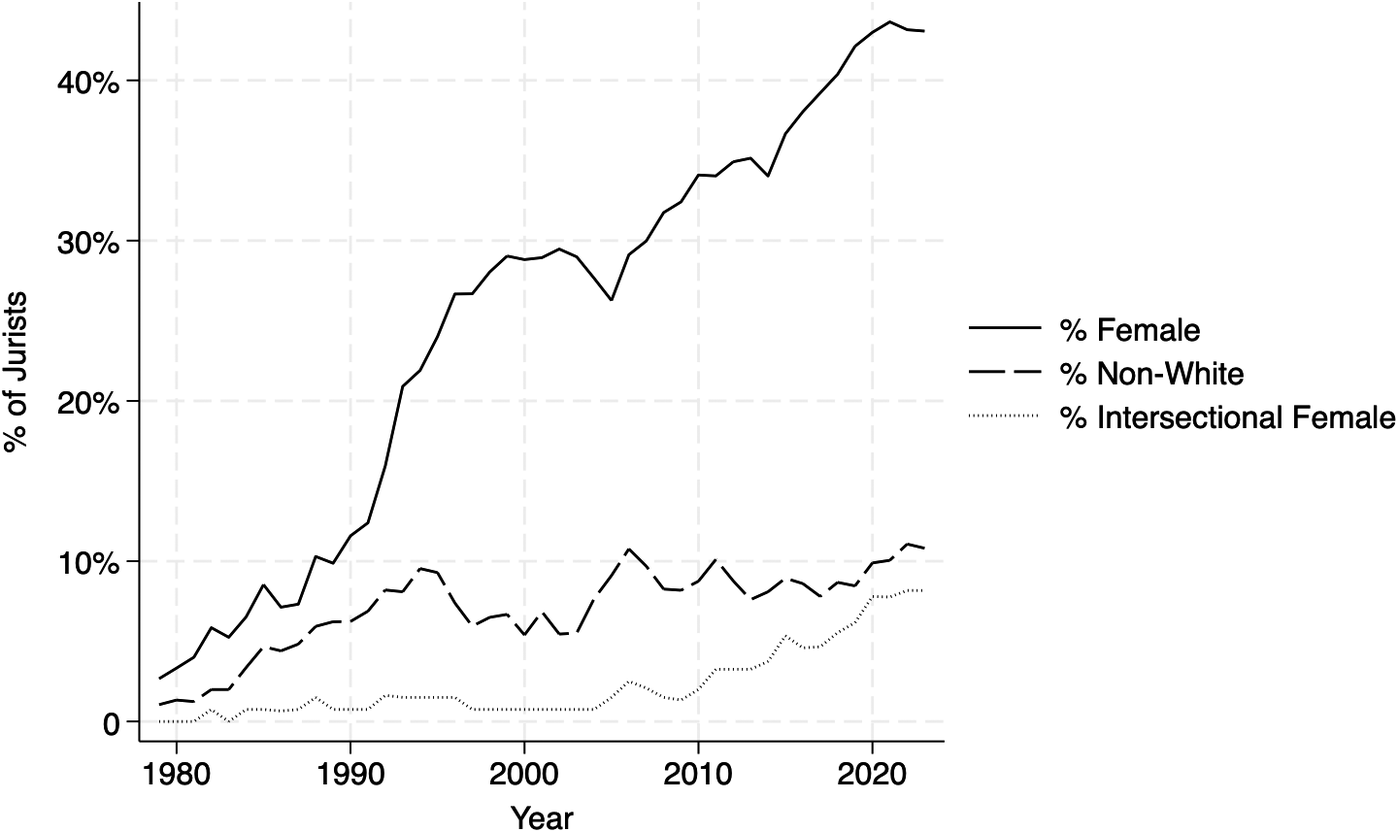
In recent years, state supreme courts have become increasingly diverse. Figure 1 shows the average number of non-traditional jurists on state supreme courts in electoral states from 1979 to 2023. The solid line depicts the average percentage of female jurists. The long-dashed line shows non-White jurists, and the short-dashed line displays intersectional female jurists. Throughout the early 1980s, women made up less than 5% of all jurists on state supreme courts. Their numbers grew gradually at first, reaching 10% by the late 1980s. In the 1990s and early 2000s, women’s presence increased rapidly (save for periodic dips notably in the mid-2000s). By 2023, women held over 40% of all seats. Non-White and intersectional female jurists have grown more slowly. In the early 1980s, both comprised a remarkably small portion of jurists on state supreme courts. Non-White jurists grew steadily from the mid-1980s to the mid-1990s before dipping throughout the latter half of the 1990s. By 2023, non-Whites make up just over 10% of jurists. Intersectional jurists remain quite rare, only reaching 5% by the mid-2010s. By 2023, they remain less than 10%.Footnote 22
Percentage of non-traditional jurists on state supreme courts in electoral states, 1979 to 2023.

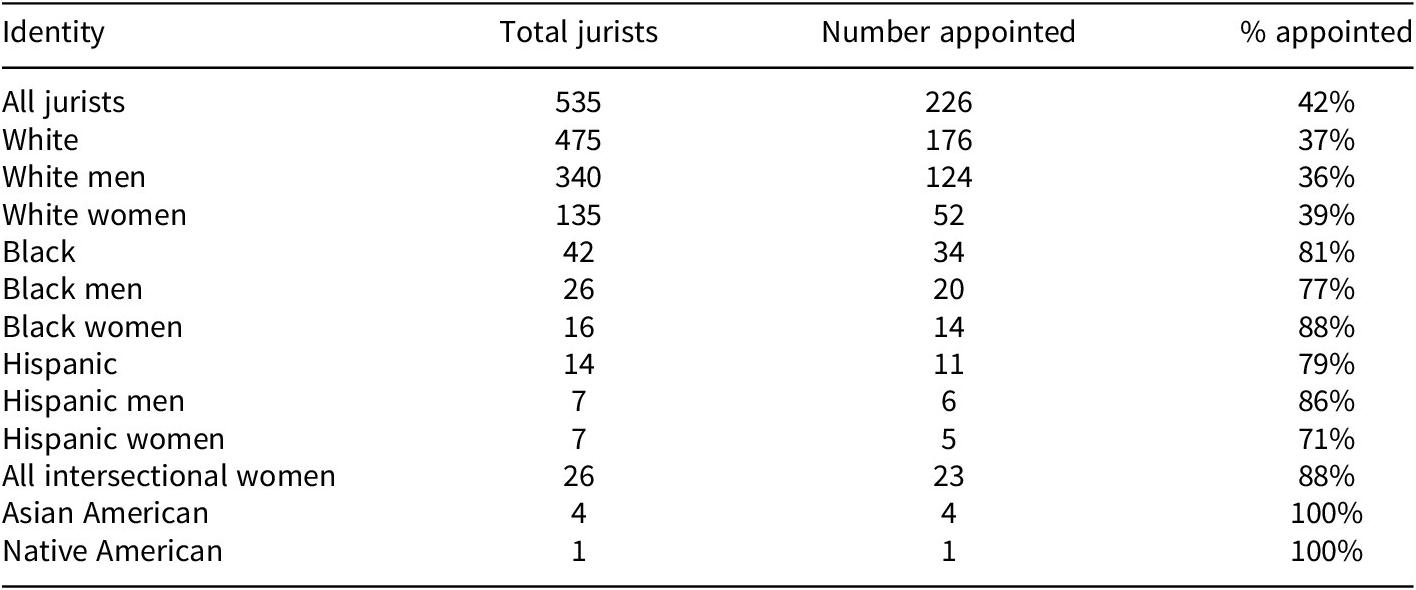
It is also important to note how non-traditional jurists reach the bench. Table 1 shows the total number of jurists by demographic background and the paths taken to state supreme courts in electoral states. We also include groups we are unable to examine in the predictive models such as Hispanics, Hispanic men, Hispanic women, Black women, Asian Americans, and Native Americans. Just over 40% of justices took the bench via interim gubernatorial appointment (see also Gibson and Nelson Reference Gibson and Nelson2021), but these numbers vary considerably by identity. Only 37% of Whites (both men and women combined) are appointed. Women, White men, and White women closely mirror these percentages. However, rates of gubernatorial appointment increase substantially for racial minorities.
State supreme court jurists by initial path to bench

Note: We only include jurists from the courts included in our analysis.
About 80% of Black state supreme court jurists are initially appointed by the governor. While 77% of Black men are appointed, almost 90% of Black women are. Shifting our focus to Hispanic jurists, we note the opposite pattern. As a whole, 79% of Hispanic jurists are appointed. While 86% of Hispanic men are appointed, just 71% of Hispanic women are. 89% of intersectional women (women of color) are appointed. Turning focus to Asian Americans and Native Americans, we note all of these jurists are initially appointed. This is likely a function of their low numbers on state supreme court benches overall.
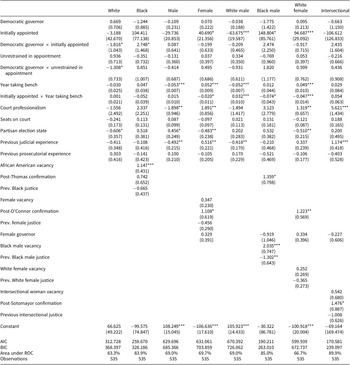
Our predictive models appear in Table 2. At first glance, they appear underwhelming; the Democratic governor and institutional constraints measures are never significant. The initially appointed and year measures are only significant in about half of the models. However, our hypotheses are conditional. Accordingly, we cannot assess them like traditional additive terms. Rather, both constituent terms must simultaneously vary for evaluation. This is best accomplished graphically (Brambor, Clark, and Golder Reference Brambor, Clark and Golder2006).Footnote 23
Predictors of state supreme court justices taking bench
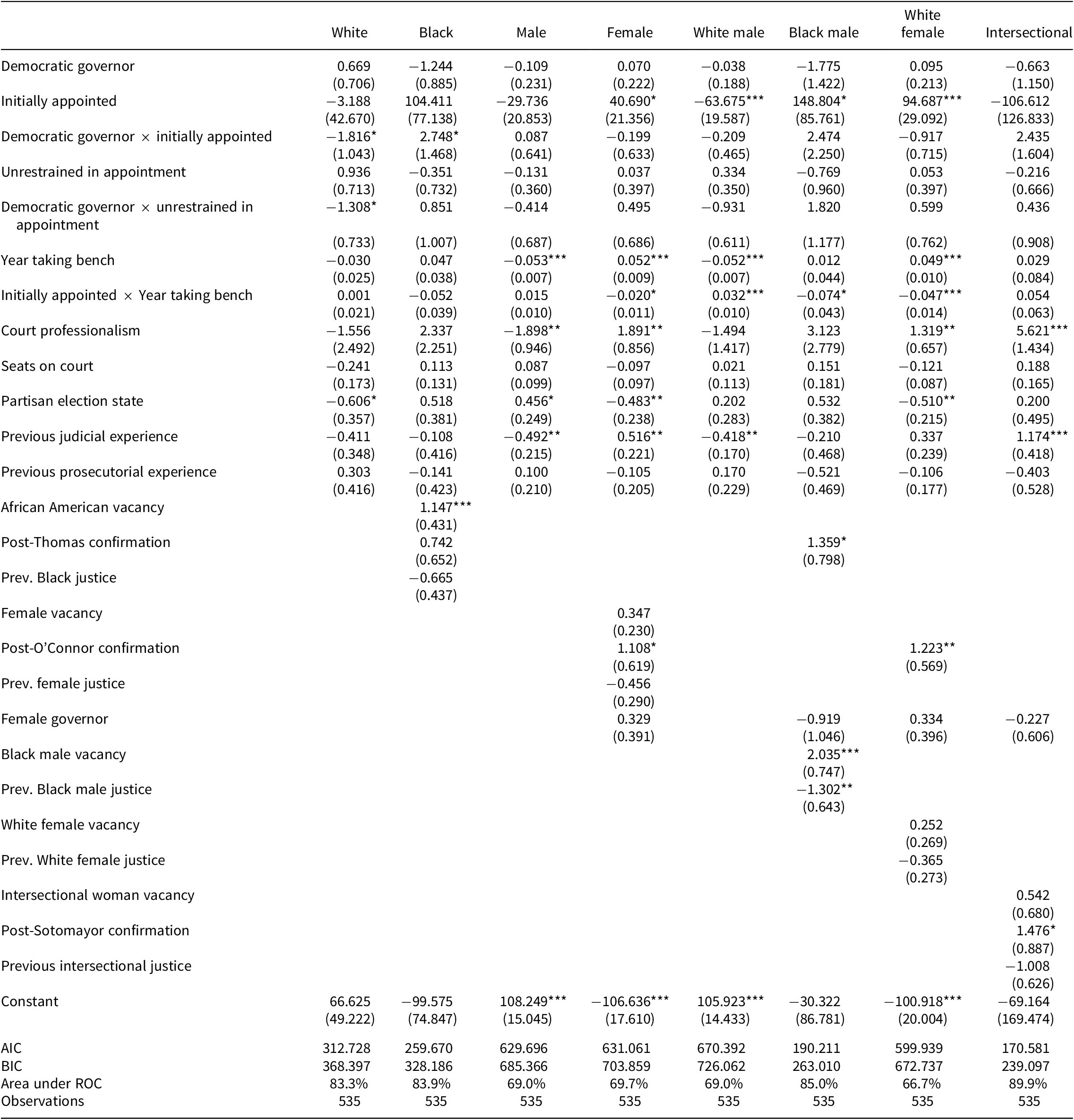
Note: Standard errors in parentheses clustered on court. *p < 0.10, **p < 0.05, ***p < 0.01.
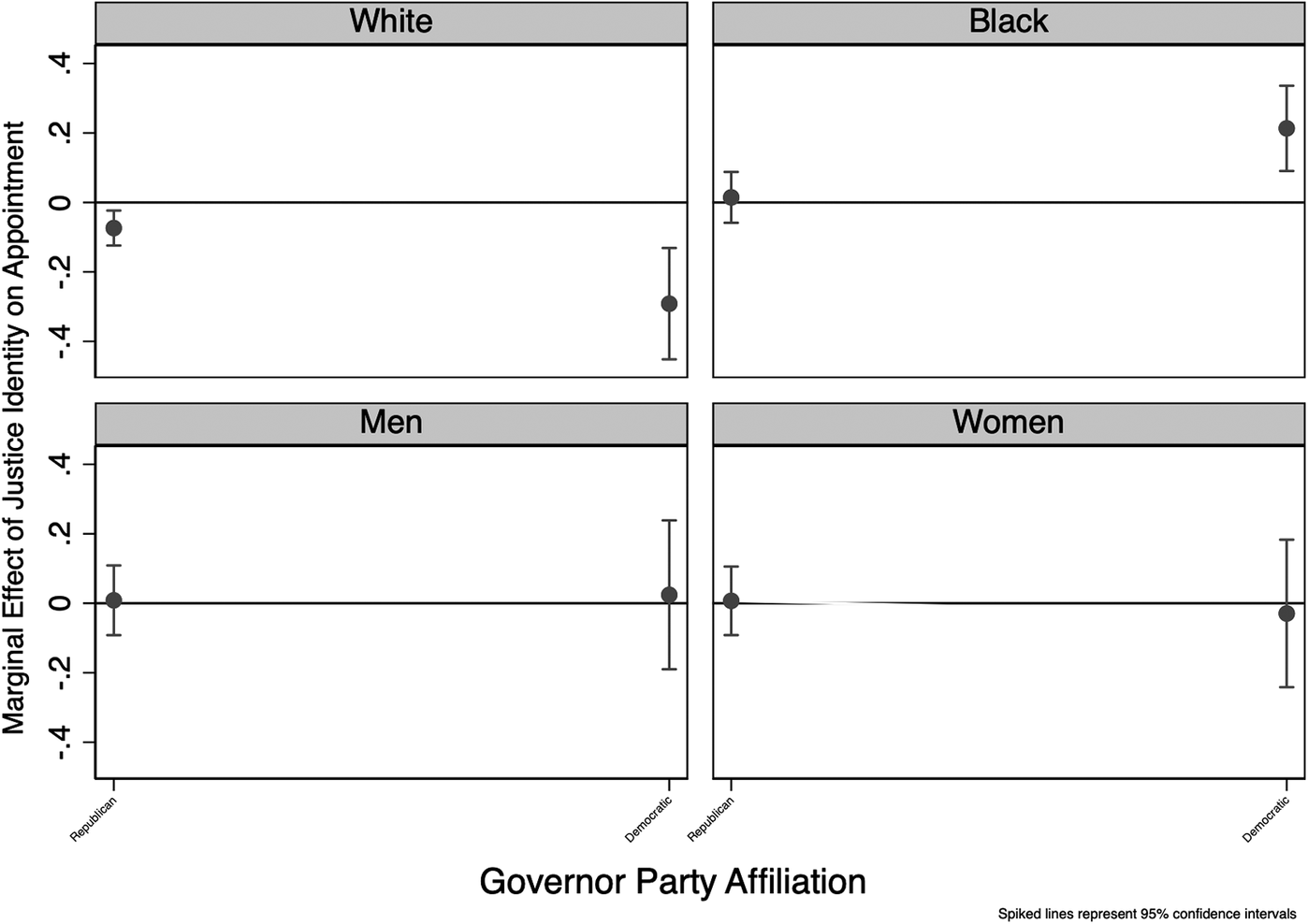
In Figure 2, we show the interaction between the governor’s party and the method of taking the bench (Hypothesis 1) for White, Black, male, and female jurists. In each panel, the y-axis depicts the marginal effect of appointment on taking the bench. The left point estimate on the x-axis depicts Republican governors. The right shows Democratic governors. The spiked lines represent 95% confidence intervals; should the spike pass through the reference line at y = 0, the interaction is not significant in that configuration.
Appointment of state supreme court jurists by identity by gubernatorial party, 1980 to 2023.

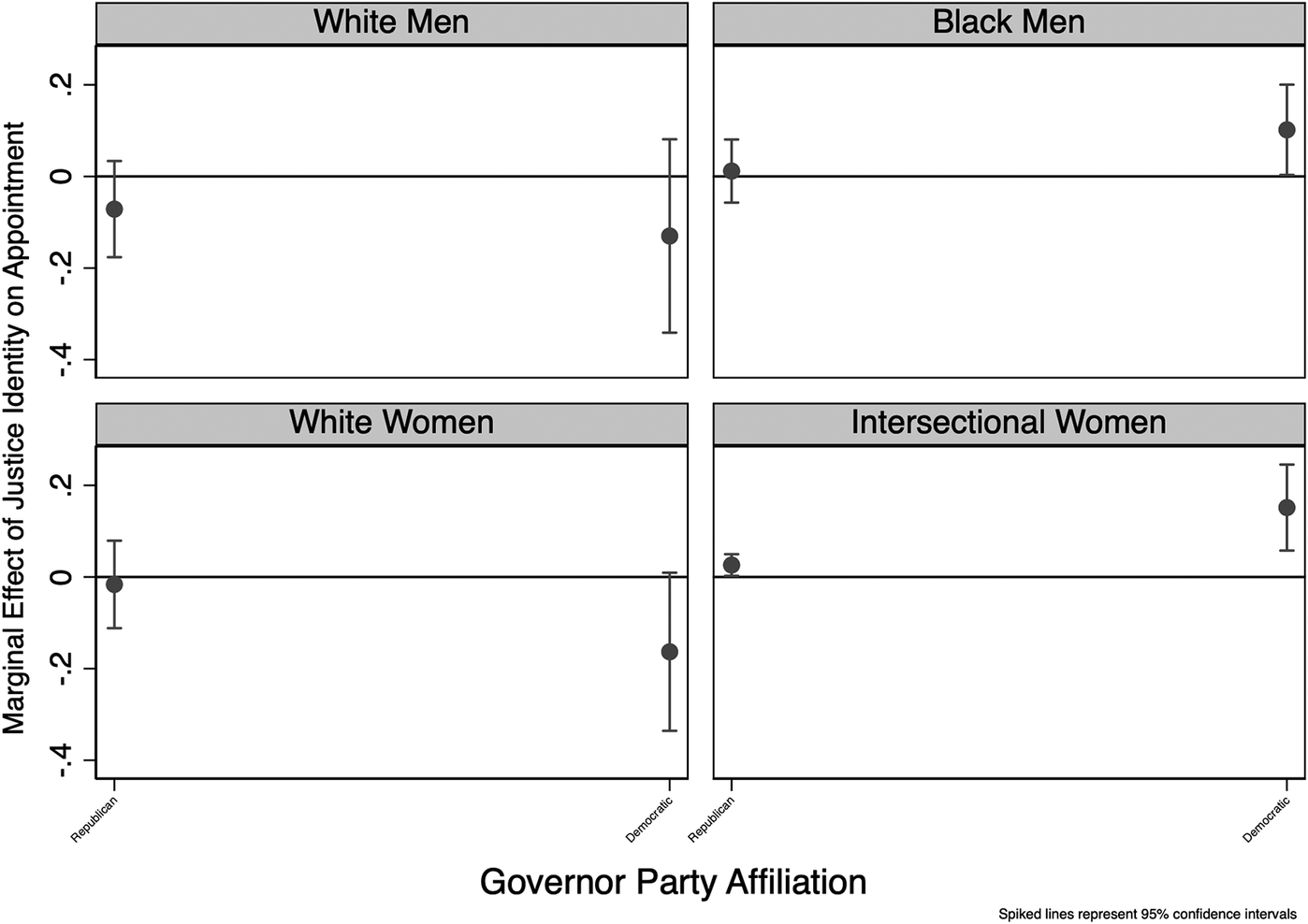
Whites are less likely to be appointed by both Republicans and Democrats; although the substantive size of the effect is more pronounced for Democrats. Shifting from a Republican to Democratic governor decreases the predicted probability of White jurists being appointed from −0.074 to −0.291. Blacks are more likely to reach the bench via appointment under Democratic (but not Republican) governors: The predicted probability of appointment is 0.213 under Democratic governors. Male and female jurists are never more likely to be appointed by either Democrats or Republicans. Figure 3 follows the same layout and logic as Figure 2, but for intersectional identities. Under Democratic governors, the predicted probability of Black men being appointed is 0.102. Both Republican and Democratic governors have a higher propensity to appoint intersectional women; but this is more pronounced for Democrats. Moving from a Republican to Democratic governor increases the predicted probability of appointment from 0.026 to 0.152. The interactions for White men and White women are never significant. Collectively, Figures 2 and 3 provide support for Hypothesis 1.
Appointment of state supreme court jurists by identity by gubernatorial party, 1980 to 2023.

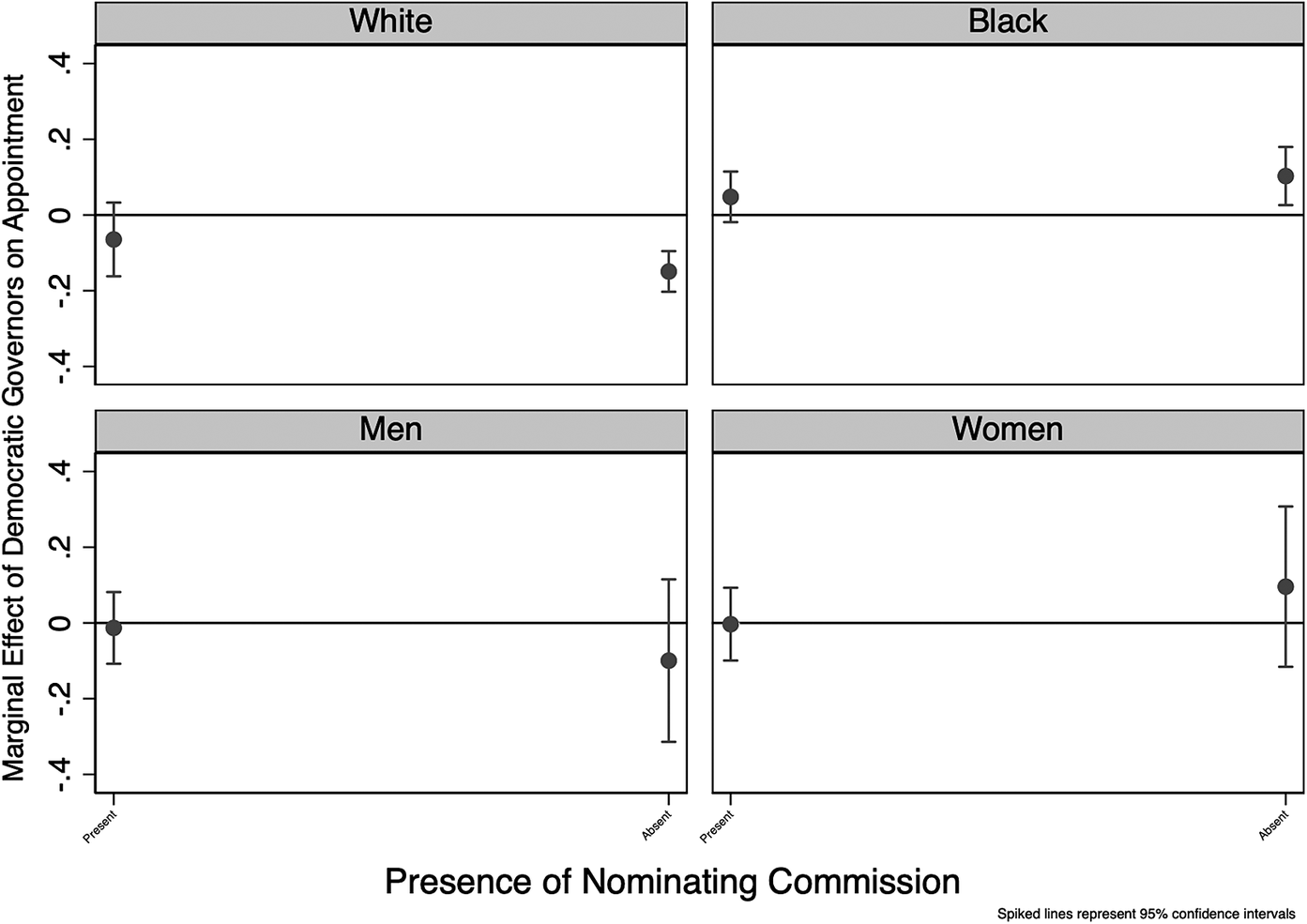
Figure 4 is structured in much the same way as Figures 2 and 3, but it shows the interaction between Democratic governors and institutional constraints for White, Black, male, and female jurists (Hypothesis 2). The predicted probability of Democrats appointing Whites decreases by 0.149 when unconstrained. The opposite is true for Blacks; the predicted probability of Democrats appointing Blacks increases to 0.103 when unconstrained. At no point are the interactions significant for male or female jurists.
Appointment of state supreme court jurists by Democratic governors under nomination constraints, 1980 to 2023.

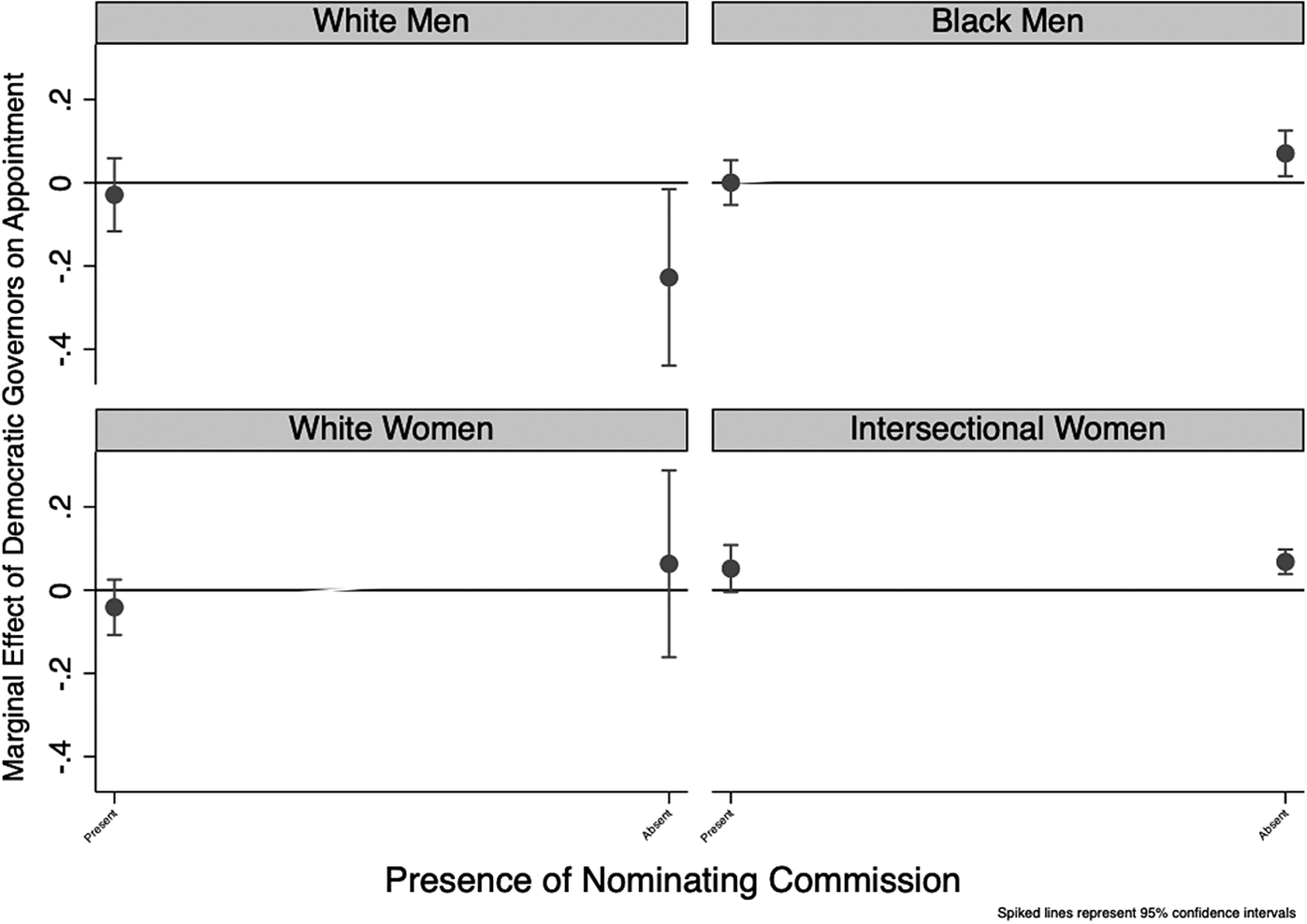
Figure 5 utilizes the same logic as Figure 4, but for White men, Black men, White women, and intersectional women. The predicted probability of Democrats appointing White men falls to –0.228 when unconstrained. At no point is the interaction for White women significant. Democrats have a higher predicted probability of appointing Black men (0.070) when unconstrained. Democrats are always more likely to appoint intersectional women. But they are more likely to do so when unconstrained; moving from constrained to unconstrained increases the predicted probability of appointing intersectional women from 0.052 to 0.068. Collectively, Figures 4 and 5 indicate Democratic governors who would otherwise appoint a non-traditional jurist are unable to do so when faced with nominating commissions. This provides support for Hypothesis 2.
Appointment of state supreme court jurists by Democratic governors under nomination constraints, 1980 to 2023.

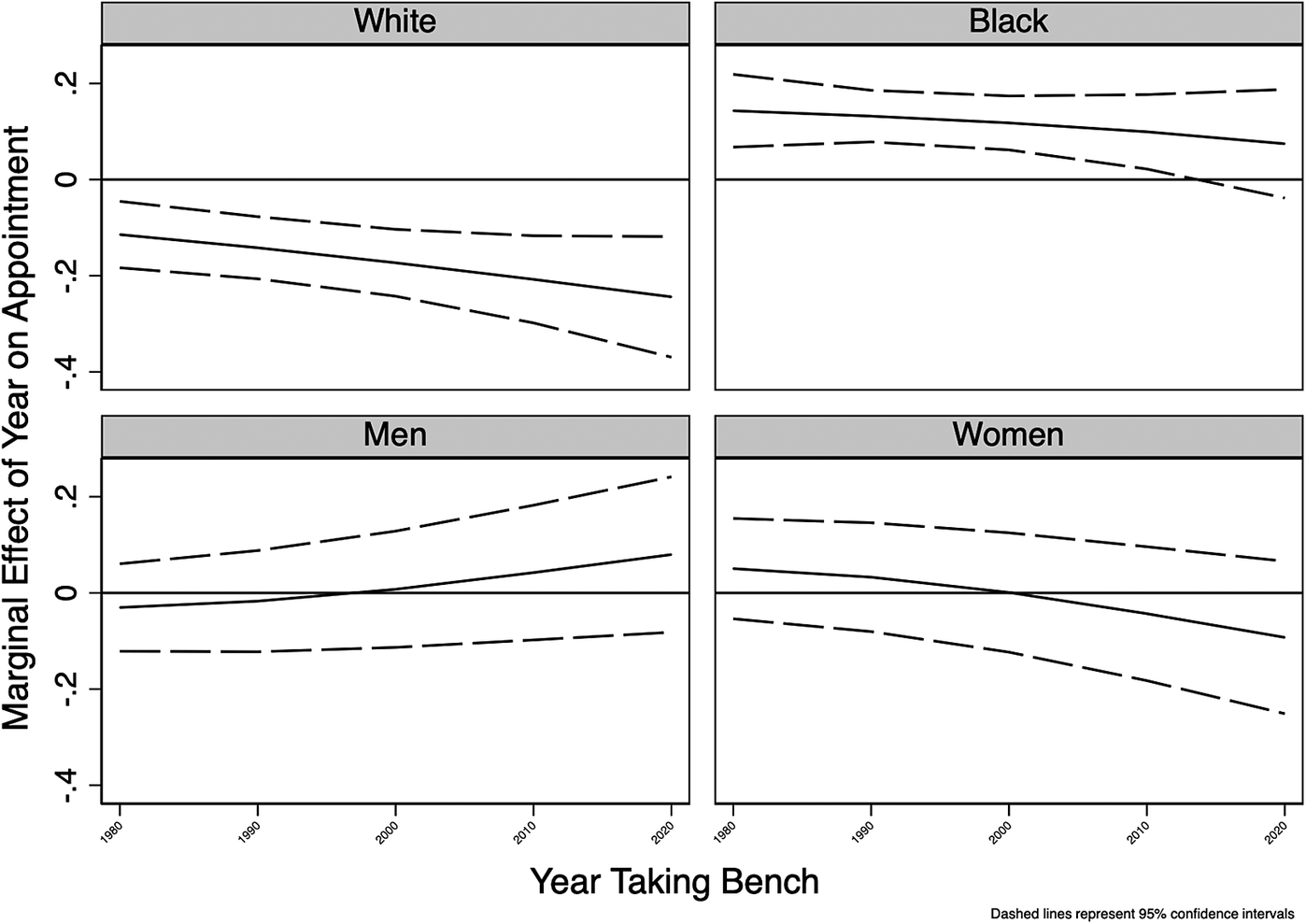
In Figure 6, we show the interaction between appointment and year joining the bench for White, Black, male, and female jurists (Hypothesis 3). The x-axis shows the year the justice takes the bench. The solid sloped line shows the marginal effect of the year on a jurist of a given background being appointed. Should the reference line at y = 0 be included in the 95% confidence intervals (denoted by dashed lines), the interaction is insignificant at that level. Whites are always less likely to be appointed than elected, although this effect becomes more pronounced with time. Whereas the predicted probability of appointment is −0.114 in 1980, it falls to −0.244 in 2020. The predicted probability of Blacks being appointed drops from 0.143 in 1980 to 0.099 in 2000. By 2010, the interaction was no longer significant. For men and women, the interactions are never significant.
Appointment of state supreme court jurists by identity over time, 1980 to 2023.

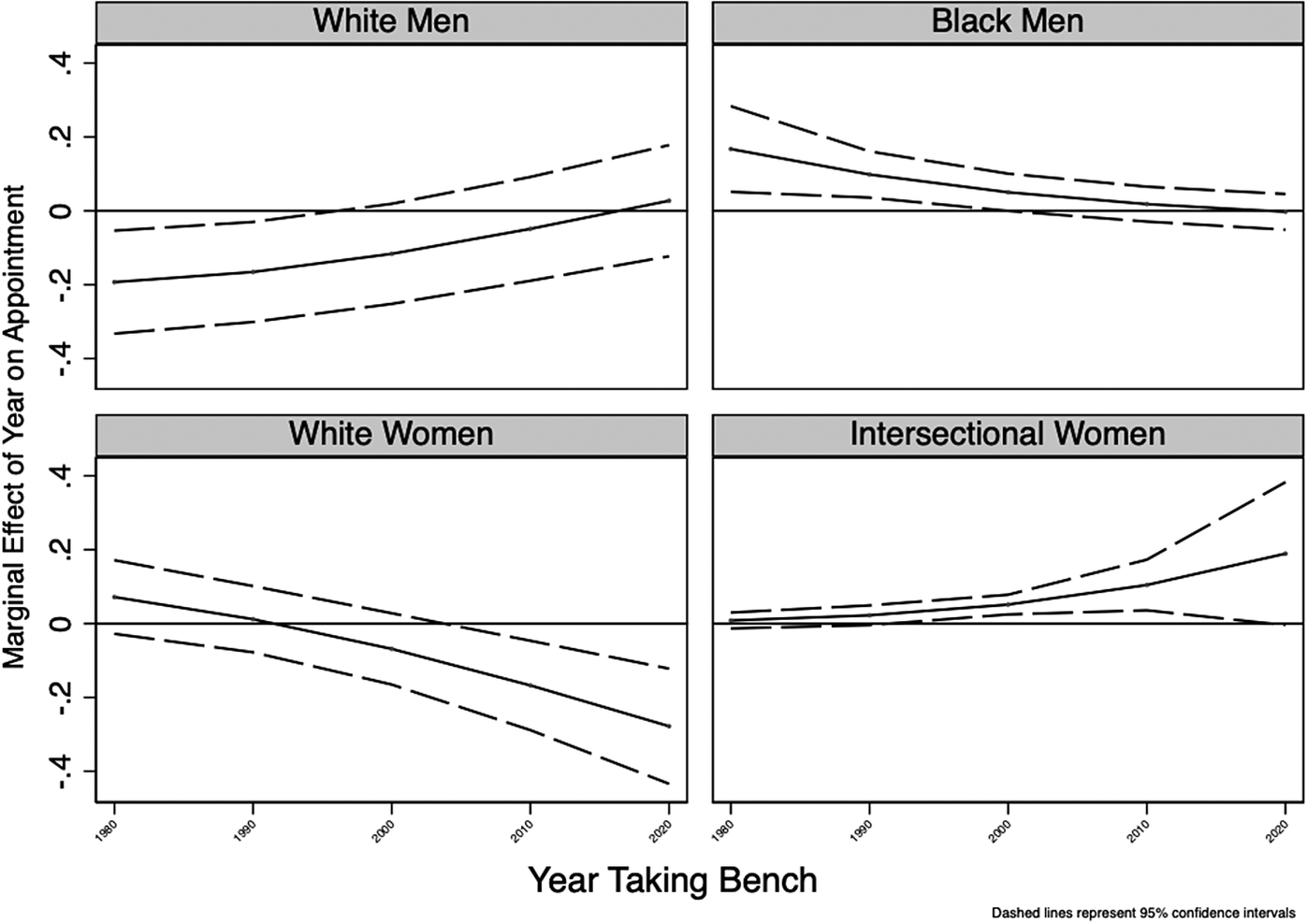
Figure 7 utilizes the same logic as Figure 6, but for White men, Black men, White women, and intersectional women. White men are less likely to be appointed in 1980, although by 2000 the predicted probability increases from −0.193 to −0.116. By 2010, the interaction is no longer significant. Black men follow the opposite track; they are more likely to be appointed prior to 2010, although the predicted probability drops from 0.167 in 1980 to 0.050 in 2000. The interaction for White women is not significant until 2000. After that, White women became less likely to be appointed from 2010 (−0.167) to 2020 (−0.278). Intersectional women are more likely to take the bench via appointment but only after 2000. Their predicted probability is 0.051 in 2000 before increasing to 0.104 in 2010. In 2020, the interaction barely misses conventional levels of statistical significance (p = 0.06) and has a predicted probability of 0.189. Collectively, Figures 6 and 7 provide support for Hypothesis 3.
Appointment of state supreme court jurists by identity over time, 1980 to 2023.

Discussion
A court’s legitimacy and the contours of its case law depend, in part, on its composition (Evans et al. Reference Evans, Ana Franco, Wenzel and Wrinkle2017; Ono and Zilis Reference Ono and Zilis2022; Reference Ono and Zilis2023; Scherer and Curry Reference Scherer and Curry2010). For all its normative benefits, diversification is a slow process which, even in electoral states, often depends on gubernatorial appointments (Bratton and Spill Reference Bratton and Spill2002; Holmes and Emrey Reference Holmes and Emrey2006; Hurwitz and Lanier Reference Hurwitz and Lanier2008). Gubernatorial appointments, while important for courts, state executive agencies, and the US Senate, are understudied (Bernick Reference Bernick2016). We address this gap by demonstrating, even after initial diversification, appointments are a key way non-traditional jurists reach the bench. Given minorities face difficulty in statewide races (Rhinehart and Geras Reference Rhinehart and Geras2020) and women are less likely to run for office (Nguyen Reference Nguyen2019), gubernatorial appointments represent a primary way benches can reflect the populations they serve.
Appointments depend on several factors which hinge on the governor. Democratic governors are more likely to appoint non-traditional jurists, but their ability to do so is institutionally constrained. Additionally, the relative propensity for any given group to be appointed varies with time. This also varies by sub-population; there is no single unified explanation for appointments across identity groups. Our results contribute to our understanding of judicial selection and governors’ appointment calculus. Yet, our findings also pose several avenues for future research.
We find Democratic governors are more likely to appoint non-traditional jurists; but their ability to do so is constrained by the presence of a nominating commission. But there are certainly instances where non-traditional jurists advance to the selection stage; Lanier and Handberg (Reference Lanier and Handberg2011) note more diverse nominating commissions produce more diverse shortlists. Their study, limited to Florida appellate courts from 1991 to 2003, suggests a contagion effect (e.g., Boyd, Epstein, and Martin Reference Boyd, Epstein and Martin2010). Briefly, nominating commission diversity may “level the playing field.” As the legal profession continues to diversify at higher levels (American Bar Association 2024), it follows nominating commissions should diversify too. This is consequential for the shortlists presented to governors for both interim appointments in electoral and merit selection states. We encourage future scholars to explore this further, with particular attention to variation based on identity.
A key advantage of appointment is appointed jurists may then run for reelection with an incumbency advantage (Kritzer Reference Kritzer2015; Reference Kritzer2023). While not as extensive as the incumbency advantage enjoyed by initially elected jurists (Curry and Romano Reference Curry and Romano2018), it is possible incumbency advantage varies based on jurist identity. This is illustrated by Chief Justice Sears. While Supreme Court of Georgia races are historically sleepy affairs (e.g., Kritzer Reference Kritzer2015), Sears faced a bruising electoral challenge in 2004 (Davis Reference Davis2017). Would the race have been as contentious if she were White or male? We encourage future scholars to explore how identity shapes the electoral fortunes of initially appointed jurists across identities.
We find Democratic governors are more likely to appoint non-traditional jurists. This finding may be rooted in the Democratic Party’s nature as a coalition of identity groups (Bratton and Spill Reference Bratton and Spill2002; Grossmann and Hopkins Reference Grossmann and Hopkins2015) and the party’s relative focus on diversity (Wolbrecht Reference Wolbrecht2000). So, this finding may be a function of Democrats having a “deeper bench” for non-traditional candidates. While this is historically true, Donald Trump’s strong showing with Hispanics and Blacks (e.g., Petty, Magilligan, and Bailey Reference Petty, Magilligan and Bailey2022) may soon give Republican governors a more diverse set of potential nominees. This could, however, be exacerbated by non-traditional judicial candidates’ “leaky pipeline” (e.g., Collins and Moyer Reference Collins and Moyer2008). We encourage future scholars to explore this at both the state and federal levels.
State supreme courts are rapidly diversifying; what had once been studied just in terms of race and sex has since expanded to a more ecumenical list of identities (Goelzhauser Reference Goelzhauser2021; Reference Goelzhauser, Solberg and Waltenburg2024; González, Fairbanks, and Gleason Reference González, Fairbanks, Gleason, Solberg and Waltenburg2024). While we distinguish Whites into male and female categories and racial minorities into Black men and intersectional women, other groupings are excluded from our predictive analysis because low numbers and relative distribution on key independent variables make statistical modeling impossible. Much as our analysis of intersectional jurists would not have been possible at the time Bratton and Spill (Reference Bratton and Spill2002) conducted their study; future scholars will be better situated to explore an even more diverse group of identities such as Latinx and Asian Americans.
Time should, presumably, allow scholars to examine a greater number of identities. However, that approach requires potentially waiting years. In the interim, scholars may find purchase in exploring the conditions under which non-traditional jurists are appointed to state trial courts and intermediate courts of appeals (e.g., Hurwitz and Lanier Reference Hurwitz and Lanier2003; Lanier and Handberg Reference Lanier and Handberg2011). Such a study has clear normative value: Lower state courts handle a greater caseload than their respective apex courts and are often the pool for apex court appointments (e.g., Alozie Reference Alozie1996; Goelzhauser Reference Goelzhauser2018b). We do, however, note an important caveat: Courts at different levels, particularly trial courts, have different diversification processes (Williams Reference Williams2007). So, exploring lower courts augments rather than replaces future studies exploring state supreme courts.
Finally, and perhaps most broadly, our results demonstrate the critical role governors play in state supreme court diversification in electoral states. Despite the governor’s position as the state’s chief executive, relatively little is known about her appointment power generally (Bernick Reference Bernick2016; Riccucci and Saidel Reference Riccucci and Saidel2001). While our focus is on judicial appointments, we encourage scholars to explore appointments broadly. This is particularly urgent for US Senate appointments. These have key structural differences from state supreme court appointments (e.g., Cooper, Knotts, and Ragusa Reference Cooper, Knotts and Ragusa2016). Accordingly, by exploring Senate appointments in tandem with state supreme court appointments, scholars can arrive at a broad ecumenical understanding of how diversity impacts gubernatorial appointments across institutional contexts.
State supreme courts are the court of last resort for the overwhelming majority of disputes in the United States. While scholars have explored how various selection mechanisms advance or inhibit diversity on the bench, less attention has been paid to one of the central ways non-traditional jurists reach the bench in electoral states: interim appointments to complete an unexpired term. Drawing on data spanning 1980 to 2023, we find Democratic governors are more likely to appoint non-traditional jurists than Republicans particularly when unconstrained by electoral commissions. Critically, these results are not constant over time nor uniform across all identities. This highlights the unique aspects of different identities and warrants future research.
Supplementary material
The supplementary material for this article can be found at http://doi.org/10.1017/spq.2026.10018.
Acknowledgements
A previous version of this article was presented at the 2024 Annual Meeting of the Midwest Political Science Association, Chicago, IL. We are grateful to Greg Goelzhauser and Chihiro Isozaki for sharing data.
Funding statement
This research received no specific grant from any funding agency in the public, commercial, or not-for-profit sectors.
Competing interests
The authors declare none.
Shane A. Gleason is Associate Professor of Public Policy & Law at Trinity College. His research focuses on how attorney and jurist identity shapes outcomes in federal and state courts.
Marigail G. Reyna recently earned her bachelor’s degree in Political Science at Texas A&M University- Corpus Christi. Her research interests focus on intersectionality and its effects on judicial behavior and decision-making.


 Open access

