




Introduction to Duan Qingbo's Life and Scholarship:
Duan Qingbo was born in 1964 in Ruicheng, Shanxi. After graduating in 1985 with a bachelor's degree in archaeology from Northwest University in Xi'an, he started working on Qin and Han excavations throughout North China. Duan earned his PhD in history from Northwest University in 2007 and returned to his alma mater to become professor, head of graduate studies, and later dean of the recently re-christened School for Cultural Heritage, where he trained over forty graduate students in history and archaeology.
In 1998 Duan Qingbo was appointed as director of the excavation team at the First Emperor's necropolis. For the next decade, he oversaw some of the most spectacular discoveries at the site since the initial find of the terracotta warriors in 1974. These included the satellite pits containing terracotta entertainers and bureaucratic officials, the bronze cranes, geese, and ducks of the First Emperor's underground pleasure park, and numerous assemblages of blue-slate armor. He also uncovered a massive underground water diversion system, employed by the tomb builders to protect the site from inundation, and he probed the tomb mound with direct and remote sensing devices, revealing the internal structure of the mound as a nine-step pyramid topped with wood-frame architecture. These fieldwork results were published in numerous preliminary reports and three major excavation volumes (2000, 2006, 2007; see bibliography), and they were synthesized in Duan's monograph on the necropolis published in 2011. For almost two decades, Duan served as the “ambassador” of the First Emperor of Qin to the Western world, appearing in numerous television documentaries and writing several essays for catalogs of traveling exhibitions of the terracotta warriors.
In 2006, Duan was selected to lead the Shaanxi regional survey of the surviving traces of the various “Great Walls” built in North China from the Warring States period onward. This was part of a national project to survey and conserve all the ancient long walls in the country. Duan and his team personally walked over 1,900 km of territory and excavated numerous wall segments and guard posts in a two-year project. These regional survey results were published in 2015, with broader syntheses covering the great walls of all time periods published in 2014 and 2019.
Stimulated by his discovery of the terracotta entertainers at the necropolis, which display a style of sculpture unprecedented in East Asia, as well as by the internal step-like architecture embedded within the emperor's tomb mound, Duan began to explore the influence of West Asian cultures on the Qin. He published some preliminary ideas on this topic in his 2011 monograph on the necropolis, but it was most fully explored in three articles published in successive issues of his university journal, Xibei daxue xuebao, in 2015 (translated here in their entirety).
In April of 2018, Professor Anthony Barbieri-Low of UCSB (the translator), and Professor Lothar von Falkenhausen of UCLA arranged a conference called “Ancient China in a Eurasian Context” at UC Santa Barbara and invited Professor Duan to give one of the keynote addresses. He presented his research from these three articles, and the audience was deeply fascinated, prompting plans to translate these pieces to make them available in English to the wider scholarly world. Unfortunately, soon after the conference, Professor Duan suffered a recurrence of the cancer that first struck him in 2016, and he passed away about a year later.
In his last few years, Duan was developing a novel theoretical framework to define the key features of ancient civilizations, but specifically focusing on Chinese civilization. He had become dissatisfied with the strongly materialist orientation of traditional archaeology in China, which overlooks the importance of ideas and institutions in the formation and evolution of ancient cultures. He laid out what he called the theory of the “Three Views” (sanguan 三觀), those core concepts that defined, gave cohesion to, and fostered the continuity of an ancient civilization. These were the mutually constructed and reinforcing systems of societal regulation (shehui zhili tixi 社會治理體系), which defined the power relationship between the state and its subjects (i.e., the form of government), cosmology (yuzhouguan 宇宙觀), the worldview and ideological framework which legitimated the state's system of social regulation and clearly defined the relationship between heaven, earth, and man, and, finally, the core system of values (hexin jiazhiguan 核心價值觀), which revealed the priorities of both the state and society, supported the implementation of governance, and resulted in particular modes of behavior and cultural productions. The material remains that archaeologists uncover are merely the byproducts of these all-important systems, making it difficult to penetrate the veil to comprehend the real society behind the material culture. Though he died before he could fully develop his theory, one can see a hint of some of these ideas expressed in the articles translated here. Duan Qingbo's passion, curiosity, and broad-minded approach were an inspiration to scholars in both China and the broader world of scholarship.
PART ONE EVIDENCE OF CULTURAL INTERCHANGE IN THE NECROPOLIS OF THE FIRST EMPEROR
Archaeological evidence makes it increasingly clear that technologies like wheat agriculture, iron-smelting, and fabrication of gold and silver vessels were introduced to China from West Asia and Central Asia along the Silk Road.Footnote 1 Bronze technology and the horse chariot, both of which arose in West Asia and traversed the steppe, deserts, and the oases, or along the ancient “Tea and Horse Road” or other routes, had a profound influence upon China.Footnote 2 Of course, there had been other cultural exchanges in even earlier periods (such as among Neolithic painted pottery cultures), and all of this occurred well before Zhang Qian 張騫 (d. ca. 114 BCE) had supposedly opened up some of these routes.Footnote 3
During the archaeological exploration of the mausoleum of the First Emperor of Qin, we also discovered that many cultural elements such as terracotta warriors and horses, figures of entertainers, bronze carriages and horses, bar-shaped bricks, stepped-architecture within burial mounds, and some techniques in the casting process for the bronze waterfowl appear completely out of the blue in the archaeological record, and, moreover, don't really leave many traces in subsequent periods. These phenomena deserve our comprehensive consideration within a larger temporal and spatial framework.
Terracotta Figures of Soldiers and Horses
Of the things that make the First Emperor's mausoleum world famous, enjoying the reputation as the “Eighth Wonder of the World,” none surpasses the many thousands of life-size terracotta figures of warriors and horses. The terracotta army, which seems to have appeared out of nowhere, may have garnered people's great admiration, but at the same time, it has prompted the following sort of doubts: Why did the idea of focusing on humans and animals as a way to express an artistic vision, which had never appeared before, suddenly arise during the Qin dynasty?
During the pre-Qin period, especially since the Shang and Zhou period (ca. 1045–256 BCE), the traditional artistic craft had always been the bronzecrafter's art, which principally involved the craftsman deploying extremely imaginative motifs to make all sorts of ritual vessels capable of communicating with the heavens. Depictions of humans and animals during this time only played supporting roles in expressing this principal theme, mostly as attachments to the bases of vessels or as decoration on handles. Although there have been scholars who have discussed the supporting technical prerequisites during the Qin period that would have allowed Qin artisans to produce the terracotta army, they have not considered the logical question of why such large-scale ceramic sculptures would appear at this particular moment in time.Footnote 4 More than thirty-five years ago [1986], there was a European scholar (German Hafner, 1911–2008) who considered that the art of the terracotta army “originated from Western contact, originated from knowledge of Alexander the Great and the splendor of Greek art.”Footnote 5 Lukas Nickel of SOAS has put forward a similar proposition.Footnote 6
Compared to bronze casting, ceramic sculpture was rather underdeveloped during the pre-Qin period, and its accomplishments were not really outstanding. It was only during the Warring States period (ca. 453–221 BCE), that there began to appear some small-scale sculptural pieces. A group of ceramic figurines about 10 centimeters in height was unearthed from one of the sacrificial pits accompanying a burial of the Spring and Autumn-Warring States period transition at Langjiazhuang 郎家莊 near Linzi County, Shandong.Footnote 7 There have also been scattered discoveries [of ceramic figurines] from other Warring States-period tombs of the various polities.Footnote 8 In the state of Qin, it was only during the late Warring States-period that we start to find some ceramic funerary figurines from several burials around the capital area of Xianyang.Footnote 9 In terms of typology, these unearthed Qin ceramic figurines consist of horse-and-rider figurines, or individual human or horse figurines, with heights all around 10 cm. The most telling feature of all these pieces is the lack of a detailed portrayal of the human body and especially in the face. The bodily proportions of the human and equine figures are neither harmonious nor accurate. And although they have polychrome painted decoration, only three types of pigments are utilized: white, red, and black. Some of the figurines are made of kiln-fired ceramic, while others are just modelled, unfired clay. The terracotta figurines of people, oxen, sheep, and dogs from the Qin tomb at Zaomiao 棗廟 village in Tongchuan County are just shaped out of clay then brightly painted.Footnote 10 The pottery figurines from the southern suburbs of Xi'an and the area of the confluence of the Jing and Wei rivers had a firing temperature that was very low. Some others are just unfired clay figurines. The clay or ceramic figurines are hand-modeled from red clay, and supplemented with applique, engraved designs, gouging, and other methods, while the majority are just painted monochromatically.Footnote 11 The two, gray-bodied earthenware horse and rider figurines of nearly identical size and shape from the late Warring States-period burial at Taerpo 塔兒坡 near Xianyang had collars, cuffs, hood brims, hems, and noses that were painted in red, while the fabrication method was clearly hand modeling (see Figure 1).Footnote 12
Mounted rider, Qin kingdom, ca. 320–300 BCE. Painted earthenware; h. 22.6 cm. From tomb no. 28057 at Taerpo site. After Xianyang Shi Wenwu Kaogu Yanjiusuo, Taerpo Qin mu, Figure 96.

The tallest Qin figurines from the late Warring States period do not exceed 20 centimeters in height, and the majority are around 10 centimeters. But once we arrive at the Qin imperial period (221–207 BCE), the Qin terracotta warriors have suddenly sprung up in height to between 180 and 196 centimeters. Even the bodies of the kneeling horse-groom figurines unearthed at the Shangjiaocun 上焦村 site are still an unprecedented 100 centimeters in height. Not only is there a huge disparity between the two groups in terms of physical dimensions, but in terms of fabrication techniques, painting style, figurine types, and other aspects, they can't even be spoken of in the same breath. The terracotta warriors and horses are gray-bodied earthenware, fired at between 950 and 1,000°C. They were fashioned using techniques that combined both painting and modeling, and a sculptural technique in which some parts that were prefabricated in molds were later combined with parts that were hand-worked. Types of figures include generals, officers, chariot drivers, kneeling archers, cavalry soldiers, foot soldiers, entertainers, bureaucratic officials, musicians, stable attendants, and horses. The palette of colors used for painting is quite rich, including green, red, black, purple, pink, white, yellow, and sienna. The modeling of faces and hair is extremely fine and detailed.
Although the Western Han dynasty (206 BCE–8 CE), which inherited and carried forward many aspects of the Qin, also employed pottery figurines to accompany burials, and the fabrication techniques of these figures seem to roughly follow the style of the earlier Qin pieces, the modeling is comparatively stiff and unnatural. The main purpose was to employ an orderly military formation to demonstrate to people a stern and imposing armed troop for the burial rites of the deceased. But when comparing these figurines to the Qin terracotta warriors and horses in terms of dimensions, the majority of these Western Han figurines are much smaller at only 30–40 centimeters in height, with the tallest not surpassing 60 centimeters. But the types of figurines are now even more varied, with bureaucratic officials, musicians, dancers, servants, and the recently unearthed ceramic figurines featuring articulating wooden arms and wearing actual clothing.Footnote 13
So, even though there is only a distance of several decades in time between the pottery figurines of the various Eastern Zhou polities along with the late-Warring States Qin figures and the appearance of the imperial Qin terracotta warriors and horses, there is a considerable difference in terms of artistic techniques and a massive difference in artistic style. If we place them on the path of development of Qin culture and carry out a logical assessment, we see that between the former and the latter there is a sudden qualitative leap. The huge gap in the developmental sequence between the two is logically unacceptable, and the greater resource allocation ability of the Qin empire is clearly insufficient to explain this degree of difference. When assessing the development in terms of size, form, and artistic style between the Qin terracotta army and the Western Han-period figurines, there is a similar sort of puzzle. So, what is the cause that leads to the huge difference in style between the pottery figurines of these three periods of the Warring States-period Qin state, the Qin empire, and the Western Han?
In terms of formal characteristics and style of dress and adornment, the closest parallels to the Warring States-period Qin figurines are found in the Scythian culture. Wang Hui 王輝 has examined the exchanges between the cultures of the Yellow River valley and the Scythian culture of the steppe.Footnote 14 During a 2007 exhibition on the Scythians in Berlin, there was a bronze hood on display labeled a “Kazakh military cap.”Footnote 15 This bronze hood and the clothing of the nomads in kneeling posture [also depicted in the exhibition] are very similar in form to those of the terracotta figurines from the late Warring States Qin-period tomb at the Taerpo site (see Figure 1). The style of the Scythian bronze horse figures and the saddle, bridle, and other accessories on their bodies are nearly identical to those seen on the Warring States-period Qin figurines and a similar type of artifact from the Ordos region, and they all date to the fifth to third centuries BCE.
Large-scale ceramic sculpture similar in dating and style to the imperial Qin terracotta warriors and horses have not yet been discovered in other cultural traditions such as Persian, Greco-Roman, or Indian civilizations. However, these regions did have long traditions of bronze and stone sculpture, like the widespread tradition of narrative relief carvings and paintings of ancient Egypt or the states of the ancient Near East, as well as the classical sculptural and painting traditions of ancient Greece, which took the actual size of the human figure as a model. The only thing that closely matches the artistic style of the imperial Qin terracotta warriors is the head of a painted pottery figure unearthed in Uzbekistan (see Figure 2).Footnote 16 The piece dates to around 100–50 BCE. Unfortunately, all that was found was the head, which measures 23 cm high (the heads of the Qin terracotta warriors range from 23–26 cm). The figure wears a felt hat and an upper garment with a high collar. The facial features and facial hair are quite lifelike, and the face is covered with a reddish pigment. The way of assembling the head and body for this Kushan figure of a warrior (possibly Saka) was the same as that employed for the Qin terracotta warriors, in that they were fabricated separately, and then the head was inserted into the trunk of the figure.
Warrior, Kushan kingdom, mid-first century BCE. Painted ceramic. Found at Khalchayan palace site, Uzbekistan. Termez Archaeological Museum. Photographer Nicoletta Stofkoper (CC0 license).
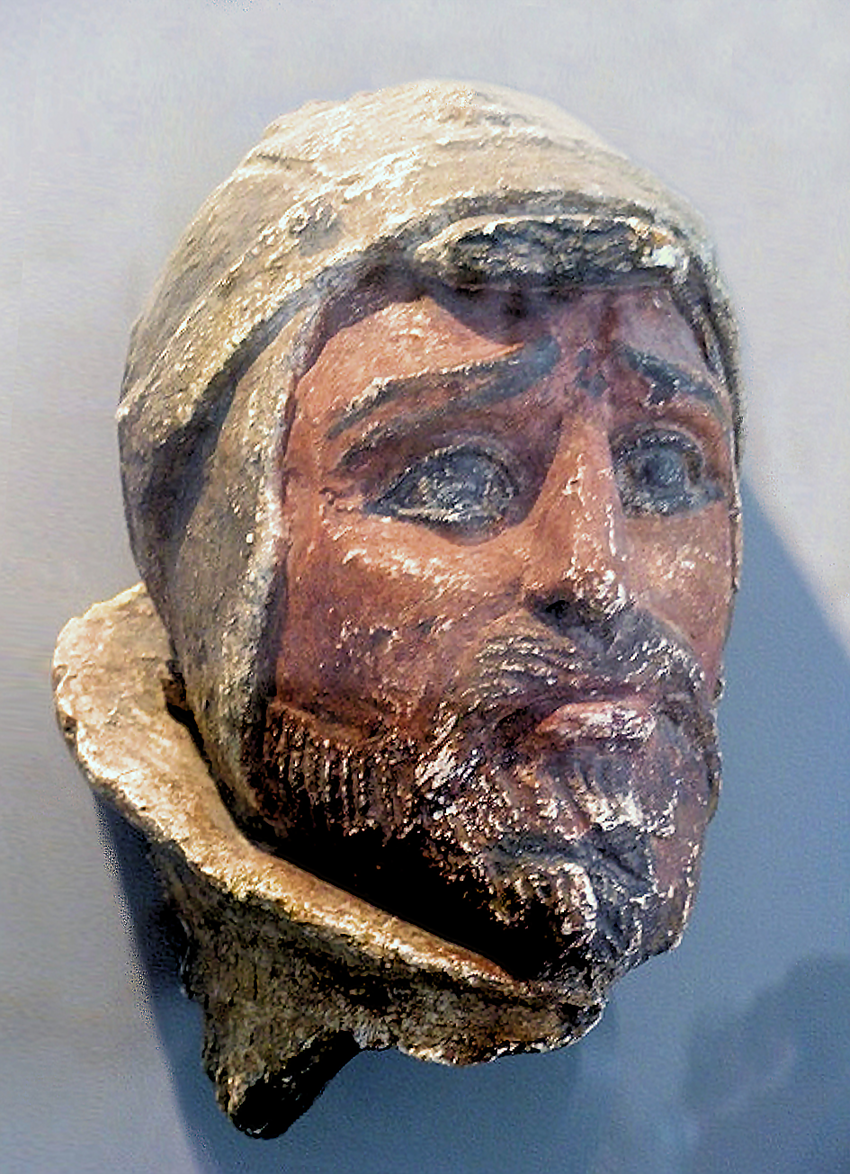
The information presented above clearly shows that the artistic form of the Warring States-period Qin figurines may have received influence from the Scythian culture, but that the art of the Qin imperial terracotta warriors possibly had a different source of inspiration.
Figurines of the Long-Pole Entertainers from Dulu
A group of life-size, polychrome-painted terracotta figures of entertainers was unearthed from sacrificial pit no. K9901 at the First Emperor's necropolis. The sculptural techniques and painting style employed to make these were identical to those used to fashion the terracotta warriors. The facial expressions are also a bit stiff and lacking in vitality. It seems that the clothing style on all these terracotta figures consisted of just a short kilt around the waist, with the remainder of the limbs and trunk left completely nude.
But there were also some differences in modeling techniques between these terracotta figures of entertainers and those of the terracotta army. The methods for portraying expression in the torso, skeleton, and musculature, along with the highly accurate bodily proportions, reveal that the artists had a very refined grasp of human anatomy. The bulging arm muscles when a figure exerts itself, the visible musculature and ribs along the flanks, the suggestion of spinal vertebrae, and the postural shift in the bulging belly when a figure is lifting something heavy, all demonstrate that the sculptor had also developed mastery concerning the kinetics of the human body (see Figure 3). That kind of artistic style, at this stage in the development of Far Eastern art traditions, is unprecedented.
Strongman, Imperial Qin period (221–207 BCE). Terracotta with polychrome paint. From pit no. K9901 at First Emperor's Necropolis, Lintong County, Shaanxi. Museum of the Qin Emperor's Terracotta Warriors and Horses. Photo courtesy of Duan Qingbo.

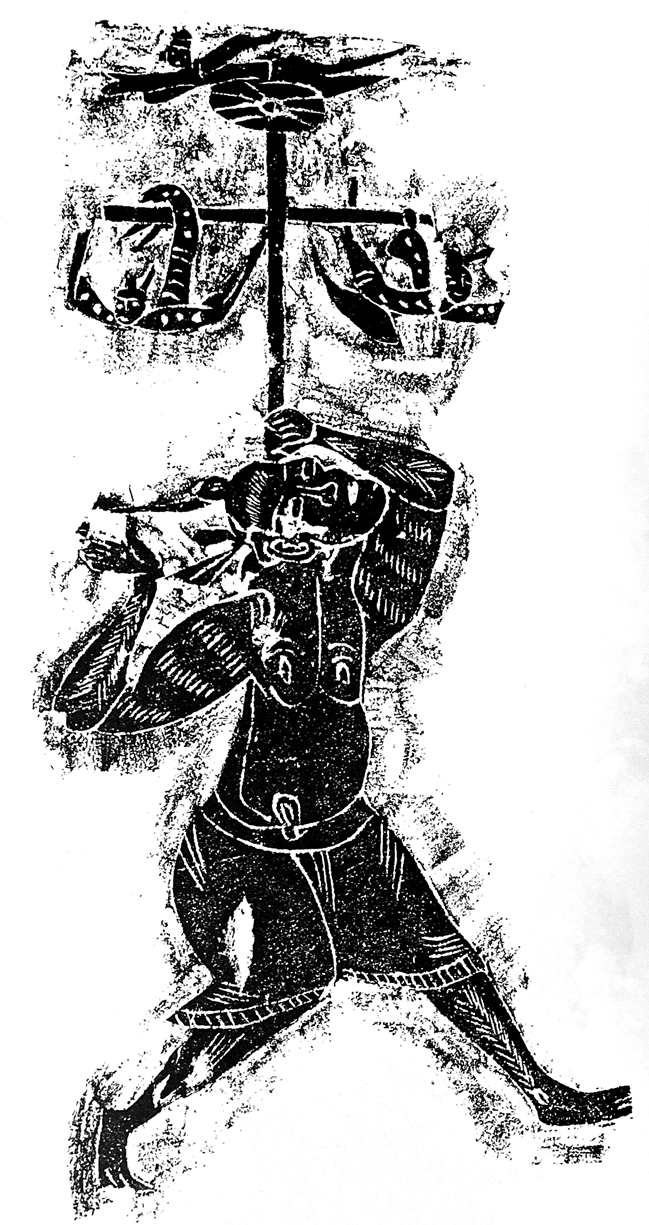
There is one figure among the terracotta entertainers that scholars have determined is a long-pole entertainer from Dulu. Dulu long-pole acrobatics was a very popular entertainment during the Han period, involving acrobats who climbed to the top of a long pole. In the pictorial stone carvings of Han-period funerary shrines and tombs, depictions of this entertainment are fairly common (see Figure 4). Today, it is just called “long-pole acrobatics.” It involves a formidable strongman who supports a long pole with either his two hands or with his head. Atop the pole there are numerous performers doing acrobatic tricks. The greatest number of performers seen in depictions reaches as many as nine people.Footnote 17 The performers’ actions include hanging upside-down, leaping, twirling, dancing, and sitting. The entertainment would have been breathtaking, with one thrill after another. There are some scholars who consider that this entertainment developed from the “dwarves climbing halberd shafts” (zhuru pulu 侏儒扶盧) entertainment of the Spring and Autumn period.Footnote 18 But Dulu 都盧 is an ancient non-Chinese placename. Some consider that it was located south of present-day northern Vietnam; others think that it was located near Pyay, along the middle course of the Irrawaddy River in present-day Myanmar.Footnote 19
Long-pole acrobats, Eastern Han period, ca. 150–184 CE. Ink on paper rubbing of pictorial stone. From lintel of east wall of central chamber of tomb no. 1, Beizhai village, Yi'nan, Shandong. Collection of Anthony Barbieri-Low
It has been said that the “Discourses of the Jin” section of the Discourses of the States (Guoyu 國語) text records that during the Spring and Autumn period they already had an acrobatic skill called “dwarves climbing halberd shafts” which might, in terms of form, be related to the “long-pole entertainers of Dulu” of the Qin and Han periods; however, when looking at the Han-period designation of “Dulu” in the title “long-pole entertainers of Dulu,” we must admit that the Qin and Han period version of this entertainment possibly took shape under the transformative influence of foreign acrobatic traditions.Footnote 20 When the Han envoy Zhang Qian was pioneering the route to the Western Regions and was in Bactria (in present-day northern Afghanistan), he saw cloth from Shu 蜀 and bamboo staves from the region of Qiong 邛 (both in present-day Sichuan) which had been imported from the southwestern portion of China, having passed through India, before arriving in Sogdiana and Bactria.Footnote 21 It shows that already during the pre-Han period there existed a “southwestern Silk Road” for economic and cultural exchange, traveling from southwest China, passing through Myanmar to India and then to Central Asia and West Asia.Footnote 22
So, we can make the following conjecture: the envoys of cultural exchange, whether by traversing the traditional oasis Silk Road or the southwestern Silk Road, brought with them ideas about sculptural arts from Greece in the Mediterranean and from Persia, carrying them into the Central Plain of China. So, after the sculptural tradition of Qin figurines and entertainer figurines had reached an early stage of sculptural development, people opened up external communication through the southwestern Silk Road and brought the acrobatic entertainment of the “long-pole climbers of Dulu” from the Myanmar region into the Land within the Passes (Guanzhong 關中; the Qin heartland), and this melded with the native Chinese tradition of the “dwarves climbing halberd shafts,” forming a new acrobatic skill. Of course, at this time, we also see imported into China the “magic mountain jutting out of the artificial sea,” “the dance of the Manyan sea monster,” and other acrobatic skills and magic tricks.Footnote 23
Mass Grave Pits of the Necropolis Workers
During the spring of 2003, within the necropolis of the First Emperor of Qin, we discovered a mass burial pit of some of the workers who built the mausoleum. All the 121 skeletons belonged to males whose bodies were heaped up in a disorderly fashion, within an abandoned kiln site. The bodies all overlapped each other and were not provided with coffins or burial goods. The orientation of the limbs and heads was chaotic with no consistency. The age of most of the men ranged from 15 to 40 years old, and the average height was around 1.7 meters. The skeletons, which exhibit robust development and prominent spinal columns, all clearly belong to heavy laborers.
When we were carrying out physical anthropological identifications at the site, we discovered three relatively well-preserved skulls that exhibited the unusual features of cheek bones and nasal ridges that were relatively higher and eye sockets that were rather deep set, clearly differentiating them from the other skulls. Later, under comparative analysis in the lab, the specialists considered that these features still fell within the normal variation of East Asian physical types. We then took samples from this group of bones for DNA analysis. During the first test, we discovered that one of the skeletons belonged to an individual of a European haplogroup. Later, when we retested the materials, we extracted mitochondrial DNA sequences of nineteen individuals. Specialists in molecular biology compared these mitochondrial DNA sequences with those of thirty-two modern Chinese individuals and determined that the nineteen ancient laborers belonged to a mixed East Asian group. Compared with the samples of the thirty-two modern Chinese individuals, they exhibit even more diversity. Among the laborers, there were those from ethnic-Han Chinese stock, and some from those who are today classified as ethnic minorities in China. The majority of those appear to have come from southern China, while there was no sample that clearly pointed to an individual from a northern ethnic minority.Footnote 24
As for the mitochondrial DNA analysis undertaken by the molecular biologists on the skeletons to determine the racial affiliation of ancient human bones, it is still difficult to accurately characterize with any certainty the racial or ethnic affiliation of bones that were archaeologically excavated, based on the accumulated data and the current stage of development of this technology. Because of the disparity between the on-site visual inspection of the mass graves of the necropolis workers, and the results of the first and second DNA analyses, it is still not possible to make any final conclusions in terms of the racial or ethnic affiliation of the skeletons unearthed from the mass burial. However, it does provide us with some room for imagination to speculate about the place of origin of these heavy laborers.
Terraced Architecture within the Grave Mound
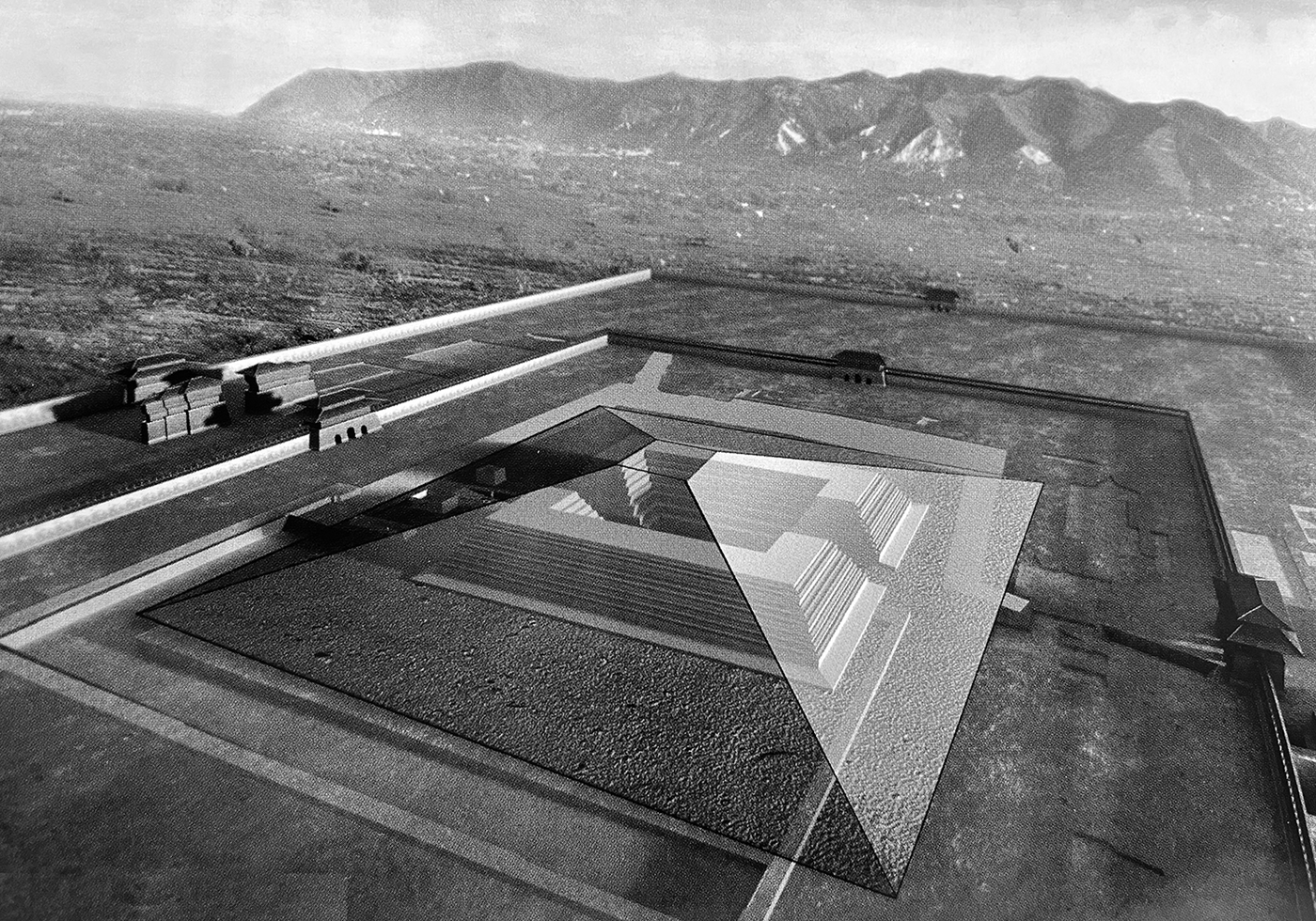
After grave mounds began to appear at elite mausolea in the Yellow River valley during the late Spring and Autumn period, the construction of those mounds basically consisted of layer after layer of rammed earth (hangtu 夯土) of inconsistent thickness. But only at the necropolis of the First Emperor of Qin do we find the phenomenon of large-scale architecture that is built above ground, but embedded within the tomb mound itself. Inside the tomb mound of the First Emperor of Qin, we discovered a cluster of completely unprecedented rammed-earth constructions jutting high above the ground level. These were built on each of the four sides over the tomb pit, towering about 30 meters in height. When taken together, they form a stepped, rammed-earth enclosure wall, narrow at the apex and broad at the base, with stepped platforms facing the exterior and the interior (see Figure 5). In cross section, it would look a bit like the Chinese character tu 凸. The exterior face of the four-sided rammed-earth construction forms a nine stepped platform. On the steps, we discovered a rather thick deposit of ceramic roof tile fragments, and upon the highest steps, near the apex of the platform, the tile fragments were particularly plentiful. There was no scorched red earth found atop the platform or on any of the steps, nor any remains of charcoal from burned timber. The exterior side of the base of the rammed earth platform was built atop the original Qin-period ground level, beyond the perimeter of the tomb pit itself, and the inner facing steps extend towards the pit. The foundation of the rammed-earth platform had first been leveled, so that the lowest steps of each side of the construction would be at the same height.Footnote 25
Reconstruction of Stepped Platform within Tomb Mound of the First Emperor. From Duan Qingbo, Qin Shihuangdi lingyuan kaogu yanjiu 秦始皇帝陵園考古研究 (Beijing: Beijing Daxue, 2011), frontispiece. Photo reproduced with permission of estate of Duan Qingbo
This form of architecture is related to that of the high-platform constructions of ancient China. In terms of construction techniques and shape, there is no real difference between the two. High-platform terraced architecture really flourished during the Spring and Autumn period (722–481 BCE) and was not well developed before then. Received texts only mention that during the prior Three Dynasties period (of the [legendary] Xia, Shang, and Western Zhou), there was the Jade Terrace (Yao Tai 瑤臺) of King Jie 桀 of the Xia, the Deer Terrace (Lu Tai 鹿臺) of King Zhou 紂 of the Shang, and the Magic Terrace (Ling Tai 靈臺) of King Wen 文 of the Zhou.Footnote 26 Once we get to the Spring and Autumn period, there was the gradual proliferation in each state of constructions referred to in one later text as “pavilions and lavish palace rooms atop high-terraced platforms” (gao taixie, mei gongshi 高臺榭,美宮室).Footnote 27 The most famous high-terraced constructions during this period were the “Nine-Level Terrace” (Jiuceng Tai 九層臺) of Duke Ling of Jin (Jin Ling Gong 晉靈公, r. 620–607 BCE), which was begun in 611 BCE, but never completed,Footnote 28 and the Zhanghua Terrace (Zhanghua Tai 章華臺) of King Ling of Chu (Chu Lingwang 楚靈王, r. 540–529 BCE), completed in 535 BCE.Footnote 29 During the Warring States period (453–221 BCE), terraced constructions were all the rage. The rulers of the various polities all constructed palaces atop high terraces, trying to outdo one another for ostentatiousness. The most famous examples are the Patterned Terrace (Wen Tai 文臺) in Wei,Footnote 30 the Grand Terrace (Hong Tai 鴻臺) in Han,Footnote 31 the Royal Hall Terrace (Luqin Tai 路寢臺) in Qi,Footnote 32 and the Terrace of Connected Palaces (Cong Tai 叢臺) in Zhao.Footnote 33 In terms of architectural form, craftsmanship, and building materials, these high-terraced constructions were basically the same as the stepped-terrace construction embedded within the tomb mound of the First Emperor of Qin. But, as far as we can tell, these palace terraces of the Warring States period rarely exceeded three stepped stages, whereas the terrace in the First Emperor's tomb mound rose in nine stepped levels. However, since the high-terraced buildings within the Qin emperor's tomb mound were eventually covered over completely and crushed by the earthen fill of the mound, they clearly served a different function.
Roughly comparable in form to the Chinese high-terrace architecture was a long-standing tradition in Mesopotamia of a similar type of construction. Due to the lack of stone and wooden building materials there, a style of multi-step high-terraced building called the ziggurat was developed in response to local conditions, fashioned out of a core of sun-dried mud bricks and rammed earth and sometimes faced with kiln-fired bricks. They were used for sacrifices to nature deities and to observe and record celestial phenomenon. This kind of building exhibited a stepped form, with the four corners oriented to the cardinal directions. A sloped ramp or staircase led to the apex, upon which was built a small shrine. The surviving Great Ziggurat at Ur, dedicated to the moon goddess (Nanna), stood about 21 meters high and was originally a three-stepped terraced construction made of mostly adobe bricks and rammed earth. Under the Assyrian Empire, in the eighth century BCE, some ziggurats rose to as high as 60 meters. Assyrian King Sargon II's (r. 721–705 BCE) palace at Dur-Sharrukin, near present-day Khorsabad, Iraq, had a terraced ziggurat with four levels, successively colored black (to represent the netherworld), red (the human realm), blue (the sky), and white (the sun).Footnote 34 In the sixth century BCE, after the Achaemenid Persian Empire had conquered the Neo-Babylonian Empire (539 BCE), the technique of terraced-platform architecture, or at least the idea of it, was transmitted to Persia. The tomb of the founder of the Persian Empire, Cyrus the Great (r. 559–530 BCE), and the tomb of the nominal satrap (and quasi-independent ruler) of Caria, Mausolus (r. 377–353 BCE), both belong to this general category of terraced-platform architecture. Cyrus's tomb is located at his capital of Pasargadae, 79 kilometers northeast of Persepolis.Footnote 35 The base of the mausoleum is made of giant stone slabs, with six broad stone steps on the exterior leading to the summit. The tomb of Mausolus was located in present-day southwestern Turkey (ancient Halicarnassus) and was built in around 353 BCE. As reported by classical authors like Pliny the Elder, Pausanias, and Vitruvius, the lower part of the mausoleum was an elevated rectangular podium, and the top part was a seven-meter-high pyramid-like construction with twenty-four receding steps, symbolizing the number of years of Mausolus’ rule. At the apex stood a six-meter-high colossal statuary group in marble of Mausolus and his wife (Artemisia II) driving a four-horse war chariot.
As for the stepped-terrace construction embedded within the Qin emperor's tomb mound, although porches covered with ceramic tile roofs were constructed on each level, it is significantly different in conception from the elevated terrace constructions in evidence from the pre-Qin period onward. Because this nine-step construction was eventually covered over completely by the earth of the man-made tomb mound, I once proposed that they served as the “viewing pavilions at the mezzanine level” (zhongcheng guanyou 中成觀游), mentioned by the Han scholar Jia Shan 賈山, which allowed the soul of the First Emperor of Qin to journey forth from the tomb to view his domain.Footnote 36 As for a precedent for a nine-stepped terraced building, among Chinese received texts, we have only the never-completed Nine-Level Terrace of Duke Ling of Jin. Could there be any connection between the six-stepped stone mausoleum of Cyrus the Great of the Persian Empire, [or any of the other such Persian-style platform tombs found in Asia Minor], or the twenty-four-step pyramid atop the mausoleum of the satrap Mausolus and the terraced constructions embedded within the tomb mound of the First Emperor of Qin? If there is some sort of connection, then what gave rise to the similarity between them? If there is no connection, then why, among all the tomb mound structures of ancient China, is the First Emperor's tomb the only example with such a feature?Footnote 37
Bar-Shaped Bricks
Within the territories of the various polities of the Warring States period, we have discovered quantities of bluish-gray bricks, fired at a relatively high temperature. The main types are all varieties of square or rectangular paving bricks and large hollow-cored bricks, but from this period we have never discovered bar-shaped bricks that were used as masonry to build up the body of a wall. In fact, the bar-shaped paving bricks discovered in the terracotta warrior pits of the First Emperor's mausoleum are a relatively early example of this type. Our question is this: What is the ultimate origin of the bar-shaped bricks, as well as related technologies such as staggered brick patterns and brick arch construction?
The bar-shaped bricks found in the Qin terracotta warrior pits are fine-textured and fired at a relatively high temperature, with the most prevalent unearthed so far being small rectangular bricks of about 28 cm by 14 cm by 7 cm. The floors of the pits have been paved with bar-shaped bricks running in regular horizontal and vertical rows, without any staggering pattern. In addition, in the southeast corner of terracotta warrior pit no. 1, there is a brick wall measuring 1.65 meters high, 0.85 meters wide, and half a meter thick, built as a retaining wall to repair a partially collapsed section of the regular rammed-earth wall of the pit. The two courses of bricks are just stacked vertically, with no overlap or staggering pattern between them. One can imagine that this configuration would not be very stable. The earliest use of bar-shaped bricks to construct an underground crypt is found in two burials to the west of the First Emperor's necropolis at the Warring States-period cemetery at Liuzhuang 劉莊.Footnote 38 Those buried here died constructing the First Emperor's necropolis, but the tombs were fashioned by free artisans with a grasp of certain technical skills. The walls of the tomb chamber were built of courses of bar-shaped bricks, while the ceiling was covered over with wooden beams. Even though the preliminary report of the excavation said that they employed “a technique of stacked and staggered brick courses to build up the walls, and the floor was also paved by laying flush staggered courses of bricks,” the evidence from contemporary finds, in particular the bar-shaped brick masonry techniques found in the Qin terracotta warrior pits, leads me to doubt the accuracy of that report.
The current state of archaeological data demonstrates that, before the middle of the Western Han period, no one in China had yet discovered the technique of using an arch to solve the problem of spanning a space with bar-shaped bricks. The tomb of a consort in the lineage cemetery of the famous late Western Han-period minister Zhang Anshi 張安世 (d. 62 BCE) revealed what is probably the earliest evidence in the Central Plain of China of a vaulted-brick chamber tomb.Footnote 39 The near-contemporary tomb of Zhang Anshi himself consisted of front and rear tomb chambers. And while the main rear chamber took the form of a traditional wooden-beam outer coffin, this wooden chamber was enveloped by another wall built up in staggered courses of bar-shaped bricks, with a layer of charcoal in between the two walls. All was later covered over with a ceiling of wooden beams. The staggering of courses is foundational to the technique of constructing arches and vaults. Arch-building technology appeared relatively late in China. Spanning architectural gaps had gone through several developmental stages, including the use of lintel slabs made of large hollow-cored bricks, pointed arches, and finally curved arches.Footnote 40 Starting from the late Western Han period, the technique and style of building barrel-arched or dome-vault shaped tomb chambers and tomb entrances using bar-shaped bricks began to appear. Slightly later, multi-chambered, vaulted tombs constructed of bar-shaped bricks became very popular throughout the Han empire's territory. Not only were bar-shaped bricks and their associated construction techniques able to spread rapidly, but also various forms of blue-gray bricks suitable for the construction of different types of tomb chambers began to appear in rapid succession, including wedge-shaped bricks, fan-shaped bricks, tongue-and-groove bricks, and interlocking bricks. In West Asia and the Mediterranean, arch technology has a relatively clear sequence of transmission and development. The earliest arch technology originated in Mesopotamia in the fourth millennium BCE. Later, it underwent further application and development in Babylonia, Assyria, India, and the Roman Empire. The technique of the corbelled arch had already appeared by 1250 BCE, as seen in the famous Lion Gate at the citadel of Mycenae, and in later periods of Ancient Greece (eleventh–first centuries BCE), arch construction witnessed very considerable advances. Later, this technology spread to the west coast of Asia Minor and to the region of Etruria in northern Italy, and after subsequent wars, was carried far down the Italian Peninsula.Footnote 41 The period of ancient Rome, from around the first to fourth centuries CE, is when arch construction gradually reached maturity. The ancient Romans, building on the foundations of the Etruscans (eighth–second centuries BCE) and ancient Greeks, developed a comprehensive system of post-and-lintel and arch construction that combined both Near Eastern and Mediterranean technologies.
In the more than one hundred years following the first appearance of bar-shaped bricks in the First Emperor of Qin's necropolis, we see almost no material that demonstrates that these bricks were being used to build walls or used to solve the problem of spanning open spaces by using arch technology. The most prevalent technology seen in the Far East during this century was still the various types of bricks which had appeared during the pre-Qin period (i.e., late Warring States period), such as hollow-cored bricks and square and rectangular paving bricks. The fact that, during the late Western Han period after Zhang Qian had opened the routes to the Western Regions of Central Asia, arch technology underwent an unusually rapid development in China, leads us to consider that although the technique of making bar-shaped bricks had already been spread to China through cultural exchanges beginning during the Qin dynasty, arch technology had not been promoted along with it. It was only during the Western Han period, after Zhang Qian had opened up the route to Central Asia, that this technique once again passed through the oasis Silk Road, or through the maritime Silk Road, and was reintroduced to the East, quickly gaining widespread recognition and application.Footnote 42
Casting Technology of the Bronze Waterfowl
Forty-six life-size, painted bronze waterfowl were unearthed from pit no. K0007 at the First Emperor's necropolis. They include cranes, swans, ducks, and wild geese, and they were discovered together with terracotta figures of musicians playing instruments. This burial pit represents a tableau of a musical troupe composed of fifteen performers. One can imagine that as they performed their songs, it caused the waterfowl to gracefully dance to the changing rhythm of the music. During restoration and conservation work on some of the waterfowl, conservation experts discovered some bronze fabrication techniques that are rarely seen in East Asia but are quite commonly observed in the Mediterranean area. The bronze of these waterfowl is composed of an alloy of the two elements of copper and tin, very similar in elemental composition to other bronzes previously discovered at the First Emperor's necropolis, but differing from the normal composition of pre-Qin bronzes in China, which were cast from an alloy of copper, tin, and lead.Footnote 43 Moreover, in the fabrication process for the bronze waterfowl, the craftsmen frequently employed a technique whereby individual parts were cast separately and later connected with joinery techniques, such as brazing or mortise and tenon joints. Almost all of the core-supports used in the casting of the waterfowl were made of clay, and they were put in place by inserting little rods of clay. Core support rods are often found in the neck area of the birds, made of either bronze or wood. The bases of the waterfowl all have one or two square apertures which had later been patched over. Casting defects on the exterior surfaces, holes left by the core supports, and the square apertures on the bases were all patched by the inlaying of a bronze plaque into a prepared recess with slightly undercut sides. The techniques seen in the bronze waterfowl, such as the multi-part casting, the joinery methods, the particular core-support method, the use of support rods within the core, the square apertures seen on the base of most pieces, and especially the technique of inlaying bronze plaques for patching, are rarely or never seen on pre-Qin bronze vessels found in China,Footnote 44 but they are commonly seen on the bronze sculptures of Egypt, Greece, and Rome starting in the sixth and fifth centuries BCE in the Mediterranean region. So, based on the current data, experts speculate that the fabrication techniques seen in the bronze waterfowl from the First Emperor's necropolis had received some influence from the bronze-casting technology of the Mediterranean.Footnote 45
Bronze Carriages with Horses
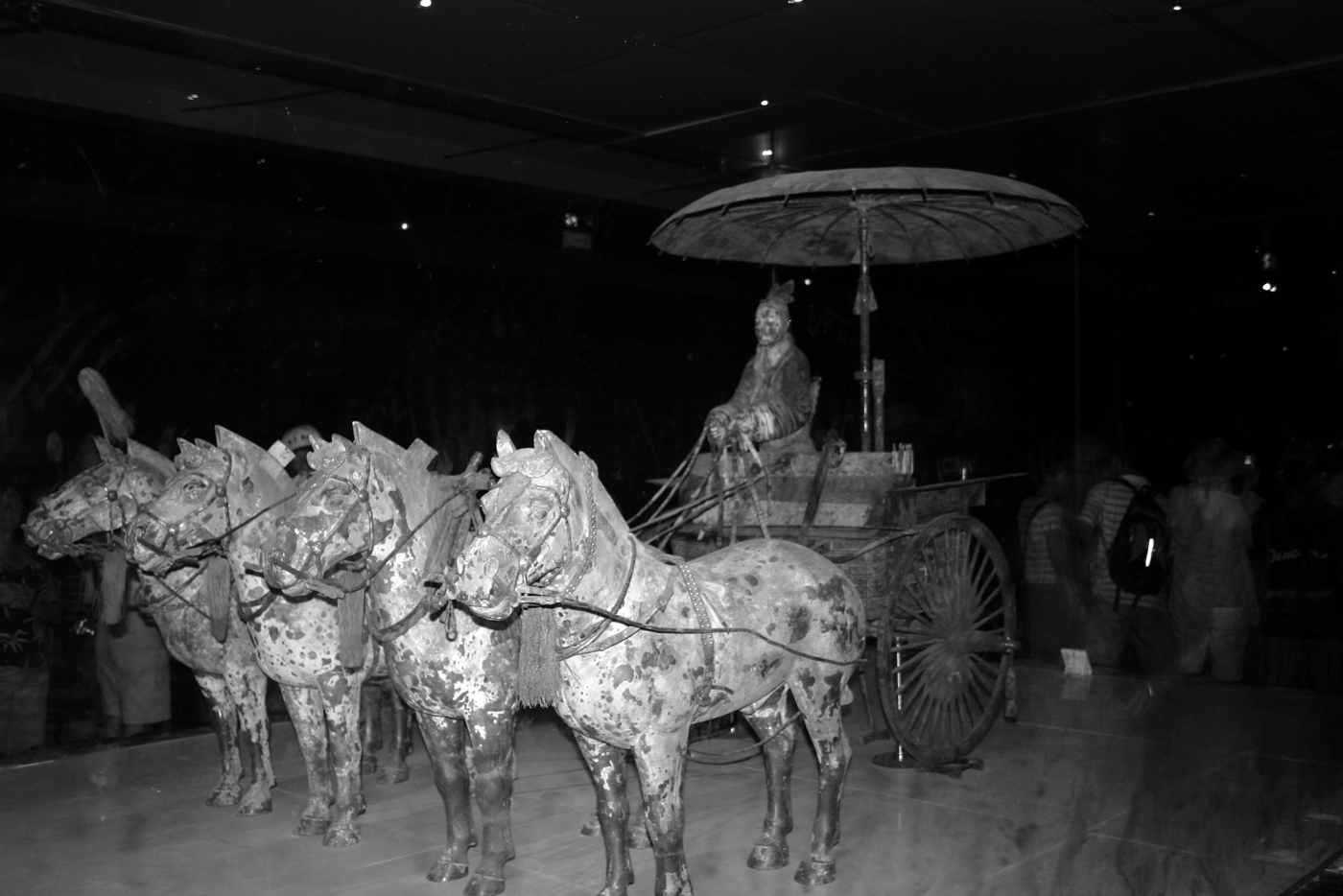
Of all the wonderful objects unearthed from the First Emperor's necropolis, nothing surpasses the two polychrome-painted bronze horse and carriage teams, one representing a military-style chariot driven by a royal guard, and the other, a comfortable traveling carriage for the First Emperor to ride in (see Figure 6). The vehicles and the horses were all fashioned at one-half scale. The former weighs 1,061 kg, and the latter weighs 1,241 kg. The construction of both vehicles is quite complex, as both are comprised of a great number of individual parts that were later joined together into assemblages. Most of these parts were first shaped by casting, and then finished by grinding, polishing, drilling, cutting, engraving, inlaying, punching, and other processing techniques. Many parts were then connected by precasting (where a premade part is placed within the mold for the casting of the next part), casting-on (where a handle or other part is cast onto an existing part, locking it into place), or soldering.Footnote 46 Although the bronze horse and carriage teams unearthed at the First Emperor's necropolis are only one-half life-size, the high degree of realism in the simulation of all their components makes people almost gasp in amazement. Using bronze to simulate a horse and carriage team, whether as an actual working object or as a piece of art, is a phenomenon never witnessed in ancient China, either in received texts or in archaeological excavations. But, faraway in the Persian Empire, atop the tomb of Mausolus, completed sometime in the 330s BCE, there is indeed a precedent. Although specific information about this gilded, two-wheeled, bronze [sic] chariot driven by statues of Mausolus and his queen can no longer be known, there is no doubt that in its form, and the very concept of having a bronze [sic] carriage, it was quite consistent with the bronze carriages found at the First Emperor of Qin's necropolis.Footnote 47
Imperial carriage and quadriggae. Qin dynasty, ca. 210 BCE. Bronze with paint. Museum of the Qin Emperor's Warriors and Horses, Lintong County, Shaanxi. Photograph by Anthony Barbieri-Low, August 4, 2005
Conclusion to Part One
When one investigates the Qin terracotta warriors and other cultural remains discovered at the site of the First Emperor's necropolis from the perspective of craftsmanship, technology, or artistic conception, one cannot discover anything similar from the Chinese cultural sphere during the same time period. Looking at the chain of development and evolution of these cultural remains, there is not only a large missing link, but also a lack of a proper logical sequence, which is quite thought-provoking.
In addition to the cultural elements of the First Emperor of Qin's necropolis described above, looking at Qin culture as a whole, including the gold objects from the middle of the Spring and Autumn period, late Spring and Autumn-period iron objects, the trough-form flat roof tiles from the Yong city site in Fengxiang County, also from the late Spring and Autumn period, the flexed form of Qin burials, the cocoon-shaped elliptical vessels from the middle Warring States period, and the Warring States to imperial Qin-period stone sculptures and inscriptions, there is a clear contrast with cultural phenomena from the Six States to the east during the same time period. Clearly, these cultural elements were not produced from the soil of the eastern cultural areas of China. Their appearance forces us to seriously consider the question: under what sort of cultural environment were all these things produced?
We have found that, regardless of how one thinks about these issues, only relying on the theory of independent cultural origins cannot adequately explain the problems raised above. If many new cultural elements appear, whether as the result of cultural exchanges, collisions, or fusions, what is the most important aspect in the overall process of cultural interchange? What circumstances will actually enable elements to be accepted by a culture, allowing for successful interchange and diffusion? The most obvious and irrefutable things that can be observed through archaeology are the material remains of these cultural elements. Of course, cultural remnants that have crystalized into material remains are relatively easy to distinguish, but, looking at the transformations that have occurred in Chinese society before and after the Chinese Revolution and Reform Period, it seems that the most important results of cultural interchange and contact between civilizations are not manifested at the material level only. In other words, the material level of interchange may not have been the most important. Rather, it is the transformations brought about by exchanges at the ideological, cultural, and institutional levels that might be far more important. For the same reason, figuring out what actually occurred in regard to cultural exchanges during the period of development of Qin culture is a problem that we need to think very seriously about.
From the sixth to the fourth centuries BCE, Central Asia and northwestern Pakistan were continuously occupied by the Persian Empire, which had established satrapies for the administration of these regions. Persian art and technology were brought into these areas, which promoted the development of indigenous technology and art. After that came the defeat of King Darius III (r. 336–330 BCE) of Persia by Alexander the Great, who then took over administration of the former regions of the Persian Empire. In 329 BCE, when Alexander's eastern campaign entered the Bactria region of Central Asia (present-day northern Afghanistan) and the Samarkand Basin (present-day Uzbekistan), he carried with him Hellenistic art, technology, and forms of governance into these areas. Perhaps, it was at this time that the two fundamentally different civilizations of East and West experienced their first great collision.
PART TWO OTHER EVIDENCE OF EAST-WEST CULTURAL INTERCHANGE IN QIN CULTURE
Just because there are many examples of Western cultural elements discovered at the First Emperor of Qin's necropolis that do not belong to Qin culture, or to Far Eastern culture in general, does not mean that East–West cultural exchange only began during the period of the Qin empire. While combing through the developmental course of Qin culture, we have discovered that from the late Spring and Autumn Period to the late Warring States period (ca. 500–222 BCE), for a period of roughly three centuries, there are relatively clear clues pointing towards ongoing Sino-Western cultural exchanges. At the beginning of the last century, when archaeological materials were still lacking, Chinese scholar Zhang Xinglang 張星烺 (1888–1951) put forward the view that, “without a doubt, there was a flourishing exchange between the Qin dynasty and the Western Regions before the time of the First Emperor.”Footnote 48 With the continuous enrichment of archaeological data, we have discovered a few important objects and craft techniques that clearly had been transmitted from West to East during this earlier period and that the state of Qin played an important role in this process due to its unique geographic location.
The currently available data makes clear that the earliest man-made iron objects (i.e., not of meteoric iron) originated in West Asia in roughly 2000 BCE, and that, after that, iron-working spread to South Asia, Europe, and Central Asia. In recent years, a relatively large number of iron objects, dating to around 1000 BCE, have been unearthed from tombs in the Xinjiang area of far northwest China. Some scholars have speculated that “China's initial iron-smelting technology, including that of the Qin State, may have been brought from outside the region.”Footnote 49 Not only have the finds of iron objects from the Qin state been more numerous than those from any of the other polities, but they are also the earliest, chronologically. From the early Spring and Autumn period, there are the iron objects from the large Qin ducal tomb at Dabuzishan 大堡子山, in Li County, Gansu, and from the Qin tomb at Yuandingzishan 圓頂子山. There is also the iron sword with bronze hilt from the Qin tomb at Bianjiazhuang 邊家莊 in Long County, the iron dagger from the Qin tomb at Changwu County, Shaanxi, as well as the iron sword with bronze hilt unearthed from the Qin tomb at Jingjiazhuang 景家莊, Lingtai County, Gansu. From the middle to late Spring and Autumn period, there are the iron shovels and spades unearthed from the enormous Qin ducal tomb no. 1 in Fengxiang County, Shaanxi, the iron spade from the Qin ancestral temple site at Majiazhuang 馬家莊, and especially the twenty-three very impressive iron artifacts uncovered from the Qin tomb dated to the early part of the late-Warring States period at Yimenbu 益門堡 village (also called Yimencun 益門村), in Baoji, Shaanxi province. The unearthed types include three iron swords with golden hilts, thirteen iron-bladed knives with golden ring-handles, two iron-bladed knives with rectangular gold handles, and two iron-edged blades with golden ring handles. After analysis, it was determined that the iron sword with bronze hilt from the Jingjiazhuang site, and the iron swords with golden handles from the Yimenbu site were carburized, forged blades made from directly reduced sponge iron, and that the iron objects from the Qin ducal tomb no. 1 and the Majiazhuang site were all made of cast pig iron. These and all the other iron objects from this period can definitely be considered to be from man-made (and not meteoric iron) materials.Footnote 50 Contemporary with these pieces, the earliest man-made iron objects from the Central Plain area include the iron sword with bronze hilt from the large incipient Spring and Autumn-period tomb no. 2001 from the Guo 虢 state cemetery at Shangcunling 上村嶺 near Sanmenxia in Henan and the iron knife with bronze handle from tomb no. 2009 at the same site. From the early and middle Spring and Autumn period in the Central Plain, we have the fragmentary iron objects found near the capital of the Jin 晉 state at the Tianma-Qucun 天馬曲村 site in Shanxi. The iron objects from the area of the Chu 楚 state all date from the late Spring and Autumn period, or the transitional period between the Spring and Autumn period and the Warring States period. From this evidence, we can see that almost all the earliest iron objects were discovered within the bounds of the Qin polity.
Moreover, flexed burials and solid gold objects seem to have followed the same route of transmission as iron production. Chinese scholar Zhao Huacheng 趙化成 considers that many elements of Qin culture, including flexed burials, the prevalence of iron smelting and iron objects, and the use of gold are all evidence for cultural interchange.Footnote 51 This conclusion has been receiving more and more recognition from scholars. In addition, we have discovered many other elements within Qin culture pointing to cultural exchange, which shall be introduced forthwith.
Trough-Form Pan Tiles for Roofing
The trough-form, pan tile for roofing, in which the two sides are sharply folded up into a raised lip, appears suddenly at the middle-to-late Spring and Autumn-period site of Majiazhuang, purportedly the Qin ancestral temple in the capital of Yong (see Figure 7).Footnote 52 This type of pan tile had not been seen previously in Qin culture and would not appear again after this time; nor has it yet been found in the cultural remains of any of the other polities of the Eastern Zhou period.
Qin Trough-Form Pan Tiles with Cover Tile. Qin state, ca. 500–400 BCE. From Majiazhuang site, Fengxiang County, Shaanxi. Photo courtesy of Duan Qingbo

During the fifth and sixth centuries BCE, the architectural building materials in the Qin capital of Yong seem to undergo a process of extremely rapid development. Not only do the types of building techniques and materials abruptly become quite rich and varied, but also the scale of construction suddenly becomes much greater. The trough-form pan tiles for roofing unearthed from the ancestral temple site at Majiazhuang is just one example of this.Footnote 53 In form, these pan tiles have a dustpan like shape, with the two sides sharply turned upward. The leading and trailing edge are of different width, which facilitates the interlocking and overlap of further tiles to the front and rear. The interior and exterior surfaces of most of the pan tiles have cord markings, though some have a triangular pattern impressed on the exterior at one end. Most of the pan tiles are about 44–47 cm long, 24–27 cm wide, with the wall of the trough extending about 4–7.6 cm upward. They are about 1 cm in thickness and weigh up to 2.75 kg each.
Even though trough-form pan tiles only appear at this one site in all of East Asia, they are very commonplace from around the sixth century BCE in the Greco-Roman world and Persian Empire in the west. Guo Qinghua and others have pointed out that in terms of typology, basic form, and special features, the trough-form pan tiles from the Yong capital site of the Qin have many similarities to Acquarossa-type (Etruscan) and Roman-type pan tiles, and that the Far Eastern trough-form pan tiles make their appearance later than the comparable Western types.Footnote 54
Scholars consider that clay roof tiles were invented in the first half of the seventh century BCE in Corinth, for shortly after 680 BCE the first known baked terracotta-tile roofing system was deployed at the Temple of Apollo at Corinth.Footnote 55 This new technology greatly improved the water resistance and fire resistance of roofing, and quickly spread to all of the areas of the Greek world. Not only that, but the technology was soon widely deployed on the Italian peninsula as well. At the Etruscan settlement site of Acquarossa (near Viterbo in Etruria), trough-form pan tiles were unearthed that date to no later than the second half of the sixth century BCE. Many features of Etruscan culture were later absorbed by the Romans. With the further expansion of Greek culture, trough-form pan roofing tiles were also discovered at the Phrygian site of Gordion in Turkey (around 90 km southwest of Ankara), dated to the middle of the sixth century BCE.Footnote 56 They have also been discovered at the site of the Macedonian capital of Pella in northern Greece, dated from around 320–300 BCE.Footnote 57 They can also be seen at the Roman period site of Burgundy in France, dated to around the turn of the common era, demonstrating that the technology of this type of tile was inherited by the Romans from Greece and then carried into France.Footnote 58 In addition, from the late Warring States period through the Qin imperial period, the practice of “quality-control and accounting inscriptions” on manufactured objects was thoroughly implemented in the state of Qin.Footnote 59 Terracotta tiles were often stamped with a designation of an official ceramic workshop, and the same phenomenon also appeared in the West during the time-period when trough-form pan tiles were popular, where some pan tiles from this period carry the impression of an official stamp.
Trough-form pan tiles for roofing appear suddenly during the middle-to-late Spring and Autumn period in China, but in Qin culture they leave no trace of their origin and disappeared just as suddenly, without seeming to have had any influence on later developments. However, in the distant Mediterranean and in the territory of the Persian Empire, this type of pan tile appeared considerably earlier and saw widespread use, with a clear sequence of development and adoption. One cannot but help to wonder whether there was some cultural interchange between the two areas.
Prohibition of “Bu-de” Sacrifices
It is almost universally accepted that Buddhism passed through Central Asia before being introduced to China; however, there is still no consensus about the exact time period of its transmission to the Central Plain. It may be possible to make a case that it arrived during the Qin period. In the “Basic Annals of the First Emperor of Qin” in the Records of the Grand Scribe (Shi ji 史記) of Sima Qian, it is recorded for the thirty-third year of the reign of King Zheng (214 BCE) that, “It was forbidden to offer sacrifice to the bu-de 不得; a comet appeared in the western sky.”Footnote 60 The earliest person to put forward the view that Buddhism had been introduced to China during the Qin dynasty was the Japanese scholar Fujita Toyohachi 藤田豊八 (1869–1929).Footnote 61 In a 1927 article, he suggested that the phrase bu-de, seen in that passage in the Records of the Grand Scribe, was a transliteration of the Sanskrit “Buddha,” which today (and since the medieval period in China) is usually transliterated as Fotuo 佛陀 or Futu 浮屠/浮圖. Thus, he considered that Buddhism had already entered China by the time of the First Emperor of Qin. Soon after Fujita published this piece, it caused a major reaction among Japanese and Chinese scholars. Chen Yinke 陳寅恪 (1890–1969), Fu Ssu-nien 傅斯年 (1896–1950), Xiang Da 向達 (1900–1966), Ma Feibai 馬非百 (1896–1984), Tang Yongtong 湯用彤 (1893–1964), Cen Zhongmian 岑仲勉 (1885–1961) and others discussed this problem.Footnote 62 There were a few who endorsed Fujita's theory, while those who opposed it were quite numerous.Footnote 63 This controversy has continued until quite recently.Footnote 64 Cen Zhongmian, in particular, had originally endorsed this theory, but after extensive further research, he concluded that the above-mentioned historical materials do not refer to Indian Buddhism, but rather to Zoroastrianism coming to China from Iran during the Qin dynasty.Footnote 65 Most scholars still consider that the reference in the Records of the Grand Scribe indicates the prohibition of sacrificial activities to some kind of star or other astrological phenomena.Footnote 66 Xin Deyong 辛德勇 thinks that the passage in question should be parsed together with the following one, resulting in, jinbude ci mingxing chu xifang 禁不得祠明星出西方, meaning that “private sacrifices to Venus (the asterism that controls the fate of military affairs), when it appears in the west, are to be prohibited.”Footnote 67
Ma Feibai believed that the casting of the famous “Twelve Bronze Men” of the Qin (see part three, below) and the Buddhism of the Western Regions were closely connected. In his compendium of Qin historical records, Ma includes the later (Sui dynasty) story that reads as follows:
In the time of the First Emperor, there were eighteen foreign sage monks, including Shi Li Fang [室利防/釋利防/釋利坊/釋利房], who brought Buddhist sutras in order to convert the First Emperor. The First Emperor would not follow their teachings, so he imprisoned them and prohibited their religion. One night, six large Buddhist warriors made of diamond came and destroyed the jail and freed them. The First Emperor was shocked and afraid, so he kowtowed before the monks and apologized.Footnote 68
According to a passage in the Weilüe 魏略 (A Brief Account of the Wei Kingdom) text (mid-third century CE) by Yu Huan 魚豢:
Formerly, in the first year of the Yuanshou reign period of Emperor Ai of the Western Han [2 BCE], a disciple of the court academicians [i.e., a student at the national academy] name Jing Lu 景盧, who was sent as envoy to the Great Yuezhi polity, received an oral transmission of the Futu jing 浮屠經 [Sutra of the Buddha] from Yicun 伊存, the envoy of the Yuezhi king.Footnote 69
This is the earliest mention in received literature of the formal introduction of Buddhism to China, but there is no relevant archaeological data to support it.
Also according to received literature, during the Eastern Han period (25–220 CE), under the reign of Emperor Ming (r. 57–75 CE), Buddhism had already entered China. In the tenth year of the Yongping era (67 CE), Emperor Ming dreamt that he saw a golden man. Thereupon, he sent men to the Western Regions to welcome the two eminent monks Jieye Moteng 迦葉摩騰 (Kāśyapa Mātaṇga) and Zhu Falan 竺法蘭 (Dharmaratna the Indian), using a white horse to carry a statue of the Buddha and Buddhist sutras. He thereupon established the White Horse Monastery in the capital of Luoyang.Footnote 70 However, judging by the statement that Emperor Ming immediately constructed a Buddhist monastery soon after the white horse brought back the sutras prompted by his dream, Buddhism must have already established a foundation in China before this point. It had just not received official recognition by the government. Therefore, the emperor's dream was just used as a pretext to spread the faith with even greater fanfare, the goal being to lend greater credibility to the unification of politics and religion.
The time period and route of transmission of Buddhism is an important subject in the study of Chinese cultural history. However, based on the existing data, it is still impossible to reach a consensus regarding the exact time, route, and recognizable signs of its introduction to China. As one possibility, Buddhism may have been introduced to China during the Qin dynasty. We put forward this possible premise, for as we have seen, the presence of Western cultural elements within Qin culture was commonplace.
Stone Inscriptions and Stone Sculpture
Before the appearance of the large-scale stone sculptures in front of the tomb of Huo Qubing 霍去病 (d. 117 BCE) of the middle Western Han period (see Figure 9), no monumental works of sculptural stone art like this had ever been seen in Qin culture or in those of the other Warring States polities.Footnote 71 There are a small number of inscribed stone artifacts from Qin culture, including the famous Stone Drums of Qin, the inscribed chime stones from the tomb of Duke Jing of Qin (r. 576–537 BCE), the “Curses against Chu” execration texts (zu Chu wen 詛楚文) from the reign of King Huiwen of Qin (r. 338–311 BCE), and, of course, the stone steles carved on mountaintops during the First Emperor of Qin's imperial tours. From within the territories of the Six States to the east of Qin, there is only the Heguang 河光 stele from the polity of Zhongshan 中山.
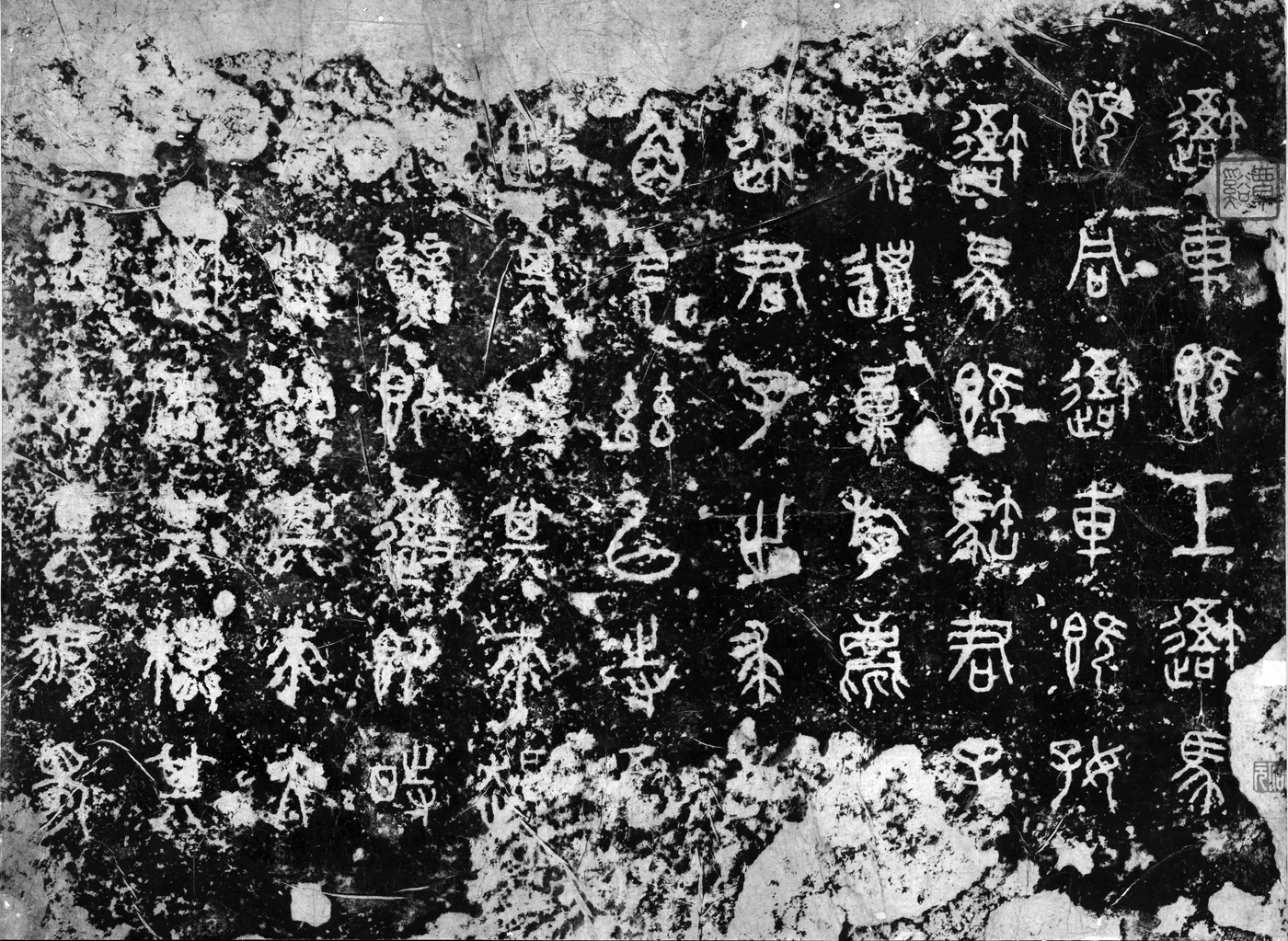
The inscribed Stone Drums of Qin are some of the most well-known of all the remains of Qin culture, but their dating has elicited great controversy (see Figure 8).Footnote 72 This assemblage consists of ten inscribed drum-shaped blocks of stone, around 60 cm in diameter and 90 cm in height. They were found during the Tang dynasty, and may have originally been installed near the Altar of Fu 鄜畤, one of the noted sacrificial altars near the Qin capital of Yong, (present-day Changqing Township, southwest of Fengxiang County), where the Qin made suburban sacrifices to Heaven (or to the different di 帝 powers).Footnote 73 They are carved with inscriptions related to historical events of the Qin, and their style of calligraphy has characteristics of an intermediate phase between Scribe Zhou's script (zhouwen 籀文) and large seal script (dazhuan 大篆). Each stone “drum” is carved with a poem in predominantly four-character lines, for a total of ten verses. The majority of the graphs on the stone drums are completely effaced. When Ouyang Xiu 歐陽修 (1007–1072 CE) recorded the inscriptions during the Northern Song period, 465 graphs were still visible, while the Ming dynasty “Tianyi Pavillion” library edition of the rubbings of the Fan family, preserved only about 462 graphs. Yet, today, on the eighth of the drums, now preserved in the Palace Museum in Beijing, not a single graph can be made out.
Inscription on Stone Drum of Qin (fifth century BCE). Ink on paper rubbing, Ming dynasty, seventeenth century CE. Metropolitan Museum of Art, accession no. 1992.166.1a, b. Photo courtesy of Metropolitan Museum of Art (CC0 license)
The oldest Qin stone inscription extant today is found carved in large-seal script on a chime-stone excavated from the tomb attributed to Duke Jing of Qin (d. 537 BCE), and its dating is not disputed. After compiling the inscription from the seventeen different inscribed chime-stones, there are twenty-six lines overall, for a total of 206 characters. They were made in 573 BCE (the fourth year of Duke Jing's reign). The main idea of the inscriptional text is that Duke Jing would carry on the Mandate of Heaven and had acquired the throne in legitimate succession from Duke Gong (r. 608–605 BCE) and Duke Huan (r. 604–577 BCE) of Qin, which had been recognized by the Zhou king. Relying on the blessings of their high ancestor, Zhuanxu 顓頊, the Qin state had pacified the peoples of the Four Quarters, and their might and prestige resounded throughout the lands of the Chinese cultural sphere (Huaxia) and even extended to those of the barbarians, who vied among themselves to be the first to submit to Qin.
There have been no further discoveries of inscriptions on stone within the territory of the polity of Qin for the two-hundred-year period after the reign of Duke Jing. It is not until the twenty-sixth year of the reign of King Huiwen of Qin (312 BCE), that we have another example (which was discovered during Northern Song times). In that year, King Huiwen of Qin ordered the invocator of the Qin ancestral temple to beseech three powerful Qin ancestral and nature spirits (Wu Xian 巫賢, Dachen Juejiao 大沈厥湫, and Wutuo 惡駝) to bring down destruction upon the polity of Chu.Footnote 74 The texts are known as the “Chu Execration Texts” (Zu Chu wen 詛楚文). Though each stone entreats a different spirit, the text on each is nearly identical, and the well-proportioned calligraphy is very close to Qin Small Seal (xiaozhuan 小篆) script. There is a slight difference in the number of graphs on each stone (only differing because of the name of each respective deity). They were buried in three separate locations: Kaiyuan Si 开元寺 in Fengxiang County, Shaanxi; Chaonaqiu 朝那湫, west of Pingliang City, Gansu; and Yaoceqiu 要冊湫, northeast of Zhengning County, Gansu. The three tablets carried 336, 318, and 325 graphs, respectively. All three tablets were lost sometime after the Southern Song period (1127–1279 CE), and today we only have transmitted rubbings of them.Footnote 75
Around a century later, during the time of the First Emperor of Qin (r. 221–210 BCE), there suddenly appear seven great stone inscriptions. After his “unification” of China, the First Emperor embarked on extensive tours of his empire, and during four eastern tours, he left behind stone inscriptions in six of the locations he passed through. These are the Jieshi 碣石 inscription, the Zhifu 之罘 inscriptions (two steles), the Mount Tai 泰山 inscription, the Langye Terrace 琅琊臺 inscription, the Mount Kuaiji 會稽 inscription, and the Mount Yi 嶧山 inscription.Footnote 76 The graphs were all carved in Qin Small Seal script, supposedly based on the brush calligraphy of the minister, Li Si 李斯. Some were carved on the living rock of mountains, while others were carved on prepared stone steles. For example, the stele erected upon Mount Tai reportedly measured three zhang and one chi (approx. 7.61 m) in height and three chi (approx. 0.693 m) in breadth.Footnote 77 When the Second Emperor of Qin made his royal progresses throughout the empire, he imitated his father's practice and appended inscriptions to those stele previously erected by his father. All these inscriptions, except for the inscription on Mt. Yi, are fully recorded in the “Basic Annals of the First Emperor of Qin” in the Records of the Grand Scribe of Sima Qian. Generally, there are three major themes in the inscriptional texts: The first is the justification that the state of Qin carried out the will of Heaven when it “unified” the land, because the other Six States to the east were all greedy and corrupt, which concerns the legitimation of the regime. The second is that the policies implemented after the conquest were all magnificent and correct, which provides the rationale for the institutions of government. The third is that by following the current institutional blueprint, the country in the future will be prosperous and the people will be strong, which demonstrates wise foresight and planning.
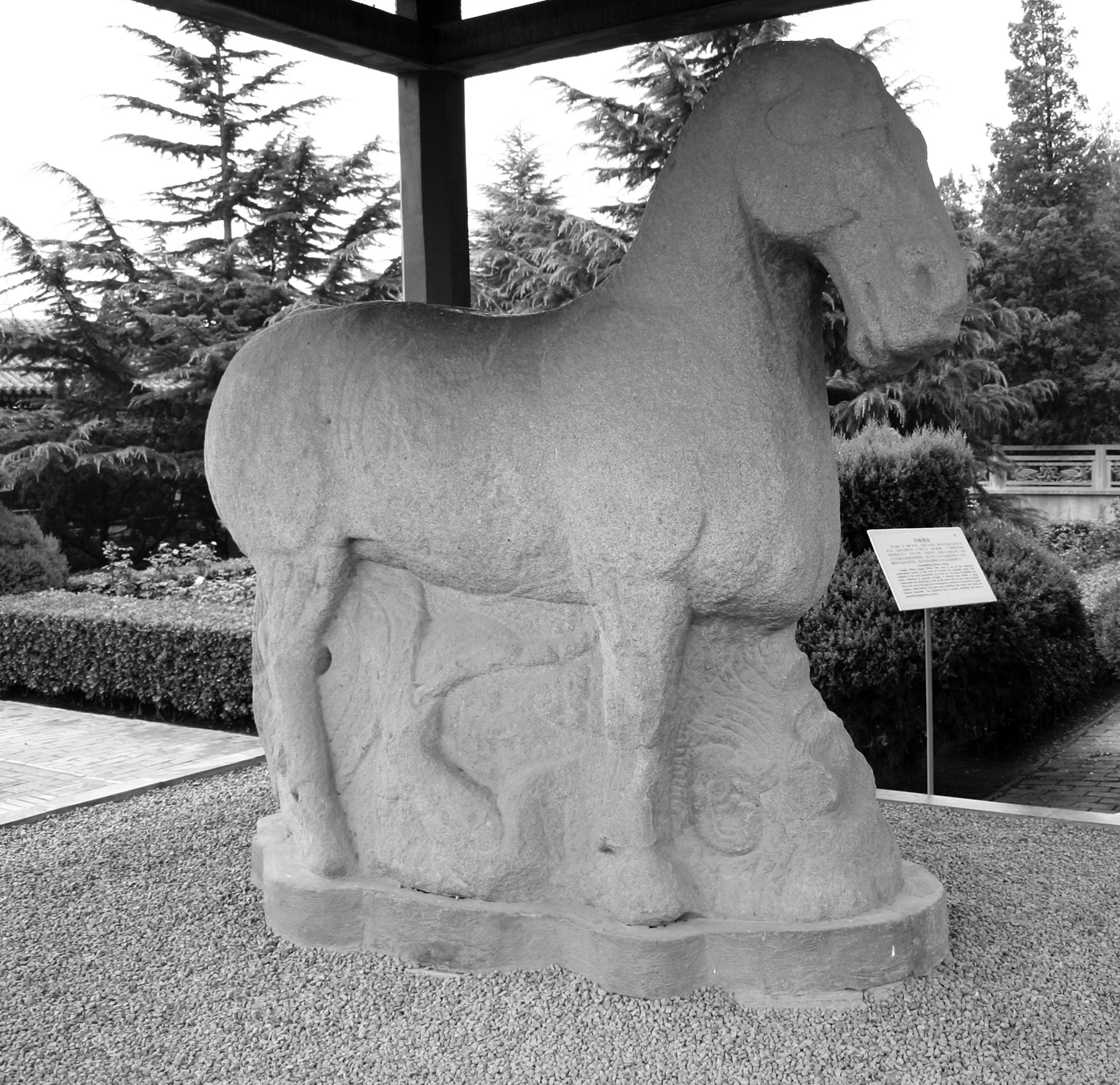
The majestic Qin dynasty tradition of stone inscriptions (and stone sculptures) suddenly disappeared without a trace after the demise of the empire. It is not until around a century later that the phenomenon reappears within the territory of an East Asian empire. The sixteen large stone sculptures in front of the tomb of the Han general Huo Qubing 霍去病 (ca. 117 BCE), are mostly sculpted following the form of the original stone (see Figure 9). They employ techniques such as sculpting in the round, raised relief, and engraved intaglio lines to carve stone sculptures of oxen, horses, pigs, tigers, sheep, a fantastic beast eating a sheep, a man fighting a bear, a horse trampling a Xiongnu warrior, and other images. It is hard to find any evidence in China for this type of crude but concise lifelike rendering before these monuments.
Horse Trampling a Xiongnu Warrior. Western Han period, ca. 117 BCE. Carved stone. Tomb of Huo Qubing, Xingping City, Shaanxi. Photo by Anthony Barbieri-Low, August 5, 2005
When we next see an example of the art of stone carving or inscription, it is with the Stone Classics of the Xiping era (Xiping shijing 熹平石經), from the reign of Emperor Ling (168–189 CE) of the later Eastern Han period. The classical texts were carved on stone steles, which measured about one zhang (approx. 2.31 m) in height and four chi (approx. 92.4 cm) in breadth, following the clerical script, brush-written draft of Cai Yong 蔡邕 (132–192 CE) and others. Altogether there were forty-six steles, totaling 200,911 graphs, including classics like the Book of Documents (Shangshu 尚書), Lu Recension of the Book of Poetry (Lu Shi 魯詩), Book of Etiquette and Ceremonial (Yili 儀禮), Spring and Autumn Annals (Chunqiu 春秋), Gongyang Commentary (Gongyang Zhuan 公羊傳), and the Confucian Analects (Lunyu 論語). The calligraphic style of the graphs was not only a major achievement in Han clerical script, as a contemporary model for standardized calligraphy, but is also significant for its deep and long-lasting influence on the calligraphic tradition. During this period, in several regions of China, there also appeared a great quantity of pictorial stone carvings.Footnote 78
Stone stele inscriptions and the art of stone sculpture not only emerged very early in places like Egypt, Persia, and the Mediterranean, but the subject matter was incredibly rich, and the technology became highly developed. Looking at materials from along the route of the classic “Silk Road,” the techniques of stone inscriptions and stone sculpture shows signs of having diffused from the West to the East. The practice was first transmitted from Egypt and Babylonia to Greece, and then throughout the Mediterranean islands and coastal areas. After that, from the territory of the Persian Empire, it spread to India during the Mauryan dynasty in the time of Ashoka, to Pakistan and Afghanistan, and finally arrived in China. The timeframe for the first appearance of the art of stone carving basically follows the pattern of “early in the West, later in the East.” And even though the techniques of stone inscriptions and stone sculpture progressively absorbed some of the local artistic characteristics of each area that they passed through in their course of development from West to East, looking at it from a purely chronological perspective, the chain of transmission from West to East is basically complete.
The Law Code of Hammurabi, which was unearthed from a secondary context in Susa, Iran, is an artifact which dates to around 1792–1750 BCE. The sculpted relief portion measures about 71 centimeters high, while the entire stele is 2.13 meters long, engraved on all sides with a long cuneiform inscription. The carving is very fine and the entire surface has been polished. The uppermost part of the stone displays a deep-relief carving of the Babylonian sun god Shamash conferring the law code upon King Hammurabi (r. ca. 1792–1750 BCE) of Babylon. The sun god is depicted as larger (than Hammurabi) and his whiskers are neatly plaited. He is adorned with a spiral-shaped crown as he sits upright, wearing a robe with one shoulder bared. He is shown in the act of conferring the magical rod and ring, emblems of authority, upon Hammurabi. Hammurabi is depicted wearing the traditional crown of kingship. His expression is solemn as he raises his right arm to declare an oath.
Because of the great antiquity of the Law Code of Hammurabi, and the great differences in terms of both space and time between that monument and the stone carvings found within Qin culture, it would be hard to say that there is any relationship between them. It is only with the stone inscriptions and stone sculptural art unearthed from within the territory of the Achaemenid Persian Empire (559–330 BCE) that we might begin to see a greater correlation with similar remains from Qin culture, which now deserves our special attention.
The Old Persian cuneiform inscription found at the site of Bost (Qala-i-Bist) in Sistan, southwestern Afghanistan, is a noteworthy inscription from the Achaemenid Persian Empire, dating from around the fifth century BCE. It was incised on a pyramidal green diorite stone that served as a standard weight measure.Footnote 79 But the monument which holds the most probable link to comparable remains within Qin culture would be the famous cliff inscription at Bisitun, set up by the Persian king Darius I (r. 522–486 BCE) (see Figure 10).
Bisitun Carving and Inscription. Achaemenid Persian Empire, ca. 520 BCE. Height 15m; breadth 25 m. Public domain photograph
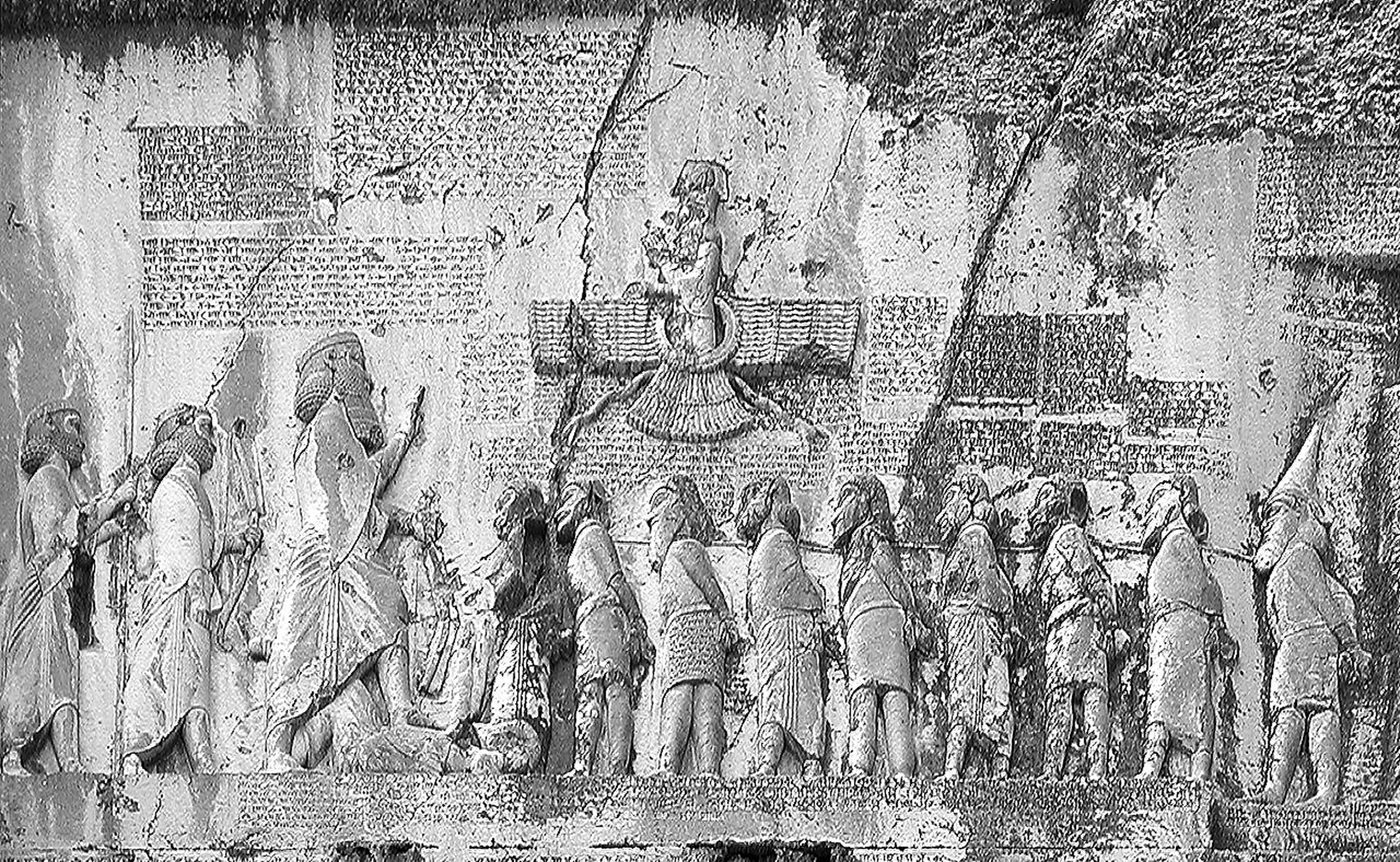
The Bisitun inscription was carved by Darius I around 520 BCE on the face of a sheer limestone cliff located near present-day Bisitun village, 32 kilometers east of Kermanshah, Iran. Darius was said to be greatly moved when he passed through this area, so he ordered men to record his merit for reunifying the empire in both words and images on this rock face.Footnote 80 The area of high-relief carving is about three meters high and five meters wide, and in general the sculpted images occupy the upper portion of the carving, while most of the trilingual text sits below the images. The relief carving shows the nine pretender kings who rebelled against Darius I and were captured (the image of a tenth defeated ruler was added later). Nine of the captives are chained at the neck by a long rope, and their hands are tied behind their backs as they face Darius. The life-size figure of Darius stands erect, his left foot trampling on the prostrate figure of Gaumata (the false Bardiya). Darius grasps a bow in his left hand, while with his right he gives gratitude and praise to a representation of the highest god Ahura Mazda in the sky (shown as a divine king within a winged solar disc).Footnote 81 As a creator god symbolizing light, Ahura Mazda holds the magic ring symbolizing legitimate kingship in his left hand and prepares to hand it to Darius. The lengthy inscription is carved in three languages using cuneiform script: Old Persian, Elamite, and Akkadian. The main content of Darius's inscription relates the following: testifying that he (Darius) is the legitimate king in the Persian succession; boasting of his military exploits in nineteen wars in a single year and the capture of the nine rebel kings; signifying his receipt of a heavenly mandate from Ahura Mazda; and emphasizing the inviolability of his divinely ordained kingship. When the beginning of his inscription states, “I am Darius, the Great King, King of Kings, King in Persia, King of All Countries,” this naturally leads one to think of the similar content in the First Emperors of Qin's inscribed steles from his eastern tours. The Central Asian inscriptions of the edicts of the Mauryan king Ashoka the Great (r. ca. 268–232 BCE) and the Greek recensions of these that were found in Afghanistan (the Chehel Zina Greek-Aramaic bilingual inscription and the Greek-only inscription, both near Kandahar), as well as other Greek [private-dedication inscriptions on metal vessels] from the Gandharan region of northwest Pakistan are the closest in geographic proximity to the stone inscriptions found in the Qin culture.Footnote 82 They can be roughly dated to between 260 and 232 BCE and certainly can't be earlier than 329 BCE (the date of commencement of Alexander the Great's Central Asian campaigns). They are all later than Duke Jing of Qin's chimestone inscriptions, but earlier than the First Emperor of Qin's steles from his eastern tours.
After sifting through all the information presented above, we realize that commemorating events with stone inscriptions had a very long history in Egypt, Greece, and West Asia, and the high level of achievement in the art of stone sculpture in Greece, Rome, and Persia is quite well known. But what we want to know is this: why does the Qin state, which was located at the far western corner of the Chinese cultural sphere, develop a tradition of commemorating events through stone inscriptions (even though the remains show some discontinuity, it probably was always present), when none of the other states to its east had done so? And why was the art of carved stone illustration so rare in central China before the end of the Eastern Han period? Scholars of the previous generation (like Cen Zhongmian) had already incisively recognized that the creation of stone stele carving in China must have received some influence coming from the West.Footnote 83 When the Stone Drums of Qin make an appearance, the inscriptional form and technique is already exquisite and highly advanced. Just as was the case with the sudden appearance of bronze vessels in China, this must have been the result of learning from foreign models from beyond the frontiers.
Elliptical Cocoon-Form Flasks
As a container for holding liquids like water, wine, or oil, the elliptical cocoon-form flask is relatively complicated to manufacture, but carries the advantages of ease of pouring liquids in and out, a relatively large capacity, the ability to withstand relatively high external pressure, as well as the convenience of being highly portable without being easily damaged.Footnote 84 Those cocoon-form flasks discovered so far (from the middle to late Warring States period) have mostly been found at sites in the core area of Qin culture (i.e., Guanzhong), as well as in the expanded zone of Qin culture.Footnote 85 This type of small-mouthed, broad-bellied ceramic vessel, with the belly taking a form similar to a silkworm cocoon, maintains a relatively stable vessel shape over its period of development. Only rarely do we see examples fashioned in bronze, such as the vessel excavated from the tomb of a chief of the Rong at the Majiayuan 馬家塬 site. They can be divided into types with a slightly flattened circular base (see Figure 11 left) or those with a ring-footed base (see Figure 11 right).
Cocoon-Form Flasks. Left: Qin Imperial Period, ca. 221–210 BCE. From First Emperor of Qin's Necropolis. After Qin Shihuangling kaogudui 秦始皇陵考古隊, eds., “Qin Shihuangling xice ‘Lishan shiguan” jianzhu yizhi qingli jianbao” 秦始皇陵西側「麗山飤官」建築遺址清理簡報 [Preliminary report of the clearing of the architecutural site of the Lishan Provisioning Office on the western side of the mausoleum of the First Emperor of Qin], Wenbo 1987.6, 17 Figure 143. Right: Late Warring State period, ca. 250–221 BCE. From Yilipo tomb no. 3, Ankang County, Shaanxi. After Li Qiliang 李啟良, “Shaanxi Ankang Yilipo Zhanguo mu qingli jianbao” 陝西安康一里坡戰國墓清理簡報 [Preliminary report of the cleaning of the Warring States tomb at Yilipo, Ankang County, Shaanxi] Wenwu (1992.1), Figure 3.5

In general, the vessels are not that large, with most being around 30 centimeters in breadth. The only exception to this is the more than twenty examples exceeding 60 centimeters in diameter excavated from sacrificial pits next to the large (probably royal) late Warring States Qin tomb at the Shenheyuan 神禾塬 site, in the Chang'an district of present-day Xi'an. Some of the ceramic cocoon-form flasks from that site also carry polychrome painted decoration on the exterior.Footnote 86 The cocoon-form flask first appears during the middle Warring States period (late fourth–early third centuries BCE) and its use extended to the middle of the Western Han period (ca. 100–50 BCE). Most examples have come from burials. After the middle Western Han period, they seem to disappear completely.
Actually, the earliest type of cocoon-form flask appeared in the Guanzhong area during the middle-to-late Western Zhou period (ca. 900–771 BCE). The Qijia 齊家 village hoard in Fufeng County yielded one ceramic cocoon-form flask, and the bronze hoard site in Wugong County yielded four cocoon-form vessels.Footnote 87 I have not seen any report of a find of a cocoon-form flask from the Spring and Autumn period, and it is only by the middle Warring States period that they once again make an appearance. At the bronze foundry site of the Jin state at Houma 侯馬, archaeologists discovered a huge cocoon-form vessel, which was probably a water storage jar.Footnote 88 This type of vessel was produced once more within the Qin culture of the middle Warring States period, where it flourished and underwent further development.
According to the archaeological finds, cocoon-form flasks were quite rare before the middle-to-late Warring States period. Although a similar oviform vessel was unearthed from the enormous tomb no. 1001 at the Xibeigang royal cemetery near Houjiazhuang 侯家莊 (ca. 1200 BCE) at the last Shang dynasty capital near Anyang, Henan, the further development of this form was not continuous or smooth, probably because of the difficulty in manufacturing vessels of this shape. It was only during the middle-to-late Warring States period, especially after it was accepted into Qin culture, that this vessel form was able to achieve widespread endorsement and rapid dissemination.
Far away, in the islands and coastal areas of the eastern Mediterranean, there existed a type of cocoon-form flask that was similar in size and shape to those examples found in Qin culture (see Figure 11). It was prevalent between the tenth century BCE and second to third centuries CE. The body was made of earthenware, and the exterior was frequently polished and sometimes painted with exquisite designs (see Figure 12).
Barrel-Shaped Jugs from Cyprus: (a) Cypro-Geometric III (ca. 850–750 BCE). H. 24 cm. Metropolitan Museum of Art, accession no. 74.51.495. (b) Cypro-Archaic I (ca. 750–600 BCE). H. 35 cm, L 32 cm. Metropolitan Museum of Art, accession no. 74.51.517. Photographs courtesy of Metropolitan Museum of Art (CC0 license)
The island of Cyprus is the easternmost island in the Mediterranean. It faces Greece, Turkey, Syria, Lebanon, Israel, and Egypt across the sea. Since ancient times, it has been a transport hub connecting the Middle East, Africa, and Europe. In Ancient Greece, the cocoon-form flasks popular in this area (called by European scholars “barrel-shaped jug” or “barrel-shaped vase”) are dated to between 950–600 BCE (see Figure 12). Their outward form is very similar to that of the cocoon-form vessels found in Qin culture.
The mouth is often flared out and trumpet-shaped, the belly looks a bit like a silkworm cocoon, and the base is curved, without a ring-foot pedestal. The body of the jug is often painted with bird, floral, and other plant designs, and some pots are also equipped with a filter (Figure 12b). This type of vessel is most often found in tombs, so it is speculated that the jugs contained offerings for the deceased. The size of these vessels varies. The small ones are considered to have served as perfume containers, while the larger ones probably were used to store and transport liquids like wine and olive oil. Some scholars think that this vessel type was first developed within the indigenous civilization on Cyprus, but strongly under the influence of Mycenaean culture.Footnote 89
There is a relatively high degree of formal similarity between the cocoon-form (barrel-shaped) jugs of the Eastern Mediterranean and the comparable vessels found within Qin culture, where most examples have also come from a funerary context. However, due to limitations in the collected evidence, we cannot yet sort out the development and distribution of similar artifacts in the Mediterranean region, nor in the domain of the Persian Empire. However, when such distinctive artifacts with similar shapes and functions appear in areas separated by such distances, with one situated at the far eastern edge of the Mediterranean and the other at the far western part of China, it certainly stimulates the imagination.
Conclusion to Part Two
After combing through all these diverse materials, we can confirm that there is a consistently high degree of similarity between cultural elements such as ironware, the use of gold, flexed burials, trough-form pan tiles, elliptical cocoon-form flasks, stone inscriptions, and stone sculpture seen within Qin culture and comparable elements from Achaemenid Persia and from the far-off Mediterranean coastal areas. Based on this, it can reasonably be inferred that starting from at least the Spring and Autumn period, there have been frequent and in-depth exchanges between Eastern and Western civilizations.
Documentary and archaeological evidence makes it clear that the oasis Silk Road, which first passes through the Hexi Corridor area, had already become a route of cultural exchange between East and West during an even earlier time period. From the thirteenth to fourth centuries BCE in Xinjiang, the use of adobe building materials, which had diffused from the West, became widespread. At the same time, many figurines of humans and animals appeared in this area. Furthermore, in the 1970s, from the Plains of Zhou area of Shaanxi province, people discovered two human figurines carved from bone with high-bridged noses and deep-set eyes which were not carved using traditional techniques known in the Central Plain of China. In the Baoji area of Shaanxi, many tombs from the Western Zhou period have yielded glass objects which, based on elemental analysis and clay-core residues, were made locally in China but employed a technology which ultimately derives from West Asia. Finally, we see that before the time when the flexed corpse burial style became widespread in the Qin culture of the Land within the Passes (Guanzhong) area, this burial style was frequently found in both Xinjiang and Central Asia. According to one modern scholar, all these phenomena suggests that the geographic field-of-view of the Chinese people during the Warring States period could be said to reach the Arctic Circle in the north, the southern hemisphere to the south, Mesopotamia and the Mediterranean in the west [incorporating the northwest portion of South Asia], and Korea and Japan in the east, or even farther afield.Footnote 90
PART THREE DARIUS THE GREAT AND THE FIRST EMPEROR OF QIN
The establishment of the Qin empire cannot be considered simply as the inevitable result of societal evolution in China since the Spring and Autumn and Warring States periods, but must be seen as a pioneering innovation, a decisive rupture with the traditions of the past in terms of political and cultural forms. If one seeks to understand the political and institutional civilization, as well as the artistic forms and technological innovations created during the Qin period, it is necessary to examine Qin culture in the context of the developmental sequence of the evolution of Chinese civilization, but it is even more imperative to broaden one's horizon and carry out objective analyses that always take care to consider the patterns of Greco-Roman, Persian, or Indian civilizations.
Comparison of Ruling Ideology and Policies of Darius I and the First Emperor of Qin
Through the conduit of the Silk Road, certain material cultural elements that were appreciated in both the East and the West were able to achieve acceptance and spread, and we can confirm this with textual and archaeological evidence. But my question is this: Is the fusion, interchange, and dissemination of these kinds of material cultural elements really the most important and crucial aspect in the process of civilizational interchange?
Upon comparison, we discover that the series of reform measures adopted by Darius I after he “unified” the Persian Empire during the sixth century BCE, and the institutions established by the First Emperor of Qin after his “unification” of China three hundred years later, show a surprisingly high degree of similarity with some being almost identical. Aspects of concrete knowledge as well as their underlying ideological principles, such as the First Emperor of Qin's ruling ideology, the actual system of government, and its administrative measures had perhaps been deeply influenced by the Persian Empire. This outcome may be related to the eastern campaigns of Alexander the Great of Macedon.
Basic Survey of the Two Empires
Referring to himself as “King of Kings” and “King of Countries,” Darius I (ca. 550–486 BCE; r. 522–486 BCE) was the third ruler of the Achaemenid Persian Empire (550–330 BCE). He not only established a great empire spanning the three continents of Europe, Asia, and Africa, that extended from Afghanistan and the Indus Valley in the east, to the Aegean Sea in the west, to Egypt in the southwest, and to the southern coasts of the Caspian Sea and Black Sea in the north, but also integrated the diverse and heterogenous cultures within the empire's territory into one effectively functioning system. In order to administer a colossal empire with more than seven million square kilometers of territory and a population of fifty million people,Footnote 91 enabling more economically developed areas like West Asia and Egypt to integrate and develop together simultaneously with those areas like Iran and Central Asia which were still in “slave society” or more primitive stages of socio-economic development, Darius instituted from the beginning of his reign a series of reform measures, ranging from governmental systems to culture, that ensured the effective operation of the imperial system during the succeeding two hundred years.Footnote 92 The “pioneering” systems that he established in areas such as provincial administration, military districts, currency, taxation, law, and writing, deeply influenced later world empires like the Macedonian Empire of Alexander the Great, the Seleucid Empire, the Roman Empire, the Arab Empire, and the Ottoman Empire.Footnote 93
From the time when the First Emperor of Qin (259–210 BCE; r. 246–210 BCE) first took control of the unified empire in 221 BCE, he carried out a thorough reform of all governmental, economic, and cultural systems, moving from “theory” to “practice” with unprecedented daring, enabling the former Six States of the east, which had possessed very different cultural traditions as well as political systems and economic institutions, to be well incorporated into the framework of the newly established empire and then to operate smoothly, producing an efficient, centralized regime that could administer a territory of over 4.5 million square kilometers with a population of over twenty million.
With decisive courage, he completely discarded the institution of territorial enfeoffment based on patrilineal kinship regulated by the ancestral temple that had predominated for over eight hundred years, and he boldly established a centralized political system under the autocratic control of an emperor, administering the state under the guiding ideology of the legal system, which played a vital role in cementing political and economic unity as well as cultural identity within the empire's territory.Footnote 94 During the following two thousand years, this political system had a strong and lasting influence on the development of Chinese society.
Restructuring the Form of Government
The most fundamental reform measure of both Darius I and the First Emperor of Qin was political restructuring. They each established a comprehensive, centralized political system for the empire in which an autocratic ruler presided over a provincial administration. These two great empires of the East and West shared the ideological and legal principle that all secular power flowed from the sole person of the emperor.
The Persian Empire allowed conquered territories to maintain a certain degree of autonomy, based upon a fundamental acknowledgement of the emperor's supreme authority, similar to the Chinese idiom, “So long as the whole is unified, the subordinate unit can govern itself.” It was Darius I who first established the system of provinces, dividing the empire into more than twenty satrapies.Footnote 95 Each satrapy was provided with a governor (satrap), who was in charge of administrative and legal affairs, a military general, and a taxation official.Footnote 96 The power of these three officers was segregated, and their power was checked by a system of mutual supervision. The satrap was personally appointed by the emperor, on either a hereditary or non-hereditary basis, usually drawn from the body of Persian noblemen. He was charged with maintaining law and order and economic prosperity in his province, as well as having authority as supreme judge in legal decisions and for the creation of coinage. Each of these three appointees to the provinces was aided by an assistant who was sent by the emperor, but since this assistant was responsible directly to the emperor himself, he really acted as the emperor's personal agent or spy.
For the administration of the central government, the Qin Empire adopted the system of the Three Excellencies (sangong 三公) and the Nine Ministers (jiuqing 九卿), which were senior officials appointed by the emperor to run each ministry, and their posts were never hereditary.Footnote 97 There was a clear separation between those in charge of government affairs, military matters, and inspection/oversight, so that the Chief Minister (chengxiang 丞相), the Grand Commandant (taiwei 太尉), and the Imperial Prosecutor (yushi dafu 御史大夫) were not subordinate to each other but did provide checks upon each other's power.Footnote 98 They were all responsible directly to the emperor, allowing all political power to be concentrated in his person. In terms of regional administration, the First Emperor completely eliminated the institution of territorial enfeoffment and comprehensively implemented the system of commanderies (jun 郡) and counties (xian 縣) that had been adopted by several polities of the East Asian subcontinent since the Warring States period. Under the Qin system, the emperor appointed the chief administrators of each region. For each commandery, he appointed a Governor (jun shou 郡守), a Commandery Commandant (jun wei 郡尉), and censorial officials, separating the responsibilities of government affairs, military matters, and oversight/inspection.Footnote 99 These officials were not subordinate to one another but did supervise and provide checks upon each another. Below the level of the commandery, the Qin established counties (xian 縣), each headed by a County Magistrate (xian ling 縣令 or xian zhang 縣長), along with a County Commandant (xian wei 縣尉), and an Assistant Magistrate (xian cheng 縣丞).Footnote 100 Each county was further subdivide into a certain number of districts (xiang 鄉), which oversaw a group of constituent villages/wards (li 里) as well as police stations (ting 亭). The creation of this comprehensive and powerful system of regional administration ensured the implementation of the First Emperor's ruling principles. The establishment of the commandery and county system enabled China for the first time to truly realize the concept of a definitive “territorial domain.” The notions of “All under Heaven” and the “Four Quarters” were now given concrete existence and were no longer just fantasy. The idea of the Great Unity (da yitong 大一統) has since then become one of the core concepts of Chinese culture.
Just as Darius I considered himself to be the “King of Kings, King of Countries,” the First Emperor of Qin considered that, since he had personally unified the Six States, his “virtue was greater than that of the Three Sovereigns of antiquity and his merits exceeded those of the Five Emperors.”Footnote 101 Thus, his self-coined appellation of August Thearch (huangdi 皇帝), which proclaimed a divine right of kingship through spiritual connection and absolute authority, received unquestionable confirmation. And similar to the Persian royal lineage, where we have the likes of Cyrus I (r. ca. 600–580 BCE), Cyrus II (r. ca. 559–530 BCE), Darius I (r. 522–486 BCE), Darius, II (423–404 BCE), and Darius III (r. 336–330 BCE), the Qin Empire abolished the practice of ministers evaluating the sovereign and sons passing judgment on their fathers that was inherent in the so-called “models for conferring posthumous titles” (shifa 謚法) system, and based on the pattern of royal titles of the First Emperor of Qin (Qin Shihuang 秦始皇) and Second Emperor of Qin (Qin Ershi秦二世), they hoped to realize the wish of “infinite succession.”
Reform of Economic Institutions
The Persian and Qin empires both adopted economic policies to standardize taxation and unify currency. Darius I implemented measures that set a fixed quota for tribute from each satrapy and established a standardized currency. In terms of taxation, people from the Persian heartland enjoyed some privileges, for it appears that they only paid taxes in kind (e.g., gain and livestock) and not in silver. Other regions also had a set tribute in specific products (in addition to the quota of tribute silver). For example, Egyptian tribute was heavily weighted toward submission of grain; Armenia was to send horses; Media was to send sheep; and the Indus Valley was to submit ivory, etc. Each year, the empire could garner in tribute the equivalent of 14,560 Euboean talents of silver (each Euboean/Attic talent equals around 25.86 kg) or 376,522 kg. of silver.Footnote 102 With respect to the currency system, Darius I standardized this as well. Currency was divided into three types: gold coinage, silver coinage, and bronze coinage. The minting of gold coins (Dareikos stater; “daric”) was a monopoly of the central government, and they circulated throughout the empire. Each satrapy could mint its own silver coinage (siglos), and each autonomous city could mint its own bronze coins, and these silver and bronze coins circulated within a particular region. The form of both the gold and silver coins was round.Footnote 103 In addition, Darius I standardized the units of weight and measurement for the entire empire, based on the standards of Babylonia.
The Qin empire appears to have recognized the private ownership of land. Members of society fulfilled their obligations to the state in the form of in-kind taxation of agricultural fields, a poll tax paid in coins, military conscription, and labor service. After the state unified the currency system, the authority to cast coins belonged exclusively to the central government, and private casting of coins was severely punished. Currency was divided into the two categories of bronze and gold, where yellow gold bullion (measured in yi 鎰) was considered the premier currency, and bronze coins were considered the lesser currency. The standardized bronze coin (banliang 半兩) was round with a square whole in the middle.Footnote 104 Gold bullion appears to have been used primarily for rewards for service and gifts from the emperor, whereas bronze coinage was the principal medium of exchange circulating throughout the empire. In order to improve the development of the economy within the empire's territory, the First Emperor of Qin implemented policies to unify all weights and measures during the first year of the declared empire (221 BCE), along with those to standardize coinage, written characters, and the axle gauge of carriages, basically using the standards of the former Qin kingdom for each of these and disseminating them throughout the empire. In terms of economic measures, the First Emperor implemented the empire-wide policy, which had been practiced in Qin since the times of Lord Shang's reforms (mid-fourth century BCE), of “elevating agriculture and rooting out the peripheral occupations” through a concerted effort to emphasize agriculture and suppress commerce. After implementing these reforms, within six or seven years, the empire achieved its objective of a more stable society and was able to (according to Chief Minister Li Si) “reduce legal punishments and lessen tax burdens.”Footnote 105
Reform of the Legal System
Although both great empires implemented a unified, empire-wide legal system, the Persian Empire stipulated that so long as they abided by the foundational pan-empire law, various regions were still allowed to continue their own legal traditions. Darius I strengthened the monarchial tradition which asserted that the will and commands of the king have the force of law, and although the law code that Darius created is no longer extant, this code was still seen as an authoritative legal text in the Seleucid kingdom until the end of the third century BCE. In this code, Darius also established a supreme court as well as regional legal courts.Footnote 106
The relative perfection and implementation of legal norms and legal institutions had, since the time of the reforms of Lord Shang, assured the fundamental success of the Qin in military, economic, and political affairs. After the establishment of the empire in 221 BCE, the First Emperor took the statutory law of the Qin state as the foundation and supplemented it with certain legal provisions borrowed from the former Six States, formulating and promulgating a unified, empire-wide law code. In the words of the First Emperor's inscription from Mount Zhifu, “Far and wide he dispensed his enlightened laws to bind together and regulate All under Heaven, standing as an eternal model.”Footnote 107 The Qin wooden boards and slips excavated from the sites of Shuihudi 睡虎地, near Yunmeng, Hubei and the site of Liye 里耶 in Hunan, which extensively copy or quote from the laws, demonstrate that Qin law did indeed see widespread implementation throughout the empire.
Reform of Military Institutions
The notion that the emperor was the supreme commander of the military was manifested in both great empires, East and West. The Achaemenids divided the empire into five military districts, but each garrison was under the control not of the local satrap, but the central government. The empire implemented universal, compulsory military service. The armed forces were separated into an imperial guard charged with protecting the royal family, a standing army that was responsible for empire-wide defense, and various regional armies that garrisoned certain provinces. The army was organized under four classifications: the ten-thousand elite “Immortals” of the imperial guard, divisions of one thousand men, companies of one hundred men, and platoons of ten men.Footnote 108 Persian men formed the core units of both the infantry and the cavalry.
The army of the Qin Empire consisted of three branches: the infantry, the chariot corps, and the cavalry, which were divided between the imperial core and a regional defense system. All military authority was concentrated in the person of the emperor, who appointed and removed military officials at will. But he also delegated his authority and mobilized the army through the use of two-part “tiger tallies,” which gave generals supreme authority over their troops. The source of soldiers was mostly through the conscription system, whereby adult men were enrolled on “service registers” (fuji 傅籍) and were required to serve a fixed period of time in military service or on guard duty for the empire.
Reform of Written Language
Standardizing the written language was a cultural measure implemented by both empires. In order to resolve the difficulties posed by the presence of numerous ethnic groups and the different languages and scripts used throughout the empire, Darius I designated the Aramaic language, which was popular in West Asia at that time, as the official administrative language of the empire, used to issue edicts and in official documents. But, at the same time, he allowed each region to continue to use their local language for routine, everyday matters.Footnote 109 Even in the imperial core of Persia, Old Persian, Elamite, and Akkadian cuneiform scripts, Egyptian demotic, as well as Aramaic and Greek alphabetic scripts were in simultaneous use. This is clearly demonstrated in Darius I's famous cliffside royal inscription at Bisitun that recorded his great accomplishments, in which three different cuneiform scripts (Old Persian, Elamite, and Akkadian) were employed in parallel registers (see Figure 10). During the reign of Darius I, the Persian language surprisingly did not become the lingua franca of the entire empire and did not have a special status in government.
The Qin Empire devised their Small Seal script, based on the form of written graphs prevalent in the Qin state, and promulgated it throughout the empire as the official writing system.
Reform of Communication Systems
A shared pursuit of both great empires was the construction of a quick and efficient transportation network. To facilitate the dispatch of troops to and from the various satrapies and to efficiently transmit information, Darius I constructed a “Royal Road” throughout the entire empire, establishing courier stations and hostels along the route. The more than 2,500 kilometer Royal Road from the Aegean Sea (at Sardis) to the capital of Susa was outfitted with over one hundred courier stations.Footnote 110 Within three days, one could transport seafood from the Aegean Sea to the imperial kitchens. This stretch of road eventually formed the far western stretch of the later Silk Road. He also constructed a Royal Road from Babylon, across the Iranian Plateau and traversing up into Bactria and down to the Indus Valley. The Persians also initiated a “maritime Silk Road,” sending men to survey the sailing routes from the Indus River to Egypt, and completed a canal (begun by pharaoh Necho II [r. 610–595 BCE]), from a branch of the Nile River in the Delta (at Bubastis) to the Red Sea, an ancient predecessor of the modern Suez Canal.Footnote 111
Soon after the establishment of the Qin empire in 221 BCE, the First Emperor “demolished city walls and fortifications, opened up waterways, cut through embankments, and leveled the steep declivities.”Footnote 112 Beginning the next year in 220 BCE, the Qin emperor ordered the construction of an Imperial Highway (chidao 馳道; lit. “road for galloping”), centered on the capital of Xianyang, which branched throughout the entire empire: “To the east it extended to the territories of Yan and Qi; to the south, it extended to the lands of Wu and Chu. It skirted all the rivers and lakes of the realm and extended all the way to overlook the seashore.”Footnote 113 The famous Imperial Highway system of the Qin incorporated the Shang Commandery Road, the Linjin Road, the Eastern Road, the Wu Pass Road, the Qin Cliffside-Plank Road, and the Western Road. In addition, in 212 BCE, the First Emperor began construction of the Direct Road (zhidao 直道), which traveled from Jiuyuan (in Inner Mongolia) to Ganquan Mountain (in Yunyang) near the Qin capital of Xianyang (about 1,000 km), reportedly built by “leveling the hills and filling in the valleys, so it could travel in a straight line.”Footnote 114 With the exception of the Direct Road and the Cliffside-Plank Road (to Sichuan), most of the Qin imperial roads were built upon the foundations of former roads in the Qin heartland, following old roads belonging to the Six States, or along routes constructed by the Qin during its campaigns against them. The Qin Imperial Highways were “fifty paces broad, spanning three lanes, with trees planted every three zhang (approx. 7 m). The roadbeds were tamped down into a convex profile with heavy metal hammers, and the trees were mostly pine.”Footnote 115 There were also standardized regulations on the width and quality of roads, as well as some concerning their safety and defense. In addition, to enable transport to the Lingnan area of the far south, the Qin constructed the Magic Canal (lingqu 靈渠) connecting the Xiang River (a tributary of the Yangzi River) to the Li River (at the headwaters of the Pearl River watershed).
Religious Reforms
After the re-establishment of the empire by Darius I, the Persian Empire pursued parallel policies of promoting the state religion while also allowing regional religious diversity. During the imperial Qin period, no true formal religion had taken shape, for “primitive” polytheistic worship of multiple deities and spirits still predominated. Specifically, the Qin Empire carried out sacrifices to the nature spirits of mountains, caves, rivers, and celestial phenomenon of the original Qin state's territory as well as to the nature spirits of the former Six States to its east.
Although Darius I promoted Zoroastrianism as the official state religion and worshipped Ahura Mazda, the god of light, truth, and joy, enabling Zoroastrianism to be transmitted widely within the territory of the empire, he took no measures to persecute the indigenous religions of the territories under his control.Footnote 116 By effectively preserving the indigenous deities and religious practices of each region, Darius I greatly stabilized the social foundation of newly conquered frontier territories.
After the establishment of the empire in 221 BCE, the First Emperor of Qin continued sacrifices to the spirits of the previous kings and dukes in the Qin royal lineage and to the nature spirits of famous mountains and rivers in Qin territory, but he also carried out sacrifices to the nature spirits of the former Six States to the east, especially those centered in the former territory of the Qi polity. He did not establish a unified sacrificial system for the empire.
These two outstanding political leaders in eastern and western ancient history, who were separated by more than three centuries, and who were operating in entirely different historical contexts and under very different cultural traditions, each adopted a series of reform measures after their consolidation of the empire, which in terms of ideological principles, strategies, and actual implemented measures, give one the impression of remarkable similarity—like two carts running in the same track. This might not be an accidental coincidence at all.
Reasonable Speculation Concerning East–West Cultural Interaction during the Reign of the First Emperor of Qin
In 330 BCE, the Persian Empire, which had persisted for 220 years, was conquered by Alexander the Great of Macedon. After he incorporated the Persian Empire into his realm, this new master of the state inherited and basically continued the entire political and administrative structure of the former Persian Empire, and like Darius I, Alexander also conquered east to the Indus River valley. It was perhaps at this time that Persian, Greek, and Chinese culture collided with each other and experienced a series of interchanges.
Concerning the Encounter with the Men of Great Stature
In the “Treatise on the Five Phases” (Wuxing zhi 五行志) in History of the Han (Han shu 漢書) of Ban Gu 班固 (32–92 CE), the following extraordinary occurrence is recorded:
In the twenty-sixth year of the reign [of King Ying Zheng of Qin; i.e., The First Emperor] (221 BCE), men of very great stature, five zhang in height (approx. 11.55 m) and leaving six chi (approx. 1.37 m) long footprints on the ground when they walked, all wearing foreign robes, twelve men in all, appeared in Lintao 臨洮 (present-day Min County, Gansu). This was an admonition from Heaven that said something like, “You must abstain from barbarous policies, or you will meet with disaster!” In the same year, the First Emperor succeeded in conquering the Six States, so he was actually overjoyed at this strange appearance and took it as on auspicious omen instead. Thereupon, he melted down the impounded weapons of All under Heaven and cast twelve bronze statues of men to represent them (viz., the men of tall stature from Lintao).Footnote 117
This text may be one of the most important and most direct pieces of evidence for the process of cultural interchange between China and the West; but because of its exaggerated description of “giants,” it has not attracted appropriate attention. Most scholars associate it with the mention in the Records of the Grand Scribe of Sima Qian in which the First Emperor of Qin, after he had united All under Heaven, confiscated the weapons of the defeated states and amassed them in Xianyang, casting twelve enormous bronze statues of men.Footnote 118 And even though it is true that the comparatively earlier text in the Records of the Grand Scribe states that
Weapons from all over the empire were confiscated, brought to Xianyang, and melted down to be used in casting bells, bell stands, and twelve men made of bronze. These last weighted 1,000 shi (approx. 29,760 kg) each and were set up in the palace. All weights and measures were standardized, the gauge of wheeled vehicles was made uniform, and the writing system was standardized.
That passage, however, does not mention anything about encountering “men of great stature” in Lintao.Footnote 119
The general circumstances of this incident might be as follows: In 221 BCE, some Qin imperial troops guarding the far western frontier in Lintao encountered twelve “men of great stature” who were all “wearing foreign robes.” When the First Emperor of Qin heard this news, he was pleased beyond expectations and considered it to be an auspicious omen. Thereupon, after the confiscated bronze weapons of the defeated states had been transported to the capital, he cast twelve bronze human statues of barbarians, “each weighing 1,000 shi,” with each statue pedestal being “three zhang (approx. 6.93 m) in height.” According to the later text, Yellow Plan of the Three Capital Districts (Sanfu huangtu 三輔黃圖; ca. third–fourth century CE) each colossus as carved on its back (or chest) with an inscription which read:
In his twenty-sixth year, the First Emperor first united All under Heaven, converted the territories of the Regional Lords to commanderies and counties, standardized the legal statutes as well as weights and measures. Men of great stature arrived, appearing at Lintao, who were five zhang in height and had footprints six chi long.Footnote 120
These statues were supposedly set up in front of one of the Qin palaces,Footnote 121 and in the same year, the First Emperor carried out his policies of standardizing the laws, weights and measures, and the writing system.
The story of the First Emperor's plan to cast twelve bronze human statutes is not fantasy. Relevant later texts describe the particulars of these twelve bronze sculptures and their subsequent history, relating that each one did indeed weigh at least thirty metric tons.Footnote 122 The Old Events from the Three Capital Areas (Sanfu jiushi 三輔舊事) text (third century CE) records that, “[The First Emperor] gathered together the weapons of All under Heaven and cast the twelve bronze men. Each weighed 240,000 jin (approx. 59,520 kg). During the Han dynasty, they were relocated in front of the gates to the Palace of Lasting Joy (Changle Gong).”Footnote 123 Towards the end of the Eastern Han period, when the tyrant Dong Zhuo 董卓 (d. 192 CE) had entered the Guanzhong area, he “smashed to pieces ten of the bronze men and the bell-rack stands in order to cast his small (i.e., debased) bronze coinage.”Footnote 124 As for the surviving two statues, according to the Record of the Land within the Passes (Guanzhong ji 關中記) text:
After Dong Zhuo destroyed [ten of] the bronze men, the remaining two were moved inside the Qing[ming] Gate (on the east side of Chang'an). Emperor Ming of the Wei (Cao Rui 曹叡; r. 226–39 CE) wanted to move them to [his renovated capital of] Luoyang and had them dragged as far as Bacheng (east of Chang'an), but because of their enormous weight, he could not complete the transport. Later, Shi Hu 石虎 (r. 334–49 CE), Emperor Wu of the Later Zhao dynasty, moved them to his capital of Ye 鄴, and Fu Jian 苻堅 (r. 357–85 CE), Emperor Xuanzhao of the Former Qin dynasty, subsequently move them back to Chang'an and melted them down.Footnote 125
This legend of the encounter with the men of great stature at Lintao in 221 BCE reveals two significant implications. First, at the far northwestern frontier of the empire, Qin people encountered a group of non-ethnic-Han people; and second, these people brought with them the techniques for casting large bronze statuary. I say this because if the Qin people had encountered some familiar frontier group of barbarians of the same basic physical type (such as Xiongnu or Qiang), even though their speech may have been incomprehensible, this alone would not have led Ban Gu and other authors to use such exaggerated words to record their appearance. A reasonable inference would be that these men who appeared in the area around Lintao must have belonged to some group of non-ethnic-Han people that the Qin had never heard of or seen before, such as Caucasians, for only this would have astonished the Qin people so much that when the news was transmitted to the Qin heartland in Guanzhong, the foreign men were transformed into giants who were “five zhang in height.” After meeting this group of strange visitors, it seems that there must be some connection between the casting of the twelve great bronze statues and the measures promulgated concurrently to standardize weights and measures, the writing system, and the legal statutes. At the very least, knowledge of the techniques needed to cast bronze human statues weighing thirty metric tons must be related to this group of people. This group of “barbarian” people who left such a deep impression may have been Greeks or Macedonians from the Mediterranean or Persian people. If this inference is valid, then what might this group of foreign visitors, who had come from so very far away to arrive on Eastern soil, have brought with them to the Qin Empire? Could it really have been just some material objects and techniques for cultural interchange?
A Reasonable Conjecture
The Persian Empire reconstituted and reformed by Darius I (r. 522–486 BCE) and the Qin Empire ruled by the First Emperor (r. 221–210 BCE) were separated by almost three centuries. However, the ideological principles they relied upon and the concrete measures they implemented to administer their two enormous empires were remarkably similar, as we have seen in detail above. So, is it possible that the achievements of Darius's reforms (the most important of which were those concerning political institutions), after having been inherited by Alexander the Great, were then carried with him eastward in his campaigns, across Central Asia west of the Pamirs and then down into the Indus River Valley, and that knowledge of this package of well-developed institutions of empire was then carried over the Pamirs and into China?
Around 518–515 BCE, Darius I sent troops into the Indus River valley, conquering the northwestern part of the Indian subcontinent and establishing the twentieth satrapy of the Persian Empire. The founder of the Macedonian empire, Alexander the Great (356–323 BCE), took over the Persian Empire's territory in 330 BCE. During the period when he actually ruled his great empire (334–323 BCE), Alexander fully inherited and continued the administrative principles of the Persian Empire, including the centralized political structure and the division into provinces, as well as their relevant administrative institutions. This system was not only implemented in the core areas of the empire, but was once again brought to the eastern frontier regions, along the trajectory of Alexander's eastern expedition, with the furthest extent reaching present-day Uzbekistan, Afghanistan, Pakistan, and northwestern India. At the same time, Hellenistic culture was also carried to the east. During the ten-year course of his eastern expedition of conquest, it is recorded that Alexander founded more than seventy “Alexandria” cities. In the entire history of human civilization, the promotion of Hellenistic culture within the bounds of Alexander's empire was unprecedented. In addition, Egyptian civilization, Persian civilization, Jewish civilization, and Indian civilization were able to have interchanges and influence one another within the territory of the empire. The art of Greek sculpture advanced by great strides into the eastern world, and the astronomical and mathematical knowledge of the East was transmitted to the West. In 329 BCE Alexander the Great led his army through the Hindu Kush mountains, which form the border between present-day Afghanistan and Pakistan and connects to the east with the Pamir mountain chain that runs partway into present-day Xinjiang, China. He campaigned as far as the Syr Darya (Jaxartes) river of Central Asia and then went south to invade the upper reaches of the Indus River and the Punjab. These events transpired only one hundred years before the First Emperor of Qin “unified China” in 221 BCE.
There is no data that can prove there was any direct contact between Eastern civilization and either Greek or Persian civilization during these one hundred years, nor is there any concrete proof that the “men of great stature” that the Qin people met in Lintao in 221 BCE were either Persians or Greeks. Earlier, we had discussed how these “men of great stature” were unlikely to have belonged to any East Asian physical type, so they were possibly subjects of the Macedonian empire (i.e., the Greco-Bactrian Kingdom [256–100 BCE]) who came from west of the Pamirs. They had probably been sent out on this expedition, either through compulsion or of their own accord. No matter what the reason, they or their descendants arrived at the frontier of the empire of the East and possibly told the administrators of the Qin Empire everything they knew, including both elements from institutional culture and material technologies. What is even more incredible is that this information seems to have received the approval of the Qin emperor, who then adapted it to his circumstances and put it into practice.
So, reaching this point, we can now understand why these works of art, material culture remains, and architectural styles, which did not follow traditional Chinese artistic forms or concepts, appeared at the First Emperor's necropolis and throughout the Qin dynasty. But the cultural exchanges between Greco-Persian civilization and Chinese civilization did not just begin during the time of the First Emperor of Qin. The evidence from Qin culture presented above clearly shows that during the Spring and Autumn period, there was already cultural interchange between the civilizations of East and West along the traditional path of the Silk Road in addition to that along the steppe belt to the north. And, of course, there was also the passageway to other civilizations such as India that ran through the southwest.Footnote 126


 Open access

