

Introduction
Scandium is considered as a critical metal, owing to its high demand in technologically strategic materials in next-generation industries (e.g. COM, 2020; Sovacool et al., Reference Sovacool, Ali, Bazilian, Radley, Nemery, Okatz and Mulvaney2020). It is a relatively rare transitional metal with an average concentration of 25.3 and 7 ppm in the lower and upper continental crust, respectively (Wedepohl, Reference Wedepohl1995). According to the International Union of Pure and Applied Chemistry (IUPAC) (Connelly et al., Reference Connelly, Damhus, Hartshorn and Hutton2005), Sc belongs with yttrium and lanthanides (Ln) in the rare earth elements (REE), however its ionic radius (VIII0.87 Å; VI0.745 Å) is substantially smaller than the ionic radius of Ln and Y (VIII1.16–0.98 Å). Consequently scandium substitutes for smaller ions of similar ionic radii (Fe, Mg, Zr, Sn, Ti and Al; see Shannon, Reference Shannon1976) and is easily incorporated into certain rock-forming (pyroxene, garnet, amphibole, biotite; Neumann, Reference Neumann1961; Eby, Reference Eby1973; Glassley and Piper, Reference Glassley and Piper1978; Chassé et al., Reference Chassé, Griffin, Alard, O’Reilly and Calas2018; Gion, Reference Gion2020) and accessory (zircon, columbite, wolframite, beryl, epidote, tourmaline) minerals (Das et al., Reference Das, Zonderhuis and van der Marel1971; Novák et al., Reference Novák, Johan, Škoda, Černý, Šrein and Veselovský2008, Reference Novák, Škoda, Filip, Macek and Vaculovič2011; Přikryl et al., Reference Přikryl, Novák, Filip, Gadas and M.V2014; Čopjaková et al., Reference Čopjaková, Škoda, Galiová, Novák and Cempírek2015; Výravský et al., Reference Výravský, Novák and Škoda2017; Williams-Jones and Vasyukova, Reference Williams-Jones and O.V2018). Hence, individual scandium minerals and economic-grade deposits are very rare. To date, 23 minerals approved by the International Mineralogical Association (IMA) with Sc as an essential component have been described (Mindat.org, 2024). Four of them are known only from meteorites (Ma et al., Reference Ma, Beckett and Rossman2014, Reference Ma, Krot, Beckett, Nagashima and Tschauner2015, and references therein), and eight of them contain Ca as an essential element in their crystal structure. On the Earth, Sc-minerals are known from several geological environments including: carbonatites (Amli, Reference Amli1977; Liferovich et al., Reference Liferovich, Subbotin, Pakhamovsky and Lyalina1998), high-temperature skarns (Galuskina et al., Reference Galuskina, Galuskin, Dzierzanovsky, Armbruster and Kozanecki2005), hydrothermal phosphate veins (Bernhard et al., Reference Bernhard, Walter, Ettinger, Taucher and Mereiter1998), diagenetic ironstone (Moëlo et al., Reference Moëlo, Lulzac, Rouer, Palvadeau, Gloaguen and Leone2002), and various supergene to very low-temperature hydrothermal systems (Frondel et al., Reference Frondel, Ito and Montgomery1968; Dill et al., Reference Dill, Weber, Füssl and Melcher2006; Spandler et al., Reference Spandler, Hermann and Rubatto2004). However, granitic pegmatites are by far the most important environment for both the diversity of species and the size of the individual crystals. Elevated concentrations of Sc and the presence of Sc-minerals are typical for pegmatites of the NYF geochemical family (sensu Černý and Ercit, Reference Černý and T.S2005); however, pretulite (ScPO4) as a decomposition product of Sc-rich zircon and ixiolite from an LCT-type pegmatite (sensu Černý and Ercit, Reference Černý and T.S2005) has been investigated by Výravský et al. (Reference Výravský, Novák and Škoda2017). Thortveitite, monoclinic (C2/m) Sc2Si2O7, is the only primary magmatic, terrestrial Sc-mineral. Regardless of its rarity, magmatic thortveitite is found in the blocky zone of some NYF granitic pegmatites (e.g. Evje-Iveland pegmatites in southern Norway; Schetelig, Reference Schetelig1922; Bjørlykke, Reference Bjørlykke1935; Williams-Jones and Vasyukova, Reference Williams-Jones and O.V2018) as prismatic crystals up to several tens of cm long. Nevertheless, more commonly, thortveitite and other Sc minerals, typically Ca-bearing (kristiansenite, cascandite, scandiobabingtonite), are among the most recent minerals in miarolic cavities (e.g. Pezzotta et al., Reference Pezzotta, Diella and Guastoni2005), or are found as probable proximal replacement products of the Sc-bearing precursors (e.g. Raade et al., Reference Raade, Bernhard and Ottolini2004; Novák and Filip, Reference Novák and Filip2010; Výravský et al., Reference Výravský, Novák and Škoda2017).
In this contribution, we report a unique assemblage of secondary Sc-minerals from the intraplutonic NYF pegmatite Kožichovice II, of the Třebíč Pluton (Moldanubicum) consisting of kristiansenite, Ca2ScSn(Si2O7)(Si2O6OH), thortveitite, Sc2Si2O7, and nioboheftetjernite, ScNbO4, which originated by hydrothermal replacement of Sc-enriched columbite-(Mn). This investigation focuses on: (1) the composition of the Sc-bearing and associated minerals; (2) the conditions of their formation and mass balance; (3) importance of Ca-rich fluids for the formation of Sc-minerals in granitic pegmatites; and (4) the behaviour of the Sc from the magmatic crystallisation through metasomatic replacements to the hydrothermal stage.
Geological setting and the pegmatite investigated
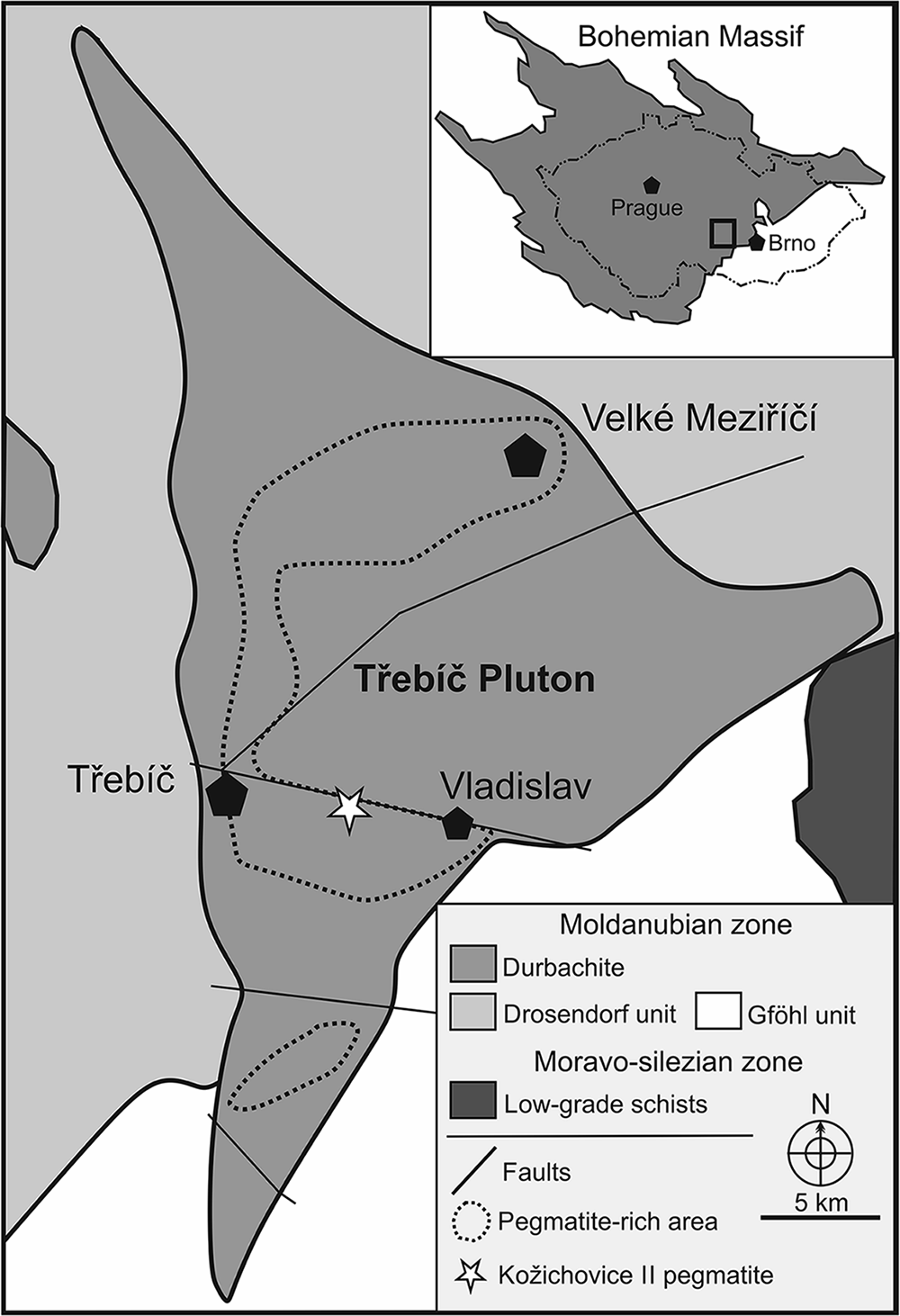
The Třebíč Pluton (343–335 Ma, Janoušek et al., Reference Janoušek, Holub, Verner, Čopjaková, Gerdes, Hora, Košler and Tyrrell2019) forms a large flat body composed of durbachites (K-Mg-rich melagranites to melasyenites), which intruded high-grade metamorphic rocks (sillimanite–biotite paragneiss with intercalations of amphibolites, marbles and quartzites) in the eastern part of the Moldanubian Zone, Bohemian Massif, Czech Republic (Fig. 1) (Leichmann et al., Reference Leichmann, Gnojek, Novák, Sedlák and Houzar2017; Janoušek et al., Reference Janoušek, Hanžl, Svojtka, Hora, Kochergina, Gadas, Holub, Gerdes, Verner, Hrdličková, Daly and Buriánek2020). The origin of durbachite magma is interpreted to be a result of the melting of mantle domains previously metasomatised by fluids released from a subducted slab of mature continental crust and physically contaminated by that crustal material. The melt reflects simultaneous enrichment in typical mantle (Mg, Cr, Ni) and lithophile elements (K, Rb, Cs, Th, U). Noticeably, the durbachites of the Třebíč Pluton yielded quite high concentrations of Sc of 8–30 ppm (Janoušek and Holub, Reference Janoušek and F.V2007; Janoušek et al., Reference Janoušek, Hanžl, Svojtka, Hora, Kochergina, Gadas, Holub, Gerdes, Verner, Hrdličková, Daly and Buriánek2020).
Simplified geological map of Třebíč Pluton with marked pegmatite fields and highlighted Kožichovice II pegmatite (after Zachař et al., Reference Zachař, Novák and Škoda2020). The position of the Třebíč Pluton within the Bohemian Massif is indicated as a rectangle in the overview inset.
The intraplutonic pegmatites that are related genetically to the Třebíč Pluton have variable degrees of textural and geochemical evolution. They form minor primitive segregations as well as more common dykes, up to ∼2 m in thickness and several tens of metres in length, with transitional to sharp contacts with the host durbachite (Škoda and Novák, Reference Škoda and Novák2007, Zachař et al., Reference Zachař, Novák and Škoda2020). Zoned dykes consist of a granitic graphic and blocky unit, albite unit typically located between blocky K-feldspar and a quartz core, and locally small miarolitic cavities (Zachař and Novák, Reference Novák2013; Zachař et al., Reference Zachař, Novák and Škoda2020). The pegmatites belong to the NYF petrogenetic family although they are F-poor (Škoda and Novák, Reference Škoda and Novák2007; Čopjaková et al., Reference Čopjaková, Škoda, Vašinová Galiová and Novák2013). They are also an example of Group 2 pegmatites generated from residual melts of granite magmatism (RMG) in the proposed nomenclature of granitic pegmatites (Wise et al., Reference Wise, Müller and Simmons2022). On the basis of their mineralogy, two types of pegmatites were distinguished: (1) Simply zoned primitive allanite-type pegmatites (Kfs+Qz+Pl+Bt±Amp) containing allanite, ilmenite, zircon, titanite ± tourmaline; and (2) more evolved euxenite-type pegmatites (Kfs+Qz+Pl+Ab+Bt±Tur), with euxenite-(Y) and aeschynite-group minerals ± Be-minerals (primary: beryl, phenakite, helvine–danalite; secondary: bavenite–bohseite, milarite–agakhanovite-(Y), hingganite-(Y), bazzite), Sn-minerals (primary: cassiterite, herzenbergite; secondary: stokesite) and common greenish K-feldspar (amazonite variety). Mineral symbols are abbreviated according to Warr (Reference Warr2021).
The euxenite-type pegmatite Kožichovice II crops-out in the fields ∼ 1.5 km NE of the Kožichovice village, in the southeastern vicinity of Třebíč town. It was found in the 1980s, and currently the material is available as boulders and small fragments in the field and in the collection of the Moravian Museum, Brno. The dyke is ∼0.5 m in thickness and several tens of metres in length and consists of granitic, graphic, blocky zones and a quartz core. The albite unit is developed between the blocky K-feldspar and the quartz core (Novák and Filip, Reference Novák and Filip2010). The investigated sample is an ∼10 cm large fragment of massive quartz and pale green blocky amazonite. The quartz hosts a euhedral crystal of fresh phenakite, ∼ 20 × 5 mm in size, and a dark brown, dull to metallic heterogeneous aggregate, ∼10 mm in size, which contains the Sc mineralisation pertinent to this investigation.
Analytical settings
Two polished epoxy discs (RS88 and RS169 samples) containing fragments of the Sc-rich aggregate were prepared for electron-probe microanalyses, TIMA and Raman investigation.
Electron probe microanalysis
The compositions of minerals were determined by means of a CAMECA SX100 electron-probe microanalyser (EPMA) at the Department of Geological Sciences, Masaryk University, Brno. The wavelength-dispersive mode, an accelerating voltage of 15 kV, a beam current of 20 nA, and an electron beam diameter of 1–5 µm were used. The following characteristic X-ray lines and standards were used for oxide minerals quantiitative analysis: Kα lines – F (topaz); Na (albite); Si (sanidine); Sc (ScVO4); Mg (MgAl2O4); Ti (anatase); Mn (Mn2SiO4); Fe (almandine); Zn, Al (gahnite); Kβ lines – Ca (wollastonite); Lα lines – Y (YAG); Nb (columbite Ivigtut); W (metallic W); Sn (SnO2); Lβ lines – Zr (zircon); Sb (metallic Sb); Mα lines – Ta (CrTa2O6); Hf (metallic Hf); Th (CaTh(PO4)2); Mβ lines – Pb (vanadinite); U (metallic U); Bi (metallic Bi). Silicates were analysed using the same standards as above plus Lα lines – La (LaPO4), Ce (CePO4); Sm (SmPO4); Lβ lines – Pr (PrPO4), Nd (NdPO4). Raw X-ray intensities were corrected for matrix effects with a ϕρ(z) algorithm of the X-PHI routine (Merlet, Reference Merlet1994). On the basis of the counting statistics, the measurement error expressed as 2σ is approximately <1 rel.% for concentrations of ∼20 wt.% and ∼8 rel.% for concentrations of ∼1 wt.%. Due to an interference of the ZrLα line with the 2nd-order ScKα line, the Zr was measured on the ZrLβ line using pentaerythritol monochromator.
Raman Spectroscopy
Most of the investigated phases were identified and classified with confidence on the basis of the EPMA data. However, as the mineral with composition CaNb2O6 can crystallise with a columbite (fersmite) or aeschynite (vigezzite) structure, and the natural ScNbO4 phase was described just recently as nioboheftetjernite with a wolframite structure, these two phases were investigated using Raman spectroscopy in order to determine their structural properties. The spectra were obtained from uncoated polished sections using an Horiba Labram HR Evolution spectrometer equipped with an Olympus BX 41 optical microscope, a diffraction grating with 600 gr/mm, and a Peltier-cooled, Si-based charge-coupled device (CCD) detector, at the Department of Geological Sciences, Masaryk University, Brno. The Raman signal was excited by a 532 nm laser and collected in the range of 50–4000 cm–1 using a 100× objective. Experimental conditions and band fitting procedure were similar to those described in Škoda et al. (Reference Škoda, Plášil, Čopjaková, Novák, Jonsson, Galiová and Holtstam2018).
The Raman spectroscopy unequivocally established that the CaNb2O6 phase corresponds to fersmite and ScNbO4 to nioboheftetjernite. The observed vibration bands together with published data are shown in Supplementary materials – Table ST1 and Figs S1 and S2.
TIMA
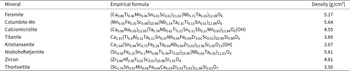
The panoramic phase- and element-distribution maps (Figs S3 and S4 in supplementary material) together with numerical values for volume ratios of individual minerals were obtained using a TIMA (Tescan Integrated Mineral Analyzer) mounted on a Tescan MIRA FEG electron microscope at TESCAN GROUP, Brno, using the following analytical conditions: working distance of 15 mm, accelerating voltage of 25 kV and probe current of 10 nA. The data were acquired using liberation analysis, high-resolution mapping mode (see Hrstka et al., Reference Hrstka, Gottlieb, Skála, Breiter and Motl2018 for more details). The pixel spacing for both back-scattered electron (BSE) and energy dispersive spectroscopy (EDS) data was 1 µm/pixel. The computation of the mineral volumetric proportions was based on spatial ratios determined by TIMA; the EPMA data for individual phases were used as representative compositions and mineral densities were calculated for these compositions using published unit-cell volumes of the closest end-members (Table 1). Although unit cell volume varies with composition, in our case the changes in density with respect to the end-members are predominantly caused by changes in Nb/Ta ratio. Coincidently, Nb and Ta have virtually the same ionic radius (Shannon, Reference Shannon1976), therefore, their substitution should not change the unit cell volume. We believe that potential errors in the density calculations are small enough to have no significant influence on the interpretations discussed below.
Mineral empirical formulas and densities used for TIMA calculations

Results
Mineral assemblages and textures
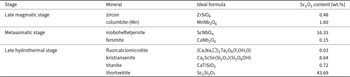
A detailed study of the Sc-rich assemblage in BSE images and TIMA phase- and element-distribution maps revealed complex mineral assemblages and textural relations (Table 2).
Overview of minerals studied and their succession

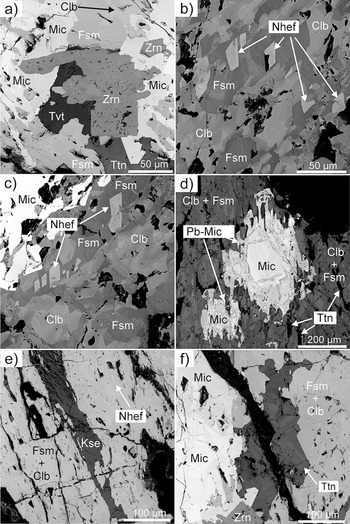
Zircon and columbite-(Mn) are evidently the early minerals in the assemblage and formed during a late magmatic stage of the pegmatite-forming process. Zircon forms euhedral crystals and crystal aggregates, up to 500 µm in diameter, typically enclosed in columbite-(Mn) or later fersmite, locally however it also crystallised in cavities in columbite-(Mn) and was subsequently overgrown by younger thortveitite and kristiansenite (Fig. 2a). Columbite-(Mn) forms aggregates of crystals reaching ∼2.5 mm in size. The crystals exhibit complex patchy to irregular zoning in BSE, with lighter areas being Ta (and Sn, Ti, Sc) enriched. The edge of the columbite-(Mn) grains commonly have embayment features and grains are evidently intensively corroded by later fersmite (Figs S3, S4).
BSE images of the mineral assemblages. (a) Euhedral zircon associated with columbite-(Mn) and fersmite, fluorcalciomicrolite, thortveitite and titanite. (b) and (c) Corroded relics of columbite replaced by fersmite and overgrown by euhedral crystals of nioboheftetjernite. (d) Complexly altered fluorcalciomicrolite with rare thin bright veinlets of Pb-enriched fluorcalciomicrolite. The microlite fills open spaces in older mineralisation dominated by columbite-(Mn) and fersmite (dark grey). Note the feeder structure connecting two microlite aggregates. (e) Kristiansenite veinlet traversing the columbite-(Mn) + fersmite aggregates. Note also a small brighter crystal of nioboheftetjernite. (f) Oscillatory zoned grain of titanite. Zrn – zircon, Clb – columbite-(Mn), Fsm – fersmite, Mic – fluorcalciomicrolite, Tvt – thortveitite, Ttn – titanite, Kse – kristiansenite, Nhef – nioboheftetjernite.

Fersmite extensively replaces columbite-(Mn) as irregular aggregates or veinlets and locally exhibits a weak zonation in BSE-images (Fig. 2b, c). The euhedral, prismatic crystals of nioboheftetjernite up to ∼100 µm in length, typically grew on surfaces of columbite-(Mn) corroded by fersmite (Fig. 2b, c). Nioboheftetjernite crystals are surrounded by fersmite or grew into vugs within fersmite (Fig. 2b–e), or subsequently were overgrown by younger minerals, typically titanite (Figs S3, S4).
Irregular aggregates of fluorcalciomicrolite, up to ∼1 mm in size, appear to be younger than associated fersmite (Figs 2, S3, S4,). They are typically strongly hydrothermally altered with complex zoning in BSE images, locally with late Pb-enriched replacements and overgrowths (Fig. 2d). Very rare anhedral thortveitite fills small cavities, up to ∼50 µm, commonly associated spatially with euhedral zircon (Fig. 2a). Kristiansenite and titanite also occur as cavity- and fracture-filling minerals, up to several hundred µm in size. Kristiansenite is typically homogeneous in BSE-images (Fig. 2e), whereas titanite commonly displays fine oscillatory zonation, reflecting the variable Ta content (Fig. 2f). Textural relationships indicate the following crystallisation sequence of primary to secondary minerals: zircon + columbite-(Mn) → fersmite + nioboheftetjernite → kristiansenite + thortveitite + titanite + fluorcalciomicrolite.
Composition and Raman spectroscopy
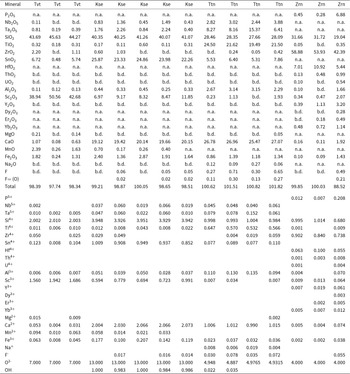
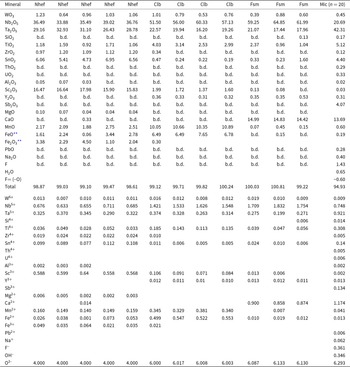
The zircon is enriched in Hf (0.06–0.10 apfu; 6.4–10.9 wt.% of HfO2, Table 3). Fresh zircon contains an average 0.01 apfu of Sc (0.43 wt.% Sc2O3), and 0.02 apfu of Y+HREE (Dy, Er, Yb). The infrequent altered domains have elevated actinide contents, lower analytical totals, uptake of non-formula elements (Ca, Al, Fe, F) as well as elevated contents of Sc and P, up to ∼2 wt.% of Sc2O3 and ∼7 wt.% of P2O5.
Representative compositions of silicates in wt.% and atoms per formula unit (apfu)*
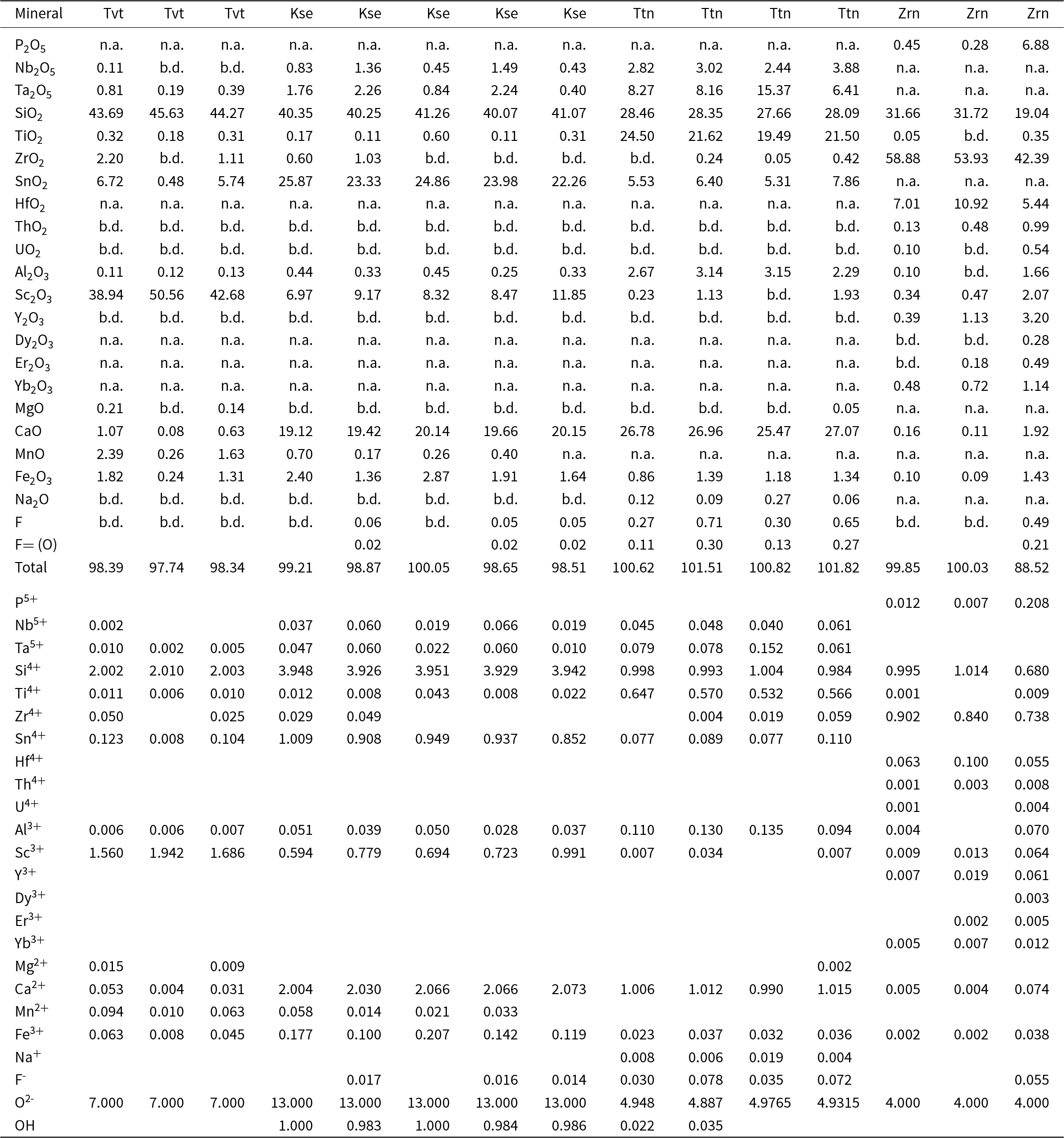
Tvt – Thortveitite, Kse – kristiansenite, Ttn – titanite, Zrn – Zircon.
* Thortveitite and kristiansenite and zircon data were normalised to 7, 14 and 4 anions pfu. Titanite formula was normalised to 3 cations pfu; n.a. = not analysed, b.d. = below detection limit. Mineral symbols were abbreviated according to Warr (Reference Warr2021).
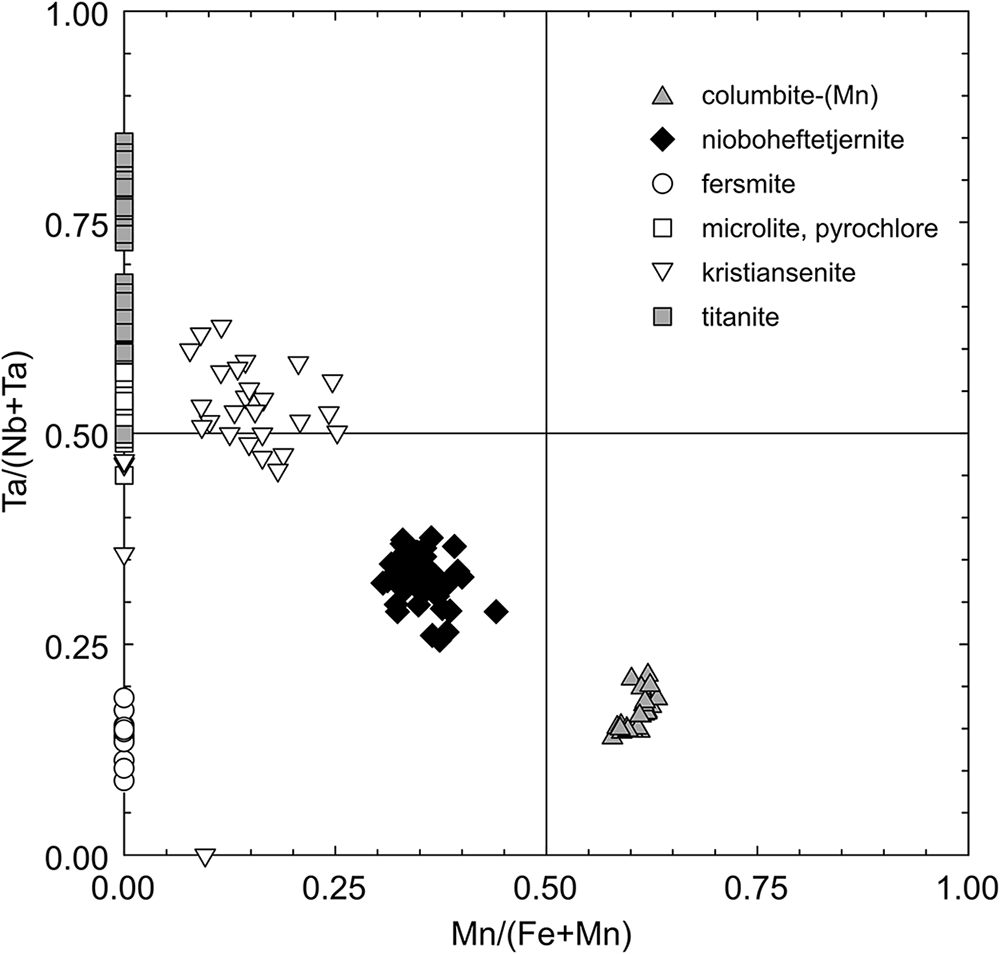
Columbite-(Mn) contains 1.42–1.62 apfu of Nb, 0.26–0.39 apfu of Ta, 0.52–0.57 apfu of Mn. and 0.32–0.38 apfu of Fe, resulting in a Ta/(Ta + Nb) ratio of 0.14–0.22 and a Mn/(Mn + Fe) ratio of 0.58–0.64 (Fig. 3). Titanium (avg. 0.14 apfu, 3.06 wt.% TiO2) and Sc (avg. 0.08 apfu, 1.6 wt.% of Sc2O3) are the most important minor elements. Tin, Y and W were detected, though with concentrations ≤ 0.01 apfu (Table 4).
Graph showing Ta/(Ta+Nb) vs. Mn/(Mn+Fe) atomic ratios for selected minerals.
Representative compositions of oxides in wt.% and atoms per formula unit*

Key: Nhef – nioboheftetjernite; Clb – columbite–(Mn); Fsm – fersmite; Pcl – fluorcalciopyrochlore; Mic – fluorcalciomicrolite (mean of 20 analyses). b.d. = below detection limit.
* Nioboheftetjernite data were recalculated on the basis of 2 cations pfu. Columbite-(Mn) and fersmite on the basis of 3 cations pfu and microlite + pyrochlore based on assumption that Nb + Ta + Ti + W = 2 apfu. **Ferric to ferrous ratio was calculated to preserve electroneutrality and set at 4 and 6 O for nioboheftetjernite and columbite, respectively.
Nioboheftetjernite corresponds to a simplified empirical formula (N = 61 analyses) (Sc0.58Fe0.15Sn0.10Mn0.08Zr0.02)Σ0.93(Nb0.67Ta0.33W0.01Ti0.04)Σ1.05O4. The ratio Ta/(Ta + Nb) = 0.26–0.39 and Mn/(Fe+Mn) = 0.31–0.46 (Fig. 3), whereas Sc contents vary between 0.50 and 0.64 apfu (14.08–17.98 wt.% of Sc2O3), Table 4. Kolitsch et al. (Reference Kolitsch, Kristiansen, Raade and Tillmanns2010) assigned Ti into the octahedral site in chemically related heftetjernite, ScTaO4. Adopting the same approach, the Sc- and Nb-site stoichiometry of the phase would be close to 1:1 ratio. The characteristic Raman bands are similar to the spectra published by Lykova et al. (Reference Lykova, Rowe, Poirier, McDonald and Giester2021) for recently described nioboheftetjernite from the type locality as well as the synthetic ScNbO4 phase of wolframite structure (Ouahrani et al., Reference Ouahrani, Garg, Rao, Rodríguez-Hernández, Muñoz, Badawi and Errandonea2022), see Table ST1 and Fig. S1.
Fersmite is more enriched in Nb than columbite-(Mn) with 1.58–1.83 apfu Nb, 0.17–0.37 apfu Ta and a Ta/(Ta + Nb) ratio of 0.09–0.19 (Fig. 3). Apart from major Ca (0.83–0.94 apfu) fersmite contains 0.06 apfu of Ti, Σ Mn + Fe = 0.02 apfu (Mn ˃ Fe), ∼0.01 apfu of Y, W and Sn, and only 0.007 apfu of Sc (0.16 wt.% of Sc2O3, Table 4). The main Raman bands are consistent with those published by Husson et al. (Reference Husson, Repelin, Dao and Brusset1977) and Moreira et al. (Reference Moreira, Teixeira, Andreeta, Hernandes and Dias2010) for Pbcn CaNb2O6, a synthetic analogue of fersmite (Table ST1, Fig. S2)
Fluorcalciomicrolite (to rare fluorcalciopyrochlore) has variable Ta (0.77–1.13 apfu), Nb (0.57–0.94 apfu) and Ti (0.20–0.46 apfu) content, resulting in Ta/(Ta + Nb) = 0.45–0.65 (Fig. 3). In addition, it contains 1.14 Ca, 0.06 Na, 0.13 Sb, 0.14 Sn, 0.04 Mn, 0.36 F, and ≤ 0.01 Y, U, Th, Si, Fe and W (all avg. in apfu). The calculated vacancy in the Ca position ranges between 0.20–0.90 apfu, avg. 0.42 apfu. Scandium is systematically low ∼ 0.03 wt.% of Sc2O3, close to the detection limit. The mineral is classified as fluorcalciomicrolite as F slightly prevails over OH and O in that particular structural site. However, the exact identification requires additional study, as the amount of OH was not determined directly but derived from the electroneutrality. Fluorcalciomicrolite is locally penetrated by late Pb-enriched domains (≤0.23 apfu of Pb). Compositions are shown in Table 4.
The simplified empirical formula of kristiansenite (N = 30) corresponds to: Ca2.04[Sn0.94Sc0.73Fe0.15(Nb,Ta)0.08Zr0.03Mn0.02Ti0.02]Σ1.97(Si3.95Al0.05)Σ4.00O13OH. The amount of Sc varies between 0.56–0.98 apfu (6.62–11.85 wt.% of Sc2O3, Table 3).
Thortveitite composition (Table 3) ranges from an almost pure end-member with 1.95 apfu Sc (50.56 wt.% of Sc2O3) to a composition with 1.57 apfu of Sc (38.94 wt.% of Sc2O3). Remarkably, the measured Sn content of ≤0.12 apfu (6.72 wt.% of SnO2) is the highest reported so far.
Titanite is significantly enriched in Ta and Nb, with ≤0.2 apfu of Ta + Nb and Ta/(Ta + Nb) = 0.5–0.85, (Fig. 3, Table 3) and has variable enrichment of Sn 0.01–0.11 apfu and Sc ≤0.03 apfu (0.04–1.93 wt.% of Sc2O3).
TIMA results
The high-resolution phase- and element-distribution maps of the whole sample are very useful because they reveal textural features and mineral relationships otherwise unrecognisable by conventional scanning electron microscopy (EDS mode) investigation. Variability in the composition of columbite and fersmite causes their mean Z (atomic number) to overlap, making it impossible to distinguish them by BSE, hence a combination of BSE with EDS mapping is essential. In addition, changing the view field from mm to cm scale revealed that the metasomatic alteration propagated inwards and that columbite is mostly replaced along cracks (Figs S3, S4).
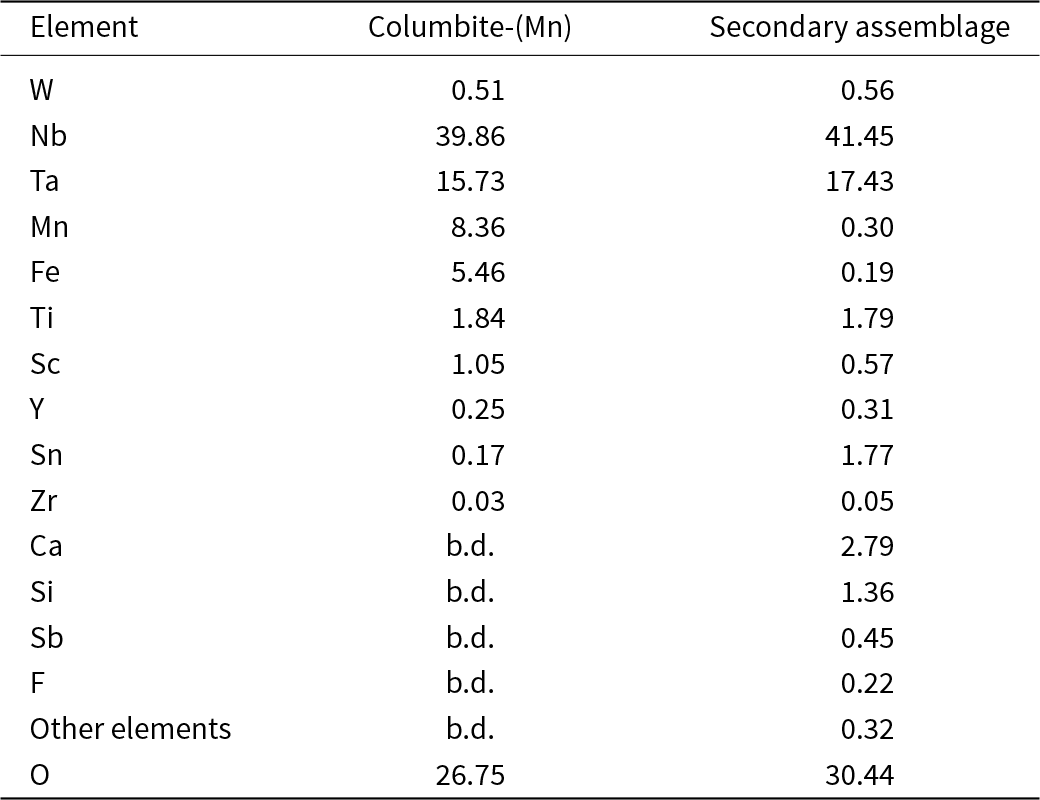
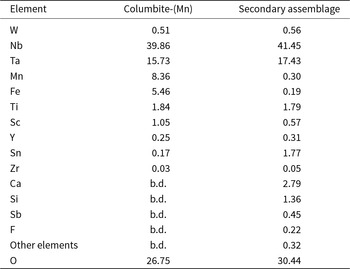
Fersmite is the volumetrically dominant mineral (∼51 vol.% of the aggregate), followed by relics of columbite (∼29 vol.%), and fluorcalciomicrolite (∼10 vol.%), respectively. The most abundant Sc-dominant mineral is kristiansenite comprising 3.3 vol.%, followed by nioboheftetjernite (1.4 vol.%) and thortveitite, which accounts for only 0.08 vol.%. The amount of titanite corresponds to 4.6 vol.% and the remaining 0.7 vol.% is represented by zircon. Unfortunately, the volume of voids cannot be properly measured, because they are commonly above the BSE background threshold. The significant loss of Fe and Mn and substantial gain of Ca, Si and Sn in secondary mineral assemblages are evident. The calculated (see Analysis section on TIMA) bulk composition of the secondary mineral assemblage (Table 5) shows that it contains only 0.57 wt.% Sc compared to 1.05 wt.% in primary columbite, and its bulk content of 1.77 wt.% Sn is approximately ten times higher than in the primary precursor.
Concentration (in wt.%) of relevant elements in the primary columbite (Mean of 26 from EPMA) and in the secondary mineral assemblage (calculated by TIMA based on volume proportions and values from Table 1)
b.d. = below detection limit.
Discussion
Substitution mechanisms of Sc
The very high compatibility of Sc resulting from it having an ionic radius similar to Fe2+, Fe3+, Mg, Zr, Sn, Ti, and Al (Shannon, Reference Shannon1976) enables easy incorporation into numerous major to accessory minerals. Two principal substitution mechanisms, homovalent and heterovalent, have been recognised (Raade et al., Reference Raade, Ferraris, Gula, Ivaldi and Bernhard2002). Homovalent substitutions include Sc = Al, Fe3+ (garnet, beryl, amphibole, pyroxene: Frondel et al., Reference Frondel, Ito and Montgomery1968; Quartieri et al., Reference Quartieri, Oberti, Boiocchi, Dalconi, Boscherini, Safarova and Woodland2006; Neumann, Reference Neumann1961; Eby, Reference Eby1973; Chassé et al., Reference Chassé, Griffin, Alard, O’Reilly and Calas2018; Novák and Filip, Reference Novák and Filip2010; Přikryl et al., Reference Přikryl, Novák, Filip, Gadas and M.V2014) and rather exceptionally Sc = Y, HREE (keiviite: Langhoff, Reference Langhof1996; xenotime: Bernhard et al., Reference Bernhard, Walter, Ettinger, Taucher and Mereiter1998). The heterovalent substitutions typically involve R3+ + R4+ = R2+ + R5+ (Novák and Černý, Reference Novák and Černý1998; Wise et al., Reference Wise, Černý and Falster1998), 2R3+ = R2+ + R4+ (e.g. helvine: Raade et al., Reference Raade, Ferraris, Gula, Ivaldi and Bernhard2002; ilmenite: Kalashnikov et al., Reference Kalashnikov, Yakovenchuk, Pakhomovsky, Bazai, Sokharev, Konopleva, Mikhailova, Goryainov and Ivanyuk2016), R3+ + R5+ = R4+ + R4+ (e.g. zircon: Moëlo et al., Reference Moëlo, Lulzac, Rouer, Palvadeau, Gloaguen and Leone2002; Výravský et al., Reference Výravský, Novák and Škoda2017; baddeleyite: Kalashnikov et al., Reference Kalashnikov, Yakovenchuk, Pakhomovsky, Bazai, Sokharev, Konopleva, Mikhailova, Goryainov and Ivanyuk2016) and R3+ + R+ = R2+ + R2+ (e.g. jervisite: Mellini et al., Reference Mellini, Merlino, Orlandi and Rinaldi1982; Vignola et al., Reference Vignola, Rotiroti, Hatert, Bersani, Andò and Varvello2019) where R2+= Fe, Mn, Mg, Ca; R3+ = Sc, Y, Ln; R4+ = Ti, Sn, Zr, Si; and R5+= Nb, Ta, P.
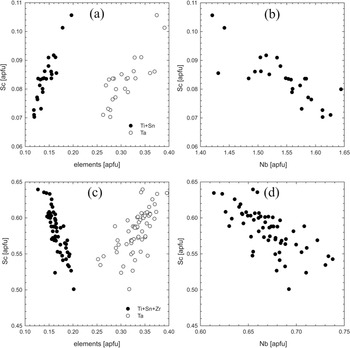
Columbite-(Mn) from the Kožichovice II pegmatite has a very strong negative correlation between Sc and Nb, and a strong positive correlation between Sc and Ta (R = –0.84 and +0.82, respectively; Fig. 4). A positive correlation of Sc with Ti (R = +0.92) indicates the euxenite-type substitution R3+ + R4+ = R2+ + R5+. However, the amount of Ti significantly exceeds the content of Sc(+Y)3+ and due to very low amounts of calculated Fe3+, the remaining Ti is possibly incorporated via the rutile-type substitution 3Ti4+ = Fe2+ + 2Nb5+.
Compositional trends involving Sc in (a) and (b) columbite-(Mn); (c) and (d) nioboheftetjernite.
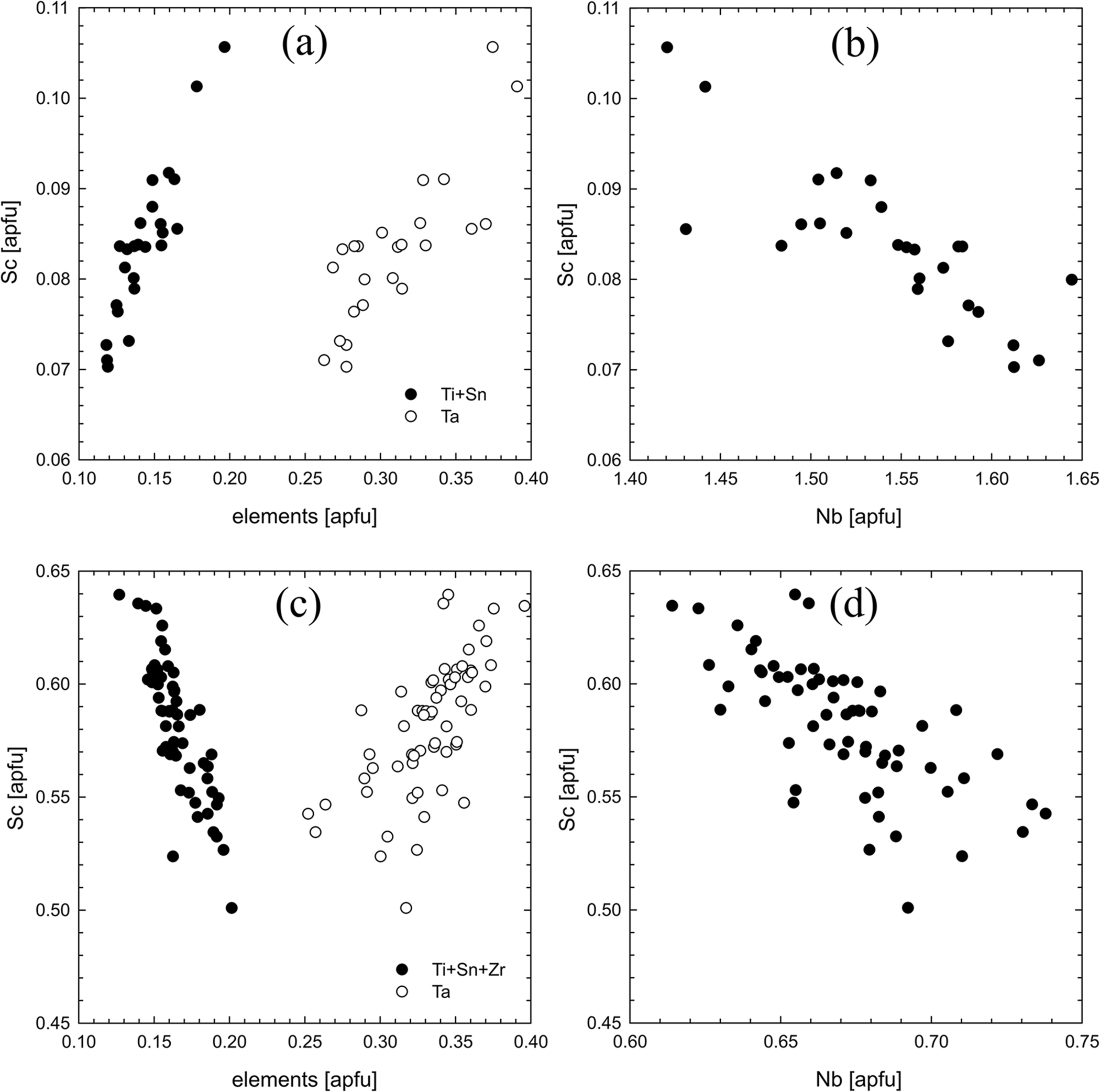
Very uniform ΣNb + Ta (0.99–1.02 apfu, avg. 1.00 apfu) in the nioboheftetjernite and low correlation coefficients with other elements (strongest –0.37 for Ti) indicate, that there is only very limited substitution in the Nb site. In contrast all of the remaining elements (except Zr) correlate negatively with Sc. Noticeably, Sc (and Zr) are enriched in the Ta-rich compositions (Fig. 4), whereas all the other elements (Fe, Mn, Sn, Ti) trend to Nb-rich compositions, indicating solid solution between Sc2Ta2O8 and M2+M4+Nb2O8 and the substitution 2M3+ = M2+ + M4+. However, regardless of the low calculated Fe3+ (avg. 0.04 apfu), the amount of M2+ surpasses that of M4+, leaving a slight deficit in charge in the Sc site, which is roughly equivalent to the surplus of charge caused by presence of W in the Nb site. This is in contrast with the observations of Kolitsch et al. (Reference Kolitsch, Kristiansen, Raade and Tillmanns2010) in heftetjernite, where the amount of M2+ and M4+ matched almost perfectly, and indicates a possible substitution mechanism involving R2+ and W6+.
The composition of kristiansenite is comparable to the type kristiansenite from Heftetjern pegmatite (Raade et al., Reference Raade, Ferraris, Gula, Ivaldi and Bernhard2002, Reference Raade, Bernhard and Ottolini2004) except for elevated Nb and Ta (avg. 0.04 apfu each). The Nb + Ta correlates positively (R = 0.8) with (Fe,Mn)2+, indicating possible substitution Sc3+ + Sn4+ = Fe2+ + (Nb, Ta)5+. As the slope of regression line is ≈0.5, other substitution mechanisms might take place simultaneously. The most important substitution in the samples of thortveitite is 2Sc3+ = (Fe, Ca, Mn, Mg)2+ + (Sn, Ti, Zr)4+. The incorporation of Ta and Nb in titanite is facilitated mainly by a 2Ti4+ = (Al, Sc, Fe)3+ + (Nb, Ta)5+ and subordinately also by Na+ + (Ta, Nb)5+ = Ca2+ + Ti4+ substitution, respectively (see e.g. Lussier et al., Reference Lussier, Cooper, Hawthorne and Kristiansen2009).
Behaviour of the individual elements
Scandium as a compatible element is incorporated in mafic silicates (amphibole, pyroxene, garnet, biotite) or zircon during the solidification of granitic magmas (Glassley and Piper, Reference Glassley and Piper1978; Williams-Jones and Vasyukova, Reference Williams-Jones and O.V2018). The Třebíč Pluton consisting of amphibole- and biotite-rich melasyenite to quartz syenite (durbachite) contains 8–30 ppm Sc (Holub, Reference Holub1997; Janoušek et al., Reference Janoušek, Hanžl, Svojtka, Hora, Kochergina, Gadas, Holub, Gerdes, Verner, Hrdličková, Daly and Buriánek2020). The residual magma that was more felsic and volatile-rich solidified locally as pegmatite bodies with a NYF signature; although these are typically F-poor. The NYF pegmatites of the Třebíč Pluton commonly host biotite, tourmaline (schorl–dravite–dutrowite solid solution), beryl and scarce actinolite, all these minerals can potentially incorporate Sc. Rare actinolite is present only in the outermost granitic unit, whereas common biotite occurs in the less-evolved textural-paragenetic units (granitic, graphic). Tourmaline is a rare accessory-to-minor mineral in some NYF pegmatites of the Třebíč Pluton. It occurs in the graphic, blocky and aplitic unit and contains 30–500 ppm Sc (Novák et al., Reference Novák, Škoda, Filip, Macek and Vaculovič2011; Čopjaková et al., Reference Čopjaková, Škoda, Vašinová Galiová and Novák2013, Reference Čopjaková, Škoda, Galiová, Novák and Cempírek2015). This is, together with biotite, the most common mineral with elevated concentrations of Sc.
At the Kožichovice II pegmatite, crystallisation of volumetrically dominant feldspars and quartz, together with the absence of primary tourmaline, and relative scarcity of biotite, resulted in enrichment of Sc in a residual pegmatitic melt. Consequently, Sc entered the structure of beryl and columbite-(Mn) which crystallised at the late magmatic stage. Very rare tourmaline (schorl–dravite) is present only as a late fracture-filling morphological type of subsolidus origin (Novák et al., Reference Novák, Škoda, Filip, Macek and Vaculovič2011). Thus its crystallisation did not influence the concentration of Sc during the magmatic stage. Scandium-enriched beryl (0.05–0.68 wt.% Sc2O3) is rare (Novák and Filip, Reference Novák and Filip2010) and not related spatially to the Sc-enriched columbite-(Mn) (avg. 1.6 wt.% Sc2O3). Regardless of a complete solid solution between ZrSiO4 and ScPO4, even at rather low temperatures (Möelo et al., Reference Moëlo, Lulzac, Rouer, Palvadeau, Gloaguen and Leone2002; Výravský et al., Reference Výravský, Novák and Škoda2017), the very low content of P in the pegmatites of the Třebíč Pluton (Škoda et al., Reference Škoda, Novák and Houzar2006, Zachař Reference Zachař2021) severely limited this substitution in zircon (avg. 0.43 wt.% Sc2O3) associated with columbite-(Mn). Further, zircon is volumetrically subordinate in the mineral assemblage (0.7 vol.%).
The columbite-(Mn) crystal aggregates were corroded by Ca-enriched residual fluids and replaced in situ by fersmite mainly along fractures propagating into the central parts of the grains (Fig. S3, S4). Almost no (Fe + Mn) and only ∼10 wt.% of Sc (related to the primary columbite) were accommodated in fersmite (avg. 0.16 wt.% Sc2O3), which has also significantly lower content of Ti and a slightly lower Ta/(Ta+Nb) ratio (Fig. 3). Nioboheftetjernite commonly growing on the corroded surfaces of columbite-(Mn) is usually enclosed in fersmite and both newly-formed minerals appear to be in textural equilibrium (Fig. 2). Very low Sc in newly formed fersmite as a consequence of crystal structural constraints (VISc 0.745 Å and VICa 1.000 Å; Shannon, Reference Shannon1976) resulted in a local supersaturation of Sc and allowed crystallisation of nioboheftetjernite. However, fersmite and nioboheftetjernite contain a higher amount of Sn (0.49 and 6.12 wt.% SnO2, respectively) relative to primary columbite-(Mn) (0.25 wt.% SnO2). This results in Sn-enrichment of the residual fluids together with Ca.
In the late hydrothermal stage, the compositions of the crystallising phases still indicate a very high activity of Ca, Sc and Sn, accompanied by the introduction of Si and enrichment in Ta, demonstrated by high Ta/(Ta + Nb) ratios for kristiansenite, microlite and titanite: avg. 0.50, 0.56 and 0.73, respectively (Fig. 3). Ilmenite, intensively replaced by Sn-enriched titanite from several NYF pegmatite bodies (Škoda et al., Reference Škoda, Novák and Houzar2006), the occurrence of kristiansenite after Sc-enriched columbite-(Mn) at the pegmatite Číměř I (Zachař, Reference Zachař2021), and common bavenite–bohseite replacement of primary Be minerals (beryl, phenakite, helvine–danalite; Novák and Filip, Reference Novák and Filip2010; Zachař et al., Reference Zachař, Novák and Škoda2020; Novák et al., Reference Novák, Dolníček, Zachař, Gadas, Nepejchal, K. and Vrtiška2023), demonstrates that Ca- and Sn-enriched residual fluids are a common feature of the NYF pegmatites of the Třebíč Pluton.
The last recognisable processes are formation of Pb-enriched veinlets in the fluorcalciomicrolite aggregates and alteration of earlier fluorcalciomicrolite, as is known from other pegmatites (see e.g. Chládek et al., Reference Š, Uher, Novák, Bačík and Opletal2021). Additionally, some of the zircon grains are locally hydrothermally altered (see Results); however, the timing of this alteration is remains unclear.
The replacement scenario
Despite having detailed information (TIMA and EMPA data) regarding the composition and abundance of all minerals involved in the evolution of these pegmatites, definitive conclusions about the behaviour of particular elements cannot be drawn as the initial amount of columbite-(Mn) and its porosity are not known. Three possible scenarios are discussed below.
Scenario 1: The replacement process was isovolumetric, all minerals from the metasomatic and late hydrothermal stage directly replaced columbite. In this scenario, more than 50% of the Sc, originally present in columbite-(Mn), was leached out from this mineral. The Nb, Ta and Ti do not show significant influx or leaching. Our data show that a significant majority of Ca and Sn was derived from fluids and almost all Mn and Fe were leached out of the system (see Table 6). This scenario is rather unlikely because most of the minerals from the late hydrothermal stage (microlite, titanite, kristiansenite, thortveitite) crystallised in open spaces or filled fractures and do not replace earlier-formed minerals (Figs 2, S3, S4). Moreover, the presence of porosity is crucial for the formation of secondary mineral assemblages by fluid driven dissolution–reprecipitation processes (Putnis and Putnis, Reference Putnis and Putnis2007).
Ratios between absolute mass of individual elements in dissolved columbite-(Mn) and in the secondary mineral assemblage according to three scenarios. (See description of these in the discussion section). Values <1 indicate influx of the elements from outside the system, whereas values >1 correspond to leaching. The columbite occupancy fraction indicates the volumetric fraction of the current secondary mineral assemblage that must have been occupied by columbite-(Mn) before it was replaced by the secondary minerals. The remainder indicates the fraction of the secondary assemblage that crystallised in open fractures and cavities
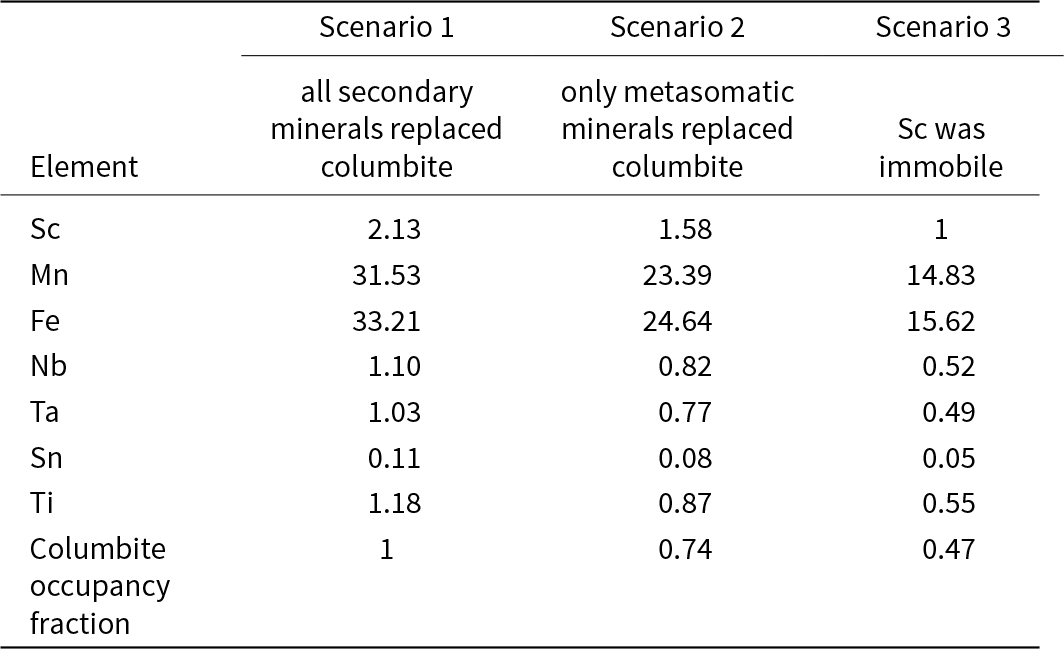
Scenario 2: The volume of the replaced columbite-(Mn) corresponds to the volume of the minerals from the metasomatic stage (fersmite and nioboheftetjernite). Only 74 vol.% of the whole secondary mineral assemblage directly replaced the columbite-(Mn). This scenario is consistent with our textural observations (see above, Fig. S3, S4). However, ∼40 proportional wt.% (hereinafter prop. wt.%) of Sc and most of Fe and Mn from the primary columbite-(Mn) was leached out (Table 6). A significant influx of Sn is necessary, and some Nb, Ta and Ti is required to be added to the system (Table 6). The leaching of Sc is supported by the occurrence of kristiansenite in the cracks commonly situated near the rim or in a vicinity of the aggregate (Fig. S3, S4). Similar occurrences of kristiansenite on cracks near or distal from a Sc-mineral precursor have been found at other pegmatites of the Třebíč Pluton, e.g. Číměř (Zachař, Reference Zachař2021). Apparently, distal kristiansenite originated from fluids at the conditions where Sc is more mobile relative to the nioboheftetjernite typically found in a proximity or directly on the surface of corroded columbite-(Mn). The mobility of Sc in fluids is also supported by the occurrence of kristiansenite as a fracture or miarolitic cavity filling mineral at other occurrences: Baveno, Italy (Pezzotta et al., Reference Pezzotta, Diella and Guastoni2005), Heftetjern, Norway (Raade et al., Reference Raade, Ferraris, Gula, Ivaldi and Bernhard2002, Reference Raade, Bernhard and Ottolini2004), Věžná I, Czech Rep. (Toman and Novák, Reference Toman and Novák2020), Szklarska Poręba, Poland (Evans et al., Reference Evans, Gołębiowska, Groat and Pieczka2018) and Cadalso de los Vidrios, Spain (Prado-Herrero et al., Reference Prado-Herrero, Garcia-Guinea, Crespo-Feo, Correcher and Salvar2009; Correcher and Garcia-Guinea, Reference Correcher and Garcia-Guinea2020).
Scenario 3: Sc was not leached out of the system. This scenario is unlikely because it requires a very high initial porosity of the original columbite-(Mn) aggregate or the presence of a significant amount of a now completely dissolved Sc-free mineral. The results of the mass balance calculations demonstrate that the quantity of dissolved columbite-(Mn) required for the formation of the current secondary mineral assemblage would occupy only 47 vol.% of the total amount of the secondary mineral assemblage (Table 6). Furthermore, there is evidence of high Sc mobility in the textural position of kristiansenite (see above), and high mobility of Sc has been observed at other localities (see the review below of Sc-bearing minerals in granitic pegmatites).
Scenario 2 illustrates most closely the real behaviour of elements during the alteration process based mainly on our textural evidence and mass-balance calculations. Consequently, the following conclusions can be drawn: (1) All Sc necessary for the formation of the secondary Sc-bearing minerals has been supplied by decomposition of Sc-enriched columbite-(Mn) coupled with leaching out of a significant portion of the Sc. The alteration of Sc-bearing zircon could yield only a negligible amount of Sc. (2) Approximately 3–7 prop. wt.% of Mn and Fe from the parental columbite-(Mn) remained in the secondary mineral assemblage with the remainder being leached out. (3) Only ∼5–11 prop. wt.% Sn contained in the secondary mineral assemblage could have been supplied by the decomposing columbite-(Mn). (4) Because the Si, Ca and Sb contents are below the detection limit of EPMA in columbite-(Mn), they must have been supplied by the incoming fluids together with most of the Sn. (5) Metasomatic alteration of the Sc-enriched precursors could be a source of Sc for the distal secondary hydrothermal Sc-rich minerals in granitic pegmatites including those developed in miarolitic pockets.
Review of Sc-bearing minerals in granitic pegmatites
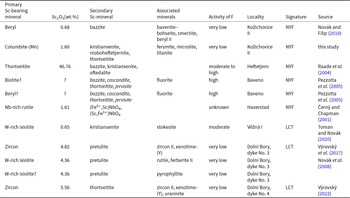
Scandium-bearing minerals from granitic pegmatites have been distinguished on several compositional and paragenetic criteria. We use the term Sc-mineral for the minerals with nominal Sc (e.g. thortveitite, bazzite) and the term Sc-enriched mineral for the minerals where Sc enters as a minor to trace cation at distinct positions in the crystal structure (Table 7). On the basis of their position in pegmatite evolution the following paragenetic types of Sc-bearing minerals have been defined: (1) primary magmatic in massive rock; (2) primary hydrothermal in miarolitic pockets; and (3) secondary hydrothermal defined as proximal (3a) in pseudomorphs after Sc-bearing precursor and distal (3b) developed on tectonic fractures close to, or far from from the primary precursor. A similar paragenetic classification was previously used for cookeite (Novák et al., Reference Novák, Čopjaková, Dosbaba, Galiová, Všianský and Staněk2015), secondary Be-minerals (Zachař et al., Reference Zachař, Novák and Škoda2020; Novák et al., Reference Novák, Dolníček, Zachař, Gadas, Nepejchal, K. and Vrtiška2023) and Nb–Ta oxide minerals (Chládek et al., Reference Š, Uher, Novák, Bačík and Opletal2021) from other occurrences.
Review of primary Sc-minerals and their breakdown products from a variety of granitic pegmatites. Secondary Sc-minerals from miaroles are in italics
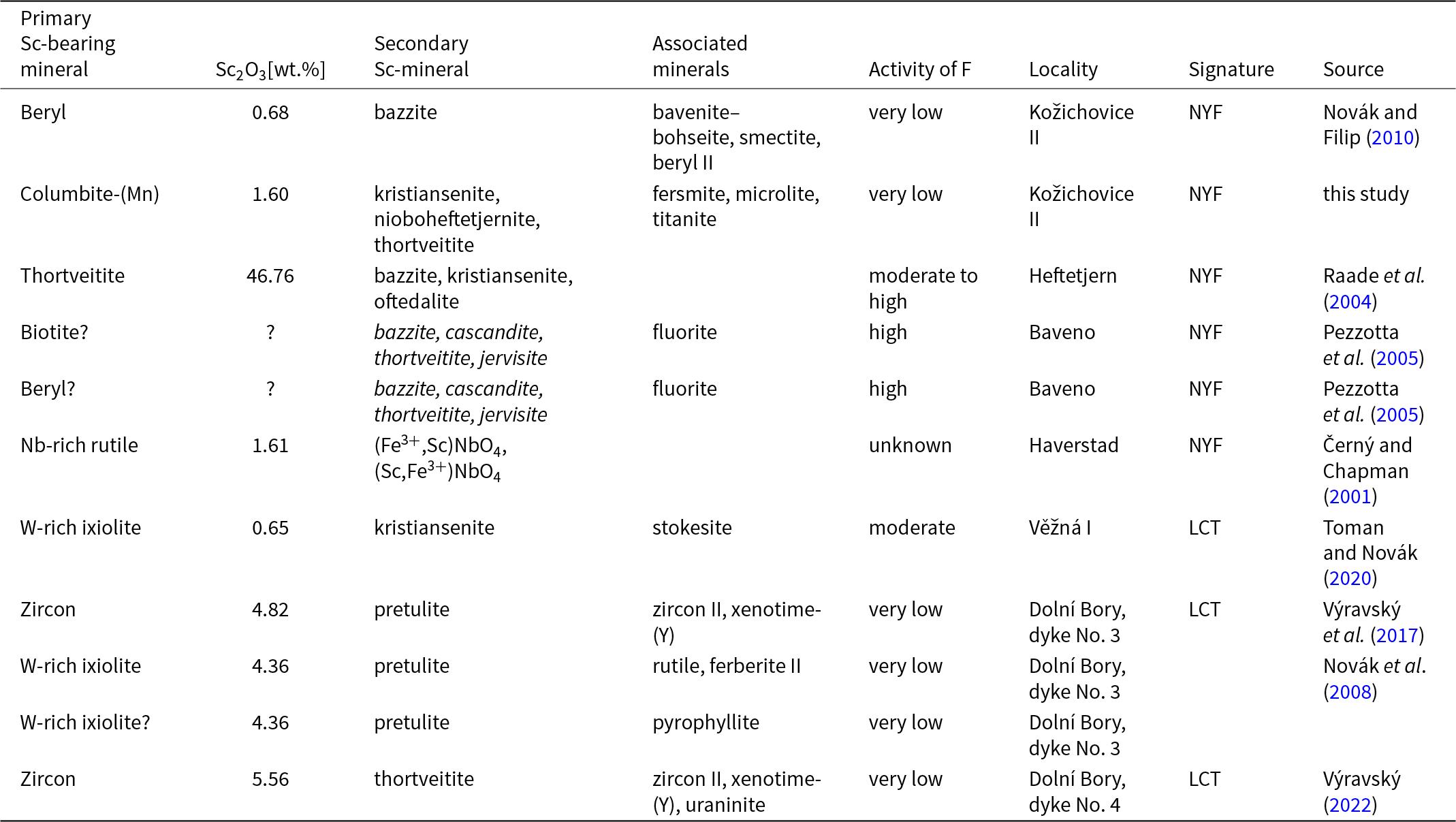
The source of Sc for the formation of hydrothermal Sc-bearing minerals might be fluids exsolved from residual magma or altered primary Sc-minerals or Sc-enriched minerals. Examples of Sc-bearing minerals and their relationships are given in Table 7. The only known terrestrial primary magmatic Sc-mineral is thortveitite. However, Sc is present in substantial amounts in several primary minerals: keiviite (isostructural with thortveitite), zircon, beryl, Nb-rich rutile, ixiolite, columbite-group minerals, wolframite, garnet, biotite, epidote and tourmaline (see Table 7 for details and references). Note that many of these are prone to alteration by hydrothermal fluids.
At the Kožichovice II pegmatite hydrothermal alteration of two distinct Sc-bearing precursors, beryl and columbite-(Mn), yielded two distinct assemblages. Alteration of beryl by alkaline Ca-rich fluids at T < 250–350°C produced an Al-enriched assemblage (secondary beryl, bavenite–bohseite, smectite) + bazzite (Novák and Filip, Reference Novák and Filip2010). The elevated activity of Ca is evident from the common presence of bavenite–bohseite (Table 7). The assemblage is also Ca-rich, though compositionally the very distinct oxide precursor columbite-(Mn) facilitated the formation of a different, dominantly oxide, secondary mineral assemblage. The textural relationships between columbite-(Mn), nioboheftetjernite and fersmite (Fig. 2, Supplementary Figs S3, S4) unambiguously testify for the metasomatic origin of nioboheftetjernite related to the replacement of Sc-enriched columbite-(Mn) by fersmite.
The most significant pegmatite-hosted occurrences of Sc mineralisation are the Heftetjern pegmatite in the Tørdal area of southern Norway (Bergstøl and Juve, Reference Bergstøl and Juve1988; Raade et al., Reference Raade, Ferraris, Gula, Ivaldi and Bernhard2002, Reference Raade, Bernhard and Ottolini2004; Cooper et al., Reference Cooper, Hawthorne, Ball and Kristiansen2006; Kolitsch et al., Reference Kolitsch, Kristiansen, Raade and Tillmanns2010 and references therein), and intraplutonic miarolitic pegmatites in the Baveno area, northern Italy (Gramaccioli et al., Reference Gramaccioli, Diella and Demartin2000; Pezzotta et al., Reference Pezzotta, Diella and Guastoni2005; Guastoni et al., Reference Guastoni, Nestola, Ferraris and Parodi2012 and references therein). These occurrences have remarkable similarities with the Kožichovice II pegmatite especially with respect to the high activity of Ca in fluids and paragenetic position of Sc-minerals.
In the Heftetjern pegmatite, three paragenetic types of the Sc mineralisation were recognised. (1) Some textural varieties of thortveitite and bazzite in massive rock are probably primary magmatic (Juve and Bergstøl, Reference Juve and Bergstøl1990; Raade et al., Reference Raade, Bernhard and Ottolini2004; Kristiansen, Reference Kristiansen2009). (2) Late Sc-minerals from small miarolitic (?) cavities in albite (kristiansenite, bazzite, scandiobabingtonite, cascandite, heftetjernite, oftedalite – Raade et al., Reference Raade, Ferraris, Gula, Ivaldi and Bernhard2002; Kolitsch et al., Reference Kolitsch, Kristiansen, Raade and Tillmanns2010; Raade and Erambert, Reference Raade and Erambert1999; Cooper et al., Reference Cooper, Hawthorne, Ball and Kristiansen2006), show no direct evidence of an altered Sc-bearing precursor. (3) Secondary Sc-minerals (kristiansenite, bazzite, oftedalite) formed by a direct metasomatic replacement of a Sc-rich precursor (thortveitite, Raade et al., Reference Raade, Bernhard and Ottolini2004). The source of Sc necessary for crystallisation of Sc-minerals from the small pockets (2) is not clear. Residual postmagmatic Sc-enriched fluids are possible; however, there is significant amount of intensively chloritised Sc-enriched biotite (≤ 2800 ppm Sc; Rosing-Schow et al., Reference Rosing-Schow, Müller and Friis2018), whereas chlorite is Sc-poor (EPMA; < 300 ppm, below detection limit of EPMA; unpublished data of the authors). Because we observed mobility of Sc on a cm scale from the altered precursors (Výravský et al., Reference Výravský, Novák and Škoda2017, discussion above), we assume, that the Sc necessary for the formation of late hydrothermal stage Sc-minerals in small cavities in albite or along the microfractures in the central part of the pegmatite body was derived from altered biotite or perhaps another altered primary Sc-enriched mineral (see list of Sc-enriched minerals and description of textural types of Sc-minerals in Kristiansen, Reference Kristiansen2009). There is common almandine–spessartine in the Heftetjern pegmatite containing ≤2000 ppm of Sc (Steffenssen et al., Reference Steffenssen, Müller, Munnik, Friis, Erambert, Kristoffersen and Rosing-Schow2020); however, its role as a source of Sc for late-stage mineralisation is unlikely due to the absence of alteration.
In the Baveno pegmatites, the only known primary magmatic Sc-bearing mineral is beryl with a concentration of Sc ≤ 0.34 wt.% Sc2O3 (Pezzotta et al., Reference Pezzotta, Diella and Guastoni2005). Scandium minerals (cascandite, kristiansenite, scandiobabingtonite, bazzite, jervisite, thortveitite) associated with fluorite and Ca-zeolites occur as hydrothermal minerals in miarolitic pockets. Pezzotta et al. (Reference Pezzotta, Diella and Guastoni2005) ascribed the source of Sc to subsolidus alteration of magmatic siderophyllite–‘zinnwaldite’ and gadolinite-(Y).
Černý et al. (Reference Černý, Chapman and Masau2000) described an exsolved phase (Fe3+,Sc)NbO4, possible rossovskyite, as tiny lamellas in Nb-rich rutile from the NYF pegmatite Håverstad, Evje-Iveland pegmatite district, Norway. It was interpreted as a process of cooling-related exsolution and the early exsolution was followed by coarsening and extended exsolution to a product with Sc > Fe3+, possible nioboheftetjernite, developed along microfractures presumably assisted by a fluid phase.
In the Věžná I pegmatite, zoned hübnerite to W-rich ixiolite (0.64 wt.% of Sc2O3) from the most evolved albite–pollucite unit (Toman and Novák, Reference Toman and Novák2018, Reference Toman and Novák2020) was strongly hydrothermally altered to a mixture of variable pyrochlore-group minerals, a Mn-hydroxide close to vernadite, and adularia. A few millimetres from this replacement assemblage, fracture filling kristiansenite associated with stokesite were found. Abundant Ca-rich pyrochlore minerals, stokesite and fluorapatite suggest elevated activity of Ca in the acting fluids.
Scandium-enriched wolframite to W-rich ixiolite and Sc-enriched zircon from the Dolní Bory pegmatite No. 3 underwent a hydrothermal replacement at P ≈200 MPa and T < 300–350°C and released Sc precipitated as proximal pretulite ScPO4 within the pseudomorphs after the precursors (Novák et al., Reference Novák, Johan, Škoda, Černý, Šrein and Veselovský2008; Výravský et al., Reference Výravský, Novák and Škoda2017). Rare distal pretulite also was identified (Table 7). These secondary assemblages of Sc-rich minerals differ from all others by high activity of P and Al and particularly by total absence of Ca-rich minerals except for very rare scheelite found in pseudomorphs after W-rich ixiolite and not associated with pretulite (Novák et al., Reference Novák, Johan, Škoda, Černý, Šrein and Veselovský2008). Recently, Výravský (Reference Výravský2022) described the breakdown of Sc-enriched zircon from nearby pegmatite Dolní Bory No. 4, where in contrast with the pegmatite No. 3, the hydrothermal recrystallisation led to the formation of small amounts of secondary thortveitite instead of pretulite and leaching of most of the released Sc.
Importance of Ca-rich fluids for the formation of Sc-minerals in granitic pegmatites and their sources
The incompatibility of Sc in volumetrically dominant newly formed secondary minerals is the main factor allowing separation of Sc and formation of Sc-rich minerals. This is caused by: (a) rather low temperature, which makes the crystal structures more rigid and less favourable to Sc substitution; and mainly by (b) favourable composition of the fluids. The Ca-rich fluids are particularly favourable for the formation of Sc-dominant minerals, because Sc does not preferentially enter the Ca-crystallographic site in substantial amounts due to its difference in ionic radius (100 pm vs. 75 pm for octahedrally coordinated Ca and Sc, respectively; Shannon, Reference Shannon1976). The hydrothermal Sc-minerals from granitic pegmatites are commonly Ca-rich (kristiansenite, cascandite, scandiobabingtonite; see Table 7), where Sc enters the octahedral site. In contrast, the crystallisation of a large volume of Sc-compatible Ca-minerals from hydrothermal fluids, e.g. titanite-group minerals, would prevent the precipitation of Sc-minerals. Thus, the overall chemical composition of the Ca-rich fluids as well as the composition of the Sc-enriched precursor are crucial for the formation of Sc-minerals.
A summary of similarities and differences between three important known occurrences of Sc-minerals in granitic pegmatites is given in Table 8. The pegmatites belong to the NYF compositional family (Černý and Ercit, Reference Černý and T.S2005) and the intra-granitic pegmatites Kožichovice II and Baveno have an obvious magmatic source. In the exo-plutonic Heftetjern pegmatite, Bergstøl and Juve, (Reference Bergstøl and Juve1988) speculated about Sc-enrichment originating from the surrounding amphibolites. The Sc-minerals are either late hydrothermal minerals in cavities or could be directly linked to metasomatic replacement of some older Sc-enriched precursor. In addition, the high activity of Ca in parental fluids manifested by the presence of Ca-rich minerals (Table 8) in close paragenetic association with Sc-minerals is typical at all localities.
Comparison of geological, geochemical and mineralogical characteristics of the pegmatites with Sc mineralisation at Kožichovice, Baveno and Heftetjern. Sources: Kožichovice – Janoušek et al. (Reference Janoušek, Hanžl, Svojtka, Hora, Kochergina, Gadas, Holub, Gerdes, Verner, Hrdličková, Daly and Buriánek2020), Zachař (Reference Zachař2021), this work; Baveno – Pezzotta et al. (Reference Pezzotta, Diella and Guastoni2005), Pinarelli et al. (Reference Pinarelli, Moro and Boriani1988, Reference Pinarelli, Moro, Boriani and Caironi2002); Heftetjern – Bergstøl and Juve (Reference Bergstøl and Juve1988), Steffenssen et al. (Reference Steffenssen, Müller, Munnik, Friis, Erambert, Kristoffersen and Rosing-Schow2020), Rosing-Schow et al. (Reference Rosing-Schow, Romer, Müller, Corfu, Škoda and Friis2023)

The activity of F is very variable among the individual localities as is demonstrated by the mineral assemblages. Fluorite and/or topaz is common in the Baveno and Heftejern pegmatites but absent in Kožichovice II and all pegmatites from the Třebíč Pluton. The composition of fluorcalciomicrolite is very close to its not yet described OH analogue (0.36 apfu F and 0.35 apfu OH) and resulted from the low F activity. Consequently, a high activity of F is evidently not essential for the formation of Sc-dominant minerals in pegmatites as was proposed by Gramaccioli et al. (Reference Gramaccioli, Diella and Demartin2000). The origin of Sc mineralisation at the relevant localities could be explained by metasomatic alteration of Sc-enriched precursors by Ca-rich fluids, where Sc was not compatible with the majority of coeval secondary minerals and therefore formed its own Sc-minerals.
Late Ca-enrichment is typical in the Kožichovice II pegmatite (Novák and Filip, Reference Novák and Filip2010) and in many granitic pegmatites worldwide (Novák et al., Reference Novák, Selway, Černyý, Hawthorne and Ottolini1999, Reference Novák2013, Reference Novák, Dolníček, Zachař, Gadas, Nepejchal, K. and Vrtiška2023; Teertstra et al., Reference Teertstra, Černý and Ottolini1999; Tindle et al., Reference Tindle, Breaks and Selway2002, Reference Tindle, Selway and Breaks2005; Martin and De Vito, Reference Martin and De Vito2014); however, the origin of Ca in these fluids is still not fully understood. Four principal sources of Ca in hydrothermal fluids are viable. (1) Pegmatite melt was primarily enriched in Ca from its parental granite or (2) Ca was derived by Ca-contamination in the early stages of pegmatite crystallisation (pre-emplacement and/or post-emplacement stage; Novák, Reference Novák2013) as has been documented at pegmatites cutting metacarbonates, calc-silicate rocks and/or skarns (Novák et al., Reference Novák, Selway, Černyý, Hawthorne and Ottolini1999, Reference Novák, Kadlec and Gadas2013; Buřival and Novák, Reference Buřival and Novák2018). The late, but primary, fluorapatite, liddicoatite, fluorite, calcite and zeolites are evidence that some of the Ca might have survived to later stages of primary crystallisation. Martin and De Vito (Reference Martin and De Vito2014) suggested an additional source of Ca by (3) a late Ca ‘miniflood’ originating from albitisation of Ca-rich plagioclase in host rocks facilitated by the fluids which escaped from a pegmatite (see also Pieczka et al., Reference Pieczka, Szuszkiewicz, Szełęg and Nejbert2019). (4) Serpentinite-derived fluids are an additional important source of Ca (Evans et al., Reference Evans, Hattori and Baronnet2013) as documented at primitive pegmatites with accessory tourmaline enclosed in serpentinite (Čopjaková et al., Reference Čopjaková, Prokop, Novák, Losos, Gadas, Škoda and Holá2021).
At the intra-granitic pegmatites of the Třebíč Pluton including the Kožichovice II pegmatite, residual fluids are the most probable source of Ca. Evidence for this is in the common secondary bavenite–bohseite ± milarite after beryl, phenakite and helvine–danalite (Novák and Filip, Reference Novák and Filip2010; Zachař et al., Reference Zachař, Novák and Škoda2020) and common secondary titanite after ilmenite (Škoda et al., Reference Škoda, Novák and Houzar2006; Zachař and Novák, Reference Novák2013). The secondary Ca-rich minerals are typically proximal in pseudomorphs after a primary precursor (Novák et al., Reference Novák, Dolníček, Zachař, Gadas, Nepejchal, K. and Vrtiška2023). Rare primary actinolite in the outermost primitive unit and locally abundant Ca-enriched primary tourmaline (Novák et al., Reference Novák, Škoda, Filip, Macek and Vaculovič2011) show that high Ca was present in the original pegmatite melt. Further, the total absence of distal secondary Be-minerals on late fractures (Zachař et al., Reference Zachař, Novák and Škoda2020) and other fracture-filling Ca-bearing minerals, which are potential channel-ways for externally derived Ca-rich fluids, support the evidence that residual fluids are the source of Ca.
Conclusions
The unique assemblage of Sc-minerals in the Kožichovice II pegmatite has enabled an investigation of in situ processes of formation of Sc-minerals in granitic pegmatites and revealed the conditions favourable for their formation in magmatic-hydrothermal systems. The process includes three principal phases.
(1) Pre-concentration of Sc in the NYF pegmatitic melt typically derived from A- or I-type granites with elevated concentrations of Sc. This is because A-type granites are the products of melting of upper mantle and overlying lower crust containing 25.4 ppm Sc, compared to upper crust containing 7 ppm Sc (Wedepohl, Reference Wedepohl1995). The A- and I-type granites are enriched in Sc compared to upper crust-derived S-type granites. Importantly, S-type granites are usually rich in P, which facilitates incorporation of Sc into early crystallised zircon and thus impeding concentration of Sc in a residual melt. Consequently, in granitic systems Sc-rich minerals occur mainly in NYF pegmatites. The Třebíč Pluton has I-type affinity and evident enrichment in Sc (8–30 ppm; Holub, Reference Holub1997, Janoušek et al., Reference Janoušek, Hanžl, Svojtka, Hora, Kochergina, Gadas, Holub, Gerdes, Verner, Hrdličková, Daly and Buriánek2020) is reflected in the presence of Sc-rich minerals in its pegmatites.
(2) Incompatibility of Sc in the volumetrically dominant rock-forming minerals (feldspars and quartz; Hreus et al., Reference Hreus, Výravský, Cempírek, Breiter, Vašinová Galiová, Krátký, Šešulka and Škoda2021; Steffenssen et al., Reference Steffenssen, Müller, Munnik, Friis, Erambert, Kristoffersen and Rosing-Schow2020) during magmatic crystallisation leads to its pre-concentration in minor and accessory minerals (biotite-group micas, tourmalines, epidote-group, zircon, columbite-group, rutile, cassiterite, garnets). At this stage, the precursor minerals contain hundreds of ppm to units of wt.% Sc. Only very exceptionally, Sc-dominant minerals, such as thortveitite, could form in the late-magmatic stage (e.g. Evje-Iveland pegmatites, Norway) after solidification of large quantities of feldspars and quartz in the central parts of pegmatite, which resulted in saturation of Sc in melt (Bjørlykke, Reference Bjørlykke1935; Williams-Jones and Vasyukova, Reference Williams-Jones and O.V2018). In the Kožichovice II pegmatite, Sc preferentially entered primary columbite-(Mn) and beryl (Novák and Filip, Reference Novák and Filip2010).
(3) Subsolidus hydrothermal alteration of the precursor Sc-rich minerals by Ca-rich fluids, coupled with the incompatibility of Sc in volumetrically dominant secondary minerals, locally facilitated saturation of minor secondary Sc-minerals. In the Kožichovice II pegmatite, the metasomatic replacement of Sc-bearing columbite-(Mn) by fersmite led to the formation of nioboheftetjernite and later kristiansenite and thortveitite.
On the basis of detailed study of minerals assemblages of Sc-enriched primary and secondary Sc-rich minerals, it is reasonable to assume, that Sc-minerals at the localities Heftetjern, Baveno and Kožichovice II originated during similar primary solidus and subsolidus processes. However, F activity was very low in Kožichovice II, indicating the F complexation is not needed for the formation of secondary Sc-minerals in granitic pegmatites, whereas the presence of Ca-rich fluids is essential.
Supplementary material
The supplementary material for this article can be found at https://doi.org/10.1180/mgm.2024.85.
Acknowledgements
The authors are grateful to reviewers Pietro Vignola, and two anonymous reviewers and also to handling editor Fabrizio Nestola for constructive comments that improved the manuscript. This research was supported by OP RDE [grant number CZ.02.1.01/0.0/0.0/16_026/0008459 (Geobarr) from the ERDF] for MN and RŠ. This paper is dedicated to our friend Alessandro Guastoni who intensively studied Sc-bearing minerals from pegmatites during his scientific career. The authors also thank Production Editor Helen Kerbey and Principal Editor Roger Mitchell for editorial assistance and copy editing.
Competing interests
The authors declare none.





 Open access

