

Introduction
Strengthening cultivation of native crops is a means to enhance agricultural productivity and climate change adaptation in Africa because of their tolerance to drought and poor soils, nutritional values and adaptability, among other traits (Tadele and Assefa, Reference Tadele and Assefa2012; Chivenge et al., Reference Chivenge, Mabhaudhi, Modi and Mafongoya2015). Fonio (Digitaria exilis (Kippist) Stapf) and Bambara groundnut (Vigna subterranea (L.) Verdc.) are ancient crops in West Africa that maintain a livelihood role in the region (Kahlheber and Neumann, Reference Kahlheber, Neumann, Denham, Iriarte and Vrydaghs2016; Temegne et al., Reference Temegne, Gouertoumbo, Wakem, Nkou, Youmbi and Ntsomboh-Ntsefong2018). Fonio was likely domesticated in the upper Niger river basin and is cultivated between the 8th and 14th north parallels from Senegal to Lake Chad (Adoukonou-Sagbadja et al., Reference Adoukonou-Sagbadja, Wagner, Dansi, Ahlemeyer, Daïnou, Akpagana, Ordon and Friedt2007; Cruz et al., Reference Cruz, Béavogui, Dramé and Diallo2016). Bambara groundnut is thought to have been domesticated in northern Nigeria and Cameroon and is cultivated throughout much of Tropical Africa (Temegne et al., Reference Temegne, Gouertoumbo, Wakem, Nkou, Youmbi and Ntsomboh-Ntsefong2018). Both crops are grown primarily for subsistence and are emerging income sources (Jideani and Jideani, Reference Jideani and Jideani2011; Hillocks et al., Reference Hillocks, Bennett and Mponda2012). Their yields are low and irregular and their progressive abandonment has been observed in various parts of West Africa (Adoukonou-Sagbadja et al., Reference Adoukonou-Sagbadja, Dansi, Vodouhè and Akpagana2006; Berchie et al., Reference Berchie, Adu-Dapaah, Dankyi, Plahar, Nelson-Quartey, Haleegoah, Asafu-Agyei and Addo2010; Dansi et al., Reference Dansi, Adoukonou-Sagbadja and Vodouhè2010; Abu and Buah, Reference Abu and Buah2011; Sani et al., Reference Sani, Bakasso, Inoussa, Barnaud, Sanoussi, Mahamane, Saadou and Billot2018). They are currently minor crops in Mali with fonio representing 0.3% of cereal production and Bambara groundnut 4% of legume production (Ministere de l'Agriculture, 2016).
Both crops effectively comprise landraces. No improved variety of Bambara groundnut is available in Mali and although seven improved fonio varieties have been released, adoption is low. As for other traditional grain crops, cultivation of fonio and Bambara groundnut in Mali depends on the informal seed system. Intraspecific diversity and farmer practices of seed selection and exchange support crop adaptation and resilience of seed supply under the variable climate conditions and fragile agricultural support typical of the region (Bazile and Abrami, Reference Bazile and Abrami2008; Coulibaly et al., Reference Coulibaly, Bazile, Sidibé and Abrami2008; Vigouroux et al., Reference Vigouroux, Barnaud, Scarcelli and Thuillet2011). Albeit, seed exchanges can be limited geographically or within kinship networks with inconsistent seed quality (Bazile, Reference Bazile2006; Coulibaly et al., Reference Coulibaly, Bazile, Sidibé and Abrami2008, Smale et al., Reference Smale, Diakité, Dembélé, Traoré, Guindo and Konta2008).
In this context, community biodiversity management – increasing farmers' access and awareness of intraspecific diversity and building local institutions and capacities for its effective management (Shrestha et al., Reference Shrestha, Shrestha, Subedi, Peroni, de Boef, de Boef, Peroni, Subedi, Thijssen and O'Keeffe2006) – can be strategic towards strengthening fonio and Bambara groundnut cultivation. Enhancing farmers' access to diversity enables the identification of material suited to local environments, emerging climate conditions and preferences (Dawson et al., Reference Dawson, Murphy and Jones2008; van Etten et al., Reference van Etten, de Sousa, Aguilar, Barrios, Coto, Dell'Acqua, Fadda, Gebrehawaryat, van de Gevel, Gupta, Kiros, Madriz, Mathur, Mengistu, Mercado, Nurhisen Mohammed, Paliwal, Pè, Quirós, Rosas, Sharma, Singh, Solanki and Steinke2019), while community institutions help secure the role of farmers in conserving and shaping diversity for local needs (Ahmed et al., Reference Ahmed, Gregg, Louwaars, Jaenicke, Ganry, Hoeschle-Zeledon and Kahane2009; Clavel et al., Reference Clavel, Bazile, Bertrand, Sounigo, Vom Brocke, Trouche and Sourisseau2015; Mabhaudhi et al., Reference Mabhaudhi, O’Reilly, Walker and Mwale2016). A community biodiversity management approach combining diversity field fora, community seed banks and seed fairs has supported diffusion and conservation of sorghum, pearl millet and cowpea varieties in Mali (Huvio and Sidibé, Reference Huvio and Sidibé2003; Jackson et al., Reference Jackson, van Noordwijk, Bengtsson, Foster, Lipper, Pulleman, Said, Snaddon and Vodouhe2010; Smale et al., Reference Smale, Diakité, Sidibé, Grum, Jones, Traore and Guindo2010; Sidibe et al., Reference Sidibe, Vodouhe, N'Danikou, Vernooy, Shrestha and Sthapit2015). We investigated the potential for this approach to revitalize fonio and Bambara groundnut cultivation in terms of the number of producers, yields and intraspecific diversity maintained by communities.
Materials and methods
Study sites
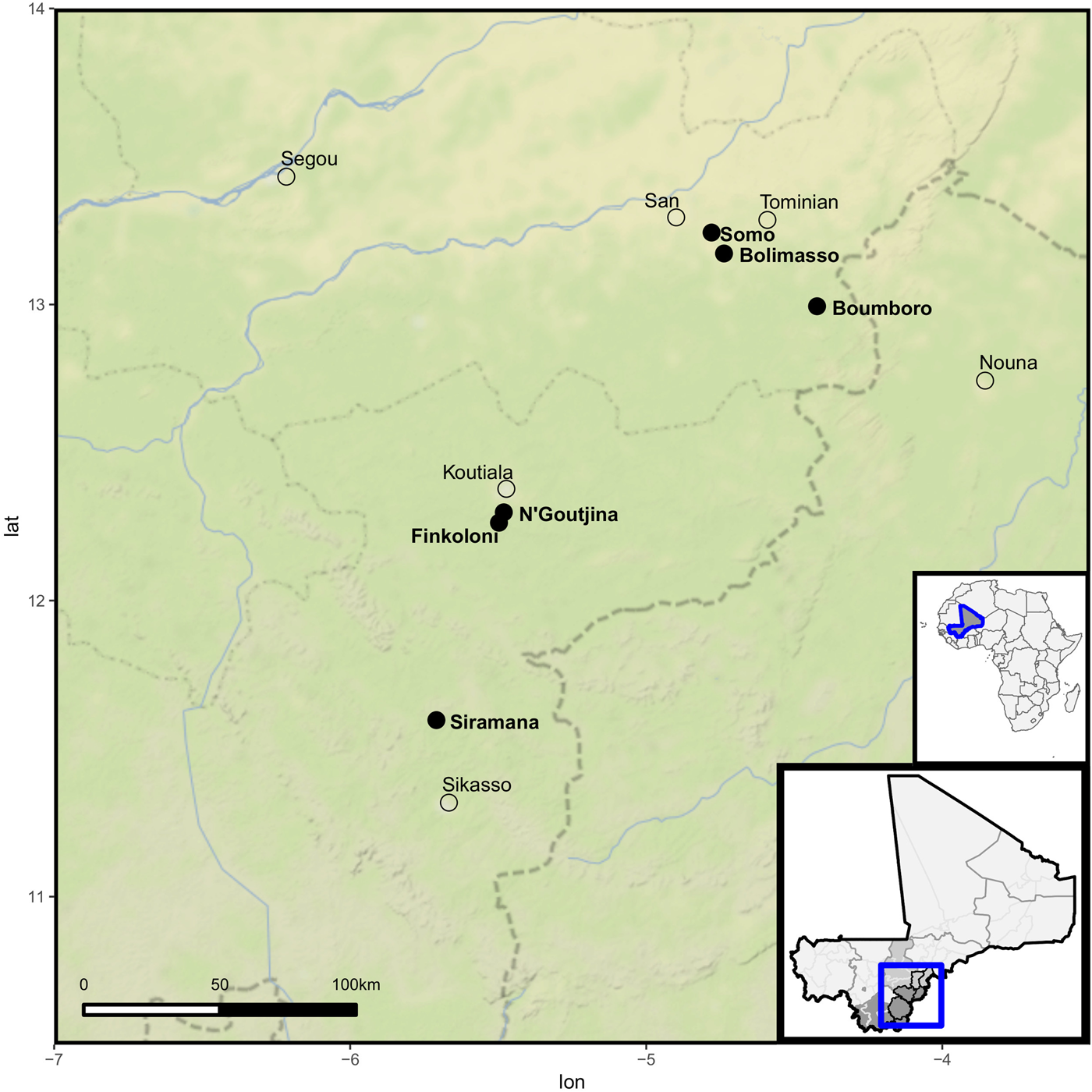
Six villages in southern Mali were included in the study (Table 1; Fig. 1). All were settled agriculturalists with livelihoods based on integrated crop-livestock production for subsistence and income generation. We aimed to include sites where fonio and Bambara groundnut maintained a considerable role in local cropping systems and livelihoods, as well as sites where these crops were rare or abandoned, with potential to support livelihood diversification. The villages selected for the study had at least a few households involved in the production and sale of the focal crops. Willingness of villagers to undertake the activities was an important criterion and we opted to work in villages that held good rapport and trust with the researchers' affiliated organizations. Safety and accessibility by road were additional factors that informed site selection.
Map of the study sites. Focal villages are indicated with filled circles and nearby larger population centres are indicated with open circles. Base map by Stamen Design CCBY 3.0 and shapefiles by Diva-GIS.
Characteristics of the focal villages, households surveyed and diversity fields

* Source: Ministère de l'Economie des Finances et du Budget (2013).
† Source: 2015 household survey.
‡ Following classification by Soumaré et al. (Reference Soumaré, Bazile, Vaksmann, Kouressy, Diallo and Diakité2008): NSS=North Sudano-Sahelian; OCB=Old cotton basin; SDZ=Sikasso diversification zone.
§ Rainfall data are not available for some sites in 2017 as a result of technical difficulties.
Three villages in the Ségou region were included where fonio and Bambara groundnut feature prominently in local cropping systems. Among the different regions of Mali, the greatest production of fonio and Bambara groundnut has been recorded in Ségou, which accounted for 52 and 50% of the national production of these crops, respectively, in 2015 (Ministere de l'Agriculture, 2016). The study villages in this region are within the North Sudano-Sahelian production zone (sensu Soumaré et al., Reference Soumaré, Bazile, Vaksmann, Kouressy, Diallo and Diakité2008), where cropping systems are based on pearl millet and sorghum complemented by peanut. Rotations commonly initiate with pearl millet followed by sorghum, peanut and/or fonio in biennial or quadrennial cycles involving the limited use of organic or mineral fertilizer for pearl millet (Dembele et al., Reference Dembele, Soumaré and Gaillard2016). Fonio and pearl millet tend to be grown on sandy soils and sorghum on more clayey soils (Cruz et al., Reference Cruz, Béavogui, Dramé and Diallo2016).
Furthermore, three villages in Sikasso region were included in the study, where fonio and Bambara groundnut have a more limited role in cropping systems. Two of the villages (Finkoloni and N'Goutjina) were located in the old cotton basin and the third (Siramana) in the Sikasso diversification zone (sensu Soumaré et al., Reference Soumaré, Bazile, Vaksmann, Kouressy, Diallo and Diakité2008). The cropping systems in these areas are dominated by rainfed cotton and maize grown with mineral fertilizer and organic manure (Soumaré et al., Reference Soumaré, Bazile, Vaksmann, Kouressy, Diallo and Diakité2008). Tubers, vegetables and fruits are also commonly produced in lowland areas in the Sikasso diversification zone (Dufumier, Reference Dufumier2005; Soumaré et al., Reference Soumaré, Bazile, Vaksmann, Kouressy, Diallo and Diakité2008). Sikasso region accounted for 8% of fonio and 7% of Bambara groundnut production in Mali in 2015 (Ministere de l'Agriculture, 2016). However, in the study areas, traditional grain crops, including sorghum and pearl millet, have been largely displaced with the expansion of cotton and maize production (Kouressy et al., Reference Kouressy, Bazile, Vaksmann, Soumaré, Doucouré and Sidibé2003; Djouara et al., Reference Djouara, Bélières and Kébé2006; Cooper and West, Reference Cooper and West2017). Biennial rotations of cotton and maize, along with triennial and quadrennial variations followed by sorghum and millet, are predominant cropping systems in the region (Dufumier, Reference Dufumier2005; Dembele et al., Reference Dembele, Soumaré and Gaillard2016). Minor cropping systems that are generally managed by women and involve no external inputs include plots of rice, peanut and rotations of peanut and Bambara groundnut (Dufumier, Reference Dufumier2005; Dembele et al., Reference Dembele, Soumaré and Gaillard2016). The legumes are typically grown after cereals. Fonio is sown on the poorest soils, at the end of rotations, commonly following a legume, or intercropped with roselle (Soumaré et al., Reference Soumaré, Bazile, Vaksmann, Kouressy, Diallo and Diakité2008; Cruz et al., Reference Cruz, Béavogui, Dramé and Diallo2016; Cooper and West, Reference Cooper and West2017).
The terrain in all the study sites is flat savannah at an altitude of 300–400 m.a.s.l. The climate is characterized by a rainy season from May to October and a dry season from November to April. Annual rainfall ranges from 400 to 1000 mm, with more southern sites receiving higher rainfall. Temperatures range from 20–36 °C with mean 29 °C (Traore et al., Reference Traore, Corbeels, van Wijk, Rufino and Giller2013).
Diversity field fora
Diversity field fora are a form of farmer field school that aims to enhance farmers' access, knowledge and capacity for managing crop genetic resources, considering short-term production goals and long-term conservation of diversity (Huvio and Sidibé, Reference Huvio and Sidibé2003; Jackson et al., Reference Jackson, van Noordwijk, Bengtsson, Foster, Lipper, Pulleman, Said, Snaddon and Vodouhe2010). Drawing on principles of community learning (Coudel et al., Reference Coudel, Tonneau and Rey-Valette2011), adult learning (Knowles, Reference Knowles1978) and experiential learning (Lewis and Williams, Reference Lewis and Williams1994) that are applied in farmer field schools (Gallagher, Reference Gallagher2003), diversity field fora involve a process of farmer-led research-action-training that builds on participants' existing knowledge and encourages innovation suitable to their livelihoods. Weekly meetings are organized to observe unique characteristics of varieties, compare their performance and discuss cultivation, harvest, post-harvest and seed management practices, along with approaches for constraint resolution (Huvio and Sidibé, Reference Huvio and Sidibé2003). A facilitator encourages an exchange of knowledge between farmers, technicians and researchers with no dominance, encouraging each actor to feel free and confident to propose their ideas for discussion. The diversity field fora follow the entire crop cycle, supporting processes of ‘learning by doing’ and ‘learning from others’ to promote adoption and innovation according to local needs (Foster and Rosenzweig, Reference Foster and Rosenzweig1995; Gallagher, Reference Gallagher2003; Huvio and Sidibé, Reference Huvio and Sidibé2003).
Diversity fields with 10–12 fonio varieties and 8–12 Bambara groundnut varieties were established in each village in 2016 and 2017. One exception was in N'Goutjina, where a plot for Bambara groundnut could not be established in 2017 as a result of storage pests affecting seed availability. Varieties included in the diversity fields were sourced from the national research system (IER, Ministry of Agriculture), from communities participating in the study and from other communities Mali. Six improved varieties of fonio were planted in each site in both years, while nine local varieties of fonio and 28 local varieties of Bambara groundnut had more mixed representation across diversity fields (online Supplementary Tables S1 and S2). Plantings were realized in the last decade of July in both cropping seasons. Fonio was broadcast sown at a rate of 30 kg/ha. Row spacing of Bambara groundnut was 0.45 m × 0.15 m for a seeding rate of 80 kg/ha. Each variety was assigned a plot of 10 m × 5 m (50 m2) with homogeneous soil. The areas assigned to the diversity fields had sandy soil in Finkoloni and N'Goutjina; sandy/loam soil in Somo, Bolimasso and Boumboro and sandy/rocky soil in Siramana. Fertilizer was applied at planting time at a rate of 100 kg/ha of diammonium phosphate (DAP) or cereal complex for fonio and 65 kg/ha of DAP for Bambara groundnut. Weeding was performed as required and pesticide was only applied in critical cases. The crops were exclusively rainfed. Rainfall measured by site-specific weather stations from June to September 2016 and 2017 is summarized in Table 1 and online Supplementary Fig. S1. Harvest was realized at maturation for each variety in the central part of the plots to assess yield. The harvest was threshed manually with care to avoid contamination or grain losses.
Through weekly meetings, farmers were actively engaged in establishing and maintaining the diversity fields and collecting data on the varieties with support from researchers of Institut d'Economie Rurale (IER) and technicians from Aide au Sahel et à l'Enfance au Mali (ASEM) in Boumboro, Bolimasso and Somo and Centre d'Appui à l'Autopromotion pour le Développement (CAAD) in Finkoloni, N'Goutjina and Siramana. The diversity field fora involved the participation of 150 farmers (30 women and 120 men) who in each village were organized in five working groups of five people, including one composed of women. The gender ratio of participants in the diversity field fora was defined based on preliminary surveys, which indicated that both men and women are involved in fonio and Bambara groundnut cultivation in the communities, but that men generally have a more prominent role in cultivation activities, while the role of women is most critical in post-harvest activities (Bioversity International and IER, 2017). Participants for the diversity fields were selected through general assemblies managed by the village councils and chaired by the village heads, during which the activities were presented and villagers expressed their interest to join. The selection aimed to include people from different households and favoured those who were willing and available to participate in weekly meetings. The final selection was determined by the village committees following local decision-making processes.
Community seed banks, biodiversity registers and seed fairs
Community seed banks are locally-governed institutions whose core function is to maintain seeds for local use (Vernooy et al., Reference Vernooy, Sthapit, Otieno, Shrestha and Gupta2017). Community seed banks were established progressively in each study village with support from projects led by IER and Bioversity International funded by the International Fund for Agricultural Development (IFAD). Building on knowledge and experience gained through earlier seed bank initiatives in Mopti and Ségou regions (Goïta et al., Reference Goïta, Goïta, Coulibaly, Winge, Andersen and Winge2013; Dalle and Walsh, Reference Dalle, Walsh, Vernooy, Shrestha and Sthapit2015; Sidibe et al., Reference Sidibe, Vodouhe, N'Danikou, Vernooy, Shrestha and Sthapit2015), community seed banks were established in Somo, Bolimasso, Boumboro and Siramana in 2014 and in Finkoloni and N'Goutjina in 2018. The community seed banks maintain varieties of several food crops, playing a role in their conservation and seed provision. Committees in each village maintain biodiversity registers to monitor the varieties used locally and available in the seed bank, and initiate multiplication activities.
Several seed fairs were organized between 2015 and 2017 that allowed farmers from the study communities and neighbouring villages to access seed and associated knowledge of different varieties of fonio and Bambara groundnut and other traditional food crops. The seed fairs took place in Tominian on 6 May 2016; Somo and Finkoloni on 14 to 20 March 2017 and Siramana from 26 to 30 December 2017. Awareness was raised during these events on the nutrition and resilience benefits of fonio and Bambara groundnut, recipes were exchanged among participants, and drudgery-reducing processing methods were displayed.
Assessing change in diversity and use of fonio and Bambara groundnut
Household surveys were carried out in each village in 2015 and 2018 to assess the diversity and the use of fonio and Bambara groundnut before and after the diversity field activities. Households were randomly selected with the assistance of local resource farmers to build a sampling frame. The sample size was 50–60 households per village in 2015 and 30 households per village in 2018, for a total sample of 314 households in 2015 and 180 households in 2018 (Table 1). The reduction in sample size was a consequence of resource limitations. In both years, the survey was carried out in the month of October, around the time of crop harvest. The male head of household was interviewed regarding the varieties cultivated (vernacular name), area allocated and production achieved in the most recent growing season, as well as seed sources.
Data analysis
All analyses were performed using R version 3.5.1 (R Core Team, 2018) in RStudio version 1.1.463 (RStudio Team, 2016). Yields of fonio and Bambara groundnut in the diversity fields were analysed with linear mixed effect models fitted by restricted maximum likelihood (Bates et al., Reference Bates, Mächler, Bolker and Walker2015). Variety was modelled as a random factor (random intercept), considering that the varieties included in the diversity fields were a selection from many available in the region (Smith et al., Reference Smith, Cullis and Thompson2005; Harrison et al., Reference Harrison, Donaldson, Correa-Cano, Evans, Fisher, Goodwin, Robinson, Hodgson and Inger2018). The study sites formed three groups with similar latitude and rainfall: (1) Boumboro, Bolimasso and Somo at 12.9931–13.2431°N; (2) Finkoloni and N'Goutjina at 12.2630–12.298°N and (3) Siramana at 11.5962°N (Fig. 1). Latitude group, year and their interaction were included as fixed effects. In the fonio model, variety type (improved or local) was included as an additional fixed effect in which variety was nested. Degrees of freedom were determined using Satterthwaite approximation to calculate P-values using the lmerTest package (Kuznetsova et al., Reference Kuznetsova, Brockhoff and Christensen2017; Luke, Reference Luke2017; Leyrat et al., Reference Leyrat, Morgan, Leurent and Kahan2018). Plots of the best linear unbiased predictor (BLUP) and conditional variance were inspected to assess differences in variety performance.
In analysing the household surveys, generalized linear models (glms) assessed differences between sites and years in the frequency of fonio and Bambara groundnut cultivation, the area allocated and yields obtained. Crop area and yield data were log transformed to adhere to a normal distribution. A binomial distribution was applied in modelling frequency of cultivation. Differences between sites were assessed by a series of planned orthogonal contrasts that were defined to compare sites with distinct production systems, latitudes and ethnicities (Table 1): 1 – sites in the North Sudano Sahelian zone (Bolimasso, Somo and Boumboro) versus sites in cotton and maize-based systems at more southern latitudes (Finkoloni, N'Goutjina and Siramana); 2 – sites in the old cotton basin with Minianka ethnicity (Finkoloni and N'Goutjina) versus site in the Sikasso diversification zone with Senoufo ethnicity (Siramana); 3 – differences between Miniaka communities in the old cotton basin (Finkoloni versus N'Goutjina); 4 – Bobo (Bolimasso and Somo) versus Dafing (Boumboro) communities in the North Sudano-Sahelian zone and 5 – differences between Bobo communities in the North Sudano Sahelian zone (Bolimasso versus Somo). The contrasts were performed using chi-square tests for crop cultivation frequency and t-tests for crop area and yield.
The number of varieties of fonio and Bambara groundnut cultivated by households was assessed by site and year. Changes in variety diversity of fonio and Bambara groundnut at the village level were explored using accumulation curves to account for differences in the sample size between years and to provide a more robust assessment. The effect of the sampling effort on estimates of species richness in natural ecosystems is well documented and accumulation curves are used to control for this relationship to enable meaningful comparisons (Soberon and Llorente, Reference Soberon and Llorente1993; Moreno and Halffter, Reference Moreno and Halffter2000; Colwell et al., Reference Colwell, Mao and Chang2004). This method was applied to compare village-level variety diversity between 2015 and 2018 using the ‘vegan’ package in R (Gotelli and Colwell, Reference Gotelli and Colwell2001; Oksanen et al., Reference Oksanen, Blanchet, Friendly, Kindt, Legendre, Mcglinn, Minchin, Hara, Simpson, Solymos, Stevens, Szoecs and Wagner2019). The authors and field teams verified the names of varieties provided by the survey respondents to control for synonyms and the analysis was conducted separately for each village to minimize issues of synonyms used between communities that speak different languages.
Results
Fonio diversity fields
Fonio yields in the diversity fields ranged from 110.0 to 2000.0 kg/ha with a mean of 732.4 kg/ha (Fig. 2 top left panel). There was considerable variation in the performance of fonio varieties between sites and years (online Supplementary Fig. S2 top panel). The results of the mixed effects model for fonio yield are shown in Table 2. Overall, yields were significantly higher in the northern sites (Siramana versus Boumboro, Bolimasso and Somo: t 117.4 = −5.964, P < 0.001; Finkoloni and N'Goutjina versus Boumboro, Bolimasso and Somo: t 127.1 = −8.755, P < 0.001) and significantly higher in 2016 than in 2017 (t 108.3 = −5.803, P < 0.001). Yields declined significantly in 2017 in the northern sites, whereas an opposite but less pronounced trend was seen in the southern sites (Fig. 2 top left panel). No significant yield difference was observed between improved varieties and local varieties. Indeed, the conditional standard deviations for the BLUPs of all varieties overlapped suggesting no significant difference in variety performance overall (Fig. 2 bottom left panel). Local varieties Pébirou, Wanblen and Finidjè had the highest BLUPs and local varieties Finibléni, Péfozo Clement and Péfozo Lamine had the lowest BLUPs.
Box plots of Bambara groundnut and fonio yields in the diversity fields in 2016 and 2017 for sites with similar latitude (top panels) and the BLUPs of specific varieties with conditional standard deviation (bottom panels).

Mixed effect model results for fonio (144 observations of 16 varieties) and Bambara groundnut yields (113 observations of 28 varieties) in the diversity fields

a Degrees of freedom estimated by Satterthwaite's approximation.
Bambara groundnut diversity fields
Yields of Bambara groundnut in the diversity fields ranged from 30.0 to 3960.0 kg/ha with a mean of 903.7 kg/ha (Fig. 2 top right panel). Little consistency was observed in the yield of specific varieties between sites and years (online Supplementary Fig. S2 bottom panel). The mixed effect model results for Bambara groundnut yields are shown in Table 2. As for fonio, Bambara groundnut yields were significantly higher in the northern sites (Siramana versus Boumboro, Bolimasso and Somo: t 103.9 = −11.172, P < 0.001; Finkoloni and N'Goutjina versus Boumboro, Bolimasso and Somo: t 106.9 = −14.543, P < 0.001) and significantly higher in 2016 than 2017 (t 100.3 = −14.192, P < 0.001). Yields declined significantly in 2017 in the northern sites, whereas in the southern sites, yields were similar between years (Fig. 2 top right panel). All conditional standard deviations for the variety BLUPs overlapped, suggesting no significant difference in performance (Fig. 2 bottom right panel). Varieties with the lowest BLUPs (Noufing, Paratourou and Noublen) never obtained yields exceeding 2500 kg/ha and tended toward lower yields overall. Varieties with the highest BLUPs (Tiamba, Tiandjè and Fitèrè) reached yields over 3000 kg/ha in northern sites in 2016.
Changes in diversity managed by community institutions
Conservation and management of fonio and Bambara groundnut were developed through the community seed banks and seed cooperatives. The varieties of fonio and Bambara groundnut maintained by these institutions were recorded in the community biodiversity registers and the number increased considerably between 2015 and 2018 (online Supplementary Table S3). In 2015, the community biodiversity registers in Finkoloni, N'Goutjina and Siramana documented just one variety of fonio, in Somo two varieties and in Bolimasso and Boumboro four varieties. By 2018, the number of fonio varieties documented in the community biodiversity registers increased to 12 in each study site. For Bambara groundnut, 3–5 varieties were documented in the community biodiversity registers in each site in 2015, which increased to 11–12 varieties in 2018.
The seed fairs engaged the participation of numerous farmers who displayed and exchanged seeds of a diversity of crops and varieties. In the Tominian seed fair in 2016, 122 people (84 men and 38 women) participated who displayed 19 species and 121 varieties in total, including 17 varieties of fonio and 15 varieties of Bambara groundnut. In the Somo and Finkoloni seed fairs in 2017, 293 people (146 men and 147 women) participated. In Somo, 14 species and 73 varieties were presented, including 11 varieties of fonio and 6 of Bambara groundnut. In Finkoloni, 12 species and 39 varieties were presented including 15 of fonio and 14 for Bambara groundnut. In Siramana, 219 people (121 men and 98 women) participated in the seed fair who displayed seeds of eight species and 33 varieties including 11 varieties of fonio and 10 of Bambara groundnut.
Changes in household cultivation of fonio and Bambara groundnut
In 2015, fonio was cultivated by the majority of households in Bolimasso (90%) and Boumboro (88%); less commonly in Somo (38%), N'Goutjina (22%) and Finkoloni (17%); and very rarely in Siramana (4%; Fig. 3 top left panel). The number of households cultivating fonio significantly increased in 2018, especially in Finkoloni and Somo, and marginally in Siramana (glm results Table 3; contrast results online Supplementary Table S4; Fig. 3 top left panel). Bambara groundnut was also cultivated by a majority of households in Bolimasso (80%) and Boumboro (66%) in 2015 and less commonly in Somo (33%) and N'Goutjina (26%) (Fig. 3 top right panel). Compared to fonio, Bambara groundnut was cultivated by considerably more households in Finkoloni (78%), where it was a common crop, and also in Siramana (16%), where it was nevertheless a rare crop. The number of households cultivating Bambara groundnut significantly increased between 2015 and 2018, especially in Boumboro, Somo, N'Goutjina and Siramana (glm results Table 3; contrast results online Supplementary Table S4; Fig. 3 top right panel).
Results of household surveys on fonio and Bambara groundnut cultivation in the six study sites in 2015 and 2018, including the percent of households cultivating both crops, area cultivated, yield and accumulation curves for village-level variety diversity.

Summary of glm results for fonio and Bambara groundnut cultivation by households in the study sites in 2015 and 2018

A binomial distribution was applied for cultivation (y/n) and a Gaussian distribution was applied to log-transformed area and yield data.
In contrast to trends for cultivation, the area growers allocated to fonio and Bambara groundnut declined significantly from 2015 to 2018, especially in N'Goutjina and Bolimasso (glm results Table 3; contrast results online Supplementary Table S4; Fig. 3 second row). While showing a similar trend over time, the area of fonio cultivated by households was significantly larger in the northern sites compared to the southern sites (mean 0.88 ha versus 0.36 ha; t 120.55 = 8.5601, P < 0.05) and was especially large in Bolimasso (mean 1.32 ha, as compared to Somo: t 78.28 = 7.9175, P < 0.05). By contrast, the area of Bambara groundnut cultivated by households was significantly smaller in the northern sites than in the southern sites (mean 0.27 ha versus 0.40 ha; t 271.74 = −4.9386, P < 0.05).
Fonio yields at the household level ranged from 0.7 to 3000 kg/ha with a mean of 615.3 kg/ha. Fonio yields achieved by households were significantly higher in the northern sites as compared to the southern sites (mean 663.4 kg/ha versus 376.5 kg/ha; t 94.151 = 5.0107, P < 0.05). No significant change in household yield for fonio was detected between 2015 and 2018 (glm results Table 3; contrast results online Supplementary Table S4; Fig. 3 third row). Bambara groundnut yields ranged from 0.4 to 2500 kg/ha with a mean of 549.1 kg/ha. Yields of Bambara groundnut were significantly higher in 2018 than in 2015 in Bolimasso (t 39.138 = −2.2252, P < 0.05), Finkoloni (t 66.835 = −3.5055, P < 0.05) and Siramana (t 6.2882 = −2.6066, P < 0.05) (glm results Table 3; Fig. 3 bottom right panel).
Changes in intraspecific diversity maintained by households
Households typically cultivated one variety of fonio and rarely two varieties, which did not change notably between 2015 and 2018. In 2015, 40% of households did not know the name of the variety they cultivated, whereas in 2018, all growers were aware of the variety identity. A total of 17 fonio varieties were named by the farmers surveyed in 2015 and improved varieties were used by 12% of growers (20% in Bolimasso; 17% in Somo; 14% in Boumboro and 0% in Finkoloni, N'Goutjina and Siramana), which were of two types: Kassambara and Niatia. In 2018, 16 varieties of fonio were named in the household survey and a greater percent of households was cultivating improved varieties (43% overall; 10% in Bolimasso; 48% in Somo; 96% in Boumboro; 23% in Finkoloni; 46% in N'Goutjina and 40% in Siramana), which included all six types from the diversity fields. The accumulation curves revealed that fonio variety diversity at the village level increased in Finkoloni, N'Goutjina and to a lesser degree in Siramana between 2015 and 2018, whereas it showed signs of decline in Bolimasso, Boumboro and to a lesser degree Somo (Fig. 3 bottom left panel; online Supplementary Table S5).
Households cultivating Bambara groundnut also generally planted one variety and only rarely two varieties. In 2015, 19% of Bambara groundnut growers interviewed could not specify the variety they cultivated, while in 2018, all were able to name their varieties. A total of 23 varieties of Bambara groundnut were documented in the household survey in 2015. The variety accumulation curves revealed that intraspecific diversity of Bambara groundnut increased in Bolimasso, Boumboro and N'Goutjina between years (Fig. 3 bottom right panel; online Supplementary Table S4).
Seed sources
Households sourced their fonio and Bambara groundnut seed most commonly from their own production (Fonio – 2015: 41%; 2018: 47%; Bambara groundnut – 2015: 40%; 2018: 42%) and many obtained seed from relatives or other farmers (Fonio – 2015: 19%; 2018: 18%; Bambara groundnut – 2015: 15%; 2018: 20%), which did not change considerably between years. In 2015, 3% of Bambara groundnut producers obtained their seed from the community biodiversity management system, which increased to a third of producers (32.5%) in 2018. The amount of fonio producers sourcing their seed from the community biodiversity management system also increased from 2015 (24.6%) to 2018 (36%). By contrast, the number of producers sourcing seed from the market declined between years (Fonio 2015: 14%; 2018: 0%; Bambara groundnut 2015: 32%; 2018: 3%).
Discussion
The community biodiversity management system developed in the study sites addressed several challenges for the cultivation of fonio and Bambara groundnut, by enhancing seed availability; access to varieties with diverse traits; promoting knowledge sharing on good cultivation practices; raising awareness of their roles in diversified production systems and strengthening community institutions for conserving and managing their seed. There was evident adoption of fonio and Bambara groundnut in several of the study sites and especially in villages where these crops were rare in 2015. Since the approach was multifaceted, the aspects that were most critical in promoting adoption cannot be definitively determined. However, improved seed availability and enhanced knowledge and awareness of these crops seem to be major drivers, as discussed in the following paragraphs.
In 2015, seed of fonio and Bambara groundnut in the study communities was sourced primarily from farmers' own production, exchanges with other farmers and more rarely from the market, which is similar to the situation for these crops in other parts of Africa (Anchirinah et al., Reference Anchirinah, Yiridoe and Bennett-Lartey2001; Dansi et al., Reference Dansi, Adoukonou-Sagbadja and Vodouhè2010; Abu and Buah, Reference Abu and Buah2011; Ibrahim et al., Reference Ibrahim, Dansi, Salifou, Ousmane, Alzouma and Alou2018). As fonio and Bambara groundnut were rare in several study sites, inherently their seed availability would also have been limited. Poor access to seed is a recognized barrier for increasing the use of neglected and underutilized species (Padulosi and Hoeschle-Zeledon, Reference Padulosi and Hoeschle-Zeledon2004) and has been cited as a challenge for Bambara groundnut cultivation in Western Niger (Ibrahim et al., Reference Ibrahim, Dansi, Salifou, Ousmane, Alzouma and Alou2018) and Benin (Gbaguidi et al., Reference Gbaguidi, Faouziath, Orobiyi, Dansi, Akouegninou and Dansi2015). The community seed banks and seed cooperatives established in the study sites have been successfully organizing seed production and distribution, which has helped promote the uptake of both crops. Farmers' access to seed of fonio and Bambara groundnut has dramatically increased in communities where these crops were rare at the start of the study through multiplication in the diversity fields and farmers' fields. The results suggest that producers were using the community biodiversity management system in place of market sources in 2018. Local markets have an important role as a backup source for the seed of traditional grains in Mali, especially in cases of repeated crop failure, although seed quality is a concern in these transactions (Diakité et al., Reference Diakité, Sidibé, Smale and Grum2008; Smale et al., Reference Smale, Diakité, Dembélé, Traoré, Guindo and Konta2008). Farmers continued sourcing fonio and Bambara groundnut primarily from their own production and exchanges with other farmers in 2018, while the community biodiversity management system added an additional source that has enhanced resilience of seed supply for these crops. Earlier experiences with community seed banks in Mali (Goïta et al., Reference Goïta, Goïta, Coulibaly, Winge, Andersen and Winge2013; Dalle and Walsh, Reference Dalle, Walsh, Vernooy, Shrestha and Sthapit2015; Sidibe et al., Reference Sidibe, Vodouhe, N'Danikou, Vernooy, Shrestha and Sthapit2015) and beyond (Vernooy et al., Reference Vernooy, Sthapit, Otieno, Shrestha and Gupta2017) have similarly improved seed security in areas with a high risk of crop failure and supported crop diversification.
In addition to increasing seed access and availability, the diversity field fora and diversity fairs raised farmers' knowledge and awareness of fonio and Bambara groundnut. The declining use of food plants is linked with loss of knowledge and awareness of associated practices and values (Virchow, Reference Virchow, Smartt and Haq2008; Kerr, Reference Kerr2014; Chivenge et al., Reference Chivenge, Mabhaudhi, Modi and Mafongoya2015). Inadequate information and lack of trust also limit farmer adoption of varieties from the formal seed system in Mali (Diakité et al., Reference Diakité, Sidibé, Smale and Grum2008; Coulibaly et al., Reference Coulibaly, Bazile and Sidibe2014). The diversity field fora contributed to overcome these challenges by encouraging experiential learning. The decline in mean area growers allocated to fonio and Bambara groundnut in 2018 suggests that ‘learning by doing’ processes continued independently in farmers' fields, where new adopters allocated small areas to assess their potential in their farming system (Foster and Rosenzweig, Reference Foster and Rosenzweig1995). Increased awareness of variety names for fonio and Bambara groundnut registered in the household survey in 2018 as compared to 2015 also hints to the success of knowledge transmission. Raising farmers' interest for observing and utilizing crop diversity was a critical element in the success of previous diversity field fora for sorghum and pearl millet (Huvio and Sidibé, Reference Huvio and Sidibé2003; Smale et al., Reference Smale, Diakité, Sidibé, Grum, Jones, Traore and Guindo2010) and increased knowledge and awareness are also likely major factors that promoted adoption of fonio and Bambara groundnut in this case.
No significant yield advantage was detected for any of the varieties introduced through the diversity fields, including the improved fonio varieties. The Péfozo Clement and Péfozo Lamine fonio varieties tended to be lower yielding, which is consistent with their identity as fast-maturing ‘stricta’ varieties (Portères, Reference Portères1955; Vall et al., Reference Vall, Andrieu, Beavogui and Sogodogo2011). Some varieties attained very high yields in specific cases – up to 3960 kg/ha for Bambara groundnut and 2000 kg/ha for fonio – that approached maximal values recorded for these crops (4000 kg/ha for Bambara groundnut – Hillocks et al., Reference Hillocks, Bennett and Mponda2012; >2000 kg/ha for fonio – Small, Reference Small2015). Nevertheless, there was strong variability by site and year and no variety stood out for producing consistently higher yields. It should be emphasized that the diversity fields were not strictly controlled agronomic trials and there was inadequate replication by site and year to conclude definitively whether certain varieties performed better than others. A mixed performance was likewise observed for sorghum and pearl millet varieties in prior diversity field fora in southern Mali, which was attributed to gene by environment interactions (Huvio and Sidibé, Reference Huvio and Sidibé2003). Variation in soil type, total rainfall and the pattern of rainfall between sites and years provided conditions for gene by environment effects in this case (Table 1; online Supplementary Fig. S1). The diversity fields in the northern study sites had better soil quality than the southern sites, which likely supported higher yields in 2016, whereas lower rainfall in 2017 was at least one factor behind the drop in yields in the 2nd year. Differences in management practices and their interactive effects on variety performance also added to yield variability (Jeuffroy et al., Reference Jeuffroy, Bazile, Beauval, Pinochet and Doré2014; Hatfield and Walthall, Reference Hatfield and Walthall2015). For example, in the southern sites, yields suffered from delayed planting and harvesting, as farmers in this region tend to be labour constrained (Soumaré et al., Reference Soumaré, Bazile, Vaksmann, Kouressy, Diallo and Diakité2008) and prioritize their time to plant and harvest cotton before their other crops. In any case, high yield variability seen in the diversity fields aligns with previous observations of fonio and Bambara groundnut that each present a diversity of traits within and between landraces (Massawe et al., Reference Massawe, Mwale, Azam-Ali and Roberts2005; Adoukonou-Sagbadja et al., Reference Adoukonou-Sagbadja, Wagner, Dansi, Ahlemeyer, Daïnou, Akpagana, Ordon and Friedt2007; Jørgensen et al., Reference Jørgensen, Liu, Ouédraogo, Ntundu, Sarrazin and Christiansen2010; Molosiwa et al., Reference Molosiwa, Aliyu, Stadler, Mayes, Massawe, Kilian and Mayes2015; Aliyu et al., Reference Aliyu, Massawe and Mayes2016; Sani et al., Reference Sani, Bakasso, Inoussa, Barnaud, Sanoussi, Mahamane, Saadou and Billot2018). Heterogeneity in germination rates, flowering time and growth parameters are known to contribute to yield variability in Bambara groundnut (Massawe et al., Reference Massawe, Mwale, Azam-Ali and Roberts2005; Gbaguidi et al., Reference Gbaguidi, Dansi, Dossou-Aminon, Gbemavo, Orobiyi, Sanoussi and Yedomonhan2018). The poor differentiation of variety performance seen in these crops shows parallels to observations of sorghum under low-productivity conditions in Mali, which is a condition that discourages adoption of improved varieties (Sissoko et al., Reference Sissoko, Tekete, Kouressy, Thera, Dembélé, Doumbia, Sissoko, Sanogo, Diarra, Samaké and Rami2018).
Household yields in 2015 were in line with levels documented in national production statistics (494 kg/ha for fonio; 625 kg/ha for Bambara groundnut – Ministere de l'Agriculture, 2016), as well as typical values recorded for these crops across their ranges (200–900 kg/ha for fonio – Ayenan et al., Reference Ayenan, Sodedji, Nwankwo, Olodo and Alladassi2018; 400–800 kg/ha for Bambara groundnut – Hillocks et al., Reference Hillocks, Bennett and Mponda2012). Although not conclusive, there is an indication that the diversity field fora contributed to enhance household yields of Bambara groundnut in three of the study communities, whereas a similar effect was not detected for fonio. Compared to household production, mean yields in the diversity fields were considerably higher on average for Bambara groundnut and moderately higher for fonio. The fact that the diversity fields and the household surveys were carried out in different years in a context with substantial interannual weather variation, impedes our ability to conclusively link increased Bambara groundnut yields to the interventions. Nevertheless, fertilizer and better crop care (timely weeding) supported good production levels in the diversity fields and it is possible these practices were applied by farmers in their own fields. Optimal spacing and weeding are known to significantly improve Bambara groundnut yields (Akpalu et al., Reference Akpalu, Sarkodie-Addo and Akpalu2012; Banta and Sodangi, Reference Banta and Sodangi2016; Ikenganyia et al., Reference Ikenganyia, Anikwe and Ngwu2017). Nitrogen fertilization during early crop growth and phosphorus fertilization also raise yields of this crop (Ikenganyia et al., Reference Ikenganyia, Anikwe and Ngwu2017; Temegne et al., Reference Temegne, Gouertoumbo, Wakem, Nkou, Youmbi and Ntsomboh-Ntsefong2018), while it is unlikely farmers were applying fertilizer to Bambara groundnut in their fields because it is generally prioritized for cereals (Laris et al., Reference Laris, Foltz and Voorhees2015; Dembele et al., Reference Dembele, Soumaré and Gaillard2016). The more moderate difference in fonio yield between the diversity fields and household production could relate to the use of broadcast sowing, which is less productive than drill sowing (Dachi et al., Reference Dachi, Mamza and Bakare2017), or suboptimal nitrogen, phosphorus and potassium fertilizer ratios (Gigou et al., Reference Gigou, Stilmant, Diallo, Cissé, Sanogo, Vaksmann and Dupuis2009), among other factors.
Yield was not the only characteristic that would have driven adoption from the diversity fields. For example, the Kassambara fonio variety that has large grains and late maturation (Portères, Reference Portères1955; Sani et al., Reference Sani, Bakasso, Inoussa, Barnaud, Sanoussi, Mahamane, Saadou and Billot2018) was popularly adopted in the northern study sites, where villagers reported it had good taste. The Bambara groundnut varieties had an assortment of colours, grain sizes and agronomic attributes. Time to maturity, size of grains, taste and cooking time are characteristics known to influence farmer selection of Bambara groundnut in addition to yield (Abu and Buah, Reference Abu and Buah2011). Ease of processing and maturation time likewise influence farmer selection of fonio varieties (Dansi et al., Reference Dansi, Adoukonou-Sagbadja and Vodouhè2010). Furthermore, although yields of fonio and Bambara groundnut are typically lower than for other local cereal and legume crops (pearl millet 989 kg/ha; sorghum 1048 kg/ha; maize 2538 kg/ha; rice 2541 kg/ha; peanut 969 kg/ha – Ministere de l'Agriculture, 2016), they can play important roles in diversified agricultural systems. Fonio is grown at the end of crop rotations, which extends the productivity of depleted soils (Cruz et al., Reference Cruz, Béavogui, Dramé and Diallo2016; Sani et al., Reference Sani, Bakasso, Inoussa, Barnaud, Sanoussi, Mahamane, Saadou and Billot2018) and short-maturing varieties support food security during the lean period before other cereals are harvested (Vall et al., Reference Vall, Andrieu, Beavogui and Sogodogo2011). Bambara groundnut improves soil fertility through nitrogen fixation and when intercropped with cereals, suppresses weed growth and improves soil moisture (Abu and Buah, Reference Abu and Buah2011; Cleasby et al., Reference Cleasby, Massawe, Symonds and Lichtfouse2016).
The community biodiversity management approach applied in this study aimed to improve accessibility and conservation of intraspecific diversity of Bambara groundnut and fonio in recognizing its importance for supporting yield stability and adaptability under variable environmental conditions (Massawe et al., Reference Massawe, Mwale, Azam-Ali and Roberts2005; Vigouroux et al., Reference Vigouroux, Barnaud, Scarcelli and Thuillet2011). The approach showed clear success in raising the number of varieties maintained by community seed banks and multiplied by local seed cooperatives. Farmers' fields reflected the increased access to Bambara groundnut diversity. Higher variety diversity of fonio was also detected in farmers' fields in the southern sites, whereas in the northern sites there were signs that fonio diversity declined between 2015 and 2018. Most households cultivated just one fonio variety each year, so the adoption of varieties from the diversity fields would have meant displacing those already under cultivation. The decline in fonio diversity may be even greater than our results indicate, as many farmers were unaware of the names of the varieties they were growing in 2015, such that variety richness may have been underestimated that year. It is noted that displaced fonio varieties were not necessarily lost thanks to the capacity of the seeds to withstand storage over multiple years (Adoukonou-Sagbadja et al., Reference Adoukonou-Sagbadja, Dansi, Vodouhè and Akpagana2006; Cruz et al., Reference Cruz, Béavogui, Dramé and Diallo2016) and that vernacular names do not always correspond perfectly with genetic diversity (e.g. Mekbib, Reference Mekbib2007). Albeit, our findings recall concerns raised by other authors about interfering with informal seed systems of neglected and underutilized species, because the complexities that maintain their diversity and support adaptation are not well understood and may be disrupted by arrangements of the formal seed system (Mabhaudhi et al., Reference Mabhaudhi, O’Reilly, Walker and Mwale2016). Innovations that enable provision of quality seed, while maintaining diversity and farmer roles in selecting and shaping diversity are called for to support sustainable agriculture – especially in Africa, where the bulk of seed is sourced from the informal seed system (Abrami et al., Reference Abrami, Bazile, Trebuil, Le Page, Bousquet, Dionnet and Vejpas2008, Chevassus-au-Louis and Bazile, Reference Chevassus-au-Louis and Bazile2008, McGuire and Sperling, Reference McGuire and Sperling2016). A prior initiative in social learning involved farmers and other seed system stakeholders in Mali to explore solutions to this challenge with a focus on sorghum and pearl millet, which highlighted the critical role of farmer organizations as an interface between formal and informal seed systems (Abrami et al., Reference Abrami, Bazile, Trebuil, Le Page, Bousquet, Dionnet and Vejpas2008; Coulibaly et al., Reference Coulibaly, Bazile, Sidibé and Abrami2008; Clavel et al., Reference Clavel, Bazile, Bertrand, Sounigo, Vom Brocke, Trouche and Sourisseau2015). The community biodiversity management approach explored in this study fits well within this vision by developing capacities of community institutions for seed management, while our results flag the need for robust monitoring and ex situ conservation in order to prevent loss of varieties with the introduction of new varieties or promotion of select varieties.
The use of fonio in the study sites in 2015 reflected the displacement of traditional crops that has taken place in southern Mali in the last half century. Fonio was nearly abandoned in the most southern study site of Siramana and was rare in the other two cotton and maize growing communities. Historical data on the cultivation of fonio in the study sites are not readily available but the crop was observed to be frequently grown in the area by several authors in the 1970s (Jonckers and Colleyn, Reference Jonckers and Colleyn1974; Cissé, Reference Cissé1975, Portères, Reference Portères, Harlan, de Wet and Stemler1976) and it remains a popular crop in the west of Sikasso region near Bougouni, where uptake of maize has been less substantial (Giraudy et al., Reference Giraudy, Gigou, Niang, Ratnadass, Chantereau and Gigou1997; Soumaré et al., Reference Soumaré, Bazile, Vaksmann, Kouressy, Diallo and Diakité2008; Cruz et al., Reference Cruz, Béavogui, Dramé and Diallo2016). Adoption and use of maize over traditional grains like sorghum and millet has been motivated by its greater yield and responsiveness to fertilizers supplied for cotton at subsidized rates (Djouara et al., Reference Djouara, Bélières and Kébé2006; Laris et al., Reference Laris, Foltz and Voorhees2015; Cooper and West, Reference Cooper and West2017). Early-maturing maize varieties have supplanted the role of fonio as the first crop harvested that breaks the famine (Vall et al., Reference Vall, Andrieu, Beavogui and Sogodogo2011). Meanwhile difficult processing and commercialization have likely demotivated the production of fonio as other options have become available, as recorded in cases across its growing range (Togo – Adoukonou-Sagbadja et al., Reference Adoukonou-Sagbadja, Dansi, Vodouhè and Akpagana2006; Benin – Dansi et al., Reference Dansi, Adoukonou-Sagbadja and Vodouhè2010; Senegal – Cruz et al., Reference Cruz, Béavogui, Dramé and Diallo2016; Niger – Sani et al., Reference Sani, Bakasso, Inoussa, Barnaud, Sanoussi, Mahamane, Saadou and Billot2018). In the southern study sites, the sustainability of fonio adoption will depend on longer-term results of farmer experimentation. Adoption could be short-lived, as has been observed in some cases of technology adoption from farmer field schools (Yamano et al., Reference Yamano, Arouna, Labarta, Huelgas and Mohanty2016), or it may be sustained because the crop is well appreciated for its taste, ceremonial role and growing market potential (Fanou et al., Reference Fanou, Koreissi, Dossa and Brouwer2009; Jideani and Jideani, Reference Jideani and Jideani2011). Indeed, while there was an overall decline in the fonio area in West Africa in the 1960s and 1970s, this trend has reversed and production has been increasing in recent years – especially in Guinea and Nigeria – which may indicate a favourable environment for reuptake of this crop in areas where it was abandoned in Mali (FAOSTAT 1961–2017; Adoukonou-Sagbadja et al., Reference Adoukonou-Sagbadja, Wagner, Dansi, Ahlemeyer, Daïnou, Akpagana, Ordon and Friedt2007; Cruz et al., Reference Cruz, Béavogui, Dramé and Diallo2016). By comparison to the southern study sites, we expect that fonio varieties and knowledge gained through the diversity fields should be well retained in the northern study sites because fonio has maintained a prominent role in local cropping systems and incomes. Inadequate levels of rainfall for maize and abandonment of cotton have contributed to the persistence of traditional grains in this region (Cruz et al., Reference Cruz, Béavogui, Dramé and Diallo2016).
Bambara groundnut had comparable production levels to fonio in the study communities in 2015, suggesting common drivers for its cultivation, but there were a couple of exceptions. Whereas fonio was a rare crop in Finkoloni at the start of the study in 2015, Bambara groundnut was popularly grown. The reasons for the greater use of Bambara groundnut in this site as compared to the nearby village of N'Goutjina require more detailed study, yet households in Finkoloni were noted to have larger areas of pearl millet and fallow land (online Supplementary Fig. S3), which may reflect lower soil quality or continuity of traditional crop rotation cycles, which have been shortened in much of the region with population growth and intensification of production (Cissé, Reference Cissé1975; Soumaré et al., Reference Soumaré, Bazile, Vaksmann, Kouressy, Diallo and Diakité2008). N'Goutjina is closer to the administrative centre of Koutiala and an intersection of two roads, which provides greater access to technical and social innovations. A similar effect was observed in Somo that is located on a main road close to the administrative centre of San, where the lower use of Bambara groundnut and fonio was recorded as compared to other villages in the North Sudano-Sahelian zone. The biocultural factors associated with Bambara groundnut cultivation have not been thoroughly studied to date in Mali or elsewhere in its range. Current and historical records of Bambara groundnut cultivation are sparse in Mali and, while our results confirm the greater production levels of Bambara groundnut in Ségou region as compared to Sikasso region recorded in national production statistics (Ministere de l'Agriculture, 2016), there is need to refine understanding of production levels to a finer geographic scale. Because of limited information, it is not clear whether Bambara groundnut was more common in the study areas in the past, as records suggest for fonio. Abandonment of Bambara groundnut has been documented in various parts of West Africa (northern Ghana – Abu and Buah, Reference Abu and Buah2011; Berchie et al., Reference Berchie, Adu-Dapaah, Dankyi, Plahar, Nelson-Quartey, Haleegoah, Asafu-Agyei and Addo2010; northern Nigeria – Tanimu and Aliyu, Reference Tanimu and Aliyu1997; Cote d'Ivoire – Bonny et al., Reference Bonny, Adjoumani, Seka, Koffi, Kouonon, Koffi and Bi2019), whereas an increasing area under Bambara groundnut has been recorded for several West African countries in recent decades (FAOSTAT, 1961–2017). Berchie et al. (Reference Berchie, Adu-Dapaah, Dankyi, Plahar, Nelson-Quartey, Haleegoah, Asafu-Agyei and Addo2010) observed that the introduction of early maize varieties contributed to abandonment of Bambara groundnut in the Guinea Savannah region of Ghana. In Cote d'Ivoire, it has been abandoned as priority shifted to crops like cocoa, coffee, cashew, peanut and maize (Bonny et al., Reference Bonny, Adjoumani, Seka, Koffi, Kouonon, Koffi and Bi2019). Aside from competition with other crops, challenges with drought are another factor contributing to declining use of Bambara groundnut in northern savannah areas of Ghana and Nigeria (Tanimu and Aliyu, Reference Tanimu and Aliyu1997; Berchie et al., Reference Berchie, Adu-Dapaah, Dankyi, Plahar, Nelson-Quartey, Haleegoah, Asafu-Agyei and Addo2010). Areas with higher levels of rainfall, further south of our study sites, may in fact be more suitable for Bambara groundnut (Temegne et al., Reference Temegne, Gouertoumbo, Wakem, Nkou, Youmbi and Ntsomboh-Ntsefong2018) but pests and diseases are also significant constraints that limit the use of this crop in more humid zones (Tanimu and Aliyu, Reference Tanimu and Aliyu1997; Akpalu et al., Reference Akpalu, Sarkodie-Addo and Akpalu2012; Hillocks et al., Reference Hillocks, Bennett and Mponda2012; Aviara et al., Reference Aviara, Lawal, Atiku and Haque2013).
By the end of our study, Bambara groundnut was cultivated by almost all households surveyed in the focal communities, except in the most southern site of Siramana. As for fonio, the sustainability of Bambara groundnut adoption will depend on farmer's longer-term evaluation of its livelihood contributions and its compatibility with local cropping systems. Adoption of Bambara groundnut in northern Ghana led to improved welfare in terms of per capita food expenditures (William et al., Reference William, Donkoh, George, O'Reilly, Olawale, Sean, Aryo and Halimi2016). In Malawi, adoption of Bambara groundnut in a study promoting legume cultivation was motivated primarily for its role in food diversity and food security, with potential for income generation (Kamanga et al., Reference Kamanga, Kanyama-Phiri, Waddington, Almekinders and Giller2014). Marketability was a factor that motivated rising Bambara groundnut production in the forest and transition zones of Ghana and Nigeria (Tanimu and Aliyu, Reference Tanimu and Aliyu1997; Berchie et al., Reference Berchie, Adu-Dapaah, Dankyi, Plahar, Nelson-Quartey, Haleegoah, Asafu-Agyei and Addo2010). Similar benefits could inspire continued cultivation of this crop by adopting households in our study communities. However, where more remunerative options for food and income are available, adoption may be less likely to be sustained. For instance, low adoption of fonio and Bambara groundnut in Siramana was likely a result of competition for labour and land in this region that offers more diverse cropping options compared to the other study sites (Soumaré et al., Reference Soumaré, Bazile, Vaksmann, Kouressy, Diallo and Diakité2008).
Involving a limited number of women in the diversity field fora could be another reason behind limited adoption in Siramana. Such few households were growing fonio and Bambara groundnut in this site in 2015 that we did not have a concrete picture of gendered use practices for these crops and we opted to follow a similar gender ratio as the other sites. Fonio is considered a man's crop in several communities in West Africa (Niger – Rochette Reference Rochette1965; Togo – Adoukonou-Sagbadja et al., Reference Adoukonou-Sagbadja, Dansi, Vodouhè and Akpagana2006; Benin – Cruz et al., Reference Cruz, Béavogui, Dramé and Diallo2016), but there are accounts of it becoming a woman's crop after it was abandoned by men and women have been observed to be the primary cultivators of fonio in sites in the west of Sikasso region near Bougouni, in southwest Burkina Faso and Senegal (Cruz et al., Reference Cruz, Béavogui, Dramé and Diallo2016). On the other hand, women are often found to be the primary actors cultivating Bambara groundnut, including in communities in Mali (Bamana in Koulikoro region – Akeredolu et al., Reference Akeredolu, Asinobi and Ilesanmi2007), Togo (Nambou, Reference Nambou1997), Benin (Gbaguidi et al., Reference Gbaguidi, Faouziath, Orobiyi, Dansi, Akouegninou and Dansi2015), Ivory Coast (Touré et al., Reference Touré, Koné, Silué and Kouadio2013), Dosso and Tillabéry Regions of Niger (Issa et al., Reference Issa, Bakasso, Mayaki, Doumma and Boucar2014; Ibrahim et al., Reference Ibrahim, Dansi, Salifou, Ousmane, Alzouma and Alou2018), Kenya (Wasula et al., Reference Wasula, Wakhungu and Palapala2014), Zimbabwe (Hillocks et al., Reference Hillocks, Bennett and Mponda2012) and Tanzania (Ntundu et al., Reference Ntundu, Shillah, Marandu and Christiansen2006). Men are also engaged in Bambara groundnut cultivation in Mali (Bamana in Koulikoro region – Wooten, Reference Wooten and Howard2003) and elsewhere in West Africa, including Maradi, Zinder and Diffa regions of Niger (Issa et al., Reference Issa, Bakasso, Mayaki, Doumma and Boucar2014) and among the Gnaraforo in Ivory Coast (Touré et al., Reference Touré, Koné, Silué and Kouadio2013). Notably, in Ghana Bambara groundnut was observed to be grown by more men in areas where it was a cash crop and by more women in areas where it was primarily a subsistence crop (Berchie et al., Reference Berchie, Adu-Dapaah, Dankyi, Plahar, Nelson-Quartey, Haleegoah, Asafu-Agyei and Addo2010). Bias in extension services to men has been prevalent in Africa even though women are important producers (Farnworth and Colverson, Reference Farnworth and Colverson2015), and we did not intend to add to this tendency. In working with abandoned crops, for which there may be a shift in associated gender roles, involving an equal gender ratio of participants in the diversity fields may have been strategic to enable more women to assess the potentials of these crops in their production and livelihood systems. However, given high rates of adoption seen across all sites aside from Siramana, we see that gender ratios in the diversity fields were likely only a minor factor influencing adoption rates. A more thorough study of the social dynamics and impacts of fonio and Bambara groundnut adoption in the study villages would be worth exploring in future studies.
Conclusions
Agriculture is a critical livelihood source in Mali that is challenged by environmental, socio-economic and policy factors. As for other traditional crops, the formal seed system for fonio and Bambara groundnut is not well developed. These crops are at risk of abandonment as a result of competition from other crops that are better served by the formal system, but they could have an important role in supporting greater productivity under climate change. The community biodiversity management approach developed in this study was successful towards revitalizing fonio and Bambara groundnut cultivation and promoting diffusion and use of fonio and Bambara groundnut varieties by improving access to seed, diverse varieties and awareness of the values of these crops in diversified and resilient production systems. The diversity fields introduced new varieties from IER and other communities, which are now being conserved, multiplied and disseminated to villagers through the community seed banks and seed cooperatives. This approach is a promising way forward for strengthening the seed system of neglected and underutilized crops by building on the strengths of both formal and informal systems. In the northern study sites the activities have been particularly relevant in providing access to different varieties and building knowledge of cultivation practices, as these crops had not previously received much support from agricultural research and extension despite their important livelihood roles. In the southern study sites, a clear increase in the cultivation of fonio and Bambara groundnut occurred, which could support climate change adaptation in this region where climate change and soil degradation are increasingly challenging maize and cotton production (Traore et al., Reference Traore, Corbeels, van Wijk, Rufino and Giller2013). The results of this investigation can inform initiatives to strengthen the cultivation of neglected and underutilized species and other traditional crops in Africa such as sorghum and pearl millet, which face similar constraints, and whose wider use is highly desirable for building more resilient production and food systems.
Supplementary material
To view supplementary material for this article, please visit https://doi.org/10.1017/S1479262120000076.
Acknowledgements
The authors extend thanks to the community members for their participation in this study. Warm thanks are directed to colleagues at CAAD, ASEM and IER who supported the field work. The manuscript benefitted greatly from the feedback of two anonymous reviewers. This research was carried out as part of the project ‘Linking Agrobiodiversity Value Chains Climate Adaptation and Nutrition: Empowering the Poor to Manage Risk’ which was financially supported by the European Commission and IFAD (Grant 2000000978) and implemented as part of the CGIAR Research Programmes on Climate Change, Agriculture and Food Security (CCAFS) and Agriculture for Nutrition and Health (A4NH). Acknowledgement is also made to IFAD's Fostering Agricultural Productivity Project (PAPAM/ASAP) for co-financing the diversity fields.


 Open access

